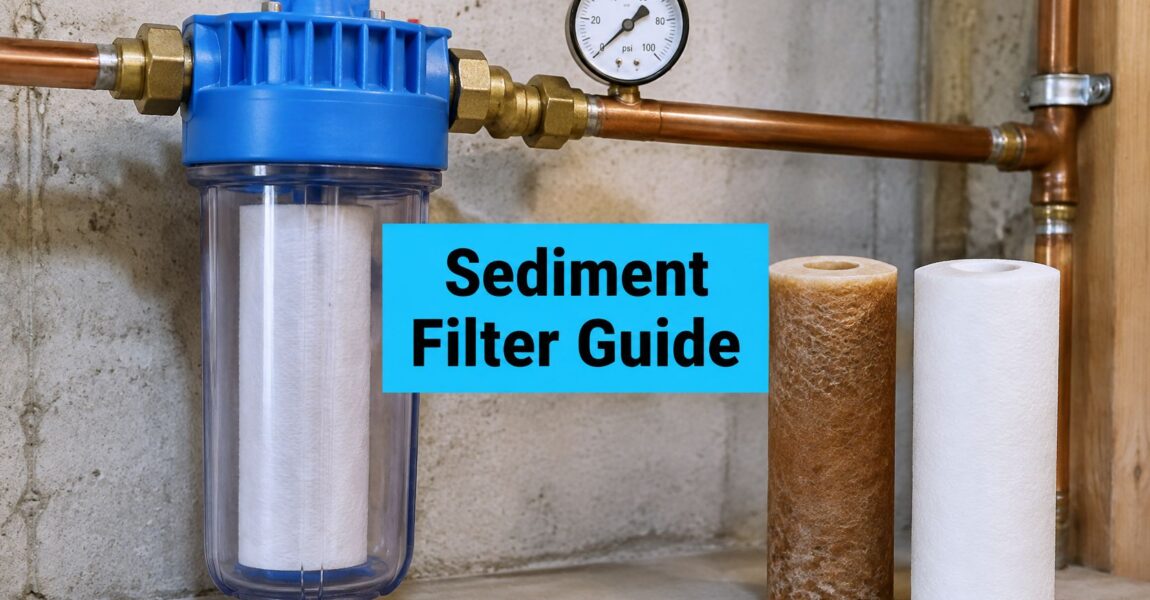
Whole House Sediment Filter: Micron Ratings and Replacement
The kitchen tap opens on a Saturday morning and the glass fills cloudy white. Half a minute later the cloudiness drops out from the bottom up, leaving a thin line of grit behind. By midweek you've rinsed sand out of two faucet aerators, and the toilet tank has a pale orange ring that wasn't there last month.
Nobody panics at this stage. The water tastes fine, the coffee tastes fine, and it clears if you let the tap run. But those particles are grinding through valve seats, heater elements, and the inlet screens on your washing machine every time someone calls for hot water.
So the useful question isn't which cartridge to buy. It's where the grit is coming from, how big it is, and which of two very different jobs you need done: protecting the plumbing, or making the water safe to drink. One housing won't do both, and treating them as the same job is where most households waste money.
What a Whole House Sediment Filter Actually Catches
A whole house sediment filter is a coffee filter for the building. One housing sits on the main line where water enters the house, and every drop headed for the water heater, the washing machine, the ice maker and the shower passes through a cartridge or a stainless screen first. Particles that would otherwise settle into valve seats and tank bottoms get trapped in a single place you can see and empty.
That placement is the entire point. The filter is a protective first stage, not a finishing treatment. Clemson University's residential well water treatment guide describes these systems as removing particulate matter and notes that they improve the effectiveness of, and reduce maintenance demands on, later treatment devices.
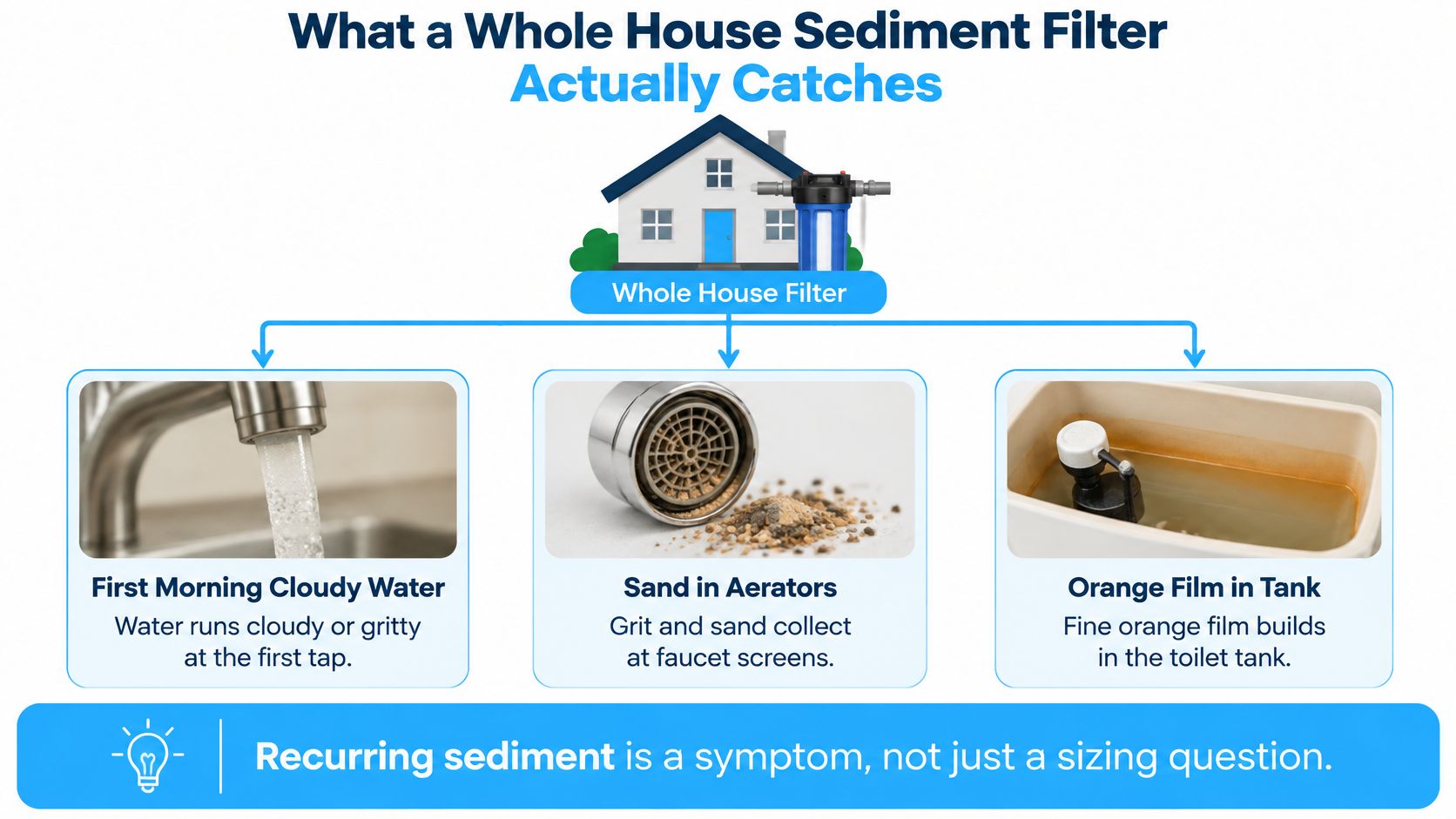
The Particles It Actually Holds
Read the cartridge when you change it and you'll learn more than any spec sheet tells you.
- Sand and grit: heavy grains that feel like fine beach sand between your fingers and settle to the bottom of a glass in seconds.
- Silt and clay: the particles that keep water cloudy for minutes or hours, and the reason a cartridge turns brown across its whole face.
- Rust flakes: orange-brown specks that come from corroding galvanized pipe, an aging pump, or iron in the source water oxidizing as it hits air.
- Loose debris: bits of pipe dope, solder, mineral scale and biofilm that break free after repairs or a pressure swing.
What all four have in common is size. They're suspended solids, which means a physical barrier can stop them. Anything dissolved, anything living, and anything measured in parts per billion needs a different tool, which is a boundary Clemson keeps explicit: sediment filtration is a protective first stage for homes dealing with sand, silt, rust or other suspended solids, not a complete solution for dissolved contaminants, disinfectants or microorganisms.
The Quick Self Check
If your complaint is visible particles, a sediment filter is the right first purchase and you can shop with confidence. If your complaint is taste, smell, staining, or water that looks clear but leaves you uneasy, the filter is the wrong starting point. Trace the cause first, then size the equipment to what you find. The next sections walk that trace in order, from the well head to the carton on the shelf.
Tracing Sediment to Its Source First
Sediment that appears once is weather. Sediment that appears every month is a diagnosis, and the diagnosis matters more than the micron rating, because recurring grit can mean a damaged well screen, a disturbed aquifer, a failing pump, or a contaminated well rather than a filter-sizing problem.
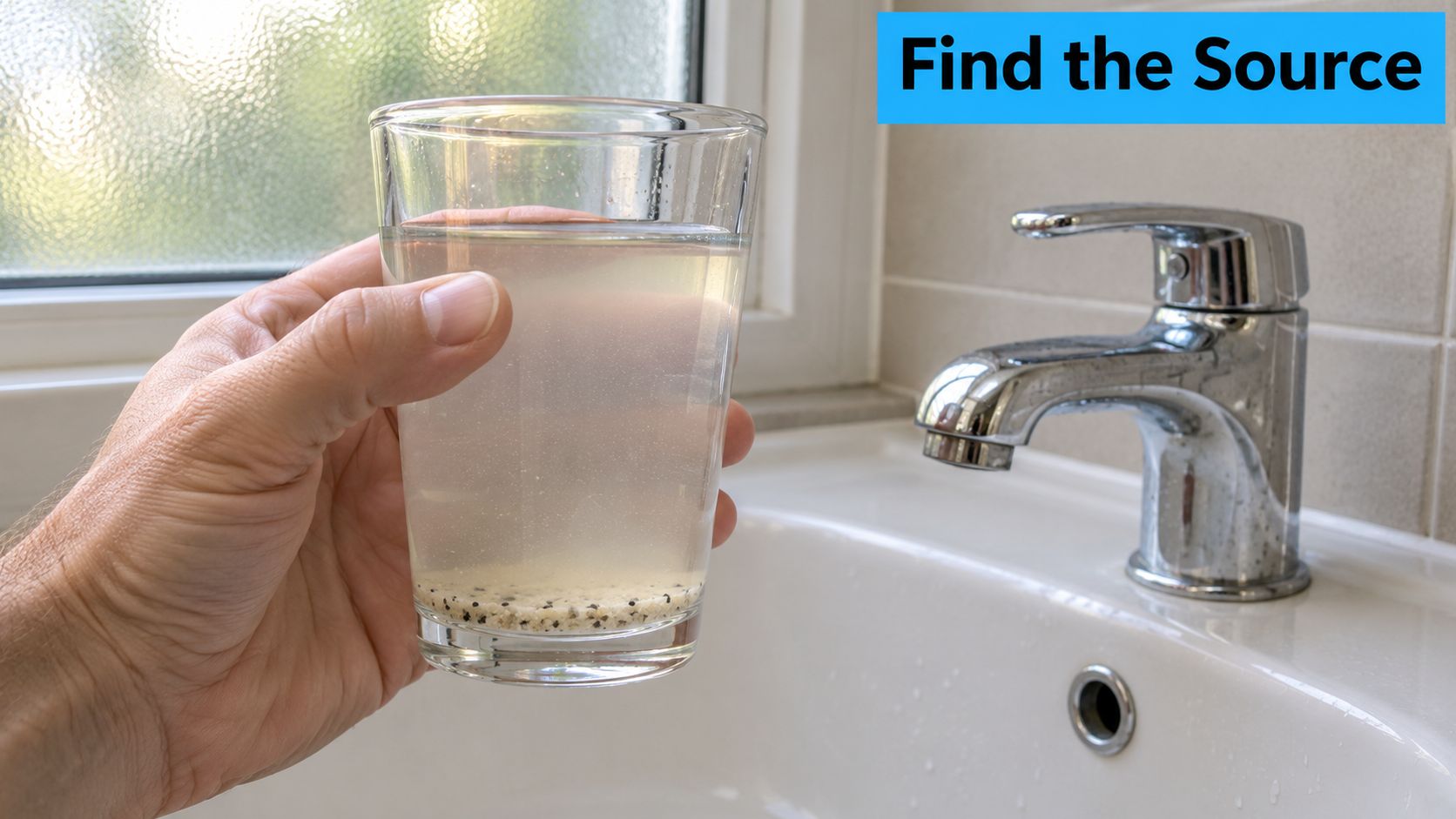
Start with chemistry, not hardware. EPA guidance on protecting private well water notes that private wells aren't federally regulated and that owners carry responsibility for water safety, and it recommends annual testing for total coliform bacteria, nitrates, total dissolved solids, and pH, plus keeping records of well maintenance and sediment removal. That panel tells you whether you're dealing with a mechanical annoyance or something with a health dimension.
Reading the Water Before You Buy Anything
Work through these in order. Skipping to step five is how people end up replacing a cartridge every three weeks for a year.
- Test the water. The four-parameter panel above is the floor, not the ceiling. Add iron, manganese, hardness and turbidity if the basics come back clean and the water still looks wrong.
- Inspect the well itself. A cracked screen, a dropped water level, or a pump that's pulling sand because it sits too close to the formation will keep feeding grit no matter what you install downstream. A well contractor with a downhole camera settles this in an afternoon.
- Check the pressure tank. Sediment accumulates in the bottom of the tank, and a waterlogged bladder turns a steady flow into pressure swings that stir that sediment back into suspension. Tap the tank: a dull thud low and a hollow ring high is normal.
- Identify the particle. Sand is gritty, sinks fast, and feels like sand because it is. Clay stays suspended for hours. Rust is orange, stains porcelain, and often shows up only on hot water. Biological growth is slimy, smells like a pond, and coats the housing wall rather than the cartridge face.
- Match the remedy to the answer. A spin-down separator or washable screen handles heavy sand cheaply. A cartridge handles fine silt that slips past a screen. A repair handles the well itself.
The detail, including how sediment behaves in a well and what each particle type usually points to, is covered in this guide to sediment in well water.
When the Water Turns Muddy After a Storm
Flooding and heavy runoff create the one situation where you should stop filtering rather than buy a finer cartridge. EPA flood guidance notes that silt and sand can damage pumps, and that muddy water should be flushed until it runs clear before normal use returns. A cartridge won't disinfect anything, so a filter installed on flood-affected water gives you clean-looking water with whatever was in the flood still in it.
If the water changes color, odor or taste suddenly, treat the supply as suspect until a test says otherwise. A filter is a clarity tool, not a safety net.
Keep a short written log: test dates, cartridge part numbers, the date each change went in, and any work done on the pump or tank. When something changes six months from now, that page tells you whether it's new or whether you've been slowly losing ground.
Micron Ratings at a Glance
A micron is one millionth of a meter, and a cartridge's micron rating is the particle size it's built to hold back. Lower numbers catch finer particles, clog faster and cost you more pressure. That's the whole trade in one sentence.
Here's the practical map, and the full micron chart for water filters goes deeper if you want to compare specific cartridges.
| Micron rating | Particles it catches | Typical placement |
|---|---|---|
| 50 micron | Sand, grit, large debris | First stage on well water with heavy sand |
| 20 micron | Fine sand, rust flakes | Coarse pre-filter for well or municipal supply |
| 5 micron | Silt, fine rust, fine sediment | Standard whole-house default |
| 1 micron | Fine silt, clay, very small particles | Final sediment stage, watch for flow loss |
Why You Step Down Instead of Jumping to One Micron
A single 1 micron cartridge on a sandy well is a filter you'll replace in three weeks, and it will starve your shower in the meantime. Finer media pack particles tightly, so the surface loads up fast and the flow path narrows. Coarser media let water through with less resistance but wave the small stuff on to whatever comes next.
The fix is staging: let a coarse cartridge eat the heavy load, then let the finer one polish what's left. Two cartridges in series usually last longer together than one fine cartridge alone, because the fine stage never sees the sand that would have blinded it.
A filter that clogs in a fortnight isn't doing a better job. It's telling you the stage ahead of it is missing.
Matching the Number to Your Water
Decision logic beats brand loyalty here.
Heavy visible sand from a well means a coarse first stage at 20 to 50 micron, ideally a flushable screen, before any cartridge sees the water. Municipal supply with mild sediment from pipe work or a main break usually suits a single 5 micron cartridge. A house with weak pressure is a housing problem before it's a micron problem, and moving to a larger cartridge with more surface area often restores flow better than switching to a coarser rating.
If you're adding an undersink stage as well, Ring Hot Water's cartridge guide walks through how cartridge format and housing type change the choice, which is worth reading before you assume the whole-house number carries over to the kitchen tap.
Capacity and Replacement Schedule by Filter Size
Capacity means two things, and mixing them up is why people buy a housing that's technically correct and practically useless. First, flow capacity: how many gallons per minute the housing can pass before pressure at the fixtures drops. Second, dirt capacity: how much sediment the cartridge holds before it's spent. A big housing with a fine cartridge has plenty of the first and very little of the second.
| Housing or cartridge | Typical flow rate | Replacement interval | Change sooner when |
|---|---|---|---|
| 10-inch cartridge | 3 to 5 GPM | 3 to 6 months | Well water is muddy or after storms |
| 20-inch cartridge | 5 to 10 GPM | 6 to 12 months | Household has several fixtures running at once |
| 20-inch big blue housing | Up to about 20 GPM | 6 to 12 months or more | Large homes with high peak demand |
Size the housing against peak demand, not average use. Count what runs simultaneously on a weekday morning: a shower, the washing machine filling, a dishwasher, an irrigation zone. If those add up to more than the housing can pass, everyone notices it as weak pressure, and no micron rating will fix it.
The Pressure Signal Does the Scheduling for You
EPA consumer guidance on home water filters says to watch for sediment and replace the filter when water pressure becomes noticeably reduced. That's the honest replacement rule for a sediment stage: captured particles restrict flow, flow loss shows up at the tap, and the cartridge is done. The same guidance cautions that ordinary carbon-based home filters may improve taste and odor and remove selected contaminants, but don't remove or destroy bacteria, which is another reason not to judge a sediment cartridge by how the water tastes afterward.
Calendar intervals are a backup, not the trigger. A well that runs muddy in spring may need a change every few weeks through the wet season. City water with light sediment can run six months on one cartridge. If you can't remember when the last change went in, that's your answer.
Install a pressure gauge downstream of the housing. A drop of a few PSI tells you the cartridge is loading up, weeks before the shower starts feeling weak.
Write the install date on the cartridge with a marker, set a phone reminder for the calendar interval, and glance at the gauge monthly. Two minutes of attention beats an emergency call about a pressure switch.
Where to Install It on Your Water Line
Position matters more than brand. The filter belongs on the main line, immediately after the point where water enters the house, or after the pressure tank on a well system, and before any branch takes off to a bathroom or appliance.
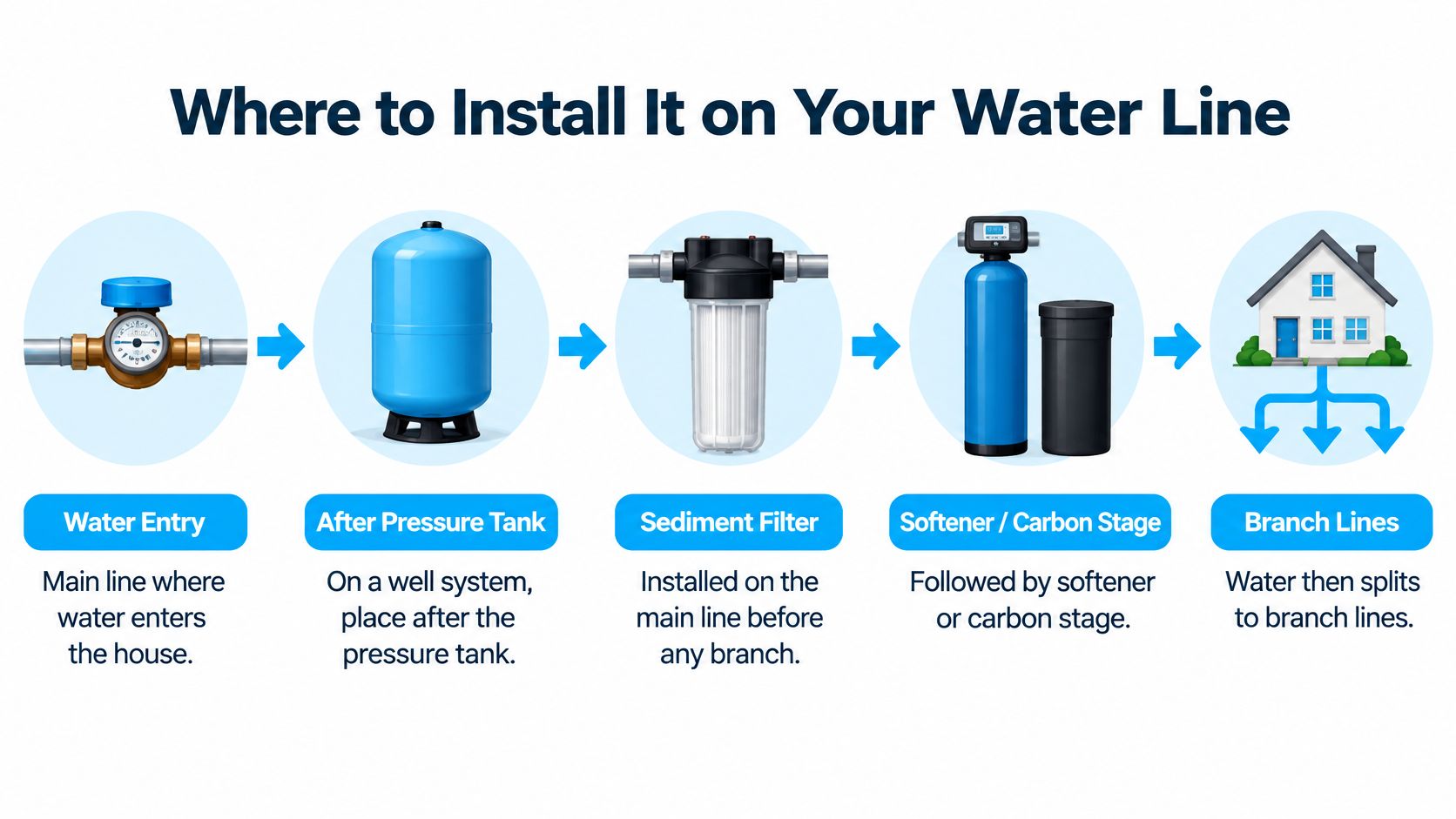
The Order, and the Reason for Each Position
- Water entry or well pump. This is the only place every drop passes through, so anything installed downstream of a branch protects only part of the house.
- Pressure tank or main shutoff. On a well, mounting after the tank smooths the pressure swings that stir sediment loose and keeps the housing off the pump's discharge surge.
- Sediment filter with a bypass valve. The bypass lets you service the cartridge without shutting water off to the whole house, which matters on a Sunday evening when the housing O-ring fails.
- Softener or carbon stage. Grit fouls resin beds and carbon media, so the sediment stage goes first and takes the load off equipment that's expensive to rebuild.
- Water heater and fixtures. Keeping sediment upstream of the heater stops it collecting on the tank floor, where it insulates the element and shortens the tank's life.
Mount the housing vertically with the bowl facing down so debris falls away from the seal, leave enough clearance underneath to drop a 20-inch cartridge out, and fit a drain point or pressure relief nearby. Before you cut pipe, confirm the flow arrow on the housing points toward the house and measure the footprint against the wall you're mounting to.
What It Costs to Get It Wrong
HomeGuide's 2026 cost data for well water filtration puts sediment-filter equipment for well-water systems at $50 to $300, with installed costs of $150 to $500. That spread is mostly labor, and it's the reason a $30 housing with the wrong thread, wrong clearance or missing bypass ends up costing more than the plumber would have charged to fit the right one.
What a Sediment Filter Cannot Remove
Clear water feels safe. That's the trap, and it's worth naming plainly: a sediment cartridge removes suspended particles and nothing else. Water can come out of the tap sparkling and still carry bacteria, nitrates, lead, or PFAS.
Cloudiness itself is only a rough signal. The USGS water science school defines turbidity as a measure of how much light passes through water, caused by suspended material such as clay, silt, fine organic and inorganic particles, plankton and microscopic organisms. High turbidity looks bad and can indicate surface contamination reaching groundwater after rainfall, but low turbidity proves nothing about what's dissolved in the water.
The List It Doesn't Touch
- Bacteria and viruses. Most are far smaller than the pores of a sediment cartridge, and none of the common ratings is a disinfection step.
- PFAS and other industrial chemicals. EPA's PFAS research program identifies granular activated carbon, ion exchange and reverse osmosis as the technologies studied for PFAS reduction, including at point of use, and notes that effectiveness depends on maintenance. A polypropylene sediment cartridge isn't on that list.
- Lead and nitrates. Both are dissolved. They pass through a 5 micron cartridge as easily as through an open pipe.
- Dissolved minerals. Hardness, iron in its clear dissolved form, and manganese all survive filtration and need ion exchange or oxidation to come out.
Certification Is Claim by Claim
Packaging can be misleading. NSF's explanation of water treatment standards notes that residential treatment products have no federal regulation, so voluntary standards set the minimums: NSF/ANSI 42 covers aesthetic effects such as chlorine, taste, odor and particulates, while NSF/ANSI 53 covers specified health-related contaminant reduction claims. Manufacturers choose which contaminants they certify for, and NSF verifies that specific claim. A housing labeled for sediment reduction tells you it was tested for sediment. It says nothing about lead, bacteria or anything else on the box.
Look for the standard number that matches the claim you need, not the biggest logo on the carton.
The practical split follows from all of this. Whole-house sediment treatment earns its place protecting plumbing, appliances and downstream media. Drinking and cooking water deserves a certified point-of-use system sized to whatever your test found. Municipal customers can start with the utility's annual water quality report, which lists detected contaminants and turbidity results. Private well owners need their own independent test, because nobody else is running one for them.
Your Next Step Today
Pick the action that matches your water source and do it before you shop.
On a city supply, pull the utility's annual water quality report, usually a PDF on the utility website, and look at the turbidity and sediment-related entries against the stage you're considering. That report tells you whether you're solving a real problem or buying equipment for a problem your utility already handles.
On a private well, order the four-parameter panel: total coliform bacteria, nitrates, total dissolved solids, and pH. Add iron, manganese and hardness while you're at it, since those three explain most of the staining and cloudiness complaints well owners bring up. Our simple water test kits cover exactly this kind of first check, and our Choosing a Water Filter guide answers how to pick one once the results are in front of you.
Then read the packaging. Find the certification that matches the claim you need, not the claim that sounds most impressive. Compare housings and cartridges on the same three criteria: micron rating, flow at your peak demand, and certified performance claims. A cartridge that wins on one and loses on the other two is a false economy.
The single step worth taking today is the boring one. Test the water, or if you already know your water is clean and merely gritty, write down your current pressure reading at a hose bib. That number is your baseline. When the shower starts to weaken in four months, you'll know exactly how far it has fallen, and you'll know which cartridge to buy based on a measurement instead of a guess.
Water Filter Advisor has been testing and explaining home filtration since 2007, and the whole-house sediment stage is where most households should start, because protecting the plumbing is cheaper than repairing it. If you'd rather compare housings and cartridges side by side before you cut any pipe, visit Water Filter Advisor for buying guides, micron charts, and replacement-cartridge advice written to be read before the purchase, not after the leak.
