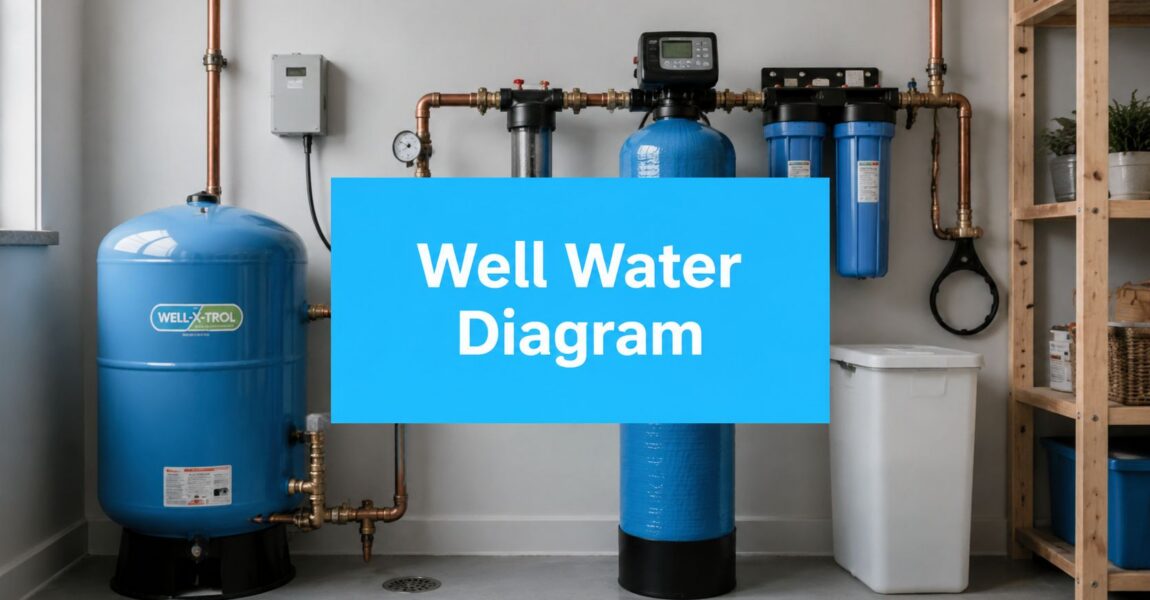
Well Water Filter System Diagram: Your Home Guide
You turn on the kitchen tap and the water smells off. The bathtub picks up a rusty ring. White crust forms on fixtures. Maybe the water looks clear one day and dull the next, which is what makes well water so frustrating. The problem isn't just that something's in the water. It's that the fix depends on exactly what that “something” is.
That's where most homeowners get steered wrong by a generic well water filter system diagram. They find one neat picture online, buy the boxes it shows, and install them in that order. Sometimes they get lucky. Often they build a system that fights itself.
A good diagram is less like a universal blueprint and more like a road map drawn around your water test. If your well has sediment and iron, one sequence makes sense. If low pH is driving corrosion, the order may need to change. If odor is the main issue, the layout can shift again. The parts matter, but the order matters just as much.
Your Roadmap to Crystal Clear Well Water
Bad well water has a way of becoming part of the house. You see it in laundry stains, smell it at the tap, and hear about it when guests ask why the water tastes different. Homeowners often start by shopping for a filter, but what they really need first is the right map.
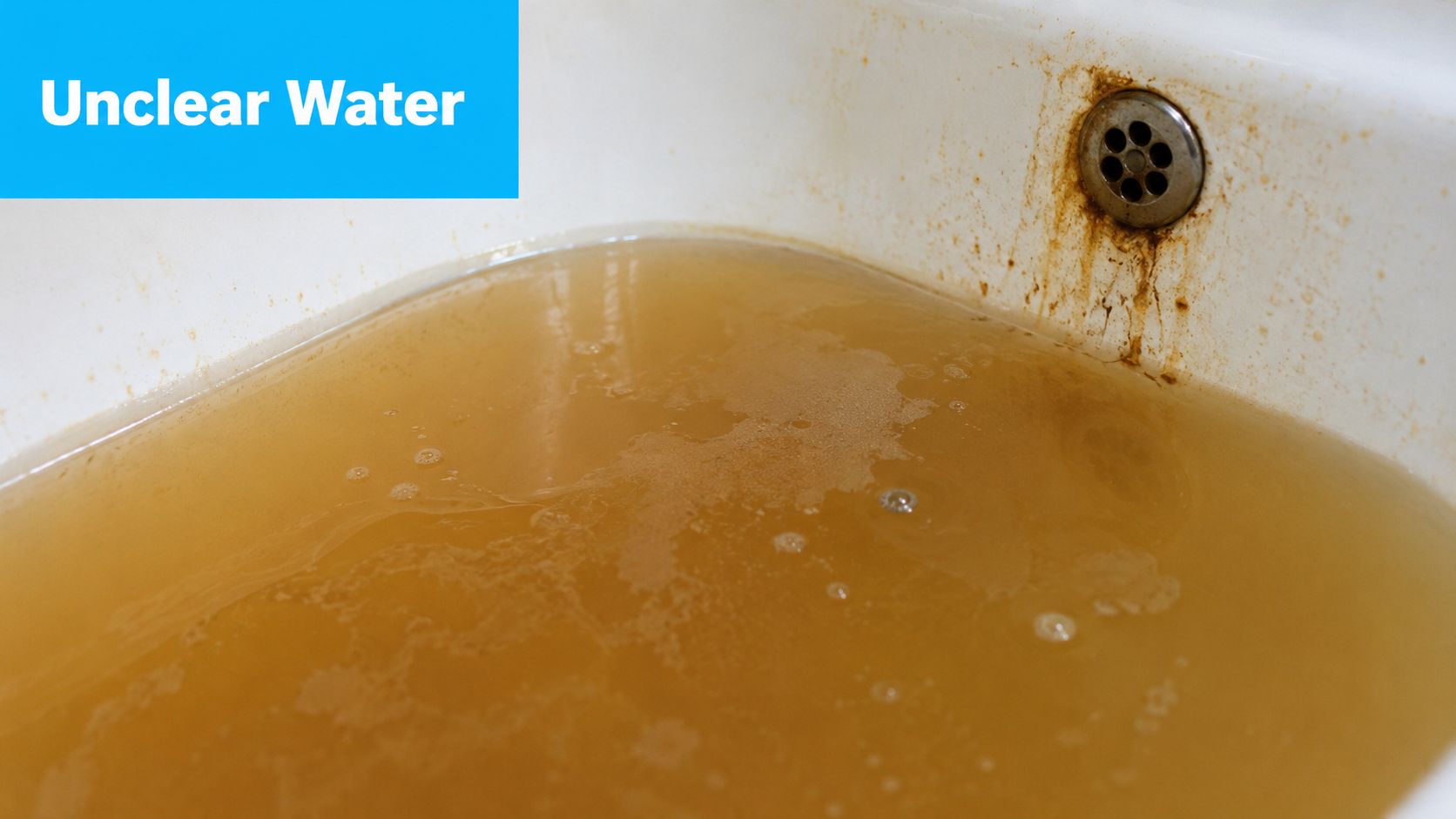
A well water filter system diagram should show the path water takes from the well to the tap, and why each component sits where it does. Consider the analogy of lining up workers on a jobsite. If the wrong worker shows up first, the whole crew slows down. A UV unit can't disinfect cloudy water well. A softener doesn't like being asked to handle heavy iron. A sediment filter placed carelessly can clog fast and starve the rest of the system.
Practical rule: The best diagram isn't the prettiest one online. It's the one that matches your test results and your home's actual plumbing layout.
You may also be chasing plumbing symptoms that overlap with water quality issues. If banging pipes are part of the headache, Platinum Heating & Cooling water hammer tips are worth a look because pressure behavior and treatment equipment often affect each other in real homes.
The goal is simple. You want water that doesn't stain, doesn't smell, doesn't attack plumbing, and doesn't leave you guessing what failed. That starts with understanding the pieces in the system before deciding on the order.
Decoding the Diagram The Cast of Components
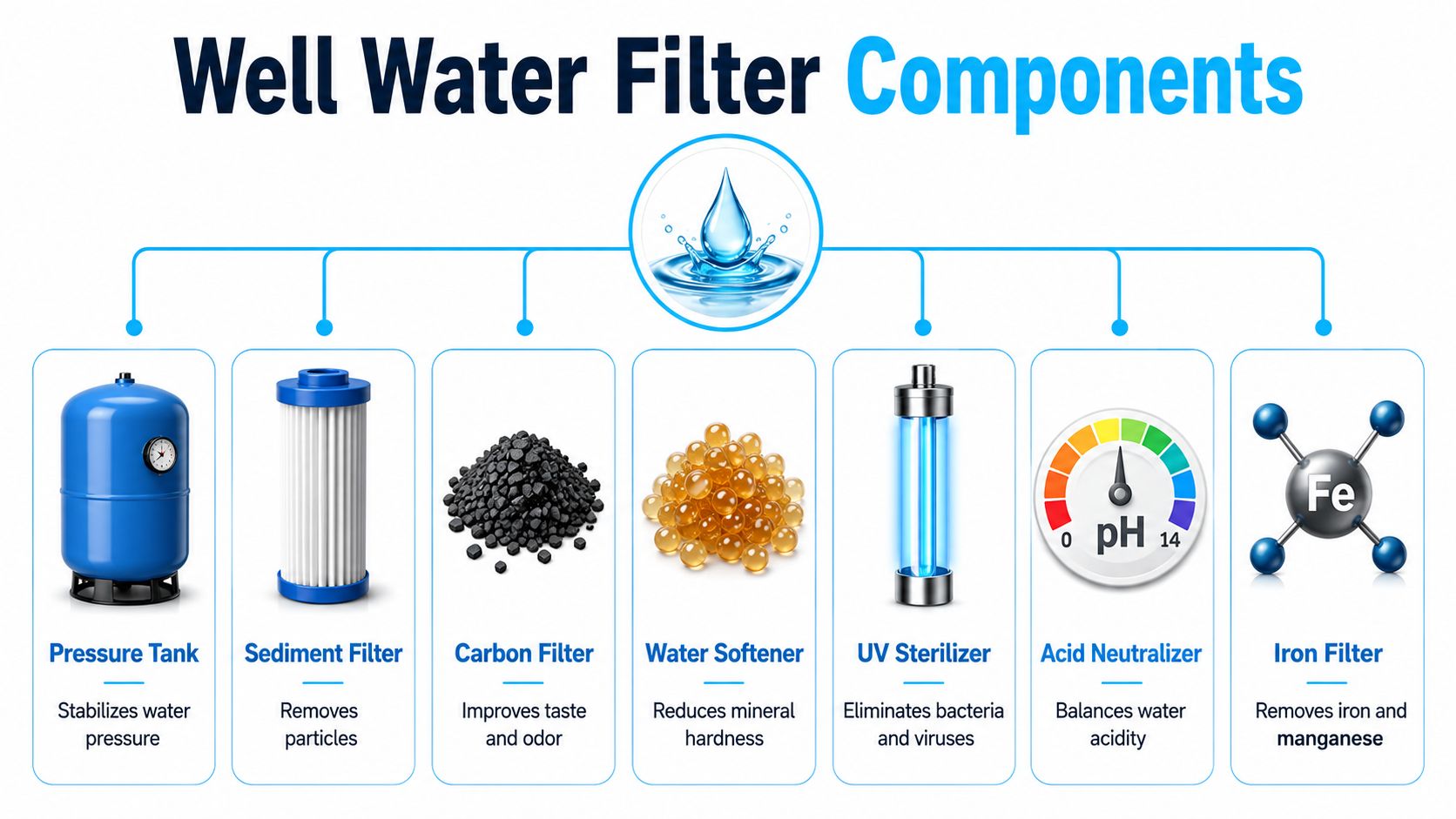
Before a diagram makes sense, the hardware has to make sense. Each treatment stage has a job. Some remove particles. Some change water chemistry. Some polish. Some disinfect. If you ask one component to do another component's work, you get poor performance and a lot more maintenance.
The front end of the system
The pressure tank is the traffic controller. It stabilizes water delivery and provides the pressure needed for equipment to operate correctly, including backwashing filters. Without stable pressure, even good media can't clean itself properly.
The sediment filter is the bouncer at the door. It catches dirt, sand, and other physical debris before those particles jam control valves or load up downstream media. According to benchmark discussion and field guidance summarized in this Water Treatment thread on well water treatment diagrams, pleated sediment filters provide 30–50% higher flow rates than standard solid filters and last longer because their larger surface area spreads out the dirt load.
The problem solvers in the middle
The iron filter handles staining minerals and sulfur-related odor issues when the chemistry is right for that technology. A common example is a Fleck 2510AIO paired with Katalox Light media. In the verified guidance, that type of setup is described as suitable for up to 30 ppm iron, 15 ppm manganese, and 10 ppm H₂S. That doesn't make it universal. It means the unit has to be matched to the test and placed where it can do its work.
The acid neutralizer corrects low pH. If your water is acidic, it can corrode pipes and leave blue-green staining. This stage isn't cosmetic. It protects plumbing and can determine whether downstream equipment works at all.
The water softener removes hardness. It also cleans up excess hardness added by a neutralizer. That's why the softener often belongs after pH correction. In real installations, this pairing is common because neutralizing media can solve corrosion and create a hardness side effect at the same time.
Clear water and soft water aren't the same thing. One fixes particles and staining. The other fixes scale.
The finishing stages
The carbon filter is the polisher. It improves taste, reduces odors, and removes certain chemicals. It belongs late in the chain because cleaner, softer water lets carbon focus on polishing instead of acting like a dirt trap.
The UV purifier is the final guard. It disinfects, but only after the water is already clear. Verified data notes that UV systems can achieve a 99.9% pathogen kill rate when the water is properly pre-treated and sediment is controlled. If particles or hardness remain, they can shield microorganisms from the light.
Here's the quick-read version:
| Component | Main job | What goes wrong if misplaced |
|---|---|---|
| Pressure tank | Stabilizes pressure | Backwash and flow problems |
| Sediment filter | Traps dirt and sand | Valves clog, media loads up |
| Iron filter | Removes iron, manganese, sulfur odor in-range | Softeners foul, staining remains |
| Acid neutralizer | Raises pH | Corrosion continues |
| Water softener | Removes hardness | Resin can foul if iron hits it first |
| Carbon filter | Improves taste and odor | Carbon plugs early if used too soon |
| UV purifier | Disinfects clear water | Poor kill performance in dirty water |
The Standard Well Water Filter System Diagram Explained
Most whole-house well systems start from a familiar baseline. That baseline is useful, but only if you treat it as a default, not a law.
The common sequence follows a simple logic. Water leaves the well, enters the pressure tank, and then moves through treatment stages that get progressively more specialized. Big physical debris gets handled first. Chemistry corrections happen in the middle. Final polishing and disinfection happen last.
The default sequence that usually makes sense
A verified installation guide from Mid Atlantic Water's complete guide to well water filtration systems states that a complete system should follow this order:
- Pressure tank
- Sediment filter
- Iron filter
- Acid neutralizer
- Water softener
- Carbon filter
- UV purifier
That order isn't arbitrary. The sediment stage protects downstream control heads. The iron filter goes ahead of the softener because softener resin is a poor place to dump heavy iron. The neutralizer comes before the softener because it raises pH and can add hardness that the softener then removes. Carbon sits near the end for polishing. UV comes last because disinfection works best on clear, conditioned water.
A useful detail from the same verified guidance is that placing a 5-micron sediment filter after a softener can be acceptable, because the resin bed itself acts as a filter. Placing that kind of cartridge before the right upstream stages can be ineffective and may lead to premature clogging.
What the standard diagram gets right
The standard layout works well when water problems line up with the assumptions behind it. You have particulate matter that needs screening, iron that responds to the selected media, acidity that needs correction, hardness that belongs in a softener, and a need for final taste improvement or microbial control.
This walkthrough helps visualize the flow in a real installation:
Put a softener before an iron filter in high-iron water and you're asking the softener resin to do the dirty work. That's how systems get expensive fast.
Where homeowners misread the standard diagram
Trouble starts when people treat the default sequence as a universal answer. A standard diagram is a starting point. It is not permission to skip testing. If the water chemistry doesn't match the assumption built into that order, one stage can cripple the next.
Why One Diagram Does Not Fit All Customizing Your System
The biggest mistake in home well filtration is assuming there's one correct well water filter system diagram for every house. There isn't. The right order depends on what dominates your water chemistry.
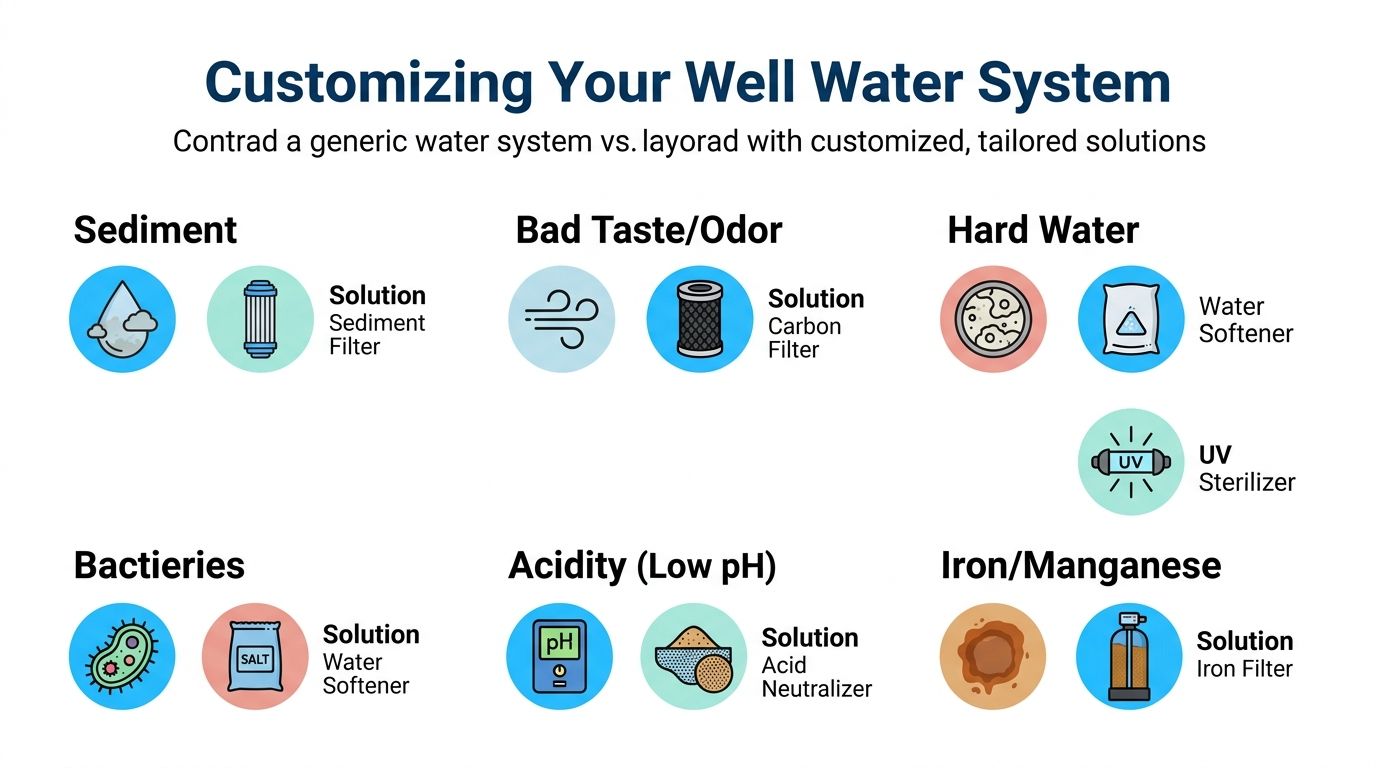
Verified data makes the problem plain. 78% of DIY well owners install systems in a standard order without prior water testing, leading to 60% premature filter clogging or recontamination. It also states that 92% of retail diagrams fail to show alternative ordering, and 70% of system failures trace back to incorrect sequencing. Those numbers explain why so many homeowners buy decent equipment and still hate the result.
When low pH changes the order
Acidic water can interfere with iron treatment. In some wells, the pH has to be corrected before iron removal works the way it should. That means the standard order gets rearranged.
A practical custom sequence for that water profile often looks like this:
- Pressure tank
- Sediment filter
- Acid neutralizer
- Iron filter
- Water softener
- Carbon filter
- UV purifier
Why the swap? Because the iron filter may need a friendlier pH environment to perform well. If you leave the neutralizer too late, the iron stage may underperform and pass trouble downstream.
When sulfur becomes the main issue
Hydrogen sulfide changes the conversation again. In the verified guidance, sulfur-dominant wells are called out as a major reason static diagrams fail. If hydrogen sulfide is the primary issue, it may need to be removed before pH adjustment to avoid acid generation that can corrode downstream piping.
That leads to a different logic:
| Water problem driving the design | Order logic |
|---|---|
| Low pH blocks effective iron treatment | Neutralize before iron removal |
| Hydrogen sulfide dominates | Remove sulfur before pH adjustment |
| Heavy sediment load | Protect every valve and media bed early |
This is why a one-size chart misleads people. Two homes can both have “well water problems” and require different treatment order because one is staining and corrosive while the other is odorous and reactive.
A water test doesn't just tell you what to buy. It tells you what must go first.
The myth of the universal online diagram
A lot of online diagrams are clean, simple, and wrong for somebody's well. They show the same lineup every time because it's easier to publish one picture than to explain branching logic. The result is a homeowner staring at a nice visual that doesn't match the chemistry in the basement.
Here are the warning signs that the generic diagram in front of you may not fit your house:
- It never mentions pH: Low-pH wells can demand a different sequence.
- It treats sulfur as an afterthought: Odor-first wells often need their own layout logic.
- It never asks for a test result: If the diagram starts with shopping instead of testing, it's skipping the step that drives the design.
- It assumes every home needs every stage: Some homes need the full chain. Others need fewer stages, but in the right order.
Build the diagram from the test, not from the catalog
The right way to customize is simple in principle, even if the details get technical. Start with the contaminants that can damage equipment or block later treatment. Then place the chemistry-correction stages where they support the next filter, not where a generic image says they belong. Finish with polishing and disinfection.
That's the shift homeowners need to make. Don't copy a diagram. Diagnose the water, then assemble the order.
Practical Layouts Point of Use vs Whole House
Once the order is right, the next decision is scope. Do you want to treat every gallon entering the house, or only the water used for drinking and cooking?
Whole-house treatment
A point-of-entry system treats water where it enters the home. This is the right layout when the problems affect plumbing, appliances, bathing, laundry, and fixtures. Iron stains on toilets, scale on water heaters, and sulfur odor in showers are whole-house problems, so they usually need whole-house treatment.
This layout is also the only sensible path when the system includes equipment like an acid neutralizer, iron filter, softener, or UV stage meant to protect the entire home. If the issue follows water to every tap, isolating treatment to one sink won't solve much.
Under-sink treatment
A point-of-use system treats water at a single fixture, usually the kitchen sink. This makes sense when your main concern is drinking water taste or a targeted contaminant at one tap, while the rest of the house water is acceptable.
A point-of-use layout is simpler, smaller, and often easier for a handy homeowner to install. But it won't stop iron stains in the shower or scale in the dishwasher. It won't protect the water heater. And it won't fix corrosive water attacking plumbing in the walls.
A practical comparison
| Layout | Best for | Not ideal for |
|---|---|---|
| Whole house | Stains, odor through the home, hardness, low pH, broad protection | Homeowners who only want to improve drinking water |
| Point of use | Drinking and cooking water at one tap | Fixture staining, appliance protection, whole-home odor or scale |
If you're weighing options and want a broader consumer-style comparison, this roundup of top water filter systems for home can help frame the categories. Just remember that category choice comes after you decide whether your water problem lives at one faucet or across the entire house.
Installation Essentials Bypass Loops and Maintenance Access
A clean diagram on paper can still become a miserable install if nobody leaves room to service it. Good water treatment has to be maintainable. That means bypass valves, access space, drains where needed, and a way to test before and after treatment.
The bypass loop is not optional
A bypass loop lets you isolate the treatment train without shutting water off to the whole house. When a filter needs service, you can route water around the equipment temporarily. That matters on routine maintenance days and on the bad days when a valve sticks or a tank needs repair.
Build for testing and servicing
Verified data notes that the lack of maintenance-focused planning is a major failure point. 95% of well system failures stem from neglected maintenance, and 82% of owners skip backwashing, causing 70% of iron filter failures. Accessible valves and gauges help prevent that by making routine service visible and easier to do.
Use this checklist during layout:
- Add sample taps: One before treatment and one after treatment let you confirm performance.
- Leave working room: Cartridges need clearance below housings. Softeners need room for salt loading.
- Keep drains practical: Backwashing equipment needs a reliable place to discharge.
- Label the valves: A bypass is only useful if someone can operate it correctly during a rushed repair.
- Plan maintenance paths: Helpful service guidance from Water Filter Advisor's advice section can make ongoing care easier to track.
Service access is part of treatment design. If you can't reach it, test it, or bypass it, you don't have a finished system.
Beyond the Diagram A Living System
A well water filter system diagram shouldn't end the day the plumber leaves. It should stay useful afterward as a maintenance map. Sediment stages load up. Iron filters need proper backwashing. Softeners need salt and correct settings. Carbon eventually loses polishing power. UV units need clean conditions and routine attention.
The homeowners who do best with well water usually treat the system like a piece of working equipment, not a decorative appliance. They know what each stage does, what symptoms show up when it falls behind, and which valve to turn when service day arrives.
If there's one step that separates a smart install from an expensive guess, it's the water test. That test tells you whether the standard order fits, whether the order needs to flip, and whether you need the full chain at all. Start there, and the diagram stops being confusing. It becomes accurate.
For homeowners who want help choosing, comparing, and maintaining the right filtration setup, Water Filter Advisor is a useful next stop. It's a practical resource for sorting out whole-house systems, under-sink options, replacement filters, and maintenance questions so you can turn a confusing water problem into a plan that works.
