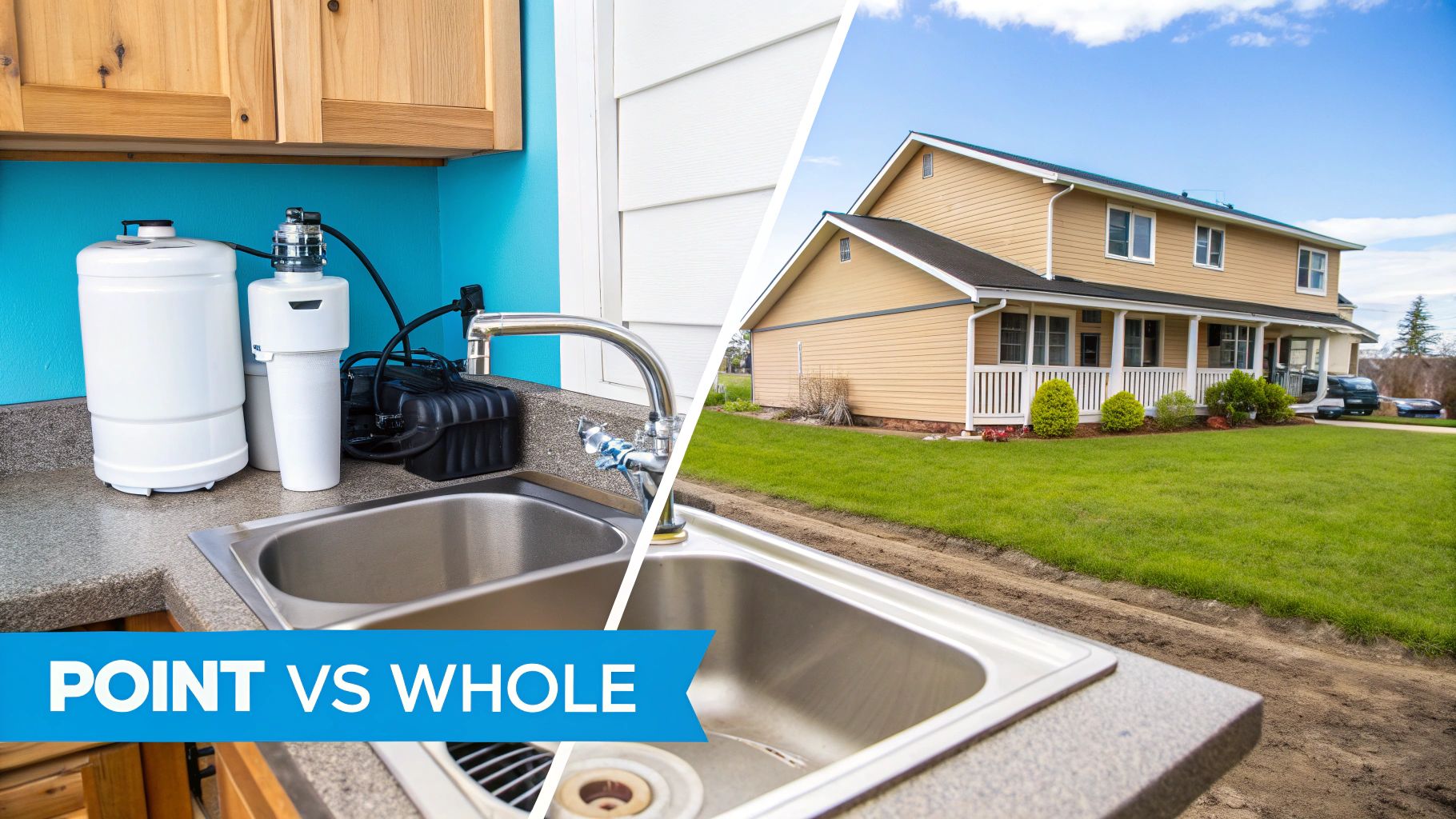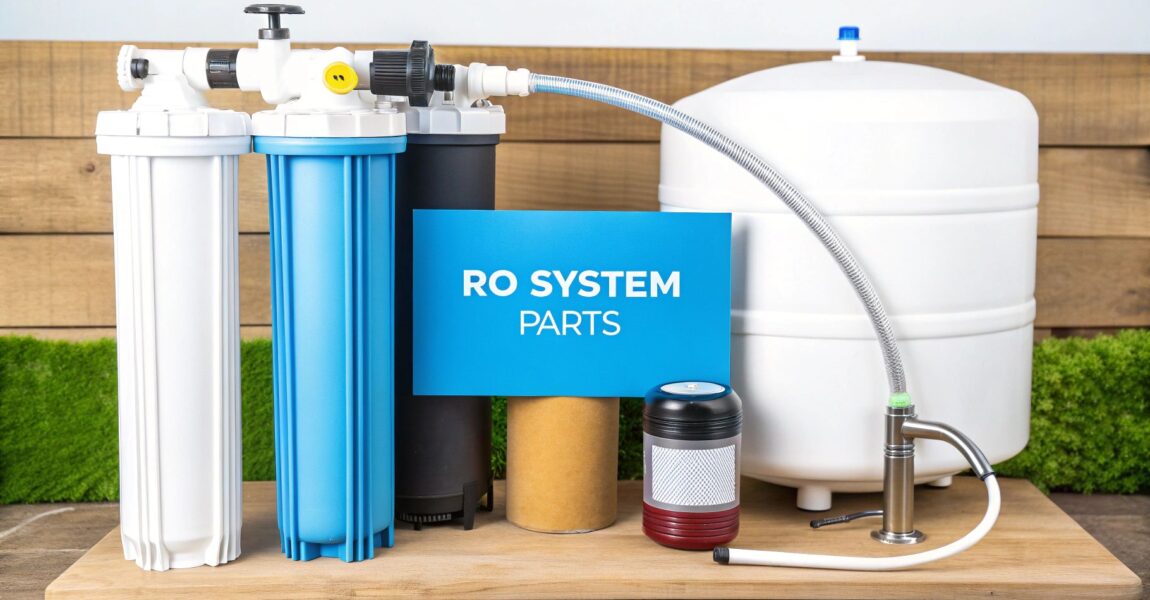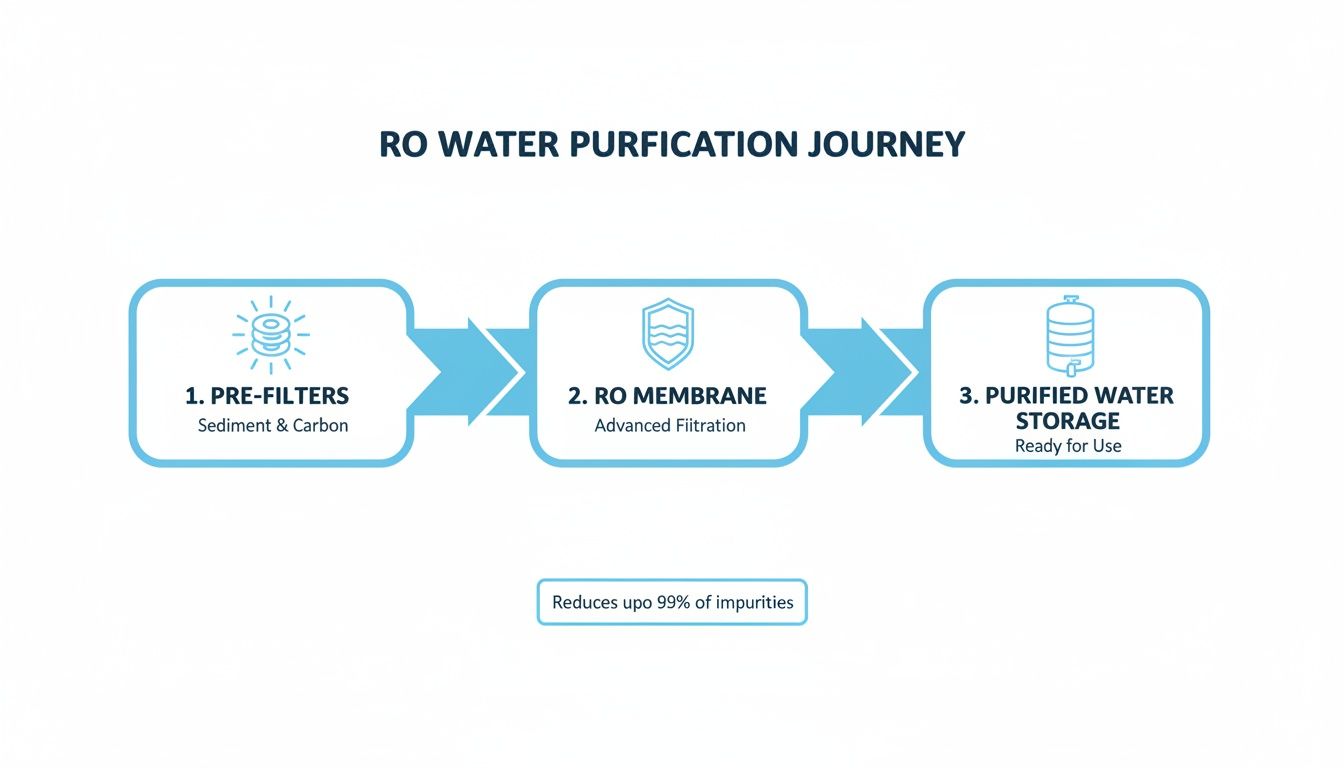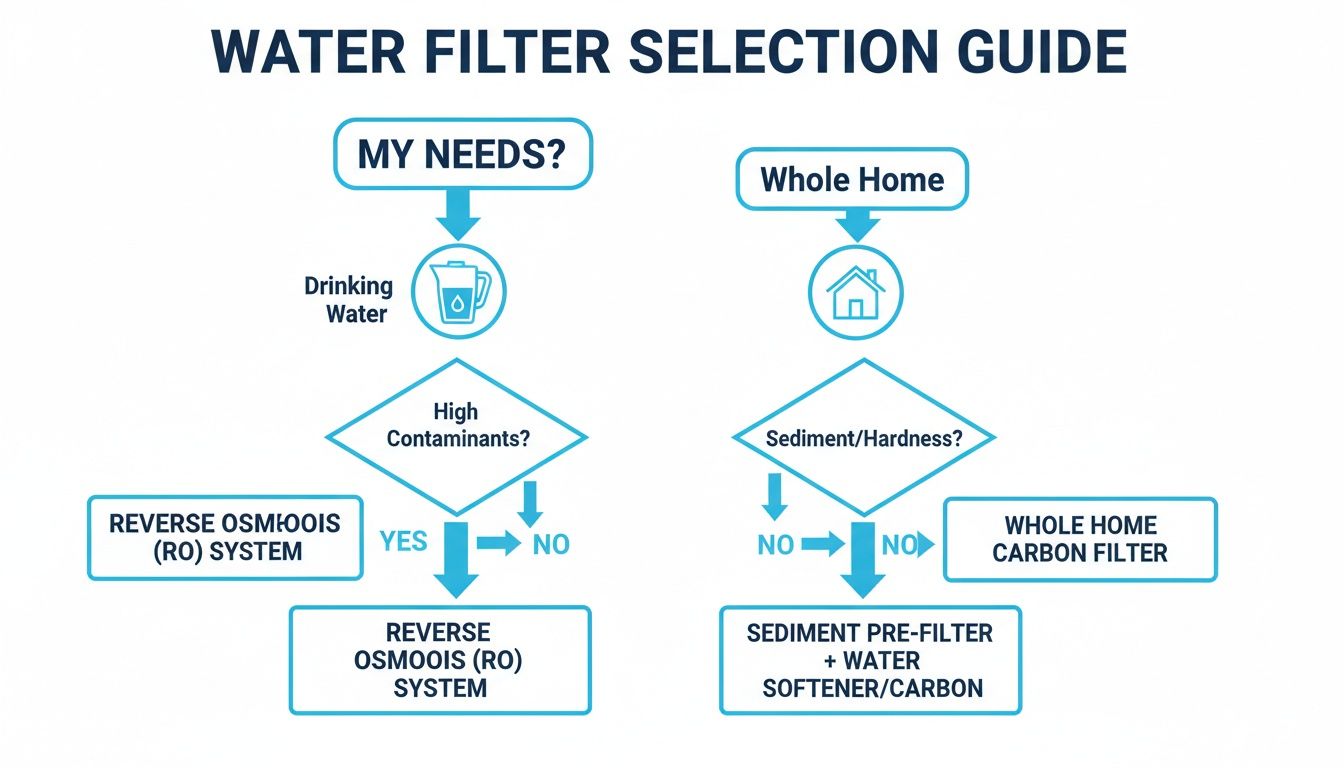
Top picks from whole house water filter reviews

After digging through a mountain of whole house water filter reviews, one thing is crystal clear: these systems are more than just a simple upgrade. They’re a complete overhaul for your home’s water, protecting your pipes, appliances, and your family's health in ways a simple pitcher filter never could.

Why a Whole House Filter Is a Game-Changer

Clean water flowing from a kitchen faucet into a glass, with a 'CLEAN WATER EVERYWHERE' banner.

Most people start their search because they're tired of the chlorine taste in their tap water. A whole house filter absolutely solves that, but its real superpower is that it works on every single faucet and water-using appliance in your home. It’s a point-of-entry system, meaning it cleans the water for everything—not just for drinking.

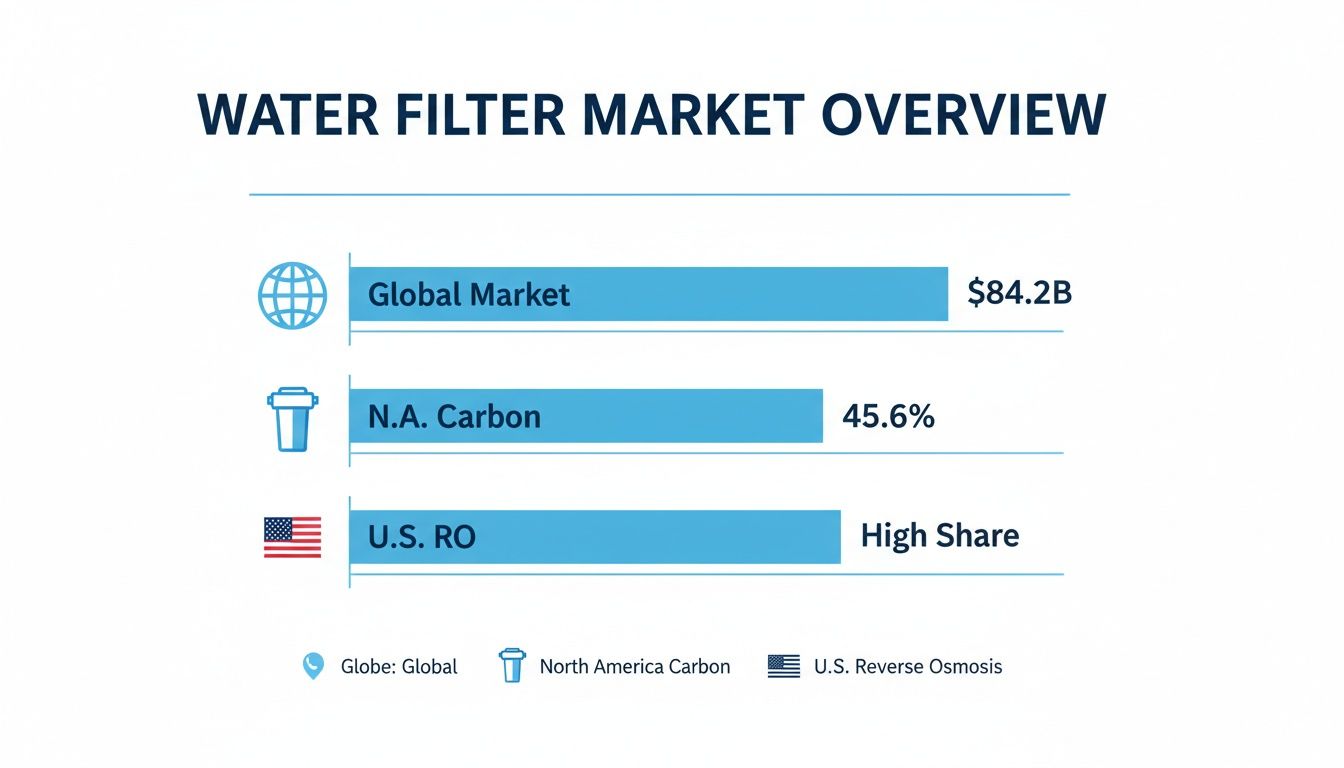
This all-in-one approach is why the market is booming. The global home water filtration market hit a value of USD 20.26 billion in 2024 and is expected to keep climbing. A huge chunk of that growth is driven by whole house units. You can discover more insights about the growing water purifier market if you're curious.

Beyond the Kitchen Sink

Think about it. Your morning shower, the dishwasher, the washing machine—unfiltered water affects them all. A whole house system tackles these issues at the source, giving you consistent, high-quality water everywhere.

Here are the benefits you'll actually notice:

  • Appliance and Plumbing Protection: Sediment, chlorine, and hard water minerals are brutal on your pipes, water heater, and washing machine. Filtering them out from the start can extend the life of these expensive appliances and help you avoid costly repairs from scale buildup and corrosion.
  • Healthier Skin and Hair: That chlorine in city water is great for killing germs, but it also strips the natural oils from your skin and hair. This leads to dryness and irritation. Filtering your shower water means softer skin and hair, without that chemical smell.
  • Brighter and Softer Laundry: Ever wonder why your clothes feel stiff or look faded? Hard water minerals are often the culprit. Filtered water helps your detergent work better, so you get brighter colors and softer fabrics while using less soap.

The biggest benefit, though, is the peace of mind. Knowing every drop of water in your home—for cooking, drinking, bathing, and cleaning—is free from nasty contaminants is a level of confidence you just can’t get from a single-faucet filter.

At the end of the day, installing a whole house water filter is a solid investment. It's an investment in your home's plumbing and, more importantly, in your family's well-being. By treating water the moment it enters your house, you fix dozens of small problems at once and totally change your relationship with the water you use every day.

How Do Whole House Filters Actually Work?

Before you can make sense of any whole house water filter reviews, you have to get a handle on what’s happening inside those tanks. Don't think of these systems as a single wall stopping everything bad. It’s more like a specialized team where every player has a specific job. Each filter type is built to tackle a different problem, from stinky chlorine smells to things you can't even see.

It all starts at the "point of entry"—right where the main water line comes into your house. A whole house system gets installed there, treating every single drop of water before it ever gets to your kitchen sink, your shower, or your washing machine. The specific tech it uses is all based on what's actually in your water to begin with.

The Main Filtration Technologies

Most systems you'll see use a multi-stage approach, layering different filter materials to pull out contaminants one by one. This is a smart setup because it gets rid of the bigger gunk first, letting the later stages focus on the finer, tougher-to-catch stuff.

Here’s a breakdown of the three main players:

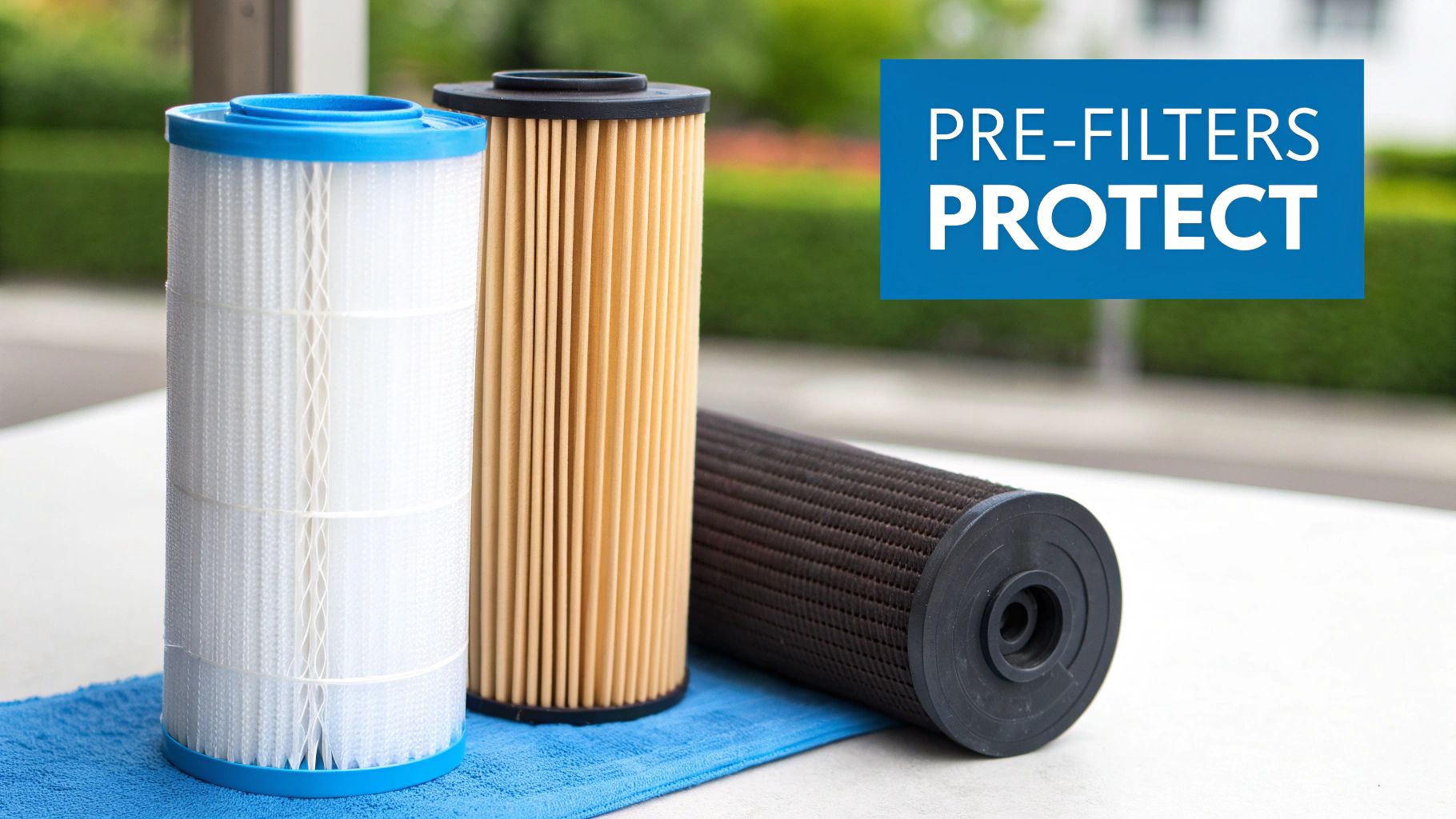
  • Multi-Stage Carbon and Sediment Filters: This is your go-to setup for most city water problems. A sediment pre-filter is like the bouncer at the door, catching all the obvious troublemakers like rust, sand, and dirt. After that, the water hits an activated carbon filter, which acts like a powerful magnet for chemicals. It's fantastic at grabbing chlorine, pesticides, and those nasty volatile organic compounds (VOCs) that make water taste and smell bad.
  • Water Softeners (Ion Exchange): Got hard water? A softener is what you need. It works through a process called ion exchange. Picture tiny little resin beads loaded with sodium ions. When hard water minerals like calcium and magnesium flow past, they get swapped for the sodium. This "softens" the water and stops that crusty scale buildup that wrecks your appliances.
  • UV Purifiers: If you’re on well water, you’re probably worried about bacteria and other microbiological threats. A UV purifier is your high-tech security guard. It uses a strong ultraviolet lamp to zap bacteria, viruses, and cysts, effectively scrambling their DNA so they can't reproduce and get you sick. It’s a great chemical-free way to make your water safe to drink.

The EPA's WaterSense program often talks about using water efficiently, which goes hand-in-hand with keeping your home’s plumbing healthy. A good filter system does just that by preventing the scale and corrosion that unfiltered water can cause.

This focus on quality and efficiency is exactly what a good filtration system brings to the table—it protects your pipes and appliances from the constant assault of unfiltered water.

Each filtration method is a specific tool for a specific job. A carbon filter won't soften water, and a softener won't kill bacteria. Understanding this is the key to matching a system to your home's unique water profile.

At the end of the day, picking the right system isn’t about buying the one with the most stages. It’s about figuring out your main water issues and choosing the technology designed to fix them. Once you understand how these filters actually do their job, you’ll be much better equipped to read reviews with a critical eye and find a solution that delivers clean water everywhere in your home.

A Detailed Comparison of Top-Rated Systems

Looking at all the whole house water filter reviews can make your head spin. But if you know what to look for, you can cut right through the marketing fluff and get to the good stuff: performance, filter life, and certified results. Let's break down the metrics that separate a decent filter from a great one.

The most important job of any filter is getting the junk out of your water. This isn't just about making it taste less like a swimming pool; it's about targeting specific problems, like the chlorine from your city's treatment plant or the sediment stirred up from a private well. The best systems use multiple stages to catch a wide range of impurities.

Next up is the flow rate, which we measure in gallons per minute (GPM). This number is huge because it directly affects your home's water pressure. Get a system with too low a GPM, and you'll be dealing with a sad, trickling shower every time someone runs the dishwasher.

Finally, we'll look at how long the filters last. A system that needs new, expensive filters every few months is just a money pit waiting to happen. The real winners have high-capacity cartridges that can go for years—or hundreds of thousands of gallons—making them a true set-it-and-forget-it solution.

To give you a clearer picture, this table lays out the core specs of some of the leading systems on the market. It's a straightforward way to see how they stack up against each other on the most critical performance points.

Performance Breakdown of Leading Whole House Water Filters

System Model Filtration Technology Removes These Contaminants Flow Rate (GPM) Filter Lifespan (Gallons) NSF/ANSI Certified
Aquasana Rhino® Sediment, Carbon, KDF Chlorine, Sediment, VOCs, Herbicides 7 – 15 600,000 – 1,000,000 42
SpringWell CF1 Sediment, Carbon, KDF Chlorine, Chloramine, PFOA/PFOS 9 – 20 1,000,000 42, 53
Pentair PC600 Sediment, Carbon Chlorine, Sediment, Particulates 6 600,000 42
iSpring WGB32B Sediment, CTO Carbon Chlorine, Sediment, Rust, Pesticides 15 100,000 42, 53
Express Water Sediment, GAC, Carbon Chlorine, Sediment, VOCs, Odors 15 100,000 42, 53

As you can see, filter lifespan and flow rates can vary quite a bit. A system like the SpringWell or Aquasana is built for the long haul, while others might require more frequent changes but offer a high flow rate out of the box.

Contaminant Removal Capabilities

At the end of the day, a filter has one job: clean your water. But they don't all go about it the same way. The top-tier models are engineered to knock out an impressive list of contaminants, giving you peace of mind with every drop.

Take a quality system like the Aquasana Rhino. It uses a tag-team approach with a sediment pre-filter, activated carbon, and KDF media. This combination is brutally effective against the usual suspects:

  • Chlorine and Chloramine: These are the chemicals cities use to disinfect water, and they’re why your tap water might smell and taste like a public pool. A solid carbon filter will get rid of more than 97% of it.
  • Sediment and Rust: These are the tiny particles that make water look cloudy and can wreck your appliances over time. A sediment filter is your first line of defense.
  • VOCs and Pesticides: Volatile Organic Compounds and other nasty chemicals can find their way into water supplies. Activated carbon is a champ at grabbing and holding onto them.

The best way to know if a filter really does what it says is to look for third-party certifications. You want to see labels like NSF/ANSI 42 (for things like chlorine and taste) and NSF/ANSI 53 (for health-related contaminants like lead). This is your proof that the system has been independently tested and actually works.

Flow Rate and Water Pressure

"Will this thing kill my water pressure?" It's one of the first questions I hear from homeowners, and it's a valid one. This is where the flow rate (GPM) is so important. For an average home, you’ll want a system that can handle 10 to 15 GPM so you can run a few things at once without the water slowing to a crawl.

Think about it: you’re in the shower, and someone starts the washing machine. With a low-GPM filter (say, 5-7 GPM), your shower will feel weak and pathetic. But a system built for high flow (15+ GPM) won't even flinch. The best ones are designed with wider ports and high-flow media to keep your water pressure strong and steady.

Filter Lifespan and Long-Term Value

The sticker price is just the beginning. The real cost of a whole-house filter shows up over time, and it all comes down to the filter lifespan. Swapping out cartridges every few months is a pain, and the cost adds up fast.

The best systems are built like tanks. The Aquasana Rhino, for example, has a main filter that’s good for one million gallons—that can be up to 10 years of clean water. Sure, you’ll still need to change the pre-filters every 3-6 months, but the main unit is built to last. That means less money and less hassle for you.

This simple graphic shows the most common tools in a whole house system's toolbox.

An illustration showing three Fowak filter types: Carbon, Softener, and UV light filters.

It shows how different technologies—like carbon, water softeners, and UV purifiers—are each designed for a specific job, whether it's removing chemicals or ensuring your water is biologically safe to drink.

System Type and Suitability

The right filter for you really depends on where your water comes from. City water and well water are two completely different beasts.

Best for City Water

If you're on a municipal supply, your main enemies are chlorine, chloramines, and sediment. A multi-stage system with a sediment pre-filter and a big activated carbon tank is perfect for this. It'll make your water taste and smell great while protecting your pipes.

  • Key Feature: A high chlorine reduction rate (over 97%).
  • Certification to Look For: NSF/ANSI 42.
  • Benefit: No more chemical smells, softer skin and hair after a shower, and way better-tasting coffee and tea.

Best for Well Water

Well water is a whole other ballgame. You could be dealing with sediment, iron, manganese, and even bacteria or viruses. A proper well water system needs a multi-layered defense:

  1. Sediment Pre-filter: To catch all the sand and silt.
  2. Iron and Manganese Filter: To stop those ugly orange stains and metallic taste.
  3. Carbon Filter: To handle any pesticides or chemical runoff.
  4. UV Purifier: This is the knockout punch. It zaps 99.99% of bacteria and viruses to make your water safe to drink.

This is why people love whole house filters—they solve the problem everywhere, for every use. From the kitchen sink to the shower, you get clean, safe water without thinking about it. Users constantly rave about the low maintenance and long filter life, not to mention the huge difference in water clarity and taste. You can discover more insights about the growing water purifier market to see just how essential these systems have become.

Ultimately, picking the right system is about matching its certified performance to your water's specific problems. Focus on contaminant removal, flow rate, and filter life, and you’ll find a whole house filter that gives you great water from every tap.

Calculating the True Cost of Clean Water

That sticker price on a new whole house water filter? It’s just the starting line. To get the full picture of what you’ll actually spend, you need to look at the total cost of ownership. This means factoring in the initial purchase, the cost of professional installation, and—most importantly—the recurring expense of replacement filters and media.

It’s easy to get fixated on the upfront price, but that can be a costly mistake. A cheaper system might look like a great deal today, but if you’re swapping out expensive filters every six months, it will quickly eclipse the cost of a premium system built to last a decade. The real goal is finding the best long-term value, not just the lowest price tag.

Breaking Down the Initial Investment

First up is the system itself. Prices can run from a few hundred dollars to several thousand, depending on what you need it to do. A simple sediment and carbon filter for treated city water will be on the lower end. But if you’re dealing with well water, a more robust setup with a UV purifier and a water softener will naturally cost more.

Next, you have to get it installed. If you’re a seasoned DIYer with plumbing experience, you might be able to handle this yourself. For most people, though, this is a job for a professional.

  • DIY Installation: You can save a few hundred bucks, but it involves cutting into your main water line. Only go this route if you’re absolutely confident in your plumbing skills.
  • Professional Installation: Expect to pay anywhere from $300 to over $1,000. The final cost depends on how complex the system is and the current state of your home’s plumbing. It’s always smart to get a couple of quotes before you commit.

The Critical Ongoing Costs

This is where the long-term financial reality sets in. Maintenance is a recurring expense, and it can vary wildly from one model to the next. These are the costs you’ll need to budget for year after year.

Here are the most common recurring expenses:

  • Sediment Pre-filters: Think of these as the first line of defense for your system. They usually need to be replaced every 3-9 months and are fairly inexpensive, typically costing $20-$50 each.
  • Carbon Media/Tanks: The main carbon filter does the heavy lifting. High-capacity tanks can last 6-10 years or filter up to a million gallons. When it’s finally time for a swap, a new tank can run you $500-$800 or more.
  • UV Bulbs: If your system includes a UV purifier to kill bacteria and viruses, the bulb needs to be replaced annually to stay effective. These usually cost between $70 and $150.
  • Salt (for Softeners): A traditional salt-based water softener needs a steady supply of salt. This can add another $10-$25 per month to your operating costs.

The real value of a whole house filter isn’t its upfront cost, but its cost-per-gallon over its entire lifespan. A system rated for one million gallons might seem pricey at first, but it often brings the cost of purified water down to just pennies per gallon in the long run.

Estimated 5-Year Cost of Ownership Comparison

To really see how these costs play out, let's map it out over five years. This table gives you a clearer idea of how different types of systems stack up financially over time, helping you look beyond the initial price.

See how costs add up over five years. This breakdown compares the initial purchase, installation, and recurring filter expenses for different whole house systems.

System Type Initial System Cost Estimated Installation Annual Filter Costs Total 5-Year Cost
Basic Sediment/Carbon $400 – $800 $400 $100 $1,300 – $1,700
High-Capacity Carbon $1,200 – $2,000 $500 $50 $1,950 – $2,750
Well Water System + UV $1,800 – $3,000 $700 $150 $3,250 – $4,450
System with Softener $1,500 – $2,500 $600 $200 $3,100 – $4,100

By adding up the true cost of clean water, you can make a much smarter decision. It helps you balance the initial hit to your wallet against the long-term maintenance costs, making sure you pick a system that fits both your water needs and your budget for years to come.

How to Choose the Right Filter for Your Water

Jumping into whole house water filter reviews is a recipe for confusion unless you know exactly what problem you’re trying to solve. The best system in the world is completely useless if it doesn't target the junk floating around in your tap water. So, the first and most critical step is to stop guessing and find out what you’re really up against.

If you're on city water, your local utility is required to publish an annual water quality report, sometimes called a Consumer Confidence Report (CCR). It’s a decent starting point, listing contaminants they've found and at what levels. But for a true picture of what's coming out of your faucets—or if you have a private well—an independent home water test is the only way to go. It gives you a clear, actionable list of what you need to filter out.

Finding Your Perfect Match Through Scenarios

Once you have those test results in hand, you can stop looking at generic features and start matching your specific needs to the right technology. The goal is to find a system built for your exact situation. Think of it less like buying an appliance and more like getting a prescription for your home's water.

Let's walk through a few common real-world scenarios to see how this plays out.

Scenario 1: The City Dweller Tired of Chlorine

You live in a typical suburban home on city water. Your biggest complaints are that your shower smells like a swimming pool and your drinking water has a faint chemical taste. Your appliances seem fine, but you're constantly buying bottled water because the tap stuff just isn't cutting it.

  • Your Water Problem: Primarily chlorine, chloramine, and maybe some sediment or VOCs.
  • Your Ideal Solution: A multi-stage system that includes a sediment pre-filter followed by a big activated carbon tank. The carbon is the star of the show here; it’s fantastic at grabbing the chlorine and other chemicals that ruin the taste and smell of your water.
  • Key Feature to Look For: Make sure it has NSF/ANSI 42 certification. This is the official stamp that proves the system is effective at reducing aesthetic issues like chlorine.

Scenario 2: The Well Water Homeowner Worried About Safety

You’re out in the country and get your water from a private well. It sometimes has a bit of an earthy smell, and you've noticed some rust-colored stains popping up in your sinks and toilets. Your main concern, though, is the invisible stuff—potential bacteria or viruses, since your well isn't treated by a municipality.

  • Your Water Problem: Sediment, iron, manganese, and potential microbiological contaminants like bacteria and cysts.
  • Your Ideal Solution: You need a heavy-duty, multi-stage system built for well water. It should absolutely have a sediment filter, an iron and manganese filter, a carbon filter for any stray chemicals, and—this is the most important part—an ultraviolet (UV) purifier.
  • Key Feature to Look For: The UV purifier is non-negotiable. It uses light to zap 99.99% of microorganisms, making your water biologically safe to drink without adding a single chemical.

Choosing the right filter is all about matching the technology to the contaminant. A carbon filter won't stop bacteria, and a UV light won't remove sediment. Understanding this distinction is the key to getting water that is truly clean and safe for your family.

Scenario 3: The Homeowner Battling Hard Water Scale

Your water tastes perfectly fine, but you're in a constant war against hard water. There’s a chalky white film on your shower doors, your coffee maker is always getting clogged, and your dishwasher leaves spots on every single glass. You're worried about what this scale is doing to your pipes and expensive appliances over time.

  • Your Water Problem: High levels of dissolved minerals like calcium and magnesium—in other words, hard water.
  • Your Ideal Solution: A whole house filter paired with a water softener or a salt-free water conditioner. A classic softener uses ion exchange to physically remove hardness minerals. A salt-free conditioner, on the other hand, changes their structure so they can’t stick to surfaces and form scale.
  • Key Feature to Look For: Look for systems that are explicitly designed to reduce scale buildup. Salt-free conditioners are becoming a popular choice for their low-maintenance, set-it-and-forget-it design.

By figuring out which scenario you're in, you can confidently pick a system that directly solves your problem. That way, every dollar you spend actually delivers the results you’re looking for. The same principle of matching the right tool to the right job is key in all aspects of home maintenance, and it's useful for understanding the differences between various purification systems for your home's air as well.

Practical Tips for Installation and Maintenance

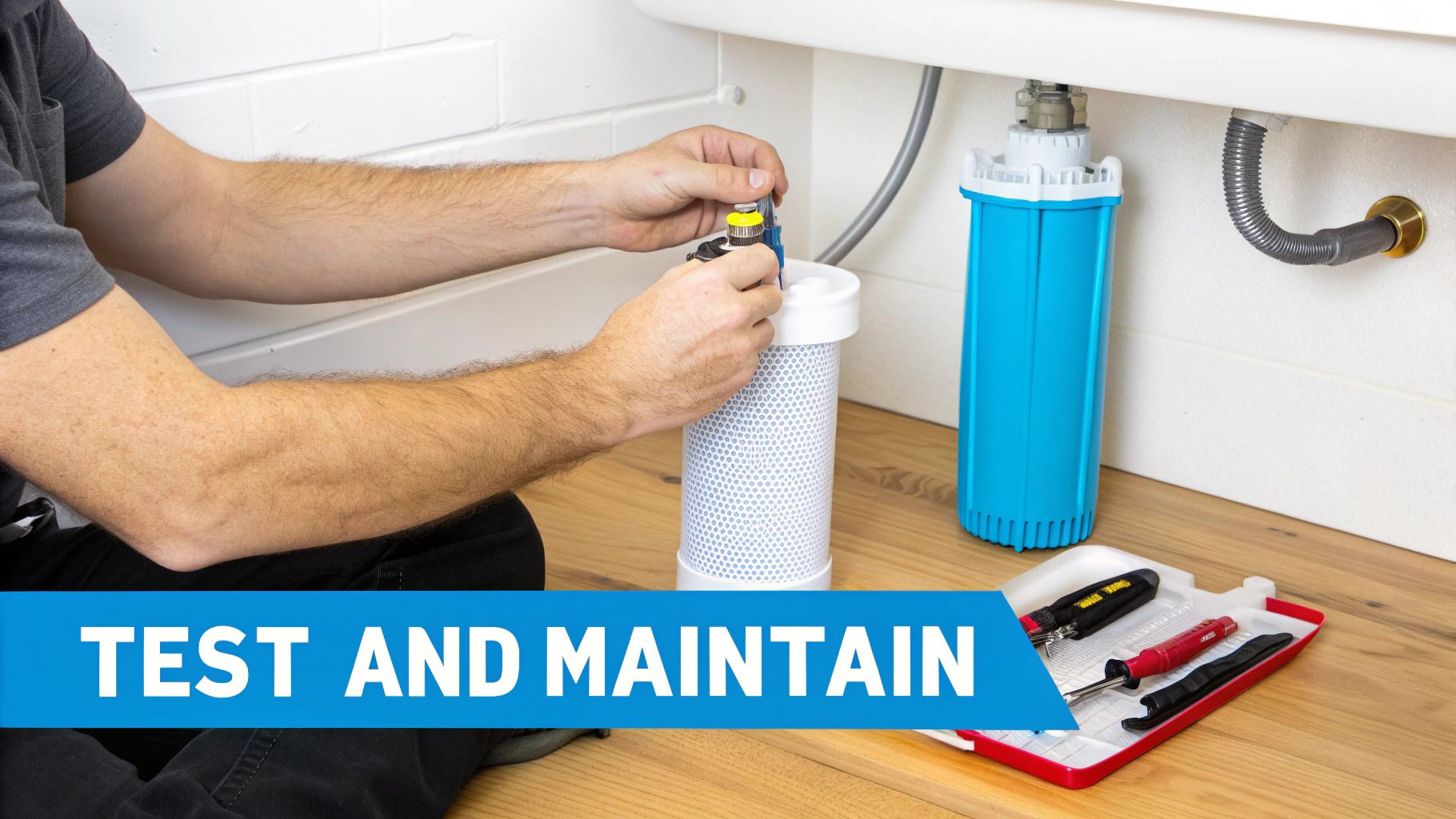
A man performs maintenance on a whole house water filter system, with tools and equipment nearby.

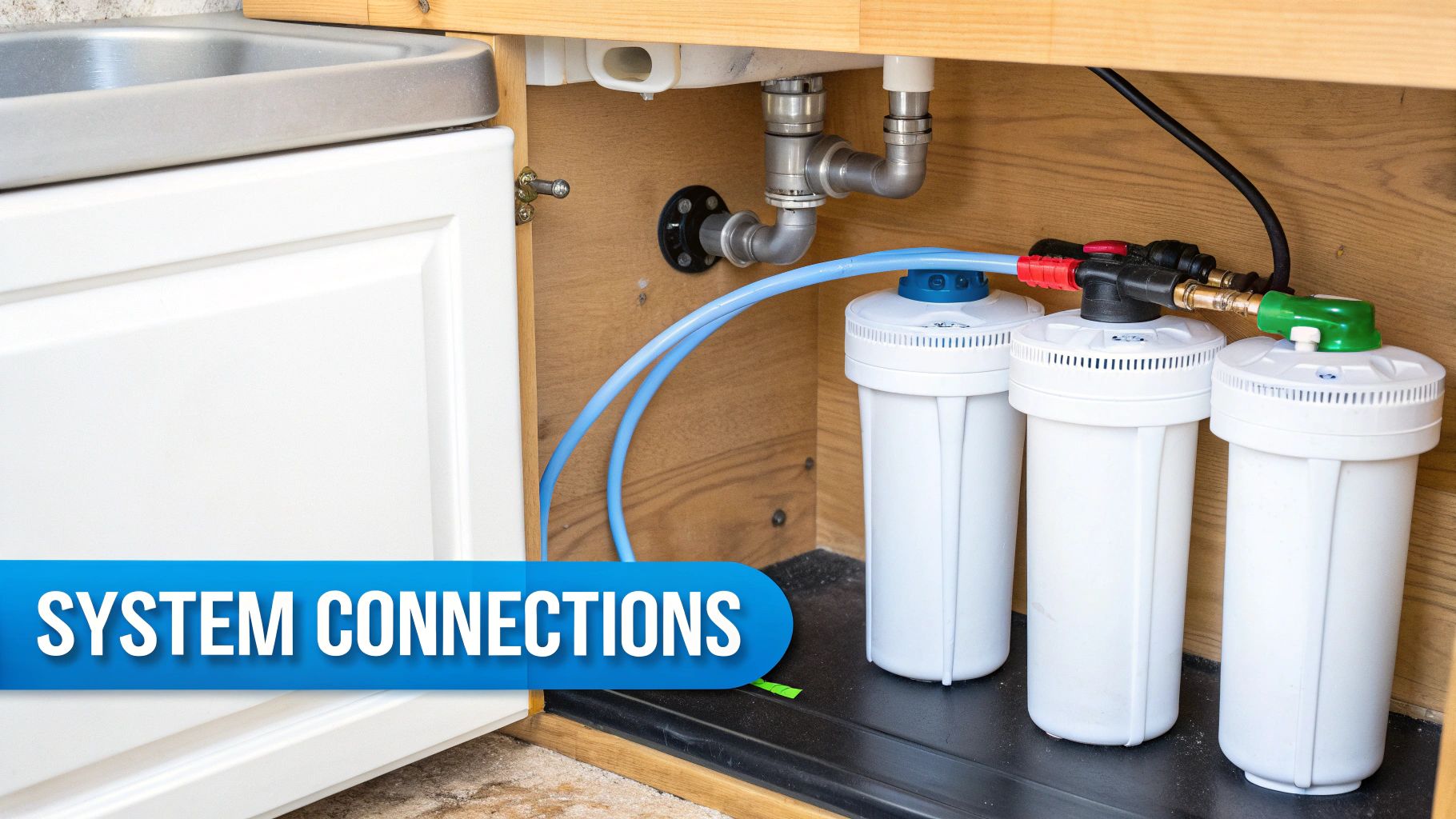
Okay, you've sifted through the whole house water filter reviews and picked your system. What's next? Getting it installed and running is where the rubber meets the road. A proper setup is non-negotiable if you want your filter to perform at its best for years to come.

The first big question is always DIY vs. pro install. While some kits look simple enough, remember that you're cutting into your home's main water line. If you've got serious plumbing chops and the right tools, it’s a project you can probably handle.

For most of us, though, hiring a licensed plumber is the way to go. It's just smarter and safer. A pro makes sure everything is leak-free, up to code, and doesn't do anything to void your warranty.

Proactive Maintenance for Pure Water

Once your system is in, a little upkeep goes a long way. This is how you protect your investment and make sure your water quality stays high. If you neglect it, you'll eventually deal with clogged filters, dropping water pressure, and a system that gives out way too early.

The good news is that for most multi-stage systems, maintenance is pretty simple—it’s mostly just changing out filters. You can always find more in-depth advice on water filter maintenance for specific models, but a basic schedule is all you really need to stay on top of things.

Don't wait until your shower feels weak or that old chlorine smell comes back. A simple, proactive maintenance plan is the best way to guarantee you always have great-tasting water and get the maximum life out of your filter.

Your Essential Maintenance Checklist

Think of this as your cheat sheet for keeping the system running like new. I recommend setting calendar reminders so you don't forget. A few minutes of prevention now saves you from big headaches later.

Here’s what a typical schedule looks like:

  • Pre-Filter Change (Every 3-6 Months): This is your system’s front line. The sediment pre-filter catches all the big stuff like rust and sand. Changing it out is the most frequent task, and it's crucial for protecting the more expensive carbon filter down the line. It's a cheap and easy swap with a huge payoff.
  • UV Lamp Replacement (Annually): If you have a UV purifier, especially for well water, the bulb must be replaced every 12 months. Don't be fooled if the light is still on—its germ-killing power fades over time. An old bulb gives you a false sense of security, so this is a non-negotiable for safe water.
  • Main Media Tank Replacement (Every 5-10 Years): The big carbon tank is the workhorse, often rated for a million gallons or more. Depending on how much water you use and how clean it is to start with, this tank will eventually need to be replaced. Just check your manual for the exact lifespan.

Stick to this simple schedule, and you'll keep your water pressure strong and your water pure. It’s the easiest way to get your money's worth from your new system.

Your Top Water Filter Questions Answered

To wrap things up, here are a few quick answers to the questions we hear most from homeowners when they're looking at whole house water filters.

Will It Lower My Water Pressure?

A properly sized and installed system really shouldn't have a noticeable impact on your water pressure. The key is making sure the filter you choose has a flow rate (measured in GPM, or gallons per minute) that can keep up with your home's demand.

If you do notice a drop in pressure down the road, the most likely culprit is a clogged filter. That's why sticking to a regular maintenance schedule is so important.

How Do I Know What's In My Water?

If you're on city water, your local utility is required to provide an annual Consumer Confidence Report (CCR). This gives you a good baseline.

For a much more detailed picture, especially if you have a private well, grabbing an independent home water test kit is your best bet. It will pinpoint the specific contaminants you're dealing with, so you can choose a system that actually targets your home's unique water issues.

Can I Install a System Myself?

Some of the simpler models are definitely designed with DIY in mind. That said, it almost always involves cutting into your main water line, so you need to be pretty confident in your plumbing skills.

If you're not comfortable with that, we always recommend hiring a licensed professional. It's better to get it done right the first time.


Ready to find the perfect filtration solution for your home? The team at Water Filter Advisor has done the research to make your decision simple and stress-free. Explore our in-depth guides and top picks today!

How to Remove Chlorine from Drinking Water: A Guide to Home Filtration

Ever pour a glass of tap water and get hit with that unmistakable "public pool" smell? You're not imagining it. That distinct chemical scent is chlorine, and figuring out how to remove chlorine from drinking water usually comes down to one fantastic solution: water filtration, especially the activated carbon systems designed to make your home’s water taste amazing.

Why Your Tap Water Smells Like a Swimming Pool

That chlorine smell is actually a sign of a public health success story that’s been running for over a century. Your local water treatment plant adds chlorine for one very important reason: to wipe out nasty bacteria, viruses, and other pathogens that could make you seriously sick. It's a rock-solid disinfectant that keeps our water safe as it travels through miles of pipes to get to your tap.

This simple practice has been a game-changer for public health. In fact, after Jersey City, New Jersey, became the first U.S. city to chlorinate its entire water system back in 1908, deaths from diseases like typhoid fever plummeted. It was a massive leap forward, and you can read more about the history of water chlorination from the EPA.

Glass of clear drinking water on kitchen counter with text overlay saying smells like pool

Chlorine vs. Chloramine: Know Your Opponent

Here’s where it gets a little more technical. While chlorine is effective, many water suppliers now use chloramine—a compound made by mixing chlorine with ammonia—because it’s more stable. Knowing which one is in your water is key, as they don't filter out the same way.

Let's break it down:

  • Chlorine: This is a gas that works fast but also fades pretty quickly. It's the easier of the two to get rid of. Basic carbon filters are chlorine’s kryptonite.
  • Chloramine: This stuff is designed to last longer, providing protection all the way through the distribution system. That stability, however, makes it a lot tougher to remove. You'll typically need a more advanced filter, like catalytic carbon, to get it out.

So, while that chlorine smell means your water is safe from germs, it definitely doesn't do any favors for taste and odor. On top of that, chlorine can react with organic stuff in the water and create what are known as disinfection byproducts (DBPs), like trihalomethanes (THMs). Concerns over long-term exposure to DBPs are a big reason why so many people decide to filter their water at home.

The goal of home water filtration isn't to second-guess your city's water safety. It's about taking that safe water and making it exceptional—improving the taste, smell, and overall quality right before you drink it.

Understanding the "why" behind the pool smell is your first step. The chlorine did its job, but its journey can end at your faucet. Now you can take over and turn safe water into truly clean, fantastic-tasting water for your family.

Finding the Right Home Water Filtration System

While boiling water or letting it sit out works in a pinch, those aren't exactly practical long-term solutions for getting fresh, chlorine-free water on demand. When you're ready to banish that "public pool" smell from your kitchen for good, it's time to look at home water filtration. These systems act as the final barrier, turning your already-safe municipal water into something truly exceptional right at the tap.

The real workhorse behind most chlorine removal is a material called activated carbon. You can think of it as a sort of chemical sponge. Each tiny granule has an incredibly porous surface that snags and holds onto chlorine molecules in a process known as adsorption. It’s not just straining particles; it's a chemical reaction that locks the chlorine away so it never makes it into your glass.

Point-of-Use Filters: Your First Line of Defense

For most people, especially renters or anyone just dipping their toes into water filtration, "point-of-use" systems are the perfect place to start. These are devices that treat water at a single spot, like your kitchen sink or a pitcher you keep in the fridge. They're affordable, a breeze to set up, and focus on filtering the water you actually drink and cook with.

You've got a few common options, and each one fits a different lifestyle:

  • Water Filter Pitchers: This is as simple as it gets. A pitcher with a carbon filter inside is perfect for one person or a small family in an apartment. Just fill it from the tap, stick it in the fridge, and you’ve got cold, clean water waiting for you. A college student wanting to improve their dorm's tap water without any installation is a classic example.
  • Faucet-Mounted Filters: These little gadgets clip right onto your kitchen faucet. With the flip of a lever, you can switch between filtered water for drinking and plain tap water for washing dishes, which is a great way to make the filter cartridge last longer. Think of a family renting a house who wants filtered water on-demand but can't make permanent plumbing changes.
  • Under-Sink Filters: This is a more tucked-away solution. These systems are installed in the cabinet under your kitchen sink and feed a separate, smaller faucet. They usually have bigger, more robust carbon filters than pitchers or faucet mounts, so they last longer and do a more thorough job.

Now, while these carbon-based filters are champs at removing standard chlorine and making your water taste great, you need to know if your municipality uses chloramine instead. That's a different beast.

First, you have to figure out what's actually in your water. This diagram can help you sort it out.

Diagram comparing chlorine chemical compound with flask and chloramine supplement bottle with letter C

The big takeaway? Standard activated carbon handles chlorine just fine, but chloramine is tougher and often requires a special type of carbon (catalytic carbon) or one of the more advanced systems we'll get into next.

Leveling Up with Reverse Osmosis Systems

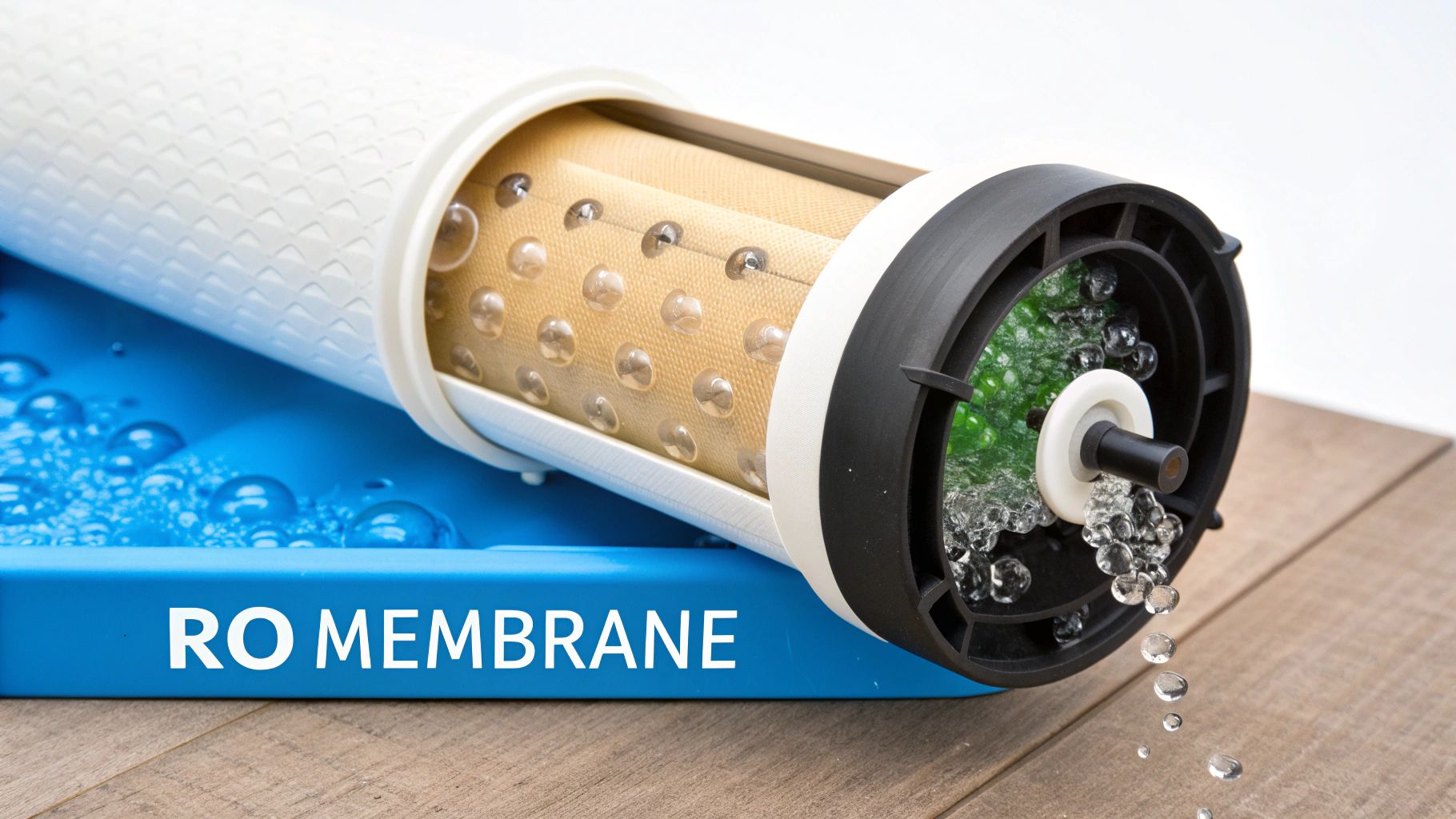
If you're aiming to remove more than just chlorine, a Reverse Osmosis (RO) system is a major upgrade. These are the heavyweights of under-sink filtration, capable of stripping out a huge list of potential contaminants. An RO system uses pressure to force water through a very fine membrane, removing not just chlorine and chloramine, but also things like heavy metals, salts, and other dissolved solids.

The process is pretty thorough and usually involves a few steps:

  1. A pre-filter catches sediment like silt and rust.
  2. An activated carbon filter removes the chlorine/chloramine to protect the delicate RO membrane.
  3. The RO membrane does the real work, filtering out the vast majority of everything else.
  4. A final post-filter, often another carbon filter, gives the water a final "polish" to ensure it tastes crisp and clean.

An RO system is the go-to for a health-conscious family that wants total peace of mind, knowing they've removed the widest possible range of impurities from their water, far beyond just the taste and smell of chlorine.

It’s worth remembering that water disinfectants are used for a very important reason: public safety. The U.S. Environmental Protection Agency and the CDC have established that chlorine or chloramine levels up to 4 parts per million (ppm) are safe to drink, a standard based on a ton of research.

Home Filtration Methods for Chlorine Removal

To make sense of the options, here's a quick rundown of the most common home filtration methods and what they're best at.

Filtration Method Effectiveness (Chlorine) Effectiveness (Chloramine) Initial Cost Ongoing Cost Best For
Activated Carbon Filter Excellent Fair to Poor Low Low Basic taste/odor improvement, renters, single-tap use (pitchers, faucet filters).
Catalytic Carbon Filter Excellent Good to Excellent Moderate Moderate Homes with chloramine-treated water, under-sink or whole-house systems.
Reverse Osmosis (RO) Excellent Excellent Moderate to High Moderate Maximum purity, removing a wide range of contaminants beyond chlorine.
Whole-House Carbon Excellent Good (if catalytic) High Low to Moderate Treating all water in the home for drinking, showering, and appliances.

Choosing the right one really comes down to whether your city uses chlorine or chloramine, your budget, and whether you want to treat just your drinking water or every tap in the house.

Whole-House Systems: The Ultimate Solution

For anyone who wants chlorine-free water everywhere—from the kitchen to the shower to the washing machine—a whole-house filtration system is the end-game. Sometimes called a "point-of-entry" system, this is a large unit installed right where the main water line enters your home. From that point on, every drop of water you use is filtered.

The perks go way beyond just better-tasting water. Showers without chlorine can lead to softer skin and hair because you're not stripping away their natural oils. Your clothes might fade less, and water-using appliances like your coffee maker and dishwasher are protected from chlorine's corrosive effects over the long haul.

These systems typically use large tanks of activated or catalytic carbon and can go for years before needing the filter media replaced. When you start looking into a major upgrade like a whole-house system, it's a good idea to seek out comprehensive plumbing services for a professional installation. And for more general guidance on all your filter options, you can find a lot of great advice available on Water Filter Advisor.

Ultimately, picking the right system depends on your home, budget, and water quality goals, but a dedicated filter is hands-down the most effective way to say goodbye to chlorine for good.

The Hidden Benefits of a Chlorine-Free Home

Getting rid of that chemical swimming pool taste is usually what kicks off the search for how to remove chlorine from drinking water. But once you start looking into home filtration, you quickly find out that better-tasting water is just the beginning. The real magic happens when you filter chlorine out of your entire home’s water supply. It changes everything.

The kitchen is where you'll notice the first big win. Chlorine has a way of muting delicate flavors. Brew your morning coffee or tea with filtered water, and the real notes of the beans or leaves come alive. The same goes for food that soaks up water during cooking—think pasta, rice, and soups. They just taste cleaner and more authentic.

Softer Skin and Healthier Hair

You might not drink your shower water, but the perks of filtering it are just as noticeable. Chlorine is a fantastic disinfectant because it's a strong oxidizer. The problem is, it doesn’t know the difference between bad bacteria and the natural oils that keep your skin and hair healthy.

Showering in chlorinated water day after day can strip those protective oils, often leading to:

  • Dry, Itchy Skin: If you have sensitive skin or conditions like eczema, chlorinated showers can be a real nightmare, making irritation worse. Removing the chlorine helps your skin hang on to its natural moisture, leaving it feeling softer and less inflamed.
  • Brittle, Dull Hair: Chlorine is rough on hair, leaving it weak, dry, and prone to breaking. Filtered shower water keeps your hair's natural oils where they belong, making it shinier, healthier, and way more manageable.

The feeling after a shower in chlorine-free water is something you really have to experience for yourself. So many people say their skin feels less tight and their hair is noticeably softer almost immediately—no new fancy products needed.

Beyond just comfort, filtering out chlorine gives a deeper sense of well-being. It cuts down your family's daily exposure to disinfection byproducts (DBPs), which form when chlorine mixes with organic stuff in the water. While tap water is treated to meet safety standards, a lot of people choose whole-house filtration simply to reduce their contact with these compounds.

This isn't just some household trend, either. It’s been done on a massive scale. The Netherlands, for instance, led the way in shifting its public water systems away from chlorine. Concerned about DBPs, they mandated that all drinking water had to be chlorine-free by 2005. It just goes to show that high-quality, safe water is totally possible without needing residual disinfectants at the tap. You can read about the Dutch approach to water treatment and see how they made it work.

A Quick Word on Safety and Maintenance

Of course, you have to be smart about this. When you take chlorine out of your home's water, you're also removing the very thing that keeps bacteria from growing in your pipes. For most modern homes where water is constantly flowing, this isn't a huge deal, but it brings up a critical point.

Removing that safety net makes your filter system's maintenance absolutely non-negotiable. If you neglect your filter, it can become a breeding ground for the very bacteria you're trying to avoid. That defeats the whole purpose.

Regularly replacing filter cartridges according to the manufacturer's schedule is essential. You have to do it to make sure your water stays both chlorine-free and safe. Don't think of a filter as a one-and-done purchase. It's an ongoing commitment to your water quality. The benefits are amazing, but they completely depend on you keeping the system in top shape.

Keeping Your Filtration System Running Smoothly

Putting in a water filter is a great first move, but it's definitely not a "set it and forget it" kind of deal. Think of it like changing the oil in your car—if you want clean water and a system that actually works, routine maintenance isn't optional. Skipping it can pretty much undo all the good your filter was supposed to do in the first place.

A clogged or old filter doesn't just get less effective; it can actively work against you. The activated carbon gets totally saturated, which means it can’t grab onto any more chlorine. Worse, the filter itself can turn into a perfect home for bacteria, potentially making your water quality even sketchier than the tap water you started with.

Person replacing cylindrical water filter cartridge above kitchen sink during routine maintenance procedure

Your Filter Replacement Checklist

The single most important thing you can do is stick to a replacement schedule. These timelines are all over the map depending on your specific system and how much water your family goes through. Always check the manufacturer's guide, but here are some solid rules of thumb to get you started.

  • Pitcher & Faucet Filters: These are the little guys doing a big job. Their small cartridges fill up fast, so plan on swapping them out every 2 to 3 months or after about 40 gallons.
  • Under-Sink & Countertop Filters: With bigger cartridges, these units have more staying power. You can usually get a good 6 to 12 months out of them before they need to be replaced.
  • Reverse Osmosis (RO) Systems: These are more involved, with multiple filter stages. The sediment and carbon pre-filters need changing every 6 to 12 months, but the main RO membrane is the long-distance runner, lasting 2 to 4 years.
  • Whole-House Systems: Maintenance for these workhorses really depends on the model. Big sediment filters might need an annual change, while the giant carbon media tanks can go anywhere from 3 to 10 years before the carbon itself needs to be replaced.

Keep in mind, these are just averages. If your water has a lot of sediment or extra-high chlorine levels—or if you have a big family—you'll probably be changing filters on the shorter end of these estimates.

Key Maintenance Tasks Beyond Replacement

Beyond just swapping cartridges, a little extra TLC can make a big difference. Keeping the whole system clean ensures you’re always getting top-tier water quality.

For starters, always flush a new filter cartridge before you use it. New carbon filters often release a fine, harmless carbon dust (sometimes called "fines") at first. Just run some water through the new filter for a few minutes until it’s clear. This washes those particles out so they don't end up in your glass.

It's also a great habit to sanitize the filter housing periodically. When you're changing a cartridge, take that opportunity to wash the pitcher, canister, or housing with warm, soapy water. This gets rid of any biofilm or gunk that might have started growing inside.

Troubleshooting Common Filter Problems

So, how can you tell if your filter needs a change before its scheduled date? Your water will usually drop some heavy hints. If you spot any of these signs, it's time to take a look.

A sudden drop in water pressure from your filtered faucet is the classic sign of a clogged filter. As it traps more gunk, it gets harder for water to get through, leading to that weak, slow flow.

Likewise, if that all-too-familiar chlorine taste or smell starts creeping back in, that’s a dead giveaway. Your carbon filter has hit its limit and can't absorb any more chlorine. It’s absolutely time for a new one.

To give your home's plumbing complete protection, you might also look into smart water leak detectors that can catch small issues before they become disasters. Ultimately, staying on top of maintenance is how you make sure your investment keeps paying off with clean, great-tasting water for years to come.

Your Top Questions About Chlorine Removal, Answered

Even after weighing all the options, you probably have a few questions rolling around. Picking the right water solution for your home is a big deal, so let's clear up some of the most common things people ask.

Do Fridge Filters Actually Remove Chlorine?

Yes, they do. Most of the filters built into refrigerator water and ice dispensers use activated carbon, which is fantastic at grabbing chlorine. It's the reason water from the fridge dispenser usually tastes so much better than what you get straight from the tap.

The catch? These filters are small and need to be replaced on a strict schedule, usually every six months. If you let it go, its ability to pull out chlorine plummets, and it can even become a breeding ground for bacteria. They're a nice perk, but only for the water coming out of your fridge.

Is Chlorine-Free Water Really Better?

While water treated with low levels of chlorine is considered safe by municipalities, getting rid of it can bring some real, noticeable benefits. For anyone with sensitive skin or conditions like eczema, showering in chlorine-free water can mean less dryness and irritation. It also stops stripping the natural oils from your hair, leaving it feeling softer.

The choice to remove chlorine often boils down to personal preference. It's about taking water that's already safe and making it taste, smell, and feel amazing.

And, of course, there's the taste. Taking out chlorine and its byproducts can completely change the flavor of everything from a simple glass of water to your morning coffee.

Does a Water Softener Get Rid of Chlorine?

This is a huge point of confusion for a lot of homeowners. A water softener has one very specific job: it removes hardness minerals like calcium and magnesium. It does not remove chlorine.

In fact, chlorine is actually bad for the resin beads inside your water softener. Over time, it will degrade them and shorten the life of your system. This is why a proper whole-house setup almost always includes a carbon filter before the water softener. The carbon filter takes out the chlorine (protecting the softener) while the softener handles the hard water.


Ready to enjoy the crisp, clean taste of chlorine-free water in your home? At Water Filter Advisor, we provide expert reviews and straightforward guides to help you find the perfect filtration system for your needs. Explore your options and make a confident choice for healthier, better-tasting water today at https://www.waterfilteradvisor.com.
Removing Sulfur From Well Water: Your Guide to Ditching That Rotten Egg Smell

Ah, the rotten egg smell. It’s the unmistakable, nose-wrinkling sign that your well water has a sulfur problem. But here's the good news: removing sulfur from well water is a totally winnable battle with the right filtration game plan. The culprit is almost always hydrogen sulfide gas, and it doesn't just stink—it can wage a corrosive war on your plumbing and fixtures over time. Figuring out where this smelly villain is hiding is the first and most important step to kicking it out for good.

Why Your Well Water Smells Like a Science Experiment Gone Wrong

Chrome faucet filling glass with water that has rotten egg sulfur smell odor

If you've ever turned on a faucet only to be blasted by that nasty rotten egg odor, you’ve just been formally introduced to hydrogen sulfide (H₂S). It's the number one reason homeowners start a frantic Google search for home water filtration systems. So, where does this stuff come from? Is your well sitting on a portal to another dimension? Not quite. The problem can be geological or biological, and sometimes it's hiding right inside your own house.

Most often, sulfur in well water is just nature doing its thing. Sulfates are naturally found in rocks and soil. As groundwater journeys through these mineral deposits, it dissolves them and brings them straight into your well. The hydrogen sulfide gas that produces the smell is incredibly potent—your nose can detect it at concentrations as low as 1 ppm (part per million). Even tiny amounts make water corrosive enough to tarnish your copper pipes and silverware. You can dig deeper into sulfur's effects by checking out the EPA's supply chain profile.

The Two Main Suspects in the Sulfur Caper

Nailing down the exact cause is the key to choosing the right weapon for the fight. In my experience, it almost always comes down to one of two things.

  • Geological Presence: For many folks, sulfates and hydrogen sulfide are just part of the local geology. If you live in an area rich with shale, sandstone, or gypsum, your water is basically picking up these sulfur compounds on its way to your well. It’s not a flaw; it’s just a feature of the neighborhood.
  • Bacterial Shenanigans: This one is a real party crasher. Certain types of bacteria, called sulfur-reducing bacteria, absolutely love low-oxygen hangouts like wells, plumbing lines, and especially hot water heaters. They throw a feast on the naturally occurring sulfates in your water and, as a thank you, produce stinky hydrogen sulfide gas as a byproduct.

While these bacteria aren't harmful to drink, they are the tiny factories turning your water into a foul-smelling brew.

Key Takeaway: That rotten egg smell is more than just an annoyance. It's a clear signal of hydrogen sulfide, a gas that can lead to serious corrosion in your pipes and fixtures, causing expensive damage if you ignore it.

Plot Twist: Your Water Heater Might Be the Real Problem

Before you start pricing out a filtration system that could rival a small car in cost, do a little detective work. Is the smell only coming from the hot water taps? If so, the villain is almost certainly your water heater.

Most water heaters have a component inside called a magnesium anode rod. Its noble job is to sacrifice itself to prevent the steel tank from rusting out. The catch? This rod can have a chemical reaction with sulfates in the water, creating a non-stop supply of hydrogen sulfide gas. The warm, oxygen-starved tank is the perfect five-star resort for this reaction.

If this sounds like your situation, you might be in luck. Often, simply swapping that magnesium rod for an aluminum one can stop the reaction in its tracks and solve the smell completely, no expensive filter needed.

Pinpointing Your Sulfur Problem Like a Pro

Before you spend a single dime on a home water filtration system to get rid of sulfur, you’ve got to play detective. The whole point is to figure out exactly what kind of sulfur issue you have and where it's coming from. Getting this wrong is like buying shoes without knowing your size—it’s just a recipe for an expensive and frustrating fix that doesn't work.

The first, and by far the easiest, diagnostic you can run is the hot versus cold water showdown. This simple little experiment can literally save you hundreds, if not thousands, of dollars. Just run a cold water tap for a few minutes and give it a good sniff. Then, do the same thing with a hot water tap.

Does that rotten egg funk only show up with the hot water? If so, you can breathe a huge sigh of relief. The problem is almost certainly your water heater, not your well. Like we mentioned earlier, the magnesium anode rod inside the tank is probably reacting with naturally occurring sulfates, which creates hydrogen sulfide gas. The fix might be as simple as swapping it out for an aluminum or powered anode rod.

When Your Nose Isn't Enough: Calling in the Experts

If both your hot and cold water carry that distinct sulfur perfume, the issue is deeper in your plumbing or the well itself. This is your cue to move past the sniff test and get some hard data. While you can find DIY water testing kits at the hardware store, for a sulfur problem, a professional lab analysis is a much smarter investment.

Why go pro? A lab report gives you precise, actionable numbers that a home kit just can't match. It’s the difference between guessing and knowing.

You wouldn’t accept a medical diagnosis without bloodwork, so don’t choose a water treatment system without a proper water analysis. The details in that report are the blueprint for your solution.

A comprehensive lab test provides the critical information needed to pick the right home filtration system. It takes the conversation from "my water stinks" to "I have 5 ppm of hydrogen sulfide and a pH of 6.8." See the difference?

Decoding Your Water Test Report: A Cheat Sheet

When you get that professional water analysis back, it might look a little intimidating with all its numbers and chemical names. Don't sweat it. You only need to zero in on a few key metrics to really understand your sulfur problem and find the right way to get it out of your well water.

Here’s what to look for and what it means for your home:

  • Hydrogen Sulfide (H₂S) Concentration: This is the big one, measured in parts per million (ppm). This number is the single most important factor in deciding which type of home water filtration system you need. A level below 2 ppm might be handled by a simple carbon filter, but if you're seeing numbers above 6-7 ppm, you’ll need a more heavy-duty solution like chemical injection.
  • Iron and Manganese Levels: These minerals are sulfur's partners in crime. They often show up together and can sabotage certain sulfur removal methods. High iron, for example, can completely foul up carbon filters and some oxidation media, which means you’ll need a system designed to handle both.
  • pH Level: This tells you how acidic or alkaline your water is. Your water's pH can dramatically affect how well certain treatments work. Chlorination, for instance, is far more effective at a lower pH, while some other systems work best in a neutral to alkaline environment.
  • Presence of Bacteria: The test should also check for sulfur-reducing or iron-related bacteria. If these nasty bugs are the root cause, you need a system that also disinfects the water—like a chlorine injection system or an ozonator—not just one that filters it.

Armed with this data, you can have a real, informed conversation with a water treatment specialist or confidently compare systems yourself. You’ll know exactly what you’re up against, ensuring the home filtration solution you pick is perfectly matched to your well’s unique water chemistry.

Matching the Right Filtration Fix to Your Sulfur Issue

Alright, you've got your water test results. Now for the fun part: playing matchmaker between the problem and the solution. When it comes to getting sulfur out of well water, there's no magic bullet. The right home water filtration fix is always dictated by the data you're holding in your hand.

Think of it like this: you wouldn't take a painkiller for a broken arm. You need the correct treatment for your specific ailment, and just guessing is a surefire way to waste money on something that won't work.

The whole game is about matching the filtration technology to the concentration of hydrogen sulfide (H₂S) in your water. A system that’s perfect for a faint whiff of sulfur will get completely steamrolled by a heavy-duty problem. On the flip side, installing an industrial-strength system for a minor odor is just burning cash. Let's walk through the options so you can pick a system that’s got the muscle you need without the hefty price tag.

First, this quick decision tree can help you figure out if the problem is just your water heater or if you're dealing with a whole-house issue.

As you can see, the first diagnostic step is critical. If that rotten egg smell only shows up when you run the hot water, the problem is almost certainly your water heater. If it's in both hot and cold, you're looking at a whole-house water filtration system.

Solutions for Low Sulfur Levels (Up to 2 ppm)

If your test came back showing hydrogen sulfide levels below 2 parts per million (ppm), you're in luck. This is more of a nuisance level that can usually be handled with simpler, more affordable gear. These home filtration methods are fantastic for getting rid of that annoying background smell without a huge investment.

A go-to solution in this range is a good old activated carbon filter. These work through adsorption—the carbon media essentially acts like a sponge, grabbing the hydrogen sulfide gas and yanking the odor out of your water. They're pretty easy to install and maintain, usually just needing a cartridge change every few months.

One thing to keep in mind, though: if you also have a lot of iron in your water (a common partner-in-crime with sulfur), it can exhaust the carbon filter much faster. They work best when the water is otherwise relatively clean.

Tackling Moderate Sulfur Levels (2 to 6 ppm)

Once your H₂S concentration starts creeping into that 2 to 6 ppm range, a simple carbon filter isn't going to have enough firepower. At this point, you need a more powerful system that actively removes the sulfur instead of just trapping it. This is where oxidation filters really start to shine.

These home water filtration systems, which you'll often see called air injection or iron filters, work by pulling an oxidizer (usually just plain air) into the water. This process instantly changes the dissolved hydrogen sulfide gas into tiny solid particles of sulfur. From there, these particles get trapped in a bed of special filter media.

Some of the most popular media types include:

  • Manganese Greensand: This is a classic, tried-and-true media coated with manganese dioxide. It does a great job but needs to be regenerated every so often with potassium permanganate, a strong purple oxidant that you need to handle carefully.
  • Katalox Light or Filox: These are more modern, high-performance media. They can handle higher flow rates and knock out sulfur, iron, and manganese all at once, often without needing any chemical regenerants.

These systems are super effective and pretty self-sufficient. They automatically backwash every few days, flushing all the trapped sulfur particles down the drain to clean themselves out.

Heavy-Duty Systems for High Sulfur Levels (Above 6 ppm)

If your test results are showing H₂S levels above 6 or 7 ppm, you've officially entered heavy-duty territory. At this concentration, even a good oxidation filter can get overwhelmed. You need a more aggressive approach to guarantee that fresh, odor-free water you're after. The undisputed champion here is a chemical injection system.

This setup uses a small feed pump to inject a very precise amount of an oxidizing agent right into your water line. The two most common choices for homes are chlorine and hydrogen peroxide.

The word "chemical" can sound a little scary, I get it. But when these systems are sized and maintained correctly, they are an incredibly safe, reliable, and powerful way to completely wipe out even the most severe sulfur problems.

The injected chemical oxidizes the H₂S, and a large carbon filter downstream removes the resulting particles. Chlorine is a fantastic option because it also kills any sulfur-reducing bacteria that might be causing the problem to begin with. Hydrogen peroxide is a strong, clean alternative that breaks down into just oxygen and water, so it leaves no residue behind.

While your main concern is the well water, sometimes other stubborn smells can hang around the house. If that's the case, you might look into comprehensive odor removal services to make sure your whole home feels fresh.

Comparing Your Home Water Filtration Options

To help you see how these solutions stack up, I've put together a quick comparison table. Choosing the right system means balancing the upfront cost with long-term maintenance and overall effectiveness. Each one has its own strengths and weaknesses.

Sulfur Treatment Options by Concentration Level

Treatment Method Best For (H₂S Level) Pros Cons
Activated Carbon Filter Low (0-2 ppm) Inexpensive, easy to install, improves taste Short filter life with iron, doesn't kill bacteria
Oxidation Filter Moderate (2-6 ppm) Chemical-free, low maintenance, very effective Higher initial cost, requires backwashing
Chemical Injection High (6+ ppm) Kills bacteria, handles very high H₂S levels Requires ongoing chemical purchase, more complex

At the end of the day, picking the right equipment for removing sulfur from well water is a decision driven by data, not guesswork. Your water test results are your roadmap, and understanding these home water filtration options gives you the tools to follow it. By matching the technology to your specific sulfur level, you'll land on a solution that gets rid of that rotten egg smell for good—without breaking the bank.

How to Choose and Size Your Home Water Filtration System

https://www.youtube.com/embed/ak5o479A–o

You’ve done the hard part—you’ve tested your water and you know which filtration technology you need. Now, it's time to match that technology to the right system for your home. This is where the rubber meets the road, and getting it right is the difference between fresh, clean water and dealing with a system that just can't keep up.

This is about more than just picking a brand. You need to make sure the system can handle your family's water demand without dropping the ball. Trust me, sizing a system incorrectly leads to nothing but headaches: weak water pressure, that rotten egg smell creeping back in, and a much shorter lifespan for your equipment.

Calculating Your Home's Peak Flow Rate

The very first number you need to nail down is your home's peak flow rate, measured in gallons per minute (GPM). This is a snapshot of the maximum amount of water your household might use at any given moment. A system that can’t meet this demand will leave you with a dribble in the shower the second someone flushes a toilet or starts the dishwasher.

Here’s a simple way to get a solid GPM estimate using a fixture count:

  • Standard Faucets (Kitchen, Bath): 1.5 GPM each
  • Showerheads: 2.5 GPM each
  • Dishwasher: 2 GPM
  • Washing Machine: 2.5 GPM

Just add up the GPM for all the fixtures you could see running at the same time. For a typical family of four, that might be a shower (2.5 GPM), the dishwasher (2 GPM), and a kitchen sink (1.5 GPM). That adds up to a peak demand of 6 GPM. Your new home filtration system must have a service flow rate that meets or, even better, exceeds this number.

Considering Other Water Quality Issues

Here's something I've seen trip up countless homeowners: sulfur rarely shows up to the party alone. Other common well water issues like iron, manganese, and hardness can absolutely wreck the performance of your sulfur removal system if you ignore them.

For example, high iron levels will quickly foul up the media in an oxidation filter or clog an activated carbon filter solid, making it totally useless against sulfur. Hard water is just as bad, creating a rock-like scale buildup inside your system that chokes its efficiency and can lead to expensive mechanical failures.

Pro Tip: Always look for a system designed to handle the full picture of your water quality. It’s almost always more effective and cheaper in the long run to install a single system that treats both iron and sulfur, rather than trying to bolt on a second unit later.

Understanding Key System Specifications

When you start comparing models, that technical spec sheet is your best friend. Don't let your eyes glaze over—the details on that page tell you everything you need to know about the system's real-world performance and long-term costs.

Pay close attention to these critical specs:

  • Backwash Rate and Frequency: This tells you how much water the system uses to clean itself and how often it needs to do it. An efficient backwash cycle is absolutely crucial for keeping the filter media healthy and effective.
  • Media Lifespan: How long will the filter media last before you have to shell out for a replacement? A system with media that lasts 5-10 years offers far better long-term value than one that needs new media every year or two.
  • Warranty Details: A strong warranty is a good sign that the manufacturer stands behind their product. Look for comprehensive coverage on the tank, the control valve, and the electronics.

If you want to dig deeper into choosing a system, our guide on general water filtration advice is a great place to broaden your knowledge.

The good news is that modern systems are incredibly effective. Most quality units on the market today boast over 90% removal efficiency for sulfur. These advancements in sulfur removal technology have been a game-changer for well water treatment. By carefully sizing your system and paying attention to these key specs, you can make a smart investment that delivers fresh, odor-free water for years to come.

Installation and Long-Term Maintenance Insights

Plumber performing maintenance on residential water heater system with tools and equipment

Alright, so you've picked out your new home water filtration system. It's a beast of a tool in the fight for fresh, odor-free water, but let’s be clear: it's not a "set it and forget it" appliance. The real difference between a quick fix and a lasting solution comes down to proper installation and consistent maintenance. Nail these two things, and you’ll get every penny's worth out of your investment for years to come.

Whether you're a seasoned DIYer ready to get your hands dirty or you're calling in a pro, a solid setup starts with a little planning. Think about where this thing is going to live. Ideally, you want to install it after your pressure tank but before your water heater. This protects both appliances from whatever you're filtering out. It also needs a nearby power source for the control valve and, critically, a drain for its backwashing cycles.

Make sure the spot you pick is level and won't freeze in the winter. Just as important, leave yourself enough elbow room to get around it for future service. It might be tempting to shove it into a tight corner to save space, but you’ll be kicking yourself the first time you need to check a fitting or swap out the media.

Your Essential Maintenance Checklist

Once your system is humming along, a simple, consistent maintenance routine is your best friend. This is what keeps that rotten egg smell from making a comeback. We're not talking about spending every weekend tinkering with your plumbing—just a few scheduled checks to stop big problems before they start.

For most systems, it boils down to a handful of key tasks. Think of it as a quick health checkup for your water.

  • For Chemical Injection Systems (Chlorine/Peroxide): You’re the supply manager here. At least once a month, pop the lid on your chemical solution tank and top it off. While you're there, give the injection pump and tubing a quick once-over for any clogs or leaks.
  • For Oxidation Filters (Air Injection, Greensand): These are pretty self-sufficient, but the media inside won't last forever. Check the manufacturer's guidelines and mark your calendar. You'll likely need to replace the media every 5-10 years.
  • For All Systems: Every few months, just do a quick visual inspection of all the fittings and connections. A tiny drip might not seem like a big deal, but it can waste a surprising amount of water and signal a bigger problem.

Maintenance Mindset: Treat your filtration system like any other major appliance in your home—your furnace, your A/C, your water heater. A little proactive care goes a long way in ensuring it lasts and does its job, protecting both your investment and your water quality.

Spotting Trouble Before It Starts

Even with perfect maintenance, things can still go sideways. The trick is to know the early warning signs so you can jump on a problem before it turns into a costly repair or, worse, a full-blown return of the sulfur stench.

Start by listening. Pay attention to the sounds your system makes. Is the backwash cycle suddenly running way longer than it used to? Do you hear the well pump kicking on and off more often? These little changes are often the first clues that something’s not quite right.

Another huge red flag is a gradual drop in your home's water pressure. This almost always points to a clog somewhere in the system, either from sediment building up or the filter media getting fouled. If you notice the flow from your faucets getting weaker, it’s time to investigate the filtration unit. Catching these things early is the key to keeping your system for removing sulfur from well water running like a top.

Common Questions About Sulfur in Well Water

Once you've zeroed in on the right system for removing sulfur from well water, you might still have a few questions rattling around. It's totally normal. Sorting out those last few details can feel a bit overwhelming, but getting solid answers is key to feeling confident about your new home filtration setup.

Let's dive into the most common questions we hear from homeowners who are just about to cross the finish line on their water treatment project. We'll cover everything from the role of your water softener to what you should expect the moment your new system fires up.

Will a Standard Water Softener Remove the Rotten Egg Smell

This is probably the number one question we get, and the short answer is almost always no. A standard water softener is a specialist; its whole job is to pull out hardness minerals like calcium and magnesium using a process called ion exchange. It's built to stop scale, not fight odors.

Sure, some softeners might seem to knock back very low levels of hydrogen sulfide, but they simply aren't designed for it. Worse, high concentrations of sulfur can actually foul the softener's resin bed over time, making it less effective and shortening its life. To really solve the problem, you need a dedicated piece of equipment like an oxidation filter or a chemical injection system.

Think of it this way: you wouldn't use a hammer to turn a screw. A water softener is the wrong tool for the sulfur job. Relying on it is an ineffective and potentially costly mistake.

Is It Safe to Drink Water That Smells Like Sulfur

For the most part, the hydrogen sulfide gas that causes that rotten egg smell is more of a nuisance than a direct health threat at the levels you'd typically find in a home well. The US Environmental Protection Agency (EPA) actually classifies it as a secondary contaminant, which means it mainly impacts things you can taste and smell.

But, and this is a big but, that smell is a major red flag. Its presence can signal that conditions in your well are perfect for certain types of bacteria to thrive. Plus, high levels of sulfates—a different, related form of sulfur—can have a laxative effect, which is a real concern for infants or even visitors not used to the water. The only way to know for sure what's going on is to get your water professionally tested. While you're at it, you might have other frequently asked plumbing questions about your home's water system in general.

How Long Does It Take for a New Filtration System to Work

You should notice a huge difference almost immediately after your new sulfur filter is installed and flushed out. As soon as the system runs its first cycle, that treated, odor-free water will start making its way into your pipes.

That said, it takes a little time to completely push out all the old, smelly water that's already in your plumbing—especially inside your hot water tank. Give it a few hours, or maybe even a full day, for the rotten egg smell to vanish completely. If the odor is still hanging around after 24 hours, it’s a good time to double-check the system's settings or give your installer a call to see what's up.


At Water Filter Advisor, we provide the practical guidance and research-driven reviews you need to make confident decisions about your home's water quality. Find the perfect solution for your needs at https://www.waterfilteradvisor.com.
Filtered Water vs Reverse Osmosis: Which Is Right for Your Home?

Trying to pick the right water filter for your home? It’s a classic showdown that usually boils down to choosing between a standard filter and a reverse osmosis system. They both promise cleaner water, but they go about it in wildly different ways.

So what's the short answer? Standard filters are perfect for a quick and easy upgrade to your tap water's taste and smell, getting rid of annoyances like chlorine. On the other hand, reverse osmosis systems are the heavy hitters, providing a much more intense level of purification that strips out nearly everything—we're talking dissolved salts, lead, and even fluoride.

Choosing Your Home Water Filtration System

This guide is here to walk you through exactly what each technology does. We’ll break down what they remove, how much they cost, and which system really makes sense for your kitchen. The goal is to give you the confidence to pick the best option for your family's health and hydration.

Two clear glasses of water on kitchen counter comparing filtered water versus reverse osmosis systems

When you think "filtered water," you probably picture a simple pitcher in your fridge or a small filter clicked onto your faucet. These are incredibly popular for a reason—they work great for improving the basic quality of city water. Most of them rely on activated carbon to tackle those aesthetic issues, making your water much more enjoyable to drink.

A Reverse Osmosis (RO) system is a different beast altogether. It's a more comprehensive setup, usually installed under your kitchen sink. It pushes water through a multi-stage process, with a special membrane at its core, to remove a significantly wider range of contaminants. For those curious about specific faucet options, this overview of BRITA integrated water filter taps provides a great deep dive into how those particular systems work.

To get a quick handle on the key differences, it helps to see them side-by-side.

Filtered Water vs Reverse Osmosis at a Glance

This table lays out the core distinctions between standard filters and RO systems. Think of it as your cheat sheet before we dive into the nitty-gritty.

Feature Standard Water Filter (e.g., Carbon) Reverse Osmosis (RO) System
Primary Goal Improves taste and odor by removing chlorine. Comprehensive purification, removing up to 99% of contaminants.
Key Technology Activated carbon adsorption. A semi-permeable membrane that blocks dissolved solids.
Contaminants Removed Chlorine, some VOCs, sediment, bad tastes/smells. Lead, arsenic, fluoride, dissolved salts, pesticides, and more.
Installation Very easy (pitchers) to simple DIY (faucet). Moderate DIY, may require a plumber for under-sink models.
Cost Low upfront cost, frequent filter replacements. Higher initial cost, less frequent but pricier replacements.

As you can see, the choice isn't just about "better" filtration—it's about matching the right technology to your specific needs, budget, and water quality concerns at home.

How Standard Water Filters Improve Your Tap Water

When most people talk about "filtered water" at home, they're usually thinking of the common, easy-to-use filters that tackle specific water problems. These standard filters are your first line of defense against the usual suspects that give tap water that off-putting taste or smell. Think of them as specialists, not generalists—they're built for quick, noticeable improvements, not total purification.

Person filling water filter pitcher from kitchen faucet for better tasting drinking water

The secret sauce for most of these filters is activated carbon. It’s pretty amazing stuff. Imagine a super-porous sponge with a massive internal surface area. To put it in perspective, just a single gram of activated carbon can have a surface area bigger than a football field. That structure makes it an incredibly effective magnet for certain contaminants.

The Power of Activated Carbon

Activated carbon works its magic through a process called adsorption. This is where impurities chemically latch onto the carbon's surface rather than being physically strained out. It’s an incredibly effective method for grabbing the specific things that mess with taste and odor, which is why you’ll find it in almost every home water filter.

Here's what it's best at nabbing:

  • Chlorine: This is the big one. Your city water treatment plant adds chlorine to kill germs, but it often leaves behind a strong chemical taste and smell. Activated carbon is a champ at adsorbing chlorine, which is why your water tastes so much better right away.
  • Volatile Organic Compounds (VOCs): These are chemicals from industrial sources and solvents that can sometimes seep into the water supply. A good carbon filter can pull many of them out.
  • Pesticides and Herbicides: Small traces from agricultural runoff can also be caught on the carbon's surface.

By zeroing in on these contaminants, a simple carbon filter in a pitcher or screwed onto your faucet can take your drinking water from just "drinkable" to genuinely "enjoyable." It's a targeted fix for a very common household complaint.

Key Takeaway: Standard filters lean heavily on activated carbon to make your tap water taste and smell better. They’re great for chlorine but aren't designed to remove the tough stuff like lead or fluoride.

Beyond Carbon: Sediment and Specialty Filters

While carbon is the star of the show, it often works with a supporting cast, especially in more serious under-sink or whole-house systems. Another common player is the sediment filter, which acts more like a simple screen or sieve.

Sediment filters are all about catching physical debris. Think of them as the bouncer at the club, stopping the big, clunky stuff from getting in.

Their job is to block:

  • Rust flakes from old, aging pipes
  • Sand, silt, and dirt from the water main
  • Any other visible gunk

These filters are absolutely crucial for protecting the more delicate filtration stages that come after them, whether that's a carbon filter or the high-tech membrane in a reverse osmosis system. By trapping all that grit, they keep things from getting clogged and help the whole system last longer.

This kind of specialization is what really defines standard filtration. You have a carbon filter adsorbing chlorine and a sediment filter blocking rust—each piece has a specific job. This is the heart of the filtered water vs. reverse osmosis debate; one improves, the other purifies.

What's Going On Inside a Reverse Osmosis System?

If you think a standard water filter is doing a lot, a reverse osmosis (RO) system is on a whole other level. This isn't just about filtering out the obvious stuff; it's a deep-clean purification process that literally takes your water apart, scrubs it clean of almost everything, and then puts it back together for drinking.

Think of it less like a simple screen and more like a high-tech water treatment plant shrunk down to fit under your sink. Every drop of water goes through a rigorous, multi-stage journey, which is what really separates RO from a basic pitcher or faucet filter.

The Multi-Stage Journey of Your Water

The real power of reverse osmosis comes from its methodical, step-by-step approach. Your tap water doesn't just hit one filter and call it a day. It has to pass through a series of checkpoints, each designed to tackle a different problem and protect the next stage down the line.

It all kicks off with pre-filtration. Before the water even gets close to the main event, it has to get past the bouncers. These usually include:

  1. A Sediment Filter: This is the first line of defense, acting as a physical net to catch the big gunk. It snags rust flakes, sand, silt, and any other grit that could jam up the more sensitive parts of the system.
  2. A Carbon Filter: Next, the water moves through an activated carbon filter. Just like the ones in standard systems, this filter's job is to grab onto chlorine and other chemicals. This is crucial because chlorine can actually eat away at the delicate RO membrane.

These pre-filters are the unsung heroes of the operation. They're the bodyguards that make sure the star of the show can do its job properly.

The Heart of the System: The RO Membrane

Once the pre-filtering is done, the real magic happens. The water is pushed at high pressure up against a semi-permeable membrane. This is a special material with pores so tiny—around 0.0001 microns—that they’re almost impossible to imagine.

These microscopic holes are just big enough for H₂O molecules to squeeze through, but they slam the door on almost everything else. This is where an RO system leaves other filters in the dust.

An RO membrane is an incredible barrier, capable of kicking out up to 99% of all total dissolved solids (TDS). We’re talking about heavy metals like lead and arsenic, inorganic minerals like fluoride, and dissolved salts that breeze right through simpler carbon filters.

After the water has been forced through the membrane, it’s collected in a small storage tank. But there’s one final step. Right before it comes out of your special RO faucet, the water gets a final once-over from a post-carbon filter. This last filter acts as a "polisher," wiping away any lingering off-tastes or smells the water might have picked up in the tank. The result is water that's not just clean, but noticeably crisp and fresh.

This technology is so effective it's become a massive force in the global water filtration world. According to Mordor Intelligence, its ability to remove such a huge range of contaminants makes it a go-to solution for ensuring water safety in homes everywhere. It's this tough, multi-stage process that makes RO the heavyweight champion for anyone serious about getting incredibly pure drinking water.

A Detailed Contaminant Removal Comparison

When you're trying to choose between filtered water and reverse osmosis, it really comes down to one question: what does each system actually take out of my water? This is where the two go their separate ways. Think of standard filters as specialists, while reverse osmosis systems are the all-in-one purifiers designed to catch pretty much everything.

This difference is a big deal. With concerns about water quality growing, effective home filtration has become a top priority for families everywhere. The global market for water purifiers is booming, and RO filters are leading the pack simply because of how well they perform.

What Standard Filters Are Good At

Standard filters, especially the ones using activated carbon, are fantastic for making your water taste and smell better. They go after the common stuff that makes tap water unappealing.

Here’s what they tackle best:

  • Chlorine: This is the #1 job for carbon filters. They're great at absorbing the chlorine from city water treatment, which gets rid of that "swimming pool" odor and taste almost instantly.
  • Volatile Organic Compounds (VOCs): These filters can catch certain industrial chemicals and solvents that might be lingering in your water supply.
  • Bad Tastes and Odors: By grabbing chlorine and some other organic compounds, carbon filters make your water taste crisp and clean.

But it's crucial to know what they don't do. Standard filters can't remove dissolved solids. That means things like heavy metals, fluoride, arsenic, and nitrates slide right past the carbon and stay in your glass.

The Full-Spectrum Power of Reverse Osmosis

A reverse osmosis (RO) system is a whole different beast. It purifies water on another level, using a multi-stage process to strip out a huge list of contaminants that standard filters can’t even touch.

This diagram gives you a great visual of how water moves through an RO system—from the initial pre-filters, through the powerhouse membrane, and to a final post-filter.

Reverse osmosis water filtration system diagram showing three stages: pre-filter, membrane, and post-filter

Each stage has a specific role, but the RO membrane is the star of the show, separating pure water molecules from nearly everything else.

The secret is the semi-permeable membrane at the heart of the system. Its pores are incredibly tiny—about 0.0001 microns—so they block almost anything that isn't a water molecule.

An RO system’s real claim to fame is its ability to remove up to 99% of Total Dissolved Solids (TDS). This is a massive category that includes some of the most serious health concerns, many of which you can't see, taste, or smell.

Contaminant Removal Head-to-Head

Let's put them side-by-side to see where RO really shines.

Contaminant Concern Standard Filter (Activated Carbon) Reverse Osmosis System The Bottom Line
Chlorine Excellent Excellent (via pre-filter) Both are great for fixing this common taste and smell problem.
Lead & Heavy Metals Limited / None Excellent RO is the clear winner for removing lead, arsenic, mercury, and other metals.
Fluoride Ineffective Excellent If you want to remove fluoride, an RO membrane is the only reliable way.
Nitrates & Sulfates Ineffective Excellent These dissolved salts get right through carbon but are stopped by an RO membrane.
Bacteria & Viruses Ineffective Highly Effective The pores in an RO membrane are just too small for microorganisms to get through.
Total Dissolved Solids (TDS) No Reduction Excellent (up to 99%) This is the key difference. RO cleans water at the molecular level.

Seeing it laid out like this makes the decision much simpler. If your main goal is just to improve the taste of your city water, a standard filter is a solid, budget-friendly choice. But if you're worried about specific health-related contaminants like lead, fluoride, or arsenic—or you just want the purest water possible—a reverse osmosis system is hands-down the best option for your home. It delivers a level of confidence that standard filters just can't offer.

Comparing Cost, Maintenance, and Installation

Let's get practical. Beyond what a filter actually removes from your water, the real-world factors of cost, upkeep, and setup are often what seal the deal. This is where the filtered water vs. reverse osmosis debate really heats up, because the right choice for your home has to balance the upfront investment with long-term effort and expenses.

Under sink water filtration system installation with tools showing professional plumbing setup costs

Standard filters, like the pitcher in your fridge or a simple faucet attachment, are incredibly easy to get started with. You can grab one for as little as $20-$50, making them a super accessible first step toward better water. The catch? Their true cost is hidden in the constant, recurring expense of replacement filters, which can absolutely pile up over a year.

On the other side of the ring, reverse osmosis (RO) systems are a more serious initial investment. You’re typically looking at $150 to over $500 for a solid under-sink model. While that stings a bit more upfront, the ongoing maintenance is usually more predictable. The workhorse RO membrane can last for 2-4 years, spreading that cost out over a much longer timeline.

Upfront vs. Long-Term Financials

You have to look at the total cost of ownership, not just the price tag on the box.

That simple water pitcher might seem like a bargain, but if you're replacing its $15 filter every two months, you're spending $90 a year. Fast forward three years, and you've sunk $270 into a solution that only filters water for one pitcher at a time.

Now, let's look at an under-sink RO system that costs $250 to buy. Its annual filter kits—for the sediment and carbon pre-filters—usually run about $60-$80. The main RO membrane, which costs around $50-$100, only needs to be swapped out every few years. When you do the math, RO often becomes the more cost-effective choice for truly pure drinking water in the long run.

Thinking about the long-term care of a water system is a lot like other home improvement projects. It's smart to see it as part of your overall upkeep strategy, similar to the other essential home maintenance tips that keep your house running smoothly.

Installation and Upkeep Demands

The setup experience couldn't be more different between standard filters and RO systems. It’s the classic trade-off: simplicity for performance.

  • Standard Filters: A water pitcher requires zero installation—just unbox it, rinse the filter, and fill it up. Faucet and countertop filters are also built for a quick DIY setup, usually taking just a few minutes with no special tools required.
  • Reverse Osmosis Systems: Most under-sink RO units are designed for a handy homeowner to install. It involves tapping into the cold water line, drilling a small hole in your countertop for a dedicated faucet, and connecting a line to the drain. It’s definitely a more involved project, but totally manageable if you’re comfortable with basic tools.

The Installation Verdict: If you're renting or just want an immediate, no-fuss fix, standard filters are the hands-down winner. But for homeowners willing to tackle a straightforward plumbing project for far superior water quality, an under-sink RO system is a rewarding and permanent upgrade.

What About the Water Waste?

One of the biggest knocks against reverse osmosis has always been water waste. And it’s true—early models were horribly inefficient, sending gallons of water down the drain for every gallon of pure water they produced. But this is one area where the technology has made huge leaps.

Modern, high-efficiency RO systems have drastically improved their game. We've come a long way from the old days where a system might waste three or more gallons for every one it purified. Thanks to better membrane technology, some newer systems have drastically cut down on waste water, making them far more efficient.

This makes today's RO a much more responsible and sustainable choice for any eco-conscious homeowner.

Making the Right Choice for Your Home

Choosing between standard filtered water and reverse osmosis really boils down to your specific situation. We’ve gone through the tech and the costs, but now it's time to connect that to the reality of your kitchen sink. The "best" choice isn't about which system is superior on paper, but which one truly fits your home, your water, and your lifestyle.

To simplify things, let’s walk through a few common household scenarios. Your own needs will almost always point you straight to the right solution.

Matching the System to Your Home

Take a moment to think about your living situation and what your main worries are about your water. The right answer usually becomes obvious when you look at it this way.

  • For the Renter or College Student: You need a portable, no-installation fix to make your water taste better. A simple pitcher or faucet filter is perfect. They give you immediate results for chlorine and odors without making any permanent changes to the plumbing.

  • For the Suburban Family on City Water: You generally trust your municipal supply for safety but worry about hidden stuff like lead from old pipes or trace industrial chemicals. An under-sink reverse osmosis system is your strongest move for targeted, high-level purification right where you get your drinking and cooking water.

  • For the Homeowner with Well Water: If you're on a private well, you are 100% responsible for your water's safety. Well water can have a huge range of unknown contaminants like nitrates, arsenic, and bacteria. In this case, a reverse osmosis system is almost always the go-to recommendation for real peace of mind and comprehensive protection.

The core of the filtered water vs. reverse osmosis debate is this: standard filters improve water, while reverse osmosis systems purify it. Your choice hinges on which of those two things your water actually needs.

A Simple Framework for Your Decision

Feeling a bit overwhelmed? Don't be. You can pick the perfect system with confidence by following three simple steps. This approach cuts through the noise and zeroes in on what actually matters for your family.

  1. Test Your Water: You can't fix a problem you don't understand. The first step is always getting a quality water test kit to see exactly what’s in your tap water. This data is the single most critical piece of the puzzle.

  2. Evaluate Your Budget: Look at both the upfront price and the long-term cost of replacing filters. A pitcher is cheap to buy, but those filter costs add up. An RO system is a bigger initial investment but usually has more predictable yearly maintenance.

  3. Consider Your Installation Capabilities: Be honest with yourself about your DIY comfort level. Are you looking for something you can use right out of the box, or are you okay with a more involved under-sink installation?

For more great tips on choosing a system that works for you, check out the helpful resources in our detailed water filter advice section.

By taking this approach, you move past just comparing specs on a box and instead choose the system that is genuinely the right fit for your home's unique water challenges.

Common Questions About Water Filtration

Even with all the details laid out, you probably still have a few lingering questions. That's perfectly normal. Let's tackle some of the most common ones we hear to help you feel confident in your decision.

Does Reverse Osmosis Remove the Good Minerals Too?

Yes, that's a fair point. An RO membrane is so powerful that it pulls out nearly everything—that includes beneficial minerals like calcium and magnesium right along with the bad stuff. But here's the thing: most people get the vast majority of their essential minerals from a healthy diet, not from their tap water.

If you're still concerned, many modern RO systems have a great solution: an optional remineralization filter. This adds a balanced mix of healthy minerals back into the water right before it comes out of the faucet, which also tends to improve the taste and pH.

How Often Will I Be Changing Filters?

That really depends on the system you choose and how much gunk is in your starting water. It’s a bit of a sliding scale.

  • Pitcher Filters: These are the most frequent. You'll be swapping them out every 2-3 months.
  • Under-Sink Carbon Filters: These guys last quite a bit longer, usually about 6-12 months.
  • Reverse Osmosis Systems: This is a multi-stage process. The first couple of filters (sediment and carbon) need to be changed every 6-12 months. But the core RO membrane is the real workhorse and can last anywhere from 2-4 years.

Always double-check the manufacturer's recommendations. If you have particularly high sediment or heavy usage, you might need to change them a bit sooner. Staying on schedule is the key to keeping your water pure.

Is Installing a Reverse Osmosis System a Huge Hassle?

Honestly, not usually. It's definitely more involved than just filling up a pitcher, but most under-sink RO systems are designed for a homeowner to install themselves. The kits come with everything you need and step-by-step instructions.

You'll basically be connecting a valve to your cold water line, installing a new, dedicated faucet (this might mean drilling a small hole in your countertop), and running a tube to your sink's drain. If you're comfortable with a few basic tools, it's a project you can easily knock out on a Saturday.


At Water Filter Advisor, we want to help you find the right solution for your home. Check out our detailed guides and reviews to make a smart, cost-effective choice for your family at https://www.waterfilteradvisor.com.
Filtered Water vs Reverse Osmosis: Which Is Right for Your Home?

So, you want better tap water. Welcome to the club! But when you start looking, you run into two heavy hitters: standard water filters and reverse osmosis systems. What's the real difference?

Let's cut to the chase. A standard filtered water system is like a bouncer at a club—it grabs the obvious troublemakers, like chlorine, making your water taste and smell way better. A reverse osmosis (RO) system is like a top-secret government lab—it purifies your water, zapping up to 99% of almost everything else, including salts, heavy metals, and fluoride.

The choice boils down to a simple question: are you looking for a simple taste upgrade, or do you want the absolute purest water you can get flowing from your tap?

Choosing Your Home Water System: A Quick Comparison

Diving into the world of home water filtration can feel like you’ve stumbled into a chemistry class you didn't sign up for. You'll hear technical terms like "activated carbon" and "semi-permeable membrane" tossed around, which can make a simple decision feel surprisingly complex.

But don't worry. Comparing filtered water to reverse osmosis is easier than it sounds. It all comes down to what's lurking in your water and what you personally want to kick to the curb.

Two clear glasses of water on kitchen counter comparing filtered water versus reverse osmosis systems

Key Differences at a Glance

Think of standard filters—the kind you find in a simple pitcher, faucet attachment, or under-sink unit—as a basic gatekeeper. They do a fantastic job of grabbing the big stuff that ruins the taste and smell of your water, especially chlorine. They take your regular city tap water and make it genuinely pleasant to drink.

Reverse osmosis (RO) is a whole other beast. It's more like a high-security checkpoint for your water. By forcing water through an incredibly fine membrane, it strips out nearly everything that isn't pure H₂O. We're talking dissolved salts, fluoride, arsenic, lead, and a long list of other contaminants that simpler filters can't even see.

To make the right call, let's put them side-by-side. This table cuts through the noise and lays out the core differences.

Filtered Water vs Reverse Osmosis at a Glance

Feature Standard Water Filters Reverse Osmosis (RO) Systems
Primary Goal Improves taste, odor, and clarity by removing chlorine and sediment. Purifies water by removing a huge range of dissolved contaminants.
Technology Uses media like activated carbon or sediment screens to trap particles. Pushes water through a high-tech membrane to separate out impurities.
Contaminant Removal Great for chlorine, sediment, some VOCs, and larger particles. Removes up to 99% of TDS, including salts, fluoride, arsenic, and lead.
Mineral Impact Keeps healthy minerals like calcium and magnesium. Removes almost all minerals, both the good guys and the bad guys.
Installation Simple (pitchers, faucet mounts) to moderate (under-sink systems). More complex, usually needing a dedicated faucet and drain connection.

This gives you a solid starting point. For more in-depth comparisons and product suggestions, you can always check out more expert advice to zero in on the perfect fit. Now, let's dig deeper to help you match the right system to your home's unique needs.

Before we can really get into the reverse osmosis vs. filtered water debate, we need to be clear about what we mean by "filtered water." It's a broad term that covers a few popular technologies, each one a specific tool for a specific job. These methods don't technically purify water; they improve it by tackling problems like bad taste, weird smells, and cloudy appearance.

Think of standard filters as a bouncer at a club. They aren't there to check the ID of every single molecule, but they are great at stopping the most obvious troublemakers from getting past the rope. For most people on city water, this is often all you need to take your tap water from "meh" to "ahh."

The Workhorse: Activated Carbon Filters

The most common player in the home filtration game is the activated carbon filter. This is the magic inside everything from your basic water pitcher and refrigerator filter to the more serious under-sink and whole-house systems. It's so popular because it’s incredibly good at one thing: adsorption.

An activated carbon filter is basically a super-sponge with a massive, porous surface area that acts like a magnet for certain contaminants. As water flows through, chemicals and impurities get trapped and stick to the surface. It’s especially good at nabbing chlorine—the chemical most cities use for disinfection and the main reason your tap water can taste and smell like a swimming pool.

By removing chlorine and some volatile organic compounds (VOCs), these filters make a huge difference in how your water tastes. If you want to get into the nitty-gritty, you can dig deeper into understanding water filtration and its impact on flavor. For many households, just getting rid of that chemical funk is the entire goal.

The Gatekeepers: Sediment Filters

Next up are sediment filters. These are the unsung heroes in many home water setups, especially for homes with older pipes or private well water. Their job is simple, physical screening—they’re basically a high-tech net designed to catch solid gunk.

Imagine pouring water through an extremely fine mesh. That’s what a sediment filter does, catching debris both big and small, like:

  • Rust flakes from old pipes
  • Sand and silt
  • Dirt and other bits of organic matter

These filters are absolutely essential for protecting the more delicate and expensive parts of a system that might come after them, like an RO membrane. They keep your water clear and prevent clogs, making sure everything runs smoothly.

The Specialist: UV Purifiers

While carbon and sediment filters deal with chemicals and grit, ultraviolet (UV) purifiers are built to fight an entirely different enemy: living microorganisms. A UV purifier isn't a "filter" in the traditional sense because it doesn't actually remove anything from the water. Instead, it blasts the water with powerful UV-C light.

This blast of UV light wrecks the DNA of bacteria, viruses, and nasty protozoa like Giardia and Cryptosporidium. It doesn't kill them, but it renders them sterile and harmless, neutralizing them without adding a single chemical to your water.

UV purification is a crucial defense for anyone on a private well, where microbial contamination is a real risk. It’s also used as a final safety step in many high-end systems to give you total peace of mind against invisible biological threats that other filters can't touch.

Each of these standard methods is great at its specific job, but they all leave smaller, dissolved contaminants behind. And that’s where the conversation really shifts over to reverse osmosis.

How Reverse Osmosis Delivers Ultimate Water Purity

When a standard filter just won't cut it, reverse osmosis (RO) steps into a league of its own. This isn't just about filtering water; it's a full-blown purification process designed to strip your tap water down to its purest form: H₂O. If you're looking for the absolute cleanest water possible for your home, this is the technology you need to know.

Reverse osmosis water filtration system with blue filter cartridges and brass fittings on countertop

The concept is surprisingly simple but incredibly powerful. An RO system uses your home's water pressure to push tap water through a special semi-permeable membrane. This membrane is the heart of the system, packed with microscopic pores around 0.0001 microns—so tiny that practically nothing but pure water molecules can squeeze through.

Everything else dissolved in the water—from salts and heavy metals to fluoride and nitrates—gets blocked and flushed down the drain. This core difference is what truly separates simple filtering from genuine purification when you compare filtered water vs reverse osmosis.

The Multi-Stage Purification Journey

A typical under-sink RO system isn't a one-trick pony. It’s a team of filters working in harmony, with each stage playing a crucial part in delivering that incredibly pure water.

  1. Sediment Pre-Filter: This is the bodyguard. It stops all the physical gunk like rust, sand, and dirt, protecting the more sensitive parts of the system from getting clogged or damaged.
  2. Carbon Pre-Filter: Before the main event, water flows through an activated carbon filter. Its job is to remove chlorine and other chemicals that could wreck the delicate RO membrane, helping it last longer and work better.
  3. The RO Membrane: This is where the magic happens. Water is forced through the membrane, which separates the pure water from a long list of dissolved contaminants.
  4. Storage Tank: Because the RO process is slow and steady, the purified water is stored in a small pressurized tank under your sink. This gives you a ready supply of clean water whenever you turn on the faucet.
  5. Post-Filter (Polishing Filter): Right before the water comes out of your special RO faucet, it usually gets one last pass through another carbon filter. This final "polish" removes any lingering tastes or smells picked up from the tank, ensuring your water is perfectly crisp and delicious.

This methodical, multi-stage process is exactly why RO is considered the gold standard for home water treatment. It’s not one filter doing all the work; it’s a coordinated system built for maximum purity.

You can't argue with the results. Reverse osmosis technology is a major player in the global water purification scene, holding about 36-39% of the market share. Its power to remove up to 99% of dissolved salts, heavy metals, and fluoride makes it an essential tool, especially where groundwater quality is a concern. You can find more details on the water filter market and current trends.

What Makes RO the Ultimate Choice for Purity

The number one reason people choose reverse osmosis is simple: it removes the nasty stuff that other filters can't even touch. An activated carbon filter is great for getting rid of chlorine, but it's completely helpless against dissolved inorganic compounds.

An RO system, on the other hand, is built to tackle a whole range of tough contaminants:

  • Heavy Metals: It dramatically reduces lead, arsenic, mercury, and chromium.
  • Dissolved Solids: It slashes the Total Dissolved Solids (TDS) count, which includes salts and other minerals.
  • Fluoride: This is one of the very few home-use methods that effectively removes fluoride.
  • Nitrates & Nitrites: A must-have for anyone on well water, especially near agricultural areas.

This level of performance gives you complete peace of mind. For families with specific health concerns, compromised immune systems, or anyone who just wants the purest water they can get, the power of RO is unmatched. It’s the final word when just improving your water isn’t enough and you’re aiming for true purification.

Contaminant Removal: A Detailed Performance Comparison

This is where the gloves come off and the real differences between standard filters and reverse osmosis (RO) shine. Choosing the right system for your home isn’t just about the technology—it's about matching that tech to the specific water problems you need to solve.

You can think of it this way: standard filters are great at making decent water even better, while reverse osmosis is designed to take questionable water and make it exceptionally pure. Let’s break down exactly what each method is built to handle and what it leaves behind.

Taste, Odor, and Chlorine: The Realm of Carbon Filters

For most homes on a municipal water supply, the biggest complaints are about taste and smell. The culprit is almost always chlorine, which is where filters using activated carbon are the undisputed champions. They are specialists at improving the "aesthetic" qualities of your water.

Activated carbon works like a sponge, using its huge internal surface area to adsorb chlorine and other volatile organic compounds (VOCs). When water flows through, these unwanted elements get trapped, leaving you with water that tastes crisp and clean, without that faint “swimming pool” aroma. Their job pretty much stops there, though; they aren't designed to touch dissolved solids, heavy metals, or salts.

If your main goal is simply to banish that chlorine taste and odor, an activated carbon filter is the most direct and budget-friendly solution. While RO also removes chlorine (usually in a pre-filter), its true purpose is to tackle a much wider range of contaminants.

Tackling Heavy Metals, Fluoride, and Nitrates

Here's where reverse osmosis systems pull away from the pack. Contaminants like lead from old pipes, naturally occurring arsenic, fluoride added by water districts, and nitrates from farm runoff are all dissolved in water. Standard carbon or sediment filters just can't physically grab them.

An RO system's semi-permeable membrane, with pores as tiny as 0.0001 microns, is specifically engineered to block these dissolved inorganic compounds. It forcefully separates pure water molecules from a long list of things you don't want to drink.

  • Lead & Arsenic: RO systems are proven to reduce these toxic heavy metals, often by over 95%.
  • Fluoride: It’s one of the only residential water treatment methods that can reliably remove fluoride.
  • Nitrates: For homes on well water near agricultural land, an RO system is a critical defense against nitrate contamination.

If your water test shows high levels of any of these, reverse osmosis isn't just a good idea—it's essential for your family's safety and peace of mind.

The Mineral Question: Beneficial vs. Unwanted Solids

A huge difference between filters and RO is how they treat minerals. Standard filters like carbon are selective; they take out the bad stuff but let beneficial minerals like calcium and magnesium pass right through. Many people prefer this for both taste and potential health benefits.

Reverse osmosis, however, is not selective at all. Its ultra-fine membrane strips out nearly all total dissolved solids (TDS). This includes harmful contaminants, but it also takes out those healthy minerals. The result is incredibly pure but "demineralized" water. While we don't rely on water for our primary mineral intake, some people find the taste a bit flat. To solve this, many modern RO systems now come with a remineralization post-filter that adds a balanced amount of healthy minerals back into the water right before it hits your glass.

Contaminant Removal Capabilities: Filter vs RO

To make this simple, the table below gives you a clear, at-a-glance breakdown of what each technology can and cannot do. Use it to quickly match your specific concerns with the right system.

Contaminant Activated Carbon Filter Sediment Filter UV Purifier Reverse Osmosis System
Chlorine Excellent Ineffective Ineffective Excellent (via pre-filter)
Sediment (Sand, Silt, Rust) Fair Excellent Ineffective Excellent (via pre-filter)
Lead & Heavy Metals Limited / Varies Ineffective Ineffective Excellent
Fluoride Ineffective Ineffective Ineffective Excellent
Nitrates & Sulfates Ineffective Ineffective Ineffective Excellent
Bacteria & Viruses Ineffective Ineffective Excellent Good (but UV is better)
Healthy Minerals Retains Retains Retains Removes

Ultimately, your decision comes down to your water quality. If you have generally safe city water and just want it to taste better, a standard filter is a perfect fit. But if you have specific worries about hard-to-remove contaminants or just want the highest level of purity possible, reverse osmosis is the undisputed champion.

The Real-World Breakdown: Cost, Upkeep, and Installation

Performance is one thing, but how a system fits into your budget and your life is what really matters. When we get down to the practical differences of filtered water vs reverse osmosis, the cost, maintenance, and installation are worlds apart.

The Financial Commitment

Let's talk money. These two approaches are on completely different financial planets.

Standard filters are your easy entry point. A basic water pitcher can be yours for $20-$40, and a more serious under-sink or faucet-mounted setup will run you $50 to $200. The ongoing costs are straightforward, too—you'll swap out filter cartridges every few months, which usually costs between $15 and $50 a pop.

Reverse osmosis systems are a bigger investment in your home's water quality. A solid under-sink RO unit starts around $200 and can easily top $500, especially with fancy features like a remineralization stage. The long-term costs are also more involved. You aren't just changing one filter; you're replacing multiple cartridges (sediment, carbon, etc.) every year and the main RO membrane every two to four years.

This decision tree cuts through the noise by boiling it down to what you care about most: better taste or ultimate purity.

Decision tree diagram comparing filtered water and reverse osmosis by taste and purity factors

As you can see, if you're just looking to improve taste and odor, a standard filter is your best bet. If you're after the highest level of purification possible, the path leads straight to reverse osmosis.

Installation: A Weekend Project or a Call to a Pro?

This is another area where the two systems couldn't be more different.

Most standard water filters are designed with the DIYer in mind. A pitcher filter obviously needs no installation, and you can usually twist a faucet filter on in minutes without any tools. Even most under-sink carbon filters are manageable for anyone comfortable with basic home repairs.

Installing a reverse osmosis system is a real project. It involves:

  • Drilling a new hole in your countertop or sink for its dedicated faucet.
  • Tapping into your sink's drainpipe to get rid of the wastewater.
  • Juggling multiple water line connections for all the different parts—pre-filters, the membrane, the storage tank, and the faucet.

While many kits are marketed for DIY, one wrong move can lead to a leaky disaster under your sink. That's why a lot of homeowners just hire a plumber, which can add another $150-$300 to the initial cost.

Let's Talk About RO Water Waste

One of the biggest concerns people have with reverse osmosis is the wastewater. It’s a valid point. To flush away all those contaminants it removes, the system has to send a certain amount of water down the drain. This is a key difference from standard filters, which produce zero wastewater.

The efficiency of an RO system is all about its pure-water-to-wastewater ratio. Older systems were infamous water hogs, sometimes wasting three gallons (or more!) for every single gallon of pure water they produced. Thankfully, modern technology has come a long way.

Today’s systems are much smarter. While you might still see ratios from 1:1 to 3:1 (waste to pure), the best modern RO units have dramatically improved, with some models achieving nearly 80% water recovery rates. In fact, the US EPA calculates that if everyone switched to WaterSense-labeled RO systems, we could save over 3.1 billion gallons of water across the country every year. You can learn more about how newer systems have tackled this issue over at hawaiiancoolwater.com. This progress makes choosing an RO system a much more eco-friendly decision than it used to be.

Matching a Water System to Your Household Needs

The choice between a standard water filter and a reverse osmosis system gets a lot easier once you stop focusing on technical specs and start thinking about your actual situation at home. What's the real goal here? Are you just trying to make your morning coffee taste better, or are you worried about specific health risks hiding in your water supply?

Let's walk through a few common household scenarios to figure out which system is the right fit for you.

Three miniature house models beside blue sign reading match your needs for property selection

Different Households Different Solutions

Scenario 1: The City Dweller Seeking Better Taste

You live in an apartment or a fairly new house with a reliable municipal water supply. Your main gripe is that chlorine smell and taste that makes tap water just a little bit… off. You’re not really concerned about heavy metals or anything serious—you just want crisp, clean-tasting water on demand.

  • Ideal Solution: A simple activated carbon filter. This could be anything from a pitcher in the fridge to a filter you screw onto your faucet or install under the sink. They're affordable, easy to manage, and fantastic at knocking out that chlorine taste for much better-tasting water.

Scenario 2: The Suburban Family with Older Plumbing

Your family lives in a home built before the 1980s, and you have a nagging worry about lead potentially leaching from old pipes or solder joints. The city’s water report looks okay, but you're not so sure about the plumbing that leads directly to your kitchen tap.

  • Ideal Solution: A reverse osmosis system. When it comes to dissolved heavy metals like lead, this is hands-down the most reliable option for a home. While some high-end carbon filters are certified to reduce lead, an RO system offers the highest level of protection and peace of mind for your family.

Think of it as a matter of risk management. If you just want better taste, a standard filter is perfectly fine. But for tough-to-remove contaminants like lead or fluoride, reverse osmosis is the undisputed winner for maximum safety.

Scenario 3: The Rural Homeowner on Well Water

You're on a private well, which means you're the captain of your own water quality ship. Your list of potential concerns is long, from sediment and rust to invisible threats like nitrates from agricultural runoff or even bacteria and viruses.

  • Ideal Solution: A multi-stage approach is non-negotiable here. A powerful setup would start with a sediment pre-filter to catch the big stuff, followed by a reverse osmosis system to tackle dissolved contaminants like nitrates, and then a UV purifier as the final line of defense against microorganisms. This combination gives you a robust shield against the unknowns of well water.

Scenario 4: The Health-Conscious Individual Seeking Purity

You want your water to be as pure as humanly possible. We're talking free from fluoride, trace pharmaceuticals, microplastics, and all the other emerging contaminants you hear about. Your goal is simple: total control over what's in your glass, leaving nothing but pure H₂O.

  • Ideal Solution: A high-efficiency reverse osmosis system, probably one that includes a remineralization stage. RO is unmatched in its power to strip out the widest range of dissolved solids. Adding a remineralization filter puts beneficial minerals like calcium and magnesium back into the water, which improves the taste and balances the pH for perfectly optimized drinking water.

As you plan out your installation, especially for a more involved RO system, it's smart to think about the long term. Looking into innovations like smart plumbing systems with leak-detecting pipes can make a real difference in your installation and future maintenance plans. Once you diagnose what your home truly needs, you can pick a system with confidence, knowing it will deliver exactly what you're looking for.

Common Questions About Home Water Filtration

Deciding between a standard filter and a reverse osmosis system can feel a bit overwhelming. Let's tackle some of the most common questions head-on to help you get the clarity you need.

Does Reverse Osmosis Remove Healthy Minerals From Water?

Yes, it does. The RO process is so fine that it strips out nearly all dissolved solids, including good-for-you minerals like calcium and magnesium.

But here's the thing: we get the vast majority of our minerals from food, not water. If you're still concerned or just prefer the taste of mineral water, many modern RO systems have an add-on remineralization filter that puts a healthy dose of minerals back in before the water ever hits your glass.

Can I Install a Reverse Osmosis System Myself?

Absolutely. Most under-sink RO systems are designed for the handy homeowner. If you're okay with basic plumbing tasks—like hooking up a few water lines and drilling a small hole in your countertop for the new faucet—you can probably get it done in an afternoon.

If that sounds like a recipe for a weekend headache, just call a plumber. It's a quick job for a pro and gives you peace of mind that it's done right and won't spring a leak.

The most crucial part of the filtered water vs reverse osmosis decision is knowing what you're trying to remove. Without that information, you're just guessing.

How Do I Know What Contaminants Are in My Water?

The only way to know for sure is to test it.

A good first step is to check the free consumer confidence report (CCR) from your local water utility. It gives you a baseline of what they've found. For a more precise look at what's coming out of your faucet—and this is a must if you have a private well—you can buy a home water test kit or send a sample to a state-certified lab for a full-blown analysis.


At Water Filter Advisor, our goal is to give you the clear, unbiased information you need to choose the best water filtration system for your family's health and peace of mind. Explore our in-depth guides and reviews at https://www.waterfilteradvisor.com.
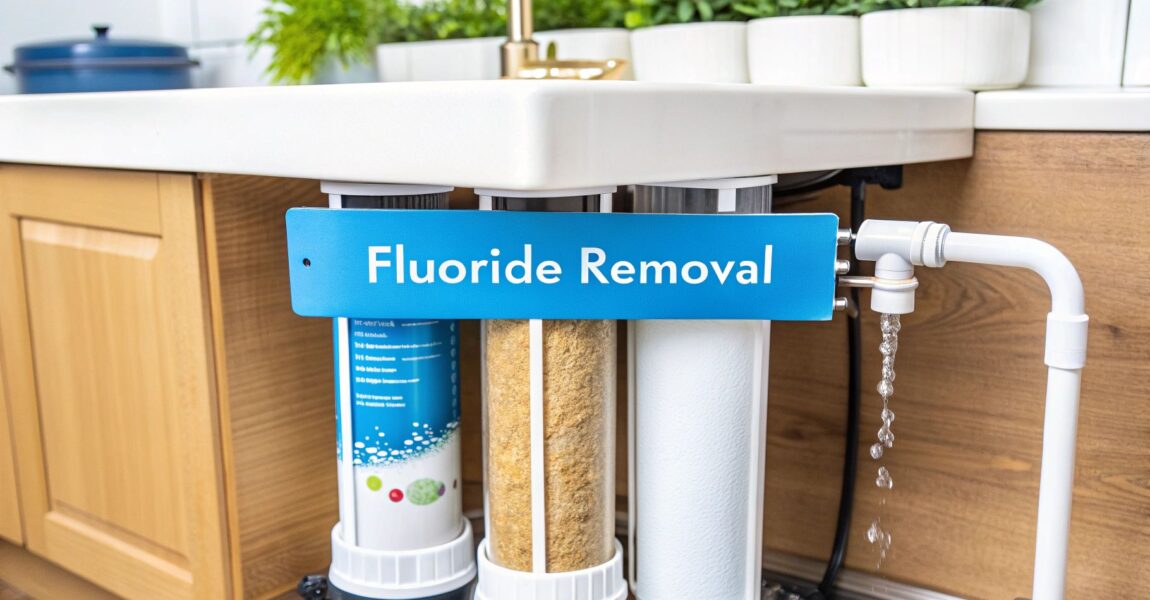
How to Remove Chloramine from Water: A Homeowner’s Filtration Guide

If your tap water tastes and smells a little too much like the local swimming pool, you’re not imagining things. You're dealing with chloramine, the long-lasting disinfectant many cities use to keep our water safe. The catch? Your standard pitcher filter is completely outmatched by it.

So, how do you kick it to the curb? The secret lies in specialized home water filtration. The heavyweight champs for this job are systems using catalytic carbon or reverse osmosis. Forget boiling or letting it "air out"—those tricks don't work here. Let's dive into how you can reclaim your tap and get back to truly fresh, clean water.

So, Why Is Chloramine in Your Tap Water Anyway?

A glass of tap water being filled from a kitchen faucet, representing municipal water treated with chloramine

That subtle chemical tang isn't an accident; it's a feature, not a bug. Your municipal water supplier adds disinfectants to hunt down and destroy nasty bacteria and viruses, ensuring the water is safe by the time it reaches your home. For decades, chlorine was the star player, but many municipalities have upgraded to a more resilient disinfectant: chloramine.

What’s the magic recipe? Chloramine is simply chlorine plus ammonia. This chemical tag team makes it far more stable and persistent than chlorine alone. When water has to travel through miles of aging pipes, that stability is a massive win for public health. It ensures a consistent shield of disinfection from the treatment plant all the way to your faucet, preventing nasty pathogens from crashing the party along the way.

The Chloramine Conundrum at Home

While the EPA gives chloramine the green light for drinking, its stubborn persistence can be a real headache once it's in your house. Unlike its cousin chlorine, which will politely see itself out if you let water sit for a while, chloramine sticks around like a guest who doesn't know when to leave. This is precisely why so many homeowners are searching for an effective way to remove it.

Most of the frustrations I hear from people boil down to a few key issues:

  • That Unmistakable Taste and Odor: The most common complaint is the unpleasant "off" taste and chemical smell. It can turn a perfect cup of coffee into a disappointment and make a simple glass of water taste anything but refreshing.
  • Skin and Hair Rebellion: Countless people have told me about their battles with dry skin, mysterious irritation, and brittle hair after showering. If you already have sensitive skin or conditions like eczema, chloramine can feel like a daily antagonist.
  • Trouble for Hobbies and Pets: For some, chloramine is more than an annoyance; it's a saboteur. It's highly toxic to fish and aquatic pets, turning an aquarium into a danger zone. It can also stunt the growth of delicate plants in hydroponics and create funky off-flavors for homebrewers.

Water districts switched to chloramine for a very good reason: it’s a more reliable disinfectant for complex water systems. But that very same chemical resilience is what makes it a pain to deal with in your home, demanding specialized filtration to knock it out.

Your Concerns Are Valid

If you've noticed these problems, you're not going crazy. The properties that make chloramine an excellent municipal disinfectant are the exact same ones that cause issues once it flows from your tap. Because it refuses to break down easily, it impacts everything from your morning brew to the health of your fish and garden.

This is why your generic, off-the-shelf water filter often falls flat. Those standard pitcher filters are designed to tackle chlorine and are almost useless against the tougher chloramine molecule. Understanding this distinction is the first step toward finding a real solution—a filtration system engineered specifically to break apart this tenacious compound and put you back in control of your water.

Choosing the Right Carbon Filter System

A close-up shot of a whole-house catalytic carbon water filtration system installed in a residential garage.

When you start digging into how to remove chloramine from water, you'll quickly discover that carbon filtration is the MVP for most homes. It's a true workhorse. But here's the plot twist that catches many people off guard: not all carbon filters are created equal.

The difference between standard activated carbon and its superstar cousin, catalytic carbon, is the difference between sort of addressing the problem and actually solving it for good.

Standard Activated Carbon vs. Catalytic Carbon: The Showdown

Think of standard activated carbon—the stuff in your basic pitcher or faucet filter—as a magnet for chlorine. It does a fantastic job of grabbing chlorine molecules and holding onto them through a process called adsorption.

Chloramine, however, plays by different rules. It’s a stubborn bond of chlorine and ammonia. Standard carbon just doesn’t have the muscle to break that bond effectively.

This is where catalytic carbon makes its grand entrance. It's not a different material, but rather activated carbon that's been given a supercharged surface. This special surface acts as a catalyst, sparking a chemical reaction that literally splits the chloramine molecule into harmless chloride and ammonia. It’s a targeted, aggressive, and highly effective attack.

The science backs this up. Studies show that when facilities use activated carbon columns, they can slash chloramine levels from 0.25–0.3 ppm to below the detectable limit of 0.1 ppm. The data is clear, and you can explore the full findings on chloramine reduction techniques on NCBI.

To put it bluntly: if you're serious about evicting chloramine from your water, catalytic carbon isn't just a nice upgrade—it's the only tool for the job.

Here's a quick cheat sheet to see the difference at a glance.

Comparing Carbon Filters for Chloramine Removal

Feature Standard Activated Carbon Catalytic Carbon
Primary Mechanism Adsorption (traps contaminants) Catalytic Reaction (breaks contaminants down)
Chloramine Removal Poor to fair Excellent
Chlorine Removal Good to excellent Excellent
Lifespan Shorter; gets exhausted by chloramine Longer; more durable and efficient
Cost Lower upfront cost Higher upfront cost
Best For Chlorine taste and odor Complete chloramine removal

As you can see, for the specific mission of eliminating chloramine, catalytic carbon is the undisputed champion.

Whole House vs. Point of Use: Where to Install Your Filter?

Okay, you're on board with catalytic carbon. Now for the next big question: where do you put it? Your decision comes down to a simple choice: treat all the water in your house, or just the water at a specific tap.

A point-of-use (POU) system is your precision strike. These are typically installed under the kitchen sink, feeding a dedicated faucet. If your main goal is unbelievably pure, fantastic-tasting water for drinking and cooking, this is a brilliant and budget-friendly choice.

A whole-house system, also known as a point-of-entry (POE) system, is the all-in-one fortress. It’s installed where your main water line enters your home, meaning every single drop you use gets treated. We're talking chloramine-free showers, cleaner laundry, and happier appliances. This is the ultimate solution for protecting your skin and hair and shielding your home’s plumbing from long-term damage.

A whole-house catalytic carbon system is an investment in your entire home's infrastructure and your family's daily comfort. An under-sink system is a targeted fix for perfect water right where you need it most. Your budget and biggest annoyances will point you to the right answer.

What to Look for When You're Shopping

When you start browsing for systems, you'll be swimming in a sea of marketing buzzwords. To cut through the noise, focus on the specs that actually matter for defeating chloramine.

Here's a quick buyer's checklist:

  • Carbon Type: This is the big one. The product description must explicitly say "catalytic carbon." If it just says "activated carbon" or "carbon block," walk away. It's the wrong tool for this job.
  • Contact Time: In filtration, longer is better. This refers to how much time the water spends in contact with the carbon. For whole-house systems, this means a bigger tank equals more contact time, which equals more complete removal.
  • Micron Rating: This tells you the filter's pore size. A smaller number (like 0.5 microns) is great for catching sediment, but remember, the catalytic action is what zaps the chloramine, not the micron rating.
  • Certifications: Look for a seal of approval from a third-party tester like NSF International. The NSF/ANSI Standard 42 certification for chloramine reduction is your guarantee that the system has been independently tested and proven to work.

Keep these four points in mind, and you'll be able to confidently pick a system that delivers the clean, safe, and gloriously chloramine-free water you've been dreaming of.

Beyond Carbon: Other Powerful Filtration Methods

While catalytic carbon is the undisputed champion for whole-home chloramine removal, some situations call for the heavy artillery. If you're chasing the absolute highest level of water purity, particularly at your kitchen sink, it's time to meet the elite forces of filtration: Reverse Osmosis and distillation.

These technologies play a completely different game. They go far beyond just disinfectants, targeting a massive spectrum of contaminants. They operate on unique principles, giving them distinct advantages—and, naturally, their own set of rules. Understanding how they work is the key to deciding if one of these powerhouses is the right move for your home.

The Power of Reverse Osmosis

Reverse Osmosis, or RO, is the rockstar of the water purification world. It works by using pressure to force water through a semipermeable membrane—a filter with pores so ridiculously tiny that they block almost everything that isn't a pure water molecule. This makes it a beast at removing a long list of undesirables, from heavy metals like lead to dissolved salts and, yes, chloramine.

But there’s a crucial detail that often gets overlooked when people research how to remove chloramine from water with an RO system. The high-tech RO membrane is actually quite delicate and can be damaged by disinfectants like chlorine and chloramine.

To solve this, every quality RO system includes a secret weapon: a carbon pre-filter. This pre-filter is the unsung hero of the whole operation. It eliminates the chloramine before the water ever reaches the sensitive RO membrane, protecting it from degradation and ensuring the system runs like a champ for years.

  • What it does: Pushes water through a microscopic membrane to strip out up to 99% of all dissolved solids (TDS).
  • Key Feature: Relies on a catalytic carbon pre-filter to neutralize chloramine first, acting as a bodyguard for the RO membrane.
  • Best For: Achieving exceptionally pure drinking and cooking water at a single location, like your kitchen sink.

The Secret Weapon: The Carbon Pre-Filter

So, when you buy an RO system to get rid of chloramine, you're actually getting a multi-stage purification dream team. The carbon pre-filter does the heavy lifting on the chloramine, and then the RO membrane polishes the water to an incredible level of purity. Without that vital carbon stage, an RO system would have a very short and unhappy life.

This is why you should always check the specs of that pre-filter. Make sure it uses catalytic carbon for the best possible defense against chloramine. This one-two punch delivers some of the cleanest, best-tasting water you can get at home. While carbon filtration is a fantastic solution for chloramine, plenty of other water quality filtration methods exist for different needs and contaminants.

When you choose a Reverse Osmosis system, you're not just buying a membrane; you're investing in a team of filters working in perfect harmony. The catalytic carbon pre-filter is the most valuable player on that team for defeating chloramine.

Distillation: The Ultimate Purifier

For the purists who demand nothing less than absolute perfection, water distillation is another formidable option. This method cleverly mimics Mother Nature's own water cycle: you boil water into steam, leaving virtually all contaminants behind, and then condense that pure steam back into pristine liquid water.

Distillation is practically unbeatable in its ability to remove the widest possible range of impurities. By physically separating pure H₂O from everything else, it effectively eliminates:

  • Heavy metals (lead, arsenic, mercury)
  • Bacteria and viruses
  • Dissolved minerals and salts
  • Chloramine and other chemicals

But this level of perfection comes with a few trade-offs. Distillers work at a snail's pace, often taking hours to produce a single gallon of water. They also require a significant amount of electricity to boil the water, making them less energy-efficient than other systems.

Comparing High-Purity Systems

Filtration Method How It Works Key Pros Key Cons
Reverse Osmosis Pushes water through a semipermeable membrane. Highly effective; removes a wide range of contaminants; provides on-demand water. Produces wastewater; requires regular filter changes.
Water Distillation Boils water to steam, then condenses it back to liquid. The highest level of purity; removes nearly all contaminants. Very slow process; high energy consumption; not on-demand.

Ultimately, choosing between these advanced systems and a dedicated carbon filter comes down to your primary goal. If you want great-tasting, chloramine-free water throughout your entire home, a whole-house catalytic carbon system is the most practical and effective choice. But if your mission is the absolute purest drinking water possible from your kitchen tap, an RO system with a top-notch carbon pre-filter is an unbeatable solution.

Solutions for Showers, Aquariums, and Gardens

A person tending to a lush indoor garden with various plants, highlighting the need for treated water.

While a whole-house system is the ultimate "set it and forget it" solution, you don't always need to bring in the big guns. Sometimes, you just need a targeted fix for a specific problem—and chloramine causes trouble in more places than just your drinking glass. It can wage war on your skin in the shower, endanger your prized fish, and even stress out your garden.

Luckily, there are simple, brilliant, and affordable solutions for these smaller battlefronts. These point-of-use fixes are perfect for neutralizing chloramine on a smaller scale, giving you immediate relief without needing to call a plumber.

Soothe Your Skin and Hair with Vitamin C

Ever stepped out of the shower feeling dry, itchy, and wondering why your hair feels like straw? Chloramine is a notorious culprit, stripping away the natural oils that keep your skin and hair happy and hydrated. This is where a Vitamin C shower filter becomes your new best friend.

These little wonders couldn't be easier to install. You just screw one on between the shower arm and your existing showerhead. Inside, a cartridge filled with ascorbic acid (good old Vitamin C) instantly neutralizes chloramine as water flows through it, turning it into harmless compounds before it ever touches your body. The difference can be shockingly immediate.

  • How it Works: Water passes through the filter, dissolving a tiny amount of Vitamin C, which triggers an instant chemical reaction that zaps chloramine on contact.
  • Benefits: You'll likely notice softer skin and hair, less scalp irritation, and the disappearance of that "pool" smell from your shower steam.
  • Maintenance: Simply swap out the Vitamin C cartridge every few months, depending on your water's chloramine levels and how often you shower.

Protect Your Aquarium and Hobbies

For fish keepers, chloramine isn't just an irritant—it's a death sentence. It enters a fish's bloodstream directly through the gills and can be fatal even at the low concentrations found in tap water. The same goes for hobbies like homebrewing, where chloramine creates foul "chlorophenol" off-flavors, or for growing sensitive plants like orchids.

For these specialized uses, chemical neutralization is the quickest and most reliable method. You can easily treat water in small batches for aquarium changes, brewing sessions, or watering your fussy plants.

For aquarists and homebrewers, precision is paramount. A simple chemical treatment gives you total control over your water quality, ensuring your fish stay healthy and your brew tastes exactly as it should.

Products containing ascorbic acid (Vitamin C) or sodium thiosulfate are the industry standard. These compounds react instantly with chloramine to render it harmless. For ascorbic acid, the required dose is incredibly small—about 1.5 milligrams for every milligram of chloramine—making it a super-efficient way to get safe water in seconds.

Treat Water for Your Garden

Your garden plants might not die as dramatically as fish, but many varieties, especially seedlings, can be stressed by chloramine-treated water. Over time, it can harm the beneficial microbes in your soil that are vital for healthy root systems and nutrient uptake.

A few simple strategies can make a world of difference for your green thumb:

  1. Use a Hose-End Carbon Filter: You can find filters designed to attach right to your garden hose. Just be sure to get one specifically rated for chloramine (it will likely use catalytic carbon) to treat water as you spray.
  2. Treat Water in a Rain Barrel: If you collect water in a large container, you can add Vitamin C powder or sodium thiosulfate drops to treat the entire batch at once. Problem solved.

Water quality is just as important as timing; learn more about optimizing your watering practices for healthy plants. By taking this extra step, you're helping create a thriving soil ecosystem for a more bountiful garden.

These targeted solutions prove you don't have to live with chloramine's annoying side effects. Whether it's a simple shower filter or a few drops of a neutralizer, you can easily and affordably win these smaller battles around your home.

Getting Your System Installed and Keeping It Running

Alright, you've navigated the technical jargon and picked your champion filtration system. But what's it really like to live with one of these systems day to day? Choosing the right filter is only half the battle. The other half is tackling the practical stuff: the cost, the installation, and the ongoing maintenance. This is where the rubber meets the road.

Your first major decision is a fork in the road: are you treating every drop of water entering your home, or just the water you drink? This single choice will shape everything that follows.

Whole House or Point of Use?

A whole-house system, sometimes called a point-of-entry (POE) system, is the big kahuna. It’s installed right where your main water line enters your home, treating every single drop of water. This means chloramine-free showers, cleaner laundry, and even protection for your pipes and appliances from the inside out. If you're sensitive to chloramine on your skin or just want the ultimate peace of mind, this is your answer.

On the other hand, a point-of-use (POU) system is a sharpshooter. Think of an under-sink reverse osmosis unit that filters only the water going to your kitchen tap. It's a highly targeted approach, which also makes it significantly more affordable upfront. This is a fantastic solution for renters or anyone whose main concern is having pristine water for drinking, cooking, or filling the pet's bowl.

The choice between whole-house and point-of-use really boils down to one question: Are you trying to fix a specific issue, like the taste of your drinking water, or are you looking to upgrade the water quality for your entire home? Your answer will point you in the right direction.

Unpacking the True Costs

The price tag on the box is just the beginning. To truly understand your total investment, you need to look at both the upfront purchase price and the ongoing costs to keep it humming. The numbers can vary wildly, so it pays to know what you're getting into.

  • Initial Purchase & Installation: This is your biggest one-time expense. A quality under-sink POU system might cost you $150 to $500. A serious whole-house catalytic carbon system can easily run from $800 to over $2,000, and that’s before installation. Hiring a professional plumber will add a few hundred dollars, but it’s often money well spent for the confidence that it's installed correctly.
  • Recurring Filter Replacements: This is the cost that often surprises people. Filters are consumables; they don't last forever. An under-sink RO unit might require $50 to $150 in new pre-filters and post-filters each year. A large whole-house system has a carbon tank that could last 3 to 5 years (or even longer), but when it's time to replace that media, it can be a significant expense.

Planning for these costs ahead of time saves you from sticker shock down the road and lets you budget for years of clean, hassle-free water.

Cost and Maintenance Overview for Chloramine Removal Systems

To make it easier to compare, here's a quick snapshot of what you can generally expect in terms of cost and upkeep for the most common systems. These are just ballpark figures, but they give you a solid starting point for your budget.

System Type Initial Cost Estimate Annual Maintenance Cost Best For
Catalytic Carbon (Whole House) $800 – $2,500+ $100 – $300 (for pre-filters & media replacement, averaged) Complete home protection against chloramine's effects on skin, pipes, and appliances.
Reverse Osmosis (Under-Sink) $200 – $600 $50 – $150 Highest purity drinking and cooking water at a single tap.
Specialty Shower Filter $30 – $90 $30 – $60 Targeted removal for softer skin and hair; great for renters.
Ascorbic Acid Neutralizer $50 – $150 (for filters) $40 – $80 Specific uses like bathing or for aquariums and hydroponics.

Remember, the "best" system is the one that solves your specific problem without demolishing your budget. The initial hit for a whole-house system is steep, but the comprehensive protection is unbeatable. For targeted purity, nothing beats an RO system.

Creating a Simple Maintenance Schedule

Your water filter is just like any other hard-working appliance in your home—it needs a little TLC to keep performing at its best. If you neglect to change the filters, you're not just getting less effective filtration; you could end up with low water pressure or even damage the entire system. A simple maintenance plan is your best friend.

The manufacturer's guide is always your go-to resource, but you'll want to adjust that schedule based on two key factors:

  1. Your Water Usage: A large, thirsty family will exhaust filters much faster than someone living alone. It’s a simple matter of volume.
  2. Your Local Water Quality: If your city's water is particularly high in sediment or uses a higher concentration of chloramine, your filters are working overtime and will need to be replaced more frequently.

Here’s a basic schedule you can adapt:

  • Under-Sink POU: Plan on swapping the pre- and post-filters every 6-12 months. The RO membrane is the marathon runner, typically lasting 2-4 years. Pro tip: The day you install new filters, set a calendar reminder on your phone for six months out. Future You will be grateful.
  • Shower Filter: These have a shorter lifespan, usually needing a new cartridge every 3-6 months. My advice? Buy replacement cartridges in multi-packs. You'll save a few bucks and won't get caught without a spare when you need it.
  • Whole-House Carbon: The giant tank of carbon media is the workhorse, lasting anywhere from 3 to 5 years or more. You’ll likely have a sediment pre-filter that needs changing every 6-12 months. A simple trick: Grab a permanent marker and write the installation date directly on the tank. No more guessing games.

Staying on top of a simple schedule like this ensures your investment continues to pay dividends in the form of clean, safe, and great-tasting water for your family.

Common Questions About Chloramine Removal

Even after you've done your research on how to remove chloramine from water, it's completely normal to have a few nagging questions. I field calls about this all the time. Let’s tackle some of the most common head-scratchers so you can move forward with total confidence.

Can I Just Boil Chloramine Out of My Water?

This is easily the most popular myth, and the answer is a firm no.

While boiling water for about 20 minutes is a time-honored trick for getting rid of standard chlorine, it's utterly useless against the much more stubborn chloramine molecule. In fact, boiling can actually make things worse by concentrating other unwanted contaminants as the water evaporates.

Stick with a proven method that chemically breaks the chloramine bond, like a catalytic carbon filter or even a simple Vitamin C treatment.

How Do I Know If My City Uses Chloramine?

Finding out is much easier than you'd think. Your local water utility is required by law to publish an annual Water Quality Report, sometimes called a Consumer Confidence Report. This document details exactly which disinfectants they use and at what concentrations.

Your first move should be to visit your city or water district's website. A quick search for "[Your City Name] Water Quality Report" will usually pull it right up. If you can't find it online, a simple phone call to their customer service department will get you the answer you need. For a deeper dive into what else might be lurking in your pipes, you can find a ton of great water filter advice and guidance to help you decode your home's unique water profile.

Is a Standard Carbon Filter Good Enough?

Unfortunately, no. This is a critical point that trips up many people.

Standard activated carbon filters—the kind found in most basic pitcher and faucet-mount filters—are designed for chlorine. They use a process called adsorption to physically trap chlorine molecules, but they are painfully slow and inefficient when faced with chloramine.

If chloramine is your primary target, you absolutely need a filter that contains catalytic carbon. This souped-up media actively triggers a chemical reaction that shatters the chloramine molecule. Don't make the common mistake of bringing a generic carbon filter to a chloramine fight.

This decision tree gives you a great visual for that first big choice.

Infographic about how to remove chloramine from water

As the graphic shows, it really comes down to deciding whether you need to treat all the water coming into your house or just the water at a specific tap, like your kitchen sink.

Your Complete Guide to Point of Entry Water Filters

Picture this: you turn on any tap in your house—the kitchen sink for a glass of water, the shower after a long day, the bathroom faucet to brush your teeth—and out comes pure, clean, refreshing water. Every. Single. Time. That isn't a far-off dream; it's the reality a point-of-entry (POE) water filter delivers. Think of it as hiring a top-notch security guard for your home's entire water supply, inspecting and purifying every drop the moment it steps onto your property.

This isn't about slapping a filter onto a single faucet. A POE system is a comprehensive solution that cleans all your water at its source, protecting not just your family's health, but your expensive appliances from a whole rogues' gallery of unwanted contaminants.

What Are Point of Entry Water Filters?

A point-of-entry filter, known in the biz as a whole-house water filter, is a system plumbed directly into your main water line. It's the ultimate gatekeeper. Before a single drop of water can make its way to your shower, washing machine, or that fancy coffee maker, it has to pass inspection through this central filtration fortress.

This setup ensures that every drop you use for bathing, cooking, cleaning, and drinking is purified. Instead of playing whack-a-mole with water quality issues from room to room, a POE system provides one powerful, all-encompassing solution. These systems are true workhorses, built to handle a serious volume of water, easily purifying thousands of gallons a day without ever making your home's water flow skip a beat.

Why Whole-House Filtration Is a Big Deal

The quest for cleaner water is more than just a trend; it's a growing necessity. It's estimated that in the U.S. alone, over 7.1 million Americans fall ill each year from waterborne contaminants. That's a staggering public health issue, and it's prompting more and more homeowners to take a hard look at what's really flowing through their pipes.

This rising awareness is fueling a massive market shift. In fact, the demand for point-of-entry systems is projected to explode into an USD 18.15 billion industry by 2035. You can dive deeper into the data behind this trend over at Spherical Insights & Consulting.

By treating every drop entering your home, these systems solve a wide array of problems that affect your daily life, and the benefits extend far beyond just better-tasting water.

A point of entry system isn't just about purifying drinking water; it's about elevating the quality of life throughout your entire home. It protects your health, preserves your appliances, and enhances your daily routines, from showering to doing laundry.

Key Benefits for Your Home

Installing a point-of-entry water filter in your home brings a cascade of immediate and long-term perks:

  • Luxurious Showers and Baths: By removing chlorine and other harsh chemicals, the water becomes gentler on your skin and hair, reducing that annoying dryness and irritation. Hello, spa day at home!
  • Appliance Life Support: Sediment, minerals, and chlorine are the arch-nemeses of water-using appliances like dishwashers, washing machines, and water heaters. Filtered water helps them live longer, more efficient lives.
  • Better-Tasting Water, Everywhere: Enjoy the peace of mind that comes with clean, delicious water from every single faucet in the house—not just the one in the kitchen.
  • Brighter, Softer Laundry: When you eliminate the contaminants that make fabrics feel dingy and stiff, your clothes emerge from the wash brighter, softer, and cleaner than ever.

How a Whole House Filter Actually Works

To truly appreciate what a point-of-entry water filter does, you need to peek inside the tank. Don't imagine a simple screen; picture a highly coordinated team of filtration specialists, each with a specific mission to purify your water. When water flows in from your main line, it isn't just passing through a single barrier. It’s embarking on a journey through several sophisticated layers of filter media.

This multi-stage gauntlet is what makes these systems so formidable. Each layer is engineered to target and eliminate different types of impurities. By the time the water exits the tank, it has been thoroughly scrubbed, ensuring that one system can tackle a huge range of issues, from dirt and chemicals to heavy metals.

This graphic provides a clear visual of how a POE filter acts as the gatekeeper for your home's entire water supply, treating it before it ever reaches your faucets.

Infographic about point of entry water filters

As you can see, the filter is a central checkpoint. It guarantees that every tap—from your kitchen sink to your shower—delivers purified water.

The First Line of Defense: The Sediment Filter

The journey always begins with the sediment filter. Think of it as the bouncer at an exclusive club. Its sole job is to stop the big, obvious troublemakers from getting past the velvet rope. This initial stage snags physical debris like sand, dirt, silt, and rust that can make water cloudy and wreak havoc on your plumbing fixtures over time.

It's essentially a high-tech colander for your water. This simple but absolutely crucial first step prevents larger particles from clogging up the more delicate, specialized filter media that comes next. By clearing the path, the sediment filter protects the rest of the system, helping it perform better and last longer.

The Chemical Sponge: Activated Carbon

Once the water is free of sediment, it moves on to meet the undisputed champion of chemical removal: activated carbon. Now, this isn't the same charcoal you use for grilling. It's an incredibly porous material with a mind-boggling surface area—a single gram can have the surface area of an entire football field.

Activated carbon uses a process called adsorption, where chemical contaminants literally stick to its surface like tiny magnets. It’s a beast at grabbing things like chlorine, pesticides, herbicides, and those nasty volatile organic compounds (VOCs) that give your water weird tastes and smells. This is exactly why it’s a non-negotiable part of nearly every top-tier point-of-entry water filter.

By yanking out chlorine and its byproducts, activated carbon doesn’t just make your water taste and smell fantastic. It also makes it much kinder to your skin and hair when you shower.

The Elite Specialists: Advanced Media for Tough Contaminants

Some homes face water challenges that require more than just the basics. For those dealing with more stubborn or specific contaminants, advanced filtration media provides that next level of protection. These are highly engineered materials designed to tackle the tough stuff that standard carbon filters might miss.

To give you an idea of the available arsenal, we’ve put together a table breaking down the most common types of filter media and their specific targets.

Common Filtration Media and Their Targets

Filtration Media Primary Function Removes Contaminants Like…
Sediment Physical Particulate Removal Sand, silt, rust, dirt, and other suspended solids.
Activated Carbon Adsorption of Chemicals Chlorine, pesticides, herbicides, VOCs, and improves taste/odor.
KDF (Kinetic Degradation Fluxion) Redox Reactions & Bacteriostatic Heavy metals (lead, mercury, iron), chlorine, and inhibits bacteria/algae growth.
Catalytic Carbon Catalytic Conversion Chloramine (a persistent chlorine/ammonia disinfectant), hydrogen sulfide.
Oxidation Media (e.g., Manganese Greensand) Oxidation and Filtration Iron, manganese, and hydrogen sulfide (rotten egg smell).

These advanced stages work in concert with the sediment and carbon layers. Each one builds on the last, systematically stripping away impurities until only clean, safe water is left to flow through your home. This teamwork is the real secret behind a truly effective whole-house system.

Choosing the Right System for Your Home

A close-up of a point of entry water filter system installed on a wall.

When you're picking out a point-of-entry water filter, it's not about finding the biggest, most expensive unit you can. The best system is the one that fits your home's unique water needs like a glove.

It’s a bit like buying a car. You wouldn't get a tiny two-seater sports car for a family of six, right? And you probably wouldn't commute to the office every day in a massive RV. Your water filter needs to be the right fit for your household, and that comes down to three things: sizing, flow rate, and performance certifications. Nail these, and you'll have clean, reliable water without any headaches.

Sizing Your System for Your Household

First things first, you need a handle on how much water your family actually uses. A system that’s too small will constantly struggle to keep up. You'll end up with clogged filters way too soon and, even worse, a drop in water pressure. On the flip side, an oversized system is just money down the drain.

To get a solid estimate, just look at two key factors:

  • Number of People: The classic rule of thumb is that each person uses somewhere between 75 and 100 gallons of water a day. That covers everything from showers and laundry to flushing the toilet.
  • Number of Bathrooms: A house with more bathrooms means more fixtures that can all be running at once. Think about those chaotic weekday mornings! A four-bathroom house is going to have a much higher peak demand than a one-bathroom apartment.

So, a family of four in a three-bathroom home has very different needs than a couple living in a two-bathroom condo. Sizing your system correctly ensures it can handle your busiest moments without skipping a beat. For more detailed help, you can find a ton of professional advice over at https://www.waterfilteradvisor.com/advice/.

Understanding Flow Rate and Water Pressure

Ever been enjoying a hot shower when someone flushes a toilet, and suddenly your water pressure tanks? That’s what a poor flow rate feels like. Flow rate is measured in gallons per minute (GPM), and it basically tells you how much water can pass through your filter at one time.

A point of entry water filter's flow rate must be high enough to meet your home's peak demand. This is the amount of water needed when multiple appliances and faucets are running simultaneously, like the shower, dishwasher, and a sink.

A standard shower head uses about 2.5 GPM, a dishwasher needs around 2 GPM, and a kitchen faucet runs at about 1.5 GPM. If your family often has all these going at once, your peak demand could easily be 6 GPM or more. You need to pick a system with a GPM rating that meets—or even better, exceeds—that number to keep the water pressure strong and steady everywhere in the house.

Why Certifications Matter

So, how can you be sure a filter actually does what the box says it does? This is where you look for certifications from independent organizations like the NSF (National Sanitation Foundation) and ANSI (American National Standards Institute). They’re your best friend in this process.

These certifications aren't just clever marketing. They are cold, hard proof that a third-party lab has put the system through its paces to make sure it really removes the contaminants it claims to.

For example, NSF/ANSI 42 certifies that a filter makes your water taste and smell better by reducing chlorine. NSF/ANSI 53, on the other hand, is a much more serious certification confirming it can remove health-related contaminants like lead or cysts. If you're building a new home, it's a good idea to review some essential questions to ask a custom home builder to ensure they plan for plumbing that can accommodate certified filtration systems.

Always check for these certification marks when you're shopping around. They give you an unbiased guarantee of performance and peace of mind that you're making a solid investment in your family's water quality.

Whole House vs Single Faucet Filters

So, you're trying to figure out if you need a big whole-house system or just something small for the kitchen sink. It can feel like a tough choice, but there's a simple way to think about it.

A whole-house filter is like your home's central air conditioning—it treats every single room, providing consistent comfort everywhere. A single-faucet filter, on the other hand, is like a portable window AC unit. It does an amazing job cooling one specific room, but the rest of the house is on its own.

Both are great at what they do. The right one for you really comes down to what you're trying to fix, your budget, and how much of your home you want to cover. Let's break down the differences.

The Point of Entry Advantage: Comprehensive Coverage

A point of entry (POE) system, also known as a whole-house filter, is the ultimate "set it and forget it" solution for your water. It gets installed right where the main water line enters your house, so it filters every single drop of water before it ever reaches a tap.

This means you get filtered water for everything, not just drinking. Think about it:

  • Better Showers: Less chlorine and other chemicals means softer skin and hair. No more that dry, itchy feeling after a shower.
  • Longer-Lasting Appliances: Your dishwasher, washing machine, and water heater are shielded from sediment and scale buildup that can cause damage over time.
  • Cleaner Laundry: Your clothes will feel softer and look brighter without all those harsh minerals and chemicals.

The biggest plus is peace of mind. You never have to wonder which faucet is safe—they all are. The trade-off? These systems have a higher upfront cost and usually need a professional to install them correctly.

The Point of Use Approach: Targeted and Affordable

Point-of-use (POU) filters are the sharpshooters of water filtration. These are your under-sink systems or faucet-mounted units that treat water at a single spot, usually the kitchen sink. They are fantastic for making sure the water you drink and cook with is as pure as possible.

To get a better idea of how these fit in, it helps to understand the various types of kitchen faucets where you'd typically install a POU filter. Their popularity comes from being affordable and pretty easy to install yourself.

In fact, the global water filter market is expected to reach USD 48.2 billion by 2025, and POU systems account for a huge chunk of that—almost 44.8% of total revenue. People love them because they're a low-cost, effective way to get great-tasting water right where they need it most.

The bottom line is this: POE systems give you complete, home-wide protection. POU filters give you high-purity water for drinking and cooking at a much lower cost, but they leave the rest of your home’s water untreated.

To give you a clearer picture, here’s a quick side-by-side comparison of the two approaches.

Whole-House vs. Single-Faucet Filter Comparison

Feature Point of Entry (Whole-House) Point of Use (Single-Faucet)
Coverage Treats all water entering the home. Treats water at a single tap (e.g., kitchen sink).
Protection Protects plumbing and all water-using appliances. Protects only the specific faucet it's attached to.
Installation Typically requires professional plumbing. Often a simple DIY installation.
Upfront Cost Higher initial investment ($500 – $3,000+). Lower initial investment ($50 – $500).
Maintenance Less frequent filter changes (e.g., 6-12 months or longer). More frequent filter changes (e.g., 2-6 months).
Best For Widespread issues like chlorine, sediment, or hard water. Targeted removal of contaminants for drinking water.

This table helps illustrate the core trade-offs. It's not about one being "better," but about which one is the right tool for your specific job.

Finding the Best of Both Worlds

For a lot of homeowners, the perfect setup isn't an "either/or" decision. It’s a "both/and" strategy. You can actually combine both types of systems to create a powerful, multi-layered defense against any water contaminant.

Here’s how it usually works: You install a whole-house carbon filter to take care of the big stuff—chlorine, sediment, and general chemicals—at every tap. Then, you add a specialized POU system, like a reverse osmosis unit, under the kitchen sink to get rid of the really tough contaminants like lead, fluoride, or arsenic.

This hybrid approach gives you the absolute best of both worlds. You get general protection for your appliances, pipes, and skin, plus surgical precision for the water you and your family actually drink. It's a comprehensive solution that leaves no stone unturned.

Installation, Maintenance, and Long-Term Costs

A plumber working on installing a point of entry water filter system in a residential setting.

Buying a whole-house water filter is a bit like buying a car. The sticker price is just the beginning. To really understand the investment, you have to factor in the installation, the regular maintenance, and the total cost over its lifetime. Think of it as the fuel, oil changes, and tune-ups that keep it running smoothly for years.

Planning for these things from the start means you’ll get the clean, safe water you paid for without any nasty surprises down the road. It turns a simple purchase into a smart, long-term investment in your home and your family's health.

Getting Your System Up and Running

So, you’ve picked out the perfect point of entry water filter. Now what? The first step is getting it installed, which usually means cutting into your home's main water line. It’s a job that demands a steady hand and a solid understanding of plumbing.

You’ve got two options here: DIY or hire a pro. Going the DIY route can definitely save you some money on labor, but it’s a serious project. One slip-up could lead to leaks, a drop in water pressure, or a system that isn't even filtering properly. For most people, hiring a licensed plumber is the way to go. It ensures the job is done right, meets local codes, and keeps your warranty intact.

Professional installation for a whole house system can run anywhere from $300 to over $1,000, depending on how complex your plumbing is and the going rates in your area. It's an extra cost, sure, but the peace of mind is often worth every penny.

Creating a Clear Maintenance Roadmap

Your whole-house filter is a workhorse, but it’s not a “set it and forget it” appliance. To keep it working at peak performance and maintain strong water pressure, you'll need to do some regular upkeep. The good news is the schedule is predictable and pretty easy to manage.

Maintenance mostly boils down to swapping out the filter media. How often you do this depends on the specific part and just how "gunky" your water is to begin with.

Here’s a general idea of what to expect for a replacement schedule:

  • Sediment Pre-filter: This is your first line of defense, and it catches the most stuff. Plan on replacing it every 3 to 12 months.
  • Carbon Pre/Post-filter: If your system has separate carbon block filters, they typically last about 6 to 12 months.
  • Main Media Bed: This is the heart of the system, where the heavy lifting happens with a big tank of activated carbon or KDF. This core component has a much longer lifespan, usually needing a replacement every 5 to 10 years or after filtering a huge volume of water, like 1,000,000 gallons.

Understanding the Total Cost of Ownership

To budget properly, you need to look past the initial price tag and think about the total cost of ownership over the filter's entire life. This gives you a clear, honest picture of what you'll be spending over time.

Let's break down the costs you can expect with a point of entry water filter:

  1. Initial System Cost: This is the price of the unit itself, which can be anywhere from $500 for a basic setup to $3,000+ for a beefy, multi-stage system.
  2. Installation Fee: As we mentioned, getting it installed professionally is a key part of that initial investment.
  3. Recurring Filter Replacements: This will be your main ongoing expense. You’ll want to budget for the annual sediment and carbon filter changes, plus the big, less frequent main media replacement down the line.
  4. Operational Costs: Most standard systems don’t use any electricity. However, if you get a model with a UV purifier or an automatic backwashing valve, you’ll see a small bump in your utility bill.

When you add it all up, you get a realistic picture of your investment. A little foresight here means you can enjoy great-tasting, clean water without any financial stress.

Answering Your Top POE Filter Questions

Even after you've got a handle on how these systems work, it's totally normal to have some practical questions pop up. Think of this section as your personal FAQ, where we'll tackle the common worries and head-scratchers we hear about all the time.

We've pulled together the top questions from homeowners just like you. Let's get you some answers.

Will a Whole House Filter Lower My Water Pressure?

This is probably the number one concern we hear, and for good reason. Nobody wants a weak shower. The short answer is no—a properly sized and installed system should have almost no noticeable effect on your home's water pressure.

If you do see a significant drop in pressure, it's a big red flag that something's wrong. The usual suspects are a system that’s too small for your house's needs or, more commonly, a filter cartridge that's clogged and way past its replacement date. Keeping up with the maintenance schedule is the single best way to keep your water flowing strong.

Do I Still Need a Water Softener?

This is a common mix-up. A whole-house water filter and a water softener are two completely different tools for two different jobs. Most POE filters are rockstars at pulling out things like chlorine, sediment, and other chemical contaminants. What they don't do is remove the dissolved minerals—calcium and magnesium—that cause hard water scale and soap scum.

So, the bottom line is yes, if you have hard water, you will likely still need a separate water softener. Many people opt for an integrated setup that combines both filtration and softening into one seamless system. It's the best way to get a complete fix for both water quality and hardness.

The only way to know for sure what's in your water is to test it. A good starting point is your local water utility's annual Consumer Confidence Report, which is free. For a much closer look, you can grab an at-home test kit or send a sample to a certified lab. The results will point you directly to the contaminants you need to address.

What Is the Average Lifespan of a POE System?

A good quality point-of-entry system is a long-term investment. The main tank and valve head—the core hardware—can easily last 10 to 15 years, or even longer if you take care of it.

The part that needs regular replacement is the filter media inside the tank. That's the stuff doing all the heavy lifting, and it eventually gets used up.

Here’s a general idea of the replacement timeline:

  • Sediment Pre-filters: These catch the big stuff and take the most abuse. Expect to change them every 3 to 12 months.
  • Main Media Bed: This is the big tank of carbon or other specialized media. It will typically last 5 to 10 years, but this can vary a lot based on your water quality and how much you use.

When you look at the system's longevity alongside its maintenance needs, you get a much clearer picture of what you're investing in for the long haul.


At Water Filter Advisor, we're committed to helping you find the perfect water filtration solution for your home. Explore our in-depth guides and unbiased reviews to make a confident decision for your family's health. Learn more at https://www.waterfilteradvisor.com.
How to Maintain Your Water Softener: A Guide to Silky-Smooth Water

Keeping your water softener humming along is surprisingly simple. Forget picturing some complex, intimidating chore. Think of it as a small time investment that protects a major home filtration system, guaranteeing you that glorious silky-smooth water while saving your pipes and appliances from the villainous clutches of scale buildup.

This isn't just a niche concern anymore. The crusade for better home water is booming. The global water softener market is on track to become a multi-billion dollar industry, a testament to how many people are tired of hard water hassles and are taking control of their home's water quality.

Making Maintenance a Simple Habit

The secret to a long and happy life for your water softener isn't becoming a certified water treatment expert. It's all about a few core tasks that deliver the most bang for your buck. Simple, consistent checks are what separate a well-oiled machine from a future headache.

Here are the absolute must-dos for any solid water softener maintenance routine:

  • Keep an Eye on the Salt: This is your most frequent mission. A quick peek once a month is usually all it takes to make sure you don't run out. If the salt's gone, the softening party stops dead.
  • Watch for Salt Bridges: This is a classic softener snafu where a hard crust of salt forms in the tank. It’s a sneaky trick because it looks like the tank is full, but the salt underneath can't dissolve. We'll show you how to spot and bust these up in a snap.
  • Give the Brine Tank a Good Scrub: Once a year, or maybe twice if your water source is particularly gunky, a full clean-out evicts sediment and keeps your whole filtration setup hygienic and efficient.
  • Double-Check Your Settings: Make sure your softener’s regeneration schedule is still a good fit for your family's water usage. Getting this right saves a ton on salt and water.

Once you get these few tasks down, you're no longer just reacting to problems. You're proactively managing your home's water filtration. That simple shift is the secret to getting years of reliable service from your water softener.

Water Softener Maintenance At-a-Glance

To make it even easier, here’s a quick-reference table that lays out the essential tasks and when you should be doing them.

Maintenance Task Recommended Frequency Purpose
Check Salt Level Monthly Ensures the system has enough salt to regenerate and soften water.
Break Up Salt Bridges As needed (check monthly) Prevents blockages that stop salt from dissolving into the brine.
Clean the Brine Tank Every 6-12 months Removes sediment, dirt, and salt residue for optimal filtration performance.
Check System Settings Annually Confirms the regeneration cycle matches your water usage for efficiency.

Following this simple schedule will keep your home water filtration system in top shape and prevent most common issues before they start.

It also helps to understand how your softener fits into your home’s bigger plumbing picture. For a great overview, checking out an ultimate guide to plumbing can be a real eye-opener. And for more targeted info on all things filtration, we’ve got a whole library of https://www.waterfilteradvisor.com/advice/ waiting for you.

Mastering Salt Management for Peak Filtration

Think of the salt in your softener as its fuel. Without it, the whole ion exchange process—that scientific magic trick where hard minerals get swapped out for sodium ions—grinds to a halt. Nailing salt management is the single most important part of your maintenance routine, and there's more to it than just dumping in a bag.

The kind of salt you use really does matter. You'll typically find three main options: evaporated, solar, and rock salt.

  • Evaporated Salt: This is the purest (and priciest) stuff. It dissolves without leaving much gunk behind, making it a fantastic choice for keeping your filtration system clean and running at peak efficiency.
  • Solar Salt: This is a solid middle-of-the-road option. It's made from evaporated seawater, so it's cleaner than rock salt but can still leave a bit of sediment over time.
  • Rock Salt: It's the cheapest but also the dirtiest. If you go this route, plan on cleaning your brine tank more often to get rid of the sludge that will inevitably build up.

For most modern home softeners, your best bet is usually evaporated salt pellets. They keep maintenance low and filtration performance high.

Spotting and Solving Common Salt Problems

Even with the best salt, a couple of common issues can shut your system down: salt bridges and salt mushing. Knowing what these are and how to fix them is a must for any softener owner.

A salt bridge is exactly what it sounds like—a hard crust of salt that forms over the water in your brine tank. This usually happens when it's humid or if the tank gets overfilled. It’s tricky because when you peek inside, it looks like you've got a full tank of salt, but underneath that crust is just empty air. The salt can't dissolve, no brine gets made, and your system essentially starves.

It's a classic scenario: a homeowner notices their dishes are spotty and their soap isn't lathering. They check the tank, see what looks like plenty of salt, and figure there's a serious mechanical failure. More often than not, it's just a sneaky salt bridge.

Pro Tip: Not sure if you have a bridge? Give the side of the tank a gentle tap, or use a broom handle to poke the top of the salt. If it feels solid and sounds hollow underneath, you've found your culprit.

Fixing it is easy. Just take your broom handle and carefully tap and poke the crust until it breaks apart. Scoop out any big chunks that are left.

Preventing Salt Mushing and Blockages

Down at the bottom of the tank, you can run into salt mushing. This is when salt recrystallizes into a thick, mucky sludge that can completely block the system's intake. Cheaper, less pure salts are notorious for causing this filtration nightmare.

Taking care of your salt isn't just a chore; it’s about protecting your investment. The global water softener market hit USD 1.14 billion in 2024 and is expected to climb to USD 1.53 billion by 2032, which shows just how vital these water filtration systems have become. Simple maintenance, like cleaning the brine tank every six months to clear out any potential bridges or mush, is key to performance. You can dig deeper into water softener market trends to see how proper care protects value. A clean tank means your softener can do its job, giving you the soft water you rely on.

A Practical Guide to Cleaning Your Brine Tank

While you’re probably used to topping off the salt every month or so, your brine tank needs a much more thorough cleaning about once every six to twelve months. Don't think of it as just another chore; it's more like a vital tune-up for your home’s water filtration system. This isn't just about appearances—it's about keeping your softener running at its best.

Over time, all sorts of gunk like sediment, dirt, and impurities from lower-quality salt can build up a nasty sludge at the bottom of the tank. If you let it go, this sludge can clog the brine well, which is the heart of the regeneration process. When that happens, your softener can't make the brine solution it needs to flush out hardness minerals, and you're suddenly back to square one with spotty dishes and scratchy laundry.

Getting Started with Your Tank Cleanout

First things first, you need to prep the tank. The easiest way to do this is to let the system use up most of the salt. A nearly empty tank is a lot easier to handle.

Once the salt is low, switch your system to bypass mode. You'll usually find a valve or a handle that reroutes water around the softener. This is a brilliant feature because it means you can work on the unit without having to shut off the water to your whole house.

Now you can disconnect the brine tank from the control valve. This usually just means detaching a couple of tubes and maybe the brine well cover. Just be gentle here—those plastic parts can get brittle over the years. With the tank free, your next job is to get rid of any leftover salt and water. A wet/dry vac makes short work of this, but a good old-fashioned scoop and bucket work just fine too.

This simple infographic gives you a visual on the day-to-day salt care that leads up to this big cleanout.

Infographic about how to maintain water softener

As you can see, staying on top of salt levels and breaking up any salt bridges are key. Good habits here mean you'll have a lot less gunk to deal with when cleaning day comes around.

The Cleaning and Sanitizing Process

Okay, now for the main event. With the tank empty, you can finally see what’s been lurking at the bottom. If you're on well water, don't be shocked to find a sludgy, rust-colored layer of iron sediment. It looks nasty, but this is exactly why you're doing this.

You don't need any harsh chemicals to get it clean. A simple mix of mild dish soap and warm water is usually all it takes.

  • Grab a long-handled brush and scrub the inside of the tank. Really get into the bottom and the corners where all that gunk likes to hide.
  • After a good scrubbing, rinse the tank out completely with clean water. You want to get every last bit of soap residue out.
  • Sanitizing is an optional step, but I highly recommend it. Just mix a small amount of unscented household bleach with a few gallons of water, swish it around the tank, and let it sit for about 15 minutes. This will kill off any bacteria that might be hanging around. Dump it and give the tank one final, thorough rinse.

Make absolutely sure the tank is completely rinsed and dry before you hook anything back up. Leftover soap or bleach can mess with your system's filtration performance and, more importantly, the quality of your home's water.

Once it's clean and dry, reattach the tubes to the control valve. Pour a few gallons of fresh water into the tank, then fill it up with new, high-quality salt. The last step is to take the system out of bypass mode. I always recommend running a manual regeneration cycle right away. This gets a fresh batch of brine into the system and ensures your softener is ready to get back to its water-purifying work.

How to Revitalize Your System's Resin Bed

The resin bed is the heart and soul of your water softener. It's the engine room of your home filtration, where the magic happens—where those pesky hard water minerals get snatched up and swapped out. But like any hard-working component, it can get tired. Over time, it gets gunked up with iron, manganese, and other sediment, which slowly kills its ability to do its job.

Think of the resin beads as tiny, powerful magnets. When they're clean, they grab onto calcium and magnesium with no problem. But once they're coated in grime, that magnetic pull gets weaker, and hard water starts sneaking past.

A close-up view of water softener resin beads

This is a really common issue for homes on well water, since it’s often packed with higher levels of iron that are brutal on resin. If you're noticing your laundry looks dingy, soap scum is making a comeback, or the water just doesn't feel as soft, a fouled-up resin bed is probably the culprit.

Why a Resin Tune-Up Is a Smart Move

Letting a clogged resin bed go is just asking for trouble. It's not just that your water quality drops; the entire system has to work harder to regenerate, which means you're wasting both salt and water. A quick cleaning can bring it right back to life and add years to your softener's lifespan.

Think of it like this: you wouldn't drive your car for years without an oil change and expect the engine to hold up. A resin cleaning is a cheap, easy bit of preventative maintenance that can save you from a massive replacement bill later on.

This simple step in how to maintain water softener performance really pays off. Research shows that well-maintained systems can help appliances last up to 50% longer than those running on hard water, saving you a fortune in repair costs. This is especially true in places with extremely hard water, like the U.S. Southwest, where softener ownership can be over 70% and routine care is absolutely essential. You can find more data about water softening systems on futuremarketinsights.com.
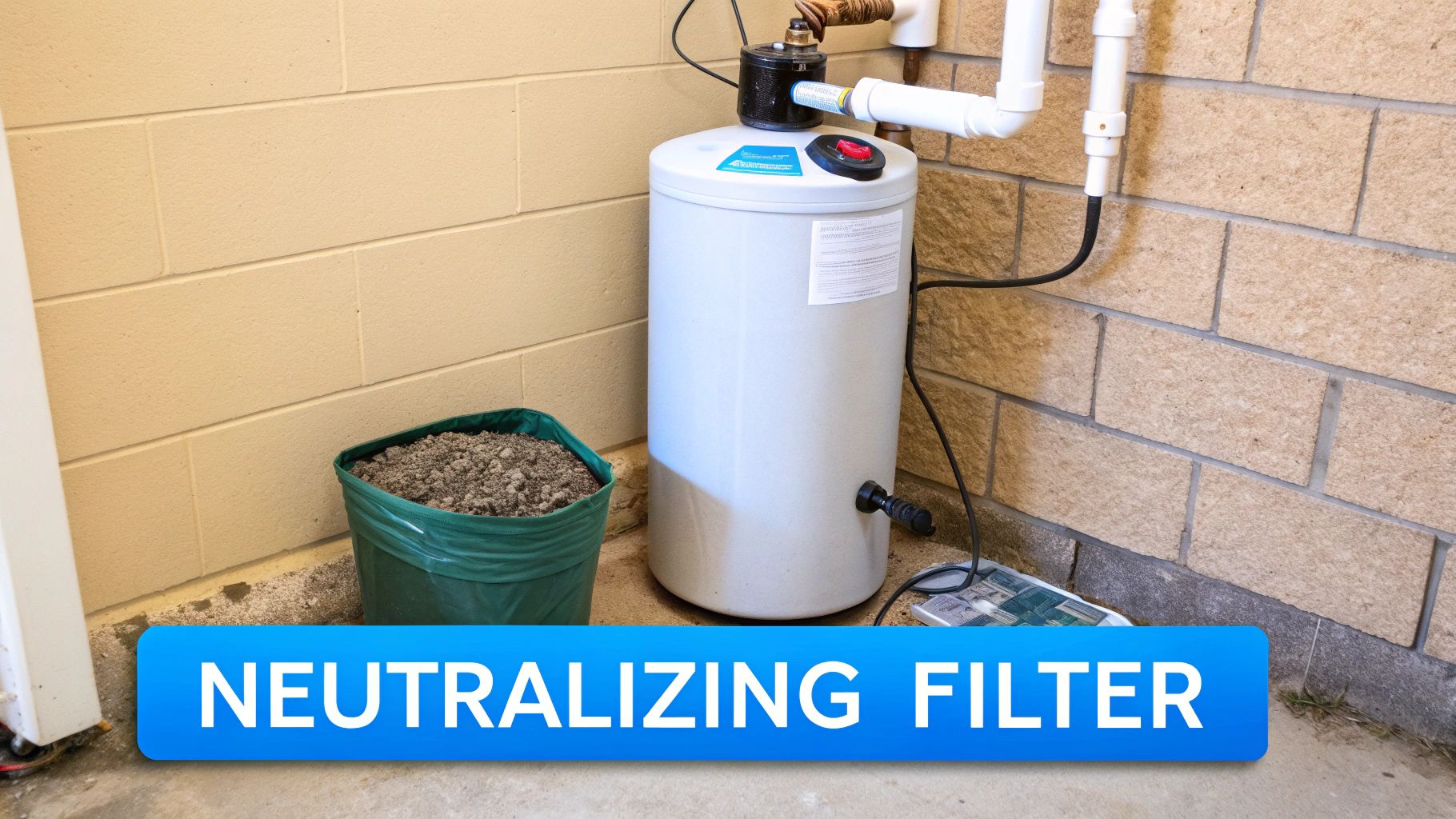
Using a Resin Cleaner Effectively

Thankfully, getting your resin bed back in shape is pretty straightforward. All you need is a good water softener resin cleaner, which is made specifically to break down iron and mineral deposits without damaging the delicate resin beads themselves.

Here’s how you do it:

  • Wait for the Right Moment: The best time to add the cleaner is when the salt in your brine tank is running low, right before you toss in a new bag. This helps the cleaner get pulled into the system properly during the next cycle.
  • Add the Cleaner: Pour the amount recommended on the bottle right into the brine well. That’s the narrow tube you see inside the main tank. If you can't get to it easily, just pouring it over the remaining salt will also work.
  • Kick Off a Manual Regeneration: As soon as you add the cleaner, start a manual regeneration cycle on your softener. This will send the cleaner-and-brine mix through the resin bed, giving it a deep clean and stripping away all that built-up gunk.

Do this just once or twice a year, and you'll keep the core of your water softening system running like new, giving you consistently soft, filtered water for a long time to come.

Fine-Tuning Your Softener's Settings for Ultimate Efficiency

Your water softener's control valve is its brain, but it's not a mind reader. So many people think the settings punched in during installation are set in stone, but that's almost never the case. A "set it and forget it" attitude is a fast track to wasting salt, water, and money.

Life changes, and your water consumption changes right along with it.

Think about a family whose kids just went off to college. All of a sudden, their daily water use can drop by 50% or more. If the softener is still regenerating based on the old, higher-demand schedule, it's literally just flushing salt and water down the drain for no good reason.

This is why getting familiar with your system's settings is a huge part of knowing how to maintain water softener efficiency.

Demand-Initiated vs Timer-Based Regeneration

Most modern softeners run on demand-initiated regeneration. This is a smart system that actually tracks how much water you use and only triggers a cleaning cycle when the resin bed is getting close to full. It’s hands-down the most efficient method because it adjusts to your life—whether you've got a house full of holiday guests or you're gone for a week on vacation.

Older models might use a simple timer, kicking off a regeneration cycle on a fixed schedule, like every Sunday night. It's dependable, sure, but it can be incredibly wasteful if your usage isn't perfectly consistent. If your system has a "metered" or demand-initiated option, switching to it is the single best tweak you can make for your filtration system.

Programming Your Water Hardness Level

Your softener can't do its job right if it doesn't know what it's up against. That means you need to program in your local water hardness level, which is measured in grains per gallon (GPG). You can usually get this number from your city water provider's website, or you can find it yourself with a simple water test kit.

Let's imagine your water hardness is 15 GPG, but your softener is still set to a default of 25 GPG. What happens? Your system will regenerate way too often because it thinks the water is much harder than it really is.

Getting the GPG setting right is fundamental. It tells the softener exactly how much filtration work the resin beads have to do before they need a rinse, making sure every regeneration cycle is truly necessary. This one small adjustment has a direct impact on your salt and water bills.

Adjusting Regeneration Frequency

Even with a smart, demand-initiated system, you often have some control over the regeneration frequency or reserve capacity. This setting basically tells the softener how low to let the "tank" get before scheduling a cleaning.

For example, setting it to regenerate when it hits 20% capacity is a good way to ensure you never get caught with hard water, even after an unusually heavy day of laundry and showers.

Pull out your user manual and see how to adjust these settings. Spending just 15 minutes to dial in your softener to your family's current habits will ensure your home's water filtration runs as efficiently as possible, protecting your plumbing and appliances without wasting a drop.

Common Questions About Water Softener Care

Even with the best routine, questions always come up. Think of this as the troubleshooting guide that turns you from a water softener owner into a water softener pro. These are the most common hiccups I see, and the answers are usually simpler than you think.

How Often Do I Really Need to Add Salt?

There's no single, perfect answer here, but a great rule of thumb is to check the salt level once a month. You're aiming to keep the brine tank at least one-third full. Letting it run completely empty is a big no-no, but you also don't want to overfill it and create those rock-hard salt bridges.

For a typical family of four, you'll probably find yourself adding a new bag of salt every month or two. But if your water is extra hard or your family uses a ton of water, you might be topping it off more frequently. Just keep an eye on it—that’s the real secret.

My Water Suddenly Feels Hard Again. What Do I Check First?

It's always a bummer when you feel that dry, scratchy skin and see spots on your glassware making a comeback. Don't call for service just yet. Before you do anything else, run through this quick checklist.

  1. Check the Brine Tank: First, is there enough salt? Just as important, is there a solid crust on top? That’s a salt bridge, and it’s stopping the salt from dissolving into the water.
  2. Find the Bypass Valve: It's easy for this valve to get bumped into the "bypass" position, especially if it's in a high-traffic area. If it is, your water is just skipping the softener completely.
  3. Look for Power: Is the unit actually on? Check if it's plugged in and if the screen is lit up. You'd be surprised how often this is the culprit.

Honestly, these three simple steps solve the problem more than 90% of the time and will save you the cost of a service call.

A sudden change in water feel is almost always a sign of a simple issue with salt, power, or the bypass valve. Checking these three things first will save you time, money, and a lot of headaches.

Does the Type of Salt I Use Really Matter?

Oh, absolutely. It matters a lot. While you can use any type of water softener salt in a pinch, they are definitely not all the same. Using the right kind is a huge part of keeping your filtration system running well for years.

  • Rock Salt: It’s the cheapest, but it’s also the dirtiest. It's full of impurities that will turn into a nasty sludge at the bottom of your tank, meaning more frequent, messy cleanouts for you.
  • Solar Salt: This is a good middle-of-the-road option. It's much cleaner than rock salt but can still leave some sediment behind over time.
  • Evaporated Salt: This is the good stuff. It's the purest salt you can get, dissolving cleanly with almost no residue. It's the best choice, hands down, for keeping modern, high-efficiency softeners happy.

If you're interested in a wider view of home system care, you can often find helpful parallels. For further insights and tips on home maintenance, check out resources that cover the whole home.

Is Cleaning the Resin Bed Necessary if My Water Is Clear?

Yes, and think of it as cheap insurance for your softener. Even if you don't have iron issues, the chlorine and other tiny sediments in city water slowly build up on the resin beads over time. This makes them less effective. You probably won't even notice the performance drop until it's pretty bad. A quick cleaning with a dedicated resin cleaner once a year keeps those beads working at full capacity and helps you squeeze every last bit of life out of your home filtration system.


At Water Filter Advisor, our goal is to empower you with the knowledge to manage your home's water quality effectively. From choosing the right system to keeping it in peak condition, we provide the expert guidance you need for safer, better-tasting water. Discover more at https://www.waterfilteradvisor.com.