So you've welcomed a water softener into your home. Fantastic choice! Now, let's make sure this champion of home water filtration stays in fighting shape. Taking care of your water softener really boils down to a few simple tasks. You’ll need to keep an eye on the salt levels, give the brine tank a good cleaning about once a year, and occasionally use a resin cleaner. If you can stick to this simple routine, you'll head off most common problems and keep your system running smoothly for years to come.
Why Bother with Water Softener Maintenance
You invested in a water softener to protect your pipes, fixtures, and appliances from the scaly tyranny of hard water. That’s a smart move. But it’s not an appliance you can just "set and forget." Think of it more like a high-performance engine for your home's water—it needs a little TLC to perform its best and avoid expensive repairs down the line. A bit of regular upkeep is all it takes to guarantee a steady supply of silky-smooth soft water and get the most life out of your unit.
Letting your softener go without maintenance is like watching money swirl down the drain. An ignored system becomes less efficient, burning through more salt and water with every regeneration cycle. That means higher utility bills and more trips to the store for salt. More importantly, a little effort now prevents a massive plumbing headache later.
The Real Payoff of a Simple Routine
A small amount of care pays off in big ways, saving you money and keeping your home's entire water system running smoothly. With regular maintenance, a good water softener can last up to 20 years—far longer than the typical 10-15 year lifespan of a neglected one. This is huge, especially considering that over 85% of households in North America are in a constant battle with hard water.
Something as simple as checking the salt every few weeks can prevent 70% of common failures. It makes sense when you realize that salt-based systems, which make up a whopping 74.18% of the market, are completely reliant on it to do their job.
Before you start any hands-on maintenance, make sure you know how to turn off your water main. It’s a crucial first step that can save you from turning a small fix into a major flood.
The core tasks aren't complicated. We're talking about managing salt levels, cleaning out the brine tank, and making sure the settings are optimized for your household's needs. Getting these right is the key to peak filtration performance.
If you’re looking to get a better handle on your home's water quality, our complete collection of advice on water filtration systems is packed with helpful information. To get you started, here’s a quick-glance guide to your softener’s maintenance schedule.
Water Softener Maintenance at a Glance
This table breaks down the essential maintenance tasks, how often you should do them, and what you’ll need to get the job done.
| Maintenance Task | Recommended Frequency | Required Tools & Supplies |
|---|---|---|
| Check Salt Levels | Every 2-4 weeks | Water softener salt |
| Clean Brine Tank | Annually | Mild soap, water, soft brush |
| Add Resin Cleaner | Every 6-12 months | Resin cleaner solution |
| Check Settings | Quarterly | Your system's manual |
Sticking to this simple schedule will keep your water softener in peak condition, ensuring it works efficiently for its entire lifespan.
Mastering the Brine Tank and Salt Levels
Your water softener's brine tank is its command center. This is where the salt lives, creating the brine solution that strips all those hard minerals out of the resin bed. Keeping an eye on this tank is probably the most important thing you'll do for your softener. If you let it run dry, the system just stops filtering. Simple as that. You'll be right back to dealing with hard water scale.
A good habit is to keep the tank at least half-full of salt. This guarantees you'll always have enough on hand for a strong brine solution when it's time to regenerate. For most families, a quick peek every two to four weeks is plenty. Just top it off as needed, but try not to fill it all the way to the brim—that can sometimes lead to clumping and other headaches.
Choosing the Right Salt for Your System
When you're at the store, you'll see a few different kinds of salt. They all work, but they're not all the same. The one you pick can really affect how often you have to clean the tank and how well your home's water filtration system performs.
- Evaporated Salt Pellets: This is the good stuff. It’s typically 99.9% pure sodium chloride, which means it leaves almost no gunk behind in your tank. You'll clean it less often, and it's the least likely to cause salt bridges. For most modern softeners, this is the top recommendation.
- Solar Salt Crystals: Made from evaporated seawater, this type is also very pure (around 99.6%). It's a solid, budget-friendly choice. The only downside is it might leave a bit more sediment at the bottom of the tank over time compared to the pellets.
- Rock Salt: It’s the cheapest option, but you get what you pay for. Rock salt has more impurities and minerals that don't dissolve. All that dirt and sediment builds up fast, potentially clogging up your filtration system and forcing you to do a lot more cleaning.
Honestly, spending a little extra on evaporated salt pellets usually pays for itself. You'll save time on maintenance and keep the system running better for longer.
This simple workflow gives you a great visual of the core tasks for keeping your softener in top shape.
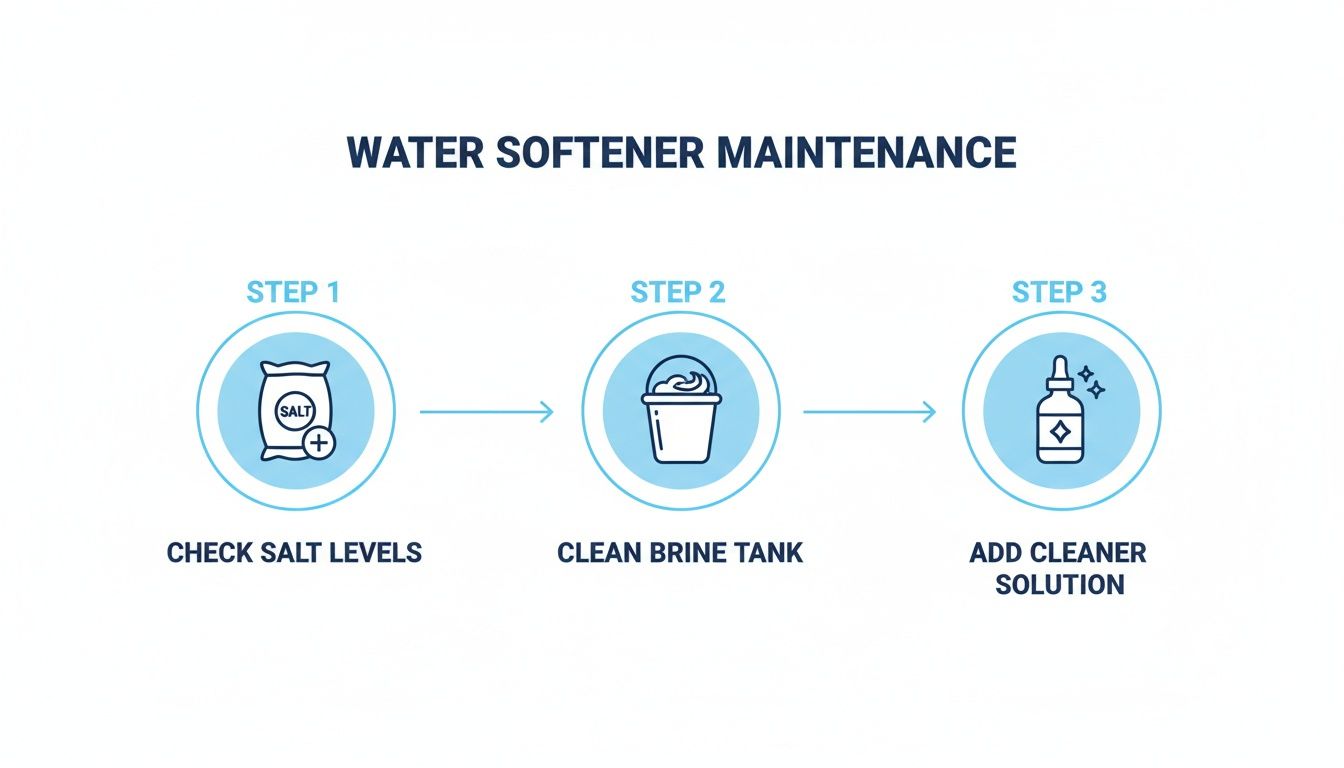
As you can see, it's all about a simple, proactive cycle: regular salt checks, an annual tank cleaning, and throwing in a resin cleaner every now and then.
The Annual Brine Tank Deep Clean
About once a year, you’ll want to give the brine tank a good scrub. This gets rid of all the sludge, dirt, and "salt mush" that can build up, preventing clogs and keeping your filtration process sanitary. It's an easy job that shouldn't take you more than an hour.
The easiest way to start is to let the salt level get low so there’s less to scoop out. Next, switch the softener to bypass mode—this stops water from flowing to the unit. Now you can disconnect the brine tank, dump out any leftover salt and water, and tip it on its side to drain completely.
Once it's empty, grab a soft brush or cloth and some mild soapy water to scrub the inside clean. Really focus on the bottom, since that's where most of the gunk settles. Rinse it out well with fresh water, hook it back up, and you're ready to fill it with a fresh bag of salt.
Defeating the Dreaded Salt Bridge
A salt bridge is one of the most common—and annoying—filtration problems you'll run into. It’s a hard crust of salt that forms in the tank, creating a dome over the water. The salt above can't drop down and dissolve, so your system stops making brine, even though the tank looks full. You'll know it's happened when your water suddenly feels hard again.
A salt bridge effectively starves your softener of the one thing it needs to regenerate. Identifying and breaking it is a simple fix that solves a major filtration failure.
To check for one, just take a broom handle and gently poke the salt. If you feel a hard crust with an empty space underneath, you've got a salt bridge.
Breaking it up is easy. Just use the handle to gently tap the crust near the edges of the tank until it all falls apart. Just be sure not to use anything sharp, you don't want to puncture the plastic tank. After it's broken up, give the salt a good stir with the handle to make sure it settles back into the water. Then, just run a manual regeneration cycle to get things back to normal.
Keeping Your Resin Bed Healthy and Effective
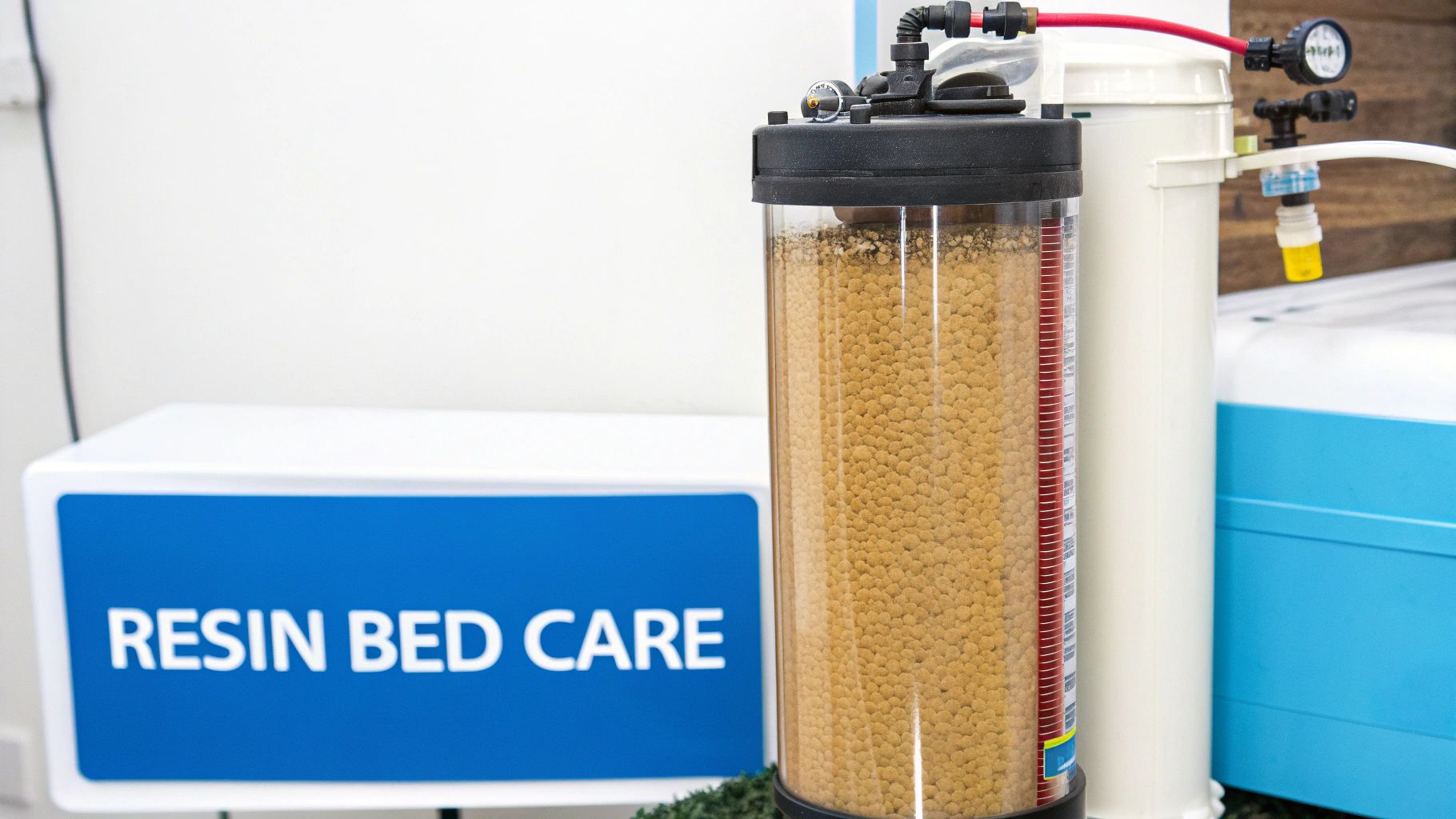
While everyone talks about the brine tank, the real heavy lifting happens inside the resin tank. This tank is jam-packed with thousands of tiny, porous resin beads. Think of them like microscopic magnets that grab onto hard water minerals—calcium and magnesium—as water passes through. This is the heart of your home's water filtration process.
These little beads are the soul of your softener. When the system regenerates, that salty brine solution you’ve been maintaining washes over them, breaking the minerals' grip and flushing them away. This recharges the beads, getting them ready to filter more water.
But here's the catch: hard water minerals aren't the only thing that can get stuck to them.
Recognizing the Signs of Resin Fouling
Over time, other gunk like iron, manganese, sediment, and even chlorine can build up on the resin beads. This is what we call resin fouling. It essentially puts a stranglehold on the beads, stopping them from grabbing those hardness minerals. When that happens, your softener’s performance just tanks.
You’ll know you have a problem when those all-too-familiar hard water issues start creeping back. Keep an eye out for these tell-tale signs:
- Your water just doesn't feel soft anymore. The soap won't lather up, and your skin and hair feel dry and sticky after a shower—just like before you got the softener.
- Stains reappear on fixtures. See those ugly reddish-brown rust stains showing up in your sinks and toilets again? That's a dead giveaway for iron fouling.
- Water pressure takes a hit. If the resin bed gets badly clogged with sediment, it can choke off the water flow, giving you weak pressure at your faucets and showerheads.
If you spot any of these, and you know your salt level is fine and the brine tank is clean, it's a pretty safe bet your resin bed is crying out for help. Ignoring it won't make it go away.
Think of resin cleaner as a powerful detox for your water softener. It strips away the iron and sediment that a normal salt regeneration cycle can't touch, restoring the beads to their original mineral-grabbing glory.
A good maintenance schedule that includes resin care is crucial for the long haul. A healthy resin bed can last a solid 10 to 15 years, but a fouled one might give up in just a few, sticking you with a hefty replacement bill.
Using a Resin Cleaner for a Deep Clean
Using a resin cleaner is a simple but incredibly effective task you should tackle every six to twelve months. Your timing really depends on your water quality. If you're on well water with high iron, you’ll want to do this more often, maybe even every four months.
Most resin cleaners are pretty straightforward. They’re specifically designed to dissolve iron and other crud without harming the delicate resin beads themselves. The process is a breeze:
- Read the Instructions: First things first, always read the label on the cleaner you buy. Most will have you pour a certain amount directly into the brine well—that's the narrow tube inside your brine tank.
- Add the Cleaner: Carefully measure and pour the recommended amount of cleaner right into that brine well. If your system doesn't have a well, the instructions might tell you to add it to the tank itself when the salt level is low.
- Run a Manual Regeneration: The final step is to immediately kick off a manual regeneration cycle. This will pull the cleaner-infused brine into the resin tank, letting it get to work scrubbing those beads clean.
This simple job restores your system’s filtration efficiency, keeps your water feeling great, and can seriously extend the life of your resin bed. It's one of the easiest ways to protect your investment and keep your softener working like a champ.
Optimizing Regeneration for Peak Efficiency
Your water softener's regeneration cycle is its reset button—it's how the system flushes out all the hard minerals it has trapped and recharges itself with salt. But get the settings wrong, and that "reset" becomes a huge waste of salt and water. This is where a little bit of know-how goes a long way toward keeping your filtration system running efficiently and your bills down.
The whole show is run by the control valve, which is basically the brain of your softener. Most of the time, when a softener is wasting resources, it's because the settings on this valve aren't matched to your home's water filtration needs.
Timer-Based vs. Demand-Initiated Regeneration
First things first, you need to know what kind of system you're working with. Softeners decide when to regenerate in one of two ways, and understanding which one you have is key.
-
Timer-Based Systems: These are the old-school, set-it-and-forget-it models. You program a schedule—say, every four days at 2 AM—and it regenerates like clockwork, no matter what. The downside is its inflexibility. It doesn't know you had a house full of guests or that you were away on vacation. This often leads to regenerating too early (wasting resources) or too late (hello, hard water).
-
Demand-Initiated (Metered) Systems: These are the smart ones. They actually track how much water your household uses and only kick off a regeneration cycle once a preset volume of water has been treated. It's a much more efficient approach because it adapts to your actual usage. A metered system can cut your salt and water consumption by up to 75% compared to a basic timer model.
If you have the option, a demand-initiated system is the hands-down winner for saving money and optimizing your home's filtration.
True water softener maintenance is about tailoring the machine to your life. The whole point is to sync up its regeneration schedule with your family’s water habits and the specific hardness of your local water.
Dialing in the Settings for Your Home
Fine-tuning your softener isn't guesswork; it's about plugging in the right numbers. You just need two key pieces of information to get started: your water hardness level and how much water your family uses.
You can usually find your water hardness on your local utility's website or by using a simple test kit. It’s measured in grains per gallon (GPG). For water usage, a solid rule of thumb is 75 gallons per person, per day. A family of four, for example, will go through about 300 gallons daily.
Let’s run through a quick example. Say you're that family of four, and your water is a very hard 20 GPG.
- Figure out the daily hardness load: Just multiply your daily water use by the hardness. So, 300 gallons/day × 20 GPG = 6,000 grains of hardness that your softener has to tackle every day.
- Know your system's capacity: Check the manual for your softener's grain capacity. A 32,000-grain unit is a pretty common size.
- Calculate the regeneration frequency: Divide the softener's capacity by the daily hardness load. 32,000 grains ÷ 6,000 grains/day = 5.3 days. This tells you the system needs to regenerate roughly every five days to keep up.
That's it. This simple math takes all the mystery out of it.
Fine-Tuning at the Control Valve
Once you've got your numbers, it's time to head to the control valve. Every model's a bit different, so grab your owner's manual. Generally, you’ll be punching in the hardness (GPG) and the number of people in your household.
On a metered system, entering these values lets the softener's computer figure out the regeneration schedule automatically. If you have a timer-based unit, you'll use your own calculation (like our "every five days" result) to set the schedule manually.
And don't be afraid to tweak things. If you start to feel that hard water film on your skin again, you might need to shorten the time between cycles. On the flip side, if you're burning through salt like crazy, try extending the cycle by a day. A few small adjustments can make a huge impact on both filtration performance and your wallet.
Troubleshooting Common Water Softener Problems
Even with perfect maintenance, filtration systems can act up. One day your water is silky smooth, and the next you’re right back to dealing with spotty dishes and soap scum. It’s frustrating, but don’t pick up the phone just yet.
Most of the time, the fix is something you can easily handle yourself in just a few minutes. We’ll walk through the most common hiccups—from a system that mysteriously stops using salt to weird noises and leaks—so you can play detective and get your filtration running again.
Hard Water Is Suddenly Back
This is the number one complaint I hear, and it almost always has a simple solution. Before you assume the whole filtration unit is shot, let's run through a quick checklist.
First thing to check: is the bypass valve on? This handle routes water around the softener, which is great for maintenance but not for daily use. If it's in the "bypass" position, just flip it back. Problem solved.
If that's not it, take a look inside the brine tank. A salt bridge is a frequent offender. This is a hard crust of salt that forms above the water level, creating an empty space underneath. The system thinks it has salt, but none is dissolving. Just take a broom handle and gently poke at the salt. If it collapses, you've found your culprit.
Why Isn’t My System Using Any Salt?
You keep checking the brine tank, but the salt level never goes down. This is a clear sign your softener isn’t regenerating, which means your water isn't actually getting softened.
Again, check for a salt bridge first. If the salt is solid all the way down, you might be dealing with "salt mushing." This is a thick, pasty sludge at the bottom of the tank that’s clogging everything up. If you see that, you'll need to scoop it all out and give the tank a good cleaning.
Also, trace the brine line—that little tube running from the tank to the control valve. Make sure it isn’t kinked, disconnected, or blocked. No brine can get to the resin tank if that line is compromised.
Neglecting basic water softener maintenance isn’t just an inconvenience; it can drive up operational costs by 25-40% annually. In regions like Europe and North America, unchecked systems often suffer from resin fouling, which can slash efficiency by 50% in just two years and spike energy bills as the system works harder to compensate.
Decoding Leaks and Strange Noises
A puddle of water or a new clanking sound is enough to make any homeowner nervous, but it's not always a five-alarm fire.
Most leaks come from loose fittings. Get a flashlight and carefully check where the water lines connect to the control valve and where the brine line attaches. Often, a simple hand-tighten is all it takes to stop the drip.
As for noises, a bit of gurgling during the regeneration cycle is normal. But if you hear a constant hiss or a loud, mechanical grinding sound you haven't heard before, that could point to an issue with the valve motor or internal seals. Beyond troubleshooting, addressing common issues often requires delving into general maintenance and repairs to restore your system's functionality.
For a quick reference, here are some of the most common issues at a glance.
Quick Fixes for Common Softener Issues
| Symptom | Potential Cause | DIY Solution to Try First |
|---|---|---|
| Water feels hard again | Bypass valve is engaged | Locate the bypass valve and ensure it's in the "Service" position. |
| Salt level isn't dropping | Salt bridge has formed | Gently break up the hard crust of salt with a broom handle. |
| Water in brine tank is too high | Clogged brine line or injector | Disconnect and clear the brine line; clean the venturi/injector assembly. |
| System is making unusual noises | Loose parts or air in the line | Check for loose fittings. Manually run a regeneration to purge any air. |
| A small puddle is on the floor | Loose hose connections | Check and hand-tighten the connections on the bypass valve and brine line. |
This table should get you through the most frequent headaches, but remember, some problems are bigger than a quick DIY fix.
When Is It Time to Call a Professional?
Knowing your limits is key. Trying to be a hero on a complex repair can turn a small issue into a very expensive one. It's time to call in an expert if you run into these situations:
- Electrical Issues: The display is dead or flashing an error code you can’t clear (and yes, you’ve already checked the outlet). This usually points to a bad circuit board.
- Persistent Leaks: You've tightened every fitting you can find, but the drip continues. This could be a cracked tank or a bad internal seal, which isn't a simple fix.
- Motor or Valve Failure: The softener is stuck in a regeneration cycle for hours, or you hear a constant grinding from the control head. The internal mechanics have likely failed.
- You've Tried Everything: If you've gone through this guide and are still stumped, a pro has the diagnostic tools and experience to find the root cause quickly.
Knowing how to troubleshoot the basics empowers you to handle the small stuff and make a smarter call when you need backup.
Your Top Water Softener Questions Answered
We’ve covered the nuts and bolts of routine maintenance, but a few questions always seem to pop up. It's totally normal to have a few lingering "what-ifs" as you get to know your system. Let's tackle some of the most common ones we hear from homeowners.
Think of this as your quick-reference FAQ. No fluff, just straight answers to help you manage your home water filtration system like a pro and protect your investment.
How Often Should I Really Clean My Brine Tank?
The standard answer is "once a year," but honestly, it really depends on what you’re feeding your softener.
If you stick to high-purity evaporated salt pellets and your city water is relatively clean, you can easily push that to every 18 months. But if you're using cheaper rock salt or have well water that’s heavy on iron and sediment, you need to be more watchful.
In that case, I’d pop the lid and take a look every six months. See a thick layer of gunk, sludge, or just general nastiness at the bottom? It's cleaning time, regardless of what the calendar says.
A little proactive cleaning goes a long way. It's much easier to prevent a sludge problem than it is to fix a clogged-up injector assembly later.
Can I Use Any Type of Salt in My Water Softener?
While most softeners can technically use pellets, crystals, or block salt, that doesn't mean you should. One type is almost always the right choice for your specific unit. High-purity pellets are the gold standard for a good reason—they burn clean, dissolve evenly, and are the least likely to cause frustrating salt bridges.
Solar salt crystals are another great, often more affordable, option. Block salt is the cleanest but is also the most expensive and is really designed for specific models that can handle it. The most important thing you can do? Check your manufacturer's manual. Using the wrong salt can tank your filtration performance and might even void your warranty.
What Are the Signs I Need a New Water Softener?
A well-cared-for softener is a workhorse, often lasting 15 years or more. But nothing lasts forever. There are a few dead giveaways that it's time to start shopping for a replacement.
- Hard Water Returns: If your water feels hard again and you've already deep-cleaned the resin bed and checked the settings, that's the biggest red flag.
- Constant Repairs: Are you on a first-name basis with your plumber? If repair bills are piling up, they can quickly eclipse the cost of a new, more efficient unit.
- Visible Damage: Cracks, rust, or serious leaks on the tanks aren't just cosmetic issues; they are major warning signs.
- Major Drop in Water Pressure: If you've ruled out other plumbing issues, a sudden drop in pressure throughout the house could mean the resin bed is so clogged it's strangling your water flow.
If your system is over a decade old and showing any of these signs, investing in a new model is usually the smarter financial move.
Should I Install a Pre-Filter Before My Softener?
For most people, yes. A pre-filter is one of the best upgrades you can make to protect your softener.
If you're on a private well, a simple sediment pre-filter is practically a necessity. It’s your front-line defense, catching sand, silt, and rust before they can gum up your softener's control valve or foul the resin.
Even on city water, a carbon pre-filter is a brilliant move. It removes chlorine, which slowly degrades the resin beads over time and can drastically shorten their lifespan. Think of a pre-filter as a cheap insurance policy for your much more expensive water softener.
At Water Filter Advisor, our mission is to empower you with the knowledge to achieve safer, better-tasting water at home. From in-depth buying guides to practical maintenance checklists, we provide clear, research-driven advice to help you make confident decisions for your family. Explore our resources today at https://www.waterfilteradvisor.com.
- January 17, 2026
- 0
- Uncategorized
