
Black Specks in Filtered Water Causes and Fixes
Black specks that appear right after you install a new carbon cartridge are usually activated-carbon fines, tiny fragments shed from the filter media, and they should fade out during the flush the cartridge maker specifies. They're not evidence that your tap water suddenly turned dirty. Hold a glass of that water against a white mug or a sheet of paper and take a second look, because what the flecks do in the glass and when they started tells you far more than their color does.
Discolored water draws a crowd. The Drinking Water Inspectorate's 2024 consumer contacts summary for England records 28,974 consumer contacts about brown, black, or orange water discoloration in 2024, and the equivalent 2024 summary for Wales records 5,624. Plenty of those events begin at the treatment works or in the street. Plenty more begin six inches from your glass, inside a pitcher, a fridge dispenser, an under-sink carbon block, or a whole-house tank.
That second group is where this guide lives. Black is not an identity. It's a color shared by carbon dust, crumbling rubber, oxidized manganese, iron sediment, and the biofilm that grows on a wet aerator. Texture, timing, and which taps carry the flecks separate them, and once the sorting is done, the fix is usually small.
Black Specks After a New Home Filter
You changed the cartridge on a Saturday. By Sunday night the ice cubes look speckled, and by Monday morning there's a scattering of black flecks in the bottom of the glass you just poured. Nothing about your water supply changed between Friday and Monday. The filter did.
Activated carbon, the material inside almost every household cartridge, is described by the U.S. Environmental Protection Agency's activated carbon guidance as black granules made from coal, wood, nutshells, or other carbon-rich materials, with contaminants adhering to the granules' surfaces as water passes through. Because the media itself is black, loose dust looks exactly like dirt or sediment, even when the incoming water is unchanged. The same EPA installation guidance warns that newly installed filters may initially produce cloudy water or black carbon dust, and states that the material should diminish during the filter's priming step.
That last clause is the whole ballgame. A cartridge that sheds a puff of black powder for the first pitcher fill or the first few minutes of cold flow is behaving like a new cartridge. Run the flush volume on the label, and the specks should taper.
The timing test: flecks that begin the same hour a carbon cartridge goes in are the classic startup pattern. Flecks that begin after a main break, or arrive oily at three taps, are something else wearing the same color.
Color alone never names a particle. Timing does more work than any visual inspection, and texture does the rest. Before you order another filter, or decide your municipal supply has gone bad, work through the diagnosis table below. It costs nothing and it rules out the two most expensive wrong turns: replacing good hardware, and ignoring a mineral problem while blaming carbon.
Carbon Fines Versus Other Black Particles
Match the glass to a row before reading the reasoning.
| What you see | When it starts | Where it shows | Likely source | First move |
|---|---|---|---|---|
| Soft black powder that marks the fingers | Right after a new or replaced carbon cartridge | Only the filtered tap, pitcher, or fridge dispenser | Activated-carbon fines from priming | Flush the labeled volume, then recheck one glass |
| Hard bits like coarse coffee grounds | After install, a crack, or an overdue cartridge | Filtered outlet; may clog the aerator | Granular carbon escaping the cartridge | Stop that cartridge, inspect housing and seals, replace and flush |
| Oily black bits that smear and may float | Gradual, not tied to a new filter | Several fixtures | Degrading rubber gasket, washer, or O-ring | Find and replace the rubber part |
| Gritty dark particles that do not powder | After a main break, construction, or on well water | Multiple taps, including unfiltered | Iron or manganese sediment | Test for iron and manganese |
| Slimy black film stuck on metal, clear glass | Builds on wet surfaces between uses | Aerator, showerhead, drain, or fridge spout | Surface biofilm, not particles in the supply | Clean the fixture; do not buy a filter for slime alone |
Cambridge's drinking-water FAQ, published by the City of Cambridge water operations division, identifies the same visually similar candidates: deteriorating rubber gaskets or O-rings, carbon fines from a cartridge, and iron or manganese released after construction or a water-main break. The city's list and the table agree, which is the point. Several different materials can look identical in a glass.
Texture, timing, and which tap
Rub one speck between clean fingers. Soft black powder that marks the skin fits carbon fines, especially when the filter was replaced this week. Hard, similarly sized bits that feel like coarse coffee grounds are also carbon, but they signal media escaping a damaged, exhausted, badly seated, or under-flushed cartridge rather than ordinary startup dust. If the particle smears oily and floats, suspect a gasket, washer, or O-ring breaking down somewhere in the plumbing, often at more than one fixture. Gritty dark bits that refuse to powder, arriving after a main break, construction, or in well water, fit iron or manganese loosened from pipe walls.
Then count the outlets. One filtered tap points at the cartridge or the housing. Three taps including an unfiltered outdoor bib points upstream, at the supply, a softener, or a whole-house tank.
Why the cartridge is often only the messenger
A filter doesn't create debris out of nothing. It traps debris that was already moving through the line and holds it in the media bed. Shake that bed, crack the housing, let the cartridge run past its rated capacity, or knock the pressure around during a power cut, and the same cartridge releases what it had captured. Whole-house owners and renters see this most, because neither group can easily open a wall to check what's arriving from the street.
One glance cannot rule out manganese, iron, lead, or microbes. Treat the table's last column as a first move, not a verdict. If you're deciding which stage to add next, our sediment filter versus carbon filter comparison explains which one catches particles and which one catches dissolved contaminants, because buying the wrong stage is how a small problem turns into a repeat purchase.
How to Flush and Check a Shedding Cartridge
Pull the cartridge and start over in a deliberate order. The sequence below works for a pitcher, a faucet mount, an under-sink block, and a whole-house housing, and the order matters more than the brand on the box.
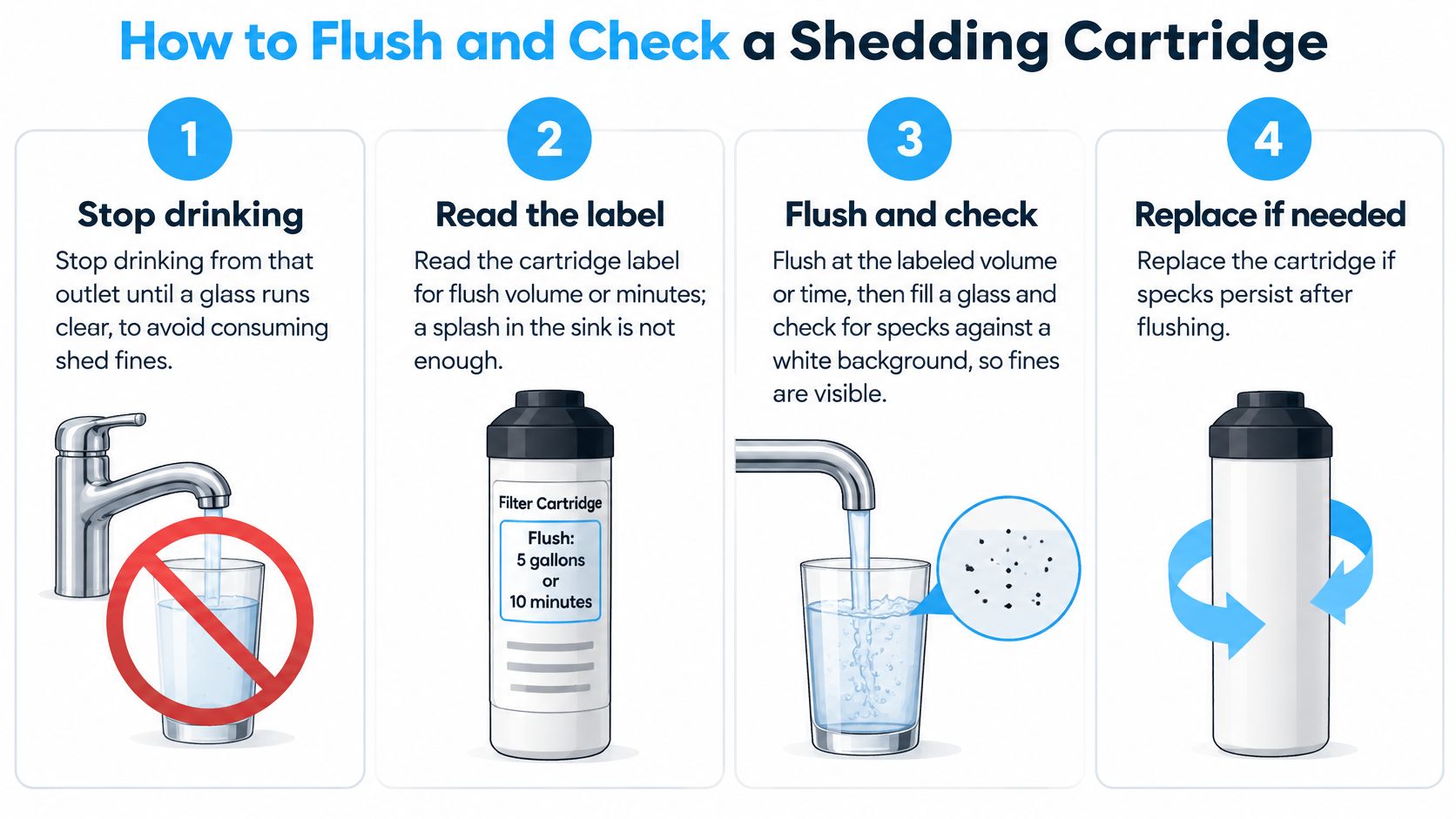
One exception changes the whole plan before you start. Particles that are hard, similarly sized, and look like coarse coffee grounds point to granular activated carbon escaping a damaged, exhausted, improperly assembled, or insufficiently flushed cartridge, according to the Massachusetts guidance on color, taste, and odor. That's a hardware fault, and more flushing won't fix it.
- Stop drinking from that outlet. Until a glass runs clear, draw water from a different tap. You don't need to treat a few carbon fines as toxic, but you also don't want to keep drinking from a housing that might be cracked.
- Read the label for a flush volume or time. A splash under the faucet isn't priming. Many pitchers want two or three full fills discarded. Under-sink and refrigerator cartridges often ask for several minutes of cold flow at the dedicated faucet.
- Take the aerator off first. Fines pack into the screen and then release in bursts for days, which makes a solved problem look unsolved. Set it aside instead of rinsing it back into the stream.
- Run cold water only. Cold flow is what the maker's instructions assume, and hot water carries more dissolved material into a fresh carbon bed.
- Watch the specks thin. Black dust on a new filter should diminish as you flush. If the glass is as dark at the end of the flush as it was at the start, move to step six.
- Treat coffee-ground bits as a fault, not a flush problem. Stop using that cartridge, inspect the housing, O-ring, and end caps for cracks or a missing screen, then install the correct replacement part.
- Prime the replacement completely before anyone drinks from it or fills an ice tray. The first trays of ice from an unprimed fridge cartridge are the most common source of a second round of speck complaints.
- Bypass and compare if specks persist. Run the filter bypass, then take a glass from the bypassed outlet and a glass from the filtered outlet. Matching specks on both sides mean an upstream plumbing source. Specks on the filtered side alone mean the cartridge or housing is still releasing media.
Practical rule: carbon fragments clog aerators, ice makers, and downstream valve screens, so rinse those screens once the source is corrected. A cracked cartridge that still improves taste is still a cracked cartridge, and it should come out of service.
If you'd rather see the sequence performed than read it, this walkthrough covers the same ground at the sink.
Pitchers Fridges and Whole House Filters
Each piece of home gear fails in its own way, and knowing which one you own shortens the diagnosis considerably.
A pitcher or faucet-mount filter makes the problem most visible because the carbon bed is small and people drink the priming water. Black dust confined to the pitcher, gone after two or three discarded fills, is ordinary break-in.

An under-sink carbon block has to be flushed at its own dedicated faucet. Running the main kitchen tap does nothing for the housing under the cabinet, because the water never passes through it. Plenty of homeowners prime the wrong tap and then conclude the cartridge is defective.
A refrigerator filter hides the same dust in the first trays of ice. Dump the ice made in the first day, then check the dispenser screen in the door before blaming the city supply. Our walkthrough on how to flush a refrigerator water filter covers the volume and the order of steps for the door-mounted and in-line versions.
A whole-house carbon tank can send fines to every cold tap after a new media fill or a backwash, which feels like a street-wide event. The tell is what stays clear: hot water from the tankless heater and a hose bib plumbed ahead of the tank. If those run clean, the tank is shedding, not the main.
Well systems add the split that matters most. Black bits that also show at an unfiltered outdoor bib are more likely iron, manganese, or sediment passing through a softener or carbon tank. Fines born inside a cartridge don't appear upstream of it.
Renters who can't open a wall can still divide the house into three streams: filtered cold, unfiltered cold, and hot. Whichever stream carries the specks is the stream that needs work.
One more pattern worth naming: a cartridge that only misbehaves after a power cut or a slammed shutoff valve may have been shaken hard enough to dump media it had already caught. In that case the specks stop on their own once the line settles.
Slime on the Fixture Versus Specks in the Glass
Two scenes get treated as one contaminated supply, and separating them saves people from buying a whole-house system they don't need.
Scene one is discrete particles in a glass you just filled from the filter. Scene two is a black stain or slimy film on the aerator, showerhead, drain, or refrigerator spout that stays exactly where it is when the water is off.
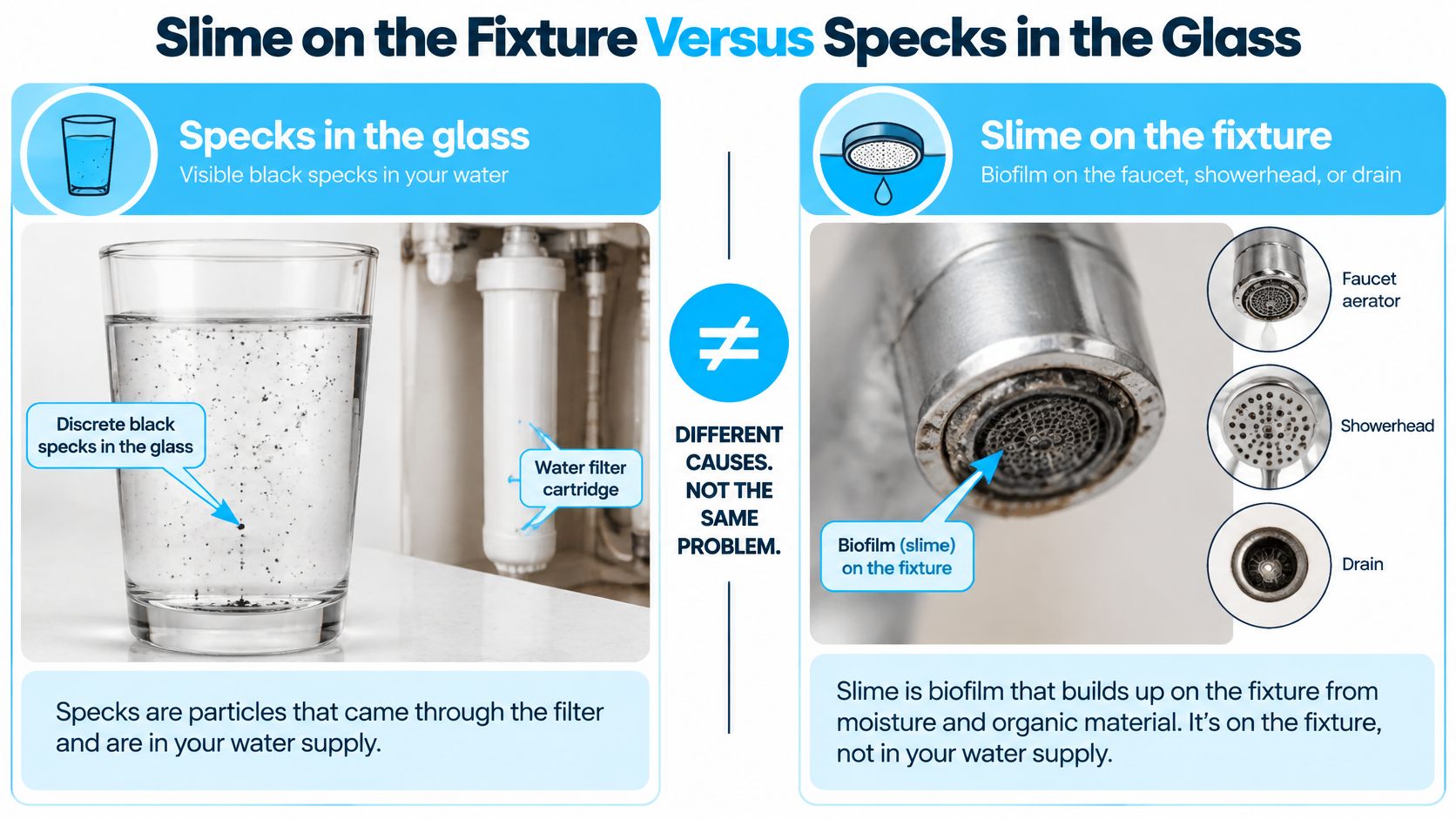
UK drinking-water guidance on biofilms, mould, slimes and staining treats visible black staining or slime as a surface biofilm that generally does not indicate a deficient supply or a health risk. The same guidance reports that German drinking-water researchers found black biofilms on taps colonized by bacteria and fungi, with black yeasts predominant, and their current assessment is that these yeasts are generally not health-relevant, although growth can return within weeks of cleaning.
That last detail matters for expectations. Scrubbing an aerator is maintenance, not a cure, and a film that comes back in three weeks is behaving normally for a wet, mineral-rich surface.
The fix for scene two is mechanical: a soak in a cleaner the fixture maker allows, a soft brush into the aerator threads, a rinse, and the aerator screwed back on. No cartridge is involved. A carbon filter sits downstream of nothing that grows on the outside of a spout.
A film living above the waterline won't be fixed by a cartridge sitting below it, and carbon still falling into a glass won't be fixed by scrubbing the aerator.
"Usually harmless" isn't the same as "universally harmless." Someone with severe immunocompromise who keeps seeing slime return alongside an odor should raise it with a clinician rather than self-treating with hardware.
Here's the line, in one place. If the film lives only on the metal and the glass runs clear, clean the fixture and recheck in a few weeks. If particles appear in freshly drawn water, especially at several taps or alongside an odd taste, odor, discoloration, or recent plumbing work, go back to source tracing.
Sampling When the Specks Keep Coming
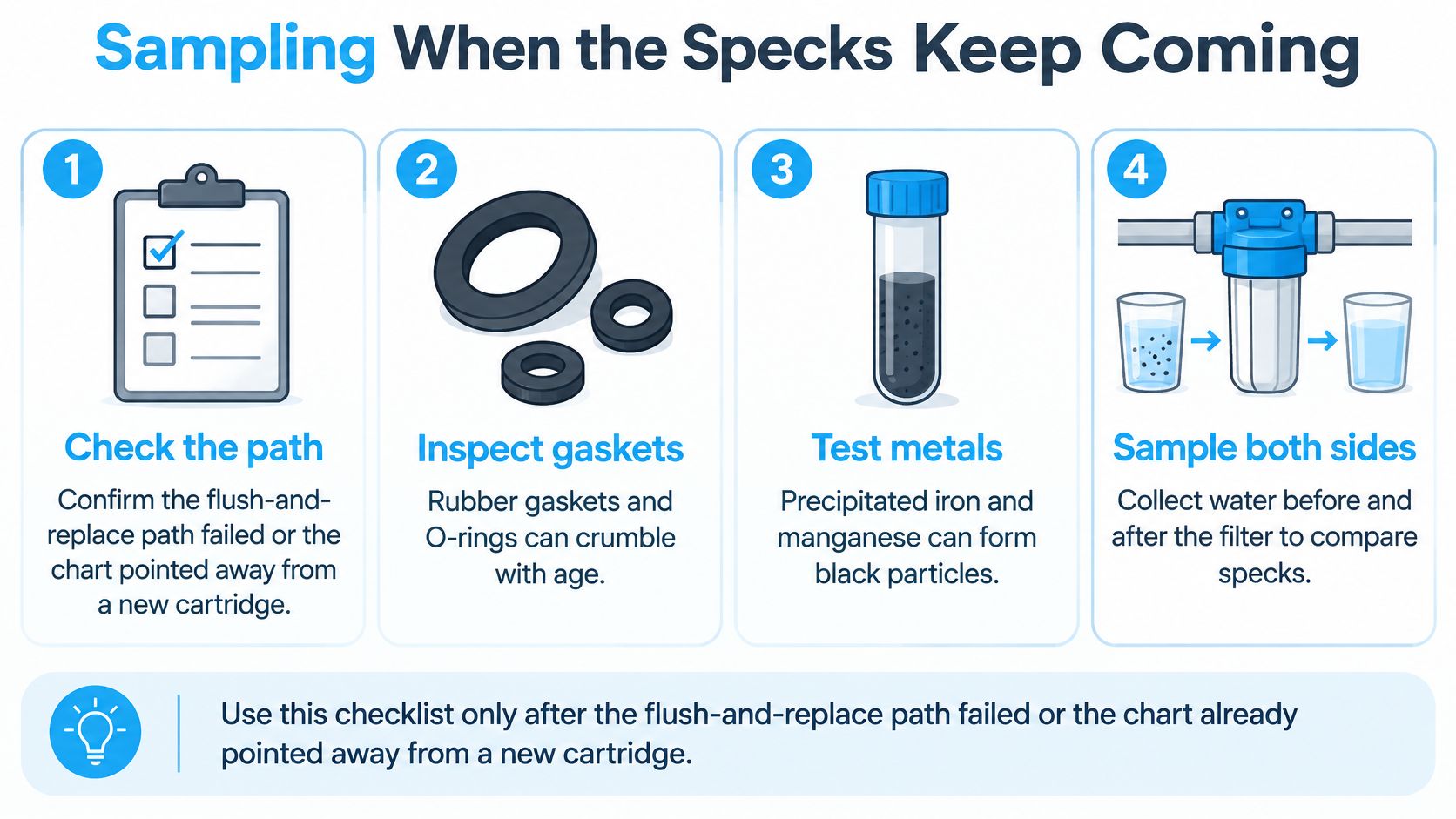
Reach for samples only after the labeled flush and a correct replacement have both failed, or when the earlier table already pointed away from carbon.
Public water guidance keeps three candidates in play beyond filter media. Cambridge's drinking-water FAQ notes that rubber gaskets and O-rings disintegrate over time, that precipitated iron and manganese can loosen from pipe walls after a water-main break or major construction, and that small carbon particles from a pitcher or plumbing filter can pass into the water. Color cannot sort these out. Black grit from a crumbling washer looks nearly identical to black grit from a manganese deposit, so what identifies the particle is where it shows up, not what shade it is.
Sample several points at once rather than filling one dramatic glass.
- Pick three collection points. One unfiltered cold tap, the filtered outlet, and the aerator you removed. Label the cups before you fill them.
- Collect a first-draw sample after the water has sat for several hours, ideally first thing in the morning.
- Flush for about two minutes, then draw a second sample from the same point.
- Read the pattern across the cups. Specks that vanish after the flush usually mean debris that settled in the pipe overnight. Matching particles before and after the filter point upstream. Particles only on the filtered side point back at the cartridge or its seals.
- Pinch the rubber if the pattern fits. Check supply-line washers and the housing O-ring for cracks and black crumbs, and replace anything that sheds when you squeeze it.
- Book a lab test when the pattern fits minerals. An upstream signature, a private well, or particles that appeared after utility work all justify an iron and manganese result instead of another judgment call at the sink.
One split needs a different map. If the flecks show up in hot water only while the cold side runs clear, the suspect moves to the water heater rather than the supply, and the walkthrough on troubleshooting rusty water from hot taps from Bear Valley Plumbing & Heating covers that plumbing side of the split.
A careful cup lineup still has a ceiling. Sight, texture, and timing can separate carbon from rubber from mineral grit, but they cannot see lead or count microbes. When particles arrive with a new taste, odor, or discoloration, laboratory analysis is the only answer that counts.
When to Stop Using the Tap
Finish the sequence before making a decision, then apply a few clear rules.
If one filtered outlet ran clear after the cartridge's stated flush volume, keep that cartridge in service. Fill the same glass again after a week of normal cooking and drinking. If specks, odor, or color return in that glass, stop using that tap for drinking and cooking until a lab result is in. When an odor is strong enough to notice in the shower, bathing waits for the same result.
Coffee-ground bits, or dust that survives a correct replacement and a full prime, mean retiring that housing or that stage entirely. Don't drink from it and don't fill ice trays while a new cartridge is still unprimed.
Matching particles on an unfiltered cold tap, on a well, or after a main break or construction means ordering an iron and manganese test rather than another carbon cartridge. A clear glass with film only on the aerator, showerhead, or fridge spout stays a cleaning job, rechecked in a few weeks.
If a replacement stage failed, our Choosing a Water Filter guide covers how to pick one without repeating the same mistake, and the Simple Water Test Kits section is where to start when the sample plan says the particles aren't carbon.
Water Filter Advisor was founded in 2007 to analyze water filtration and get down to the data, which is the approach we'd take to your glass of flecks. If the diagnosis lands on your hardware rather than your supply, visit Water Filter Advisor for side-by-side guides to whole-house, under-sink, faucet, refrigerator, and pitcher systems, along with the cartridges and maintenance steps each one requires. Start with the setup that matches your kitchen, then come back to this page the next time a cartridge change sends a few black specks into your water.
