
If you've got nitrates in your well water, a standard pitcher filter just isn't going to cut it. You need a dedicated system to tackle this specific problem. For home use, the two most reliable technologies are reverse osmosis and ion exchange. Both are fantastic at physically removing or swapping out the nitrate ions, bringing your water back into a safe range and giving you peace of mind.
Why Nitrates in Your Well Water Are a Silent Problem
That glass of water from your well might look perfectly clear and refreshing, but it could be hiding a dangerous secret. Nitrates are one of the most common contaminants found in groundwater, and you'd never know they were there—they have no color, taste, or smell. This makes them a silent but serious issue for millions of well owners.
Unlike city water, which is constantly tested and treated, a private well is 100% the homeowner's responsibility. The buck stops with you when it comes to ensuring your family's water is safe to drink.
Where Do Nitrates Come From?
Nitrates (NO₃⁻) are just nitrogen compounds that dissolve easily in water. While they occur naturally at low levels, human activity can cause their concentration in groundwater to skyrocket. Think of the ground as a giant sponge; anything put on the surface can eventually seep down into the very water your well taps into.
The most common culprits behind high nitrate levels are:
- Agricultural Runoff: Nitrogen-based fertilizers are a primary source. When farmers apply more fertilizer than crops can use, the excess washes away with rain or irrigation, filtering down into the groundwater.
- Septic Systems: An old, failing, or poorly placed septic tank can leak untreated waste into the surrounding soil, releasing a steady stream of nitrates.
- Livestock Manure: Runoff from large farms and animal feedlots is loaded with nitrogen from animal waste, which can contaminate nearby wells.
Ultimately, tackling nitrate contamination at its source means looking at how the land around us is managed. Practices focused on improving soil quality naturally play a huge role in preventing nitrates from leaching into our water supplies in the first place.
The Hidden Health Risks
For most healthy adults, a little nitrate in their water isn't a huge deal. But for vulnerable groups, it’s a completely different story. The biggest danger is a condition called methemoglobinemia, better known as "blue baby syndrome."
When infants under six months drink water high in nitrates, their bodies convert those nitrates into nitrites. This messes with the blood's ability to carry oxygen, which can be fatal.
The U.S. Environmental Protection Agency (EPA) set the safe drinking water limit for nitrates at 10 milligrams per liter (mg/L)—or 10 parts per million (ppm). This standard was put in place specifically to protect infants from blue baby syndrome.
Pregnant women and people with certain health conditions like anemia or heart disease are also at greater risk. Because the threat is so severe, figuring out how to remove nitrates from your well water is absolutely essential for your family's safety.
Your Options for Nitrate Removal
The good news is that there are proven home filtration technologies that can solve this problem. Just know that your Brita filter or standard water softener won't touch nitrates. And whatever you do, don't boil the water! Boiling only makes the problem worse by increasing the nitrate concentration as the water evaporates.
Effective solutions target nitrates directly. This problem is more widespread than you might think; the USGS estimates that about 7% of domestic wells in the U.S. have nitrate levels above the safe limit. You can dig into the data from the USGS water quality assessment yourself.
To get you started, here’s a quick rundown of the most effective technologies we'll cover in this guide.
Quick Guide to Home Nitrate Removal Methods
This table summarizes the best filtration methods for getting rid of nitrates in your well water, so you can see at a glance how they work and what they're best used for.
| Filtration Method | How It Works | Best For |
|---|---|---|
| Reverse Osmosis | Uses high pressure to force water through a semipermeable membrane, blocking nitrates and other contaminants. | Point-of-use systems for drinking and cooking water; also removes a wide range of other contaminants. |
| Ion Exchange | Employs a special resin that captures nitrate ions from the water and replaces them with harmless chloride ions. | Whole-house (point-of-entry) systems where all water in the home needs treatment for nitrates. |
| Distillation | Boils water to create steam, leaving nitrates and other impurities behind, then condenses the steam back into pure water. | Smaller, countertop batches of highly purified water; effective but slow and energy-intensive for daily use. |
Each of these systems has its own set of pros and cons, which we'll dive into next to help you pick the right one for your home.
First Things First: Get a Real Number on Your Nitrate Levels
Before you even think about buying a filter, you need to know exactly what you’re dealing with. When it comes to your family’s health, guessing is not an option. Nitrates are sneaky—you can't see them, taste them, or smell them. Testing is the only way to find out if they're in your well water and at what concentration.
If you're on a private well, this is all on you. Unlike city water, which is tested regularly by law, your well's safety is your responsibility. Think of it as a crucial first step in taking control of your water quality.
From a Quick Check to a Certified Analysis
You've got a couple of ways to go about testing. The one you pick really just depends on if you need a quick ballpark number or a precise figure you can bank on.
-
DIY Test Strips: These are the fast and cheap route. Dip a strip in your water, wait a second, and match the color to a chart. They're perfect for a quick spot-check or for making sure your filter is still working down the road. Just know they give you a range, like 10-20 mg/L, not a hard number.
-
Professional Lab Analysis: This is the undisputed champ for accuracy. You'll grab a water sample following their instructions and mail it off to a state-certified lab. The report you get back will be dead-on precise, giving you the exact nitrate concentration. This is the data you need to choose and size a treatment system correctly.
While those DIY strips are handy, I always tell people to start with a professional lab test. It's the only way to know your starting point for sure.
So, what do the numbers on the report actually mean? You'll see nitrates listed as either milligrams per liter (mg/L) or parts per million (ppm). Don't let it confuse you—they're the exact same thing. 10 mg/L is identical to 10 ppm.
What to Do With Your Test Results
Once that report is in your hands, the magic number you're looking for is 10 mg/L. That's the Maximum Contaminant Level (MCL) set by the EPA. If your number is at or above 10 mg/L, you need to take action, especially if you have infants or pregnant women in the house.
Let me give you a real-world example. I worked with a family out in a rural area who were getting nervous about all the farming nearby. They’d never tested their well before. The lab report came back with a nitrate level of 15 mg/L—a full 50% over the safety limit.
That one number changed everything. It took their vague worry and turned it into a concrete problem with a clear solution. Armed with that 15 mg/L figure, they knew they needed a serious system like reverse osmosis or a dedicated anion exchange filter. That's the power of good data; it removes the uncertainty and puts you on a clear path to safe water.
Your Guide to the Best Nitrate Filtration Systems
Okay, you've got your water test results in hand and a hard number for your nitrate levels. Now for the fun part: picking your weapon.
When it comes to removing nitrates from well water, three technologies consistently rise to the top: Reverse Osmosis (RO), Ion Exchange, and Distillation. Each one gets the job done differently, and the best fit for your home really comes down to your specific needs, your budget, and how you use your water.
Let's dig into these workhorse methods and see what makes them tick.
Reverse Osmosis: The All-Around Contaminant Blocker
Think of a filter so ridiculously fine it can stop individual ions in their tracks. That's the magic behind reverse osmosis.
An RO system uses your home's water pressure to force water through a special, semipermeable membrane. This membrane acts like a super-strict bouncer at a nightclub—it lets pure water molecules slip through but slams the door on larger molecules. That includes dissolved salts, heavy metals, and, most importantly for us, nitrates.
Because it’s a beast at removing a whole slew of contaminants (often 90-98% of them), RO is a very popular choice. The purified water gets stored in a small tank under your sink, ready to go from a dedicated faucet. This makes it a perfect "point-of-use" (POU) system that treats just the water you'll be drinking and cooking with.
The trade-off? RO systems do produce wastewater, often called brine, which carries all those rejected contaminants down the drain. For every gallon of pure water you get, a few gallons get flushed. Modern systems are much better about this, but it's something to keep in mind. They also strip out everything, even beneficial minerals, which can make the water taste a bit "flat."
Ion Exchange: The Targeted Nitrate Swapper
If RO is a broad-spectrum shield, ion exchange is more like a heat-seeking missile aimed squarely at nitrates. This approach uses a tank packed with millions of tiny resin beads that have been "charged" with harmless chloride ions.
As your well water flows through this resin bed, a pretty clever swap takes place. The resin is more attracted to the nitrate ions in your water than the chloride ions it's holding. So, it snatches the nitrates out of the water and releases an equal amount of chloride to take their place. It’s a clean, efficient, and highly effective trade.
This efficiency makes ion exchange a great choice for "point-of-entry" (POE), or whole-house systems, treating every single drop of water coming into your home. The system does need to "regenerate" every so often. This involves flushing the resin with a saltwater brine to wash away all the captured nitrates and recharge the beads with fresh chloride.
Heads Up: An ion exchange system for nitrates uses a special anion resin to target negatively charged ions like nitrates (NO₃⁻). This is not the same as a standard water softener, which uses a cation resin to go after positively charged hardness minerals like calcium.
Distillation: The Original Water Purifier
Distillation is basically nature's purification process, condensed into a countertop appliance. A distiller works by boiling your water, turning it into pure steam. When the water evaporates, it leaves everything else behind—nitrates, minerals, heavy metals, you name it.
That pure water vapor is then collected and cooled in a separate chamber, where it condenses back into liquid. What you're left with is exceptionally pure water, free from pretty much all impurities. It’s a bulletproof method for getting rid of nitrates.
The catch is that distillation is slow. It works in batches and uses a fair amount of electricity to do its thing. It’s just not practical for treating all the water in your home or for getting a quick glass of water on demand. It’s really best for making smaller amounts of ultra-pure water for drinking, cooking, or maybe for medical devices. You can see similar principles at work in high-purity lab water purifier systems.
What you decide to do with your water test results is the most critical step.
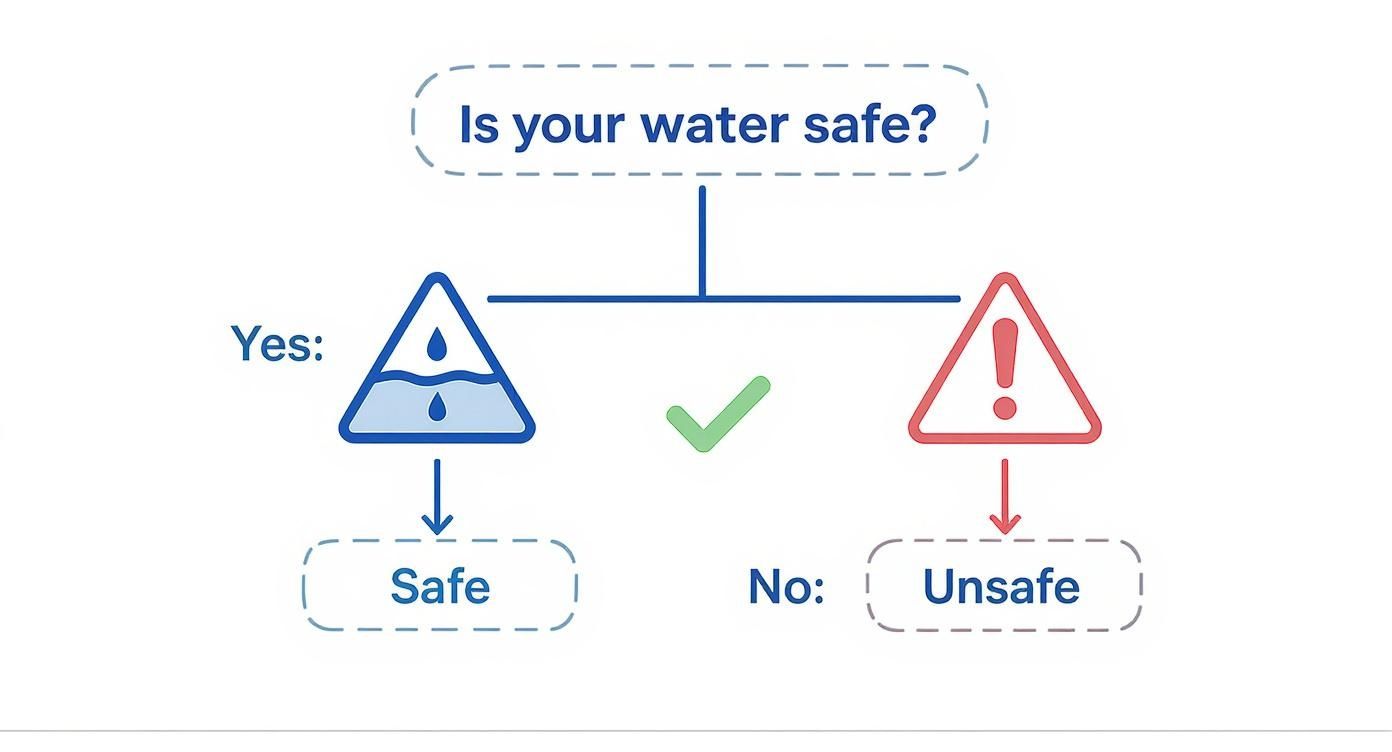
This decision tree shows the simple path from testing your water to confirming it's safe. An "unsafe" result means it's time to take action.
Nitrate Removal System Comparison: Reverse Osmosis vs. Ion Exchange vs. Distillation
Trying to pick the right system can feel like a lot. To make things a little easier, we’ve put the top three methods side-by-side to see how they stack up on the things that matter most to a homeowner.
| Feature | Reverse Osmosis | Ion Exchange | Distillation |
|---|---|---|---|
| Primary Use | Point-of-Use (drinking water) | Point-of-Entry (whole-house) | Countertop (small batches) |
| Effectiveness | Excellent (90-98% removal) | Excellent (90-95% removal) | Near total removal (99%+) |
| Other Contaminants | Removes a wide range | Only removes specific anions | Removes nearly everything |
| Installation Cost | Low to Moderate | Moderate to High | Low (no installation) |
| Operating Cost | Moderate (filter changes) | Moderate (salt, water) | High (electricity) |
| Maintenance | Regular filter/membrane changes | Refill salt, occasional resin care | Regular cleaning/descaling |
| Water Taste | Can taste "flat" or "empty" | May have slightly salty taste | Very pure, flat taste |
So, what's the bottom line? For most families just wanting to ensure their drinking and cooking water is safe, a point-of-use reverse osmosis system hits the sweet spot of performance, cost, and convenience. If you need to treat every faucet in your house, a dedicated nitrate-selective ion exchange system is the way to go. Distillation remains a solid, if niche, choice for those who need the absolute highest purity in smaller quantities.
Choosing the Right System Setup for Your Home
Alright, you’ve done the hard part. You understand the tech behind reverse osmosis and ion exchange and have a feel for their strengths and weaknesses. Now it's time to bring it home—literally. This isn't just about picking a product off a shelf; it's about matching the right hardware to your family's daily life and the unique plumbing of your house.
The whole decision really hinges on one simple question: do you need to treat every drop of water in your house, or just the water you drink and cook with? Your answer will point you straight to the perfect setup.
Point-of-Use vs. Point-of-Entry Systems
The first fork in the road is deciding between a Point-of-Use (POU) and a Point-of-Entry (POE) system. I like to think of it as the difference between a scalpel and a floodlight—one is for precision work, the other for broad coverage.
A Point-of-Use (POU) system gets the job done right where you need it most. The classic example is an under-sink reverse osmosis unit that feeds a special, dedicated faucet right next to your main kitchen tap.
- Who it's for: Frankly, most households dealing with nitrates. The health risk is all about ingestion, so zeroing in on your drinking and cooking water is an incredibly smart and budget-friendly approach.
- What it looks like in practice: You'll fill your water bottle, coffee maker, and pasta pots from this dedicated faucet. Water for washing hands or dishes at the main sink, along with every other tap in the house, will still be your regular, untreated well water.
On the other hand, a Point-of-Entry (POE) system is the full-house solution. We install this beast right where the main water line comes into your home, treating every single drop of water that flows past it.
- Who it's for: This is for homes with seriously high nitrate levels or other water quality problems you want gone everywhere. It’s the comprehensive, no-compromise option.
- What it looks like in practice: This is a much bigger job, both in terms of equipment and installation. Because of the high flow rates needed to run a whole house, ion exchange is the go-to technology for POE nitrate removal.
For the vast majority of families I work with, a POU system is the clear winner for nitrates. It tackles the actual health risk head-on without the cost and complexity of a whole-house installation.
Let me give you a real-world example. A family finds their well water has nitrate levels around 12-15 mg/L. They install an under-sink RO system. This gives them total confidence in the water they drink, while they continue to use untreated well water for showering and laundry, where nitrates pose zero risk. It's the perfect balance.
Sizing Your System for Your Family
Once you've picked your approach (POU or POE), you have to make sure the system can actually keep up with your household's demand. It all comes down to capacity and flow rate.
For a POU reverse osmosis system, the magic number is Gallons Per Day (GPD). A standard under-sink unit might be rated at 50 to 75 GPD. That doesn't mean you'll use 50 gallons in a day, but it tells you how fast the system can produce purified water to refill its little storage tank. For a family of four, a 50 GPD system is almost always plenty for all your drinking and cooking needs.
For a POE ion exchange system, we're talking about flow rate, measured in Gallons Per Minute (GPM). You need a system that won’t leave you with a dribbling shower just because the dishwasher kicked on. A pro will calculate your home's peak demand, but for reference, a typical family home usually requires a system that can handle 10-15 GPM without breaking a sweat.
Pre-Filters and Post-Treatments: The Unsung Heroes
A top-tier nitrate removal system is rarely a solo act. To protect your main unit and get water that actually tastes great, you absolutely need to think about what happens before and after the heavy lifting.
Pre-filtration is non-negotiable with well water. Period. Your well can kick up sediment, sand, and rust that will shred a delicate RO membrane or gum up the resin beads in an ion exchange system in no time.
- Sediment Filter: This is your system’s bodyguard. It’s a simple cartridge that grabs all the physical gunk before it can do any damage to the expensive parts downstream.
- Carbon Filter: If you've got any "earthy" or chemical tastes and odors in your water, a carbon pre-filter is fantastic for absorbing them before they get to the main unit.
Post-treatment is all about polishing the water to perfection right before it hits your glass. This is especially crucial for reverse osmosis.
- Remineralization Filter: RO is so effective it strips out everything, including beneficial minerals like calcium and magnesium. This can leave the water tasting sterile and "flat." A remineralization filter adds a touch of these healthy minerals back, which makes a world of difference in taste and can slightly balance the water's pH.
- UV Purifier: If your water test also flagged any bacteria or viruses, a UV light is the perfect final security checkpoint. Added after the main system, it zaps any lingering microorganisms to ensure total safety.
Putting these pieces together means you’re not just buying a filter—you’re building a complete system that will run efficiently, last for years, and deliver consistently safe and delicious water.
Keeping Your Water Safe with Smart System Maintenance
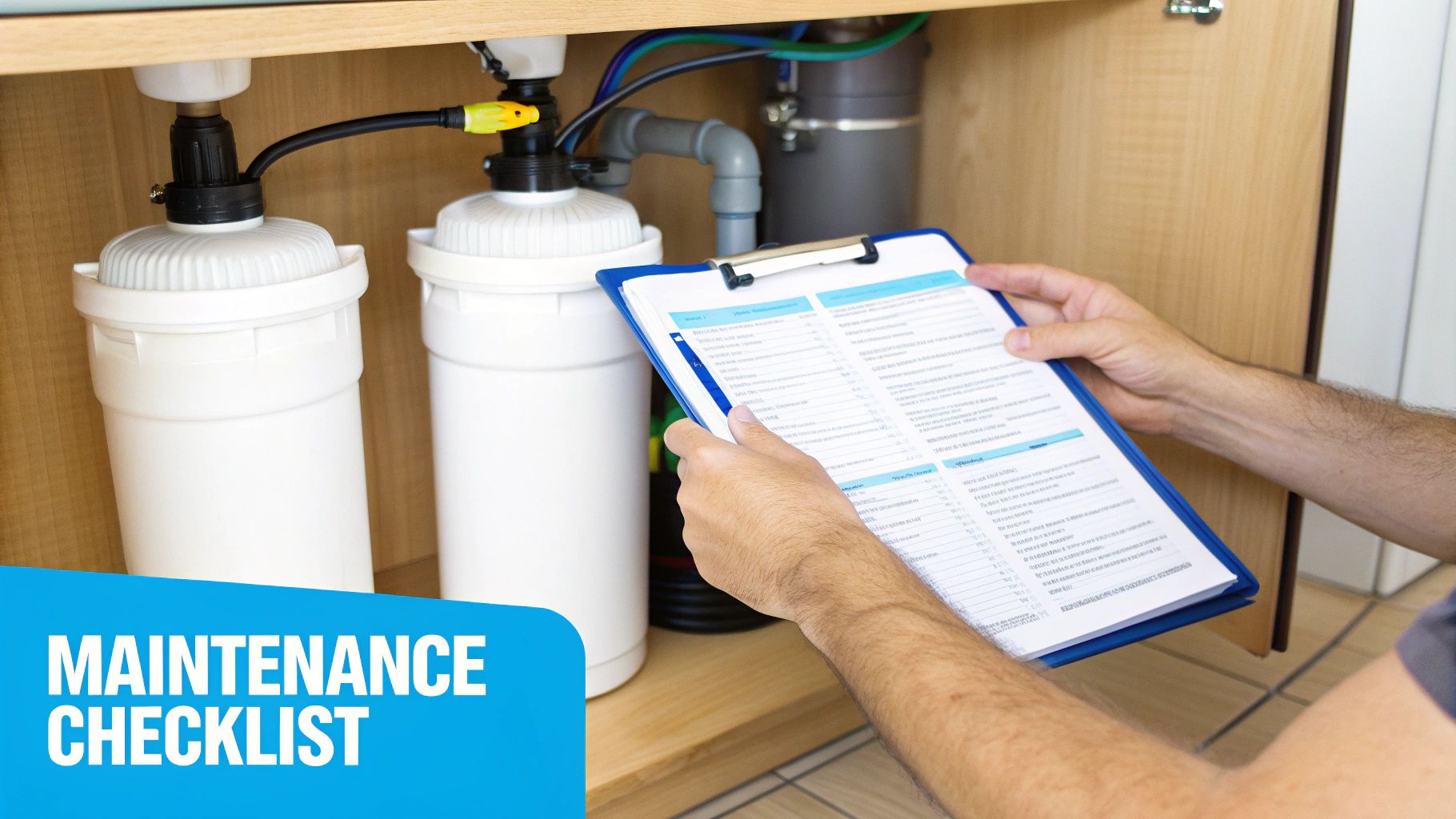
Putting in a new filtration system is a great first move, but it's definitely not a "set it and forget it" kind of deal. Think of it like a new car—you wouldn't skip the oil changes, right? Regular maintenance is what keeps that system running smoothly and protecting your family for years to come.
If you let it slide, even the best system will eventually stop working effectively. Filters clog, membranes get fouled, and resin beds get worn out. This isn't just a performance issue; it directly impacts the safety of your water.
Your Reverse Osmosis Maintenance Checklist
Reverse osmosis systems are the go-to for nitrate removal, but their multi-stage setup means you need to pay attention to a few different parts. Each component has a specific job and, more importantly, a limited lifespan.
Your system’s manual is the best guide, but here’s a general schedule to keep in mind:
- Sediment & Carbon Pre-filters: These are the gatekeepers, protecting the delicate RO membrane from grit and chlorine. You'll want to replace these every 6 to 12 months.
- RO Membrane: This is the core of your system. If you take care of the pre-filters, the membrane itself can last 2 to 3 years. A classic sign it’s failing is a noticeable drop in how much water it produces.
- Carbon Post-filter: This last filter is what polishes the water for taste. Swap it out every 12 months to keep things tasting fresh and clean.
Keeping Your Ion Exchange System Regenerating
An ion exchange system is pretty low-maintenance, but it has one critical need: salt. The salt in the brine tank is what recharges the resin beads, allowing them to keep grabbing nitrates out of your water.
Think of the salt as fuel for your nitrate removal engine. If you let the brine tank run dry, the system can't recharge, and nitrates will start slipping right through into your taps.
Pop the lid on your brine tank at least once a month. A good rule of thumb is to always keep it at least half-full. The good news? The resin bed itself is a real workhorse, often lasting 10 years or more with proper care.
The Simple Care for Distillation Units
If you went with a distiller, you’ve got the easiest maintenance routine of the bunch. Because distillers boil water, their main enemy is the mineral buildup (or scale) that gets left behind. This limescale can coat the heating element and make the whole unit less efficient.
Just plan on cleaning it every few weeks or once a month, depending on how hard your water is. It's usually a simple process involving a cleaning cycle with some white vinegar or a descaling solution. Let it soak, give it a rinse, and you’re back in business.
The Non-Negotiable Annual Re-Test
No matter what system you have, this is the one maintenance step you can't skip: re-testing your well water every year. It’s the only way to know for sure that your system is still doing its job.
Well chemistry can change. It can be affected by seasonal shifts, nearby farming, or even a failing septic system. An annual lab test confirms your filter is handling the current nitrate levels and will catch any new issues before they become a real problem.
This is especially critical since high nitrate levels over the 10 mg/L limit are a serious health concern, linked to "blue baby syndrome" and other risks. If you want to dig deeper, you can learn more about the global impact of nitrate contamination and see why staying on top of it is so important.
This yearly check-up gives you true peace of mind. It’s the final step in knowing you’ve successfully removed the nitrates from your well water—and that they’re staying out.
Common Questions About Nitrates in Well Water
Even with all the facts, some questions always pop up when you're trying to figure out how to handle nitrates in your well water. Let's run through the most common ones I hear to get you on the right track.
Can I Just Boil My Water to Get Rid of Nitrates?
This is a huge, and frankly dangerous, mistake. Never boil water to remove nitrates. Boiling is great for killing bacteria, but it actually makes your nitrate problem worse.
As the water boils, some of it turns to steam and escapes, but the nitrates get left behind. This means you end up with the same amount of nitrates in less water, which shoots their concentration way up.
If you start with water at 10 mg/L, a good boil can easily push that to 15 mg/L or more. That's a big jump into a more dangerous zone, especially for infants.
Will a Regular Water Softener or Pitcher Filter Work?
Nope, sorry. A standard water softener is a type of ion exchange system, but it’s only built to grab positively charged things like the calcium and magnesium that cause hard water. Nitrates are negatively charged, so a softener just lets them slide right by.
Same deal with that carbon filter in your fridge pitcher. It’s a champ at getting rid of chlorine and making your water taste better, but it physically can't trap dissolved nitrates. You need a specific tool for the job, like reverse osmosis or a special nitrate-selective ion exchange filter.
Is an Under-Sink System Really Enough?
For most families, absolutely. A point-of-use (POU) system that sits right under your kitchen sink is usually the perfect fit. The real health risk from nitrates comes from drinking the water or using it to mix baby formula or cook.
A POU unit, like a reverse osmosis system, treats just the water you’ll actually consume. This makes it a super effective and affordable way to solve the problem. Going with a whole-house system is usually overkill unless your nitrate levels are off the charts or you're dealing with a bunch of other water quality problems at the same time. For more general tips on home setups, you can find a lot of good water filtration advice to see what might work for you.
My Neighbor's Well Is Fine, So Mine Should Be Too, Right?
I wouldn't bet on it. It’s amazing how different well water can be, even from one yard to the next.
Things like the depth of your well, the local geology, which way the groundwater is flowing, and how close you are to a septic tank or a fertilized field can create totally different conditions. The only way to know for sure what's in your water is to get your own test done.
At Water Filter Advisor, our goal is to help you find the right fix for your home's water. Check out our guides and reviews to make a smart choice for your family's health over at https://www.waterfilteradvisor.com.
- December 7, 2025
- 0
- Uncategorized
