If you're looking for the fastest way to lower the TDS in your water, you'll need a serious filtration system. We're talking about the heavy hitters of home water treatment: reverse osmosis, distillation, or deionization.
These methods are the special ops of water purification, designed to physically pull those dissolved solids out of the water. They go way beyond what a standard carbon filter can do, which mostly just handles things like chlorine and funky smells. For most homes, a reverse osmosis system is the undisputed champ for tackling high TDS.
What Is This TDS Stuff in My Water Anyway?
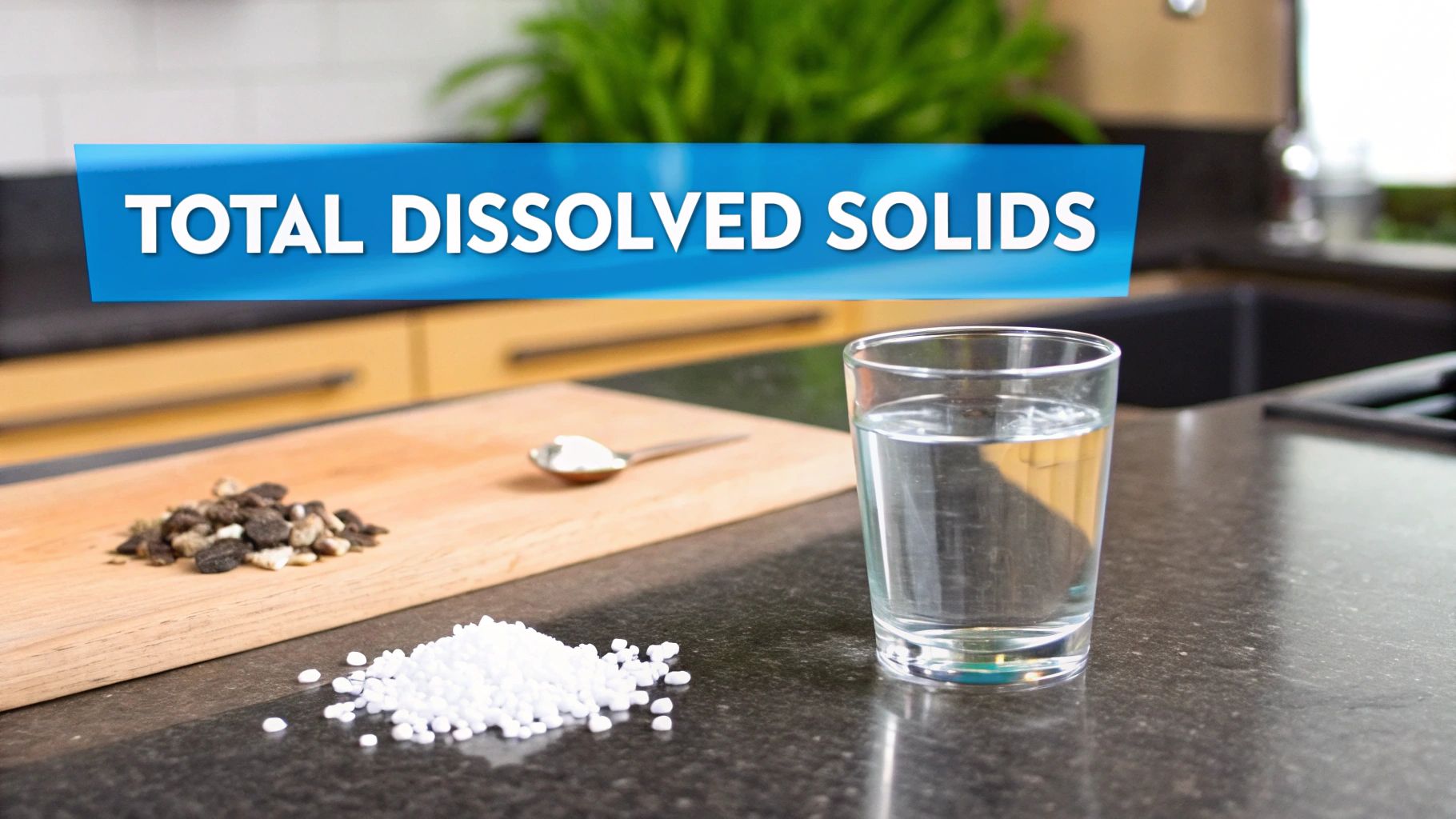
Ever notice your water tastes a bit… off? Or that your "clean" glasses come out of the dishwasher looking like they have a case of the spots? Maybe your morning coffee just doesn't hit the spot. If any of this sounds familiar, you might be dealing with high Total Dissolved Solids, or TDS.
It sounds like a complicated lab term, but its effects are super practical and show up all over your home.
TDS is simply a measure of everything dissolved in your water that isn't pure H₂O. These particles are microscopic, so you can't see them, but they definitely make their presence known. Think of your water as a delivery truck, and TDS is all the cargo it picked up on its journey to your faucet.
Where Do These Solids Come From?
That "cargo" in your water comes from all sorts of places, both natural and man-made. As rainwater seeps into the ground, it naturally dissolves minerals from rocks and soil. This is why you hear about "mineral-rich" spring or well water—that's just a fancy way of saying it has high TDS.
The most common sources of TDS in your tap water include:
- Good Minerals: Things like calcium and magnesium are big contributors to TDS and are the main reason you get "hard water."
- Salts and Ions: Sodium, potassium, and chlorides often dissolve into water from natural deposits underground.
- Trace Metals: Older plumbing can sometimes leach elements like iron, copper, or zinc into the water as it passes through.
- Runoff: Agricultural runoff carrying fertilizers and pesticides, along with urban discharge, can add a whole host of other substances into the water supply.
Because the sources are so diverse, a TDS reading is really a measure of quantity, not quality. It tells you how much stuff is in your water, but it doesn't tell you what that stuff is. A high reading could just mean you have hard, mineral-heavy water, which is perfectly safe. But in some cases, a spike in TDS could hint at other, less desirable contaminants.
What High TDS Means for Your Home
The U.S. Environmental Protection Agency (EPA) doesn't regulate TDS as a direct health threat. Instead, they consider it a "secondary standard." But high levels can still create a whole bunch of annoying and expensive headaches around the house.
A high TDS reading is often the hidden villain behind common household frustrations. It affects everything from the taste of your food and drinks to the efficiency and lifespan of your water-using appliances.
Here’s where you’ll feel the impact of high TDS the most:
- Taste and Odor: High concentrations of dissolved solids often give water a bitter, salty, or metallic taste. This ruins the flavor of your coffee, tea, and anything you cook with water, like pasta or soup.
- Cleaning Nightmares: See those stubborn white spots on your dishes and shower doors? That’s mineral residue left behind when high-TDS water evaporates. It also makes it harder for soap to lather, leading to soap scum and laundry that feels stiff and looks dull.
- Appliance Assassination: This is the big one. That mineral buildup, known as limescale, can clog pipes and coat the heating elements in your water heater, dishwasher, and coffee maker. This forces them to work harder, use more energy, and eventually, break down completely.
Getting a read on your water's TDS level is the first step. It gives you a clear baseline to figure out if it's a problem you need to solve to make life at home a little bit better.
Testing Your Water's TDS Level at Home
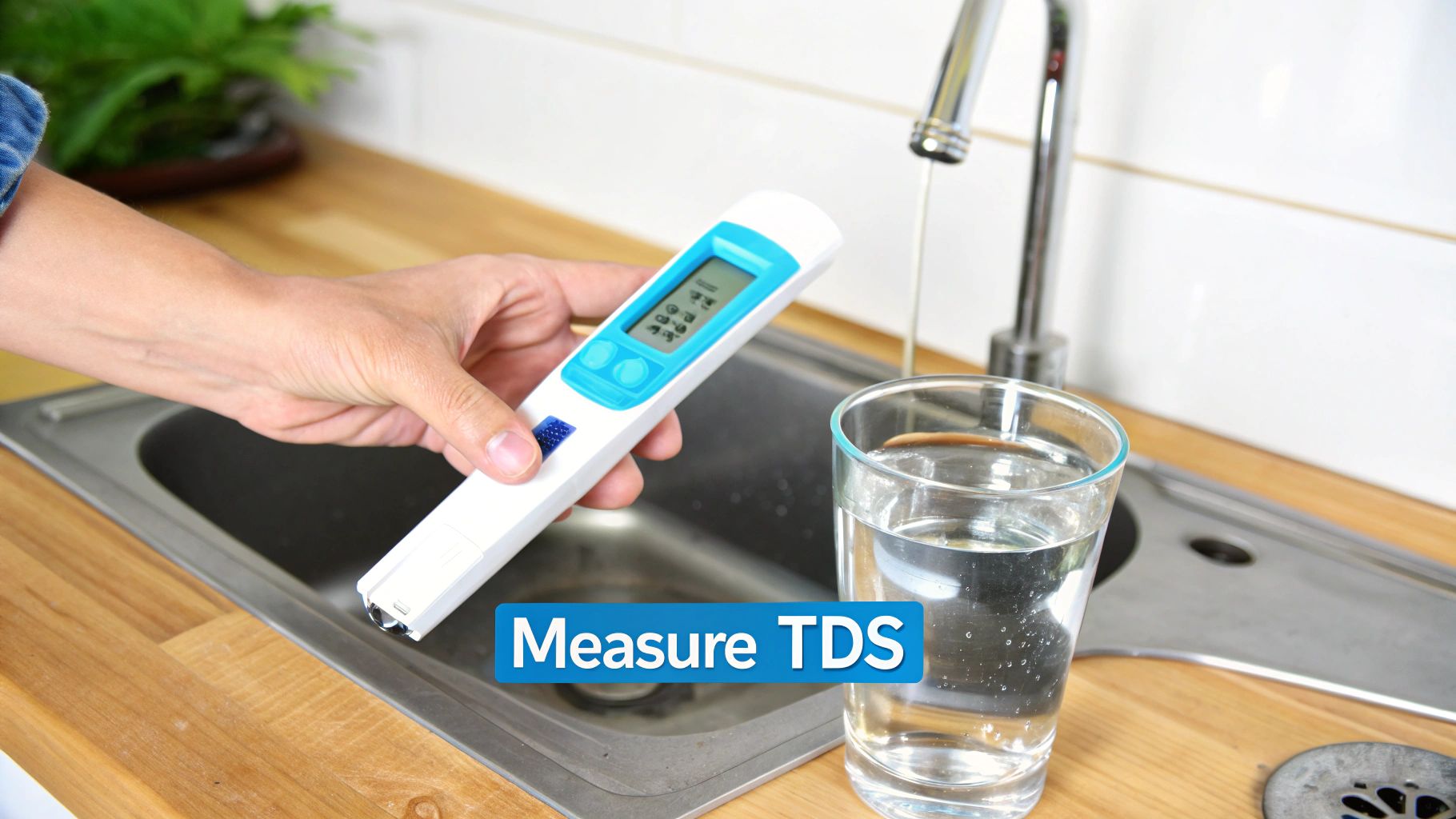
Before you can tackle a high TDS problem, you have to know if you even have one. You can't just guess based on spotty dishes or dull laundry—you need a real number. The good news? Getting that number is surprisingly simple and affordable, and you can do it right in your kitchen.
The quickest and most common tool for the job is a digital TDS meter. These handy little devices are inexpensive and give you an instant reading of the total dissolved solids in your water, measured in parts per million (ppm). Think of it as a pocket-sized detective for your water.
Getting a Good Reading with Your TDS Meter
Just dipping the meter in water isn't quite enough to get an accurate reading. To make sure your results are solid, there are a few quick steps to follow. This process will give you a reliable baseline to work from as you figure out how to best treat your water.
Here’s a simple routine for a dependable measurement every time:
- Prep Your Samples: First, grab two clean, dry glasses. Fill one right from your kitchen tap with cold water, but let the faucet run for about 30 seconds first to clear the pipes. If you already use a filter (like in a pitcher or your fridge), fill the second glass with that water.
- Ready the Meter: Pop the protective cap off your TDS meter and switch it on.
- Take the Measurement: Submerge the meter's tip about an inch into the first glass of tap water. Give it a gentle swirl to knock off any air bubbles that might be clinging to the sensors.
- Log the Number: Just wait a moment for the reading on the digital display to settle. That number is your water’s TDS level in ppm. Jot it down.
- Rinse and Repeat: Before you test your filtered water, give the meter's probe a quick rinse with distilled water (if you have some handy) or just shake it dry. Then, repeat the whole process with the second glass. The difference between those two numbers is a great indicator of how well your current filter is working.
It's important to know what your TDS reading means. While the EPA suggests a level below 500 ppm for aesthetic reasons like taste and odor, most folks are aiming for a reading somewhere between 50-150 ppm for the best-tasting drinking water.
When a TDS Meter Isn't Enough
A TDS meter is a fantastic tool for getting a quick snapshot of your water, but it does have one big limitation: it tells you how much stuff is dissolved in your water, but not what that stuff is. It can't tell the difference between harmless minerals like calcium and more concerning contaminants like heavy metals.
I always recommend a professional lab test if:
- You're on well water, which is far more prone to contamination.
- Your TDS reading is consistently over 500 ppm.
- You live in an area with known water quality problems or have very old plumbing.
- You notice a sudden, big jump in your TDS levels that you can't explain.
A lab analysis will give you a detailed report breaking down the specific minerals, salts, metals, and anything else lurking in your water. This is the complete picture you need to choose the right filtration system for your home’s unique water profile, moving you from just a number to a real, targeted solution.
A Head-to-Head Comparison of TDS Reduction Methods
So, you've got your TDS number. Now what? The next step is figuring out the best way to lower it, and let's be clear—not all water filters are up to the task. That trusty pitcher filter you keep in the fridge is great for making tap water taste better by zapping chlorine, but it won’t do a thing for dissolved solids.
To really tackle TDS, you need to call in the specialists.
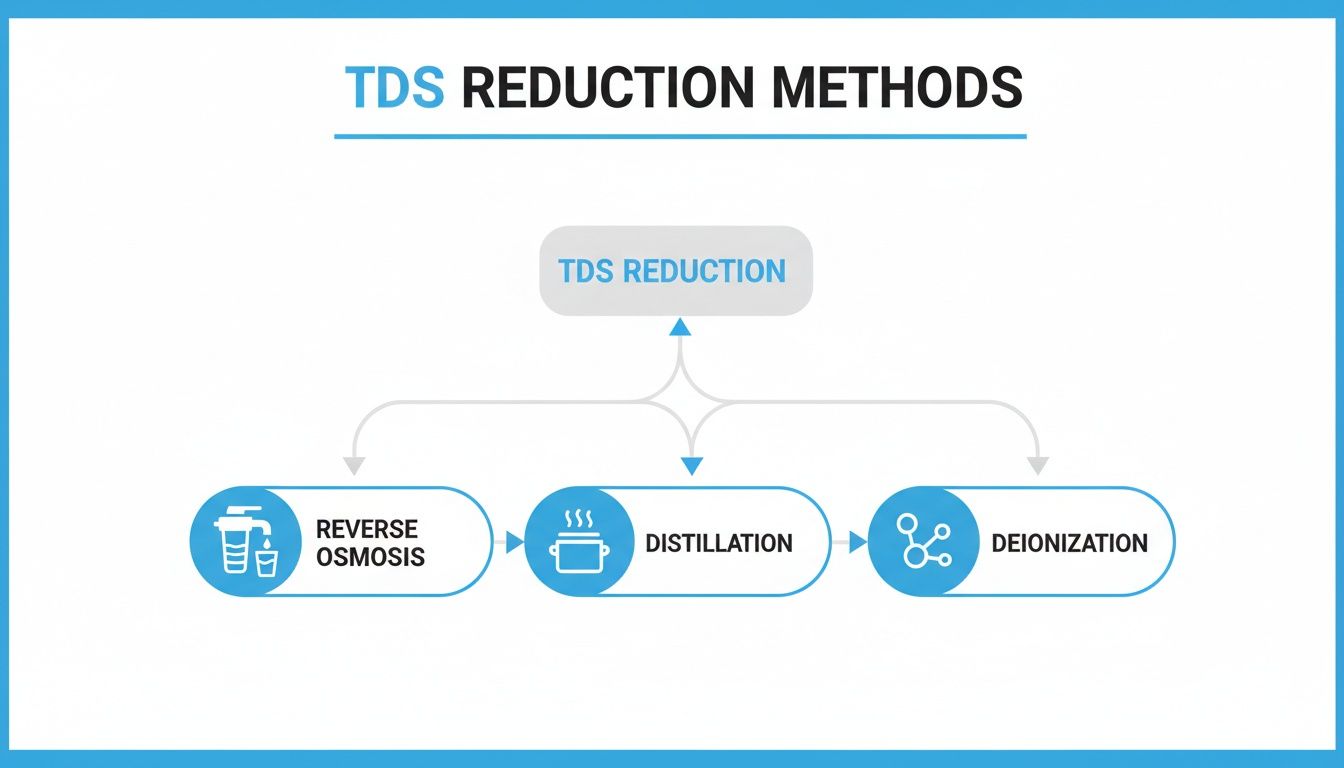
We're talking about three core technologies that are the go-to solutions for slashing TDS at home: Reverse Osmosis (RO), Distillation, and Deionization (DI). Each one has a completely different playbook for stripping solids out of your water, and they all come with their own set of trade-offs.
Reverse Osmosis: The Gold Standard for Home Filtration
For most people looking to get serious about their water quality, Reverse Osmosis is the undisputed champion. It’s the most practical and popular way to get low-TDS water right from your tap.
Think of it like an ultra-exclusive nightclub for water molecules. An RO system uses your home’s water pressure to push water through a special semipermeable membrane. This membrane is a marvel of engineering, with pores so tiny that only pure H₂O can get through.
Everything else—the salts, heavy metals, and other dissolved gunk—gets left behind and flushed down the drain. What comes out the other end is incredibly clean water, often with a TDS reading that’s nearly zero. A good RO system will reliably remove 95% to 99% of all total dissolved solids.
Distillation: The Tried-and-True Purifier
Distillation is one of the oldest tricks in the book for purifying water, and its elegance lies in its simplicity. It’s basically a man-made version of the earth’s natural water cycle.
A home distiller boils water, turning it into pure steam. As the steam rises, it leaves behind all the dissolved solids—minerals, salts, and other contaminants that can't evaporate. The steam is then cooled in a separate container, where it condenses back into liquid. The result is some of the purest water you can make, with a TDS of virtually zero.
While it’s incredibly effective, distillation isn’t always practical for a busy household. It's a slow process, it uses a fair amount of electricity to boil the water, and you can only make a few gallons at a time. It’s a great option for specific uses, but less so for the all-day demands of a family.
Deionization: The Ultimate TDS Scrubber
Deionization, or DI, uses a bit of chemistry to get the job done. A DI system sends water through special resins that are loaded with positive and negative charges. These resins act like super-magnets for dissolved solids, which are basically ions.
As water flows past, the resin beads snatch ions like calcium and chloride right out of the water, swapping them for hydrogen (H+) and hydroxyl (OH-) ions. Those two new ions immediately bond to form pure water (H₂O).
DI systems are amazing at producing ultra-pure water and can easily bring TDS down to absolute zero. But they’re usually reserved for specialized applications like reef aquariums or lab work, not so much for drinking water. The resin cartridges get used up quickly, especially in high-TDS areas, and can be pricey to replace.
For pure, great-tasting drinking and cooking water from a dedicated faucet, Reverse Osmosis is the clear winner. It offers the best balance of performance, affordability, and convenience for the modern home.
Comparing TDS Reduction Technologies for Your Home
To really see how these methods stack up, let's put them side-by-side. This table gives you a quick look at the top home water filtration methods for reducing Total Dissolved Solids (TDS).
| Method | TDS Removal Rate | Initial Cost | Ongoing Maintenance | Best For |
|---|---|---|---|---|
| Reverse Osmosis | 95-99% | Moderate | Filter changes (every 6-24 months) | Creating superior drinking and cooking water at a dedicated faucet. |
| Distillation | 99%+ | Low to Moderate | Regular cleaning to remove scale buildup | Producing small batches of ultra-pure water for specific uses. |
| Deionization | 99%+ | Low to High | Frequent resin cartridge replacement | Polishing already filtered water for aquariums, labs, or medical use. |
For many homes, the ultimate solution is often a tag-team approach. You might have a whole-house carbon filter to handle chlorine and sediment for all your taps and appliances, combined with a dedicated under-sink RO system for the purest possible water right at the kitchen sink.
Choosing the Right Filtration System for Your Home
Okay, you've got your TDS reading and you know the basics of how these systems work. Now it’s time to pick the right one for your home. This isn't about buying the most powerful or expensive system; it's about finding the one that actually fits your water, your budget, and your daily life.
The decision really comes down to a few key questions. Thinking through these helps you get past the technical jargon and focus on what you'll actually use day-to-day. A setup that's perfect for a big family on well water would be total overkill for someone in a city apartment. Let's match the solution to your specific problem.
Start with Your Water Source and TDS Reading
That TDS number you measured is your North Star. It sets the stage for everything else and tells you just how much work needs to be done. Your water source—whether it’s from the city or a private well—is just as important.
Let’s look at a couple of real-world scenarios:
-
The Suburban Family on City Water: Picture a family whose tap water comes from the city and has a TDS reading of 350 ppm. The water is safe, but they're annoyed with spotty dishes and that funky taste in their morning coffee. Their main goal is getting crystal-clear drinking and cooking water. An under-sink Reverse Osmosis (RO) system is a fantastic fit here. It targets the water they actually consume, it's budget-friendly, and it's often a manageable weekend DIY project.
-
The Rural Homeowner with Well Water: Now, think about a family with a private well. Their TDS reading comes in at a whopping 800 ppm, and it’s full of minerals like calcium and iron. They're not just worried about taste; they're seeing limescale build up on showerheads and they know it's slowly wrecking their water heater. A simple filter won't cut it. A whole-house water softener to knock out the hardness minerals, followed by an under-sink RO system for pure drinking water, gives them a powerful one-two punch that protects their appliances and their health.
Sizing Up Your Household Needs
How many people are in your home? How much water do you use? A single person might do just fine with a small countertop distiller, but a family of five would find it completely impractical.
You'll need to decide if you want to treat water at a single faucet (point-of-use) or treat all the water coming into your house (point-of-entry).
-
Point-of-Use (POU) Systems: These are your under-sink RO units and countertop distillers. They’re perfect for targeting just your drinking and cooking water. This makes them a really cost-effective way to improve taste and purity right where you need it most.
-
Point-of-Entry (POE) Systems: Also called whole-house systems, these are installed right where your main water line enters your home. Full whole-house RO systems are pretty rare and expensive for residential use, but a common strategy is to pair a whole-house sediment filter with an under-sink RO for drinking water.
As you can see, if getting the highest purity drinking water is your top priority, Reverse Osmosis is almost always the most direct and popular solution for homeowners.
Budget and Installation Considerations
Your budget is obviously a big factor. You'll want to think about the initial purchase price and the long-term cost of replacing filters. Under-sink RO systems usually hit a sweet spot, with prices ranging from a couple hundred to several hundred dollars. Whole-house solutions are a bigger upfront investment, but they can save you money down the road by protecting expensive appliances.
Pro Tip: Make sure any RO system you're looking at has an NSF/ANSI 58 certification. This isn't just marketing fluff. It's an independent verification that the system has been tested and proven to reduce TDS and other contaminants just like it claims. It's your peace of mind.
Finally, there's the installation. Many under-sink RO systems are designed for DIYers, complete with color-coded tubes and step-by-step guides. But if you’re not comfortable with basic plumbing, there’s no shame in calling a pro to make sure it’s done right.
Keeping Your System Running for Peak Performance
Putting in a quality water filtration system is a huge first step. But the real secret to getting that clean, low-TDS water for years to come? It's all in the follow-through.
The initial setup and a consistent maintenance schedule are what truly keep your system at the top of its game. If you let it slide, you’re basically buying a high-performance car and never changing the oil. Sooner or later, you'll see that performance drop.
Setting Up Your System for Success
Getting your system installed can be anything from a simple Saturday project to a job for the pros, all depending on what you bought.
A standard under-sink Reverse Osmosis (RO) unit, for instance, is usually pretty DIY-friendly. Most people with basic tools can get one up and running. Manufacturers have really stepped up their game with things like color-coded tubes and dead-simple instructions.
A whole-house system, though? That's a different story. You’ll be cutting into your main water line, and that takes some serious plumbing know-how. If that sounds intimidating, it’s a smart move to call in a licensed plumber. They'll make sure it's done right, with no leaks, and everything's up to code.
A flawless installation is the foundation of a high-performing filtration system. Taking the time to do it right—or hiring someone who can—prevents common headaches like leaks, low pressure, and premature filter failure.
Your Essential Maintenance Checklist
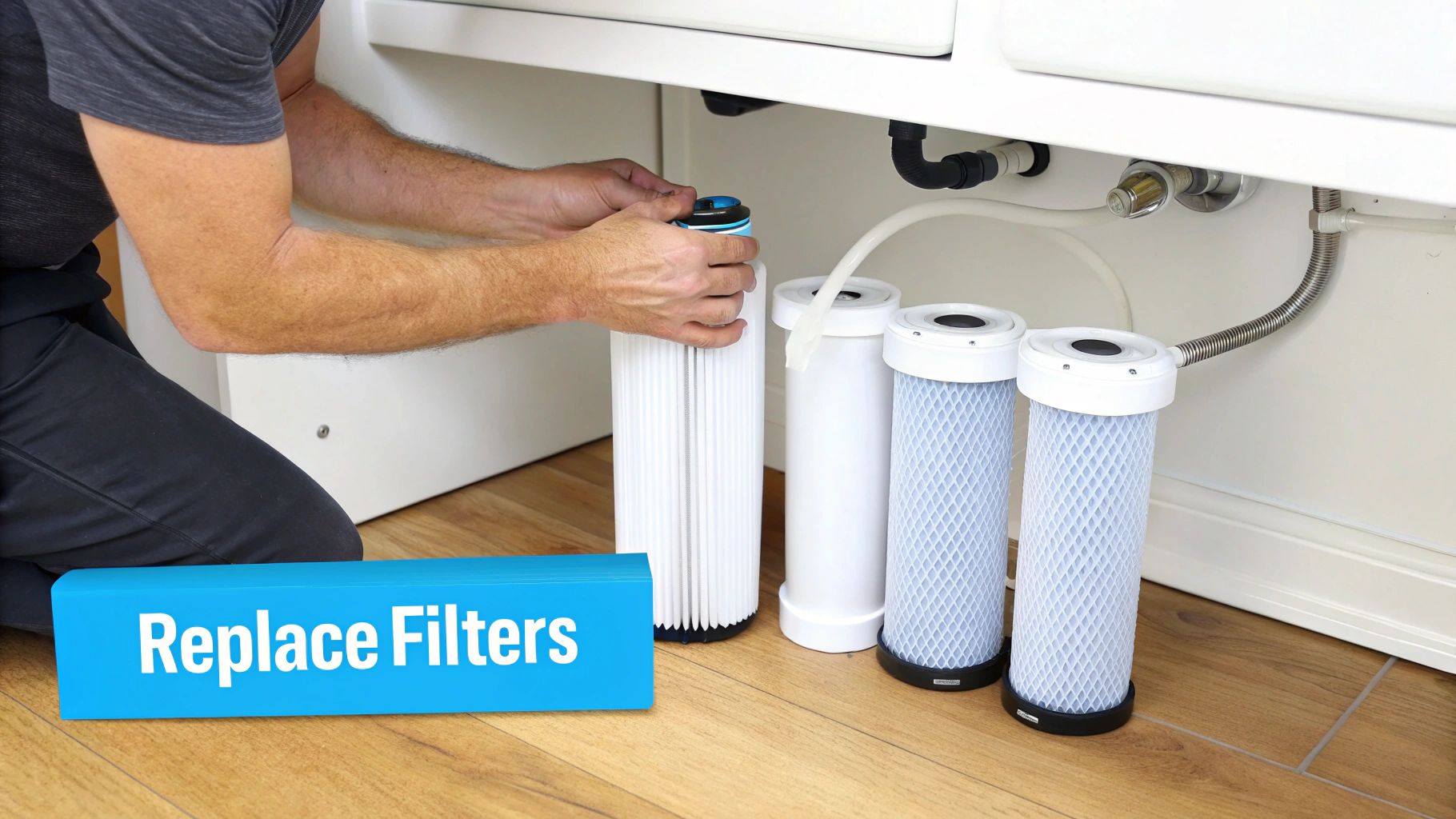
Once you're all set up, the game shifts to routine maintenance. This isn't just about keeping the water on; it's about making sure your system is actually pulling its weight and cutting down those TDS levels. Over time, those filters get packed with all the gunk they’re supposed to be removing.
For a typical RO system, here’s a rough timeline to follow:
- Pre-Filters (Every 6-12 Months): Think of these as the bouncers for your system. The sediment and carbon filters grab the big stuff—rust, silt, chlorine—before it can get to the more sensitive parts. Swapping these out on schedule is the best thing you can do to protect the RO membrane.
- RO Membrane (Every 2-3 Years): This is the heart of the operation, where the serious TDS reduction happens. How long it lasts really depends on your water quality and how diligent you are with those pre-filters.
- Post-Filter (Every 12 Months): This is the final polish. This last carbon filter gets rid of any lingering off-tastes before the water hits your glass.
This isn't just about under-sink systems, either. Even simpler filters need attention. Knowing the basics of routine filter changes keeps all your drinking water sources clean and safe.
Troubleshooting Common Filtration Issues
Even with the best maintenance, things can go sideways. No need to panic. Most problems have simple fixes.
If you suddenly notice a drop in water pressure, a clogged pre-filter is almost always the cause. If the water starts tasting "off" all of a sudden, that’s your post-filter telling you it's time for a change.
The biggest red flag, though, is a sudden spike in your TDS readings. If you test your water and see the numbers have jumped, it’s a strong sign your RO membrane has finally given up the ghost. Keeping a TDS meter handy lets you do quick spot-checks to catch these problems early. It’s this kind of proactive approach that ensures you always know how to reduce TDS in water.
Your Top Questions About Lowering TDS in Water
Once you start looking into TDS, it's natural for a bunch of questions to come up. It can feel like a whole new world. To help you out, we've gathered the most common questions and myths we hear from people just like you and answered them in plain English.
Think of this as your go-to guide for busting myths and getting clear on how to manage the TDS in your home's water. We want you to have the practical, real-world info you need to make the right choice for your family.
Is a High TDS Level Automatically Dangerous?
This is the big one, and the short answer is: usually, no. A high TDS number doesn't automatically mean your water is dangerous. Most of the time, it just points to a high concentration of harmless minerals like calcium and magnesium, which are the culprits behind "hard water."
The catch is that a basic TDS meter can't distinguish between those benign minerals and nasty stuff like lead, arsenic, or pesticides. That's why the EPA suggests keeping TDS below 500 ppm. If your reading is north of that—or if you're on well water—it's smart to get a proper lab test done. That's the only way to know for sure what you're dealing with.
Why Doesn't Boiling Water Lower My TDS?
This is a really common misconception. People assume boiling purifies water, and while it does kill germs, it actually makes your TDS worse.
Here’s why: when you boil water, the pure H₂O turns into steam and escapes, but all the dissolved solids—the salts, minerals, and metals—are left behind. As the water level drops, those solids become even more concentrated. So, while boiling is great for disinfecting water, your TDS reading will actually go up, not down.
Key Takeaway: Boiling water sterilizes it but concentrates dissolved solids, increasing the TDS level. True TDS reduction requires physically removing the solids through filtration or distillation.
What Is the Difference Between a Regular Filter and an RO System?
This is a super important distinction to understand. The standard carbon filter you have in your pitcher or fridge is designed to make your water taste and smell better. It does a fantastic job of grabbing things like chlorine and some organic chemicals.
A Reverse Osmosis (RO) system, on the other hand, is a whole different beast. It uses a high-tech semipermeable membrane with microscopic pores to physically block and strip out up to 99% of all dissolved solids.
Let's break it down simply:
- Standard Carbon Filter: Think of it like a sponge that soaks up specific contaminants like chlorine. It won't do much for your TDS reading.
- Reverse Osmosis System: This is more like a bouncer at an exclusive club. It only lets pure water molecules through and kicks almost everything else out. For lowering TDS at home, it’s the best tool for the job.
Can My Water's TDS Be Too Low?
It's a fair question. Once you see how powerful an RO system is, you might wonder if you can take too much out of the water. Some worry that removing minerals makes water unhealthy or "dead."
The truth is, we get the vast majority of our essential minerals from our food, not our water. The amount of calcium or magnesium you'd get from even very hard water is pretty tiny compared to what a balanced diet provides.
In fact, most people end up loving the pure, clean taste of low-TDS water, which typically clocks in between 0-50 ppm. For almost everyone, the peace of mind that comes from removing potential contaminants far outweighs the loss of a few trace minerals from your water.
At Water Filter Advisor, we believe everyone deserves access to clean, safe, and great-tasting water. Our in-depth guides and unbiased reviews are designed to help you find the perfect filtration solution for your home, so you can feel confident with every sip. Explore our expert buying guides and find your ideal water filter today.
- December 23, 2025
- 0
- Uncategorized
