Your tap water may be safe enough to drink, but that doesn't mean you like it. A lot of homeowners end up stuck between two bad options. They either keep hauling home bottled water, or they install an older reverse osmosis unit and then cringe at how much water goes down the drain.
That's the gap the brondell circle reverse osmosis system tries to fill. It's an under-sink RO unit built for people who want the deep filtration reverse osmosis is known for, but don't want the usual bulky tank and heavy wastewater penalty that comes with many traditional systems.
Most write-ups stop there. They praise the design, mention the water savings, and move on. For homeowners, that's only half the story. The better question is simpler: how does it perform in a real kitchen, what do you have to maintain, and what does it cost to own over time?
Tired of Wasting Water or Buying Bottles?
If you've used bottled water as your workaround, you already know the routine. You keep a case in the garage, another in the pantry, and somehow you're always close to running out when guests come over. If you've gone the reverse osmosis route before, you may have run into the opposite problem. The water tastes great, but the system wastes so much water that it feels wrong every time it runs.
That's why the Brondell Circle gets attention. It was built as a tankless under-sink filtration solution with a much stronger focus on water efficiency than older RO designs, according to Tap Water Data's Brondell Circle review. It also avoids electricity, which matters for homeowners who want fewer moving parts and less under-sink complexity.
What matters in a home RO system
When I evaluate a reverse osmosis setup for a home kitchen, I care about four things first:
- Wastewater behavior: If the system sends too much water to drain, homeowners notice it fast.
- Filtration scope: Taste matters, but contaminant reduction is the primary reason to choose RO.
- Maintenance rhythm: A system that performs well on paper but is annoying to service won't stay maintained properly.
- Ownership cost: The purchase price is only the opening number. Filters and membrane changes decide whether the system still feels like a smart buy later.
A good residential RO system has to work on a Tuesday morning when everyone's rushing, not just on a spec sheet.
The Brondell Circle is strongest where many legacy systems are weakest. It aims squarely at water waste, cabinet space, and ease of living with the unit day to day. That doesn't mean it's perfect for every household. It does mean it deserves a closer look than the typical feature list.
How the Brondell Circle Ends Water Waste
The central idea behind the Brondell Circle is straightforward. Traditional reverse osmosis systems often waste a lot of water because of backpressure. The storage side pushes back against the membrane, so the system has to work harder and flush more water away.
Why traditional RO systems waste so much
A simple way to think about backpressure is a balloon. If the balloon is nearly full, pushing more air into it gets harder. Old-style RO systems behave similarly. As stored water builds up, pressure builds against the membrane, and that pressure works against efficient filtration.
That's where Brondell changed the design. The RC100 achieves a product efficiency rating of 33.5% with a waste-to-product water ratio of about 2.1:1, compared with conventional reverse osmosis systems that typically generate 24:1 waste ratios, according to the Ferguson Home Brondell RC100 listing. The same source credits that improvement to patented Smart Valve technology, which reduces backpressure.
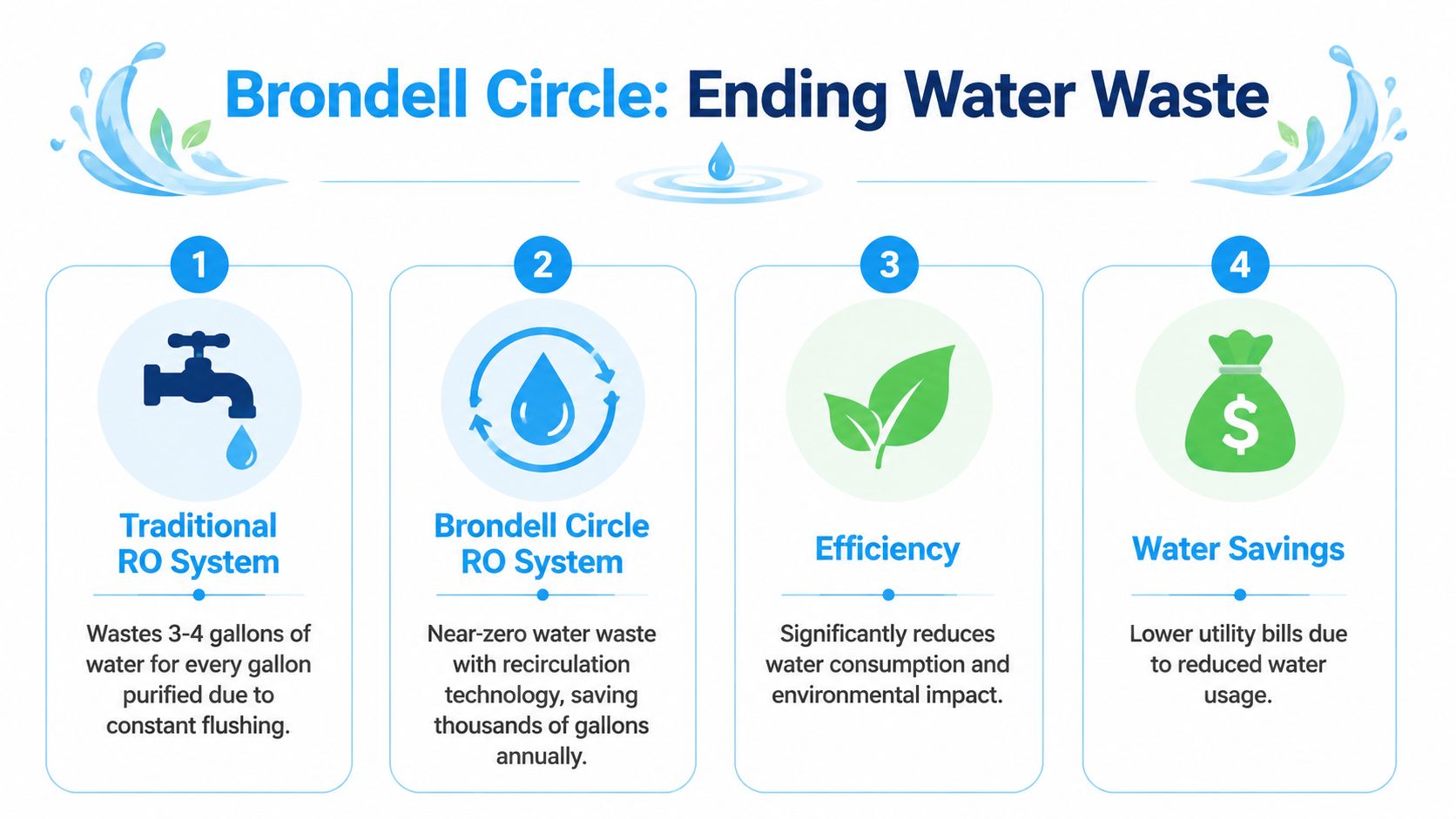
If you want a broader explanation of why this matters in real homes, this guide on reverse osmosis system water waste is worth reading.
What the Smart Valve is actually doing
Brondell pairs that valve design with a flexible 6-liter internal reservoir. Instead of forcing water into a rigid setup that constantly fights incoming pressure, the reservoir absorbs pressure more dynamically. In practice, that means less stress on the membrane and less reject water.
This is the part many homeowners miss. The Circle doesn't save water because of a marketing trick or a pump-heavy workaround. It saves water because the pressure problem is addressed at the design level.
Here's what that means in plain English:
- Less drain waste: More of the water entering the system ends up as usable drinking water.
- No bulky tank behavior: The internal reservoir changes how the unit stores water without relying on the old tank model.
- No electricity required: The system runs on municipal water pressure rather than powered pumps.
- Better fit for efficiency-minded homes: If water conservation is part of your buying decision, this design is the main reason the Circle stands out.
Traditional RO often makes homeowners choose between purity and efficiency. The Circle is one of the few systems that tries to deliver both.
That doesn't erase every trade-off. It still uses proprietary filters, and replacement timing matters. But on water waste alone, this is the feature that makes the brondell circle reverse osmosis system different from the pack.
The 4-Stage Filtration That Purifies Your Water
Water efficiency gets attention, but filtration remains the primary function. The Brondell Circle uses a four-stage filtration architecture that assigns a specific task to each filter stage, according to the Home Depot certification document.

Stage by stage under your sink
Think of the filter train as a team, not one magic cartridge.
- Stage 1 handles grit first. The sediment filter, rated at 5 microns or larger, catches rust, sand, and particulate matter before they foul the later stages.
- Stage 2 focuses on chemical cleanup. The pre-carbon plus filter targets chlorine and volatile organic compounds, which helps both taste and downstream membrane protection.
- Stage 3 does the heavy lifting. The RO membrane reduces heavy metals, industrial chemicals, fluoride, and total dissolved solids.
- Stage 4 finishes the water. The post-carbon block acts like the final polish, cleaning up residual taste and odor before water reaches your glass.
That sequence matters. Homeowners sometimes assume RO is all about the membrane, but the upstream and downstream filters decide how hard the membrane has to work and how the water tastes at the faucet.
What that means in daily use
In practical terms, this setup is designed for the kinds of concerns people mention at the sink:
- Chlorine taste from city water
- Worry about lead or other metals
- Cloudiness or grit from aging plumbing
- General “flat” or stale drinking water
One detail I like is that each stage has a clear purpose. That makes maintenance less mysterious. When a homeowner understands that one stage blocks sediment while another handles chlorine or dissolved solids, filter replacement feels like routine upkeep instead of a black box.
The best filtration systems make contamination control visible in your mind, even if the actual process happens inside sealed cartridges.
This four-stage design is one of the reasons the Brondell Circle appeals to households that want true RO treatment rather than a lighter taste-only filter.
Decoding Performance and Official Certifications
A lot of filter marketing collapses into one vague word. Certified. That sounds reassuring, but it only helps if you know what the certifications cover.
For the Brondell Circle RC100, the key point is that it holds NSF/ANSI 42, 53, 58, and 372 certification, with verification by the Water Quality Association, as shown in the earlier certification reference. Those standards tell you what kind of claims were independently tested.
What the standards mean at the kitchen faucet
Here's how I explain those standards to homeowners.
| Standard | What it covers | Why it matters at home |
|---|---|---|
| NSF/ANSI 42 | Aesthetic reduction for chlorine, taste, and odor | Your water should taste and smell cleaner |
| NSF/ANSI 53 | Health-related contaminants such as lead, arsenic, and cysts | This is the standard people care about when safety is the issue |
| NSF/ANSI 58 | Reverse osmosis performance including TDS reduction | It confirms the RO side is doing real dissolved-solids work |
| NSF/ANSI 372 | Lead content compliance | It addresses the material side of the system itself |
That list matters because not all filters with strong marketing have the same certification depth. A pitcher may improve taste. A faucet filter may reduce some contaminants. A certified RO system is usually the better fit when a homeowner wants broader contaminant reduction under one sink.
Performance in real homes
The certification document also shows something useful that doesn't get enough attention. It lists different rated capacities for different contaminant categories. For example, the system is rated for 3,500 gallons for aesthetic chlorine reduction but 243 gallons for VOC reduction in the cited document. That tells you filter media doesn't wear evenly.
If your water concern is mostly chlorine from municipal treatment, the maintenance experience may feel straightforward. If VOCs are part of your concern profile, the carbon stage can become the limiting factor faster.
Certification tells you a system was tested. It doesn't remove the need to match the system to your own water.
Pressure matters too. The Circle is designed to operate on standard municipal pressure, and homes with weak flow at the kitchen sink may need to address that before expecting ideal RO performance. If low pressure is already a known plumbing issue, this explanation of common low water pressure causes from MG Drain Services LLC can help you separate a house plumbing problem from a filter problem.
Installation and Ongoing Maintenance Guide
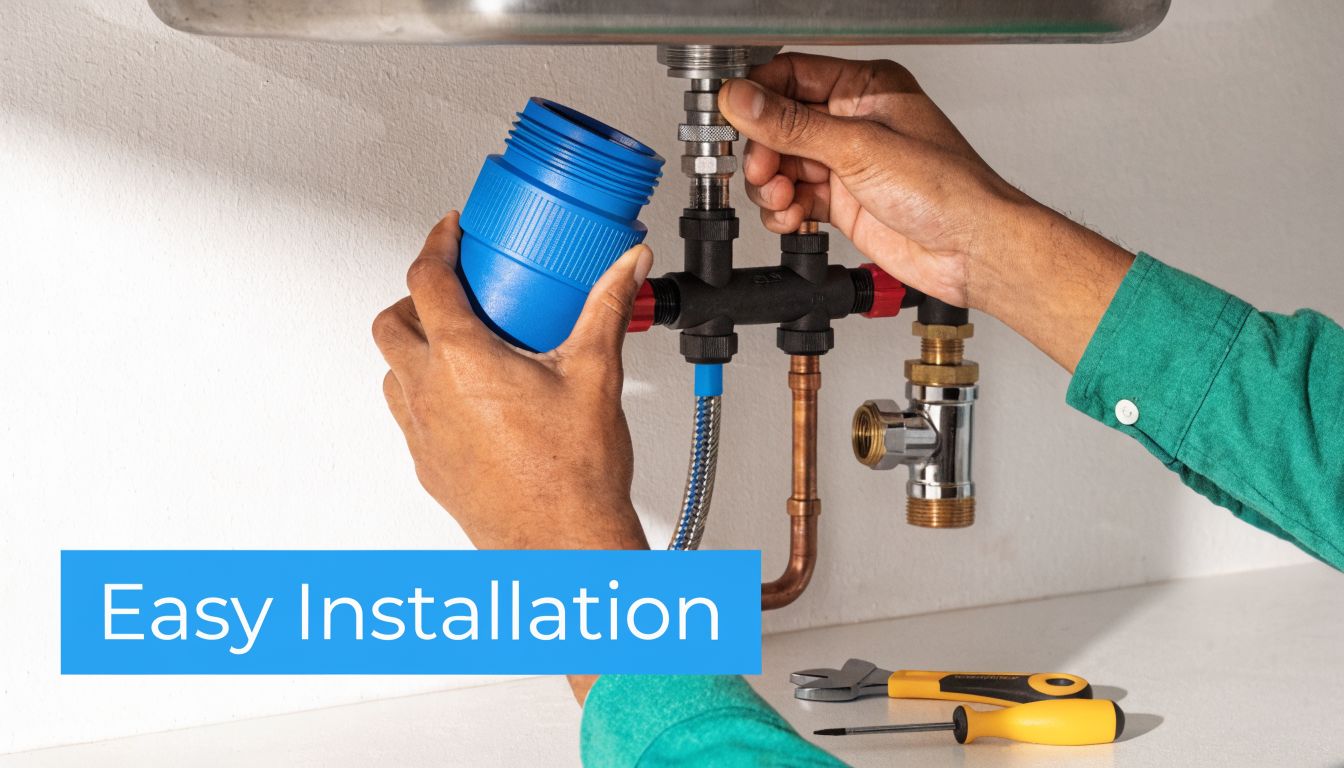
The Brondell Circle is friendlier to install than many older RO systems because it keeps the footprint compact and avoids the classic bulky storage tank. That doesn't make it a zero-effort project. You're still working under a sink, connecting feed water, drain, and faucet hardware in a tight cabinet.
What installation usually feels like
For a DIY homeowner, the job is manageable if you're comfortable with basic under-sink plumbing. The all-in-one design helps because you're not trying to position a separate pressure tank somewhere behind cleaning supplies. Color-coded tubing also cuts down on the usual guesswork.
A practical install checklist looks like this:
- Clear the cabinet first: Give yourself real working space before bringing in parts and tools.
- Confirm faucet space: Under-sink RO units need a dedicated faucet unless your sink setup already accommodates one.
- Check your pressure conditions: The unit is meant to operate on 40 to 120 PSI, with optimal performance around 60 PSI, according to the earlier product data.
- Expect careful fitting work: The hardest part usually isn't the filter body. It's making neat, leak-free connections in a cramped space.
Living with the maintenance schedule
The day-to-day ownership side is simpler than installation. Filter changes are the primary recurring task.
The replacement schedule is clear in the manufacturer and retailer documentation referenced earlier:
- Sediment, pre-carbon, and post-carbon filters: replace every 6 months
- RO membrane: replace every 24 months
That's a reasonable maintenance pattern for an under-sink RO, but homeowners should be honest with themselves about consistency. Missing those replacement windows is how good systems turn into mediocre ones.
Here's a visual walkthrough for homeowners who want to see the system in action:
Practical rule: Put filter replacement dates on your phone calendar the day the system goes in. Don't trust memory.
One more maintenance reality deserves mention. The Circle is compact and polished, but it uses brand-specific filter components. That's convenient when the fit is exact, and less convenient if you prefer broad third-party cartridge options.
The True Cost of Ownership Over Five Years
Most Brondell Circle reviews lose their depth at this point. They mention the purchase price, hint at water savings, and stop before the harder question. What will this thing cost you after years of normal use?
The starting point is clear enough. The unit itself is typically listed around $399 to $449, and any honest cost review has to include the filter schedule of 6 months for the three main filters and 24 months for the RO membrane, as noted in the Lowe's product page.
What we can calculate and what we can't
There's one big limitation. Public listings and reviews don't give a consistent, transparent long-term filter cost history. That means a precise five-year dollar total for every household would be guesswork unless you use current vendor pricing, and those prices can vary.
So the transparent way to analyze the Circle is this:
- Use the verified purchase price range
- Map the required replacement intervals across five years
- Treat filter and membrane pricing as a variable you must verify before buying
That still gives you a useful ownership framework.
5-Year Cost Comparison
| Filtration Method | Year 1 Cost | 5-Year Total Cost | Notes |
|---|---|---|---|
| Brondell Circle | $399 to $449 plus filter replacements based on actual vendor pricing | $399 to $449 plus ongoing 6-month filter replacements and 24-month membrane replacements | Strongest fit for buyers who value water efficiency and certified RO performance |
| Traditional tank-based RO | Varies | Varies | Compare not just purchase price, but higher water waste and maintenance differences |
| Water filter pitcher | Varies | Varies | Lower upfront cost, but it's a different filtration category with a different use case |
| Bottled water | Varies | Varies | Usually the least convenient long-term option and the hardest to manage day to day |
That table may look less dramatic than the typical review table full of made-up certainty, but it's more honest.
The real ownership trade-off
The Brondell Circle asks for a higher upfront commitment than simpler filters. In return, you get an under-sink RO system with strong efficiency and broad certification coverage. The financial catch is that filter economics remain a live variable, not a fixed number you should accept from a generic review.
What I tell homeowners is simple:
- If you want the cheapest entry point, this isn't it
- If you want certified under-sink RO with much better water efficiency, the premium may be justified
- If you hate hidden ownership costs, confirm cartridge and membrane pricing before purchase
The wrong way to shop for reverse osmosis is to compare only the box price. The right way is to compare the box price plus the maintenance calendar.
That's especially true with proprietary systems. Convenience and compact engineering are valuable, but they tie you more closely to replacement part availability and pricing.
Is the Brondell Circle Right for Your Home?
The Brondell Circle is a strong match for a specific kind of homeowner. If you want serious under-sink filtration, care about wastewater, and don't want an old-school tank taking over the cabinet, it makes a convincing case.
It's not the universal answer. Some buyers will still be better off with a simpler and cheaper filtration method.
Who should seriously consider it
The Circle makes the most sense for these households:
- Eco-conscious homeowners: Water efficiency is the reason this system exists. If drain waste bothers you, the design directly addresses that problem.
- Homes short on under-sink space: The compact tankless layout is easier to live with than a bulky conventional RO setup.
- Families focused on broad contaminant reduction: The certification profile gives more confidence than basic taste-improvement filters.
- People staying put for a while: A permanent under-sink RO system makes more sense when you expect to use it long enough to justify installation and recurring filter purchases.
Who may want an alternative
Some homes should take a different path.
A renter who can't modify plumbing much may be happier with a countertop or faucet-mounted filter. A homeowner whose top priority is the lowest upfront spend may still choose a traditional tank-based RO and accept the water waste trade-off. Someone who only wants better-tasting city water, with no strong concern about dissolved solids, may not need reverse osmosis at all.
For readers comparing this model more directly with other under-sink options, this Brondell H2O Circle reverse osmosis system review is a useful next stop.
Final verdict
What works well with the brondell circle reverse osmosis system is clear. It addresses one of the oldest complaints about home RO. It also packages certified filtration in a cleaner under-sink format than many legacy units.
What doesn't work as well is just as important. The initial cost is higher than basic filtration options, and the long-term replacement economics require homework before you buy.
If you want my practical read, it's this. The Brondell Circle is best for homeowners who value efficiency, compact design, and certified RO performance more than the lowest possible purchase price. For that buyer, it's one of the more thoughtful under-sink RO designs on the market.
Need help comparing reverse osmosis systems, checking certifications, or figuring out which filtration type fits your water and budget? Visit Water Filter Advisor for practical guides, maintenance tips, and side-by-side reviews built for real households.
- May 8, 2026
- Uncategorized
