Your Complete Guide to a Well Water Sulfur Filter

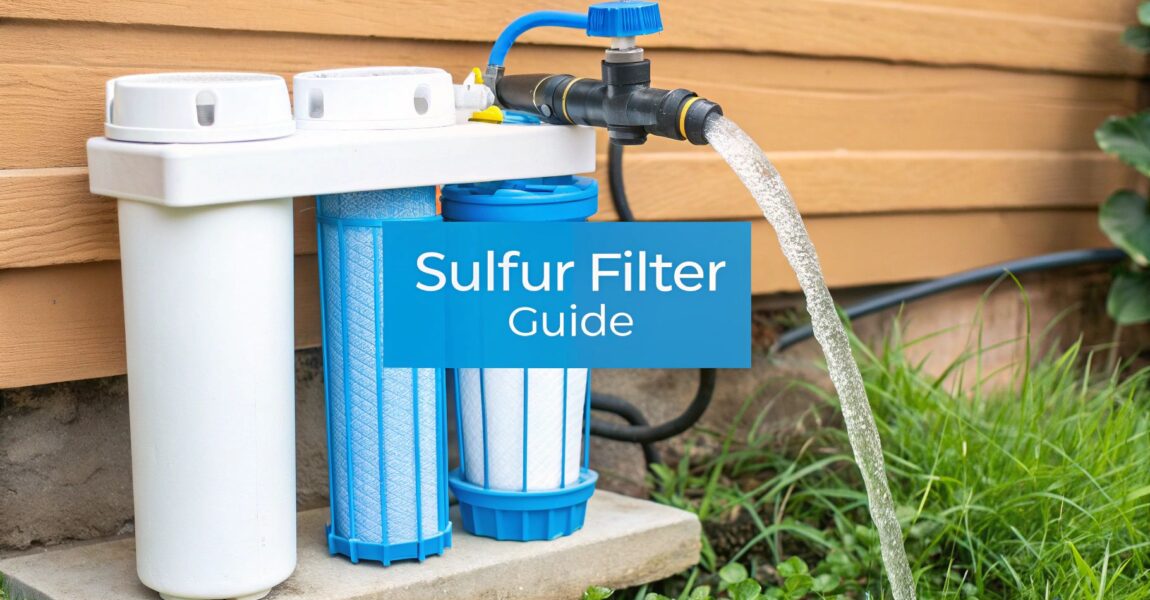
If you’ve ever turned on your faucet and been greeted by that infamous “rotten egg” smell, you know the feeling. That unmistakable odor is the calling card of sulfur in your well water, and a well water sulfur filter is your ticket to getting rid of it for good.

Finally Banish That Rotten Egg Smell From Your Well Water

It’s a problem that plagues millions of homeowners with private wells. You go for a glass of water, hop in the shower, or start a load of laundry, and that foul smell just ruins the experience. The culprit is hydrogen sulfide gas, a naturally occurring compound that can make your otherwise pristine water completely unappealing.

But here’s the fantastic news: you don’t have to live with it.

This guide is your battle plan. We'll walk you through everything you need to know to tackle the problem head-on, from identifying the source of the stench to picking the perfect well water sulfur filter that will have your family enjoying clean, fresh-smelling water from every tap.

This mission is about more than just getting rid of a bad smell. Sulfur doesn't just stink—it can tarnish your silverware, leave unsightly stains on your clothes and fixtures, and even corrode your plumbing over time. Investing in the right filter is an investment in your home and your peace of mind.

To give you a clear path forward, we've put together a quick guide summarizing the common symptoms and the best filtration solutions we'll be diving into.

Quick Guide to Solving Sulfur Water Problems

Symptom You're Experiencing The Likely Cause in Your Well The Best Filtration Solution
A "rotten egg" smell from both hot and cold water taps. Hydrogen Sulfide Gas (H₂S) dissolved in the water supply. An Air Injection Oxidizing (AIO) or Chemical Injection system.
The smell is only noticeable from the hot water faucet. Sulfur-reducing bacteria reacting with your water heater's anode rod. Replacing the anode rod or a simple shock chlorination.
Black or gray stains on laundry, silverware, and plumbing. Hydrogen sulfide gas or high levels of sulfates. An AIO system or Catalytic Carbon Filter.
Water has a bitter taste but little to no odor. High concentration of dissolved sulfates. A Reverse Osmosis system (for drinking water) is most effective.

This table is just the starting point. In the rest of this guide, we'll break down each of these issues and solutions in detail so you can find the perfect fix for your home.

What You Will Learn in This Guide

Here’s a quick look at what we’ll cover to get you from smelly water to pure refreshment:

  • Finding the Source: We'll dig into the science behind that rotten egg smell, showing you how to tell the difference between hydrogen sulfide gas and pesky sulfur bacteria.
  • Testing Your Water: Learn how to do a few simple tests at home and know when it’s time to send a sample to a lab for a detailed analysis of what’s really lurking in your water.
  • Comparing Filter Types: We'll give you the real-world pros and cons of the top treatment options, like air injection, chemical injection, and catalytic carbon filters.
  • Sizing and Installation: Get practical advice on choosing the right size system for your family’s needs, plus tips for a smooth installation and easy maintenance down the road.

Our goal is simple: to arm you with the knowledge to choose a filter that wipes out your sulfur problem for good. By the time you're done here, you'll be ready to transform your problem water into something you and your family can finally enjoy. Let's get started.

So, Why Does Your Well Water Smell Like Sulfur?

To get rid of that rotten egg smell once and for all, you have to understand its origin story. Picture the aquifer that supplies your well—it’s not just a big underground pool of water. It's a whole ecosystem down there, full of rocks, soil, minerals, and all sorts of microscopic life.

When the conditions are just right (or, for our noses, just wrong), this hidden world starts pumping out sulfur compounds that eventually find their way into your faucets. It's a completely natural process, but the result is anything but pleasant.

The Two Main Culprits Behind the Sulfur Smell

The problem isn't sulfur itself, but what happens to it underground. Two things are typically responsible for creating the hydrogen sulfide gas that stinks up your well water.

  1. Sulfur-Reducing Bacteria (SRBs): These are naturally occurring little critters that thrive in places with very little oxygen, like deep wells and even your home's plumbing. Think of them as tiny factories that don't need oxygen to live. Instead, they "breathe" sulfates (a form of sulfur) and exhale hydrogen sulfide gas as waste. This is, by far, the most common reason for that powerful smell.

  2. Chemical Reactions with Sulfates: Sometimes, the issue isn't biological at all. If your water has a lot of dissolved sulfates, they can react with other things—most notably, the anode rod inside your hot water heater. This reaction spits out hydrogen sulfide gas, which is why some folks only notice the smell (or a much stronger version of it) when they turn on the hot tap.

It’s no surprise that people are paying more attention to what's in their water. The global water filter market has exploded as homeowners demand effective solutions. Installing a well water sulfur filter is a huge part of this trend, as families take control of contaminants like hydrogen sulfide.

Hydrogen Sulfide vs. Sulfates: What's the Difference?

You’ll hear these terms thrown around, and it's super important to know what's what because each one needs a different fix. Getting this right is the first step in picking a well water sulfur filter that actually works.

  • Hydrogen Sulfide Gas (H₂S): This is the main offender—the gas that gives you that distinct rotten egg smell. It's dissolved in the water, and our noses are incredibly sensitive to it. You can often smell it at concentrations as low as 0.5 parts per million (ppm).
  • Sulfates (SO₄): These are minerals containing sulfur that are dissolved in your water. At normal levels, you'd never know they were there; they're odorless and tasteless. But if the concentration gets high (over 250 ppm), they can make the water taste bitter and even have a laxative effect.
  • Elemental Sulfur (S): This is just solid sulfur. If you have a filter system that oxidizes hydrogen sulfide, you might start seeing tiny yellow or black specks in your water. That's a good thing! It means the gas has been turned into a solid particle that your filter can now trap.

Here's the bottom line: Hydrogen sulfide is the gas you smell. Sulfates are the minerals that bacteria munch on (or that make your water taste bad). Elemental sulfur is the solid particle that a filter can physically grab. Each one tells you something different about what's going on with your water.

Knowing which one you're dealing with isn't just a science lesson—it's the key to solving your problem for good. If you've got sulfur-reducing bacteria, just filtering out the gas won't stop them from growing in your pipes. If you have high sulfates but no smell, a standard sulfur filter isn't the right tool for the job. This basic knowledge ensures you put your money into a solution that hits the problem at its source, bringing fresh, clean-smelling water back into your home.

How to Properly Test Your Water for Sulfur

Before you even think about buying a well water sulfur filter, you’ve got to play detective. Figuring out exactly where that smell is coming from is the single most important step, and honestly, it can save you from spending a lot of money on a system you don't even need.

The good news is, you can start this investigation right at your kitchen sink. Your best tool is the one you were born with: your nose. The simple "smell test" reveals a ton. First, run the cold water for a minute, fill a glass, and then step away from the sink to give it a sniff. Now, do the exact same thing with the hot water. This little test is your first huge clue.

Is It Your Well or Just Your Water Heater?

The results from your sniff test will point you down one of two very different paths. Getting this right is critical, because one solution is a whole-house filter, and the other is a cheap and easy plumbing fix.

  • Smell from Both Hot and Cold Water: If both taps are putting out that rotten egg smell, the problem is in your well water itself. This means you’re looking at a whole-house treatment system to get rid of it for good.

  • Smell Only from Hot Water: If the stink is only coming from the hot side, the culprit is almost certainly your water heater. Inside the tank, a little part called a magnesium anode rod is reacting with sulfates in the water and creating hydrogen sulfide gas. A simple swap to an aluminum or zinc-aluminum rod usually solves the problem completely.

When You Need a Professional Lab Test

While the smell test is a fantastic starting point, it doesn't give you the whole story. For that, you absolutely need a professional water analysis. If the smell is coming from both hot and cold water, a lab test is your next move—it gives you the hard data needed to choose and size the right well water sulfur filter.

Think of it like getting a real diagnosis before you pick up a prescription. A lab test won't just tell you if sulfur is there, it'll tell you exactly how much is there. It measures hydrogen sulfide in parts per million (ppm), which is the key number you need.

Knowing the precise concentration of hydrogen sulfide and other contaminants is non-negotiable. A filter designed for 2 ppm of sulfur will be completely overwhelmed if your water actually has 8 ppm, wasting your money and leaving you right back where you started.

When you send a sample off to a state-certified lab, don't just ask for a sulfur test. You need the full picture of your water's chemistry to understand what might interfere with a filter's performance.

Make sure the lab test includes:

  1. Hydrogen Sulfide (H₂S): This confirms the concentration of the gas causing the odor.
  2. Iron and Manganese: These common minerals can clog up filter media and often need to be treated first.
  3. pH Level: The acidity of your water can make or break how well certain oxidation filters work.
  4. Total Dissolved Solids (TDS): High levels could point to other issues you’ll want to address.

Once that report is in your hands, you can confidently match your water's unique profile to a filtration system that is guaranteed to work. That's how you ensure every drop from your tap is finally fresh, clean, and odor-free.

Comparing The Best Sulfur Filter Technologies

Alright, you've figured out what's causing that rotten egg smell. Now comes the fun part: picking the right tool to get rid of it for good. Choosing the best well water sulfur filter isn't about finding a one-size-fits-all solution. It’s about understanding how different technologies work and matching the right one to what your water test told you.

Let's walk through the three heavy hitters in the world of sulfur filtration. Think of it like a mechanic's toolbox—you wouldn't use a wrench to hammer a nail, and the same logic applies here. Each system has its own strengths, weaknesses, and a specific job it's perfect for.

Air Injection Oxidation (AIO): The Chemical-Free Powerhouse

Air Injection Oxidation, or AIO for short, is hands-down one of the most popular and effective ways to tackle sulfur. The idea behind it is brilliant because it's so simple—it basically "rusts" the sulfur right out of your water.

Picture the hydrogen sulfide in your well as invisible gas dissolved in the water. An AIO system works by drawing in a bubble of air (oxygen) and mixing it with the water inside a large tank. This process, called oxidation, instantly forces the smelly gas to turn into solid sulfur particles. They can't stay dissolved anymore. Once they're solid, the filter media inside the tank easily traps them.

Every few days, the system cleans itself out with a powerful backwash cycle, flushing all those trapped sulfur particles down the drain. It's a set-it-and-forget-it kind of deal.

Why People Love AIO Systems

  • Completely Chemical-Free: This is the number one reason homeowners choose AIO. You never have to buy, store, or mess with chemicals like chlorine.
  • Low Maintenance: Once it's up and running, an AIO system pretty much takes care of itself. The automatic backwash means you don't have to do much.
  • Takes Care of Iron and Manganese, Too: These systems are fantastic multi-taskers. The same oxidation process that knocks out sulfur also removes iron and manganese, two minerals that often show up with sulfur in well water.

The Downsides to AIO

  • Higher Upfront Cost: AIO systems usually have a bigger price tag at the start compared to other options.
  • Needs Good Water Pressure: That backwash cycle is crucial, and it requires a decent flow rate from your well pump to work effectively. If you have a low-yield well, you might need a booster pump.

Chemical Injection Systems: The Targeted Disinfectant

A chemical injection system is like calling in a SWAT team for your water supply. This setup uses a small pump to inject a very precise dose of a sanitizing chemical—usually chlorine—directly into your water line.

The chlorine goes to work immediately, oxidizing the hydrogen sulfide to eliminate the smell. But it does more than that; it also kills any sulfur-reducing bacteria that might be causing the problem in the first place. The water then flows into a holding tank to give the chlorine time to work before passing through a carbon filter. This last step gets rid of any leftover chlorine taste and smell, so all you're left with is clean, fresh water.

Key Insight: Chemical injection is often the go-to solution for really high levels of hydrogen sulfide (think above 10 ppm) or when you also need to kill bacteria like coliform or E. coli.

To get a better handle on your situation, this simple chart can help you start the diagnostic process.
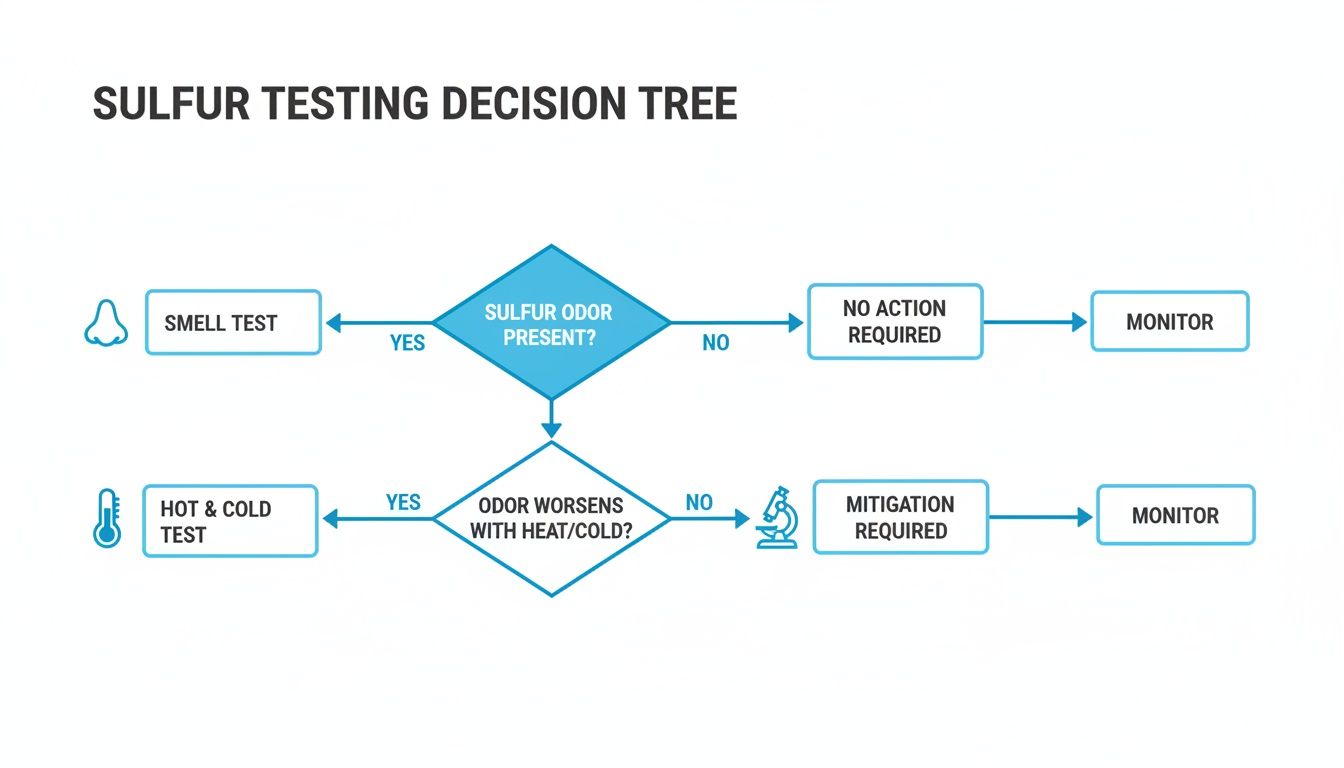
Decision tree flowchart outlining sulfur testing procedures and actions based on odor presence and temperature effects.

As you can see, just checking if the smell is in your hot and cold water can point you in the right direction—is it just the water heater, or is it a bigger problem coming straight from the well?

Catalytic Carbon Filters: The Specialized Sponge

Catalytic carbon filters offer a simpler, more passive way to deal with sulfur. Don't think of this as a regular charcoal filter; it's more like a specialized sponge with a reactive surface. While standard activated carbon is good for taste and odor, catalytic carbon has been specially treated to kickstart the oxidation of hydrogen sulfide gas.

As water passes through the tank, the catalytic carbon media encourages the sulfur gas to convert into solid particles, which then get trapped in the filter bed. Just like AIO systems, these filters need to backwash on a regular schedule to clean themselves out and keep the media working effectively.

Pros and Cons of Catalytic Carbon

  • Pro: Lower Cost & Simpler: These systems are generally cheaper and take up less space than AIO or chemical injection rigs.
  • Pro: No Chemicals Needed: Like AIO, it's a completely chemical-free process, which is a huge plus for many folks.
  • Con: Limited Horsepower: Catalytic carbon works best for low to moderate levels of sulfur, typically under 6 ppm. It just can't keep up with higher concentrations.
  • Con: Shorter Media Lifespan: The carbon media will eventually wear out and need to be replaced, usually every 3 to 5 years, depending on your water quality and how much you use.

To make the choice a bit easier, here’s a side-by-side look at how these technologies stack up.

Sulfur Filtration Technology Comparison

This table breaks down the key differences between the most common sulfur filters, helping you see at a glance which one might be the right fit for your well.

Filtration Method How It Works Best For (Sulfur Level) Pros Cons
Air Injection Oxidation (AIO) Injects air to oxidize sulfur gas into solid particles, which are then filtered out. Moderate to High (2-15 ppm) Chemical-free, low maintenance, also removes iron and manganese. Higher initial cost, requires strong well pump flow rate.
Chemical Injection Injects a chemical (like chlorine) to oxidize sulfur and kill bacteria. A second filter removes the chemical taste. Very High (10+ ppm) & Bacteria Extremely effective, disinfects water, handles the toughest cases. Requires chemical refills, higher maintenance, more complex setup.
Catalytic Carbon Uses a special carbon media with a reactive surface to convert sulfur gas to solid particles for filtration. Low to Moderate (Under 6 ppm) Lower cost, simple design, no chemicals needed. Less effective on high sulfur levels, media needs periodic replacement.

Ultimately, the best well water sulfur filter for you comes down to what's in your water. An AIO system is a powerful, chemical-free workhorse for most homes. Chemical injection is the heavy-duty solution when you need serious disinfecting power. And for smaller sulfur issues, a catalytic carbon filter can be a simple and affordable fix.

Choosing and Sizing Your Sulfur Filter System

You've done the water tests and figured out which type of filter technology is the right match. Now comes the critical part: picking the actual unit. Choosing the perfect well water sulfur filter goes beyond just the technology—it’s about getting the size and specs just right for your home.

Think of it this way: an undersized system will lead to frustrating drops in water pressure every time you try to multitask. An oversized one? That's just a waste of money. Getting the size right means your filter will work efficiently without making your daily routine a headache.

It’s like a highway. A two-lane road can’t handle rush-hour traffic without a major slowdown. In the same way, your filter has to be big enough to handle your household's peak water demand without choking.
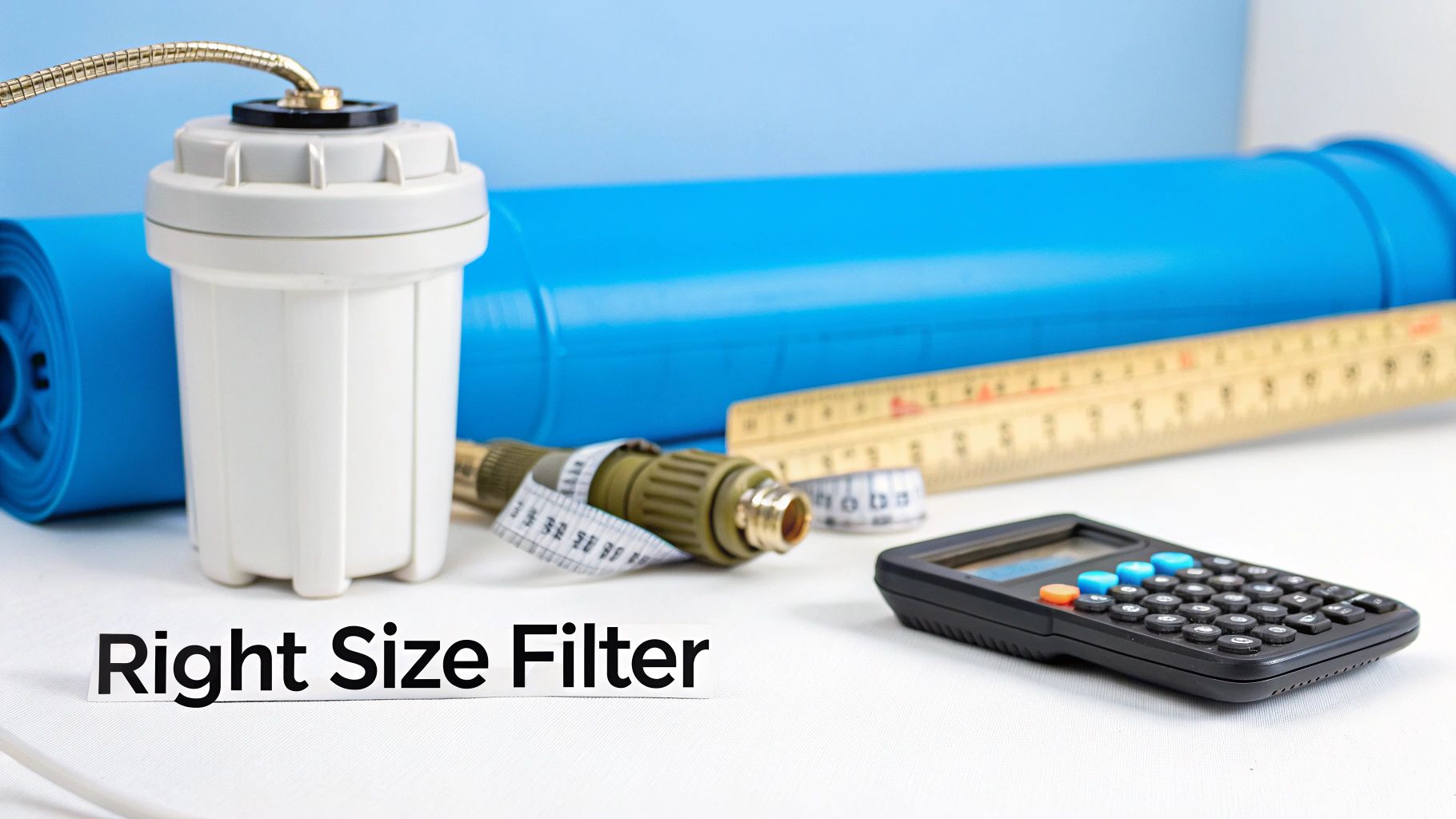
A white water filter, measuring tape, ruler, and calculator are on a white surface with a blue pipe, indicating filter sizing.

Calculating Your Household's Flow Rate

The single most important factor for sizing your filter is its flow rate, which we measure in gallons per minute (GPM). This number tells you the maximum amount of water your home might pull from the well at any given moment. If your filter's GPM is too low, turning on the dishwasher while someone is in the shower could turn that shower into a sad little trickle.

You don't need to be a plumber to get a good estimate. Just follow these simple steps:

  1. Count Your Fixtures: Make a quick list of everything that uses water in your house—sinks, showers, toilets, the washing machine, dishwasher, etc.
  2. Estimate Demand: Each fixture has a typical flow rate. For example, a standard showerhead uses about 2.5 GPM, a kitchen faucet is around 1.5 GPM, and a washing machine needs about 2.0 GPM.
  3. Find Your Peak: Now, think about your busiest morning. Add up the GPM for all the fixtures you might realistically have running at the same time.

Let's say a family of four might have a shower (2.5 GPM), the dishwasher (1.5 GPM), and a toilet flush (1.6 GPM) all happening at once. That adds up to a peak demand of 5.6 GPM. To be safe, you'd want a system rated for at least 10-12 GPM to comfortably handle that load and then some, completely avoiding any pressure loss.

A correctly sized well water sulfur filter should match or slightly exceed your home’s peak flow rate. This guarantees strong, consistent water pressure even when multiple taps are open.

Why Third-Party Certifications Matter

As you start comparing different filter models, you’ll see labels like NSF/ANSI thrown around. These aren't just marketing fluff—they are your guarantee that a filter actually does what the box says it does. These independent organizations put filtration systems through tough tests to make sure they meet public health standards.

Here are the key certifications to look for:

  • NSF/ANSI 42: This certifies that a filter can reduce "aesthetic" issues like chlorine, which affects taste and odor. While it isn't specifically for sulfur, it's a great baseline for overall performance.
  • NSF/ANSI 53: This is a much stricter, health-focused standard. It verifies a filter can remove specific health-related contaminants like lead, cysts, and certain chemicals.
  • WQA Gold Seal: The Water Quality Association (WQA) also offers a certification confirming a system is durable, safe, and performs as advertised.

Seeing these seals means the filter has been put through its paces by an unbiased third party. This demand for proven, effective solutions is a big deal. The market for home water purifiers, including the well water sulfur filter, is booming, driven by homeowners who want reliable, tested technology. You can learn more about the expanding market for home water purifiers and see just how common this is becoming.

Installation and Long-Term Maintenance Tips

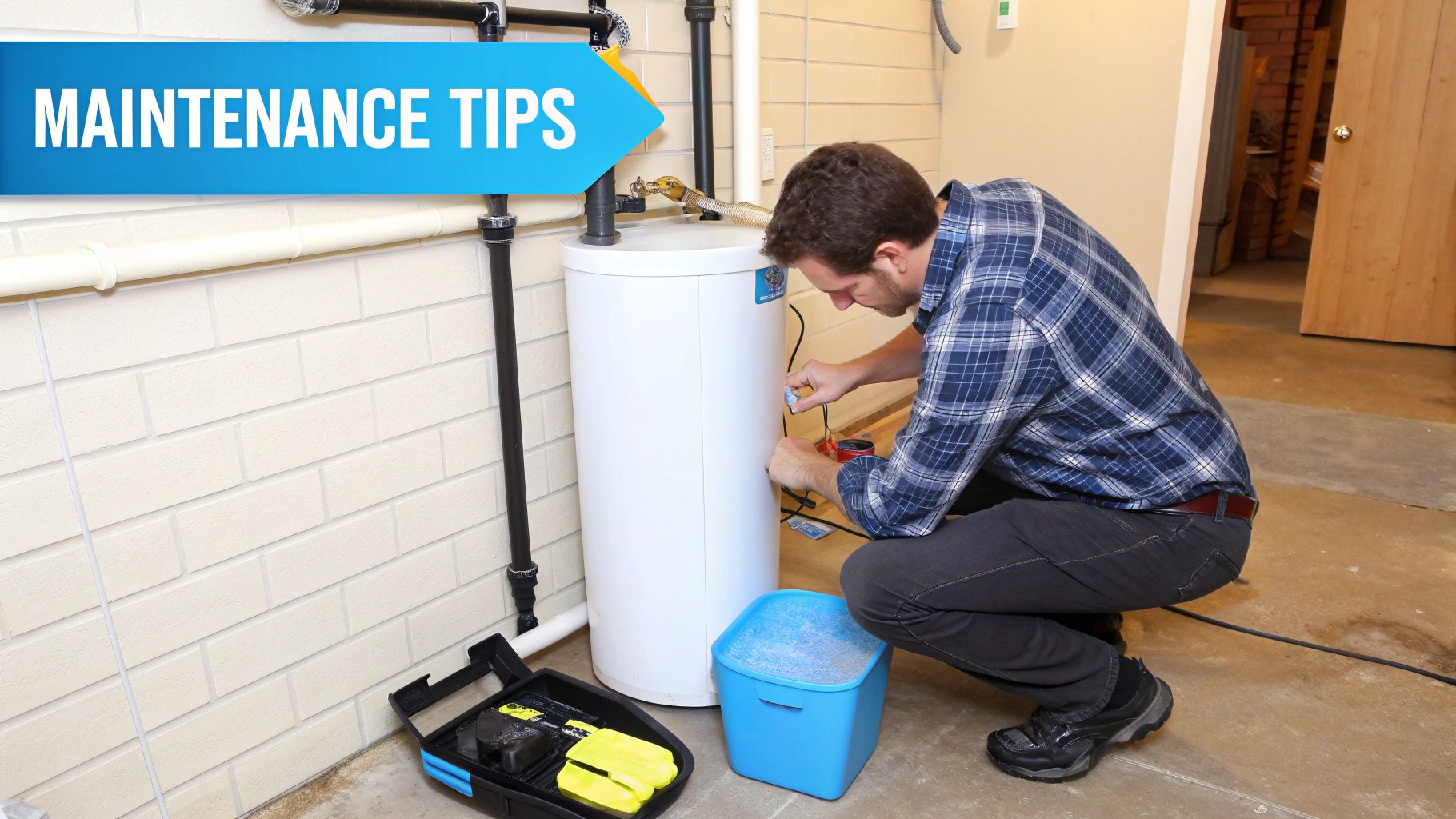
A high-quality well water sulfur filter is a fantastic investment, but its real value comes down to a solid installation and a little bit of regular upkeep. Getting these two things right is the key to enjoying fresh, odor-free water for years to come—and avoiding those surprise repair bills nobody likes.

The first big question is always: DIY or hire a pro? Many of the newer systems are definitely designed with the handy homeowner in mind. They often come with simple push-to-connect fittings and clear instructions. If you know your way around basic plumbing and don't mind cutting into your main water line, you can absolutely save a few hundred bucks by installing it yourself.

But let's be realistic. If you're looking at a more complex chemical injection setup, or if the thought of cutting pipes makes you break out in a cold sweat, calling a professional is the way to go. A good plumber will make sure everything is installed to code, integrated perfectly with your existing plumbing, and dialed in for peak performance right from the start.

Creating a Simple Maintenance Schedule

Once your filter is installed and humming along, a simple maintenance routine becomes your best friend. Honestly, neglecting it is like never changing the oil in your car—sooner or later, things are going to grind to a halt. The good news is that keeping a sulfur filter in top shape is surprisingly easy.

Here are the key things to keep an eye on:

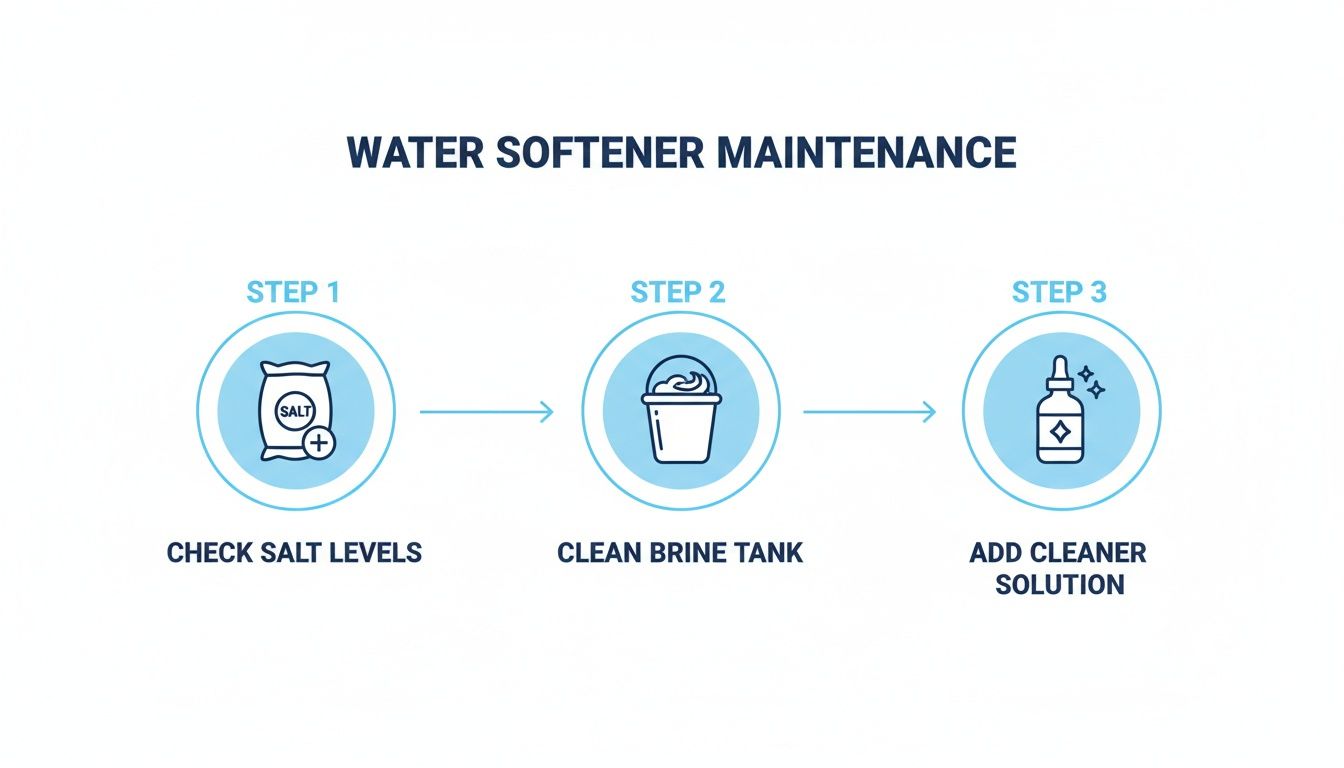
  • Check Salt or Solution Levels (if applicable): If you have a system that uses a brine tank or chemical feed, just peek at the levels once a month. Top it off when it gets low.
  • Verify Backwash Cycles: Make sure the automatic backwash or regeneration cycle is actually running when it's supposed to. A typical AIO system, for instance, might backwash every 3-4 days.
  • Inspect for Leaks: Once a month, just do a quick walk-around and eyeball the fittings and connections. Catching a tiny drip early can save you a massive headache later.

A proactive maintenance schedule is the difference between a system that lasts 5 years and one that lasts 15 years. Just a few minutes of attention each month protects your investment and guarantees your water stays clean.

Know When to Service Your Filter Media

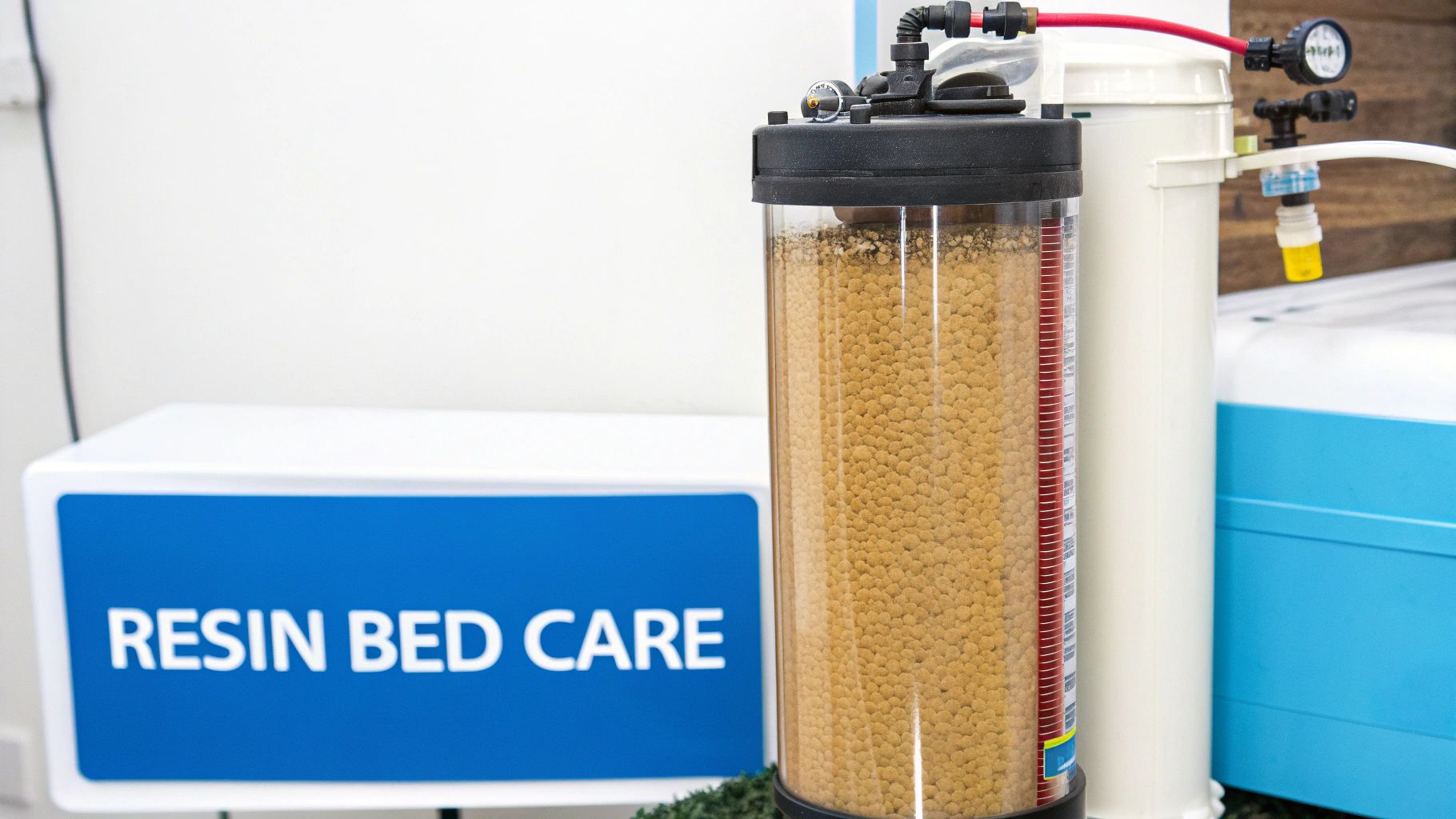
The heart of your well water sulfur filter is the media—that's the stuff inside the tank doing all the heavy lifting. Over time, this media can get gunked up or just plain wear out. For a catalytic carbon filter, you're probably looking at replacing the media every 3 to 5 years. For AIO systems, the media usually lasts a lot longer, sometimes 8 to 10 years or even more.

The market for these solutions is growing, reflecting major advancements in filter media and smart systems that make maintenance easier. This growth offers homeowners better access to effective solutions and professional services.

Understanding long-term upkeep is crucial for all home water systems. For instance, knowing the ins and outs of a sump pump replacement guide can offer some great parallels on making important maintenance decisions for other critical equipment in your home. And for more great filtration advice, feel free to check out our other tips and guides.

A Few Final Questions on Sulfur Filters

Even after you've done all the digging, a couple of practical questions usually pop up right before you pull the trigger on a well water sulfur filter. We've been there. So, let's clear up the most common ones to make sure you're heading in the right direction.

Think of this as your last gut check. It’s here to help you dodge some common pitfalls and make certain the system you pick is the right one to fix your water issues for good.

Will a Water Softener Get Rid of the Sulfur Smell?

In almost all cases, no. A water softener has one main job: to remove hardness minerals like calcium and magnesium that create scale and soap scum. It simply isn't built to grab the dissolved hydrogen sulfide gas that causes that nasty rotten egg smell.

Sure, a softener might accidentally catch a tiny bit of other stuff, but it's not going to make a dent in a real sulfur problem. For that, you absolutely need a dedicated well water sulfur filter, like an Air Injection Oxidation (AIO) unit or a catalytic carbon system.

It's a classic mistake to think one piece of equipment can do it all. Softeners are for hardness, sulfur filters are for the smell. Using the right tool for the job is the only way to get the clean water you're after.

What's a Whole House Sulfur Filter Going to Cost Me?

The price tag on a whole house sulfur filter can swing quite a bit, mostly depending on the technology inside and how much water it can handle. Knowing the ballpark figures helps you set a realistic budget.

  • Catalytic Carbon Filters: These are usually your most wallet-friendly choice, running somewhere between $500 and $900. They're a solid pick for lower levels of sulfur.
  • Air Injection Oxidation (AIO) Systems: These are the more powerful, chemical-free workhorses. Expect to see prices in the $1,000 to $2,500 range.
  • Chemical Injection Systems: Upfront, these cost about the same as AIO systems, but you'll have ongoing costs for chemicals like chlorine.

Don't forget to account for professional installation. That can add another $300 to $800 to the final bill, depending on who you hire and the complexity of the job.

Why Does Only My Hot Water Smell Like Sulfur?

This one stumps a lot of people. If that rotten egg odor is only coming from your hot water taps, the problem isn't your well water. The real culprit is almost always the anode rod inside your hot water heater.

Most water heaters come with a magnesium anode rod to keep the tank from rusting out. The trouble is, this rod can have a chemical reaction with sulfates that are naturally in your water, which creates hydrogen sulfide gas as a byproduct. The fix is usually cheap and easy: have a plumber swap out that magnesium rod for an aluminum or zinc-aluminum one. If both your hot and cold water smell bad, then you know a whole-house filter is what you need.


Here at Water Filter Advisor, our mission is to give you clear, no-nonsense advice to help you get safer, better-tasting water for your home. Check out our in-depth guides and reviews to find the perfect filtration setup for your family at https://www.waterfilteradvisor.com.
Water Filter Coliform: Your Ultimate Guide to Safe Drinking Water

Discovering coliform bacteria in your water is like finding a stranger in your house—it's a sign something is seriously wrong with your security. But don't panic. A good water filter for coliform is the best home security system you can buy for your tap water. Technologies like Ultraviolet (UV) light, Reverse Osmosis (RO), or ultrafiltration are incredibly effective at either physically removing these unwanted guests or zapping them into oblivion.

While most coliforms won't harm you, their presence is a giant red flag. It’s your water’s way of screaming that a barrier has been breached, leaving a wide-open door for truly nasty pathogens like E. coli to waltz right in. A certified water filter acts as your home's personal bodyguard, ensuring that what comes out of your faucet is safe and clean, every single time.

What Are Coliform Bacteria in Your Water?

Think of coliforms as nature’s alarm system for your water. Their discovery in a water test is like the check engine light suddenly flashing on your car's dashboard.

The light itself isn't the problem, but it’s telling you something under the hood is seriously wrong. In the same way, most coliform bacteria are harmless, but their presence is a clear signal that the safeguards protecting your water have failed. It means a door has been left open for more dangerous germs to sneak into your pipes.

The Different Types of Coliform Bacteria

When you get a water test report back, you'll likely see a few different names. Understanding what they mean helps you gauge the real risk to your family. Water quality experts break them down into a few key groups, each telling a piece of the story.

There are three main categories you need to know:

  • Total Coliforms: This is a huge, diverse group of bacteria that are all over the place in nature—in soil, on plants, and in lakes and rivers. Finding them in your water suggests that surface contaminants have somehow seeped into your system, but it doesn't automatically mean it's from a hazardous source.
  • Fecal Coliforms: Now we're getting more specific. This is a sub-group of total coliforms, and they come from one place: the intestines and waste of warm-blooded animals (including people). Discovering these is a much more serious warning that your water has been contaminated by sewage or animal feces.
  • Escherichia coli (E. coli): This is the one everyone's heard of. As the most well-known member of the fecal coliform family, finding E. coli is the smoking gun for recent fecal contamination. Certain strains can cause violent gastrointestinal illness, so a positive test requires immediate action.

The U.S. Environmental Protection Agency (EPA) has a zero-tolerance policy for E. coli in drinking water. A single positive sample is considered a violation of safety standards and requires immediate notification and corrective action to protect public health.

Why They Are Called Indicator Organisms

So, why not just test for the dangerous germs directly? Because testing for every single waterborne virus and bacteria out there would be outrageously complicated and expensive. Instead, labs look for coliforms because they're common and easy to find.

They are called indicator organisms for a reason. If these widespread bacteria are present, it’s a powerful sign that the protective barriers around your water source—whether that’s the city treatment plant or your private well casing—have been compromised.

This failure means that the really bad stuff like Giardia, Cryptosporidium, and harmful E. coli strains could have slipped in, too. Coliforms are the canary in the coal mine, warning you of potential danger before anyone gets sick.

How Bacteria Get Into Your Home's Water

It's a bit unsettling to think about, but invisible bacteria can find a way into the water you drink every day. How they get there is a different story depending on where your water comes from—a private well or your city’s municipal supply.

But the core problem is always the same: a tiny breach is all it takes for contamination to start. Think of it like a fortress. Your water system is designed to be sealed and secure, but even the smallest crack in the wall can let intruders in. Figuring out where those weak points are is the key to defending your water with the right filter.

Why Private Wells Are So Vulnerable

If you have a private well, you're the one in charge of security. It's your responsibility to guard against contamination, which means you need to know where to look for trouble. It’s a lot like maintaining the roof on your house; a small, hidden leak can go unnoticed for a long time while causing serious damage.

Most well contamination happens quietly, out of sight.

  • A Broken Seal: A cracked well casing or a loose, improperly sealed well cap is like leaving your front door wide open. Rainwater washes over the ground, picking up bacteria from the soil, and funnels it straight into your well.
  • Nearby Farms: Living in a rural area has its perks, but nearby agricultural activity can be a risk. Runoff from fields treated with manure or fertilizers can soak into the ground, eventually making its way into the aquifer that feeds your well. This risk skyrockets after heavy rain.
  • Bad Septic Systems: A failing septic system—or even a perfectly good one that’s just too close to your well—can leak raw sewage into the surrounding soil. From there, it’s a short trip for dangerous stuff like fecal coliforms and E. coli to migrate through the ground and into your drinking water.

Studies on private wells have shown a direct link between septic systems and water quality. Wells located within 100 feet of a septic drain field were found to be far more likely to test positive for total coliforms and E. coli.

How City Water Can Go Wrong

You’d think being on city water means you’re in the clear, right? While it’s true that municipal water gets treated at a central plant, it still has to travel miles through a massive network of underground pipes to reach your home. And sometimes, that aging infrastructure is where the problems begin.

Picture the city's water main like a major highway. Most of the time, everything runs smoothly. But one bad accident can cause a massive pile-up and create unexpected problems for miles.

Here are the most common ways city water gets contaminated:

  • Old, Crumbling Pipes: Many American cities are relying on water pipes that were put in the ground before your grandparents were born. Over decades, these pipes corrode, rust, and develop cracks. Those cracks become entry points for contaminated groundwater to get sucked into the system.
  • Water Main Breaks: This is the most dramatic failure. When a large water main bursts, the pressure is lost instantly. As water rushes out, a vacuum is created, pulling in surrounding dirt, mud, and bacteria right into the clean water line.
  • Sudden Pressure Drops: You don't need a full-blown break for things to go wrong. A significant drop in pressure—maybe from firefighters hooking up to a hydrant or heavy use in one area—can cause the same vacuum effect. This "negative pressure" can slurp contaminants into the pipes through tiny, pre-existing cracks.

Whether you're on a well or city water, it's clear that contamination can happen. This is exactly why a good water filter for coliform is so important. It acts as your last line of defense, protecting you and your family right at the tap.

The Most Effective Coliform Removal Technologies

Finding out you have coliform bacteria in your water is alarming, but the good news is there are proven, reliable ways to get rid of them. Choosing the right water filter for coliform means understanding how these different systems work to protect your family. Each one tackles bacteria in a unique way, giving you a solid line of defense.

Think of it like hiring different kinds of security for your water supply. Some are like bouncers, physically blocking unwanted guests from getting in. Others are more like high-tech security systems, neutralizing threats before they can cause any harm. Let’s walk through the most effective options out there.

Ultraviolet Purification: A Sunburn for Microbes

One of the most powerful and popular methods for water disinfection is ultraviolet (UV) purification. A UV system doesn't actually remove bacteria from the water; instead, it zaps them and renders them completely harmless. It's basically a high-intensity, concentrated sunburn for microbes.

Here's how it works: your water flows through a chamber that houses a special UV lamp. This lamp emits intense ultraviolet light at a very specific wavelength (254 nanometers) that penetrates the cell walls of bacteria like coliform and E. coli and completely scrambles their DNA. This process, called ultraviolet germicidal irradiation (UVGI), makes it impossible for them to reproduce or make you sick.

One of the biggest wins for UV systems is that they purify water without adding a single chemical. That means the taste, smell, and color of your water don't change at all. You get powerful disinfection that neutralizes 99.99% of harmful bacteria and viruses while keeping your water's natural qualities intact.

Reverse Osmosis: The Nightclub Bouncer

If UV is the silent zapper, Reverse Osmosis (RO) is the exclusive nightclub bouncer with a list he checks twice. It's a physical filtration process that uses your home's water pressure to force water through a special membrane with ridiculously small pores—we're talking as tiny as 0.0001 microns.

This membrane is the ultimate gatekeeper. It's so selective that only pure H2O molecules are small enough to pass through. Everything else—bacteria, viruses, salts, heavy metals, and other contaminants—gets rejected and washed right down the drain. This is what makes RO systems so incredibly good at what they do.

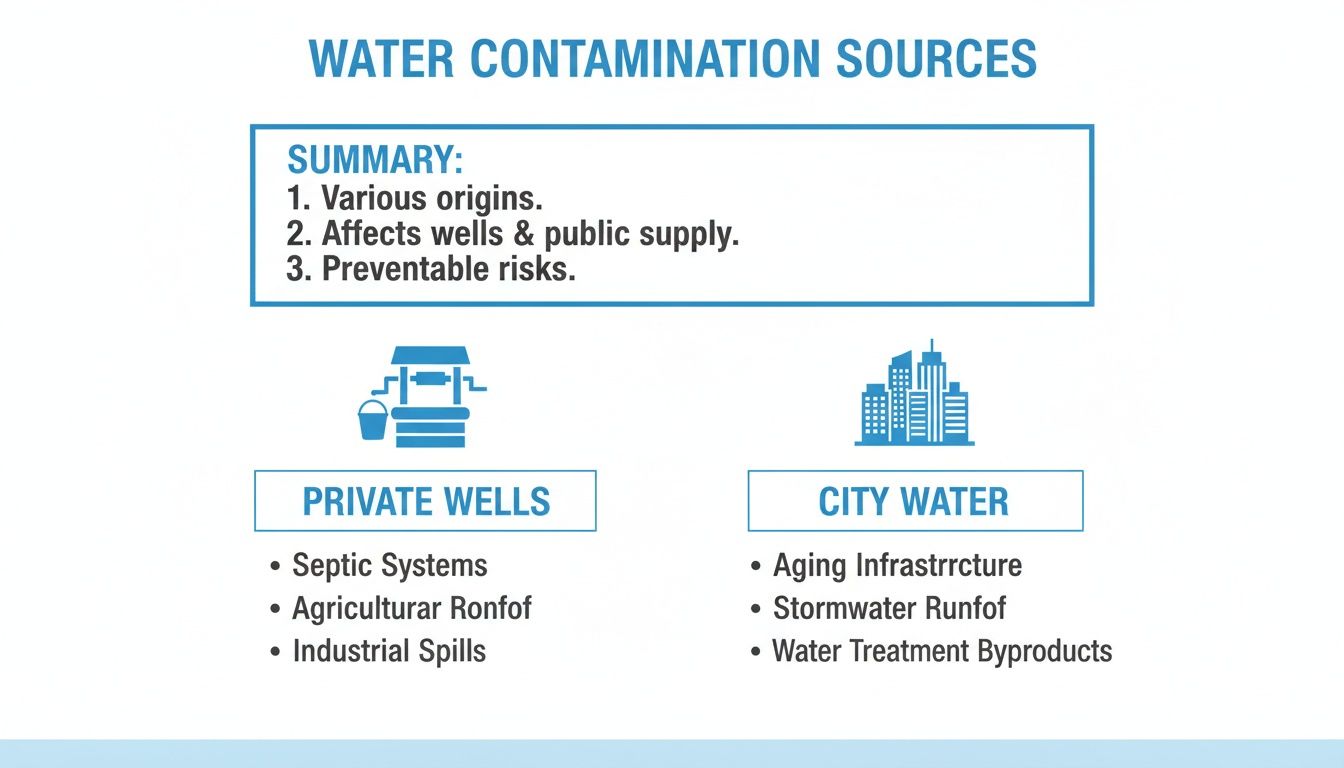
This infographic shows just how easily both private wells and city water systems can get contaminated, which really drives home the need for a final barrier filter in your home.

Infographic detailing water contamination sources for private wells and city water, including septic systems and aging infrastructure.

Whether it’s a leaky well cap or a tiny crack in a city water main, these vulnerabilities show why having a filter at your home—either for the whole house or just at the kitchen sink—is a critical last line of defense.

Ultrafiltration: The Microscopic Net

Ultrafiltration (UF) is another highly effective physical barrier. The best way to picture a UF filter is as a microscopic net woven from thousands of tiny, hollow fibers. The pores in these fibers are bigger than an RO membrane's but still plenty small—around 0.02 microns—to physically block and trap bacteria, protozoa, and even some viruses.

Water is pushed through these hollow fibers, and while the clean water passes through, all the nasty stuff gets caught on the outside. Because UF doesn't remove dissolved minerals, it's a fantastic choice for people who want to keep the natural mineral content of their water while still getting total peace of mind from microbiological threats.

To help you figure out what’s best for your home, I've put together a table comparing these top technologies side-by-side.

Comparing Coliform Removal Technologies

This table compares the most effective water treatment methods for eliminating coliform bacteria, helping you choose the best fit for your home's needs and budget.

Technology How It Works Effectiveness on Coliforms Best For Typical Cost Key Maintenance
UV Purification Uses ultraviolet light to scramble bacterial DNA, preventing reproduction. Excellent (99.99% inactivation) Whole-house disinfection, especially for well water. $300 – $1,500 Annual UV lamp and quartz sleeve replacement.
Reverse Osmosis Forces water through a semipermeable membrane that blocks bacteria. Excellent (99.99%+ removal) Under-sink systems for drinking/cooking water. $200 – $600 Pre-filter changes every 6-12 months; membrane every 2-4 years.
Ultrafiltration Uses a hollow fiber membrane to physically block bacteria and viruses. Very Good (99.9%+ removal) Point-of-use or whole-house where mineral retention is desired. $250 – $1,200 Regular backwashing; cartridge replacement every 1-3 years.
Sub-Micron Filters Traps bacteria in a filter medium with a pore size of 0.2 microns or less. Good (for bacteria, not viruses) Portable filters, emergency use, or as a pre-filter. $50 – $200 Frequent cartridge replacement based on usage.

Each of these systems offers a rock-solid solution if you're dealing with coliforms. Your final decision will come down to things like your water source, how bad the contamination is, your budget, and whether you want to treat every drop of water in your house or just what comes out of the kitchen tap.

Choosing the Right Water Filter for Coliform

Now that you know which technologies can knock out coliform bacteria, how do you pick the right system for your home? Choosing the best water filter for coliform isn't about finding a single "magic bullet" product. It's about matching the right tool to the job, and that job looks very different depending on whether your water comes from the city or a private well.

Your entire decision boils down to one simple question: Are you adding a final line of defense against a potential municipal system failure, or are you building a complete bacterial shield for your own well water? Each scenario requires a totally different game plan.

Solutions for City Water Users

If you're on city water, your main worries are things like aging pipes, sudden water main breaks, or those dreaded boil water advisories. Your goal is simply to create a final, bulletproof barrier right where you use your water most. For this, a point-of-use system is almost always the most practical and effective way to go.

These systems treat the water at a single tap—usually the kitchen sink, where you get all your water for drinking and cooking.

  • Under-Sink Reverse Osmosis (RO) System: An RO unit tucked away under your kitchen sink is a fantastic final barrier. It doesn't just physically block bacteria; it also tackles a huge list of other common contaminants like lead, chlorine, and other dissolved solids.
  • Under-Sink UV Purifier: If your concern is purely microbiological, a dedicated UV system can be installed on the line to your main faucet. This guarantees that any stray bacteria that might have survived the trip from the treatment plant are zapped just seconds before the water hits your glass.

A More Robust Plan for Well Owners

For well owners, the game changes completely. The risk of contamination is much higher and can come from a number of sources. Since you are the sole manager of your water's safety from the ground up, a whole-house solution isn't just a good idea—it's the industry standard. This approach ensures every single tap in your home, from the kitchen to the bathroom shower, delivers microbiologically safe water.

A proper whole-house setup for well water is almost always a multi-stage process:

  1. Sediment Pre-filter: This is always step one. It catches all the dirt, sand, and rust particles. This isn't just for clean-looking water; it's critical because sediment can actually act like a shield for bacteria, protecting them from the UV light and making the whole system less effective.
  2. Whole-House UV Purifier: Right after the pre-filter, a powerful UV system acts as your primary microbiological defense, neutralizing 99.99% of bacteria and viruses as the water enters your home's plumbing.

As you weigh your options, it helps to understand the pros and cons of different types of filtration systems to make a truly informed choice.

Decoding Certifications: Your Seal of Approval

So, how can you be sure a filter actually does what the box says it does? You look for certifications from NSF International (which used to be called the National Sanitation Foundation). Think of an NSF seal as a stamp of approval from a trusted, independent third party that has rigorously tested and verified a product’s claims.

A sobering 2014 global assessment found that 1.8 billion people around the world depend on drinking water sources contaminated with fecal matter. That staggering number is a stark reminder of why a final barrier is so important, even on treated city water where old, cracking pipes can let contaminants back in.

When it comes to bacteria, two standards are absolutely essential:

  • NSF/ANSI 55 (Ultraviolet Microbiological Water Treatment Systems): This standard is broken into two tiers. Class A systems are certified to disinfect water, removing microorganisms like bacteria and viruses, which makes them suitable for treating contaminated water. Class B systems are only certified for "supplemental" treatment on water that's already considered safe, like public tap water.
  • NSF/ANSI 58 (Reverse Osmosis Drinking Water Treatment Systems): This certification confirms that an RO system is effective at reducing a broad spectrum of contaminants, including cysts, which are even larger than bacteria.

Choosing a certified product gives you peace of mind, knowing your investment is backed by real science and independent testing. For more in-depth guidance on finding the perfect system, be sure to check out our extensive advice on water filters.

Your Action Plan for Contaminated Water

Getting a water test back positive for coliform bacteria is definitely jarring. It's okay to feel a moment of shock, but don't panic. Think of it as a clear signal that it's time to take action. With a simple, methodical plan, you can tackle the problem head-on and make your home's water safe again.

We'll break this down into a calm, four-step drill for your water supply: Test, Isolate, Treat, and Retest. Following this process turns a moment of uncertainty into a clear path forward, giving you total control over the health and safety of your family.

Step 1: Confirm the Problem with Testing

First things first, let's make sure we know exactly what we're dealing with. A single positive test is a big red flag, but getting a second, follow-up test from a state-certified lab is absolutely critical. This confirms the initial findings and makes sure you aren't about to spend time and money chasing a false positive.

Your local health department can point you to a list of certified labs in your area. When you collect the sample, follow the lab's instructions to the letter. It’s surprisingly easy to accidentally contaminate the sample from your hands or the faucet, which can completely throw off the results. An accurate diagnosis is the bedrock of an effective solution.

Step 2: Isolate and Protect Your Household

While you're waiting for confirmation or figuring out a treatment plan, your number one priority is protecting everyone in your home. This means immediately stopping the use of your tap water for anything that involves consumption.

Put these safety measures in place right away:

  • Switch to Bottled Water: Use it for everything—drinking, cooking, making ice, and brushing teeth. No exceptions.
  • Issue a Household "Boil Water" Notice: For tasks like washing dishes or rinsing produce, bring a pot of water to a rolling boil for at least one full minute, then let it cool before using. This is a tried-and-true method for killing harmful bacteria.

Taking immediate protective steps is non-negotiable. A positive coliform test means there's a breach in your water's safety barrier. Temporary measures like boiling water are your essential first line of defense until a permanent fix is in place.

Step 3: Treat the Contamination

Now it's time to put a permanent solution in motion. This is where you choose and install the right water filter for coliform based on the technologies we've already covered, whether that's a whole-house UV purifier or an under-sink reverse osmosis system.

The best system for you really depends on your water source and how bad the problem is. A home with well water that has persistent coliform issues, for instance, is a prime candidate for a robust whole-house UV system paired with a sediment pre-filter. That combination ensures effective, long-term disinfection.

Beyond just filters, you need an immediate action plan, especially if you're dealing with a major contamination event. For instance, homeowners facing a worst-case scenario should consult an essential guide to sewage damage clean up to understand the much bigger steps required for severe situations.

Step 4: Retest to Verify the Solution

You've installed your new filtration system and it's up and running. Great! But you're not done just yet. The final, crucial step is to close the loop and verify that your solution actually worked. Wait a few days to a week after installation, then take another water sample and send it back to that certified lab.

This retest is your proof of success. A negative result for both coliform and E. coli is the official all-clear, confirming that your new filter has knocked out the threat and your water is safe to drink again. This final step is what turns a stressful situation into lasting peace of mind.

Maintaining Your Filter for Long-Term Safety

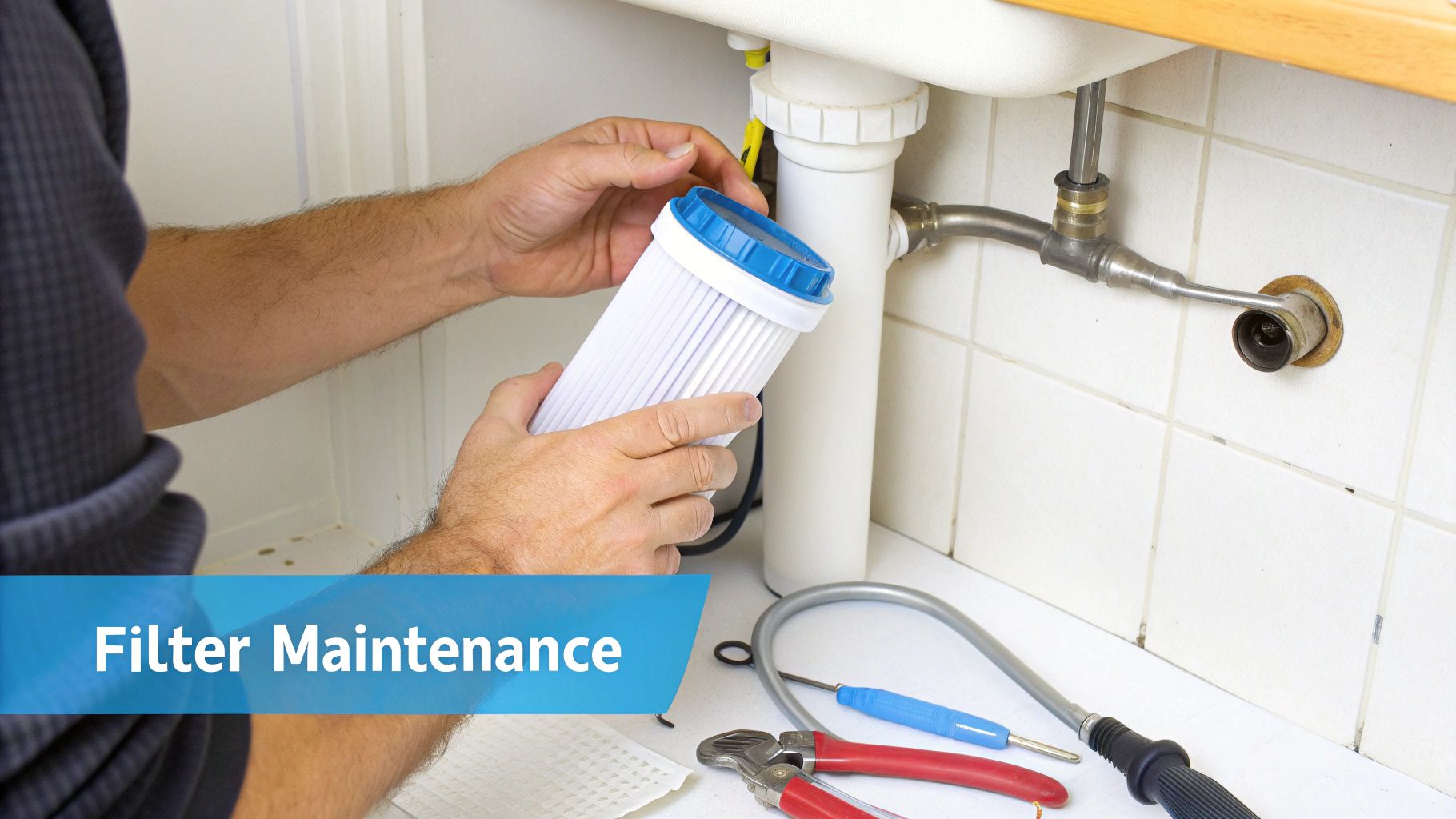
A person's hands are replacing a new water filter cartridge under a kitchen sink, with tools nearby.

Getting a high-quality water filter for coliform installed is a massive step toward making your home's water safe. But the job isn't done. Think of it like a performance car—it needs regular oil changes and tune-ups to keep running like it should.

Consistent maintenance is the single most important thing you can do to make sure your filter keeps protecting your family. A neglected system doesn't just stop working; it can actually become a breeding ground for bacteria, completely undoing all your hard work and investment.

Creating a Practical Maintenance Schedule

The real secret to long-term safety is consistency. Just follow the manufacturer's recommended schedule. It takes all the guesswork out of the process and keeps your system in peak condition. Different filters have different needs, but the basic rhythm of care is usually the same.

Think of your maintenance plan as a roadmap to safe water. It's what ensures every part of the system is doing its job, providing that critical barrier against coliforms and other nasty stuff.

Your schedule should include a few non-negotiable tasks:

  • Pre-Filter Swaps: If your system has sediment pre-filters, these are your first line of defense. They usually need to be replaced every 3 to 6 months. This prevents clogs that tank your water pressure and protects the more sensitive parts of your system down the line.
  • UV Lamp Replacement: The UV lamp is the heart of a UV purification system. It might still light up after a year, but its germ-killing power drops off a cliff. Swapping it out annually is non-negotiable if you want to be sure it’s actually neutralizing bacteria.
  • System Sanitization: Every so often, you need to flush and sanitize your system, especially if it's a reverse osmosis unit. This simple step prevents biofilm from building up and keeps everything clean and effective.

Here's something most people don't know: neglecting filter changes can lead to a problem called "channeling." This is where water literally carves a path around an old, clogged filter instead of passing through it. Contaminants, including bacteria, get a free pass right into your tap. It creates a completely false sense of security.

How to Spot Early Signs of Trouble

Beyond your regular schedule, you need to learn to spot the warning signs that your system needs attention. Catching these things early can stop a small problem from becoming a total failure.

These are the clues your system is asking for a check-up:

  • A Sudden Drop in Water Pressure: This is usually the first and most obvious sign of a clogged filter. If your showerhead starts trickling or your faucets are running slow, it's a dead giveaway that your sediment or carbon pre-filters are maxed out and need to be replaced.
  • Warning Lights or Alarms: Modern UV systems have sensors that watch the lamp's performance. If you see an indicator light or hear an alarm, it means the lamp is no longer effective. It needs to be replaced immediately to ensure disinfection is actually happening.
  • Changes in Water Taste or Odor: Remember that "off" taste or smell that your filter got rid of? If it suddenly comes back, that's a clear sign the filter media (like activated carbon) is spent and can no longer do its job.

Staying on top of this routine maintenance is what turns your water filter from a simple appliance into a reliable, long-term health investment. A well-maintained system gives you the peace of mind that every single drop of water from your tap is as safe as it can possibly be.

Got Questions About Coliform Filters? We've Got Answers.

When you're dealing with something like bacterial contamination in your water, you're bound to have questions. Finding the right water filter for coliform means getting clear, no-nonsense answers to protect your family's health.

Let's cut through the jargon and tackle the most common things homeowners ask when that water test comes back positive.

Will a Brita Pitcher Get Rid of Coliform Bacteria?

No, a standard pitcher filter like a Brita won't touch coliform bacteria. These filters are great for what they're designed for—using activated carbon to make your water taste and smell better by removing things like chlorine.

But their filter pores are way too big to catch microscopic bugs like bacteria. For something that small, you need a certified purification system—think UV, reverse osmosis, or an ultra-fine absolute filter that's specifically built to stop pathogens in their tracks.

How Often Should I Test My Well Water for Coliforms?

For private well owners, testing for total coliforms and E. coli at least once a year is non-negotiable. Think of it as your annual safety check-up.

You'll also want to test your water immediately if certain situations pop up:

  • After a flood or any significant ground disturbance near your wellhead.
  • If you notice any change in your water’s taste, odor, or color.
  • Anytime your well has been repaired or you've had the pump replaced.
  • If anyone in the house has unexplained stomach or gut issues.

Is Shocking My Well with Chlorine a Permanent Fix?

Shock chlorination is a powerful tool, but it's a temporary one. It’s like hitting a reset button—it wipes out the immediate bacterial problem that’s already in your well.

Think of shock chlorination as a one-time deep clean. It sanitizes the well but doesn't fix the leaky window that let the germs in.

The problem is, it doesn't plug the hole that let the bacteria in to begin with. If you have a cracked well casing or a faulty seal, the coliforms will be back. A permanent water filter for coliform, like a whole-house UV purifier, is what provides that constant, 24/7 protection against whatever might get in down the road. It’s the long-term solution, not just a quick fix.


At Water Filter Advisor, we're here to help you find the right filtration solution to keep your family's water safe. For more deep-dive guides, product reviews, and expert advice, come see us at https://www.waterfilteradvisor.com.
Carbon Filtered Water vs Reverse Osmosis: The Ultimate Showdown for Your Kitchen Sink

When you're squaring up to decide between a carbon filter and a reverse osmosis system, it all comes down to a single, epic question: What villain are you trying to defeat in your water?

If your city water just tastes a bit like a swimming pool thanks to chlorine, a simple carbon filter is your quick and easy superhero. It’s an affordable and crazy-effective way to make your water taste and smell amazing. But if your concerns are more sinister—like evil heavy metals, pesky fluoride, or other dissolved solids lurking in your pipes—then reverse osmosis is the heavy-hitting avenger you need to call.

Choosing Your Home Water Filtration Champion

Diving into the world of water filtration can feel like trying to drink from a firehose, but it doesn't have to be. The two most popular champions you'll encounter are activated carbon filters and reverse osmosis (RO) systems. Both promise cleaner, better-tasting water, but they get there using completely different battle tactics and are designed to fight different enemies.

Understanding this fundamental difference is the key to choosing wisely for your home. Think of a basic carbon filter—like the one in your fridge or a Brita pitcher—as a super-powered sponge. It uses a cool process called adsorption to grab onto contaminants that make your water taste and smell funky. An RO system, however, is a much more intense, multi-stage gladiator that forces water through a ridiculously fine membrane, stripping out nearly everything else along the way.

The Rise of the Home Filtration Fortress

The quest for better water at home isn't just a fleeting trend. Back in the early 2000s, as more reports surfaced about the millions of Americans drinking tap water with unsafe contaminants, carbon filters became the first line of defense for countless households. Their secret weapon is an incredible surface area; a single gram of activated carbon can have a surface area of up to 1,000 square meters, enabling it to achieve up to 99.9% removal of certain volatile organic compounds (VOCs). If you want to see how different filter types stack up against specific contaminants, check out this 2025 guide to water filtration.

In this guide, we’re going to spill all the tea. We’ll cover:

  • How each technology actually works its magic.
  • The specific villains each one is best at vanquishing.
  • The real-world differences in cost, maintenance, and daily use.
  • No-nonsense recommendations to help you match the right system to your home's water.

To get started, let’s look at a quick tale of the tape. For more in-depth guidance on various filter types, you might be interested in exploring our comprehensive water filter advice section.

Carbon Filter vs Reverse Osmosis at a Glance

This table gives you a bird's-eye view of the key differences between these two filtration titans. It's a great way to quickly see which system might be a better fit for your home's needs before we get into the nitty-gritty.

Feature Carbon Filtration Reverse Osmosis (RO)
Primary Function Improves taste and odor by removing chlorine and VOCs Purifies water by removing a broad range of contaminants
Contaminant Removal Chlorine, pesticides, herbicides, some sediments, VOCs Dissolved solids, heavy metals, fluoride, nitrates, bacteria
Impact on Minerals Retains healthy minerals like calcium and magnesium Removes nearly all minerals, which can affect taste
Wastewater Produces no wastewater Creates a wastewater stream to flush away contaminants
Installation Simple; ranges from pitchers to under-sink units More complex; typically an under-sink system with a tank
Upfront Cost Lower ($20 – $200) Higher ($150 – $500+)

As you can see, the choice isn't just about which one is "better," but which one is better for you. One is a targeted solution for taste, while the other is a comprehensive purification powerhouse.

How Carbon Filters Polish Your Water

Before we can truly get into the carbon filtered water vs reverse osmosis debate, we need to appreciate the elegant simplicity of carbon filtration. This isn't some high-tech gimmick; people have been using charcoal to keep water fresh since ancient Egypt. Of course, today’s tech is a whole lot sleeker, but the basic principle is the same.

At its core, a carbon filter acts like a powerful magnet for certain types of contaminants. As water flows through it, a process called adsorption kicks in, making chemical impurities literally cling to the carbon's surface. Picture a microscopic maze with an insane amount of surface area—it traps all the gunk while letting pure water molecules sail right on through.

The end result? Water that tastes crisp and has no funky smells, free from the chemical signature that's all too common in city tap water.

The Power of Activated Carbon

So, what’s this "activated" business all about? This is where the magic happens. The raw carbon, usually from something awesome like coconut shells, gets superheated with steam. This process riddles the carbon with millions of tiny pores, massively expanding the internal surface area where adsorption can occur.

This sprawling network of pores is incredibly good at grabbing onto the specific culprits that ruin your water's taste and smell.

  • Chlorine: This is carbon's #1 enemy. If your water has that swimming pool vibe, a carbon filter will knock it out cold.
  • Volatile Organic Compounds (VOCs): These are various industrial and commercial chemicals that can unfortunately sneak their way into our water sources.
  • Pesticides and Herbicides: Carbon is also a champ at reducing many common agricultural chemicals.

But what a carbon filter doesn't do is just as important to understand. It won't remove dissolved solids like salts, most heavy metals (think lead or arsenic), fluoride, or nitrates. It essentially polishes your water—it doesn't purify it down to the molecular level.

Granular vs. Block Carbon Filters

Not all carbon filters are created equal. The two main types you'll encounter are Granular Activated Carbon (GAC) and Carbon Block, and knowing the difference will help you choose the right warrior for your home.

GAC filters are filled with loose carbon granules. You’ll find these in most basic water pitchers or the filter in your fridge. They work, but over time, water can carve a sneaky path of least resistance through the granules—a phenomenon called "channeling"—which means it's not getting fully filtered.

Carbon block filters, on the other hand, are made from activated carbon powder that’s been compressed into a solid brick. This forces water through a much more uniform and intricate obstacle course, preventing channeling and maximizing contact time with the carbon. This makes them a more thorough and reliable choice, typically found in under-sink setups and faucet-mounted filters.

A great real-world example is a simple Cuisinart compatible activated charcoal water filter replacement. It's this exact kind of technology that transforms a harsh, chlorinated cup of coffee into something smooth and delicious, just by starting with better water.

How Reverse Osmosis Purifies Your Water

Think of a carbon filter as a magnet that grabs specific things you don't want, like chlorine. A reverse osmosis (RO) system, on the other hand, is more like a bouncer at an exclusive club—it lets almost nothing through except pure water. It’s an intense, multi-stage process built to strip out a massive range of contaminants, producing exceptionally pure H₂O.

Instead of the adsorption method used by carbon, reverse osmosis relies on raw pressure. Your home’s water pressure is used to force water molecules through a special semi-permeable membrane. This membrane is the real MVP, packed with microscopic pores around 0.0001 microns in size. They’re so tiny that almost nothing besides a water molecule can get through.

It’s essentially the opposite of natural osmosis, which is where it gets its name. The result is a purification powerhouse that goes far beyond taste and odor improvement. It’s about fundamentally changing the water’s makeup to get it as close to pure as possible.

The Multi-Stage Purification Journey

An RO system isn't a single filter; it's a super-team of filters, all working together. Water from your tap goes on a little adventure, where each stage cleans it up and prepares it for the next step. This sequence protects the most important component—the RO membrane—and guarantees the final product is pristine.

Here's a look at the typical path water takes in an under-sink RO system:

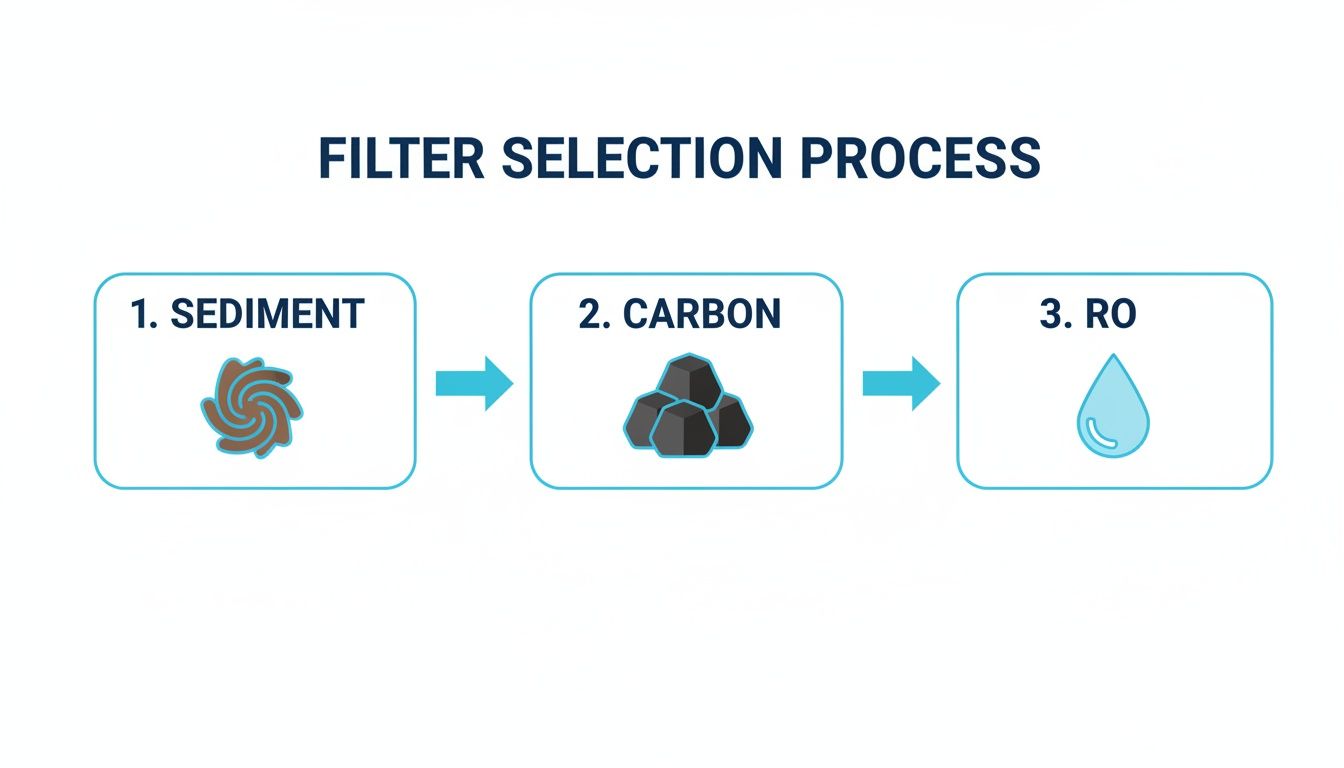
  1. Sediment Pre-Filter: The first stop is like a bouncer for the big stuff—dirt, sand, rust, and other grit. Its main job is to keep this gunk from clogging up the more sensitive filters down the line.
  2. Carbon Pre-Filter: Next, the water flows through an activated carbon filter. This is a critical step because it removes chlorine and chloramines, which can literally eat away at the delicate RO membrane and ruin it.
  3. The RO Membrane: This is where the real magic happens. Water pressure shoves the pre-filtered water against the semi-permeable membrane. The tiny water molecules are squeezed through, while dissolved contaminants are left behind and rejected.
  4. The Wastewater Stream: Everything rejected by the membrane gets collected into a concentrated stream of wastewater and is simply flushed down your drain. This is a necessary part of the process that keeps the membrane from getting clogged.
  5. Storage Tank: The purified water, now called permeate, is collected and stored in a small pressurized tank, usually located right under your sink.
  6. Post-Filter (Polishing Filter): When you turn on your dedicated RO faucet, the water leaves the storage tank and passes through one last carbon filter. This final "polishing" step gets rid of any slight taste or odor the water might have picked up while sitting in the tank.

The core difference in the carbon filtered water vs reverse osmosis debate lies here. An RO system includes carbon filtration as a crucial support stage, but its primary purification engine—the membrane—removes a much broader range of contaminants that carbon alone cannot touch.

Targeting Total Dissolved Solids

A key performance metric for any RO system is how well it reduces Total Dissolved Solids (TDS). TDS is just a measurement of all the inorganic salts, minerals, heavy metals, and other matter dissolved in your water.

High TDS can give water an off-putting salty or bitter taste. More importantly, it can signal the presence of contaminants you definitely don't want to be drinking. RO systems are absolute champions at this, consistently removing over 95% of TDS. This is why RO water has that signature "pure" taste—it's been stripped of nearly everything but water itself.

Comparing Contaminant Removal Capabilities

Alright, this is the main event. Choosing the right system means looking past the marketing jargon and getting real about what each filter can actually pull out of your water. This is where your local water quality report becomes your best friend—it tells you exactly which villains you're up against.

Let's put these two technologies head-to-head across the most common water woes. We'll see where each one shines and where it falls short, giving you a clear path to the right solution for your home.

Chlorine, Taste, and Odor

Does your tap water taste and smell like it just jumped out of a swimming pool? If so, an activated carbon filter is your hero. It works through a process called adsorption, where chlorine and other foul-tasting compounds get trapped on the carbon's surface. It's incredibly effective and a quick fix.

Reverse osmosis systems also vanquish chlorine, but they do it with a carbon pre-filter before the water even hits the main RO membrane. So, while both get the job done, a simple carbon filter is the more direct and affordable solution for just bad taste and odor.

Pesticides and Volatile Organic Compounds (VOCs)

This is where things get a bit more interesting. A good-quality carbon block filter can do a fantastic job of reducing a wide range of organic chemicals, including many common pesticides, herbicides, and those nasty VOCs.

An RO system also tackles these chemicals, again using its carbon pre-filters. The difference is that the RO membrane itself acts as a second, powerful line of defense. If your water report flags a cocktail of different chemical contaminants, that extra layer of protection from an RO system is hard to beat.

The Key Takeaway: For simply making your water taste great and getting rid of that chlorine smell, carbon is the clear winner. For a more comprehensive shield against a wider variety of chemicals, reverse osmosis offers ultimate peace of mind.

Heavy Metals Like Lead and Arsenic

Here’s where the two systems really part ways. A standard carbon filter is not the right tool for removing heavy metals like lead, arsenic, or mercury. While some specialized carbon filters are certified for lead reduction (look for NSF/ANSI 53), they won't handle the full spectrum of heavy metals.

This is reverse osmosis's time to shine. The semi-permeable RO membrane is engineered specifically to block these tiny, dissolved contaminants. It’s not uncommon for an RO system to remove up to 99% of heavy metals. If you have any reason to be concerned about lead or other metals in your water, RO is the only responsible choice.

Dissolved Solids, Fluoride, and Nitrates

The term Total Dissolved Solids (TDS) covers everything from healthy minerals to unwanted stuff like fluoride, nitrates, and salts. Carbon filters do almost nothing to reduce TDS—they let all of it pass right through.

Reverse osmosis, on the other hand, is designed from the ground up to slash TDS levels. Its fine-pored membrane is a powerhouse against:

  • Fluoride: RO is one of the very few home filtration methods that can effectively remove fluoride.
  • Nitrates: A serious concern in agricultural areas, nitrates are easily rejected by an RO membrane.
  • Salts: If your water has a salty or brackish taste, an RO system can make it pure and clean.

Effectiveness Against Common Water Contaminants

To make it even clearer, let's look at a side-by-side scorecard. This table shows how each system handles specific contaminants you might find in your home's water supply, whether it's from the city or a private well.

Contaminant Type Carbon Filter Effectiveness Reverse Osmosis Effectiveness Best Choice For
Chlorine Excellent (main function) Excellent (uses a carbon pre-filter) Carbon Filter
Taste & Odor Excellent Excellent Carbon Filter
Pesticides/VOCs Good to Very Good Excellent Reverse Osmosis
Lead Poor (unless NSF 53 certified) Excellent (>95% removal) Reverse Osmosis
Arsenic & Mercury Not Effective Excellent (>97% removal) Reverse Osmosis
Fluoride Not Effective Excellent (>90% removal) Reverse Osmosis
Nitrates & Sulfates Not Effective Excellent Reverse Osmosis
Bacteria & Viruses Not Effective Very Good to Excellent Reverse Osmosis
PFAS ("Forever Chemicals") Good Excellent Reverse Osmosis

This comparison really highlights the core difference: Carbon filtration is a fantastic improver, making good water taste great. Reverse osmosis is a purifier, taking water with serious contamination issues and making it exceptionally safe to drink.

Emerging Contaminants like PFAS

The conversation around "forever chemicals" like PFAS (PFOA/PFOS) is growing, and for good reason. High-quality activated carbon filters have proven effective at reducing certain PFAS compounds, which is a great start.

However, reverse osmosis is widely considered the gold standard for removing a broad spectrum of PFAS from drinking water. The one-two punch of carbon pre-filters and the RO membrane provides a robust, multi-stage defense against these stubborn chemicals.

While these systems are excellent for everyday home use, it's also smart to be aware of other fast, reliable water purification methods for survival for situations where your primary system might not be available.

The Real Cost of Ownership and Daily Use

Picking a water filter isn't just about science; it's about how the system fits into your life and your wallet. The price on the box is only the beginning. When you're weighing carbon filtered water vs reverse osmosis, you have to look at the practical, long-term costs and how each one feels to use every day.

A simple carbon filter, whether it clips onto your faucet or tucks under the sink, is pretty easy on the budget upfront. You can get a great system for well under $200. Reverse osmosis systems are more complex, with their multiple filter stages and storage tanks, so they naturally start a bit higher, usually running from $150 to over $500 for a standard under-sink setup.

But that initial investment is just one part of the story. The ongoing costs are where you'll really see the financial differences stack up over time.

Calculating Long-Term Expenses

The true cost of ownership comes down to replacing the filters. This is where you’ll be spending money for years, so it’s a huge factor in your decision.

With a basic under-sink carbon filter, you're usually just swapping out a single cartridge every 6 to 12 months. These replacements are pretty affordable, often landing somewhere between $40 and $100 for the whole year, depending on the brand and how much water your family uses. It’s a simple, predictable expense.

Reverse osmosis systems have more components to maintain. You’ll be replacing several different filters on a staggered schedule:

  • Sediment and Carbon Pre-filters: These workhorses protect the main membrane and typically need to be changed every 6 to 12 months.
  • RO Membrane: This is the heart of the system and the most expensive part. Thankfully, it's also the most durable, usually lasting 2 to 3 years.
  • Carbon Post-filter: This final "polishing" filter gets swapped out every 6 to 12 months to keep the water tasting fresh.

All in, you can expect to spend between $100 and $200 annually on replacement filters for an RO system. It’s more than a carbon filter, sure, but that cost covers a much more thorough, multi-stage purification process.

Daily Usability and Flow Rate

Money aside, how does each system actually work in your kitchen day-to-day? One of the first things you'll notice is the flow rate.

Under-sink carbon filters hook right into your main cold water line. When you turn on the tap, water comes rushing out at pretty much the same speed you're already used to. There’s no waiting around—it’s a completely seamless experience.

Reverse osmosis systems are a different beast. The purification process is incredibly slow and detailed, so RO systems need a small storage tank to keep a reserve of purified water ready to go. This water comes out of a separate, dedicated faucet installed right on your sink. The flow from this smaller faucet is definitely slower than your main tap. It's the classic trade-off for purity—you get amazingly clean water, but you have to be a little more patient.

The difference in flow rate is a perfect example of the core trade-off. Carbon offers convenience and speed for better-tasting water, while reverse osmosis sacrifices some speed for a much higher level of purification.

The Critical Difference in Water Taste

Finally, let's talk taste—the whole reason you’re looking for a filter in the first place. This is where the two systems really part ways, and it often comes down to personal preference.

Carbon filters are fantastic at improving taste. They remove chlorine and other funky chemicals but intentionally leave in beneficial minerals like calcium and magnesium. This gives you water that tastes clean, crisp, and refreshing, a lot like a high-end bottled spring water. It's the taste most of us know and love.

Reverse osmosis, on the other hand, is so powerful it strips out practically everything—including those healthy minerals. The result is ultra-pure H₂O, which can have a "flat" or even slightly acidic taste that some people don't care for. It’s pure, but it lacks the character minerals provide.

Luckily, there’s an easy fix. Many modern RO systems now come with a remineralization filter as the final stage. This little cartridge adds a balanced mix of healthy minerals back into the water just before it hits your glass, dramatically improving the taste and raising the pH. It’s really the best of both worlds: the absolute purity of RO with the pleasant, familiar taste of mineral water.

Making the Right Choice for Your Home

Figuring out the whole carbon filtered water vs reverse osmosis thing isn't about finding the one "best" system. It's about matching the right technology to the specific problems coming out of your tap. It really boils down to what you're trying to fix.

If you’re on city water, chances are it's perfectly safe to drink, but it might taste or smell like a swimming pool. That strong chlorine flavor is a common complaint. In this situation, a quality activated carbon filter is your best bet. It’s fantastic at knocking out the chlorine and other stuff that makes water unpleasant, giving you crisp, clean-tasting water without the cost and complexity of a bigger system.

When to Upgrade to Reverse Osmosis

The conversation completely shifts if you're worried about more than just taste and smell. This is where a reverse osmosis system moves from a "nice-to-have" to a smart investment, especially if you have a private well or live in an area with older city pipes.

You should seriously consider an RO system if you're dealing with any of these issues:

  • High Total Dissolved Solids (TDS): If your water has a salty, bitter, or just "heavy" taste, an RO system is the only practical way to lower those TDS levels.
  • Known Heavy Metals: For serious contaminants like lead, arsenic, or mercury, the RO membrane acts as a nearly impenetrable barrier that a simple carbon filter can't provide.
  • Nitrates or Fluoride: These are common in agricultural areas or municipalities that add fluoride, and only reverse osmosis can reliably remove them.
  • Emerging Contaminants: An RO system offers the most powerful defense you can get for your home against things like PFAS ("forever chemicals") and other industrial runoff.

The real lightbulb moment for many people is realizing that every reverse osmosis system already includes carbon filters. They act as pre-filters to protect the RO membrane and a post-filter to polish the taste. So, an RO unit isn't an alternative to carbon—it's a complete, multi-stage solution that uses both technologies.

This decision tree gives you a great visual for weighing the costs and benefits.

As you can see, the path forks pretty quickly based on your budget, what you need to remove, and how much maintenance you’re willing to do.

Your First Step is Always Testing

You can't fix a problem if you don't know what it is. Before you spend a dime on a filter, you need to find out exactly what's in your water.

If you get your water from a municipality, just ask them for their latest Consumer Confidence Report (CCR). It's a free annual report that lists all the tested contaminants and shows how they stack up against EPA limits.

For those on well water, the responsibility for testing is on you. A good starting point is to contact your local health department; they can provide a list of state-certified labs that will run a full analysis for you.

Once you have your water report in hand, look for official certifications when you start shopping. The gold standard comes from NSF/ANSI.

  • NSF/ANSI 42: This is the basic certification for taste and odor. It confirms a filter reduces aesthetic issues like chlorine. Any decent carbon filter should have this.
  • NSF/ANSI 53: This is a big one. It certifies that a filter reduces specific health-related contaminants, such as lead, mercury, or cysts.
  • NSF/ANSI 58: This certification is exclusive to reverse osmosis systems. It verifies the system’s ability to reduce TDS and a whole list of other tough contaminants like arsenic and fluoride.

Choosing a certified product means you aren't just taking the manufacturer's word for it. It's proof that the system does what it claims to do, giving you real peace of mind with every glass you drink.

Your Top Questions Answered

When you're comparing carbon filtration to reverse osmosis, a few key questions always come up. Let's tackle them one by one so you can feel totally confident in your choice.

Does Reverse Osmosis Remove Healthy Minerals?

Yes, it does. Reverse osmosis is incredibly thorough—so much so that it strips out beneficial minerals like calcium and magnesium right along with the bad stuff. This is what gives RO water its signature ultra-pure, and sometimes "flat," taste.

For most of us, this isn't a huge deal since we get plenty of minerals from our diet. But if you're concerned about mineral intake or just prefer the taste of mineral water, there's an easy fix. Many modern RO systems now come with a remineralization filter that adds a healthy balance of minerals back into the water just before it hits your glass.

Can I Install These Systems Myself?

It really depends on what you buy. Most of the simpler carbon filters—like pitchers, countertop models, and faucet attachments—are designed for anyone to install. You can usually get them up and running in a few minutes with no tools required.

Under-sink carbon filters and full reverse osmosis systems are a bit more involved and require some basic plumbing know-how. The instructions are usually clear enough for a confident DIYer, but if messing with your home's water lines makes you nervous, calling a plumber is always the smart move. It's better than dealing with a leak down the road.

The trade-off is clear: simpler carbon filters offer plug-and-play convenience, while more powerful RO systems demand a more permanent installation. Assess your comfort level with plumbing tasks before making a purchase.

How Much Water Does a Reverse Osmosis System Waste?

Older RO systems definitely earned their reputation for being water hogs, but today's technology is much better. Many new, high-efficiency models have brought the waste-to-pure-water ratio down to around 1:1 or 2:1.

That "wastewater" (also called brine) is just carrying all the filtered-out contaminants safely down the drain. For the average family, the extra water usage is pretty minimal in the grand scheme of things, but it's something to consider if water conservation is a major priority for you.

Which System Has a Better Water Flow Rate?

Hands down, carbon filters win on flow rate. Because they integrate right into your main line, whole-house or under-sink carbon filters have almost no impact on your water pressure. You won’t even notice a difference at the tap.

Reverse osmosis, on the other hand, is a much slower, more methodical process. To get around this, RO systems use a pressurized storage tank to keep a supply of purified water ready to go. This water is delivered through a separate, dedicated faucet, and the flow will be noticeably slower than your main kitchen faucet. It's a practical trade-off for getting that level of purity.


Ready to find the perfect filtration solution for your home? The experts at Water Filter Advisor have done the research for you, with in-depth guides and unbiased reviews to help you choose with confidence. Explore our comprehensive resources at https://www.waterfilteradvisor.com.
A Homeowner’s Guide to Block Carbon Filter Water Systems

Imagine turning on your kitchen tap and getting water that’s not just safe, but tastes crisp, clean, and refreshing every single time. That’s the magic of a block carbon filter, a quiet hero in the world of home water purification. It's the ultimate fix for common annoyances, like that swimming pool scent in your morning coffee or the invisible chemicals you'd rather not be drinking.

Your Guide to Purer Water

Think of a carbon block as a microscopic maze with magnetic walls. As water flows through, the maze physically traps gunk like sediment and rust. At the same time, the carbon's massive internal surface area acts like a chemical super-magnet, pulling nasty contaminants out of the water and holding onto them through a process called adsorption. It’s a simple concept with seriously powerful results for your home.

This guide will walk you through everything you need to know about this essential home upgrade. We'll cover:

  • How these impressive filters are actually made and the science behind how they work.
  • The specific contaminants they target to protect your family's health.
  • How to choose the perfect system for your home, whether you own or rent.

The Growing Demand for Clean Water

The rising popularity of carbon block filters isn’t just a trend; it's a direct response to growing concerns about what’s really in our tap water. Families everywhere are deciding they want more control over their water quality, looking for reliable ways to remove chlorine, volatile organic compounds (VOCs), and funky odors. It’s a smart investment in your family's well-being. A high-quality filtration system delivers immediate benefits, from better-tasting food and drinks to protecting your home’s appliances from sediment buildup.

By removing impurities right at the source, a block carbon filter provides peace of mind with every glass. It transforms your tap water from a source of uncertainty into a reliable foundation for a healthier household.

Ready to take the next step? For more expert insights and comparisons, check out our comprehensive water filter advice to find the perfect solution for your needs. This guide will give you the practical knowledge you need to make a confident choice.

How a Block Carbon Filter Purifies Your Water

It might surprise you to learn that a carbon block filter starts out as something pretty basic, like coconut shells or coal. These raw materials are super-heated in a low-oxygen chamber, which transforms them into a fine powder called activated carbon. But this isn't your average powder—it's incredibly porous, with millions of microscopic nooks and crannies.

That activated carbon powder is then mixed with a food-grade binder and squished under extreme pressure, forming a solid, dense block. The final product looks simple, but it’s hiding an incredible secret: a massive internal surface area. In fact, a single gram of this material can have more surface area than an entire football field.

The Two-Stage Purification Powerhouse

When tap water passes through a carbon block, it gets cleaned in two distinct ways. This dual-action approach is what makes these filters so incredibly effective, using a one-two punch of physical blocking and chemical attraction.

First up is mechanical filtration. Think of the filter as an extremely fine screen. As water is forced through its tightly packed structure, the filter physically traps and holds onto larger particles.

  • Silt and Sediment: This is the stuff that makes water look cloudy or murky.
  • Rust Flakes: Flakes from older pipes get caught before they can get into your glass.
  • Organic Debris: Tiny bits of sand, dirt, and other gunk are strained out.

This first step clears up the water, but the real magic happens next, at a level you can't even see.

This infographic shows the simple yet effective journey your water takes through a block carbon filter system.

Infographic showing the three steps of block carbon water filtration: tap, filtration, pure water.

As you can see, the process efficiently turns standard tap water into purified drinking water just by passing it through the specialized carbon block.

Adsorption: The Chemical Magnet

The second, and more powerful, stage is called adsorption. Now, it’s easy to mix this up with absorption, but they're totally different. A sponge absorbs water by soaking it all up. Adsorption is more like static cling or a chemical magnet.

As the water snakes its way through the filter's maze-like interior, dissolved chemical contaminants are attracted to the carbon's surface and literally stick to it. This chemical bond yanks them right out of the water, locking them inside the filter for good.

Think of the carbon block's vast internal surface as a massive parking lot for contaminants. Adsorption is the process that directs unwanted chemicals like chlorine and pesticides into parking spots, where they remain locked away, allowing only clean water molecules to drive past.

This unique ability to grab and hold onto impurities is what allows a block carbon filter to make such a dramatic difference in your water's taste and smell, all while targeting specific chemicals that are a concern for your health.

Preventing a Common Filter Flaw

One of the biggest wins for the solid block design is that it prevents a problem called channeling. In looser filter media, like some granular activated carbon (GAC) filters, water can carve out little tunnels—the path of least resistance—and flow right through without being properly treated.

When that happens, a good chunk of the water bypasses the filtration media entirely. The solid, compressed structure of a carbon block makes that impossible. Every single drop of water is forced to take the long, scenic route through the dense carbon, which guarantees maximum contact time and ensures no contaminant gets a free pass. It’s this reliability that makes block filters a go-to choice for anyone wanting consistently clean water.

What Contaminants Do Carbon Block Filters Actually Remove?

A clear glass of water, supplements, and a 'VOC' bottle on a wooden table, emphasizing contaminant removal.

Alright, now that we've pulled back the curtain on how a block carbon filter works its magic, let's get into the nitty-gritty. What is this little powerhouse actually pulling out of your tap water?

Knowing what a filter is designed to target—and just as importantly, what it leaves behind—is the absolute key to choosing the right one for your home and feeling confident about it. We can group the stuff a carbon block filter grabs into three main categories.

Better Taste and Smell

This is where you'll notice the most immediate difference. If your tap water tastes a bit "off" or has a funky chemical smell, a carbon block filter is your new best friend. It’s fantastic at grabbing the compounds that cause these common annoyances.

  • Chlorine: This is the big one. Your city uses chlorine to keep the water supply safe, which we want, but nobody loves that swimming pool taste and smell it leaves behind. Carbon filters are champs at removing chlorine, completely changing your water's flavor for the better.
  • Hydrogen Sulfide: Ever turn on the tap and get that "rotten egg" smell? That's hydrogen sulfide. Carbon filters do a great job of reducing it, making your water much more pleasant to be around.

If you want to dig deeper into why that chlorine taste is so common, it’s worth understanding the ugly truth about chlorine in your tap water and why getting rid of it is a win for both taste and health.

Health-Critical Contaminants

This is where a quality carbon block filter really earns its keep. It's not just about making water taste good; it’s about creating a crucial line of defense against a whole host of potentially nasty chemicals.

These filters are especially good at adsorbing organic, carbon-based chemicals that you can't see, smell, or taste.

  • Volatile Organic Compounds (VOCs): This is a huge category of chemicals that includes industrial solvents and components of gasoline that can unfortunately find their way into groundwater. A solid carbon block is highly effective at trapping many of them.
  • Pesticides and Herbicides: Agricultural runoff can taint water supplies with these chemicals, but activated carbon is proven to reduce them significantly.
  • Trihalomethanes (TTHMs): These are sneaky disinfection byproducts that form when chlorine mixes with organic matter in the water. They are a genuine health concern, and certified carbon filters are specifically tested to remove them.

The ability to remove these invisible contaminants is what elevates a block carbon filter from a simple taste-improver to an essential health-focused appliance in your home. It’s the protection you can't see that often matters most.

Grabbing Physical Gunk

Finally, that dense, tightly packed structure we talked about makes a carbon block a fantastic mechanical filter. It physically blocks and traps tiny particles that make water look cloudy or murky.

This includes common culprits like:

  • Sediment and Silt
  • Sand and Dirt
  • Rust Flakes from old pipes

By straining out this grit, the filter doesn't just make your water clearer. It also protects your coffee maker, ice machine, and other appliances from getting clogged up.

Carbon Block Filter Contaminant Removal Guide

To make it even clearer, here’s a quick-reference table that lays out what carbon block filters are great at removing and what they typically leave behind.

Contaminant Category Specific Examples Effectively Removed by Carbon Block? Notes for Homeowners
Aesthetic Contaminants Chlorine, Hydrogen Sulfide (rotten egg smell), Chloramines Yes This is the primary reason many people install them—for dramatically better taste and odor.
Organic Chemicals Pesticides, Herbicides, VOCs, TTHMs Yes Carbon's porous structure is ideal for adsorbing these carbon-based compounds.
Physical Particulates Sediment, Silt, Sand, Rust Flakes Yes The dense block acts as a sieve, physically trapping particles down to its micron rating.
Heavy Metals Lead, Mercury, Arsenic Sometimes Standard carbon blocks are not effective. Specialized "catalytic" or modified blocks can reduce lead, but always check for specific NSF certifications.
Dissolved Minerals Calcium, Magnesium, Potassium, Fluoride, Salts No These healthy minerals pass right through, which is generally a good thing. Carbon filters do not soften water.
Microorganisms Bacteria, Viruses, Cysts (like Giardia) No (Typically) Standard carbon filters don't remove these. You need a sub-micron filter (e.g., 0.5 microns for cysts) or a dedicated UV purification system.

This table shows that while carbon block filters are incredibly versatile, they aren't a silver bullet. Understanding their specific strengths helps you build the right water treatment plan for your home.

What Carbon Filters Don't Remove

It’s crucial to be realistic about what a carbon filter can't do. Think of it as a specialized tool, not a cure-all for every possible water problem.

Here are a few things they generally won't touch:

  • Beneficial Minerals: Healthy stuff like calcium, magnesium, and potassium flows right through. This is good! These minerals are great for you and give water a pleasant taste.
  • Dissolved Solids: This includes salts, which means a carbon filter won't fix hard water.
  • Most Microorganisms: Standard carbon blocks are not designed to remove bacteria or viruses. For that, you need a specialized system like a UV purifier.
  • Fluoride: This is another dissolved mineral that carbon adsorption doesn't capture.
  • Heavy Metals: While some high-end carbon blocks are treated to reduce lead, your average filter isn't going to reliably remove things like lead, arsenic, or mercury.

Knowing these limitations is powerful. For many homes, a carbon block filter is the perfect all-in-one solution. But if you have more complex water issues, it serves as a critical first step in a more comprehensive multi-stage filtration system.

Choosing the Right Carbon Block Filter for Your Home

Finding the perfect carbon block filter for your home isn’t about grabbing the most expensive one off the shelf. It's about matching the right technology to what you actually need.

Whether you're a homeowner dreaming of a whole-house solution or a renter who just needs something simple for the kitchen sink, understanding a few key specs will help you see past the marketing hype and make a choice you can feel good about. Let's break down the technical jargon into practical terms.

Decoding the Tech Specs

When you start comparing filters, you’ll see a few numbers pop up again and again: micron rating, flow rate, and capacity. Getting a handle on these makes the whole process a lot less intimidating.

  • Micron Rating: This is all about how fine the filter's mesh is. A micron is a microscopic unit of measurement, so this number tells you the size of the smallest particle the filter can reliably trap. A 5-micron filter is great for catching sediment, but a super-dense 0.5-micron filter is what you need to capture tiny cysts like Giardia.
  • Flow Rate: Measured in gallons per minute (GPM), this tells you how fast water can actually move through the filter. A low flow rate might be fine for a single kitchen tap, but for a whole-house system, you'll want a much higher GPM to avoid weak showers and slow-filling washing machines.
  • Capacity: This is the filter's lifespan, measured in gallons. It’s an estimate of how much water it can purify before it gets clogged with contaminants and needs to be replaced.

Finding Your Perfect System Type

Carbon block filters are the powerful engine inside many different types of water purification systems. The best setup for you really depends on your budget, your living situation, and how much of your home's water you want to treat.

Here are the most common ways they're packaged:

  • Faucet-Mounted Filters: These little guys attach directly to your kitchen tap. They're incredibly easy to install, which makes them a go-to for renters or anyone wanting a quick, targeted fix for their drinking and cooking water.
  • Refrigerator Filters: If your fridge has a water and ice dispenser, it's almost certainly using a small carbon block filter. These are awesome for convenience but only treat the water coming from that one appliance.
  • Under-Sink Systems: Installed out of sight beneath the kitchen sink, these systems feed filtered water to a dedicated, smaller faucet. They strike a great balance between performance and convenience, usually offering a much higher capacity than the faucet-mounted options.
  • Whole-House Systems: This is the most comprehensive solution you can get. Installed where the main water line enters your home, a whole-house system treats every single drop of water you use—for drinking, cooking, showering, and doing laundry.

The Gold Standard: NSF Certifications

So, how do you really know if a filter does what it claims? You look for the seal of approval from NSF International (formerly the National Sanitation Foundation). These independent, third-party tests are the only way to be sure you're getting what you pay for.

Think of NSF/ANSI certifications as a trusted report card for your filter. They prove a product has been rigorously tested and meets strict standards for contaminant removal, so you know you're getting the protection you expect.

Two certifications are particularly important for carbon block filters:

  1. NSF/ANSI 42: This standard focuses on aesthetic effects, like removing that chlorine taste and smell from city water. If you're mainly after better-tasting water, this is the seal to look for.
  2. NSF/ANSI 53: This one is all about health effects. Filters with this certification are proven to reduce specific health-related contaminants like lead, certain VOCs, and cysts.

Which Carbon Filter System Is Right For You?

This table breaks down the most popular home water filter systems that rely on carbon blocks. Use it to compare options based on installation, cost, and how much of your home’s water they cover.

Filter System Type Best For Typical Installation Pros Cons
Faucet-Mounted Renters, budget-conscious individuals, quick kitchen fix DIY, screws onto existing faucet in minutes Very affordable, easy to install/remove, targets drinking water Slower flow, frequent filter changes, may not fit all faucets
Refrigerator Convenience, filtered ice and water from the fridge DIY, usually involves twisting or pushing in a cartridge Extremely convenient, improves taste of water/ice Only filters fridge water, proprietary and can be expensive
Under-Sink Homeowners wanting dedicated filtered tap Moderate DIY or plumber-assisted High capacity, out of sight, excellent performance Requires under-sink space, may need a hole drilled for a new faucet
Whole-House Homeowners wanting comprehensive filtration Professional installation recommended Filters all water in the house, protects plumbing/appliances Higher upfront cost, larger footprint, more involved installation

Ultimately, choosing the right system comes down to your primary goals. If it's just better-tasting drinking water, an under-sink or faucet model is perfect. If you want to protect your whole home, a whole-house system is the way to go.

By focusing on certified performance and the right system for your lifestyle, you can find a filter that delivers pure, great-tasting water for years to come. To get a wider view, you might find it helpful for understanding carbon filter technology in a broader context and seeing how it stacks up against other methods.

Putting Your Filter to Work: Installation and Upkeep

Alright, you've picked out the perfect block carbon filter. Now for the important part: getting it installed and keeping it running smoothly. Proper setup and a little routine care are all it takes to get that clean, tasty water you're after.

The very first thing you need to do with a new carbon filter is also the one most people skip. You have to flush it. New filters often have some loose carbon dust, or "fines," which is just harmless residue from the manufacturing line.

Running cold water through the filter for a few minutes before you start drinking from it washes all that dust away. This simple step prevents any cloudy water or little black specks from showing up in your glass and gets your system started on the right foot.

Quick Tips for a Smooth Installation

Putting in a water filter can feel like a big job, but most systems made for homes are pretty simple. Whether you've got an under-sink model or a whole-house unit, these tips will help you avoid the most common pitfalls.

  1. Read the Manual: I know, I know. But seriously, taking five minutes to scan the manufacturer's instructions can save you an hour of headaches.
  2. Shut Off the Water: Before you loosen a single connection, find the shut-off valve for the line you're working on and turn it off. It's the only way to guarantee you won't flood your kitchen.
  3. Do a Leak Check: After everything is hooked up, turn the water back on slowly. Then, meticulously check every connection point for drips. Even a tiny, slow leak can cause a world of damage if it goes unnoticed.

Knowing When It's Time for a Change

So, how do you know when your filter is spent? Manufacturers give you a ballpark timeframe, like every six months, but the real answer depends on your water and how much of it you use. The best way to know for sure is to just pay attention.

There are two dead giveaways that your filter needs to be replaced:

  • Your Water Pressure Drops: This is the most obvious sign. As the filter catches more and more gunk, it gets clogged, and the water has a harder time getting through. If your faucet flow has slowed to a trickle, the filter is full.
  • Bad Tastes and Smells Come Back: Remember that chlorine smell you wanted to get rid of? If you start tasting it again, it means the carbon is maxed out. Its contaminant "parking lot" is full, and new stuff is just passing right through.

Forget the calendar. The best way to maintain your water quality is to watch for these two clues—slower flow and returning tastes. That way, you're changing the filter based on its actual condition, not just a date.

Why You Can't Just Wash and Reuse a Carbon Filter

It's a logical question: can't I just give the filter a good rinse and pop it back in? With a block carbon filter, the answer is a hard no, and here's why. The filter works through adsorption, a process where contaminants get chemically stuck to the carbon's massive internal surface.

Once those microscopic pores are filled up, they're full for good. There's no way for a homeowner to scrub or flush those trapped chemicals out. Trying to clean it won't work, and you'll probably damage the filter's solid structure, which could let unfiltered water sneak right through.

Think of it like a dead battery. Once it's used up, you can't just shake it back to life. The filter did its job protecting you, and the only way to get that protection back is to put in a fresh cartridge. A little bit of simple maintenance goes a long way in guaranteeing you'll have pure, healthy water for years.

Your Top Questions About Block Carbon Filters

When you start digging into water filtration, a lot of questions pop up. It's totally normal. You're trying to figure out which technology is best, how it will actually affect your home, and how to get the most bang for your buck. Let's tackle some of the most common questions we hear about the workhorse of water filtration: the block carbon filter.

Are Block Carbon Filters Actually Better Than Granular Filters?

This is a great question because it gets right to the core of how these filters work. Think of it this way: a Granular Activated Carbon (GAC) filter is like a big jar of marbles. Water can find little gaps and channels to zip through, sometimes missing a lot of the filtration media.

A block carbon filter, on the other hand, is like a solid brick of compressed sand. Water has no choice but to slowly and methodically work its way through the entire dense structure. This forced contact is what makes all the difference.

That's why a certified carbon block is almost always the better pick for removing serious health-related contaminants like lead or VOCs in your home. For consistent and reliable filtration, the block design is simply superior because it eliminates "channeling," where water takes the easy way out.

Will a Block Carbon Filter Kill My Water Pressure?

Yes, any filter will cause a small drop in pressure, but it's usually so minor you won't even notice. The real factor here is the filter's micron rating. A filter with a very fine 0.5-micron rating has much smaller pores than a standard 5-micron one, so it will restrict the flow a bit more.

For a single faucet at your kitchen sink, this is rarely an issue. But for a whole-house system, you absolutely need to pay attention to this. Make sure the system you choose is properly sized for your home's plumbing. Always check the gallons per minute (GPM) flow rate to ensure it can keep up with your showers and appliances.

How Do I Really Know When to Replace the Filter?

Forget the calendar. While manufacturers give you a ballpark estimate like "every six months," your water and your house will give you much clearer signals.

Here are the two dead giveaways that it's time for a new filter:

  1. Your Water Pressure Drops Noticeably: This is the most obvious sign. As the filter does its job trapping gunk and sediment, it slowly gets clogged. When your faucet flow turns into a sad trickle, it's begging for a replacement.
  2. Bad Tastes and Smells Come Back: Remember that chlorine smell your water used to have? If it starts creeping back in, the carbon is maxed out. Think of it like a parking lot—once all the spots are full, new contaminants have nowhere to go and just drive right on through.

Trust these real-world signs. It’s always better to change a filter a bit early than to wait until it’s not doing its job anymore.

Can I Use a Block Carbon Filter for My Well Water?

You bet, but it should never be the only thing you use. A block carbon filter is fantastic for handling the organic stuff often found in well water, like pesticides or herbicides, that can make it taste and smell funky.

The thing is, well water usually has other baggage that carbon can't handle alone, such as:

  • Heavy Sediment: Sand and silt will clog a carbon filter in no time.
  • Bacteria/Viruses: Carbon filters trap things; they don't kill microorganisms.
  • Iron & Manganese: These minerals cause those lovely orange stains and need special filters.

A smart well water setup will almost always have a sediment pre-filter before the carbon block to protect it, and often a UV purifier after it to zap any bacteria. The first step, no matter what, is to get your well water tested so you know exactly what you're up against.


At Water Filter Advisor, our goal is to cut through the confusion and help you find the right filtration solution for your home. Check out our guides and reviews to make a smart decision for your family. Visit us at https://www.waterfilteradvisor.com to get started on your path to cleaner, safer water.

Your Complete Guide to Whole House Filtration System Costs

Let's talk water. When you start digging into the world of whole-house water filtration systems, the price tag can look a little scary. But here’s the good news: for most homeowners, the total all-in cost lands somewhere between $1,000 and $4,000. That ballpark figure usually covers the system itself, professional installation, and all the initial parts you'll need to transform your home’s water.

For an average-sized home, you can expect to land right in the middle of that range, turning every tap into a source of pure, clean water.

What Is The Real Cost Of Clean Water At Home?

Before we dive into the nitty-gritty of different filter types, let's zoom out. Think of this less as buying a new gadget and more as a fundamental upgrade to your home’s circulatory system. This is an investment that impacts every single drop of water you use, from the water you drink to the water you shower in.

The final bill is really a trio of key parts: the system itself, the professional installation, and the ongoing filter replacements. If you overlook any one of these, you could be in for some surprise costs down the road.

Breaking Down The Core Expenses

To budget like a pro, you need to know exactly where your money is going. The cost isn't just about the shiny new tank that shows up on your doorstep. It’s a mix of a few crucial factors:

  • The Filtration System: This is the heart of the operation. The price here can swing wildly depending on the technology used to purify your water, the system's capacity, and the brand's reputation.
  • Professional Installation: While the DIY spirit is tempting, calling in a professional plumber is a seriously smart move. It protects your warranty and ensures everything is set up for leak-free, high-performance operation.
  • Ongoing Maintenance: This is mostly about swapping out old filters for new ones. It’s the essential tune-up that keeps your water pristine and the system running like a dream.

To put a real number on it, a complete installation for a family of 4-5 people often lands around $2,500. That typically includes the system itself (which might be in the $652 to $734 range), the plumber's time, and the small but crucial fittings needed to connect everything correctly. As you can find out in guides about water filtration, having a pro handle the install ensures all the important connections are rock-solid.

A whole house water filtration system is an investment in your home’s health. It protects your pipes and appliances from scale and sediment while delivering better-tasting, safer water to every single faucet.

To give you an even clearer picture right from the start, let's break down what you can expect to pay for each major component.

Estimated Cost Breakdown For A Typical Whole House System

This table gives you a quick summary of the potential costs you'll run into when buying and installing a standard whole-house water filter for an average-sized home.

Cost Component Low-End Estimate High-End Estimate Key Details
Filtration Unit $500 $2,000+ Price depends on filtration technology, size, and brand.
Installation Labor $400 $1,500 Varies based on plumbing complexity and local labor rates.
Annual Maintenance $100 $500+ Primarily covers replacement filters and potential service calls.

As you can see, the numbers can vary quite a bit. The specific system you choose and the complexity of your home's plumbing will be the biggest factors in determining your final cost. Don't forget to check out some of our other articles for more specific advice on picking the right system for your needs.

Decoding The Price Tag: How System Types Impact Your Budget

The biggest chunk of your whole-house filtration system cost is, you guessed it, the system itself. But what are you actually paying for when you buy that big tank that gets installed in your garage or basement? It’s not just a fancy container; it’s a specific piece of technology designed to go to war with whatever is messing up your water.

Think of it like hiring a specialist. You wouldn't call a plumber to fix your roof. In the same way, you don't buy a chlorine filter if your real problem is hard water scale that's clogging up your showerhead. The type of system you need is dictated entirely by the contaminants you're trying to get rid of, and that choice is the single biggest factor in your upfront cost.

This breakdown shows exactly where your money goes—it's more than just the initial purchase.

As you can see, the system is just the starting line. Installation and the ongoing cost of replacement filters complete the financial picture.

Activated Carbon Filters: The Chlorine Sponge

If you're on city water, an activated carbon filter is your most straightforward and affordable line of defense. Picture the inside of the tank filled with a material that acts like a giant, porous magnet for chemicals. As your water flows through, the carbon's huge surface area literally grabs onto chlorine and chloramine—the stuff that makes your tap water smell and taste like a swimming pool.

  • Best For: Municipal water with that classic chlorine taste and odor.
  • Typical Price Range: $500 – $1,500 for the unit itself.

These systems are fantastic for making your water just plain better. Your coffee tastes cleaner, your shower feels nicer, and you can fill a glass from the tap without that chemical cringe.

Multi-Stage Systems: The All-In-One Solution

When your water has a cocktail of issues, a single-focus filter just won't cut it. That's where multi-stage systems come in. These are like having a team of water-purifying superheroes working together in one unit. The first stage might be a simple sediment filter to catch rust and grit, followed by a carbon stage for chlorine, and maybe a KDF media stage to tackle heavy metals like lead.

These units are so effective because they layer different technologies to target a whole spectrum of contaminants. Naturally, this comprehensive approach means they're a bigger investment than a simple carbon filter.

Choosing a multi-stage system is an investment in broad-spectrum protection. It ensures that from the initial sediment filter to the final carbon block, your water is being purified at multiple levels before it reaches any tap in your home.

Water Softeners: The Hardness Eliminator

Are you constantly fighting a losing battle with white, chalky spots on your dishes, faucets, and shower doors? That’s hard water, and a water softener is the specialized tool for that job. These systems don't "filter" in the traditional sense. Instead, they use a clever process called ion exchange to swap out the "hard" minerals (calcium and magnesium) for "soft" sodium ions.

  • Best For: Homes plagued by hard water that causes scale buildup in appliances and plumbing.
  • Typical Price Range: $800 – $2,500.

By getting rid of those minerals, a softener protects your expensive appliances like water heaters and dishwashers from getting choked with scale. It's an investment that can save you a ton of money on repairs down the road.

UV Purifiers: The Microbe Guardian

For anyone on a private well, microbial safety is a huge deal. A UV purifier acts like a silent, microscopic bouncer for your water supply. It uses a powerful ultraviolet light to zap bacteria, viruses, and other nasty microorganisms like E. coli and Giardia. The UV light essentially scrambles their DNA, making it impossible for them to reproduce and make you sick.

It's a brilliant, chemical-free way to disinfect your water. But here's the catch: UV light can't penetrate cloudy water. That's why these systems are almost always installed after another filter (like a sediment or carbon filter) that clears the water first. This two-part setup is why the total cost can be higher.

  • Best For: Well water users who need a defense against bacteria and viruses.
  • Typical Price Range: $700 – $2,000, plus the cost of a required pre-filter.

Ultimately, picking the right system boils down to one simple question: what’s in your water? Getting a professional water test is the absolute best first step. It takes the guesswork out of the equation, lets you match the right technology to your specific needs, and helps you accurately budget your whole-house filtration system cost.

Understanding Installation Costs: More Than Just Nuts and Bolts

So, you've picked out the perfect filtration system. That's a huge step, but it's really only half the battle. Now comes the installation—the part where a box of parts actually becomes a functional, protective layer for your home's water.

It's easy to dismiss installation as just another line item on the bill, but it's so much more. Think of it as an investment in your home's plumbing, your system's lifespan, and frankly, your own sanity.

A botched installation can lead to a whole host of headaches. We're talking about everything from a frustrating drop in water pressure to tiny, slow leaks that can cause thousands in water damage before you even notice them. Worse yet, most manufacturers will only honor their warranty if the system is installed by a licensed and insured plumber. One wrong cut during a DIY attempt could mean you're on the hook for any future repairs.

A man in a cap installing a blue whole-house water filtration system, with 'INSTALLATION COST' overlay.

What You're Really Paying For in a Professional Quote

When a plumber hands you a quote, you're not just paying for a few hours of their time. You're paying for their expertise, their specialized tools, and the guarantee that the job is done right and up to code. It's a full-service job that ensures the filter is integrated seamlessly right where your water main enters the house.

A professional quote for your whole house filtration system cost will typically break down into a few key areas:

  • Plumber's Hourly Rate: This is the baseline, and it can vary a lot depending on where you live and the plumber's experience. A master plumber costs more than an apprentice, but their know-how can prevent problems you didn't even know you could have.
  • Job Complexity and Time: A simple setup in a wide-open basement with easy access to the main line might only take a couple of hours. But if the plumber has to squeeze into a tight crawl space, cut through drywall, or reroute pipes, that's going to add time and cost to the job.
  • Essential Parts and Materials: The quote also includes all the necessary plumbing bits and pieces—copper or PEX piping, shut-off valves, pressure gauges, and various fittings. A true pro will also install a bypass loop, which is a lifesaver. It lets you "go around" the filter for maintenance without having to turn off the water to your entire house.

The Real Cost: DIY vs. Professional Work

I get it. The temptation to save a few hundred bucks by doing it yourself is strong. But with plumbing, the risks often shoot past the potential rewards. What looks like a simple cut-and-connect job can quickly turn into a nightmare if you make a small mistake.

On average, you can expect installation costs for a whole house system to run anywhere from $300 to $1,000. The final price tag depends on how complex your system is and the quirks of your home's plumbing. While a DIY approach might shave 20-40% off that labor cost, you're taking a massive gamble with your warranty. In fact, some industry numbers suggest that up to 70% of self-installs run into problems like bad seals or connection errors.

"A professional plumber doesn't just install a filter; they integrate it. They ensure proper flow, prevent leaks, and set up a bypass for future maintenance. This foresight is what protects your home and your investment."

If you're building a new home, thinking about the plumbing for a filter system is similar to the detailed planning needed for custom home building services. Both require careful planning, adherence to codes, and professional skill to ensure everything works safely and lasts for the long haul.

At the end of the day, hiring a professional plumber isn't an "extra" expense—it's a fundamental part of the total whole house filtration system cost. It's the only way to be sure the system you invested in works correctly and safely for years, all while keeping your warranty intact. Getting it done right the first time is always the cheapest option in the long run.

Budgeting For The Long Haul: Maintenance And Filter Costs

The upfront cost to buy and install your system is a big part of the equation, but it's not the whole story. You need to think of your whole house filtration system less like a countertop appliance and more like your car—it needs regular tune-ups to keep running at its best.

This long-term upkeep is a critical piece of the total cost of ownership. Budgeting for it from the get-go means you won't get hit with any unpleasant financial surprises down the line. Most of these ongoing costs come down to one thing: replacing the filter cartridges or media. These are the workhorses of your system, and just like a kitchen sponge, they eventually get saturated with all the gunk they’ve pulled from your water. If you wait too long to change them, the system becomes less effective, and you might even notice a drop in your home's water pressure.

Desk with two filters, a calculator, a notebook, and a 'Maintenance Budget' banner.

The Filter Replacement Schedule

Not all filters are built the same, and their lifespans can be wildly different. A typical multi-stage system usually has a few different filters, each with its own replacement schedule.

For instance, your basic sediment pre-filter is the first line of defense, grabbing the big stuff like sand and rust. Because it works so hard, you’ll probably need to swap it out every 3 to 6 months.

On the other hand, the main carbon media tucked inside that large tank can go for much, much longer—often 5 to 10 years before it needs a full replacement. Getting a handle on this staggered schedule is the secret to creating a realistic annual maintenance budget.

Neglecting filter changes is like driving a car and never changing the oil. It might seem fine for a bit, but eventually, performance will nosedive, and you could end up damaging the entire system.

How Water Quality And Usage Affect Costs

The replacement timelines you see from manufacturers are really just ballpark estimates. The two biggest things that will dictate your actual filter lifespan are the quality of your water and how much of it your family uses.

If your water is loaded with sediment or other contaminants, your filters are going to clog up a lot faster. That means more frequent changes and higher annual costs. Likewise, a big family will run through a filter's capacity much quicker than a couple living in the same home. It's not uncommon for a family of five to replace filters twice as often as a two-person household.

To give you a clearer picture, here’s a breakdown of what to expect for common filter types.

Typical Replacement Filter Costs And Schedules

This table compares the estimated replacement frequency and cost for common filter components in a whole house system, helping you plan for long-term maintenance.

Filter Type Typical Lifespan Estimated Cost Per Replacement Annual Cost Estimate
Sediment Pre-Filter 3-9 Months $20 – $60 $80 – $240
Carbon Block Filter 6-12 Months $50 – $150 $100 – $300
Granular Carbon Media 3-5+ Years $200 – $500 $40 – $150 (averaged over life)
UV Lamp Bulb 12 Months $70 – $150 $70 – $150

As you can see, different parts contribute to your long-term whole house filtration system cost in different ways. This helps you budget for everything from quick, simple swaps to those bigger, less frequent media replacements.

Beyond The Standard Filters

Depending on your specific setup, you might have a few other recurring costs to keep in mind. It's smart to factor these into your budget for a complete financial picture.

  • Salt for Water Softeners: If your system has a water softener component, you'll need to keep the brine tank topped up with salt. A typical family often goes through one or two 40-pound bags of salt per month, which usually runs about $10 to $20.
  • UV Lamp Replacements: If you're on well water and use a UV purifier, that ultraviolet lamp needs to be replaced every single year to stay effective. This is a non-negotiable—the lamp's intensity fades over time, even if it still lights up.
  • Professional Servicing: While you can easily handle most filter changes yourself, you might want to call in a pro for more complex jobs, like swapping out the media in a huge carbon tank. This could be an extra cost to plan for every few years.

By planning for these recurring expenses right from the start, you can ensure your system keeps delivering clean, safe water for your family without any surprise hits to your wallet. It's how you turn a water filtration system into a truly sustainable, stress-free investment.

Is The Investment In Clean Water Worth It?

After running the numbers, it’s fair to ask whether the whole house filtration system cost is actually worth it. The upfront price tag can seem steep, but thinking of it as just another purchase doesn't quite capture the full picture. It’s much more of a long-term upgrade to your home's core infrastructure—and to your family's daily life.

The payoff shows up in ways you can both see on your bank statement and feel every day. The most obvious financial win is saying goodbye to bottled water for good. A typical family can easily burn through hundreds of dollars a year on plastic bottles, an expense that a whole house system completely wipes out.

Protecting Your Home's Most Expensive Appliances

Beyond just saving on water bottles, filtered water acts as a silent guardian for your plumbing and appliances. Hard water minerals and sediment are public enemy number one for any machine that uses water. Over time, this gunk builds up into scale, forcing your appliances to struggle, work harder, and run less efficiently.

This scale buildup is particularly nasty for your big-ticket equipment:

  • Water Heater: Scale acts like an insulator on the heating element, forcing it to burn more energy just to heat your water. This drives up your utility bills and can eventually cause the unit to fail altogether.
  • Dishwasher: Hard water is the culprit behind those chalky spots on your glasses. It also clogs up the internal parts, like spray arms and pumps, leading to breakdowns.
  • Washing Machine: Scale can destroy the heating element and block intake valves, leading to expensive service calls and a much shorter lifespan for your washer.

By filtering your water right where it enters your home, you're not just getting better water to drink. You're actively preventing costly repairs and avoiding the premature replacement of appliances that can set you back thousands. To get a better sense of how this fits into your overall home finances, you might want to look at some general home renovation budgeting and investment tips.

The Invaluable Benefits You Can Feel

While the financial arguments are compelling, some of the biggest returns on this investment won't ever appear on a spreadsheet. These are the small but significant upgrades to your daily life.

You’ll notice it right away. Your first cup of coffee made with pure, chlorine-free water will taste richer and smoother, without that slightly bitter edge. Food cooked with filtered water simply tastes like it's supposed to, free from any weird chemical aftertaste.

The real value of a whole house system is the peace of mind. It’s knowing that every single drop of water in your home—from the kitchen tap to the showerhead—is clean and safe. It just removes that background worry about what might be flowing through the pipes.

This benefit extends to your shower, too. When you bathe in filtered water, you’re no longer dousing yourself in chlorine and other harsh, drying chemicals. The result is skin and hair that feels noticeably softer and healthier, without the irritation that hard or treated water often causes.

Ultimately, the investment goes far beyond money. It's about creating a healthier, more comfortable home. It’s the confidence you get from knowing the water your family drinks, cooks with, and bathes in is as pure as it can possibly be.

Even after you've nailed down a budget, a few questions about the total whole house filtration system cost are probably still rattling around in your head. Let's tackle them head-on. This section is all about giving you direct, no-fluff answers to the most common questions we get from homeowners, so you can feel confident moving forward.

Can I Install A Whole House Water Filter Myself To Save Money?

This is easily the most tempting corner to cut, but going the DIY route is a minefield. You might save a few hundred bucks on labor right out of the gate, but the risks can quickly eclipse those savings. For starters, most manufacturers are very clear: their warranty is void unless the system is installed by a licensed and insured plumber.

Beyond losing your warranty, a simple installation mistake can spiral into a costly disaster. An improperly sealed connection can lead to a slow, hidden leak that causes thousands in water damage over time. Setting it up wrong can also create a bottleneck in your plumbing, leaving you with a frustrating drop in water pressure all over the house.

A pro plumber does a lot more than just connect two pipes. They’re ensuring the system works seamlessly with your plumbing, including essentials like a bypass valve. That little valve is a total lifesaver, letting you change filters without having to shut off water to the entire house.

When you weigh the potential cost of fixing a DIY mess—from mold remediation to buying a whole new system without a warranty—that initial savings disappears fast. Professional installation is really an investment in getting it done right the first time.

How Much More Does A System For Well Water Cost?

If your home is on a private well, be prepared for a bigger investment compared to a system for city water. This isn't an upsell; it's a reflection of the job at hand. Municipal water is already treated, so a home filter is mostly just doing a final polish to remove things like chlorine, chloramine, and sediment.

Well water is a different beast entirely. It’s raw, untreated, and can come with a cocktail of contaminants you just don't see in city water.

  • Iron and Manganese: The culprits behind those ugly orange and black stains on your sinks, toilets, and laundry.
  • Sulfur: The source of that distinct "rotten egg" smell.
  • Bacteria and Viruses: Things like E. coli can be a serious health risk.
  • Heavy Sediment: Sand, silt, and other grit can wreck your pipes and appliances.

Because of this, a well water system needs a much more robust, multi-stage strategy. You might need a dedicated iron filter, a water softener, and a UV sterilizer all working together. That extra equipment and complexity means a proper well water solution can easily cost 50% to 200% more than a standard system designed for city water.

Does The Size Of My House Affect The System Cost?

Yes, but maybe not how you'd expect. The cost isn't really about your home's square footage. It’s all about water demand, which comes down to two things: how many bathrooms you have and how many people live with you.

The magic number here is the system's flow rate, measured in gallons per minute (GPM). A system with a low GPM simply can't keep up with a busy household. The minute someone starts a shower while the dishwasher and washing machine are running, you’ll notice a major drop in water pressure.

To prevent that, a larger household needs a system with a higher flow rate. These high-capacity systems are physically bigger, hold more filter media, and are built to handle more volume without choking your water pressure. Naturally, they cost more. Installation in larger homes with more complex plumbing can also drive up labor costs a bit.

Are There Financing Options Or Rebates Available?

The good news is you don't always have to pay the full cost upfront. Many professional plumbers and manufacturers get that this is a big purchase, so they offer financing plans to make it more manageable. You can often find everything from low-interest loans to simple monthly payment plans that spread the cost out.

Rebates are a bit less common for water filters compared to things like energy-efficient HVAC systems, but it never hurts to check. Contact your local water utility and ask if they offer any incentives for installing water quality systems. In very rare cases, if a community is dealing with a specific, known contamination issue, you might find health-related grants available to help homeowners cover the cost.


At Water Filter Advisor, our goal is to help you find the perfect filtration solution for your home and your budget. Dig into our in-depth guides and reviews to make a smart, informed decision. https://www.waterfilteradvisor.com

Your Ultimate Guide to the Water Softener Installation Diagram

Think of your water softener installation diagram as your project's command center—your treasure map to pure, soft water. It's the sacred scroll that transforms a potentially confusing plumbing saga into a straightforward, follow-the-arrows quest. This diagram is your secret weapon, laying out exactly how water will journey from your main line, through the magical resin tank, and then out to every faucet in your home. It clearly flags the inlet, outlet, bypass valve, and other key landmarks, making the entire home water filtration process completely manageable.

Decoding Your Water Softener Blueprint

A detailed installation diagram on a clipboard with plumbing tools and a large white bucket, on a blue grid background.

Before you even dream of cutting a pipe, take a few minutes to get intimate with your installation diagram. Don't see it as a complex schematic; view it as a storybook for your plumbing. This visual guide demystifies the whole setup, showing you precisely how every piece fits together to create a fortress against hard water.

When you trace the path of the water on paper first, you're building the confidence you'll need when you're actually holding the tools. The diagram illustrates the entire pilgrimage your water will take, starting right at your main supply line. This is where you'll tap into your home's water circulatory system to route it into the softener. From there, it’s just a matter of following the lines to victory.

Key Components on Your Installation Diagram

To truly master the diagram, you need to know the cast of characters. Each part plays a vital role in the water filtration drama. This table breaks down the essentials you'll find on almost any water softener diagram.

Component Name What It Does Installation Tip
Inlet Port Welcomes hard water from the main supply into the softener. This must connect to the pipe coming from your water meter or well. No exceptions!
Outlet Port Sends the newly purified, soft water to the rest of your house. This pipe will feed all your hot and cold water lines (but not your garden hose!).
Bypass Valve Lets you temporarily shut off water to the softener for maintenance. Always install this. It’s your “get out of jail free” card for maintenance without a household water shutdown.
Brine Line A small tube that sips saltwater from the brine tank. Ensure the connection is airtight to prevent hiccups during the regeneration cycle.
Drain Line Carries the captured hard minerals and waste water away to a drain. Make sure there's an air gap between the tube and the drain to prevent gross back-siphoning.
Overflow Tube A safety line on the brine tank that acts as a flood warden. This is your insurance policy. Route it to the same drain as the main drain line.

Getting familiar with these parts on paper first makes the hands-on work feel less like brain surgery and more like building with LEGOs.

Tracing the Flow of Water

The first thing to find on your diagram is the inlet port on the control head. This is the gateway where hard water enters the filtration system. Follow the lines, and you'll see the water travel down into the resin tank. That tank is where the real magic happens—it’s filled with tiny resin beads that act like magnets, grabbing onto hard water minerals like calcium and magnesium through a process called ion exchange.

Once the water is purified, it flows back up and out through the outlet port. This is the pipeline that delivers silky-smooth, soft water to your showers, sinks, and washing machine. Getting the inlet and outlet pipes hooked up correctly is the most critical part of the job. It’s a common DIY mistake to reverse them, and if you do, the softener simply won't work.

Key Takeaway: The arrows on your diagram and the labels on the control valve are your best friends. Double- and triple-check that the "IN" port is connected to your main water supply and the "OUT" port is feeding the rest of your house.

Identifying Critical Connections

Your diagram will also highlight a few other essential connections that are just as important as the main water lines. These allow the softener to clean itself and operate safely, ensuring your home filtration system runs smoothly.

You'll need to locate:

  • The Bypass Valve: A lifesaver for any future maintenance. The diagram shows how this valve fits onto the inlet and outlet, giving you a way to isolate the softener without turning off your home's water.
  • The Brine Line: Look for the smaller-diameter tube connecting the control head to the salt tank. This line is responsible for sucking the saltwater solution into the resin tank to "recharge" the beads during a regeneration cycle.
  • The Drain Line: This line runs from the control head to a nearby floor drain or utility sink. It’s where all the hard minerals and salty rinse water get flushed out.
  • The Overflow Tube: This is a crucial safety feature. It’s a secondary tube on the brine tank that prevents a salty flood if the tank ever overfills due to a malfunction.

More and more homeowners are taking control of their water quality, and it shows in the market. The global water softeners market was valued at USD 3.35 billion in 2024 and is on track to hit USD 5.57 billion by 2032. This growth comes from people in areas with hard water, especially in North America, who are seeing the value in DIY-friendly solutions. Learning to read a simple installation diagram is your first step to joining them. You can find more insights about the growing water softener market and its drivers here.

Gathering Your Tools and Finding the Perfect Spot

Any good DIY quest starts with assembling your gear, and a water softener install is no exception. Before you even glance at a water softener installation diagram, you need to have every tool and part laid out and ready. Nothing kills your momentum faster than a mid-project run to the hardware store for a fitting you forgot.

Think of yourself as a surgeon for your home's water filtration system. You wouldn't start an operation without your instruments neatly arranged, right? For this procedure, you’ll need a few key items on your "surgical tray."

Your Essential Installation Checklist

You're going to need more than just a single wrench for this job. The type of plumbing you have—copper, PEX, or CPVC—will determine some of the specifics, but this list is a solid starting point for almost any setup.

  • Pipe Cutters: Make sure you have the right kind for your pipes (copper, PEX, etc.).
  • Two Adjustable Wrenches: Your go-to tools for tightening down fittings and connecting hoses.
  • Measuring Tape: You get one shot when cutting your main water line. Measure twice, cut once.
  • Teflon Tape: A plumber’s best friend for a reason. Use it to create a leak-proof seal on any threaded connections.
  • Bucket and Towels: When you cut that pipe, water is coming out. Be ready for it.

Beyond these basics, you’ll need the right fittings. Modern push-to-connect fittings (like SharkBites) are a game-changer for DIYers because they don't require any soldering. If you're more old-school and comfortable with sweat soldering on copper pipes, that'll give you a permanent, rock-solid bond.

Choosing the Right Battleground for Your Softener

Where you install your water filtration system is just as critical as how you install it. The wrong spot can lead to poor performance, a major headache during maintenance, or even expensive water damage. You're looking for a spot that checks a few very important boxes.

The perfect location is as close as possible to where your main water line enters the house, and before it tees off to the water heater. This setup ensures that all the water in your home, both hot and cold, gets treated. Before you cut any pipes, it's also a good idea to confirm you have good flow; learning how to address low water pressure can be a crucial first step.

Pro Tip: Never, ever install a water softener after your water heater. The high temperatures will absolutely destroy the delicate resin beads inside the tank, rendering your entire filtration unit useless.

Your chosen spot also needs easy access to a power outlet and a drain. The control head needs electricity to run the regeneration cycles, and the system needs that drain to flush out all the hard minerals it captures.

Finally, keep your investment safe from the elements. A garage, basement, or utility closet is ideal. Steer clear of any spot where temperatures might drop below freezing—a frozen, cracked tank is a costly disaster you don't want to deal with. For more expert guidance on a variety of home water systems, be sure to visit Water Filter Advisor and check out these tips for various water filtration needs. Nailing the location from the start will save you a world of trouble and keep your system running at its best for years.

Bringing Your Installation Diagram to Life

Alright, you've got your tools laid out and the perfect spot picked. Now for the main event. This is where we turn that water softener installation diagram from a piece of paper into a hard-working piece of equipment for your home. We're going from blueprint to reality, and it all starts with one critical, non-negotiable step.

First things first: shut off the main water supply to your house. Find your main shutoff valve—it's usually where the water line first enters your home—and turn it completely off. To drain the pipes, open the lowest faucet you have (like in the basement or an outside spigot) and the highest one (maybe an upstairs bathroom sink). This simple step is the difference between a smooth installation and a frantic, soggy call to a plumber.

This quick visual guide sums up the prep work we've covered, from grabbing your tools to prepping the pipes.

A three-step preparation process flow diagram showing tools, location, and pipes.

Think of it this way: good prep work is the foundation for a successful install. It makes sure you have everything you need before you make a single cut.

Making the Cut and Installing the Bypass

Here we go—the point of no return. It’s time to cut into your main water line. Carefully measure the space you'll need for the bypass valve assembly that came with your softener. Remember the old rule: measure twice, cut once. It definitely applies here. Use a pipe cutter for a clean, straight cut and keep a bucket handy to catch any leftover water.

With that section of pipe removed, you can install the bypass valve. This little piece is a lifesaver, letting you shut off water to the softener for maintenance without turning off water to the whole house. Most modern systems are pretty DIY-friendly, using push-to-connect or threaded fittings. Just make sure the arrows on the valve are pointing in the direction of the water flow—away from the main and toward the rest of your home's plumbing.

Connecting to the Control Valve

Now that the bypass is in, it's time to connect it to the softener's control valve. This is the brain of the whole filtration operation. It tells the water where to go and manages the cleaning (regeneration) cycle. Your kit should have flexible connector hoses or fittings for this.

Hand-tighten the connections first, then give them a gentle quarter-turn with a wrench. A classic rookie mistake is cranking down on these fittings, especially the plastic ones. Overtightening can create tiny cracks that turn into slow, disastrous leaks over time. You’re looking for a snug, watertight seal, not a new world record in grip strength.

To really nail your install, it helps to understand the bigger picture of plumbing. For a deeper dive, check out this complete plumbing installation guide.

Securing the Brine and Drain Lines

Your diagram also shows two smaller lines coming from the control valve. Don't overlook them—the brine line and drain line are essential for the softener to actually do its job and recharge itself.

  • The Brine Line: This is the thin tube running from the control valve to the salt tank. It pulls the saltwater solution into the resin tank during the regeneration cycle. Make sure the compression fittings on both ends are tight enough to keep air from getting sucked in, which can mess up the whole process.
  • The Drain Line: This line gets rid of all the hard minerals and wastewater after the regeneration cycle. You'll run it from the control valve to a suitable drain—a floor drain or utility sink works great. Be sure to secure it so it doesn't pop out and start spraying funky water all over your basement.

Critical Safety Note: The drain line needs an air gap. This means the end of the drain tube must hang at least 1.5 inches above the top of the drain. This gap prevents nasty wastewater from being siphoned back into your clean water supply. It's not just a suggestion; it's a mandatory plumbing code in most places.

Getting these connections right is what empowers you to tap into a growing trend. The residential water softener market, guided by these same principles, was worth USD 1.12 billion back in 2018 and has seen a 25% yearly installation surge. With hard water affecting 80% of urban supplies, a good DIY install doesn't just save you a plumber's fee—it protects your appliances from about $300 in yearly damage.

Final Checks Before Powering On

Before you even think about turning that main valve back on, do one last sweep. Go over every single connection you made. Run your hand over the fittings on the bypass valve, the control head, and that tiny nut on the brine line. Double-check that everything feels solid and matches your water softener installation diagram.

This final check is your best defense against leaks. A couple of minutes of inspection right now can save you hours of cleanup and a massive headache later. Once you’re confident everything is buttoned up, you're ready for the final stage: turning on the water and programming your new system.

Powering Up and Programming Your System

The pipes are all connected, and your setup is finally starting to look like the installation diagram. But the wrench-turning is only half the battle. Now it’s time for the crucial final phase: the initial startup and programming. This is where you breathe life into your water filtration system and teach it how to protect your home.

The very first thing you’ll do is turn the water back on—but slowly and methodically. Make sure your water softener is still in the bypass position, then just crack open the main water shutoff valve. You want water to trickle back into your plumbing, not blast through like a fire hose.

This gentle repressurization gives you a chance to meticulously inspect every single connection you made for drips. I like to use a dry paper towel and touch it to each fitting; the slightest hint of moisture means you need to shut the water off and give that connection another quarter-turn. Once you're absolutely certain everything is bone-dry and watertight, you can fully open the main valve.

Opening the Gates to Soft Water

With your connections leak-free, it’s time for the moment of truth. Slowly open the bypass valve to let water flow into the softener for the first time. You’ll hear some gurgling and hissing as air gets purged from the resin tank and pushed out through your pipes. Don't worry, this is completely normal.

Just head to the faucet farthest from your softener (like a second-floor bathroom sink) and open the cold water tap. Let it run until the stream is clear and free of any air bubbles. This ensures the entire system is filled and ready for the next step: plugging it in and programming the control head.

Key Takeaway: That initial water test is your final quality control check. Taking your time here prevents a tiny drip from becoming a major flood. A little patience now will save you a massive headache later.

Demystifying the Control Head Settings

The control head is the brain of your softener, and programming it correctly is what makes the magic happen. While every model’s interface is a bit different, they all need the same core information to run efficiently. Getting these settings right from the jump is the key to an effective and efficient home water filtration system.

You will typically need to input three main things:

  • Current Time: This tells the softener when it’s okay to run its cleaning cycle.
  • Water Hardness: Measured in grains per gallon (GPG), this is the most critical setting. It dictates how often the system needs to regenerate.
  • Regeneration Time: You can schedule the cycle for a time when nobody is using water. 2 AM is the classic choice for a reason.

Entering the correct water hardness value is non-negotiable. If you set it too low, you'll get hard water creeping back into your home before the next cycle. Set it too high, and the system will regenerate way too often, wasting hundreds of gallons of water and bags of salt every year.

It's no wonder these systems are so popular. North America led the water softeners market in 2024, holding a global share of about 39.17%. That’s largely because an estimated 60 million U.S. households are dealing with moderate-to-hard water. For those homeowners, a properly programmed softener can extend appliance life by 30-50%, cutting down on repair costs that often average $500 annually in hard water areas. Following a precise water softener installation diagram and programming it correctly helps ensure your system performs as expected. You can explore more about the growth and benefits of the water softener market here.

This table breaks down the most common settings you'll encounter on your control head. Understanding these will help you dial in your system for peak performance and efficiency.

Common Control Head Settings Explained

Setting What It Controls Why It's Important
Water Hardness (GPG) Determines the capacity of the resin between regenerations. The most critical setting. Too low causes hard water breakthrough; too high wastes salt and water.
Regeneration Time Sets the time of day (e.g., 2:00 AM) for the automatic cleaning cycle. Prevents regeneration during peak water usage times, ensuring you always have soft water when you need it.
Salt Setting For some models, this sets the amount of salt used per regeneration. Balances salt efficiency with water softness. A higher salt dose provides more capacity but is less efficient.
Regeneration Type Switches between "metered" (demand-based) and "timed" (scheduled) cycles. Metered is far more efficient, as it only regenerates after a specific volume of water has been treated.

Once you have these core settings programmed, your system will be ready for its first official run.

Kicking Off the First Regeneration Cycle

With your settings locked in, the final step is to initiate a manual regeneration cycle. This isn't just for practice; it serves a vital purpose. It allows the system to flush out any leftover manufacturing residue from the resin tank and properly prepares the resin beads for their first water filtration job.

Just find the "Regen" or "Recharge" button on your control head and hold it down for a few seconds. The softener will immediately kick off its first cycle. This is your chance to watch the whole process unfold, making sure water is properly drawn from the brine tank and flushed out the drain line.

Once it completes this first cycle, your system is officially online and ready to deliver soft, luxurious water to your entire home.

Common Installation Mistakes to Avoid

A man with a beard displays plumbing parts and a banner reading 'COMMON MISTAKES' on a table.

Look, even the best water softener installation diagram can’t save you from a few classic blunders I see all the time. The secret to a smooth install isn’t being a master plumber—it’s knowing how to sidestep the handful of common, and often costly, mistakes that trip people up.

These simple errors can quickly turn a satisfying home filtration project into a nightmare of leaks, a softener that doesn't soften, and money down the drain. Let’s walk through the most common foul-ups so you can get it right the first time.

The Classic Inlet and Outlet Mix-Up

It sounds way too basic to be a real issue, but hooking the unit up backward is easily the number one mistake I see. Your control valve will have ports clearly marked "IN" and "OUT." If you connect your incoming hard water to the "OUT" port, you're forcing water through the filtration system the wrong way.

This doesn't just mean your water won't get soft; it can actually damage the internal parts like the resin bed and distribution tube, which are built for water to flow in a specific direction.

The Fix: Before you wrench anything down, stop and trace the pipes with your finger. Say it out loud: "This is the hard water coming from the main, and it's going into the 'IN' port." It feels silly, but this five-second check can save you hours of teardown and frustration.

Forgetting the Essential Drain Line Air Gap

This one isn't just a simple mistake; it's a serious health risk and a code violation in most places. The drain line is where your softener purges all the brine and hard minerals during its cleaning cycle. If you shove the end of that drain tube directly into a floor drain or sink, you risk siphoning that nasty wastewater right back into your clean water supply.

It’s called back-siphonage, and it can contaminate your entire home’s plumbing system.

  • The Rule: You absolutely must have an air gap of at least 1.5 inches between the end of your drain line and the point where water could overflow the drain.
  • The Method: Just secure the tube so it hangs above the drain. Don't create a sealed connection. It’s that simple.

Over-Tightening Plastic Fittings

I get it. When you're dealing with water, you want every connection to be rock solid. But most modern softeners use control valves and bypass valves made from high-strength plastic, not brass. If you crank down on them with the same force you'd use on a metal fitting, you can easily cause hairline cracks.

You might not even see a leak right away. But over time, water pressure will find that weak spot and start a slow drip that can lead to some serious water damage. The goal here is "snug," not strained.

Here’s the right way to do it:

  1. Hand-tighten the fitting as far as it will go.
  2. Then, use your wrench to give it just another quarter to a half turn.
  3. That's it. Stop right there. This is all you need for a perfect seal without risking damage.

Choosing a Poor Location

Where you put your filtration system is just as important as how you plumb it. Stick it in an unheated garage in a cold climate, and you're just asking for a frozen, cracked tank and a massive flood. At the same time, wedging it into a tiny closet will make hauling 40-pound bags of salt a miserable chore.

Before you cut a single pipe, make sure your spot is:

  • Protected: Away from freezing temperatures.
  • Accessible: With plenty of room to open the lid and pour in salt.
  • Level: The unit needs to sit on a flat, stable surface to work correctly.

Getting the location right from the get-go, just like your water softener installation diagram shows, will save you from a world of hurt down the road.

Your Water Softener Installation Questions Answered

Even with the best water softener installation diagram and a pile of new tools, a few questions always manage to pop up. Think of this as your final check-in, where we'll tackle those common head-scratchers that can trip you up. Getting these last few things straight will give you the confidence to finish the job and finally start enjoying the benefits of a complete home water filtration system.

From whether you should call a pro to figuring out just how hard your water actually is, let's get these last few questions answered so you can wrap this project up.

Do I Need a Plumber to Install a Water Softener

This is the big one, and the honest answer is… maybe. For many homeowners with some solid DIY experience, this is a totally doable project. If you’re comfortable with the idea of cutting into your main water line and have a good handle on basic plumbing, you can probably tackle this yourself.

But, if the thought of making that first cut sends a jolt of anxiety down your spine, or if your local codes demand it, hiring a plumber is the way to go. A pro guarantees the install is up to code, which is especially important for things like backflow prevention and the drain line air gap, ensuring your water filtration is both effective and safe.

Where Is the Best Place to Install a Water Softener

Location is everything. The perfect spot is right where the main water line enters your house, but before it splits off to the water heater. That’s the only way to ensure both your hot and cold water get treated, protecting all your pipes and appliances.

Look for a spot that checks these boxes:

  • It's on a level surface that can handle the weight of the tank when it's full of water and salt.
  • It has easy access to a standard electrical outlet.
  • It's close to a suitable drain, like a floor drain or a utility sink.
  • It's in a spot that will never freeze.

Basements, utility closets, or a heated garage are usually your best bets. Just make sure you leave enough elbow room around the unit to make refilling salt and doing maintenance a hassle-free job later on.

Pro Tip: Don't forget about your outside spigots and sprinklers. You almost never want to soften the water going to your lawn and garden—the sodium from the softening process is terrible for plants. Make sure you install the softener after any pipes that tee off to feed your outdoor faucets.

What Happens If I Install My Water Softener Backward

Hooking up your water softener backward by swapping the inlet and outlet pipes means it simply won't work. Water is supposed to flow down through the resin bed in a very specific way. Reversing that flow can actually damage the internal parts of your filtration system, like the delicate resin beads and the distributor tube.

The system also won't be able to regenerate properly, which means it can't clean itself, and you'll be stuck with hard water. Always, always double-check the "IN" and "OUT" arrows on the control valve before you tighten those final connections.

How Do I Determine My Water Hardness Level for Programming

This is the single most important piece of info you'll need to program your new system. The most reliable way to get it is with a simple water hardness test kit, which you can grab online or at any home improvement store. They’re cheap and give you an exact number in just a few minutes.

You can sometimes find this information in your city’s annual water quality report, which is usually posted on your local utility's website. If you're on a private well, testing is an absolute must. Punching in the right hardness level—measured in grains per gallon (GPG)—ensures your softener only regenerates when it needs to. That’s a huge long-term savings in both salt and water.


At Water Filter Advisor, our mission is to give you the clear, practical information you need to improve your home's water. From detailed diagrams to troubleshooting tips, we're here to help you make confident decisions about your home water filtration. Explore our in-depth guides and reviews at https://www.waterfilteradvisor.com.

How to Maintain a Water Softener for Peak Performance

So you've welcomed a water softener into your home. Fantastic choice! Now, let's make sure this champion of home water filtration stays in fighting shape. Taking care of your water softener really boils down to a few simple tasks. You’ll need to keep an eye on the salt levels, give the brine tank a good cleaning about once a year, and occasionally use a resin cleaner. If you can stick to this simple routine, you'll head off most common problems and keep your system running smoothly for years to come.

Why Bother with Water Softener Maintenance

You invested in a water softener to protect your pipes, fixtures, and appliances from the scaly tyranny of hard water. That’s a smart move. But it’s not an appliance you can just "set and forget." Think of it more like a high-performance engine for your home's water—it needs a little TLC to perform its best and avoid expensive repairs down the line. A bit of regular upkeep is all it takes to guarantee a steady supply of silky-smooth soft water and get the most life out of your unit.

Letting your softener go without maintenance is like watching money swirl down the drain. An ignored system becomes less efficient, burning through more salt and water with every regeneration cycle. That means higher utility bills and more trips to the store for salt. More importantly, a little effort now prevents a massive plumbing headache later.

The Real Payoff of a Simple Routine

A small amount of care pays off in big ways, saving you money and keeping your home's entire water system running smoothly. With regular maintenance, a good water softener can last up to 20 years—far longer than the typical 10-15 year lifespan of a neglected one. This is huge, especially considering that over 85% of households in North America are in a constant battle with hard water.

Something as simple as checking the salt every few weeks can prevent 70% of common failures. It makes sense when you realize that salt-based systems, which make up a whopping 74.18% of the market, are completely reliant on it to do their job.

Before you start any hands-on maintenance, make sure you know how to turn off your water main. It’s a crucial first step that can save you from turning a small fix into a major flood.

The core tasks aren't complicated. We're talking about managing salt levels, cleaning out the brine tank, and making sure the settings are optimized for your household's needs. Getting these right is the key to peak filtration performance.

If you’re looking to get a better handle on your home's water quality, our complete collection of advice on water filtration systems is packed with helpful information. To get you started, here’s a quick-glance guide to your softener’s maintenance schedule.

Water Softener Maintenance at a Glance

This table breaks down the essential maintenance tasks, how often you should do them, and what you’ll need to get the job done.

Maintenance Task Recommended Frequency Required Tools & Supplies
Check Salt Levels Every 2-4 weeks Water softener salt
Clean Brine Tank Annually Mild soap, water, soft brush
Add Resin Cleaner Every 6-12 months Resin cleaner solution
Check Settings Quarterly Your system's manual

Sticking to this simple schedule will keep your water softener in peak condition, ensuring it works efficiently for its entire lifespan.

Mastering the Brine Tank and Salt Levels

Your water softener's brine tank is its command center. This is where the salt lives, creating the brine solution that strips all those hard minerals out of the resin bed. Keeping an eye on this tank is probably the most important thing you'll do for your softener. If you let it run dry, the system just stops filtering. Simple as that. You'll be right back to dealing with hard water scale.

A good habit is to keep the tank at least half-full of salt. This guarantees you'll always have enough on hand for a strong brine solution when it's time to regenerate. For most families, a quick peek every two to four weeks is plenty. Just top it off as needed, but try not to fill it all the way to the brim—that can sometimes lead to clumping and other headaches.

Choosing the Right Salt for Your System

When you're at the store, you'll see a few different kinds of salt. They all work, but they're not all the same. The one you pick can really affect how often you have to clean the tank and how well your home's water filtration system performs.

  • Evaporated Salt Pellets: This is the good stuff. It’s typically 99.9% pure sodium chloride, which means it leaves almost no gunk behind in your tank. You'll clean it less often, and it's the least likely to cause salt bridges. For most modern softeners, this is the top recommendation.
  • Solar Salt Crystals: Made from evaporated seawater, this type is also very pure (around 99.6%). It's a solid, budget-friendly choice. The only downside is it might leave a bit more sediment at the bottom of the tank over time compared to the pellets.
  • Rock Salt: It’s the cheapest option, but you get what you pay for. Rock salt has more impurities and minerals that don't dissolve. All that dirt and sediment builds up fast, potentially clogging up your filtration system and forcing you to do a lot more cleaning.

Honestly, spending a little extra on evaporated salt pellets usually pays for itself. You'll save time on maintenance and keep the system running better for longer.

This simple workflow gives you a great visual of the core tasks for keeping your softener in top shape.

A diagram showing three essential steps for water softener maintenance: check salt levels, clean brine tank, and add cleaner solution.

As you can see, it's all about a simple, proactive cycle: regular salt checks, an annual tank cleaning, and throwing in a resin cleaner every now and then.

The Annual Brine Tank Deep Clean

About once a year, you’ll want to give the brine tank a good scrub. This gets rid of all the sludge, dirt, and "salt mush" that can build up, preventing clogs and keeping your filtration process sanitary. It's an easy job that shouldn't take you more than an hour.

The easiest way to start is to let the salt level get low so there’s less to scoop out. Next, switch the softener to bypass mode—this stops water from flowing to the unit. Now you can disconnect the brine tank, dump out any leftover salt and water, and tip it on its side to drain completely.

Once it's empty, grab a soft brush or cloth and some mild soapy water to scrub the inside clean. Really focus on the bottom, since that's where most of the gunk settles. Rinse it out well with fresh water, hook it back up, and you're ready to fill it with a fresh bag of salt.

Defeating the Dreaded Salt Bridge

A salt bridge is one of the most common—and annoying—filtration problems you'll run into. It’s a hard crust of salt that forms in the tank, creating a dome over the water. The salt above can't drop down and dissolve, so your system stops making brine, even though the tank looks full. You'll know it's happened when your water suddenly feels hard again.

A salt bridge effectively starves your softener of the one thing it needs to regenerate. Identifying and breaking it is a simple fix that solves a major filtration failure.

To check for one, just take a broom handle and gently poke the salt. If you feel a hard crust with an empty space underneath, you've got a salt bridge.

Breaking it up is easy. Just use the handle to gently tap the crust near the edges of the tank until it all falls apart. Just be sure not to use anything sharp, you don't want to puncture the plastic tank. After it's broken up, give the salt a good stir with the handle to make sure it settles back into the water. Then, just run a manual regeneration cycle to get things back to normal.

Keeping Your Resin Bed Healthy and Effective

A transparent resin bed water filter container with a 'RESIN BED CARE' sign on a blue panel.

While everyone talks about the brine tank, the real heavy lifting happens inside the resin tank. This tank is jam-packed with thousands of tiny, porous resin beads. Think of them like microscopic magnets that grab onto hard water minerals—calcium and magnesium—as water passes through. This is the heart of your home's water filtration process.

These little beads are the soul of your softener. When the system regenerates, that salty brine solution you’ve been maintaining washes over them, breaking the minerals' grip and flushing them away. This recharges the beads, getting them ready to filter more water.

But here's the catch: hard water minerals aren't the only thing that can get stuck to them.

Recognizing the Signs of Resin Fouling

Over time, other gunk like iron, manganese, sediment, and even chlorine can build up on the resin beads. This is what we call resin fouling. It essentially puts a stranglehold on the beads, stopping them from grabbing those hardness minerals. When that happens, your softener’s performance just tanks.

You’ll know you have a problem when those all-too-familiar hard water issues start creeping back. Keep an eye out for these tell-tale signs:

  • Your water just doesn't feel soft anymore. The soap won't lather up, and your skin and hair feel dry and sticky after a shower—just like before you got the softener.
  • Stains reappear on fixtures. See those ugly reddish-brown rust stains showing up in your sinks and toilets again? That's a dead giveaway for iron fouling.
  • Water pressure takes a hit. If the resin bed gets badly clogged with sediment, it can choke off the water flow, giving you weak pressure at your faucets and showerheads.

If you spot any of these, and you know your salt level is fine and the brine tank is clean, it's a pretty safe bet your resin bed is crying out for help. Ignoring it won't make it go away.

Think of resin cleaner as a powerful detox for your water softener. It strips away the iron and sediment that a normal salt regeneration cycle can't touch, restoring the beads to their original mineral-grabbing glory.

A good maintenance schedule that includes resin care is crucial for the long haul. A healthy resin bed can last a solid 10 to 15 years, but a fouled one might give up in just a few, sticking you with a hefty replacement bill.

Using a Resin Cleaner for a Deep Clean

Using a resin cleaner is a simple but incredibly effective task you should tackle every six to twelve months. Your timing really depends on your water quality. If you're on well water with high iron, you’ll want to do this more often, maybe even every four months.

Most resin cleaners are pretty straightforward. They’re specifically designed to dissolve iron and other crud without harming the delicate resin beads themselves. The process is a breeze:

  1. Read the Instructions: First things first, always read the label on the cleaner you buy. Most will have you pour a certain amount directly into the brine well—that's the narrow tube inside your brine tank.
  2. Add the Cleaner: Carefully measure and pour the recommended amount of cleaner right into that brine well. If your system doesn't have a well, the instructions might tell you to add it to the tank itself when the salt level is low.
  3. Run a Manual Regeneration: The final step is to immediately kick off a manual regeneration cycle. This will pull the cleaner-infused brine into the resin tank, letting it get to work scrubbing those beads clean.

This simple job restores your system’s filtration efficiency, keeps your water feeling great, and can seriously extend the life of your resin bed. It's one of the easiest ways to protect your investment and keep your softener working like a champ.

Optimizing Regeneration for Peak Efficiency

Your water softener's regeneration cycle is its reset button—it's how the system flushes out all the hard minerals it has trapped and recharges itself with salt. But get the settings wrong, and that "reset" becomes a huge waste of salt and water. This is where a little bit of know-how goes a long way toward keeping your filtration system running efficiently and your bills down.

The whole show is run by the control valve, which is basically the brain of your softener. Most of the time, when a softener is wasting resources, it's because the settings on this valve aren't matched to your home's water filtration needs.

Timer-Based vs. Demand-Initiated Regeneration

First things first, you need to know what kind of system you're working with. Softeners decide when to regenerate in one of two ways, and understanding which one you have is key.

  • Timer-Based Systems: These are the old-school, set-it-and-forget-it models. You program a schedule—say, every four days at 2 AM—and it regenerates like clockwork, no matter what. The downside is its inflexibility. It doesn't know you had a house full of guests or that you were away on vacation. This often leads to regenerating too early (wasting resources) or too late (hello, hard water).

  • Demand-Initiated (Metered) Systems: These are the smart ones. They actually track how much water your household uses and only kick off a regeneration cycle once a preset volume of water has been treated. It's a much more efficient approach because it adapts to your actual usage. A metered system can cut your salt and water consumption by up to 75% compared to a basic timer model.

If you have the option, a demand-initiated system is the hands-down winner for saving money and optimizing your home's filtration.

True water softener maintenance is about tailoring the machine to your life. The whole point is to sync up its regeneration schedule with your family’s water habits and the specific hardness of your local water.

Dialing in the Settings for Your Home

Fine-tuning your softener isn't guesswork; it's about plugging in the right numbers. You just need two key pieces of information to get started: your water hardness level and how much water your family uses.

You can usually find your water hardness on your local utility's website or by using a simple test kit. It’s measured in grains per gallon (GPG). For water usage, a solid rule of thumb is 75 gallons per person, per day. A family of four, for example, will go through about 300 gallons daily.

Let’s run through a quick example. Say you're that family of four, and your water is a very hard 20 GPG.

  1. Figure out the daily hardness load: Just multiply your daily water use by the hardness. So, 300 gallons/day × 20 GPG = 6,000 grains of hardness that your softener has to tackle every day.
  2. Know your system's capacity: Check the manual for your softener's grain capacity. A 32,000-grain unit is a pretty common size.
  3. Calculate the regeneration frequency: Divide the softener's capacity by the daily hardness load. 32,000 grains ÷ 6,000 grains/day = 5.3 days. This tells you the system needs to regenerate roughly every five days to keep up.

That's it. This simple math takes all the mystery out of it.

Fine-Tuning at the Control Valve

Once you've got your numbers, it's time to head to the control valve. Every model's a bit different, so grab your owner's manual. Generally, you’ll be punching in the hardness (GPG) and the number of people in your household.

On a metered system, entering these values lets the softener's computer figure out the regeneration schedule automatically. If you have a timer-based unit, you'll use your own calculation (like our "every five days" result) to set the schedule manually.

And don't be afraid to tweak things. If you start to feel that hard water film on your skin again, you might need to shorten the time between cycles. On the flip side, if you're burning through salt like crazy, try extending the cycle by a day. A few small adjustments can make a huge impact on both filtration performance and your wallet.

Troubleshooting Common Water Softener Problems

Even with perfect maintenance, filtration systems can act up. One day your water is silky smooth, and the next you’re right back to dealing with spotty dishes and soap scum. It’s frustrating, but don’t pick up the phone just yet.

Most of the time, the fix is something you can easily handle yourself in just a few minutes. We’ll walk through the most common hiccups—from a system that mysteriously stops using salt to weird noises and leaks—so you can play detective and get your filtration running again.

Hard Water Is Suddenly Back

This is the number one complaint I hear, and it almost always has a simple solution. Before you assume the whole filtration unit is shot, let's run through a quick checklist.

First thing to check: is the bypass valve on? This handle routes water around the softener, which is great for maintenance but not for daily use. If it's in the "bypass" position, just flip it back. Problem solved.

If that's not it, take a look inside the brine tank. A salt bridge is a frequent offender. This is a hard crust of salt that forms above the water level, creating an empty space underneath. The system thinks it has salt, but none is dissolving. Just take a broom handle and gently poke at the salt. If it collapses, you've found your culprit.

Why Isn’t My System Using Any Salt?

You keep checking the brine tank, but the salt level never goes down. This is a clear sign your softener isn’t regenerating, which means your water isn't actually getting softened.

Again, check for a salt bridge first. If the salt is solid all the way down, you might be dealing with "salt mushing." This is a thick, pasty sludge at the bottom of the tank that’s clogging everything up. If you see that, you'll need to scoop it all out and give the tank a good cleaning.

Also, trace the brine line—that little tube running from the tank to the control valve. Make sure it isn’t kinked, disconnected, or blocked. No brine can get to the resin tank if that line is compromised.

Neglecting basic water softener maintenance isn’t just an inconvenience; it can drive up operational costs by 25-40% annually. In regions like Europe and North America, unchecked systems often suffer from resin fouling, which can slash efficiency by 50% in just two years and spike energy bills as the system works harder to compensate.

Decoding Leaks and Strange Noises

A puddle of water or a new clanking sound is enough to make any homeowner nervous, but it's not always a five-alarm fire.

Most leaks come from loose fittings. Get a flashlight and carefully check where the water lines connect to the control valve and where the brine line attaches. Often, a simple hand-tighten is all it takes to stop the drip.

As for noises, a bit of gurgling during the regeneration cycle is normal. But if you hear a constant hiss or a loud, mechanical grinding sound you haven't heard before, that could point to an issue with the valve motor or internal seals. Beyond troubleshooting, addressing common issues often requires delving into general maintenance and repairs to restore your system's functionality.

For a quick reference, here are some of the most common issues at a glance.

Quick Fixes for Common Softener Issues

Symptom Potential Cause DIY Solution to Try First
Water feels hard again Bypass valve is engaged Locate the bypass valve and ensure it's in the "Service" position.
Salt level isn't dropping Salt bridge has formed Gently break up the hard crust of salt with a broom handle.
Water in brine tank is too high Clogged brine line or injector Disconnect and clear the brine line; clean the venturi/injector assembly.
System is making unusual noises Loose parts or air in the line Check for loose fittings. Manually run a regeneration to purge any air.
A small puddle is on the floor Loose hose connections Check and hand-tighten the connections on the bypass valve and brine line.

This table should get you through the most frequent headaches, but remember, some problems are bigger than a quick DIY fix.

When Is It Time to Call a Professional?

Knowing your limits is key. Trying to be a hero on a complex repair can turn a small issue into a very expensive one. It's time to call in an expert if you run into these situations:

  • Electrical Issues: The display is dead or flashing an error code you can’t clear (and yes, you’ve already checked the outlet). This usually points to a bad circuit board.
  • Persistent Leaks: You've tightened every fitting you can find, but the drip continues. This could be a cracked tank or a bad internal seal, which isn't a simple fix.
  • Motor or Valve Failure: The softener is stuck in a regeneration cycle for hours, or you hear a constant grinding from the control head. The internal mechanics have likely failed.
  • You've Tried Everything: If you've gone through this guide and are still stumped, a pro has the diagnostic tools and experience to find the root cause quickly.

Knowing how to troubleshoot the basics empowers you to handle the small stuff and make a smarter call when you need backup.

Your Top Water Softener Questions Answered

We’ve covered the nuts and bolts of routine maintenance, but a few questions always seem to pop up. It's totally normal to have a few lingering "what-ifs" as you get to know your system. Let's tackle some of the most common ones we hear from homeowners.

Think of this as your quick-reference FAQ. No fluff, just straight answers to help you manage your home water filtration system like a pro and protect your investment.

How Often Should I Really Clean My Brine Tank?

The standard answer is "once a year," but honestly, it really depends on what you’re feeding your softener.

If you stick to high-purity evaporated salt pellets and your city water is relatively clean, you can easily push that to every 18 months. But if you're using cheaper rock salt or have well water that’s heavy on iron and sediment, you need to be more watchful.

In that case, I’d pop the lid and take a look every six months. See a thick layer of gunk, sludge, or just general nastiness at the bottom? It's cleaning time, regardless of what the calendar says.

A little proactive cleaning goes a long way. It's much easier to prevent a sludge problem than it is to fix a clogged-up injector assembly later.

Can I Use Any Type of Salt in My Water Softener?

While most softeners can technically use pellets, crystals, or block salt, that doesn't mean you should. One type is almost always the right choice for your specific unit. High-purity pellets are the gold standard for a good reason—they burn clean, dissolve evenly, and are the least likely to cause frustrating salt bridges.

Solar salt crystals are another great, often more affordable, option. Block salt is the cleanest but is also the most expensive and is really designed for specific models that can handle it. The most important thing you can do? Check your manufacturer's manual. Using the wrong salt can tank your filtration performance and might even void your warranty.

What Are the Signs I Need a New Water Softener?

A well-cared-for softener is a workhorse, often lasting 15 years or more. But nothing lasts forever. There are a few dead giveaways that it's time to start shopping for a replacement.

  • Hard Water Returns: If your water feels hard again and you've already deep-cleaned the resin bed and checked the settings, that's the biggest red flag.
  • Constant Repairs: Are you on a first-name basis with your plumber? If repair bills are piling up, they can quickly eclipse the cost of a new, more efficient unit.
  • Visible Damage: Cracks, rust, or serious leaks on the tanks aren't just cosmetic issues; they are major warning signs.
  • Major Drop in Water Pressure: If you've ruled out other plumbing issues, a sudden drop in pressure throughout the house could mean the resin bed is so clogged it's strangling your water flow.

If your system is over a decade old and showing any of these signs, investing in a new model is usually the smarter financial move.

Should I Install a Pre-Filter Before My Softener?

For most people, yes. A pre-filter is one of the best upgrades you can make to protect your softener.

If you're on a private well, a simple sediment pre-filter is practically a necessity. It’s your front-line defense, catching sand, silt, and rust before they can gum up your softener's control valve or foul the resin.

Even on city water, a carbon pre-filter is a brilliant move. It removes chlorine, which slowly degrades the resin beads over time and can drastically shorten their lifespan. Think of a pre-filter as a cheap insurance policy for your much more expensive water softener.


At Water Filter Advisor, our mission is to empower you with the knowledge to achieve safer, better-tasting water at home. From in-depth buying guides to practical maintenance checklists, we provide clear, research-driven advice to help you make confident decisions for your family. Explore our resources today at https://www.waterfilteradvisor.com.
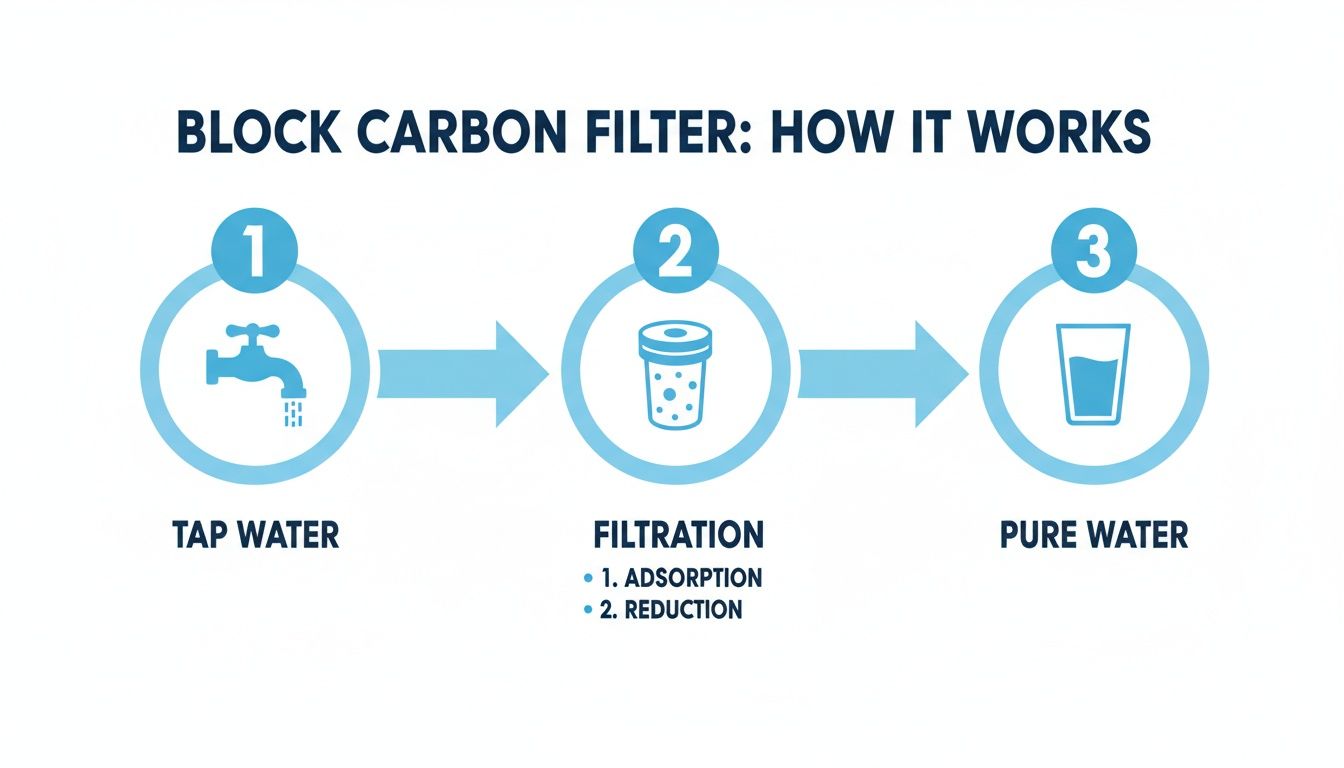
DIY Home Water Filtration: Your Complete Guide to Purer, Tastier Water

Building your own home water filtration system is one of the most empowering projects you can take on. It puts you in the driver's seat, giving you total control over the quality of your water. You get to build a solution that's a perfect match for your home's unique needs—often for a lot less than hiring a pro—and you get complete peace of mind about what's coming out of your tap.

Why Build Your Own Home Water Filter?

A smiling woman and a child fill a glass with clean tap water from a kitchen faucet.

Ever notice that faint swimming pool smell from your tap? Or wonder why your morning coffee just tastes a bit… off? While municipal water is treated to be safe, it often leaves behind things like chlorine, sediment, and minerals that can mess with the taste, smell, and even the lifespan of your appliances.

Taking on a DIY home water filtration project lets you tackle these issues head-on. This isn't just about saving money; it’s about becoming more self-reliant. You'll gain a real understanding of your home's water—from the source right to your glass—and build something that fixes your specific problems.

Addressing Real-World Water Woes

Imagine a family on well water who's constantly dealing with that awful "rotten egg" smell from hydrogen sulfide. A professionally installed system could run them thousands, but a well-designed DIY setup with the right carbon filter can knock out that odor for a fraction of the cost.

Or think about the city apartment dweller who's sick of chlorine ruining their tea. A simple under-sink activated carbon filter—a project you can easily knock out in an afternoon—solves the problem instantly. It's this direct, hands-on approach that connects your concerns with a real, working solution.

The real magic of the DIY approach is customization. You aren't just buying a generic box off the shelf. You're engineering a solution perfectly matched to your water quality report, whether you're targeting lead, sediment, or excessive hardness.

This drive for tailored solutions is a big reason why the home water filtration market, valued at a massive USD 20.26 billion in 2024, is projected to hit USD 50.89 billion by 2033. For people like us, simple point-of-use filters are a huge part of this trend. Going the DIY route can slash installation costs by up to 70% compared to hiring a professional.

DIY vs. Professional Installation: Cost and Benefit Snapshot

Deciding between a DIY project and hiring a pro often comes down to balancing cost, time, and complexity. This table gives you a quick look at what to expect from each path for common filtration setups.

Factor DIY Home Water Filtration Professional Installation
Upfront Cost Low. Mainly parts and basic tools. High. Includes parts, labor, and company overhead.
Time Commitment Moderate. From a few hours to a full weekend. Low. Usually completed in a few hours.
Skills Required Basic plumbing and handyman skills. None. The expert handles everything.
Customization High. You choose every component. Limited to the pro's available systems.
Key Benefit Cost savings and deep system knowledge. Convenience and warranty-backed work.

While hiring a professional guarantees a quick and polished result, the satisfaction and savings from doing it yourself can't be beaten, especially for simpler systems.

The Power of Knowing Your System

When you build your own filter, you know exactly what's inside it, how every part works, and when it needs a tune-up. That knowledge is incredibly empowering.

  • Complete Control: You hand-pick the filtration media, whether it's a sediment filter to catch rust or a carbon block to absorb chemicals.
  • Cost Savings: Sourcing your own parts and putting in the elbow grease dramatically cuts the final price tag, making top-tier filtration more affordable.
  • Skill Building: You’ll pick up basic plumbing skills and get more confident with home maintenance—a huge win for any homeowner.

There's a special kind of satisfaction that comes from turning on your faucet and knowing you're the one responsible for that pure, great-tasting water. If you enjoy the self-sufficiency that comes from creating your own home solutions, you might also be interested in exploring other DIY home wellness projects. It's about more than just a project; it's about making your daily life better, one drop at a time.

Understanding Your Water Before You Build

Before you even think about buying parts for a DIY home water filtration system, you need to play detective.

Building a filter without knowing what’s in your water is like trying to fix a car without looking under the hood—you might get lucky, but you're probably wasting time and money. The goal is to build a system that solves your specific water problems, not someone else's.

The very first step is to figure out exactly what you're up against. Are you dealing with the lingering taste of chlorine from city treatment, or is your well water leaving rust-colored stains from high iron content? Each contaminant requires a different filtration strategy.

Decoding Your City Water Report

If you get your water from a municipal source, you have a powerful tool at your disposal: the Consumer Confidence Report (CCR). Your local water utility is required by law to provide this report to its customers annually. It's a detailed breakdown of what's in your water, including detected contaminant levels and how they compare to legal safety limits.

You can usually find your CCR on your water company's website. Keep an eye out for terms like:

  • Chlorine/Chloramine: These are common disinfectants. While effective, they can leave a chemical taste and odor. High levels are a clear signal that an activated carbon filter should be a core component of your build.
  • Hardness: Measured in grains per gallon (GPG), high hardness is caused by calcium and magnesium. It's not a health risk, but it causes scale buildup that can destroy appliances.
  • Lead and Copper: These often leach from old plumbing pipes. If your report shows levels close to the action limit, a specialized filter certified for lead reduction is essential.

Understanding this report turns a guessing game into a targeted plan. For more detailed advice on interpreting these results and choosing the right filter, you can find a wealth of information in guides for homeowners. For an in-depth look, you might be interested in exploring the expert advice at Water Filter Advisor to make a more informed decision.

When to Test Your Well Water

For those on private well water, the responsibility for testing falls squarely on you. Unlike city water, well water isn't treated or monitored by a utility, meaning its quality can change with the seasons or due to environmental factors. A professional lab test is a non-negotiable first step.

A comprehensive well water test will screen for a different set of potential troublemakers. You'll want to check for things like iron, manganese, sulfur (that "rotten egg" smell), nitrates, and bacteria like E. coli. High sediment, for instance, points to the need for a robust pre-filter to protect the more sensitive components of your system downstream.

A water test isn't an expense; it's an investment in your project's success. It provides the exact blueprint you need to build a DIY filtration system that actually works, ensuring every dollar you spend is on a component that targets a real problem.

Before deciding on a filtration method, it's also crucial to understand the quality of water entering your home, and for many, this includes ensuring a clean water supply starts at the source with proper water tank cleaning. Contaminants can build up in storage tanks, undermining even the best filtration system.

Once you have your test results in hand, you can confidently move forward. High iron? An oxidizing filter is your answer. Bacteria present? A UV purification stage becomes a priority. This data-driven approach is the foundation of every successful DIY home water filtration project, ensuring you get safe, clean, and great-tasting water from day one.

Choosing Your Filtration Superheroes

Alright, you’ve got your water test results in hand and you know what you’re up against. Now for the fun part: choosing your filtration method. This isn't a one-size-fits-all situation. The best DIY home water filtration setup depends entirely on what you're trying to remove.

Think of it like building a custom toolkit. You need to pick the right components for the job, balancing performance, cost, and how much time you want to spend on the project. Let's dig into the most common technologies you can put together yourself.

The Foundation: Sediment Filters

A sediment filter is the first line of defense for any serious water filtration system. Its job is simple but crucial: it catches all the big stuff. We’re talking about the sand, silt, rust particles from aging pipes, and any other gunk that makes your water look murky.

This is almost always the first stage in any DIY build, and for good reason. It acts as a bodyguard for the more delicate (and expensive) filters down the line. Without it, a high-end carbon filter or a reverse osmosis membrane would get clogged and destroyed in no time.

You'll run into a few main types:

  • String-Wound: These look just like they sound—a big spool of string. They’re fantastic for well water where you might have particles of all different sizes.
  • Pleated: With a huge surface area, these filters allow for great water flow without a big drop in pressure. They're usually the go-to for city water.
  • Spun-Polypropylene: These are a solid, budget-friendly choice for basic sediment removal.

If you're in an apartment on city water, a simple pleated filter is probably all you need to snag any debris from the pipes. But if you're on a well, you'll likely want a lower-micron string-wound filter to handle the heavier load.

The Workhorse: Activated Carbon Filters

Hate that "public pool" smell and taste? Activated carbon is your answer. These filters are masters at pulling chlorine out of water. They work through a process called adsorption, where chemical contaminants literally stick to the carbon's massive internal surface area.

Beyond just chlorine, activated carbon is a champ at removing volatile organic compounds (VOCs), pesticides, and a whole host of other chemicals that mess with your water's taste and odor.

For most DIY projects, you'll be looking at an activated carbon block filter. These solid blocks can filter particles down to an incredibly fine 0.5 microns. That means they don't just improve taste—they can also trap nasty cysts like Giardia and Cryptosporidium, making them a seriously versatile part of your system.

A simple two-stage setup with a sediment pre-filter and a carbon block filter is probably the most popular DIY project out there. It’s a weekend warrior’s dream, solving the most common city water problems—cloudiness and chlorine—in just a couple of hours.

This combo is perfect for renters or anyone who wants a massive upgrade in water quality without touching their home's main plumbing.

The Heavy-Hitter: Reverse Osmosis (RO)

When you need water that's as pure as you can possibly get it, you bring in the big guns: Reverse Osmosis (RO). This is serious filtration. An RO system uses high pressure to force water through a special membrane that strips out almost everything else. We’re talking lead, arsenic, fluoride, nitrates, salts—you name it.

Putting together a DIY RO system is a more involved project, but it's totally achievable. A typical setup has a few key parts:

  1. Pre-filters: You'll always have a sediment filter and at least one carbon filter to protect the RO membrane.
  2. RO Membrane: This is the heart of the system, where the real magic happens.
  3. Storage Tank: RO makes water slowly, so a small tank keeps a supply of purified water ready to go.
  4. Post-filter: This is usually a final carbon filter to give the water a final "polish" for taste before it hits your glass.

The market shows just how effective these systems are. RO units command over 60% of the market share, but other technologies are making moves. For example, UV purifiers are seeing a projected 10.6% growth rate, largely because they offer a chemical-free way to kill bacteria, which is a great option for renters. As a reader of Water Filter Advisor, you know the golden rule: test your water first, then build your system with NSF-certified media. You can read the full analysis of the home water filtration market to see where the industry is heading.

Building an RO system is a commitment, but if your water report shows heavy metals or other nasty contaminants, it's the single most effective DIY path to getting water that’s purer than most bottled brands, right from your own tap.


Choosing the right filter media is the most critical decision in your DIY build. This table breaks down what each type is good at, so you can mix and match components to target the specific contaminants in your water.

Filtration Media Performance Against Common Contaminants

Filtration Media Removes Chlorine Removes Sediment Removes Lead/Metals Removes Bacteria/Viruses
Sediment Filter No Excellent No No
Activated Carbon Excellent Good (some) Good (some) Poor (cysts only)
Reverse Osmosis Excellent Excellent Excellent Good
UV Purifier No No No Excellent

As you can see, no single filter does it all. That's why multi-stage systems are so popular and effective. A sediment filter protects a carbon filter, which in turn protects an RO membrane, giving you layers of purification that cover all your bases.

Building a Basic Under-Sink Water Filter

Alright, time to roll up your sleeves. We're going to walk through one of the most practical and rewarding DIY home water filtration projects you can tackle: a two-stage under-sink filter. This setup is a fantastic starting point for dealing with both sediment and common chemical culprits like chlorine.

We’ll go from gathering the parts to doing that final, all-important leak check. Even if you're new to this kind of work, don't sweat it. The process is pretty straightforward when you take it one step at a time. With a bit of patience, you can have a custom filter up and running in a single afternoon.

Gathering Your Tools and Materials

A successful project starts with having everything you need laid out and ready to go. Trust me, there’s nothing worse than having to make a frantic trip to the hardware store with your water shut off.

Here’s what you'll need for a standard two-stage system:

  • Two 10-inch Filter Housings: These are the main bodies that hold your filter cartridges. Make sure the kit includes a mounting bracket and a housing wrench—you'll need it.
  • A Sediment Filter Cartridge (5-micron): This is your first line of defense, designed to catch the bigger stuff like rust, sand, and silt.
  • An Activated Carbon Block Cartridge (0.5 to 5-micron): Stage two. This one is for tackling chlorine, weird tastes and smells, and VOCs.
  • PEX Tubing or Braided Steel Lines: You'll need a couple of sections to plumb the water from your cold line, through the filters, and back to the faucet.
  • Shut-off Valve (Angle Stop Adapter): This little piece is a game-changer. It lets you isolate the filter system so you don't have to shut off water to the whole sink just to change a cartridge.
  • Fittings: You'll need the right connectors (push-to-connect and compression are common and easy to use) for your tubing, filter housings, and water line.
  • Plumber's Tape: An absolute must-have for creating a watertight seal on any threaded connection.

For tools, grab a pipe cutter, an adjustable wrench, a drill for the mounting bracket, and definitely a bucket and some old towels. No plumbing job is ever completely dry.

The diagram below shows a typical filtration sequence. It starts with a sediment filter, then carbon for chemicals, and often reverse osmosis for the highest level of purification.

Diagram illustrating a three-stage filter selection process for water purification: Sediment, Carbon, and RO.

This multi-stage approach is so effective because each filter does a specific job and protects the next one down the line, making the whole system more efficient and longer-lasting.

Assembling and Mounting the Filter Unit

With all your parts in front of you, the first real step is putting the filter unit together. Go ahead and attach the two filter housings to the mounting bracket. Next, you'll install the inlet and outlet fittings into the housing caps. Before you do, wrap the threads with plumber's tape—give it three to four wraps in a clockwise direction—then tighten them down.

Pro Tip: Get your fittings hand-tight first, then give them just a gentle quarter-to-half turn more with a wrench. Over-tightening is the #1 reason people end up with cracked housings and annoying leaks. The tape is what creates the seal, not brute force.

Once it's all assembled, find a good spot for it under your sink. You need to leave enough clearance below the housings—at least a couple of inches—to have room to unscrew them when it's time to swap cartridges. Use your drill to mount the bracket securely to the cabinet wall.

Tapping Into Your Cold Water Line

This is the part that seems intimidating, but it's really not that bad. First thing's first: shut off the main water supply to your house. Then, open your kitchen faucet to let the line drain completely.

Put your bucket under the cold water line to catch the last few drips. Now, use your pipe cutter to make a single, clean cut in the line that runs between the wall shut-off and the faucet. This is where you'll install your new angle stop adapter. This adapter is key because it gives you an extra port to feed water to your new filter system.

From there, it's just a matter of connecting the dots. Run a piece of PEX tubing from the adapter's outlet port to the "IN" port of your first housing (the sediment filter). Then, connect another piece of tubing from the "OUT" port of your second housing (the carbon block) and run it back to connect with the faucet's cold water line.

The Moment of Truth: Testing for Leaks

Okay, deep breath. Before turning the water back on, give every connection one last check to make sure it's snug. A great trick is to place a dry paper towel under each fitting; they'll show you even the tiniest drop of water instantly.

Now, head to your main valve and very slowly turn the water back on just a crack. Go back to the sink and listen for any hissing and watch every single connection point for drips. If everything looks good and stays dry, you can open the main valve the rest of the way.

Let the water run through the new filters and out the faucet for about five minutes. This flushes out any loose carbon fines from the new cartridge.

And that's it! You just built and installed your own under-sink water filter. This simple but powerful DIY home water filtration system will give you much cleaner, better-tasting water right from your kitchen tap.

Maintaining Your DIY Filtration System

A person's hands are changing white cylindrical water filters on a clean white kitchen counter.

So, you’ve built and installed your DIY home water filter. Fantastic work. But getting it up and running is just the first step. To keep that clean, pure water flowing, you've got to think about long-term care.

Proper maintenance is what keeps your system working like it should. If you neglect it, filters get clogged, water pressure plummets, and worst of all, it stops trapping contaminants. A filter that's completely saturated can actually start leaking the gunk it's already captured right back into your water.

The easiest way to avoid this is to set up a simple maintenance schedule you can stick to.

Creating a Practical Filter Replacement Schedule

Knowing when to swap out your filters is the heart of the maintenance plan. There's no single magic number here—lifespan depends on the filter type and just how much work it has to do with your specific water source. Someone on well water with lots of sediment will be changing pre-filters way more often than a person on city water.

As a rule of thumb, here are some good starting points for common filters:

  • Sediment Filters: These are your workhorses, catching all the initial grit and grime. Expect to change them every 3 to 6 months.
  • Activated Carbon Block Filters: Great for taste, odor, and chemicals, these typically last 6 to 12 months before they're "full."
  • Reverse Osmosis (RO) Membranes: The RO membrane itself is surprisingly resilient. If you're good about changing your pre-filters, it can last 2 to 3 years.

Of course, these are just guidelines. The real trick is learning to recognize the signs that your system is telling you it's time for a change.

Visual Cues and Performance Indicators

Your filter will give you some pretty clear hints when it's time for a swap. Instead of just marking a date on the calendar, learn to spot the physical signs of a filter that's done its job.

One of the first things you'll almost always notice is a drop in water pressure. If your faucet flow has slowed to a sad trickle, it’s a dead giveaway your sediment filter is clogged and fighting a losing battle.

Another clue is when old problems reappear. That chlorine taste you got rid of suddenly comes back? Your carbon filter is saturated. For sediment filters, you don't even have to guess—just look at it. If a once-white filter cartridge is now a nasty shade of brown or orange, it's long overdue for a change.

The Importance of Post-Installation Testing

How can you be sure your filter is still working? You test the water. Regular testing is the only way to get real proof that your system is performing up to snuff.

You don't need to be a chemist or send samples off to a lab every week. There are plenty of simple, affordable home water testing kits that give you quick answers on things like chlorine levels, pH, and water hardness.

Testing your water every few months is a smart move. Let's say a test shows chlorine is slipping past your filter. That tells you it's time for a new carbon cartridge, even if you haven't hit the six-month mark yet. This kind of data-driven approach takes all the guesswork out of maintenance and makes sure your water is always as clean as you intended.

Got Questions About DIY Water Filtration?

Building your own home water filtration system is a great project, but it's totally normal to have a few questions before you start twisting wrenches. Getting the right answers can be the difference between a smooth installation and a frustrating Saturday afternoon. We've pulled together some of the most common questions we hear to help you get started.

What Size Filter Do I Need?

Picking the right filter size is all about balancing how much filtration you need with your home's water flow.

For most projects tucked under a sink or sitting on a countertop, the standard 10-inch filter housing is your best bet. It’s small enough to fit into tight spaces but big enough to hold a huge variety of effective filter cartridges.

But if you're building a system for your whole house, you need to think bigger. We're talking about the 20-inch "Big Blue" style housings. These brutes can handle a much higher volume of water without choking your home's water pressure. Just match the filter size to the demand you’re putting on it.

Will a DIY Filter Kill My Water Pressure?

Yes, any filter will reduce water pressure a little bit, but it shouldn't feel like you've gone back to a low-flow showerhead from the 90s. If you notice a major drop, your system probably isn't designed right.

The usual suspects for pressure loss are:

  • A Clogged Sediment Filter: This is the #1 reason. As that first filter catches all the gunk, it gets harder for water to pass through. You have to change these regularly.
  • An Undersized System: Trying to force all your home’s water through a little 10-inch filter is a recipe for a weak flow.
  • A Super-Fine Filter: A filter with a tiny micron rating (like a 0.5-micron carbon block) will naturally slow things down more than a standard 5-micron filter.

To keep your pressure up, always use the right size filter for the job and don't slack on your replacement schedule.

A properly built DIY system might cause a pressure drop so small you'll barely notice. If your shower suddenly feels weak right after an install, your first move should be to check for a clogged or undersized filter.

Can I Actually Filter My Own Well Water?

Absolutely. In fact, this is where DIY systems really shine. You can build a custom, multi-stage setup to knock out the specific problems common in well water, like iron, sulfur, and heavy sediment—issues you rarely see with city water. A typical DIY well setup might go from a heavy-duty sediment filter to an iron filter, then finish with a carbon filter to fix any taste and odor issues.

The most important first step, though, is getting a comprehensive lab test on your well water. This test is your roadmap; it tells you exactly what you're fighting so you can pick the right tools for the job. If you skip the test, you're just guessing.

How Often Do I Really Need to Change My Filters?

The "change every six months" on the box is a good starting point, but the real answer comes down to your water quality and how much you use. If your water is loaded with sediment, you might be changing that first-stage filter every three months, while the carbon filter after it could easily last the full year.

Let the system tell you what it needs.

  • Look: Is that white sediment filter looking more like mud? It's time.
  • Taste: Can you taste the chlorine coming through again? Your carbon filter is done.
  • Flow: Has your water pressure taken a nosedive? Your pre-filter is probably clogged solid.

It helps to jot down when you change each filter. Soon you'll have a realistic schedule dialed in for your specific home and water. Consistent maintenance is what makes a DIY home water filtration system work, giving you clean, safe water for years.


Ready to stop wondering and start building? The team at Water Filter Advisor has spent years reviewing and testing every type of filter imaginable. Our in-depth guides and unbiased reviews will help you choose the perfect components for your project, ensuring you get it right the first time. Visit us today to make confident, cost-effective decisions for your home's water.

Find your perfect filter at https://www.waterfilteradvisor.com.
How to Treat Hard Water: A Homeowner’s Filtration Face-Off

Tired of chalky faucets, sad-looking soap suds, and dishes that come out of the dishwasher looking dirtier than they went in? You’re not just imagining it—you’re in a battle with hard water. The only way to win this war for good is to install a whole-house water filtration system that attacks the problem at the source, kicking those pesky hardness minerals like calcium and magnesium to the curb. This is your ticket to stopping limescale in its tracks, getting a luxurious lather, and saving your appliances from an early, crusty demise.

The Telltale Signs of Hard Water in Your Home

An old faucet with running water in a kitchen sink, showing mineral deposits from hard water.

Before you can pick your weapon, you need to be sure you're fighting the right enemy. Luckily, hard water isn't subtle. It leaves a trail of evidence all over your house, disguised as everyday annoyances you've probably just accepted as normal.

Hard water is simply water that’s loaded with dissolved minerals—mostly calcium and magnesium—that it picked up on its journey through the ground. While it’s perfectly safe to drink, it’s a menace to your home. So, if you think your shower doors have a permanent fog or your faucets look like they have a bad case of dandruff, you're not going crazy. That's just hard water making itself at home.

Visible Clues Around Your Sinks and Showers

The easiest place to spot the signs of this mineral invasion is wherever you use water the most. Your kitchen and bathroom are ground zero, and they're probably covered in a trail of gunk that defies all your cleaning efforts.

Look at the base of your faucets and around your showerhead. See that stubborn, white, crusty buildup? That's limescale, the calling card of hard water. It’s what’s left behind when water evaporates, and it’s basically rock. Another dead giveaway is the slimy soap scum that clings to your shower doors and tub. The minerals in your water are having a chemical party with your soap, creating that sticky, insoluble mess.

Chalky spots are another telltale sign, and they can be a real pain to remove. For some specific tips on that, check out Your Ultimate Guide to Removing Hard Water Spots on Windows.

You might also be dealing with:

  • Dull, spotty dishes and glassware: No matter how much rinse aid you use, your glasses look like they were dried with a dirty towel.
  • Weak water pressure: Limescale isn’t just an eyesore; it’s building up inside your pipes and faucet heads, slowly strangling your water flow.
  • That filmy feeling on your skin: The same reaction creating soap scum in your tub is happening on your body, leaving a residue that can clog pores and make your skin feel dry and itchy.

The Invisible Damage to Appliances and Fabrics

What you can't see is often doing the most damage. Hard water is waging a silent war on your appliances, and the collateral damage can get expensive.

Your water heater is public enemy number one for limescale. As it heats the water, scale forms directly on the heating elements, acting like a concrete blanket. This forces the unit to work way harder and burn more energy just to do its job, often leading it to fail years before its time. In fact, studies show that hard water can slash a gas water heater's efficiency by up to 24%.

Hard water doesn't just make cleaning harder; it actively works against the things you’re trying to clean. The minerals prevent detergents from lathering properly, meaning you have to use more product to get the same result, whether you're washing clothes, dishes, or yourself.

This problem carries over to the laundry room, too. Those same minerals get trapped in the fibers of your clothes, leaving them feeling stiff and scratchy. You’ll notice that your bright colors fade faster and your whites start looking dingy or gray, no matter how much bleach you throw at them. It’s a frustrating cycle of washing things that never seem to get truly clean.

To help you connect the dots, here’s a quick reference table.

Hard Water Problems and Their Filtration Solutions

This table breaks down the common issues you're seeing and points you toward the most effective water filtration system to solve them.

Common Problem Primary Cause Effective Filtration Solution
Limescale on fixtures & appliances High calcium and magnesium levels Ion-Exchange Water Softener, Salt-Free Conditioner
Soap scum & poor lather Minerals reacting with soap Ion-Exchange Water Softener
Dull, stiff, or faded laundry Mineral deposits in fabric fibers Ion-Exchange Water Softener
Dry skin and dull hair Soap residue left on skin/hair Ion-Exchange Water Softener, Showerhead Filter
Cloudy or spotty dishes Mineral deposits left after drying Ion-Exchange Water Softener, Reverse Osmosis
Reduced appliance efficiency Scale buildup on heating elements Ion-Exchange Water Softener

Ultimately, understanding these signs is the first step toward finding the right filtration treatment and reclaiming your home.

Alright, you've seen the signs. The soap scum that won’t quit, the chalky film on your faucets—something’s definitely up with your water. The next move is to find out just how hard it is.

Knowing your water's specific hardness level isn't just for bragging rights. It's the critical first step to choosing the right water treatment system. You don’t want to end up with a system that’s too weak to handle the job or, conversely, pay for more power than you actually need.

The Quick and Dirty Soap Suds Test

If you're impatient and want a rough idea right now, try the classic soap suds test. It's free, takes about five minutes, and all you need is a clean bottle with a cap and some basic liquid soap—think simple castile soap, not a fancy detergent.

Here's the drill:

  • Fill the clean bottle about a third of the way with your tap water.
  • Add around 10 drops of the liquid soap and screw the cap on tight.
  • Now, give it a good, hard shake for about 15 seconds.

Take a look. If your water is soft, you’ll see a nice, thick layer of suds, and the water below will be mostly clear. Hard water, on the other hand, will give you a sad-looking, suds-free surface and the water itself will look cloudy or milky. That cloudiness? That's your soap reacting with all the calcium and magnesium, creating the very soap scum you’re trying to get rid of.

For a More Accurate Number: DIY Test Strips

For a more scientific result, grab a pack of DIY water hardness test strips. They're cheap, easy to find at any home improvement store or online, and they give you a real number to work with.

You just dip a strip into a glass of tap water for a couple of seconds, pull it out, and wait. After a minute or so, the strip will change color. You then match that color to the chart that came in the kit.

The chart gives you a hardness reading, usually in Parts Per Million (PPM) or Grains Per Gallon (GPG). Professionals almost always talk in GPG, but the conversion is easy: 1 GPG equals 17.1 PPM.

This number is what really matters. For most homes, once you get over 7 GPG (or 120 PPM), you’re in the territory where a water softener starts to make a lot of sense. That’s the point where you’ll really see limescale build-up wreak havoc on your pipes and appliances.

For Pinpoint Accuracy: A Digital Tester

If you're a data geek or just want to be absolutely certain, a digital water tester is your best bet. These are handheld gadgets that measure the Total Dissolved Solids (TDS) in your water.

While a TDS meter measures everything dissolved in the water (not just the hardness minerals), a high TDS reading in city tap water is almost always a dead giveaway for high hardness. You get an instant, precise reading in PPM on a digital screen, which takes all the color-matching guesswork out of the equation. This kind of precision is perfect if you’re trying to dial in the settings on a high-efficiency water softener.

It's no surprise that more and more people are getting serious about this. The global water softener market was a US$2.9 billion industry back in 2022 and is projected to hit $6.8 billion by 2033. That’s a lot of homeowners deciding to protect their homes from hard water damage. You can check out more details on the water softener market trends on custommarketinsights.com.

Water Softeners vs. Water Conditioners: The Main Event

Okay, so you've confirmed hard water is the problem. Now, how do you fix it? When you're looking for a whole-house filtration solution, it really comes down to two main players: the classic salt-based water softener and the modern salt-free water conditioner.

This isn't just about plumbing hardware. It’s a choice between two completely different philosophies for dealing with those pesky minerals.

Think of it this way: a water softener is like a bouncer at a club, physically throwing the troublemakers (calcium and magnesium) out. A water conditioner, on the other hand, is like a skilled negotiator that convinces them to behave so they don't cause any problems. Both get the job done, but their methods are worlds apart.

The Classic Solution: Salt-Based Water Softeners

For most people, the image that pops into their head when they hear "hard water treatment" is a salt-based water softener. There's a good reason for that—they are the undisputed champions of hardness removal, and their method is both simple and incredibly effective.

The magic happens through a process called ion exchange. Your water flows through a tank filled with resin beads that are covered in sodium ions. Since the calcium and magnesium ions in your water have a stronger charge, they get pulled to the resin like a magnet, bumping the sodium ions off and into your water. It’s a direct swap: bad minerals out, harmless sodium in.

This total removal of hardness minerals is what gives you genuinely soft water. The difference is night and day:

  • Limescale vanishes: With the scale-forming minerals gone, they can't build up on faucets, shower doors, or inside your water heater.
  • Soap works like it should: You'll get that rich, sudsy lather you see in commercials. You'll also use way less soap, shampoo, and detergent.
  • That signature "slippery" feel: This is the tell-tale sign of truly soft water. Without minerals to react with soap, it rinses off completely, leaving your skin's natural moisture behind. It feels slick, but that’s actually the feeling of being 100% clean.

But this level of performance requires some upkeep. Eventually, those resin beads get clogged with all the minerals they've collected. To clean them, the system runs a regeneration cycle, flushing itself with a saltwater brine from a second tank. That brine tank is the part you have to keep topped up with heavy bags of salt.

The Modern Alternative: Salt-Free Water Conditioners

If you're looking for a way to stop scale damage without adding sodium to your water or lugging salt bags, a salt-free water conditioner is a fantastic option. The most important thing to know is that these systems do not remove the minerals, so they don't technically "soften" the water.

So what do they do? They change the minerals' behavior. The most proven technology here is Template Assisted Crystallization (TAC). As water flows through the TAC media, the calcium and magnesium minerals are converted into microscopic crystals.

These tiny, harmless crystals can't stick to pipes, fixtures, or heating elements. They just flow right on through your plumbing and down the drain. You get the number one benefit—scale prevention—without actually altering your water's mineral content. The healthy calcium and magnesium are still there, they've just been neutralized.

Here's the bottom line: Salt-free conditioners are all about preventing scale. You won't get that slippery feeling or mountains of soap bubbles, but you will protect your pipes, water heater, and dishwasher from destructive limescale.

This infographic lays out a few simple ways to figure out just how hard your water is. Knowing your numbers is the first critical step before picking any treatment system.

Infographic on water hardness testing, outlining a summary and three methods: DIY, test strips, and digital testers.

Whether you use a basic soap test or a precise digital meter, getting this data helps you choose and size your system correctly.

Making the Right Choice for Your Home

So, which one is for you? It really comes down to what you're trying to achieve. There’s no single “best” system, just the one that’s the best fit for your home and your priorities.

This head-to-head comparison should make the differences crystal clear.

Water Softener vs. Water Conditioner: Head-to-Head Comparison

Feature Salt-Based Water Softener Salt-Free Water Conditioner
Primary Function Physically removes calcium & magnesium Neutralizes minerals to prevent scale
How It Works Ion Exchange Template Assisted Crystallization (TAC)
Scale Prevention 100% elimination Excellent scale prevention (99%+ effective)
"Soft Water" Feel Yes, creates the distinct slippery feel No, water chemistry is unchanged
Soap Lather Significantly improves lather No change in lather
Maintenance Regularly add salt (40-50 lbs/month) Virtually maintenance-free
Environmental Impact Discharges salt brine into wastewater No salt, no waste, no electricity
Initial Cost Generally lower upfront cost Often a higher initial investment
Ongoing Costs Salt, water, and electricity for regeneration None
Best For Homeowners wanting to fix all hard water issues Homeowners focused on protecting plumbing & appliances

In the end, it’s a straightforward choice.

If you want the full soft-water experience—no scale, better skin and hair, and amazing soap lather—then a salt-based water softener is the clear winner. It's the only way to physically remove the minerals that cause all the problems.

If your main goal is to protect your home's expensive plumbing and appliances from scale buildup, and you want a zero-maintenance, eco-friendly solution, then a salt-free water conditioner is an excellent choice. It's the ultimate "set it and forget it" system for preventing the costly damage hard water can do.

Exploring Other Hard Water Filtration Methods

While whole-house softeners and conditioners are the heavy hitters, they aren't the only tools in your filtration arsenal. Sometimes, a more focused, targeted approach is exactly what’s needed.

Maybe you just want ultra-pure drinking water or a simple fix for your dry hair. For that, other filtration methods offer the perfect solution. These alternatives can work great on their own or even supplement a larger system, letting you fine-tune the water quality throughout your home.

Reverse Osmosis for Pure Drinking Water

You’ve probably heard of Reverse Osmosis (RO) systems. They are the gold standard for water purification, usually installed right under the kitchen sink with a small, dedicated faucet. An RO system is a multi-stage filtration beast that does a lot more than just soften water.

It works by pushing water through a special membrane filled with microscopic pores. This process strips out nearly everything that isn't H₂O, including:

  • Hardness minerals like calcium and magnesium
  • Contaminants like chlorine, lead, and pesticides
  • Dissolved solids, salts, and even fluoride

What you get is exceptionally clean, great-tasting water that's amazing for drinking and cooking. But that level of purification is exactly why RO is rarely a whole-house solution. These systems produce water slowly and create wastewater in the process, making them impractical and wasteful for things like showers and laundry.

Key Takeaway: An RO system is the ultimate point-of-use filtration fix for pristine drinking water. It will remove hardness minerals from the water you drink, but it isn't designed to protect your home's entire plumbing network from limescale.

The Power of Showerhead Filters

Is your main complaint about hard water what it does to your hair and skin? If so, a specialized showerhead filter is a fantastic and incredibly budget-friendly fix.

These devices are a breeze to install—they just screw on between your existing showerhead and the pipe coming out of the wall. They target the water exactly where it impacts your personal care routine the most.

They use filtration media, often a mix of KDF (Kinetic Degradation Fluxion) and carbon, to cut down on both hardness minerals and chlorine. While they don't technically "soften" water like an ion-exchange system, they do a great job reducing the scale and chlorine that are the real culprits behind dry, itchy skin and dull, brittle hair. This is an ideal solution for renters or anyone who wants to solve skin and hair issues without the cost of a whole-house system.

A Broader Look at Water Filtration

As you can see, treating hard water often involves more than just tackling minerals. The world of water filtration is huge, with systems designed for everything from sediment to specific chemical contaminants. For instance, you might have a softener to handle the minerals but still want a carbon filter to improve the taste and smell.

This is especially true in unique setups, like mobile living. In these cases, a broad approach to water quality is key. For more on keeping water clean on the go, you might want to read up on finding the best RV water filter system.

Reverse osmosis is only becoming more popular. In fact, within the water treatment world, reverse osmosis systems are expected to command about 35% of the market share by the end of 2035. It's easy to see why, since these membrane filters can remove up to 99% of water impurities. Whether it’s for your whole house, your RV, or just your drinking glass, understanding all these options is the key to finding the perfect fix for your water.

Installation and Maintenance for Your Filtration System

A man performing maintenance on a white water heater in a utility room with tools and a bucket.

Getting a hard water filtration system is a huge step, but the work doesn't stop once you've made the purchase. Proper installation and a little upkeep are what protect your investment and keep your home running scale-free for years to come.

Think of it this way: even a brand-new car needs its oil changed.

A whole-house system is a serious piece of plumbing. You're cutting into your home's main water line, which can feel pretty daunting. Your first big call is deciding whether to roll up your sleeves and do it yourself or bring in a pro.

DIY Installation vs. Professional Help

If you're already comfortable with plumbing projects, a DIY installation is definitely on the table. Most systems arrive with detailed instructions, and the basic process is straightforward: shut off the main water, cut a piece of pipe, and hook up the new unit. If you've handled pipe cutters, soldering, or PEX fittings before, you'll probably feel right at home.

For a lot of folks, though, this is a job best left to a professional plumber.

A licensed pro brings a lot to the table. They’ll ensure the system is installed to code, won’t leak (preventing a potential disaster), and can help you figure out the optimal spot for the unit. That's a big deal, especially since a salt-based softener needs to be near both a drain and a power outlet.

Expert Insight: Spending a few hundred dollars on a professional installer buys you total peace of mind. A bad install can cause leaks, a drop in water pressure, or even void your warranty, which makes hiring a pro a smart move for such a long-term home improvement.

Your Long-Term Maintenance Checklist

Once your system is up and running, a little routine care goes a long way. The maintenance you'll need to do really depends on the type of filtration system you picked.

For a traditional salt-based water softener, your main task is pretty simple: keep the brine tank topped up with salt. Here’s what that looks like:

  • Check the Salt Level: Take a peek inside the brine tank at least once a month.
  • Refill as Needed: A good rule of thumb is to keep the tank at least one-third full. For a typical family of four, you'll likely add one 40-pound bag of salt every month or two.
  • Choose the Right Salt: Stick to high-purity salt pellets made specifically for water softeners. Cheaper rock salt often has dirt and gunk that can clog up the system's more delicate parts.
  • Clean the Brine Tank: About once a year, it's a great idea to empty and clean out the brine tank. This gets rid of any sediment or "salt mush" that’s built up on the bottom.

Care for Salt-Free and Cartridge-Based Systems

If you went with a salt-free water conditioner that uses Template Assisted Crystallization (TAC), your to-do list is much shorter. There's a reason people call these "set it and forget it" solutions.

The TAC media inside the tank will eventually need to be replaced, but usually only every three to five years. It's a job many homeowners can handle themselves in under an hour—just unscrew the tank head, dump out the old media, and pour in the new.

For smaller, cartridge-based filters, like the ones you find on showerheads or under a sink, it’s even easier. All you have to do is swap out the filter cartridge based on the manufacturer's schedule, which is typically every six months to a year. Keeping up with this is key to making sure the filter keeps doing its job effectively.

Your Hard Water Questions Answered

After digging into all the different filtration methods for hard water, there are always a few questions that pop up. This is where we tackle those last few uncertainties head-on, giving you straight answers to the things we hear most often from homeowners just like you. Let's get everything cleared up so you can feel good about your next step.

Will a Water Softener Make My Drinking Water Salty?

This is probably the biggest myth we run into, and it's a totally fair question. While salt-based softeners do use sodium chloride (salt) to regenerate, the actual amount of sodium that makes its way into your tap water is tiny.

It's an ion exchange, not an addition. The system swaps a sodium ion for a calcium or magnesium ion. For most homes with moderately hard water, the sodium added is less than what's in a single slice of white bread. Honestly, you'd be hard-pressed to taste any difference at all.

That said, if you're on a strict, doctor-ordered low-sodium diet, it's something to discuss with them. A great workaround many people choose is to install a whole-house softener and then add a reverse osmosis system under the kitchen sink. You get the best of both worlds: your whole house is protected from scale, and you have ultra-pure, sodium-free water for drinking and cooking.

Can I Treat Hard Water if I Live in an Apartment?

You absolutely can. Installing a big whole-house system is usually off the table for renters, but you’ve still got some fantastic point-of-use filtration options that can make a world of difference. You don't have to just put up with hard water because you don't own the place.

Here are the most common filtration fixes for renters:

  • Showerhead Filters: This is the go-to for apartment dwellers. A simple screw-on shower filter designed for hard water can drastically cut down on scale and chlorine. The result? Skin that feels softer and hair that's healthier and easier to manage.
  • Faucet-Mounted Filters: For your kitchen sink, a filter that attaches right to the faucet is an easy way to improve the taste and quality of the water you drink and cook with.
  • Countertop Filtration Systems: From simple pitcher filters to more advanced countertop units, you can get great-tasting, filtered water without touching the plumbing at all.

These targeted solutions let you enjoy many of the perks of treated water without making a single permanent change.

How Do I Choose the Right Size Water Softener?

Getting the right size water softener is a huge deal for its efficiency and your long-term happiness with it. If it's too small, it will regenerate constantly, wasting salt and water. If it's too big, you've just spent more money than you needed to.

The right size all comes down to two numbers: your water hardness level (in Grains Per Gallon, or GPG) and how much water your household uses each day.

You can figure out your daily needs with a quick calculation:
(Number of People in Home) x (75 Gallons per Person) x (Your Water’s GPG) = Daily Grains to Remove

Let's walk through a real-world example. A family of four with water that has a hardness of 10 GPG would figure it out like this: 4 people x 75 gallons x 10 GPG = 3,000 grains per day. Since you want the system to go a few days between regeneration cycles, a standard 32,000-grain unit would be a solid choice for this family. Most manufacturers have easy-to-read sizing charts to help you lock in the perfect model. For more general filtration questions, you can always find more in-depth articles in our water filter advice section.


At Water Filter Advisor, our goal is to give you the clear, unbiased information you need to find the perfect solution for your home's water. Whether you need a whole-house system or a simple faucet filter, explore our guides and reviews to make a confident choice. Visit us at https://www.waterfilteradvisor.com to get started.

SUBSCRIBE
Weekly newsletter