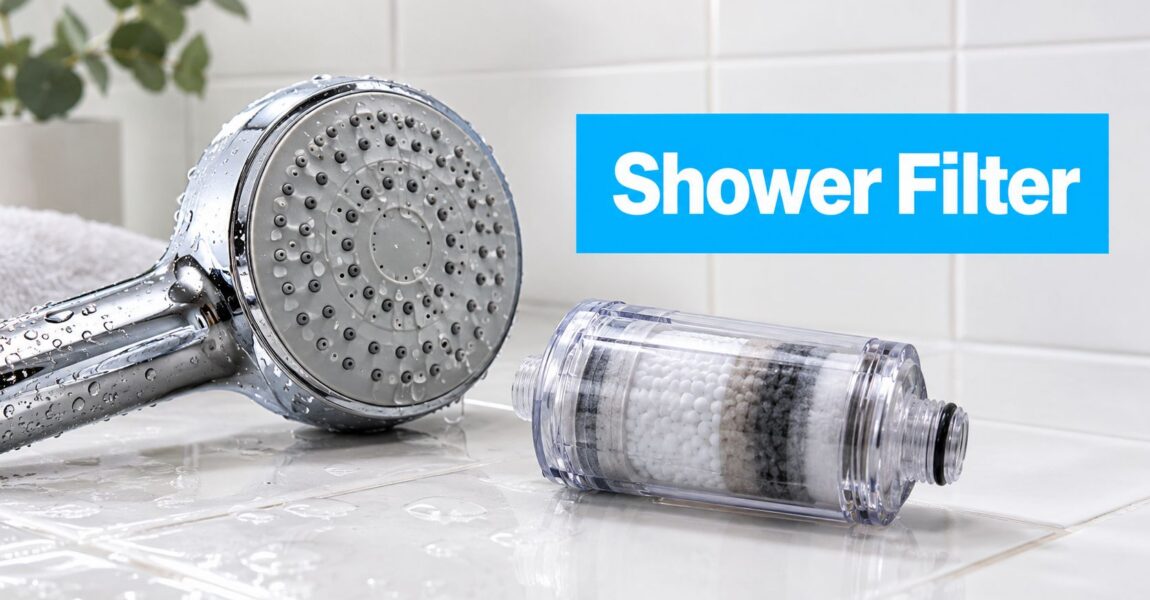
You step into the shower expecting relief, then notice the familiar chemical odor. After drying off, your skin feels tight, your scalp is irritated, and your hair seems less manageable than it did before the rinse. A shower head filter cartridge can be a practical home filtration upgrade, but only when its media, flow rating, and replacement schedule match the water coming through your pipes.
Shower filtration is no longer a niche bathroom accessory; independent market estimates valued the global shower water filters market at approximately USD 2.5 billion in 2025 and project it to reach about USD 4.5 billion by 2033 at a 7% CAGR (market estimate). More households are buying replaceable cartridges, yet many still rely on a generic calendar interval instead of considering household size, disinfectant chemistry, water temperature, and flow.
Introduction to Shower Head Filter Cartridges
A cartridge sits inside a housing connected to the shower supply, or inside a filtered showerhead. As water passes through the media, the cartridge can reduce targeted substances such as free chlorine, depending on its design and verified performance. It won't solve every water problem, and it won't turn hard water into soft water, but the right model can address odor and chlorine exposure at the point where you shower.
The practical challenge is that two homes can use the same cartridge and get very different service life. A lightly used guest bathroom may preserve its media longer than a busy family bathroom, while water treated with chloramine may require entirely different media from water treated with free chlorine.
The useful question isn't “How many months does this last?” It's “How much treated water will this household send through the media?”
This guide covers how a cartridge works, how activated carbon, KDF, vitamin C, ceramic, and mixed-media designs differ, how to match flow and capacity to your shower, and how to replace the cartridge without creating leaks. If you're planning the broader bathroom layout as well, a resource on choosing your primary bath shower can help you think through shower placement and equipment before installation.
Understanding How Shower Head Filter Cartridges Work
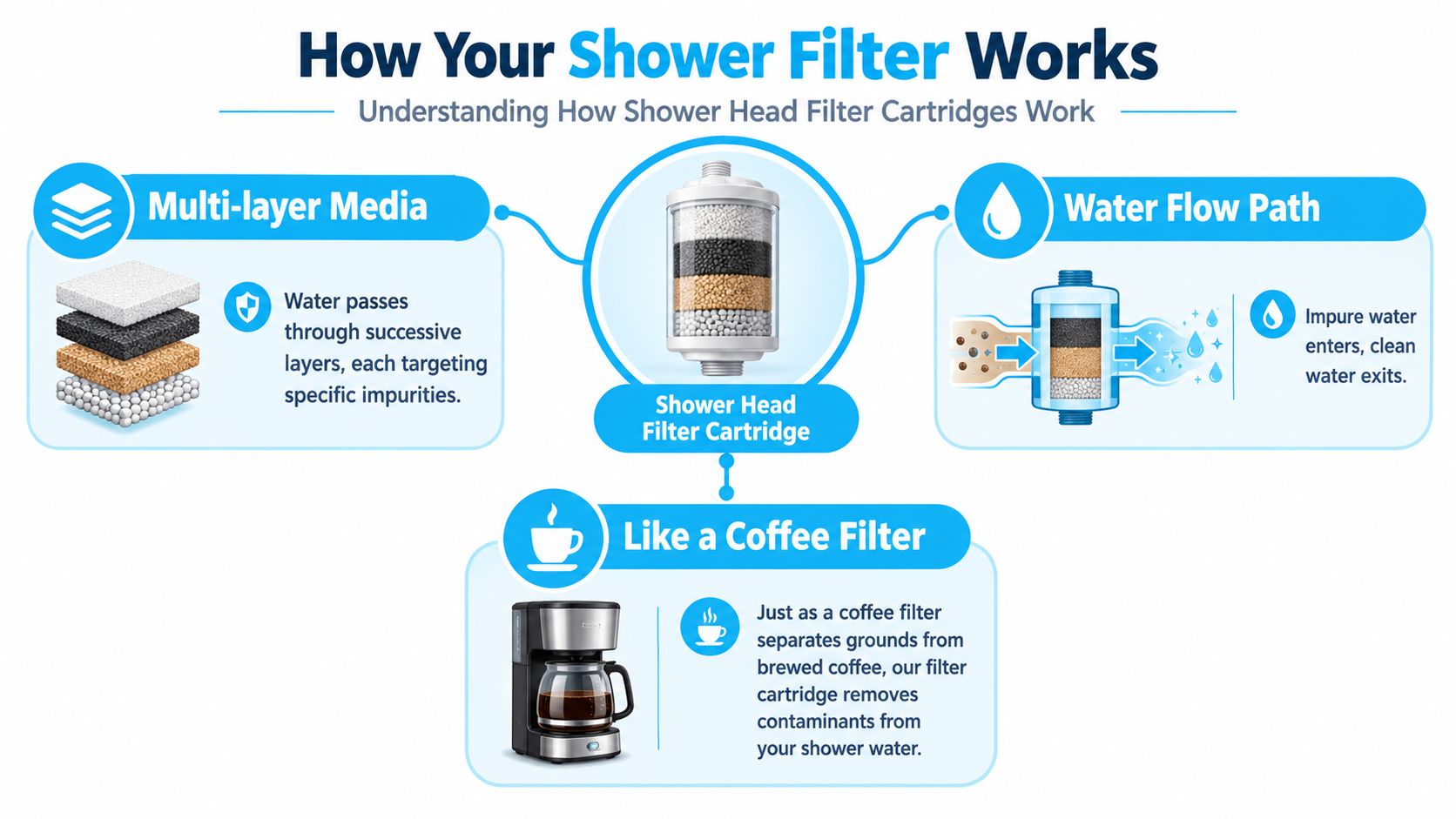
A cartridge is easier to understand if you compare it with a coffee maker. Water enters the coffee filter, moves through the grounds, and exits after contacting several materials. A shower head filter cartridge follows the same basic principle, except the internal media is selected to trap particles, adsorb chemicals, or trigger a chemical reaction.
The parts inside the housing
Most replaceable systems have three practical parts:
- Outer housing: The canister holds the media and directs water through the intended path.
- Sealing O-rings: These rubber seals prevent water from escaping at threaded connections or around the cartridge.
- Internal media pack: Granular media, blocks, screens, or layered materials perform the actual treatment.
Some cartridges also include a sediment screen or mesh layer. That layer catches loose particles before they reach the finer media, which can help preserve flow. It won't remove dissolved chlorine or chloramine, because those substances pass through a simple physical screen.
Hydraulically, untreated water enters through the inlet, travels across or through the media bed, and exits through the outlet toward the showerhead. The cartridge must provide enough contact between water and media to support reduction, while still allowing the shower to maintain usable pressure. If water moves too quickly through a small media bed, treatment can suffer. If the media is packed too tightly, pressure can fall.
Why replaceable cartridges matter
Integrated filtered showerheads combine the head and filter in one unit. They're convenient, but replacing the entire head can create unnecessary waste and restrict your choice of spray pattern. A modular cartridge system lets you keep the showerhead you prefer and replace only the exhausted treatment component.
The patent history reflects that progression. U.S. Patent 6,325,930 for a filtered showerhead was published in 2001, while later patents specifically naming modular replaceable showerhead filter cartridge assemblies appeared in 2018 (patent history). Earlier shower filter assembly filings from 1992 and 1996 also show that the basic concept has been developing for decades.
Comparing Filtration Media and Contaminants Removed
The media determines what a cartridge can realistically do. A long list of “stages” isn't useful unless you know what those stages contain and which substances they target.
Activated carbon works mainly through adsorption. Its porous surface attracts certain chemicals responsible for chlorine odor and related taste or smell concerns. Standard carbon can be useful for free chlorine, but it isn't automatically effective against chloramine.
KDF media, generally a copper-zinc alloy, uses an oxidation-reduction process. It can support free-chlorine reduction and may address some dissolved metals, but it shouldn't be treated as a universal solution. Vitamin C, or ascorbic acid, chemically neutralizes chlorine and can be useful as a finishing stage, particularly when free chlorine is the main concern. Its usefulness against chloramine depends on the formulation and test evidence.
Ceramic or mesh components primarily support particle control. They can catch sediment and protect downstream media, but they don't replace a chemical treatment stage. Mixed-media cartridges combine several approaches so that one layer handles particles while another targets disinfectants or odors.
| Media Type | Removable Contaminants |
|---|---|
| Activated carbon | Free chlorine, odor-causing compounds, and some organic contaminants |
| Catalytic carbon | Free chlorine and chloramine, where supported by testing |
| KDF copper-zinc media | Free chlorine and some dissolved metals |
| Vitamin C, ascorbic acid | Free chlorine and, in suitable formulations, chloramine |
| Ceramic or mesh | Sediment and larger suspended particles |
| Mixed-media blend | A broader combination of particles, disinfectants, odors, and selected metals |
The standard benchmark for many shower cartridges is NSF/ANSI 177. Certified shower filters must reduce free available chlorine by at least 50% when challenged with water containing 2 mg/L free available chlorine (NSF certified listings). That benchmark applies to free chlorine. It doesn't prove that the cartridge removes chloramine, hardness, lead, or every other contaminant.
A cartridge that passes a free-chlorine test isn't automatically a chloramine cartridge.
Check your utility's water report or arrange testing before choosing media. If you're also evaluating household materials, you can discover safe flooring for indoor air quality separately, but don't confuse indoor-material decisions with water-treatment performance. For the shower, the media and its test documentation remain the deciding factors.
Choosing the Right Cartridge Size and Lifespan
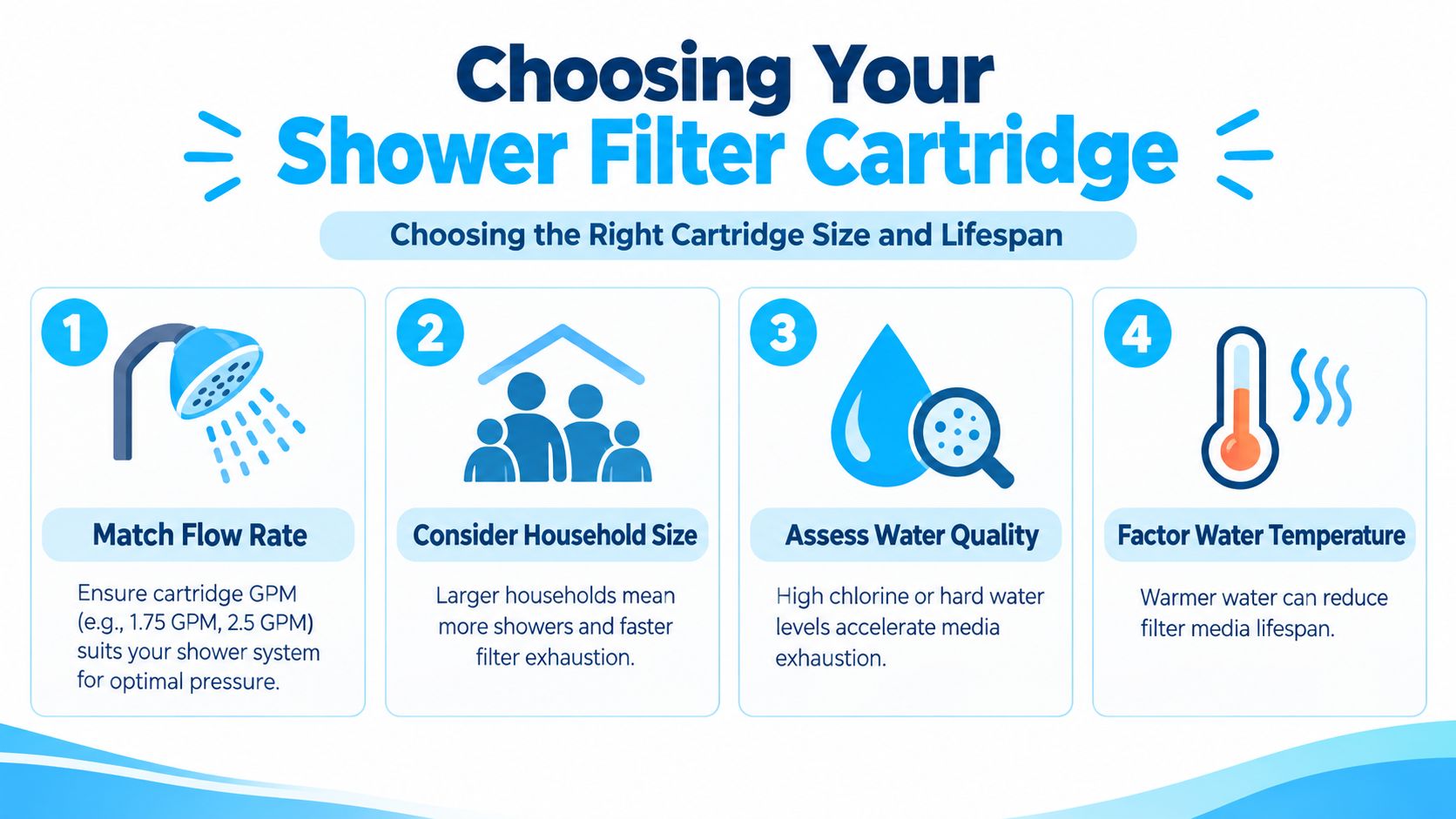
A cartridge's flow rating must suit the shower system. Published examples include cartridges rated at 1.75 GPM and others rated at 2.5 GPM, so compare the cartridge rating with the flow your showerhead requires. A restrictive cartridge may reduce pressure, while an undersized media bed may offer less contact time.
Published specifications commonly place service life around 3 to 12 months or 5,000 to 25,000 gallons, depending on media chemistry and cartridge format (service-life specifications). Those ranges aren't interchangeable promises. They describe different designs operating under different water conditions.
Calculate usage instead of guessing
A two-person household with short, occasional showers may use a cartridge far more slowly than a four-person household with frequent, longer showers. Higher disinfectant residuals, warmer water, sediment, and greater flow all increase the workload placed on the media.
One independent guidance document notes replacement windows from about 3 to 6 months and estimates that a four-person household can exhaust a cartridge in roughly 3.5 months, even when a general six-month schedule is advertised (household usage guidance). Treat the manufacturer's gallon rating as a capacity limit, then adjust your expectation for actual household demand.
Record the installation date, note how many people use the bathroom, and watch for returning odor or declining pressure. A calendar reminder is useful, but it should support, not replace, usage-based judgment.
Replacing and Maintaining Shower Head Filter Cartridges
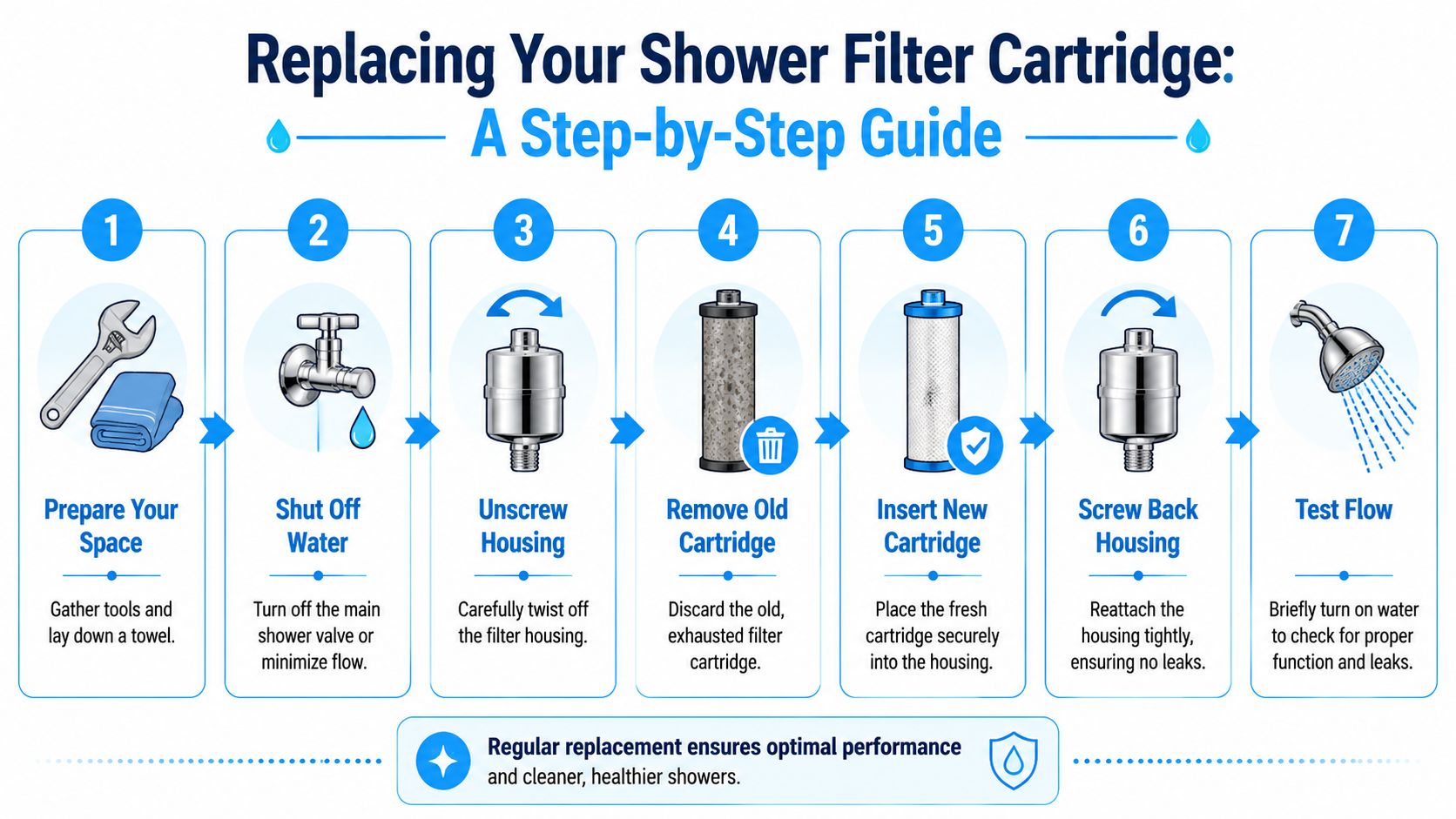
Replacing a cartridge is usually a straightforward plumbing task, but rushing the seal inspection creates most avoidable leaks. Put a towel under the housing before you begin, and keep the replacement cartridge, a wrench, and food-grade silicone grease nearby.
- Prepare the work area. Remove loose items from the shower and place the towel under the connection.
- Stop or minimize flow. Close the shower valve or reduce water flow so the housing isn't pressurized.
- Open the housing. Unscrew the canister carefully. Use a wrench only where the manufacturer permits it, because excessive force can damage plastic threads.
- Remove the old cartridge. Note its orientation before discarding it. Some cartridges have a defined inlet and outlet.
- Inspect the seals. Clean the O-ring and groove. Replace a cracked, flattened, or brittle seal rather than trying to compensate with extra tightening.
- Install the fresh cartridge. Seat it firmly in the correct direction, ensuring it isn't tilted or obstructing the outlet.
- Reassemble and test. Apply a thin film of food-grade silicone grease to the O-ring, hand-tighten the housing, then turn on the water slowly and check every joint.
Flush a new cartridge according to the manufacturer's instructions. Initial carbon fines can make the water look gray or produce temporary specks, and flushing helps clear them before normal showering. Periodically wipe the housing and inspect the threaded connections, especially if the bathroom has visible sediment.
For broader installation and maintenance guidance, the Water Filter Advisor advice library provides additional filter-care resources.
Use testing when the result matters. A simple chlorine test can confirm whether a fresh cartridge is performing as expected, while repeated odor or pressure problems may indicate a plumbing restriction rather than exhausted media.
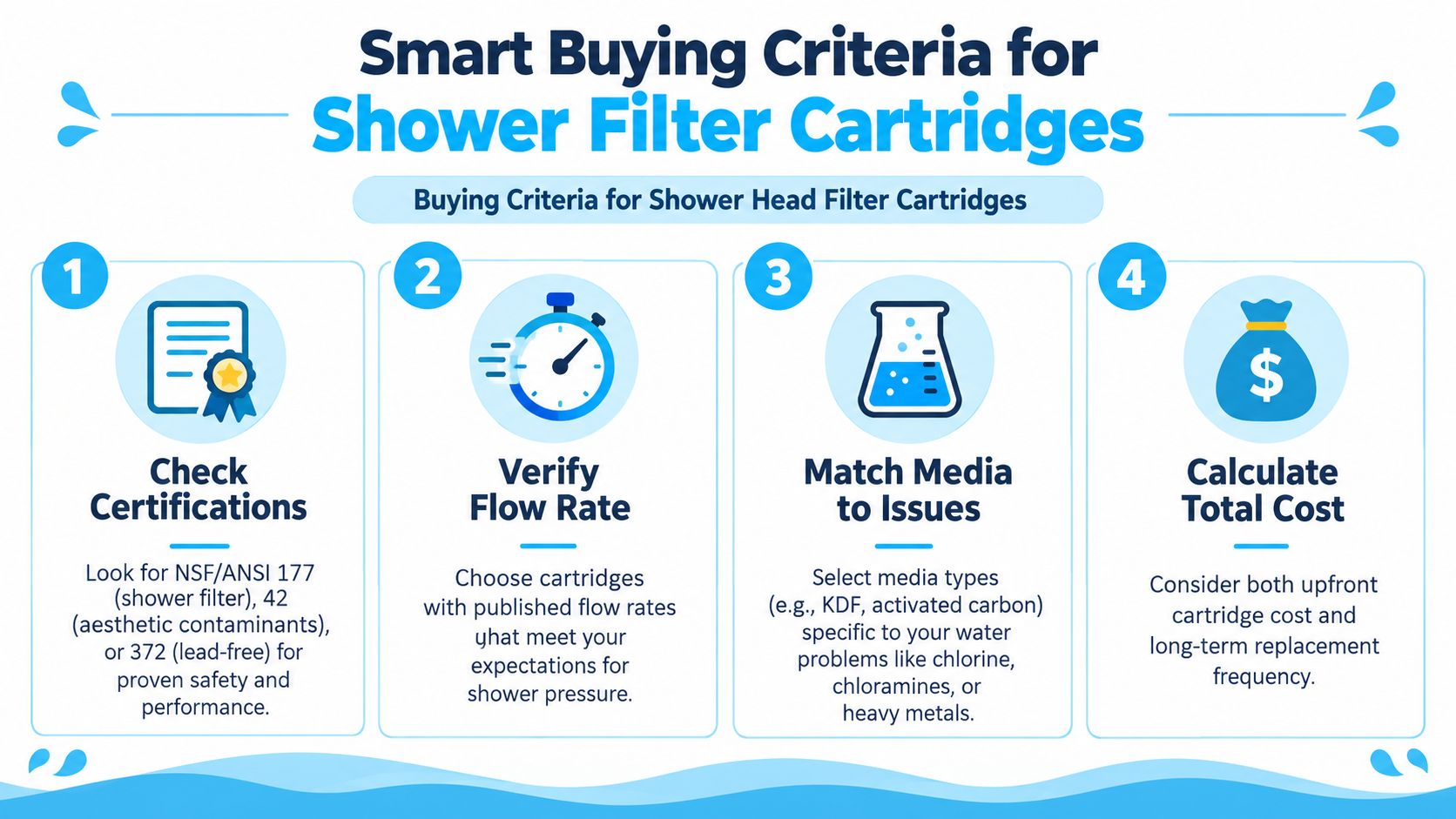
Buying Criteria for Shower Head Filter Cartridges
Buy the cartridge for your water, not for the largest stage count printed on the package. A cartridge with a clearly identified media bed, a published flow rating, and verifiable testing is usually a safer choice than one that lists numerous unnamed layers.
Start with certification and test conditions
NSF/ANSI 177 is the key shower-filter standard for free available chlorine reduction. Some products may also reference NSF/ANSI 42 for aesthetic contaminants or NSF/ANSI 372 for lead-free material requirements, but each designation addresses a different issue. Read the actual certification scope rather than assuming one certification covers every contaminant.
A useful performance sheet pairs a reduction result with operating conditions. One independently published sheet rated a cartridge at 2.5 gal/min, or 9.46 L/min, at 80 psi, while reporting an average 94.8% free-chlorine reduction under NSF/ANSI 177 test conditions. The standard's minimum pass criterion was at least 50% reduction at 2 mg/L influent free available chlorine (performance sheet).
Use a practical buying checklist
- Identify the target contaminant: Decide whether the problem is free chlorine, chloramine, sediment, odor, or selected metals.
- Confirm physical fit: Check thread compatibility, housing dimensions, cartridge orientation, and replacement availability.
- Verify flow performance: Compare the rated GPM and inlet pressure with your shower's expected pressure.
- Review certification documents: Confirm what was tested, under which standard, and whether the claim applies to free chlorine or another substance.
- Calculate ownership cost: Include the replacement cartridge price, shipping, and how often your household is likely to replace it.
The EPA's drinking-water rules set a Maximum Residual Disinfectant Level of 4.0 mg/L for chlorine and 4.0 mg/L for chloramines (EPA disinfectant limits). That regulatory threshold doesn't tell you which cartridge to buy, but it explains why disinfectant chemistry is relevant. EPA compliance also uses measurements over time, rather than relying on a single snapshot, as described in the federal rule (EPA compliance rule).
Troubleshooting Common Shower Head Filter Cartridge Problems
Low pressure doesn't always mean the cartridge has reached the end of its life. First check the showerhead screen, inlet washer, sediment pre-filter, and housing for blockage. A new cartridge may also need flushing before it reaches normal flow.
Discolored water after installation often comes from carbon fines or disturbed sediment. Flush the cartridge according to the product instructions, then inspect the housing if the discoloration persists. A strange odor can point to exhausted media, stagnant water, or a water-supply issue rather than a defective cartridge.
Reduced chlorine removal deserves a chemistry check. Testing shows that many ordinary carbon and KDF cartridges struggle with chloramine, while catalytic carbon and ascorbic-acid media provide more consistent chloramine reduction (chloramine testing and review). If your utility uses chloramine, replacing a standard carbon cartridge with the same design may repeat the problem.
Conclusion and Next Steps for Filter Cartridge Care
A dependable shower head filter cartridge starts with diagnosis. Identify the disinfectant in your water, choose media suited to that chemistry, match the flow rating to your shower, and track household usage rather than relying on a generic replacement interval. Heavy use, sediment, and demanding water chemistry can shorten cartridge life and increase replacement costs.
Protect performance with routine care. Record the installation date, flush each new cartridge, inspect O-rings, clean the housing, and replace the media before odor or pressure problems become severe. If hardness is the main concern, a shower cartridge cannot replace a whole-house softener or conditioner.
Water Filter Advisor provides consumer guidance on shower, whole-house, under-sink, faucet, refrigerator, and portable filtration. Its material covers cartridge maintenance, media selection, certifications, and water testing, helping readers compare options based on performance rather than packaging claims.
Use the maintenance and buying guidance to choose a compatible cartridge, set a changeout schedule based on actual use and water conditions, and avoid paying for media that does not match your water.
- September 7, 2026
- Uncategorized
