You’re probably here because your water is doing at least one annoying thing every day.
Maybe the shower smells a little like a pool. Maybe your coffee tastes flat even when the beans are good. Maybe new glasses come out of the dishwasher with spots, or your faucets keep collecting crusty buildup. And even when the water looks clear, you still wonder what’s riding along in it when your family drinks, cooks, showers, and washes clothes.
That’s where an affordable whole house water filter starts to make sense. Instead of treating just one sink, it treats the water as it enters the home, so the kitchen tap, shower, laundry, and bathroom all benefit. The smart way to shop, though, isn’t by sticker price alone. A filter that looks cheap on day one can get expensive fast once replacement cartridges, service, and pressure problems show up.
Why Your Tap Water Needs an Upgrade
You notice it on an ordinary Tuesday. The kids fill water glasses at the sink. The shower leaves your skin feeling tight. The coffee tastes a little off, even though you bought the good beans. None of those problems feels dramatic on its own, but together they are a sign that the water coming into your house is doing more than you want.
That matters because your plumbing works like your home’s circulatory system. If the incoming water carries chlorine, sediment, hardness minerals, or other unwanted material, those issues do not stay in one place. They show up in the shower, on clean laundry, inside appliances, and on the dishes you put back in the cabinet.
The whole-home difference
A pitcher filter helps with one glass at a time. A faucet filter helps at one sink. A whole-house system treats water at the entry point, so the water reaching your bathrooms, kitchen, laundry room, and water-using appliances starts cleaner from the start.
That wider coverage changes the value calculation. You are not just paying for better-tasting drinking water. You may also be reducing chlorine smell during showers, cutting sediment that can clog fixtures, and slowing the scale buildup that makes water heaters and dishwashers work harder over time. If you want more plain-English guidance on comparing systems, the articles in this home water filtration advice library can help.
Practical rule: If the problem shows up in more than one room, treating one tap usually leaves the bigger problem in place.
Seen problems and unseen problems
Some water issues announce themselves right away. Rust-colored stains, white crust on faucets, cloudy glasses, rotten-egg odor, or grit in the tub are hard to ignore.
Other issues are quieter. Chlorine can affect taste and smell without making water look dirty. Dissolved minerals can shorten appliance life even when the water looks clear. That is one reason shoppers get confused. Clear water is not always problem-free water.
You will also see technical terms that sound more important than they really are. One common example is TDS, or total dissolved solids. TDS is a broad measurement, not a safety verdict. It can help you understand how much material is dissolved in your water, but it does not tell you which substances are present or whether a whole-house filter alone is the right fix. For a simple walkthrough, read What Is TDS in Water.
Upgrade the water, not just the purchase price
A lot of homeowners start with the question, “What is the cheapest system I can buy?” That is understandable, but it is not the best starting point.
A better question is, “What will this system cost me to own?” A low-priced unit can act like an inexpensive printer that burns through costly ink. The tank or housing looks affordable on day one, then the replacement cartridges, service visits, pressure loss, or extra pre-filters raise the actual cost month after month. In other words, the tap water may need an upgrade, but your buying strategy does too.
That is why an affordable whole-house water filter should be judged by what it solves across the house and what it costs to keep running over several years, not just by the number on the box.
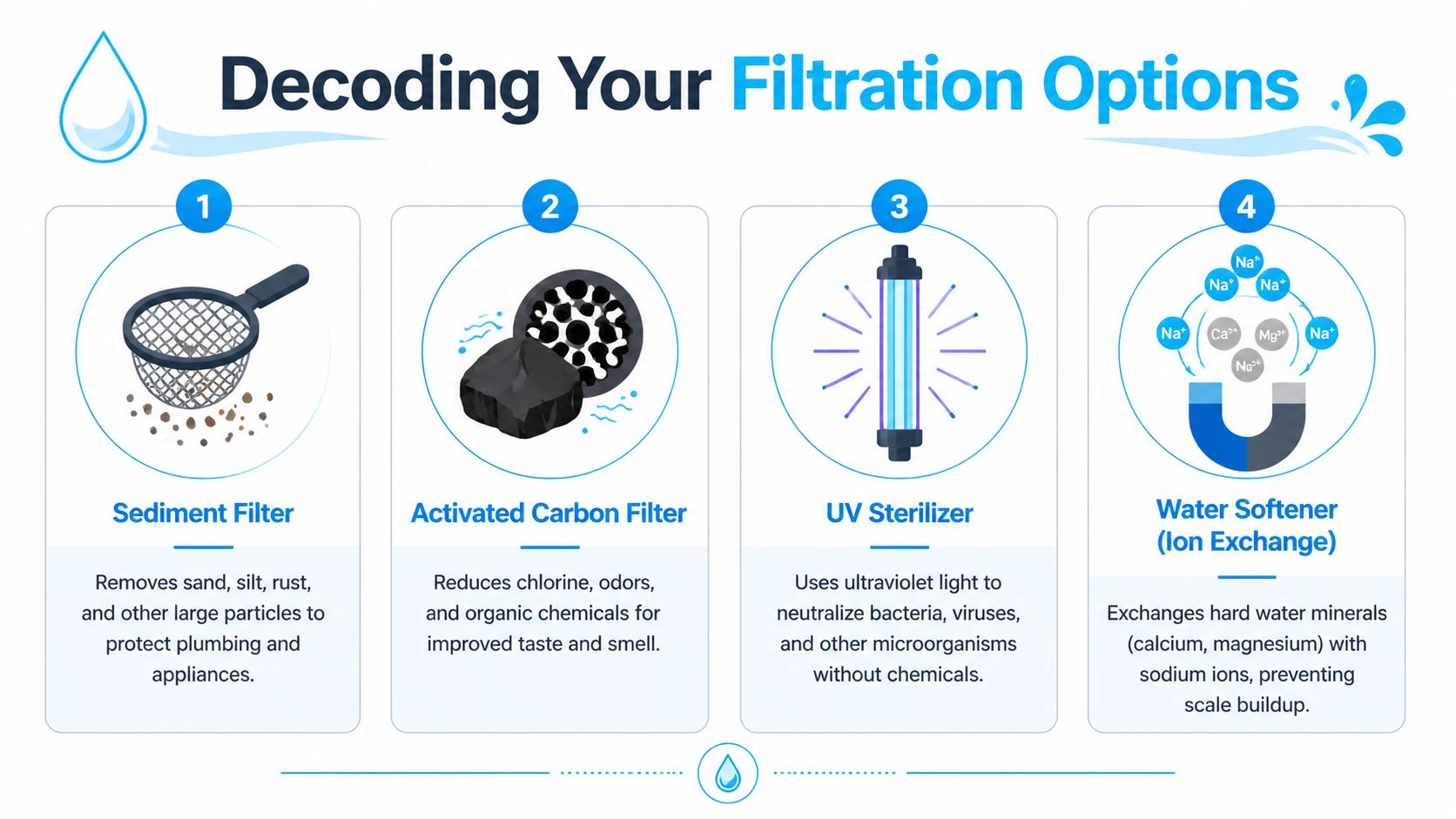
Decoding Your Filtration Options
Water filter shopping gets messy because brands love stacking buzzwords on the box. Multi-stage. Catalytic. KDF. Anti-scale. Advanced media. Most homeowners don’t need a chemistry degree. They need a plain-language translation.
Here’s the simplest way to think about it. Different filter types do different jobs. One catches grit. Another absorbs chlorine and odors. Another tackles hardness. Another deals with microbes. A good whole-house setup is often a team, not a single magic tank.
The bouncer, the sponge, and the specialist
A sediment filter is the bouncer at the door. It stops bigger particles before they get inside the system. Sand, silt, rust, and debris are its main targets. Sediment doesn’t just look bad; it can clog other media and wear down appliances.
An activated carbon filter is more like a sponge. It grabs chlorine, bad tastes, odors, and many organic chemicals. This is usually the core technology for city water homes. If your complaint is “my water smells like a swimming pool,” carbon is usually where the conversation starts.
A water softener isn’t really a filter in the usual sense. It changes the water by swapping hardness minerals for sodium ions. That helps prevent scale buildup on pipes, water heaters, shower doors, and fixtures. If your main complaint is crusty residue and spotted dishes, filtration alone may not be enough.
A UV sterilizer uses light rather than media. It’s useful when microbial control matters, especially for some well-water homes. It doesn’t remove sediment or chlorine. It handles microorganisms, so it’s usually an add-on, not a stand-alone answer.
Where catalytic carbon and KDF fit
Some systems use upgraded media instead of plain carbon. One example is the SpringWell CF, which uses a 4-stage filtration design with media such as catalytic carbon and KDF to increase contact time between water and the filter bed. That setup supports over 95% reduction in chlorine and THMs at a 12 GPM flow rate with minimal pressure drop, based on the product specifications and performance details from SpringWell’s whole-house filter page.
That “contact time” language trips people up, so here’s the plain version. Water needs enough time touching the media for the media to do its job. If water blasts through too fast, performance can drop. Better designs slow and distribute the water inside the tank without making your shower weak.
Better media can matter as much as extra stages. A two-stage system with the right media can outperform a crowded stack of mediocre cartridges.
Filter types compared
| Filter Type | Primary Target | Best For | Average Lifespan |
|---|---|---|---|
| Sediment filter | Sand, silt, rust, debris | Homes with visible particles or as a prefilter | Usually shorter-term and replaced more often |
| Activated carbon filter | Chlorine, taste, odor, many chemicals | Municipal water homes | Often long-life in tank systems, shorter in cartridges |
| UV sterilizer | Bacteria, viruses, microorganisms | Well water or homes needing microbial control | Ongoing bulb maintenance |
| Water softener (ion exchange) | Hardness minerals | Scale, spots, and hard-water buildup | Resin-based service life varies with use and water quality |
For a deeper library of plain-English buying help, Water Filter Advisor’s advice section is a handy place to compare filter types without getting buried in marketing language.
Matching the technology to the problem
Don’t start with brands. Start with symptoms and test results.
- Chlorine smell and bad taste: Carbon filtration is usually the lead player.
- Visible grit or cloudy water: Add sediment filtration first, so downstream media doesn’t get overloaded.
- Scale and white crust on fixtures: You’re in softener or conditioner territory.
- Iron staining or rotten-egg odor: You likely need specialty media, not just a standard carbon tank.
- Microbial worries on well water: UV may belong in the system after proper prefiltration.
A lot of disappointment comes from buying a good filter for the wrong problem. The hardware may be fine. The match is what fails.
Sizing Your System for Perfect Pressure and Flow
People spend hours comparing contaminants and almost no time checking flow rate. Then the system gets installed and the shower pressure tanks every time the washing machine starts.
That’s a sizing problem, not a filtration problem.
What GPM and PSI actually mean
GPM means gallons per minute. Think of it as how much water your system can deliver during busy moments, not just over a full day. If two showers, a toilet refill, and the dishwasher overlap, your filter has to keep up.
PSI means pounds per square inch. That’s your water pressure. You don’t need to become an engineer here. You just need to know that a filter can be “effective” on paper and still annoy you if it restricts flow too much.
Some affordable whole-house systems are built to avoid that tradeoff. For example, certain tank-style units are designed to maintain strong pressure with very low pressure drop, while running enough flow for multi-bathroom homes. That’s a big reason they feel better in daily life than undersized cartridge setups.
A simple way to estimate your home’s demand
Use your busiest realistic moment. Don’t overthink the whole day.
Make a quick checklist:
- Count bathrooms: More bathrooms usually means more chances for overlapping use.
- Note simultaneous fixtures: Two showers at once changes the math fast.
- Add utility loads: Washing machines and dishwashers matter if they often run during morning or evening routines.
- Look at family habits: A house with one bathroom can still need stronger flow if everyone gets ready at once.
A lot of affordable whole-house systems operate in the range that works well for small to larger homes. The right fit depends less on square footage and more on how many water events happen at the same time.
If your current pressure already feels borderline, don’t buy the smallest filter your budget can survive. Buy the smallest one that can still handle your busiest hour.
Why homeowners get this wrong
Many buyers see “whole-house” and assume it will naturally support the whole house. Not always. Some entry-level systems are better suited to lighter demand. Others are fine on paper but become restrictive as cartridges load up with sediment.
That’s especially important if your home also relies on a booster setup, a well pump, or pressure-sensitive plumbing. In those situations, general system health matters along with filtration. If you’re troubleshooting weak performance at the same time, a practical guide to pump repair, service, and maintenance can help you separate a filtration bottleneck from a pump issue.
Pressure problems usually look like this
- Morning shower drops off: The filter is too small for overlapping use.
- Water starts strong, then weakens over time: The media or cartridge may be loading with sediment.
- One bathroom is fine, two is not: The service flow rate likely doesn’t match peak demand.
- Pressure was already poor before the filter: The problem may be upstream of the filter.
A good affordable whole house water filter should disappear into the background. You notice the cleaner water, not the system struggling to keep up.
Calculating the True Cost of Ownership
A filter can look like a bargain on checkout day and still turn into the pricier choice by year three.
That happens because the price tag only shows the entry fee. The important number to care about is total cost of ownership, or TCO. A whole-house filter works more like a car than a pitcher filter. You do not judge a car by the down payment alone. You also look at fuel, maintenance, repairs, and how long it stays useful.

Four costs that decide whether a system is affordable
Start with purchase price. That is the number every seller puts front and center. Entry-level cartridge systems usually win this round because the box costs less on day one.
Then look at installation. Some setups are simple enough for a confident DIY homeowner with basic plumbing tools. Others need a plumber, shutoff planning, fittings, and enough wall space to service the unit later. That can change the first-year cost fast, even before the filter has cleaned a gallon.
Third is replacement cost. Many low-priced systems lose their advantage concerning this aspect. A cheap housing with expensive cartridges is a little like buying an inexpensive printer and paying a premium for ink every few months.
Fourth is ongoing effort. Time counts. If you need to track replacement dates, order parts often, open messy housings, and troubleshoot pressure drop, that labor belongs in the budget even if no invoice shows it.
The maintenance trap
A lot of affordable systems stay affordable only if you stop the math too early.
Budget cartridge models often ask for regular replacement filters. Mid-range tank systems usually cost more upfront but can go much longer before the media needs attention. Over a five-year stretch, that difference can flip the ranking. The cheaper system at checkout can end up costing more to own.
That is the core TCO idea in plain English. Do not compare filters by sticker price alone. Compare what they cost to keep running for the years you plan to live with them.
Wallet test: If the system is cheap to buy but expensive to keep fed with cartridges, it is not a low-cost system. It is a delayed-cost system.
A plain-English five-year comparison
Here are two common paths.
Path one: lower upfront cost. You buy a cartridge-based system because the initial bill feels manageable. Installation may be easier too. But replacements keep showing up like subscription charges. One purchase turns into a string of purchases.
Path two: higher upfront cost. You spend more on a tank-style system. That can sting at first. But if the media lasts much longer and maintenance is lighter, you may spend less across five years and deal with fewer interruptions.
The easiest way to picture this is to compare it to light bulbs. A cheap bulb costs less today, but if it burns out again and again, the long-life bulb can be the better value even with the higher shelf price.
Here’s a quick visual break if you want a general overview before doing your own math:
What to include in your own TCO math
Use a notebook, phone note, or spreadsheet. Then total these pieces over five years:
- System price: The cost of the unit itself.
- Install cost: DIY materials or plumber labor.
- Replacement schedule: Every cartridge, prefilter, or media refill the system will need.
- Maintenance effort: How often you will be servicing it, cleaning housings, or ordering parts.
- Length of ownership: A long-term homeowner and a renter may value the same filter very differently.
If a seller does not make replacement timing and replacement part pricing easy to find, treat that as a warning sign.
A smarter way to shop
Ask each brand the same set of questions so you can compare apples to apples.
- What part needs replacing first?
- How often does that happen in normal household use?
- What does each replacement cost?
- Does the quoted lifespan assume ideal water conditions?
- How much maintenance does the homeowner handle personally?
Clear answers usually point to a company that expects you to keep the system for years. Vague answers often hide the long-term bill.
An affordable whole house water filter is the one that stays reasonable to own after the first install, the first cartridge change, and the second year of use. That is why TCO matters more than the lowest number on the product page.
How to Read Certifications and Avoid Marketing Hype
The water filter industry loves broad promises. “Removes contaminants.” “Delivers pure water.” “Advanced protection.” Those phrases sound reassuring, but they don’t tell you what was tested, what was reduced, or whether anyone outside the brand checked the claim.
That’s where certifications matter.

What the common NSF standards mean
NSF/ANSI 42 usually relates to aesthetic issues such as chlorine, taste, and odor. If your goal is making water smell and taste better, this is a meaningful standard to look for.
NSF/ANSI 53 is more important when a brand is talking about health-related contaminants like lead or PFAS. Here, shoppers should slow down and read carefully, because many products imply broad protection without carrying the certification that supports the claim.
Some systems are also marketed around emerging contaminants. That’s not automatically bad. It just means the paperwork matters even more.
Why the certification gap matters
Affordable systems are starting to address newer concerns, but the gap is still big. As of 2026, only 10% to 15% of sub-$1,000 systems carry NSF/ANSI 53 certification for health contaminants like lead or PFAS, compared with over 70% of higher-priced systems. That matters more now because EPA PFAS regulations affect over 100 million US households, according to the contaminant and certification overview on Aquasana’s whole-house water filter page.
That doesn’t mean every affordable system is weak. It means you can’t assume that chlorine reduction and health-contaminant reduction are the same thing. They aren’t.
A filter can be good at taste and odor and still not be the right answer for lead or PFAS.
Marketing phrases worth side-eyeing
Use your baloney detector when you see these:
- “Removes all contaminants” because no system removes everything.
- “Lab tested” without saying what was tested, under which standard, or by whom.
- “Equivalent to certified” because equivalent is not certified.
- “Military-grade,” “space-age,” or “premium media” when there’s no performance document behind the wording.
What to check before you buy
A careful buyer looks for evidence that’s specific.
- Named certifications: Not “meets standards,” but actual NSF/ANSI numbers.
- Contaminant list: The system should say what it targets.
- Test conditions: Flow rate and operating conditions affect real performance.
- Replacement requirements: Certification only matters if the filter is maintained properly.
This is one place where spending a little more can buy clarity, not just hardware. A system that clearly states what it does is easier to trust than one that relies on glowing adjectives.
Budget Breakdowns Three Real-World Scenarios
Advice gets easier when you can see yourself in it. Here are three common households and how the numbers and tradeoffs play out when they shop for an affordable whole house water filter.
The urban renters
They live in a smaller home with city water. Their biggest complaints are chlorine smell and bad-tasting tap water. They don’t want a major install, and they may move before long, so portability matters almost as much as filtration.
A cartridge-based whole-house option can fit this situation. Systems like the RKIN CBS 5 have a relatively low upfront cost of about $776 and are DIY-friendly, according to this whole-house filter review roundup. That kind of setup works best when the goal is accessibility and simple installation.
The catch is the annual replacement cost of $120 to $300. For renters, that may still be acceptable because the lower commitment and easier install matter more than perfect long-term economics. They’re buying flexibility.
Renters often value “easy to install and easy to leave behind” more than the lowest five-year cost.
The suburban family
They own their home, have multiple bathrooms, and want cleaner water throughout the house without turning filter maintenance into a hobby. They care about taste, odor, skin comfort, and plumbing protection.
At this point, a budget tank system usually starts making more sense. The SoftPro Upflow Carbon Filter starts at $847+ and can process 600,000 to 1,000,000 gallons before media replacement is needed, based on the same review source linked above. That’s a very different ownership profile from a cartridge setup that needs frequent replacements.
For this family, the mid-range route often feels better in daily life. Fewer maintenance interruptions. Better long-term value. Less chance of replacement fatigue. They spend more upfront but often spend less emotional energy and less money over time.
The rural homesteaders
Their water comes from a private well. They’re dealing with sediment first, and maybe also iron staining or sulfur smell. Their needs are less about “nice taste” and more about protecting the rest of the system from rough water.
A cartridge or sediment-heavy setup can make sense at the front end here, especially when high sediment is the main enemy. The same RKIN category is useful for homes where easy access to sediment control matters. If they own the home and plan to stay, though, they often benefit from pairing sediment prefiltration with a longer-life primary treatment system instead of living forever on replacement cartridges.
The decision here depends on what the water test shows. For some well homes, sediment is only the first chapter. Iron, sulfur, and specialty treatment can drive the final design.
What each household is really choosing
These three homes aren’t just choosing products. They’re choosing a maintenance lifestyle.
- Urban renters pick convenience and low commitment.
- Suburban families pick lower long-term hassle.
- Rural well users pick problem-specific treatment, often starting with sediment protection.
If your home ownership horizon is short, a lower-entry cartridge system can be rational even if the long-term math is weaker. If you plan to stay put, the budget tank path often looks better because it spreads the cost over much longer service life.
The common mistake is copying someone else’s ideal setup. The best affordable whole house water filter is the one that matches your water, your home, and how long you expect to live with the decision.
Frequently Asked Affordability Questions
Is a whole-house filter cheaper than bottled water
For many households, it can be more cost-effective over time, especially because it treats water for the whole home instead of just drinking water. I’d still compare based on your actual habits rather than assuming a universal answer. The key advantage is that a whole-house system also protects plumbing, fixtures, and appliances, which bottled water can’t do.
Does a cheap system always save money upfront
At checkout, yes. Over time, not always. Systems with frequent cartridge changes can keep asking for money long after the initial purchase. A more durable setup often costs more on day one and less over the ownership period.
Should renters avoid whole-house filtration
Not necessarily. Renters just need to weigh portability and installation effort more heavily. If moving is likely, a DIY-friendly cartridge system may be the more practical choice even if it isn’t the strongest long-term value on paper.
Is professional installation always worth paying for
It depends on the system and your plumbing confidence. Some setups are straightforward, while others are better left to a pro. If the home has older plumbing, pressure issues, or a pump-related setup, paying for clean installation can prevent bigger headaches later.
Can a whole-house filter help appliances last longer
Often, yes. Cleaner water can reduce sediment exposure and help limit the wear that rough water causes inside the home. The exact benefit depends on what’s in your water and whether the chosen system targets that issue.
What’s the safest way to choose without overspending
Start with a water test. Match the filter type to the problem. Then compare total ownership cost, not just the sale price. If a brand can’t explain replacement needs clearly, move on.
If you want help comparing systems, understanding certifications, or figuring out which setup fits your budget and water source, Water Filter Advisor is a solid place to keep researching. It’s especially useful when you want practical guidance instead of marketing fluff, whether you’re choosing your first whole-house filter or trying to avoid a costly upgrade mistake.
- April 25, 2026
- Uncategorized
