So, you're standing in the water filter aisle (or scrolling through endless web pages), and you’re faced with a choice: reverse osmosis water filter vs carbon filter. It sounds complicated, but it all boils down to one simple question: What kind of superhero does your tap water need?
Are you looking for an all-powerful purifier that zaps nearly everything—from heavy metals to dissolved solids and fluoride—out of existence? Then a Reverse Osmosis (RO) system is your champion. But if you just want to improve the taste and smell of your city tap water by kicking chlorine to the curb, a simple carbon filter is a smart, budget-friendly sidekick.
Understanding the Core Differences
Choosing the right filter for your home shouldn't feel like a chemistry exam. Once you grasp what each technology is built for, the decision gets a lot easier. It’s like picking between a sledgehammer and a scalpel. Both are great tools, but for very different jobs.
Think of a carbon filter as a specialist—a taste-and-smell artist. Its main gig is to make your water more enjoyable by grabbing onto chemicals like chlorine. An RO system, on the other hand, is the all-in-one powerhouse. It's designed for serious purification, removing a much, much wider range of contaminants and giving you water that’s close to pure H₂O.
RO Filter vs Carbon Filter at a Glance
For a quick snapshot, let's lay out the key differences side-by-side. This table really highlights how a reverse osmosis water filter vs carbon filter compares on the things that matter most to homeowners.
| Feature | Reverse Osmosis (RO) Filter | Carbon Filter |
|---|---|---|
| Primary Function | Water purification (removes up to 99% of contaminants) | Water improvement (removes taste & odor impurities) |
| Key Contaminants Removed | Heavy metals, fluoride, dissolved solids, salts, bacteria | Chlorine, pesticides, VOCs, sediment |
| Installation Complexity | More involved; usually needs under-sink plumbing | Simple; available as pitchers, faucet mounts, or under-sink |
| Initial Cost | Higher | Lower |
| Maintenance | Multiple filters and a membrane replaced periodically | Single cartridge replaced every few months |
| Best For | Households wanting the highest purity for health concerns | Improving the taste and smell of city tap water |
After seeing the comparison, it’s clear they serve two distinct needs.
What This Means for Your Home
At the end of the day, the right filter for you depends on where your water comes from and what your standards are. If you’re on city water that’s generally safe but tastes like a swimming pool because of the chlorine, a carbon filter is an excellent, low-cost fix. It's a no-fuss way to get crisp, clean-tasting water right from your faucet.
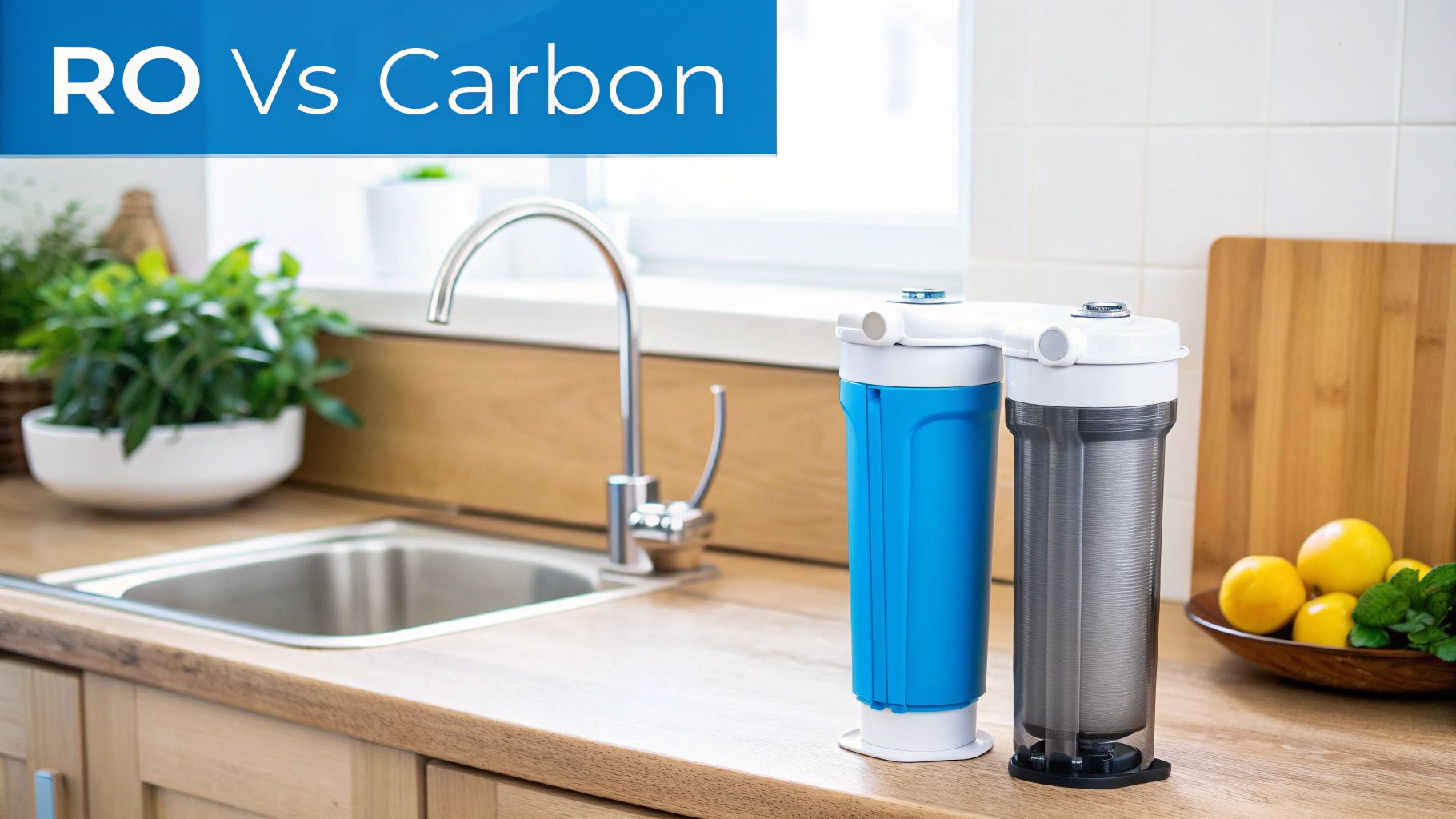
On the flip side, if you're using well water or are worried about specific contaminants like lead, arsenic, or nitrates, an RO system offers real peace of mind.
An RO system offers a robust defense against a vast array of unseen contaminants, making it an investment in your family's long-term health, not just a solution for better-tasting water.
This basic difference—purification vs. improvement—is the most important thing to remember in the reverse osmosis water filter vs carbon filter debate. As we dig deeper, you'll see how this single distinction affects everything from cost and upkeep to the exact contaminants each system can tackle.
How These Water Filtration Technologies Work
To really settle the reverse osmosis water filter vs carbon filter debate, you have to get under the hood and see how they actually work. They both give you cleaner water, but their approaches are completely different—think a high-tech security gate versus a super-powered sponge. One physically blocks junk from getting through, while the other uses a chemical attraction to grab and hold onto it.
Reverse Osmosis: The Gatekeeper Method
Picture a bouncer at an exclusive club with a list that's impossible to get on. That’s pretty much a reverse osmosis (RO) system. The star of the show is a semipermeable membrane, which is a fancy way of saying it has microscopic holes just barely bigger than a water molecule.
Your home's water pressure does all the work, pushing tap water up against this membrane. The tiny water (H₂O) molecules squeeze through, but nearly everything else gets stopped cold and physically blocked. We’re talking dissolved solids, salts, heavy metals like lead and arsenic, fluoride—even some microorganisms. The good, purified water collects on one side, while all the rejected gunk gets flushed down the drain as wastewater.
This brute-force physical separation is exactly why so many homeowners who want the purest water possible turn to RO. It's a full-on purification process, not just a simple filter.
It’s no surprise that RO systems are a huge force in the home water filtration market. The RO segment grabs a massive 38.5% of the global market share, and that's because it's proven to remove up to 99% of dissolved salts, lead, bacteria, arsenic, and other nasty stuff. For families, that kind of performance provides real peace of mind. If you want to dive deeper, you can explore more insights on water filter market trends.
Basically, a reverse osmosis system breaks your tap water down on a molecular level, separating the pure H₂O from almost everything else mixed in. It's the closest thing to getting bottled-water quality straight from your tap.
Carbon Filtration: The Sponge Method
Okay, now let's switch over to carbon filters. If RO is the bouncer, then a carbon filter is like a giant, magnetic sponge. The magic here is a process called adsorption, where impurities literally stick to the filter material instead of being physically strained out.
These filters are packed with activated carbon, which usually comes from something like coconut shells. The carbon is specially treated to give it a ridiculously porous structure and a massive internal surface area. To put it in perspective, a single gram of this stuff can have the same surface area as a football field.
As water flows through, things like chlorine, pesticides, herbicides, and volatile organic compounds (VOCs) are chemically drawn to the carbon's surface and trapped. This is why carbon filters are rockstars at making city water taste and smell better—they're exceptional at pulling out the chlorine that's added for disinfection.
Here’s a quick look at how the adsorption process works:
- Massive Surface Area: All those pores in the activated carbon create countless spots for contaminants to latch onto.
- Chemical Attraction: Certain chemicals are naturally attracted to the carbon surface.
- Contaminant Trapping: The bad stuff sticks to the carbon, and cleaner water flows on through.
This method is fantastic for specific chemical contaminants, but it won't touch dissolved solids, salts, or most heavy metals. It's a targeted tool for improving aesthetics, not a comprehensive purification system, which is a key difference when you’re comparing a reverse osmosis water filter vs a carbon filter.
Contaminant Removal Side by Side
When you put a reverse osmosis filter and a carbon filter in a head-to-head matchup, the real difference is what each one actually pulls out of your water. This isn’t a simple question of which is “better.” It’s about picking the right tool for the job.
Think of it this way: one is a broad-spectrum solution designed to tackle nearly everything, while the other is a specialized treatment for the most common issues that affect taste and smell. The distinction is pretty stark. RO systems are built for maximum purification, while carbon filters are masters of targeted chemical adsorption.
The Heavy Hitters: Heavy Metals and Dissolved Solids
Let's start with the most serious contaminants, like heavy metals and total dissolved solids (TDS). This is where the gap between the two technologies is widest.
A reverse osmosis system is the undisputed champ here. Its semipermeable membrane is the key—it physically blocks particles down to an incredible .0001 microns. This brute-force approach allows it to remove a long list of nasty stuff, including:
- Lead: A powerful neurotoxin that can leach from old pipes.
- Arsenic: A common and dangerous contaminant, especially in well water.
- Fluoride: Intentionally added to many municipal water supplies.
- Nitrates & Sulfates: Often the result of agricultural runoff seeping into groundwater.
- Total Dissolved Solids (TDS): This covers all the salts, minerals, and other dissolved inorganic compounds that a carbon filter just can't touch.
A standard carbon filter, on the other hand, just wasn't designed for this kind of work. It can't remove dissolved solids, salts, or the vast majority of heavy metals. While some specialized carbon block filters might reduce lead, they don't come close to the comprehensive removal you get from an RO system.
While a carbon filter makes water taste great, only a reverse osmosis system can reliably remove nitrates and dissolved salts. This is a critical distinction for anyone on well water or in an area with known contamination issues.
Aesthetics: Chlorine, Taste, and Odor
Now, let's talk about the things you can actually taste and smell. This is where the carbon filter really gets to show off and why it's the perfect solution for so many people.
The main reason city water tastes "off" is chlorine, which is added as a disinfectant. An activated carbon filter is an absolute powerhouse at adsorbing chlorine. As water passes through the filter media, the carbon's huge surface area snags and holds onto chlorine molecules, instantly getting rid of that "swimming pool" taste and smell.
Carbon filters also do a fantastic job of removing:
- Volatile Organic Compounds (VOCs): Nasty industrial chemicals like pesticides and herbicides.
- Chloramines: A disinfectant sometimes used as an alternative to chlorine.
- Bad Odors: Caused by various organic compounds that find their way into the water supply.
Even though most RO systems have a carbon pre-filter to protect the sensitive membrane, the carbon filter's main job in any system is improving taste and odor.
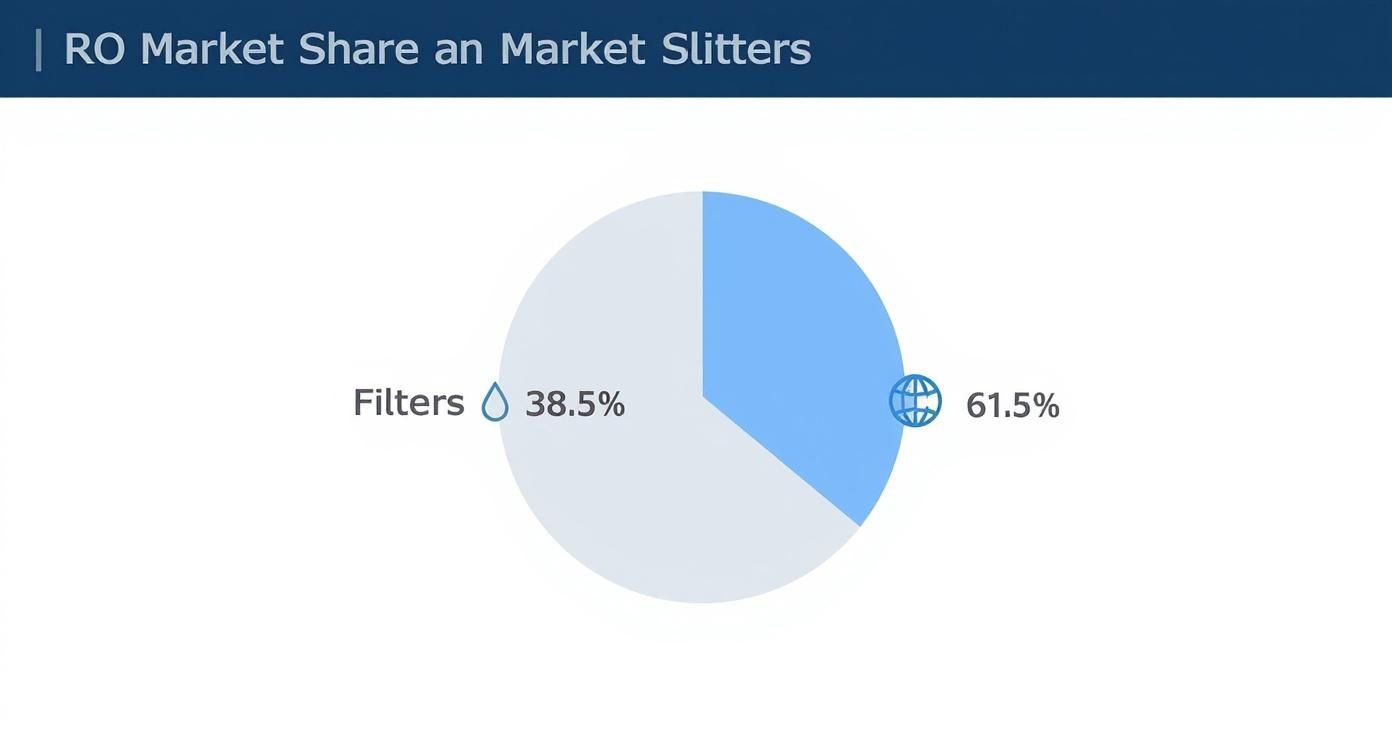
This infographic shows just how popular RO systems are, holding a massive 38.5% of the market. It really highlights that many consumers are looking for that deeper level of purification that goes far beyond just making the water taste better.
To break it down even further, here's a look at how each filter type stacks up against common contaminants.
Contaminant Removal Efficiency Comparison
| Contaminant Type | Reverse Osmosis Filter | Carbon Filter |
|---|---|---|
| Heavy Metals (Lead, Arsenic) | Excellent (95-99% removal) | Poor to Fair (Specialized filters may reduce lead) |
| Total Dissolved Solids (TDS) | Excellent (90-99% removal) | No Removal |
| Chlorine & Chloramine | Good to Excellent (Often has a carbon stage) | Excellent (Primary function) |
| VOCs & Pesticides | Good to Excellent (Carbon stage handles this) | Excellent (Adsorbs effectively) |
| Fluoride | Excellent (90-97% removal) | No Removal |
| Bacteria & Viruses | Very Good (Physical barrier) | Poor (Can harbor bacteria if not changed) |
| Cysts (Giardia, Crypto) | Excellent (Physical barrier) | Fair to Good (Requires a 0.5-micron rating) |
As you can see, the RO system offers a much broader shield against a wider array of potential threats. The carbon filter is more of a specialist, excelling at the aesthetic issues that plague most tap water.
Microorganisms: Bacteria and Viruses
When we get into biological contaminants like bacteria, cysts, and viruses, the lines can get a little fuzzy, but the RO system still comes out on top.
The pores in an RO membrane are so tiny that they physically block most bacteria and viruses from passing through, making it a very effective line of defense. It's worth remembering, though, that most residential RO systems aren't officially certified as microbiological purifiers.
Carbon filters, for the most part, do not remove bacteria or viruses. Worse, an old carbon filter that isn't changed on schedule can actually become a breeding ground for bacteria. Some high-end carbon block filters with a very fine micron rating (like 0.5 microns) can remove larger cysts like Giardia and Cryptosporidium, but they won't stop smaller bacteria or any viruses. For biologically unsafe water, a carbon filter just isn't the right choice.
Because they're so good at fixing the number one complaint about tap water—the taste—carbon filters are incredibly popular. They command a huge share of the market by removing chlorine, sediment, and VOCs, but they can't match the heavy-duty purification of an RO system. You can read the full analysis on the under-sink filter market to dig deeper into the numbers.
Ultimately, the choice comes down to your specific water quality concerns. If you need broad-spectrum protection from a whole host of contaminants, RO is the way to go. If your water is generally safe but just tastes bad, a carbon filter is a simple, effective, and budget-friendly solution.
Comparing Costs, Installation, and Ongoing Maintenance
Beyond just what they remove, the practical side of things—your budget and willingness to do upkeep—is a huge factor in the reverse osmosis water filter vs carbon filter debate. The true cost isn't just the price on the box. You've got to think about installation, filter replacements, and even hidden costs like wastewater. Let's break it down so you can see which system really fits your life and your wallet.
Right off the bat, the initial investment for these two systems is miles apart. Carbon filters are generally much cheaper to get started with, giving you options from simple faucet attachments to more serious under-sink units. An RO system, on the other hand, is a more significant purchase because of its complex, multi-stage setup.
Upfront Purchase and Installation Costs
The financial barrier to entry is probably the clearest difference here. You can pick up a simple under-sink or countertop carbon filter for a pretty low price, often well under $100. Their design is so straightforward that most people can install one themselves in less than an hour with just basic tools.
Reverse osmosis systems are a different story. They typically start in the low hundreds and can climb much higher for high-end models. The installation is also a bigger job. You'll likely need to drill a hole in your countertop for its own special faucet, hook up a drain line to your sink's plumbing, and find space for the storage tank. A confident DIYer can pull it off, but many people just call a plumber, which adds to that initial cost.
- Carbon Filter: Lower upfront cost and a simple, DIY-friendly installation.
- RO System: Higher upfront cost with a more complex installation that might require professional help.
Ongoing Maintenance and Filter Replacement
This is where the long-term cost comparison gets a little more nuanced. Carbon filters are cheap to buy, but you'll be buying replacement cartridges, and those costs can add up. This is especially true for the smaller pitcher or faucet-mounted filters that need to be swapped out pretty frequently.
An RO system’s maintenance is more involved but often more predictable. You’re looking at replacing a few different filters on different schedules:
- Sediment & Carbon Pre-filters: These are the gatekeepers that protect the main membrane. You’ll usually replace them every 6 to 12 months.
- RO Membrane: This is the core of the whole system. It’s a workhorse and typically lasts 2 to 4 years, though this depends heavily on your water quality.
- Carbon Post-filter: This last filter gives the water a final "polish" and gets changed about once a year.
While the total annual cost for RO filter replacements might be higher than for a simple carbon filter, the actual cost per gallon of purified water can be surprisingly competitive when you look at it over the system's entire lifespan.
The Hidden Cost of RO Wastewater
One unique expense tied to RO systems is the wastewater. To keep that powerful membrane from clogging up with all the contaminants it removes, the system has to flush them away. This stream of concentrated gunk goes right down the drain along with a good bit of water. Older, less efficient models were notorious for this, wasting as much as 4 or 5 gallons of water for every single gallon of pure water they produced.
Thankfully, technology has come a long way. Modern RO systems are much more efficient, with many wasting only 1 to 2 gallons for every purified gallon. It will add a small amount to your water bill, but it’s a necessary trade-off for how effectively the system purifies your water.
Thinking beyond just the filters, understanding how water quality affects your home's entire plumbing system can help you dodge future problems. Proper upkeep, for example, can save you from a lot of headaches. You can learn more about how to prevent costly plumbing repairs through regular maintenance. Taking this wider view helps ensure your whole water system stays in great shape.
What's the Best Filter for Your Home?
Alright, let's move past the technical jargon. The real question in the reverse osmosis water filter vs. carbon filter showdown is: which one actually makes sense for your kitchen? The answer depends entirely on where you live, what your water is like, and what you’re trying to fix.
Let's walk through a few real-life situations. See which one sounds most like you.
Scenario 1: The City Apartment Dweller
You live in a city high-rise. The municipal water is technically safe according to the annual reports, but you can’t stand the swimming-pool smell. That chlorine taste ruins your morning coffee and makes a simple glass of water taste… off.
For this, a carbon filter is your best bet. It’s designed specifically to adsorb chemicals like chlorine and other compounds that mess with taste and odor. It’s a simple, affordable fix that gets right to the point without over-complicating things.
- The Main Problem: Gross-tasting and smelling city tap water.
- What You're Targeting: Chlorine, chloramines, and some volatile organic compounds (VOCs).
- The Smart Choice: An under-sink or faucet-mounted carbon filter. It’s cheap, easy to put in, and you'll notice the difference immediately.
Scenario 2: The Rural Family on Well Water
Now, picture a family out in the country with their own private well. Their worries go way beyond just taste. They're concerned about things you can't see or smell—nitrates from nearby farms, naturally occurring heavy metals like arsenic, and even potential bacteria.
Here, a reverse osmosis system isn't just a nice-to-have; it's a critical safety measure. A basic carbon filter won’t touch dissolved solids, heavy metals, or microorganisms. The multi-stage process of an RO system is the only thing that offers the comprehensive protection they need for real peace of mind.
- The Main Problem: Removing a whole spectrum of potential health hazards from untreated well water.
- What You're Targeting: Nitrates, sulfates, arsenic, lead, fluoride, bacteria, and total dissolved solids (TDS).
- The Smart Choice: A multi-stage under-sink reverse osmosis system. Its special membrane is a physical wall that stops the most dangerous contaminants found in well water.
It often just comes down to where your water is from. Public utility? You’re probably just fighting bad taste, so a carbon filter will do. Private well? You need serious purification, and that means reverse osmosis.
Scenario 3: The Health-Conscious Urbanite
Let's go back to the city. This person knows the water is "safe," but they want it to be pristine. They worry about the stuff that standard city tests might miss, like trace pharmaceuticals, microplastics, or the fluoride that’s intentionally added. They’re not just after better flavor; they want truly purified water.
This is another clear-cut case for a reverse osmosis system. While the tap water meets government standards, an RO system goes much further, stripping out up to 99% of all contaminants. It takes water down to nearly pure H₂O, addressing concerns that a simple carbon filter can't even touch.
- The Main Problem: Getting the absolute purest water possible for health reasons.
- What You're Targeting: Fluoride, heavy metals, dissolved solids, and other emerging contaminants.
- The Smart Choice: An RO system, maybe even one with a remineralization filter to add healthy minerals back in for a better taste.
Scenario 4: The Budget-Minded Renter
Last one. Think of a student or anyone renting an apartment. They want cleaner water, but they can't mess with the plumbing. Money is tight, and they need something that works now and can move with them later.
A carbon filter—either in a water pitcher or a simple screw-on faucet attachment—is the perfect solution. There's no installation, the cost is minimal, and it does a great job on the number one complaint: chlorine. When the lease is up, they just pack it and go.
By looking at it this way, the choice becomes much simpler. It’s not about which filter is technically "better," but which one is the right tool for your specific job.
Making the Right Choice for Your Home
Figuring out whether a reverse osmosis or carbon filter system is right for you really just comes down to a few key questions. It’s not about which one is "better" in general, but which one is the right fit for your home and your water.
To make things simple, let's break it down into three critical areas.
Define Your Water Goals
First things first: what are you trying to remove from your water? A great place to start is your local water quality report.
Next, ask yourself if your main goal is simply better-tasting water, or if you need the highest possible level of purity for health and safety. Finally, you have to consider your budget, not just for the system itself but for the ongoing filter replacements.
Answering those questions will point you in the right direction:
- For Better Taste: If your city water is already treated but has that distinct chlorine taste and smell, a carbon filter is a simple, cost-effective fix.
- For Maximum Purity: If you're dealing with well water or have serious concerns about contaminants like lead, fluoride, or other total dissolved solids, a reverse osmosis system offers the most complete protection you can get.
The decision really hinges on a single trade-off. If your water is generally safe but just doesn't taste great, a carbon filter is all you need. But if you want total peace of mind with the highest level of purification available, then reverse osmosis is the hands-down winner.
Remember, while a good filter is essential, the cleanliness of your water source matters too. For a more complete picture, take a look at this a comprehensive guide to water tank cleaning.
If you need more personalized guidance on choosing the right filter, our team has put together some excellent resources. Learn more with our expert advice on water filters.
Frequently Asked Questions
When you're trying to choose between a reverse osmosis water filter vs carbon filter, a few questions always seem to pop up. Let's get right into the most common concerns we hear from homeowners.
Do Reverse Osmosis Systems Waste a Lot of Water?
This is probably the number one question we get about RO systems. It’s true that to get incredibly pure water, the system has to flush away all the gunk it removes, and that creates wastewater. Older systems were pretty bad, sometimes wasting many gallons for every one gallon they produced.
But technology has come a long way. Many modern, high-efficiency units now waste only 1 to 2 gallons for every gallon of pure water they make. Some even have a special permeate pump that uses the pressure from the wastewater to work more efficiently, which cuts down on waste and helps the tank fill up faster.
Will an RO Filter Remove Healthy Minerals?
Yes, it will. A reverse osmosis system is a powerhouse designed to strip out nearly everything from the water, which includes beneficial minerals like calcium and magnesium. What you're left with is exceptionally clean, demineralized water.
If you're worried about losing those minerals or just prefer the taste of mineral water, there’s an easy fix. Many RO systems come with a remineralization filter that gets added on at the very end. This puts a small amount of healthy minerals back into the water right before it hits your glass, which can really improve the taste and balance the pH.
While an RO system strips water down to its purest form, adding a remineralization stage gives you the best of both worlds—unmatched purity with the pleasant taste of essential minerals.
Can I Use a Carbon Filter with an RO System?
Not only can you, but you have to. Every single multi-stage reverse osmosis system actually includes at least one carbon filter, sometimes two. They perform a vital job.
The carbon pre-filter is there to remove chlorine and chloramines before the water can get to the delicate RO membrane. These chemicals, used for disinfection by water treatment plants, are really harsh and will literally eat away at the membrane. By taking the hit and absorbing these chemicals, the carbon filter acts like a bodyguard for the most expensive part of your system, making sure it lasts longer and works properly.
At Water Filter Advisor, our goal is to help you find the perfect water filtration solution for your family's needs. We provide clear, research-driven reviews and practical guides to make your decision easy. Explore our resources and find your ideal filter today at https://www.waterfilteradvisor.com.
- November 11, 2025
- 0
- Uncategorized
