
So, you're on a quest for pure, delicious water, and you've narrowed it down to two heavy hitters: distillation and reverse osmosis. Welcome to the main event! The real difference between distilled and reverse osmosis water boils down to their very different game plans. Think of it as a science experiment versus a high-tech security checkpoint.
Distillation is like Mother Nature's water cycle, but in a countertop gadget. It boils water, lets the pure steam rise to escape the gunk, and then cools that steam back into pristine liquid. It's a thermal process, using heat to do the dirty work. Reverse osmosis (RO), on the other hand, is a pressure-based filtration process. It's like a bouncer for your water line, using brute force to push water through an absurdly fine membrane that physically blocks troublemakers from passing.
Distilled vs Reverse Osmosis The Homeowner's Quick Guide
When you're standing in the aisle or browsing online for a home water purifier, this is one of the biggest debates you'll encounter. For homeowners, the choice really comes down to what you value most: the absolute, sterile purity you get from distillation, or the convenient, on-demand filtration of a reverse osmosis (RO) system.
Let's be clear: one isn't just flat-out better than the other. The right call depends entirely on your family's needs—what you want your water to taste like, how much hassle you're willing to put up with, and which specific contaminants you're trying to evict from your tap water.
This guide and the table below will give you a quick, at-a-glance feel for the differences in how they work, taste, and fit into your daily life.
Key Distinctions at a Glance
Just looking at how these two systems operate tells you a lot about their strengths. A typical home water distiller sits on your countertop, patiently boiling a batch of water, collecting the steam, and condensing it. It’s an incredibly thorough process that’s fantastic at removing things like heavy metals, minerals, and salts. It’s the slow and steady tortoise of the water world.
An RO system is a totally different beast. It's usually tucked away under your sink and spliced right into your plumbing, like a secret agent for your water supply. It works by pushing water through several stages of filters, but the real magic happens at the semipermeable membrane, which does the heavy lifting of blocking a massive range of dissolved solids and pollutants.
The defining difference: Distillation purifies water by turning it into steam to leave contaminants behind. Reverse osmosis purifies water by physically pushing it through a filter that blocks those contaminants.
To make things even simpler, here's a quick table to show you how they stack up side-by-side for typical home use.
Distilled vs Reverse Osmosis An At-A-Glance Comparison
| Feature | Distilled Water | Reverse Osmosis (RO) Water |
|---|---|---|
| Purification Method | Boiling water into steam & condensing it | Pushing water through a semipermeable membrane |
| Typical Setup | Countertop appliance (batch process) | Under-sink system (on-demand supply) |
| Energy Usage | Higher (requires electricity to boil water) | Lower (uses water pressure) |
| Taste Profile | Often described as "flat" or "bland" | Generally crisp, clean, and refreshing |
| Mineral Removal | Removes virtually all minerals | Removes most, but some may remain |
As you can see, the choice isn't just about which one filters "better." It's about how the system integrates into your home, how much energy it uses, and even what kind of taste you prefer.
How Water Distillation Replicates Nature's Rain Cycle
Ever wondered why the air feels so clean after a good downpour? It's because rain is nature's own purified water, and home distillation basically mimics that process—just a whole lot faster and without the risk of getting struck by lightning.
At its heart, distillation is a beautifully simple thermal process. You start by heating water in a boiling chamber up to 212°F (100°C), where it turns into steam. This jump from liquid to gas is where the magic happens.
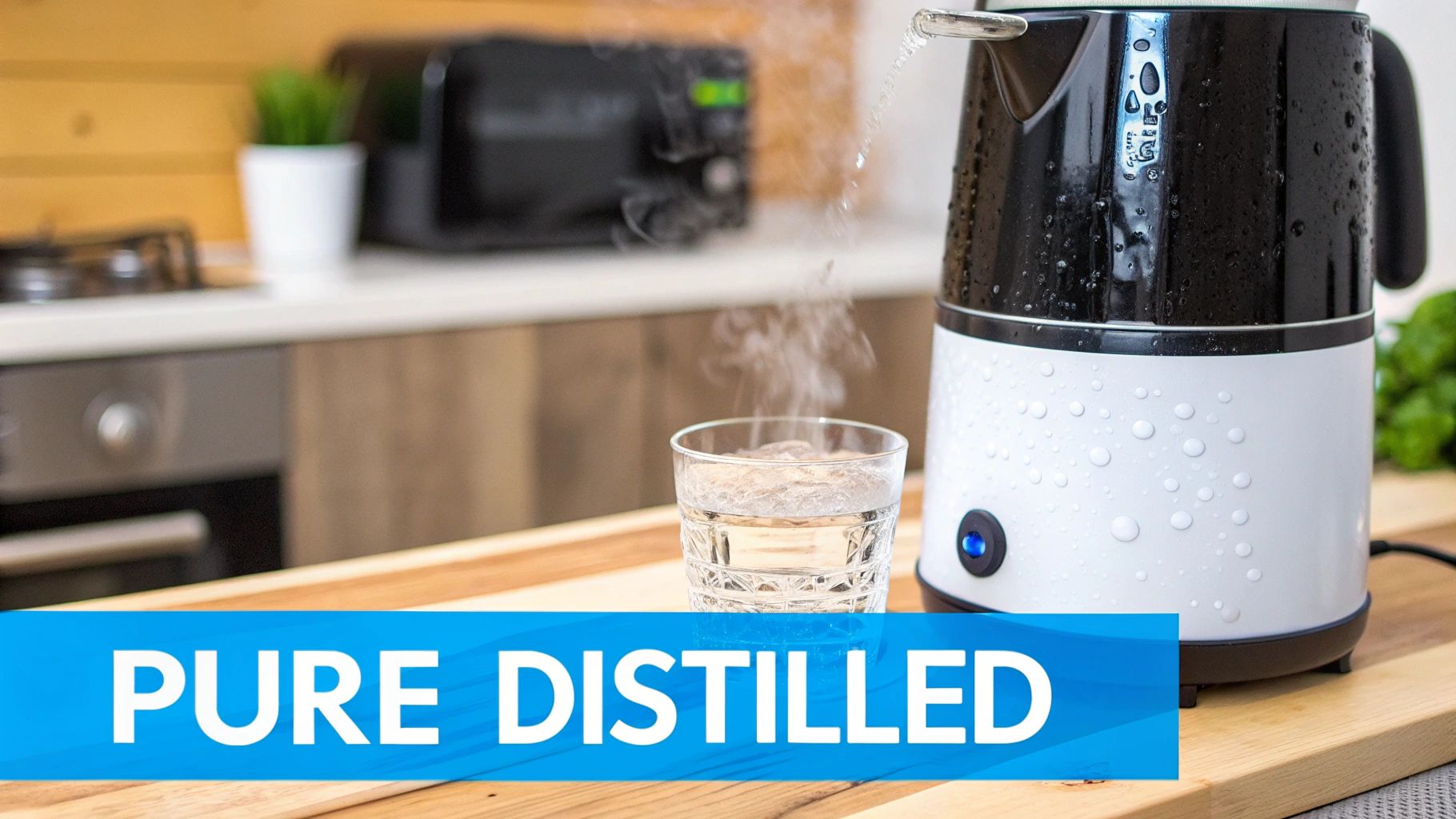
As the pure H₂O vapor rises, it leaves almost everything else behind. Heavier, non-volatile contaminants just can't make the trip. That means things like heavy metals, salts, minerals, and most microbes get left behind as a crusty sediment in the boiling chamber. It's a one-way ticket for water molecules only.
From Steam to Pure Water
Once the steam is separated, it's guided into a cooling channel. A fan typically cools it down, causing the vapor to condense back into liquid. This is your exceptionally pure distilled water, which drips into a clean carafe.
It's just like the steam that rises from a kettle on your stove. The steam itself is pure water, but any scale or residue stays put inside the kettle. A distiller just captures that steam and turns it back into pristine drinking water.
This method results in one of the purest forms of water available, stripped of the vast majority of dissolved solids found in your tap water.
By mimicking nature's cycle of evaporation and precipitation, distillation essentially hits the reset button on your water, leaving you with just H₂O.
What Distillation Removes and What It Misses
Distillation is an absolute powerhouse for removing a specific class of contaminants. Because it physically separates water from solids, it's brilliant at getting rid of:
- Heavy Metals: Lead, arsenic, mercury, and cadmium have no chance. They're left behind when the water boils.
- Dissolved Minerals and Salts: It removes calcium, magnesium, sodium, and other inorganic compounds. This is why distilled water is recommended for appliances like irons to prevent mineral buildup.
- Microbiological Threats: The high heat kills off most bacteria, viruses, and other pathogens, and they can't travel with the steam anyway.
But it’s not a perfect system. The biggest blind spot is with certain volatile organic compounds (VOCs). These are sneaky chemicals with a boiling point at or below water's. When you boil the water, these VOCs can turn to gas right along with the H₂O, travel through the condenser, and end up in your clean water.
To get around this, most modern distillers come equipped with an activated carbon post-filter designed to specifically trap these chemicals. This is a key point to remember when considering the difference between distilled and reverse osmosis, as each technology has its own set of strengths and weaknesses in removing specific contaminants.
How A Reverse Osmosis System Really Works
While a distiller is like a patient scientist, a reverse osmosis (RO) system is a high-tech commando raid on water impurities. It's not just one filter but a whole team of them working together, using high pressure to strip contaminants from your water in a methodical, step-by-step process.
The heart of the whole setup is the semipermeable membrane. You can think of it as a bouncer at an exclusive club, but for water. Its pores are unbelievably small—around 0.0001 microns—so only pure H₂O molecules get past the velvet rope. Everything else, like dissolved salts and lead, is rejected and sent packing down the drain.
But this membrane is delicate. You can't just blast raw tap water at it, or it would clog up and fail in no time. That’s why a home RO system is built with several layers of protection, all designed to safeguard this crucial component.
The Path Water Takes Through An RO System
When water enters a typical under-sink RO system, it goes on a specific journey. Each stage preps it for the next, which is key to getting the purest water possible and making the membrane last.
The whole thing breaks down into three main phases:
- Pre-Filtration: First, the water has to get through a couple of "bodyguard" filters. A sediment pre-filter catches the big stuff like rust, dirt, and sand. Then, a carbon block filter grabs chemicals like chlorine, which can eat away at the delicate membrane.
- The RO Membrane: With the water now pre-cleaned, it’s forced at high pressure against the semipermeable membrane. This is where you see the biggest difference between distilled and reverse osmosis—RO is a physical separation process, while distillation relies on evaporation. The membrane physically blocks up to 99% of total dissolved solids (TDS), which are then rinsed away into your drain.
- Post-Filtration: After passing through the membrane, the purified water sits in a small storage tank under your sink. When you open the RO faucet, the water travels from the tank through one last "polishing" filter, usually another carbon filter. This final touch gets rid of any remaining off-tastes or odors, making sure the water is perfectly crisp when it hits your glass.
An RO system isn't just one filter; it's a team of filters working in concert. The pre-filters protect the membrane, and the post-filter gives the water a final polish for perfect taste.
This multi-stage design is what allows reverse osmosis to tackle such a huge range of contaminants, giving you a steady supply of clean water right from your tap. It’s a smart and highly effective approach for any modern home.
A Head-to-Head Analysis On Contaminant Removal
When you sink your money into a water purification system, the goal is pretty straightforward: make your water safer to drink. The real difference between distilled and reverse osmosis comes down to which contaminants each one is best at removing. Both methods are powerhouses, but they go about it in completely different ways. This makes one a better fit than the other, depending on what’s actually lurking in your water.
Distillation is basically a brute-force approach. You boil the water, catch the steam, and leave nearly everything else behind. This makes it an absolute champion at getting rid of things that have a higher boiling point than water itself.
Reverse osmosis, on the other hand, is more like a highly selective bouncer at a club. It uses a multi-stage process where water is forced through a special membrane that rejects a huge range of dissolved solids based on their size and charge.
How Each Method Handles Common Contaminants
Distillation is almost flawless when it comes to removing heavy metals like lead and arsenic, boasting removal rates of 99.9%. It’s also unmatched for taking out inorganic minerals—think calcium and magnesium—and salts. This is precisely why distilled water has that distinctly "flat" taste. As a bonus, the boiling process kills just about every bacterium and virus.
Reverse osmosis is more of an all-around performer. It’s fantastic at removing dissolved salts, nitrates, and fluoride, typically cutting them down by 95-99%. RO systems also excel at filtering out things like pesticides and chlorine, which makes a huge difference in the taste and smell of your tap water. While it's great against most microbes, it doesn't use heat to sterilize the water.
This infographic gives you a good look at how a typical RO system works, showing how each stage plays a part in cleaning the water.
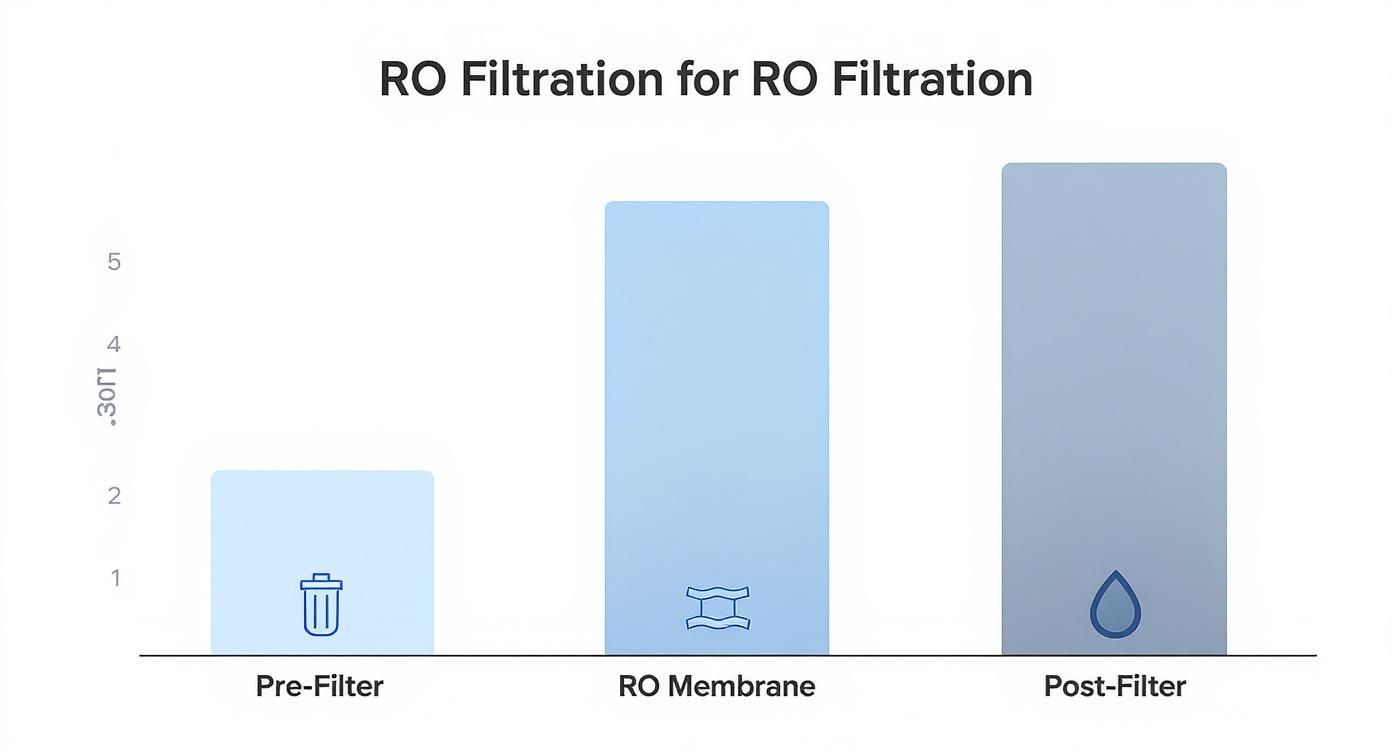
As you can see, an RO system isn't just one filter. It’s a complete process where each stage tackles different impurities, protecting the main membrane and polishing the water before it gets to your glass.
Contaminant Removal Effectiveness Comparison
Let's break down how these two stack up against specific, common water contaminants. This table gives a clear side-by-side look at where each method shines and where it might fall short.
| Contaminant | Distillation Removal Rate | Reverse Osmosis Removal Rate |
|---|---|---|
| Heavy Metals (Lead, Arsenic) | Excellent (99.9%+) | Very Good (95-97%) |
| Dissolved Minerals & Salts | Excellent (99.9%+) | Excellent (95-99%) |
| Chlorine & Chloramine | Poor (can be vaporized) | Excellent (98%+, with carbon filters) |
| Fluoride | Very Good (90-99%) | Excellent (95-97%) |
| Bacteria & Viruses | Excellent (99.9%+) | Very Good (99%+, membrane blocks them) |
| Pesticides & Herbicides | Good to Very Good | Excellent (97-99%, with carbon filters) |
| Volatile Organic Compounds (VOCs) | Poor (without a carbon filter) | Very Good (with carbon filters) |
Looking at the numbers, it's clear there's no single "best" for everything. Your choice really hinges on what you're trying to remove.
Key Takeaway: Choose distillation if you’re aiming for the absolute highest purity from minerals, heavy metals, and microbes. Go with reverse osmosis for a broader defense against dissolved chemicals like chlorine, fluoride, and pesticides, which results in better-tasting water for daily drinking.
At the end of the day, your local water quality report is your best guide. If heavy metals or microbiological threats are your main worry, distillation offers almost total peace of mind. But if you’re dealing with a cocktail of city water additives and potential agricultural runoff, a multi-stage RO system is the more well-rounded solution.
Long-Term Costs and Daily Practicality: What to Expect
When you look past the purification numbers, the real decider for most people between distilled and reverse osmosis comes down to two things: money and convenience. It's not just about the upfront cost, but how each system fits into your daily life and your monthly budget.
A countertop distiller might look like the cheaper option on the shelf, and it often is. But that initial price tag doesn't tell the whole story.
The True Cost of Running Your System
Distillation is a power-hungry process. A standard home distiller pulls around 800 watts of electricity and needs a good three to four hours to produce just one gallon of water. That adds up on your utility bill, especially if you have a family that goes through a lot of water. It’s the energy vampire of the water filter world.
Reverse osmosis, on the other hand, runs on your home's existing water pressure. It uses a tiny bit of electricity, but not enough to even notice. The main running cost for an RO system is the wastewater it sends down the drain to keep the membrane clean. Older systems were pretty wasteful, but modern ones have gotten much better, with some hitting a 2:1 or even 1:1 waste-to-pure-water ratio.
Financial Insight: With distillation, you're paying your electric company for every drop you make. With reverse osmosis, you're paying the water company—and water is almost always cheaper than the electricity needed to boil it for hours on end.
Maintenance and Day-to-Day Use
This is where the lifestyle fit really comes into play. A distiller is a batch system. You have to fill it, turn it on, and wait. It also needs to be cleaned constantly to get rid of the gunk—all those minerals and scale left behind in the boiling chamber. That descaling process can be a real chore.
An under-sink RO system is way more hands-off for daily use. You get purified water instantly from a dedicated tap whenever you want it. Maintenance is less frequent but follows a set schedule for replacing the filters and membrane.
- Pre- and Post-Filters: These usually need swapping every 6 to 12 months.
- RO Membrane: This is the heart of the system and typically lasts 2 to 3 years.
You just have to remember to order the parts and swap them out on schedule. The difference in practicality is pretty clear when you look at the market. The global reverse osmosis market was valued at around $18.8 billion and is growing fast, while the distilled water market is tiny in comparison. That alone shows you which technology is winning out in homes and cities. You can learn more about these market trends and see just how dominant RO has become.
Making The Right Choice For Your Household's Needs
https://www.youtube.com/embed/DOPweBJInr4
So, how do you decide between distilled water and a reverse osmosis system? There’s really no single “winner” here. The best choice comes down to what you actually need the water for in your home. It’s all about matching the right tool to the right job.
The decision really hinges on one simple question: Are you chasing absolute, near-perfect purity for specific tasks, or do you just want a reliable, on-demand source of fantastic-tasting water for your family?
Choose Distillation For Uncompromising Purity
If your goal is to get water that is as pure as scientifically possible, distillation is the undisputed champ. Nothing else comes close to its ability to remove virtually every last mineral and inorganic compound.
You’ll want to go with a distiller if your needs are very specific:
- Medical Devices: Things like CPAP machines and home sterilizers need water that’s completely free of minerals. Using anything else can cause damaging scale buildup and compromise sterile operation.
- Small Appliances: Ever notice that white crust in your steam iron or humidifier? That’s mineral scale. Using distilled water stops that from ever happening, making your appliances last much longer.
- Compromised Immune Systems: The boiling process is an incredibly effective defense against microbiological threats, offering an exceptional layer of safety for anyone who needs it.
Distillation gives you water that's about as close to pure H₂O as you can get. This makes it the go-to solution for specialized uses where you simply can't have any minerals or contaminants.
Choose Reverse Osmosis For Everyday Convenience And Taste
For most households, a reverse osmosis system hits the sweet spot. It delivers an excellent balance of powerful filtration, on-demand convenience, and—most importantly—great-tasting water. It’s a workhorse built for the modern kitchen.
An RO system is almost certainly your best bet if you’re looking for:
- Great-Tasting Drinking Water: RO excels at removing chlorine, dissolved solids, and other gunk that gives tap water an off-taste or weird smell. The result is crisp, clean water that actually makes you want to drink more.
- Convenient On-Demand Supply: An under-sink RO system gives you a steady stream of purified water from its own dedicated faucet. It’s perfect for filling a glass, cooking pasta, or making coffee without a second thought.
- Broad-Spectrum Contaminant Removal: These systems are fantastic at tackling a huge list of common water worries, from lead and fluoride to pesticides and nitrates.
The final call is about weighing these scenarios against what happens in your home every day. If you want more help figuring out what's right for your tap water, we have a ton of practical advice to help you choose wisely.
Tying Up Loose Ends: Your Top Questions Answered
When you're trying to pick the right water system for your home, the same questions always seem to pop up. Let's get those last few uncertainties cleared up so you can choose between distilled and reverse osmosis with total confidence. Here are the most common things people ask.
Is It Unhealthy to Drink Water Without Minerals?
This is a big one, but the short answer is no, it’s not a problem. While it's true both distillation and reverse osmosis strip out beneficial minerals like calcium and magnesium, the reality is we get almost all of these essential minerals from our food, not our water.
For most folks, the massive health benefit of yanking out harmful contaminants—think lead, chlorine, or pesticides—is far more important than the tiny amount of minerals lost. If it’s still a concern, some reverse osmosis systems even have an optional remineralization filter that adds a bit of healthy mineral content back in, which a lot of people think makes the water taste better anyway.
Which Water Is Better for Just Drinking Every Day?
For grabbing a glass of water or filling up the coffee pot, most people hands-down prefer reverse osmosis water. Distilled water has a famously "flat" or even "bland" taste because there's absolutely nothing in it, and a lot of people just don't like it.
On the other hand, RO water, especially after a final carbon "polishing" filter, tastes crisp and clean. Plus, the convenience of having an on-demand faucet right at your sink makes an under-sink RO system way more practical for daily use.
When it comes to daily use, it really boils down to taste and convenience. Reverse osmosis gives you great-tasting, clean water right when you want it, making it the clear winner for most households.
Do Reverse Osmosis Systems Waste a Ton of Water?
Older RO systems definitely earned a bad rap for being water hogs, but modern, high-efficiency systems are a whole different ballgame. Any RO system has to flush away the contaminants it catches, creating wastewater (called brine) that goes down the drain.
The good news is that many new systems have seriously impressive waste-to-pure-water ratios, with some hitting as low as 1:1. That means for every gallon of pure water you get, only one gallon of wastewater is created. It's a small trade-off for getting such a high level of purification on demand.
Ready to find the perfect filtration system for your home? The team at Water Filter Advisor has done the research for you, with in-depth reviews and practical guides to help you choose with confidence. Explore our expert recommendations at https://www.waterfilteradvisor.com.
- November 2, 2025
- 0
- Uncategorized
