
You turn on the kitchen faucet and notice a faint chlorine smell. The next morning, the water looks clear, but a rusty ring has appeared in the sink. If you rely on well water, you may instead see fine grit in a glass or notice a sulfur-like odor after the water sits. A 3 stage filtration system can help, but its performance depends on what each cartridge contains, not on the number printed on the product box.
The most useful question isn't “How many stages does this filter have?” It's “Which contaminants does each stage target, and does that match my water report?” The answer determines whether a basic sediment-and-carbon setup is enough, or whether you need reverse osmosis, ion exchange, UV disinfection, or a different treatment plan.
What a 3 Stage Filtration System Does
A 3 stage filtration system is a sequence of treatment steps, not a fixed recipe. Its results depend on the media in each cartridge and on the contaminants identified in your water report. A generic setup may improve taste and reduce sediment, while leaving hardness, dissolved metals, or microorganisms untreated.
Water normally passes through a sediment stage, a carbon stage, and a specialized or polishing stage. The first works like a screen, holding back particles. The second uses a chemical sponge, adsorbing compounds that affect taste and odor. The third must match the remaining concern, such as a dissolved contaminant, hardness, or biological contamination.
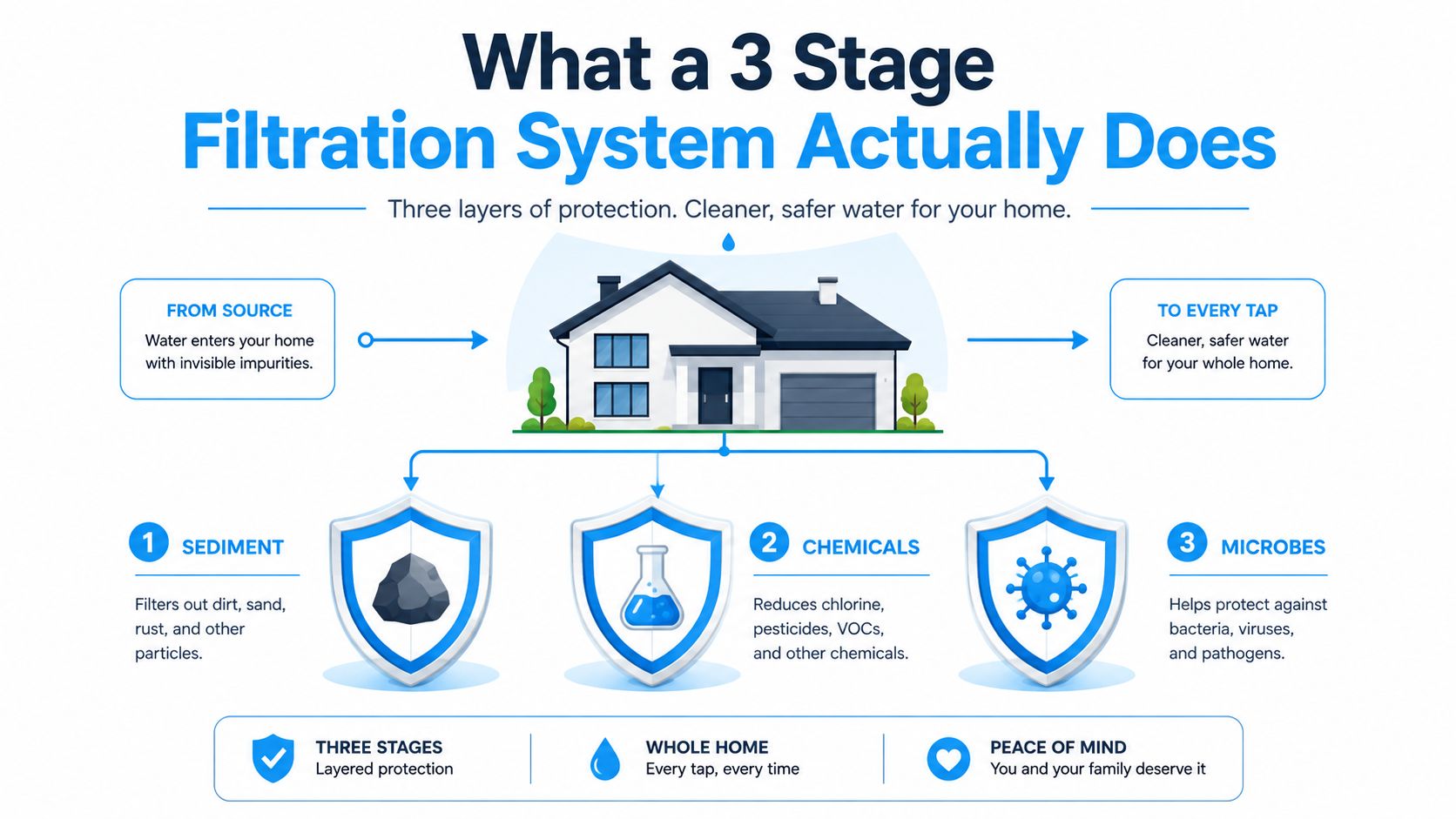
Why the order matters
A sediment prefilter commonly has a rating near 5 microns. It can intercept sand, silt, and rust before those particles reach finer media. This protects the downstream cartridges and helps preserve their usable capacity, instead of forcing one filter to handle every type of impurity. The arrangement appears in point-of-use and whole-house treatment, and the longer history of filtration is described in Luminor's filtration education resource.
The third housing is where product labels can mislead. A carbon cartridge may reduce chlorine and some organic compounds, but it does not automatically remove hardness, every dissolved metal, or microbial contamination. A specialized cartridge, reverse osmosis, ion exchange, or UV treatment may be needed, depending on the report and the manufacturer's tested claims.
Staged purification has a long history. Ancient Sanskrit writings described boiling, hot metal, sand, and charcoal around 2000 B.C. Hippocrates is credited with a simple sediment filter around 500 B.C., and Scotland built the first municipal water treatment plant using slow sand filtration in 1804. The Gorbals Waterworks later built three-stage upward-flow filters in 1846–48, extending staged treatment into municipal engineering.
Practical rule: Treat “three-stage” as a layout, not a performance guarantee. Match each cartridge to a documented contaminant target and your water report.
Inside Each Stage and What It Removes
A generic three-stage setup follows a sequence, but the label does not identify every contaminant it can reduce. The first cartridge catches particles, the second addresses chemicals affecting taste and odor, and the third is selected for the remaining concern on your water report. Media, flow rate, contact time, and tested claims determine the actual result.
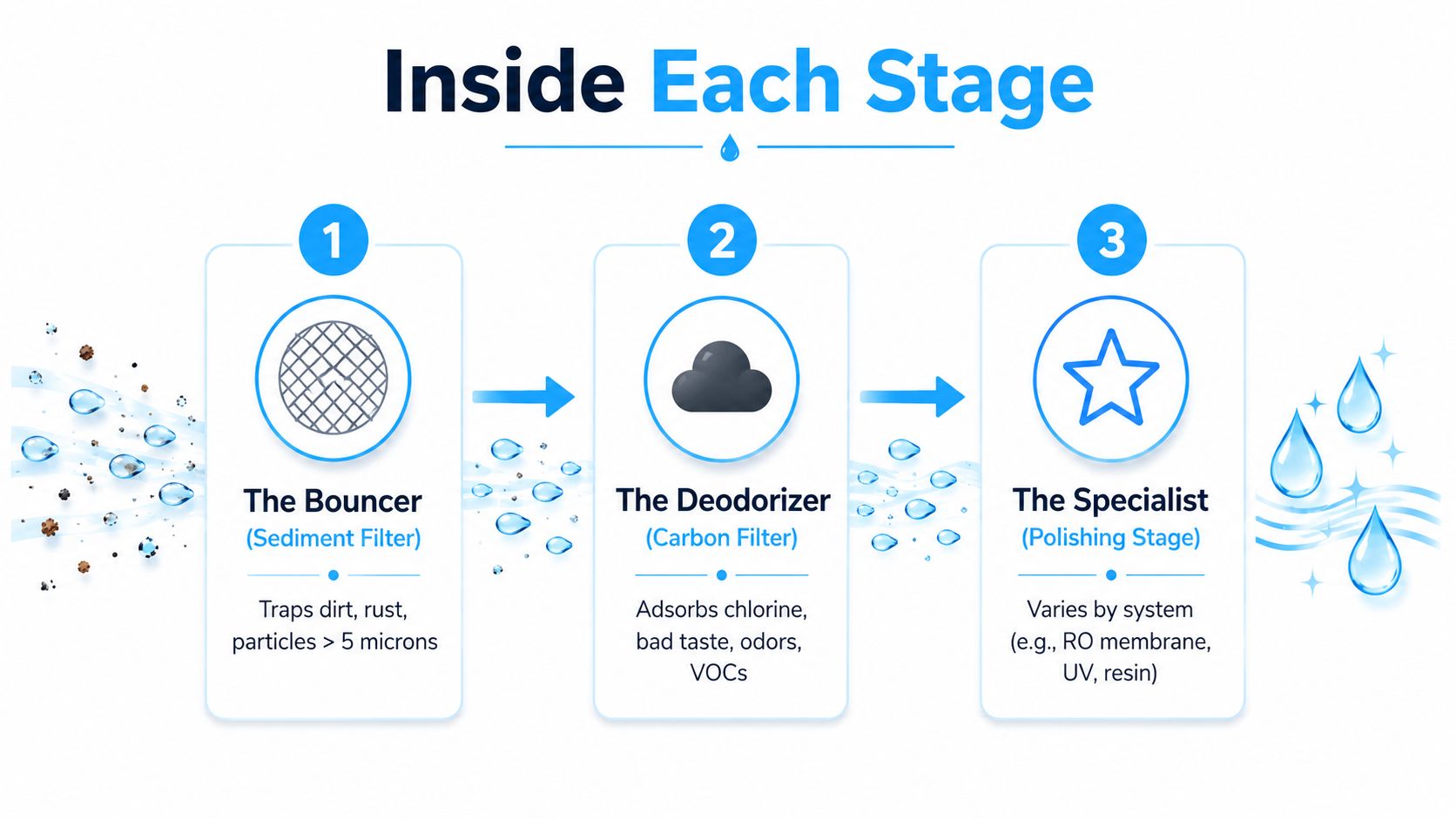
Stage one catches suspended material
The first cartridge is usually a mechanical sediment filter. Its pores hold back sand, rust, silt, and other suspended particles as water passes through. It does not dissolve or chemically neutralize them.
That limited role still protects the cartridges that follow. A heavy grit load can foul a carbon bed faster and increase pressure loss. Whole-house systems often place sediment filtration before carbon for this reason, particularly when incoming water contains visible particles.
Stage two addresses taste and odor
The second stage commonly contains activated carbon. Carbon adsorbs chlorine, chloramines, VOCs, and compounds linked to unpleasant taste and odor. Performance depends on the carbon type, contact time, flow rate, and the manufacturer's tested claim.
Chlorine reduction improves water's sensory qualities, yet it does not show that the system handles every health-related contaminant. The EPA home drinking-water filtration fact sheet advises matching treatment to the contaminant. It also notes that many products carry NSF/ANSI 42 certification for chlorine taste and odor.
Stage three must match the report
The final cartridge can be a finer mechanical filter, carbon polishing cartridge, reverse osmosis membrane, ion-exchange resin, or UV disinfection chamber. Some systems use specialized media such as KDF. Others add a final carbon block to improve taste after more intensive treatment.
A carbon cartridge, for example, does not automatically remove hardness, every dissolved metal, or microbial contamination. Those concerns may require different media or treatment, and the manufacturer's tested claims should identify what the cartridge reduces.
Replacement timing follows the installed cartridges rather than a generic calendar. One consumer three-filter system recommends replacing all three filters together after 2,000 gallons, with reported intervals of about 9 to 15 months depending on household size, as described by Water Filtration Authority's multi-stage guidance. During a kitchen or bathroom renovation, a qualified bathroom remodel plumbing installer can confirm that the inlet, outlet, shutoff, and drain connections suit the planned installation.
The video below provides another visual explanation of staged filtration.
Choosing the Right Third Stage for Your Water
The third stage is where two systems carrying the same “3 stage” label can behave very differently. One may be designed mainly for better taste. Another may contain a membrane for dissolved contaminants. A third may use UV because the homeowner is concerned about microorganisms. The label alone can't tell you which one belongs in your home.
Reverse osmosis for dissolved contaminants
Reverse osmosis, or RO, uses a membrane to reduce dissolved solids and can target substances such as some heavy metals and other dissolved contaminants. It typically needs sediment and carbon prefiltration to protect the membrane. RO is often most appropriate at a drinking-water tap, where the household wants intensive treatment for a limited volume of water.
The trade-off is slower production and wastewater. It also requires attention to prefilters and membrane condition. A three-stage RO system therefore isn't equivalent to a three-stage whole-house carbon system, even though both have three primary treatment positions.
UV for biological concerns
UV disinfection uses ultraviolet light to inactivate microorganisms. It doesn't remove chlorine, dissolved metals, salts, or sediment, so it must be paired with appropriate filtration and requires reliable water clarity and operating conditions.
For a private well with a confirmed microbial concern, UV may be a sensible final barrier. It isn't a substitute for testing, source protection, or a sediment stage.
Ion exchange for hardness and selected ions
Ion exchange swaps certain dissolved ions for others. Water softeners use this principle to address hardness, while specialized resins may target particular contaminants. The correct resin matters, and homeowners should verify the claim against the laboratory report rather than assume that any resin cartridge handles every metal.
Carbon polishing for a lighter finish
A final carbon block is often the simplest option when the main goal is taste, odor, or residual chemical reduction. It can be a good fit for treated municipal water when the report doesn't identify a contaminant requiring RO, UV, or resin.
SRS International's three-stage technical specifications describe a common whole-house architecture using sediment, carbon, and final polishing. The source also associates that design with about 30–90 psi line pressure, 1–15 L/min residential flow, and cartridge-life ranges that vary by stage and water conditions.

Certifications That Actually Prove Performance
A certification mark matters only when it matches the claim you're evaluating. A cartridge certified for chlorine taste and odor isn't automatically certified for lead, PFAS, microbes, or every other contaminant that appears in a sales brochure.
Residential water-treatment filters aren't covered by federal regulations, so voluntary standards and testing protocols help define minimum safety and performance requirements. NSF's explanation of residential water-treatment standards explains why shoppers should look for the applicable standard and the specific reduction claim.
Read the standard beside the contaminant
NSF/ANSI 42 generally relates to aesthetic effects, such as chlorine taste and odor. That's useful if your municipal water tastes heavily chlorinated, but it isn't the same as a health-contaminant certification. The EPA also notes that chlorine is added by utilities for pathogen control, so removing chlorine at the tap doesn't mean the filter has addressed every possible microbial concern.
NSF/ANSI 53 applies to specific health-related reduction claims when the product has been tested for those claims. Lead reduction is a particularly important example. The EPA's consumer tool for lead-certified point-of-use and pitcher filters identifies products that can reduce lead to 5 ppb or less while meeting particulate reduction Class I capabilities under NSF/ANSI 53 and 42.
NSF/ANSI 401 may appear on products tested for certain emerging or incidental contaminants. Don't treat the number as a universal promise. Confirm the exact contaminant listed in the performance data.
Use a three-question check
- What contaminant was tested? Look for the named substance, not a broad phrase such as “reduces impurities.”
- Which standard applies? Match NSF/ANSI 42, 53, or 401 to the claim being made.
- What are the operating limits? Flow rate, capacity, cartridge life, and installation conditions can affect performance.
A certification is a narrow proof of a tested claim. It isn't a blank check for every contaminant in your water.
How 3 Stage Systems Compare to 2 Stage and 4+ Stage Designs
A two-stage system can be perfectly reasonable when the water is already treated and the household mainly wants to reduce sediment and improve taste. A common arrangement pairs sediment filtration with activated carbon. It has fewer cartridges, fewer connections, and a smaller maintenance burden, but it may not provide a specialized response to dissolved solids, hardness, or microbes.
A 3 stage filtration system adds a dedicated position for that problem-specific job. The extra stage might be RO at a drinking tap, resin for hardness, UV for biological control, or a polishing cartridge for final taste improvement. That flexibility explains why three stages often sit at the practical center of residential filtration.
More stages can solve more problems, but not automatically
Systems with four or more stages may add prefilters, post-carbon treatment, remineralization, deionization, or additional polishing. Modern point-of-use systems may include up to seven stages when those extra functions are counted, according to Water Filtration Authority's multi-stage system overview.
More components make sense only when each one has a defined role. They can also increase cartridge replacement complexity, pressure loss, and the number of failure points. A homeowner who wants only chlorine taste reduction may gain little from adding a membrane and several polishing cartridges.
Compare the real ownership burden
| Design | Typical advantage | Main trade-off |
|---|---|---|
| Two stage | Simple sediment and carbon treatment | Limited specialization |
| Three stage | Adds a targeted finishing step | More maintenance than two stages |
| Four or more | Supports layered treatment for complex needs | Higher complexity and potentially greater pressure loss |
A system should match the water report, the installation location, and the household's willingness to maintain it. The same principle applies to other home filtration decisions, including Central Florida pollen humidity solutions where the filter choice also needs to reflect the specific problem rather than the product category alone.
Installation Basics and a Realistic Maintenance Schedule
A three-stage unit usually sits either under the sink for point-of-use drinking water or at the point of entry for whole-house treatment. In both cases, water enters the first housing, travels through the connected cartridges in sequence, and exits toward the faucet or household plumbing.
Before opening a housing, shut off the water supply and relieve pressure. Install the shutoff valve in an accessible position, connect the inlet and outlet lines in the correct direction, and check every fitting for leaks after restoring flow. Under-sink installations can be manageable for experienced DIY homeowners, but whole-house systems may require pipe cutting, support, bypass planning, and local plumbing knowledge.
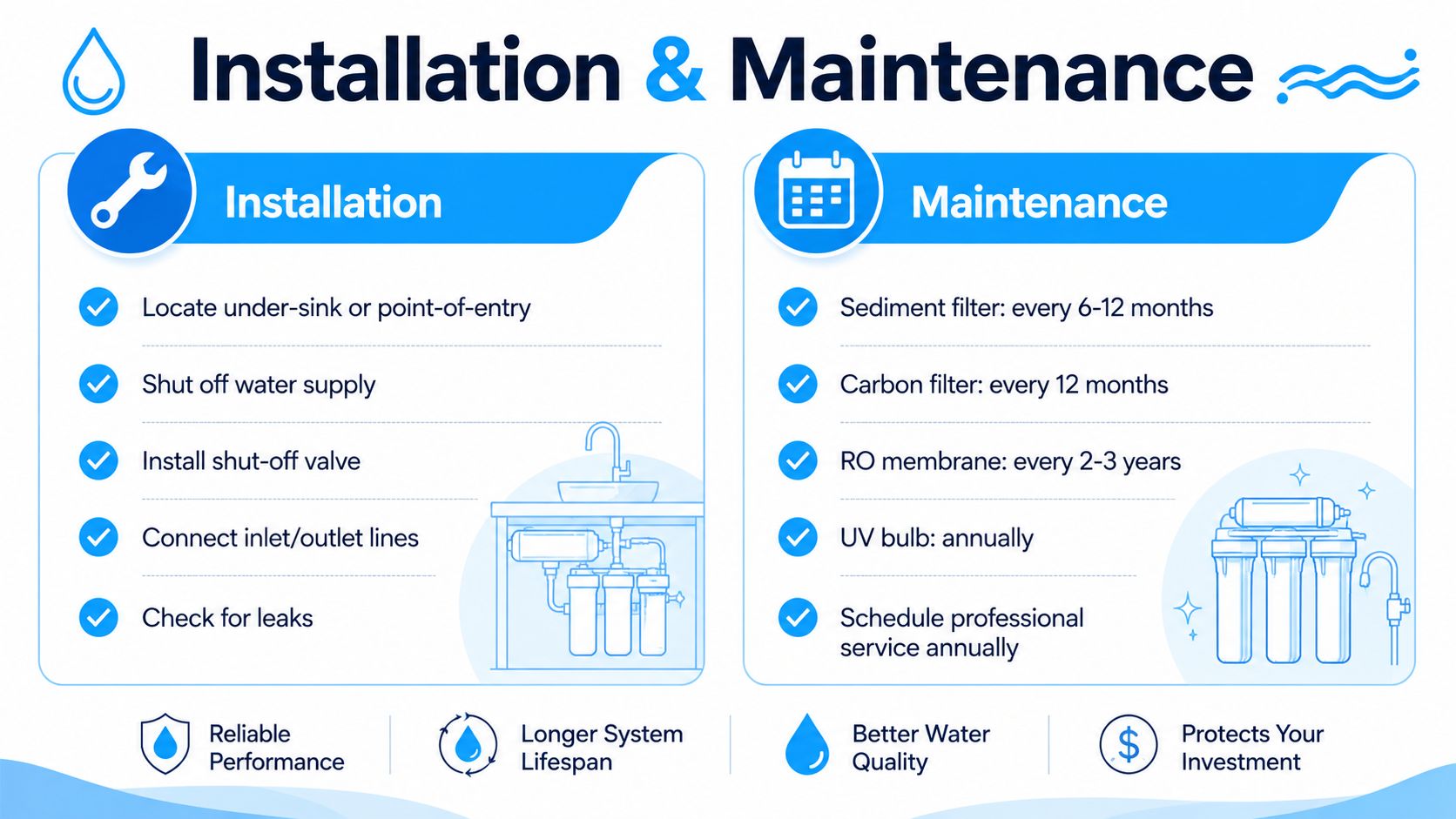
Plan replacements by stage
Published technical specifications associate sediment and final-polish cartridges with roughly 6–12 months of life, while carbon cartridges may last about 12–18 months, depending on water quality and demand. Those ranges come from SRS International's cartridge-filtration specifications, but the manufacturer's instructions should control your schedule.
One system may recommend changing all three filters together, while another gives each cartridge its own interval. Keep a written replacement log and change a cartridge sooner if flow drops, taste changes, or the housing shows unusual loading.
Avoid common maintenance mistakes
- Check pressure changes: A noticeable reduction in flow can signal clogging or excessive pressure drop.
- Clean the housings: Wash and sanitize housings during cartridge changes according to the product instructions.
- Use the correct cartridges: A physically compatible cartridge may not have the required media or certified contaminant claim.
- Inspect seals: Re-seat O-rings carefully and replace damaged seals before pressurizing the system.
For additional installation and filter-care guidance, consult Water Filter Advisor's advice resources.
Matching the Right System to Your Household
A municipal-water household with acceptable test results and a taste complaint will often have a straightforward shortlist. Sediment plus carbon may be enough, with a final carbon polish if the manufacturer's data supports it. If lead appears in the plumbing or water test, choose a cartridge independently tested and certified for lead rather than assuming that carbon alone provides the needed protection.
Private well owners face more variation. Sediment, iron, hydrogen sulfide, hardness, and microbial concerns can require different media or separate treatment equipment. A generic three-stage label can't identify the correct solution without a water report.
Renters usually benefit from point-of-use systems that avoid permanent plumbing changes, while homeowners can consider an under-sink RO unit or a point-of-entry design when broader coverage is justified. Large families should pay close attention to flow, cartridge capacity, and replacement effort because demand can shorten service life.
| Household Type | Best Third Stage | Estimated Cartridge Replacement |
|---|---|---|
| Municipal water, taste-focused | Carbon polishing | Follow the manufacturer's tested capacity |
| Municipal water, lead concern | Lead-certified cartridge or RO | Follow the certified cartridge instructions |
| Private well, microbial concern | UV after suitable prefiltration | Follow the UV manufacturer's schedule |
| Hard well water | Ion exchange or dedicated softening treatment | Depends on water quality and demand |
| Renter needing drinking-water improvement | Compact carbon or RO point-of-use unit | Based on cartridge capacity and usage |
| Large household | High-flow specialized stage | Monitor pressure and replace according to loading |
Water Filter Advisor offers consumer guidance on whole-house, under-sink, faucet, shower, refrigerator, and portable filtration, along with replacement cartridges, media, certifications, and testing kits. Its material can help organize a shortlist, but the final choice should still follow the water report and the product's verified performance claim.
Questions Homeowners Ask Before Buying
Can a three-stage system reduce lead to a safe level?
It can, but only when the specific cartridge is independently tested and certified for lead reduction. The EPA identifies point-of-use and pitcher filters that reduce lead to 5 ppb or less under the relevant certified capabilities. A standard sediment and carbon arrangement without a lead-specific claim shouldn't be treated as proof of lead protection.
Does it remove PFAS?
Not every three-stage system does. PFAS performance depends on the media, membrane, flow conditions, and verified product claim. Look for documentation that names PFAS or the relevant compound directly. The number of stages alone doesn't establish performance.
Will it handle microbes?
Only if the system includes a technology designed and tested for biological treatment, such as UV disinfection, and the installation conditions support that technology. Sediment and carbon stages can improve clarity and taste, but they aren't automatically a complete disinfection system.
What about iron or hydrogen sulfide from a well?
Those problems need media selected for the specific chemistry and concentration. A generic carbon cartridge may not solve substantial iron loading or sulfur odor. Test the well water first, then compare the results with the manufacturer's removal data.
Can renters install one?
A faucet-mounted, countertop, or compact under-sink point-of-use system may be suitable when the lease allows it and the installation doesn't require permanent plumbing changes. Ask the landlord before modifying supply lines, and choose a system that can be removed without damaging the property.
The practical buying rule is simple: choose the media first, then count the stages. A two-stage system with the right certified cartridges can outperform a four-stage product that doesn't target your actual contaminant.
Water Filter Advisor helps households compare filtration types, understand replacement cartridges, review certification claims, and plan maintenance for municipal or well water. Visit Water Filter Advisor with your water report in hand to build a focused shortlist instead of buying based on a stage count alone.
- August 17, 2026
- Uncategorized
