
Ready to dive into the world of water filters? It can feel like a deep ocean of options, but here's a secret: it all starts with one simple question. Do you want to treat all the water flooding into your house, or just the water at a specific tap, like your kitchen sink?
That's the real difference between Point-of-Entry (POE) systems, which guard your entire home's water supply, and Point-of-Use (POU) systems, which give you VIP filtration right where you drink. Nailing this one decision is your first and most important step toward tastier, safer water.
Point-of-Entry vs. Point-of-Use: What’s the Difference?
Imagine a Point-of-Entry (POE) system as the ultimate bouncer for your home. It’s installed where your main water line comes in, checking every single drop before it gets to your shower, washing machine, toilets, and taps. It’s the heavyweight champion for fighting house-wide problems, like hard water that coats everything in a crusty film or sediment that clogs your pipes.
A Point-of-Use (POU) system, on the other hand, is like a personal bodyguard for a specific faucet. These are your under-sink filters, countertop units, and faucet attachments that serve up ultra-purified water right where you need it for drinking your morning coffee or boiling pasta.
To make it even clearer, let's break down the core differences in a simple table.
Point-of-Entry vs. Point-of-Use Filters at a Glance
This table provides a high-level comparison between the two primary categories of home water filtration systems to help you quickly understand their core differences.
| Feature | Point-of-Entry (Whole-House) | Point-of-Use (Single Tap/Appliance) |
|---|---|---|
| Treatment Scope | Treats all water entering the home. | Treats water at a single location (e.g., kitchen sink). |
| Typical Use Case | Addressing widespread issues like hardness, chlorine, sediment. | Improving taste, odor, and purity of drinking/cooking water. |
| Installation | Professional installation is often required. | Typically a simple DIY installation. |
| Cost | Higher initial investment. | Lower initial cost, more accessible. |
| Maintenance | Less frequent filter changes (e.g., every 6-12 months or longer). | More frequent filter changes (e.g., every 2-6 months). |
As you can see, the choice isn't about which one is "better" overall, but which one is better for you.
Why This Choice Is So Important
Figuring this out from the start saves you a world of headaches. It explains why your neighbor might install a massive whole-house system to stop hard water from destroying their appliances, while you might be perfectly happy with a simple pitcher filter just to make your iced tea taste better. It all comes down to your water and your goals.
It's no surprise that targeted, easy-to-use solutions are wildly popular. In fact, Point-of-Use (POU) filters are on track to make up nearly 44.8% of total revenue in the home filtration market by 2025. Why? Because they're easy. Anyone can grab a pitcher or screw on a faucet filter without calling a plumber. If you want to dig deeper, you can discover more insights about the water filter market and its growth.
The real question isn't just "What's in my water?" but also "Where do I need the cleanest water?" Answering that will instantly point you in the right direction.
This guide will walk you through all the specific types of home water filtration systems that fall into both of these categories. Now that you understand the basic landscape, you're ready to explore the different technologies—from reverse osmosis to activated carbon—and find the perfect fit for your home.
Whole-House Filters: The Ultimate Solution for Your Home's Water
Imagine turning on any faucet in your house—the shower, the washing machine, the bathroom sink—and getting pure, clean water. Not just in the kitchen, but everywhere. Every single drop is treated. That’s not a dream—it's what a Point-of-Entry (POE), or whole-house, water filtration system delivers.
These systems are the comprehensive guardians of your home’s water. Installed right where the main water line enters your house, they stand as a fortress to ensure that every appliance and tap gets the good stuff.
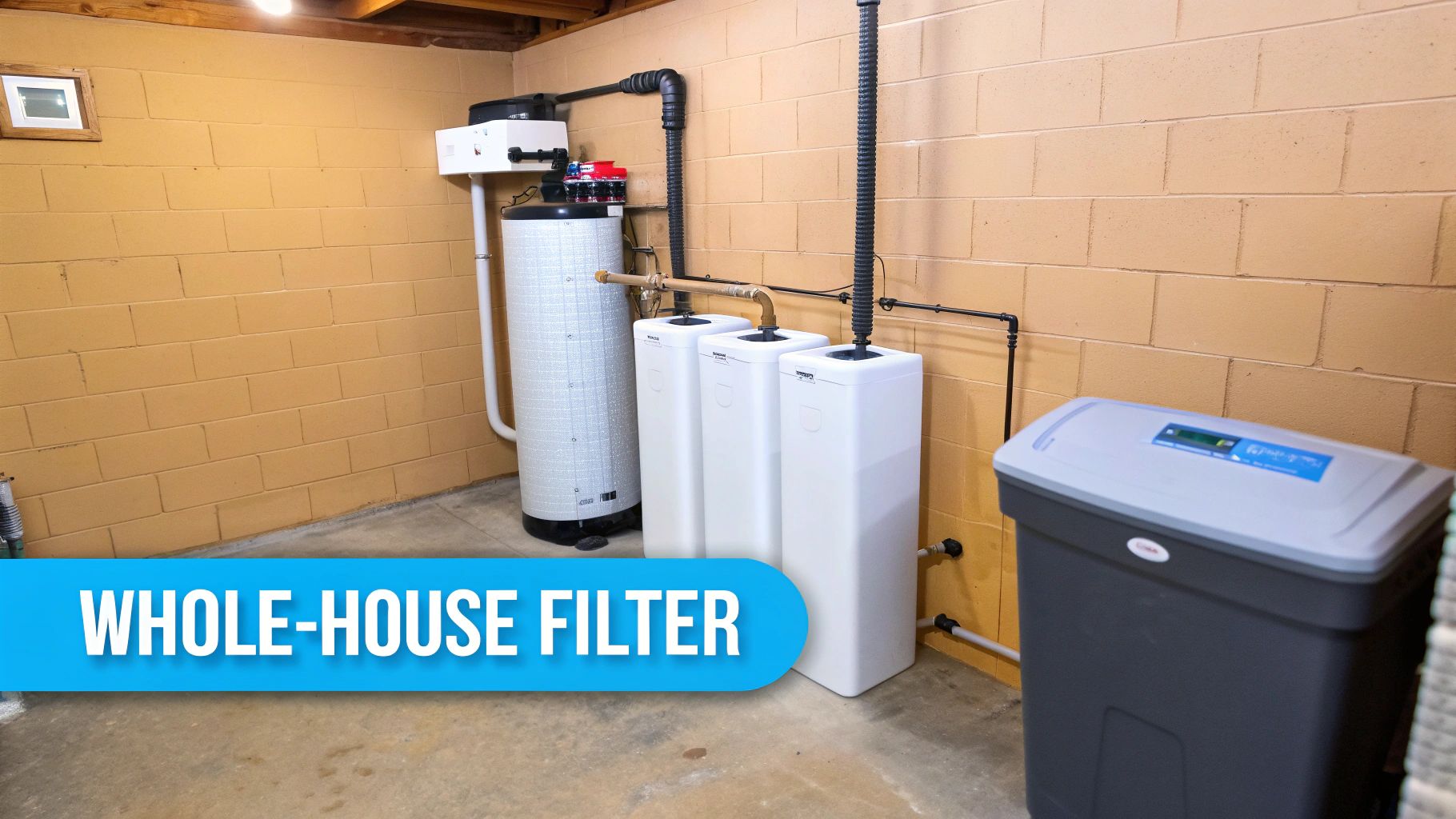
This all-in-one approach is exactly why so many homeowners are opting for a total water quality upgrade. The market is booming, expanding from $20,502.5 million in 2021 with a forecast to hit $25,389.4 million by 2025. People are tired of dealing with widespread issues like chlorine, sediment, and other contaminants, and they want a solution that tackles them at the source.
How Do These Systems Actually Work?
Think of a whole-house filter like a multi-stage security checkpoint for your water. As water enters from the main line, it’s pushed through a series of different filter media, with each layer designed to snag specific troublemakers. This layered defense is what makes them so powerful against a whole range of issues.
A typical setup often includes a few key players working together:
- Sediment Pre-Filter: This is your first line of defense. It catches the big stuff—sand, silt, rust, and dirt—and prevents it from clogging up the more sensitive filters down the line.
- Activated Carbon Filter: This is the real workhorse for getting rid of nasty chemicals. It uses super-porous carbon to absorb chlorine, chloramine, pesticides, and other compounds (VOCs) that make your water taste and smell funky.
- KDF Media: Kinetic Degradation Fluxion (KDF) is a fancy name for a special blend of copper and zinc that creates a chemical reaction. It’s fantastic at removing heavy metals like lead and mercury and even helps stop bacteria and algae from growing inside your filter.
Many systems can also be customized with add-ons like a water softener to fight hard water minerals (calcium and magnesium) or a UV purifier to zap any lingering microbiological threats. The right combination really depends on what’s in your water to begin with.
The True Value of Treating Your Entire Home
The payoff of a whole-house system goes way beyond just better-tasting water from the kitchen tap. Since every drop is treated, you’ll notice the benefits in places you might not expect. Your shower water will be free of drying chlorine, and your clothes will come out of the wash brighter and last longer.
One of the biggest long-term wins is how it protects your plumbing and all your water-using appliances. By filtering out corrosive chemicals and scale-building minerals, you extend the life of your water heater, dishwasher, washing machine, and pipes, saving yourself a ton of money on repairs and replacements.
This makes a whole-house system a really smart investment, especially if you're already planning a big home upgrade. If you're tackling a major project, thinking about your water from the get-go is key. For example, this helpful whole house renovation checklist shows how water filtration can fit right into the bigger picture of your home improvements.
Is a Whole-House Filter the Right Choice for You?
Making the jump to a whole-house system means weighing the upfront cost against the incredible long-term, home-wide benefits.
Here’s what you need to keep in mind:
- Installation: This isn't a simple DIY job. These systems need to be tied into your main water line, so you'll almost always need a licensed plumber to do it right. This adds to the initial cost but ensures everything is hooked up correctly and safely.
- Maintenance: While you won't be changing filters every month, the maintenance is more involved. You’ll be swapping out large filter cartridges every 6-12 months or sometimes even longer, depending on your water quality and how much you use.
- Cost: The initial price tag can be anywhere from a few hundred to a few thousand dollars, plus what you'll pay for installation. But when you add up the savings from longer-lasting appliances and plumbing, the value becomes crystal clear over time.
For any homeowner who is serious about getting the absolute best water quality in every part of their home, a whole-house filter is the definitive solution.
Under-Sink Systems for Targeted Purification
While whole-house systems cast a wide net, sometimes you need surgical precision. For many of us, the most critical battleground for water quality is the kitchen sink—the source of our drinking and cooking water. This is precisely where under-sink filtration systems come in, giving you a powerful, localized defense right where it counts most.
Tucked away in the cabinet, these units are the quiet heroes of home water treatment, delivering incredibly clean water without the need for a major plumbing overhaul.
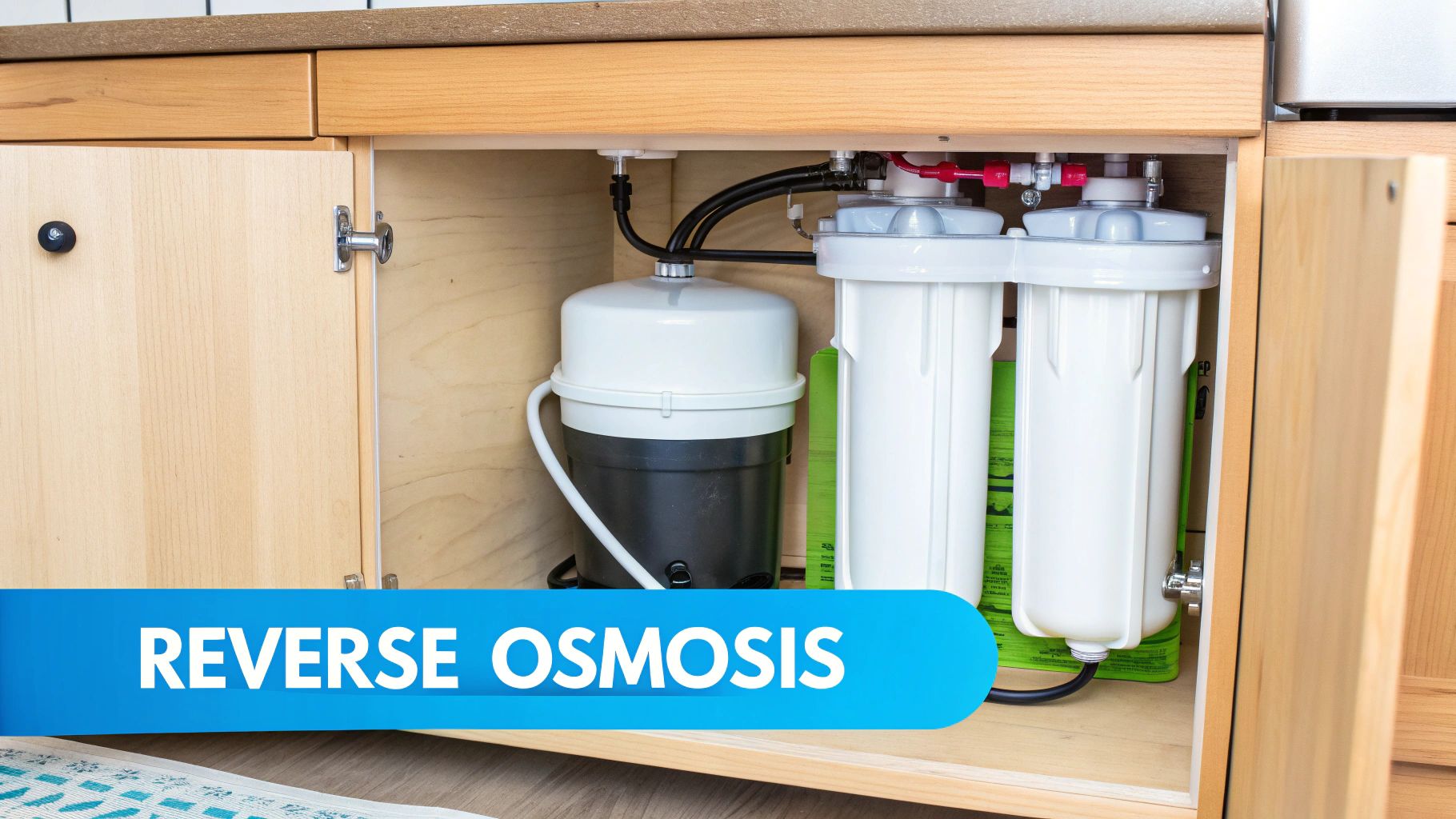
When you start looking at under-sink options, one technology consistently rises to the top as the gold standard for purity: Reverse Osmosis (RO). It's the system of choice for anyone serious about getting the cleanest water possible, tackling contaminants other filters simply can't touch.
The Powerhouse of Purification: Reverse Osmosis
Think of a Reverse Osmosis system as the ultimate gatekeeper for your water. It’s not just a simple filter; it's a multi-stage purification process. Water first travels through a series of pre-filters, typically sediment and carbon, which knock out the big stuff like rust, dirt, and chlorine.
But the real workhorse is the RO membrane. This is where the magic happens.
This specialized, semipermeable membrane has microscopic pores so tiny that only water molecules can pass through. Nearly everything else—up to 99% of dissolved solids—is physically blocked, rejected, and sent down the drain. The result is water that is exceptionally pure.
Common Contaminants Removed by RO Systems
- Heavy Metals: A knockout punch for lead, arsenic, mercury, and copper.
- Dissolved Solids: Catches the things other filters miss, like fluoride, nitrates, and nitrites.
- Chemicals: Removes chlorine and other disinfectants that create unpleasant tastes and smells.
- Salts and Minerals: Drastically reduces total dissolved solids (TDS), leaving you with incredibly pure water.
Because this process is so meticulous, it's also a bit slow. That’s why nearly every RO system comes with a small storage tank. This tank keeps a few gallons of purified water on deck, ready to flow the moment you turn on the dedicated faucet.
Understanding the Pros and Cons
Like any high-performance technology, Reverse Osmosis has its trade-offs. It delivers a level of purification that’s second to none, but it’s important to understand what that involves.
The real beauty of an RO system is its ability to remove an incredibly broad spectrum of contaminants. It gives you peace of mind that your water isn't just filtered—it's truly purified.
Let's break down the good and the not-so-good:
| Pros of Reverse Osmosis | Cons of Reverse Osmosis |
|---|---|
| Superior Contaminant Removal: The most effective point-of-use method for getting rid of the widest range of pollutants. | Wastewater Production: The system flushes away rejected contaminants, which creates wastewater (often 1-3 gallons for every pure gallon produced). |
| Improved Taste and Odor: By removing almost all impurities, it delivers crisp, clean-tasting water. | Slower Water Flow: The purification process is methodical, which is why a storage tank is necessary for on-demand use. |
| Cost-Effective: Over time, it's far cheaper and more convenient than buying endless cases of bottled water. | Requires a Dedicated Faucet: Most setups need a separate, smaller faucet installed on your sink just for the purified water. |
| Hidden from View: The entire system lives neatly under the sink, leaving your countertops free of clutter. | Removes Beneficial Minerals: The membrane is non-discriminatory; it removes healthy minerals like calcium along with the bad stuff. Some systems include a remineralization stage to fix this. |
Simpler Alternatives: Multi-Stage Carbon Filters
If a full RO system seems like more than you need, there's a great middle-ground option: a multi-stage carbon filter. These units also install under the sink and connect directly to your cold-water line, but they work with your existing kitchen faucet.
These systems use a combination of advanced carbon blocks and other filter media. While they won't remove dissolved solids like fluoride or nitrates, they are fantastic at eliminating chlorine, lead, pesticides, and other chemicals that ruin the taste and smell of your water. They're also simpler to install, produce zero wastewater, and don't slow down your water flow, making them an excellent choice for targeted, high-quality filtration.
The Most Accessible Filters: Pitchers and Faucets
Sometimes, you don’t need a massive, complex system to get better-tasting water. For many people—especially renters, college students, or anyone wanting an immediate and affordable upgrade—the solution is right on the countertop or attached to the kitchen tap.
This is the world of water filter pitchers and faucet-mounted units, the most convenient entry points into home water filtration.
These simple devices are perfect for tackling the most common complaints about tap water, like that unmistakable chlorine smell or a slightly "off" taste. They're designed for quick results, transforming your water glass by glass, without needing any tools, plumbers, or permanent changes to your home's plumbing. It's no wonder they're one of the most popular types of home water filtration systems out there.
The Science Behind the Simplicity: Activated Carbon
The secret weapon inside both pitchers and faucet filters is activated carbon. Imagine a tiny, porous sponge with a massive surface area. As water passes through the filter cartridge, this carbon acts like a magnet for certain contaminants.
Its porous structure physically traps and absorbs undesirable elements. This process, known as adsorption, is incredibly effective at grabbing the specific culprits that mess with taste and odor, making your water instantly more palatable.
What Activated Carbon Filters Typically Remove:
- Chlorine: This is the big one. Carbon excels at removing the chlorine used by municipal treatment plants, which is the main reason for that “pool water” smell and taste.
- Lead and Mercury: Many certified filters can significantly reduce levels of heavy metals that might leach from older pipes.
- Volatile Organic Compounds (VOCs): This can include various industrial chemicals and solvents that sometimes find their way into water supplies.
- Bad Tastes and Odors: By targeting the compounds responsible for funky smells and flavors, these filters deliver a much cleaner, crisper final product.
The result is a noticeable improvement in the quality of your drinking water, coffee, and even the water you use for cooking. Suddenly, those fruity notes in your expensive coffee beans actually come through because they aren't being masked by chemical tastes.
Water Filter Pitchers: Your First Step to Better Water
A water filter pitcher is often the very first filtration device people buy. It’s the definition of plug-and-play; just fill the reservoir, let gravity do the work, and pour. It’s an incredibly low-stakes way to see if filtered water makes a difference for you.
Of course, this convenience comes with a few trade-offs. The main limitations are capacity and speed. You have to refill it constantly, and waiting for the water to trickle through the filter can be a test of patience when you're thirsty. Filter life is also short, typically requiring a replacement every 40 gallons or about two months, which means ongoing costs.
Faucet-Mounted Filters: On-Demand Filtration
For those who want filtered water on demand without the wait, a faucet-mounted unit is a fantastic step up. These devices screw directly onto your existing kitchen faucet in minutes—no tools needed. A small lever lets you switch between a filtered stream for drinking and an unfiltered one for washing dishes, which helps extend the filter's lifespan.
The real advantage of a faucet filter is its immediacy. You get a continuous flow of clean water right when you need it, bridging the gap between the patience required for a pitcher and the commitment of an under-sink system.
While they filter a wider range of contaminants than many basic pitchers and last longer (around 100 gallons or three months), they do have their own quirks. They can slow down your water flow and might not fit on all faucet types, especially those with pull-out sprayers.
Both pitchers and faucet units are excellent starting points, but they are primarily designed to improve aesthetics—taste and smell—rather than remove a broad spectrum of microscopic contaminants.
Specialized Filters for Unique Water Problems
Sometimes, the problems with your water go way beyond a funny taste or smell. You could be dealing with invisible microorganisms or hard water minerals that are slowly killing your pipes and appliances. When a standard carbon filter just won't cut it, you have to bring in the specialists.
These advanced systems are engineered to solve very specific problems, giving you a targeted defense against some of the toughest water quality issues out there. The most common and effective are UV purifiers, water distillers, and ion exchange systems. Each one uses a different scientific angle to get the job done.
UV Purifiers: The Chemical-Free Germ Killer
If you get your water from a private well or you’re worried about what might be swimming in it, a UV Purifier is your silent guardian. This tech doesn't "filter" water in the classic sense; instead, it zaps it with a powerful ultraviolet light.
Think of it like a security checkpoint for germs. As water flows through the unit, it’s hit with a special UV lamp that emits light at a specific wavelength (254 nanometers). This intense UV-C light blasts through the cell walls of things like bacteria, viruses, and protozoa (like Giardia and Cryptosporidium), completely scrambling their DNA. They can't reproduce, so they can't make you sick. It's a remarkably effective way to disinfect your water without adding a drop of chemicals.
So, when do you actually need a UV Purifier?
- Well Water: It’s a non-negotiable for homes on well water. Groundwater can easily get contaminated from farm runoff or leaky septic systems.
- Boil Water Advisories: If you’re on city water, a UV system gives you peace of mind when those boil water alerts pop up.
- Compromised Immune Systems: For households with anyone who is immunocompromised, this extra layer of defense against microbes is a smart move.
Maintenance is pretty simple. You'll need to replace the UV lamp once a year to make sure it's still powerful enough, and the quartz sleeve that protects the bulb needs a good cleaning every so often.
Water Distillers: Mimicking Nature’s Purity
For anyone chasing the absolute purest water possible, a Water Distiller is the answer. This machine basically copies the earth’s natural water cycle—evaporation, condensation, and rain—to produce exceptionally clean water right on your countertop.
The process itself is straightforward but incredibly powerful. A distiller boils water, turning it into steam. As that steam rises, it leaves almost everything else behind: heavy metals, salts, bacteria, viruses, minerals, and chemicals. The pure water vapor is then cooled back down in a condenser coil and drips out as clean, distilled water.
A water distiller is the ultimate purification machine, knocking out a wider range of contaminants than just about any other single system. It's the gold standard for anyone who needs water that's as close to pure H₂O as you can get.
But that level of purity has its downsides. Distillation is slow, typically making only a few gallons a day, and it uses a fair bit of electricity. It also strips out beneficial minerals like calcium and magnesium, which gives the water a "flat" taste that some people don't care for.
Ion Exchange: The Science Behind Soft Water
Ever see those chalky white spots on your glassware? Or that crusty buildup on your showerhead? That's hard water. The culprits are high levels of calcium and magnesium, and the solution is an Ion Exchange system—what most of us just call a water softener.
Inside a water softener is a tank filled with thousands of tiny resin beads. These beads are "charged up" with sodium (or sometimes potassium) ions. When your hard water flows through the tank, the resin beads act like tiny magnets. They grab the hard water minerals (calcium and magnesium) and, in exchange, release the sodium ions into the water.
This simple "swap" is what makes your water soft. It stops scale buildup in its tracks, protects your appliances, and even makes your skin and hair feel softer. Of course, those beads eventually get full of minerals, so the system has to "regenerate" every so often. It does this by flushing itself with a brine (salt water) solution, which washes the calcium and magnesium away and recharges the beads with fresh sodium ions.
How To Choose The Right Water Filter For Your Home
Feeling a bit overwhelmed by the sheer number of options out there? That’s completely normal. Choosing from all the different types of home water filtration systems can seem complicated, but it really just boils down to answering three simple questions about your home and what you’re trying to achieve.
Answering these will cut through the noise and point you straight to the perfect solution. So, let's forget the technical jargon for a moment; this is your practical game plan for getting it right.
Start With What’s In Your Water
You can’t solve a problem if you don’t know what it is. The single most important first step is to figure out exactly what contaminants are flowing through your tap water. Honestly, you might be surprised by what you find.
-
For City Water: Your local municipality is required to send out an annual water quality report, often called a Consumer Confidence Report (CCR). This document lists all the tested contaminant levels and is a fantastic starting point.
-
For Well Water: If you have a private well, the responsibility for testing falls on you. Getting your water tested by an independent lab is essential to check for things like bacteria, nitrates, heavy metals, and other common groundwater issues.
Once you have this data, you have a clear target. You're no longer guessing; you're making a smart decision based on real facts. For more help, the extensive advice from Water Filter Advisor can help you make sense of your results.
This simple flowchart is a great way to visualize the process of testing your water and matching the results to the right filter technology.
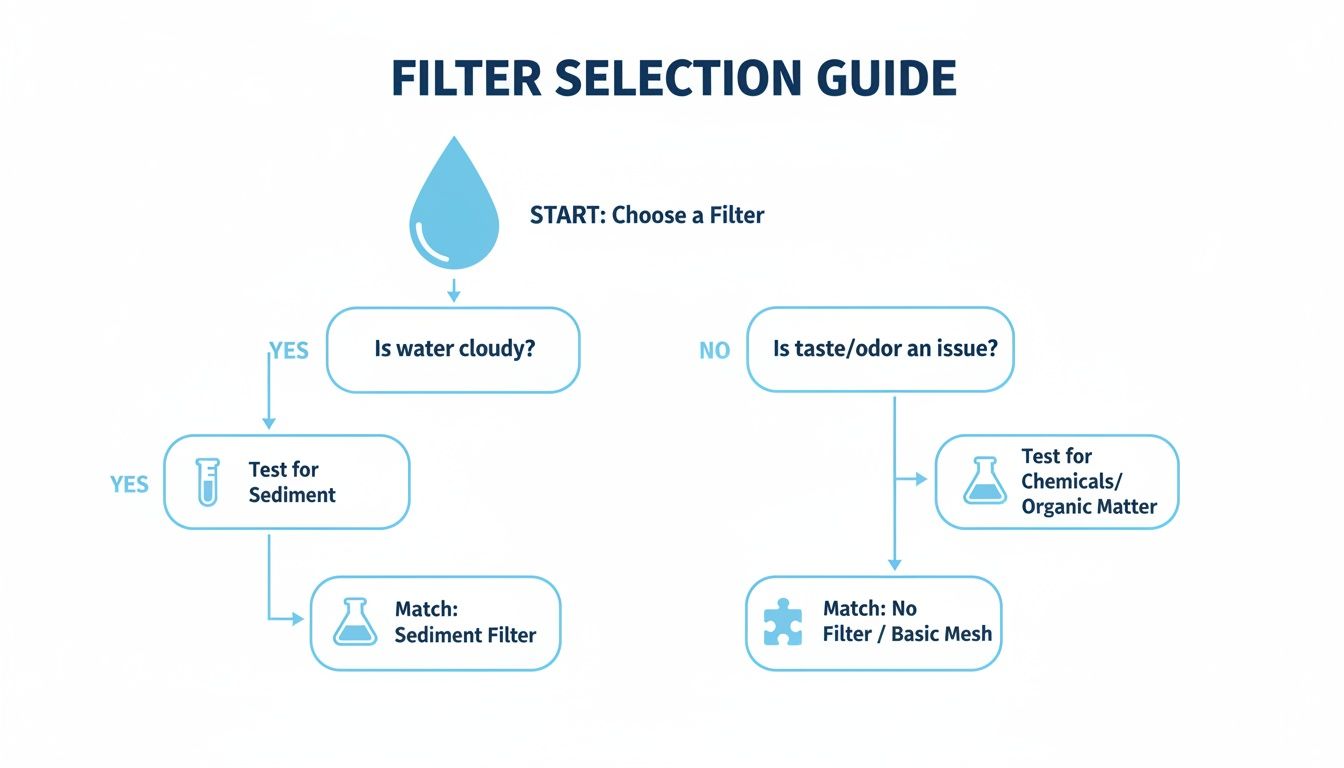
The key takeaway here is pretty straightforward: let your water's specific issues—whether it’s a bad taste, a strange smell, or invisible contaminants—directly guide your choice of filter.
Match The Problem To The Technology
Now that you know what you need to remove, you can match the problem to the right tool for the job. Not all filters are created equal; each type is designed to target different things.
The goal isn't to find the "best" filter on the market, but to find the best filter for your water. A system that’s perfect for removing chlorine might do absolutely nothing for hard water minerals.
To simplify things, I've put together a quick table to help you connect common water complaints with the most effective filtration systems we've talked about.
Matching Your Water Problem to the Best Filter Type
This table is designed to help you quickly identify the most effective filtration system based on the specific water quality issues you're facing at home.
| Common Water Problem | Primary Contaminants | Recommended Filter Type(s) |
|---|---|---|
| Bad Taste/Smell (Chlorine) | Chlorine, Chloramine, VOCs | Activated Carbon (Pitcher, Faucet, Under-Sink, Whole-House) |
| Cloudy or Murky Water | Sediment, Silt, Rust | Sediment Filter (Often part of a Whole-House system) |
| Hard Water Stains & Buildup | Calcium, Magnesium | Ion Exchange (Water Softener) |
| Lead, Fluoride, Arsenic Concerns | Heavy Metals, Dissolved Solids | Reverse Osmosis (Under-Sink) |
| Well Water Safety (Bacteria/Viruses) | E. coli, Giardia, Viruses | UV Purifier, Distiller |
By pinpointing your problem in the first column, you can easily see which type of filter is best equipped to handle it.
Consider Your Budget And Installation Comfort
Finally, you have to think about the practical side of things. How much are you willing to invest, and are you comfortable with a DIY project, or would you rather hire a pro? A simple pitcher filter might cost less than $50 and requires zero installation, while a whole-house system can run into the thousands and definitely needs a plumber.
Be realistic about your budget for both the initial purchase and long-term maintenance, like filter replacements. Once you've considered all these factors, you can start to explore yasutrading's product range to see what fits your needs and price point. With this structured approach, you'll feel confident choosing a system that truly protects your home.
Frequently Asked Questions About Home Water Filters
Even after looking at all the options, you probably still have a few questions. That's normal. Let's tackle some of the most common ones we hear from homeowners to clear up any final confusion.
Is My City's Treated Water Good Enough?
Sure, the water coming from your city's treatment plant meets the legal minimum safety standards. But that doesn't mean it's great. It's often loaded with disinfectants like chlorine or chloramine, which is why your tap water can taste and smell like a swimming pool. These chemicals can also dry out your skin and hair.
Don't forget that water travels a long way to get to you, and it can pick up contaminants like lead from old pipes along the journey. A home filter is your last line of defense, making sure the water is as clean as possible right where you use it.
What Is the Difference Between Filtration and Purification?
It's a great question. Think of it this way: filtration is like cleaning, while purification is like sterilizing.
Filtration removes sediment, chemicals, and other particles that affect taste and clarity. Most carbon-based filters are in this category. Purification is a more intense process that kills or removes living microorganisms like bacteria and viruses. Systems using Reverse Osmosis or UV light are considered purifiers. For most people on city water, filtration is all you need. If you're on well water, purification is often a must.
How Often Should I Change My Water Filters?
This one is non-negotiable: you have to follow the manufacturer's schedule. A filter that's past its prime doesn't just stop working—it can actually become a breeding ground for bacteria and make your water worse than it was before.
A filter's lifespan is a promise, not a suggestion. Ignoring it means you're no longer protecting your water; you're just running it through a dirty sponge.
Here are some general timelines, but always check your specific model:
- Pitcher Filter: Every 2 months or so.
- Under-Sink Filter: Typically every 6-12 months.
- Whole-House Filter: Anywhere from 3-9 months, depending on your water quality.
Staying on top of this one simple task is the best way to guarantee your system keeps working like it's supposed to.
Ready to find the perfect filtration solution for your home? At Water Filter Advisor, we provide expert reviews, in-depth guides, and practical advice to help you make a confident choice. Explore our resources today and start your journey to better water at https://www.waterfilteradvisor.com.
- December 26, 2025
- 0
- Uncategorized
