Carbon Filtered Water vs Reverse Osmosis: The Ultimate Showdown for Your Kitchen Sink

When you're squaring up to decide between a carbon filter and a reverse osmosis system, it all comes down to a single, epic question: What villain are you trying to defeat in your water?

If your city water just tastes a bit like a swimming pool thanks to chlorine, a simple carbon filter is your quick and easy superhero. It’s an affordable and crazy-effective way to make your water taste and smell amazing. But if your concerns are more sinister—like evil heavy metals, pesky fluoride, or other dissolved solids lurking in your pipes—then reverse osmosis is the heavy-hitting avenger you need to call.

Choosing Your Home Water Filtration Champion

Diving into the world of water filtration can feel like trying to drink from a firehose, but it doesn't have to be. The two most popular champions you'll encounter are activated carbon filters and reverse osmosis (RO) systems. Both promise cleaner, better-tasting water, but they get there using completely different battle tactics and are designed to fight different enemies.

Understanding this fundamental difference is the key to choosing wisely for your home. Think of a basic carbon filter—like the one in your fridge or a Brita pitcher—as a super-powered sponge. It uses a cool process called adsorption to grab onto contaminants that make your water taste and smell funky. An RO system, however, is a much more intense, multi-stage gladiator that forces water through a ridiculously fine membrane, stripping out nearly everything else along the way.

The Rise of the Home Filtration Fortress

The quest for better water at home isn't just a fleeting trend. Back in the early 2000s, as more reports surfaced about the millions of Americans drinking tap water with unsafe contaminants, carbon filters became the first line of defense for countless households. Their secret weapon is an incredible surface area; a single gram of activated carbon can have a surface area of up to 1,000 square meters, enabling it to achieve up to 99.9% removal of certain volatile organic compounds (VOCs). If you want to see how different filter types stack up against specific contaminants, check out this 2025 guide to water filtration.

In this guide, we’re going to spill all the tea. We’ll cover:

  • How each technology actually works its magic.
  • The specific villains each one is best at vanquishing.
  • The real-world differences in cost, maintenance, and daily use.
  • No-nonsense recommendations to help you match the right system to your home's water.

To get started, let’s look at a quick tale of the tape. For more in-depth guidance on various filter types, you might be interested in exploring our comprehensive water filter advice section.

Carbon Filter vs Reverse Osmosis at a Glance

This table gives you a bird's-eye view of the key differences between these two filtration titans. It's a great way to quickly see which system might be a better fit for your home's needs before we get into the nitty-gritty.

Feature Carbon Filtration Reverse Osmosis (RO)
Primary Function Improves taste and odor by removing chlorine and VOCs Purifies water by removing a broad range of contaminants
Contaminant Removal Chlorine, pesticides, herbicides, some sediments, VOCs Dissolved solids, heavy metals, fluoride, nitrates, bacteria
Impact on Minerals Retains healthy minerals like calcium and magnesium Removes nearly all minerals, which can affect taste
Wastewater Produces no wastewater Creates a wastewater stream to flush away contaminants
Installation Simple; ranges from pitchers to under-sink units More complex; typically an under-sink system with a tank
Upfront Cost Lower ($20 – $200) Higher ($150 – $500+)

As you can see, the choice isn't just about which one is "better," but which one is better for you. One is a targeted solution for taste, while the other is a comprehensive purification powerhouse.

How Carbon Filters Polish Your Water

Before we can truly get into the carbon filtered water vs reverse osmosis debate, we need to appreciate the elegant simplicity of carbon filtration. This isn't some high-tech gimmick; people have been using charcoal to keep water fresh since ancient Egypt. Of course, today’s tech is a whole lot sleeker, but the basic principle is the same.

At its core, a carbon filter acts like a powerful magnet for certain types of contaminants. As water flows through it, a process called adsorption kicks in, making chemical impurities literally cling to the carbon's surface. Picture a microscopic maze with an insane amount of surface area—it traps all the gunk while letting pure water molecules sail right on through.

The end result? Water that tastes crisp and has no funky smells, free from the chemical signature that's all too common in city tap water.

The Power of Activated Carbon

So, what’s this "activated" business all about? This is where the magic happens. The raw carbon, usually from something awesome like coconut shells, gets superheated with steam. This process riddles the carbon with millions of tiny pores, massively expanding the internal surface area where adsorption can occur.

This sprawling network of pores is incredibly good at grabbing onto the specific culprits that ruin your water's taste and smell.

  • Chlorine: This is carbon's #1 enemy. If your water has that swimming pool vibe, a carbon filter will knock it out cold.
  • Volatile Organic Compounds (VOCs): These are various industrial and commercial chemicals that can unfortunately sneak their way into our water sources.
  • Pesticides and Herbicides: Carbon is also a champ at reducing many common agricultural chemicals.

But what a carbon filter doesn't do is just as important to understand. It won't remove dissolved solids like salts, most heavy metals (think lead or arsenic), fluoride, or nitrates. It essentially polishes your water—it doesn't purify it down to the molecular level.

Granular vs. Block Carbon Filters

Not all carbon filters are created equal. The two main types you'll encounter are Granular Activated Carbon (GAC) and Carbon Block, and knowing the difference will help you choose the right warrior for your home.

GAC filters are filled with loose carbon granules. You’ll find these in most basic water pitchers or the filter in your fridge. They work, but over time, water can carve a sneaky path of least resistance through the granules—a phenomenon called "channeling"—which means it's not getting fully filtered.

Carbon block filters, on the other hand, are made from activated carbon powder that’s been compressed into a solid brick. This forces water through a much more uniform and intricate obstacle course, preventing channeling and maximizing contact time with the carbon. This makes them a more thorough and reliable choice, typically found in under-sink setups and faucet-mounted filters.

A great real-world example is a simple Cuisinart compatible activated charcoal water filter replacement. It's this exact kind of technology that transforms a harsh, chlorinated cup of coffee into something smooth and delicious, just by starting with better water.

How Reverse Osmosis Purifies Your Water

Think of a carbon filter as a magnet that grabs specific things you don't want, like chlorine. A reverse osmosis (RO) system, on the other hand, is more like a bouncer at an exclusive club—it lets almost nothing through except pure water. It’s an intense, multi-stage process built to strip out a massive range of contaminants, producing exceptionally pure H₂O.

Instead of the adsorption method used by carbon, reverse osmosis relies on raw pressure. Your home’s water pressure is used to force water molecules through a special semi-permeable membrane. This membrane is the real MVP, packed with microscopic pores around 0.0001 microns in size. They’re so tiny that almost nothing besides a water molecule can get through.

It’s essentially the opposite of natural osmosis, which is where it gets its name. The result is a purification powerhouse that goes far beyond taste and odor improvement. It’s about fundamentally changing the water’s makeup to get it as close to pure as possible.

The Multi-Stage Purification Journey

An RO system isn't a single filter; it's a super-team of filters, all working together. Water from your tap goes on a little adventure, where each stage cleans it up and prepares it for the next step. This sequence protects the most important component—the RO membrane—and guarantees the final product is pristine.

Here's a look at the typical path water takes in an under-sink RO system:

  1. Sediment Pre-Filter: The first stop is like a bouncer for the big stuff—dirt, sand, rust, and other grit. Its main job is to keep this gunk from clogging up the more sensitive filters down the line.
  2. Carbon Pre-Filter: Next, the water flows through an activated carbon filter. This is a critical step because it removes chlorine and chloramines, which can literally eat away at the delicate RO membrane and ruin it.
  3. The RO Membrane: This is where the real magic happens. Water pressure shoves the pre-filtered water against the semi-permeable membrane. The tiny water molecules are squeezed through, while dissolved contaminants are left behind and rejected.
  4. The Wastewater Stream: Everything rejected by the membrane gets collected into a concentrated stream of wastewater and is simply flushed down your drain. This is a necessary part of the process that keeps the membrane from getting clogged.
  5. Storage Tank: The purified water, now called permeate, is collected and stored in a small pressurized tank, usually located right under your sink.
  6. Post-Filter (Polishing Filter): When you turn on your dedicated RO faucet, the water leaves the storage tank and passes through one last carbon filter. This final "polishing" step gets rid of any slight taste or odor the water might have picked up while sitting in the tank.

The core difference in the carbon filtered water vs reverse osmosis debate lies here. An RO system includes carbon filtration as a crucial support stage, but its primary purification engine—the membrane—removes a much broader range of contaminants that carbon alone cannot touch.

Targeting Total Dissolved Solids

A key performance metric for any RO system is how well it reduces Total Dissolved Solids (TDS). TDS is just a measurement of all the inorganic salts, minerals, heavy metals, and other matter dissolved in your water.

High TDS can give water an off-putting salty or bitter taste. More importantly, it can signal the presence of contaminants you definitely don't want to be drinking. RO systems are absolute champions at this, consistently removing over 95% of TDS. This is why RO water has that signature "pure" taste—it's been stripped of nearly everything but water itself.

Comparing Contaminant Removal Capabilities

Alright, this is the main event. Choosing the right system means looking past the marketing jargon and getting real about what each filter can actually pull out of your water. This is where your local water quality report becomes your best friend—it tells you exactly which villains you're up against.

Let's put these two technologies head-to-head across the most common water woes. We'll see where each one shines and where it falls short, giving you a clear path to the right solution for your home.

Chlorine, Taste, and Odor

Does your tap water taste and smell like it just jumped out of a swimming pool? If so, an activated carbon filter is your hero. It works through a process called adsorption, where chlorine and other foul-tasting compounds get trapped on the carbon's surface. It's incredibly effective and a quick fix.

Reverse osmosis systems also vanquish chlorine, but they do it with a carbon pre-filter before the water even hits the main RO membrane. So, while both get the job done, a simple carbon filter is the more direct and affordable solution for just bad taste and odor.

Pesticides and Volatile Organic Compounds (VOCs)

This is where things get a bit more interesting. A good-quality carbon block filter can do a fantastic job of reducing a wide range of organic chemicals, including many common pesticides, herbicides, and those nasty VOCs.

An RO system also tackles these chemicals, again using its carbon pre-filters. The difference is that the RO membrane itself acts as a second, powerful line of defense. If your water report flags a cocktail of different chemical contaminants, that extra layer of protection from an RO system is hard to beat.

The Key Takeaway: For simply making your water taste great and getting rid of that chlorine smell, carbon is the clear winner. For a more comprehensive shield against a wider variety of chemicals, reverse osmosis offers ultimate peace of mind.

Heavy Metals Like Lead and Arsenic

Here’s where the two systems really part ways. A standard carbon filter is not the right tool for removing heavy metals like lead, arsenic, or mercury. While some specialized carbon filters are certified for lead reduction (look for NSF/ANSI 53), they won't handle the full spectrum of heavy metals.

This is reverse osmosis's time to shine. The semi-permeable RO membrane is engineered specifically to block these tiny, dissolved contaminants. It’s not uncommon for an RO system to remove up to 99% of heavy metals. If you have any reason to be concerned about lead or other metals in your water, RO is the only responsible choice.

Dissolved Solids, Fluoride, and Nitrates

The term Total Dissolved Solids (TDS) covers everything from healthy minerals to unwanted stuff like fluoride, nitrates, and salts. Carbon filters do almost nothing to reduce TDS—they let all of it pass right through.

Reverse osmosis, on the other hand, is designed from the ground up to slash TDS levels. Its fine-pored membrane is a powerhouse against:

  • Fluoride: RO is one of the very few home filtration methods that can effectively remove fluoride.
  • Nitrates: A serious concern in agricultural areas, nitrates are easily rejected by an RO membrane.
  • Salts: If your water has a salty or brackish taste, an RO system can make it pure and clean.

Effectiveness Against Common Water Contaminants

To make it even clearer, let's look at a side-by-side scorecard. This table shows how each system handles specific contaminants you might find in your home's water supply, whether it's from the city or a private well.

Contaminant Type Carbon Filter Effectiveness Reverse Osmosis Effectiveness Best Choice For
Chlorine Excellent (main function) Excellent (uses a carbon pre-filter) Carbon Filter
Taste & Odor Excellent Excellent Carbon Filter
Pesticides/VOCs Good to Very Good Excellent Reverse Osmosis
Lead Poor (unless NSF 53 certified) Excellent (>95% removal) Reverse Osmosis
Arsenic & Mercury Not Effective Excellent (>97% removal) Reverse Osmosis
Fluoride Not Effective Excellent (>90% removal) Reverse Osmosis
Nitrates & Sulfates Not Effective Excellent Reverse Osmosis
Bacteria & Viruses Not Effective Very Good to Excellent Reverse Osmosis
PFAS ("Forever Chemicals") Good Excellent Reverse Osmosis

This comparison really highlights the core difference: Carbon filtration is a fantastic improver, making good water taste great. Reverse osmosis is a purifier, taking water with serious contamination issues and making it exceptionally safe to drink.

Emerging Contaminants like PFAS

The conversation around "forever chemicals" like PFAS (PFOA/PFOS) is growing, and for good reason. High-quality activated carbon filters have proven effective at reducing certain PFAS compounds, which is a great start.

However, reverse osmosis is widely considered the gold standard for removing a broad spectrum of PFAS from drinking water. The one-two punch of carbon pre-filters and the RO membrane provides a robust, multi-stage defense against these stubborn chemicals.

While these systems are excellent for everyday home use, it's also smart to be aware of other fast, reliable water purification methods for survival for situations where your primary system might not be available.

The Real Cost of Ownership and Daily Use

Picking a water filter isn't just about science; it's about how the system fits into your life and your wallet. The price on the box is only the beginning. When you're weighing carbon filtered water vs reverse osmosis, you have to look at the practical, long-term costs and how each one feels to use every day.

A simple carbon filter, whether it clips onto your faucet or tucks under the sink, is pretty easy on the budget upfront. You can get a great system for well under $200. Reverse osmosis systems are more complex, with their multiple filter stages and storage tanks, so they naturally start a bit higher, usually running from $150 to over $500 for a standard under-sink setup.

But that initial investment is just one part of the story. The ongoing costs are where you'll really see the financial differences stack up over time.

Calculating Long-Term Expenses

The true cost of ownership comes down to replacing the filters. This is where you’ll be spending money for years, so it’s a huge factor in your decision.

With a basic under-sink carbon filter, you're usually just swapping out a single cartridge every 6 to 12 months. These replacements are pretty affordable, often landing somewhere between $40 and $100 for the whole year, depending on the brand and how much water your family uses. It’s a simple, predictable expense.

Reverse osmosis systems have more components to maintain. You’ll be replacing several different filters on a staggered schedule:

  • Sediment and Carbon Pre-filters: These workhorses protect the main membrane and typically need to be changed every 6 to 12 months.
  • RO Membrane: This is the heart of the system and the most expensive part. Thankfully, it's also the most durable, usually lasting 2 to 3 years.
  • Carbon Post-filter: This final "polishing" filter gets swapped out every 6 to 12 months to keep the water tasting fresh.

All in, you can expect to spend between $100 and $200 annually on replacement filters for an RO system. It’s more than a carbon filter, sure, but that cost covers a much more thorough, multi-stage purification process.

Daily Usability and Flow Rate

Money aside, how does each system actually work in your kitchen day-to-day? One of the first things you'll notice is the flow rate.

Under-sink carbon filters hook right into your main cold water line. When you turn on the tap, water comes rushing out at pretty much the same speed you're already used to. There’s no waiting around—it’s a completely seamless experience.

Reverse osmosis systems are a different beast. The purification process is incredibly slow and detailed, so RO systems need a small storage tank to keep a reserve of purified water ready to go. This water comes out of a separate, dedicated faucet installed right on your sink. The flow from this smaller faucet is definitely slower than your main tap. It's the classic trade-off for purity—you get amazingly clean water, but you have to be a little more patient.

The difference in flow rate is a perfect example of the core trade-off. Carbon offers convenience and speed for better-tasting water, while reverse osmosis sacrifices some speed for a much higher level of purification.

The Critical Difference in Water Taste

Finally, let's talk taste—the whole reason you’re looking for a filter in the first place. This is where the two systems really part ways, and it often comes down to personal preference.

Carbon filters are fantastic at improving taste. They remove chlorine and other funky chemicals but intentionally leave in beneficial minerals like calcium and magnesium. This gives you water that tastes clean, crisp, and refreshing, a lot like a high-end bottled spring water. It's the taste most of us know and love.

Reverse osmosis, on the other hand, is so powerful it strips out practically everything—including those healthy minerals. The result is ultra-pure H₂O, which can have a "flat" or even slightly acidic taste that some people don't care for. It’s pure, but it lacks the character minerals provide.

Luckily, there’s an easy fix. Many modern RO systems now come with a remineralization filter as the final stage. This little cartridge adds a balanced mix of healthy minerals back into the water just before it hits your glass, dramatically improving the taste and raising the pH. It’s really the best of both worlds: the absolute purity of RO with the pleasant, familiar taste of mineral water.

Making the Right Choice for Your Home

Figuring out the whole carbon filtered water vs reverse osmosis thing isn't about finding the one "best" system. It's about matching the right technology to the specific problems coming out of your tap. It really boils down to what you're trying to fix.

If you’re on city water, chances are it's perfectly safe to drink, but it might taste or smell like a swimming pool. That strong chlorine flavor is a common complaint. In this situation, a quality activated carbon filter is your best bet. It’s fantastic at knocking out the chlorine and other stuff that makes water unpleasant, giving you crisp, clean-tasting water without the cost and complexity of a bigger system.

When to Upgrade to Reverse Osmosis

The conversation completely shifts if you're worried about more than just taste and smell. This is where a reverse osmosis system moves from a "nice-to-have" to a smart investment, especially if you have a private well or live in an area with older city pipes.

You should seriously consider an RO system if you're dealing with any of these issues:

  • High Total Dissolved Solids (TDS): If your water has a salty, bitter, or just "heavy" taste, an RO system is the only practical way to lower those TDS levels.
  • Known Heavy Metals: For serious contaminants like lead, arsenic, or mercury, the RO membrane acts as a nearly impenetrable barrier that a simple carbon filter can't provide.
  • Nitrates or Fluoride: These are common in agricultural areas or municipalities that add fluoride, and only reverse osmosis can reliably remove them.
  • Emerging Contaminants: An RO system offers the most powerful defense you can get for your home against things like PFAS ("forever chemicals") and other industrial runoff.

The real lightbulb moment for many people is realizing that every reverse osmosis system already includes carbon filters. They act as pre-filters to protect the RO membrane and a post-filter to polish the taste. So, an RO unit isn't an alternative to carbon—it's a complete, multi-stage solution that uses both technologies.

This decision tree gives you a great visual for weighing the costs and benefits.

As you can see, the path forks pretty quickly based on your budget, what you need to remove, and how much maintenance you’re willing to do.

Your First Step is Always Testing

You can't fix a problem if you don't know what it is. Before you spend a dime on a filter, you need to find out exactly what's in your water.

If you get your water from a municipality, just ask them for their latest Consumer Confidence Report (CCR). It's a free annual report that lists all the tested contaminants and shows how they stack up against EPA limits.

For those on well water, the responsibility for testing is on you. A good starting point is to contact your local health department; they can provide a list of state-certified labs that will run a full analysis for you.

Once you have your water report in hand, look for official certifications when you start shopping. The gold standard comes from NSF/ANSI.

  • NSF/ANSI 42: This is the basic certification for taste and odor. It confirms a filter reduces aesthetic issues like chlorine. Any decent carbon filter should have this.
  • NSF/ANSI 53: This is a big one. It certifies that a filter reduces specific health-related contaminants, such as lead, mercury, or cysts.
  • NSF/ANSI 58: This certification is exclusive to reverse osmosis systems. It verifies the system’s ability to reduce TDS and a whole list of other tough contaminants like arsenic and fluoride.

Choosing a certified product means you aren't just taking the manufacturer's word for it. It's proof that the system does what it claims to do, giving you real peace of mind with every glass you drink.

Your Top Questions Answered

When you're comparing carbon filtration to reverse osmosis, a few key questions always come up. Let's tackle them one by one so you can feel totally confident in your choice.

Does Reverse Osmosis Remove Healthy Minerals?

Yes, it does. Reverse osmosis is incredibly thorough—so much so that it strips out beneficial minerals like calcium and magnesium right along with the bad stuff. This is what gives RO water its signature ultra-pure, and sometimes "flat," taste.

For most of us, this isn't a huge deal since we get plenty of minerals from our diet. But if you're concerned about mineral intake or just prefer the taste of mineral water, there's an easy fix. Many modern RO systems now come with a remineralization filter that adds a healthy balance of minerals back into the water just before it hits your glass.

Can I Install These Systems Myself?

It really depends on what you buy. Most of the simpler carbon filters—like pitchers, countertop models, and faucet attachments—are designed for anyone to install. You can usually get them up and running in a few minutes with no tools required.

Under-sink carbon filters and full reverse osmosis systems are a bit more involved and require some basic plumbing know-how. The instructions are usually clear enough for a confident DIYer, but if messing with your home's water lines makes you nervous, calling a plumber is always the smart move. It's better than dealing with a leak down the road.

The trade-off is clear: simpler carbon filters offer plug-and-play convenience, while more powerful RO systems demand a more permanent installation. Assess your comfort level with plumbing tasks before making a purchase.

How Much Water Does a Reverse Osmosis System Waste?

Older RO systems definitely earned their reputation for being water hogs, but today's technology is much better. Many new, high-efficiency models have brought the waste-to-pure-water ratio down to around 1:1 or 2:1.

That "wastewater" (also called brine) is just carrying all the filtered-out contaminants safely down the drain. For the average family, the extra water usage is pretty minimal in the grand scheme of things, but it's something to consider if water conservation is a major priority for you.

Which System Has a Better Water Flow Rate?

Hands down, carbon filters win on flow rate. Because they integrate right into your main line, whole-house or under-sink carbon filters have almost no impact on your water pressure. You won’t even notice a difference at the tap.

Reverse osmosis, on the other hand, is a much slower, more methodical process. To get around this, RO systems use a pressurized storage tank to keep a supply of purified water ready to go. This water is delivered through a separate, dedicated faucet, and the flow will be noticeably slower than your main kitchen faucet. It's a practical trade-off for getting that level of purity.


Ready to find the perfect filtration solution for your home? The experts at Water Filter Advisor have done the research for you, with in-depth guides and unbiased reviews to help you choose with confidence. Explore our comprehensive resources at https://www.waterfilteradvisor.com.

A Complete Guide to Types of Home Water Filtration Systems

Ready to dive into the world of water filters? It can feel like a deep ocean of options, but here's a secret: it all starts with one simple question. Do you want to treat all the water flooding into your house, or just the water at a specific tap, like your kitchen sink?

That's the real difference between Point-of-Entry (POE) systems, which guard your entire home's water supply, and Point-of-Use (POU) systems, which give you VIP filtration right where you drink. Nailing this one decision is your first and most important step toward tastier, safer water.

A bright kitchen scene with a 'Clean Water Guide' sign, a sink, faucet, and a water pitcher.

Point-of-Entry vs. Point-of-Use: What’s the Difference?

Imagine a Point-of-Entry (POE) system as the ultimate bouncer for your home. It’s installed where your main water line comes in, checking every single drop before it gets to your shower, washing machine, toilets, and taps. It’s the heavyweight champion for fighting house-wide problems, like hard water that coats everything in a crusty film or sediment that clogs your pipes.

A Point-of-Use (POU) system, on the other hand, is like a personal bodyguard for a specific faucet. These are your under-sink filters, countertop units, and faucet attachments that serve up ultra-purified water right where you need it for drinking your morning coffee or boiling pasta.

To make it even clearer, let's break down the core differences in a simple table.

Point-of-Entry vs. Point-of-Use Filters at a Glance

This table provides a high-level comparison between the two primary categories of home water filtration systems to help you quickly understand their core differences.

Feature Point-of-Entry (Whole-House) Point-of-Use (Single Tap/Appliance)
Treatment Scope Treats all water entering the home. Treats water at a single location (e.g., kitchen sink).
Typical Use Case Addressing widespread issues like hardness, chlorine, sediment. Improving taste, odor, and purity of drinking/cooking water.
Installation Professional installation is often required. Typically a simple DIY installation.
Cost Higher initial investment. Lower initial cost, more accessible.
Maintenance Less frequent filter changes (e.g., every 6-12 months or longer). More frequent filter changes (e.g., every 2-6 months).

As you can see, the choice isn't about which one is "better" overall, but which one is better for you.

Why This Choice Is So Important

Figuring this out from the start saves you a world of headaches. It explains why your neighbor might install a massive whole-house system to stop hard water from destroying their appliances, while you might be perfectly happy with a simple pitcher filter just to make your iced tea taste better. It all comes down to your water and your goals.

It's no surprise that targeted, easy-to-use solutions are wildly popular. In fact, Point-of-Use (POU) filters are on track to make up nearly 44.8% of total revenue in the home filtration market by 2025. Why? Because they're easy. Anyone can grab a pitcher or screw on a faucet filter without calling a plumber. If you want to dig deeper, you can discover more insights about the water filter market and its growth.

The real question isn't just "What's in my water?" but also "Where do I need the cleanest water?" Answering that will instantly point you in the right direction.

This guide will walk you through all the specific types of home water filtration systems that fall into both of these categories. Now that you understand the basic landscape, you're ready to explore the different technologies—from reverse osmosis to activated carbon—and find the perfect fit for your home.

Whole-House Filters: The Ultimate Solution for Your Home's Water

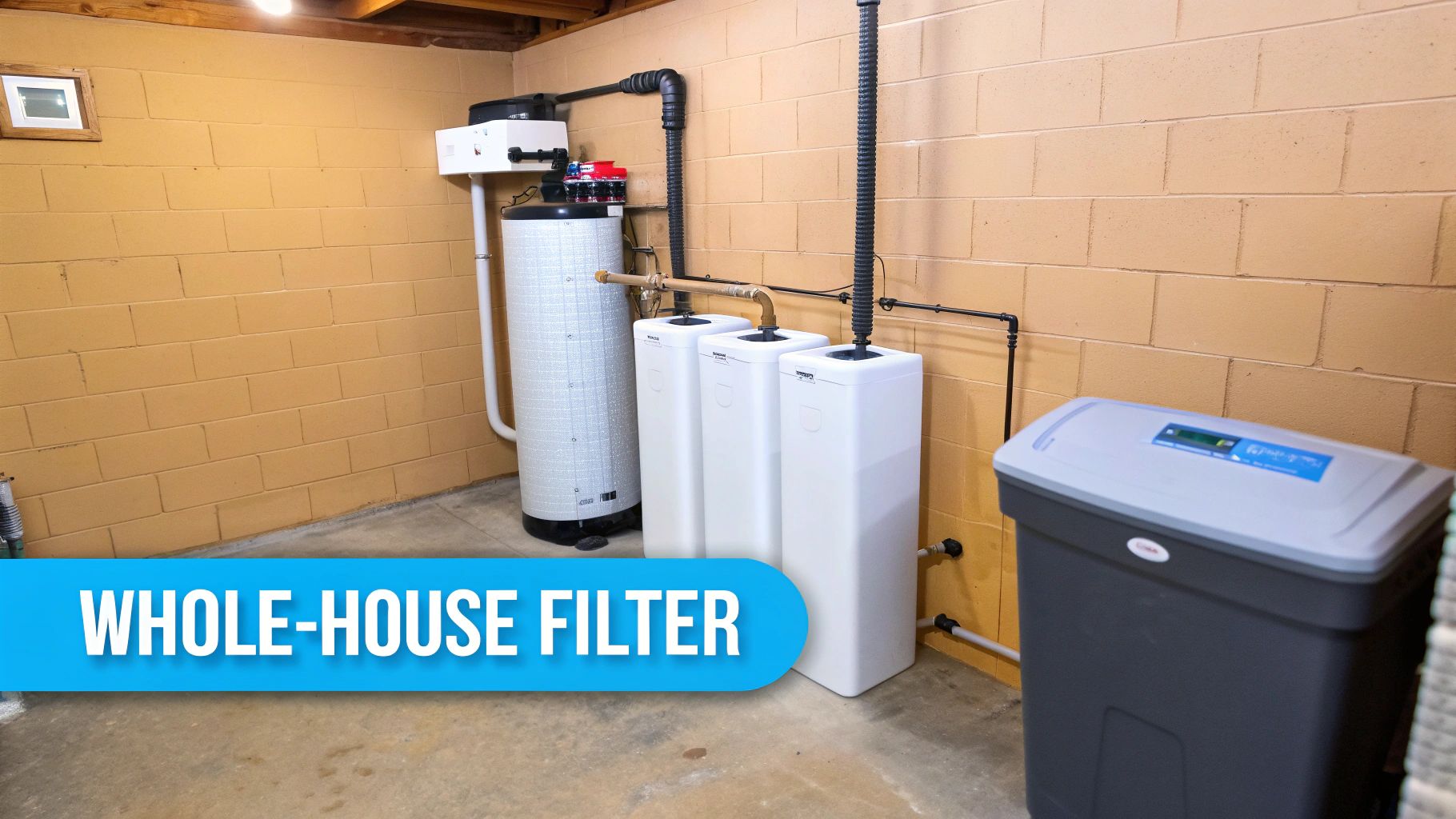
Imagine turning on any faucet in your house—the shower, the washing machine, the bathroom sink—and getting pure, clean water. Not just in the kitchen, but everywhere. Every single drop is treated. That’s not a dream—it's what a Point-of-Entry (POE), or whole-house, water filtration system delivers.

These systems are the comprehensive guardians of your home’s water. Installed right where the main water line enters your house, they stand as a fortress to ensure that every appliance and tap gets the good stuff.

A basement utility area featuring a complex whole-house water filtration and softening system with multiple tanks.

This all-in-one approach is exactly why so many homeowners are opting for a total water quality upgrade. The market is booming, expanding from $20,502.5 million in 2021 with a forecast to hit $25,389.4 million by 2025. People are tired of dealing with widespread issues like chlorine, sediment, and other contaminants, and they want a solution that tackles them at the source.

How Do These Systems Actually Work?

Think of a whole-house filter like a multi-stage security checkpoint for your water. As water enters from the main line, it’s pushed through a series of different filter media, with each layer designed to snag specific troublemakers. This layered defense is what makes them so powerful against a whole range of issues.

A typical setup often includes a few key players working together:

  • Sediment Pre-Filter: This is your first line of defense. It catches the big stuff—sand, silt, rust, and dirt—and prevents it from clogging up the more sensitive filters down the line.
  • Activated Carbon Filter: This is the real workhorse for getting rid of nasty chemicals. It uses super-porous carbon to absorb chlorine, chloramine, pesticides, and other compounds (VOCs) that make your water taste and smell funky.
  • KDF Media: Kinetic Degradation Fluxion (KDF) is a fancy name for a special blend of copper and zinc that creates a chemical reaction. It’s fantastic at removing heavy metals like lead and mercury and even helps stop bacteria and algae from growing inside your filter.

Many systems can also be customized with add-ons like a water softener to fight hard water minerals (calcium and magnesium) or a UV purifier to zap any lingering microbiological threats. The right combination really depends on what’s in your water to begin with.

The True Value of Treating Your Entire Home

The payoff of a whole-house system goes way beyond just better-tasting water from the kitchen tap. Since every drop is treated, you’ll notice the benefits in places you might not expect. Your shower water will be free of drying chlorine, and your clothes will come out of the wash brighter and last longer.

One of the biggest long-term wins is how it protects your plumbing and all your water-using appliances. By filtering out corrosive chemicals and scale-building minerals, you extend the life of your water heater, dishwasher, washing machine, and pipes, saving yourself a ton of money on repairs and replacements.

This makes a whole-house system a really smart investment, especially if you're already planning a big home upgrade. If you're tackling a major project, thinking about your water from the get-go is key. For example, this helpful whole house renovation checklist shows how water filtration can fit right into the bigger picture of your home improvements.

Is a Whole-House Filter the Right Choice for You?

Making the jump to a whole-house system means weighing the upfront cost against the incredible long-term, home-wide benefits.

Here’s what you need to keep in mind:

  • Installation: This isn't a simple DIY job. These systems need to be tied into your main water line, so you'll almost always need a licensed plumber to do it right. This adds to the initial cost but ensures everything is hooked up correctly and safely.
  • Maintenance: While you won't be changing filters every month, the maintenance is more involved. You’ll be swapping out large filter cartridges every 6-12 months or sometimes even longer, depending on your water quality and how much you use.
  • Cost: The initial price tag can be anywhere from a few hundred to a few thousand dollars, plus what you'll pay for installation. But when you add up the savings from longer-lasting appliances and plumbing, the value becomes crystal clear over time.

For any homeowner who is serious about getting the absolute best water quality in every part of their home, a whole-house filter is the definitive solution.

Under-Sink Systems for Targeted Purification

While whole-house systems cast a wide net, sometimes you need surgical precision. For many of us, the most critical battleground for water quality is the kitchen sink—the source of our drinking and cooking water. This is precisely where under-sink filtration systems come in, giving you a powerful, localized defense right where it counts most.

Tucked away in the cabinet, these units are the quiet heroes of home water treatment, delivering incredibly clean water without the need for a major plumbing overhaul.

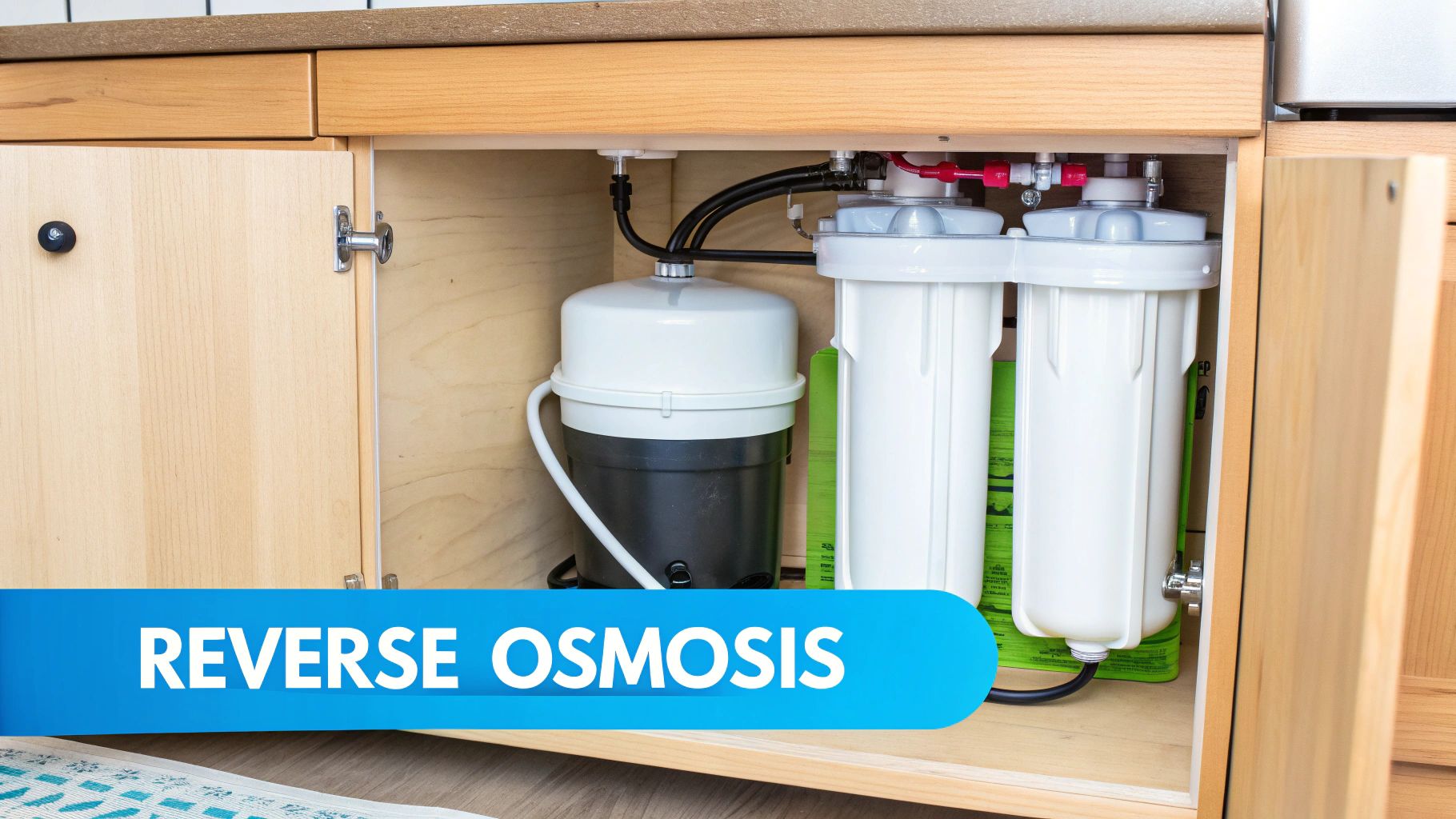
An under-sink reverse osmosis water filtration system with white filters and a tank inside a wooden kitchen cabinet.

When you start looking at under-sink options, one technology consistently rises to the top as the gold standard for purity: Reverse Osmosis (RO). It's the system of choice for anyone serious about getting the cleanest water possible, tackling contaminants other filters simply can't touch.

The Powerhouse of Purification: Reverse Osmosis

Think of a Reverse Osmosis system as the ultimate gatekeeper for your water. It’s not just a simple filter; it's a multi-stage purification process. Water first travels through a series of pre-filters, typically sediment and carbon, which knock out the big stuff like rust, dirt, and chlorine.

But the real workhorse is the RO membrane. This is where the magic happens.

This specialized, semipermeable membrane has microscopic pores so tiny that only water molecules can pass through. Nearly everything else—up to 99% of dissolved solids—is physically blocked, rejected, and sent down the drain. The result is water that is exceptionally pure.

Common Contaminants Removed by RO Systems

  • Heavy Metals: A knockout punch for lead, arsenic, mercury, and copper.
  • Dissolved Solids: Catches the things other filters miss, like fluoride, nitrates, and nitrites.
  • Chemicals: Removes chlorine and other disinfectants that create unpleasant tastes and smells.
  • Salts and Minerals: Drastically reduces total dissolved solids (TDS), leaving you with incredibly pure water.

Because this process is so meticulous, it's also a bit slow. That’s why nearly every RO system comes with a small storage tank. This tank keeps a few gallons of purified water on deck, ready to flow the moment you turn on the dedicated faucet.

Understanding the Pros and Cons

Like any high-performance technology, Reverse Osmosis has its trade-offs. It delivers a level of purification that’s second to none, but it’s important to understand what that involves.

The real beauty of an RO system is its ability to remove an incredibly broad spectrum of contaminants. It gives you peace of mind that your water isn't just filtered—it's truly purified.

Let's break down the good and the not-so-good:

Pros of Reverse Osmosis Cons of Reverse Osmosis
Superior Contaminant Removal: The most effective point-of-use method for getting rid of the widest range of pollutants. Wastewater Production: The system flushes away rejected contaminants, which creates wastewater (often 1-3 gallons for every pure gallon produced).
Improved Taste and Odor: By removing almost all impurities, it delivers crisp, clean-tasting water. Slower Water Flow: The purification process is methodical, which is why a storage tank is necessary for on-demand use.
Cost-Effective: Over time, it's far cheaper and more convenient than buying endless cases of bottled water. Requires a Dedicated Faucet: Most setups need a separate, smaller faucet installed on your sink just for the purified water.
Hidden from View: The entire system lives neatly under the sink, leaving your countertops free of clutter. Removes Beneficial Minerals: The membrane is non-discriminatory; it removes healthy minerals like calcium along with the bad stuff. Some systems include a remineralization stage to fix this.

Simpler Alternatives: Multi-Stage Carbon Filters

If a full RO system seems like more than you need, there's a great middle-ground option: a multi-stage carbon filter. These units also install under the sink and connect directly to your cold-water line, but they work with your existing kitchen faucet.

These systems use a combination of advanced carbon blocks and other filter media. While they won't remove dissolved solids like fluoride or nitrates, they are fantastic at eliminating chlorine, lead, pesticides, and other chemicals that ruin the taste and smell of your water. They're also simpler to install, produce zero wastewater, and don't slow down your water flow, making them an excellent choice for targeted, high-quality filtration.

The Most Accessible Filters: Pitchers and Faucets

Sometimes, you don’t need a massive, complex system to get better-tasting water. For many people—especially renters, college students, or anyone wanting an immediate and affordable upgrade—the solution is right on the countertop or attached to the kitchen tap.

This is the world of water filter pitchers and faucet-mounted units, the most convenient entry points into home water filtration.

These simple devices are perfect for tackling the most common complaints about tap water, like that unmistakable chlorine smell or a slightly "off" taste. They're designed for quick results, transforming your water glass by glass, without needing any tools, plumbers, or permanent changes to your home's plumbing. It's no wonder they're one of the most popular types of home water filtration systems out there.

The Science Behind the Simplicity: Activated Carbon

The secret weapon inside both pitchers and faucet filters is activated carbon. Imagine a tiny, porous sponge with a massive surface area. As water passes through the filter cartridge, this carbon acts like a magnet for certain contaminants.

Its porous structure physically traps and absorbs undesirable elements. This process, known as adsorption, is incredibly effective at grabbing the specific culprits that mess with taste and odor, making your water instantly more palatable.

What Activated Carbon Filters Typically Remove:

  • Chlorine: This is the big one. Carbon excels at removing the chlorine used by municipal treatment plants, which is the main reason for that “pool water” smell and taste.
  • Lead and Mercury: Many certified filters can significantly reduce levels of heavy metals that might leach from older pipes.
  • Volatile Organic Compounds (VOCs): This can include various industrial chemicals and solvents that sometimes find their way into water supplies.
  • Bad Tastes and Odors: By targeting the compounds responsible for funky smells and flavors, these filters deliver a much cleaner, crisper final product.

The result is a noticeable improvement in the quality of your drinking water, coffee, and even the water you use for cooking. Suddenly, those fruity notes in your expensive coffee beans actually come through because they aren't being masked by chemical tastes.

Water Filter Pitchers: Your First Step to Better Water

A water filter pitcher is often the very first filtration device people buy. It’s the definition of plug-and-play; just fill the reservoir, let gravity do the work, and pour. It’s an incredibly low-stakes way to see if filtered water makes a difference for you.

Of course, this convenience comes with a few trade-offs. The main limitations are capacity and speed. You have to refill it constantly, and waiting for the water to trickle through the filter can be a test of patience when you're thirsty. Filter life is also short, typically requiring a replacement every 40 gallons or about two months, which means ongoing costs.

Faucet-Mounted Filters: On-Demand Filtration

For those who want filtered water on demand without the wait, a faucet-mounted unit is a fantastic step up. These devices screw directly onto your existing kitchen faucet in minutes—no tools needed. A small lever lets you switch between a filtered stream for drinking and an unfiltered one for washing dishes, which helps extend the filter's lifespan.

The real advantage of a faucet filter is its immediacy. You get a continuous flow of clean water right when you need it, bridging the gap between the patience required for a pitcher and the commitment of an under-sink system.

While they filter a wider range of contaminants than many basic pitchers and last longer (around 100 gallons or three months), they do have their own quirks. They can slow down your water flow and might not fit on all faucet types, especially those with pull-out sprayers.

Both pitchers and faucet units are excellent starting points, but they are primarily designed to improve aesthetics—taste and smell—rather than remove a broad spectrum of microscopic contaminants.

Specialized Filters for Unique Water Problems

Sometimes, the problems with your water go way beyond a funny taste or smell. You could be dealing with invisible microorganisms or hard water minerals that are slowly killing your pipes and appliances. When a standard carbon filter just won't cut it, you have to bring in the specialists.

These advanced systems are engineered to solve very specific problems, giving you a targeted defense against some of the toughest water quality issues out there. The most common and effective are UV purifiers, water distillers, and ion exchange systems. Each one uses a different scientific angle to get the job done.

UV Purifiers: The Chemical-Free Germ Killer

If you get your water from a private well or you’re worried about what might be swimming in it, a UV Purifier is your silent guardian. This tech doesn't "filter" water in the classic sense; instead, it zaps it with a powerful ultraviolet light.

Think of it like a security checkpoint for germs. As water flows through the unit, it’s hit with a special UV lamp that emits light at a specific wavelength (254 nanometers). This intense UV-C light blasts through the cell walls of things like bacteria, viruses, and protozoa (like Giardia and Cryptosporidium), completely scrambling their DNA. They can't reproduce, so they can't make you sick. It's a remarkably effective way to disinfect your water without adding a drop of chemicals.

So, when do you actually need a UV Purifier?

  • Well Water: It’s a non-negotiable for homes on well water. Groundwater can easily get contaminated from farm runoff or leaky septic systems.
  • Boil Water Advisories: If you’re on city water, a UV system gives you peace of mind when those boil water alerts pop up.
  • Compromised Immune Systems: For households with anyone who is immunocompromised, this extra layer of defense against microbes is a smart move.

Maintenance is pretty simple. You'll need to replace the UV lamp once a year to make sure it's still powerful enough, and the quartz sleeve that protects the bulb needs a good cleaning every so often.

Water Distillers: Mimicking Nature’s Purity

For anyone chasing the absolute purest water possible, a Water Distiller is the answer. This machine basically copies the earth’s natural water cycle—evaporation, condensation, and rain—to produce exceptionally clean water right on your countertop.

The process itself is straightforward but incredibly powerful. A distiller boils water, turning it into steam. As that steam rises, it leaves almost everything else behind: heavy metals, salts, bacteria, viruses, minerals, and chemicals. The pure water vapor is then cooled back down in a condenser coil and drips out as clean, distilled water.

A water distiller is the ultimate purification machine, knocking out a wider range of contaminants than just about any other single system. It's the gold standard for anyone who needs water that's as close to pure H₂O as you can get.

But that level of purity has its downsides. Distillation is slow, typically making only a few gallons a day, and it uses a fair bit of electricity. It also strips out beneficial minerals like calcium and magnesium, which gives the water a "flat" taste that some people don't care for.

Ion Exchange: The Science Behind Soft Water

Ever see those chalky white spots on your glassware? Or that crusty buildup on your showerhead? That's hard water. The culprits are high levels of calcium and magnesium, and the solution is an Ion Exchange system—what most of us just call a water softener.

Inside a water softener is a tank filled with thousands of tiny resin beads. These beads are "charged up" with sodium (or sometimes potassium) ions. When your hard water flows through the tank, the resin beads act like tiny magnets. They grab the hard water minerals (calcium and magnesium) and, in exchange, release the sodium ions into the water.

This simple "swap" is what makes your water soft. It stops scale buildup in its tracks, protects your appliances, and even makes your skin and hair feel softer. Of course, those beads eventually get full of minerals, so the system has to "regenerate" every so often. It does this by flushing itself with a brine (salt water) solution, which washes the calcium and magnesium away and recharges the beads with fresh sodium ions.

How To Choose The Right Water Filter For Your Home

Feeling a bit overwhelmed by the sheer number of options out there? That’s completely normal. Choosing from all the different types of home water filtration systems can seem complicated, but it really just boils down to answering three simple questions about your home and what you’re trying to achieve.

Answering these will cut through the noise and point you straight to the perfect solution. So, let's forget the technical jargon for a moment; this is your practical game plan for getting it right.

Start With What’s In Your Water

You can’t solve a problem if you don’t know what it is. The single most important first step is to figure out exactly what contaminants are flowing through your tap water. Honestly, you might be surprised by what you find.

  • For City Water: Your local municipality is required to send out an annual water quality report, often called a Consumer Confidence Report (CCR). This document lists all the tested contaminant levels and is a fantastic starting point.

  • For Well Water: If you have a private well, the responsibility for testing falls on you. Getting your water tested by an independent lab is essential to check for things like bacteria, nitrates, heavy metals, and other common groundwater issues.

Once you have this data, you have a clear target. You're no longer guessing; you're making a smart decision based on real facts. For more help, the extensive advice from Water Filter Advisor can help you make sense of your results.

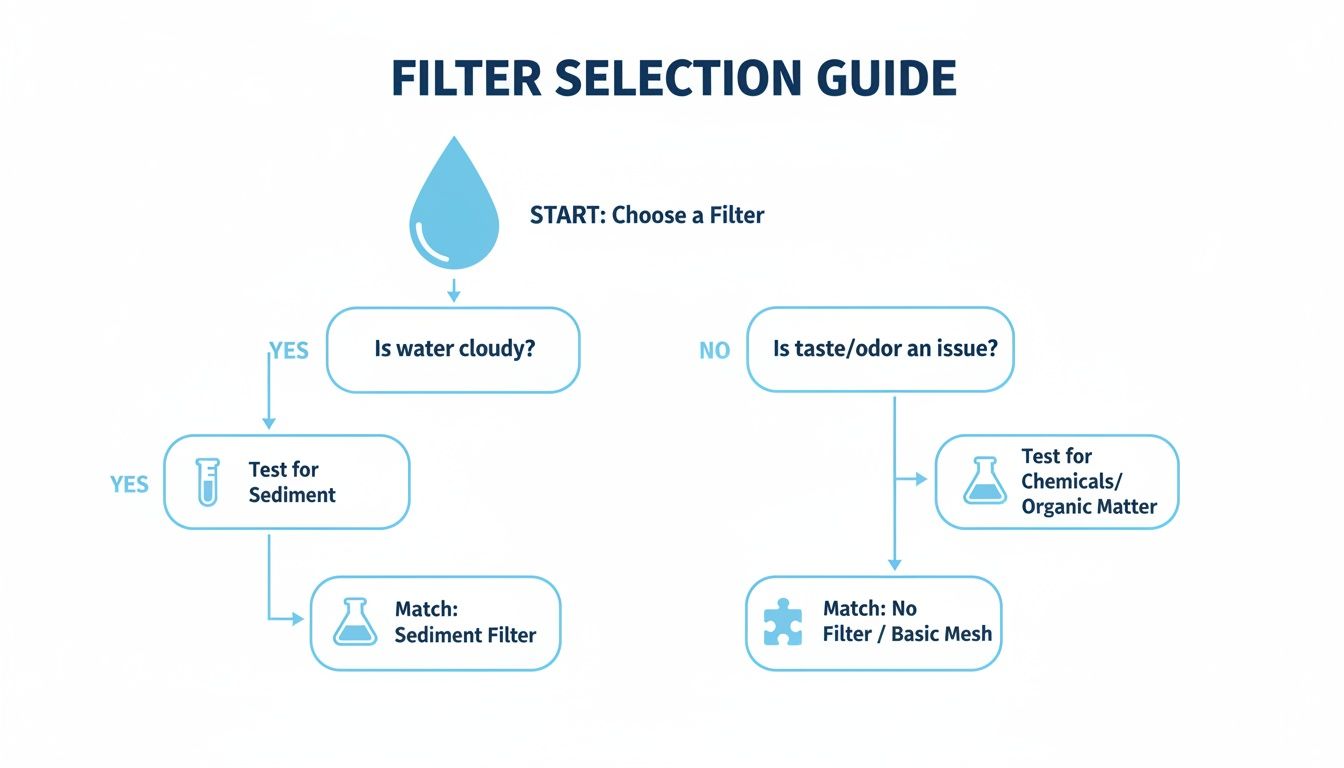
This simple flowchart is a great way to visualize the process of testing your water and matching the results to the right filter technology.

Flowchart showing a water filter selection guide with decisions based on water clarity, taste, and odor.

The key takeaway here is pretty straightforward: let your water's specific issues—whether it’s a bad taste, a strange smell, or invisible contaminants—directly guide your choice of filter.

Match The Problem To The Technology

Now that you know what you need to remove, you can match the problem to the right tool for the job. Not all filters are created equal; each type is designed to target different things.

The goal isn't to find the "best" filter on the market, but to find the best filter for your water. A system that’s perfect for removing chlorine might do absolutely nothing for hard water minerals.

To simplify things, I've put together a quick table to help you connect common water complaints with the most effective filtration systems we've talked about.

Matching Your Water Problem to the Best Filter Type

This table is designed to help you quickly identify the most effective filtration system based on the specific water quality issues you're facing at home.

Common Water Problem Primary Contaminants Recommended Filter Type(s)
Bad Taste/Smell (Chlorine) Chlorine, Chloramine, VOCs Activated Carbon (Pitcher, Faucet, Under-Sink, Whole-House)
Cloudy or Murky Water Sediment, Silt, Rust Sediment Filter (Often part of a Whole-House system)
Hard Water Stains & Buildup Calcium, Magnesium Ion Exchange (Water Softener)
Lead, Fluoride, Arsenic Concerns Heavy Metals, Dissolved Solids Reverse Osmosis (Under-Sink)
Well Water Safety (Bacteria/Viruses) E. coli, Giardia, Viruses UV Purifier, Distiller

By pinpointing your problem in the first column, you can easily see which type of filter is best equipped to handle it.

Consider Your Budget And Installation Comfort

Finally, you have to think about the practical side of things. How much are you willing to invest, and are you comfortable with a DIY project, or would you rather hire a pro? A simple pitcher filter might cost less than $50 and requires zero installation, while a whole-house system can run into the thousands and definitely needs a plumber.

Be realistic about your budget for both the initial purchase and long-term maintenance, like filter replacements. Once you've considered all these factors, you can start to explore yasutrading's product range to see what fits your needs and price point. With this structured approach, you'll feel confident choosing a system that truly protects your home.

Frequently Asked Questions About Home Water Filters

Even after looking at all the options, you probably still have a few questions. That's normal. Let's tackle some of the most common ones we hear from homeowners to clear up any final confusion.

Is My City's Treated Water Good Enough?

Sure, the water coming from your city's treatment plant meets the legal minimum safety standards. But that doesn't mean it's great. It's often loaded with disinfectants like chlorine or chloramine, which is why your tap water can taste and smell like a swimming pool. These chemicals can also dry out your skin and hair.

Don't forget that water travels a long way to get to you, and it can pick up contaminants like lead from old pipes along the journey. A home filter is your last line of defense, making sure the water is as clean as possible right where you use it.

What Is the Difference Between Filtration and Purification?

It's a great question. Think of it this way: filtration is like cleaning, while purification is like sterilizing.

Filtration removes sediment, chemicals, and other particles that affect taste and clarity. Most carbon-based filters are in this category. Purification is a more intense process that kills or removes living microorganisms like bacteria and viruses. Systems using Reverse Osmosis or UV light are considered purifiers. For most people on city water, filtration is all you need. If you're on well water, purification is often a must.

How Often Should I Change My Water Filters?

This one is non-negotiable: you have to follow the manufacturer's schedule. A filter that's past its prime doesn't just stop working—it can actually become a breeding ground for bacteria and make your water worse than it was before.

A filter's lifespan is a promise, not a suggestion. Ignoring it means you're no longer protecting your water; you're just running it through a dirty sponge.

Here are some general timelines, but always check your specific model:

  • Pitcher Filter: Every 2 months or so.
  • Under-Sink Filter: Typically every 6-12 months.
  • Whole-House Filter: Anywhere from 3-9 months, depending on your water quality.

Staying on top of this one simple task is the best way to guarantee your system keeps working like it's supposed to.


Ready to find the perfect filtration solution for your home? At Water Filter Advisor, we provide expert reviews, in-depth guides, and practical advice to help you make a confident choice. Explore our resources today and start your journey to better water at https://www.waterfilteradvisor.com.