Best Water Test Kit for Well Water Worth Buying in 2026
You're standing at the kitchen sink, holding a pack of test strips that promises to check a dozen things. The water tastes fine, the color chart looks reassuring, and you still don't know whether the well is safe to drink from. That's because a strip can tell you something about a few basic water properties, but it can't rule out many contaminants that matter for health or determine which filter will address them.
The best water test kit for well water isn't the one with the longest list on the box. It's the one that tests for the risks tied to your location, uses a method suited to those contaminants, and gives you results you can use to choose treatment.
| Testing option | Best for | Main limitation |
|---|---|---|
| Basic strip kit | Quick checks for pH, hardness, iron, manganese, and sometimes nitrate | Not a substitute for lab analysis when assessing health risks |
| Home mailer with laboratory analysis | Routine testing when you want measured results and a documented method | Check that the lab, analytes, and sample requirements are clearly stated |
| Certified laboratory panel | Health decisions or known local risks | Choose the panel to fit your well, not just the largest menu |
Why Well Water Owners Can't Just Guess
At a municipal home, water-quality information comes from the public water system. At a home with a private well, there's no routine federal monitoring of the tap. Private wells aren't covered by the federal Safe Drinking Water Act, so the homeowner has to arrange testing and decide what to do with the results.
That gap matters because a well's water can change without announcing itself. Floodwater can carry bacteria into a damaged or poorly sealed well. A newly fertilized field nearby can raise concern about nitrate. Arsenic can come from local geology, not from anything that looks or smells unusual in the kitchen.
USGS research makes the problem concrete. In a study of about 2,100 domestic wells, roughly one in five contained at least one contaminant above a human-health benchmark. A separate assessment of 1,389 wells found that 23% exceeded a benchmark for at least one chemical, with radon, arsenic, uranium, nitrate, and fluoride among the frequent concerns, according to the USGS overview of domestic private-supply wells.
Your senses can't clear the water
Taste and odor are useful clues, but they aren't safety tests. A metallic taste might prompt you to investigate plumbing or metals, and a sudden change in smell is a good reason to retest. But water that tastes normal can still contain contaminants that require laboratory analysis to detect.
That's why choosing a kit is a health and filtration decision, not a curiosity purchase. If you don't know what's in the water, you can't confidently choose a filter. A carbon cartridge may improve taste and odor, for example, but its presence in a filter doesn't prove it treats the specific contaminant in your well.
Start with the property and the likely risks, then choose the tests. Don't buy a treatment system because the water tastes odd, and don't call it safe because it tastes fine.
The Five Contamination Groups That Matter Most
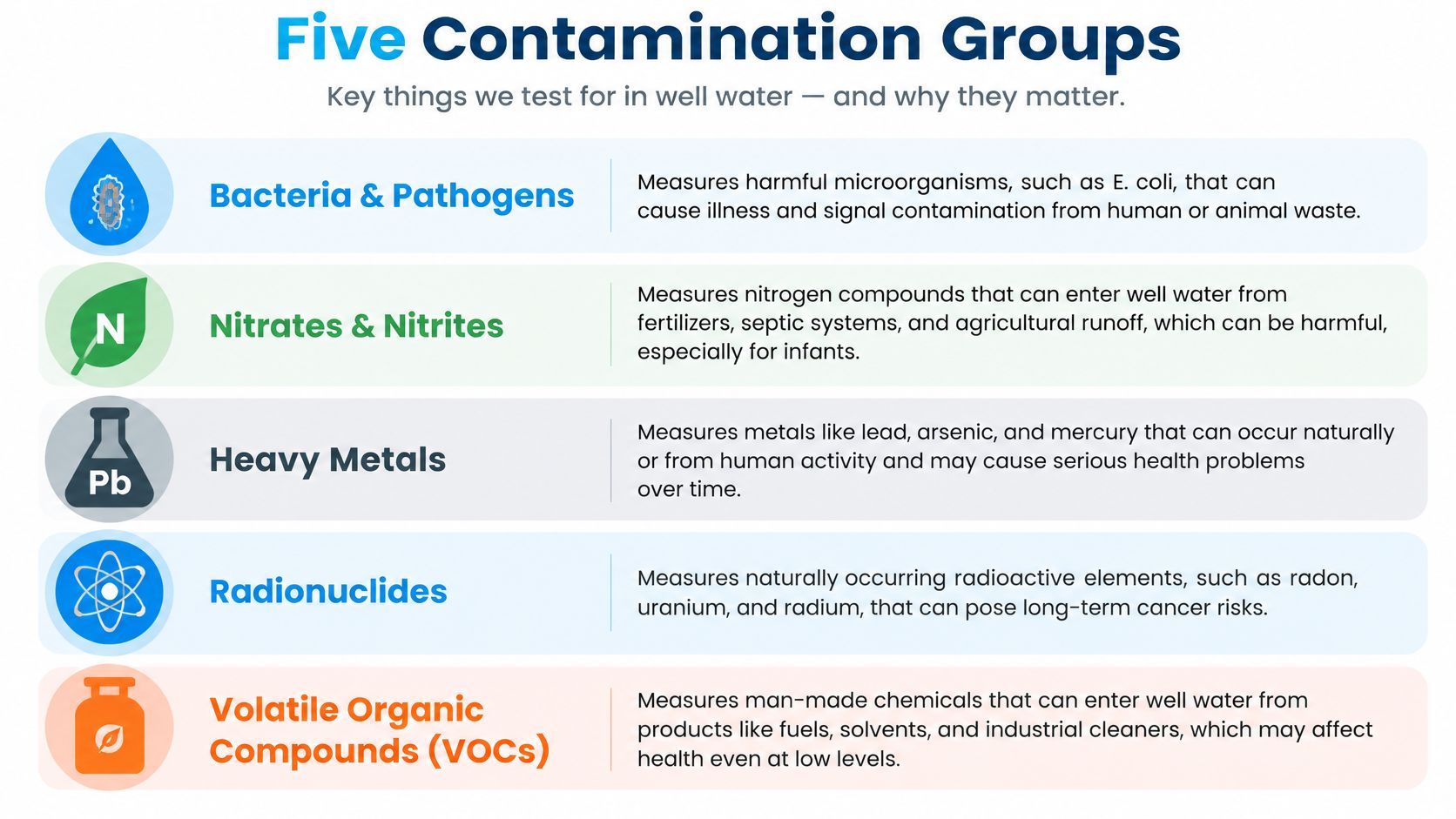
A well-water panel should be built around contaminants that affect health, not just visible signs such as cloudiness or staining. Five broad groups are worth considering: bacteria and pathogens, nitrates and nitrites, metals, volatile organic compounds and pesticides, and radionuclides.
What the categories cover
- Bacteria and pathogens can enter through surface water, flooding, or problems with the well or its components. Ask whether the panel tests for total coliform and E. coli using a laboratory method. For more background, see this guide to coliform bacteria testing methods.
- Nitrate and nitrite can be linked to agricultural activity and other sources. They deserve particular attention in well water because a strip's rough reading may not provide the quantitative result needed for a health decision.
- Metals include arsenic, lead, manganese, and uranium. Their presence may be connected to local geology or plumbing, and appearance and taste won't reliably identify them.
- Volatile organic compounds and pesticides can be relevant near certain industrial or agricultural activities. A kit has to name the analytes it measures; “chemical testing” alone doesn't tell you whether the panel fits your property.
- Radionuclides, including radon and radium, are another reason a basic strip set can't stand in for a broader assessment.
USGS research across nearly 19,000 privately owned drinking-water wells found that arsenic exceeded the EPA maximum contaminant level of 10 micrograms per liter in about 11% of 7,580 wells. Nitrate exceeded its 10 milligrams-per-liter limit in about 8% of 3,465 wells, and uranium-238 exceeded its 30-micrograms-per-liter limit in roughly 4% of wells. Radon exceeded screening levels of 300 and 4,000 picocuries per liter in approximately 75% and 9% of evaluated wells, respectively, according to the USGS research on contaminants in private wells.
A strip that checks only pH and hardness can still be useful for basic water-quality troubleshooting. It just covers a small fraction of the risks a well owner may need to evaluate.
Lab Panels vs At-Home Strip Kits
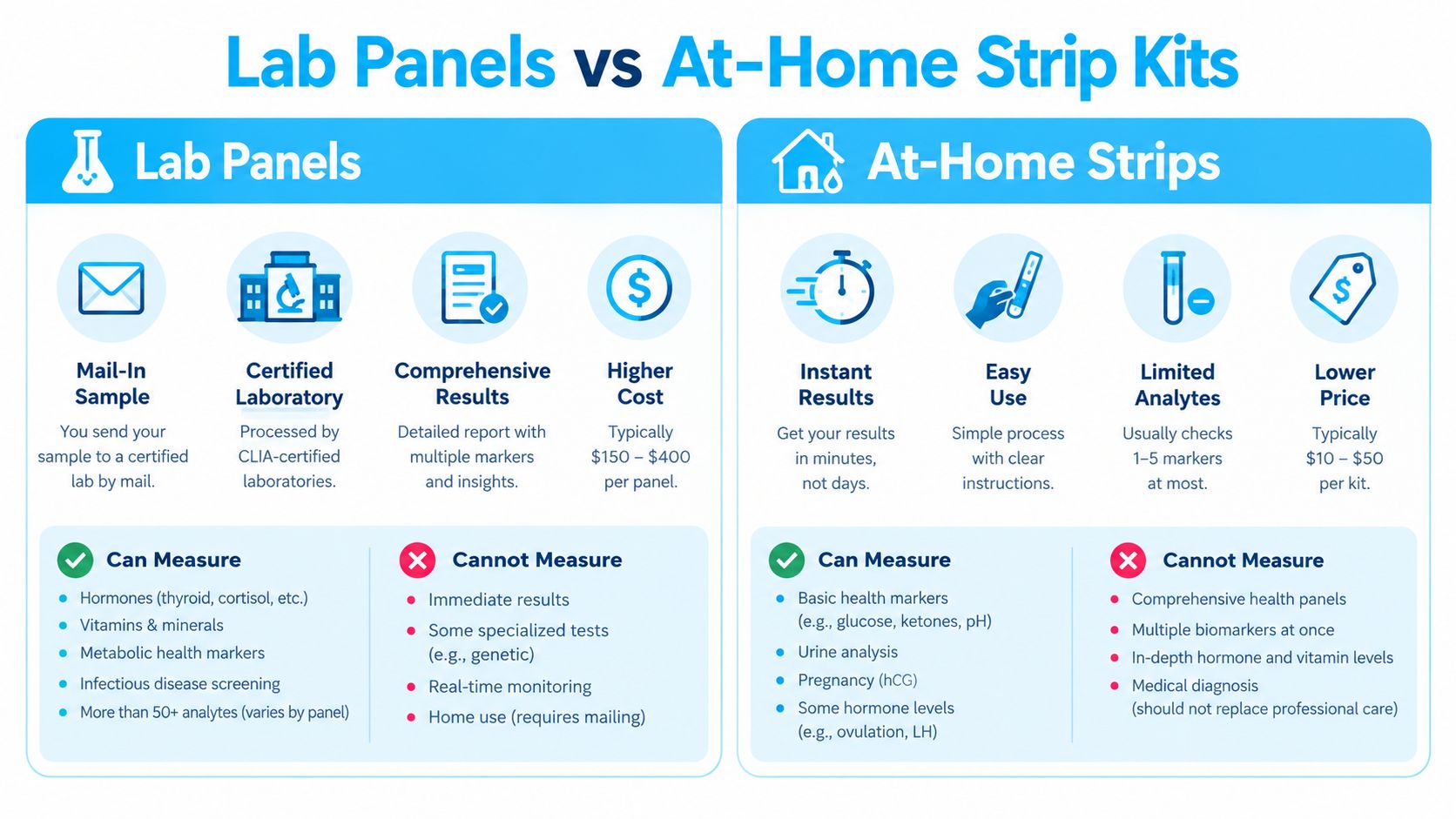
Pick the method after you name the risk. If your worry is a nearby farm field, a flooded wellhead, old plumbing, or arsenic-bearing bedrock, the question is which analytes must be measured and how precise the result has to be. Strips answer “did something shift?” Laboratories answer “is the level safe, and what treatment fits?”
What a strip kit can do
Home strips can give fast readings for pH, hardness, iron, manganese, chlorine, and sometimes nitrate. Use them for routine checks after maintenance, a change in taste, or a quick screen before deciding whether a lab test is warranted. I would not use them to clear arsenic, uranium, volatile chemicals, lead, or radon.
Color matching has a hard limit: you compare a pad color with a printed chart under your lighting, with your eyes. That can flag a change. It rarely proves a concentration is below a health benchmark or above a treatment threshold.
What a lab panel should provide
For decisions tied to health or treatment equipment, choose a mail-in kit or local service that sends the sample to a state-certified or appropriately accredited drinking-water laboratory. The report should list the analytes, methods, detection or reporting limits, units, and any sampling steps that affect validity.
Methods such as ion chromatography, atomic spectroscopy, and mass spectrometry produce numerical results for nitrate, arsenic, lead, manganese, and similar contaminants. The CDC's well-water testing guidance recommends routine testing for key parameters and adding other tests based on local conditions, which is the right way to build a panel.
Practical rule: Screen simple properties with strips. Confirm safety, contaminant levels, and treatment sizing with lab results.
Use both when the situation calls for it: a strip can catch a sudden change, and the lab tells you whether that change matters. The short clip below shows how a strip reading compares with a lab report for the same sample.
Building Your Local Risk Profile
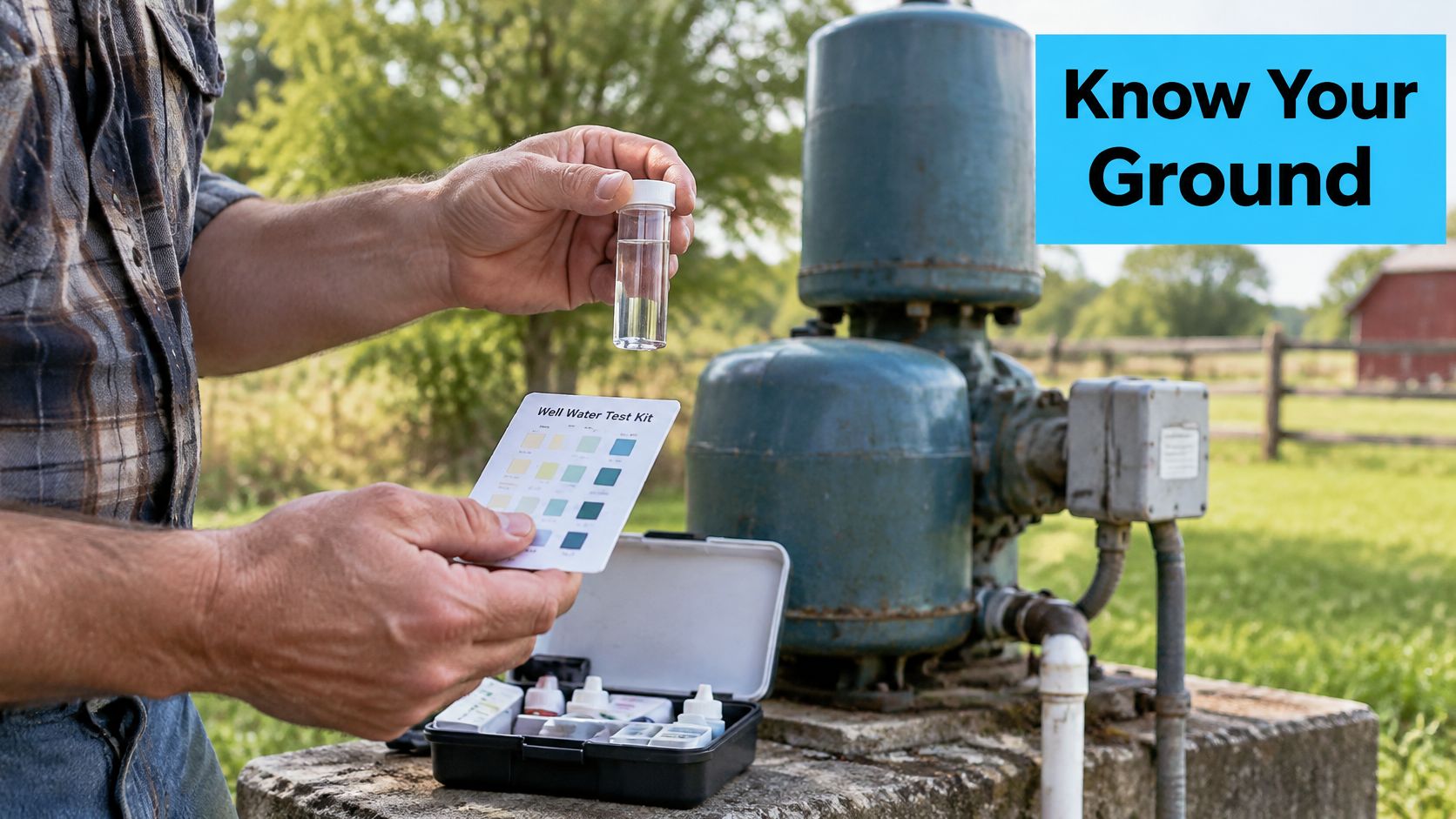
A generic bundle can be convenient, but it cannot know what is upstream, underground, or newly changed around your property. Build the panel from exposure first: where the well sits, what the aquifer tends to carry, what happens nearby, and what just disturbed the system. Then buy only the tests that answer those exposures.
Ask these questions before buying
- What does the local geology suggest? Ask the health department, extension office, or state geological survey whether arsenic, uranium, radon, manganese, or naturally high dissolved solids show up in nearby wells. If radionuclides are plausible locally, confirm the panel includes them.
- What surrounds the well? Fields and feedlots point toward nitrate and pesticides. Mining or industrial sites push metals higher on the list. Gas drilling can put chloride, sodium, barium, and strontium in scope.
- What condition is the well in? Shallow or older wells are easier for surface water to reach. Cracked casing, a questionable seal, recent pump work, or an unknown construction history all argue for bacterial testing and a qualified well inspection.
- What changed lately? Flooding, repairs, new construction, a sudden taste or odor shift, or a pregnancy or infant in the house are triggers for extra testing outside the routine schedule covered at the end of this guide.
Match events to tests
Treat the choice like a decision tree tied to your address. Flood or repair leads to bacteria first. Farm country leads to nitrate and pesticide coverage. A new industrial site, mine, or drilling operation leads to metals and locally named chemicals. A change you can taste, smell, or see leads to a quick screen now and a lab confirmation if the answer matters.
Buy for the exposures you can name, not for the longest parameter list. If your old panel no longer matches the risks around the well, replace it before the next sampling round.
Matching Kit Archetypes to Real Situations
Skip the search for a universally perfect product. Think in terms of three kit types, then choose the one that gives you the evidence your situation requires.
| Criterion | Basic Strip Kit | Home Mailer | Certified Lab Panel |
|---|---|---|---|
| Parameters covered | A few basic properties; may include nitrate | Depends on the named package | Selected analytes based on local risks |
| Detection limits | Often not suited to confirming low health-relevant concentrations | Check the lab report and method details | Should be disclosed for the analytes tested |
| Accreditation | Not a lab result | Verify the laboratory's credentials | Verify the laboratory's credentials |
| Turnaround | Read at home | Depends on sample shipping and lab processing | Depends on sample shipping and lab processing |
| Price band | Usually positioned as a basic screening purchase | Varies by panel | Varies by panel and analytes |
A basic strip kit makes sense for a quick check of pH or hardness, or as a preliminary way to spot a change. It doesn't replace a lab panel for a new well, a household health concern, or a treatment purchase.
A home mailer with lab analysis is the practical starting point for many homeowners. Before you buy, confirm that it includes annual bacterial and nitrate testing, identifies the laboratory, and offers the analytes relevant to your area. Don't assume a mailer covers everything just because its packaging lists many tests.
A certified lab panel is the better choice when the well has a known local risk, when the household needs health-relevant results, or when a broad baseline is needed. A new well owner in a low-risk area should still begin with a lab-based baseline and the routine tests recommended for private wells. A family with a new baby should pay particular attention to nitrate and bacterial coverage. Near agriculture, check pesticide coverage as well as nitrate. With a radon concern, order a panel that explicitly includes the relevant radionuclide testing.
My recommendation: Buy the narrowest lab panel that examines the risks you can name, not the broadest package by default. Add tests when local information or a change in conditions gives you a reason.
Collecting a Sample You Can Actually Trust
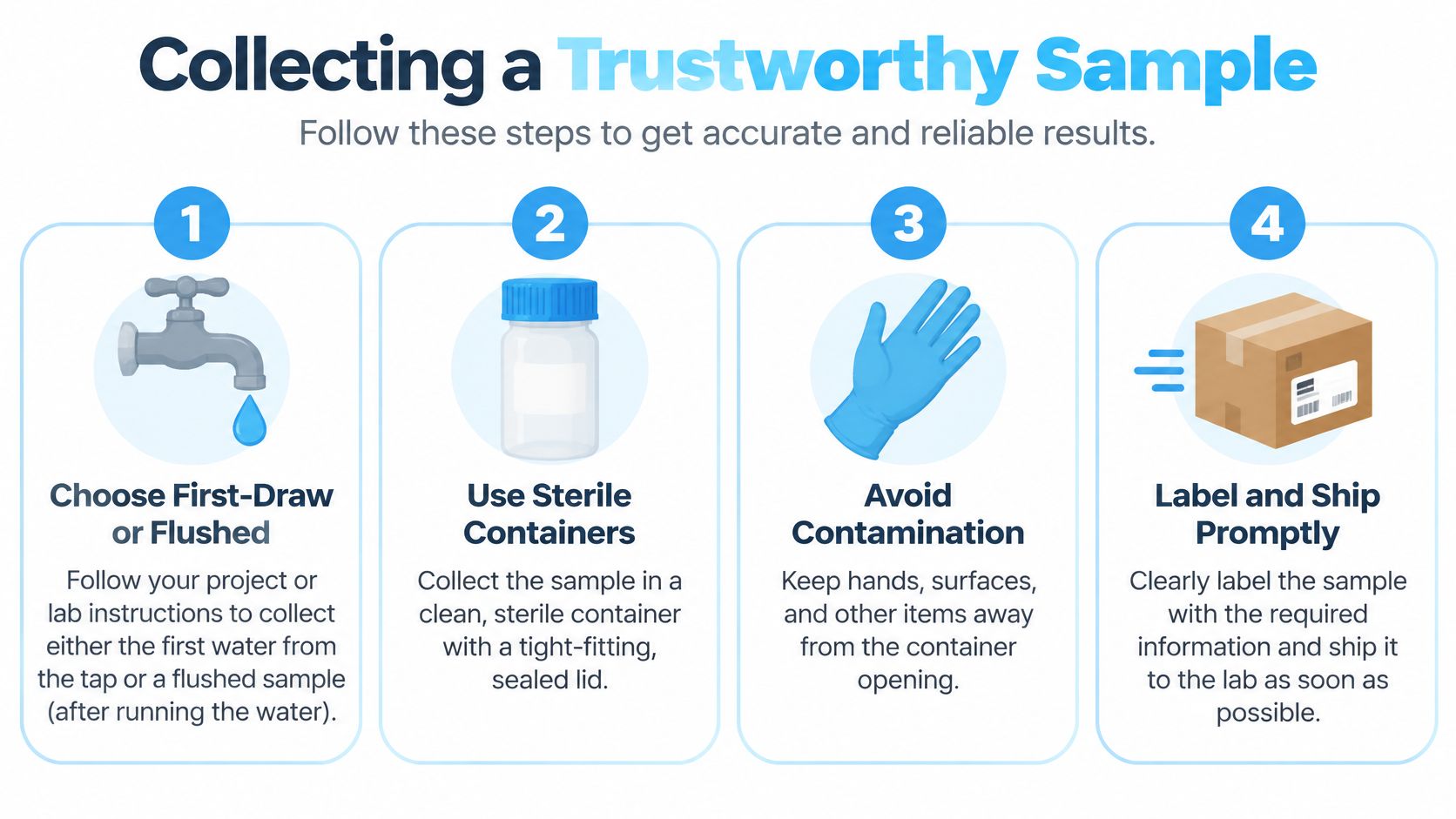
A well-chosen kit can still produce a misleading result if the sample is collected badly. Follow the lab's instructions exactly, especially for bacteria testing, where the container, sampling method, temperature, and shipping requirements matter.
A careful collection routine
- Check whether the lab wants first-draw or flushed water. The right choice depends on what the test is intended to measure. Don't substitute one method for the other because it seems easier.
- Use the supplied sterile container for microbiological tests. Don't rinse it, touch the inside of the cap, or transfer the sample into a household jar.
- Follow the tap instructions. Use the specified tap and avoid contaminating the container or the water as you fill it. If the instructions call for removing an attachment or following a particular flow procedure, do that.
- Label, store, and ship as directed. Note the collection details the kit requests, meet its temperature requirements, and get the sample to the lab within its specified window.
Avoid collecting from a tap served by a treatment device unless the test is specifically meant to assess that treated water. A non-sterile jar can introduce contamination; late shipping or improper storage can compromise the sample. A negative result is also a snapshot, not permission to ignore future changes or routine testing.
For bacterial screening, choose a kit with sterile containers, explicit collection directions, temperature and shipping requirements, and an accredited laboratory method for total coliform and E. coli. The EPA's guidance on protecting private-well water explains why careful sampling matters: poor handling can produce false negatives or contamination artifacts.
Turning Results Into the Right Treatment
Testing earns its keep when it guides what you install. Don't buy a filter based on a general claim such as “whole-house protection.” Match the treatment to the contaminant, the treatment location, and documented performance for that contaminant.
Bacteria calls for a different response from dissolved metals. A qualified well professional may recommend correcting a well or plumbing issue and disinfection; ongoing treatment may require a properly selected UV or reverse-osmosis system. For arsenic, nitrate, or uranium, investigate treatment technologies such as reverse osmosis or ion exchange, then verify that the specific system is designed and certified for the contaminant found.
Radionuclides deserve particular care. The EPA recommends testing private wells for radionuclides every three years and identifies ion exchange and reverse osmosis among point-of-use treatment options. It also cautions that a sediment or carbon filter shouldn't be assumed to remove radionuclides without appropriate evidence or certification, as described in its guidance on natural radionuclides in private wells.
A whole-house carbon filter can improve some taste and odor problems, but don't treat that as proof it removes arsenic or radionuclides. Check the product's contaminant-specific performance documentation before buying. When results arrive, use this guide to read water test results and connect the numbers to an appropriate filtration decision.
A Year-One Testing Plan You Can Run
Start your first year of well ownership with a laboratory panel that covers total coliform bacteria and nitrate, then add the analytes your local profile points to: arsenic where bedrock geology suggests it, pesticides near farmland, volatile organic compounds near fuel storage or industrial activity. A strip kit earns its place for quick trend checks between lab visits, but it cannot stand in for the safety panel.
Then run the schedule:
- At least annually: Test for total coliform bacteria and nitrate, and consider total dissolved solids.
- Every three years: Add radionuclides, following the EPA's recommendation for private wells.
- After any triggering event: Retest after flooding, well or plumbing repairs, a meaningful change in taste or odor, or new land-use activity near the well, and pick the analytes that specific event points to.
You don't need to panic-buy the biggest kit in the search results. Identify your local risks, order the lab panel that covers them, collect the sample exactly as instructed, and let the results drive the filtration choice.
Water Filter Advisor offers practical guidance on choosing water test kits and comparing home filtration options, including under-sink and whole-house systems. Visit Water Filter Advisor to connect your well-water test results with a filtration choice that fits your home.