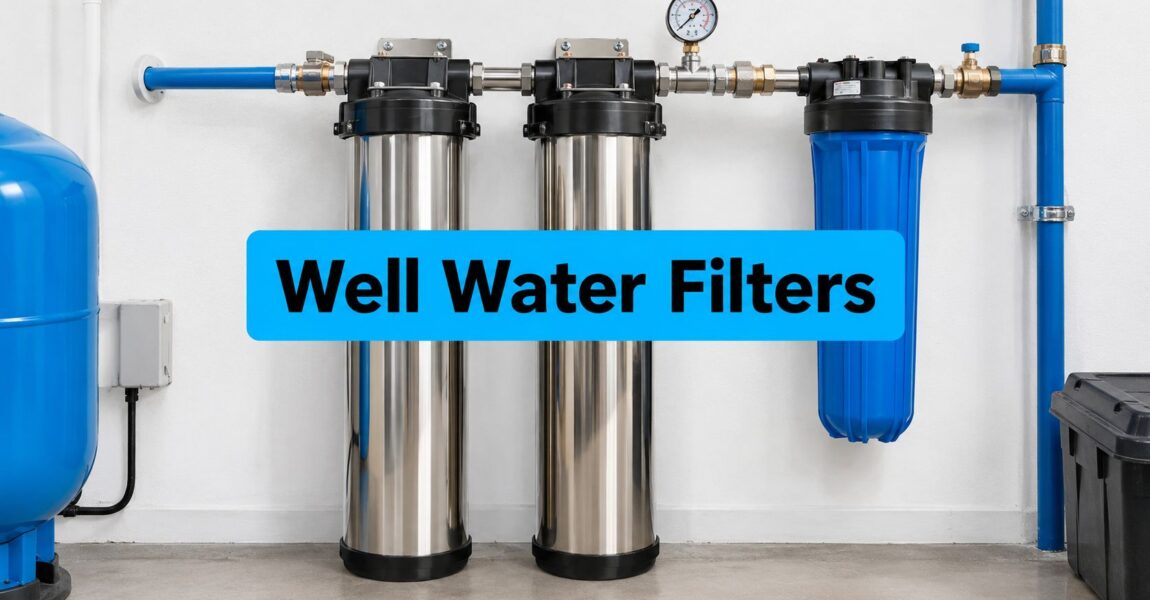
Filters for Well Water Systems: Home Guide
The most popular advice about filters for well water systems is also the most expensive: buy a generic whole-house filter and let it handle everything. That approach sounds convenient, but private wells don't produce standardized water. One property may have sand and silt, another dissolved iron and manganese, and another bacteria, nitrate, or a volatile contaminant that a basic cartridge can't touch.
The right question isn't “What's the best well water filter?” It's “What exact problem is present at this house?” Test first, choose treatment for the actual contaminant, and install each stage in an order that protects the next one. That method costs less trouble, prevents premature media failure, and gives your family a treatment system that does a specific job instead of making vague promises.
Why Generic Whole-House Filters Fail Private Wells
A private well isn't a small municipal water plant. The homeowner owns the source, the pump, the plumbing, the testing schedule, and the treatment decisions. The EPA's guidance on private well contaminants says around 15% of the U.S. population, or more than 43 million people, rely on private wells, while more than 23 million households use them. Private wells aren't regulated under the Safe Drinking Water Act, and the CDC notes that government officials don't regulate, treat, or monitor their water.
That responsibility gap changes how you should shop. A cartridge marketed as a “whole-house solution” may remove visible sediment while leaving dissolved iron, hardness, bacteria, nitrate, or other contaminants untouched. A carbon cartridge can improve taste and odor, but it isn't a dedicated dissolved-iron treatment. A sediment filter can catch particles, but it won't solve every invisible water-quality problem.
The cartridge is often blamed for the wrong problem
Homeowners commonly see a filter clog quickly and assume they bought a defective product. More often, the filter is doing exactly what it was asked to do, but it was placed directly in front of a heavy sediment load without adequate prefiltration. Fine media loads rapidly when coarse sand, silt, rust, or precipitated metals arrive all at once.
The opposite failure is just as frustrating. A filter lasts a reasonable time, but the orange stains, sulfur odor, scale, or health concern remains. That happens when the equipment never matched the contaminant. The system may be functioning normally while the homeowner is waiting for the wrong technology to produce an impossible result.
Practical rule: A filter can only remove what its media or membrane is designed to target. “Whole-house” describes where the equipment is installed, not everything it can remove.
A U.S. Geological Survey study cited by the EPA found that about one in five private wells in a sample of 2,100 contained at least one contaminant above a human-health benchmark. That finding doesn't support buying the biggest filter package available. It supports identifying the specific contaminant before selecting equipment.
The better approach is targeted treatment. Use mechanical filtration for particles, oxidation for dissolved iron or manganese, softening for hardness, carbon for appropriate taste, odor, or volatile compounds, and disinfection when biological contamination requires it. The system may still be whole-house, but every stage should earn its place.
Testing Your Well Water Before Buying Equipment
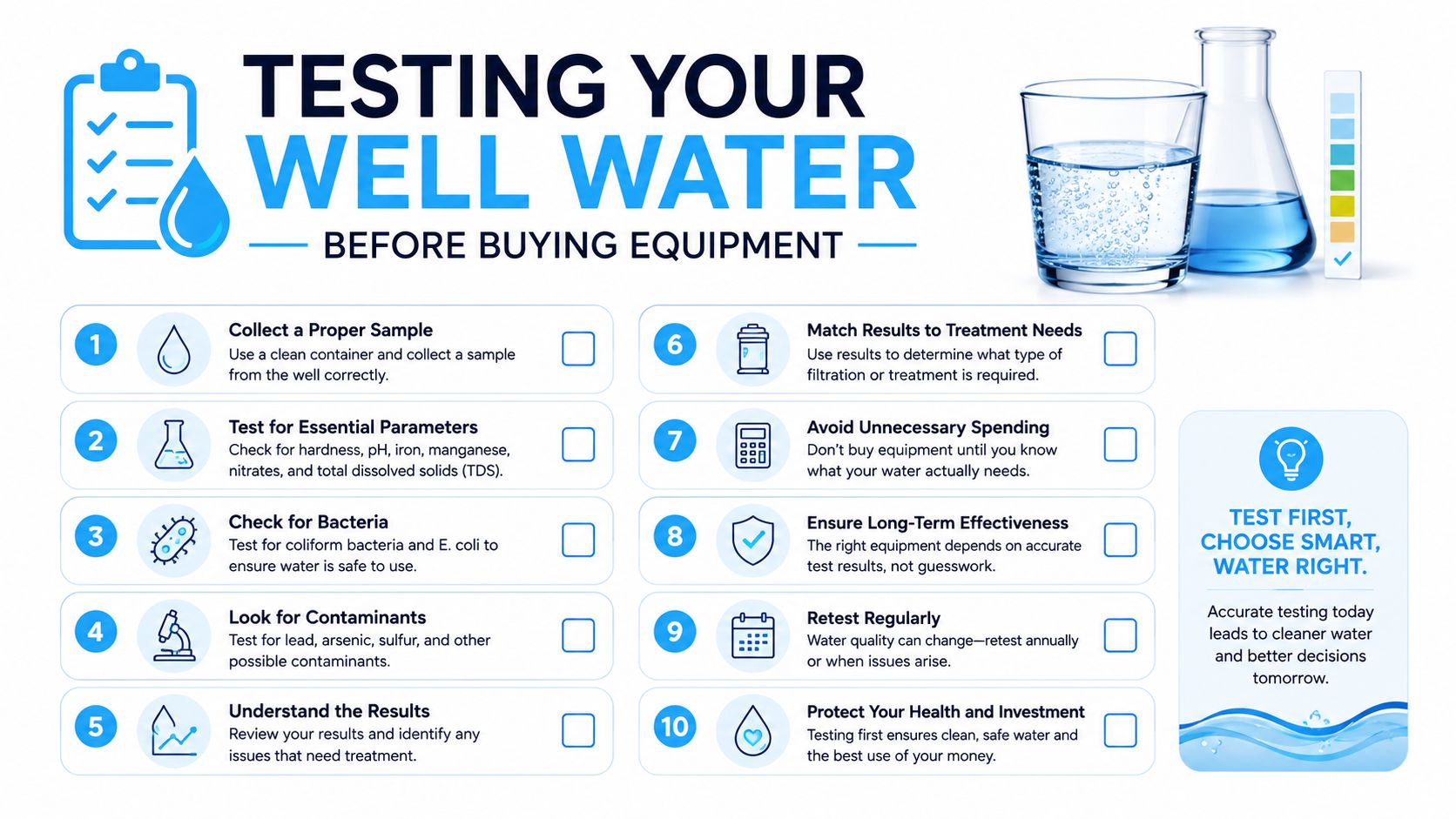
Buying equipment before testing is backwards. Start with a laboratory analysis that gives you a defensible picture of the source water, then use those results to choose treatment. Taste, odor, and appearance are useful clues, but they aren't a complete safety assessment. Clear water can still contain contaminants that demand a specialized treatment stage.
Begin with a baseline panel suitable for a private well. Include bacteria and nitrates, then add metals and nuisance contaminants that fit the symptoms at your property. Iron, manganese, hardness, hydrogen sulfide, pH, and sediment-related measurements can explain staining, scale, odor, or cloudy water. Ask the laboratory how to collect the sample, because a dirty bottle, an unclean faucet aerator, or poor preservation can compromise the result.
Build a testing routine
The EPA recommends annual testing for bacteria and nitrates. Test again after flooding or when the water develops a change in taste, odor, or color. Those events can signal a change at the well or in the surrounding environment, and a treatment setup selected from an old report may no longer fit the water entering the house.
Use a certified laboratory when the result will determine a major equipment purchase or a health-protection decision. Keep the laboratory report, sampling date, well details, and treatment status together. If you test after treatment, label that sample clearly. A treated sample tells you how the equipment performs, while an untreated sample tells you what the source is demanding.
Read the report as a treatment brief
Don't treat every line on a laboratory report as a reason to buy equipment. Separate the findings into three groups:
- Health-related findings: Bacteria, nitrate, lead, arsenic, PFAS, and other contaminants may require certified treatment or professional design.
- Aesthetic findings: Iron, manganese, hydrogen sulfide, sediment, and hardness can affect fixtures, laundry, taste, odor, and appliances.
- System-design findings: Flow demand, pressure behavior, pH, and the contaminant load determine whether a cartridge, backwashing vessel, softener, UV unit, or point-of-use membrane makes sense.
Pay attention to the units and the laboratory's reference limits. Parts per million and parts per billion aren't interchangeable, and a result without units is not enough to select equipment. For radon, use a dedicated test and follow the sampling instructions. This resource on radon gas testing from Royal LePage Brookside provides useful context for homeowners who are assessing that risk.
Before comparing products, review a practical well-water treatment advice guide and write down the contaminants that need treatment, the fixtures that need protection, and whether you want whole-house or drinking-water coverage. That short preparation prevents the common mistake of letting a product page define the problem.
Matching Filter Types to Specific Well Contaminants
Once the results are in, choose equipment by contaminant, not by the number of stages printed on the box. A multi-stage system isn't automatically better. Three incompatible stages can perform worse than two correctly selected stages.
Choose the treatment that matches the water
Sediment filtration handles suspended sand, silt, rust particles, and other undissolved material. It belongs near the beginning of the treatment train and protects downstream media from physical loading. A coarse reusable screen can handle larger particles, while a finer cartridge can polish the water before sensitive equipment.
Oxidizing filtration is the appropriate direction for dissolved iron, manganese, or hydrogen sulfide when testing confirms those problems. University of Georgia guidance recommends considering oxidizing filters when iron exceeds 0.30 mg/L and/or manganese exceeds 0.05 mg/L, and says certified units should reduce soluble iron to 0.2 ppm or below and soluble manganese to 0.05 ppm or below. See the University of Georgia guidance on oxidizing filters for the treatment principle and performance context.
Activated carbon is useful for taste, odor, and suitable organic or volatile compounds. It isn't a universal contaminant remover, and it shouldn't be expected to remove dissolved iron. Place it after iron removal when both treatments are needed.
Water softeners address hardness minerals and their scale consequences. They aren't a substitute for disinfection, arsenic treatment, nitrate treatment, or iron removal unless the specific equipment and water chemistry support that claim.
UV purification is a disinfection stage for biological threats. It needs clear water and dependable pretreatment, because suspended particles can interfere with UV performance. A UV unit also doesn't remove dissolved chemicals or minerals.
The guide to bacteria and nitrates in water is useful when a laboratory report identifies biological or nitrate concerns. Don't assume that a taste-and-odor cartridge addresses either one.
Whole-house or point-of-use
Point-of-entry treatment handles all water entering the home, making it the sensible format for problems that affect showers, laundry, fixtures, appliances, or every tap. EPA material on whole-house treatment for private water supplies identifies applications that include iron, manganese, hardness, sulfide, bacteria, nitrate, radon, MTBE, and other VOC concerns. It also describes whole-house treatment when arsenic is above 250 ppb, or 0.25 mg/L, or when iron removal is needed as part of the treatment strategy.
A kitchen reverse osmosis unit can make sense for drinking and cooking when the source-water report calls for additional dissolved-contaminant reduction. Don't force a whole-house membrane to handle every use if only drinking water needs that level of treatment.
| Contaminant | Primary Filter Type | Key Certification / Threshold |
|---|---|---|
| Sand, silt, and suspended rust | Sediment filter | Match the media and flow capacity to the particle load |
| Dissolved iron or manganese | Oxidizing filter | Consider oxidizing treatment above the University of Georgia thresholds cited above |
| Hardness | Water softener | Select from the hardness result and household demand |
| Taste, odor, and suitable VOCs | Activated carbon | Use after sediment and iron treatment where applicable |
| Bacteria | UV or validated disinfection | Pretreat for sediment and confirm the source-water result |
| Lead | Certified filtration or reverse osmosis | NSF/ANSI 53 or 58 performance is evaluated at 150 ppb and targets less than 5 ppb in filtered water |
| PFAS | Certified PFAS reduction system | NSF cites EPA MCLs of 4.0 ppt for PFOA and PFOS, and 10 ppt each for PFHxS, PFNA, and HFPO-DA |
For lead, check the product's certification rather than trusting a generic “heavy metals” claim. NSF's lead-reduction listing says certified systems tested to NSF/ANSI 53 or 58 are evaluated against water containing 150 ppb of lead, with expected reduction to less than 5 ppb under the standard requirements. NSF also says performance isn't evaluated above 150 ppb, so don't rely on that filter when the incoming water exceeds that level.
For PFAS, use a product with a specific, current certification claim. NSF's PFAS drinking-water guidance cites the EPA limits and explains that PFAS reduction claims require lowering PFAS below 20 ppt, with periodic retesting and annual factory inspections used to maintain certification.
Sequencing Your Filtration Train for Maximum Lifespan
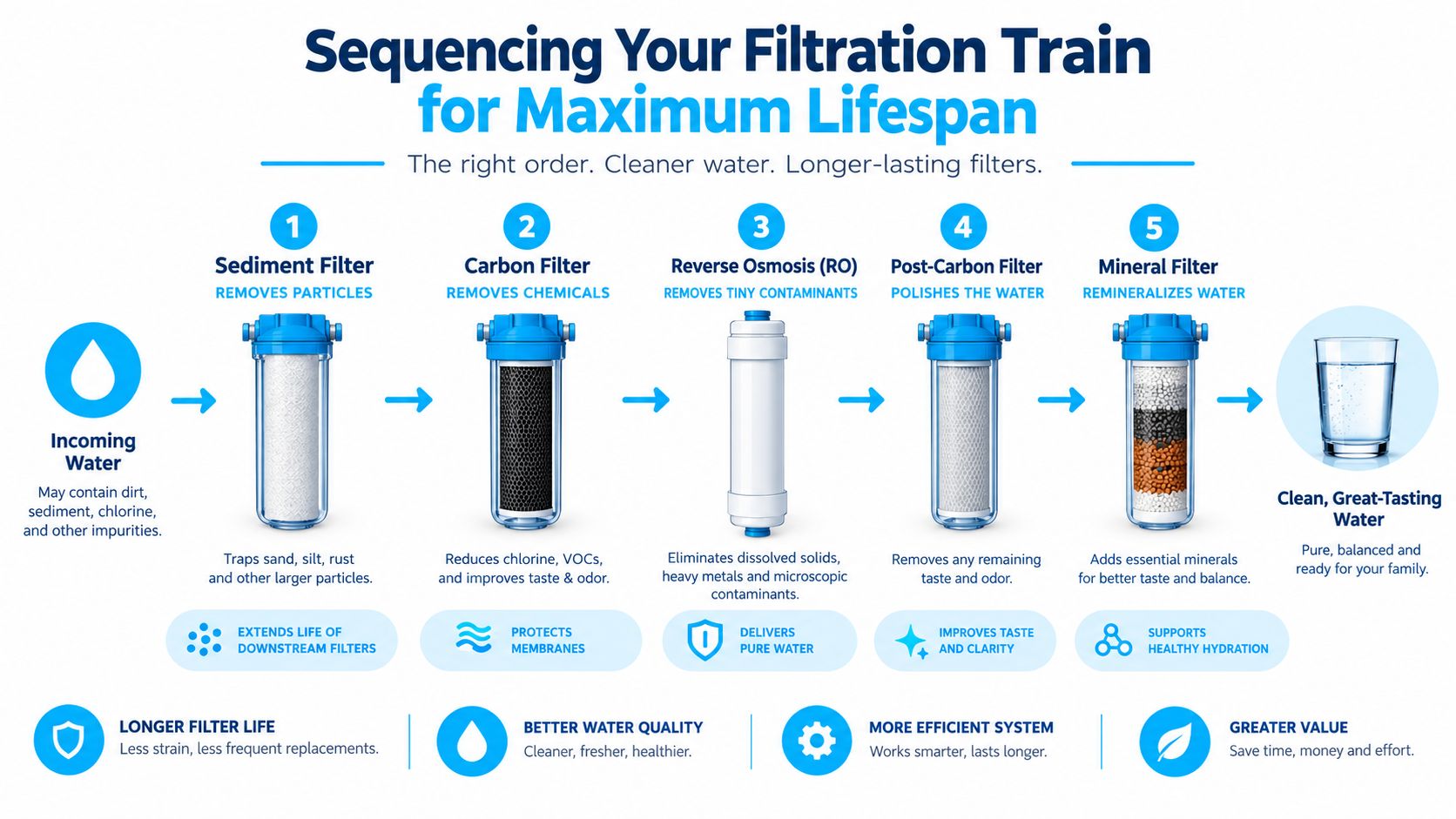
Correct equipment in the wrong order is still a bad system. Water treatment works as a treatment train, with each stage reducing a particular load before the next stage receives the water.
Start with sediment. A mechanical stage should remove sand, silt, rust particles, and other suspended material before water reaches a softener, carbon bed, iron-removal vessel, UV chamber, or reverse osmosis membrane. If you skip that protection, downstream media has to act as a sediment filter, and it will load faster than intended.
A logical order of operations
A typical arrangement looks like this:
- Pressure tank and shutoff controls: Stabilize the incoming well-water supply and provide a service point.
- Coarse sediment protection: Remove larger particles before they reach finer cartridges or backwashing equipment.
- Fine sediment filtration: Polish the water to protect treatment media and sensitive components.
- Targeted treatment: Use iron or manganese oxidation, softening, carbon, or another contaminant-specific stage.
- Drinking-water polishing or disinfection: Place reverse osmosis at the point of use when appropriate, and place UV after pretreatment when biological disinfection is required.
The exact train depends on the test report, but the principle doesn't change. Coarse filtration comes before fine filtration, and contaminant-specific treatment comes before final polishing.
Protect carbon and reverse osmosis
Activated carbon should follow iron removal when iron is present. The well-water treatment sequencing guidance explains that high iron concentrations can foul carbon media quickly, while carbon doesn't remove dissolved iron and isn't a replacement for dedicated iron or manganese treatment.
Reverse osmosis belongs after the water has been conditioned for it. Sediment should be removed first, followed by targeted treatment such as iron removal or softening, with RO used afterward for drinking water when the analysis supports it. Sending iron, hardness, or heavy sediment directly to an RO membrane is an efficient way to shorten its useful life.
Install pressure gauges before and after critical cartridges when possible. The pressure difference tells you whether a stage is loading, while a flow complaint alone can be caused by a closed bypass, a failed valve, or an undersized housing. Good sequencing makes diagnosis easier because each component has a defined job.
Installation Realities and True Cost of Ownership
A treatment design has to fit the house, not just the water report. Before ordering equipment, identify the main water line, pressure tank, drain access, electrical outlet requirements, shutoff locations, and enough room to remove cartridges or service valves. Backwashing filters and softeners need a suitable drain connection, and they need clearance for routine service.
Put a bypass around major treatment equipment. A bypass lets you isolate a vessel or cartridge housing without shutting water off to the entire home. It also gives you a way to compare treated and untreated water during troubleshooting, provided the bypass is clearly labeled and normally remains in the treatment position.
Plan for discharge and electricity
Backwashing equipment sends water and spent media fines to a drain. The drain must accept the discharge without backing up, and the installation should follow the equipment manufacturer's air-gap and drain requirements. A UV system needs reliable power, and its alarm or lamp indicator should remain visible. Don't hide the controller behind stored boxes where a warning can go unnoticed.
Cartridge housings need enough working space below or around them for a wrench and a replacement cartridge. A large media tank may fit beside the pressure tank but leave no room to remove the control valve. Measure the service envelope, not just the footprint.
Count recurring obligations
The purchase price is only one part of ownership. Budget for replacement sediment cartridges, salt or other regeneration supplies for a softener, UV lamp replacement, oxidizing-media replenishment, electricity, drain use, and periodic laboratory testing. Some systems need routine cleaning of injectors, screens, flow controls, or quartz sleeves. Those tasks aren't optional maintenance extras. They keep the equipment operating at its intended flow and treatment rate.
Create a simple service record with the installation date, test results, cartridge changes, regeneration settings, lamp changes, and observed pressure. Keep spare consumables on hand, but don't replace media on an arbitrary calendar if the manufacturer specifies a performance-based schedule. Pressure drop, exhausted capacity, alarm conditions, and updated water tests are more useful indicators than guesswork.
Ownership test: If you can't explain what each stage removes, when it needs service, and where its wastewater goes, you don't yet have a complete installation plan.
A professional installer should verify pipe sizing, flow demand, drain capacity, electrical protection, and treatment compatibility. The installer shouldn't be choosing media blindly from a sales catalog. Give them the laboratory report and ask them to document the intended order, bypass arrangement, and maintenance requirements.
Troubleshooting Common Well Water Filter Problems
Most filtration complaints start as a symptom at the tap. Treat that symptom as evidence, not as a diagnosis. A pressure drop, sulfur odor, or orange stain can come from a loaded cartridge, a failed valve, depleted media, a change in source water, or a treatment stage that was never suitable for the contaminant.
Start with the easy checks
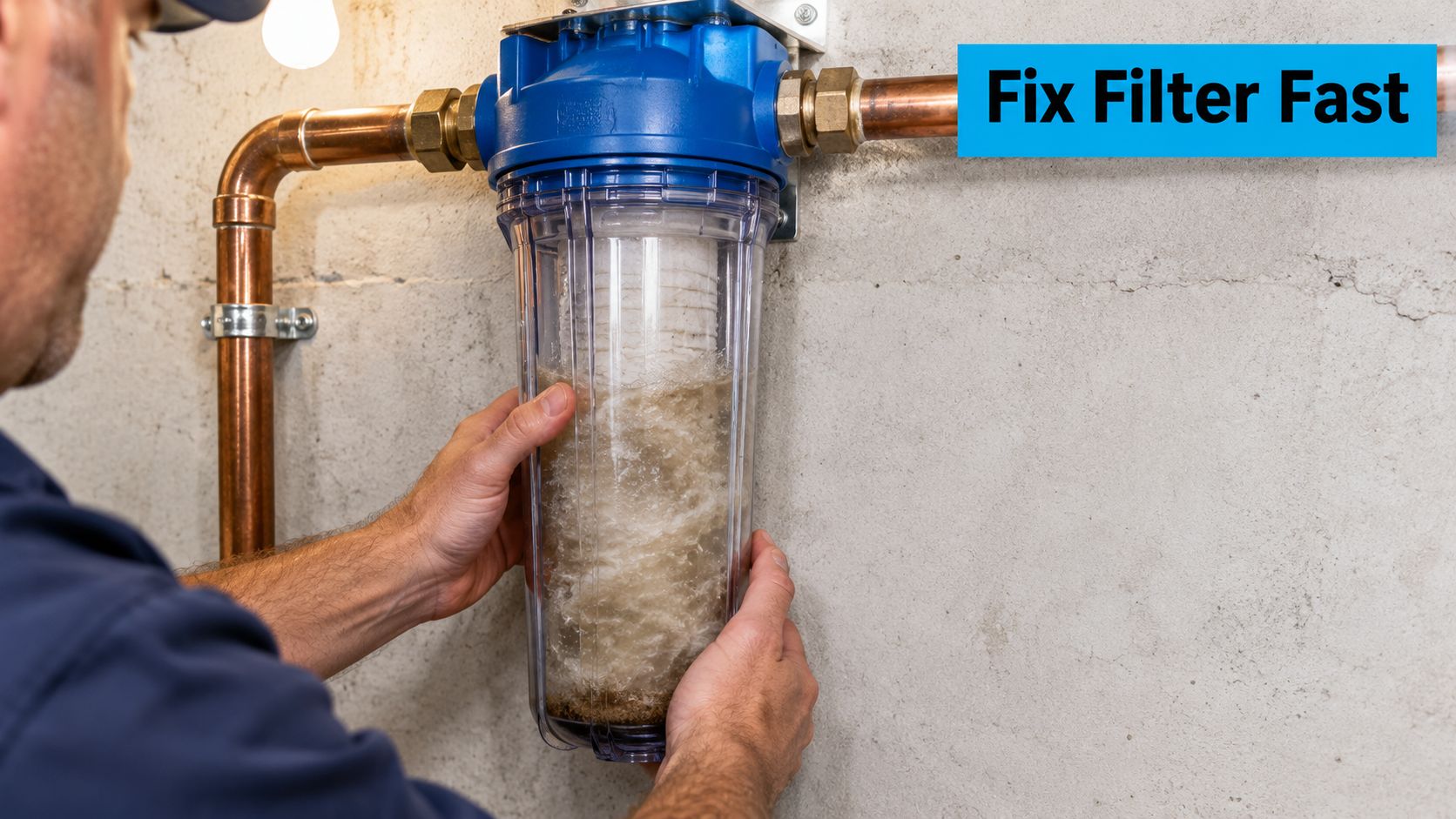
If pressure drops throughout the house, check that the main shutoff and every bypass valve are fully open. Inspect the sediment cartridge, clean a reusable screen, and look for debris at the housing inlet. If a new cartridge causes an immediate pressure problem, it may be too fine, too small, or overloaded by a contaminant that requires pretreatment.
If pressure is normal before a treatment vessel but low afterward, the restriction is probably localized. A fouled bed, blocked inlet screen, failed control valve, or closed service valve can all create that pattern. Don't keep changing cartridges if the pressure remains poor with a clean filter. Measure the pressure on both sides and isolate the faulty stage.
Match symptoms to likely causes
Returning sulfur odor can indicate exhausted media, an interrupted regeneration or oxidation cycle, a failed injector, or a change in the well chemistry. Confirm that the control valve is cycling correctly and that the air or chemical feed components, if used, are operating. If the odor returns suddenly after stable performance, retest the source rather than assuming the cartridge alone is responsible.
Orange stains and metallic taste point toward iron treatment that is undersized, depleted, bypassed, or receiving water with a different iron load. A sediment filter may catch visible rust particles but won't solve dissolved clear-water iron. Retest if the symptom changes, then compare the new result with the original design basis.
Cloudy water or grit usually calls for inspection of the first sediment stage and the well-side plumbing. Check the filter housing for a damaged seal, confirm that the cartridge is seated correctly, and look for a sudden increase after flooding or disturbance near the well. The EPA recommends additional testing after flooding or changes in taste, odor, or color, so don't treat a sudden event as routine cartridge wear.
When the checks don't identify the cause, call a water-treatment professional or qualified well contractor. Stop using untreated water for drinking when a test indicates a possible health contaminant, and don't attempt to solve bacteria, nitrate, lead, PFAS, or arsenic with an unverified general-purpose cartridge.
Use this visual walkthrough as a practical aid while inspecting a residential filter installation:
Building a Sustainable Strategy for Safe Home Water
Good well-water treatment is a management system, not a one-time purchase. A homeowner who tests the source, records the results, sequences the equipment, and maintains each stage has a far better chance of catching a changing problem before it becomes a household disruption.
Use a simple decision path. First, test untreated water through a laboratory. Second, separate health-related contaminants from aesthetic complaints. Third, select a dedicated treatment method for each verified issue. Fourth, put sediment protection at the front and keep carbon, softening, oxidation, UV, and reverse osmosis in positions that suit their jobs. Finally, test treated water when performance or health protection needs verification.
Keep the system tied to evidence
Suppose a homeowner sees orange laundry stains and installs a carbon cartridge because the product page mentions odor and metal reduction. The stains continue, the cartridge loads prematurely, and the homeowner concludes that whole-house filtration doesn't work. The better decision would have been to test for iron and manganese, select oxidation-based treatment if indicated, place sediment protection ahead of it, and use carbon only for contaminants it is capable of adsorbing.
A different home may have clear water with a bacteria result. A sediment cartridge won't disinfect it. That property needs a validated disinfection strategy, suitable pretreatment, and follow-up testing. Another home may need whole-house treatment for hardness and iron but point-of-use reverse osmosis for a drinking-water concern. The system should reflect the report, not a generic checklist.
A sustainable setup has three records: the untreated-water report, the treatment design, and the maintenance history.
Review the water when the well is disturbed, the household notices a persistent change, or the equipment no longer produces the expected result. Keep labels on bypass valves and media tanks. Make sure every adult in the home knows which valve position provides treated water and which one bypasses the equipment.
The strongest filters for well water systems aren't defined by the most impressive product label. They're defined by a clear contaminant target, correct sequencing, realistic maintenance, and certification that matches the claim. Test first, treat the cause, protect every downstream stage, and verify the result instead of trusting appearance alone.
Water Filter Advisor offers practical buying guides, comparisons, installation advice, maintenance checklists, and water-testing guidance for homeowners choosing and maintaining filtration equipment. Visit Water Filter Advisor to compare treatment options for your well water and build a system around your actual test results.
