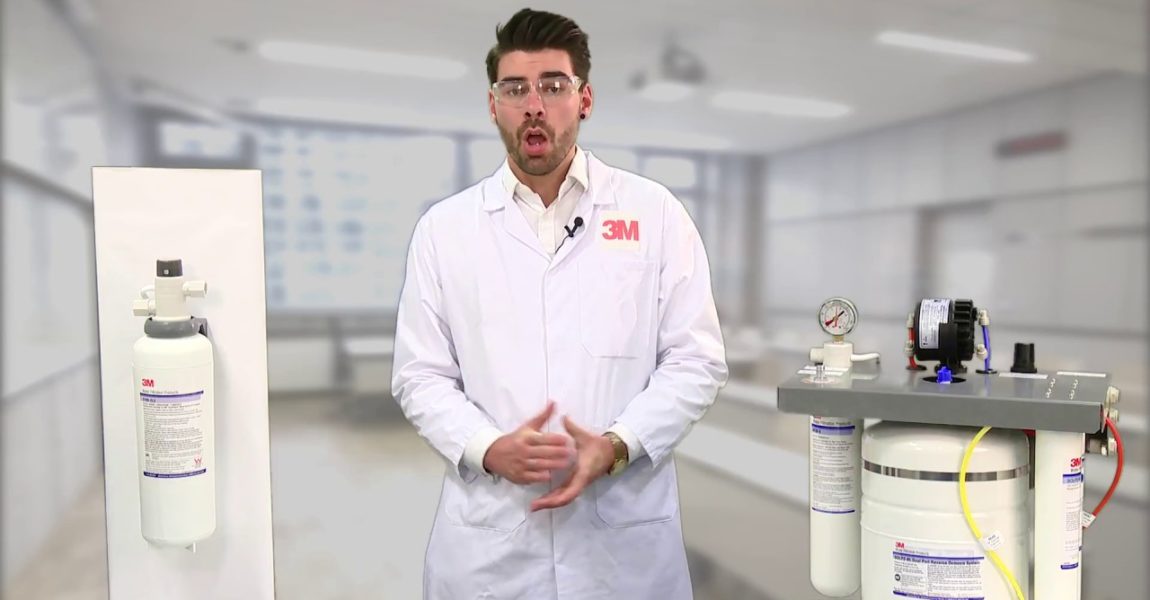
Whole House Water Filtration: Your Ultimate Guide to Cleaner, Safer Water at Home

Ever wonder what's really in your tap water? When you start exploring ways to improve it, you'll quickly run into the great debate: whole house water filtration vs water softener. But here’s the secret: they're not really in competition. One is about creating the healthiest, best-tasting water imaginable, and the other is a specialized tool for a very specific plumbing problem.

Let's focus on the star of the show: the whole house water filter. Think of it as a personal bodyguard for every drop of water that enters your home. Its mission? To purify your water by removing a whole host of unwanted contaminants, giving you healthier, tastier water from every single tap. On the other hand, a water softener is more like a plumber's assistant, designed solely to remove hard minerals that clog up your pipes.

Depending on your water, you might need one, the other, or even both. But understanding the power of filtration is the first step to truly transforming your home's water.

What Problem Are You Really Trying to Solve?

Let's cut through the jargon. What's the real difference between a filter and a softener?

Imagine a water filter is a high-tech security system for your body, while a water softener is an insurance policy for your pipes.
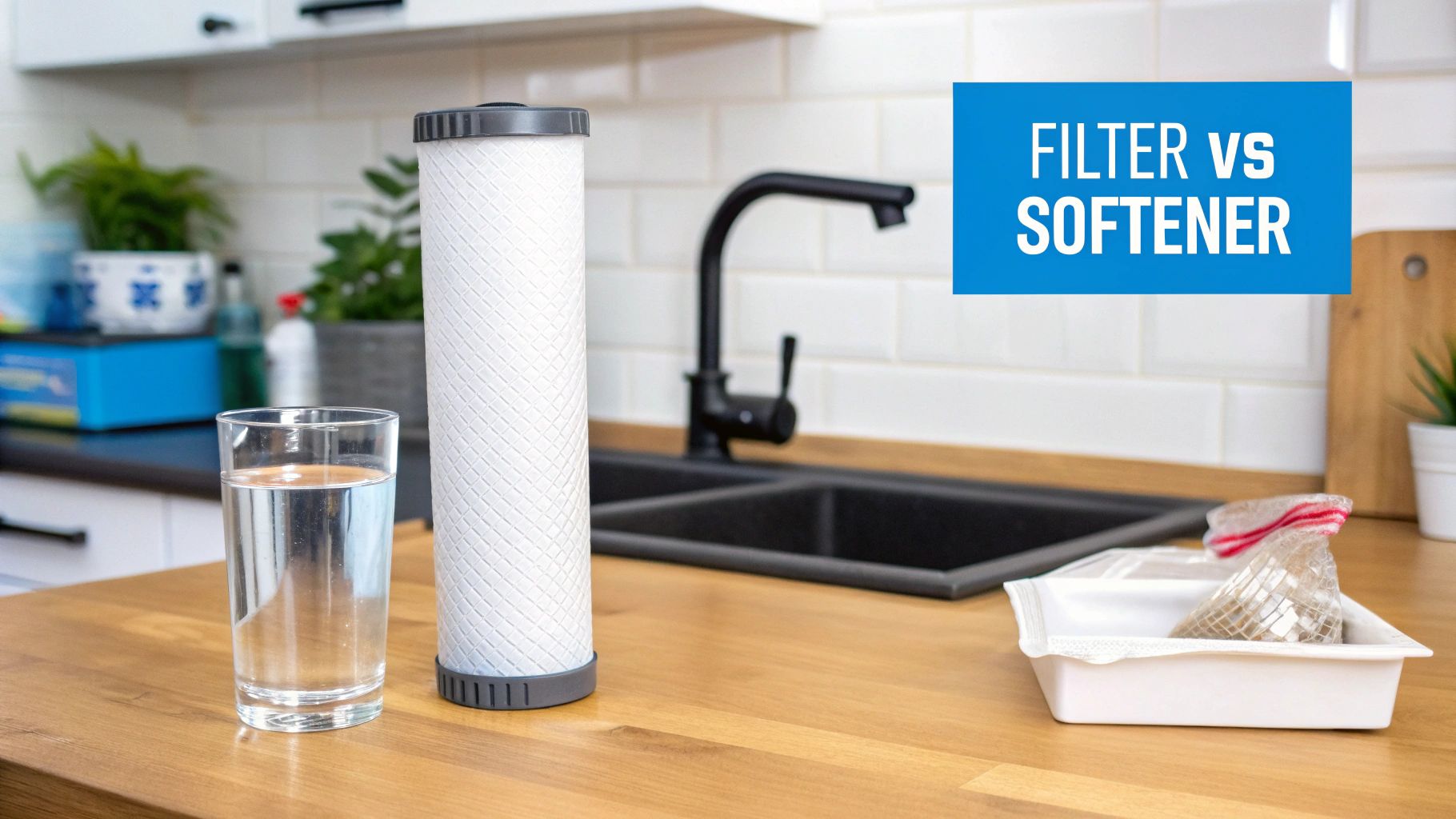
A white water filter cartridge, a glass of water, and a kitchen sink with a 'FILTER VS SOFTENER' sign.

A whole-house water filter is all about your health, safety, and senses. Its job is to be an uncompromising gatekeeper, trapping and removing a wide range of impurities. We're talking about things that can make your water unsafe, smell like a swimming pool, or taste like dirt. It’s the hero your water deserves.

A water softener, by contrast, is a one-trick pony—a very useful one, but still a specialist. Its single, focused mission is to combat "hard water," which is water loaded with minerals like calcium and magnesium. These minerals are harmless to drink but are absolutely brutal on your pipes, faucets, and appliances.

The Core Mission of Filtration

To put it plainly, you get a filter to protect your family's health. You get a softener to protect your financial investment in your home. A filter targets the quality of the water you drink, cook with, and bathe in; a softener deals with the destructive consequences of your water's mineral content.

This is the critical takeaway. A filter won't soften your water, and a softener won't remove chlorine, lead, or pesticides. Each is a specialized tool for a specific task, but filtration is the one that directly impacts your well-being.

Here's the simplest way to remember it: Filtration is for consumption and health, while softening is for plumbing and appliance preservation. Once you get that, you're on your way to diagnosing your water woes and finding the perfect solution.

Let's break it down side-by-side to make it even clearer.

Feature Whole House Water Filtration Water Softener
Primary Goal Purification: To remove contaminants from water. Protection: To remove hardness minerals from water.
What It Removes Chlorine, sediment, pesticides, lead, VOCs, and other chemicals. Calcium, magnesium, and sometimes small amounts of iron.
Key Benefit Improves water taste, odor, and safety for drinking and bathing. Prevents scale buildup, extending appliance life and improving efficiency.

Ultimately, it’s not always an either/or choice. Many homes—especially those on well water—are stuck with both hard water and other contaminants. For them, the ultimate setup involves both systems working in tandem to deliver genuinely clean, problem-free water from every faucet.

How a Whole House Filter Cleans Your Water

Think of a whole house water filtration system as a dedicated security checkpoint for your home's entire water supply. Installed right where the main water line enters your house, its sole job is to stop an army of contaminants before they ever reach your taps. This isn't just a simple strainer; it's a multi-stage purification process designed to give your water a serious upgrade from the ground up.

Your water embarks on a journey through different layers of specialized filter media, with each layer targeting specific impurities. It’s a comprehensive strategy that ensures every single drop—whether for drinking, cooking, or showering—is cleaner, safer, and tastes amazing.
Water pouring from a modern kitchen faucet into a clear glass on a wooden countertop.

This is the heart of the whole house water filtration vs water softener discussion. While softeners tackle minerals, filtration systems are engineered to purify water by removing the things that impact its taste, smell, and safety.

The Unsung Heroes: Filter Media

The real magic happens inside the filter tanks, where different types of filter media team up to form a powerful line of defense against common water contaminants.

  • Sediment Pre-Filters: This is stage one, the bouncer at the door. These filters catch the big stuff—sand, silt, rust, and dirt. Removing this gunk not only makes your water look clearer but also protects the more advanced filter stages from getting clogged and worn out prematurely.

  • Activated Carbon Filters: This is the brains of the operation. Activated carbon is an incredibly porous material with a massive surface area, making it a rockstar at trapping chemical contaminants through a process called adsorption. It effectively grabs onto chlorine, pesticides, herbicides, and volatile organic compounds (VOCs), which is why your water suddenly starts tasting and smelling fantastic.

Think of activated carbon as a powerful magnet for chemicals. As water flows through, unwanted contaminants stick to the carbon's surface, letting wonderfully pure water flow into your home. This is exactly how that "public pool" smell from chlorinated city water vanishes.

Whole house filters are designed to capture a wide array of contaminants that municipal treatment plants might not completely remove. They can handle everything from chlorine and its byproducts to heavy metals like lead. In fact, real-world tests show just how effective they are, with some systems reducing lead levels to 0.0007 ppm and eliminating disinfection byproducts entirely. For a closer look at what these filters remove, this whole-home water filtration system guide is a great resource.

The Real-World Health Perks

By removing this cocktail of contaminants, a whole house filter does far more than improve your water's taste. It’s a direct investment in your family's health and well-being.

Filtering water at the point of entry means you’re protected from contaminants in the water you drink and the water you shower in. Your skin is your body's largest organ, and it can absorb chemicals like chlorine directly from shower water. By eliminating these substances, a great filtration system can lead to softer skin, healthier hair, and even better indoor air quality by reducing chemical vapors released during a hot shower.

At the end of the day, a whole house filtration system delivers unparalleled peace of mind. You can trust that the water from every tap is consistently clean and safe, tackling potential health concerns at the source.

How Water Softeners Protect Your Home

If a whole-house filter is the guardian of your family's health, a water softener is the bodyguard for your home's plumbing and appliances. It’s designed to fight a single, destructive enemy: hard water.

Hard water is just water that’s loaded with dissolved minerals, mostly calcium and magnesium. While these minerals won't hurt you to drink, they can absolutely wreck your home from the inside out.

A water softener has one job and one job only: stop those minerals before they can cause any damage. This is the fundamental difference to keep in mind when comparing whole-house water filtration vs. water softener systems. One is for broad-spectrum contaminant removal, and the other is a specialist, surgically targeting the minerals that lead to expensive problems.
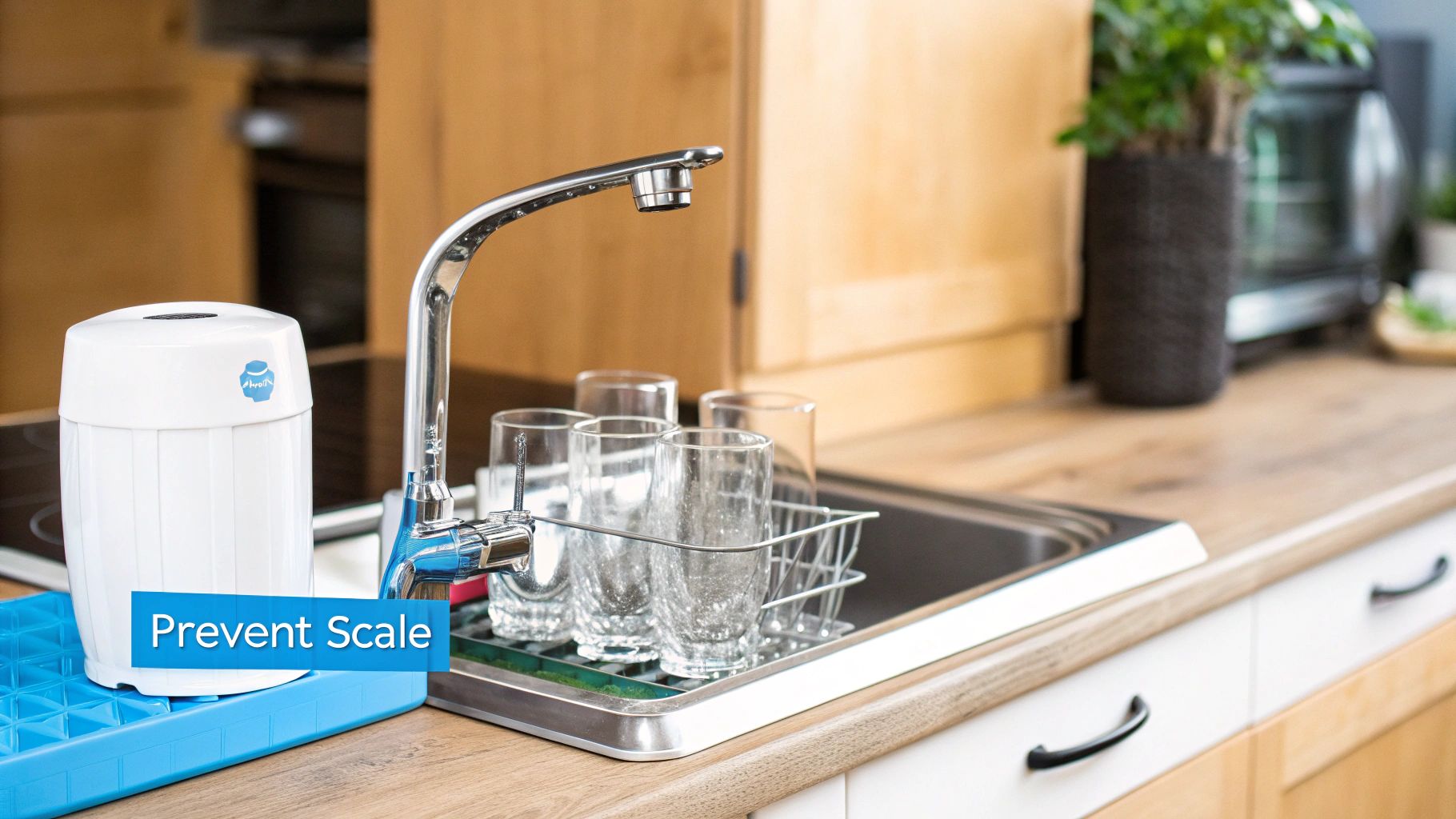
A white water filter system on a blue mat next to a kitchen sink with clean glasses.

This distinction matters because hard water is everywhere. More than 85% of homes in the U.S. deal with it. The fallout is significant—scale buildup from hard water can drive up a home's energy costs by as much as 29% and slash the lifespan of your appliances by 30%.

The Science of Ion Exchange Explained Simply

The magic behind a salt-based water softener is a process called ion exchange. Think of it as a simple trade. The main tank of the softener is filled with tiny resin beads that are covered in sodium ions.

When hard water flows over these beads, the calcium and magnesium ions—which have a stronger electrical charge—are drawn to the resin. They literally bump the weaker sodium ions off and take their place. The sodium flows out with the water, leaving you with "soft" water that's free of those damaging minerals.

It’s a simple swap, but it completely changes how your water behaves. The system works automatically until the resin beads are full of hardness minerals. Then, it runs a "regeneration" cycle to wash the minerals away and recoat the beads with fresh sodium.

Solving Everyday Hard Water Annoyances

You’ll see the benefits of this mineral swap almost right away. Soft water makes a huge difference in daily chores and eliminates all those frustrating hard water symptoms.

Here’s what you can expect:

  • Soap That Actually Lathers: Hardness minerals kill suds. With soft water, you’ll find yourself using way less soap, shampoo, and detergent to get a rich, cleansing lather.
  • Spotless Dishes and Glassware: That annoying cloudy film on your glasses? It’s mineral residue. Soft water rinses completely clean, leaving dishes and glassware sparkling.
  • Brighter, Softer Laundry: The same minerals that spot your dishes also get trapped in your clothing fibers, making them feel stiff and look dull. Soft water helps detergent work better, keeping colors vibrant and fabrics feeling soft.

A water softener’s primary job is to stop scale buildup before it starts. By removing calcium and magnesium, it protects the expensive, hard-working parts of your home's plumbing from the inside out.

Protecting Your Home's Most Valuable Assets

Beyond the daily perks, a water softener offers critical long-term protection for your home. The biggest threat from hard water is limescale—that hard, chalky gunk that clogs up pipes, faucets, and appliances.

Scale acts like cholesterol in your home’s arteries. It restricts water flow and makes your appliances work much harder than they should, eventually causing them to fail. Hard water can also cause other malfunctions, like the ones covered in this list of common reasons your dishwasher might not be getting water.

By preventing scale from ever forming, a water softener extends the life and efficiency of your most expensive appliances—like your water heater, dishwasher, and washing machine. It saves you a fortune in premature replacement costs and frustrating repair bills.

Comparing Filtration and Softening Head-to-Head

So, when it comes down to the whole house water filtration vs water softener choice, you need to look past the sales pitch and get into the practical, day-to-day realities. How do they actually work? What’s the upkeep really like? What will they cost you over the long haul?

Let's put these two systems side-by-side and break down how they perform in the areas that actually matter to a homeowner. This isn’t just about what’s getting pulled out of your water; it’s about what it’s like to live with each of these systems.

Primary Function: Health vs. Protection

The biggest difference between these two is their fundamental mission. A whole-house water filter is all about your health. Its job is to purify your water by taking out a wide range of nasty contaminants to improve the safety, taste, and smell of the water you drink and use every day.

A water softener, on the other hand, is basically a protection plan for your home. It does one thing and one thing only: it removes the hard minerals—calcium and magnesium—that wreck your pipes and appliances. Its purpose is to stop that destructive scale buildup before it starts, saving you a fortune in repairs and replacements.

Here’s the simplest way to think about it: A filter cleans water for your body. A softener conditions water for your house. They aren't interchangeable.

Installation and Space Requirements

Both of these systems get installed right where your main water line enters your house, but the space they take up can be surprisingly different.

  • Whole House Filters: These are often the more compact option, especially the newer cartridge or single-tank carbon setups. You’re usually looking at one or two tanks or housings you can mount right on the wall or sit on the floor, so they don’t demand a huge amount of real estate.

  • Water Softeners: Your typical salt-based softener is a bit more of a space hog. You've got the main mineral tank (where the magic happens) plus a separate, pretty bulky brine tank for the salt. This two-tank setup almost always needs more floor space than a filtration system.

Maintenance Routines: Salt vs. Filters

This is where your life as a homeowner really changes depending on which system you choose. The ongoing maintenance couldn't be more different.

With a whole house filtration system, your main job is changing out filters. Depending on your water quality and usage, you might swap a pre-filter every few months, but the main carbon media can last anywhere from 5 to 10 years. It’s a pretty clean and predictable task.

A salt-based water softener requires a lot more muscle. You’ll be buying and lugging 40-50 pound bags of salt to dump into the brine tank, probably once a month. You also have to keep an eye on it to make sure it’s regenerating properly and that you don't get a "salt bridge" clogging things up.

Long-Term Operational Costs

Don't just look at the price tag on the box. The real cost of any water treatment system is what you pay to keep it running year after year.

For a whole house filter, your ongoing costs are almost entirely for replacement filters. It’s a straightforward expense you can easily budget for. They also use very little electricity and don’t waste water, unless you have a model that backwashes occasionally.

For a water softener, you’re looking at a few different running costs:

  1. Salt: This is the big one. You’ll be buying salt for the life of the system.
  2. Water: Every time the softener regenerates to clean itself, it flushes a good amount of water down the drain.
  3. Electricity: The control valve needs power to run the regeneration cycles.

These costs add up over time, which is why a softener is generally more expensive to operate than a filter.

Water Filtration vs. Water Softener At A Glance

To make it even clearer, here’s a quick-glance table breaking down the core differences. This should help you see exactly where each system shines.

Feature Whole House Water Filtration Water Softener
Main Purpose Removes contaminants for health, taste, and odor. Removes hardness minerals to protect plumbing and appliances.
Targets Chlorine, pesticides, lead, sediment, VOCs. Calcium and magnesium.
Primary Benefit Safer, better-tasting water from every tap. Prevents limescale buildup and extends appliance life.
Typical Footprint More compact; often one or two tanks. Larger; requires both a mineral tank and a brine tank.
Maintenance Change filters periodically (months to years). Regularly add heavy bags of salt (monthly).
Operating Costs Replacement filters. Ongoing purchases of salt, plus water and electricity for regeneration.

This side-by-side look makes it obvious: these are two very different tools for two very different jobs. One isn't better than the other—it's all about what problem you're trying to solve with your water.

Choosing the Right System for Your Home

Deciding between whole house water filtration vs water softener really comes down to diagnosing your specific water issues. Instead of taking a guess, let the water itself tell you what it needs. Think of it like being a detective—the clues are right there in your home.

Start with your senses. Does your tap water smell like a swimming pool? That’s a clear sign of chlorine, which is a job for a filter. If you notice a metallic taste or that "rotten egg" smell, those are also classic signs that a whole house filter is what you need to remove those contaminants.

The evidence for hard water is more visual and tactile. Are you tired of scrubbing that stubborn white scale off your faucets and showerheads? Is your glassware always cloudy, even right after a wash? These are the telltale signs of excess minerals, pointing you straight toward a water softener.

When a Filter Is Your Priority

If your main concern is the safety and quality of the water you drink and bathe in, a filtration system should be your first consideration. It’s the go-to solution for improving the overall health of your water.

You should make a whole house filter your top priority if you're dealing with:

  • Noticeable Odors: A strong chlorine or chemical smell is a dead giveaway that your water needs to be purified.
  • Unpleasant Taste: If your water tastes metallic, earthy, or just "off," a filter will target the contaminants causing it.
  • Concerns About Contaminants: For anyone worried about invisible threats like lead, pesticides, or VOCs, a high-quality filtration system provides critical peace of mind.

This infographic breaks down the core functions: filters are for health, while softeners are for protection.
Two icons separated by a line: a blue water drop for Health and a gray shield for Protection.

The image makes the distinction clear: filtration improves the water you consume, while softening protects your home’s plumbing and appliances.

When a Softener Is the Answer

If your biggest headaches are home maintenance and extending the life of your appliances, a water softener is the specialized tool for the job. It directly solves the expensive and annoying problems caused by mineral buildup.

A water softener is the right call if your home has:

  • Visible Limescale: That chalky white residue on fixtures, shower doors, and in your coffee maker is the most obvious sign of hard water.
  • Poor Soap Performance: If soap and shampoo just don't lather well and you find yourself using more and more detergent, hardness minerals are the culprit.
  • Appliance Issues: Frequent breakdowns or the early death of your water heater, dishwasher, or washing machine often traces back to scale.

The Common Scenario When You Need Both

For many people, especially those on well water, the problems aren't so clear-cut. You might have hard water that also smells like sulfur and is full of sediment. In these common cases, picking just one system means you’re leaving a big problem unsolved.

The best solution for total water treatment is often a combined system. This setup delivers the best of both worlds: pure, great-tasting water for your family and mineral-free water to protect your home.

When you install both, the order is crucial. The whole house water filter is always installed first, right after the main water line enters your home. This lets it strip out chlorine, sediment, and chemicals that can ruin the sensitive resin beads inside a water softener, making it last longer and work better. The softener comes second, treating the already-filtered water to remove the hardness minerals.

This two-stage setup ensures every tap in your house delivers clean, safe, and soft water. For more detailed guides on specific water problems, you can find tons of practical water filter advice to help you figure out exactly what you need. When looking at your home's water system, also consider if you need water storage solutions like Vertical Water Storage Tanks as part of a complete setup.

Common Questions About Water Treatment Systems

Diving into the world of home water treatment can feel like a lot, especially when you're just trying to solve a specific problem like hard water spots or weird-tasting tap water. As you weigh the pros and cons in the whole house water filtration vs water softener debate, the same handful of questions pop up again and again. Getting clear answers is the key to making a smart investment.

Let’s tackle the most common questions we hear from homeowners. We'll clear up the confusion and give you the straightforward details you need to choose the right system for your family.

Can A Whole House Filter Also Soften Water?

This is probably the number one question we get, and the short answer is a firm no. A standard whole house water filter is a purifier, not a softener. Its job is to grab contaminants like chlorine, sediment, pesticides, and other chemicals that make your water taste and smell bad.

These systems use media like activated carbon, which is fantastic at adsorbing chemicals but simply doesn't interact with the dissolved minerals—calcium and magnesium—that cause hard water. Some devices might claim to reduce scale, but they aren't true softeners and won’t give you the same results as a dedicated ion exchange system.

Think of it this way: a filter is like a sieve catching silt and debris, but the salt dissolved in the water flows right through. You need a completely different tool to deal with dissolved minerals.

If I Get Both Systems, Which One Is Installed First?

When you need both to get the job done, the installation order is absolutely critical. The rule of thumb is simple: the whole house water filtration system always goes first, right after the main water line enters your home. The water softener comes second.

The logic here is all about protecting your equipment. City water is treated with chlorine or chloramines, which are great for killing bacteria but are absolute murder on the resin beads inside a water softener. By putting the filter first, you strip out those harsh chemicals before they can destroy the softener’s resin, which dramatically extends its lifespan.

On top of that, the filter also catches any sediment or grit that could clog the small, precise parts in the softener’s control valve, saving you from a costly repair call down the road.

Are There Health Concerns With Softened Water?

The main thing people wonder about is the sodium that salt-based softeners add to the water. In the ion-exchange process, the hard minerals (calcium and magnesium) get swapped for sodium ions. For the vast majority of people, the amount of sodium added is tiny and poses no health risk—often less than what's in a single slice of bread.

However, if you or someone in your family is on a strict low-sodium diet for a medical reason like hypertension, it’s a valid consideration. The good news is, you have options:

  • Use Potassium Chloride: You can use potassium chloride pellets instead of sodium chloride salt. It works the same way but swaps hardness for potassium.
  • Install a Reverse Osmosis System: An RO filter at your kitchen sink is a perfect companion to a softener. It removes the added sodium (along with virtually everything else) to give you purified water for drinking and cooking.
  • Choose a Salt-Free Conditioner: Also called descalers, these systems don't remove hard minerals or add sodium. Instead, they crystallize the minerals so they can't stick to your pipes and fixtures.

How Do I Test My Water To Know What I Need?

You can't fix a problem if you don't know what it is. Testing your water is the only way to move forward with confidence. Guessing is a great way to waste money on the wrong equipment and still be stuck with the same water issues.

You have two main paths for testing:

  1. DIY Test Kits: You can grab an inexpensive test kit from a hardware store for a quick read on the basics. These strips will give you a ballpark figure for hardness (measured in Grains Per Gallon, or GPG), chlorine, and pH.
  2. Certified Laboratory Testing: If you’re worried about things like lead, bacteria, arsenic, or industrial chemicals (VOCs), a professional lab test is non-negotiable. It's the only way to get accurate results you can trust. Check with your local health department for a list of state-certified labs.

A full lab report gives you the hard data you need to make an informed decision. It eliminates all the guesswork and ensures you invest in a system that’s perfectly matched to your water’s unique chemistry.


At Water Filter Advisor, we believe every family deserves access to clean, safe water. Our in-depth guides and unbiased reviews are designed to help you understand your water and choose the best solution with confidence. Explore our resources to find the perfect system for your home at https://www.waterfilteradvisor.com.
Filtered Water vs Reverse Osmosis: Your Ultimate Home Guide

Trying to pick a water filtration system for your home can feel like you're wading through a swamp of technical jargon. But don't worry—it all boils down to one simple question: what are you trying to kick out of your water?

The heavyweight championship bout of filtered water vs reverse osmosis is all about the level of purification you're after. Think of standard filters as the bouncer at a cool club—they're fantastic at grabbing the big, obvious troublemakers like chlorine and sediment, making your water taste and smell way better. Reverse osmosis (RO), on the other hand, is the secret service detail. It’s designed to strip out a much, much longer list of undesirables, including microscopic villains like heavy metals, fluoride, and even dissolved salts.

Decoding Your Home Water Filtration Options

Choosing the right water treatment for your house can seem daunting, but once you get the hang of the two main contenders, it gets a lot easier. Most of us are just trying to fix a specific problem, whether it's that "just left the public pool" taste from the city supply or deeper worries about invisible contaminants. The system you land on should be a direct answer to your water woes and what your family needs to stay healthy and hydrated.

Great water is a cornerstone of a healthy home, a point that often comes up in essential home maintenance tips. Your first mission, should you choose to accept it, is figuring out exactly what you want gone from your H₂O.

Kitchen water filtration system filling glass from modern faucet for purer healthier drinking water

Quick Comparison Filtered Water vs Reverse Osmosis

To cut through the noise, here's a quick side-by-side smackdown. This table breaks down the core differences so you can get a feel for what separates these two technologies right away.

Feature Standard Water Filters (e.g., Carbon) Reverse Osmosis (RO) Systems
Primary Goal Improves taste, smell, and clarity. Purifies water by removing a vast range of contaminants.
Technology Uses media like activated carbon to adsorb contaminants. Forces water through a semipermeable membrane.
Removes Chlorine, sediment, some VOCs, and large particles. Dissolved solids, heavy metals, fluoride, salts, and more.
Best For Municipal water with good baseline quality. Homes with specific contaminant concerns or well water.

This is the central plot twist in the whole filtered water vs reverse osmosis saga. A standard filter improves your water; a reverse osmosis system purifies it.

Reverse osmosis isn't just a niche product; it’s become the main player in the global water purification scene. RO systems now hold about 39% of the market share, making them the top technology for water treatment across the world.

In the end, this isn't about which one is flat-out "better." It’s about matching the right hero to your specific water villain. Let's dive deeper to see how each one works so you can feel like a certified water wizard.

A Look at Standard Water Filtration Methods

When most people talk about "water filters," they're usually thinking of what we call standard filtration methods. These are the most common and accessible ways homeowners can clean up their water. You'll find them everywhere, from simple pitchers in the fridge to more involved whole-house systems.

Unlike reverse osmosis, which strips water down to nearly pure H₂O on a molecular level, these filters are more like a highly targeted net. Their job isn't to create perfectly pure water, but to make already decent water even better. They tackle the most common complaints—funky tastes, weird smells, or floaties in your glass.

Let's dig into the three main technologies that do the heavy lifting in these everyday solutions.

The Power of Activated Carbon Filters

There’s a good reason activated carbon is the rockstar of filtration technology. The best way to think of it is as a super-powered sponge. Just one gram of activated carbon has a surface area as large as a football field. This massive, porous surface is what makes it so good at a process called adsorption.

Adsorption is basically a magnetic attraction for chemicals. As water flows through the carbon, contaminants like chlorine, volatile organic compounds (VOCs), and other gunk that causes bad tastes and odors get stuck to its surface. It's why a basic carbon filter in a pitcher or on your faucet can make tap water taste crisp and clean almost instantly.

But it's just as important to know what it can't do. Activated carbon won't touch:

  • Dissolved minerals or salts (TDS)
  • Heavy metals like lead or arsenic
  • Fluoride
  • Bacteria and viruses

For anyone on city water, an activated carbon filter is often the perfect, inexpensive fix for better-tasting water right out of the tap.

Key Insight: Activated carbon is all about improving the aesthetics of water—its taste and smell. It’s a rockstar at removing chlorine, making it the default choice for anyone on a municipal supply who just wants a quick, noticeable upgrade.

Sediment Filters: Your First Line of Defense

Before water ever gets to your faucet, it has traveled through miles of pipes. Along the way, it picks up tiny bits of rust, sand, dirt, and silt. A sediment filter acts as a bouncer at the door, catching all this physical grit before it can get into your home’s plumbing.

These filters are rated by their micron size, which tells you how small of a particle they can trap. A 5-micron filter, for example, will stop anything larger than that. This is huge for protecting your appliances, like water heaters and washing machines, from getting clogged up with damaging gunk.

You'll almost always see sediment filters as the first stage in a bigger setup, like an under-sink or whole-house system. They're rarely used alone for drinking water because they don't remove any chemicals or germs. Their one job is to clear the path so other, more specialized filters can do their jobs better.

UV Purifiers: A Chemical-Free Guardian

While carbon and sediment filters deal with chemicals and particles, ultraviolet (UV) purifiers take on an entirely different enemy: living microorganisms. A UV purifier zaps water with a specific wavelength of ultraviolet light, which messes with the DNA of bacteria, viruses, and other nasty microbes.

This doesn't technically "kill" them, but it makes them sterile and unable to reproduce, so they can't make you sick. It’s a fantastic way to handle microbiological threats without dumping any chemicals into your water. This is why it's a go-to solution for homes on well water, where things like E. coli can be a real concern.

Keep in mind, a UV purifier doesn't remove anything else. It won't change the water's taste, smell, or chemical makeup. For that reason, you’ll always find them paired with sediment and carbon pre-filters. The pre-filters make sure the water is crystal clear, allowing the UV light to penetrate fully and do its job effectively. Together, this trio creates a powerful defense against a wide range of common water problems.

How Reverse Osmosis Delivers Ultimate Purity

When you move past standard water filters, you get into the world of reverse osmosis (RO). This isn't just a simple filter—it's a comprehensive purification process designed to strip water down to its most basic, pure state. Think of an RO system as a team of specialized filters, each with a critical job, all working together to deliver incredibly clean water.

This multi-stage approach is what truly separates a basic filter from a real purification system when comparing filtered water vs reverse osmosis. It’s an engineered solution built to handle a much broader, more serious list of contaminants, offering a level of purity that other methods just can't touch.

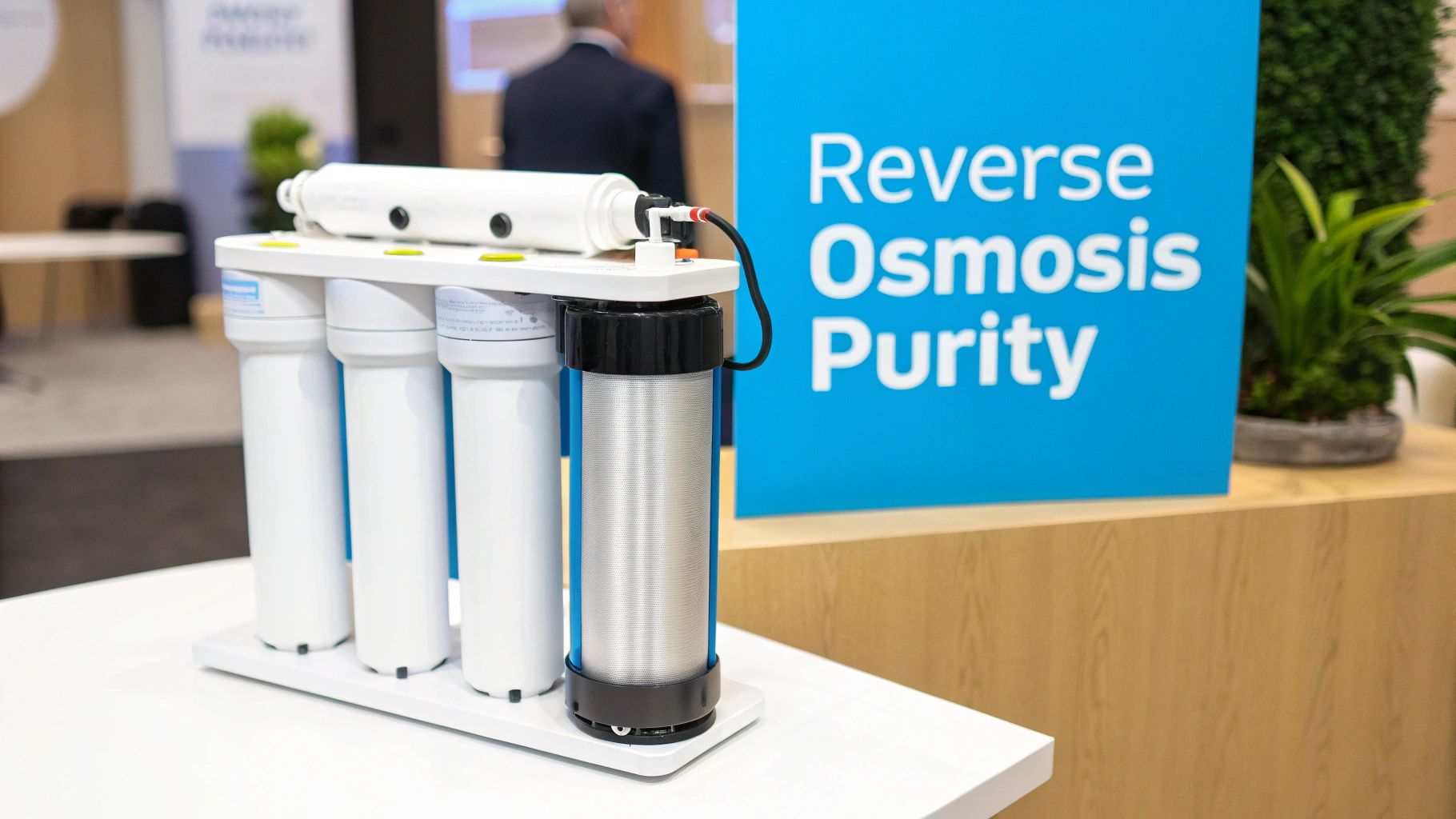
Reverse osmosis water filtration system with multiple filter stages displayed at trade show booth

The Multi-Stage Purification Journey

Before your tap water even gets to the main event, it passes through a couple of crucial pre-filters. These are the unsung heroes of the RO system, responsible for protecting the most important and delicate component from getting damaged.

Here’s how the journey usually starts:

  1. A Sediment Pre-Filter: This is the first line of defense. It catches all the big stuff—we're talking rust, sand, dirt, and silt. Getting this physical debris out of the way prevents clogs and protects the more sensitive filters that come next.
  2. An Activated Carbon Pre-Filter: After the sediment filter, the water moves through one or more carbon filters. Just like in standard pitcher or faucet filters, their job is to grab onto chlorine and other chemicals that can wreck the RO membrane and make your water taste and smell bad.

These pre-filters get the water ready for the real powerhouse of the system.

The Reverse Osmosis Membrane Explained

At the heart of every RO system is its semipermeable membrane. The best way to think of this membrane is like a microscopic bouncer at an exclusive club. Its pores are unbelievably small, around 0.0001 microns.

When your home's water pressure forces water against this membrane, the tiny water molecules are small enough to squeeze through. But just about everything else dissolved in the water—from salts and lead to fluoride and other minerals—is too big. They get turned away and flushed down the drain in a stream of wastewater.

This is the key difference that puts reverse osmosis in its own category. It doesn't just trap some particles; it physically separates pure H₂O from a huge list of dissolved contaminants.

A quality residential RO system is incredibly effective, capable of removing up to 99% of all total dissolved solids (TDS). That includes a long list of things that standard filters simply don't touch.

Targeting Contaminants Others Miss

Thanks to that unique membrane, reverse osmosis excels at removing contaminants you can't see, taste, or smell. This makes it the go-to solution when you’re dealing with more serious water quality issues than just chlorine.

An RO system is your best defense against things like:

  • Heavy Metals: It’s incredibly effective at getting rid of dangerous metals like lead, arsenic, mercury, and chromium that can come from old pipes or the water source itself.
  • Dissolved Solids (TDS): This includes inorganic compounds like salts and sulfates. High TDS levels can give water an "off" taste and indicate a high concentration of various substances.
  • Fluoride and Nitrates: Many people prefer to remove the fluoride added to city water. RO systems also effectively remove nitrates, which often get into water supplies from agricultural runoff.

After the water makes it through the membrane, it usually gets a final "polish" from a carbon post-filter to catch any last traces of taste or odor. From there, it's stored in a small tank under your sink, ready to go. This complete, end-to-end process is why RO provides some of the purest water you can get right from your own kitchen.

Comparing Contaminant Removal Capabilities

When you're trying to decide between a standard water filter and a reverse osmosis system, it all boils down to one critical question: what, exactly, are you trying to remove from your water? This is where the two paths really split. While regular filters are fantastic for specific, targeted improvements, an RO system offers a far more comprehensive purification shield.

To really get to the heart of the matter, we have to look past the marketing claims and see how each system stacks up against the common culprits found in home water tests. Your choice should directly solve the problems unique to your water supply, whether that’s just the funky taste of city chlorine or more serious, unseen threats lurking in a private well.

Side-by-side comparison of TDS filter and reverse osmosis purified water in clear glasses with testing kit

Chlorine and Taste Improvement

Let's start with the most common complaint for folks on municipal water: the taste and smell of chlorine. This is where activated carbon filters really shine. They use a neat process called adsorption to grab onto and trap chlorine molecules, making your water instantly more pleasant to drink.

A simple carbon-based pitcher or faucet filter can make a world of difference in the day-to-day quality of your water. It's important to remember, though, that this is their main job. They aren't built to handle a wider array of chemical or biological contaminants.

Reverse osmosis systems also get rid of chlorine. They almost always include a carbon pre-filter that tackles it before the water even hits the RO membrane. So, while both solve the chlorine problem, the RO system is just getting warmed up.

Heavy Metals and Dissolved Solids

Here’s where we see a major split between the two. Standard filters, including both carbon and sediment types, are not effective at removing dissolved contaminants like heavy metals or salts. Things like lead from old plumbing, arsenic from groundwater, or a high concentration of total dissolved solids (TDS) sail right through these filters.

Reverse osmosis, on the other hand, was engineered specifically to stop these threats. The semipermeable membrane has microscopic pores—we’re talking around 0.0001 microns—that are so tiny they physically block these larger molecules.

An activated carbon filter is the perfect solution for improving the taste of city water, but it falls short for well water safety or concerns about lead. A reverse osmosis system provides comprehensive protection, making it the superior choice when your water test reveals more serious issues.

This makes RO the undisputed champ for anyone worried about:

  • Lead: Can leach from older pipes and solder joints.
  • Arsenic: A common groundwater contaminant in certain parts of the country.
  • High TDS: An indicator of a high concentration of various minerals and salts.

Fluoride and Nitrates

Fluoride is another substance that standard filters just can't touch. While many cities add it for dental health, some people prefer to remove it. Only a reverse osmosis system can effectively strip fluoride out of your drinking water.

Similarly, nitrates—which often get into water from fertilizer runoff—are a big concern, especially for homes with infants. An RO system is incredibly effective at removing nitrates, while standard filters aren't. This is a crucial difference for families in agricultural areas or those on private wells.

The power of an RO system is hard to overstate here. They can remove up to 99% of bacteria, viruses, dissolved salts, heavy metals, and microplastics. In contrast, traditional water filters typically only remove 50-70% of these contaminants, depending heavily on the filter type and how well it's maintained. If you want to dig deeper, you can explore the water filter market trends and see why RO systems are leading the industry.

Biological Contaminants and Microplastics

Now, when we talk about bacteria and viruses, the comparison gets a little more interesting. A standard carbon filter won't stop microorganisms. For that, you need a dedicated UV purifier, which is often paired with other filters to specifically neutralize these biological threats by scrambling their DNA.

A reverse osmosis system also removes bacteria and viruses simply because they are too large to squeeze through the membrane's tiny pores. For the ultimate peace of mind, especially for well water users, many people pair an RO system with a UV purifier for a powerful, two-pronged defense.

And what about emerging concerns like microplastics? RO handles them with ease. Those tiny plastic particles, while small, are still far too large to get through an RO membrane and are filtered out.

Contaminant Removal Showdown

To make it crystal clear, let's put these systems head-to-head. The table below breaks down how each one performs against the most common water quality issues.

Contaminant Activated Carbon Filter Sediment Filter UV Purifier Reverse Osmosis System
Chlorine Excellent None None Excellent
Sediment/Rust Poor Excellent None Excellent (with pre-filter)
Heavy Metals None None None Excellent
Fluoride None None None Excellent
Bacteria/Viruses None None Excellent Excellent
Microplastics Limited Limited None Excellent

This side-by-side comparison really tells the story. Your choice depends entirely on your goal. If you just want better-tasting water, a carbon filter will do the trick. But if you're looking for true purity, reverse osmosis is the clear winner.

Cost, Maintenance, and Environmental Impact

Beyond the raw purification power, the practical side of things—cost, upkeep, and environmental footprint—is where the rubber really meets the road. It’s here, in the filtered water vs reverse osmosis debate, that the true long-term value starts to show. A cheap pitcher might look good on the shelf, but a more serious system could save you a lot more per gallon over its life.

This isn’t just about the sticker price. We need to look at the whole picture: what you pay upfront, the cost of replacement filters down the line, and what it actually takes to keep your system running at peak performance. It's all about finding a solution that fits your budget and lifestyle without causing headaches for your wallet or the planet.

The Financial Breakdown

Right off the bat, the initial cost of getting into water filtration varies wildly. You can grab a standard activated carbon pitcher filter for as little as $20, or a faucet-mounted one for around $30-$50. These are super accessible ways to start improving the taste and smell of your tap water.

Reverse osmosis systems, on the other hand, are more complex machines, and their price reflects that. A good under-sink RO system will typically start around $200 and can climb to $500 or more for models loaded with extras like remineralization stages or high-efficiency designs.

But the story doesn't end there. Let's talk ongoing costs.

  • Pitcher Filters: Those cartridges need swapping every 1-2 months, and they’ll set you back $6 to $15 a pop. That can easily add up to $90 or more every year.
  • Faucet Filters: These last a bit longer, usually 2-3 months, with replacements costing about $15-$25 each.
  • RO Systems: The upfront cost is higher, sure, but the maintenance is spread out. You'll replace the pre-filters and post-filters every 6-12 months for around $50-$80 for the set. The main RO membrane itself is the real workhorse and only needs to be replaced every 2-4 years, depending on your water quality.

When you do the math and break it down to cost per gallon, an RO system often pulls ahead as the more economical choice over time, especially for families who go through a lot of water.

Unpacking Maintenance Requirements

Keeping your filter effective takes some attention, but the effort involved is quite different for each type. For pitcher and faucet filters, maintenance is a breeze—just pop out the old cartridge and stick in a new one. The biggest challenge is just remembering to do it on time so your water quality doesn't dip.

A point people often miss is installation. Pitchers need zero setup, of course. Faucet and basic under-sink filters can usually be installed by anyone reasonably handy in less than an hour. A full reverse osmosis system is a bit more involved, but it's still a manageable weekend project for many DIY-ers.

An RO system needs a more structured maintenance plan. You've got to keep track of the replacement schedule for several different filters—sediment, carbon, and post-filters—plus the RO membrane itself. It's a little more to juggle, but the reward is consistently pure water. Dropping the ball on replacing pre-filters can kill the expensive RO membrane early, so staying on schedule is key.

The Environmental Factor: Wastewater

One of the biggest hang-ups people have in the filtered water vs reverse osmosis discussion is the environmental impact—specifically, the wastewater from RO systems. Years ago, older RO systems got a bad rap for being incredibly wasteful, but honestly, that's a dated concern. Technology has made some huge leaps.

Many of those old-school models would waste up to three gallons of water for every single gallon of pure water they produced. Today, high-efficiency RO systems have blown that out of the water, with some top-tier models getting close to a 1:1 ratio of clean water to wastewater. You can filter out fact from fiction on RO wastewater and see how far the tech has come. This innovation makes RO a far more sustainable choice than it used to be.

How to Choose the Right System for Your Home

https://www.youtube.com/embed/DOPweBJInr4

So, how do you decide between a standard water filter and a full-on reverse osmosis system? It's actually simpler than it sounds. Your first move should always be the same: figure out what's really in your water. Get a water quality report. It’s the only way to know what you’re truly up against.

Once you have that information, the right choice usually snaps into focus. This isn’t about finding a single "best" filter—it's about matching the right tool to your specific water problems and your lifestyle.

Let's walk through a few common situations.

Scenario 1: The City Apartment Dweller

If you’re in a city apartment, you're getting municipally treated water. That means it’s biologically safe, but it's often packed with chlorine to keep it that way. For most people, the biggest complaint is that "pool water" taste and smell.

  • Your Main Concern: Getting rid of that awful chlorine taste and odor.
  • Best Solution: An activated carbon filter. A simple pitcher, a filter that screws onto your faucet, or a basic under-sink unit will do the trick perfectly.
  • Why It Works: Carbon is a champion at grabbing onto chlorine and other chemicals that ruin the taste of your water. It’s a cheap, easy fix that makes a huge difference right away, with no complicated installation needed.

Scenario 2: The Suburban Family with Older Pipes

Living in a suburban home on city water presents a slightly different picture. You've still got the chlorine issue, but now you’re also wondering about the older plumbing—either in your house or running under the street. The big worry here is lead.

  • Your Main Concerns: Chlorine taste, plus potential heavy metals like lead.
  • Best Solution: A reverse osmosis (RO) system.
  • Why It Works: A good carbon filter will handle the chlorine, sure, but it won’t touch lead. The RO system’s special membrane is one of the only technologies available for home use that can reliably strip out dissolved heavy metals. It offers total peace of mind.

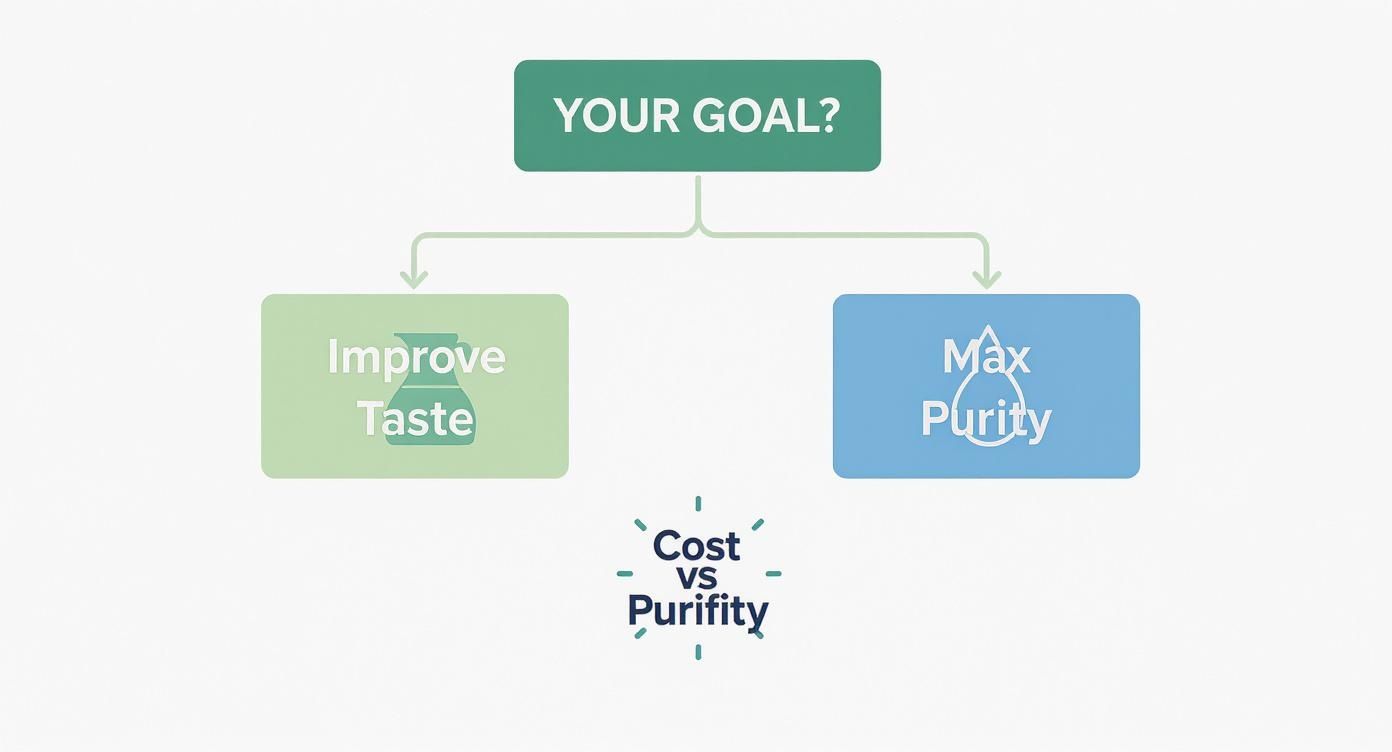
This little decision tree can help you visualize whether you just need a taste upgrade or if you’re aiming for maximum purity.

Decision flowchart showing water filtration goals: improve taste versus maximize purity with cost considerations

As you can see, if better-tasting water is all you're after, standard filters are a fantastic and affordable option. But if you want to remove the most contaminants possible, reverse osmosis is the way to go.

Scenario 3: The Rural Home on Well Water

Being on a private well is a whole different ballgame. Your water isn't treated by anyone, so you could be dealing with a huge range of issues. We're talking everything from dirt and high mineral content (hard water) to invisible threats like bacteria, nitrates from fertilizer runoff, and pesticides.

When you're on a private well, you are your own water treatment plant. You can't just assume the water is safe. Testing is non-negotiable, and a serious purification system is an essential, not a luxury.

  • Your Main Concerns: Bacteria (like E. coli), viruses, nitrates, heavy metals, sediment, and possibly high Total Dissolved Solids (TDS).
  • Best Solution: A multi-stage reverse osmosis system, often paired with a UV purifier.
  • Why It Works: This one-two punch creates an ironclad defense. The RO system takes care of the chemicals, metals, and dissolved solids. Then, the UV light acts as a final, chemical-free sterilizer, zapping any nasty microorganisms that could make your family sick. For more tailored help, you can find a ton of practical advice for choosing a water filter that covers all kinds of water sources and contamination issues.

Common Questions About Home Water Filtration

Making the final call between a standard water filter and a full reverse osmosis system usually brings up a few last-minute questions. Let's walk through some of the most common ones so you can feel good about your choice for cleaner water at home.

Does Reverse Osmosis Remove Healthy Minerals?

Yes, it does. An RO system is designed to be incredibly thorough, and its membrane can't tell the difference between a harmful contaminant and a beneficial mineral like calcium or magnesium. It simply removes almost all total dissolved solids (TDS).

But here’s the thing: most of us get the vast majority of our minerals from the food we eat, not from our drinking water. If you’re still concerned, you can easily add a remineralization filter to most modern RO systems. This adds a healthy balance of minerals back into the water after it's been purified, which also tends to improve the taste and pH.

It's a common myth that pure RO water will somehow leach minerals from your body. The reality is that the mineral content in typical tap water is tiny compared to what a balanced diet provides.

Is Filtered Water Really Better Than Bottled Water?

Absolutely, and for two big reasons: cost and environmental impact. When you buy bottled water, you're paying a huge premium—often hundreds of times more per gallon than what comes out of your tap.

Then there's the plastic. The energy used to produce and transport all those bottles, plus the waste they create, is a massive environmental problem. A home filtration system gives you top-quality water right from your faucet, without the constant expense and plastic waste.

How Do I Know When to Replace My Filters?

This is a big one, because an old filter isn't just ineffective—it can be worse than no filter at all. The best advice is to follow the manufacturer's schedule to the letter.

For most standard filters, like what you’d find in a pitcher or attached to a faucet, you’re looking at a replacement every 2-3 months.

Reverse osmosis systems have a few different components. The pre-filters and post-filters usually need to be swapped out every 6-12 months. The RO membrane itself is the workhorse and can last 2-4 years. If you let them go too long, performance drops, and you risk letting contaminants sneak back into your water.


Ready to explore the best filtration solutions for your home? The team at Water Filter Advisor provides in-depth reviews and practical guides to help you find the perfect system. Discover unbiased advice at https://www.waterfilteradvisor.com.
Choosing the Best Whole House Water Filter for Your Home

Ever wondered what's really in your tap water? When you start the hunt for the best whole house water filter, you're not just buying an appliance—you're taking control of every drop of water in your home. The top-tier systems all do a few key things brilliantly: they attack contaminants with multiple stages of filtration and are built like tanks to last for years. This isn't just a filter under your sink; it's a full-on water upgrade for your entire house, purifying water from the laundry room to your morning shower.

Your Guide to Pure Water in Every Room

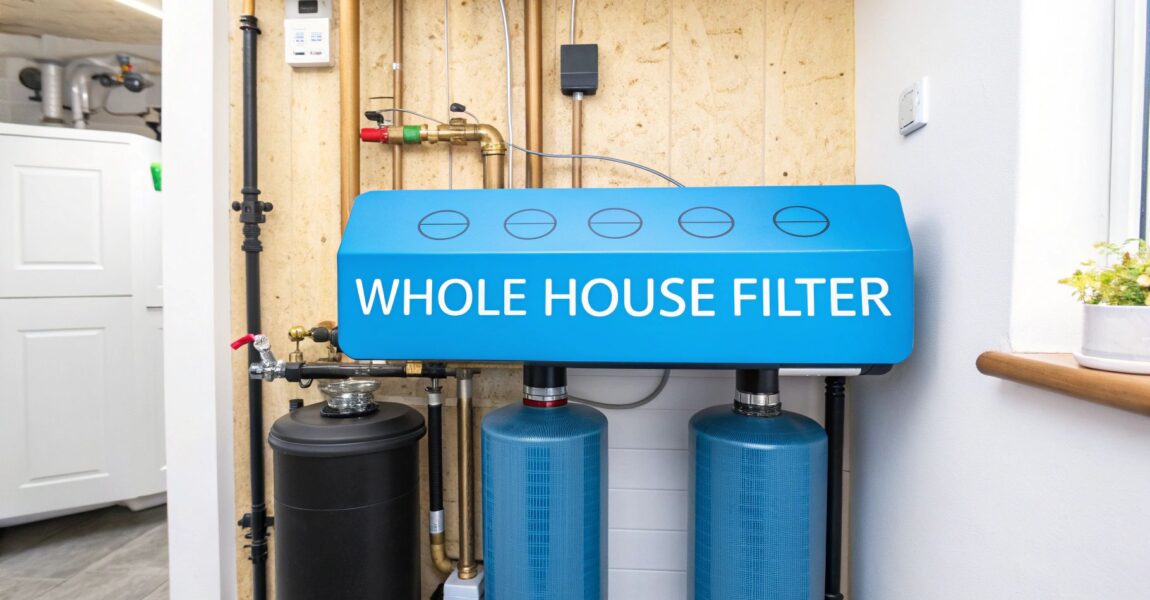
A modern whole house water filter system installed in a clean utility room

A whole house water filter, also known as a point-of-entry (POE) system, is the ultimate solution for your home's water quality. Forget those clunky pitchers or faucet attachments that only treat water at a single tap. This powerhouse gets installed right where your main water line enters your home.

The result? Every single faucet, showerhead, and water-using appliance—from your washing machine to your dishwasher—gets pristine, filtered water.

Choosing the right system is about more than just banishing a funky taste or smell. It's a serious investment in your family's well-being and the longevity of your home's plumbing. Unseen villains like chlorine, sediment, and heavy metals can wreak havoc on your pipes and force your appliances to work overtime, leading to costly repairs.

Why a Whole Home System is a Game-Changer

Installing a full-scale filtration system delivers benefits you'll feel all over the house. It provides a level of comprehensive protection and convenience that single-point filters simply can't match.

Here are the key perks:

  • Healthier Skin and Hair: Say goodbye to the dry, itchy skin and brittle hair that often comes from showering in chlorinated city water. Filtered water is gentler and more nourishing.
  • Appliance Lifeguard: Sediment and mineral scale are the arch-nemeses of dishwashers, washing machines, and water heaters. Clean water helps them run efficiently and last much longer.
  • Superior Taste and Odor: Finally, you can enjoy crisp, delicious water for drinking and cooking from any faucet in the house. No more stocking up on bottled water.
  • Total Peace of Mind: There's a certain confidence that comes with knowing your water is free from a whole host of potential contaminants every time you turn on the tap.

Many homeowners switch to a whole house filter because they're tired of the constant hassle of water treatment. It transforms water quality from a daily chore—refilling pitchers, changing tiny filters—into something that just works, silently and effectively, in the background.

The demand for these systems is surging as more people become aware of what's in their water. The U.S. water purifier market was valued at approximately USD 7.0 billion in 2024 and is projected to climb to USD 10.7 billion by 2033. This boom is fueled by a collective desire for healthier living and incredible advancements in filtration technology, proving just how much homeowners value a reliable, whole-home solution. We'll get into the nitty-gritty of testing your water, comparing different technologies, and finding the perfect system for your needs in the next sections.

Diagnosing Your Home's Water Quality

https://www.youtube.com/embed/fsosGnwhgd4

Before you can choose the right whole house water filter, you have to play detective. What’s actually in your water? Without knowing what you're fighting, you’re just shooting in the dark and might end up with a system that doesn't solve your specific problems.

Your water comes from one of two places: a municipal supply (city water) or a private well. Each source presents a unique cast of potential contaminants, and identifying yours is the most critical first step. This isn't just about making your water taste better; it's about safeguarding your health and your home.

City Water Versus Well Water

If a water bill shows up in your mailbox every month, you're on municipal water. This means a public utility treats the water with chemicals like chlorine or chloramine to kill germs before it reaches you. That's a huge head start on safety, but it leaves behind those treatment chemicals.

On the flip side, if your home has a private well, you are the sole guardian of your water's safety. Well water is far more likely to contain naturally occurring contaminants like sediment, iron, manganese, and even microorganisms like bacteria or viruses, particularly after heavy rain.

The core difference is this: city water is pre-treated for safety but contains disinfection byproducts, while well water is completely untreated and can harbor a much wider range of natural and environmental contaminants. Your filter choice must be tailored to your water source.

Uncovering What's in Your Water

Figuring out the specific chemistry of your water is easier than you might think. The path to answers is quite different depending on where your water originates.

For homeowners on municipal water, your local utility is legally required to provide you with an annual water quality report, often called a Consumer Confidence Report (CCR). This free document is your treasure map, listing detected contaminants and their levels against EPA standards. You can almost always find it on your city’s website.

If you have a private well, testing is your responsibility. While home test strips can give you a basic idea, sending a sample to a state-certified laboratory is the only way to get a truly accurate and detailed analysis. This is non-negotiable for identifying invisible threats like bacteria, nitrates, arsenic, or VOCs.

Common Contaminants and Their Impact

Once you have your report or lab results, you can start identifying the real culprits. Each one affects your water in a different way.

  • Chlorine & Chloramine: Used to disinfect city water, these are responsible for the "swimming pool" smell and taste. They also dry out your skin and hair and can cause textiles to fade faster in the laundry.
  • Sediment: This is a catch-all term for dirt, sand, rust, and other fine particles. It makes water cloudy, clogs faucet aerators, and can wear down the internal components of your appliances.
  • Hardness Minerals (Calcium & Magnesium): The cause of hard water. These minerals leave behind that crusty white limescale on fixtures, kill soap lather, and leave frustrating spots on your clean dishes.
  • Heavy Metals (Lead, Iron, Manganese): Lead can leach into water from old plumbing and is a serious health risk. Iron and manganese are common in well water, causing a metallic taste and leaving behind ugly reddish-brown or black stains in sinks, toilets, and on laundry.
  • Volatile Organic Compounds (VOCs): These are industrial chemicals and solvents that can seep into the water supply. They're often tasteless and odorless but can have serious long-term health effects.
  • Microorganisms (Bacteria, Cysts, Viruses): A major concern for well owners, these can cause gastrointestinal illnesses. Eliminating them requires a specific purification method like a UV light system.

Knowing exactly what's in your water is the first step to fixing it. For coffee lovers, this is a familiar topic; you can see how it applies to brewing in this piece on the most overlooked step in brewing: water quality. Once you know what you need to remove, selecting the right system becomes much clearer.

Comparing Top Water Filtration Technologies

Now that you know what might be lurking in your water, let's meet the technologies designed to take it out. Picking the best whole house water filter isn’t about finding a single "perfect" system. It's about assembling the right team of technologies to tackle your specific water issues. Each filtration method has a distinct specialty, excelling at removing certain contaminants while ignoring others.

This is where we get into the nuts and bolts. Forget the marketing hype for a moment and let's focus on the core technologies that make these systems work. Once you understand how each one functions, its strengths, and its maintenance needs, you can confidently build a solution that’s perfectly matched to your home.

Carbon Filters: The Chemical Sponges

Think of an activated carbon filter as a high-tech chemical sponge. Its surface is incredibly porous, packed with millions of microscopic nooks and crannies. As water flows through, these pores trap chemical contaminants through a process called adsorption.

This makes carbon filters the undisputed champions for improving the taste and smell of city water. They are phenomenal at grabbing chlorine and chloramine—the disinfectants responsible for that "public pool" scent. They also effectively remove a range of VOCs, pesticides, and industrial solvents.

However, carbon filters are not designed to remove sediment, heavy metals, or microorganisms. They are specialists, and their primary mission is to make your water taste and smell fantastic by eliminating specific chemical threats.

Sediment Filters: The Gatekeepers

Often the first line of defense in any whole house setup, a sediment filter is also the simplest. Its job is straightforward: to act as a physical barrier, catching solid particles like dirt, sand, rust, and silt before they can enter the rest of your plumbing.

These filters are rated in microns to indicate how small of a particle they can trap. A 5-micron filter, for example, will stop particles completely invisible to the naked eye.

By removing this debris first, a sediment filter protects the more expensive and sensitive filters downstream. It prevents them from getting clogged, which helps the entire system run more efficiently and last longer. A sediment filter is a non-negotiable component for nearly every setup, especially for homes on well water.

Think of your sediment filter as the bouncer at the club door of your filtration system. It stops the obvious troublemakers from getting inside and causing problems for the more specialized equipment, like your carbon filter or UV purifier.

UV Purifiers: The Microorganism Zappers

Unlike filters that physically trap contaminants, an Ultraviolet (UV) purifier is a sterilizer. It uses a powerful UV-C light lamp to scramble the DNA of living microorganisms, rendering them unable to reproduce and cause illness.

This technology is the gold standard for neutralizing biological threats like bacteria (E. coli, coliform), viruses, and protozoan cysts (Giardia, Cryptosporidium). A UV purifier is an absolute essential for any well water system or for anyone concerned about microbiological safety.

It's crucial to understand that a UV system doesn't remove anything else. It won't change your water's taste, smell, or chemical composition. That’s why it’s almost always paired with sediment and carbon pre-filters—the water must be crystal clear for the UV light to penetrate and work effectively.

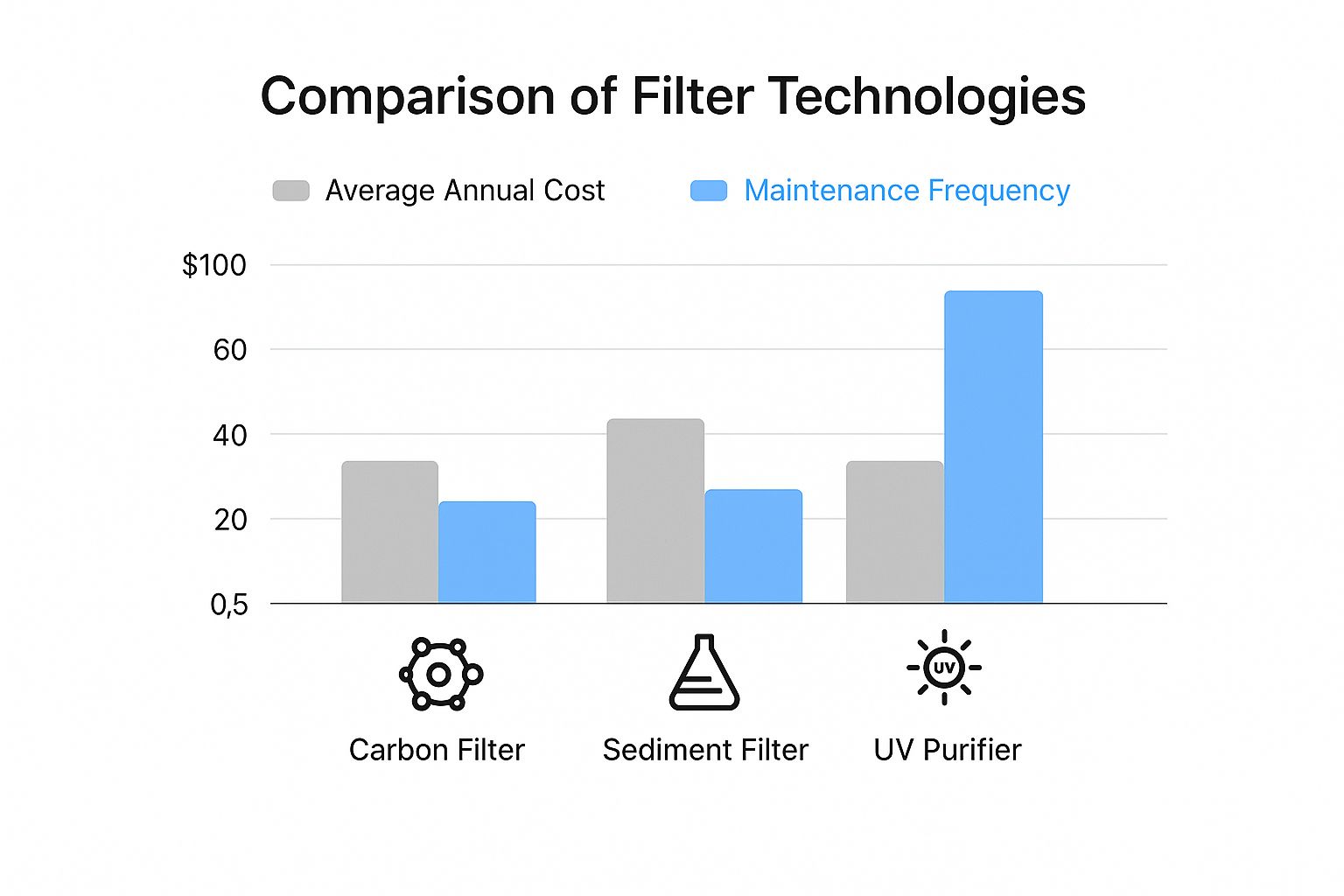
This infographic breaks down the ongoing costs and maintenance for these key technologies.

An infographic comparing the average annual cost and maintenance frequency for Carbon Filters, Sediment Filters, and UV Purifiers.

As you can see, while UV purifiers have a higher annual cost due to the lamp replacement, their maintenance is much less frequent than the cartridge-based carbon and sediment filters that need regular swaps.

To make things even clearer, here's a side-by-side comparison of what each technology does best.

Whole House Water Filter Technology Comparison

Filtration Technology Removes Best For Average Maintenance Notes
Carbon Filter Chlorine, chloramine, VOCs, pesticides, herbicides, bad taste & odor. Homes on municipal (city) water to improve taste, smell, and chemical safety. Cartridge change every 3-12 months. Doesn't remove minerals, heavy metals, or microbes. Effectiveness depends on the quality of the carbon.
Sediment Filter Dirt, sand, rust, silt, and other suspended solids. All homes, especially those on well water. Acts as a pre-filter. Cartridge change every 3-6 months. Protects other filters from clogging. Micron rating determines the size of particles it can stop.
UV Purifier Bacteria (E. coli), viruses, cysts (Giardia), and other microorganisms. Homes on well water or anyone concerned with microbiological contamination. UV lamp change every 12 months. A sterilizer, not a filter. Requires pre-filtration to ensure water clarity for the UV light to work.
Water Softener "Hardness" minerals like calcium and magnesium. Homes with hard water issues (limescale, soap scum, appliance damage). Refill salt every 1-2 months. Uses ion exchange. Doesn't filter other contaminants but solves major hard water problems.

This comparison clearly shows how each piece of equipment has a specific, targeted role. Building the ideal system is all about combining them to match your water test results.

Water Softeners: The Mineral Managers

Hard water isn't a health risk, but it's a massive household nuisance. Caused by high levels of dissolved calcium and magnesium, it leads to that crusty limescale buildup on fixtures, soap scum in the shower, and poor appliance performance.

A traditional salt-based water softener solves this problem through a process called ion exchange. It swaps the "hard" mineral ions for "soft" sodium ions, effectively stopping scale formation in its tracks. While it's the most effective way to truly soften water, it does require you to keep it topped up with salt.

The desire for solutions like these is driving massive growth in the home water treatment industry. The global home water filtration market was valued at USD 10.85 billion in 2021 and is expected to reach USD 26.73 billion by 2030, driven by consumers demanding reliable ways to clean their water. Advanced technologies like UV purifiers and multi-stage systems are a big part of that boom. You can explore more data on the home water filtration market if you're interested in the trends.

Understanding these core technologies is the key to building the best whole house water filter for your home. Next, we’ll look at how to combine them into effective systems designed for different real-world scenarios.

Matching a Filter System to Your Home

A family enjoying glasses of clean water in their modern kitchen, with sunlight streaming in.

You've got the tech down. Now for the fun part: designing the perfect system for your home. The best whole house water filter is never a one-size-fits-all solution. It’s a customized setup you build based on your water source, your family's size, and the specific contaminants revealed in your water test.

Let's move from theory to practice. We’ll walk through a few common household scenarios to show you how different components come together to solve real-world water problems. See which one sounds most like your situation—it’ll give you a fantastic starting point.

The Urban Home on City Water

If you live in a city or suburb, your water is already treated. The main complaints are almost always the swimming-pool smell of chlorine or the more persistent chloramine. It’s not just about taste; these disinfectants are also known for causing dry skin and brittle hair.

You don't need a complex system here. The goal is to refine the water the city provides.

Recommended System:

  • Stage 1 – Sediment Pre-filter: Don't skip this. Even city water can pick up rust and debris from aging municipal pipes. An inexpensive 5-micron sediment filter is crucial for protecting the more expensive carbon filter that follows.
  • Stage 2 – High-Capacity Carbon Filter: This is your workhorse. A large catalytic carbon or activated carbon block filter will adsorb the chlorine, chloramine, VOCs, and other chemicals, drastically improving how your water tastes, smells, and feels.

This simple two-stage setup is the perfect, cost-effective solution for the vast majority of homes on municipal water. You'll notice the difference at every single tap.

The Rural Property on Well Water

Well water is a completely different animal. It's raw, untreated groundwater, which means you could be facing a whole cocktail of issues. We're talking sediment, heavy metals like iron and manganese, and the most significant threat: potential microbiological contamination.

For well owners, filtration isn't a luxury; it's a critical safety measure. A robust, multi-stage system is non-negotiable.

Recommended System:

  • Stage 1 – Sediment Pre-filter: The absolute first step to catch sand, silt, and rust.
  • Stage 2 – Iron & Manganese Filter: If your water test shows these metals, you need a dedicated filter. It uses an oxidizing agent to remove them, preventing ugly stains and that metallic taste.
  • Stage 3 – Carbon Filter: This stage takes care of any earthy or organic tastes and odors, plus potential pesticides from nearby agricultural activity.
  • Stage 4 – UV Purifier: This is the final, and most critical, line of defense. A UV system zaps bacteria, viruses, and other microorganisms, making the water completely safe to drink.

For anyone on a well, the philosophy is "defense in depth." You have to assume contaminants are present and build a system that can handle sediment, chemical, and biological threats right from the start.

The Household Battling Hard Water

Hard water is an equal-opportunity offender, affecting both city and well water users. If you're fighting a losing battle against limescale on your fixtures, soap scum in the shower, and spotty dishes, your primary focus should be on mineral control.

This leads to a choice: a traditional water softener or a salt-free conditioner. A salt-based softener is the most effective fix for seriously hard water, as it actually removes the hardness minerals. A salt-free conditioner, on the other hand, alters the mineral crystals so they can't stick to surfaces, reducing scale without adding salt to your water.

Recommended Combination:

  • For Moderate Hardness: A sediment filter, followed by a salt-free conditioner and then a carbon filter, is a fantastic low-maintenance setup.
  • For Severe Hardness: You'll need the heavy artillery. Start with a sediment filter, then a salt-based water softener, and finish with a carbon filter to improve the taste.

This need for customized solutions is a global trend. The whole house water filter market is booming worldwide, driven by different local concerns. In North America, awareness of contaminants is a key driver. In Europe, it’s strict regulations, and in Asia, it's rapid urbanization. This global demand fuels continuous innovation. You can discover more insights about these global water quality trends and see how the market is evolving.

The Health-Conscious Family

For some homeowners, "good enough" isn't good enough. The goal is absolute purity. This is the family that wants to remove the widest possible range of contaminants—chlorine, sediment, heavy metals, fluoride, even trace pharmaceuticals. To achieve this, you need a comprehensive system that covers all the bases.

This is the top-tier approach for ultimate peace of mind.

Recommended System:

  • Multi-Stage Filtration: This type of system typically includes a sediment filter, a catalytic carbon filter for chemicals, and a KDF (Kinetic Degradation Fluxion) media filter that specifically targets heavy metals.
  • Optional Reverse Osmosis (RO): For the purest drinking water right at the kitchen sink, you can add a point-of-use RO system after the main whole-house unit. This will remove anything left, including dissolved solids, fluoride, and arsenic.

Planning Your Installation and Upkeep

A plumber is shown installing a whole house water filter system onto the main water line in a clean, well-lit basement.

Choosing the right whole house water filter is a huge step, but it’s only half the journey. A fantastic system is only as good as its installation and the ongoing care you provide. This is where a little planning goes a long way, transforming a box on your doorstep into a reliable source of clean water for your entire home.

Before you even make a purchase, create a solid plan for getting the system installed and maintaining it. You’ll need to decide between a DIY installation and calling a pro, and you must look beyond the initial price to understand the true, long-term costs. Getting this right from the start means no unpleasant surprises down the road.

DIY vs. Professional Installation

The first big decision is whether to install the filter yourself or hire a licensed plumber. The DIY route can certainly save you a few hundred dollars in labor costs, but it’s not a project for the faint of heart. You need to be comfortable with basic plumbing, because a single mistake could lead to leaks, water damage, or a filter that simply doesn't work correctly.

Hiring a professional plumber buys you peace of mind. They have the right tools, know the local building codes, and possess the experience to ensure your system is installed for optimal performance and water flow. While it costs more upfront, it's an investment in protecting both your new filter and your home.

If you're leaning toward DIY, make sure you know what you’re getting into. Here’s a quick reality check:

  • Essential Skills: You must be comfortable shutting off your home's main water supply and cutting into pipes (whether they're copper, PEX, or PVC). For copper pipes, you'll need soldering skills.
  • Necessary Tools: Be prepared with pipe cutters, a couple of good wrenches, a level, and Teflon tape. For copper pipes, a soldering torch and flux are also required.
  • Sufficient Space: You need clear access to your main water line with enough room to install the filter unit and any bypass valves without a struggle.

Keep this in mind: A professional installation isn't just for convenience. Many manufacturers will void their warranty if the system isn't installed by a licensed plumber. Suddenly, that DIY savings could become a very expensive gamble.

Calculating the True Cost of Ownership

That initial price tag on the filter? It’s just the beginning. To truly understand the investment, you have to factor in the ongoing maintenance costs that keep the system running effectively. Ignoring these will lead to unexpected bills and, even worse, a filter that eventually stops doing its job.

These predictable, recurring expenses reveal the true cost of the system over its lifetime and should be as important in your decision as the initial purchase price. For a deeper dive into managing your system long-term, you can explore our complete archive of water filter advice.

A Five-Year Maintenance Budget Framework

To give you a clearer picture, let's break down the common long-term costs. Thinking about these expenses over a five-year window will give you a realistic idea of the total investment.

Ongoing Expense Breakdown:

  • Filter Cartridge Replacements: This will be your most regular expense. Most sediment and carbon filters need to be swapped out every 3 to 12 months. Expect to pay anywhere from $25 to $100 per filter, depending on your system.
  • Media Re-bedding: For large tank-style systems (like carbon or oxidizing filters), the filtration media inside needs to be replaced every 5 to 10 years. It’s not frequent, but it's a significant expense when it comes due.
  • Water Softener Salt: If your system includes a salt-based softener, you’ll be adding salt every 1 to 2 months. This typically adds up to $100 to $200 per year.
  • UV Lamp Replacement: For systems that use a UV purifier to kill bacteria, the lamp must be replaced annually to remain effective. A new lamp usually runs between $70 and $150.
  • Electricity Use: It's a small cost, but UV purifiers and softeners with electronic controls do use electricity, so expect a minor increase in your monthly bill.

By mapping these costs out, you can choose a system that not only solves your water problems but also fits comfortably within your long-term budget.

Your Top Filtration Questions, Answered

As you narrow down your choices for the best whole house water filter, a few practical questions always come up. These are the real-world details that can make or break your experience. Let's get you quick, clear answers to these common sticking points so you can move forward with confidence.

Will a Whole House Water Filter Tank My Water Pressure?

Yes, any filter system will introduce some resistance to your plumbing, which can cause a slight drop in water pressure. However, a properly sized and installed system will have such a minimal effect that you likely won't even notice it. The goal is to avoid creating a bottleneck where your water enters the house.

A few factors influence pressure:

  • Filter Type: Densely packed filters and clogged sediment filters are the primary culprits for pressure loss.
  • System Flow Rate: Measured in gallons per minute (GPM), this is critical. If you choose a system with a GPM rating that's too low for your home, it will struggle to keep up during peak usage, and you’ll feel it when the shower and dishwasher are running simultaneously.
  • Pipe Condition: Older pipes with corrosion or scale buildup can worsen any existing pressure issues.

The best way to prevent problems is to select a system with a GPM rating that can handle your family's peak water demand. For most homes, a system rated for 15-20 GPM is more than adequate. Most importantly, nothing maintains strong water pressure better than changing your filters on schedule.

Will This Filter Make My Water Safe to Drink?

This is a critical question, and the honest answer is: it depends entirely on the filter system and your water source. A standard carbon filter is fantastic at removing chlorine and making water taste great, but it will not eliminate microbiological threats like bacteria or viruses.

A filter and a purifier are not the same thing. A filter removes particles and chemicals, while a purifier neutralizes living organisms. For truly safe drinking water from a questionable source, you often need both.

If your primary concern is ensuring your water is microbiologically pure—especially if you're on well water—you absolutely need a dedicated purification stage. This typically means adding a UV purification system after your main filter or choosing a specialized filter certified for cyst and virus removal, such as a sub-micron filter.

Always look for NSF/ANSI certifications. These independent, third-party ratings confirm what a system can actually remove. For example, NSF/ANSI 53 certifies a filter for removing health-related contaminants, while NSF/ANSI 55 is the standard for UV systems. It’s your guarantee that the filter lives up to its claims.

How Do I Know What Size Whole House Water Filter to Buy?

Sizing your system correctly is crucial for performance and satisfaction. It really comes down to two factors: how much water your household uses and how quickly you need it.

First, consider the number of people and bathrooms in your home. A larger family naturally uses more water, so you'll want a system with a higher filter capacity—the total number of gallons a filter can treat before it needs to be replaced.

Second, and more importantly, is the peak flow rate (GPM). You can get a rough estimate by adding up the flow rates of the fixtures you might use at the same time (a shower is about 2.5 GPM, a toilet flush is 2 GPM, a kitchen faucet is 1.5 GPM).

Here's a quick rule of thumb:

  • 1-2 Bathroom Homes: A system with a 10-15 GPM flow rate is usually sufficient.
  • 3-4+ Bathroom Homes: Look for a 15-25 GPM system to maintain strong pressure everywhere.

Choosing an undersized system is a common mistake that leads to frustration. It's always better to have a little more capacity than you think you need.


At Water Filter Advisor, our mission is to give you the knowledge to find the perfect water filtration solution for your home. We offer in-depth guides, honest reviews, and practical advice to make your decision simple. Explore our resources today to get safer, better-tasting water. Visit us at https://www.waterfilteradvisor.com.
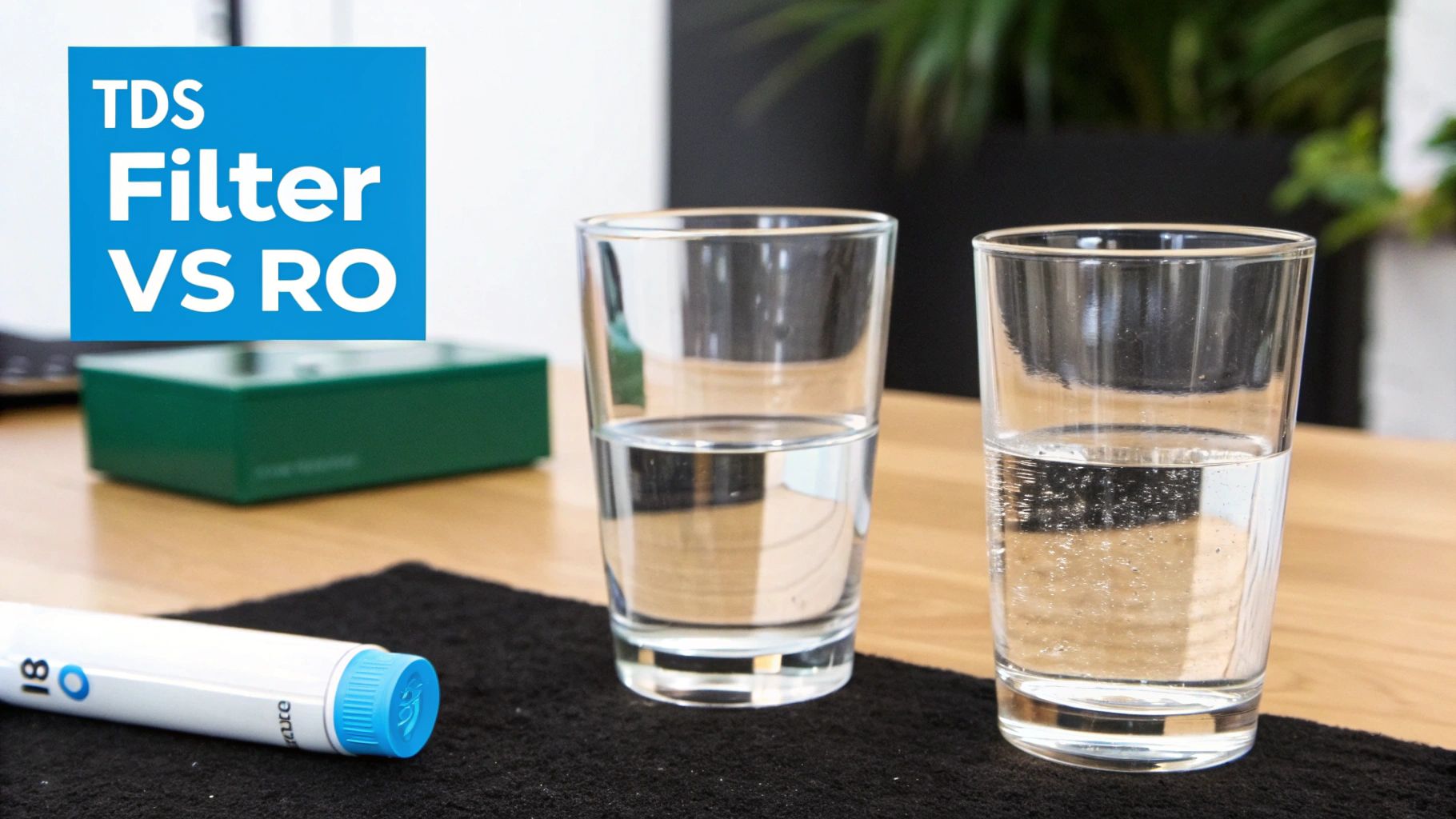
USDA-ARS National Soil Erosion Laboratory - water filtration system and P-TRAP application

USDA-ARS National Soil Erosion Laboratory – water filtration system and P-TRAP application


Featuring Dr. Chad Penn and a team of engineers and technicians.

P-TRAP is a free software developed by the USDA ARS allowing non-engineers to design and build P filters, which can significantly decrease phosphorus runoff from farm fields, reducing harmful surface water eutrophication and algal blooms, as demonstrated in this video.

The video is being distributed to farmers and organizations across the United States.

You can access the software at: bit.ly/ptrapsite

The use of trade, firm, or corporation names in these methods is for the information and convenience of the viewer. Such use does not constitute an official endorsement or approval by the U.S.D.A. Agricultural Research Service, of any product or service to the exclusion of others that may be suitable.

Original Video Source

3M™ Water Filtration Solutions for Service Companies

3M™ Water Filtration Solutions for Service Companies


Oliver Rudman, 3M Application Engineer, explains the need for service companies to understand and offer a range of water filtration solutions for pubs and high street restaurants. Find out how incorporating water cartridges and heads within your portfolio not only adds an additional revenue stream to your business and helps to improve customer satisfaction, but can also save your service engineers’ time and improve their efficiency.

Contact us for more information: www.3m.co.uk/waterquality

Original Video Source