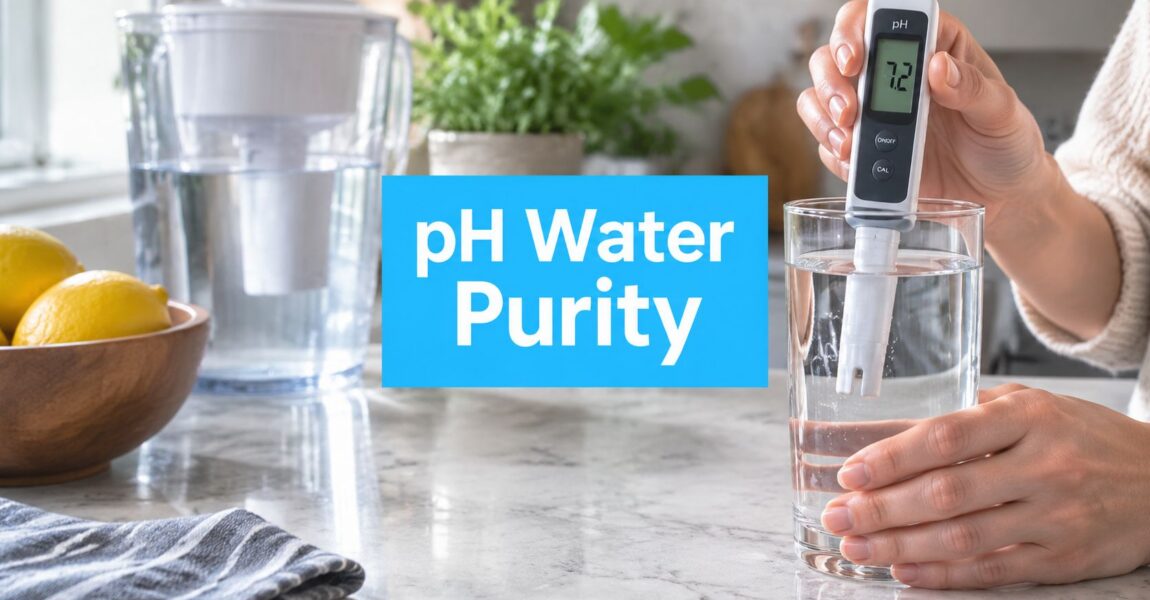
pH Machine Water Guide: Test & Filter for Purity 2026
Have you ever bought a pH machine for water expecting it to make your tap water “better,” only to realize you're not even sure whether you needed ...
Have you ever bought a pH machine for water expecting it to make your tap water “better,” only to realize you're not even sure whether you needed ...
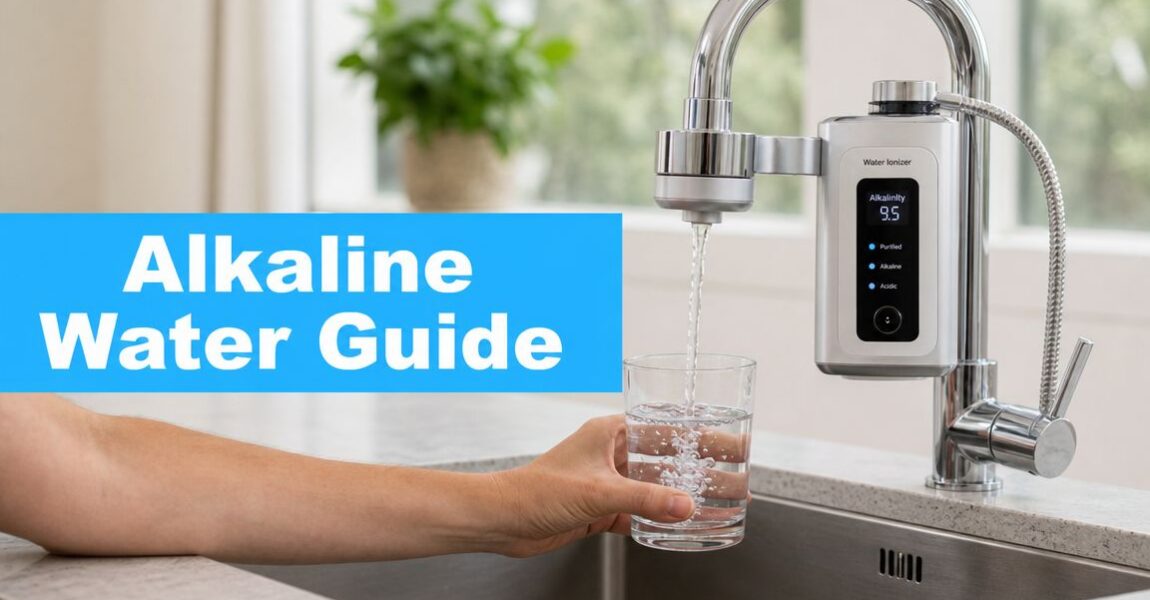
You've probably seen this happen. A friend buys a sleek countertop machine, starts talking about “ionized” water, and suddenly your plain tap filter looks old-fashioned. Then the ads start following you around. They promise cleaner water, higher pH, better hydration, and a long list of benefits that sound half science lesson, half wellness sermon.
That's where many homeowners get stuck. The words alkaline, ionized, filtered, and purified get mixed together so often that it becomes hard to tell what the machine does. And if you're spending serious money for something that sits under your sink or on your counter every day, the key questions aren't glamorous. You want to know whether it removes contaminants, whether it works with your local water, and what it will cost to keep running.
Alkaline ionized water filters require a more grounded explanation. The useful way to evaluate them isn't to start with hype. It's to start with the basics of water treatment in a home.
A lot of people first hear about alkaline water the same way. Someone says their water tastes smoother. An influencer says acidity is the problem. A product page shows glowing blue lights, molecular diagrams, and a list of features that makes the machine sound like a tiny lab.
That mix of marketing and partial science creates confusion fast. Some products are simple filters that add minerals. Some are electric appliances that use charged plates. Some do both. Many are sold with strong health messaging, even when the most important homeowner questions are much more practical.
The practical questions are less exciting, but they matter more:
Most confusion starts when buyers treat “alkaline” and “filtered” as if they mean the same thing. They don't.
That's the key mindset shift. Water chemistry and water purification are related, but they are not identical. A machine can raise pH without being the best filter in the room. A strong filtration system can remove a wide range of contaminants without producing alkaline water at all.
Once you separate those ideas, alkaline ionized water filters become much easier to judge. You stop asking whether the claims sound impressive and start asking whether the system makes sense for your home.
The term alkaline ionized water filters sounds like one category. In practice, homeowners usually run into two very different products.
Two main categories:
Mineralizing alkaline filters raise pH by adding minerals.
Electric water ionizers use electrolysis to split water into alkaline and acidic streams.
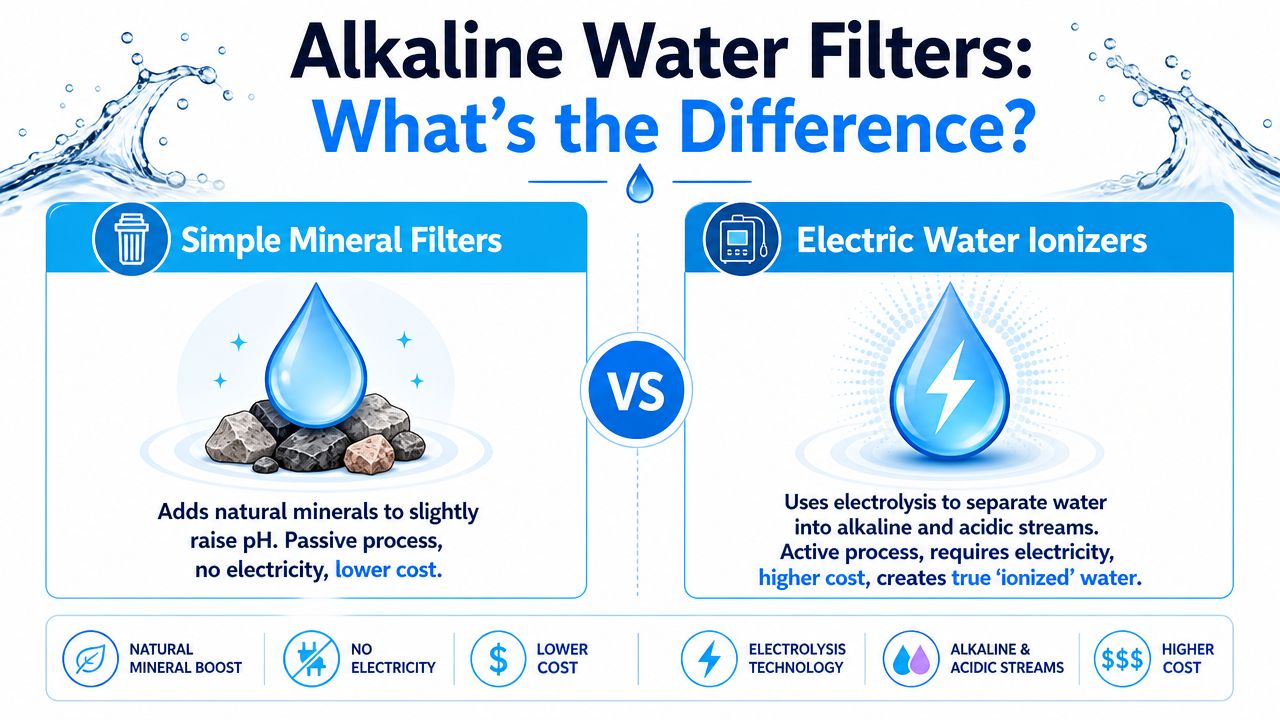
Independent explanations note that alkaline filters typically raise pH by adding minerals such as calcium carbonate, calcium, magnesium, or potassium, while ionizers use electrolysis. They also sit in very different price bands, with alkaline filters often estimated at about $30 to $200 and ionizers at about $500 to $5,000, according to this comparison of water ionizers and alkaline water filters.
A mineralizing alkaline filter is the easier one to understand. Water passes through filter media, then through a mineral stage that adds compounds which nudge the pH upward. It's similar to seasoning soup. You're not rebuilding the soup from scratch. You're adding a little of something that changes the final result.
These systems are usually passive. No power cord. No electrodes. No separate acidic stream. For many homes, that simplicity is the biggest advantage.
That doesn't make them superior in every case. It just means what they do is easier to understand and maintain.
An electric ionizer is closer to a water-treatment appliance. Water flows through a prefilter stage, then enters an electrolysis chamber with charged plates. The machine uses electricity to create separate output streams.
That's why the word ionized matters. It points to a process, not just a taste or pH result.
Here's where buyers often get tripped up:
If your main goal is reducing common contaminants and improving taste, a simpler under-sink filter may be the better fit. If you specifically want electrolysis and adjustable output, you're in ionizer territory.
That's a big difference in cost, installation style, and upkeep. It's also why shopping by marketing phrases alone is risky. A countertop mineral pitcher and a hardwired electric ionizer can both be sold under the same broad alkaline language, even though they behave like completely different products in daily use.
Electrolysis sounds complicated, but the basic picture is manageable. Water enters the machine, passes over electrically charged plates, and the system separates output into different streams.
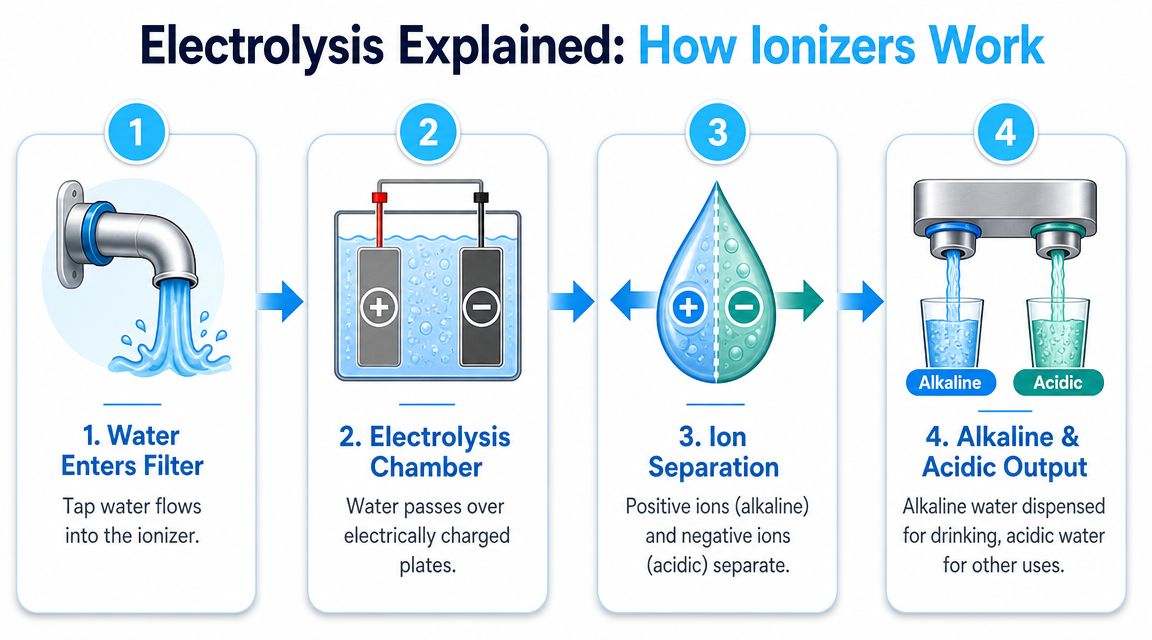
Imagine sorting mixed marbles with magnets and channels. You pour everything into one tray, then a machine guides different pieces in different directions based on electrical behavior. An ionizer does something similar with water and dissolved minerals.
The machine doesn't create minerals from nothing. It works with what's already in the incoming water. That point matters a lot later when you start asking whether the machine will perform well on very low-mineral water.
pH is a measure of how acidic or alkaline water is. If a system produces water with a higher pH, the water is more alkaline on that scale.
For products sold in this category, vendor specifications commonly place mineral-cartridge designs around pH 8.0 to 9.5, while ionizer systems are often advertised with adjustable settings around pH 7.5 to 10.5. Some also make negative ORP claims as low as -200 mV to -800 mV, according to these alkaline ionized water filter specifications.
ORP stands for oxidation reduction potential. You'll often see it in sales pages because it sounds technical and impressive. In simple terms, it's a measurement related to electron activity in water.
That's not the same as proving a health outcome. It's just a measurement the machine can advertise.
Practical rule: Treat pH and ORP as machine output metrics, not as proof that the water is safer or healthier for your household.
Ionizers depend on the condition of their electrodes and the chemistry of the incoming water. A mineral cartridge depends more on how quickly the media gets used up and how long the water stays in contact with it.
For a homeowner, that difference matters more than the brochure language. One system asks, “How are the plates holding up?” The other asks, “How exhausted is the media?” Both can drift over time. Neither should be judged by day-one marketing alone.
The strongest marketing around alkaline ionized water filters usually isn't about filtration. It's about what the water is supposed to do for your body.
You'll see claims about balancing acidity, supporting hydration, improving wellness, or making ordinary water somehow more biologically useful. Some of those claims are presented cautiously. Others are far more dramatic.
A careful homeowner should separate three different ideas:
One major issue is that ionizers are often sold as if they're a universal upgrade for any kitchen. That leaves out an important technical limitation. Electrolysis depends on the mineral content and conductivity of the incoming water.
Hydroviv argues that ionizers sold on health claims lack conclusive clinical evidence, and it also notes that low-mineral water conducts electricity poorly, which makes performance highly dependent on source water quality in the first place. That concern is especially relevant for homes using very soft water or water treated by reverse osmosis, as discussed in Hydroviv's review of ionized alkaline water claims.
In plain language, the machine may still produce a higher pH reading, but that doesn't automatically mean it's delivering the meaningful result many buyers think they're paying for.
If your local water is already low in dissolved minerals, an ionizer may have less to work with. If your home uses RO water, the machine may not behave the way the sales demo suggests.
That's why “Does it alkalize?” isn't the best first question. Better questions are:
The video below gives a broader look at how these systems are discussed and debated.
You don't have to swing to either extreme. You don't need to believe every wellness promise, and you also don't need to assume every user experience is imaginary.
A reasonable middle position is this: some people like the taste, some like the convenience of getting treated water at the sink, and some value the adjustable output. But strong health claims deserve caution, especially when the better-supported homeowner concerns are filtration quality, input water compatibility, and long-term performance.
If a company spends more time talking about your body's pH than your home's water contaminants, you're probably looking at marketing first and filtration second.
That's the lens worth keeping.
This is the part many buyers skip, and it's the part that matters most if your goal is safer tap water. A water ionizer may include a filter, but the machine's headline feature is usually electrolysis, not deep contaminant reduction.
That distinction matters because homeowners often assume an alkaline ionizer is automatically a high-performance purifier. Sometimes it isn't. Many models use prefiltration that can help with taste and common aesthetic issues, but that doesn't mean the system matches a dedicated reverse osmosis unit or a carefully selected multi-stage filter for broad contaminant reduction.
If a machine can raise pH, that tells you something about water chemistry. It does not tell you what it removed.
A better way to shop is to ask for performance details on the actual filter stage. Does it address chlorine? Chloramine? Lead? Cysts? Emerging contaminants? If those answers are vague, the machine may be selling an experience rather than a filtration result.
| Contaminant | Typical Water Ionizer | Activated Carbon Filter | Reverse Osmosis System |
|---|---|---|---|
| Chlorine taste and odor | Often addressed if the unit includes a carbon prefilter | Commonly addressed | Commonly addressed |
| Sediment | May be partly addressed, depending on prefiltration | Often addressed with the right stage | Commonly addressed with prefilters |
| Lead | Varies by filter design and certification | Some models are designed for this, but not all | Often a stronger choice when properly certified |
| Chloramine | Often limited unless the filter is specifically built for it | Some specialty carbon systems target it better | Can address it when paired with appropriate stages |
| Dissolved solids | Usually not the main strength | Not the main strength | Commonly a core strength |
| Broad contaminant reduction | Depends heavily on the built-in filter, not the ionizing function | Moderate to strong, depending on media and certification | Often the most comprehensive household option |
That table points to the big takeaway. The ionizing function and the filtering function are not the same thing.
If you've ever looked at aquarium filtration media, you've seen a useful reminder that all filtration depends on the specific media doing the job. Water treatment is never magic. Different materials target different problems. Home drinking water systems work the same way. Carbon, resin, membrane stages, and mineral media each play different roles.
So when a product page says “multi-stage filtration,” don't stop there. Ask what each stage does. A short ingredient list for the filter media can tell you more than a page of wellness copy.
For many homes, the smartest setup is to prioritize contaminant reduction first, then decide whether adding alkalinity is still important after that.
Buying one of these systems gets easier when you stop treating it like a wellness gadget and start treating it like a kitchen appliance tied to your water quality.
The biggest mistake is focusing on the highest pH setting. That's like buying a furnace based only on how hot it can get, without asking how efficient it is, how often it needs service, or whether it fits your house.
Promotional pages often highlight adjustable pH, multi-stage filtration, and simple installation, but they frequently leave out replacement cadence, scaling on electrodes, warranty limits, and the cost of keeping output stable over time. That practical concern is captured well in this discussion of long-term performance and ownership questions.
Use this checklist when comparing systems:
Some product pages make it sound as if more settings always mean a better machine. That isn't necessarily true. You're looking for a system that works consistently on your water, not one with the longest feature list.
Watch for these warning signs:
A serious filtration product should tell you how it behaves after months of use, not just how it performs on day one.
It helps to compare alkaline ionized water filters alongside more conventional systems before deciding. Resources such as Water Filter Advisor's advice library can help you compare under-sink filters, carbon systems, RO units, and maintenance expectations using the same practical lens.
That comparison often leads homeowners to one of three conclusions. Some decide they only need a strong conventional filter. Some want RO with remineralization. Others still want an ionizer, but they buy it with more realistic expectations about filtration and upkeep.
Usually, people encounter trouble concerning system integration. Ionizers rely on mineral content and conductivity in the incoming water. RO systems remove a large share of dissolved material, so the ionizer may have less to work with. If someone wants both purification and alkalinity, they need to think carefully about system design rather than assuming any two machines will pair well.
They can be, but only after you understand the well water itself. Well water can vary widely in hardness, iron, sulfur odor, sediment, and other issues. In many homes, pretreatment matters more than the ionizer. A machine that performs nicely on treated municipal water may struggle if the incoming well water is inconsistent or causes scaling.
Some do part of the job, but that depends on the filter stage, not the word “ionized.” If contaminant removal is your top priority, ask what the system is specifically designed and certified to reduce. Don't assume the alkaline feature means complete purification.
They can be more demanding than buyers expect. Electric ionizers are appliances with internal components, filter cartridges, and possible scale buildup. Simpler alkaline mineral filters are usually easier to live with. The more moving parts and performance claims a unit has, the more important routine care becomes.
Because demand has grown. A 2025 industry guide cites the global alkaline water filters market at about $1.2 billion in 2023/2024, with projections of roughly $3.1 billion by 2032, implying about 7% to 8.9% CAGR across 2025 to 2033, according to this alkaline water filtration market guide. More products on the market means more choice, but it also means more noise.
Start with your actual water. Then decide what problem you're trying to solve.
If you want broad contaminant reduction, start there. If you also want alkaline output and accept the extra maintenance, then compare ionizers carefully. If you mainly want better taste and a slight pH increase, a simpler mineralizing filter may be the more rational option.
If you're sorting through home water treatment options and want clear, practical guidance without the hype, Water Filter Advisor is a useful place to compare filtration types, maintenance tradeoffs, and buying factors before you commit to a system.
A Kangen pitch usually arrives wrapped in certainty. A friend swears the water changed their life. A relative says the machine does far more than filter. A distributor starts talking about detox, antioxidants, pH, and “living water” as if your kitchen sink has been hiding a wellness clinic all along.
That’s exactly why a careful kangen water review has to start with a harder question. Does it make household water safer to drink? For most homeowners, that matters more than mystical language about alkalinity. If your water may contain chlorine, lead, PFAS, sediment, or other contaminants, the first job of any expensive water device is simple: remove what shouldn’t be there.
Kangen machines are real appliances, not magic boxes. They use electrolysis, they produce different pH waters, and they include a built-in filter. But those facts alone don’t answer whether they’re a smart buy for the average home. To judge that, you have to separate three things that are often blended together in sales presentations: water treatment, health claims, and business model.
This review does that from a filtration-first perspective. Not from the viewpoint of a distributor, and not from the viewpoint of wellness marketing. From the viewpoint of a homeowner standing in the kitchen asking, “What am I paying for, what does it remove, and what would protect my family better?”
Kangen succeeds because it sells more than water. It sells a story. The story says ordinary tap water is the problem, and ionized alkaline water is the answer. That’s emotionally powerful because there is existing public distrust of municipal water, bottled water, or both.
The pitch also sounds technical enough to feel credible. You hear about alkaline pH, negative ORP, electrode plates, and specialized settings for drinking, cleaning, and beauty use. That language creates the impression that you’re buying a laboratory-grade water system rather than a premium countertop appliance with a very specific feature set.
A Kangen presentation often combines a few ideas that are easy to believe together:
For a consumer advocate, that leap is the key issue. A machine can alter water chemistry without providing broad contaminant reduction. Those are not the same job.
Practical rule: If a water device makes dramatic wellness claims, check its contaminant reduction before you check its pH range.
That rule changes how you evaluate Kangen. Instead of asking whether the water feels smoother or tastes different, ask whether the machine is designed like a real filtration system. A strong filter is like a good front door lock. It keeps bad things out. Ionization is more like repainting the hallway after someone’s already inside.
For home water use, the central test isn’t whether the machine produces water at a different pH. It’s whether the built-in treatment can handle contaminants that matter in actual households, especially in homes with older plumbing or known water quality concerns.
That framing strips away a lot of the mystique. Kangen may still appeal to people who want a multi-function ionizer. But if you’re shopping for cleaner, safer home water, the burden is on the machine to prove it can filter like a real filtration system, not just market like one.
Kangen water is tap water that has been filtered and then electrically altered inside an ionizer machine. The machine doesn’t create water from scratch. It takes the water already coming into your kitchen and changes some of its properties.
A useful way to picture it is a sorting belt in a factory. Water enters the machine, passes through a basic filter, then moves across charged metal plates. During that process, the machine separates the output into different streams, pushing one side toward more alkaline water and the other toward more acidic water.
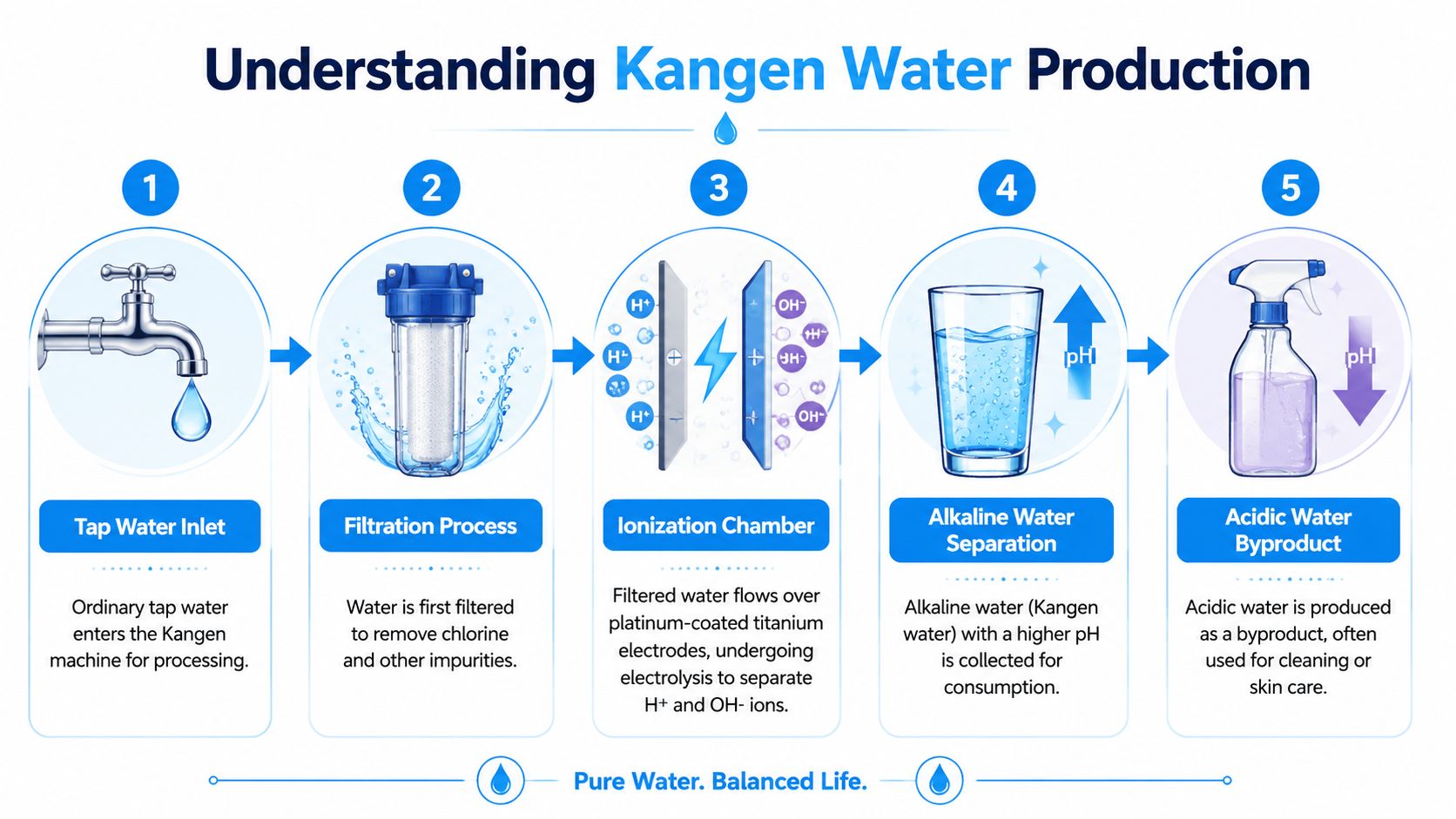
According to the Kangen model specifications chart, Kangen machines such as the K8 use electrolysis to produce several pH-adjusted waters, including drinking water at pH 8.5 to 9.5 with flow rates of 1.3 to 2.1 L/min, and Strong Acidic water at about pH 2.7. The same specifications describe a process in which tap water first passes through a basic carbon block filter, then flows over platinum-coated titanium electrode plates that split the output into alkaline and acidic streams, with an example ORP reading of -787 mV at pH 9.5.
That sounds complicated, but the homeowner version is simple. First, the machine does a light filtering step. Second, it changes the electrical environment of the water. Third, it sends different types of water out of different settings.
pH tells you whether water is more acidic or more alkaline. It doesn’t tell you whether the water is free of lead, PFAS, or pharmaceutical residues. That’s an important distinction. You can have alkaline water that still carries contaminants.
ORP, or oxidation-reduction potential, is often used in Kangen marketing to suggest antioxidant potential. But for practical home water treatment, ORP is not a substitute for verified filtration performance.
If you want a plain-English explanation of the alkaline side of this category, Water Filter Advisor’s guide to alkaline water is a better starting point than distributor language.
Kangen is best understood as an ionizer with a basic pre-filter, not as a full-featured purification system. That distinction matters because many buyers assume the opposite. They see the machine’s complexity and price, then assume the filtration must be equally advanced.
It isn’t enough to know how water is transformed inside the machine. You also need to know what survives that trip.
The strongest sales pitch in the Kangen world is also the weakest part of the evidence. The language suggests a single upgrade to your water. Better hydration, antioxidant protection, detox support, and broad wellness benefits. Science treats those as separate claims that need separate proof.

For a consumer advocate, the first question is simple. Which part of the machine is supposed to produce the health effect. The answer matters because Kangen combines two very different ideas under one premium product. One is ionization. The other is limited filtration. If the claimed benefit comes from dissolved hydrogen, pH marketing is beside the point. If the goal is safer water, hydrogen claims are beside the point.
The more credible research in this category focuses on molecular hydrogen, not alkaline pH by itself. That is a narrower claim than Kangen marketing often implies. It means the relevant performance question is whether the machine produces enough dissolved hydrogen to match the mechanism studied in research.
That framing changes the whole review.
A machine can produce alkaline water and still fall short on the metric that matters most for the health story attached to it. It can also leave buyers with a false sense that “premium water” means cleaner water, even though those are different outcomes measured in different ways.
The verified data for this review states that Kangen water ionizers are sold at premium prices through an MLM structure, while hydrogen output often falls within a range that does not consistently support the stronger therapeutic claims used in sales conversations. That gap matters because the machine is priced like a high-performance health appliance, yet the scientific case depends on a narrow and measurable variable.
In plain terms, Kangen marketing often puts the spotlight on pH and ORP because they are easy to display on a screen. Hydrogen delivery is harder to verify and far more relevant to the research.
That is a recurring pattern in water treatment marketing. Companies emphasize the metric that looks impressive in a demo, even if it is not the metric that best predicts real consumer benefit.
A clearer way to assess Kangen is to separate the common claims by mechanism and by proof standard.
“Alkaline water is healthier water.”
Alkaline pH alone does not establish a health benefit. It also says nothing about whether the water has been treated for lead, PFAS, or other contaminants.
“Negative ORP means strong antioxidant power.”
ORP is a marketing-friendly number. It is not a substitute for direct measurement of dissolved hydrogen, and it has no role in proving contaminant removal.
“People feel better, so the machine works.”
Testimonials cannot isolate cause and effect. A person may drink more water, reduce soda intake, or prefer the taste of filtered water. Those changes can influence how they feel without proving the ionizer delivered a distinct medical benefit.
That distinction is easy to miss because the claims are bundled together. The machine is sold as if one purchase solves hydration, wellness, and water quality in one step. The evidence supports a much narrower conclusion.
Kangen’s health narrative rests on a real scientific concept, but the concept is often stretched past what the evidence can support. The better question is not whether altered water can sound impressive. It is whether this specific machine delivers a meaningful amount of the studied ingredient, and whether it protects your household from harmful contaminants at the same time.
Those are two separate tests.
For buyers who came here looking for safer water, that separation is the key insight. Even if the ionization side has some limited scientific interest, the central mission of a home water system remains contaminant reduction. A machine that majors in pH messaging and minors in filtration deserves much more scrutiny than its marketing suggests.
For a home water buyer, this is the decisive section. Kangen’s biggest weakness isn’t that it ionizes water. It’s that people often mistake ionization for purification.
The verified data for this review says Kangen’s built-in filter is a single filter that removes chlorine and sediment but fails on PFAS, fluoride, lead, and pharmaceuticals, unlike certified multi-stage systems, as described in the analysis of Kangen’s filtration limitations. That same verified data also notes the current EPA focus on PFAS limits of 4 ppt for six compounds.
A standard carbon block filter can be useful. It can improve taste. It can reduce chlorine. It can help with some odor issues. For a household whose only complaint is “our tap water tastes like a swimming pool,” that kind of filtration may feel like a real improvement.
But taste improvement is not the same as broad safety treatment.
Homes don’t buy water systems just to polish flavor. They buy them because they worry about what they can’t see. That includes contaminants tied to plumbing, industrial runoff, treatment byproducts, or local source water issues.
A single carbon filter is like a doormat. It catches dirt at the front entrance. It does not search pockets, inspect bags, or screen every guest. Certified multi-stage systems are built for those harder jobs.
| Contaminant | Kangen Filter (Standard Carbon) | Reverse Osmosis (NSF/ANSI 58) | Activated Carbon Block (NSF/ANSI 42/53) |
|---|---|---|---|
| Chlorine | Yes, based on verified description of chlorine reduction | Can be designed for broad reduction depending on system certification | Often a core strength when certified for it |
| Sediment | Yes, based on verified description of sediment reduction | Typically part of staged treatment | Often handled at basic levels depending on design |
| Lead | No, based on verified data | Often targeted by certified systems | Can be targeted when specifically certified |
| PFAS | No, based on verified data | Often a priority category in certified systems | Some systems target it, but certification matters |
| Fluoride | No, based on verified data | Common reason homeowners choose RO | Not typically the main strength of standard carbon alone |
| Pharmaceuticals | No, based on verified data | Often better addressed in advanced systems | Varies widely by system and certification |
A water treatment claim means much more when it’s tied to a recognized standard than when it’s tied to branding language. “Ionized,” “micro-clustered,” and “antioxidant” may sound advanced, but they don’t tell you whether the system is built to reduce lead from old plumbing or PFAS from a contaminated source.
Bottom line: If your home needs real contaminant reduction, Kangen should not be treated as a stand-alone filtration solution.
For households with municipal water concerns, older pipes, or known contamination issues, certified under-sink systems and reverse osmosis setups answer the right question. Kangen answers a different one. It changes water characteristics after modest filtration. That may interest some buyers, but it doesn’t replace a serious home filter.
Kangen’s sales model deserves scrutiny for the same reason its filtration claims do. Incentives shape what buyers hear first.
Enagic sells Kangen machines through multi-level marketing rather than ordinary retail channels. That changes the conversation around the product. In a store, buyers can compare specs, certifications, and price tags side by side. In an MLM setting, the pitch often comes through friends, family members, or wellness influencers who are compensated for the sale and, in many cases, for recruiting additional sellers.
That structure does not prove the product is ineffective. It does explain why the message often centers on testimony, identity, and aspiration instead of the plain question a water-treatment buyer should ask first: what problem does this machine solve better than a certified filter?
A Kangen machine is priced like premium water treatment equipment, yet the filtration side of the product is relatively modest compared with systems built to target lead, PFAS, or other regulated contaminants. Once you separate ionization from filtration, the price starts to look less like a payment for water safety and more like a mix of hardware, branding, and commissions.
That distinction matters. A buyer comparing home treatment options may assume a higher price signals better contaminant removal. In this category, that assumption can fail. Expensive does not always mean more protective. Sometimes it means the product carries a sales network on its back.
The same dynamic shows up in other high-commission categories. The loudest feature is not always the feature that matters most.
MLM distributors usually sell through personal trust before technical verification. That can make skepticism socially awkward. If the seller is a friend, challenging the claims can feel like rejecting the person.
For a water ionizer, that social pressure has practical consequences. Buyers may hear long explanations about alkalinity, pH, or daily wellness routines before anyone discusses filter certifications, cartridge life, or whether the machine reduces contaminants of concern in their local water. Those are not small omissions. They are the core of a responsible water-treatment purchase.
A consumer advocate would frame it more bluntly. If a product is marketed as a better water solution, the evidence should start with what it removes, not with how inspiring the sales story sounds.
The central issue is not whether every distributor is acting in bad faith. The issue is whether the sales model helps buyers evaluate water treatment the way they should. On that standard, MLM creates friction. It encourages persuasion before comparison.
For households worried about actual contaminants, that is a poor order of operations. The safest buying process starts with local water problems, then certification data, then operating cost. Kangen sales often reverse that sequence.
Kangen’s sticker price gets attention, but ownership costs don’t stop at checkout. Countertop water machines operate in a world of scale buildup, filter changes, source-water quirks, and maintenance habits. That’s where the glamorous part of the sales pitch starts to wear off.
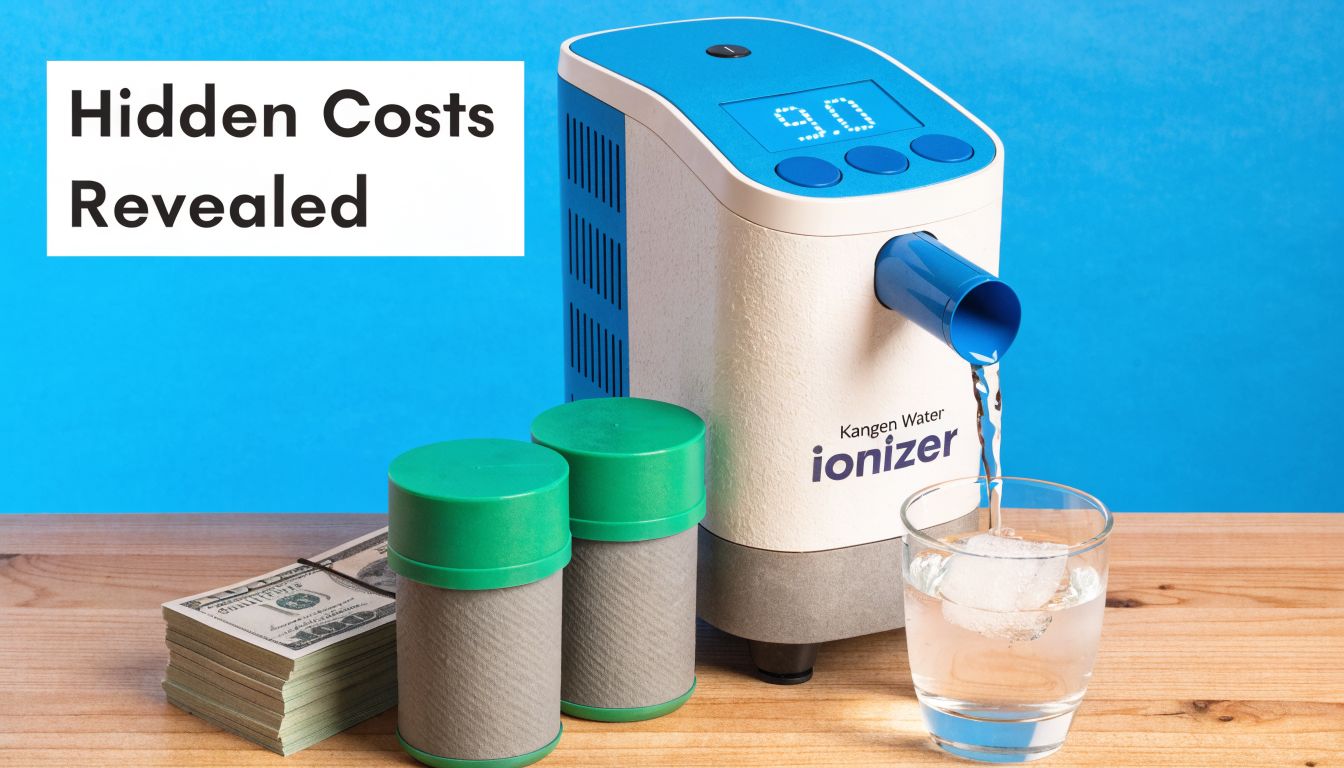
Verified data for this review states that the upfront cost is about $4,980, and that Kangen’s performance relies on 8 platinum-coated titanium plates whose efficiency in producing therapeutic H₂ is weaker than competitors and requires frequent maintenance to prevent mineral scaling, adding to lifetime costs, according to the Alkaline Water Plus review of Kangen pros and cons.
That’s the hidden burden many buyers miss. An ionizer is more like a coffee machine than a passive pitcher. It has parts that need attention. And because Kangen starts with only basic filtration, some households may still need separate treatment if their source water has harder contaminant problems.
The first cost is obvious: a premium purchase price for a machine that is not a full contaminant-removal system.
The second cost is subtler: ongoing upkeep for a machine whose value proposition depends on consistent electrolysis performance. Scale on plates doesn’t help you. Hard water doesn’t help you. A basic built-in filter doesn’t help enough if the incoming water is already challenging.
For readers comparing long-term upkeep across home water options, Water Filter Advisor’s guide to water filter replacement cost is useful because it frames recurring expense the way homeowners experience it.
When people compare Kangen only to bottled water or to untreated tap, the machine can look more attractive than it is. The better comparison is against systems built for contaminant removal first.
A quick visual may help if you want to see how these machines are typically discussed in consumer-facing reviews.
Buy the machine you’ll maintain correctly. A neglected premium ionizer can deliver less practical value than a simpler filter that directly targets your water problems.
The strongest financial argument against Kangen isn’t just that it costs a lot. It’s that its core expense doesn’t line up with the core risk most families are trying to solve.
The best alternative to Kangen depends on what problem you need to solve. That sounds obvious, but it’s where many buyers get pulled off course. Kangen sells a broad identity. Home water treatment works better when you buy a narrow solution for a specific need.
Start with certified filtration, not ionization. Homes worried about lead, PFAS, or a wider contaminant profile should look first at reverse osmosis systems or certified multi-stage under-sink units. These systems are designed around reduction performance, which is the right priority when household safety is on the line.
If your plumbing is older, or your local water report raises concerns, this category deserves your money before any pH device does.
A good carbon block system can be the right answer. It’s simpler, easier to justify, and often much closer to what many Kangen-curious buyers want. If your complaint is chlorinated taste, mild odor, or general tap unpleasantness, there’s no reason to leap straight to a premium ionizer.
That’s like buying a luxury off-road vehicle because your driveway has a pothole.
Then evaluate hydrogen delivery directly. Don’t assume alkaline branding equals strong hydrogen performance. If molecular hydrogen is the mechanism that interests you, assess products through that lens and keep filtration separate if needed.
Many shoppers overbuy. They purchase a machine marketed as a total health system when what they really wanted was either better filtration or access to hydrogen water.
Use this framework before spending serious money on any home water device:
Kangen can still appeal to buyers who enjoy the idea of multiple water settings and countertop ionization. But from a home filtration perspective, it’s hard to recommend as the first or smartest investment. The evidence points in a simpler direction: buy contaminant reduction first, then add specialty features only if they still matter after your water is clean.
If you’re comparing filters, RO systems, replacement cartridges, or whole-house options, Water Filter Advisor can help you sort marketing claims from verified filtration performance so you can choose a system that fits your water, your budget, and your home.
