Removing Sulfur Smell from Well Water: Your Guide to Clean, Odor-Free Taps

So, your well water smells like rotten eggs. Welcome to the club! It’s one of the most common—and let’s be honest, most gag-worthy—complaints from homeowners with private wells. The good news? You can absolutely fix it. Getting rid of that sulfur stench comes down to one thing: picking the right home water filtration system.

But before you start shopping, you need to play detective. Is the smell coming from a harmless gas in your groundwater, or is a colony of funky bacteria having a party in your pipes? Once you know the villain, you can choose the perfect hero—like aeration, oxidation, or a carbon filter—to save your water for good.

Why Your Well Water Smells Like Rotten Eggs

When you turn on the faucet and get hit with that unmistakable rotten egg odor, you're getting a big, smelly clue that your water chemistry is off. The culprit behind this olfactory assault is almost always a gas called hydrogen sulfide (H₂S).

Just a tiny amount of this stuff can make a glass of water undrinkable and a hot shower unbearable. The first and most critical step in your mission to reclaim your water is figuring out where that gas is coming from.

Water pours from a kitchen faucet into a glass, with a 'ROTTEN EGG SMELL' sign overhead.

In the world of well water, hydrogen sulfide usually comes from one of two places. It's crucial to identify which one you're dealing with because the filtration solutions are completely different.

The Two Main Culprits

One possibility is that H₂S is a natural feature of your local groundwater. This is common in areas with geological formations like shale or sandstone. As groundwater seeps through these layers, it picks up the gas and carries it right into your well. If this is your situation, you have a constant source of smelly water that needs a powerful, whole-home filtration system to treat it 24/7.

The second cause—and the one we see most often—is biological. We're talking about sulfur-reducing bacteria (SRBs). These microscopic critters thrive in oxygen-free environments, like the inside of your well casing, plumbing, or hot water heater. They aren't harmful to your health, but they have a nasty habit of munching on sulfates in the water and "exhaling" hydrogen sulfide gas. Voilà, instant rotten egg smell.

Key Takeaway: You're not just fighting a smell. You're either treating the water as it enters your home or evicting a colony of tiny organisms from your water system. Figuring out which it is will lead you to the right filtration fix.

A Quick At-Home Diagnostic Test

Before you spend a dime on professional testing, you can run a simple sniff test to get a huge clue about the source of the smell.

Grab two clean glasses. Fill one from the cold tap and the other from the hot tap. Now, walk them into another room (away from any stinky sink drains) and give them a sniff.

  • Smell only in the hot water? Bingo! The problem is almost certainly your water heater. The anode rod inside can react with sulfates to create H₂S gas, and the tank itself is a warm, cozy spa for sulfur-reducing bacteria.
  • Smell in both, but it fades after a minute? If the smell is strong at first but vanishes as you let the water run, the bacteria are likely living in your well or plumbing system.
  • Smell is constant in both hot and cold? A persistent stink that never goes away, no matter how long the water runs, points directly to hydrogen sulfide being naturally present in your groundwater.

This isn't just about an annoying odor. High sulfate levels that lead to hydrogen sulfide are a global issue. A 2025 study estimated that 194 million people live in areas where sulfate in drinking water exceeds WHO recommendations, which can lead to digestive issues. This makes proper filtration a health essential, not a luxury. You can read more about these global water quality findings on ScienceDaily.com.

Once you've narrowed down the source, you're ready to pick the right home filtration system and banish that rotten egg smell for good.

Getting to the Bottom of Your Sulfur Problem

When it comes to water filtration, guessing is the most expensive game you can play. Before you even think about buying a filter to fix that rotten egg smell, you need to know exactly what’s in your well water.

It's like going to a doctor: you want a diagnosis before you get a prescription. Throwing money at fancy equipment without hard data is the fastest way to get frustrated and end up right back where you started—with stinky water.

A comprehensive water analysis is your roadmap to success. It goes beyond confirming "yep, it smells" and gives you the complete chemical breakdown of your water. This is a non-negotiable step because other contaminants often tag along with hydrogen sulfide. These unwanted guests can clog or ruin certain types of filters, making one system a perfect match and another a total waste of money.

What You Absolutely Need to Test For

When you get your water tested, don't just ask them to check for "sulfur." You need specifics to choose the right home filtration system.

Make sure your report includes precise measurements for:

  • Hydrogen Sulfide (H₂S): This is the gas causing the rotten egg smell. You need to know the exact concentration.
  • Sulfates: This is the "food" for the sulfur-reducing bacteria that create the gas.
  • Iron & Manganese: These two are notorious for fouling up sulfur filters. If you have them, your filtration system needs to be able to handle them.
  • pH Level: Your water's acidity or alkalinity dramatically affects how well certain filtration methods, especially oxidation, will work.
  • Total Dissolved Solids (TDS): A high TDS level can signal other issues that might need a pre-filter or a more robust system.

With these numbers, you can confidently choose a home filtration system that’s perfectly tailored to your well's unique chemistry.

DIY Test Strips vs. a Real Lab Analysis

I know it’s tempting. You see those DIY water test kits at the hardware store and think, "Easy peasy." But for sizing a whole-home filtration system, they have serious limitations.

My Two Cents: DIY strips are fine for a ballpark guess on things like water hardness. But for hydrogen sulfide? They're notoriously unreliable. The gas can literally escape from the water sample before the strip even gets an accurate reading.

A certified lab analysis is an investment in getting it right the first time. You get precise, accurate results that allow you to buy the correct filtration equipment from the start, saving you the massive headache of installing an expensive system that can't do the job.

This detail is critical. Sulfate levels in groundwater can be all over the place. According to research from the EPA, some wells might have sulfate concentrations as low as 10 mg/L, while others can spike to over 1,000 mg/L. Without a real test, you're just flying blind.

Choosing the Right Sulfur Filtration System for Your Home

Alright, armed with your water test results, it's time for the main event: choosing a whole-house filtration system to permanently solve your rotten egg problem. This isn't a temporary patch; it's a long-term upgrade that delivers fresh, odor-free water to every faucet in your house.

Diving into the world of water filters can feel overwhelming, but for sulfur issues, it really boils down to a few proven technologies. The best one for you depends entirely on what your water test revealed. The concentration of hydrogen sulfide (H₂S), along with other party-crashers like iron and bacteria, will point you straight to the perfect system.

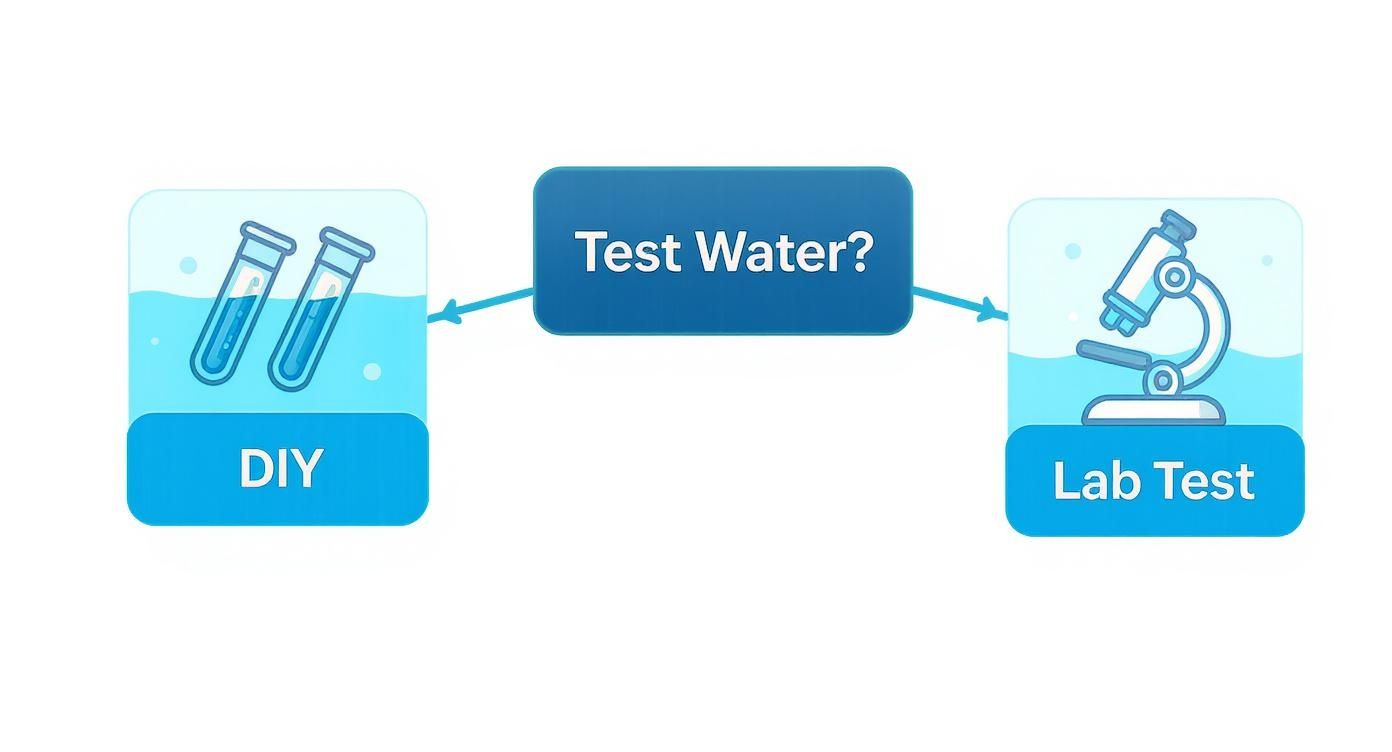
Flowchart showing two options for water testing: DIY with test tubes and professional lab test with a microscope.

Whether you used a home kit for a preliminary check or got a full lab analysis, this data is your guide to selecting the right hardware for your home.

Air Injection Oxidizing (AIO) Filters

One of the most popular and effective solutions is the Air Injection Oxidizing (AIO) filter. Think of it as the chemical-free workhorse of sulfur removal. This all-in-one system uses a simple, brilliant trick: it pulls in oxygen from the air and mixes it with your water as it enters the tank.

This kicks off a natural process called oxidation, which instantly converts the dissolved hydrogen sulfide gas into tiny solid particles. These particles are then easily trapped by a specialized media bed inside the tank. Every few days, the system automatically backwashes, flushing all the trapped sulfur and iron down the drain. It’s a clean, efficient, and low-maintenance solution.

I often recommend an AIO system when a water test shows low to moderate hydrogen sulfide—up to around 6-8 ppm—especially if there's also some iron. For most homeowners, it's a true "set it and forget it" solution.

Catalytic Carbon Filters

If you're dealing with a milder sulfur odor, a catalytic carbon filter can be an excellent and straightforward fix. These are best for H₂S levels under 1-2 ppm. While they look like standard carbon filters, the media inside has a special catalytic coating that dramatically speeds up the oxidation process.

As water flows through, H₂S gas is converted to solid sulfur and absorbed by the carbon. They’re simple, effective for slight smells, and don't use any chemicals. The only catch is that the carbon media will eventually need to be replaced, typically every couple of years.

Chemical Feed Pump Systems

Now, if your water test came back with some truly scary numbers—we're talking high hydrogen sulfide (10 ppm or more), iron bacteria, or other nasty microorganisms—it's time to bring in the heavy artillery. That’s where a chemical feed system, usually using chlorine, comes into play.

This setup injects a precise amount of chlorine into your water, which then flows into a holding tank. Chlorine is a powerful oxidizer that obliterates hydrogen sulfide and kills bacteria on contact. After the holding tank, a large carbon filter removes any leftover chlorine and sulfur particles, leaving you with completely purified, odor-free water.

This is the undisputed champion for severe water problems, but it does require more hands-on maintenance, like keeping the chemical solution tank filled. For a deeper dive into different filter types, our guides and advice section has a ton of great information and reviews.

Comparing Home Filtration Systems for Sulfur Smell Removal

Choosing the right system is a balancing act between performance, cost, and maintenance. What's perfect for your neighbor's well might be all wrong for yours. This side-by-side comparison should help clarify your decision.

Filtration Method Effective H₂S Range (PPM) Initial Cost Ongoing Maintenance Best For
AIO Filter 1 – 8 PPM Moderate Low (No chemicals) Moderate H₂S & iron
Catalytic Carbon 0.3 – 2 PPM Low-Moderate Moderate (Media change) Low H₂S, simple installs
Chemical Feed 6+ PPM High High (Refill chemicals) High H₂S & bacteria

By matching your lab results to the capabilities of each system, you can confidently invest in a home filtration solution that will finally kick that rotten egg smell to the curb.

Short-Term Fixes for Immediate Odor Relief

While you're deciding on the perfect long-term filtration system, you don't have to suffer through smelly showers. There are some powerful, immediate steps you can take to clear the air—and your water.

Think of these as your emergency first-aid kit for stinky water. They provide fast, welcome relief.

The two most common hotspots for a sudden sulfur smell are sulfur-reducing bacteria partying in your well or a similar colony that has checked into the warm, cozy spa of your water heater. Luckily, there are targeted ways to deal with both situations right now. And sometimes, if bacteria are your only problem, these fixes might even solve it for good.

Shock Chlorinating Your Well

If you've traced the odor back to bacteria in your well or plumbing, the most effective quick fix is shock chlorination. This is exactly what it sounds like: you're giving your well a sanitizing shock with a strong chlorine solution to kill off the bacteria producing that awful hydrogen sulfide gas.

It's a deep clean for your entire water system and an incredibly effective way to remove sulfur smell from well water when bacteria are the root cause. You just have to follow the steps carefully to do it safely.

Here’s the basic game plan:

  • Calculate the Dose: The amount of unscented household bleach you need depends on your well's depth and diameter. A common guideline is 2-3 pints of bleach for every 100 gallons of water in the well.
  • Mix and Circulate: Dilute the bleach in a bucket of water and pour it directly into the well. Then, connect a garden hose to an outdoor spigot and run water back into the well for at least an hour to circulate the chlorine.
  • Flush the System: Let the chlorine sit in the well for 8-24 hours. Then, go to every faucet in your house (hot and cold), run it until you smell chlorine, and shut it off. Finally, run an outdoor hose away from any landscaping or septic systems until the chlorine smell is completely gone.

Pro Tip: Shock chlorination can often keep the smell away for several months. If it comes back, you've confirmed a persistent bacteria problem. That’s your signal that a permanent filtration solution, like an AIO filter or a chemical feed system, is the next step.

Addressing the Water Heater Problem

What if your sniff test revealed the smell is only coming from the hot water? This is a dead giveaway that your water heater is the culprit. It’s a perfect breeding ground for sulfur bacteria—warm, dark, and oxygen-poor.

The anode rod inside the tank, designed to prevent rust, can sometimes make things worse. A standard magnesium rod can react with sulfates in the water, creating hydrogen sulfide gas as a byproduct.

Fortunately, the fix is pretty straightforward and doesn't involve your well at all.

You'll need to drain and flush the water heater to clear out the smelly, bacteria-filled water. For a more lasting solution, replace the standard magnesium anode rod with an aluminum-zinc alloy rod. This type of rod is much less reactive and helps prevent odor-causing bacteria from growing back. This simple swap can completely eliminate a hot-water-only sulfur smell.

While tackling your water, it never hurts to think about the bigger picture of home freshness. You can explore general strategies for eliminating common household odors to complement your efforts.

Installing and Maintaining Your Filtration System

You’ve done the heavy lifting—you tested your water, researched your options, and picked the perfect filtration system to banish that rotten egg smell for good. But the job isn't quite done. Proper installation and routine upkeep are what will make your investment pay off for years to come.

Getting this last part right is the difference between flawless, fresh water and future headaches.

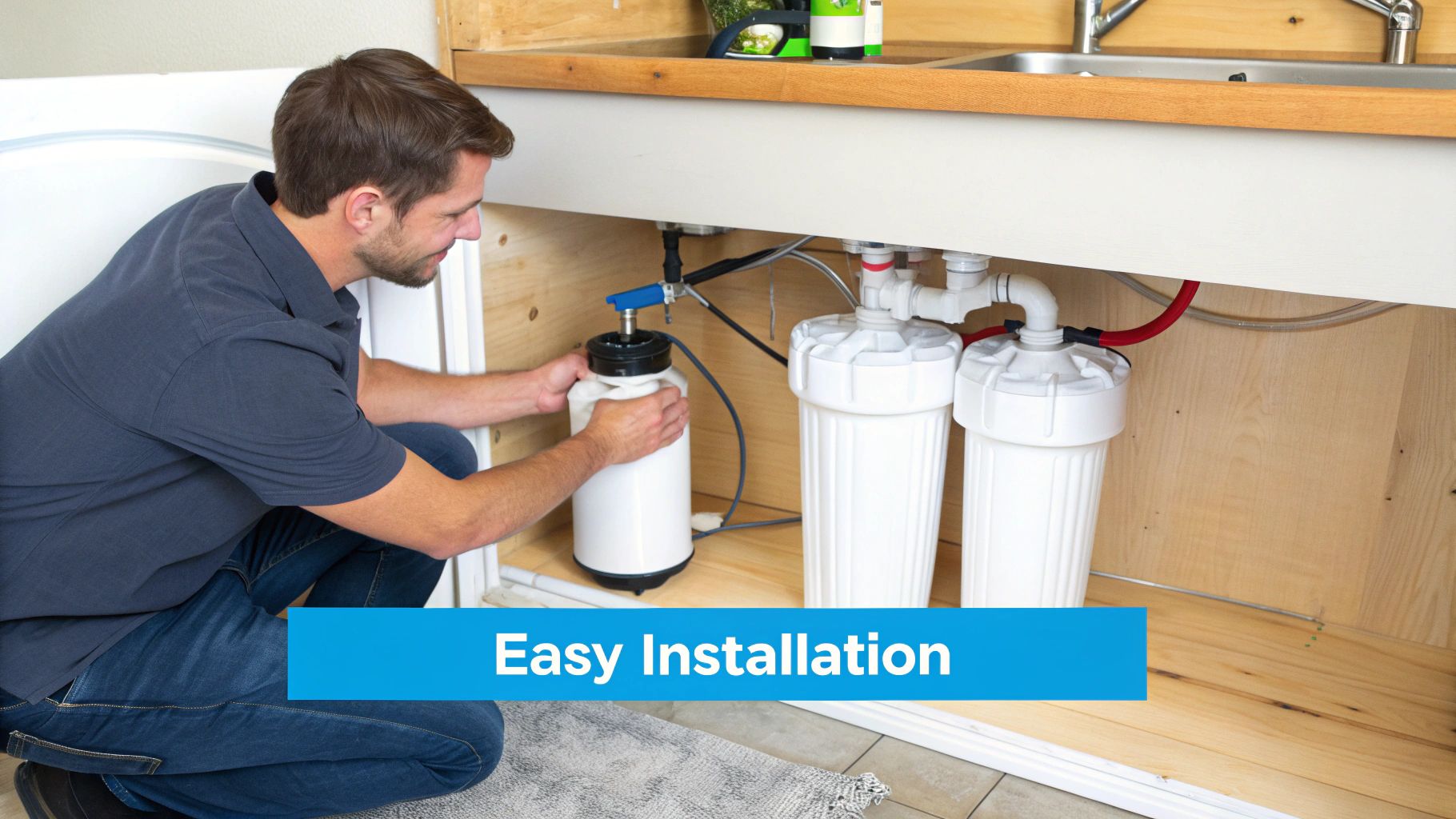
First, decide whether to DIY the installation or call in a pro. Many modern systems, like a catalytic carbon filter, are designed for a handy homeowner. But for more complex setups like a chemical feed system, having an expert handle the plumbing and initial setup is money well spent.

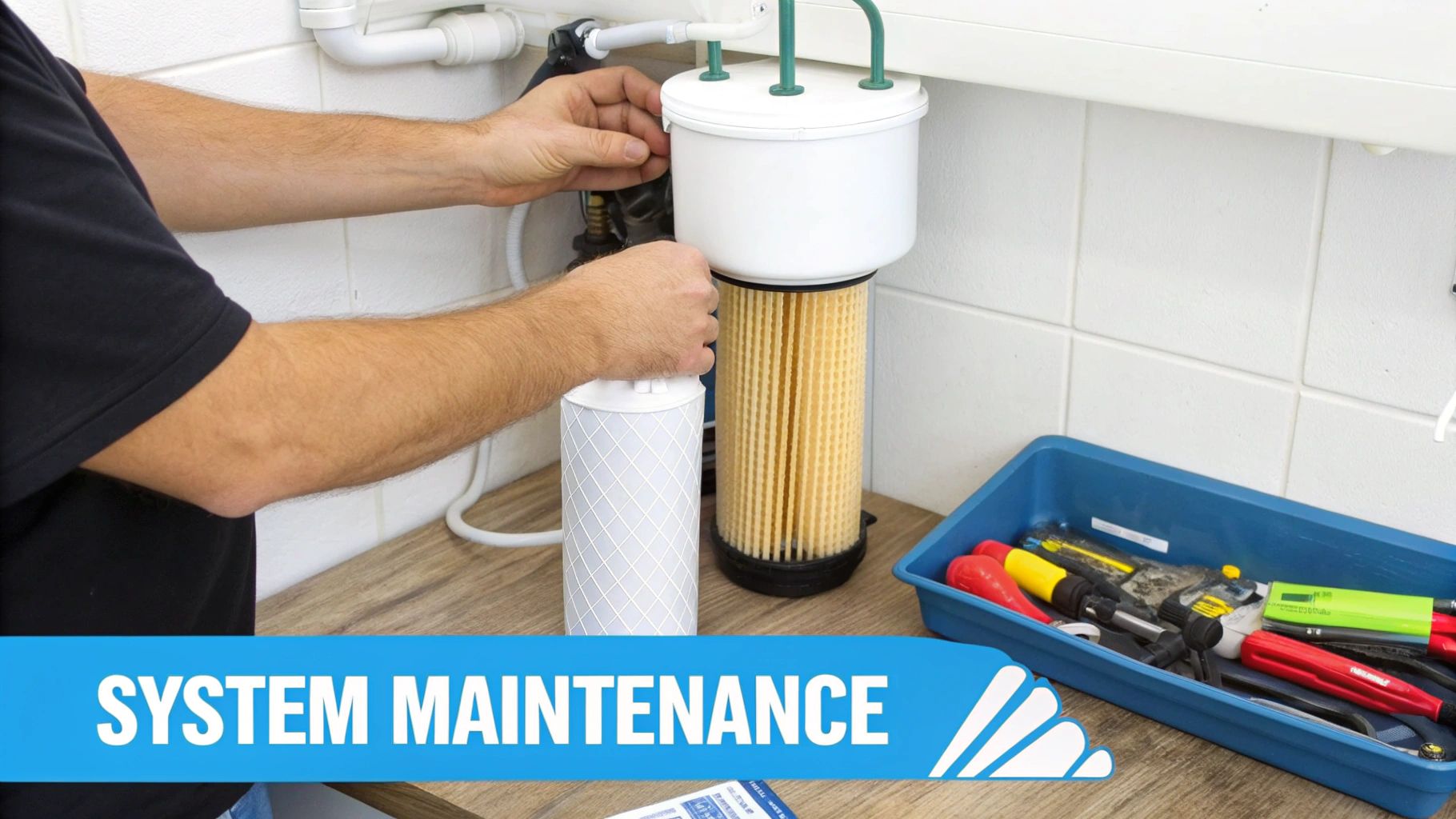
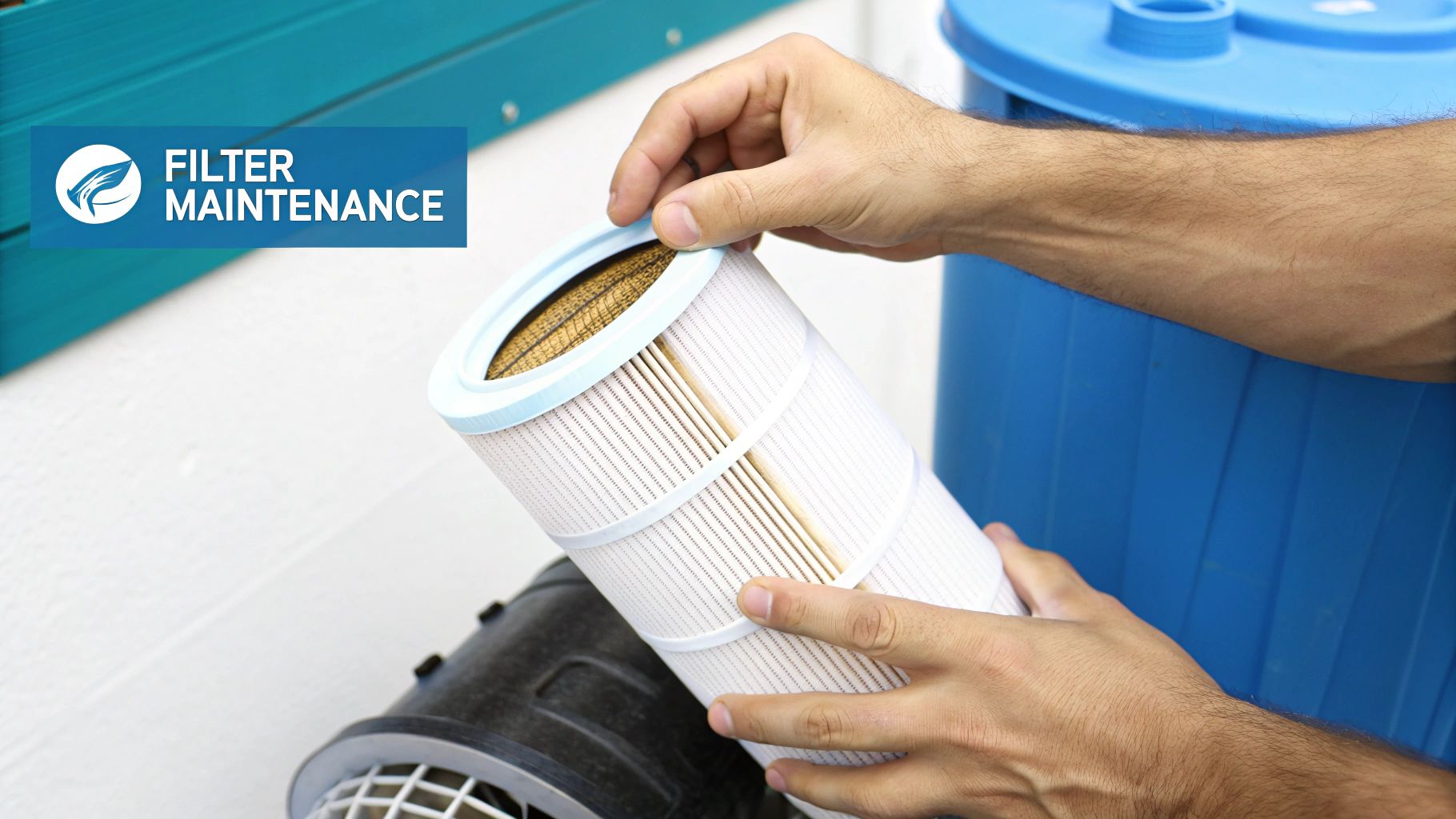
A person's hands are replacing a water filter in a home filtration system during maintenance.

Hiring a Professional Installer

If you go the pro route, don’t just hire the first name you find. A true water treatment specialist understands how to optimize your system for your specific water chemistry.

Before you commit, ask a few key questions:

  • Do you have experience with my specific type of system? An expert with AIO filters might not be the best choice for a chlorine injection pump.
  • Can you provide references from recent installations? Hearing from other homeowners is the best way to gauge reliability and quality.
  • What kind of warranty do you offer on your installation? You want to know you’re covered if a leak appears after they leave.
  • Will you program the system based on my water test results? This is critical. A properly set regeneration cycle ensures top performance and prevents water waste.

Getting solid answers here ensures your system is installed right from day one.

Long-Term Maintenance Your System Needs

Okay, your new system is humming along, and the water is glorious. Now what? A little routine maintenance is all it takes to keep it removing sulfur smell from well water effectively. Ignoring it is like never changing the oil in your car—eventually, you'll have a big, expensive problem.

A Quick Analogy: Think of your filtration system like a garden. You can't just plant it and walk away. It needs regular, simple care to thrive and keep producing that fresh, clean water you love.

Staying on top of maintenance stops small issues from becoming big, smelly ones.

Your Essential Maintenance Checklist

The exact tasks depend on your system, but here’s a practical checklist for the most common sulfur removal setups. Set a recurring reminder on your phone for these—it's easy to forget!

For Air Injection Oxidizing (AIO) Systems:

  • Check the Air Injector (Every 6-12 months): This tiny part can get clogged with iron or sediment, preventing the system from drawing in air. A quick cleaning is usually all it takes.
  • Inspect the Control Valve (Annually): Just listen to the backwash cycle. Make sure it sounds right and that the valve is moving through its positions smoothly.

For Chemical Feed Pump Systems:

  • Replenish the Solution Tank (As needed): This is your most frequent task. Keep an eye on the chemical level (usually chlorine) and top it off.
  • Clean the Injection Point (Annually): Mineral scale can clog the injection fitting where the chemical enters your water line, stopping your system cold. A quick check and clean will prevent this.

For Catalytic Carbon and Media Filters:

  • Replace the Media (Every 2-3 years): This is a bigger job, but infrequent. You’ll know it’s time when that faint rotten egg smell starts to creep back. That’s your signal that the media is saturated and needs to be replaced.

Following a simple schedule like this will ensure you get clean, odor-free water for years, protecting both your investment and your nose.

Common Questions About That Rotten Egg Smell

Even after diving into the science and solutions for that sulfur smell, it’s normal to have a few questions left. Sorting through home filtration systems can feel like a lot, but getting clear answers is the last step before you can choose a solution with total confidence.

Let's tackle the most common questions homeowners ask when they're battling the rotten egg beast.

Will a Water Softener Get Rid of the Sulfur Smell?

This is probably the biggest myth in water treatment. The short answer? No.

A standard water softener is a one-trick pony: it removes hardness minerals like calcium and magnesium. It is simply not designed to capture a dissolved gas like hydrogen sulfide.

In fact, the resin beads inside a softener can become a breeding ground for sulfur-reducing bacteria, which can make the rotten egg odor even worse. If you have a sulfur problem, you need a dedicated system for removing sulfur smell from well water.

Why Does My Water Smell Worse at Certain Times?

A sulfur smell that comes and goes can be maddening. This fluctuation usually points to a few common culprits.

  • Changes in the Water Table: Heavy rain or a dry spell can alter the groundwater chemistry, causing the smell to flare up.
  • Bacterial Activity: If bacteria are the cause, their activity level isn't always constant. It can ebb and flow, making the smell seem intermittent.
  • Water Stagnation: When water sits in your pipes or hot water heater, hydrogen sulfide gas concentrates. This is why the smell is often strongest when you first turn on a faucet after it's been off for a while.

Here's the key takeaway: an inconsistent smell still points to a consistent problem. Even if the odor vanishes for a day, the underlying cause is still there and needs a permanent filtration solution.

Is It Safe to Drink Water That Smells Like Sulfur?

At the low levels typically found in homes, the smell itself isn't considered a direct health hazard. But you absolutely shouldn't ignore it. Think of that rotten egg smell as your water’s built-in alarm system.

It’s a huge red flag that your water quality is compromised. It can signal the presence of bacteria or high levels of sulfates, which can cause digestive issues like diarrhea—especially for young children or guests. The smell is your water telling you it's time to get it tested and find the right filtration plan.

How Long Does Shock Chlorination Last?

This all depends on the source of your sulfur problem.

If the smell was caused by bacteria colonizing your well, a thorough shock treatment could solve the problem for several months, or in some cases, for good.

But if hydrogen sulfide is naturally present in your aquifer, the smell will always return as new, untreated water is drawn into the well. In that case, shock chlorination is just a temporary fix. It’s a great way to get immediate relief, but it also confirms that you need a permanent filtration system for a true, long-term solution.


At Water Filter Advisor, we're dedicated to helping you find the perfect, lasting solution for your well water. Explore our expert guides and reviews to make a confident choice for your home at https://www.waterfilteradvisor.com.
Does a Water Filter Soften Water in Your Home

Let's dive right in: a standard water filter does not soften water. It's an easy mix-up, but filtration and softening are two completely different ball games, designed to solve entirely different problems in your home's water supply.

Imagine your water filter is the head of security for your drinking glass. Its mission is to spot and block troublemakers like chlorine, funky-tasting sediment, and pesky pesticides. It ensures the water you drink is clean, safe, and doesn't taste like a swimming pool. A water softener, however, is more like a diplomatic negotiator—it specifically targets "hard" mineral ions and swaps them for something less problematic.

Filtration vs. Softening: The Core Difference

Clear water pouring from a kitchen faucet into a glass, symbolizing clean filtered water.

Most of us reach for a water filter to make our tap water safer and more enjoyable. The goal is purification. You want to kick out anything that might be harmful or just plain weird-tasting.

A filter's job is to remove a whole squad of contaminants, from chlorine and heavy metals to VOCs and bacteria. It's all about purity. But the minerals that cause hardness—our old friends calcium and magnesium—usually get a free pass to slide right on through.

Water softening, on the other hand, is on a completely different mission.

Its one and only purpose is to eliminate the minerals responsible for that crusty, white scale buildup in your pipes, on your showerheads, and inside your appliances. That buildup is a silent killer of efficiency and can lead to eye-watering repair bills. Softening is all about protecting the plumbing and appliances you've invested in.

To help you see the difference clearly, here's a quick side-by-side comparison.

Filtration vs. Softening at a Glance

Feature Water Filter Water Softener
Primary Goal Removes contaminants Removes hardness minerals
Improves Water taste, odor, and safety Prevents scale buildup
Targets Chlorine, lead, bacteria, pesticides, etc. Calcium and magnesium
Main Benefit Healthier, better-tasting water Protects pipes & appliances

This table shows that you're not choosing between one or the other; you're choosing which problem you want to solve.

Why You Might Need Both

Because filters and softeners are specialists in different fields, they aren't mutually exclusive. In fact, many homes with hard, contaminated water benefit from having both systems working in tandem.

The filter first removes the nasty stuff, then the softener takes care of the minerals. This dream team ensures your water is not only pure and great-tasting but also won't wage war on your coffee maker.

For anyone looking for a complete fix, a water softener and filter system combo is the way to go. This integrated approach gives you the best of both worlds, and understanding this key difference is the first step toward finding the perfect setup for your home.

Understanding the Problem of Hard Water

So, what is this stuff we call “hard water”? It’s really just water that’s picked up a high concentration of dissolved minerals—mostly calcium and magnesium—on its journey through the ground.

Think of these minerals as microscopic bits of rock hitching a ride in your water. When the water evaporates from a surface, like your shower door or kitchen faucet, it leaves those tiny hitchhikers behind. That’s where all the frustration begins.

A shower head clogged with white mineral scale buildup.

This leftover residue is the culprit behind that chalky film on your glass shower doors, the stubborn white spots on your dishes, and that crusty buildup around your sink fixtures. It’s also the reason your soap and shampoo just won't lather up properly, forcing you to use way more product than you should need to.

More Than Just Annoying Spots

While the visible signs are a nuisance, the real damage is happening where you can't see it. That mineral residue quietly builds up inside your pipes and appliances, forming a hard, rocky coating called limescale.

Limescale acts like plaque in your home's plumbing arteries. It slowly constricts water flow, forcing your entire system to work harder and less efficiently.

This buildup has serious consequences for some of your most expensive household appliances. It can choke the life right out of your water heater, dishwasher, washing machine, and even your coffee maker. In fact, some espresso machine experts claim that unfiltered hard water is directly responsible for over 50% of leak-related problems they see.

The effect on your energy bills is just as bad. Limescale is a terrible heat conductor, so when it coats the heating element in your water heater, the unit has to burn more energy just to get the water to the right temperature. This leads straight to higher utility bills and a much shorter lifespan for the appliance itself.

The Real-World Impact of Scale Buildup

The effects of this silent destroyer pop up all over the house. Over time, you’ll probably start to notice:

  • Reduced water pressure: As scale narrows the inside of your pipes, water flow drops. This means weak showers and sinks that take forever to fill.
  • Dull, stiff laundry: Hardness minerals get trapped in the fibers of your clothes, leaving them feeling rough and making colors fade much faster.
  • Dry skin and hair: Those same minerals that leave a film on your dishes also leave a residue on your body, which can clog pores and leave your skin and hair feeling dry and itchy.
  • Appliance failure: The constant strain and internal damage from scale buildup eventually lead to costly repairs and, all too often, premature appliance replacement.

Ultimately, dealing with hard water isn't just about getting shinier dishes or a better lather from your soap. It’s about protecting your home’s critical infrastructure—your plumbing and major appliances—from slow, expensive, and completely preventable damage. Since a standard water filter doesn't remove these minerals, homeowners often need to look at specific solutions designed to tackle hardness.

How Home Water Filters Actually Work

To get why most filters don't soften water, we have to pop the hood and see how they’re built. Think of water filtration like a series of specialized nets, where each one is designed to catch a different kind of unwanted particle. The size and type of that net dictate what it catches and what it lets slip right on through.

Most of the filters you find in homes are all about purification—getting rid of things that make your water taste, smell, or feel funky. They are fantastic at their jobs, but that job isn't softening.

https://www.youtube.com/embed/-_sr7mzhVsE

The Most Common Filter Types

Let's break down the workhorses of home water filtration. Each has a very specific role, and you'll quickly notice a common theme: they aren't designed to go after hardness minerals.

  • Sediment Filters: These are the simplest of the bunch. They work like a screen door for your water supply, blocking bigger stuff like dirt, sand, rust, and silt before it gets into your plumbing. While they're essential for protecting other filters and appliances, those dissolved hardness minerals just sail right through.

  • Activated Carbon Filters: This is the hero you'll find in pitcher filters, refrigerator filters, and a lot of faucet-mounted systems. Activated carbon has this incredibly porous surface that acts like a magnet for contaminants like chlorine, pesticides, and chemicals that cause bad tastes and smells. But calcium and magnesium ions? They just don't stick to the carbon and keep on flowing.

  • UV Purifiers: Ultraviolet (UV) systems are more like assassins than catchers. They use a powerful UV light to scramble the DNA of bacteria, viruses, and other nasty microorganisms, making them totally harmless. It's a super effective way to handle microbiological threats, but it does absolutely nothing to the mineral content in the water.

An EPA overview of treatment technologies confirms this. While methods like activated carbon are great for organics and chlorine, they don't touch the minerals that cause hardness. For that, the EPA points to cation exchange as a proven method with over 99% removal efficiency for both calcium and magnesium ions.

What About Reverse Osmosis?

Now, there is one major exception in the world of filtration: Reverse Osmosis (RO). An RO system uses an incredibly fine semipermeable membrane to strip out a massive range of dissolved solids from water. We're talking lead, arsenic, and—you guessed it—the calcium and magnesium that make water hard.

So, does a water filter soften water if it’s an RO system? Technically, yes, but only at the specific tap where it’s installed.

Using an RO system for whole-home softening is like using a sniper rifle for a job that needs a bulldozer. RO is perfect for producing highly purified drinking water at your kitchen sink, but it’s not built for the volume and flow rate your entire house demands.

It produces wastewater as part of its process and just can't keep up with showers, laundry, and the dishwasher all running at once.

This distinction is crucial. While a couple of filter types can reduce hardness, their main job is purification. For true, whole-home softening, you need a system that was engineered specifically for that task.

The Science of Making Hard Water Soft

So, if most filters aren’t designed to tackle hard water, what’s the real fix? This is where a dedicated water softener comes into play. These systems are the undisputed heavyweights of hard water treatment, and the science behind them is actually pretty straightforward.

At the core of a traditional water softener is a process called ion exchange. Picture the softener’s main tank filled with millions of tiny, porous resin beads. Right out of the box, these beads are loaded up with sodium ions.

As your home's hard water flows through this tank, the magic happens. The calcium and magnesium minerals—the very things causing all that scale and soap scum—have a stronger positive charge than the sodium ions. Because of this, the resin beads act like powerful little magnets, grabbing the calcium and magnesium right out of the water and releasing the sodium ions to take their place. It's a simple and incredibly effective trade that physically removes the minerals that make water hard.

The Trade-Off: How Ion Exchange Works

This mineral swap is what gives you genuinely soft water, unlocking all the benefits you’ve heard about: no more scale buildup, richer soap lather, and softer skin and hair. Of course, this process can't go on forever.

Eventually, the resin beads become completely saturated with all the calcium and magnesium they’ve pulled from the water. At that point, they can’t grab any more. This is when the softener needs to "regenerate"—it flushes the mineral-packed beads with a concentrated saltwater (brine) solution, washing the hard minerals down the drain and reloading the beads with a fresh supply of sodium ions, ready to start the cycle all over again.

There’s no question about the demand for this technology. The U.S. water softening systems market is a clear indicator of how widespread hard water problems are, with projections showing growth from $763.6 million in 2025 to a staggering $1.19 billion by 2032. This boom is driven by a growing awareness of hard water’s damaging effects, and proven salt-based ion exchange softeners continue to dominate the market. You can discover more about the water softening market's growth and see the trends for yourself.

The Salt-Free Alternative: Water Conditioners

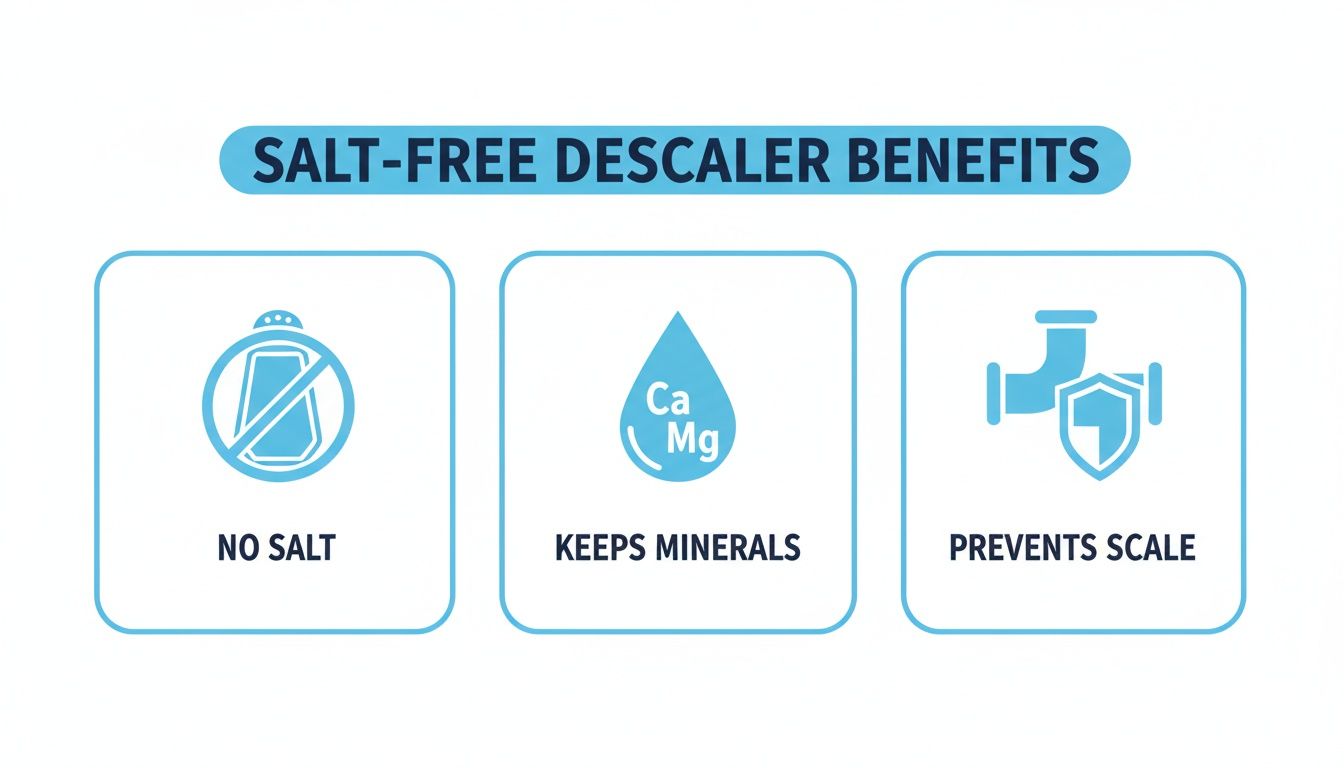
For homeowners who want a lower-maintenance option, there's another player in the game: the salt-free water conditioner, often called a descaler. Now, it's critical to understand that these systems do not actually soften the water. They don’t remove the hard minerals at all.

Instead, they use a clever technology called Template Assisted Crystallization (TAC). This process changes the physical form of the calcium and magnesium minerals, turning them into microscopic crystals that simply won't stick to your pipes, fixtures, or appliances.

Think of it this way: if scale buildup is like LEGOs clicking together to form a solid mass, a water conditioner coats each LEGO piece so it can't connect with the others. The minerals are still present in your water, but they just flow harmlessly through your plumbing without causing that destructive scale. This makes conditioners a fantastic choice for scale prevention, but you won't get those other classic benefits of soft water, like silky-smooth skin or better soap performance.

Choosing the Right Water System for Your Home

So, how do you take all this information and turn it into the right decision for your family? It really just comes down to one simple question: What problem are you trying to solve? The best choice for you is all about your specific goals.

Are you mainly concerned with making your drinking water taste better and getting rid of nasty contaminants? Or are you just plain sick of replacing appliances caked in scale and scrubbing that chalky film off your shower doors? Your answer is the key to figuring out the perfect water treatment plan for your home.

Assess Your Home’s Unique Needs

Before you buy anything, you need to know what you’re working with. A great first step is to grab a simple water hardness test kit. It will tell you exactly how many grains per gallon (GPG) of minerals are in your water. If you see a number over 3 GPG, you've got hard water that’s likely causing problems.

Next, think about your family's priorities and your budget. Are you looking for a whole-house system that protects every pipe and appliance, or is a simple under-sink filter for pure drinking water all you really need? Nailing down what you actually need helps you avoid spending money on a system that's overkill. For some great pointers, check out the expert advice on water filters to explore options that fit your situation.

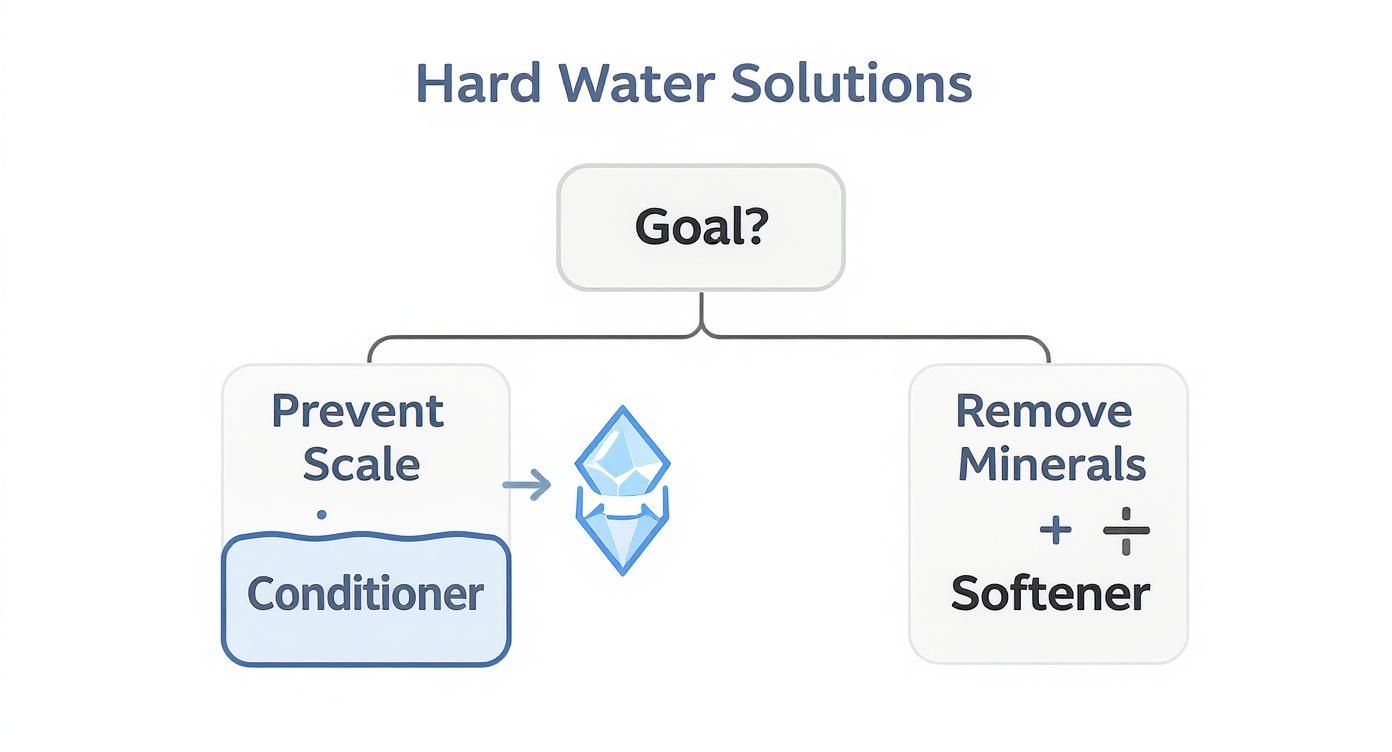
This handy decision tree makes the choice even simpler, focusing on whether you want to stop scale or completely remove the minerals causing it.

Infographic about does a water filter soften water

As you can see, if your main goal is just to stop scale from building up without messing with the water chemistry, a conditioner is the way to go. But if you want those minerals gone for good, a softener is what you need.

Creating a Hybrid Water Treatment System

For a lot of homeowners, one device just doesn't cut it. The best setups often combine different systems to create a powerful, multi-stage defense against both contaminants and hardness minerals.

Here are a couple of popular combinations that work incredibly well:

  • Ultimate Protection: Combine a whole-house sediment filter with a traditional water softener. Think of the filter as a bodyguard for your softener—it catches all the dirt, sand, and rust that could clog up and damage the softener’s resin, helping it run smoothly for years.
  • Targeted Purity and Scale Prevention: Pair a salt-free water conditioner with an under-sink Reverse Osmosis (RO) system. The conditioner protects your home's entire plumbing system from scale, while the RO unit sits right under your kitchen sink, giving you ultra-pure water for drinking and cooking.

This kind of layered approach means you're no longer just asking, "Does a water filter soften water?" Instead, you’re building a complete system that delivers pure, non-damaging water to every tap in your house.

It's also worth thinking about how your water system fits into your other home improvement goals, like creating energy-efficient smart home solutions. By preventing scale from building up inside your water heater, a softener or conditioner allows it to work more efficiently. That means less energy wasted and lower utility bills, making your water treatment system a smart investment for a more cost-effective home.

Common Questions About Water Filters and Softeners

Diving into the world of water treatment can feel a little overwhelming. Once you realize filters and softeners aren't the same thing, a whole new set of questions usually pops up. We get it.

Here are some straightforward answers to the most common queries we hear from homeowners trying to map out the perfect water strategy for their house.

Will a Reverse Osmosis System Soften My Water?

Yes, a reverse osmosis (RO) system definitely softens water, and it does a fantastic job of it. Its super-fine membrane is a beast, designed to strip out pretty much all dissolved solids, and that includes the calcium and magnesium minerals that make water hard.

But here’s the catch: RO systems are designed for a single faucet, like your kitchen sink. They work slowly, produce a stream of wastewater, and just can't keep up with the demands of an entire house. For whole-house softening, a dedicated water softener is a much more practical and efficient choice.

Is Softened Water Safe to Drink?

For almost everyone, drinking softened water is perfectly safe. The ion exchange process does add a tiny bit of sodium to the water, which is something to be aware of if you're on a strict, doctor-ordered low-sodium diet.

The amount of sodium added depends on how hard your water is to start with—the harder it is, the more sodium gets swapped in. If that’s a concern for you, you've got a couple of easy workarounds:

  • Use potassium chloride pellets in your softener instead of the standard sodium chloride ones.
  • Have your plumber bypass the cold water line to your kitchen sink, so you get unsoftened water for drinking and cooking.

Can I Use a Water Softener and a Water Filter Together?

Absolutely! In fact, combining them is often the best way to get top-tier water quality throughout your home. Think of it as creating a multi-stage defense that tackles a whole range of problems.

A popular and highly effective setup is to install a whole-house sediment pre-filter before the water softener. This filter acts like a bodyguard, grabbing all the dirt, sand, and rust that could clog up and damage the softener's sensitive resin bed. Then, you can add an activated carbon filter after the softener to strip out chlorine, giving you great-tasting, clean-smelling water from every single tap.

This layered approach is the real answer to whether a filter can soften water. It accepts that they are different tools for different jobs, and using them together gives you a complete solution for pure, non-damaging water.

What’s the Difference Between a Water Softener and a Water Conditioner?

This is a really important distinction. A traditional water softener relies on ion exchange to physically pull the hardness minerals out of your water, trading them for sodium ions. The result is truly soft water, with all the benefits you’d expect—great soap lather, no spots on dishes, and softer skin.

A water conditioner, which you might also hear called a descaler, is a salt-free alternative that works completely differently. It doesn't remove the minerals. Instead, it uses a technology like Template Assisted Crystallization (TAC) to change the physical shape of the mineral crystals. This keeps them from sticking to surfaces and forming that destructive limescale in your pipes and appliances.

Here’s a simple way to think about it: a softener removes the troublemakers entirely, while a conditioner just puts them in handcuffs so they can't cause any harm as they pass through. Conditioners are great for preventing scale buildup but won't give you the other perks of genuinely soft water.


At Water Filter Advisor, our mission is to provide clear, research-driven guidance to help you make confident decisions about your home's water quality. Explore our in-depth guides and reviews to find the perfect solution for your family at https://www.waterfilteradvisor.com.
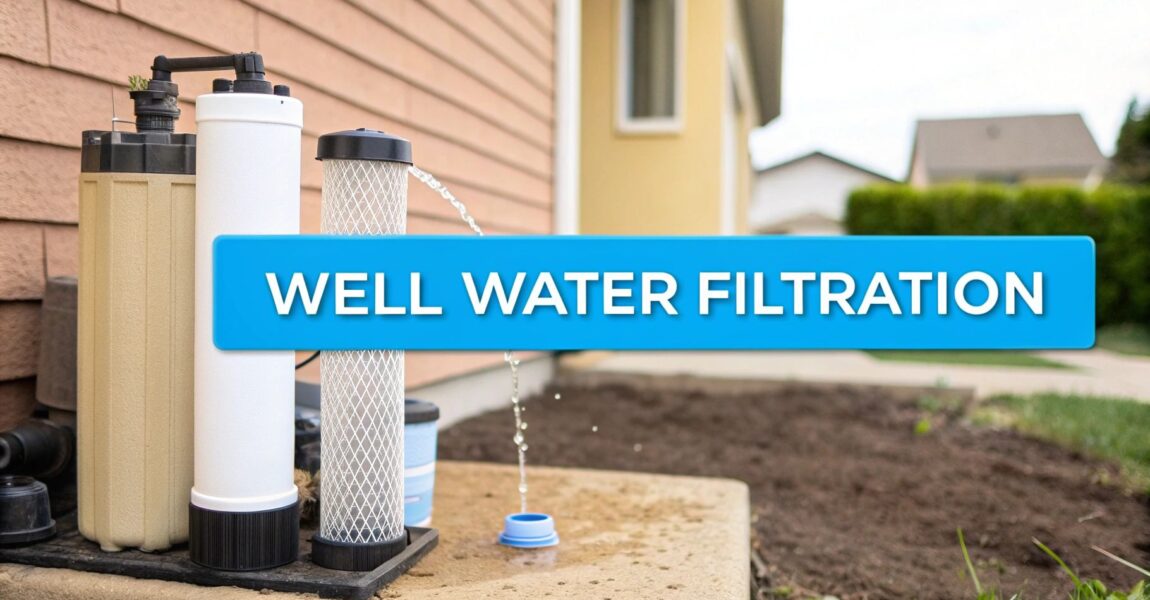
Choosing Well Water Filtration Systems for Your Home

If you're one of the millions of homeowners who gets their water from a private well, you know the freedom that comes with it. No monthly water bill! But you also know the responsibility for that water's quality is 100% on you.

Unlike city water, which is treated before it ever reaches your home, well water is a direct line from the ground to your tap. That means it's up to you to handle whatever comes along for the ride—sediment, iron, nasty bacteria, and even chemicals. A good well water filtration system isn't just a nice-to-have; it's the essential gatekeeper that makes sure your water is safe, clean, and delicious.

Why Your Well Water Needs a Guardian

Image

There's something special about having your own private well. But that independence means you're the one in charge of your water's quality and safety. While the earth does a decent job of filtering water naturally, it’s far from a perfect bouncer.

Whatever is in the ground around your property has a good chance of ending up in your glass. This could be anything from naturally occurring minerals that cause hard water to agricultural runoff or invisible bacteria. This guide is here to give you the know-how to tackle these challenges head-on.

From Murky to Crystal Clear

Think of yourself as becoming your own personal water treatment expert. You’re about to learn the story of your water, from the moment it enters the ground to the second it hits your faucet. We’ll dig into the common culprits behind those frustrating household water problems, like:

  • Aesthetic Issues: Things like that "rotten egg" smell, rust-colored stains ruining your sinks and toilets, or water that just looks cloudy and unappealing.
  • Hidden Dangers: These are the invisible threats you can't see, smell, or taste. We're talking about bacteria, nitrates, arsenic, and other chemicals that can pose serious health risks.
  • Appliance Assassins: Hard water minerals are notorious for building up inside your pipes, water heater, and dishwasher. This limescale buildup chokes their efficiency and shortens their lifespan.

Managing your well water isn't about just buying a random filter. It's about building a custom defense system designed specifically for your water's unique chemistry. This guide is your blueprint.

Once you understand what's really in your well water, you can confidently choose the right well water filtration systems to protect your home and family. We'll walk you through everything—from testing your water to picking, installing, and maintaining the perfect setup—so every drop is pure, safe, and tastes fantastic.

What Is Hiding in Your Well Water?

Before you can even think about choosing a well water filtration system, you first have to know what you’re up against. Think of your well water as its own little ecosystem. While it's mostly pure, it almost always has a few uninvited guests from the surrounding earth, and these intruders fall into a few distinct categories.

Figuring out what's in your water is the most important first step. You wouldn’t buy a home security system without knowing if you’re trying to stop a raccoon or a burglar, right? The same logic applies here. A professional water test is your reconnaissance mission, giving you the intel you need to build the right defense.

The Physical Intruders You Can See

First up are the things you can actually see—the particles and debris that make your water look cloudy or just plain dirty. These are usually the easiest problems to spot and are often the first thing a good filtration setup tackles.

Think of your well as a giant underground reservoir. As rainwater trickles down through soil and rock to fill it, it picks up tiny hitchhikers along the way. These often include:

  • Sediment, Silt, and Sand: These are the fine bits of dirt and rock that cause cloudiness, a quality known as turbidity. They don't just look bad; they can clog up your pipes, wear out appliance parts, and settle at the bottom of your water heater, making it work harder and less efficiently.
  • Rust and Iron Particles: Seeing orange or reddish-brown stains in your sinks, toilets, or laundry? That’s a dead giveaway for iron. It’s a super common mineral in groundwater that can also give your water a metallic taste.

These physical bits are more than just an eyesore. They provide perfect hiding spots for bacteria and can gum up the works for more advanced filters, like UV purifiers. This is exactly why a simple sediment filter is almost always the first component in any well water system.

To help you get a better handle on what might be lurking, here’s a quick guide to connect the dots between what you see, smell, or taste and the likely culprit.

Common Well Water Contaminants and Their Signs

Contaminant Type Common Examples Potential Signs in Your Home
Physical Sediment, Silt, Sand, Rust Cloudy or murky water, orange/brown stains on fixtures and laundry, gritty texture.
Chemical Calcium & Magnesium (Hardness) Soap scum, mineral buildup (limescale) on faucets, poor soap lather, stiff laundry.
Chemical Hydrogen Sulfide A distinct "rotten egg" smell, especially from hot water.
Chemical Heavy Metals (Arsenic, Lead) Often tasteless, colorless, and odorless. Requires a lab test to detect.
Biological Bacteria (E. coli, Coliform) Also tasteless, colorless, and odorless. Can cause stomach issues or illness.

This table is just a starting point. While some issues are obvious, many of the most serious contaminants are completely invisible, which is why a professional lab test is non-negotiable for well owners.

The Invisible Chemical Threats

Next, we have the chemical contaminants. These are dissolved substances you often can't see, taste, or smell, which is what makes them so tricky. They can seep into groundwater from all sorts of places, like farm runoff, industrial pollution, or even just the natural rocks in your area.

For well owners, this is a huge deal. The whole reason filtration became popular was because of concerns over contamination in private water sources. Globally, around 2 billion people drink from sources contaminated with feces, a stark reminder of the health risks of untreated water. Here in the United States, about 15% of the population gets their water from private wells, which aren't regulated by the EPA like city water. This leaves the responsibility for safety squarely on the homeowner. You can discover more insights about the global water filter market and its growth drivers over on openpr.com.

Some of the most common chemical culprits are:

  • Nitrates and Nitrites: These usually come from fertilizers or leaky septic systems. High nitrate levels are a serious health risk, particularly for infants.
  • Heavy Metals: Arsenic, lead, and mercury can leach into groundwater from natural mineral deposits or industrial activity. Long-term exposure can cause severe health problems.
  • Hardness Minerals: Calcium and magnesium are the duo responsible for hard water. While not a health hazard, they cause limescale buildup that wreaks havoc on your pipes, appliances, and even your skin and hair.
  • Hydrogen Sulfide: This is the gas that produces that awful "rotten egg" smell. It's created by harmless bacteria in the ground, but it can make your water completely undrinkable.

A comprehensive water test is the only way to uncover these hidden chemical threats. Without one, you’re just guessing at what your water needs, which can be an expensive and ineffective gamble.

The Biological Contaminants

Finally, we get to the biological contaminants—the living microorganisms that can make you sick. Because well water isn't treated with chlorine like city water, it’s a potential breeding ground for bacteria and viruses that get in from animal waste or failing septic tanks.

These microscopic invaders include:

  • Bacteria: E. coli and coliform bacteria are the big ones. Their presence is a strong indicator that your well has been contaminated with fecal matter, which means other nasty, disease-causing pathogens could be in there too.
  • Viruses and Protozoa: Organisms like Giardia and Cryptosporidium are notorious for causing severe gastrointestinal illness.

You can't see, smell, or taste these organisms, so a specific test for bacteria is absolutely critical. This is the one area you can’t afford to mess around with, making a UV purifier or another disinfection system a must-have for many well owners.

Alright, you've got the results from your water test. Think of that report as a scouting report on the enemy. Now, it's time to build your dream team of filters to defend your home's water supply.

Choosing the right well water filtration systems isn't a one-size-fits-all deal. It's more like putting together a special ops team—each filter has a specific job, a unique skill set designed to take out a particular contaminant. It's rare that a single, magic-bullet filter will solve all your well water woes. That's why the most effective setups are multi-stage, layering different technologies to create an impenetrable defense.

You wouldn't ask the bouncer checking IDs at the door (your sediment filter) to deal with an invisible threat like bacteria, right? You need layers. Each part of the system has its role, working in concert to deliver clean, safe water from the moment it enters your house. This approach guarantees total protection, from chunky sand and silt down to microscopic germs you can't even see.

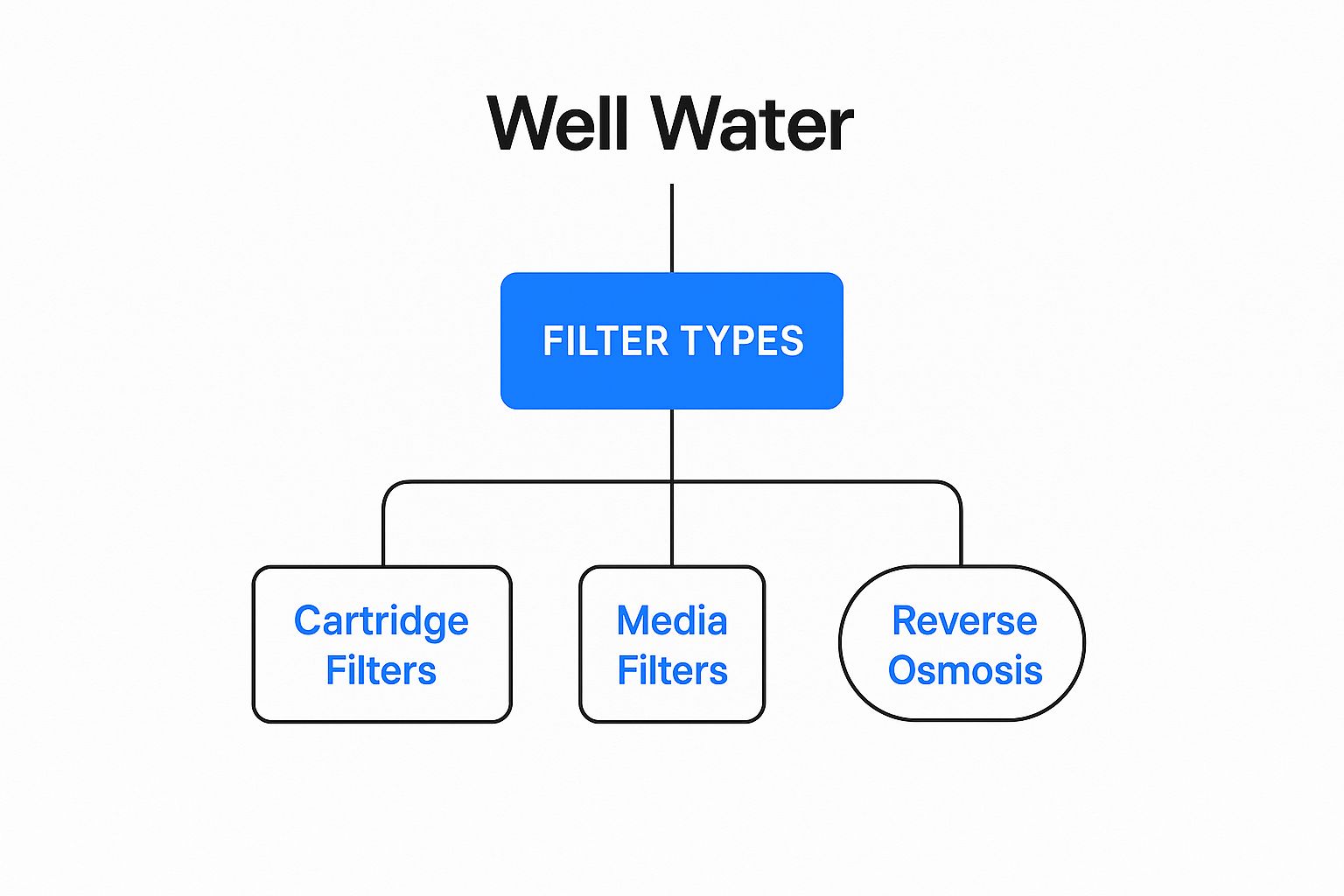
This diagram gives you a bird's-eye view of the main categories of well water filters, showing how they all fit together.

Image

As you can see, a solid strategy will likely mix and match a few of these types to get the job done right.

The Frontline Defender: Sediment Filters

Every great well water system kicks off with a sediment filter. This is your first line of defense, the bouncer at the door whose job is to stop the big, clumsy invaders before they gum up the works. Its mission is simple but absolutely critical: catch all the physical junk like sand, dirt, silt, and rust flakes.

Think of it like a screen on your window—it lets the fresh air (water) in but keeps the bugs (sediment) out. By trapping all that debris right at the start, a sediment filter not only clears up cloudy water but also acts as a bodyguard for the more delicate and expensive filters down the line. This one simple step can dramatically boost the lifespan and performance of your entire system.

The Taste and Odor Specialist: Carbon Filters

Next in the lineup is the activated carbon filter. This is your specialist, the one you call in to handle chemical contaminants and get rid of funky tastes and smells. If your water has that swimming pool chlorine odor or a weird, earthy taste, this is your hero.

The secret is its ridiculously huge internal surface area, made up of millions of microscopic pores. These pores work like a magnet for chemicals, snagging things like chlorine, pesticides, and volatile organic compounds (VOCs) through a process called adsorption. It’s the MVP for turning murky, smelly water into something that tastes crisp, clean, and refreshing.

The Mineral Manager: Water Softeners

Did your water report come back with high levels of calcium and magnesium? If so, you've got hard water. That's where a water softener steps in. Now, it's not technically a "filter" in the traditional sense; it's more of a water conditioner. Its job is to stop mineral buildup—that crusty limescale that wreaks havoc on your appliances and leaves soap scum all over your shower.

A water softener uses a clever process called ion exchange. It literally swaps out the "hard" mineral ions (calcium and magnesium) for "soft" sodium ions. This simple trade prevents scale from ever forming in your pipes, water heater, and dishwasher.

This system is your best defense against the costly damage hard water can cause, especially to appliances like water heaters, which can fail years ahead of schedule without one.

The Heavy-Duty Brawler: Iron and Sulfur Filters

For those wells cursed with rusty orange stains and that distinct "rotten egg" smell, you need to bring in the heavy hitters. Iron filters and air-injection oxidizing (AIO) systems are the specialized brawlers built to knock out high concentrations of iron, manganese, and hydrogen sulfide gas.

These systems work by oxidizing the dissolved troublemakers, which basically forces them to turn into solid particles. Once they're solid, the filter media can easily grab and flush them away, getting rid of those ugly stains and nasty smells for good. This targeted attack is way more effective than hoping a standard carbon filter or softener can handle a serious iron or sulfur problem.

The Microbial Assassin: UV Purifiers

If your water test flagged bacteria, coliform, E. coli, or other living critters, you need a surefire way to neutralize them. A UV purifier is the silent assassin for these biological threats. The best part? It doesn't add a single chemical to your water or alter its taste.

It uses a powerful ultraviolet lamp that zaps any water flowing past it. This UV light scrambles the DNA of bacteria, viruses, and other microorganisms, making it impossible for them to reproduce and cause harm. It’s a clean, highly effective final barrier that ensures your water is biologically safe to drink.

The Ultimate Purifier: Reverse Osmosis Systems

Finally, when you want the absolute highest level of purity for your drinking and cooking water, you bring in the special forces: reverse osmosis (RO). An RO system uses a super-fine, semi-permeable membrane to strip out up to 99% of all dissolved solids.

It forces water through this membrane, which is so tight it blocks nearly everything that isn't a pure water molecule. We're talking heavy metals like lead and arsenic, plus nitrates, fluoride, and salts. Because this purification process is slow and meticulous, RO systems are usually installed at a single tap—like under the kitchen sink—to provide a dedicated source of incredibly pure water right where you use it most.

How to Choose the Right Filtration System

Image

Alright, you’ve got your water test results back. Now the real fun begins. This is where you put on your detective hat and figure out exactly what your water needs to be clean, safe, and great-tasting.

Choosing the right well water filtration system isn’t about buying the most expensive gear you can find. It’s about a smart, targeted approach based on what’s actually in your water, how much of it you use, and where you need it most. Your water test is your road map—let’s use it to build the perfect solution for your home.

Decode Your Water Test and Match the Filter

Think of your water test as a diagnostic report for your well. It tells you exactly what you’re up against. Are sediment levels high? Is iron turning your fixtures orange? Your job is to match each problem with the right tool.

Here’s a simple way to break it down:

  • High Sediment or Turbidity: If your water looks cloudy, a sediment pre-filter is non-negotiable. This is always your first line of defense, catching all the dirt, sand, and rust before it can clog up the rest of your system.
  • Elevated Iron or Manganese: Seeing those classic orange or black stains? You’ll probably need a dedicated iron filter or an air-injection oxidizing (AIO) system. A water softener alone just can't keep up with heavy iron.
  • Positive for Bacteria (E. coli, Coliform): This is a serious health concern that needs an immediate fix. A UV purification system is your best bet here. It zaps bacteria and viruses with ultraviolet light, making your water biologically safe without adding any chemicals.
  • Hard Water Minerals (Calcium & Magnesium): If you're tired of limescale buildup on your faucets and appliances, a water softener is the clear winner. It's the only way to truly tackle hardness.

Make a checklist from your water report. For every contaminant you find, you'll want a specific filter stage designed to remove it.

Calculate Your Household's Flow Rate

Here's a detail that's easy to miss but can make or break your system: flow rate. Measured in gallons per minute (GPM), this tells you how much water your system can process at once. Get this wrong, and you'll be dealing with a frustrating trickle every time someone flushes a toilet while the shower is running.

You don't want your filter system to become a bottleneck. A system that's too small for your home will choke your water pressure.

To get a rough idea, just add up the GPM of the fixtures you might use at the same time. A shower is about 2.5 GPM, a toilet can be 2.2 GPM, and a sink faucet is around 1.5 GPM. For a typical family of four, a system that can handle 10-15 GPM is a pretty safe bet to keep the pressure strong everywhere.

Picking a system with a flow rate that meets or slightly beats your home's peak demand is the single best way to guarantee you never have to worry about weak water pressure again.

Point of Entry vs. Point of Use Systems

The last big decision is where you need the filtered water. Do you want to treat every drop coming into your house, or just the water at a specific tap? This leads you to two main categories: Point-of-Entry (POE) and Point-of-Use (POU).

Deciding between a whole-house system and a single-tap filter really comes down to the scope of your water problems and your end goals. Are you trying to protect your entire plumbing system or just purify your drinking water? Here's a quick comparison to help you think it through.

Point-of-Entry (POE) vs. Point-of-Use (POU) Systems

Feature Point-of-Entry (Whole House) Point-of-Use (Single Tap)
Location Installed at the main water line. Installed at a single fixture (e.g., under the kitchen sink).
Treatment Scope Treats all water entering the home. Treats water for one specific tap or appliance.
Best For Widespread issues: hardness, sediment, iron, general chemicals. Targeted issues: lead, chlorine, cysts, specific taste/odor problems.
Primary Benefit Protects plumbing, appliances, skin, and hair. Provides highly purified water for drinking and cooking.
Typical Cost Higher initial investment. Lower initial cost.
Maintenance Less frequent, but larger filter changes. More frequent, but smaller and easier filter changes.

Ultimately, a whole-house POE system offers a comprehensive solution, safeguarding your entire home. The global market for these systems was valued at $10.17 billion and is expected to keep growing as more people become aware of well water contaminants.

On the other hand, POU systems like an under-sink reverse osmosis unit are fantastic for getting ultra-pure water right where you need it most—your kitchen. They are an excellent, budget-friendly way to target drinking water quality without overhauling your entire plumbing setup.

Getting It Installed and Keeping It Running

Image

You’ve picked out the perfect filtration system for your well. Awesome. But now comes the part that makes it all work: getting it installed right and setting up a simple plan to keep it that way.

Think of your new system like a car you just drove off the lot. The installation is like making sure the engine is seated correctly, but the routine maintenance—the oil changes and filter swaps—is what keeps it from breaking down on the side of the road. Neglect this part, and you’re just asking for trouble.

DIY vs. Calling in a Pro

First up, you need to decide if you’re going to tackle the installation yourself or hire a professional. It's a big decision. While a lot of us love a good weekend project, a botched plumbing job can quickly turn into leaks, water damage, or a system that doesn't filter anything at all.

Installing a simple under-sink filter is usually something you can handle on your own. But a whole-house system with multiple tanks? That's a whole different ballgame. It means cutting into your main water line, and that requires some serious skill and confidence.

Ask yourself these questions:

  • How complex is this thing? Is it a single filter cartridge, or a multi-stage setup with a UV light that needs wiring?
  • What are my plumbing skills, really? Are you comfortable cutting pipe, sweating copper fittings, and knowing for sure it won't leak?
  • Do I have the right tools? We're talking pipe cutters, multiple wrenches, maybe even PEX crimpers.
  • What does the warranty say? Some manufacturers will void the warranty unless a licensed professional installs the system.

If you’re hesitating on any of those, just call a plumber. The cost of a professional install—often a few hundred to over a thousand dollars—is a small price to pay for the peace of mind that it’s done right.

Your Maintenance Playbook

Once your system is up and running, a little bit of proactive care is your best friend. Filters are designed to catch gunk, which means eventually, they get full. A clogged filter is not only useless, but it can also tank your home’s water pressure.

Think of your maintenance schedule as the playbook for your system's health. It turns these little tasks into simple habits, stopping small issues before they become big, expensive headaches.

The idea is to get into a routine. A good way to stay on top of everything is to use a preventive maintenance schedule template to track what needs to be done and when. No more guessing.

Here’s a general guide for what your schedule might look like:

  1. Sediment Pre-Filter: This is your first line of defense and gets dirty the fastest. Plan on swapping this out every 3-6 months, depending on how much sediment is in your water.
  2. Carbon Filters: These filters typically need to be replaced every 6-12 months. Always double-check the manufacturer's recommendation.
  3. Reverse Osmosis (RO) Membranes: The main RO membrane is a long-hauler and can last 2-5 years. But don't forget its pre-filters and post-filters—those still need to be changed every 6-12 months.
  4. UV Purifier Lamp: A UV bulb needs to be replaced every single year. It might still light up after 12 months, but its germ-killing intensity fades, leaving your water vulnerable.
  5. Water Softener Salt: This isn’t a replacement, just a refill. Peek inside the brine tank once a month and top it off with salt pellets as needed.

Jot these dates down in a calendar or set reminders on your phone. Sticking to a schedule is the single most important thing you can do to protect your investment and keep your water clean and safe for years to come.

Your Top Well Water Filtration Questions Answered

Stepping into the world of well water filtration can feel like learning a new language. You've got questions, and we've got straightforward answers from our years of experience. Let's tackle some of the most common ones homeowners ask.

How Often Should I Test My Well Water?

Think of it like an annual check-up for your water. At a minimum, you should test your well water once a year for the usual suspects like bacteria and nitrates.

But you also have to be your own first line of defense. If you ever notice a sudden change in the taste, smell, or even the color of your water, get it tested right away. It's also a smart move to do a more comprehensive test for things like heavy metals and pesticides every 3-5 years. You never know when something deep in the ground has shifted, and it's always better to be safe.

Can a Single Filter Solve All My Well Water Problems?

That’s a common hope, but unfortunately, it’s not realistic. Well water is rarely a one-problem situation; you're usually dealing with a cocktail of sediment, hard minerals, and maybe even some unseen biological contaminants.

Since most filters are built to do one job really well, a single filter just can't handle that kind of complexity. This is exactly why multi-stage systems are the gold standard. A setup that combines a sediment filter, a carbon filter, and a UV purifier creates a powerful, layered defense that addresses everything in turn.

A layered filtration strategy is the key. Each stage acts as a specialist, working with the others to remove a wide range of contaminants, ensuring the water is thoroughly treated before it reaches your tap.

A properly installed system shouldn't crush your water pressure. If you notice a serious drop, it's almost always one of two things: either your filters are clogged and screaming for a replacement, or the system itself is too small for your home's needs. Always check the flow rate (measured in gallons per minute) and make sure it can keep up with your family’s peak water usage.

Looking for more info? You might find answers in these additional Well Water FAQs.


Ready to ensure every drop from your well is clean and safe? The experts at Water Filter Advisor provide in-depth guides and unbiased reviews to help you confidently choose the perfect system for your home. Explore our resources and make the right decision for your family's water at https://www.waterfilteradvisor.com.
Article created using Outrank

How to (properly) Choose a Water Filter

How to (properly) Choose a Water Filter


✅ This video is your ultimate guide to choosing the right water treatment system for your home.

Here’s the step-by-step process on how to make tap water safe to drink at home, considering factors like your water source, contaminants, budget, and more. Learn about different treatment technologies and popular water filter types like reverse osmosis, under-sink filters, and whole-house systems and how to choose which is best for your unique situation.

💧 Need more help with water quality? Get a custom treatment plan from a Certified Water Specialist (CWS) here ➡️

Here are the steps to choose a water filter:

Understand your water:

– Determine your water source (city water vs well water)
– Get your water tested by a certified lab (optional but recommended)

Determine your “why” for filtering:

– Improve taste
– Remove specific contaminants for health reasons
– Protect your plumbing from damaging contaminants
– Have peace of mind in case of emergencies

Determine proper treatment:

– Application: Point-of-use (single faucet) or Point-of-entry (whole house)
– Treatment Technology: Choose based on your water test results and why you’re filtering (e.g. reverse osmosis, carbon adsorption)

Consider different water filtration system types:

– Countertop systems (pitchers, distillers, ROs)
– Under-sink systems (higher capacity, multiple stages)
– Faucet-mounted filters
– Refrigerator filters
– Shower and bath filters
– Whole-house systems

Important considerations when choosing a system:

– Certifications (NSF, WQA, IAMPO) for contaminant removal
– Capacity/Lifespan of filters (replacement costs)
– Flow Rate (important for point-of-entry systems)
– Construction Materials & Design Quality
– System Footprint (dimensions) & Portability
– Filter Changes (ease of replacement, availability)
– Environmental Impact (wastewater production)
– Guarantee & Warranty
– Cost Considerations (upfront, installation, maintenance)
– Installation Considerations (DIY vs professional)
– Smart Features (optional – filter reminders, app connectivity)

About Water Filter Guru:

Brian Campbell is a Water Quality Association (WQA) Certified Water Specialist (CWS) and Certified Water Treatment Representative (CWR). He founded his residential water treatment business to help individuals navigate the complex world of water purification and find the ideal solution for their unique needs. Since then, he has tested a wide range of devices, from simple pitchers and portable filters to complex whole-home systems, focusing on their effectiveness against various contaminants and different water sources.

This video is NOT sponsored. Some product links are affiliate links which means if you buy something we’ll receive a small commission at no extra cost to you.

📒 Show Notes 📒

1️⃣ Test Your Water With Tap Score:
Get $10 off Tap Score discount code here:

2️⃣ Water Filter Certification Databases:
NSF
WQA
IAPMO

⏰ Chapters ⏰
0:00 How to Choose a Water Filter
0:30 Understand Your Water
3:50 Determine Your “Why”
5:44 Determine Proper Treatment
6:57 Treatment Technologies
9:41 Important Considerations

Our mission here at WaterFilterGuru.com is to help you find information, products and solutions to address your water quality needs.

Here are the other ways we can help you with your water situation:

⚡️FREE GUIDES: Check out our in-depth guides to learn how to identify and address your water quality needs:

⚡️PERSONALIZED QUIZ: Take our interactive quiz to get a suggestion based on your specific situation:

⚡️PRIVATE FACEBOOK GROUP: Join our Clean Water Mastermind and find answers to questions other folks have already asked

Connect with us here:
YOUTUBE:
INSTAGRAM:
TWITTER:
CONTACT US:

Image(s), Footage, SFX and/or Music used under license from Envato Elements

#waterfilterguru #cleanwater #drinkingwater #watertreatment #waterfilter #filteredwater

Disclaimer: Please see the link for our disclaimer policy for all of our videos on the Water Filter Guru YouTube channel.

Original Video Source