Home Water Filter System Near Me: Your Local Buying Guide
You're probably doing what most homeowners do. You notice chlorine taste, orange staining, dry skin after showers, or a nagging doubt about what's coming out of the tap, then you search for a home water filter system near me and start scrolling local listings.
That's usually too early.
The biggest mistake I see is shopping by installer before you know what your water needs. Local companies often sell what they stock, not what your report supports. A clean install on the wrong system is still the wrong system. The smartest buyers slow down, verify the water first, then make installers prove their recommendation fits the facts.
Before You Search Test Your Local Water
You taste chlorine at the kitchen sink, see orange staining in a toilet bowl, or notice scale building up on fixtures. Two houses on the same street can need different fixes. A local search will not sort that out for you.
Start with the water report before you talk systems.
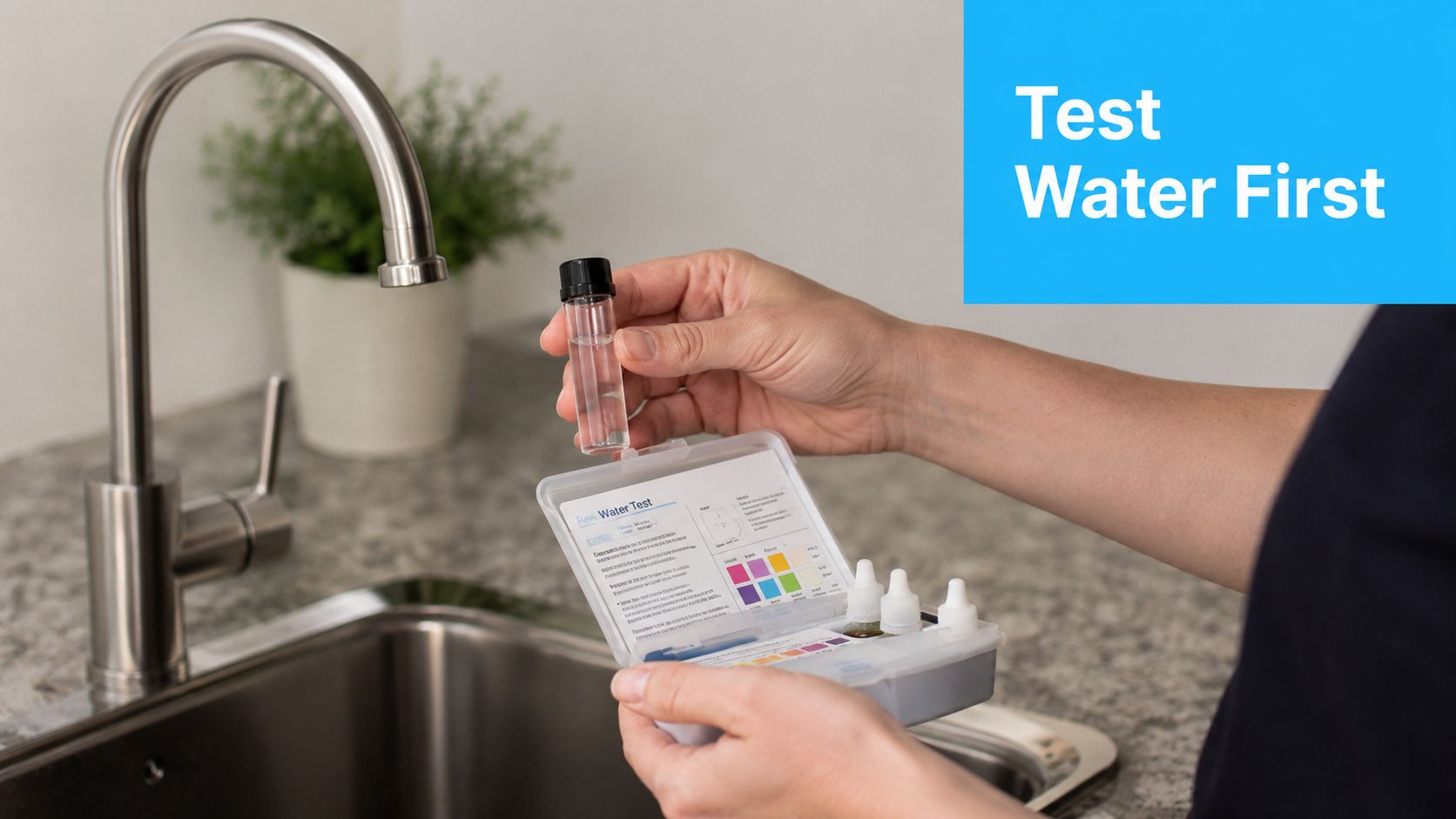
Start with the source of your water
City water and well water follow different rules, and good installers treat them differently from the first call.
If your home is on municipal water, pull the Consumer Confidence Report first. Green America notes that utilities issue these reports annually, and the report shows what the utility tested for and how those results compare with EPA limits, according to Green America's water filter guidance. That gives you a starting point, not the full picture inside your house. Old interior plumbing, a service line issue, or a problem isolated to one faucet will not always show up clearly in a utility-wide report.
If your home is on a private well, the job is more hands-on. There is no utility report to fall back on. Test the water directly, and retest when taste, odor, color, or nearby ground conditions change.
One rule matters here. Do not accept a recommendation from anyone who has not first asked whether you are on city water or a well.
What competent testing looks like
A proper recommendation starts with three checks:
Source water
Municipal supply and private well water point to different testing steps and different equipment choices.The actual problem
Chlorine taste, sulfur smell, hardness, sediment, lead risk at one tap, and bacterial concerns are separate problems. They do not call for the same filter.The treatment point
Drinking water at one sink is a different project from treating every fixture in the house. That decision changes equipment size, replacement costs, and installation labor.
Many local providers cut corners. They show up with a standard package, test for hardness and chlorine with a quick strip, then start pricing equipment. I have seen homeowners spend whole-house money on a problem that only affected drinking water at the kitchen sink. I have also seen the reverse. A cheap under-sink unit did nothing for staining, odor, or scale because the issue was in the incoming supply.
If you want a plain-English reference before talking to contractors, Water Filter Advisor's guidance on test results, certifications, and filter types is a useful place to sort out the basics.
Use the report to guide the estimate
Once you have actual test data, the conversation gets sharper. Ask the installer to tie the recommendation to the report, line by line. What contaminant or condition is the system meant to address? What certification supports that claim? What does it not solve?
That last question matters. Carbon can help with chlorine, odor, and some taste issues. It does not handle every dissolved contaminant. Reverse osmosis can address a different set of problems, but it adds reject water, slower flow at the faucet, and routine membrane service. UV can disinfect, but it does not remove sediment or hardness. Each tool has a lane.
Bring the report to every estimate. If a contractor barely glances at it and goes back to the same package they sell everyone else, keep looking.
Testing also helps you price the job accurately. A targeted under-sink system can be a manageable DIY project if you already have a shutoff valve, enough cabinet room, and basic plumbing skill. A whole-house system is different. You may need a prefilter, bypass valves, drain routing, pressure checks, and enough space to service tanks later. Professional installation costs more upfront, but it can prevent pressure-loss problems, bad drain connections, and expensive rework. The same logic applies to other hidden water issues. If testing or installation raises concerns about concealed plumbing leaks, it is smart to review Georgetown's trusted leak detection companies before the wall damage gets worse.
A water report is not a sales weapon. It is a way to keep the conversation tied to the house, the water, and the actual problem.
Smart Ways to Find Local Water Filter Experts
The first page of local search results usually reflects marketing strength, not filtration skill. A company can dominate map listings and still be weak at sizing systems, reading reports, or handling pressure-loss problems.
I'd rather find the installer backward.
Start with the equipment, then find the installer
If you already know the type of system you likely need, check manufacturer dealer locators and installer networks. That doesn't guarantee perfection, but it does improve the odds that the installer has worked with that valve, housing, bracket spacing, bypass layout, and service schedule before.
Then call a local plumbing supply house. Not the retail aisle. The pro counter. Ask who regularly installs whole-house filtration, under-sink systems, and pressure-sensitive setups without callbacks. Supply houses hear about the failures fast. They know who buys quality parts and who cuts corners.
A third route is neighborhood groups and community forums. Don't ask, “Who's the best water filter company?” That gets you fluff. Ask sharper questions:
Did they review your water report first
If not, the recommendation was probably generic.Did your water pressure change after install
That answer tells you whether the system was sized properly.Did they explain replacement filters clearly
A clean install with no maintenance plan becomes a headache later.Did the final invoice match the estimate
Plumbing surprises happen, but vague pricing is a warning sign.
Watch for adjacent plumbing clues
Sometimes the best lead comes from related trades. If a company is known for careful diagnostic plumbing work, that's often a better sign than a polished filtration ad. For example, homeowners comparing Georgetown's trusted leak detection companies can learn a lot from how those firms communicate about diagnosis, documentation, and repair logic. Those same habits matter when someone is cutting into your main line for a filtration system.
Good installers don't just sell water treatment. They diagnose the house, the plumbing, and the usage pattern.
What to ask on the first phone call
Don't spend twenty minutes listening to a pitch. Use the first call to filter out weak options.
Ask:
- Do you review CCRs or lab reports before recommending a system
- Do you install both POE and POU systems
- How do you size for flow rate and pressure drop
- Do you service the systems you install
- Can you explain the maintenance schedule before quoting
If they can't answer those cleanly, they're not your shortlist.
Choosing the Right Water Filtration System
Once you know what's in your water, system selection gets much easier. You're matching a problem to a tool instead of buying the biggest unit with the nicest brochure.
There are two broad paths. Point-of-entry (POE) systems treat water as it enters the house. Point-of-use (POU) systems treat water at a specific tap. Aquasana's explanation of how whole-house water filters work describes whole-house filters as POE systems installed at the main water line, often using a three-step process with sediment filtration, KDF and activated carbon, and a final polishing stage.
Whole house or single tap
If your issue affects every faucet, shower, and appliance, a POE system makes sense. That includes whole-house chlorine odor, sediment, or water that leaves residue throughout the home.
If the concern is mainly drinking and cooking water, a POU system often gives better value. Lead at one tap, taste complaints at the kitchen sink, or concern about a narrow set of contaminants can often be handled without filtering every gallon used for laundry and toilets.
For a practical homeowner-level read on when a larger setup is worth it, this guide to evaluate whole home water system benefits is useful because it frames the decision around household use, not marketing language.
What the main technologies do well
Not all filter types solve the same problem.
| Home Water Filter System Comparison | |||
|---|---|---|---|
| System Type | Best For Removing | Typical Cost (System Only) | Maintenance Frequency |
| Activated carbon | Chlorine, taste, odor, some chemical issues | Varies by system and size | Follow manufacturer schedule |
| Reverse osmosis | Broad purification for drinking water | Varies by system and size | Follow manufacturer schedule |
| UV filter | Microorganisms and disinfection use cases | Varies by system and size | Follow manufacturer schedule |
| Whole-house POE system | House-wide treatment at every fixture | Varies by system and size | Pre-filters and media need scheduled replacement |
| Under-sink POU system | Drinking and cooking water at one location | Varies by system and size | Cartridge or membrane changes required |
Where each type fits
Activated carbon is a workhorse for taste and odor issues, especially chlorine and chloramines. It's often the first thing I reach for when homeowners say, “The water smells like a pool,” or “Coffee tastes off.”
Reverse osmosis dominates the installed home market globally with a 62.8% share, according to Industry Research's household water purifier market report. That tracks with what homeowners want from a drinking-water system: broad purification at a single tap. But RO is not a magic answer for everything. It isn't the right response to every whole-house complaint.
UV is for disinfection scenarios. It's useful where microbial control is the issue, but it doesn't replace the need to match the rest of the system to the water chemistry.
For parasite concerns such as Cryptosporidium, the EPA guidance is specific. Use a point-of-use filter with an absolute pore size of 1 micron or smaller and look for certification under NSF 53 or 58 for cyst reduction or removal, as explained in the EPA filtration FAQ.
A filter that “improves taste” is not the same thing as a filter certified for the contaminant you're worried about.
Why certification matters more than branding
Buyers quickly become more informed. 92% of water filter owners say they're more likely to buy filters with an independent certification seal, and they're willing to pay an average premium of 17% more for certified products, according to NSF consumer research on certified water filters.
That behavior makes sense. Certification doesn't mean every product is right for your house. It does mean the claims are easier to verify. I'd rather install a plain-looking certified system that matches the report than a flashy box with vague promises.
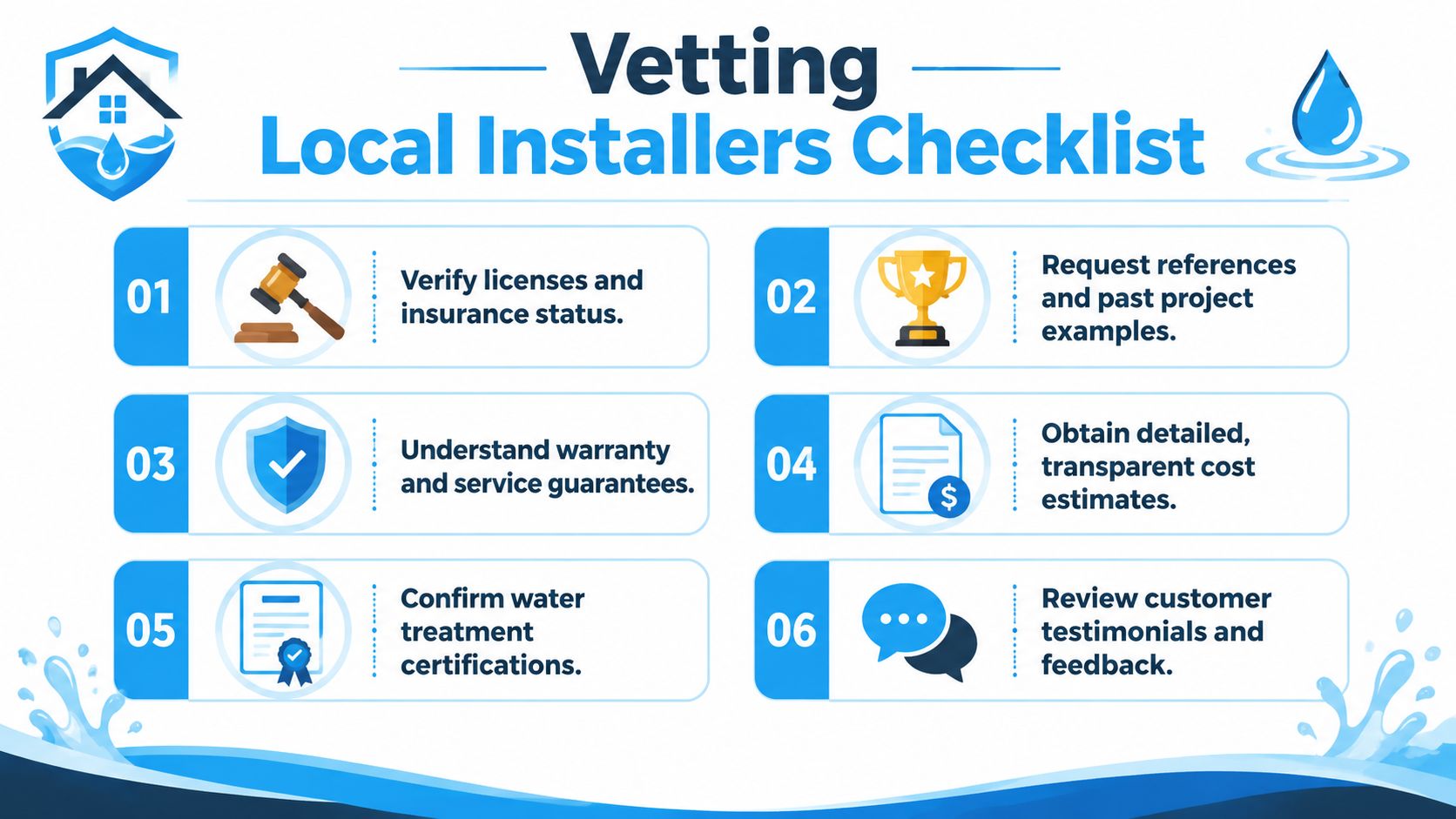
A Checklist for Vetting Local Installers
A water filter installer should be able to do more than solder pipe and tighten unions. Their primary job is matching the equipment to the water, the plumbing layout, and the household demand.
Most bad installs don't fail because the wrench work was awful. They fail because the recommendation was lazy.
The interview questions that matter
The CDC notes that 77% of U.S. water systems have detected contaminants above health guidelines, and that filter choice depends on the specific contaminants in your water. That's why a Verify Before You Buy approach matters, including making installers review your CCR before they quote, as outlined in the CDC's home water filter guidance.
Ask every installer these questions:
Show me how this recommendation fits my report
If they can't tie the system to your water data, the quote is just a sales package.What happens to pressure and flow after install
This reveals whether they've thought about household demand, bathroom count, and simultaneous use.What type of plumbing are you tying into
Copper, PEX, and older mixed-material plumbing each bring different install details.Who handles warranty service
Some companies install the unit and disappear. Others support the equipment and the labor.What is the exact maintenance schedule
If they act fuzzy here, expect confusion later when performance drops.
The answers that should make you nervous
You're not only listening for expertise. You're listening for evasion.
Red flags include:
“This is the system we put in for everyone.”
Water conditions aren't one-size-fits-all.“You don't need the report.”
That's a shortcut that usually benefits the seller.“Pressure should be fine.”
“Should” is not sizing.“Just change filters when you remember.”
Maintenance isn't casual if you expect the system to keep working.
If the installer talks more about financing than filtration, you're in a sales appointment, not a diagnostic appointment.
Ask for proof, not confidence
A solid installer should be comfortable showing license information, insurance details, references, and photos of similar installs. I also like asking what they do when the main line location is cramped, or when a customer wants a bypass for easier service. People who've done this work repeatedly answer those questions quickly and specifically.
Confidence is cheap. Clear answers are better.
Understanding Installation Costs and Logistics
Installation costs are where “near me” searches get slippery. Many local pages make the equipment price look clear and the labor feel fuzzy.
That's backwards. Labor, access, and plumbing layout often decide whether the project feels smooth or annoying.
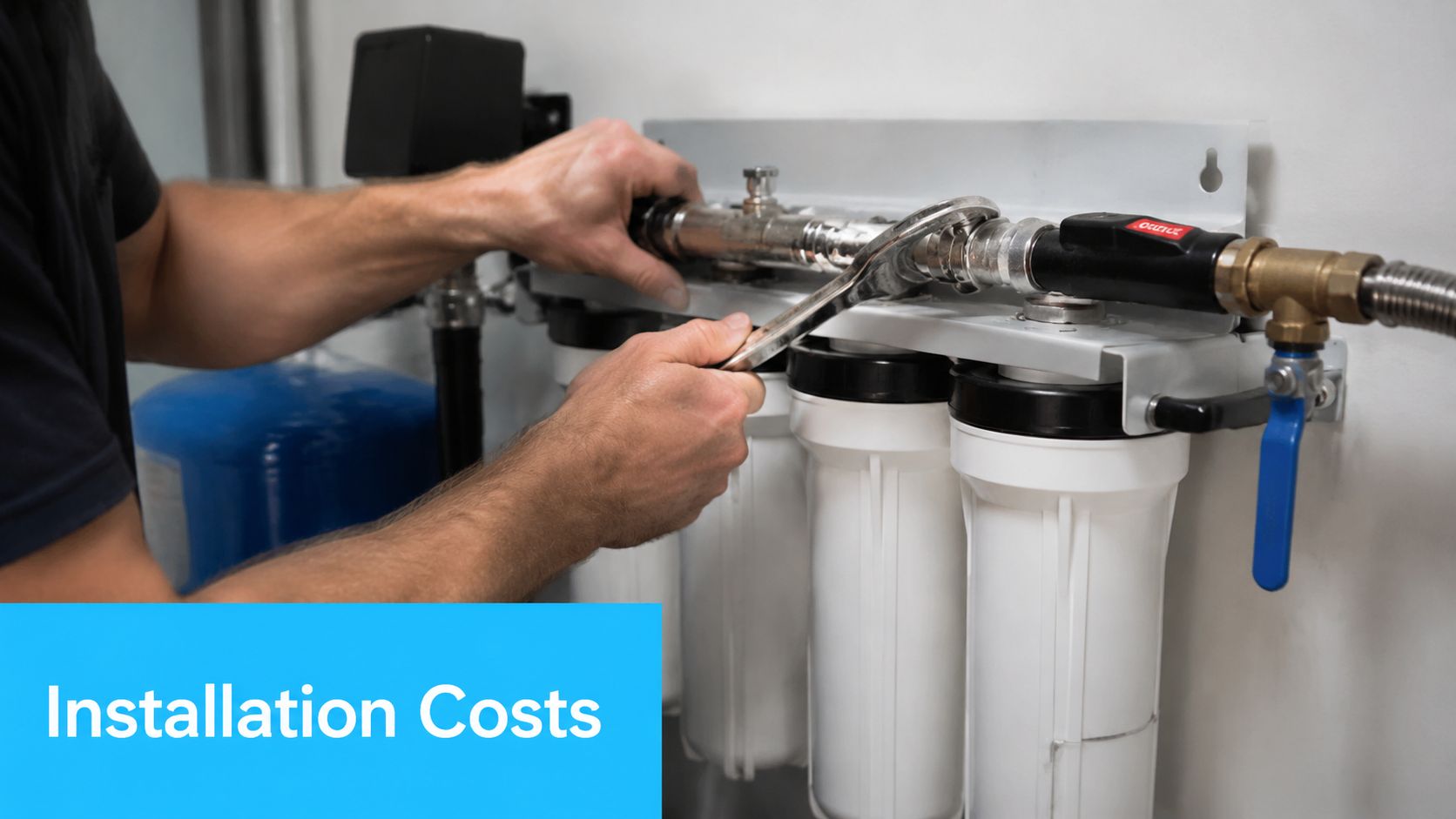
The real DIY versus pro trade-off
The gap can be bigger than homeowners expect. The typical local search often hides a $300 to $800 markup contractors charge for standard whole-house installations compared with $50 to $150 in DIY parts cost, according to Home Depot's walkthrough on installing a whole-house water filter.
That doesn't mean DIY is always the right move. It means you should understand what you're paying for.
If the main shutoff is accessible, the pipe run is straightforward, and you're experienced with plumbing work, DIY can be realistic. If the line is in a cramped crawlspace, the plumbing is older, or grounding becomes an issue, the cost of getting it wrong can wipe out any savings.
One issue rarely mentioned in local ads is electrical grounding risk. Installing a metal filter housing can interrupt the home's grounding path if it isn't properly bridged. That's not cosmetic. It's a safety problem.
What an installation day actually involves
A normal install usually includes shutting off the water, cutting into the main line for a whole-house unit or tying into a sink supply for a point-of-use unit, mounting brackets or housings, checking for leaks, and flushing the system before use.
Space matters more than people expect. Whole-house systems need room for the body of the unit, clearance to service housings, and enough access that someone can replace filters without dismantling half the setup. Under-sink systems need space around disposal lines, drain connections, and stored household junk that somehow always ends up under the kitchen sink.
For homeowners comparing trade labor in different home systems, these Brisbane hot water system installation insights are worth a look because they show the same broad truth: access, complexity, and code issues drive labor more than the equipment photo suggests.
Here's a useful visual if you want to see the install process before deciding who should handle it.
Questions to settle before work starts
Use the estimate process to pin down logistics:
Where will the system go
Get the exact location, not “near the main line.”Will there be a bypass
A bypass makes servicing much easier.Who handles permit or code questions if they apply
You want one clear answer before pipe gets cut.What does labor warranty cover
Equipment and labor are not always covered the same way.
Cheap installs get expensive when the unit is awkward to service, badly placed, or installed without regard for grounding and access.
Long-Term Maintenance and Local Compliance
The purchase price is only the opening number. Ownership cost lives in the maintenance schedule.
For many whole-house setups, sediment pre-filters need replacement every 3 to 6 months, while carbon or specialty media last 6 to 12 months. If you blow past those intervals, filtration performance can drop hard. Leaf Home notes that failing to stay on schedule can reduce efficacy by over 50% within 6 months after the required replacement point in its advanced filtration maintenance guidance.
Keep a simple service calendar
You don't need fancy software. You need a repeatable habit.
Write install dates on the housing
A marker on the canister beats guessing later.Save model numbers and filter sizes
Replacement confusion is one of the most common homeowner headaches.Watch pressure and taste changes
The water often tells you when maintenance is overdue.
Don't ignore sizing and local rules
Flow rate matters. If a whole-house unit is undersized for the home, showers, laundry, and kitchen use can fight each other. That's when homeowners think the brand is bad, when poor sizing was the issue.
Local code and HOA issues are less exciting, but they still matter. Main-line equipment placement, drain routing for certain systems, and service access can all become problems if nobody checks the rules before install day. Ask early, get it in writing, and keep the paperwork with your filter records.
A good system should be easy to live with, not just nice to buy.
If you want a straightforward place to compare filter types, understand certifications, and keep maintenance from turning into guesswork, Water Filter Advisor is a useful resource for homeowners sorting through whole-house, under-sink, shower, and replacement-filter decisions.
