Coliform Bacteria Test Method: A Homeowner’s Guide
You draw a glass from the kitchen tap, take a sip, and pause. Maybe the water tastes flat after a week of heavy rain. Maybe the well cap was disturbed during yard work. Maybe nothing seems wrong at all, and that's the problem. Coliform contamination usually doesn't announce itself with a dramatic smell or color change.
That's why homeowners get tripped up by water testing. They treat one clean result like a lifetime guarantee, or one positive result like proof the whole well has failed. In practice, a coliform bacteria test method is more like a diagnostic tool than a verdict. It tells you what was happening in that sample, at that moment, under those conditions.
For home water filtration, that distinction matters. You can't choose the right fix until you know whether you're dealing with a real contamination issue, a sampling mistake, or a short-term event that showed up after rain, plumbing work, or disturbance in the well system.
Why You Should Test Your Water for Coliform Bacteria
A common story goes like this. A homeowner has a private well, the water has always seemed fine, and then a stretch of wet weather rolls through. A few days later, the water feels “off.” Not necessarily dirty. Just different. That's often when coliform testing becomes urgent.
Coliform bacteria are best understood as an indicator. They are the warning light on the dashboard, not the engine problem itself. Their presence suggests there may be a pathway allowing contamination into your water system. That could mean surface water intrusion, a problem at the wellhead, a cracked casing, poor sealing, or contamination introduced somewhere in the home plumbing or filtration setup.
Why one test doesn't tell the whole story
Many homeowners want a simple pass or fail. Water doesn't always cooperate.
A single positive or negative result is merely a “snapshot” that can miss intermittent contamination. Coliforms in wells are most likely to appear during wet weather in late spring or early summer, which means tests taken during drier periods can create a false sense of security, as noted in this home water testing guidance.
Practical rule: If your water source is a well, treat one test result as one photograph, not the whole movie.
That matters for filtration decisions. If you install a treatment system after one bad sample without confirming the pattern, you may spend money solving the wrong problem. If you skip treatment because one winter sample came back clean, you may miss contamination that shows up when rainfall changes the groundwater conditions.
Testing comes before treatment
The first good move isn't buying equipment. It's getting a trustworthy sample and understanding what it means for the home system as a whole.
If you're sorting through treatment options, broad homeowner guidance from Water Filter Advisor's water advice library can help you compare next steps after testing, but the test itself is still the starting point. Filtration works best when it's matched to a known problem.
Understanding the Coliform Family
The term coliform refers to a broad group of bacteria, not one single organism. That distinction matters in practice because a lab report with "total coliform," "fecal coliform," or "E. coli" does not mean the same level of risk, and it should not trigger the same response.
What I tell homeowners is simple. Coliform results are less about naming one bad germ and more about locating where the water system may be vulnerable. A positive result can point to a cracked well cap, surface runoff getting where it should not, poor sampling technique, stagnant plumbing, or an actual waste-related contamination event. The label on the report helps sort those possibilities.
Total coliforms
Total coliforms are the broadest category. These bacteria are commonly found in soil, decaying vegetation, and other environmental sources, so a positive result does not automatically mean sewage or illness risk. It does mean the water system deserves a closer look.
In practice, total coliform works like a warning light on a dashboard. It tells you something is off, but not exactly which part failed. For a homeowner, that usually means checking the sampling process, inspecting the wellhead or plumbing entry points, and deciding whether a follow-up sample should be taken before spending money on treatment equipment.
This is also where timing causes confusion. A homeowner gets a positive result, shock chlorinates the well the same day, then retests too soon and gets a clean sample because chlorine temporarily suppressed the bacteria. That can hide the original problem rather than prove it is fixed. If a lab or local health authority wants confirmation sampling, follow their timing instructions closely so the retest reflects the water system, not leftover disinfectant.
Fecal coliforms
Fecal coliforms are a smaller subgroup associated more strongly with contamination from human or animal waste. This result raises the level of concern because it suggests a direct contamination pathway, not just a general system weakness.
That changes the response. Source protection and maintenance still matter, but the priority becomes safe water, faster investigation, and careful confirmation testing. I treat this as a signal to look hard at septic setbacks, runoff patterns, flooding history, and any route by which waste could reach the well or plumbing.
E. coli
E. coli is the clearest high-risk finding in this group. Its presence indicates fecal contamination and should be treated as an immediate health concern until proven otherwise.
Total coliforms warn you to inspect the system. E. coli tells you to stop using the water for drinking and food preparation until you have a safe alternative and a plan.
Home test kits and lab methods often identify E. coli by detecting enzyme activity after incubation, but the technical details matter less to a homeowner than the decision that follows. Use bottled water or another known safe source, contact your local health department or a qualified water professional, and document the sequence carefully if shock chlorination is performed. The order matters. Disinfect too early, or retest at the wrong time, and you can end up with a "good" sample that does not represent the usual condition of the well.
If you want a plain-language refresher on how microbes differ more broadly, including why bacteria behave differently from viruses, VirusFAQ's guide to microbial differences is a useful side read for non-specialists.
Comparing Coliform Bacteria Test Methods
A homeowner can get three different coliform tests on the same well and come away with three different levels of confidence. That does not always mean one test was wrong. It often means the methods answer slightly different questions, and all of them are still only a snapshot of the water at the moment you sampled it.
That snapshot problem matters more than many guides admit. If someone shock chlorinates first and tests later, the result may satisfy an immediate need for a cleaner sample, but it may also hide the condition that triggered the concern in the first place. If the goal is diagnosis, test timing matters almost as much as test method.
Membrane filtration
Membrane filtration is the method I prefer when the question is, "How much contamination are we dealing with, and is it changing?" A measured water sample passes through a very fine filter that traps bacteria. The lab places that filter on selective media and counts the colonies that grow, which gives a direct colony count rather than a statistical estimate, as described in this overview of membrane filtration and coliform enumeration.
That direct count has real value in the field. It helps compare samples before and after repairs, pressure tank work, casing fixes, or treatment changes. If a homeowner is deciding whether the problem was a one-time intrusion or an ongoing pathway, counted results usually give a clearer picture.
The trade-off is cost and handling. This method usually belongs in a certified lab, not on a kitchen counter.
MPN and presence absence methods
Most Probable Number, or MPN, estimates contamination from growth patterns in broth rather than counting colonies one by one. Presence-absence tests simplify the question even further. Is coliform detected or not?
For routine screening, that simplicity is useful. A homeowner who wants an early warning does not always need colony counts. A positive screening result is enough to stop treating the water as clearly safe and start asking the next question, which is whether the sample should be confirmed by a lab before making a large treatment purchase.
The limitation is resolution. A simple positive result can tell you there is a problem, but it does not show whether the result was barely positive or heavily contaminated. That matters if you are trying to judge severity, check whether corrective work proved effective, or document conditions before and after disinfection.
Defined substrate methods
Defined substrate tests, including products like Colilert-18, use indicator compounds that change color or fluorescence when target bacteria are present. In practice, the homeowner usually sees a straightforward readout, while the chemistry in the tray or vessel sorts total coliform signals from E. coli signals.
These tests are popular for good reason. They are faster and easier to run than older multi-step approaches, and many labs use them as well. For drinking water work, the method is standardized tightly enough that it can be a solid option when sampling and incubation are done correctly.
The caution is overconfidence. A clean result from an easy-to-run test can still be misleading if the sample was taken right after shock chlorination, after heavy flushing, or from a faucet that was not a good stand-in for normal household use. The method may be sound. The sample may still fail to represent the usual condition of the well.
What the lab does differently
Lab methods are not just "home kits, but better." The difference is control. Sample volume, incubation conditions, media, rinsing steps, and handling are all standardized so the result is more defensible, as shown in EPA Method 1604.
That matters when the result could affect treatment cost, a real estate transaction, a local health department follow-up, or a decision about whether shock chlorination worked. In those cases, I want a method that reduces avoidable error and gives a result I can compare across time.
It also helps with the timing conflict many homeowners miss. After a positive result, people often want to disinfect immediately. Sometimes that is appropriate for safety. But if a local authority, lender, or lab protocol expects a follow-up sample on a specific schedule, chlorinating too soon can muddy the record. You can end up with one sample showing the untreated condition, one sample showing the effect of fresh chlorine, and no clear picture of the baseline problem. Before doing anything, check what retesting timeline will apply.
Coliform Test Method Comparison
| Method | Typical Use | Result Type | Time | Typical Cost | Best For |
|---|---|---|---|---|---|
| Membrane Filtration | Certified lab testing, follow-up investigation | Direct colony count (CFU) | Around a day under standard incubation protocols | Usually higher than simple DIY screening | Confirming contamination and comparing results across samples |
| MPN | Basic screening, older lab workflows, some kit formats | Statistical estimate | Slower than the fastest rapid options | Varies | Homeowners who need an initial screen and can accept an estimate |
| Defined Substrate | Rapid screening in labs and kits, including Colilert-style testing | Presence, absence, or color and fluorescence-based interpretation | Fast turnaround compared with many older methods | Moderate | Quick screening when sample collection is done carefully |
Bottom line: Use a screening test to flag a problem quickly. Use a lab method, especially membrane filtration or a well-run defined substrate test, when the result will drive repairs, treatment spending, or post-chlorination confirmation. And treat every single result as a snapshot, not a lifetime guarantee of safe water.
How to Use a DIY Coliform Test Kit at Home
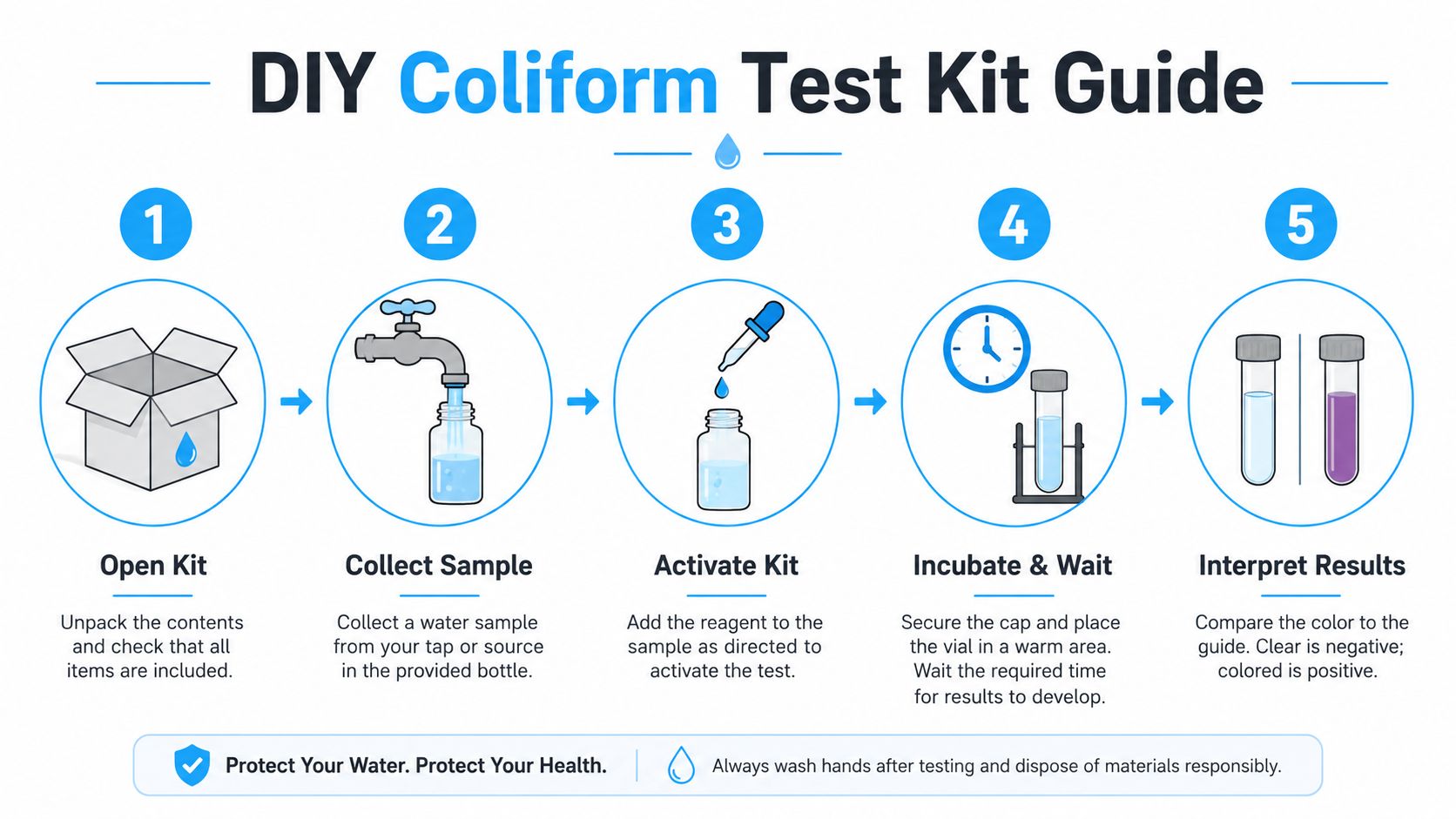
DIY kits can be useful if you treat them like sterile lab work, not a kitchen project. Most in-house residential coliform kits report results within 24 to 48 hours and can include an incubator, pump, filtration manifold, nutrient medium, and sterile filters or pads, as described in this overview of in-house coliform testing kits.
The hard part isn't opening the kit. The hard part is avoiding contamination from your own hands, faucet, or collection point.
The sampling steps that matter most
For an accurate sample, water should run for one hour to flush the system. The outlet should be sterilized with an alcohol swab, the sample should be collected from drip water without touching the spigot, and the sample should be refrigerated and delivered to a lab within six hours, according to these home coliform sampling guidelines.
If you're testing filtered water from a gravity system or similar setup, the same discipline applies. Don't touch the inside of the cap. Don't touch the bottle neck. Don't collect from a dirty spigot and assume the result represents the source water.
A practical DIY routine
- Read the whole kit first. Don't start opening sterile components while you're still figuring out the sequence.
- Flush the water path. If the instructions for your setup call for flushing before sampling, do it fully.
- Sanitize the outlet or collection area. False positives frequently arise from issues at this point.
- Collect carefully. Keep fingers away from the inside of the bottle and cap.
- Activate and incubate exactly as directed. Shortcuts ruin the test.
- Record what was happening that day. Rainfall, plumbing work, filter changes, and well disturbances all matter when you interpret the result later.
A short visual walkthrough can help if this is your first time with a kit.
What usually goes wrong
The most common DIY failure isn't the chemistry. It's the sample.
Field note: If the inside of the cap or bottle neck gets touched, the result becomes suspect. That's enough to trigger panic, unnecessary well chlorination, and sometimes the wrong filtration purchase.
If you want a fast screen at home, use the kit. If the result is positive, messy, or hard to trust, move to a certified lab before you commit to a major treatment plan.
How to Interpret Your Test Results
A test result only helps if you know what action it should trigger. Homeowners often overreact to one type of positive and underreact to another. The right response depends on which coliform category was detected and how reliable the sample was.
Negative result
A negative result is good news, but it isn't permanent protection. It means the sample did not show contamination at the time you tested under those conditions.
That's especially important for well owners. Water quality can shift with weather, runoff, repairs, or changes in the home plumbing and filtration train. If your well has a history of variability, a single negative result shouldn't be your only basis for feeling secure.
Positive for total coliforms
A total coliform positive is the water equivalent of a check engine light. It doesn't confirm the worst-case scenario, but it says the system deserves inspection.
Look first at the practical causes. Was the sample collected properly? Was the faucet or outlet sterilized? Did heavy rain, flooding, or plumbing work happen recently? In many homes, the next useful move is a careful repeat sample and a closer look at the well cap, casing, vent, pressure tank area, and filtration equipment.
Positive for E. coli
A positive E. coli result is different. Treat that as urgent. Don't keep using the water for drinking until you've switched to a safe source and started a proper follow-up process.
At that point, the question isn't whether you need a response. It's whether your response is organized enough to avoid making the diagnosis harder. Homeowners who jump straight to treatment can blur the evidence and make it tougher to identify where the contamination is entering the system.
A result should change your next decision, not just your stress level.
Build a pattern, not a single memory
The smartest homeowners keep simple notes. Test date. Weather. Recent plumbing work. Filter changes. Anything unusual around the wellhead or source.
That log turns random test results into a pattern. For home water filtration, that's powerful. It helps you decide whether you need source correction, point-of-use protection, whole-house disinfection, or just better sampling discipline.
What to Do After a Positive Test Result
A positive result rattles people, and that's understandable. The mistake is acting fast in the wrong order. I've seen homeowners chlorinate first, ask questions second, and end up with a cleaner-looking sample that hides the original problem.
Don't shock chlorinate before repeat compliance sampling
A common mistake is to shock chlorinate a well immediately after a positive test. EPA guidance says that should not happen before required repeat samples because it can skew results and mask the true contamination source, preventing an accurate diagnosis, as explained in EPA Region 8 guidance on positive total coliform or E. coli samples.
This is one of the biggest gaps in homeowner advice online. People hear “positive bacteria result” and assume chlorine is always the immediate next step. For official retesting and source diagnosis, that can be exactly backwards.
A better response sequence
Use a calm checklist.
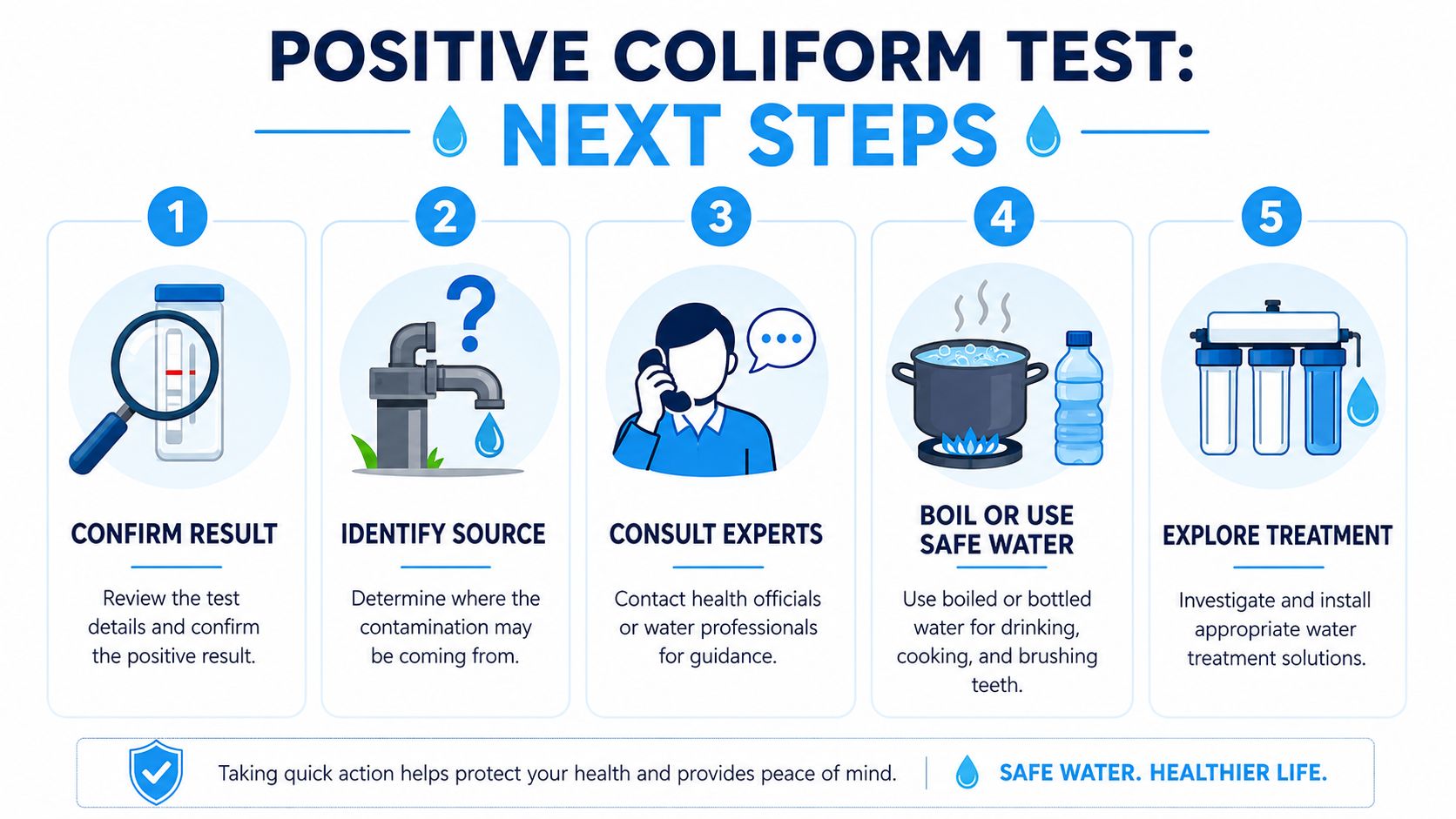
- Protect drinking water first. If the result suggests meaningful contamination, switch to a safe water source for drinking and food preparation.
- Verify the sample quality. Ask whether handling could have contaminated the bottle, cap, outlet, or collection point.
- Repeat correctly. If a repeat sample is required, collect it before disinfecting in a way that masks the source.
- Inspect the system. Look at the wellhead, seals, drainage around the well, recent disturbances, and filtration equipment.
- Treat after diagnosis. Shock chlorination and filtration both have a place. They work best when you know what problem you're treating.
When filtration enters the picture
If contamination is confirmed, many homeowners need more than a one-time disinfection event. A filtration and disinfection barrier can provide ongoing protection, especially when the source is vulnerable to runoff or recurring intrusion.
But treatment should fit the cause. If the problem is a bad sample or a loose well cap, buying a large system first won't solve the root problem. If the issue is recurring contamination, relying only on occasional shock chlorination usually won't give a stable long-term answer.
Important: Chlorine can suppress evidence. Diagnosis comes before long-term equipment choices.
Choosing a Water Filter to Remove Coliform Bacteria
Once contamination is confirmed, the conversation shifts from testing to protection. For homeowners, the two practical approaches are physical removal and disinfection. Good systems often use both.
Removal and inactivation
Ceramic microfiltration removes bacteria by physically straining them out. UV systems don't remove organisms from the water. They inactivate them by exposing the water to ultraviolet light. Each approach solves a different part of the problem.
Certified filtration systems can be highly effective. One recent lab result on a ceramic gravity filter showed total coliform dropping from over 23 MPN per 100 mL to less than 1.1 MPN per 100 mL, achieving over 99% removal, provided the source water had low turbidity, as described in this guide to filters that remove coliform bacteria.
What works best at home
A few practical rules hold up well:
- Use sediment prefiltration when water isn't clear. UV and fine filtration both perform better when turbidity is low.
- Match the system to the risk. A kitchen-only filter may help with drinking water, while a recurring source issue may justify a whole-house approach.
- Plan for maintenance. Any bacterial control system is only as reliable as its upkeep.
If contamination may be tied to a sewage event, backup, or flooding, homeowners should also understand the broader cleanup picture. A service page on sewage cleanup costs in Tampa Bay gives a useful example of how messy and expensive contamination problems can become when water intrusion isn't handled early.
The right filter is the one that fits the actual pathway of contamination, the clarity of your water, and the level of protection your household needs every day.
If you're comparing home water treatment options after a coliform result, Water Filter Advisor is a practical place to start. It helps homeowners sort through filtration types, replacement needs, and real-world setup choices so you can move from a confusing test result to a water filtration plan that makes sense.
