How to Get Rid of Calcium in Your Water: The Ultimate Homeowner’s Guide
Tired of chalky water spots and crusty faucets? The most effective way to eliminate calcium from your home's water is with a whole-house ion-exchange water softener. If you're only after pure water for drinking and cooking, a point-of-use reverse osmosis system under your kitchen sink is your best bet. This guide will break down the science, cut through the jargon, and help you choose the right filtration system to declare victory over hard water.
The Hard Truth About Your Home's Water

If you're locked in a never-ending battle with stubborn white spots on your glassware, constantly scrubbing crusty buildup off your showerheads, or wondering why your towels feel like sandpaper, you’re not alone. Welcome to the world of hard water, where the main villain is dissolved calcium.
This isn't some industrial pollutant; it’s a natural mineral that water absorbs as it travels through underground rock like limestone and gypsum. Whether you're on city water or a private well, this invisible mineral can infiltrate your pipes and become your home's arch-nemesis. It's the secret force behind some of your most frustrating household chores.
Why Calcium Is a Household Nuisance
While calcium is perfectly safe to drink, the high concentrations found in hard water create a host of expensive and infuriating mechanical problems. And the damage goes far beyond a few unsightly stains.
- Appliance Sabotage: Calcium buildup, also known as limescale, forms an insulating layer on the heating elements in your water heater and dishwasher. This forces them to work harder and guzzle more energy just to reach the right temperature, leading to higher bills and premature failure.
- Plumbing Clogs: Over time, limescale builds up inside your pipes, slowly choking off the flow of water. You might first notice a drop in water pressure, which can eventually lead to a full-blown, wallet-draining plumbing emergency.
- Personal Care Problems: That same mineral residue doesn't just stick to pipes—it clings to your skin and hair, leaving them feeling dry, brittle, and lifeless. It also clogs pores and neutralizes soaps and shampoos, preventing them from lathering up properly.
Water hardness is one of the most common water quality headaches homeowners face. According to the U.S. Geological Survey, water with calcium levels over 120 mg/L is considered very hard. That level of hardness can slash an appliance's energy efficiency by 15-25%. The constant strain from limescale forces your machines to work overtime, shortening their lifespan and driving up your utility bills.
The frustrating cycle of cleaning, scrubbing, and replacing appliances often leads back to one root cause: hard water. By tackling the calcium at its source, you can protect your investments and simplify your daily routines.
The impact of hard water goes beyond your home's pipes and appliances. For hobbyists, managing water parameters is everything, highlighting the crucial need for specific water conditions in aquariums. It's a perfect example of how mineral content affects more than just our plumbing.
If you want to dive deeper into different filtration options, you can explore plenty of comprehensive guides and advice over at https://www.waterfilteradvisor.com.
Pinpointing Your Calcium Problem: What the Tests Reveal
Before you can declare war on hard water, you need to know exactly what you’re fighting. It’s like a doctor diagnosing an illness before prescribing medicine—guessing is not an option. Measuring the calcium level in your water gives you a specific number, and that number is the single most important factor in choosing the right filtration system.
Trying to figure out how to get rid of calcium in water without knowing your hardness level is a recipe for failure. You could end up with a system that's too weak for the job or, just as bad, an overpowered one that wastes salt and water.
Starting with Simple Home Observations
You can get a quick gut check on your water with a simple, old-fashioned soap test. Grab a clear bottle with a tight-fitting cap, fill it halfway with tap water, and add about ten drops of pure liquid soap (like castile soap, not detergent).
Shake it vigorously for 30 seconds. If you get a thick, sudsy head of foam that sticks around, your water is likely on the softer side. If all you see are a few pathetic bubbles and a cloudy, milky film, you’re definitely dealing with hard water. This won't give you a precise number, but it confirms your suspicions and tells you it's time to dig deeper.
Getting a Specific Number with Test Strips
For a more accurate measurement, home water hardness test strips are an affordable and incredibly easy option. You can grab them at most home improvement stores or online. They work just like a litmus test: dip a strip into a glass of tap water, wait a few seconds, and then compare the color to a chart on the package.
That chart translates the color into a specific hardness level, usually measured in grains per gallon (GPG). This is the magic number you need. For instance, a result of 12 GPG tells you your water is "very hard" and gives you the exact data needed to properly size a water softener.
Knowing your GPG is non-negotiable. It dictates the grain capacity of the water softener you'll need and ensures it regenerates at the right intervals, saving you money on salt and water while guaranteeing soft water on demand.
The Most Accurate Testing Methods
For the highest degree of accuracy, you have two great options. If you're on city water, your local utility is required to publish a yearly Water Quality Report (sometimes called a Consumer Confidence Report). You can usually find this on their website, detailing everything about your water supply, including its average hardness level.
If you have a private well, sending a sample to a certified water testing laboratory is the best investment you can make. This will not only give you a precise hardness reading but will also screen for other potential contaminants. It gives you a complete picture of your water's chemistry so you can choose a system that addresses all your home's needs.
Imagine this: a family buys a new, high-efficiency washing machine but is constantly frustrated because their clothes come out stiff and dingy. They blame the machine, but a simple $10 test kit reveals their water is a staggering 18 GPG. Armed with this number, they install a properly sized water softener, and suddenly, the washer performs perfectly. That small diagnostic step saved them from needlessly replacing an expensive appliance.
Alright, you've got your water test results in hand and now it's time to pick your weapon. Walking into the world of water treatment can feel overwhelming, with a bunch of technical jargon like "ion exchange" and "reverse osmosis" getting thrown around.
Let's cut through the noise. I'm going to break down the most common ways to deal with calcium in your water so you can figure out what actually makes sense for your house.
This decision tree gives you a good visual of where to start. It's all about figuring out if you have a problem first, then deciding how deep you need to go with testing.
The bottom line is simple: you have to confirm you've got hard water before you start shopping. A quick DIY test can give you a clue, but a lab analysis gives you the hard numbers you need to make a smart choice.
Ion Exchange Water Softeners: The Gold Standard
If you want to protect your entire home—we're talking pipes, faucets, showerheads, and every appliance that uses water—then a traditional salt-based water softener is the undisputed champ. This is the only method that physically yanks the hard minerals right out of your water.
They work on a principle called ion exchange. Water flows into a tank filled with resin beads coated in sodium. The calcium and magnesium in your water are like magnets to these beads, sticking to them and "kicking off" the sodium into the water.
The result? Genuinely soft water. The kind that feels silky smooth, makes soap lather like crazy, and stops scale buildup dead in its tracks. It’s a true whole-house fix that tackles the problem at its source.
Salt-Free Water Conditioners: A Different Approach
You've probably seen "salt-free water softeners" advertised. Let's be crystal clear: these are water conditioners, not softeners. They don't actually remove any calcium.
Instead, they use a clever bit of science (often called Template Assisted Crystallization, or TAC) to change the physical form of the calcium minerals. Think of it like turning sticky Velcro into smooth little crystals that can't grab onto pipes or fixtures.
This is a great way to prevent scale buildup, but the calcium is still there. You won't get that classic "slick" feel of soft water and might still see some light water spots, but it's a fantastic, low-maintenance option if you just want to protect your plumbing without adding salt.
Reverse Osmosis: For Pure Drinking Water
Maybe you're not worried about your pipes, but you want absolutely pure, amazing-tasting water for drinking and cooking. In that case, a reverse osmosis (RO) system is what you're looking for.
These are typically installed right under the kitchen sink. An RO system pushes water through an incredibly fine membrane that acts like a bouncer, blocking up to 99% of all dissolved solids—calcium included.
You get incredibly clean water from a special, dedicated faucet. The catch? It's a "point-of-use" solution. It does nothing to protect your dishwasher, shower, or water heater from scale. For extreme purity, some specialized systems like lab water purifiers for distilled water use similar, highly advanced filtration principles.
Calcium Removal Methods at a Glance
To make it even simpler, here’s a side-by-side look at how these options stack up.
| Treatment Method | How It Works | Effectiveness on Calcium | Average Upfront Cost | Ongoing Maintenance |
|---|---|---|---|---|
| Ion Exchange Water Softener | Physically removes calcium and magnesium ions, replacing them with sodium ions. | Excellent. Completely removes hardness minerals for whole-house protection. | $800 – $3,000+ | Regular salt refills (typically every 1-2 months). |
| Salt-Free Water Conditioner | Alters mineral structure to prevent scale formation without removing calcium. | Good at scale prevention. Does not soften water or remove calcium. | $600 – $2,000 | Minimal. Media replacement may be needed every 3-6 years. |
| Reverse Osmosis System | Forces water through a fine membrane to remove dissolved solids. | Excellent. Removes up to 99% of calcium at a single point of use. | $200 – $600 | Annual filter and membrane replacements. |
| Magnetic Descaler | Uses a magnetic field to supposedly alter mineral ions. | Poor / Unproven. Lacks consistent scientific backing for effectiveness. | $100 – $400 | None. "Set it and forget it" installation. |
As you can see, the right choice really boils down to whether you want to completely remove calcium for your whole house or just manage its effects at specific taps.
What About Magnetic Descalers?
You’ll also stumble across magnetic or electronic "descalers." These are little gadgets that you clamp onto the outside of your main water pipe. The claim is that a magnetic field changes the calcium ions so they won’t form scale.
Frankly, the science behind these is shaky at best. While some people swear they see a small difference, most independent tests and plumbing pros agree they just don't provide the reliable, long-term results you get from a real softener or conditioner. I generally tell people to save their money and invest in a proven technology.
Sizing and Selecting Your Water Filtration System
Alright, you've got your water test results in hand. Now comes the fun part: picking the right hardware to finally get rid of that pesky calcium.
This is where a little bit of planning can save you a mountain of headaches later. One of the most common—and costly—mistakes homeowners make is choosing the wrong size system. You either end up with a unit that can't keep up with demand or, just as bad, one that’s constantly wasting salt and water.
Let’s walk through exactly how to match a filtration system to your home's unique needs. Getting this right means you’ll nail that perfect balance of performance and efficiency.
Calculating Your Water Softener Grain Capacity
When you're shopping for water softeners, "one size fits all" is a recipe for disaster. The most important number you need to get familiar with is grain capacity. This tells you how many "grains" of hardness the softener can pull out of your water before it has to run a cleaning cycle, which is called regeneration.
To figure out the right capacity, you only need two things:
- Your water hardness in grains per gallon (GPG). This is the key number from your water test.
- Your family's daily water usage. A solid rule of thumb is 75 gallons per person, per day.
The math is actually pretty simple:
Number of People x 75 Gallons/Person x Hardness (GPG) = Total Grains Per Day
That final number is the daily workload your softener will be up against. With that, you can pick a system sized to regenerate about once a week—the sweet spot for peak efficiency.
Pro Tip: Try to find a softener that regenerates roughly every seven days. If it regenerates too often, you're just throwing money away on salt and water. If it waits too long, you risk hard water "bleeding" back into your pipes before the cycle runs.
A Real-World Sizing Example
Let's make this real. Imagine a family of four—two adults, two teenagers, and a dishwasher that seems to be running 24/7.
- Family Size: 4 people
- Water Hardness Test Result: 15 GPG (which is considered very hard)
Here’s how they'd calculate their daily grain requirement:
4 people x 75 gallons/person x 15 GPG = 4,500 grains per day
Since the goal is a weekly regeneration cycle, we just multiply that by seven days:
4,500 grains x 7 days = 31,500 grains
Based on this, the family should be looking for a water softener with a capacity of at least 32,000 grains. A standard 32k-grain unit would be a perfect match, easily handling their high water usage without constantly having to regenerate.
Whole-House vs. Point-of-Use: The Strategic Choice
Your next big decision is about scope. Are you trying to protect your entire home from calcium buildup, or is your main goal just to get crystal-clear drinking water at the kitchen sink?
A whole-house water softener is your go-to solution if you want to eliminate calcium everywhere. It gets installed right where the main water line enters your home, which means every faucet, showerhead, and appliance—from the water heater to the washing machine—gets treated, soft water. This is the best way to protect your plumbing and extend the life of your appliances.
On the flip side, a point-of-use (POU) system, like an under-sink reverse osmosis (RO) filter, is a more targeted approach. It delivers incredibly pure water to a single tap, which is perfect for drinking and cooking. Just remember, it won't do a thing to stop scale from building up in your pipes or dishwasher. The right choice really just depends on what problem you're trying to solve.
Look for Credible Certifications
In the world of water treatment, it’s easy for a company to make big claims. Real proof is what separates the good from the junk. To make sure you’re buying a product that actually does what it promises, always look for third-party certifications from reputable organizations.
- For water softeners, the gold standard is NSF/ANSI 44. This certification guarantees the system effectively reduces hardness as advertised.
- For reverse osmosis systems, look for NSF/ANSI 58. This confirms the system's ability to reduce a whole host of contaminants, including dissolved solids like calcium.
Think of these certifications as your quality-control check.
This is especially critical when you look at the global picture. The World Resources Institute has documented that 25 countries, home to a quarter of the world's population, face extreme water stress. In these areas, shrinking water supplies often lead to higher concentrations of minerals. This makes effective calcium removal a must-have for both homes and industries. You can explore the findings on high water-stress regions to learn more about these growing challenges.
Installation and Maintenance for Lasting Results
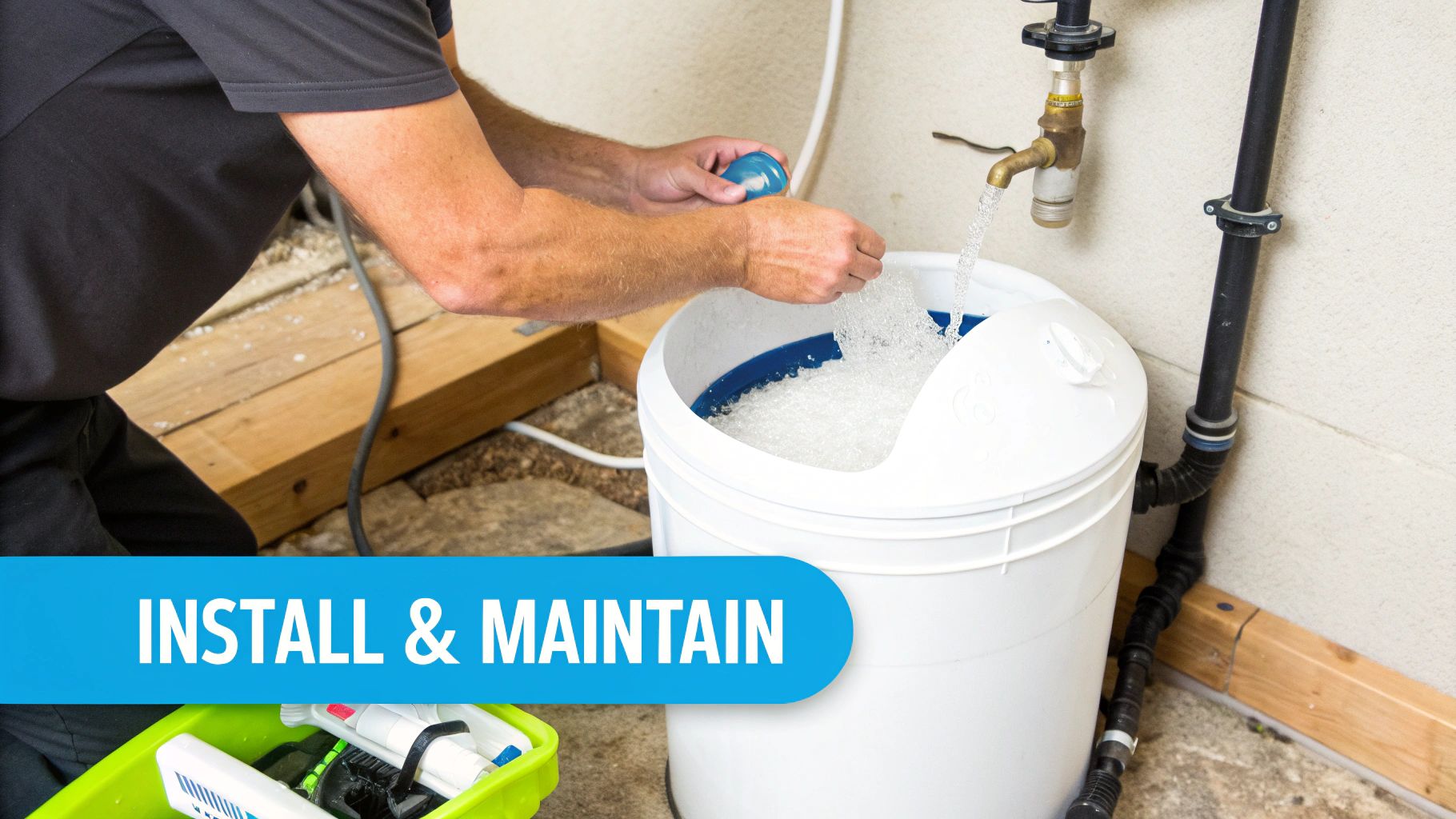
You've done the research and picked out the perfect water treatment system. That’s a huge win, but it's really only half the battle.
The truth is, a top-of-the-line softener with a sloppy installation is just a fancy, oversized paperweight. Proper setup and a little routine upkeep are what really lock in years of soft, scale-free water.
Whether you're a confident DIYer ready to roll up your sleeves or you'd rather leave it to the pros, let's walk through what it takes to get it done right.
The DIY Installation Path
If you're comfortable with basic plumbing, installing a water softener can be a totally manageable weekend project. It just requires attention to detail. The whole idea is to install the unit near your main water line—usually in the garage, basement, or a utility closet—before the line splits off to your water heater.
Before you even think about cutting pipes, make sure you've got the right gear. A smooth installation is all about having the proper tools from the start.
- Essential Tools for the Job:
- Pipe cutters and a deburring tool (for clean, professional cuts)
- Two adjustable wrenches to get fittings nice and snug
- Teflon tape for creating those crucial leak-proof seals
- A tape measure and a level to keep everything straight
- The right pipes and fittings for your specific plumbing (PEX, copper, or PVC)
One of the most important parts of any softener is the bypass valve. This is a godsend. It lets you route water around the softener for maintenance or repairs without shutting off water to the entire house. Trust me, you’ll be glad it's there.
On a difficulty scale of 1 to 10, I’d put a DIY softener installation around a 6 or 7. It’s definitely more involved than changing a faucet, but it's not as intense as replumbing a whole bathroom. If cutting into your home's main water line makes you nervous, it's always smarter to call a pro.
Vetting a Professional Plumber
Not into the idea of a DIY plumbing project? No problem. Hiring a qualified plumber is the most surefire way to get the job done right. But don't just hire the first person who pops up in a search.
A great installation starts with asking the right questions. When you're getting quotes, make sure you ask:
- "How many water softener installations have you done?" (You want experience here.)
- "Are you fully licensed and insured for this type of plumbing work?"
- "Does your quote include all parts and labor, or will there be hidden fees?"
- "Do you offer a warranty on your installation work?"
A plumber who gives you confident, straightforward answers to these questions is likely a pro you can trust.
A Simple Maintenance Schedule for Peak Performance
Once your system is up and running, a little routine care is all it takes to keep it working perfectly for years. Think of it like changing the oil in your car—a small task that prevents huge, expensive problems.
1. Keep the Salt Topped Off: This is your main job. Check the brine tank about once a month and add salt as needed. The golden rule is to always keep the salt level above the water line. This ensures the system can make the brine solution it needs for the regeneration cycle.
2. Clean the Brine Tank Annually: At least once a year, it’s a good idea to empty and clean out the brine tank. Over time, salt impurities can form a "salt bridge" or a layer of sludge at the bottom, which can clog up the works.
3. Check the Settings Periodically: If you suddenly notice your water feels hard again or your salt usage goes through the roof, your settings might have been knocked out of whack. Just take a look and verify the hardness level programmed into the control valve still matches your original water test results.
Got Questions About Removing Calcium from Water?
Even after you've done your homework on getting rid of calcium in your water, a few questions always seem to come up. Let's tackle those last-minute uncertainties and bust a few common myths so you can move forward with total confidence.
It's perfectly normal to have some lingering thoughts. You're making a pretty big decision for your home, after all, and you want to know you've covered all your bases. Here are the most common questions we hear from homeowners just like you.
Will a Refrigerator or Pitcher Filter Get Rid of Calcium?
This is a big one, and the answer is a hard no. Your standard refrigerator filter, countertop pitcher, or the little filter you screw onto your faucet are almost always just activated carbon. Their job is to make your water taste and smell better by grabbing things like chlorine.
They simply aren't designed to capture dissolved minerals like calcium and magnesium—those minerals sail right on through. To actually pull calcium out, you need a system built for that specific job, like a water softener that uses ion exchange or a reverse osmosis system that filters water down to the molecular level.
Is It Actually Unhealthy to Drink Hard Water?
For most people, drinking hard water is totally fine. In fact, it can be a small source of essential minerals like calcium and magnesium. The fight against hard water is really about protecting your house, not your health.
The real problems are mechanical and financial. Hard water is brutal on your appliances, clogs up your pipes, and leaves that scaly film on your skin and hair. The only time a health concern might come into play is for someone with specific medical issues, like a history of kidney stones. In that case, they should definitely talk to their doctor.
I Installed a Softener, So Why Do My Dishes Still Have Spots?
This is super frustrating, but it's usually an easy fix. If you're seeing spots on "clean" dishes after putting in a new softener, a few things could be going on.
First off, a rinse aid is your dishwasher's best friend, even with soft water. It helps water slide right off the dishes so spots can't form as they dry. Second, go check the settings on your softener's control head. If the hardness level is programmed too low, the system won't regenerate often enough and some hard water can slip through.
And finally, take a look in the brine tank. The number one reason a softener stops working is because it's out of salt. No salt means the resin beads can't get recharged to do their job.
What’s the Annual Cost to Run a Water Softener?
A lot of homeowners worry about the ongoing costs, but you'll be surprised at how low they are. You're really only looking at two things: salt and a tiny bit of electricity.
A typical family of four can expect to spend somewhere between $50 and $100 a year on salt, depending on how hard their water is and how much they use. The electricity is minimal—often less than what your digital alarm clock uses.
Most people find these costs are easily covered by the savings. You’ll use less soap, detergent, and cleaning supplies, and you’ll significantly extend the life of your water heater and dishwasher, which helps you avoid having to replace them way too early.
At Water Filter Advisor, we believe everyone deserves access to clean, high-quality water. Our in-depth guides and unbiased reviews are designed to help you navigate your options and make the best choice for your family. Explore our resources to find the perfect solution for your home at https://www.waterfilteradvisor.com.
