Your Guide to Choosing the Right Coliform Water Filter for Home
So, you've discovered you might have uninvited guests—bacteria—in your home's water. Your first thought might be to just boil your water, but that's like putting a band-aid on a broken pipe. For a permanent fix, a good coliform water filter is your champion. It’s the ultimate security system for your tap, working 24/7 to ensure every drop is safe, giving you that priceless peace of mind.
The Hidden Dangers in Your Drinking Water
Ever seen a "boil water" alert flash across the local news or gotten a troubling test result back from your well? It’s a jarring moment. Suddenly, the water you and your family use every single day for drinking, cooking, and even brushing your teeth feels like a bit of a gamble. This guide is here to help you take back control and turn your tap water from a source of worry into a source of pure, safe hydration.
Why Coliforms Are a Critical Warning Sign
Think of coliform bacteria as the 'canary in the coal mine' for your water supply. Here’s the surprising part: most types of coliforms won't actually make you sick. Their presence, however, signals a breach in your water's defenses—a potential pathway for much nastier pathogens to sneak in. They are an indicator, a bright red flag that something is wrong with your water system.
A positive coliform test means your water source or plumbing has a vulnerability. It’s a clear signal that disease-causing organisms like bacteria, viruses, and protozoa could get into your water.
Ignoring this warning is like leaving your front door unlocked; it leaves your family exposed to contaminants that can lead to nasty gastrointestinal illnesses and other health problems.
Taking Proactive Control of Your Water Safety
Instead of living in reaction mode, waiting for the next contamination scare, installing a high-quality coliform water filter is a permanent, proactive power move. More and more homeowners are making water safety a top priority, which is why the global water filters market is booming. It was valued at over USD 15 billion in 2024, and all that growth is pushing innovation and making top-tier filtration systems more affordable for everyday homeowners. If you're curious, you can explore more about market trends and growth projections to see how this shift in consumer awareness is shaping the industry.
Here's our game plan to get you from worried to wonderfully prepared:
- Understanding the Problem: We’ll demystify the science and explain what coliforms really are and the risks they signal.
- Testing Your Water: You'll learn how to play detective and test your water the right way to get results you can trust.
- Choosing a Solution: We’ll break down the best filtration technologies on the market so you can pick the perfect system for your home with total confidence.
Understanding Coliforms From Warning Signs to Real Threats
Getting a water test result that flags "coliforms present" can be pretty unnerving. What does it even mean? Let's use an analogy: think of it like seeing a puff of smoke on the horizon. This is your first warning, and in the water world, we call this total coliforms.
Total coliforms are a huge family of bacteria found just about everywhere in the environment—in soil, on plants, and in rivers. Most of them are harmless, but finding them in your drinking water is a red flag. It means there might be a crack in your water system's armor, a potential opening for more dangerous microbes to get into your pipes.
From General Warnings to Specific Dangers
Now, what if that puff of smoke on the horizon turns into a dark, billowing cloud? The threat just got more serious. This is what happens when your test finds fecal coliforms. This is a smaller, more specific group of bacteria that comes directly from the gut and waste of humans and animals. Finding them is a much stronger indicator that your water has been contaminated by sewage or animal droppings.
And if you finally see flames licking through that smoke? That’s E. coli (Escherichia coli). As a specific type of fecal coliform, E. coli is the smoking gun—it’s definitive proof of recent fecal contamination and an immediate health risk. The U.S. Environmental Protection Agency (EPA) has a zero-tolerance policy for E. coli in drinking water. A single positive sample is a serious problem that demands immediate action.
The presence of coliforms, especially E. coli, is a direct warning that your water may contain disease-causing pathogens. These can include other bacteria, viruses, and protozoa that travel the same contamination pathways.
This tiered system—from total coliforms to E. coli—is how water quality pros help homeowners figure out the level of risk and how to fight back.
The Real Health Risks Involved
The idea of bacteria in your water is gross, but the health consequences are what truly matter. Drinking water contaminated with these pathogens can lead to a whole range of nasty gastrointestinal illnesses, with symptoms often mistaken for a bad case of food poisoning.
These symptoms can include:
- Nausea and vomiting
- Stomach cramps and abdominal pain
- Diarrhea
- Headaches and fever
For most healthy adults, these illnesses are temporary, though intensely unpleasant. But for vulnerable people—young children, the elderly, and anyone with a compromised immune system—the stakes are much higher, with risks of severe, even life-threatening complications. This is exactly why a reliable coliform water filter is a non-negotiable shield for any home with confirmed contamination.
This isn't just a niche concern; it's a global driver for better home water purification. Documented public health crises and stricter regulations are creating huge demand for filters that can tackle coliforms. For example, the Asia-Pacific region accounts for over 40% of market revenue due to widespread contamination, while concerns over aging infrastructure in North America and Europe are pushing homeowners toward advanced point-of-use systems. You can explore the full market analysis on Mordor Intelligence to see how these trends connect.
At the end of the day, "coliforms" are more than just a word on a lab report. They’re a critical signal tied directly to the health and safety of your family, and they demand your full attention.
How to Test Your Home Water for Bacteria
You can't see, smell, or taste coliform bacteria, which makes them particularly sneaky. When your family's health is on the line, guessing just won't cut it. Before you even think about buying a water filter to tackle bacteria, you need to know for sure what you're dealing with.
Confirming the problem is your first and most critical mission. You have two main ways to get the answers you need: sending a sample to a professional lab or using a do-it-yourself kit at home. The best choice really boils down to whether you need CSI-level accuracy or just a quick, initial check-up.
The Gold Standard: Professional Lab Testing
For results you can bet the house on, nothing beats sending a water sample to a state-certified laboratory. This is the only way to get a definitive, legally defensible answer and a precise count of any bacteria in your water. That information is crucial for picking the right filtration system to solve the problem for good.
Finding a lab is easier than you might think. Your local health department or the Environmental Protection Agency (EPA) website can point you to a list of certified labs nearby. Once you choose one, they'll send you a sterile collection bottle and a very specific set of instructions. Follow these directions to the letter—it's the key to avoiding a contaminated sample and a false positive result.
Key Steps for a Pure Sample:
- Use the Right Tap: Pick a simple, cold water faucet without a screen or fancy swivel attachment. A basic utility sink or an outdoor spigot is perfect.
- Sterilize the Faucet: Wipe down the end of the faucet with an alcohol pad or a bit of diluted bleach to kill any bacteria hanging out on the surface.
- Run the Water: Let the cold water run for a good 3-5 minutes. This flushes out any stagnant water sitting in your pipes, giving you a fresh sample.
- Collect Carefully: Open the sterile bottle without touching the inside of the cap or the bottle's rim. Fill it to the indicated line, and seal it up right away.
- Deliver Promptly: Time is of the essence. Most labs require you to return the sample within 24-48 hours to ensure the results are accurate.
Your lab report will usually give you a "present/absent" result for total coliforms and E. coli. If bacteria are found, many reports will also provide a count in Colony Forming Units per 100 milliliters (CFU/100 mL), which gives you a much clearer idea of the scale of the contamination.
The Convenient Alternative: DIY Home Kits
Want a quick check without the hassle of sending a sample off to a lab? A DIY home testing kit can be a great place to start. You can find these kits easily online or at most hardware stores, and they offer a simple way to screen your water fast.
Most DIY kits are pretty straightforward. You add your water to a small vial that contains a special nutrient powder. If coliform bacteria are present, they'll feast on the nutrients and cause the water to change color—often from clear to a distinct yellow or blue-green—within 24 to 48 hours.
It’s important to know their limits, though. These kits are generally less sensitive than a professional lab test and are more prone to user error, which can skew the results. Think of a DIY kit as a preliminary screening tool, not a final verdict. If you get a positive result, your very next step should be to confirm it with a professional lab test before you invest in a filtration system.
Choosing Your Coliform Removal Technology
Once you’ve confirmed that coliform bacteria have crashed your water party, it’s time to pick your defense. This is where you match the right technology to the problem. When it comes to eliminating microscopic threats like bacteria, not just any filter will do. You need a system built specifically for microbiological purification.
Let's walk through the three heavy hitters that act as your home’s personal security detail against bacteria. Each one has a unique way of neutralizing the threat, and understanding how they work is the key to choosing the best fit for your home.
The Microscopic Bodyguard: UV Disinfection
Picture a microscopic security guard armed with a germ-zapping ray gun. That's essentially what an Ultraviolet (UV) disinfection system is. It doesn't actually remove bacteria from the water. Instead, it blasts them with a powerful dose of UV-C light, which scrambles their DNA, making it impossible for them to reproduce and cause illness.
Water simply flows through a chamber containing a special UV lamp. In a matter of seconds, any living microorganisms are rendered completely harmless. It’s a clean, chemical-free solution that won't change your water's taste or smell, and it’s incredibly effective against bacteria, viruses, and other pathogens.
The only catch? UV light needs a clear line of sight to work its magic. If your water is cloudy or has a lot of sediment, those tiny particles can act like little bodyguards for the bacteria, shielding them from the UV rays. That’s why UV systems are almost always paired with a sediment pre-filter to ensure the light can reach and zap every last microbe.
The Physical Gatekeeper: Ultrafiltration
Think of Ultrafiltration (UF) as a bouncer at an exclusive nightclub with a very strict door policy. A UF system uses a membrane made of hollow fibers, which are covered in microscopic pores—typically around 0.02 microns in size. As water is pushed through, water molecules pass through easily, but bacteria, viruses, and protozoa are simply too big to get through the tiny openings.
They get stopped at the door and flushed away, leaving only pure, clean water to flow to your tap. UF is a fantastic physical barrier that works without chemicals or electricity (beyond what's needed for normal water pressure). It’s a great choice if your primary target is microbiological contaminants.
A major plus is that UF leaves all the healthy, beneficial minerals in your water, so it won't affect the taste. The only real maintenance is that, like any physical filter, the membrane will eventually get clogged with all the contaminants it catches. It will need to be cleaned or replaced periodically to keep it working effectively.
The Ultimate Sieve: Reverse Osmosis
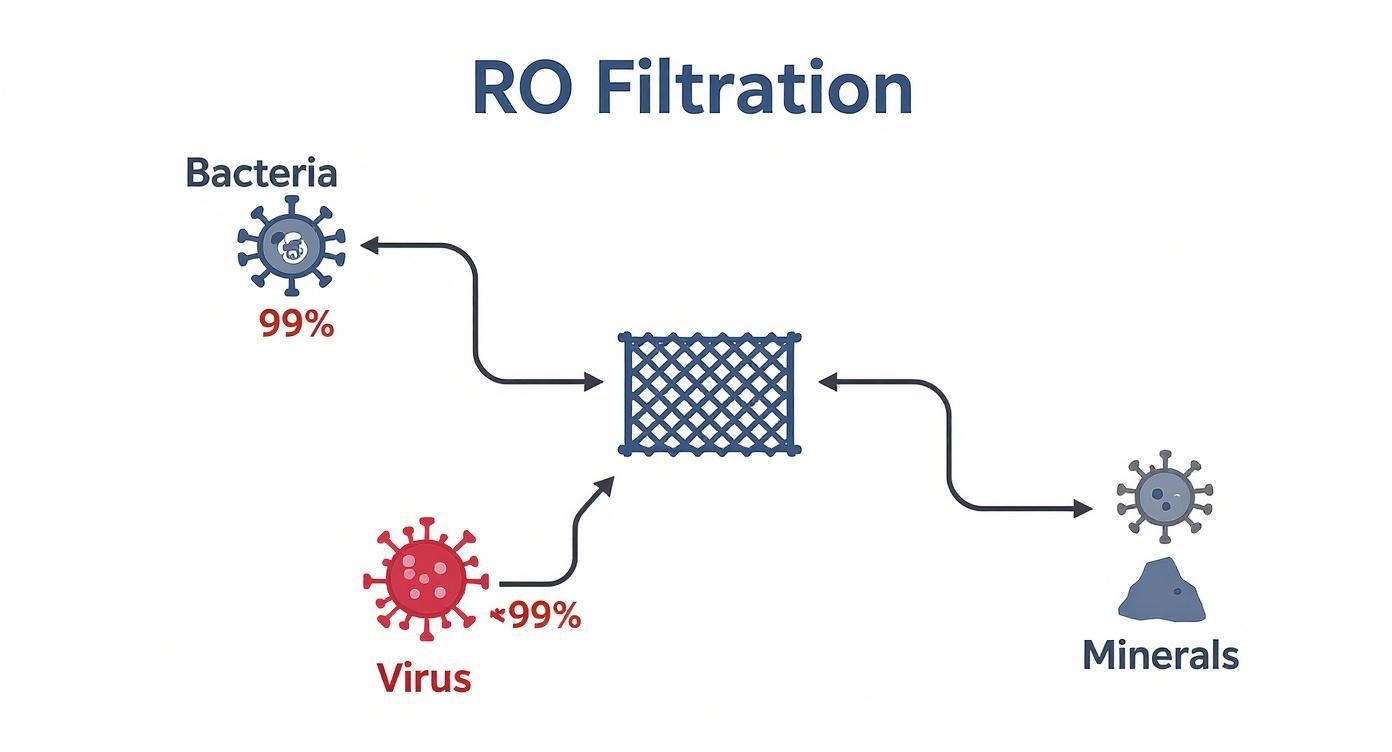
If UF is a bouncer, then Reverse Osmosis (RO) is the Fort Knox of water purification. It uses your home's water pressure to force water through an even more advanced membrane with pores as tiny as 0.0001 microns. This process is so thorough that it removes not only bacteria and viruses but also an extensive list of other contaminants.
Reverse Osmosis is one of the most comprehensive filtration methods available for home use. It effectively reduces dissolved solids, heavy metals like lead and arsenic, nitrates, and even salt, in addition to providing a powerful defense against coliforms.
This all-in-one purification makes RO a top choice for anyone dealing with multiple water quality issues beyond just bacteria. The trade-off? The membrane is so fine that it also strips out healthy minerals, which can make the water taste a bit flat. Many modern RO systems solve this by including a special remineralization filter to add those good minerals back in. RO systems also create some wastewater in the process, which is something to consider if water conservation is a priority.
Before picking a system, you need to know what you're up against. This flowchart is a great tool for figuring out the best way to test your water.
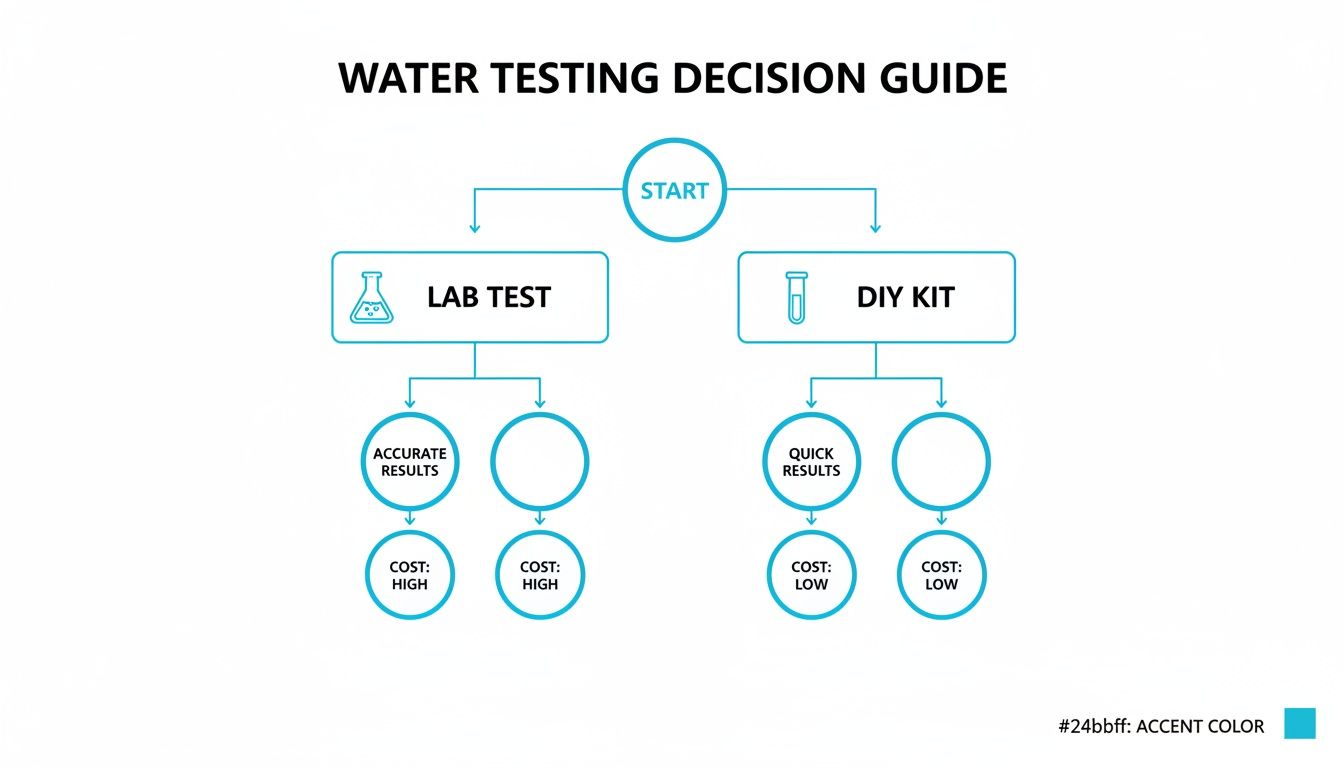
As you can see, a quick DIY kit can give you a hint, but a professional lab test gives you the solid answers you need to choose your filtration system with confidence.
Comparing Coliform Removal Technologies for Home Use
With three solid options on the table, how do you decide? The best choice really comes down to your water test results, your budget, and how much maintenance you’re willing to do. This table lays it all out to help you compare. For commercial kitchens, it’s a whole different ballgame; this ultimate guide to water filtration systems for restaurants has specialized advice for those settings.
| Technology | How It Works | Effectiveness on Coliforms | Pros | Cons | Best For |
|---|---|---|---|---|---|
| UV Disinfection | Zaps bacteria DNA with UV-C light, making them harmless. | Excellent | No chemicals, low maintenance, doesn't alter water taste. | Needs clear water to work (pre-filter often required), uses electricity. | Homes with clear water targeting just bacteria & viruses. |
| Ultrafiltration (UF) | A fine physical membrane blocks microbes from passing through. | Excellent | Physically removes bacteria, keeps healthy minerals, no electricity needed. | Can clog over time, doesn't remove dissolved chemicals. | Well water or city water where the main concern is microbes. |
| Reverse Osmosis (RO) | Pushes water through an ultra-fine membrane to strip out nearly everything. | Excellent | Removes the widest range of contaminants, including heavy metals. | Produces wastewater, removes healthy minerals (can affect taste). | Water with multiple issues beyond just bacteria (e.g., chemicals, lead). |
These powerful technologies are a big reason why the market for home water treatment is booming. Point-of-use systems, where you’ll find most of these filters, made up a market worth between USD 31.9–34.5 billion in 2024. That number is expected to jump to over USD 53 billion by 2030, mostly because systems like UV, UF, and RO give people peace of mind against microbial threats like coliforms. This steady growth means we'll keep seeing better and more affordable solutions for keeping our water safe at home.
Installation and Maintenance for Lasting Protection
Picking out a powerful coliform water filter is a huge win for your home's water safety, but the job isn't quite done when you unbox it. A top-tier system is only as good as its upkeep. Sticking to a consistent maintenance schedule ensures your investment remains a rock-solid barrier against bacteria, protecting your family for years.
Before we get into the nuts and bolts of maintenance, it helps to know where your system is going to live. You've got two main choices—whole-house or under-sink—and that decision shapes both the installation and the long-term care.
Whole-House vs. Under-Sink Systems
A whole-house system, sometimes called a Point-of-Entry (POE) system, gets plumbed in right where your main water line enters the house. It’s like having a security guard at the front door, screening every single drop of water before it heads to your showers, faucets, and appliances. This is the ultimate solution for total, comprehensive protection, especially if you have a private well where contamination could affect your entire home.
Then you have the under-sink system, or Point-of-Use (POU) system. As the name implies, it’s installed right where you use the water, usually under the kitchen sink. This gives you highly purified water for drinking and cooking from a dedicated faucet. It's often a more budget-friendly and less invasive setup, perfect for homeowners or renters who are mainly focused on ensuring their drinking water is perfectly safe.
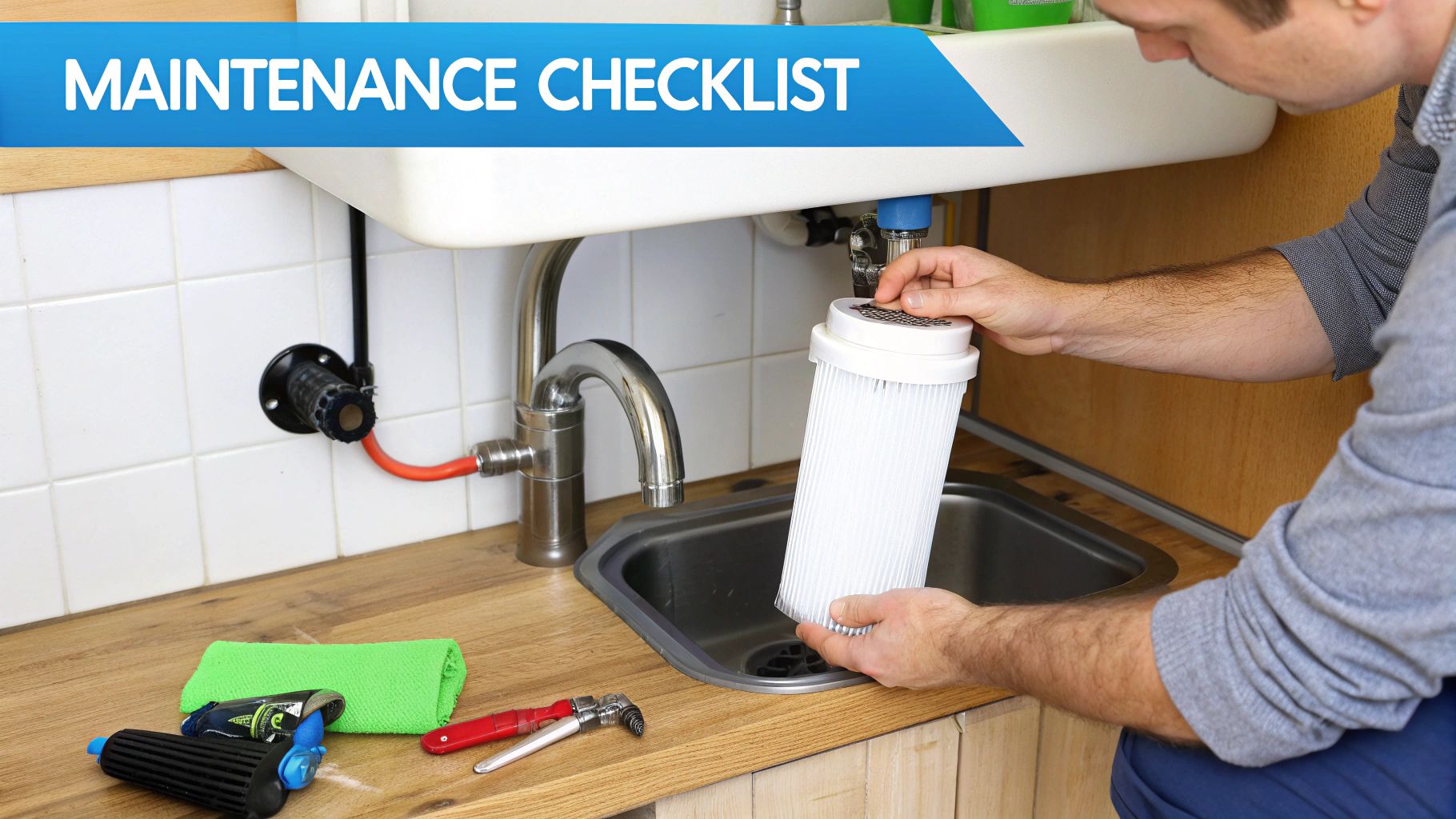
Your Essential Maintenance Checklist
Once your system is up and running, a simple maintenance routine is all it takes to keep it performing at its best. Skipping these steps is like buying a state-of-the-art security system and then leaving the front door unlocked—it defeats the purpose. Think of your filter’s manual as your playbook; follow the manufacturer's directions to the letter.
Here’s a straightforward checklist to keep everything in prime condition:
- Change Sediment Pre-Filters: These are your system's first line of defense, catching dirt, sand, and rust. They typically need replacing every 6 to 12 months to prevent clogs and ensure your main filter or UV system can do its job effectively.
- Replace UV Lamps Annually: A UV bulb loses its germ-killing power over time, even if the light still turns on. Swapping it out once a year is critical to ensuring it’s delivering a knockout punch to any bacteria.
- Sanitize System Components: Whenever you change a filter or lamp, it's a smart move to clean and sanitize the filter housings or the UV chamber. This prevents any potential bacterial growth within the system itself.
- Check Seals and Connections: Give your system a quick visual inspection every now and then for any leaks or drips. A tiny leak can lower your water pressure and, worse, create an opening for contaminants to bypass the filter.
Don't forget that your filter is just one part of the equation. Keeping all your water-related equipment clean is crucial for true protection. For instance, following the best practices for cleaning a water dispenser makes sure your purified water stays that way until you're ready to drink it.
Verifying Performance with Periodic Re-Testing
So, how do you know your system is still working perfectly a year or two down the road? Simple: test your water again. It's a step people often forget, but it provides incredible peace of mind.
Periodic re-testing is like a performance review for your water filter. It confirms that your maintenance routine is effective and that your barrier against coliform bacteria remains strong and secure.
If your home is on a private well, getting your water tested for bacteria every year is a wise move. For those on a city supply, re-testing every couple of years or after any major plumbing work is a great habit to get into. This simple check confirms that your coliform water filter is working as advertised, so you know every glass of water is just as safe as it was on day one.
How to Make a Confident and Smart Purchase
With all the different options out there, how can you possibly pick a coliform water filter you can actually trust? The trick is to ignore the marketing hype and focus on what really matters: proof that the system works. That proof comes from certifications from independent, third-party organizations.
Think of a certification as a seal of approval from an unbiased expert. It verifies that the filter performs exactly as the company claims. When you're dealing with something as serious as bacterial contamination, this kind of guarantee isn't just nice to have—it's essential.
Decoding the Most Important Certifications
The gold standard in the water filtration world is NSF/ANSI. This is an independent group that sets public health standards and runs certification programs to help protect our food, water, and consumer products. For coliform, there are two certifications you really need to know about.
-
NSF/ANSI 55 (Class A): This is the one you absolutely must look for on any UV disinfection system. Class A certification confirms the system delivers a strong enough dose of UV light to kill or inactivate nasty microorganisms like bacteria, viruses, and cysts. It’s your guarantee of microbiological safety.
-
NSF/ANSI 53: While this standard isn't exclusively for bacteria, it certifies that a filter can reduce specific health-related contaminants, which can include cysts like Giardia. If you’re leaning toward a physical filter like an ultrafiltration or reverse osmosis system, keep an eye out for this one.
A product that is "NSF Certified" has gone through a tough series of tests. These checks make sure it meets strict standards for performance, material safety, and structural integrity. It means you can be confident the system will do its job when it counts.
Critical Questions to Ask Before You Buy
Once you’ve got a shortlist of certified products, it's time to dig into the details. Asking the right questions now will save you from headaches and buyer's remorse later. For more helpful tips on water treatment, you can also check out our general water filter advice section.
Your Pre-Purchase Checklist:
- What is the system’s flow rate? You need to make sure the Gallons Per Minute (GPM) rating can handle your family's needs, especially during peak times like morning showers. Otherwise, you'll notice a frustrating drop in water pressure.
- What are the annual maintenance costs? Don't just look at the upfront price. Add up the cost of replacement UV lamps, filter cartridges, and any other parts you'll need to buy each year to get the true cost of ownership.
- What does the warranty cover? A good, solid warranty is a great sign that the company stands behind its product. Find out exactly which parts are covered and for how long.
Frequently Asked Questions About Coliform Filters
Navigating the world of water filtration can bring up a lot of questions, especially when you're dealing with something as serious as bacteria. We've put together some straight answers to the most common things homeowners ask when choosing and using a coliform water filter so you can feel confident you're making the right call for your home.
Will a Standard Brita Pitcher Filter Remove Coliform Bacteria?
This is a big one, and the answer is a simple, firm no. Your standard pitcher filters, like a Brita or a Pur, use activated carbon. Their main job is to improve your water's taste and smell, primarily by removing things like chlorine.
They simply aren't designed to stop microscopic organisms like bacteria. For true microbial safety, you absolutely need a system that is specifically certified for microbiological purification. That means a technology like UV disinfection, ultrafiltration, or reverse osmosis. Think of pitcher filters as a quick flavor fix, not a health shield.
Is City Water Safe from Coliform Contamination?
For the most part, yes. Municipal water treatment plants are under strict regulations and do an excellent job of disinfecting water before it ever leaves the facility. The catch? It's a long journey from that plant to your kitchen sink, and things can go wrong along the way.
What could happen?
- Aging Infrastructure: Old city water mains can develop cracks or leaks, creating a perfect entry point for contaminants to get into the "clean" water supply.
- Water Main Breaks: When a main breaks, the sudden pressure drop can actually suck untreated groundwater and bacteria directly into the pipes.
- Local Plumbing Issues: Sometimes the problem isn't with the city's pipes, but with the plumbing inside your own home.
While you can generally trust your city's water, a home filtration system acts as that final, critical line of defense. It ensures that anything that might have snuck in after treatment gets eliminated before it ever reaches your glass.
How Often Should I Retest My Water After Installing a Filter?
Installing a filter is a huge step, but you need to verify it's actually doing its job. It's a best practice to test your water again shortly after your new system is up and running. This first re-test simply confirms that the installation was successful and the system is working as expected.
After that, how often you test really depends on your water source. If you have a private well, you should plan on testing for bacteria annually. Well water quality can change with the seasons, so it's smart to stay on top of it.
If you're on a municipal supply, re-testing every 2-3 years is a good rule of thumb. You should also get a test done anytime you notice a sudden change in your water's taste, smell, or appearance. It's a simple habit that ensures your system is still working correctly and your family is protected.
Here at Water Filter Advisor, our mission is to give you the clear, straightforward information you need to choose what's best for your family’s health. Check out our in-depth guides and reviews to find the perfect setup for safe, great-tasting water in your home.