Your Water Filter pH Level: A Practical Home Guide 2026

You fill a glass from your kitchen filter, take a sip, and pause. Maybe it tastes flatter than the tap water used to. Maybe your kettle keeps getting crusty buildup. Maybe you heard that “alkaline water” is better and now you're wondering if your filter is helping or making things worse.

That's a smart question.

A home water filter can absolutely affect pH, but the practical answer isn't about chasing a trendy number. It's about whether your water tastes right, whether it's hard on your plumbing, and whether your filter is changing the chemistry in ways that matter for daily use. The good news is that once you understand what pH does, the whole topic gets much less mysterious.

What Is Water pH and Why Does It Matter

pH is a way to describe how acidic or alkaline water is. It functions like a see-saw: one side is acidic, the other side is alkaline, and the middle is neutral. If the balance tips too far either way, you start noticing problems.

On the pH scale, 7 is neutral. Below that, water is acidic. Above that, it's alkaline. The scale runs from 0 to 14, and the U.S. Environmental Protection Agency says drinking water should stay between 6.5 and 8.5 to protect taste, plumbing, and long-term water quality, according to this pH guide summarizing EPA standards. That same source notes that water below 6.5 is acidic enough to leach metals like lead and copper from plumbing.
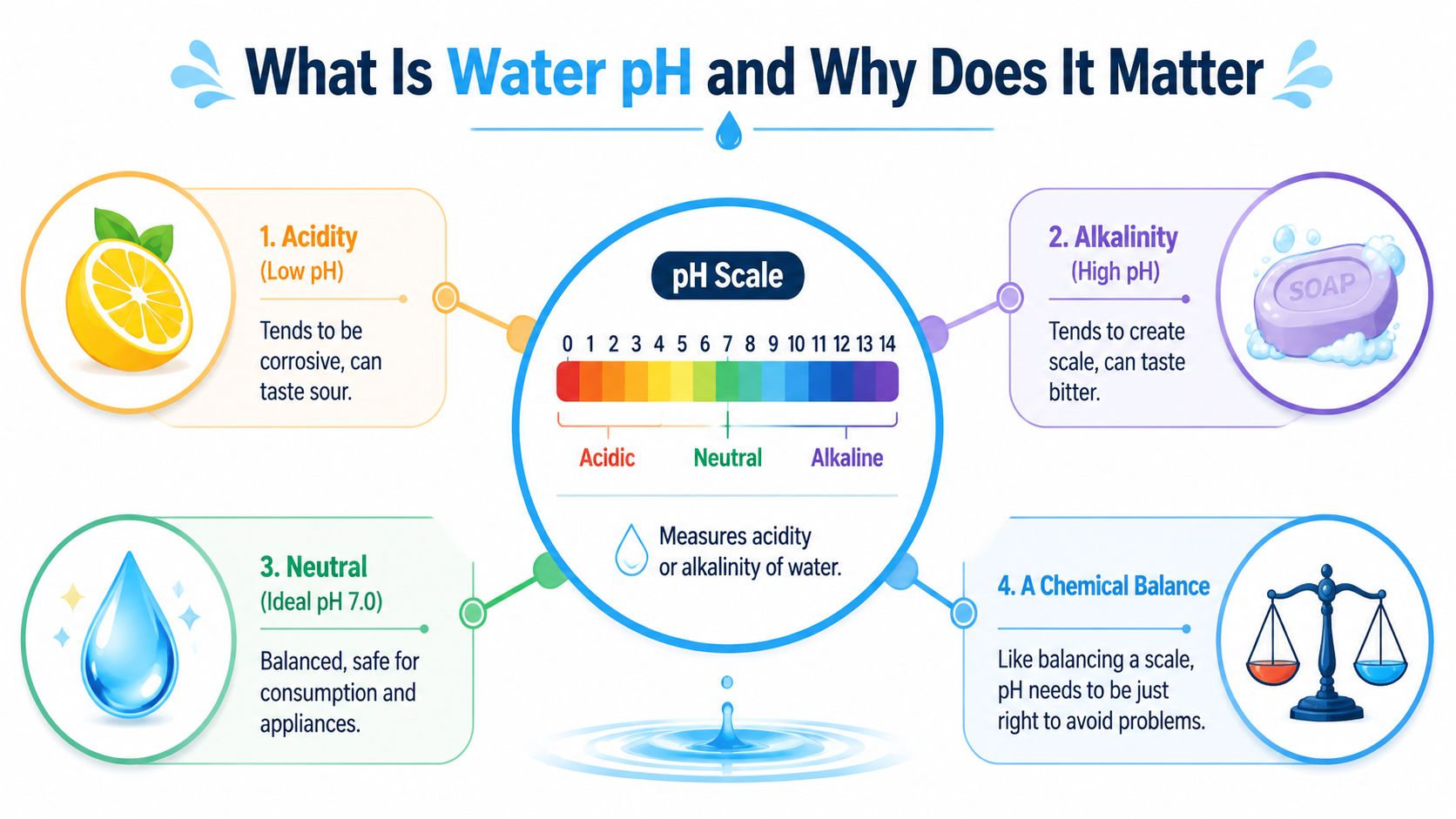
An infographic explaining water pH levels, ranging from acidic lemons to alkaline soap and neutral water.

What the see-saw means in real life

If the see-saw tips toward acidity, water can become more corrosive. That matters because your pipes, fittings, and faucet internals are in contact with water all day. Acidic water doesn't just affect taste. It can slowly pull metals from plumbing.

If it tips too far toward alkalinity, you usually get a different kind of headache. The water may taste bitter, and minerals can leave scale in pipes, coffee makers, water heaters, and showerheads.

Practical rule: Good pH isn't about perfection. It's about keeping water balanced enough that it doesn't attack your plumbing or leave a mess behind.

Why homeowners should care

People often notice pH in three places first:

  • Taste: Water that's too acidic can taste sharp or odd. Water that's too alkaline can taste bitter.
  • Appliances: Unbalanced water can shorten the comfortable life of kettles, ice makers, dishwashers, and water heaters.
  • Health concerns: The biggest household issue isn't that water changes your body chemistry. It's that acidic water can interact with plumbing materials in ways you don't want.

That's why the phrase water filter pH level matters so much in a home. Your filter isn't working in isolation. It becomes part of your water's chemistry, and that chemistry affects your faucet, your glass, and your repair bill.

How Filters Affect Your Water pH Level

Not all filters change pH in the same way. Some barely touch it. Some shift it a little. One common filter type, reverse osmosis, often changes it enough that homeowners notice.

The big idea

A filter changes pH when it removes or adds the minerals that help keep water chemically stable. Calcium and magnesium act like tiny balancing weights on that see-saw. Remove them, and the water can drift acidic. Add them back, and pH may move closer to neutral or slightly alkaline.

A simple sediment filter usually won't do much to pH. An activated carbon filter may have only a modest effect. A reverse osmosis system is much more aggressive.

According to this explanation of reverse osmosis and pH, reverse osmosis systems typically lower water to a pH between 5 and 7 because they remove dissolved minerals like calcium and magnesium that normally buffer the water.

Water Filter Type vs. pH Impact

Filter Type Typical pH Change Mechanism
Reverse osmosis Often lowers pH Removes dissolved minerals that buffer acidity
Activated carbon Usually little to modest change Improves taste and odor, but doesn't usually add minerals back
Distillation Can leave water less buffered Removes many dissolved substances, leaving water with little mineral content
Alkaline or remineralization filter Can raise pH Adds minerals back into filtered water

Reverse osmosis works like an overachiever

RO systems are excellent at reducing a wide range of unwanted dissolved material. That's why so many homeowners like them for drinking water. But RO can be a little too good at cleanup. It removes the minerals that help hold pH steady, so the finished water often lands on the slightly acidic side.

That doesn't automatically mean the water is dangerous. It means you should understand what the system is doing and decide whether you want to add a finishing stage.

RO water often tastes “clean” but also a little flat. That taste change is usually your clue that the mineral balance has shifted.

Carbon filters and basic pitcher filters

Activated carbon filters, including many faucet filters and pitchers, are usually chosen to improve taste and reduce chlorine-related issues. They don't typically have the same dramatic pH effect as reverse osmosis because they aren't stripping out dissolved minerals to the same degree.

That's why many people switch to carbon filtration and notice better flavor without much change in the overall feel of the water.

Distilled and very pure water

Distilled water and highly purified water often have very low mineral content. In real life, that can make them behave a bit like RO water from a pH standpoint. The water may not stay right at neutral once it's exposed to air and ordinary handling.

Alkaline and remineralization filters

These filters do the opposite of RO's mineral stripping. They add minerals back, often as a final polishing stage. If your filtered water tastes too flat or tests lower than you want, this type of cartridge is often the practical fix.

For homeowners, that's the main takeaway. If your current filter lowers pH because it removes buffering minerals, the answer usually isn't to replace the whole system. It's to add the right finishing stage.

When Your Water pH Level Becomes a Concern

Homeowners hear a lot of noise about alkaline water. Some of it is marketing. Some of it is confusion. The useful question is much simpler: when does pH become a real household problem?
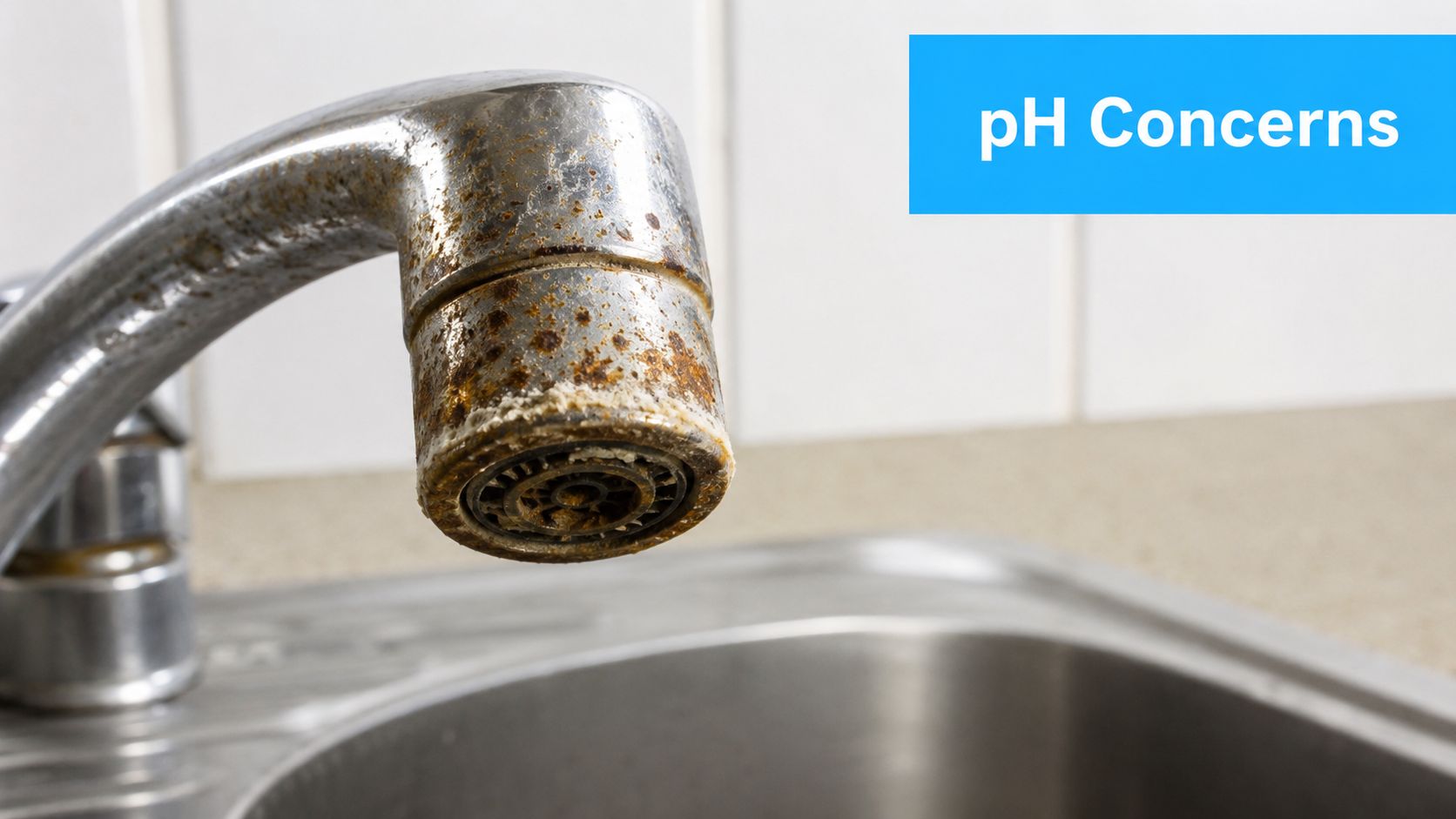
A close up view of a rusty, lime-encrusted kitchen faucet indicating potential water quality and pH concerns.

The genuine risk with low pH

If your water is acidic, the biggest practical concern is corrosion. That's especially true in older homes or homes with plumbing components that can react to aggressive water. Corrosive water can pull metals into the water stream over time.

At this point, pH stops being an abstract chemistry lesson and starts becoming a home maintenance issue with health implications attached to it.

The hype around high pH

Some products imply that more alkaline always means healthier. That's where it helps to slow down.

According to this review of alkaline water claims, human blood naturally stays between 7.35 and 7.45, and there's insufficient quality research to support claims that alkaline water treats health conditions. That same source says water above 8.5 can cause dry, itchy skin in sensitive individuals.

Don't let marketing turn pH into a miracle story. In a home, the practical targets are comfort, plumbing protection, and clean-tasting water.

What high pH looks like around the house

Water that leans too alkaline often shows up through surfaces and appliances before anything else:

  • Scale on fixtures: White or chalky deposits around faucets and showerheads
  • Appliance buildup: Kettles, coffee makers, and water heaters collect mineral residue
  • Taste complaints: Some people notice a bitter edge

That doesn't mean alkaline water is automatically unsafe. It means there's a tradeoff. Water that's too high can be annoying, and in some homes it can become expensive if scale keeps building up.

A simple way to judge urgency

Think in two categories.

If your concern is taste, and your filtered water seems flat or slightly off, you're probably dealing with a manageable pH shift from filtration.

If your concern is corrosion or heavy buildup, that deserves closer attention. Rust staining, metal taste, blue-green staining, and persistent scale are all signs that your water chemistry may need more than a basic pitcher filter.

Simple Ways to Test Your Water pH at Home

You don't need a lab to get a useful read on your water filter pH level. For most homeowners, a quick home test tells you whether the water is roughly balanced or whether it's time to investigate further.
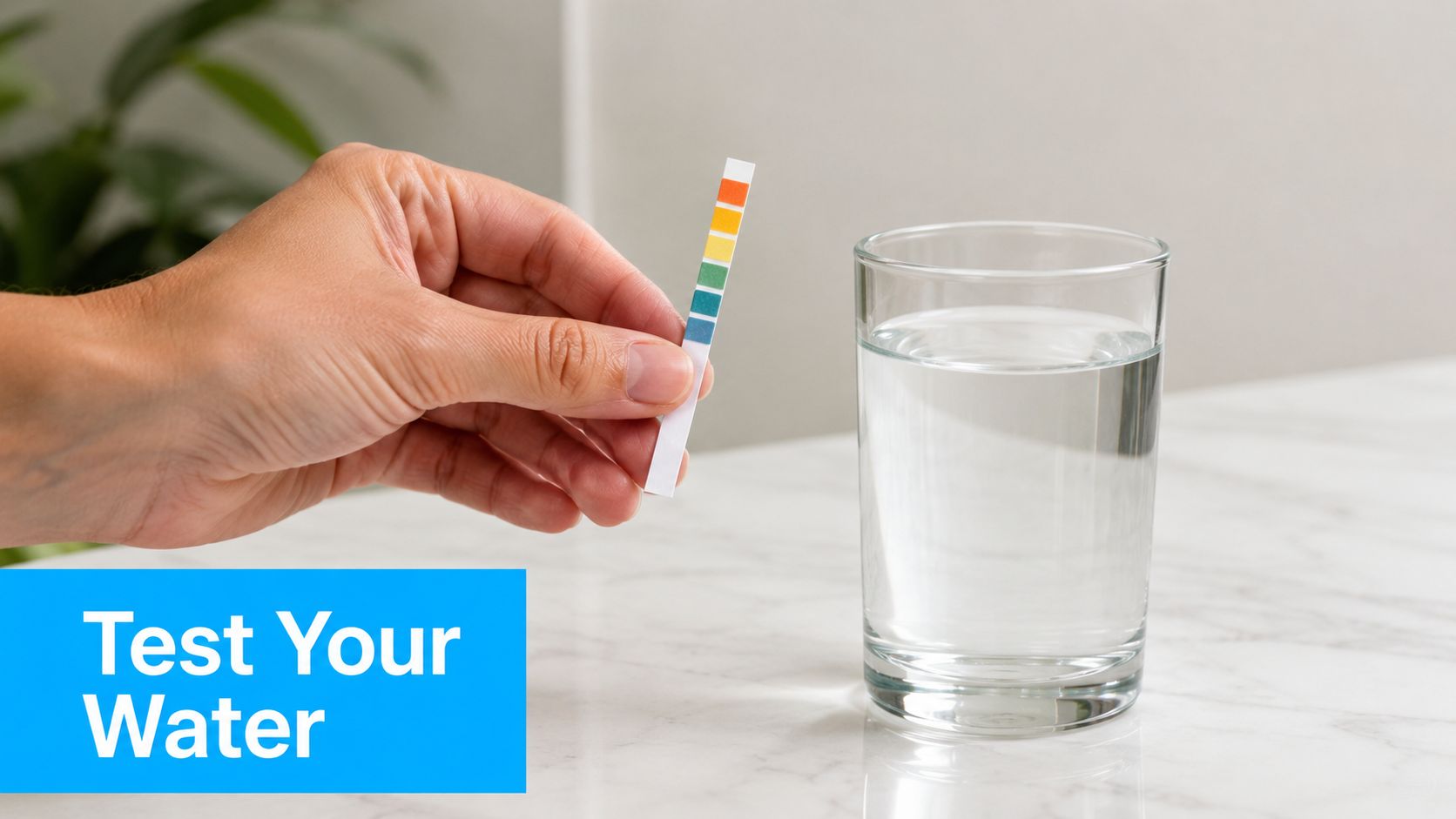
A hand holding a pH test strip next to a glass of water on a table.

Test strips for a fast snapshot

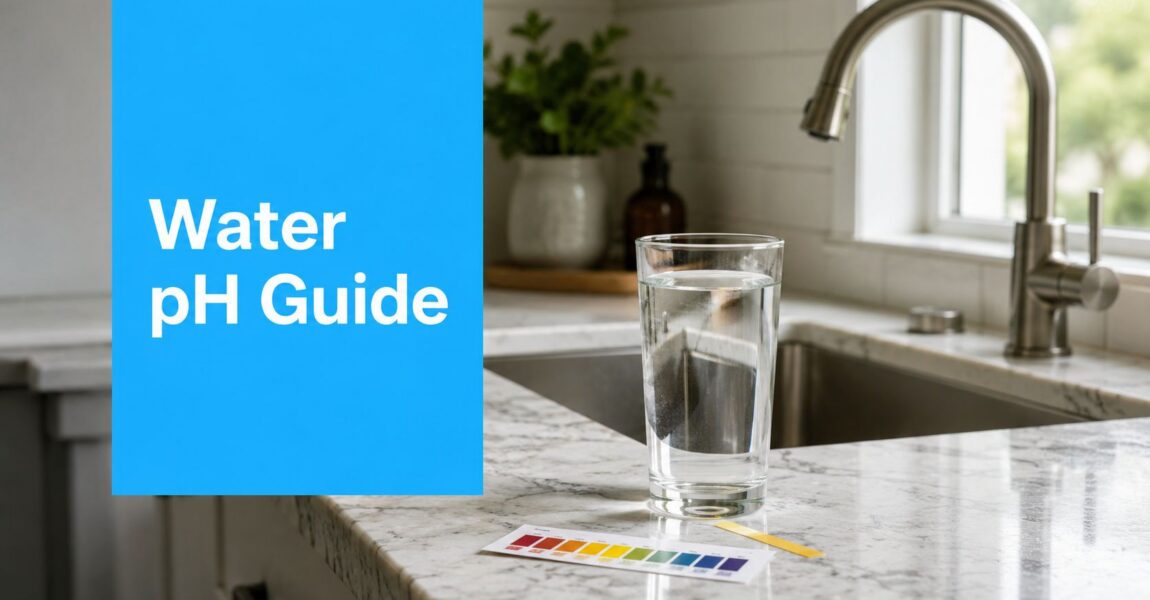
Test strips are the simplest option. Dip one in a glass of water, compare the color to the chart, and you'll get a quick estimate. They're easy to store and easy to use, which makes them great for a first check.

Their limitation is precision. If you want a rough answer, they're fine. If you're trying to fine-tune a filter setup, they can feel a little blunt.

Digital pH meters for repeat checks

A digital meter gives a direct reading and is easier to use over and over if you test often. Homeowners with RO systems, well water, or a remineralization stage usually appreciate that convenience.

The catch is maintenance. You have to keep the meter clean, calibrated, and stored properly or the reading can drift.

Liquid reagent kits for hands-on users

Liquid reagent kits sit in the middle. You add drops to a sample and compare the color result. Many people like them because they feel more deliberate than strips and less gadget-dependent than a meter.

If you want to compare options before buying, BlueRipple Aquatics' test kit reviews are worth a look. They focus on water testing tools in a practical way, and the comparisons can help you understand what makes one kit easier to use than another.

A short demonstration can also make the process less intimidating:

Best testing habits at home

  • Test the source and the filtered water: That tells you what the filter changed.
  • Use a clean glass: Soap residue can throw off your impression and your reading.
  • Check at different times: Morning water and later water can sometimes behave differently depending on your system.
  • Write the result down: Even a simple note helps you spot patterns after a cartridge change.

If you're a homeowner, that's enough to get started. You're not trying to run a chemistry lab. You're trying to answer one practical question: is my filter leaving my water in a comfortable, reasonable range?

Practical Ways to Adjust Your Water Filter pH Level

Once you know your pH, the fix is often simpler than people expect. Most homeowners don't need to overhaul the whole filtration system. They need the right add-on in the right place.

If your RO water is slightly acidic

This is the most common scenario. You install reverse osmosis, love the cleaner taste, then notice the water seems a little flat or your pH reading is lower than expected.

A guide focused on filtered water and pH balance notes that RO systems often produce slightly acidic water and that users who want alkaline water need a remineralization filter. That's the practical answer in many homes. A remineralization cartridge or alkaline post-filter adds minerals back after the membrane has done the heavy filtering.
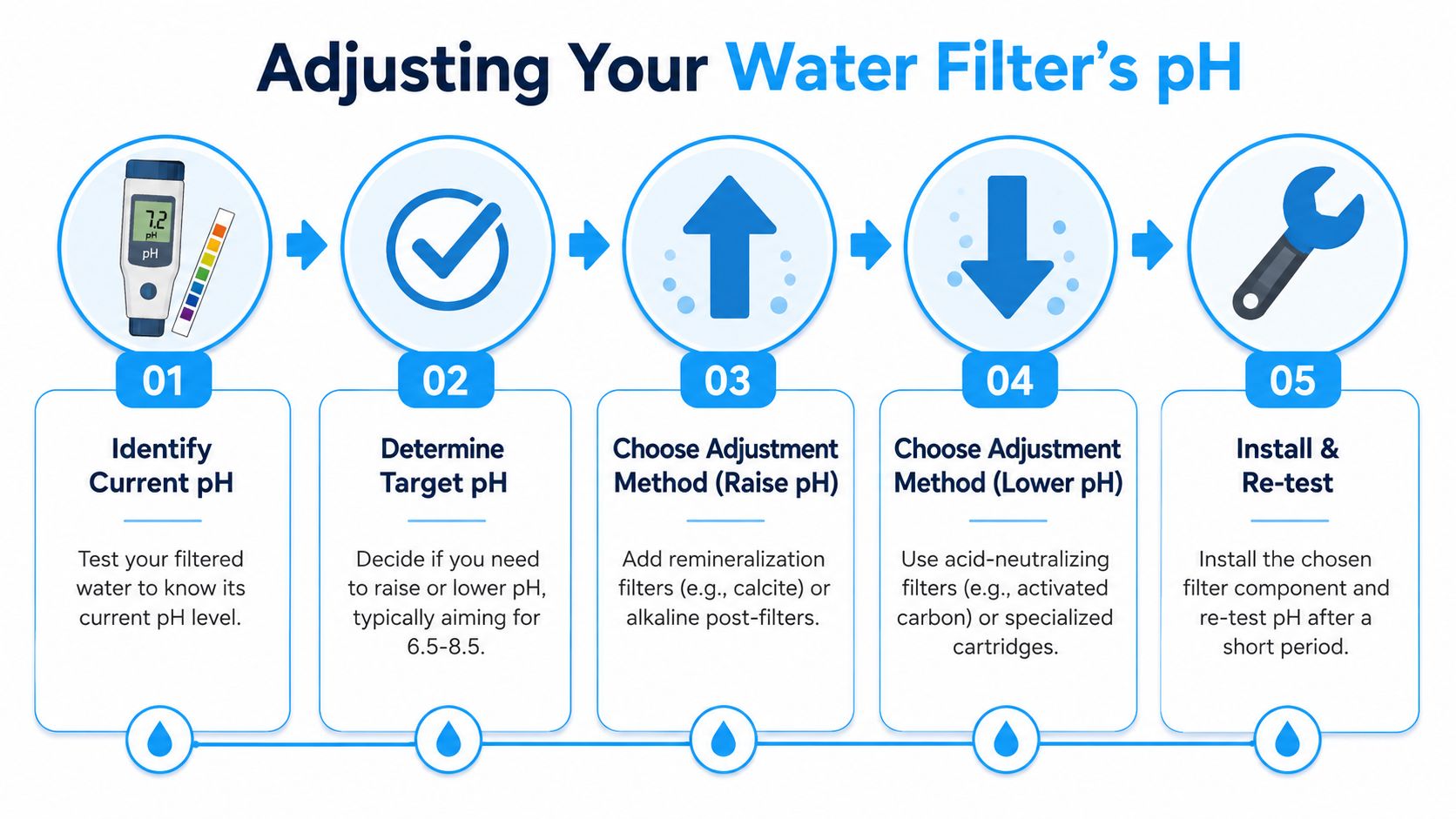
A five-step infographic guide illustrating the process of adjusting and balancing your home water filter pH levels.

If your source water is truly acidic

If you're on well water and the water starts acidic before it even reaches your kitchen filter, think bigger than an under-sink solution. In that case, a whole-house neutralizing system usually makes more sense because the problem affects every pipe, faucet, and appliance in the house.

Common neutralizing approaches use mineral media that raises pH as water flows through. These are point-of-entry solutions, which means they treat the water before it travels through your plumbing.

Homeowner shortcut: If the issue starts at the main supply, fix it at the main supply. If the issue starts after filtration, fix it at the filter.

Matching the problem to the fix

  • RO water tastes flat: Add a remineralization stage after the RO membrane.
  • Filtered water is fine, but fixtures show scale: Look at the full mineral picture, not just pH.
  • Well water seems corrosive throughout the home: Consider a whole-house neutralizer first.
  • You just want a higher-pH drinking option: A dedicated alkaline add-on can be a convenience choice, not a medical one.

Some homeowners also look at specialty devices when they want a drinking-water setup that raises pH after purification. If you're comparing that category, EcoQuest Purifiers offers an example of the alkaline water ionizer style so you can see how that approach differs from a standard remineralization cartridge.

Don't chase extremes

The smartest adjustment is usually the smallest one that solves the problem. You're aiming for balanced water that tastes good and plays nicely with your plumbing. You're not trying to win a pH contest.

That mindset saves money. It also helps you avoid piling on filter stages that sound impressive but don't address your actual issue.

Choosing the Right Water Filter for Your pH

The best filter choice starts with your source water, not the marketing on the box.

According to this overview of household pH standards and treatment options, household drinking water should stay between 6.5 and 8.5, and water around 4.5 is rare enough that it calls for advanced acid-neutralizing equipment rather than a simple drinking-water filter. That's an important dividing line. Mild pH shifts are one thing. Severe acidity is a whole-house treatment problem.

A simple buying framework

If your municipal water is already balanced and your goal is better taste, odor reduction, or common contaminant reduction, a basic carbon or under-sink system may be all you need.

If you want very thorough purification and are considering reverse osmosis, plan ahead for the possibility that the system may leave water less buffered. In that case, it's smart to choose an RO setup with an optional remineralization stage.

If you're on well water and suspect corrosive acidity, start with treatment at the entry point to the home. Don't rely on a small kitchen filter to solve a house-wide chemistry problem.

For people who like comparing higher-purity systems used in technical settings, Labs USA water systems can be useful for understanding how different purification levels are designed, even though a home usually needs a more practical, consumer-focused setup. And if you want broader homeowner guidance before buying, the advice library at Water Filter Advisor's advice center is a good next step.

Choose the filter that fits your water's starting point, your home's plumbing reality, and the kind of maintenance you'll keep up with. That's how you get water that tastes better without creating a new problem downstream.


If you want help comparing home filtration options without getting lost in hype, visit Water Filter Advisor. It's a practical resource for choosing, testing, and maintaining filters that fit your water, your budget, and your home.
Alkaline Ionized Water Filters: A Homeowner’s Guide 2026

You've probably seen this happen. A friend buys a sleek countertop machine, starts talking about “ionized” water, and suddenly your plain tap filter looks old-fashioned. Then the ads start following you around. They promise cleaner water, higher pH, better hydration, and a long list of benefits that sound half science lesson, half wellness sermon.

That's where many homeowners get stuck. The words alkaline, ionized, filtered, and purified get mixed together so often that it becomes hard to tell what the machine does. And if you're spending serious money for something that sits under your sink or on your counter every day, the key questions aren't glamorous. You want to know whether it removes contaminants, whether it works with your local water, and what it will cost to keep running.

Alkaline ionized water filters require a more grounded explanation. The useful way to evaluate them isn't to start with hype. It's to start with the basics of water treatment in a home.

The Buzz About Alkaline Water

A lot of people first hear about alkaline water the same way. Someone says their water tastes smoother. An influencer says acidity is the problem. A product page shows glowing blue lights, molecular diagrams, and a list of features that makes the machine sound like a tiny lab.

That mix of marketing and partial science creates confusion fast. Some products are simple filters that add minerals. Some are electric appliances that use charged plates. Some do both. Many are sold with strong health messaging, even when the most important homeowner questions are much more practical.

The practical questions are less exciting, but they matter more:

  • Safety first: Does the system improve the water you drink every day?
  • Filtration reality: What contaminants does it reduce, and what does it leave behind?
  • Ownership cost: What happens after the first week, when filters age and parts need cleaning?
  • Fit for your water: Will it perform the same on city water, well water, softened water, or water from a reverse osmosis system?

Most confusion starts when buyers treat “alkaline” and “filtered” as if they mean the same thing. They don't.

That's the key mindset shift. Water chemistry and water purification are related, but they are not identical. A machine can raise pH without being the best filter in the room. A strong filtration system can remove a wide range of contaminants without producing alkaline water at all.

Once you separate those ideas, alkaline ionized water filters become much easier to judge. You stop asking whether the claims sound impressive and start asking whether the system makes sense for your home.

What Are Alkaline Ionized Water Filters Anyway

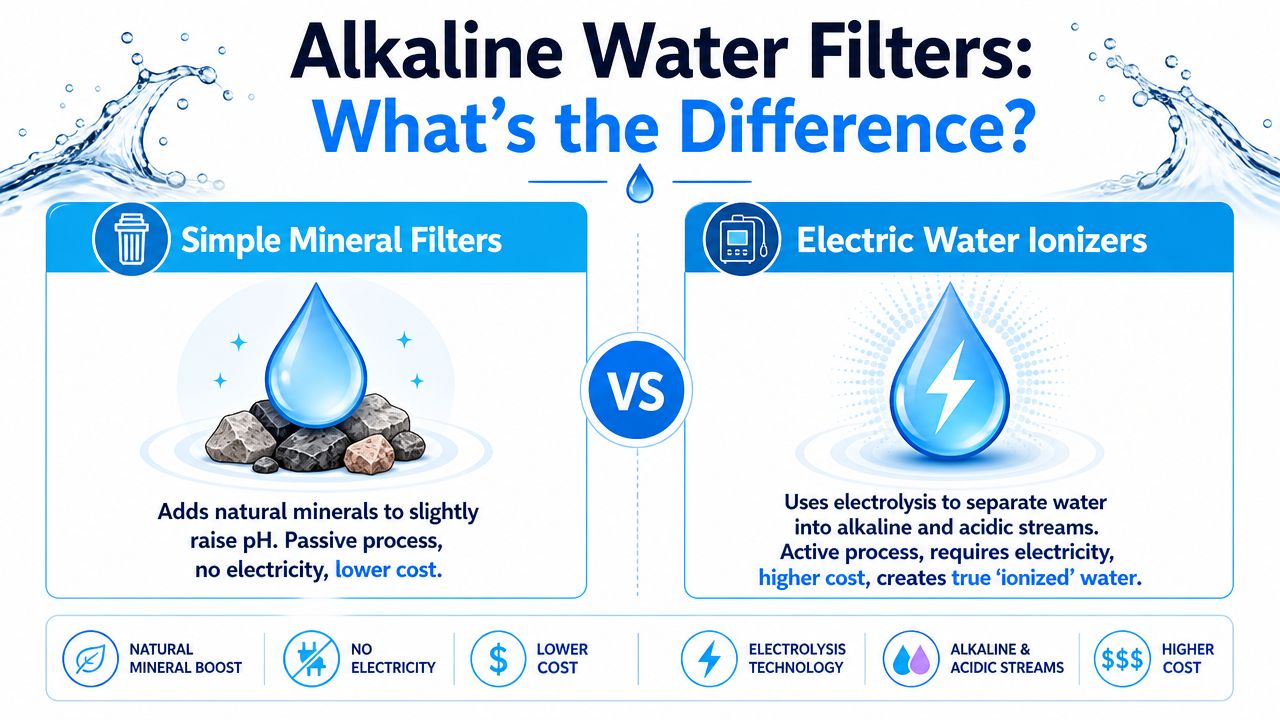
The term alkaline ionized water filters sounds like one category. In practice, homeowners usually run into two very different products.

Two main categories:
Mineralizing alkaline filters raise pH by adding minerals.
Electric water ionizers use electrolysis to split water into alkaline and acidic streams.

A comparison infographic between simple mineral alkaline water filters and electric water ionizers, highlighting key differences.

Independent explanations note that alkaline filters typically raise pH by adding minerals such as calcium carbonate, calcium, magnesium, or potassium, while ionizers use electrolysis. They also sit in very different price bands, with alkaline filters often estimated at about $30 to $200 and ionizers at about $500 to $5,000, according to this comparison of water ionizers and alkaline water filters.

Mineral filters are the simple version

A mineralizing alkaline filter is the easier one to understand. Water passes through filter media, then through a mineral stage that adds compounds which nudge the pH upward. It's similar to seasoning soup. You're not rebuilding the soup from scratch. You're adding a little of something that changes the final result.

These systems are usually passive. No power cord. No electrodes. No separate acidic stream. For many homes, that simplicity is the biggest advantage.

That doesn't make them superior in every case. It just means what they do is easier to understand and maintain.

Ionizers are appliances, not just filters

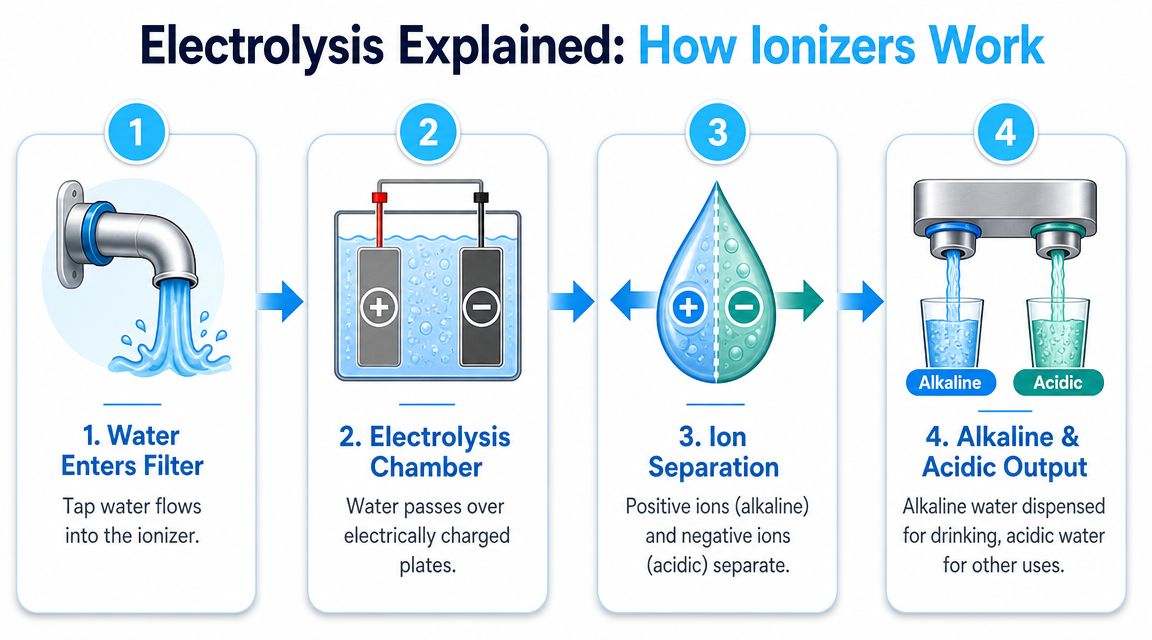
An electric ionizer is closer to a water-treatment appliance. Water flows through a prefilter stage, then enters an electrolysis chamber with charged plates. The machine uses electricity to create separate output streams.

That's why the word ionized matters. It points to a process, not just a taste or pH result.

Here's where buyers often get tripped up:

  1. A higher pH result doesn't tell you how the machine got there.
  2. “Alkaline” on the label doesn't guarantee strong contaminant removal.
  3. The more complex the machine, the more maintenance questions you should ask.

Why this distinction matters at home

If your main goal is reducing common contaminants and improving taste, a simpler under-sink filter may be the better fit. If you specifically want electrolysis and adjustable output, you're in ionizer territory.

That's a big difference in cost, installation style, and upkeep. It's also why shopping by marketing phrases alone is risky. A countertop mineral pitcher and a hardwired electric ionizer can both be sold under the same broad alkaline language, even though they behave like completely different products in daily use.

How Electrolysis Creates Ionized Water

Electrolysis sounds complicated, but the basic picture is manageable. Water enters the machine, passes over electrically charged plates, and the system separates output into different streams.

A diagram illustrating the four-step electrolysis process used by water ionizers to create alkaline and acidic water.

A simple mental model

Imagine sorting mixed marbles with magnets and channels. You pour everything into one tray, then a machine guides different pieces in different directions based on electrical behavior. An ionizer does something similar with water and dissolved minerals.

The machine doesn't create minerals from nothing. It works with what's already in the incoming water. That point matters a lot later when you start asking whether the machine will perform well on very low-mineral water.

What pH means in plain English

pH is a measure of how acidic or alkaline water is. If a system produces water with a higher pH, the water is more alkaline on that scale.

For products sold in this category, vendor specifications commonly place mineral-cartridge designs around pH 8.0 to 9.5, while ionizer systems are often advertised with adjustable settings around pH 7.5 to 10.5. Some also make negative ORP claims as low as -200 mV to -800 mV, according to these alkaline ionized water filter specifications.

What ORP means and why homeowners get confused

ORP stands for oxidation reduction potential. You'll often see it in sales pages because it sounds technical and impressive. In simple terms, it's a measurement related to electron activity in water.

That's not the same as proving a health outcome. It's just a measurement the machine can advertise.

Practical rule: Treat pH and ORP as machine output metrics, not as proof that the water is safer or healthier for your household.

The engineering catch

Ionizers depend on the condition of their electrodes and the chemistry of the incoming water. A mineral cartridge depends more on how quickly the media gets used up and how long the water stays in contact with it.

For a homeowner, that difference matters more than the brochure language. One system asks, “How are the plates holding up?” The other asks, “How exhausted is the media?” Both can drift over time. Neither should be judged by day-one marketing alone.

The Health Claims Versus Scientific Evidence

The strongest marketing around alkaline ionized water filters usually isn't about filtration. It's about what the water is supposed to do for your body.

A clear glass of water sitting on a laboratory table next to scientific equipment and test tubes.

You'll see claims about balancing acidity, supporting hydration, improving wellness, or making ordinary water somehow more biologically useful. Some of those claims are presented cautiously. Others are far more dramatic.

A careful homeowner should separate three different ideas:

  • Taste and preference: Some people prefer the taste of mineralized or alkaline water.
  • Water chemistry: A machine can absolutely change pH and mineral profile.
  • Health outcomes: That's where the debate gets much less settled.

Where the evidence gets shaky

One major issue is that ionizers are often sold as if they're a universal upgrade for any kitchen. That leaves out an important technical limitation. Electrolysis depends on the mineral content and conductivity of the incoming water.

Hydroviv argues that ionizers sold on health claims lack conclusive clinical evidence, and it also notes that low-mineral water conducts electricity poorly, which makes performance highly dependent on source water quality in the first place. That concern is especially relevant for homes using very soft water or water treated by reverse osmosis, as discussed in Hydroviv's review of ionized alkaline water claims.

In plain language, the machine may still produce a higher pH reading, but that doesn't automatically mean it's delivering the meaningful result many buyers think they're paying for.

What that means for a homeowner

If your local water is already low in dissolved minerals, an ionizer may have less to work with. If your home uses RO water, the machine may not behave the way the sales demo suggests.

That's why “Does it alkalize?” isn't the best first question. Better questions are:

  1. What is my source water like?
  2. What filtration happens before electrolysis?
  3. Will this system still perform as advertised on my actual water?

The video below gives a broader look at how these systems are discussed and debated.

A balanced way to think about the claims

You don't have to swing to either extreme. You don't need to believe every wellness promise, and you also don't need to assume every user experience is imaginary.

A reasonable middle position is this: some people like the taste, some like the convenience of getting treated water at the sink, and some value the adjustable output. But strong health claims deserve caution, especially when the better-supported homeowner concerns are filtration quality, input water compatibility, and long-term performance.

If a company spends more time talking about your body's pH than your home's water contaminants, you're probably looking at marketing first and filtration second.

That's the lens worth keeping.

Filtration What Gets Removed and What Stays

This is the part many buyers skip, and it's the part that matters most if your goal is safer tap water. A water ionizer may include a filter, but the machine's headline feature is usually electrolysis, not deep contaminant reduction.

That distinction matters because homeowners often assume an alkaline ionizer is automatically a high-performance purifier. Sometimes it isn't. Many models use prefiltration that can help with taste and common aesthetic issues, but that doesn't mean the system matches a dedicated reverse osmosis unit or a carefully selected multi-stage filter for broad contaminant reduction.

pH is not a contaminant test

If a machine can raise pH, that tells you something about water chemistry. It does not tell you what it removed.

A better way to shop is to ask for performance details on the actual filter stage. Does it address chlorine? Chloramine? Lead? Cysts? Emerging contaminants? If those answers are vague, the machine may be selling an experience rather than a filtration result.

Contaminant removal ionizers vs other systems

Contaminant Typical Water Ionizer Activated Carbon Filter Reverse Osmosis System
Chlorine taste and odor Often addressed if the unit includes a carbon prefilter Commonly addressed Commonly addressed
Sediment May be partly addressed, depending on prefiltration Often addressed with the right stage Commonly addressed with prefilters
Lead Varies by filter design and certification Some models are designed for this, but not all Often a stronger choice when properly certified
Chloramine Often limited unless the filter is specifically built for it Some specialty carbon systems target it better Can address it when paired with appropriate stages
Dissolved solids Usually not the main strength Not the main strength Commonly a core strength
Broad contaminant reduction Depends heavily on the built-in filter, not the ionizing function Moderate to strong, depending on media and certification Often the most comprehensive household option

That table points to the big takeaway. The ionizing function and the filtering function are not the same thing.

Why filter media still matters

If you've ever looked at aquarium filtration media, you've seen a useful reminder that all filtration depends on the specific media doing the job. Water treatment is never magic. Different materials target different problems. Home drinking water systems work the same way. Carbon, resin, membrane stages, and mineral media each play different roles.

So when a product page says “multi-stage filtration,” don't stop there. Ask what each stage does. A short ingredient list for the filter media can tell you more than a page of wellness copy.

For many homes, the smartest setup is to prioritize contaminant reduction first, then decide whether adding alkalinity is still important after that.

A Practical Buyer's Guide for Homeowners

Buying one of these systems gets easier when you stop treating it like a wellness gadget and start treating it like a kitchen appliance tied to your water quality.

The biggest mistake is focusing on the highest pH setting. That's like buying a furnace based only on how hot it can get, without asking how efficient it is, how often it needs service, or whether it fits your house.

Questions worth asking before you buy

Promotional pages often highlight adjustable pH, multi-stage filtration, and simple installation, but they frequently leave out replacement cadence, scaling on electrodes, warranty limits, and the cost of keeping output stable over time. That practical concern is captured well in this discussion of long-term performance and ownership questions.

Use this checklist when comparing systems:

  • Certification details: Look for filtration certifications or clearly stated reduction claims for contaminants. Health language is not the same as filtration verification.
  • Source water fit: Ask whether the unit is suitable for your exact water supply, especially if you have softened water, well water, or RO water.
  • Filter replacement plan: Find out how often cartridges need attention under normal household use.
  • Cleaning demands: Ionizers can develop scale on internal parts. If the maintenance process sounds vague, that's a warning sign.
  • Warranty limitations: Read what the warranty excludes. Water quality conditions sometimes affect coverage.
  • Annual ownership reality: Try to estimate how much usable filtered water you'll get and what it will cost to maintain performance.

Red flags in marketing

Some product pages make it sound as if more settings always mean a better machine. That isn't necessarily true. You're looking for a system that works consistently on your water, not one with the longest feature list.

Watch for these warning signs:

  1. Health-first sales pages that barely discuss contaminant reduction.
  2. Vague filter descriptions with no clear explanation of what each stage does.
  3. No maintenance detail beyond “easy to use.”
  4. No discussion of scaling or source water compatibility.

A serious filtration product should tell you how it behaves after months of use, not just how it performs on day one.

A better shopping process

It helps to compare alkaline ionized water filters alongside more conventional systems before deciding. Resources such as Water Filter Advisor's advice library can help you compare under-sink filters, carbon systems, RO units, and maintenance expectations using the same practical lens.

That comparison often leads homeowners to one of three conclusions. Some decide they only need a strong conventional filter. Some want RO with remineralization. Others still want an ionizer, but they buy it with more realistic expectations about filtration and upkeep.

Frequently Asked Questions

Can I use a water ionizer with reverse osmosis water

Usually, people encounter trouble concerning system integration. Ionizers rely on mineral content and conductivity in the incoming water. RO systems remove a large share of dissolved material, so the ionizer may have less to work with. If someone wants both purification and alkalinity, they need to think carefully about system design rather than assuming any two machines will pair well.

Are alkaline ionized water filters good for well water

They can be, but only after you understand the well water itself. Well water can vary widely in hardness, iron, sulfur odor, sediment, and other issues. In many homes, pretreatment matters more than the ionizer. A machine that performs nicely on treated municipal water may struggle if the incoming well water is inconsistent or causes scaling.

Do these systems actually filter dangerous contaminants

Some do part of the job, but that depends on the filter stage, not the word “ionized.” If contaminant removal is your top priority, ask what the system is specifically designed and certified to reduce. Don't assume the alkaline feature means complete purification.

Are they hard to maintain

They can be more demanding than buyers expect. Electric ionizers are appliances with internal components, filter cartridges, and possible scale buildup. Simpler alkaline mineral filters are usually easier to live with. The more moving parts and performance claims a unit has, the more important routine care becomes.

Why are so many companies selling them now

Because demand has grown. A 2025 industry guide cites the global alkaline water filters market at about $1.2 billion in 2023/2024, with projections of roughly $3.1 billion by 2032, implying about 7% to 8.9% CAGR across 2025 to 2033, according to this alkaline water filtration market guide. More products on the market means more choice, but it also means more noise.

What's the smartest way to decide

Start with your actual water. Then decide what problem you're trying to solve.

If you want broad contaminant reduction, start there. If you also want alkaline output and accept the extra maintenance, then compare ionizers carefully. If you mainly want better taste and a slight pH increase, a simpler mineralizing filter may be the more rational option.


If you're sorting through home water treatment options and want clear, practical guidance without the hype, Water Filter Advisor is a useful place to compare filtration types, maintenance tradeoffs, and buying factors before you commit to a system.

Kent Alkaline Water Filter Pitcher Unboxing | Alkaline Water Pitcher Unboxing and Review | Alkalizer

Kent Alkaline Water Filter Pitcher Unboxing | Alkaline Water Pitcher Unboxing and Review | Alkalizer


In this video, I have done Kent alkaline water filter pitcher unboxing. You will also find Alkaline Water Pitcher Unboxing and Review in this video. It is known that alkaline water has some good effects in our body. An alkaline water pitcher is the most simple way to get alkaline water.

We are happy that we are organizing the first giveaway in our channel. We will give away 1 Kent Alkaline Water Filter Pitcher to the lucky winner. This competition is valid in India only.

Give away link:

Kent Alkaline Water Filter Pitcher Purchase link:

PLEASE FOLLOW ME ON INSTAGRAM:

PLEASE VISIT MY WEBSITE:

1. Kent Alkaline Water Filter Pitcher Unboxing
2. Alkaline Water Pitcher Unboxing and Review
3. Alkaline Water purifier Demo
4. Alkaline Water
5. Alkaline Water Filter
6. Alkaline Water Pitcher

#TheDevReviews
#AlkalineWaterPitcher
#KentAlkalineWaterFilterPitcherUnboxing
#AlkalineWaterPitcherUnboxingAndReview

Original Video Source