So, you’re staring at your kitchen faucet, wondering if the water coming out is as good as it could be. Welcome to the great reverse osmosis vs. filtered water showdown! It’s a common homeowner head-scratcher, but it really boils down to one simple question: what uninvited guests are crashing the party in your tap water?
If you’re just looking to kick that swimming-pool chlorine taste to the curb, a standard carbon filter is your quick, budget-friendly hero. But if your local water report reads like a science experiment gone wrong—we’re talking lead, fluoride, or other nasty contaminants—then a reverse osmosis system brings a level of purification that most filters can only dream of.
Choosing Your Best Home Water Solution
Picking the right water system for your home can feel like a huge deal, but let’s make it easy. It all starts with figuring out what you’re trying to remove from your water. Not all filters are created equal, and knowing the difference is the secret to making a smart choice for your family’s hydration station.
For most folks on city water, the main goal is just making it taste and smell better. This is where common filtered water options, especially carbon filters, absolutely shine. However, if you’re dealing with specific health contaminants or you just want water so pure it’s practically a liquid diamond, then reverse osmosis (RO) is the heavy-hitter you’re looking for.
A Quick Comparison
Here’s a fun way to think about it. A standard water filter is like a friendly bouncer at a club—it stops the obvious troublemakers like chlorine from ruining the vibe. A reverse osmosis system, on the other hand, is like a top-tier security checkpoint with laser beams and a velvet rope, scrutinizing every last molecule that tries to get in.
This difference in approach is what makes each system a champ in its own right.
The core distinction between reverse osmosis and standard filtration is the size of the particles they can remove. An RO system can filter out contaminants down to a mind-bogglingly small 0.0001 microns, while a typical carbon filter is effective for particles around 0.5 to 1 micron—a massive difference in filtration power.
To help you see the differences clearly, here's a high-level overview comparing the primary methods.
At-a-Glance Comparison of Water Filtration Methods
This table gives you a quick snapshot to help you identify the best fit for your home's needs without getting lost in the technical jargon.
| Filtration Method | Best For | Effectively Removes | Retains |
|---|---|---|---|
| Reverse Osmosis (RO) | Removing the widest range of contaminants for ultimate purity. | Dissolved solids, heavy metals (lead, arsenic), fluoride, nitrates, salts. | Very few minerals; water is purified to its simplest state. |
| Filtered Water (Carbon) | Improving taste, smell, and removing common chemicals. | Chlorine, pesticides, VOCs, sediment, some cysts. | Healthy minerals like calcium and magnesium. |
As you can see, the right choice isn't about which one is "better" in general—it's about what's better for you.
How Reverse Osmosis Delivers Ultra-Pure Water
When people talk about reverse osmosis vs filtered water, it's easy to think of RO as just another filter. It’s not. A reverse osmosis system is a full-blown, multi-stage purification plant for your kitchen, engineered to strip out contaminants that other filters can't even see.
The whole process is a journey. Your tap water embarks on an epic quest through several distinct stages, each one targeting a specific group of impurities.
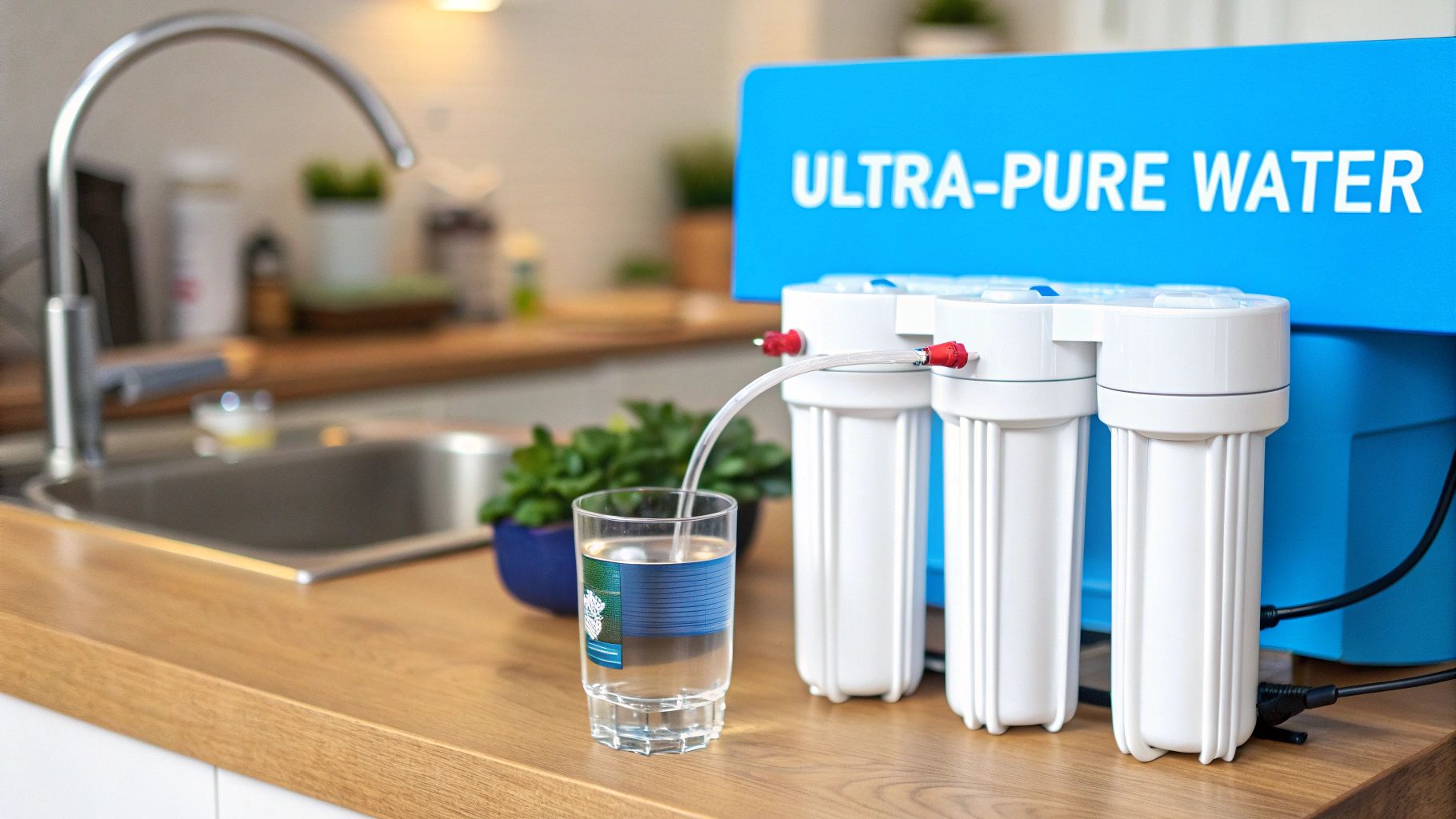
It all starts with a couple of workhorse pre-filters. These initial stages are like the opening act, warming up the crowd and protecting the main event—the RO membrane.
First, a sediment filter grabs the bigger stuff like rust, sand, and dirt. Think of it as the bouncer that throws out the rowdy, obvious troublemakers. Right after that, a carbon pre-filter gets to work adsorbing chlorine and chloramines. This is a critical step because chlorine is harsh stuff and can literally eat away at the delicate membrane, so getting rid of it first helps the whole system last much longer.
The Semipermeable Membrane: The Heart of the Operation
Once the water is pre-filtered, it’s ready for the main event: the reverse osmosis membrane. This is where the real magic happens.
The membrane is an incredibly fine sheet of material, wound up like a scroll, with pores so tiny they’re measured in fractions of a micron—down to 0.0001 microns to be exact. To put that into perspective, that's about 500 times smaller than what many standard carbon filters can catch.
Your home’s water pressure is all that’s needed to force water molecules through this microscopic maze. It’s an exclusive club, and only pure H₂O is on the guest list. Contaminants are simply too big to get in and are unceremoniously shown the door.
This single stage is powerful enough to remove up to 99% of all total dissolved solids (TDS). We’re talking about a massive list of hard-to-remove contaminants that most other filters just wave through, resulting in exceptionally clean water.
What an RO Membrane Actually Removes
The list of what an RO membrane can reject is long and impressive. It tackles many of the most serious health concerns you might find in your home’s tap water.
- Heavy Metals: Lead, arsenic, mercury, and chromium are effectively blocked.
- Dissolved Salts: Sodium, chloride, and sulfate get flushed away.
- Chemicals: Common contaminants like fluoride and nitrates are removed.
- Microplastics: Even these tiny plastic particles are too large to pass through.
This incredible rejection rate is why reverse osmosis technology is a dominant force in the global water purification market. In fact, it's on track to capture around 36% of the market value by 2025. This is largely thanks to its unmatched ability to remove dissolved salts, heavy metals, and fluoride from both city and well water sources. You can read more about the global water filter market trends to see just how important this technology has become.
After purification, the water chills out in a small storage tank. Before it gets to your glass, it passes through one final carbon "post-filter." This last step is like a final polish, removing any slight tastes or odors the water might have picked up from the tank. The result? Water that isn’t just pure, but tastes crisp and clean, too.
What is Filtered Water, Anyway?
It's easy to get excited about reverse osmosis, but before you dive into a full reverse osmosis vs filtered water debate, you need to meet the other players on the field. The truth is, many highly effective water filters can tackle specific problems in your home, often with a much smaller price tag and less installation hassle.
Let's break down the workhorse technologies you'll find in everything from a simple pitcher to a robust under-the-sink system.
Activated Carbon: The Taste and Odor Champion
If you've ever poured a glass of water from a Brita pitcher or a faucet-mounted filter, you've met activated carbon. It's the undisputed king of improving water's taste and smell, making it the most common filter material you can buy for your home.
The best way to picture an activated carbon filter is as a super-porous sponge with a ridiculously large surface area. It works through a clever process called adsorption—not to be confused with absorption. As water flows through, specific chemical contaminants are drawn to the carbon's surface and literally stick to it, getting yanked out of your water.
This is why activated carbon is a rockstar at removing:
- Chlorine: This is its main claim to fame. It completely zaps that "swimming pool" odor and taste you get from city-treated water.
- Volatile Organic Compounds (VOCs): This is a broad category of industrial chemicals and solvents that can sometimes creep into water supplies.
- Pesticides and Herbicides: Carbon does a great job of grabbing many common chemicals used in agriculture.
What’s the secret sauce? The massive internal network of pores. A single gram of activated carbon can have a surface area the size of a football field, giving contaminants countless places to get trapped.
This targeted approach makes activated carbon a fantastic choice if you're on city water and your main goal is simply better-tasting, better-smelling water. Just keep in mind its limitations: it won't touch dissolved solids like heavy metals, salts, or nitrates.
Sediment Filters: Your Home's First Line of Defense
Your water travels a long way to get to your tap, and it picks up a lot of junk along the way. Sediment filters are like the bouncers at the front door of your home's plumbing, keeping all the riff-raff out.
These filters have one job, and they do it exceptionally well: they catch physical gunk. Usually installed right where the water line enters your house (a point-of-entry system), they screen out all the larger particles that can wreak havoc on your home.
A good sediment filter will stop things like:
- Flakes of rust from old city pipes
- Sand, silt, and dirt, which is a huge issue for well water users
- Any other suspended solids floating around
By catching this stuff early, a sediment filter protects your expensive appliances like water heaters, washing machines, and dishwashers from damaging buildup. It also keeps your faucet aerators and showerheads from getting clogged. It’s no surprise that a sediment filter is the crucial first stage in almost any multi-stage system, including reverse osmosis.
UV Purifiers: The Microbiological Guardian
For some homes, especially those on well water, the biggest worry isn't chlorine or rust—it's what's living in the water. That's where Ultraviolet (UV) purifiers come in, offering a completely different approach to water safety. A UV system isn't a filter at all; it's a sterilizer.
It uses a high-intensity UV lamp to zap microorganisms as they pass by. This blast of UV light scrambles their DNA, making it impossible for them to reproduce and cause illness. It’s an incredibly effective, chemical-free way to neutralize nasty bugs like bacteria, viruses, and protozoa (like Giardia and Cryptosporidium) without changing your water’s taste one bit.
Head-to-Head: What Do They Actually Remove?
When you’re weighing reverse osmosis vs filtered water, the most important question is simple: what does it actually take out of my water? This is where the two technologies go in completely different directions.
It's like picking the right tool for a job. You wouldn't use a screwdriver to hammer a nail, and you can't expect a basic carbon filter to do the heavy lifting of a reverse osmosis system. To make the right call for your family, you have to match the filter’s strengths to the specific contaminants you're worried about.
Let’s put them head-to-head.
The Chlorine and Taste Challenge
If you're on city water, your biggest complaint is probably the swimming-pool taste and smell of chlorine. This is where activated carbon filters really shine. They're designed for one primary job: adsorption, a process where contaminants like chlorine stick to the carbon’s surface.
A simple carbon filter, whether it’s in a pitcher or under your sink, will make your tap water taste and smell much better. They're also pretty good at grabbing certain pesticides and volatile organic compounds (VOCs). But that's pretty much where their job ends.
A reverse osmosis system also removes chlorine, but it's just the first step. An RO unit has a carbon pre-filter that gets rid of chlorine before the water even touches the main RO membrane. So while both get the job done, for an RO system, it's just a warm-up for the real purification work.
The Heavy Metal and Dissolved Solids Problem
This is where the difference becomes crystal clear. Common—and dangerous—contaminants like lead, arsenic, nitrates, and fluoride are dissolved in water, meaning a standard carbon filter is completely blind to them. They'll sail right through its pores without a problem.
Here's where the reverse osmosis membrane becomes the hero. Its pores are unbelievably small—down to 0.0001 microns—and they physically block these dissolved troublemakers from getting through.
An RO system is like a molecular bouncer at the door. It lets pure water molecules in but kicks out the larger molecules of heavy metals, salts, and chemicals. This is something carbon filters just can't do.
If your local water report shows any lead, high fluoride, or nitrates (a big problem in farming areas), a reverse osmosis system isn't just a nice-to-have; it's a must-have for truly clean water. Activated carbon alone simply won't protect you from these health risks.
The Battle Against Emerging Contaminants
We're constantly learning about new things in our water we'd rather not drink. "Emerging contaminants" like microplastics, leftover pharmaceuticals, and trace industrial chemicals are a growing concern for a lot of people.
Activated carbon might trap some of these, but you can't really count on it—its performance is all over the place. Reverse osmosis, on the other hand, is a much stronger line of defense. That ultra-fine membrane is extremely effective at stopping these tiny particles and complex molecules in their tracks.
This is why RO is trusted technology worldwide. Its ability to remove up to 99% of contaminants—including bacteria, viruses, and emerging pollutants—is why the global water treatment systems market relies on it so heavily.
To see it all laid out, let's break it down side-by-side.
Performance Showdown: RO vs. Activated Carbon Filters
This table gives you a clear look at how Reverse Osmosis and Activated Carbon filters stack up against common water contaminants. I recommend pulling up your local water quality report and using this as a checklist.
| Contaminant | Reverse Osmosis (RO) | Activated Carbon Filter | Decision-Making Insight for Homeowners |
|---|---|---|---|
| Chlorine | Excellent (Removed by carbon pre-filter) | Excellent | Both are great for taste/odor, but this is the primary job of a carbon filter. |
| Lead & Arsenic | Excellent (Removes >95%) | Poor / Ineffective | If heavy metals are a concern, RO is the only reliable choice. |
| Fluoride & Nitrates | Excellent (Removes >90%) | Poor / Ineffective | These dissolved solids require a membrane; carbon filters can't remove them. |
| Bacteria & Viruses | Excellent | Poor / Ineffective | RO provides a physical barrier; carbon filters can sometimes become breeding grounds for bacteria. |
| Microplastics | Excellent | Fair / Variable | RO's tiny pores effectively block microplastics. Carbon's effectiveness is limited. |
| Dissolved Salts | Excellent | Poor / Ineffective | Only RO can desalinate water, significantly reducing Total Dissolved Solids (TDS). |
At the end of the day, the choice between reverse osmosis vs filtered water boils down to what you need removed. If you just want better-tasting water without that chlorine smell, an activated carbon filter is a great, affordable option.
But if your goal is true purification—getting rid of the tough, dangerous stuff—then a reverse osmosis system is, without a doubt, the superior technology.
Evaluating Cost, Installation, and Maintenance
When you’re weighing reverse osmosis vs. filtered water, the price tag on the box is only chapter one. To really understand the financial side of things, you need to look at the total cost of ownership—from the day you bring it home to the ongoing costs needed to keep clean water flowing. Let’s get practical and break down what you can expect to spend over the long haul with each option.
This diagram shows how different filtration methods go after specific contaminants in your tap water.
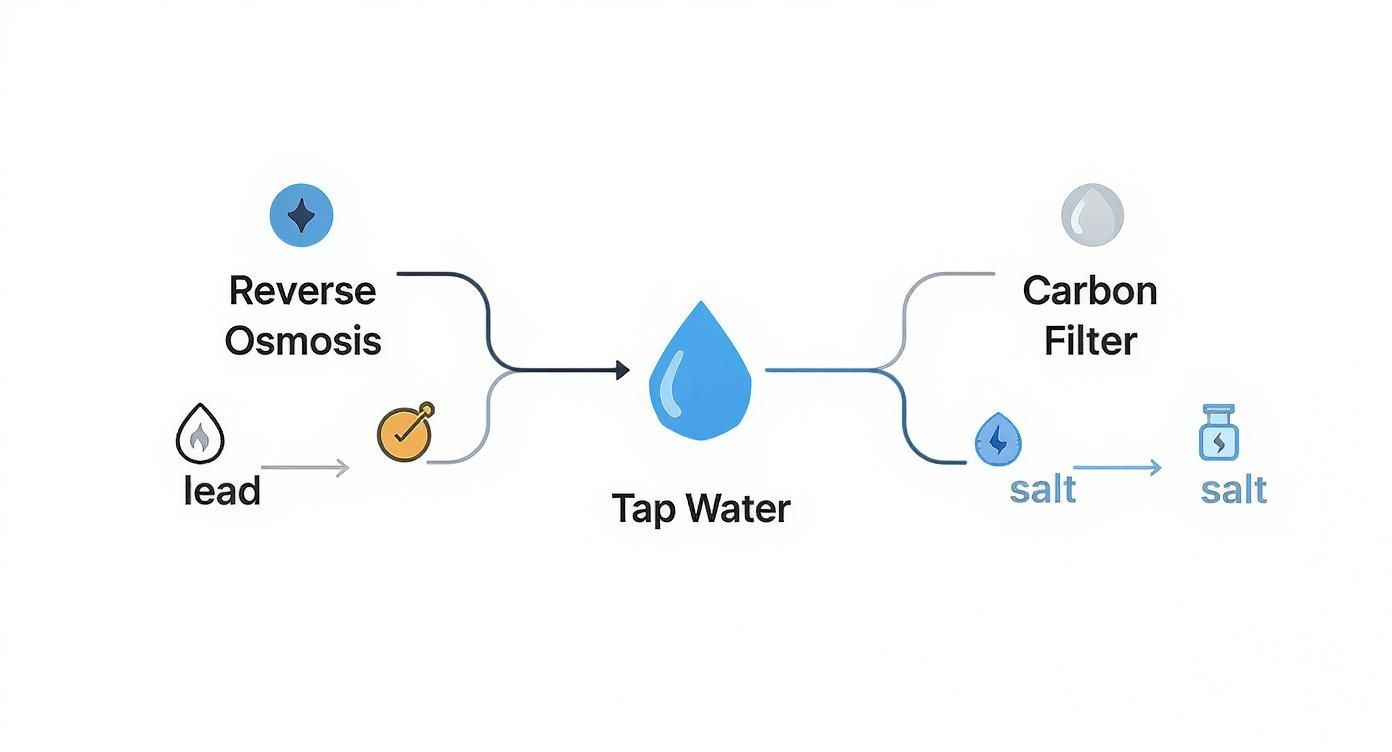
As you can see, carbon filters are great for common problems like chlorine. But reverse osmosis gives you a much wider shield, catching things that are harder to remove, like lead and salts.
The Financial Commitment of Reverse Osmosis
Let's be upfront: a reverse osmosis system is a serious investment in your home's water quality. The initial purchase is just the first part of the story, so it’s smart to budget for the full installation and the upkeep it'll need down the road.
The biggest hurdle for many people considering RO is the initial cash outlay and the recurring cost of replacement cartridges. This is a key factor in the global water purifier market, especially for budget-conscious homeowners.
Here’s a realistic look at what you’ll be spending on an RO system:
- Upfront Unit Cost: A good-quality under-sink RO system will typically run you between $200 and $500. Fancier models with extra features like remineralization can definitely cost more.
- Installation Fees: A lot of these systems are made for DIY installation, but not everyone is comfortable drilling holes in their countertops or messing with plumbing. If you call in a pro, expect to add another $150 to $300 to get a solid, leak-free setup.
- Filter Replacements: This is where the ongoing costs live. RO systems usually have 3 to 5 filter stages. The pre-filters and post-filters will need to be swapped out every 6 to 12 months, which usually costs about $50 to $100 a year.
- Membrane Replacement: The RO membrane is the heart of the system. It’s built to last longer but costs more to replace. Plan on changing this out every 2 to 4 years for $50 to $100.
When you add it all up, you’re looking at a total maintenance cost for a standard RO system of around $100 to $200 per year. That might sound like a lot, but if you do the math, the cost-per-gallon is almost always way cheaper than buying bottled water.
Cost and Maintenance of Standard Water Filters
Standard water filters, especially the ones using activated carbon, are much easier on the wallet to get started. But be careful—their long-term costs can sneak up on you, particularly with those cheap filter pitchers.
For instance, you can grab a water filter pitcher for just $30, but you’ll be replacing that filter every 40 gallons (or about every two months). At around $15 a pop, you could easily be spending $90 a year just on replacements. Suddenly, the cost-per-gallon doesn't look so low.
A much better comparison to an RO system is an under-sink carbon filter. These strike a nice balance between the initial price and ongoing expenses.
- Initial Cost: A solid under-sink carbon filter system usually costs between $100 and $200.
- Installation: This is often a much simpler job than installing an RO system. There’s no drain line or storage tank to worry about, making it a project most homeowners can tackle themselves.
- Maintenance: Your only recurring cost is the replacement cartridges. You’ll need to change them every 6 to 12 months, and they typically run between $40 and $80. This makes the annual upkeep a bit more affordable than a multi-stage RO system.
When you look at the total cost of ownership, the choice boils down to balancing your budget with how pure you want your water to be. RO systems cost more upfront and over time, but they deliver water that’s incredibly clean. Under-sink carbon filters are a more budget-friendly way to get much better-tasting water, making them a great practical choice for most homes with city water.
Making the Final Decision for Your Household
Choosing between reverse osmosis vs filtered water really comes down to knowing your water and what you want to fix about it. After wading through all the technical specs, let's boil it all down to a few simple, real-world scenarios to help you pick the right system for your home with confidence.
The entire decision hinges on one key question: are you just trying to make your water taste better, or are you trying to remove specific, known contaminants for health reasons? Your honest answer to that question is the first step toward a smart investment.
Simple Scenarios to Guide Your Choice
Let's forget the jargon for a minute and look at real-life situations. See which one of these sounds most like your house, and the best choice should become pretty obvious.
An under-sink carbon filter is probably your best bet if:
- You live in a city or town with professionally treated municipal water.
- Your biggest complaint is that your tap water tastes or smells like a swimming pool (chlorine).
- You want something you can install yourself without calling a plumber.
- You're on a tight budget and need an effective, affordable solution.
You should go with a reverse osmosis system if:
- Your local water report shows high levels of Total Dissolved Solids (TDS).
- You know there are specific health contaminants in your water, like lead, arsenic, fluoride, or nitrates.
- Someone in your home has a compromised immune system and needs the cleanest water possible.
- Your main goal is to get the absolute highest level of water purity you can achieve at home.
Think of it this way: a carbon filter is like a bouncer at a club, kicking out the obvious troublemakers like chlorine. An RO system is a full-blown security detail that vets every single molecule, ensuring nothing harmful gets past the velvet rope.
A Quick Decision-Making Checklist
Getting closer? Just run through this final checklist to make sure you've covered all the bases in the great reverse osmosis vs filtered water debate.
-
Check Your Water Report: First thing's first—get a copy of your local Consumer Confidence Report (CCR). If you see red flags like lead, nitrates, or high TDS, an RO system is the way to go. If the only real issue is chlorine, a good carbon filter will do the trick.
-
Define Your #1 Goal: Are you fighting a bad taste, or are you fighting invisible health threats? Be clear about your mission. Better taste is a job for carbon; total purification demands RO.
-
Be Real About Your Budget: Look at the whole picture—the upfront cost and the yearly maintenance. An under-sink carbon filter has a lower initial price and cheaper, simpler filter changes. An RO system costs more to buy and maintain, but you're paying for a much higher level of protection.
-
Consider Space and Installation: Do you have enough room under your sink for an RO system's storage tank? And are you up for a more involved installation, or do you need a quick and easy setup? Under-sink carbon filters are almost always a simpler, faster install.
By walking through these questions, you can cut through the confusion. The "best" system isn't always the most expensive or complicated one—it's the one that solves your water problems, fits your budget, and gives you peace of mind every time you fill up a glass.
Answering Your Water Filtration Questions
Even after comparing reverse osmosis vs filtered water, you might still have a few questions. That's perfectly normal. Let's dig into some of the most common things homeowners ask, so you can feel totally confident about your decision.
These are the kinds of details that usually seal the deal one way or the other.
Does Reverse Osmosis Remove Healthy Minerals?
Yes, it does, and it's a critical point to understand. The super-fine membrane in an RO system is great at catching nasty contaminants like lead, but it also pulls out beneficial minerals like calcium and magnesium.
Now, most of us get plenty of these minerals from food, so it's not a health concern. The bigger issue for many is the taste—demineralized water can taste a bit flat. That’s why a lot of modern RO systems include a remineralization filter. It adds a small amount of healthy minerals back into the water right before it hits your glass, which really improves the taste.
How Much Water Does an RO System Waste?
Older RO systems were pretty notorious for being water hogs, sometimes flushing several gallons down the drain for every one gallon of purified water they made. Thankfully, that's changed.
Today’s high-efficiency models are way better. It’s pretty common to see systems with a 1:1 or 2:1 ratio, meaning they only waste one or two gallons for every gallon of pure water produced. If you’re focused on water conservation, just look for a unit that’s advertised as having a low brine or low waste ratio.
That "wasted" water is often called brine, and it's just concentrated tap water. It's carrying all the junk the RO membrane filtered out and safely flushing it all away.
Is a Carbon Filter Enough to Make My Water Safe?
For most homes with city water, a good activated carbon filter does the trick. It makes your water safe, clean, and tasty. Its main job is getting rid of chlorine, and the difference in taste and smell is huge.
But a carbon filter is not a total purifier. It isn't built to handle things like heavy metals, nitrates, fluoride, or dissolved salts. The only way to know for sure if a carbon filter is all you need is to look at your local water quality report. For help making sense of it, check out our expert advice on how to choose the right water filter.
At Water Filter Advisor, we're here to help you nail down the perfect water solution for your house. Whether it’s a simple carbon filter or a full-on reverse osmosis system, our guides are designed to make the choice easy. Check out our resources today at https://www.waterfilteradvisor.com.
- December 8, 2025
- 0
- Uncategorized
