Keeping your water softener humming along is surprisingly simple. Forget picturing some complex, intimidating chore. Think of it as a small time investment that protects a major home filtration system, guaranteeing you that glorious silky-smooth water while saving your pipes and appliances from the villainous clutches of scale buildup.
This isn't just a niche concern anymore. The crusade for better home water is booming. The global water softener market is on track to become a multi-billion dollar industry, a testament to how many people are tired of hard water hassles and are taking control of their home's water quality.
Making Maintenance a Simple Habit
The secret to a long and happy life for your water softener isn't becoming a certified water treatment expert. It's all about a few core tasks that deliver the most bang for your buck. Simple, consistent checks are what separate a well-oiled machine from a future headache.
Here are the absolute must-dos for any solid water softener maintenance routine:
- Keep an Eye on the Salt: This is your most frequent mission. A quick peek once a month is usually all it takes to make sure you don't run out. If the salt's gone, the softening party stops dead.
- Watch for Salt Bridges: This is a classic softener snafu where a hard crust of salt forms in the tank. It’s a sneaky trick because it looks like the tank is full, but the salt underneath can't dissolve. We'll show you how to spot and bust these up in a snap.
- Give the Brine Tank a Good Scrub: Once a year, or maybe twice if your water source is particularly gunky, a full clean-out evicts sediment and keeps your whole filtration setup hygienic and efficient.
- Double-Check Your Settings: Make sure your softener’s regeneration schedule is still a good fit for your family's water usage. Getting this right saves a ton on salt and water.
Once you get these few tasks down, you're no longer just reacting to problems. You're proactively managing your home's water filtration. That simple shift is the secret to getting years of reliable service from your water softener.
Water Softener Maintenance At-a-Glance
To make it even easier, here’s a quick-reference table that lays out the essential tasks and when you should be doing them.
| Maintenance Task | Recommended Frequency | Purpose |
|---|---|---|
| Check Salt Level | Monthly | Ensures the system has enough salt to regenerate and soften water. |
| Break Up Salt Bridges | As needed (check monthly) | Prevents blockages that stop salt from dissolving into the brine. |
| Clean the Brine Tank | Every 6-12 months | Removes sediment, dirt, and salt residue for optimal filtration performance. |
| Check System Settings | Annually | Confirms the regeneration cycle matches your water usage for efficiency. |
Following this simple schedule will keep your home water filtration system in top shape and prevent most common issues before they start.
It also helps to understand how your softener fits into your home’s bigger plumbing picture. For a great overview, checking out an ultimate guide to plumbing can be a real eye-opener. And for more targeted info on all things filtration, we’ve got a whole library of https://www.waterfilteradvisor.com/advice/ waiting for you.
Mastering Salt Management for Peak Filtration
Think of the salt in your softener as its fuel. Without it, the whole ion exchange process—that scientific magic trick where hard minerals get swapped out for sodium ions—grinds to a halt. Nailing salt management is the single most important part of your maintenance routine, and there's more to it than just dumping in a bag.
The kind of salt you use really does matter. You'll typically find three main options: evaporated, solar, and rock salt.
- Evaporated Salt: This is the purest (and priciest) stuff. It dissolves without leaving much gunk behind, making it a fantastic choice for keeping your filtration system clean and running at peak efficiency.
- Solar Salt: This is a solid middle-of-the-road option. It's made from evaporated seawater, so it's cleaner than rock salt but can still leave a bit of sediment over time.
- Rock Salt: It's the cheapest but also the dirtiest. If you go this route, plan on cleaning your brine tank more often to get rid of the sludge that will inevitably build up.
For most modern home softeners, your best bet is usually evaporated salt pellets. They keep maintenance low and filtration performance high.
Spotting and Solving Common Salt Problems
Even with the best salt, a couple of common issues can shut your system down: salt bridges and salt mushing. Knowing what these are and how to fix them is a must for any softener owner.
A salt bridge is exactly what it sounds like—a hard crust of salt that forms over the water in your brine tank. This usually happens when it's humid or if the tank gets overfilled. It’s tricky because when you peek inside, it looks like you've got a full tank of salt, but underneath that crust is just empty air. The salt can't dissolve, no brine gets made, and your system essentially starves.
It's a classic scenario: a homeowner notices their dishes are spotty and their soap isn't lathering. They check the tank, see what looks like plenty of salt, and figure there's a serious mechanical failure. More often than not, it's just a sneaky salt bridge.
Pro Tip: Not sure if you have a bridge? Give the side of the tank a gentle tap, or use a broom handle to poke the top of the salt. If it feels solid and sounds hollow underneath, you've found your culprit.
Fixing it is easy. Just take your broom handle and carefully tap and poke the crust until it breaks apart. Scoop out any big chunks that are left.
Preventing Salt Mushing and Blockages
Down at the bottom of the tank, you can run into salt mushing. This is when salt recrystallizes into a thick, mucky sludge that can completely block the system's intake. Cheaper, less pure salts are notorious for causing this filtration nightmare.
Taking care of your salt isn't just a chore; it’s about protecting your investment. The global water softener market hit USD 1.14 billion in 2024 and is expected to climb to USD 1.53 billion by 2032, which shows just how vital these water filtration systems have become. Simple maintenance, like cleaning the brine tank every six months to clear out any potential bridges or mush, is key to performance. You can dig deeper into water softener market trends to see how proper care protects value. A clean tank means your softener can do its job, giving you the soft water you rely on.
A Practical Guide to Cleaning Your Brine Tank
While you’re probably used to topping off the salt every month or so, your brine tank needs a much more thorough cleaning about once every six to twelve months. Don't think of it as just another chore; it's more like a vital tune-up for your home’s water filtration system. This isn't just about appearances—it's about keeping your softener running at its best.
Over time, all sorts of gunk like sediment, dirt, and impurities from lower-quality salt can build up a nasty sludge at the bottom of the tank. If you let it go, this sludge can clog the brine well, which is the heart of the regeneration process. When that happens, your softener can't make the brine solution it needs to flush out hardness minerals, and you're suddenly back to square one with spotty dishes and scratchy laundry.
Getting Started with Your Tank Cleanout
First things first, you need to prep the tank. The easiest way to do this is to let the system use up most of the salt. A nearly empty tank is a lot easier to handle.
Once the salt is low, switch your system to bypass mode. You'll usually find a valve or a handle that reroutes water around the softener. This is a brilliant feature because it means you can work on the unit without having to shut off the water to your whole house.
Now you can disconnect the brine tank from the control valve. This usually just means detaching a couple of tubes and maybe the brine well cover. Just be gentle here—those plastic parts can get brittle over the years. With the tank free, your next job is to get rid of any leftover salt and water. A wet/dry vac makes short work of this, but a good old-fashioned scoop and bucket work just fine too.
This simple infographic gives you a visual on the day-to-day salt care that leads up to this big cleanout.
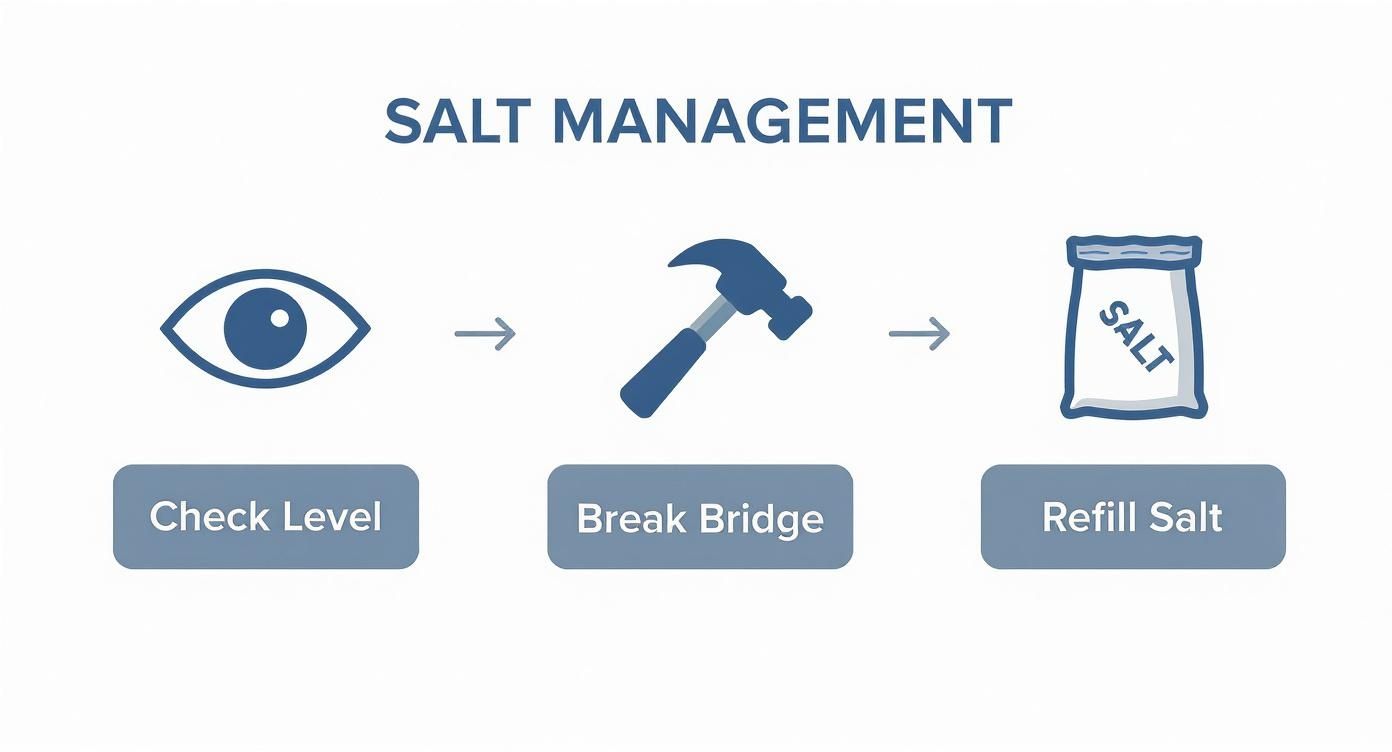
As you can see, staying on top of salt levels and breaking up any salt bridges are key. Good habits here mean you'll have a lot less gunk to deal with when cleaning day comes around.
The Cleaning and Sanitizing Process
Okay, now for the main event. With the tank empty, you can finally see what’s been lurking at the bottom. If you're on well water, don't be shocked to find a sludgy, rust-colored layer of iron sediment. It looks nasty, but this is exactly why you're doing this.
You don't need any harsh chemicals to get it clean. A simple mix of mild dish soap and warm water is usually all it takes.
- Grab a long-handled brush and scrub the inside of the tank. Really get into the bottom and the corners where all that gunk likes to hide.
- After a good scrubbing, rinse the tank out completely with clean water. You want to get every last bit of soap residue out.
- Sanitizing is an optional step, but I highly recommend it. Just mix a small amount of unscented household bleach with a few gallons of water, swish it around the tank, and let it sit for about 15 minutes. This will kill off any bacteria that might be hanging around. Dump it and give the tank one final, thorough rinse.
Make absolutely sure the tank is completely rinsed and dry before you hook anything back up. Leftover soap or bleach can mess with your system's filtration performance and, more importantly, the quality of your home's water.
Once it's clean and dry, reattach the tubes to the control valve. Pour a few gallons of fresh water into the tank, then fill it up with new, high-quality salt. The last step is to take the system out of bypass mode. I always recommend running a manual regeneration cycle right away. This gets a fresh batch of brine into the system and ensures your softener is ready to get back to its water-purifying work.
How to Revitalize Your System's Resin Bed
The resin bed is the heart and soul of your water softener. It's the engine room of your home filtration, where the magic happens—where those pesky hard water minerals get snatched up and swapped out. But like any hard-working component, it can get tired. Over time, it gets gunked up with iron, manganese, and other sediment, which slowly kills its ability to do its job.
Think of the resin beads as tiny, powerful magnets. When they're clean, they grab onto calcium and magnesium with no problem. But once they're coated in grime, that magnetic pull gets weaker, and hard water starts sneaking past.
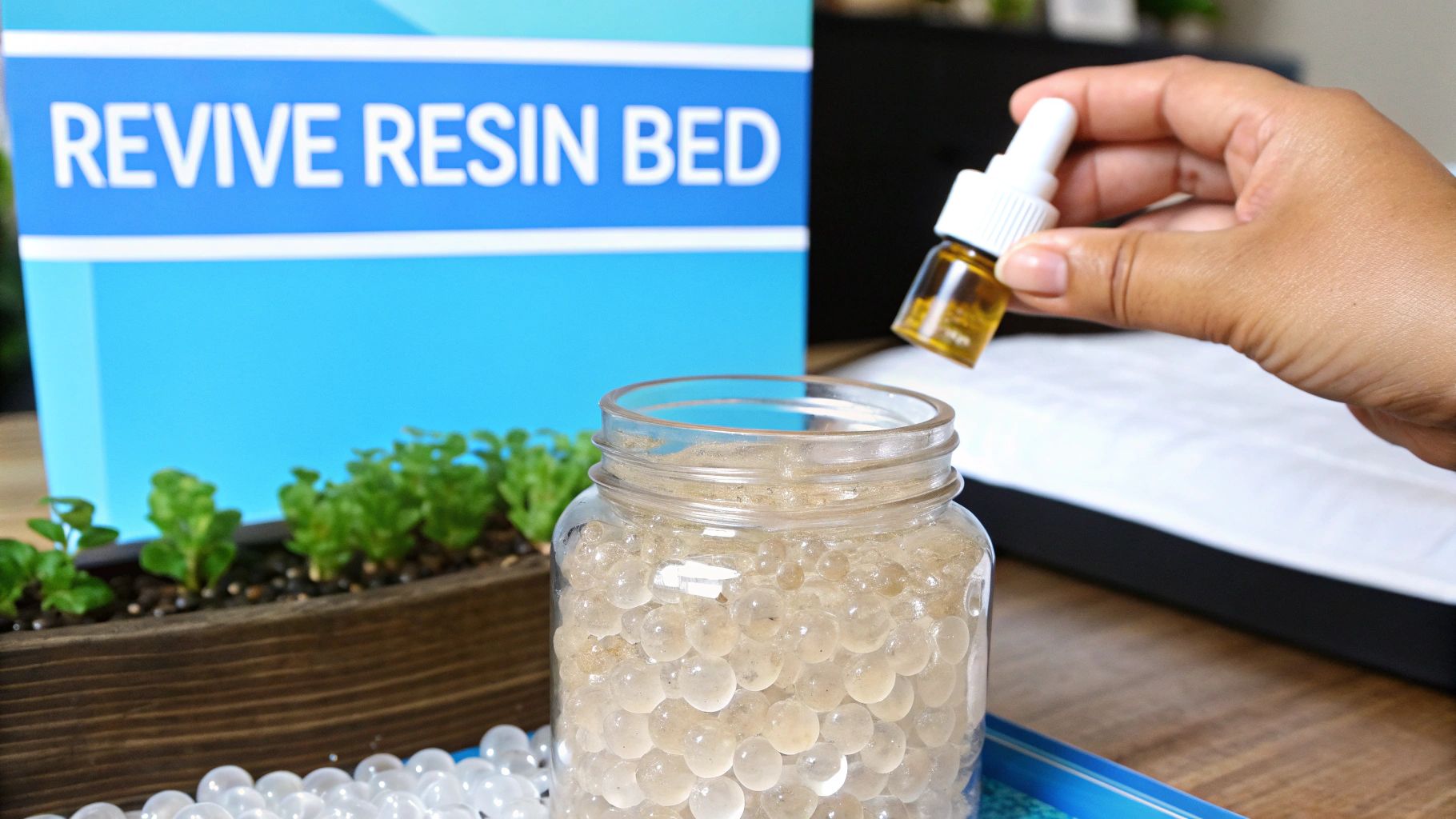
This is a really common issue for homes on well water, since it’s often packed with higher levels of iron that are brutal on resin. If you're noticing your laundry looks dingy, soap scum is making a comeback, or the water just doesn't feel as soft, a fouled-up resin bed is probably the culprit.
Why a Resin Tune-Up Is a Smart Move
Letting a clogged resin bed go is just asking for trouble. It's not just that your water quality drops; the entire system has to work harder to regenerate, which means you're wasting both salt and water. A quick cleaning can bring it right back to life and add years to your softener's lifespan.
Think of it like this: you wouldn't drive your car for years without an oil change and expect the engine to hold up. A resin cleaning is a cheap, easy bit of preventative maintenance that can save you from a massive replacement bill later on.
This simple step in how to maintain water softener performance really pays off. Research shows that well-maintained systems can help appliances last up to 50% longer than those running on hard water, saving you a fortune in repair costs. This is especially true in places with extremely hard water, like the U.S. Southwest, where softener ownership can be over 70% and routine care is absolutely essential. You can find more data about water softening systems on futuremarketinsights.com.
Using a Resin Cleaner Effectively
Thankfully, getting your resin bed back in shape is pretty straightforward. All you need is a good water softener resin cleaner, which is made specifically to break down iron and mineral deposits without damaging the delicate resin beads themselves.
Here’s how you do it:
- Wait for the Right Moment: The best time to add the cleaner is when the salt in your brine tank is running low, right before you toss in a new bag. This helps the cleaner get pulled into the system properly during the next cycle.
- Add the Cleaner: Pour the amount recommended on the bottle right into the brine well. That’s the narrow tube you see inside the main tank. If you can't get to it easily, just pouring it over the remaining salt will also work.
- Kick Off a Manual Regeneration: As soon as you add the cleaner, start a manual regeneration cycle on your softener. This will send the cleaner-and-brine mix through the resin bed, giving it a deep clean and stripping away all that built-up gunk.
Do this just once or twice a year, and you'll keep the core of your water softening system running like new, giving you consistently soft, filtered water for a long time to come.
Fine-Tuning Your Softener's Settings for Ultimate Efficiency
Your water softener's control valve is its brain, but it's not a mind reader. So many people think the settings punched in during installation are set in stone, but that's almost never the case. A "set it and forget it" attitude is a fast track to wasting salt, water, and money.
Life changes, and your water consumption changes right along with it.
Think about a family whose kids just went off to college. All of a sudden, their daily water use can drop by 50% or more. If the softener is still regenerating based on the old, higher-demand schedule, it's literally just flushing salt and water down the drain for no good reason.
This is why getting familiar with your system's settings is a huge part of knowing how to maintain water softener efficiency.
Demand-Initiated vs Timer-Based Regeneration
Most modern softeners run on demand-initiated regeneration. This is a smart system that actually tracks how much water you use and only triggers a cleaning cycle when the resin bed is getting close to full. It’s hands-down the most efficient method because it adjusts to your life—whether you've got a house full of holiday guests or you're gone for a week on vacation.
Older models might use a simple timer, kicking off a regeneration cycle on a fixed schedule, like every Sunday night. It's dependable, sure, but it can be incredibly wasteful if your usage isn't perfectly consistent. If your system has a "metered" or demand-initiated option, switching to it is the single best tweak you can make for your filtration system.
Programming Your Water Hardness Level
Your softener can't do its job right if it doesn't know what it's up against. That means you need to program in your local water hardness level, which is measured in grains per gallon (GPG). You can usually get this number from your city water provider's website, or you can find it yourself with a simple water test kit.
Let's imagine your water hardness is 15 GPG, but your softener is still set to a default of 25 GPG. What happens? Your system will regenerate way too often because it thinks the water is much harder than it really is.
Getting the GPG setting right is fundamental. It tells the softener exactly how much filtration work the resin beads have to do before they need a rinse, making sure every regeneration cycle is truly necessary. This one small adjustment has a direct impact on your salt and water bills.
Adjusting Regeneration Frequency
Even with a smart, demand-initiated system, you often have some control over the regeneration frequency or reserve capacity. This setting basically tells the softener how low to let the "tank" get before scheduling a cleaning.
For example, setting it to regenerate when it hits 20% capacity is a good way to ensure you never get caught with hard water, even after an unusually heavy day of laundry and showers.
Pull out your user manual and see how to adjust these settings. Spending just 15 minutes to dial in your softener to your family's current habits will ensure your home's water filtration runs as efficiently as possible, protecting your plumbing and appliances without wasting a drop.
Common Questions About Water Softener Care
Even with the best routine, questions always come up. Think of this as the troubleshooting guide that turns you from a water softener owner into a water softener pro. These are the most common hiccups I see, and the answers are usually simpler than you think.
How Often Do I Really Need to Add Salt?
There's no single, perfect answer here, but a great rule of thumb is to check the salt level once a month. You're aiming to keep the brine tank at least one-third full. Letting it run completely empty is a big no-no, but you also don't want to overfill it and create those rock-hard salt bridges.
For a typical family of four, you'll probably find yourself adding a new bag of salt every month or two. But if your water is extra hard or your family uses a ton of water, you might be topping it off more frequently. Just keep an eye on it—that’s the real secret.
My Water Suddenly Feels Hard Again. What Do I Check First?
It's always a bummer when you feel that dry, scratchy skin and see spots on your glassware making a comeback. Don't call for service just yet. Before you do anything else, run through this quick checklist.
- Check the Brine Tank: First, is there enough salt? Just as important, is there a solid crust on top? That’s a salt bridge, and it’s stopping the salt from dissolving into the water.
- Find the Bypass Valve: It's easy for this valve to get bumped into the "bypass" position, especially if it's in a high-traffic area. If it is, your water is just skipping the softener completely.
- Look for Power: Is the unit actually on? Check if it's plugged in and if the screen is lit up. You'd be surprised how often this is the culprit.
Honestly, these three simple steps solve the problem more than 90% of the time and will save you the cost of a service call.
A sudden change in water feel is almost always a sign of a simple issue with salt, power, or the bypass valve. Checking these three things first will save you time, money, and a lot of headaches.
Does the Type of Salt I Use Really Matter?
Oh, absolutely. It matters a lot. While you can use any type of water softener salt in a pinch, they are definitely not all the same. Using the right kind is a huge part of keeping your filtration system running well for years.
- Rock Salt: It’s the cheapest, but it’s also the dirtiest. It's full of impurities that will turn into a nasty sludge at the bottom of your tank, meaning more frequent, messy cleanouts for you.
- Solar Salt: This is a good middle-of-the-road option. It's much cleaner than rock salt but can still leave some sediment behind over time.
- Evaporated Salt: This is the good stuff. It's the purest salt you can get, dissolving cleanly with almost no residue. It's the best choice, hands down, for keeping modern, high-efficiency softeners happy.
If you're interested in a wider view of home system care, you can often find helpful parallels. For further insights and tips on home maintenance, check out resources that cover the whole home.
Is Cleaning the Resin Bed Necessary if My Water Is Clear?
Yes, and think of it as cheap insurance for your softener. Even if you don't have iron issues, the chlorine and other tiny sediments in city water slowly build up on the resin beads over time. This makes them less effective. You probably won't even notice the performance drop until it's pretty bad. A quick cleaning with a dedicated resin cleaner once a year keeps those beads working at full capacity and helps you squeeze every last bit of life out of your home filtration system.
At Water Filter Advisor, our goal is to empower you with the knowledge to manage your home's water quality effectively. From choosing the right system to keeping it in peak condition, we provide the expert guidance you need for safer, better-tasting water. Discover more at https://www.waterfilteradvisor.com.
- November 14, 2025
- 0
- Uncategorized
