
You've changed shampoos. You've bought the scalp serum. You've cut back on heat styling. Yet your hair still feels rough after every shower, your scalp feels tight, and the drain keeps collecting more strands than you'd like.
That's usually when people start looking for the best shower filter for hair loss. The mistake is assuming there's one universal winner.
There isn't.
A shower filter only helps when it targets the problem in your water. Chlorine needs one kind of performance. Chloramine is a different challenge. Hard water minerals create a different set of hair and scalp complaints. If you buy a filter based on marketing instead of water chemistry, you can end up with a nice-looking fixture that changes very little.
Here's the practical way to think about it. Start with what your water is doing to your hair, then match the filter media and model to that issue. That's how you get a result you can feel in the shower and see in the mirror.
| Water problem | What it often feels like | Filter priority | Better fit |
|---|---|---|---|
| Chlorine in municipal water | Dry hair, irritated scalp, faded color, chemical smell | Strong disinfectant reduction | Filters with proven chlorine reduction |
| Chloramine-treated city water | Persistent dryness and irritation despite a basic filter | Media that can handle chloramine, not just chlorine | More advanced multi-media designs |
| Hard water minerals | Dull texture, residue, poor lather, tangling | Treatment aimed at mineral-related issues | Shower filters designed for hard water support, or a whole-home softener if hardness is severe |
| Mixed contaminants | Hair feels coated and scalp feels off at the same time | Broad contaminant coverage | Higher-performing shower filters with tested reduction claims |
The Surprising Link Between Your Shower and Hair Thinning
The shower isn't typically blamed at first. Blame often falls on age, stress, hormones, bad luck, or the newest product that didn't live up to the label.
That makes sense. Hair shedding and breakage are messy problems because several things can be true at once. Someone can have normal daily shedding, some product buildup, and a water issue all at the same time. The shower water often gets missed because it feels ordinary. It's part of the background.
But water quality can change how your scalp feels, how your hair shaft behaves, and how well your products rinse away. Chlorine has been part of public water disinfection since the early 1900s, and many households in the 2020s still deal with chlorine or chloramine in shower water. That means daily exposure is still a real home comfort issue, especially for hair and scalp care.
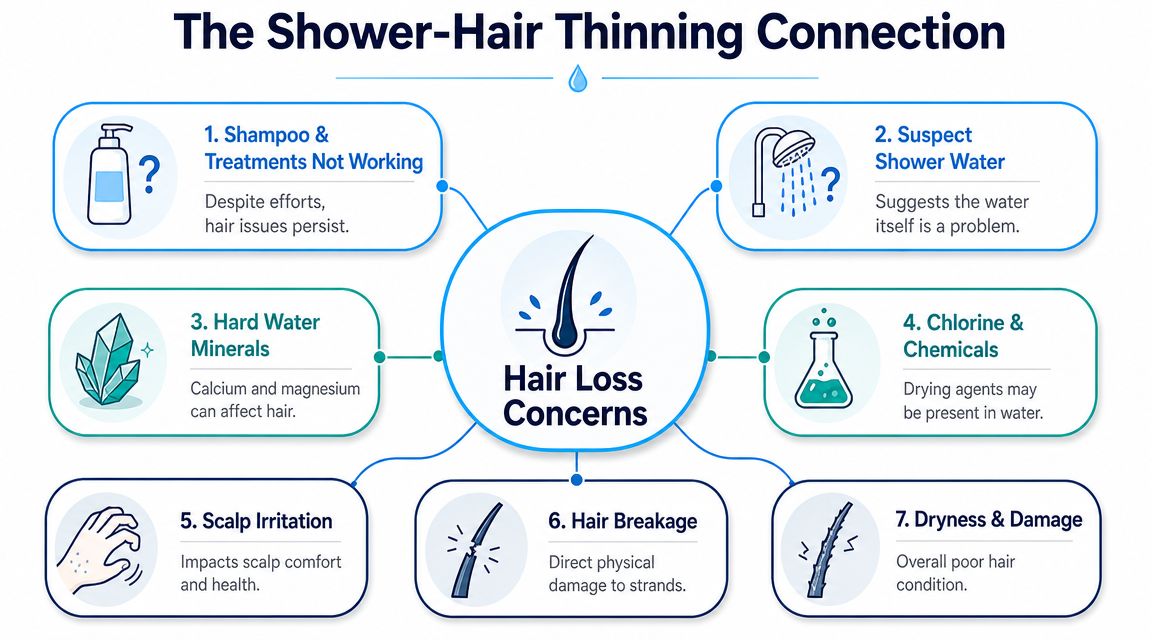
What filtered shower water may actually change
A 2026 Afina article cited a study reporting a 23% reduction in hair shedding after 8 weeks of filtered shower use and a 47% improvement in scalp hydration among participants with dry scalp, which supports the idea that better shower water can improve the scalp environment even if it won't reverse genetic hair loss (Afina on filtered showerheads and balding).
That's the key distinction. A shower filter is not a regrowth treatment for hereditary baldness. It's a home water treatment tool that may reduce one source of ongoing stress on your hair and scalp.
Practical rule: If your hair feels worse right after washing than it does before washing, the water deserves scrutiny.
That matters because “hair loss” is often a catch-all phrase. Some people are seeing true thinning. Others are dealing with breakage that makes hair look thinner. Others have scalp irritation that makes the whole situation feel more dramatic. If you're also researching the medical side, this guide to understanding male hair loss treatments helps separate water-related support from treatments meant for pattern hair loss.
For many households, the first useful clue is simple. If your scalp feels calmer and your hair feels less coated after washing with filtered or lower-mineral water, your shower may be part of the problem. If hard water is on your radar, it also helps to review these hard water effects on skin and hair so you can tell buildup apart from true scalp sensitivity.
Decoding Your Water What's Really Hurting Your Hair
You move into a new place, keep the same shampoo, and within two weeks your hair feels rougher, your scalp gets tighter after every shower, and the drain suddenly looks more alarming. That pattern usually points to the water.
A shower filter only helps when it matches the problem in your supply. “Best” is not a brand name or a price tier. It is the filter media that fits what is coming out of your showerhead.
Chlorine and chloramine
City water often contains chlorine or chloramine. They are not interchangeable from a filtering standpoint.
Chlorine is the easier one to spot. Hair may feel stripped after rinsing, the scalp can feel dry or squeaky, and hot water may release a noticeable pool-like smell. Color-treated hair often loses its soft feel faster in chlorinated water because repeated washing leaves the cuticle less comfortable and more prone to dryness.
Chloramine is more stubborn. Utilities like it because it remains stable longer as water moves through the system. The problem for shoppers is simple. Plenty of shower filters reduce chlorine reasonably well, but fewer are designed to deal with chloramine effectively. If your area uses chloramine, a basic carbon cartridge may not give you the relief you expected.
That is why water reports matter. Before buying a filter, check your utility's annual report or ask directly which disinfectant they use.
Hard water minerals
Hard water creates a different set of complaints. Instead of a stripped feeling, it usually leaves buildup behind.
Calcium and magnesium can make hair feel coated, dull, stiff, or harder to rinse clean. They also make shampoo lather poorly, so people often use more product and still feel like their hair is not fully clean. On the scalp, that combination can leave residue, dryness, and itching that gets blamed on the wrong product.
If those signs sound familiar, this guide to choosing a shower filter for hard water can help you judge whether a shower filter is enough or whether your home is really a better candidate for a softener.
Heavy metals and sediment
Heavy metals and sediment are less obvious, but they still matter.
Sediment often shows up as visible grit, discoloration, or cartridges that clog faster than expected. Heavy metals are harder to confirm without a water test, and that is exactly why they get missed. Homeowners buy a filter for chlorine, assume they covered everything, and then wonder why their hair still feels off.
When people say a shower filter “did nothing,” the usual issue is mismatch. They chose a chlorine-focused filter for water that is mainly hard, chloramine-treated, or full of sediment.
One practical clue is timing. If your hair and scalp changed after a move, after municipal water work, or after switching from well water to city water, test the water before blaming your shampoo. Hair thinning can have several causes at once, so it also helps to rule out non-water factors. My Transformation for hair confidence offers a useful overview of other reasons hair may start falling out.
The main takeaway is straightforward. Chlorine, chloramine, and hard water do not affect hair in the same way, and they are not handled by the same filter design. Matching the filter to your water chemistry gives you a much better shot at calmer scalp skin, cleaner-feeling hair, and less breakage from day-to-day washing.
Shower Filter Technologies Compared for Scalp Health
Two shower filters can look nearly identical and perform very differently on your hair. The deciding factor is the media inside the cartridge, how that media reacts with your water, and whether the filter was built for chlorine, chloramine, or a lighter cleanup job.
That is the part shoppers miss. A polished housing does not tell you if the filter can handle your actual water problem.
Shower Filter Media Comparison
| Filtration Media | Best For Removing | Less Effective Against | Notes |
|---|---|---|---|
| KDF | Chlorine support, some heavy metal reduction | Hard water softening, broad-spectrum removal by itself | Common in multi-stage shower filters. Usually more useful in a blend than as the only media. |
| Activated carbon | Chlorine, odor, some organic compounds | Hot-water performance in some shower setups, hard minerals | Familiar and useful, but shower flow rates can limit contact time. |
| Catalytic carbon | Chloramine and tougher disinfectant reduction than standard carbon | Hardness minerals | A stronger option when the utility uses chloramine instead of free chlorine. |
| Vitamin C | Chlorine and often chloramine neutralization | Sediment, mineral scale by itself | Fast-acting for disinfectants. Usually not enough if minerals are the main issue. |
| Calcium sulfite | Chlorine reduction in shower conditions | Hardness minerals, broad contaminant reduction | Popular in shower filters because it reacts quickly in warm water. |
How these media perform in actual showers
KDF has a place, especially in mixed-media cartridges. It can help reduce chlorine and can support reduction of some metals. I do not treat it as a complete answer on its own. If a filter leans heavily on KDF and says little about chloramine performance, I assume it is better suited to standard chlorine-treated water than to a tougher municipal supply.
Activated carbon can work well, but shower conditions are not gentle. Hot water and higher flow shorten contact time, which is why some carbon-based shower filters disappoint even though carbon performs well in kitchen filters. Good design matters as much as the media itself.
Catalytic carbon is the better pick when chloramine is the main problem. Standard carbon can struggle there. If your city uses chloramine and your scalp still feels irritated after trying a basic chlorine filter, this is one of the first upgrades I would look at.
Vitamin C and calcium sulfite are both practical disinfectant-focused options. They act quickly, which suits shower use. They are helpful for hair that feels dry, rough, or over-stripped after washing. They do very little for true hard water.
What shower filters usually cannot do
A shower filter is rarely a substitute for a real water softener. Some cartridges can reduce a small amount of scale-related effect or make water feel better on the skin, but they do not remove hardness minerals the way ion exchange softening does.
That trade-off matters. If your main problem is chlorine smell, a well-matched shower filter can make a noticeable difference for scalp comfort and hair feel. If your main problem is heavy scale, soap that will not lather, and constant white buildup on fixtures, a shower filter alone is usually the wrong tool.
Field note: Dry, stripped hair points toward disinfectants. Sticky residue, tangling, dullness, and poor lather point toward minerals. The filter should match that pattern.
For readers comparing cartridges and media claims, Water Filter Advisor's shower filter resources can help you check whether a product is aimed at chlorine reduction, chloramine reduction, or a more limited cosmetic improvement.
Top Shower Filter Models for Hair and Scalp in 2026
Model recommendations make sense only when they're tied to a use case. A filter that performs beautifully in a high-chlorine city may be a weak fit for someone whose main issue is stubborn hard water residue.
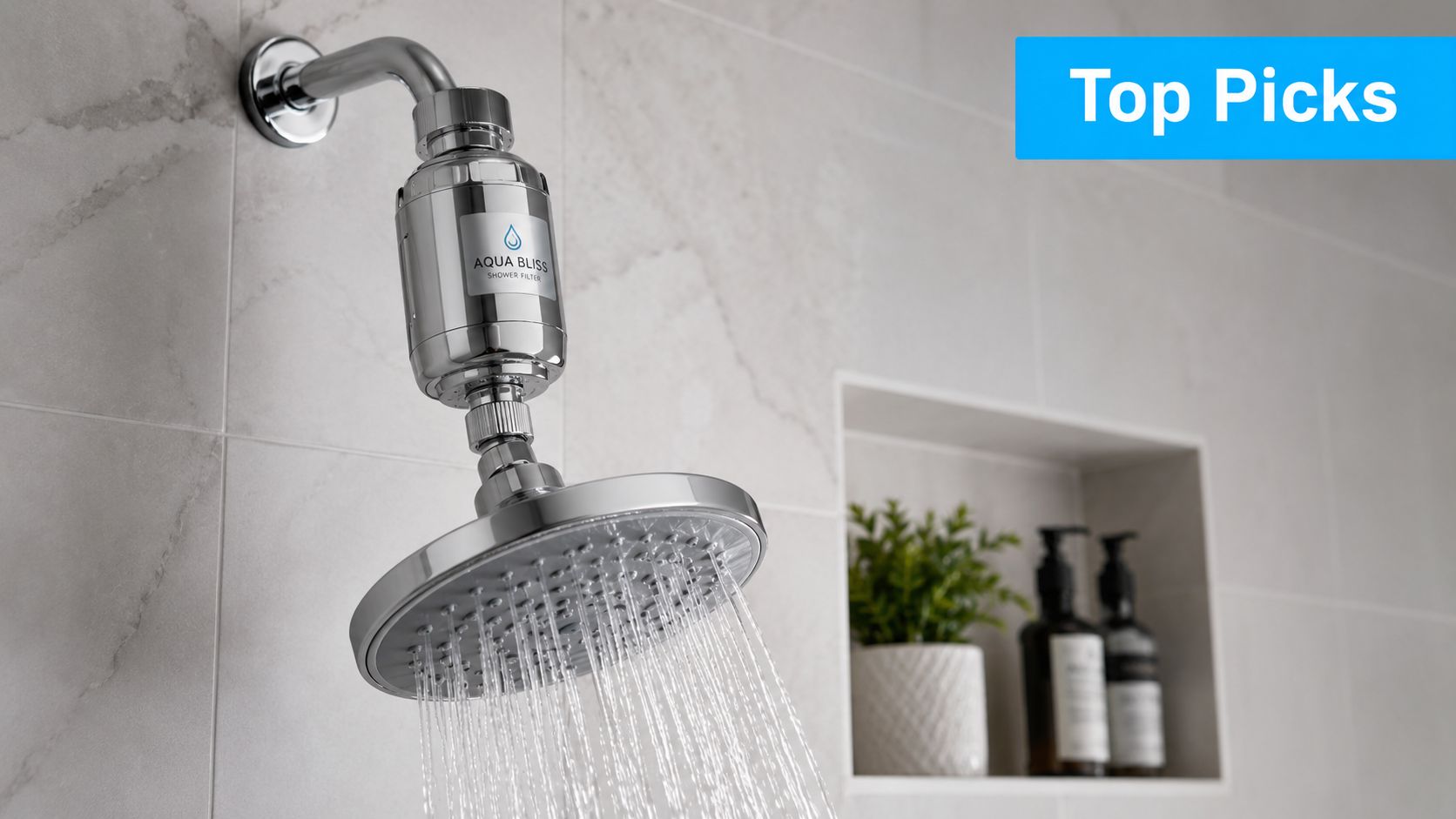
In a 2026 data-driven review, the Weddell Duo completely removed chlorine, was one of only two filters in that comparison to eliminate disinfection byproducts, and the Canopy Shower Filter reduced chlorine by 97% from 2.7 ppm to 0.06 ppm, showing that the gap between top performers and average performers is real, not cosmetic (Water Filter Guru shower filter review data).
Best for high-chlorine municipal water
Weddell Duo stands out when chlorine is the obvious enemy. If you live in a city system, smell disinfectants during hot showers, or deal with hair that feels brittle after washing, this is the type of performance you want to prioritize.
The practical appeal isn't just “cleaner water.” It's the combination of full chlorine removal and stronger contaminant reduction in testing. For hair and scalp shoppers, that matters more than a long list of vague wellness claims.
Best all-around upgrade for many households
Canopy Shower Filter makes sense for people who want a strong, measurable improvement but may not need the absolute top performer for every contaminant class. A 97% chlorine reduction is a meaningful result because it shows real treatment, not just a nicer spray pattern.
If your hair is dry, your scalp tends to feel irritated, and you want a simple shower-focused upgrade rather than a broader plumbing project, this is the kind of profile worth considering.
Best when hard water is the bigger problem
Shoppers should give this careful consideration. A shower filter can help with some hard-water-related hair complaints, but it usually won't replace a softener in a hard water home.
For mineral-heavy water, I look for shower filters that explicitly address hard water support and pair that with realistic expectations. If your hair feels coated, your shampoo doesn't lather well, and the bathroom shows scale everywhere, the right answer may be a two-part plan:
- Use a shower filter for disinfectants and general shower comfort.
- Consider a whole-home softener if mineral buildup is severe.
- Add a clarifying or chelating hair routine while you address the water source.
That hybrid approach is often more effective than asking one shower cartridge to solve every water problem in the house.
A quick product walkthrough can help you see the design differences that marketing blurbs tend to hide.
What to avoid when shopping
Some products sell “multi-stage” as if stage count equals performance. It doesn't. A filter can have many layers and still underperform if the media mix is weak or the contact time is poor.
Watch for these red flags:
- No contaminant focus: If the product says it's good for everything, it probably isn't.
- No clear media information: You should know what's inside the cartridge.
- No testing language: Even qualitative test discussion is better than a page full of beauty copy.
- Hard water promises that sound absolute: Most shower filters treat. They don't soften.
If you're trying to find the best shower filter for hair loss, the safer question is this. Which model has the strongest evidence for the contaminants most likely affecting my hair and scalp?
Installing and Maintaining Your New Shower Filter
Most shower filters are easier to install than people expect. If you can unscrew a showerhead, you can usually install one.
The standard setup is simple. Remove the existing showerhead, wrap plumber's tape if the manufacturer recommends it, thread the filter onto the shower arm, then reattach the showerhead if you're using an inline unit. Hand-tight is often enough, though an adjustable wrench can help if the old fitting is stubborn.
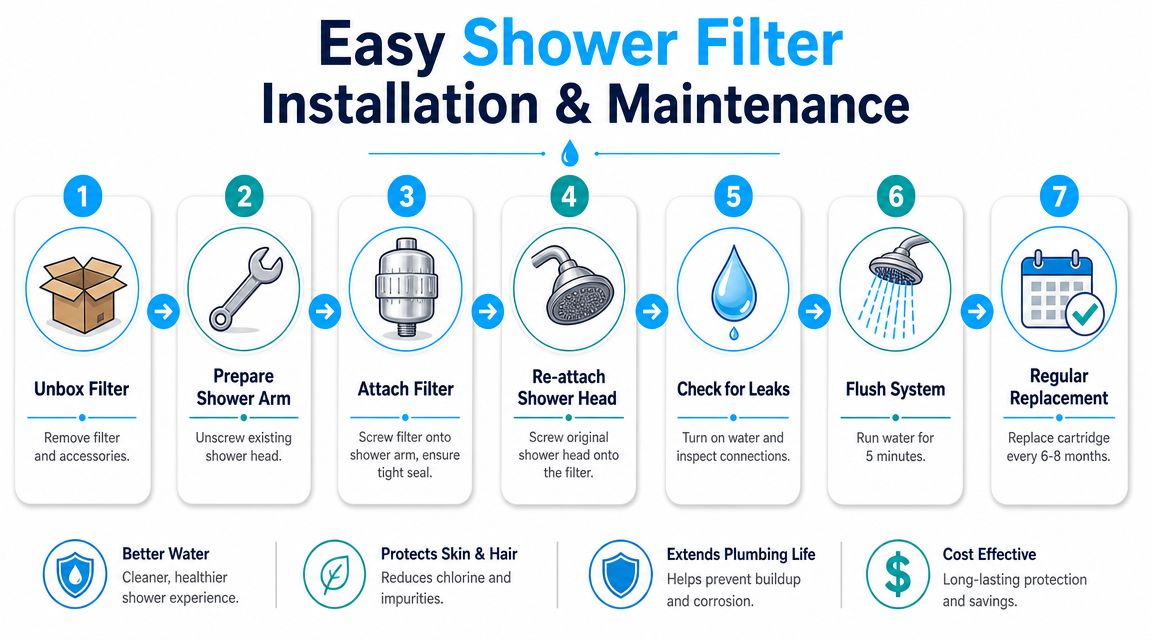
A clean install matters
After installation, run water through the unit before your first real shower. New cartridges often need a brief flush. That clears loose carbon fines or manufacturing dust and lets you check for drips around the threads.
Then pay attention to orientation. Some inline filters have a clear top and bottom. Install them backward and performance can suffer, even if water still flows.
Don't judge a new shower filter by the first minute of water. Flush it, check the seal, then evaluate it over several showers.
Maintenance decides whether the filter keeps helping
A neglected shower filter becomes a nice-looking reminder that cartridges don't last forever. As media gets spent, disinfectant reduction drops and performance becomes inconsistent.
The signs usually show up before people connect them to the cartridge:
- Hair starts feeling rough again
- The old chlorine smell returns
- Water flow changes noticeably
- Scalp irritation creeps back
- The cartridge shows visible discoloration or sediment loading
Follow the replacement interval from the manufacturer, and shorten it if your water is especially challenging. Homes with more sediment, stronger disinfectant residuals, or heavy daily use will wear cartridges out faster.
Cost of ownership is part of the purchase
A cheap housing with expensive cartridges can be more frustrating than a higher-priced unit with straightforward maintenance. Before buying, check three things:
- Replacement cartridge availability so you're not hunting around later.
- How easy the cartridge is to swap because awkward systems often get neglected.
- Whether the filter fits your shower type so you don't end up forcing adapters into a rental bathroom.
The best shower filter for hair loss isn't just one that works on day one. It's one you'll maintain on time.
How to Tell if Your Shower Filter Is Working
The fastest test is your own shower routine. Hair and scalp usually tell you something before a lab report does.
Subjective signs that matter
Look for changes in feel, not miracles. Hair may feel less straw-like when wet. The scalp may feel less itchy after rinsing. Shampoo may lather and rinse more normally, especially if disinfectants were interfering with comfort and product performance.
You may also notice that conditioner leaves hair smoother instead of fighting through a coated surface. That's often one of the earliest practical wins.
Simple ways to verify performance
For chlorine-focused filters, chlorine test strips are a smart home check. Test the unfiltered tap or tub spout water if possible, then compare it with shower output after the filter. It won't give you a full contaminant profile, but it can confirm whether the filter is still doing the job it was bought to do.
A few habits make the results more useful:
- Test at the same time of day because water conditions can shift.
- Use hot and warm settings consistently if that's how you shower.
- Retest after cartridge changes so you know your baseline.
- Keep brief notes on scalp feel, hair texture, and any chlorine odor.
The best confirmation is a match between what you feel and what you can measure. If both improve, the filter is earning its place.
If the filter tests fine but your hair still feels bad, revisit the diagnosis. You may be dealing with hard water, product buildup, or a hair-loss issue that isn't mainly caused by shower water.
Frequently Asked Questions About Shower Filters
Will a shower filter reduce water pressure
Sometimes a little, but a good design shouldn't turn your shower into a trickle. If your pressure is already weak, the plumbing may be the bigger issue. For that side of the problem, this guide on how to resolve low shower pressure with Voyager is worth reading before you blame the filter.
Do shower filters work with hot water
They're built for shower conditions, but media still responds differently under heat and fast flow. That's one reason performance varies by design. A filter that sounds impressive on paper may do less in a real hot shower than shoppers expect.
Can renters install them
Usually yes. Most inline and showerhead-replacement filters screw onto standard fittings and can be removed when you move out. That makes them one of the more renter-friendly water upgrades.
Do shower filters soften water
Usually not in the true plumbing sense. They may improve how hard water feels and reduce some associated complaints, but severe hardness usually needs a dedicated softener.
Will a shower filter regrow hair
No. A shower filter can improve water quality, which may reduce dryness, irritation, and breakage-related thinning for some people. It won't reverse genetic hair loss. Think of it as removing one avoidable source of stress, not replacing medical treatment.
What's the smartest way to choose one
Start with your water source. City water often points to chlorine or chloramine. Visible scale and poor lather point to hard water minerals. From there, choose a filter with media and test evidence that fit that problem.
If you want help comparing shower filters by contaminant type, maintenance needs, and real-world use, Water Filter Advisor offers practical guides that make it easier to choose a system that fits your home instead of chasing generic “best” lists.
- May 23, 2026
- Uncategorized
