In a word: Absolutely. When your reverse osmosis (RO) system is running as it should, it's one of the most powerful shields you can have against bacteria in your drinking water.
The secret sauce is its semipermeable membrane. This isn't just a simple strainer; it's a high-tech barrier with microscopic pores so ridiculously small that bacteria are stopped cold. Think of it as an elite bouncer for your water line—only the pure H₂O molecules get on the guest list.
Why Reverse Osmosis Is a Powerhouse Against Bacteria
When you're after truly pure water straight from your tap, few things offer the peace of mind of a reverse osmosis system. It’s more than just another filter; it’s a physical barricade that operates at a microscopic level, creating a formidable defense against all sorts of nasty waterborne germs. It doesn't just filter—it actively rejects the contaminants that could make your family sick.
The secret is simple: size matters. The pores in an RO membrane are a minuscule 0.0001 microns. Common household bacteria are literally thousands of times bigger than that.
A reverse osmosis membrane acts like a high-security checkpoint for your water. Only the smallest, purest water molecules are granted entry, while larger intruders, including virtually all bacteria, are turned away.
Comparing RO Pore Size to Bacteria
To really appreciate why RO is so dependable, you have to get a feel for this massive size difference. Let’s put it into perspective for your home.
A quick look at how the tiny pores of an RO membrane stack up against common waterborne bacteria, showing exactly why it's so effective.
Reverse Osmosis vs Common Household Bacteria
| Item | Typical Size (in microns) | Can it Pass Through an RO Membrane? |
|---|---|---|
| RO Membrane Pore | 0.0001 | N/A |
| E. coli Bacterium | 0.25 to 1.0 | No Way |
| Salmonella Bacterium | 0.7 to 1.5 | Not a Chance |
| Legionella Bacterium | 0.5 to 1.0 | Absolutely Not |
| Campylobacter Bacterium | 0.2 to 0.9 | Nope |
As you can see, bacteria like E. coli or Salmonella are absolute giants next to the openings in an RO membrane. It's physically impossible for them to squeeze through. This simple principle is what makes RO technology a cornerstone of water purification for homes everywhere.
And this isn’t just theory; its effectiveness is well-proven. Scientific studies consistently show RO systems are superior at removing bacteria. In fact, comprehensive reviews have found that RO can slash bacterial counts by about 99.997 percent—a stunning figure that highlights just how well it safeguards your water. Even the CDC ranks it as having the highest efficiency for pathogen reduction among home systems. You can learn more about the research on RO performance if you want to dig into the data.
This incredible removal rate is why so many people trust RO, especially if they’re on well water or just don’t trust their city’s supply. It’s not just about making water taste better; it’s about having a reliable shield against threats you can’t even see.
How Reverse Osmosis Physically Blocks Bacteria
So, how does a reverse osmosis (RO) system actually stop something you can't even see? It's not magic, it’s a brilliant but straightforward process that all comes down to a simple principle: size matters. At its heart, an RO system is like an ultra-strict bouncer, and its secret weapon is the semipermeable membrane.

Think of it like a high-security door with a mail slot. A tiny water molecule is like a thin sheet of paper—it slips right through without a problem. But a bacterium? That's a bulky package that gets stopped dead in its tracks. It's a game of force and size, and only the smallest get through.
Let's break down the science behind this, starting with that all-important membrane and its unbelievably small pores.
The Microscopic Gatekeeper: The Semipermeable Membrane
The real hero in any RO system is its semipermeable membrane, a true feat of material science. This isn't your average filter screen. It’s a specialized sheet of synthetic material, tightly wound and engineered with pores of a specific, microscopic size.
Just how small are we talking? These pores measure around 0.0001 microns. To give you some perspective, a single human hair is about 75 microns thick. That means the pores in an RO membrane are a staggering 750,000 times smaller. This incredible scale is what makes the system an absolute fortress against bacteria.
Now, let's compare that pore size to some common waterborne bacteria:
- E. coli is typically between 0.25 to 1.0 microns in size.
- Salmonella is even bigger, usually measuring 0.7 to 1.5 microns.
- Legionella, the culprit behind Legionnaires' disease, is around 0.5 to 1.0 microns.
It’s pretty clear from these numbers—even the tiniest bacteria are hundreds, if not thousands, of times larger than the membrane's pores. They simply can't squeeze through. It's a physical impossibility.
The whole process is mechanical, not chemical. The membrane doesn’t kill the bacteria; it just physically blocks them, much like a window screen keeps bugs out of your house. The bacteria and other rejected gunk are then simply flushed down the drain.
The Power of Pressure: Forcing Water Through
Of course, a high-tech membrane is only half the story. To get the pure water molecules to separate from all the contaminants, you need a driving force. That's where your home's water pressure steps in.
The name "reverse osmosis" clues you into how it works. In nature, osmosis is the tendency for water to move from a less concentrated solution to a more concentrated one to find balance. An RO system does the exact opposite—it reverses that natural process.
Using your household water pressure (usually 40 to 60 PSI), the system shoves the untreated water up against the semipermeable membrane. This pressure is just right to force the tiny water molecules through those microscopic pores, leaving the much larger bacteria, viruses, salts, and other impurities behind. This stream of concentrated contaminants is then washed away as wastewater.
What you get on the other side is exceptionally pure water. It's a constant battle of pressure against a microscopic barrier, ensuring only the good stuff makes it into your glass. Understanding this one-two punch—the ultra-fine membrane and steady pressure—makes it easy to see why reverse osmosis is one of the most trusted ways to get bacteria-free water at home.
Why the Whole System is a Big Deal
The reverse osmosis membrane might be the star player, but it can't win the game alone. A great RO system is more like a well-drilled team, where every filter works together to deliver pure, safe water. If you want to know if RO can really keep bacteria out for the long haul, you have to look at the entire setup.
Think of the RO membrane as a world-class surgeon. You wouldn't want them operating in a filthy room without any nurses or anesthesiologists, right? The other filters in the system are that essential support crew, prepping the water so the membrane can do its job perfectly.
The Unsung Heroes: Pre-Filters
Before water even gets a chance to meet the delicate RO membrane, it first has to get past a couple of tough "bodyguards" called pre-filters. These initial stages are absolutely critical for protecting the membrane and ensuring the system can block bacteria day in and day out. Without them, the whole operation falls apart.
The most common pre-filters you'll find in a home system are:
- A Sediment Filter: This is your first line of defense. Its one and only job is to snag bigger particles like sand, rust, silt, and general gunk. It’s a simple filter, but it prevents the more advanced filters—and especially the RO membrane—from getting clogged up and overwhelmed.
- A Carbon Block Filter: Think of this stage as the chemical cleanup crew. Its main target is chlorine, which your city uses to disinfect the water supply. Chlorine is great for killing germs in the pipes, but it’s a killer for RO membranes. It basically corrodes the delicate surface and can destroy the microscopic pores, making the membrane's bacterial barrier totally useless.
By taking out these big threats first, the pre-filters are the gatekeepers that make sure the RO membrane gets water that's clean enough for it to work its magic on a microscopic level. Skipping pre-filter maintenance is like firing the security detail—you're leaving your most valuable asset completely exposed.
Protecting the Core Bacterial Barrier
The health of your pre-filters is directly tied to the RO membrane's ability to stop bacteria. A clogged-up sediment filter can choke off water pressure, which makes the whole reverse osmosis process sluggish and less effective. Even worse, if you let the carbon filter get old and used up, chlorine will slip right through and literally eat holes in the membrane, creating openings big enough for bacteria to cruise on through.
"An RO system is a chain of trust. Every stage, from the first sediment filter to the final polishing filter, has a job to do. If one stage fails, the whole system is compromised, and that reliable barrier you counted on is gone."
This is exactly why sticking to a regular filter replacement schedule is so non-negotiable. It’s not just about making the water taste good; it’s about making sure the physical barrier that stops bacteria stays strong and intact. When the pre-filters are doing their job, the RO membrane can focus on what it does best: kicking out those microscopic contaminants.
The Final Polish: Post-Filtration
After the water is squeezed through the RO membrane and purified, it usually hangs out in a small storage tank under your sink before it gets to your faucet. The very last step on its journey is often a post-filter, which is typically another carbon filter.
This final filter isn't really involved in removing bacteria, but it's key to making sure the water tastes crisp and clean. Since purified water sits in that tank, it can sometimes pick up a flat or stale taste. The post-filter gives the water one last "polish," scrubbing away any lingering tastes or odors before it fills your glass. It’s the finishing touch that guarantees every sip is as refreshing as it is safe.
Common RO System Weaknesses and How to Fix Them
A reverse osmosis system is incredibly reliable, but like any piece of equipment in your home, its performance depends on every single part doing its job. Think of it as a fortress—the walls might be impenetrable, but a small, unguarded gate can compromise the entire structure.
Knowing where these potential weak points are isn't meant to scare you. It’s all about empowering you to keep your system running in top condition. The RO membrane is the heart of the whole operation, but tiny issues elsewhere can create a bypass for contaminants. A worn-out O-ring or a tiny crack in a filter housing is all it takes for untreated water to sneak past the filters and mix right back in with your purified water.
Tiny Leaks, Big Problems
It’s easy to get hung up on the high-tech membrane, but often it's the simplest parts that need the most attention. Those little rubber O-rings create the watertight seals between the filter housings and caps, and they can get brittle and degrade over time. If one fails, it creates an invisible channel for unfiltered water to slip right past the membrane.
Likewise, the plastic housings that hold your filters can develop hairline cracks. This usually happens from over-tightening or just from years of wear and tear. Even a crack you can barely see is more than big enough for bacteria to get through, completely defeating the purpose of the system.
The most common points of failure in a home RO system aren't the advanced components; they're the basic seals and connectors. Regular visual checks are your first line of defense against a system that looks fine but isn't providing the protection you expect.
This diagram shows the typical path water takes through an RO system, highlighting how each stage builds on the last.
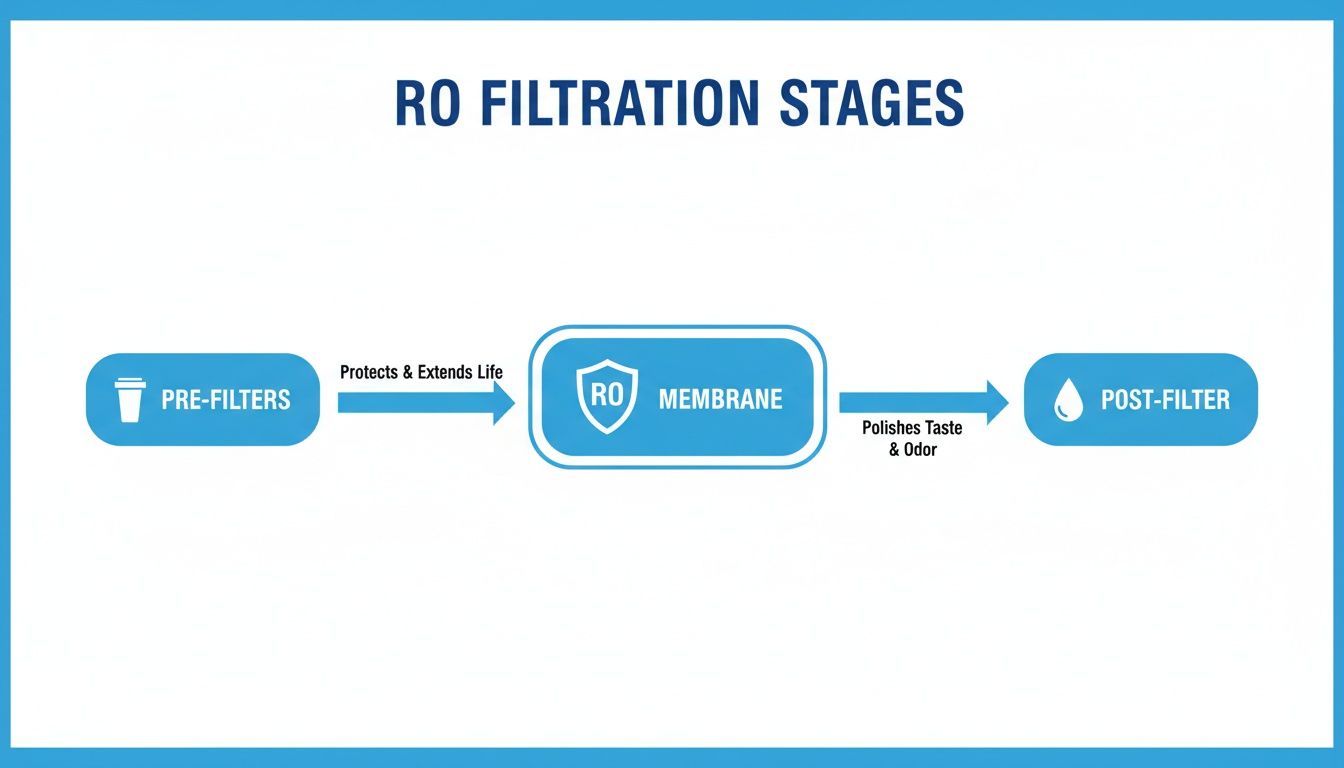
As you can see, if a seal fails before or after that central RO membrane, contaminants can get right back into the water stream, bypassing the whole purification process.
The Challenge of Biofouling
Another potential issue to watch for is something called biofouling. While the RO membrane is fantastic at blocking bacteria, it doesn't actually kill them. Over time, bacteria and other gunk from your source water can build up on the surface of the membrane, creating a slimy layer known as a biofilm.
This biofilm can cause a few headaches in your home system:
- It clogs the membrane's pores, which slows down your water flow and makes the system less efficient.
- In really bad cases, the biofilm can start to degrade the membrane material itself.
- Most importantly, if the system isn't maintained, bacteria from that biofilm could find a way into the clean water side, especially if there are any pressure changes.
Biofouling is more common if you're on well water or if the pre-filters aren't being changed on schedule. Regularly sanitizing your system, just like the manufacturer recommends, is the best way to prevent this slimy buildup.
Simple Fixes for a Secure System
The good news? Preventing these problems is pretty straightforward. You don't need to be a professional plumber to keep your RO system secure. A few simple checks as part of your regular home maintenance will keep that bacterial barrier strong.
Here are the key things to do:
- Do Regular Visual Checks: Once a month, grab a flashlight and take a quick look under your sink. Check for any drips or moisture around the filter housings and all the connections.
- Replace O-Rings with Your Filters: When you change your pre-filters, swap out the O-rings, too. Most filter replacement kits come with new ones for exactly this reason. A fresh, lubricated O-ring makes a perfect seal.
- Don't Overtighten the Housings: When you put the housings back on, tighten them until they're snug, but don't crank on them with all your might. Hand-tight is usually all you need. Overtightening is the number one cause of cracked housings.
- Stick to the Sanitization Schedule: Mark your calendar for the manufacturer's recommended sanitizing interval—usually about once every 12 months. This quick process kills any microbial growth inside the system and keeps everything fresh.
Your Guide to Keeping Your RO System in Top Shape
Think of your reverse osmosis system less like a household appliance and more like a high-performance engine for your water. Just like any engine, it needs regular tune-ups to keep running smoothly. If you want that bacterial barrier to stay strong, consistent maintenance isn't just a suggestion—it's absolutely essential.
The good news? This isn't some complex plumbing job. It’s really just about following a simple schedule. By staying on top of filter changes and the occasional deep clean, you ensure that the answer to "will reverse osmosis remove bacteria?" is always a confident "yes."
Your Maintenance Playbook
The user manual that came with your system is always the best place to start, but most residential RO units follow a pretty standard filter replacement schedule. It's critical to stick to this timeline. Why? Because old, exhausted filters don't just stop working—they can actually become a problem, either turning into a breeding ground for bacteria or letting chlorine slip through and wreck the delicate RO membrane.
We recommend setting calendar reminders so you never miss a swap.
Consistent upkeep is the single most important factor in maintaining your RO system’s microbiological safety. A neglected system is an unreliable one, plain and simple.
Here’s a general schedule for a typical under-sink system you might have in your kitchen.
Typical RO Filter Replacement Schedule
Following a regular replacement plan ensures every part of your system is working to protect the all-important RO membrane, which does the heavy lifting of blocking bacteria.
| Filter Type | Typical Replacement Frequency | Primary Function |
|---|---|---|
| Sediment Pre-Filter | Every 6-12 months | Protects other filters from sand, rust, and silt. |
| Carbon Pre-Filter(s) | Every 6-12 months | Removes chlorine to protect the RO membrane. |
| RO Membrane | Every 2-4 years | The core filter that physically blocks bacteria and dissolved solids. |
| Carbon Post-Filter | Every 12 months | Polishes the water for taste and odor after storage. |
Sticking to this routine is the best way to guarantee performance. For more detailed guides on different systems, you can find a ton of practical advice on filter maintenance and replacement.
Don't Forget to Sanitize the System
Swapping filters is only half the battle. It's also vital to sanitize the entire system every so often. Remember, while the RO membrane removes bacteria, it doesn't actually kill it. Over time, a slimy biofilm can start to build up on the "dirty" side of the membrane and even inside the storage tank or water lines.
Sanitizing your system—usually about once every 12 months—is a simple process. It involves running a special sanitizing solution through the whole unit, which kills off any microbial growth and keeps the internal pathways clean. This is your best defense against re-contamination, and most manufacturers sell easy-to-use kits for this exact job.
A Special Note for Well Water Users
If your home's water comes from a private well, you'll want to be extra diligent with your maintenance routine. Unlike city water, well water isn't treated with disinfectants, which means the type and amount of bacteria can change, especially after heavy rain.
For well owners, getting your water tested periodically is a smart move. An affordable water test accomplishes two critical things:
- It Verifies Performance: The test confirms your RO system is doing its job and effectively removing bacteria and any other contaminants unique to your well.
- It Gives You Peace of Mind: You get documented proof that your family's drinking water is safe, taking all the guesswork out of the equation.
By combining a consistent maintenance schedule with occasional testing, you create a powerful defense. This proactive approach ensures your RO system delivers on its promise of safe, bacteria-free water for years to come.
Adding UV Purification for Ultimate Protection
Think of a top-tier reverse osmosis system as a fortress for your water. If that’s the case, then adding an Ultraviolet (UV) purifier is like posting elite guards at the final gate. While a well-maintained RO system is incredible at physically blocking bacteria, a UV sterilizer provides a powerful second line of defense, creating a nearly foolproof barrier against anything living in your water.
This combination gives you the ultimate peace of mind, especially if you can’t afford any risk of contamination. The two technologies are a perfect match. The RO system strips out sediments and chemicals, which makes the water crystal clear and allows the UV light to do its job with maximum impact.
How UV Light Zaps Bacteria
Unlike an RO membrane that acts like a physical wall, a UV purifier is more of an assassin. It doesn't actually remove anything. Instead, it blasts the water with a specific wavelength of ultraviolet light (UV-C at 254 nanometers) that completely scrambles the DNA and RNA of microorganisms like bacteria, viruses, and cysts.
It's like taking the blueprint for a building and running it through a shredder. The genetic code that tells bacteria how to reproduce and make you sick is rendered totally useless. The microbes are still technically there, but they’re zombified—completely neutralized and harmless.
The whole process is lightning-fast and incredibly effective, all without adding a single chemical to your water. You won't notice any change in taste, smell, or color—just the silent, reliable deactivation of any pathogens that might have slipped through the cracks.
Adding a UV stage transforms a great filtration system into a comprehensive purification solution. It addresses the RO system’s one minor limitation—that it only blocks, not kills, microorganisms—providing a final, definitive kill step.
When Is a UV Add-On a Smart Move?
Not every home absolutely needs a UV system, but it's a fantastic upgrade in certain situations. It’s an investment in certainty, making sure your water is safe even when the source is questionable.
You should seriously consider adding UV protection to your home system if any of these sound familiar:
- You Use Well Water: Private wells don't get the municipal treatment and are far more vulnerable to bacterial contamination from things like farm runoff or a neighbor's failing septic system. UV gives you that critical protection against unpredictable water quality.
- You Live in an Area with Boil Water Advisories: If your town frequently issues boil alerts because of water main breaks or other failures, a UV sterilizer is your reliable in-home safeguard.
- You Have Vulnerable Family Members: For households with infants, the elderly, or anyone with a compromised immune system, you want the highest level of defense possible against waterborne pathogens.
By pairing these two powerful technologies, you create a multi-barrier system that tackles just about every common water contaminant. The RO system handles the physical and chemical purification, and the UV sterilizer makes sure the water is microbiologically sterile. The result is complete confidence in every single drop you drink.
Common Questions About RO and Bacteria
When you're digging into water filtration for your home, a lot of questions pop up. Let's get you some clear, no-nonsense answers to the things homeowners wonder about most when it comes to reverse osmosis and bacteria.
Can I Rely on RO Alone for Bacteria-Free Water?
A reverse osmosis system that's working right and properly maintained is phenomenal at blocking bacteria. The pores in the membrane are a microscopic 0.0001 microns—far too small for bacteria to squeeze through.
That said, if you want absolute peace of mind, especially if you're on well water, teaming it up with a UV purifier is the ultimate one-two punch. The UV light neutralizes anything that could potentially slip through, giving you a bulletproof defense.
What's the Difference Between RO and a UV Purifier?
Here’s a simple way to think about it. Reverse osmosis is like a bouncer at a club, physically stopping unwanted guests (bacteria, chemicals, sediment) from getting inside.
A UV purifier is more like an invisible security field. It doesn't remove anything, but it zaps any microorganisms with a special light, scrambling their DNA and making them totally harmless.
Reverse Osmosis physically removes contaminants by blocking them. A UV Purifier neutralizes microbes like bacteria and viruses but leaves them in the water.
Does Reverse Osmosis Get Rid of Viruses Too?
Yes, it does, and for the exact same reason it nabs bacteria: size. Viruses are even tinier than bacteria, but the vast majority are still too big to get past the RO membrane.
A typical virus measures between 0.02 and 0.4 microns. The RO membrane's pores are just 0.0001 microns. It's a simple case of not being able to fit a basketball through a keyhole. If you want to get into the nitty-gritty, you can learn about the fundamental differences between bacteria and viruses.
What Happens to the Bacteria the RO System Catches?
They don't just pile up on the membrane. The RO system is constantly working. As it pushes clean water through, it uses another stream of water to flush the "dirty" side of the membrane.
This process washes all the rejected stuff—bacteria, dissolved salts, chemicals—straight down the drain. It’s a self-cleaning mechanism that’s vital for keeping the system running efficiently for years.
At Water Filter Advisor, we're here to help you find the right, research-backed solution for your home's water. Check out our in-depth guides and reviews to choose with confidence for your family's health at https://www.waterfilteradvisor.com.
- December 30, 2025
- 0
- Uncategorized
