Springwell Water Softener: Find Your Perfect System
You notice hard water long before you test for it.
It shows up as cloudy glasses, crust around the shower head, stiff towels, and soap that seems to quit halfway through the job. The dishwasher leaves a film. The water heater gets louder. Faucets start looking older than they are. If you're scrubbing white scale off fixtures every weekend, your water is making extra work for you.
A springwell water softener is built for that exact problem. Not for marketing buzzwords. For the homeowner who wants cleaner fixtures, less scale in plumbing, and fewer hard-water headaches tied to daily use.
Is Hard Water Winning the Battle in Your Home
The usual hard water story starts in the bathroom.
You clean the shower door. Two days later it looks dusty again. You replace a shower head because the spray pattern gets weak, but mineral buildup inside the nozzles is the cause. If you're also dealing with low water pressure in your shower, it's smart to check whether scale is part of the problem before blaming the whole plumbing system.

In the kitchen, hard water is less dramatic but more expensive. It leaves spots on glassware, builds scale on heating elements, and makes dish soap work harder. The laundry room gets hit too. Fabrics can feel rough, colors can look tired, and detergent never seems to give you the result you paid for.
The signs most homeowners miss
Some symptoms are obvious. Others creep in slowly.
- Fixture buildup: White crust on faucets, shower heads, and sink edges.
- Soap frustration: Shampoo, body wash, and dish soap don't rinse or lather the way you expect.
- Appliance wear: Water heaters, dishwashers, and washing machines face more mineral exposure than they should.
- Skin and hair complaints: Many homeowners describe that tight, dry feeling after a shower.
Hard water rarely breaks one thing overnight. It shortens the life of many things a little at a time.
That's why people start looking at a springwell water softener after trying all the small fixes first. New shower head. Stronger cleaner. Descaler packets. Different detergent. Better soap. Those can treat symptoms, but they don't change the water coming into the house.
Why the right solution matters
A whole-house softener makes the most sense when hard water affects more than one room, which is most homes with a real hardness issue. The goal isn't just prettier faucets. It's reducing the mineral load moving through your plumbing every day.
That matters for your wallet as much as your comfort. Every appliance that heats water pays the hard water tax. Every fixture with buildup demands more cleaning. Every plumbing line carrying mineral-heavy water is part of the problem.
How a Springwell Water Softener Works
You see the result at the fixtures. A softener changes the chemistry before that water reaches them.
A springwell water softener uses ion exchange, which is the standard method for removing hardness in a whole-house system. Inside the mineral tank, hard water passes through resin beads charged to attract calcium and magnesium. As those minerals stick to the resin, the beads release sodium in exchange. That swap is what keeps scale from plating itself onto heating elements, faucet aerators, shower valves, and the inside of your water heater.
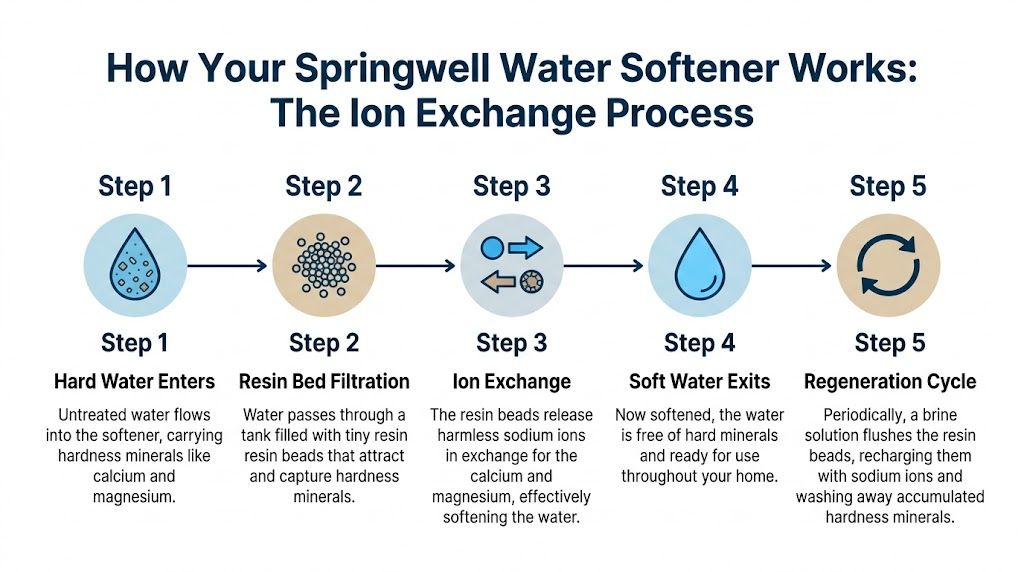
The softening cycle in plain English
The resin bed works like a loaded filter with a specific job. It is not catching dirt or sediment. It is trading one dissolved mineral for another.
That distinction matters because homeowners often expect a softener to do everything. It will stop hardness scale. It will not remove sand, chlorine, sulfur odor, or every other water problem in the line.
SpringWell sells its salt-based systems in capacities from 32,000 to 80,000 grains, and the company says the line is built to handle very hard water, up to 110 grains per gallon on certain models, as shown on SpringWell's salt water softener product page.
What regeneration actually does
Once the resin has traded away enough sodium, it fills up with hardness minerals and needs to recharge. The brine tank handles that part. During regeneration, saltwater moves through the resin, reloads it with sodium, and flushes the collected calcium and magnesium to drain.
In the field, operating cost starts to separate one softener from another. A timer-based unit can regenerate whether you used five gallons or five hundred. A metered system tracks actual water use and regenerates when the resin is close to spent. That usually means less wasted salt, less water sent to drain, and fewer unnecessary cycles over the life of the system.
SpringWell uses metered, demand-initiated regeneration with a digital control valve. For a homeowner, that matters more than the spec sheet buzzwords. Fewer extra regenerations means lower salt use over time, less wear on the valve, and a better total cost of ownership.
Why that matters in the real world
The savings are rarely dramatic in a single month. They add up over years.
A properly sized softener helps protect the expensive equipment that hard water hits hardest first. Water heaters run cleaner. Dishwashers keep heating elements and spray arms in better shape. Shower glass needs less scrubbing. Soap works the way it should. Those day-to-day improvements are the part people notice. The longer appliance life is where much of the return comes from.
A good softener should match the house. It should not force extra salt purchases and unnecessary regeneration cycles because it was sized badly or controlled poorly.
What a springwell water softener doesn't do by itself
A softener removes hardness minerals. That is its lane.
If the home also has sediment, iron, manganese, sulfur odor, chlorine, or low pH, those issues may need separate treatment ahead of or alongside the softener. I see this often on well water. Hardness is only one part of the water profile, and solving one problem does not automatically solve the rest.
Choosing the Right Springwell System for Your Home
Buying the wrong size softener creates two different kinds of regret.
Go too small and the system works too hard, regenerates more often, and struggles during busy household use. Go too large and you spend more than necessary up front. The best pick is the one that matches your water conditions and daily demand.
SpringWell offers a few clear lanes for homeowners. The company has 20 years of experience, offers a 6-month money-back guarantee, and prices its salt-based systems from $1,100 to $1,800 depending on capacity. The SS1 starts around $1,530, and the product line includes the SS1 for 1 to 6 people and the SS+ for 7+ people, according to SpringWell's salt water softener product page.
Start with household demand
You don't size a softener by guesswork. You size it by water use and hardness.
A practical formula is:
People in home × daily water use × hardness = softening load
If you know your water report or you've run a hardness test, that gives you the foundation. If you don't know the hardness yet, test first. Buying before testing is like ordering shoes without knowing your size.
Match the model to the house
SpringWell's naming is fairly straightforward. The key variables are grain capacity, bathroom count, and expected household size.
Here is the side-by-side view.
| Model | Best For (Bathrooms) | Grain Capacity (Grains) | Service Flow Rate (GPM) | Ideal Household Size |
|---|---|---|---|---|
| SS1 | Smaller homes | 32,000 to 80,000 | Varies by size | 1 to 6 people |
| SS4 | 4 to 6 bathrooms | 32,000 to 80,000 | 13 to 20 | Mid-size to larger homes |
| SS+ | Larger homes | 80,000 to 100,000 | High flow design | 7+ people |
How I think about sizing in the field
Bathroom count matters, but it isn't the whole story.
A house with two people and four bathrooms doesn't use water like a house with six people and three bathrooms. Peak simultaneous use matters too. If two showers, the dishwasher, and a laundry cycle often run close together, don't undersize the system just because the home looks modest on paper.
Use these filters when choosing:
- Choose by actual occupancy: A guest room bathroom doesn't use water every day. People do.
- Pay attention to routines: Big laundry days and back-to-back showers change demand fast.
- Think about future use: If your household is growing, size for the next few years, not just next month.
- Account for water quality: Very hard water puts more pressure on capacity planning.
If your softener is always catching up, it was undersized the day it went in.
What works and what doesn't
What works is matching the softener to how the house lives.
What doesn't is buying only on sticker price. A cheaper model that cycles too often, burns through salt, or starves the house at peak use usually costs more in annoyance and upkeep. Many homeowners often get tripped up here. They compare two units by purchase price and ignore service flow and capacity.
The better approach is to ask three questions:
- How hard is the incoming water?
- How many people use the house every day?
- How often do multiple fixtures run at once?
Answer those well, and the right SpringWell model becomes much easier to spot.
Performance Specs and Real-World Benefits
A good softener earns its keep on Tuesday morning, not on a spec sheet.
What matters in daily use is simple. The water heater stays cleaner inside. Soap stops fighting the minerals. Faucets and glass stay cleaner longer. You spend less time scrubbing white crust off fixtures and less money feeding scale-damaged equipment.
SpringWell has posted strong third-party test results for hardness reduction, low residual hardness, service flow, and, on the well-water combo, iron removal. In practical terms, those numbers point to the same outcome for the homeowner. The system cuts the mineral load enough to stop fresh scale from building at the pace hard water usually causes, while still supplying enough water for normal household demand, according to Water Filter Guru's SpringWell salt-based water softener review.
What those results change in real houses
The first benefit is cleanup. Shower glass, tile, and faucets usually stop collecting new deposits so quickly. Dishes come out with fewer spots. Laundry detergents and bath soaps rinse more like they should.
The second benefit is mechanical, and it usually matters more over time.
Scale works like plaque inside plumbing and appliances. A little buildup inside a water heater or on a heating element forces that equipment to work harder to do the same job. That means higher energy use, slower recovery, and more wear on parts that are expensive to replace. Homeowners often focus on the purchase price of the softener and miss the larger savings. Preventing one premature water heater replacement or reducing service calls on tankless equipment can do more for total cost of ownership than shaving a few hundred dollars off the initial system cost.
Flow rate matters because comfort matters
Plenty of softeners remove hardness well enough on paper but feel restrictive when the house is busy. SpringWell's better service flow is one of the reasons it fits larger households and homes with multiple bathrooms.
That shows up during normal peak use. One shower is running. The dishwasher is filling. Someone opens a kitchen faucet. In a poorly matched system, pressure drop becomes the complaint everyone notices first. In a properly sized SpringWell setup, the softener is far less likely to become the bottleneck.
For a closer look at the system in action, this walkthrough is useful:
Well water changes the equation
On well water, hardness is often only part of the problem. Iron staining on sinks and toilets, metallic taste, and orange or brown marks in tubs can make a standard softener-only approach feel incomplete.
That is why SpringWell's well-water combo gets attention. If a system reduces hardness but leaves iron behind, the house still looks and feels like it has bad water. A combo unit addresses both issues in one treatment train, which is often the more economical choice long term than installing a basic softener first and then paying to solve staining later.
For homeowners looking past the sticker price, this is the right lens. Better water quality is the daily payoff. Lower soap use, less scale cleanup, and less wear on water-using appliances are where the longer-term value shows up.
Installation Overview DIY vs Professional
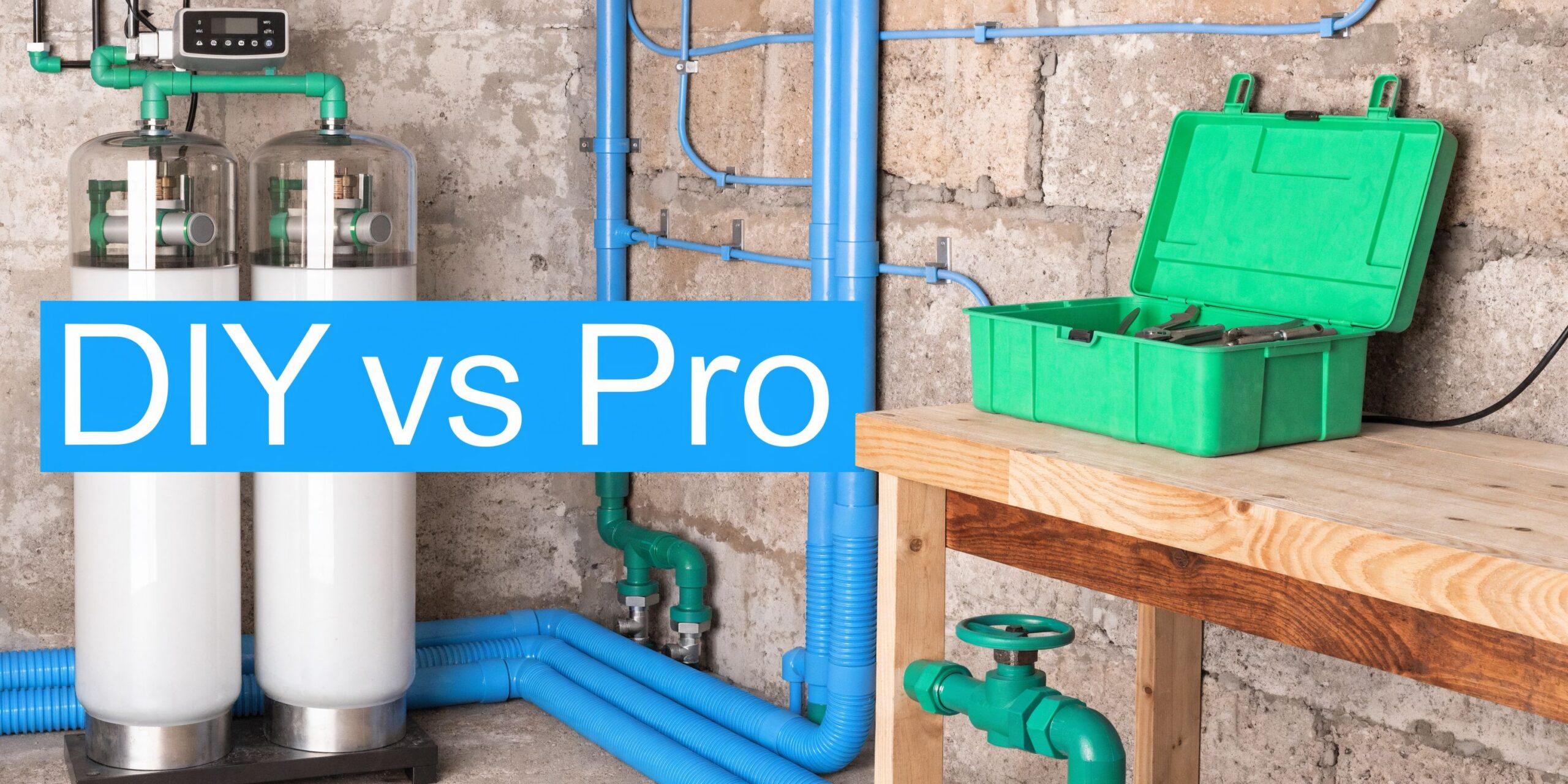
A springwell water softener isn't the hardest piece of water equipment to install, but it isn't a casual afternoon job either.
You are tying into the main water line, setting a bypass, connecting a drain, hooking up the brine tank, and programming the control head. If any part of that goes wrong, the consequences aren't abstract. They show up as leaks, drain issues, poor regeneration, or soft water that never arrives where it should.
The main stages of installation
The sequence is usually straightforward even if the work isn't.
Place the tanks properly
The mineral tank and brine tank need a level location near the main line, drain access, and power for the control head.Cut into the plumbing
This is the commitment point. You install the bypass valve and connect inlet and outlet plumbing in the correct direction.Run the drain line
Regeneration water has to discharge correctly. Poor drain routing causes headaches fast.Connect the brine line
This small connection matters more than it looks. If it's loose or kinked, regeneration performance suffers.Program the head unit
Settings need to reflect your water conditions and household use pattern.
DIY makes sense when
DIY can be the right call if you already handle plumbing repairs confidently and understand shutoffs, fittings, drains, and startup checks.
A good DIY install usually looks like this:
- You know your pipe material: Copper, PEX, and other plumbing types all change the work.
- You have room to work: Tight mechanical spaces turn simple installs into awkward ones.
- You can troubleshoot startup issues: Programming and leak checks take patience.
- You accept the risk: If you make a plumbing mistake, you're the service department.
Professional installation makes sense when
Hiring a pro is worth it when the plumbing is tight, old, unusual, or shared with other treatment equipment. It also makes sense when the drain path is tricky or the homeowner doesn't want to gamble on the main water line.
A clean install isn't just about appearance. It affects serviceability, reliability, and whether anyone will hate working on it later.
The mistake I see most often isn't bad intent. It's underestimating the drain setup and startup programming. Homeowners focus on getting water through the unit. The better installers focus on making sure the unit regenerates correctly for years.
Maintenance and Long-Term Operating Costs
A softener can look expensive on day one and still save money over time. I tell homeowners to price the whole ownership cycle, not just the box and valve.
With a SpringWell system, the total cost comes down to four buckets. Consumables, water used during regeneration, routine service, and the repair costs you avoid by keeping scale out of the plumbing and appliances. SpringWell’s help center does not publish a clear all-in annual cost breakdown on that general FAQ page, so it is better to treat ownership cost as a practical estimate based on your water hardness, family size, sewer rates, and whether you choose salt-based softening or salt-free conditioning.
What ownership usually looks like in practice
A salt-based SpringWell needs regular salt and occasional attention. That is normal for any true softener.
The day-to-day work is simple:
- Keep salt in the brine tank: If the tank runs low or empty, hardness slips through.
- Break up salt bridges if they form: The surface can look full while the system is starving for brine.
- Check the control settings after outages: A wrong time or missed setting can throw off regeneration.
- Look at the drain, bypass, and brine line: Small leaks or kinks turn into poor performance.
- Clean the brine tank as buildup develops: Not every month, but ignoring sludge invites problems later.
That is the maintenance reality. It is not difficult, but it is not zero.
A salt-free SpringWell conditioner cuts down routine chores because you are not adding salt or dealing with brine. The trade-off is function. It helps manage scale, but it does not remove hardness minerals the way a salt-based softener does. For homeowners who want the classic soft-water feel, easier soap lathering, and full hardness removal, lower upkeep does not mean better value.
Where the long-term math gets real
The savings from soft water usually show up in places homeowners do not track carefully.
Water heaters stay cleaner. Dishwasher internals collect less scale. Shower valves, ice maker components, faucet aerators, and coffee equipment tend to last longer when they are not fighting mineral buildup all year. Cleaning also gets easier because soap and detergent work better in soft water, which often means using less product and spending less time scrubbing white crust off fixtures and glass.
That is the part many buyers miss. Hard water costs are often scattered across appliance repairs, early replacements, extra cleaners, and lost efficiency. A softener does not erase every plumbing bill, but it can cut down the slow, repetitive wear that drains money out of a house.
Salt-based versus salt-free on total cost of ownership
Sticker price matters. Lifetime cost matters more.
A salt-based SpringWell asks you to buy salt, use some water during regeneration, and stay on top of basic maintenance. In return, it delivers actual hardness removal, which usually gives the strongest payoff for appliance protection and day-to-day water quality.
A salt-free SpringWell usually asks less from the owner month to month. No salt handling. Less routine involvement. But the value case depends on your goal. If the house has moderate scale issues and the owner mainly wants lower-maintenance scale control, that can be a reasonable fit. If the house has hard water and the owner wants to protect a water heater, dishwasher, fixtures, and plumbing over the long haul, true softening usually earns back more of its cost.
Cheap to maintain is not the same as cheap to own over ten years. In hard-water homes, the better investment is often the system that prevents the most damage.
When to Choose Springwell and When to Look Elsewhere
SpringWell is a strong fit when the house has real hard water and the owner wants a long-term fix, not a workaround.
That means homeowners who care about high flow rates, reliable whole-house treatment, and equipment that doesn't feel undersized during busy mornings. It also fits people who want a premium product rather than the cheapest box on the shelf.
Choose SpringWell when these conditions line up
- You own the home: Whole-house treatment makes the most sense when you're protecting plumbing and appliances you plan to keep.
- Your hard water is affecting daily life: Scale, film, soap issues, and fixture buildup have moved past minor annoyance.
- You want whole-house coverage: Not just one filtered tap or one shower.
- You have a larger household or higher demand: Flow matters when several fixtures run at once.
- You want a more polished ownership experience: Better valves, better controls, and stronger fit for serious use.
Look elsewhere when another option fits better
SpringWell isn't for everyone.
Renters usually need something smaller and reversible. Homeowners on a very tight budget may decide that a simpler, lower-cost unit is the only feasible path, even if performance and flow aren't in the same league. Some buyers also prefer a salt-free conditioner because they don't want to handle salt, even knowing that conditioning and true softening are not the same thing.
A different solution may also fit better if:
- The house has unusual contaminants: You may need layered treatment beyond a standard softener.
- Permanent plumbing changes are a problem: Condos, rentals, and restrictive setups can limit options.
- You only need point-of-use improvement: Sometimes the actual need is a shower filter or drinking water filter, not a whole-house softener.
The honest bottom line
If your main battle is hardness and scale, SpringWell is built for that job.
If your main concern is the lowest possible upfront spend, no equipment upkeep, or a temporary living situation, another route may make more sense. The smart move isn't choosing the most expensive system or the cheapest one. It's choosing the one that matches the water problem, the house, and how long you plan to live with the result.
Your Springwell Water Softener Questions Answered
Does a springwell water softener also filter chlorine or other chemicals
Not by itself in the same way a dedicated whole-house filter does. A salt-based softener's primary job is removing hardness minerals. If your water also has chlorine, sulfur, sediment, or other concerns, you may need separate filtration or a combo setup.
What's the difference between a salt-based softener and a salt-free conditioner
A salt-based softener removes hardness minerals through ion exchange. A salt-free conditioner works on scale control differently and doesn't deliver the same true-soft-water result. If your goal is actual hardness removal, a salt-based unit is the right category to look at.
Is SpringWell a good choice for well water
It can be, especially when hardness and iron show up together. Well water often needs a more complete treatment plan than city water because the water issues can stack up. Testing first is always the right move.
How hard is maintenance for most homeowners
Usually manageable. The main tasks are keeping salt in the brine tank, watching for salt bridging, and checking that the system is regenerating normally. Most problems owners run into come from neglect, not complexity.
Where can I learn more about comparing water treatment options
If you want broader help on water treatment decisions, maintenance, and system types, this advice library is a solid place to continue your research: https://www.waterfilteradvisor.com/advice/
If you're comparing systems and want practical, consumer-friendly guidance on filters, softeners, maintenance, and whole-house water treatment, visit Water Filter Advisor.
