Best Water Hardness Test Kit for Home Filtration in 2026
You're standing at the sink, staring at the same white crust around the faucet again. The shower doesn't feel great, the dishwasher spots are getting worse, and now you're wondering whether you need a softener, a filter, or just a better test before you spend real money on the wrong setup.
The answer is simple. Test the hardness first, then choose the treatment that fits the number. That's the difference between a system that protects your plumbing and one that just looks good in the cart.
| Test Kit Type | Accuracy | Speed | Best Use |
|---|---|---|---|
| Basic strips | About 25 to 50 mg/L | Fast | Quick screening |
| Drop titration kits | About 1 gpg, 17.1 mg/L | Fast to moderate | Softener setup and before/after checks |
| Certified lab testing | Standardized results | Slower | Private wells and documentation |
If you want a quick way to browse hard water solutions for homes, browse hard water solutions for homes can help you see how testing ties into real-world treatment choices. For broader buying advice, the internal Water Filter Advisor advice page is useful once you already know what your water is doing.
Why Testing Water Hardness Matters Before Installing Filtration
A homeowner notices the same thing over and over. The shower doors haze up, the kettle gets crusty, and soap never seems to rinse clean. That is usually the moment people start shopping for filters, but guessing at hardness is how they buy the wrong system or set a softener incorrectly.
Hard water is a plumbing problem first and a comfort problem second. Calcium and magnesium do not just leave residue on fixtures, they also shorten the useful life of appliances and change how treatment systems behave. If the water is harder than you thought, a small programming error can leave the softener underperforming, and if you overreact to a bad guess, you can spend money on equipment you did not need.
The hidden cost of guessing
The mistake I see most often is simple. Someone assumes all scale means a full treatment overhaul. Sometimes that is true. Other times, a properly sized softener or a targeted scale-control approach solves the problem, but only if the hardness number is real.
That is why a water hardness test kit is the first purchase, not the last. Hardness is commonly reported in gpg or ppm as CaCO3, and the difference between soft, moderately hard, and hard water can hinge on a small measurement error. A homeowner who skips testing may set the system too low, buy the wrong cartridge, or miss the actual reason dishes keep spotting.
Practical rule: if you are choosing between softening, scale control, or routine maintenance, test before you buy anything bigger than a basic replacement part.
For a homeowner dealing with scale and soap issues, the smartest path is to test at the faucet that matters most, then match treatment to that exact reading. If you want a broader starting point before you buy, the Water Filter Advisor advice page is useful once you already know what your water is doing.
If you want to compare how hardness problems show up in different regions, you can browse hard water solutions for homes and see how testing connects to real treatment choices. Outdoor conditions and city reports do not tell you what is happening after water goes through your own plumbing.
Understanding the Three Main Types of Hardness Test Kits
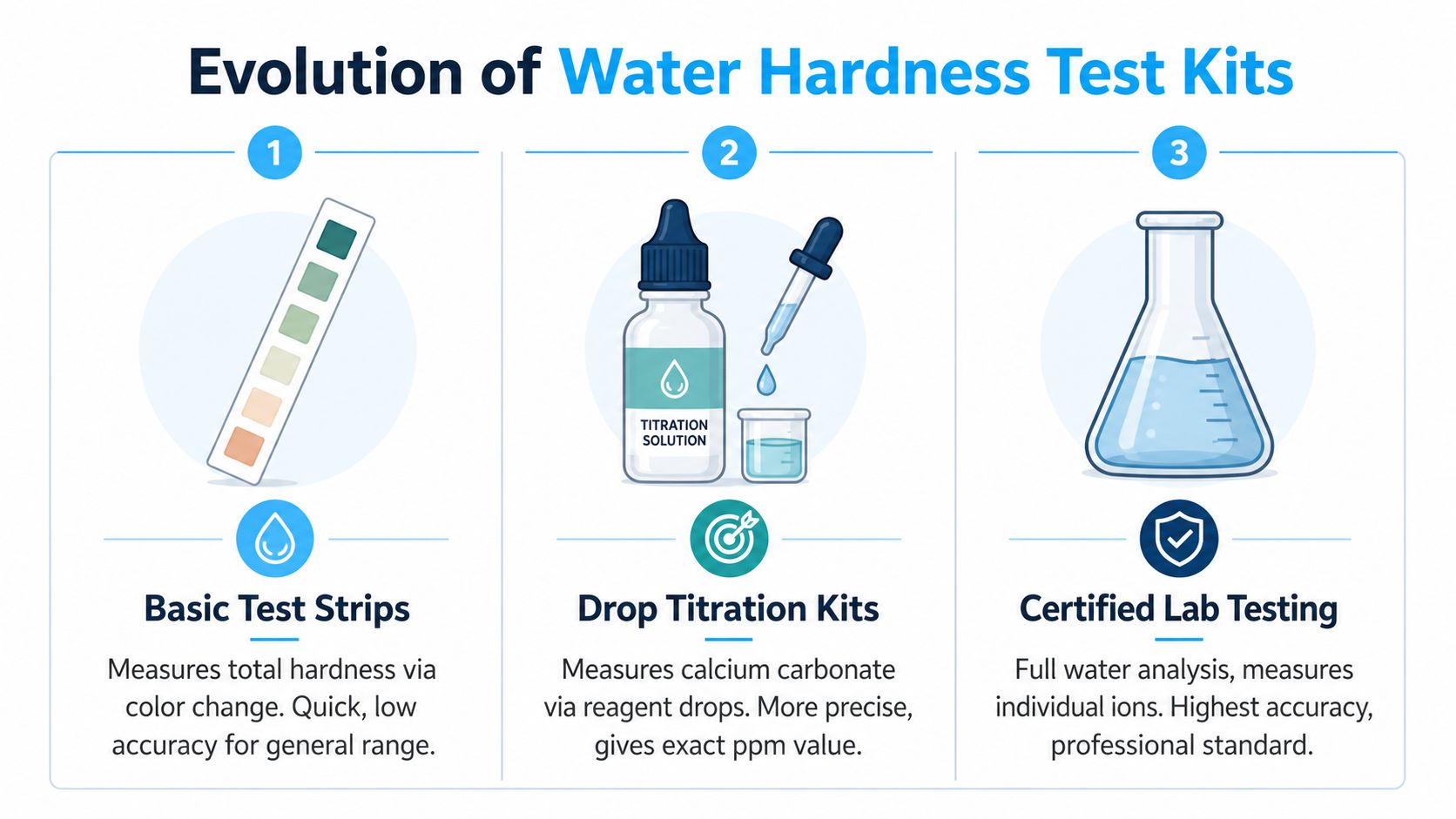
Hardness testing has moved in a clear direction. Homeowners started with strip-based screening, moved toward drop titration, and now have access to certified lab testing when they need defensible numbers. The right choice depends on whether you want a fast snapshot, a softener-setting number, or a result that can stand up in a dispute.
Strips, the cheap and fast option
Hardness strips are the quickest way to get a broad answer. Recent comparison guides put them at roughly $8 to $15 for 50 to 100 strips, and they typically read within about 25 to 50 mg/L. That's enough for a homeowner who wants to know whether water is roughly soft or clearly hard, but it's not the tool I'd trust for fine-tuning a softener.
Strips win on convenience and lose on precision. They're fine for a first pass, a rental property check, or a quick look at a faucet you don't use for drinking. They're not the tool for calibration.
Drop titration kits, the practical homeowner's pick
Drop kits are the sweet spot for most homes. Comparison guides place them at about $15 to $25, and they're accurate to within 1 gpg, 17.1 mg/L, which is exactly why they're useful for softener setup and before/after comparisons. If you need a number you can trust when adjusting equipment, I'd spend the money here.
This is the kit type I recommend most often. It's precise enough to matter, but it doesn't drag you into lab pricing when all you want is a solid household decision. If you're dealing with scale on fixtures or trying to confirm whether your softener is doing its job, drop titration is the right tool.
Certified lab testing, the documentation option
Lab testing costs more, about $25 to $50 for a hardness-specific analysis or $30 to $150 for a broader mineral panel. In exchange, you get standardized results that can hold up in private-well or dispute situations. That matters when you need documentation, not just a household estimate.
For pure hardness measurement, Hach's hardness-focused kits and analyzers are positioned as a higher-precision option, and third-party roundups list their span at about 0 to 1,000 ppm, or 0 to 30 gpg for titration-based versions. That wider range makes them attractive when you want a purpose-built hardness tool instead of a generic strip.
If you're deciding between all three, the rule is simple. Strips are for screening, drop kits are for action, and lab testing is for proof. That's the whole decision tree for most homes.
Top Water Hardness Test Kits Compared for Home Use
For routine home filtration, I'd separate the category into two jobs, precision and volume. Precision matters when you're setting a softener. Volume matters when you're checking the same system over and over and don't want to spend a fortune on each test.
One reliable benchmark is the Hach Total Hardness Test Kit / WaterWorks strip family. Hach's hardness-focused kits are built specifically for hardness determination, and comparison roundups place the measurement span around 0 to 1,000 ppm, or 0 to 30 gpg for titration-based versions. That makes it a strong pick when you care about a wider measurement window and don't want a strip kit that tops out too soon.
At the other end of the use case is JNW Direct, which multiple independent reviews list as a high-volume household choice. It comes with 150 strips, measures 0 to 425 ppm, 0 to 25 gpg, and returns results within 60 seconds. That's a routine-check kit, not a calibration tool, but for trend monitoring it's a sensible value benchmark.
If you need a broader context for choosing between products, check Melbourne water hardness alongside your own results so you can compare local conditions with what your home is seeing. Just don't use that as a substitute for testing your own tap.
Water Hardness Test Kit Comparison
| Test Kit | Type | Accuracy | Range | Price | Best For |
|---|---|---|---|---|---|
| Hach Total Hardness Test Kit / WaterWorks | Strip and titration-focused hardness kit | Higher precision for hardness-focused use | About 0 to 1,000 ppm, or 0 to 30 gpg on titration versions | Varies by kit | Softener setup and hardness-specific testing |
| JNW Direct | Strip kit | Fast routine reads, not lab-grade | 0 to 425 ppm, 0 to 25 gpg | Value-oriented strip pack | High-throughput household checks |
| Drop titration kit | Liquid-drop kit | Within 1 gpg, 17.1 mg/L | Good for household hardness comparisons | About $15 to $25 | Softener programming and before/after checks |
| Certified lab hardness analysis | Lab test | Standardized documented result | Broader mineral confirmation | About $25 to $50 | Wells, disputes, documentation |
My blunt take is this. If you're a homeowner managing a softener, buy a drop titration kit first. If you're screening a rental, checking a faucet, or just confirming a hard-water suspicion, a good strip kit is enough. If the result may be challenged, or your well water situation needs paperwork, go straight to the lab.
How to Use Your Test Kit and Read the Results Correctly
A bad sample gives you a bad number, and a bad number leads to the wrong filter. That's why the setup matters as much as the kit itself. Clean sample handling keeps you from chasing false hardness readings that were caused by contamination, residue, or sloppy timing.
For strips, collect a fresh water sample in a clean glass and use it immediately. Dip the strip exactly as directed, then compare the color under white light instead of warm bathroom lighting. The big mistake is guessing from memory, because a slightly off shade can push you into the wrong hardness category.
For drop kits, count drops carefully and stop only when the endpoint changes the way the instructions describe. Don't rush the reaction, and don't assume more shaking means more accuracy. The whole point of the titration method is that the drop count tells you the number.
Don't test from a dirty cup, a showerhead, or a container with soap residue. Those shortcuts can distort the reading enough to make a softener look fine when it isn't.
Reading the units without confusion
Hardness often shows up in gpg or ppm as CaCO3. That means you need to know how your kit reports results before you compare them to a softener chart. If you're tracking before-and-after treatment, keep the same unit every time so the comparison stays clean.
Document the result, the faucet, and the time of day. If your home uses a softener, test before and after the system at least once so you can confirm the equipment is changing the water the way you expect. That kind of log is also useful if you later need to compare a DIY result with a lab report.
What Your Test Results Mean for Your Filtration System
A hardness number only matters if it changes what you do next. If your water is already soft, you don't need to chase a big treatment system just because the shower glass looks annoying. If it's hard, though, you need to treat it as a real plumbing threat, not a cosmetic nuisance.
Match the number to the fix
Soft water generally needs little more than standard filtration for taste or sediment. Moderate hardness is where homeowners start weighing a basic softener or a scale inhibitor filter, especially if appliances are already showing residue. Hard water calls for a water softener system and a correct hardness setting, because scale control becomes a maintenance issue instead of a comfort upgrade.
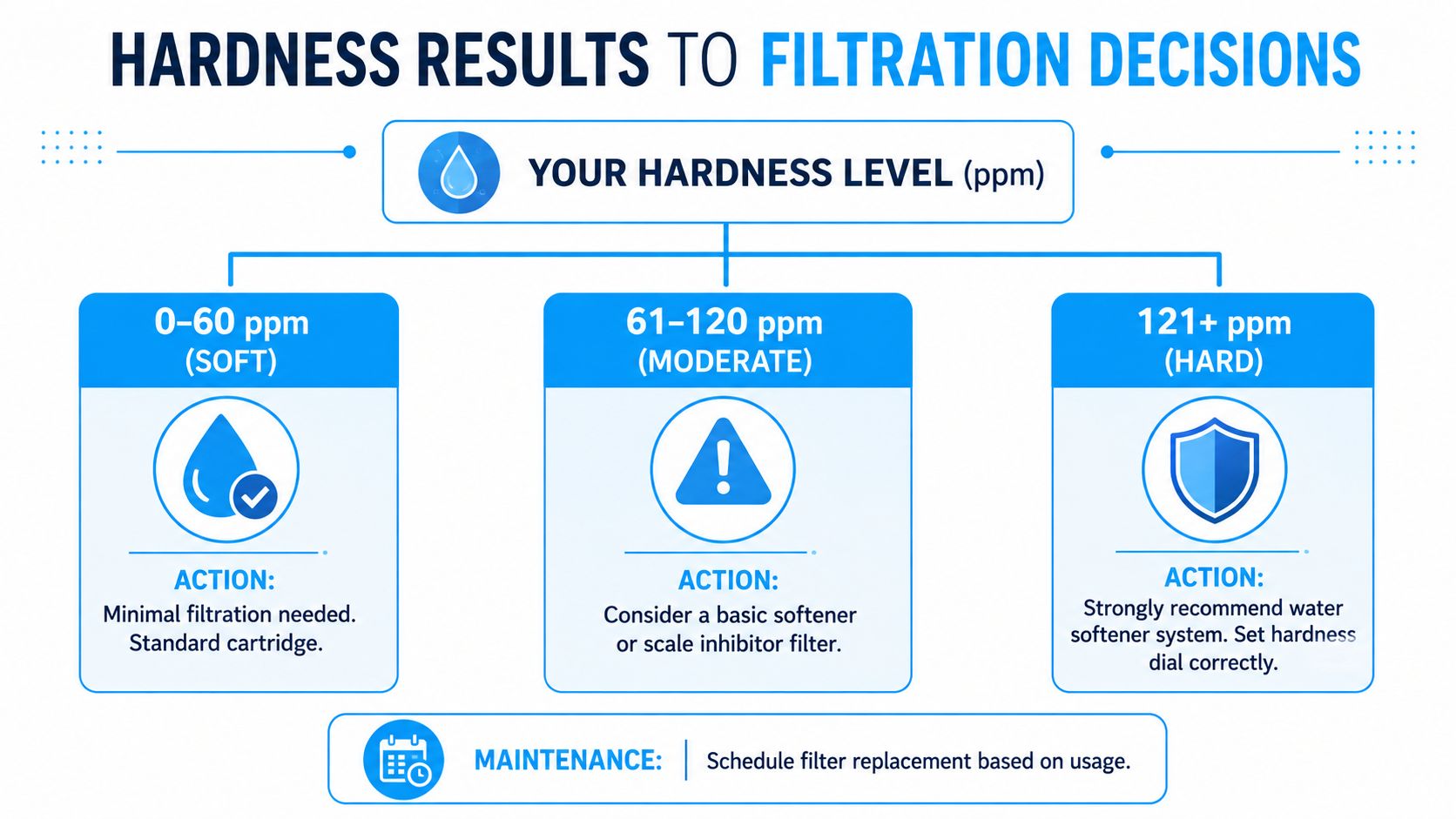
The reason to read the number carefully is simple. Hardness classification can shift with a small error, and that can change whether you install nothing, a basic cartridge, or a full softener. That's especially important for homeowners who want to protect water heaters, dishwashers, and shower valves from scale buildup.
Use the result to set maintenance expectations
Once the hardness number is known, maintenance becomes easier to plan. A softener that's dialed correctly should produce a noticeably different before-and-after result, and a filter handling scale or mineral load should be checked with the same water source every time. If the number moves, your maintenance schedule needs to move with it.
For homeowners who want a cleaner decision rule, keep it this simple. Low hardness means keep filtration modest. Midrange hardness means watch scale and consider treatment. High hardness means stop improvising and size the system properly.
Best move: choose the treatment after the number, not before it.
Choosing the Right Kit for Your Specific Situation
This is the question most buying guides dodge. You don't need the same accuracy if you're a renter checking a kitchen faucet that you'll use once a week and if you're a well owner trying to document a water problem for a contractor. Buy to the job, not to the hype.
Renters and quick checks
If you just want a fast answer, strips are enough. They're cheap, easy, and perfectly fine for learning whether the water looks soft, moderate, or hard. A renter doesn't need to overthink this unless the result is being used to argue for treatment or repairs.
Softener installers and homeowners tuning a system
If you're programming a softener, use a drop titration kit. Precision matters more than convenience here, because the number directly affects system settings and your before/after comparison. The kit should make the system easier to trust, not leave you guessing.
Private wells and documentation-heavy situations
If you own a private well, or you're in a situation where the result might be questioned, use certified lab testing. Hardness-only lab work costs more, but it gives you standardized results that are much stronger for records and disputes. That's the right call when your water chemistry is part of a larger treatment or property issue.
Families monitoring an existing system
If you already have treatment in place and just want to track performance, pick a repeatable kit and stick with it. JNW Direct is a practical example for high-volume monitoring, while Hach is the better choice when you want a hardness-focused measurement span and a more specialized option.
I'd make the recommendation even simpler. Buy strips if you need a quick answer, buy drops if you need to make a decision, and buy lab testing if you need proof. That's the right ordering for most homes, and it keeps you from overspending on precision you won't use.
Common Testing Mistakes and When You Need Professional Help
The biggest testing mistake is assuming one faucet tells the whole story. It doesn't. Hardness can vary by location in the house, and if you only test one point, you may miss what's happening at the tap that feeds your drinking water or appliance line.
Another mistake is assuming hardness is the only thing that matters. It's a major factor for scale and soap performance, but it doesn't tell you anything about every other water concern a home might have. That's why hardness testing is useful, but not universal as a full water-quality solution.
Seasonal changes can also throw people off. If your water source changes over time, a single reading can give you a false sense of certainty. The smarter move is to keep records and compare like with like.
When to stop DIY and call for lab testing
Use professional lab testing when the result needs stronger documentation, especially for private wells or any water dispute. It's also the right move if you're trying to understand broader mineral issues, not just hardness. A home kit gives you a useful household answer, but it won't replace a documented lab report.
If you're still unsure, don't buy the most expensive kit just to feel safer. Buy the one that matches the decision in front of you. That's usually the cheapest path to the right filtration system.
Water Filter Advisor helps homeowners turn confusing water results into practical filtration decisions, and that's exactly what you need when you're choosing a hardness test kit. If you want more direct guidance on matching testing methods to softeners, filters, and home setups, visit Water Filter Advisor and use the advice there to pick the right next step for your house.
