How to Treat Hard Water: A Homeowner’s Filtration Face-Off

Tired of chalky faucets, sad-looking soap suds, and dishes that come out of the dishwasher looking dirtier than they went in? You’re not just imagining it—you’re in a battle with hard water. The only way to win this war for good is to install a whole-house water filtration system that attacks the problem at the source, kicking those pesky hardness minerals like calcium and magnesium to the curb. This is your ticket to stopping limescale in its tracks, getting a luxurious lather, and saving your appliances from an early, crusty demise.

The Telltale Signs of Hard Water in Your Home
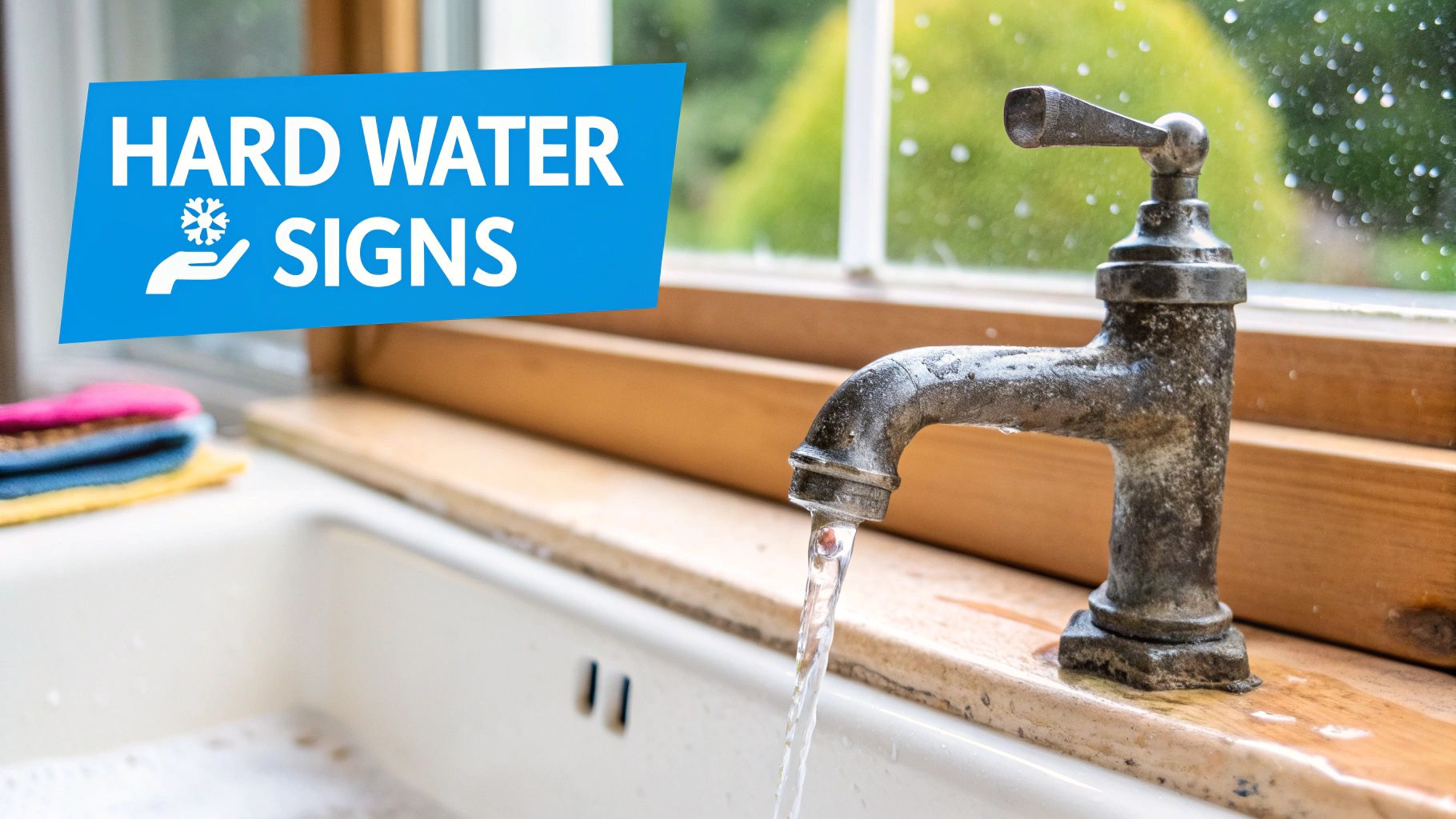
An old faucet with running water in a kitchen sink, showing mineral deposits from hard water.

Before you can pick your weapon, you need to be sure you're fighting the right enemy. Luckily, hard water isn't subtle. It leaves a trail of evidence all over your house, disguised as everyday annoyances you've probably just accepted as normal.

Hard water is simply water that’s loaded with dissolved minerals—mostly calcium and magnesium—that it picked up on its journey through the ground. While it’s perfectly safe to drink, it’s a menace to your home. So, if you think your shower doors have a permanent fog or your faucets look like they have a bad case of dandruff, you're not going crazy. That's just hard water making itself at home.

Visible Clues Around Your Sinks and Showers

The easiest place to spot the signs of this mineral invasion is wherever you use water the most. Your kitchen and bathroom are ground zero, and they're probably covered in a trail of gunk that defies all your cleaning efforts.

Look at the base of your faucets and around your showerhead. See that stubborn, white, crusty buildup? That's limescale, the calling card of hard water. It’s what’s left behind when water evaporates, and it’s basically rock. Another dead giveaway is the slimy soap scum that clings to your shower doors and tub. The minerals in your water are having a chemical party with your soap, creating that sticky, insoluble mess.

Chalky spots are another telltale sign, and they can be a real pain to remove. For some specific tips on that, check out Your Ultimate Guide to Removing Hard Water Spots on Windows.

You might also be dealing with:

  • Dull, spotty dishes and glassware: No matter how much rinse aid you use, your glasses look like they were dried with a dirty towel.
  • Weak water pressure: Limescale isn’t just an eyesore; it’s building up inside your pipes and faucet heads, slowly strangling your water flow.
  • That filmy feeling on your skin: The same reaction creating soap scum in your tub is happening on your body, leaving a residue that can clog pores and make your skin feel dry and itchy.

The Invisible Damage to Appliances and Fabrics

What you can't see is often doing the most damage. Hard water is waging a silent war on your appliances, and the collateral damage can get expensive.

Your water heater is public enemy number one for limescale. As it heats the water, scale forms directly on the heating elements, acting like a concrete blanket. This forces the unit to work way harder and burn more energy just to do its job, often leading it to fail years before its time. In fact, studies show that hard water can slash a gas water heater's efficiency by up to 24%.

Hard water doesn't just make cleaning harder; it actively works against the things you’re trying to clean. The minerals prevent detergents from lathering properly, meaning you have to use more product to get the same result, whether you're washing clothes, dishes, or yourself.

This problem carries over to the laundry room, too. Those same minerals get trapped in the fibers of your clothes, leaving them feeling stiff and scratchy. You’ll notice that your bright colors fade faster and your whites start looking dingy or gray, no matter how much bleach you throw at them. It’s a frustrating cycle of washing things that never seem to get truly clean.

To help you connect the dots, here’s a quick reference table.

Hard Water Problems and Their Filtration Solutions

This table breaks down the common issues you're seeing and points you toward the most effective water filtration system to solve them.

Common Problem Primary Cause Effective Filtration Solution
Limescale on fixtures & appliances High calcium and magnesium levels Ion-Exchange Water Softener, Salt-Free Conditioner
Soap scum & poor lather Minerals reacting with soap Ion-Exchange Water Softener
Dull, stiff, or faded laundry Mineral deposits in fabric fibers Ion-Exchange Water Softener
Dry skin and dull hair Soap residue left on skin/hair Ion-Exchange Water Softener, Showerhead Filter
Cloudy or spotty dishes Mineral deposits left after drying Ion-Exchange Water Softener, Reverse Osmosis
Reduced appliance efficiency Scale buildup on heating elements Ion-Exchange Water Softener

Ultimately, understanding these signs is the first step toward finding the right filtration treatment and reclaiming your home.

Alright, you've seen the signs. The soap scum that won’t quit, the chalky film on your faucets—something’s definitely up with your water. The next move is to find out just how hard it is.

Knowing your water's specific hardness level isn't just for bragging rights. It's the critical first step to choosing the right water treatment system. You don’t want to end up with a system that’s too weak to handle the job or, conversely, pay for more power than you actually need.

The Quick and Dirty Soap Suds Test

If you're impatient and want a rough idea right now, try the classic soap suds test. It's free, takes about five minutes, and all you need is a clean bottle with a cap and some basic liquid soap—think simple castile soap, not a fancy detergent.

Here's the drill:

  • Fill the clean bottle about a third of the way with your tap water.
  • Add around 10 drops of the liquid soap and screw the cap on tight.
  • Now, give it a good, hard shake for about 15 seconds.

Take a look. If your water is soft, you’ll see a nice, thick layer of suds, and the water below will be mostly clear. Hard water, on the other hand, will give you a sad-looking, suds-free surface and the water itself will look cloudy or milky. That cloudiness? That's your soap reacting with all the calcium and magnesium, creating the very soap scum you’re trying to get rid of.

For a More Accurate Number: DIY Test Strips

For a more scientific result, grab a pack of DIY water hardness test strips. They're cheap, easy to find at any home improvement store or online, and they give you a real number to work with.

You just dip a strip into a glass of tap water for a couple of seconds, pull it out, and wait. After a minute or so, the strip will change color. You then match that color to the chart that came in the kit.

The chart gives you a hardness reading, usually in Parts Per Million (PPM) or Grains Per Gallon (GPG). Professionals almost always talk in GPG, but the conversion is easy: 1 GPG equals 17.1 PPM.

This number is what really matters. For most homes, once you get over 7 GPG (or 120 PPM), you’re in the territory where a water softener starts to make a lot of sense. That’s the point where you’ll really see limescale build-up wreak havoc on your pipes and appliances.

For Pinpoint Accuracy: A Digital Tester

If you're a data geek or just want to be absolutely certain, a digital water tester is your best bet. These are handheld gadgets that measure the Total Dissolved Solids (TDS) in your water.

While a TDS meter measures everything dissolved in the water (not just the hardness minerals), a high TDS reading in city tap water is almost always a dead giveaway for high hardness. You get an instant, precise reading in PPM on a digital screen, which takes all the color-matching guesswork out of the equation. This kind of precision is perfect if you’re trying to dial in the settings on a high-efficiency water softener.

It's no surprise that more and more people are getting serious about this. The global water softener market was a US$2.9 billion industry back in 2022 and is projected to hit $6.8 billion by 2033. That’s a lot of homeowners deciding to protect their homes from hard water damage. You can check out more details on the water softener market trends on custommarketinsights.com.

Water Softeners vs. Water Conditioners: The Main Event

Okay, so you've confirmed hard water is the problem. Now, how do you fix it? When you're looking for a whole-house filtration solution, it really comes down to two main players: the classic salt-based water softener and the modern salt-free water conditioner.

This isn't just about plumbing hardware. It’s a choice between two completely different philosophies for dealing with those pesky minerals.

Think of it this way: a water softener is like a bouncer at a club, physically throwing the troublemakers (calcium and magnesium) out. A water conditioner, on the other hand, is like a skilled negotiator that convinces them to behave so they don't cause any problems. Both get the job done, but their methods are worlds apart.

The Classic Solution: Salt-Based Water Softeners

For most people, the image that pops into their head when they hear "hard water treatment" is a salt-based water softener. There's a good reason for that—they are the undisputed champions of hardness removal, and their method is both simple and incredibly effective.

The magic happens through a process called ion exchange. Your water flows through a tank filled with resin beads that are covered in sodium ions. Since the calcium and magnesium ions in your water have a stronger charge, they get pulled to the resin like a magnet, bumping the sodium ions off and into your water. It’s a direct swap: bad minerals out, harmless sodium in.

This total removal of hardness minerals is what gives you genuinely soft water. The difference is night and day:

  • Limescale vanishes: With the scale-forming minerals gone, they can't build up on faucets, shower doors, or inside your water heater.
  • Soap works like it should: You'll get that rich, sudsy lather you see in commercials. You'll also use way less soap, shampoo, and detergent.
  • That signature "slippery" feel: This is the tell-tale sign of truly soft water. Without minerals to react with soap, it rinses off completely, leaving your skin's natural moisture behind. It feels slick, but that’s actually the feeling of being 100% clean.

But this level of performance requires some upkeep. Eventually, those resin beads get clogged with all the minerals they've collected. To clean them, the system runs a regeneration cycle, flushing itself with a saltwater brine from a second tank. That brine tank is the part you have to keep topped up with heavy bags of salt.

The Modern Alternative: Salt-Free Water Conditioners

If you're looking for a way to stop scale damage without adding sodium to your water or lugging salt bags, a salt-free water conditioner is a fantastic option. The most important thing to know is that these systems do not remove the minerals, so they don't technically "soften" the water.

So what do they do? They change the minerals' behavior. The most proven technology here is Template Assisted Crystallization (TAC). As water flows through the TAC media, the calcium and magnesium minerals are converted into microscopic crystals.

These tiny, harmless crystals can't stick to pipes, fixtures, or heating elements. They just flow right on through your plumbing and down the drain. You get the number one benefit—scale prevention—without actually altering your water's mineral content. The healthy calcium and magnesium are still there, they've just been neutralized.

Here's the bottom line: Salt-free conditioners are all about preventing scale. You won't get that slippery feeling or mountains of soap bubbles, but you will protect your pipes, water heater, and dishwasher from destructive limescale.

This infographic lays out a few simple ways to figure out just how hard your water is. Knowing your numbers is the first critical step before picking any treatment system.
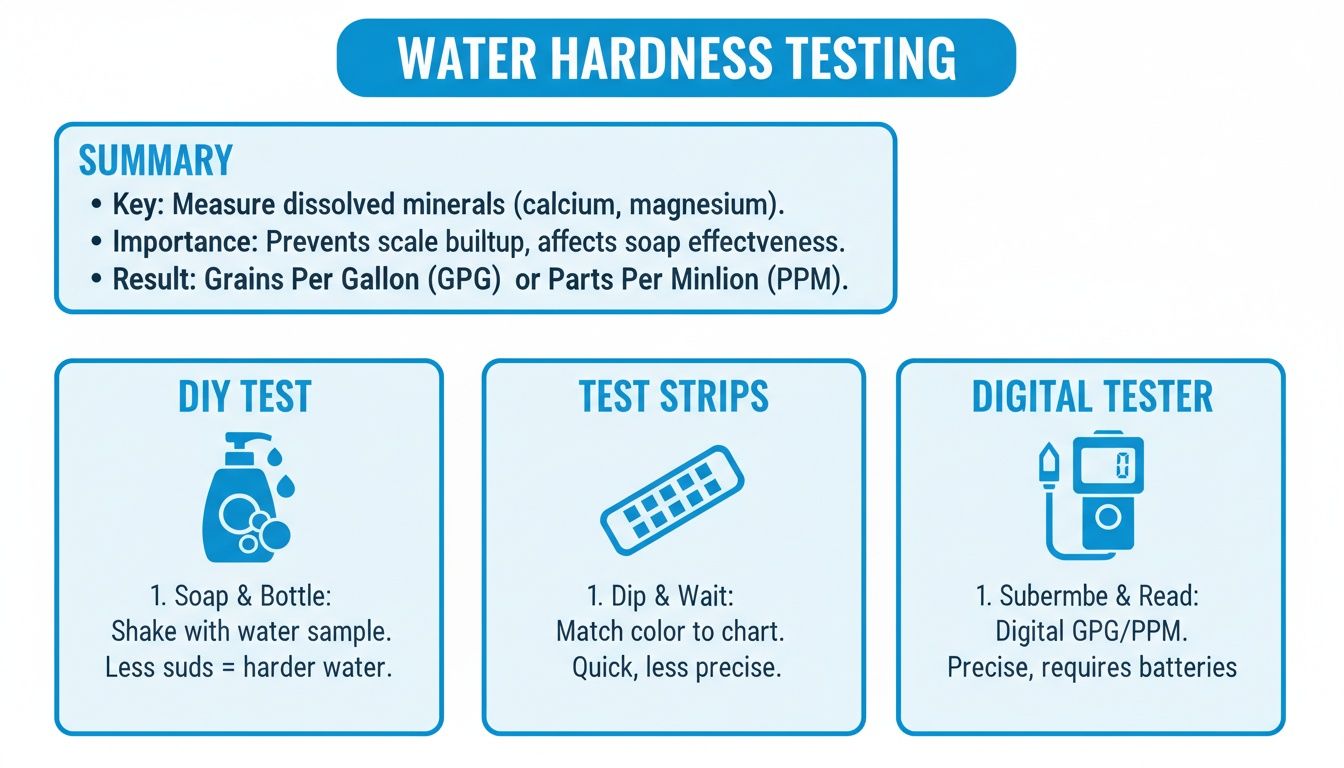
Infographic on water hardness testing, outlining a summary and three methods: DIY, test strips, and digital testers.

Whether you use a basic soap test or a precise digital meter, getting this data helps you choose and size your system correctly.

Making the Right Choice for Your Home

So, which one is for you? It really comes down to what you're trying to achieve. There’s no single “best” system, just the one that’s the best fit for your home and your priorities.

This head-to-head comparison should make the differences crystal clear.

Water Softener vs. Water Conditioner: Head-to-Head Comparison

Feature Salt-Based Water Softener Salt-Free Water Conditioner
Primary Function Physically removes calcium & magnesium Neutralizes minerals to prevent scale
How It Works Ion Exchange Template Assisted Crystallization (TAC)
Scale Prevention 100% elimination Excellent scale prevention (99%+ effective)
"Soft Water" Feel Yes, creates the distinct slippery feel No, water chemistry is unchanged
Soap Lather Significantly improves lather No change in lather
Maintenance Regularly add salt (40-50 lbs/month) Virtually maintenance-free
Environmental Impact Discharges salt brine into wastewater No salt, no waste, no electricity
Initial Cost Generally lower upfront cost Often a higher initial investment
Ongoing Costs Salt, water, and electricity for regeneration None
Best For Homeowners wanting to fix all hard water issues Homeowners focused on protecting plumbing & appliances

In the end, it’s a straightforward choice.

If you want the full soft-water experience—no scale, better skin and hair, and amazing soap lather—then a salt-based water softener is the clear winner. It's the only way to physically remove the minerals that cause all the problems.

If your main goal is to protect your home's expensive plumbing and appliances from scale buildup, and you want a zero-maintenance, eco-friendly solution, then a salt-free water conditioner is an excellent choice. It's the ultimate "set it and forget it" system for preventing the costly damage hard water can do.

Exploring Other Hard Water Filtration Methods

While whole-house softeners and conditioners are the heavy hitters, they aren't the only tools in your filtration arsenal. Sometimes, a more focused, targeted approach is exactly what’s needed.

Maybe you just want ultra-pure drinking water or a simple fix for your dry hair. For that, other filtration methods offer the perfect solution. These alternatives can work great on their own or even supplement a larger system, letting you fine-tune the water quality throughout your home.

Reverse Osmosis for Pure Drinking Water

You’ve probably heard of Reverse Osmosis (RO) systems. They are the gold standard for water purification, usually installed right under the kitchen sink with a small, dedicated faucet. An RO system is a multi-stage filtration beast that does a lot more than just soften water.

It works by pushing water through a special membrane filled with microscopic pores. This process strips out nearly everything that isn't H₂O, including:

  • Hardness minerals like calcium and magnesium
  • Contaminants like chlorine, lead, and pesticides
  • Dissolved solids, salts, and even fluoride

What you get is exceptionally clean, great-tasting water that's amazing for drinking and cooking. But that level of purification is exactly why RO is rarely a whole-house solution. These systems produce water slowly and create wastewater in the process, making them impractical and wasteful for things like showers and laundry.

Key Takeaway: An RO system is the ultimate point-of-use filtration fix for pristine drinking water. It will remove hardness minerals from the water you drink, but it isn't designed to protect your home's entire plumbing network from limescale.

The Power of Showerhead Filters

Is your main complaint about hard water what it does to your hair and skin? If so, a specialized showerhead filter is a fantastic and incredibly budget-friendly fix.

These devices are a breeze to install—they just screw on between your existing showerhead and the pipe coming out of the wall. They target the water exactly where it impacts your personal care routine the most.

They use filtration media, often a mix of KDF (Kinetic Degradation Fluxion) and carbon, to cut down on both hardness minerals and chlorine. While they don't technically "soften" water like an ion-exchange system, they do a great job reducing the scale and chlorine that are the real culprits behind dry, itchy skin and dull, brittle hair. This is an ideal solution for renters or anyone who wants to solve skin and hair issues without the cost of a whole-house system.

A Broader Look at Water Filtration

As you can see, treating hard water often involves more than just tackling minerals. The world of water filtration is huge, with systems designed for everything from sediment to specific chemical contaminants. For instance, you might have a softener to handle the minerals but still want a carbon filter to improve the taste and smell.

This is especially true in unique setups, like mobile living. In these cases, a broad approach to water quality is key. For more on keeping water clean on the go, you might want to read up on finding the best RV water filter system.

Reverse osmosis is only becoming more popular. In fact, within the water treatment world, reverse osmosis systems are expected to command about 35% of the market share by the end of 2035. It's easy to see why, since these membrane filters can remove up to 99% of water impurities. Whether it’s for your whole house, your RV, or just your drinking glass, understanding all these options is the key to finding the perfect fix for your water.

Installation and Maintenance for Your Filtration System
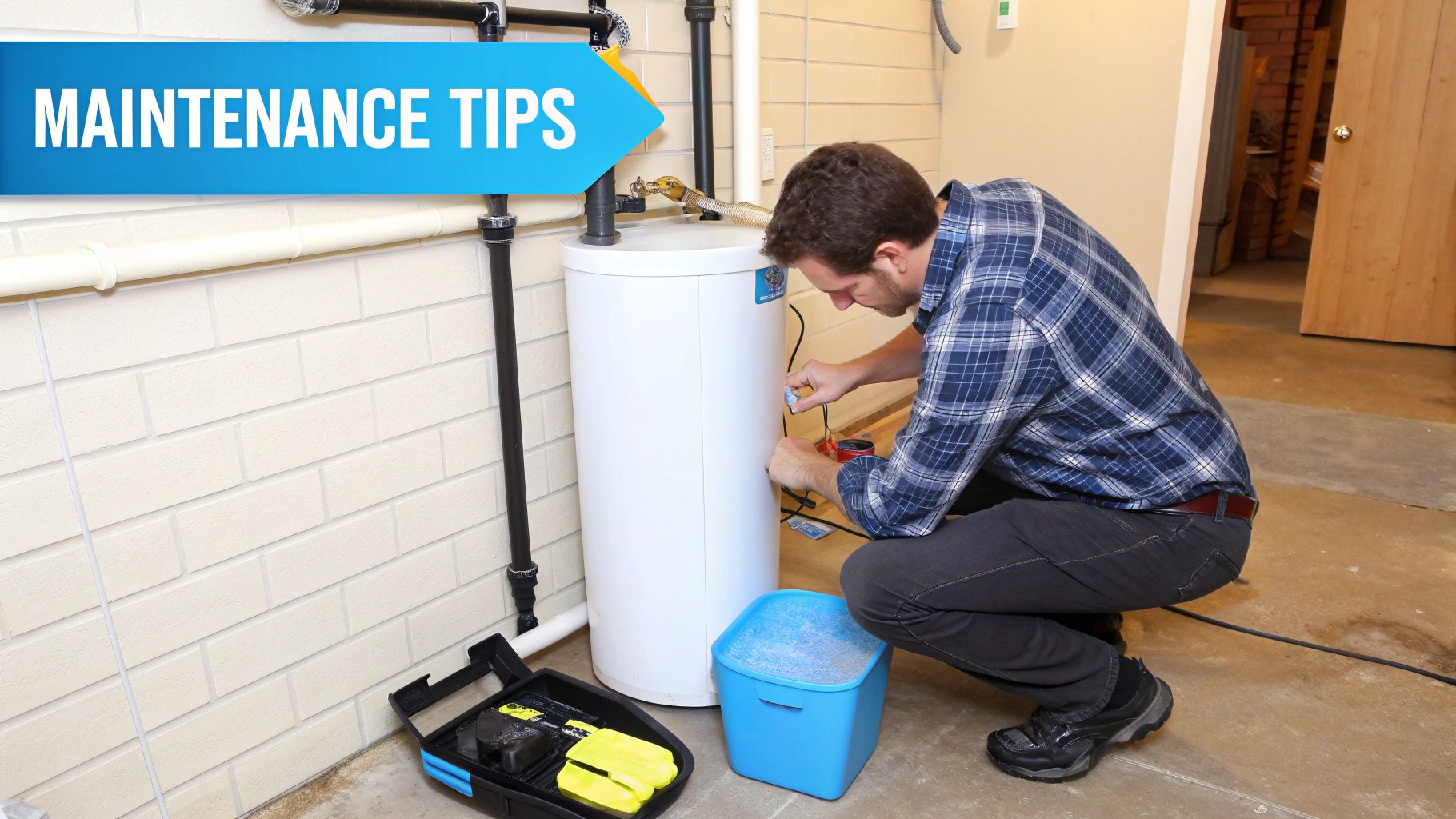
A man performing maintenance on a white water heater in a utility room with tools and a bucket.

Getting a hard water filtration system is a huge step, but the work doesn't stop once you've made the purchase. Proper installation and a little upkeep are what protect your investment and keep your home running scale-free for years to come.

Think of it this way: even a brand-new car needs its oil changed.

A whole-house system is a serious piece of plumbing. You're cutting into your home's main water line, which can feel pretty daunting. Your first big call is deciding whether to roll up your sleeves and do it yourself or bring in a pro.

DIY Installation vs. Professional Help

If you're already comfortable with plumbing projects, a DIY installation is definitely on the table. Most systems arrive with detailed instructions, and the basic process is straightforward: shut off the main water, cut a piece of pipe, and hook up the new unit. If you've handled pipe cutters, soldering, or PEX fittings before, you'll probably feel right at home.

For a lot of folks, though, this is a job best left to a professional plumber.

A licensed pro brings a lot to the table. They’ll ensure the system is installed to code, won’t leak (preventing a potential disaster), and can help you figure out the optimal spot for the unit. That's a big deal, especially since a salt-based softener needs to be near both a drain and a power outlet.

Expert Insight: Spending a few hundred dollars on a professional installer buys you total peace of mind. A bad install can cause leaks, a drop in water pressure, or even void your warranty, which makes hiring a pro a smart move for such a long-term home improvement.

Your Long-Term Maintenance Checklist

Once your system is up and running, a little routine care goes a long way. The maintenance you'll need to do really depends on the type of filtration system you picked.

For a traditional salt-based water softener, your main task is pretty simple: keep the brine tank topped up with salt. Here’s what that looks like:

  • Check the Salt Level: Take a peek inside the brine tank at least once a month.
  • Refill as Needed: A good rule of thumb is to keep the tank at least one-third full. For a typical family of four, you'll likely add one 40-pound bag of salt every month or two.
  • Choose the Right Salt: Stick to high-purity salt pellets made specifically for water softeners. Cheaper rock salt often has dirt and gunk that can clog up the system's more delicate parts.
  • Clean the Brine Tank: About once a year, it's a great idea to empty and clean out the brine tank. This gets rid of any sediment or "salt mush" that’s built up on the bottom.

Care for Salt-Free and Cartridge-Based Systems

If you went with a salt-free water conditioner that uses Template Assisted Crystallization (TAC), your to-do list is much shorter. There's a reason people call these "set it and forget it" solutions.

The TAC media inside the tank will eventually need to be replaced, but usually only every three to five years. It's a job many homeowners can handle themselves in under an hour—just unscrew the tank head, dump out the old media, and pour in the new.

For smaller, cartridge-based filters, like the ones you find on showerheads or under a sink, it’s even easier. All you have to do is swap out the filter cartridge based on the manufacturer's schedule, which is typically every six months to a year. Keeping up with this is key to making sure the filter keeps doing its job effectively.

Your Hard Water Questions Answered

After digging into all the different filtration methods for hard water, there are always a few questions that pop up. This is where we tackle those last few uncertainties head-on, giving you straight answers to the things we hear most often from homeowners just like you. Let's get everything cleared up so you can feel good about your next step.

Will a Water Softener Make My Drinking Water Salty?

This is probably the biggest myth we run into, and it's a totally fair question. While salt-based softeners do use sodium chloride (salt) to regenerate, the actual amount of sodium that makes its way into your tap water is tiny.

It's an ion exchange, not an addition. The system swaps a sodium ion for a calcium or magnesium ion. For most homes with moderately hard water, the sodium added is less than what's in a single slice of white bread. Honestly, you'd be hard-pressed to taste any difference at all.

That said, if you're on a strict, doctor-ordered low-sodium diet, it's something to discuss with them. A great workaround many people choose is to install a whole-house softener and then add a reverse osmosis system under the kitchen sink. You get the best of both worlds: your whole house is protected from scale, and you have ultra-pure, sodium-free water for drinking and cooking.

Can I Treat Hard Water if I Live in an Apartment?

You absolutely can. Installing a big whole-house system is usually off the table for renters, but you’ve still got some fantastic point-of-use filtration options that can make a world of difference. You don't have to just put up with hard water because you don't own the place.

Here are the most common filtration fixes for renters:

  • Showerhead Filters: This is the go-to for apartment dwellers. A simple screw-on shower filter designed for hard water can drastically cut down on scale and chlorine. The result? Skin that feels softer and hair that's healthier and easier to manage.
  • Faucet-Mounted Filters: For your kitchen sink, a filter that attaches right to the faucet is an easy way to improve the taste and quality of the water you drink and cook with.
  • Countertop Filtration Systems: From simple pitcher filters to more advanced countertop units, you can get great-tasting, filtered water without touching the plumbing at all.

These targeted solutions let you enjoy many of the perks of treated water without making a single permanent change.

How Do I Choose the Right Size Water Softener?

Getting the right size water softener is a huge deal for its efficiency and your long-term happiness with it. If it's too small, it will regenerate constantly, wasting salt and water. If it's too big, you've just spent more money than you needed to.

The right size all comes down to two numbers: your water hardness level (in Grains Per Gallon, or GPG) and how much water your household uses each day.

You can figure out your daily needs with a quick calculation:
(Number of People in Home) x (75 Gallons per Person) x (Your Water’s GPG) = Daily Grains to Remove

Let's walk through a real-world example. A family of four with water that has a hardness of 10 GPG would figure it out like this: 4 people x 75 gallons x 10 GPG = 3,000 grains per day. Since you want the system to go a few days between regeneration cycles, a standard 32,000-grain unit would be a solid choice for this family. Most manufacturers have easy-to-read sizing charts to help you lock in the perfect model. For more general filtration questions, you can always find more in-depth articles in our water filter advice section.


At Water Filter Advisor, our goal is to give you the clear, unbiased information you need to find the perfect solution for your home's water. Whether you need a whole-house system or a simple faucet filter, explore our guides and reviews to make a confident choice. Visit us at https://www.waterfilteradvisor.com to get started.

Does a Water Filter Soften Water in Your Home

Let's dive right in: a standard water filter does not soften water. It's an easy mix-up, but filtration and softening are two completely different ball games, designed to solve entirely different problems in your home's water supply.

Imagine your water filter is the head of security for your drinking glass. Its mission is to spot and block troublemakers like chlorine, funky-tasting sediment, and pesky pesticides. It ensures the water you drink is clean, safe, and doesn't taste like a swimming pool. A water softener, however, is more like a diplomatic negotiator—it specifically targets "hard" mineral ions and swaps them for something less problematic.

Filtration vs. Softening: The Core Difference

Clear water pouring from a kitchen faucet into a glass, symbolizing clean filtered water.

Most of us reach for a water filter to make our tap water safer and more enjoyable. The goal is purification. You want to kick out anything that might be harmful or just plain weird-tasting.

A filter's job is to remove a whole squad of contaminants, from chlorine and heavy metals to VOCs and bacteria. It's all about purity. But the minerals that cause hardness—our old friends calcium and magnesium—usually get a free pass to slide right on through.

Water softening, on the other hand, is on a completely different mission.

Its one and only purpose is to eliminate the minerals responsible for that crusty, white scale buildup in your pipes, on your showerheads, and inside your appliances. That buildup is a silent killer of efficiency and can lead to eye-watering repair bills. Softening is all about protecting the plumbing and appliances you've invested in.

To help you see the difference clearly, here's a quick side-by-side comparison.

Filtration vs. Softening at a Glance

Feature Water Filter Water Softener
Primary Goal Removes contaminants Removes hardness minerals
Improves Water taste, odor, and safety Prevents scale buildup
Targets Chlorine, lead, bacteria, pesticides, etc. Calcium and magnesium
Main Benefit Healthier, better-tasting water Protects pipes & appliances

This table shows that you're not choosing between one or the other; you're choosing which problem you want to solve.

Why You Might Need Both

Because filters and softeners are specialists in different fields, they aren't mutually exclusive. In fact, many homes with hard, contaminated water benefit from having both systems working in tandem.

The filter first removes the nasty stuff, then the softener takes care of the minerals. This dream team ensures your water is not only pure and great-tasting but also won't wage war on your coffee maker.

For anyone looking for a complete fix, a water softener and filter system combo is the way to go. This integrated approach gives you the best of both worlds, and understanding this key difference is the first step toward finding the perfect setup for your home.

Understanding the Problem of Hard Water

So, what is this stuff we call “hard water”? It’s really just water that’s picked up a high concentration of dissolved minerals—mostly calcium and magnesium—on its journey through the ground.

Think of these minerals as microscopic bits of rock hitching a ride in your water. When the water evaporates from a surface, like your shower door or kitchen faucet, it leaves those tiny hitchhikers behind. That’s where all the frustration begins.

A shower head clogged with white mineral scale buildup.

This leftover residue is the culprit behind that chalky film on your glass shower doors, the stubborn white spots on your dishes, and that crusty buildup around your sink fixtures. It’s also the reason your soap and shampoo just won't lather up properly, forcing you to use way more product than you should need to.

More Than Just Annoying Spots

While the visible signs are a nuisance, the real damage is happening where you can't see it. That mineral residue quietly builds up inside your pipes and appliances, forming a hard, rocky coating called limescale.

Limescale acts like plaque in your home's plumbing arteries. It slowly constricts water flow, forcing your entire system to work harder and less efficiently.

This buildup has serious consequences for some of your most expensive household appliances. It can choke the life right out of your water heater, dishwasher, washing machine, and even your coffee maker. In fact, some espresso machine experts claim that unfiltered hard water is directly responsible for over 50% of leak-related problems they see.

The effect on your energy bills is just as bad. Limescale is a terrible heat conductor, so when it coats the heating element in your water heater, the unit has to burn more energy just to get the water to the right temperature. This leads straight to higher utility bills and a much shorter lifespan for the appliance itself.

The Real-World Impact of Scale Buildup

The effects of this silent destroyer pop up all over the house. Over time, you’ll probably start to notice:

  • Reduced water pressure: As scale narrows the inside of your pipes, water flow drops. This means weak showers and sinks that take forever to fill.
  • Dull, stiff laundry: Hardness minerals get trapped in the fibers of your clothes, leaving them feeling rough and making colors fade much faster.
  • Dry skin and hair: Those same minerals that leave a film on your dishes also leave a residue on your body, which can clog pores and leave your skin and hair feeling dry and itchy.
  • Appliance failure: The constant strain and internal damage from scale buildup eventually lead to costly repairs and, all too often, premature appliance replacement.

Ultimately, dealing with hard water isn't just about getting shinier dishes or a better lather from your soap. It’s about protecting your home’s critical infrastructure—your plumbing and major appliances—from slow, expensive, and completely preventable damage. Since a standard water filter doesn't remove these minerals, homeowners often need to look at specific solutions designed to tackle hardness.

How Home Water Filters Actually Work

To get why most filters don't soften water, we have to pop the hood and see how they’re built. Think of water filtration like a series of specialized nets, where each one is designed to catch a different kind of unwanted particle. The size and type of that net dictate what it catches and what it lets slip right on through.

Most of the filters you find in homes are all about purification—getting rid of things that make your water taste, smell, or feel funky. They are fantastic at their jobs, but that job isn't softening.

https://www.youtube.com/embed/-_sr7mzhVsE

The Most Common Filter Types

Let's break down the workhorses of home water filtration. Each has a very specific role, and you'll quickly notice a common theme: they aren't designed to go after hardness minerals.

  • Sediment Filters: These are the simplest of the bunch. They work like a screen door for your water supply, blocking bigger stuff like dirt, sand, rust, and silt before it gets into your plumbing. While they're essential for protecting other filters and appliances, those dissolved hardness minerals just sail right through.

  • Activated Carbon Filters: This is the hero you'll find in pitcher filters, refrigerator filters, and a lot of faucet-mounted systems. Activated carbon has this incredibly porous surface that acts like a magnet for contaminants like chlorine, pesticides, and chemicals that cause bad tastes and smells. But calcium and magnesium ions? They just don't stick to the carbon and keep on flowing.

  • UV Purifiers: Ultraviolet (UV) systems are more like assassins than catchers. They use a powerful UV light to scramble the DNA of bacteria, viruses, and other nasty microorganisms, making them totally harmless. It's a super effective way to handle microbiological threats, but it does absolutely nothing to the mineral content in the water.

An EPA overview of treatment technologies confirms this. While methods like activated carbon are great for organics and chlorine, they don't touch the minerals that cause hardness. For that, the EPA points to cation exchange as a proven method with over 99% removal efficiency for both calcium and magnesium ions.

What About Reverse Osmosis?

Now, there is one major exception in the world of filtration: Reverse Osmosis (RO). An RO system uses an incredibly fine semipermeable membrane to strip out a massive range of dissolved solids from water. We're talking lead, arsenic, and—you guessed it—the calcium and magnesium that make water hard.

So, does a water filter soften water if it’s an RO system? Technically, yes, but only at the specific tap where it’s installed.

Using an RO system for whole-home softening is like using a sniper rifle for a job that needs a bulldozer. RO is perfect for producing highly purified drinking water at your kitchen sink, but it’s not built for the volume and flow rate your entire house demands.

It produces wastewater as part of its process and just can't keep up with showers, laundry, and the dishwasher all running at once.

This distinction is crucial. While a couple of filter types can reduce hardness, their main job is purification. For true, whole-home softening, you need a system that was engineered specifically for that task.

The Science of Making Hard Water Soft

So, if most filters aren’t designed to tackle hard water, what’s the real fix? This is where a dedicated water softener comes into play. These systems are the undisputed heavyweights of hard water treatment, and the science behind them is actually pretty straightforward.

At the core of a traditional water softener is a process called ion exchange. Picture the softener’s main tank filled with millions of tiny, porous resin beads. Right out of the box, these beads are loaded up with sodium ions.

As your home's hard water flows through this tank, the magic happens. The calcium and magnesium minerals—the very things causing all that scale and soap scum—have a stronger positive charge than the sodium ions. Because of this, the resin beads act like powerful little magnets, grabbing the calcium and magnesium right out of the water and releasing the sodium ions to take their place. It's a simple and incredibly effective trade that physically removes the minerals that make water hard.

The Trade-Off: How Ion Exchange Works

This mineral swap is what gives you genuinely soft water, unlocking all the benefits you’ve heard about: no more scale buildup, richer soap lather, and softer skin and hair. Of course, this process can't go on forever.

Eventually, the resin beads become completely saturated with all the calcium and magnesium they’ve pulled from the water. At that point, they can’t grab any more. This is when the softener needs to "regenerate"—it flushes the mineral-packed beads with a concentrated saltwater (brine) solution, washing the hard minerals down the drain and reloading the beads with a fresh supply of sodium ions, ready to start the cycle all over again.

There’s no question about the demand for this technology. The U.S. water softening systems market is a clear indicator of how widespread hard water problems are, with projections showing growth from $763.6 million in 2025 to a staggering $1.19 billion by 2032. This boom is driven by a growing awareness of hard water’s damaging effects, and proven salt-based ion exchange softeners continue to dominate the market. You can discover more about the water softening market's growth and see the trends for yourself.

The Salt-Free Alternative: Water Conditioners

For homeowners who want a lower-maintenance option, there's another player in the game: the salt-free water conditioner, often called a descaler. Now, it's critical to understand that these systems do not actually soften the water. They don’t remove the hard minerals at all.

Instead, they use a clever technology called Template Assisted Crystallization (TAC). This process changes the physical form of the calcium and magnesium minerals, turning them into microscopic crystals that simply won't stick to your pipes, fixtures, or appliances.

Think of it this way: if scale buildup is like LEGOs clicking together to form a solid mass, a water conditioner coats each LEGO piece so it can't connect with the others. The minerals are still present in your water, but they just flow harmlessly through your plumbing without causing that destructive scale. This makes conditioners a fantastic choice for scale prevention, but you won't get those other classic benefits of soft water, like silky-smooth skin or better soap performance.

Choosing the Right Water System for Your Home

So, how do you take all this information and turn it into the right decision for your family? It really just comes down to one simple question: What problem are you trying to solve? The best choice for you is all about your specific goals.

Are you mainly concerned with making your drinking water taste better and getting rid of nasty contaminants? Or are you just plain sick of replacing appliances caked in scale and scrubbing that chalky film off your shower doors? Your answer is the key to figuring out the perfect water treatment plan for your home.

Assess Your Home’s Unique Needs

Before you buy anything, you need to know what you’re working with. A great first step is to grab a simple water hardness test kit. It will tell you exactly how many grains per gallon (GPG) of minerals are in your water. If you see a number over 3 GPG, you've got hard water that’s likely causing problems.

Next, think about your family's priorities and your budget. Are you looking for a whole-house system that protects every pipe and appliance, or is a simple under-sink filter for pure drinking water all you really need? Nailing down what you actually need helps you avoid spending money on a system that's overkill. For some great pointers, check out the expert advice on water filters to explore options that fit your situation.

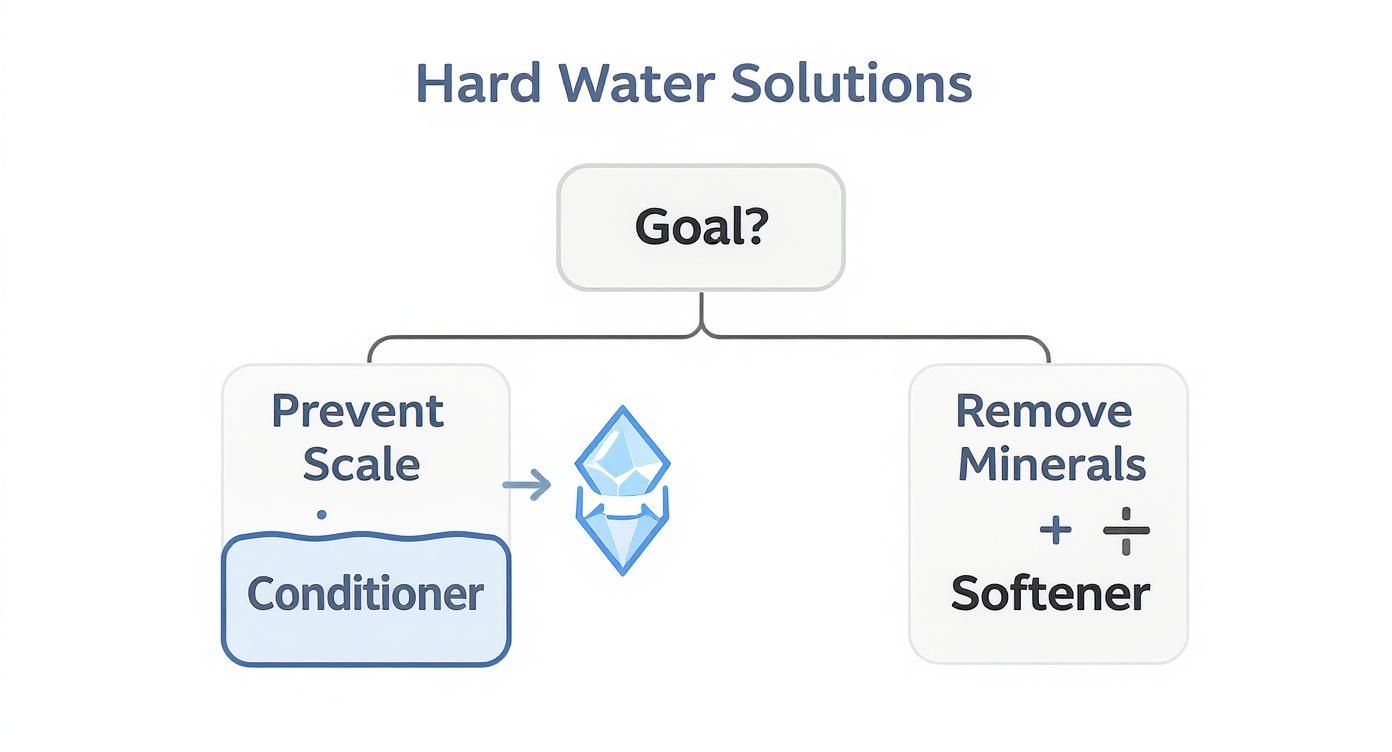
This handy decision tree makes the choice even simpler, focusing on whether you want to stop scale or completely remove the minerals causing it.

Infographic about does a water filter soften water

As you can see, if your main goal is just to stop scale from building up without messing with the water chemistry, a conditioner is the way to go. But if you want those minerals gone for good, a softener is what you need.

Creating a Hybrid Water Treatment System

For a lot of homeowners, one device just doesn't cut it. The best setups often combine different systems to create a powerful, multi-stage defense against both contaminants and hardness minerals.

Here are a couple of popular combinations that work incredibly well:

  • Ultimate Protection: Combine a whole-house sediment filter with a traditional water softener. Think of the filter as a bodyguard for your softener—it catches all the dirt, sand, and rust that could clog up and damage the softener’s resin, helping it run smoothly for years.
  • Targeted Purity and Scale Prevention: Pair a salt-free water conditioner with an under-sink Reverse Osmosis (RO) system. The conditioner protects your home's entire plumbing system from scale, while the RO unit sits right under your kitchen sink, giving you ultra-pure water for drinking and cooking.

This kind of layered approach means you're no longer just asking, "Does a water filter soften water?" Instead, you’re building a complete system that delivers pure, non-damaging water to every tap in your house.

It's also worth thinking about how your water system fits into your other home improvement goals, like creating energy-efficient smart home solutions. By preventing scale from building up inside your water heater, a softener or conditioner allows it to work more efficiently. That means less energy wasted and lower utility bills, making your water treatment system a smart investment for a more cost-effective home.

Common Questions About Water Filters and Softeners

Diving into the world of water treatment can feel a little overwhelming. Once you realize filters and softeners aren't the same thing, a whole new set of questions usually pops up. We get it.

Here are some straightforward answers to the most common queries we hear from homeowners trying to map out the perfect water strategy for their house.

Will a Reverse Osmosis System Soften My Water?

Yes, a reverse osmosis (RO) system definitely softens water, and it does a fantastic job of it. Its super-fine membrane is a beast, designed to strip out pretty much all dissolved solids, and that includes the calcium and magnesium minerals that make water hard.

But here’s the catch: RO systems are designed for a single faucet, like your kitchen sink. They work slowly, produce a stream of wastewater, and just can't keep up with the demands of an entire house. For whole-house softening, a dedicated water softener is a much more practical and efficient choice.

Is Softened Water Safe to Drink?

For almost everyone, drinking softened water is perfectly safe. The ion exchange process does add a tiny bit of sodium to the water, which is something to be aware of if you're on a strict, doctor-ordered low-sodium diet.

The amount of sodium added depends on how hard your water is to start with—the harder it is, the more sodium gets swapped in. If that’s a concern for you, you've got a couple of easy workarounds:

  • Use potassium chloride pellets in your softener instead of the standard sodium chloride ones.
  • Have your plumber bypass the cold water line to your kitchen sink, so you get unsoftened water for drinking and cooking.

Can I Use a Water Softener and a Water Filter Together?

Absolutely! In fact, combining them is often the best way to get top-tier water quality throughout your home. Think of it as creating a multi-stage defense that tackles a whole range of problems.

A popular and highly effective setup is to install a whole-house sediment pre-filter before the water softener. This filter acts like a bodyguard, grabbing all the dirt, sand, and rust that could clog up and damage the softener's sensitive resin bed. Then, you can add an activated carbon filter after the softener to strip out chlorine, giving you great-tasting, clean-smelling water from every single tap.

This layered approach is the real answer to whether a filter can soften water. It accepts that they are different tools for different jobs, and using them together gives you a complete solution for pure, non-damaging water.

What’s the Difference Between a Water Softener and a Water Conditioner?

This is a really important distinction. A traditional water softener relies on ion exchange to physically pull the hardness minerals out of your water, trading them for sodium ions. The result is truly soft water, with all the benefits you’d expect—great soap lather, no spots on dishes, and softer skin.

A water conditioner, which you might also hear called a descaler, is a salt-free alternative that works completely differently. It doesn't remove the minerals. Instead, it uses a technology like Template Assisted Crystallization (TAC) to change the physical shape of the mineral crystals. This keeps them from sticking to surfaces and forming that destructive limescale in your pipes and appliances.

Here’s a simple way to think about it: a softener removes the troublemakers entirely, while a conditioner just puts them in handcuffs so they can't cause any harm as they pass through. Conditioners are great for preventing scale buildup but won't give you the other perks of genuinely soft water.


At Water Filter Advisor, our mission is to provide clear, research-driven guidance to help you make confident decisions about your home's water quality. Explore our in-depth guides and reviews to find the perfect solution for your family at https://www.waterfilteradvisor.com.

Finding the Best Water Filter for Your Home: The Ultimate 2024 Guide

Let's be real for a second: have you ever looked at a glass of tap water and wondered what's really in there? Sure, city water gets the spa treatment at a plant somewhere, but then it travels through miles of ancient pipes to get to you. Along the way, it can pick up some uninvited guests like chlorine, lead, and other mystery gunk. A good water filter isn't just a gadget; it's the final bouncer at the door, making sure only the good stuff gets in.

Why a Great Water Filter is Your Home's Unsung Hero

A person pouring filtered water from a modern pitcher into a glass in a kitchen setting.

Choosing the best water filter for your home is more than just a kitchen upgrade; it's a power move for your family's health and your own sanity. Even when your local water report says everything is "A-OK" by federal standards, that piece of paper doesn't tell you the whole story of what's splashing out of your faucet.

Think of it like this: the water that leaves the treatment plant is like a freshly detailed car. But by the time it gets to your driveway after a long, dirty road trip, it's not so pristine anymore. It can pick up all sorts of contaminants from underground pipes, some of which might be older than your grandparents. This is why even "safe" water can taste like a swimming pool or leave chalky buildup on your faucets.

The Usual Suspects Lurking in Your Tap Water

To win the war for clean water, you have to know your enemy. Different filters are like different superheroes, each with a specific villain they're built to defeat. Figure out what's in your water, and you're halfway to finding the perfect sidekick for your home.

Here are a few of the common troublemakers a quality filter can show the door:

  • Chlorine and Chloramine: The stuff cities use to disinfect water. Great for killing germs, not so great for taste and smell.
  • Heavy Metals: Nasty characters like lead and arsenic can sneak in from old plumbing and pose serious health risks, even in tiny amounts.
  • Sediment and Particulates: We're talking about little bits of rust, sand, and silt that make your water cloudy and are rough on your appliances.
  • Volatile Organic Compounds (VOCs): These are industrial and agricultural chemicals that you definitely don't want in your morning coffee.

We're witnessing a huge cultural shift. People are waking up to the reality of their water quality. A home filtration system is no longer a luxury—it's becoming as essential as a lock on the front door.

A Growing Global Thirst for Purity

This quest for clean water isn't just happening in your neighborhood; it's a worldwide movement. The global water purifier market was valued at a cool USD 45.7 billion in 2024 and is projected to nearly double to over USD 88.8 billion by 2034. That's not just growth; it's a revolution, fueled by a greater understanding of waterborne contaminants. You can explore more about these market dynamics to see just how big this wave is.

At the end of the day, the mission is simple: make sure every drop you and your family drink is as clean, safe, and delicious as possible. In this guide, we’ll arm you with the knowledge to choose your champion filter with total confidence.

Decoding the Magic Behind Water Filtration Tech

A close-up of water flowing through a filtration system's internal layers.

To find the best water filter for your home, you need to peek behind the curtain and see how the magic happens. Different filtration technologies are designed to solve different problems. The real secret is matching the right tech to the specific junk you're trying to kick out of your water. Let's pull apart the most common systems to see what makes them tick and where they truly excel.

This isn't about blindly trusting a brand's flashy promises. It's about understanding the science so you can cut through the marketing noise. Each method has its superpowers, its perfect mission, and yes, its kryptonite. Knowing these details is the difference between a brilliant investment and a regrettable paperweight.

Activated Carbon: The Crowd-Pleasing Workhorse

You'll find activated carbon in practically everything, from your basic pitcher filter to beefy whole-house systems. It's the undisputed MVP of filtration. Imagine it as a microscopic sponge with a massive surface area, covered in tiny nooks and crannies that trap contaminants through a process called adsorption.

When water flows through, unwanted guests like chlorine, pesticides, and VOCs get stuck to the carbon's surface. The result? Water that tastes and smells crisp and clean. Since most city water has a chemical aftertaste from disinfectants, carbon filters are fantastic for an instant upgrade. If you want to nerd out, you can check out the science behind hypochlorous acid, a common chlorine treatment.

Ideal Use Case Comparison

Filter Type Best For Contaminant Focus
Pitcher/Faucet Filters Renters or small households who just want better-tasting drinking water, fast. Chlorine, taste, odor.
Whole House Carbon Filters Homeowners ready to banish chlorine from every tap, protecting skin and hair in the shower, too. Chlorine, chloramine, VOCs.

But here's the fine print: while carbon is a champion at improving your water's vibe, standard versions won't touch things like lead, nitrates, or microorganisms. For that level of security, you need to call in the special forces.

Reverse Osmosis: The Purity Powerhouse

If you’re looking for water that’s as close to pure H₂O as you can get at home, Reverse Osmosis (RO) is your answer. This system uses pressure to force water through a special membrane with pores so ridiculously small that only water molecules can get through. It’s like having a molecular bouncer at a VIP club, turning away almost everything else.

This process is ruthlessly effective at removing a massive range of contaminants. A good RO system will decimate or completely eliminate:

  • Heavy metals like lead, arsenic, and mercury.
  • Dissolved solids like salt, fluoride, and nitrates.
  • It can even kick out some bacteria and viruses, elevating it to purification status.

The classic knock against RO was water waste. Old systems were infamous for flushing gallons of water down the drain for every clean gallon produced. Luckily, modern high-efficiency models have dramatically improved, making them much friendlier to the planet and your water bill.

Because it’s so thorough, RO is typically installed under the sink with its own sleek, dedicated faucet, giving you ultra-pure water for drinking and cooking right where you need it most.

UV Purification: The Microbe-Slaying Guardian

Unlike filters that physically trap gunk, a UV purifier is an assassin. It uses a powerful ultraviolet lamp to bombard water with germicidal rays. This light attacks the DNA of bacteria, viruses, and nasty protozoa like Giardia and Cryptosporidium, making it impossible for them to reproduce and make you sick.

UV purification is a clean, chemical-free hit. It adds nothing to your water and doesn't change the taste at all. It’s an absolute non-negotiable for anyone on private well water, since wells don't get the city treatment and are far more vulnerable to microbiological party-crashers.

Just remember, a UV system is a specialist—it only handles living threats. It must be teamed up with sediment and carbon filters to tackle particles and chemicals. If your water is cloudy, the sediment can act like tiny bodyguards, shielding microbes from the UV light. Pre-filtration isn't just a suggestion; it's a mandatory partner for a successful mission.

Comparing the Top Home Water Filtration Systems

Let's cut to the chase. Choosing the right water filter for your home goes beyond flashy packaging. It's a practical decision that boils down to performance, long-term costs, and how much hassle you're willing to endure. To make the smart choice, you need a no-nonsense, head-to-head comparison of how these systems perform in the real world.

We're about to put the leading technologies in the ring together, judging them on what really counts—what they remove, what they'll cost you over five years, and what it actually takes to get one up and running.

Effectiveness in Contaminant Removal

The entire point of a filter is to deliver cleaner, safer water. But "clean" is a relative term. A filter's true might is measured by the specific villains it can vanquish, which is why hunting for NSF/ANSI certifications is your secret weapon.

An Activated Carbon filter—the hero of most pitchers and faucet attachments—is your go-to for making water taste and smell like it came from a mountain spring. It's a beast at grabbing chlorine and some VOCs. But that's where its power ends. It won't lift a finger against dissolved solids, heavy metals like lead, or microbial invaders.

On the other end of the battlefield, a Reverse Osmosis (RO) system is the heavyweight champion. It forces water through an impossibly fine membrane, stripping out a massive list of impurities. We're talking lead, arsenic, fluoride, nitrates, and even some viruses, achieving up to a 99% reduction in total dissolved solids (TDS).

Then there's the UV Purifier, the specialist operative. It doesn't actually remove anything. Instead, it unleashes a blast of ultraviolet light to neutralize bacteria and viruses by scrambling their DNA. This makes UV an essential guardian for well water, but it needs backup to handle chemical contaminants.

Key Insight: The "best" filter is the one that's perfectly matched to the specific contaminants in your water. You won't know your enemy until you get a water test. Only then can you decide if you need the overwhelming force of an RO system or if a simple carbon filter can win the day.

Installation and Maintenance Realities

Setting up a filter can range from "easier than making toast" to a full-blown weekend project. This is a massive factor that determines which system truly fits your home and lifestyle.

  • Pitcher and Faucet Filters: These are the definition of plug-and-play. You can have one running in minutes. Maintenance is a simple cartridge swap every few months. They're a perfect match for renters or anyone allergic to commitment.

  • Under-Sink RO Systems: This is more of a commitment. It involves tapping into your cold water line, drilling a hole in your countertop for a dedicated faucet, and connecting a drain line. It's a manageable DIY for the handy, but it's a permanent modification. Maintenance is also more involved, with multiple filters and the RO membrane needing replacement on different schedules (from 6 to 24 months).

  • Whole House Systems: This is the big kahuna. It requires a professional plumber to install it where the main water line enters your home. The upside? Once it's in, maintenance is often a breeze, with some filter media lasting for years. You're trading upfront cost and complexity for ultimate long-term convenience.

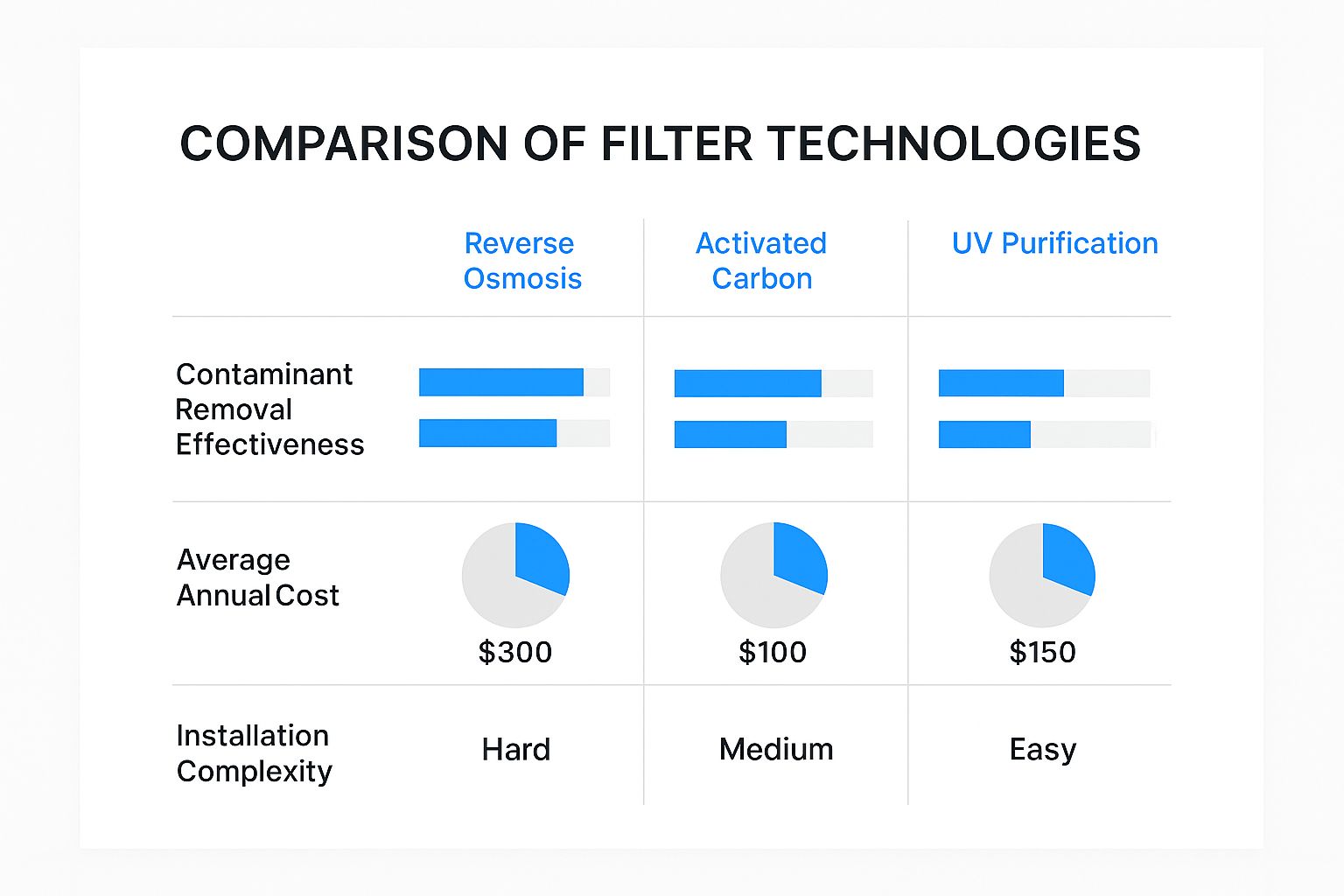
This infographic gives you a quick visual on how these technologies compare when you factor in effectiveness, cost, and installation.

Infographic about best water filter for home

As you can see, it’s all about trade-offs. Reverse Osmosis delivers the best filtration, but you'll pay for it in price and installation effort. Activated Carbon is cheap and easy, but its filtering power is limited.

The True Cost of Ownership

That price on the box? That's just the entry fee. The number you should really care about is the Total Cost of Ownership, which includes the initial purchase, installation, and all the replacement filters you'll buy over the next few years. Looking at it this way often reveals that the "cheapest" option is anything but.

Let's crunch the numbers for a family of four choosing between a pitcher and an RO system.

Scenario A: The Pitcher Filter
A pitcher costs about $30. Filters are around $8 each and need replacing every 40 gallons. If your family drinks two gallons a day, you're swapping filters every 20 days. That's roughly 18 filters a year.

  • Annual Filter Cost: 18 filters x $8 = $144 per year

Scenario B: The Under-Sink RO System
A quality RO system costs about $250 upfront. But its filters have serious staying power. The pre-filters might run $40 a year, while the main RO membrane costs $50 but only needs replacing every two years (averaging $25 per year).

  • Annual Filter Cost: $40 + $25 = $65 per year

The RO system has a higher sticker price, but its annual filter costs are less than half the pitcher's. Over five years, the family would spend $720 on pitcher filters, compared to just $575 for the RO system (initial purchase included). And for that lower long-term cost, they get dramatically better water quality.

This is exactly why you have to play the long game. As more people wise up, the market is exploding. The home water filtration industry, valued at USD 20.5 billion in 2021, is set to rocket past USD 25.3 billion by 2025. You can discover more insights about home water filtration trends to see how this health-conscious revolution is reshaping our kitchens.

Choosing the Right Filter for Your Home and Lifestyle

https://www.youtube.com/embed/DOPweBJInr4

Let's bust a myth right now: there is no single "best water filter for home." The idea of a one-size-fits-all champion is pure fiction. The right system is the one that seamlessly integrates with your life, your home, and the unique cocktail of contaminants flowing from your tap. It's a personal decision that balances performance with practicality.

Instead of drowning in technical specs, let's approach this like a matchmaker, pairing common household scenarios with their ideal filtration partner. This way, you can see how different technologies solve real, everyday problems.

The Smart Choice for Apartment Renters

Living in an apartment means you can't just start playing plumber. This immediately knocks complex under-sink or whole-house systems out of the running. For renters, the perfect solution has to be effective, ridiculously easy to install, and just as simple to pack up when you move.

This is where faucet-mounted filters and high-quality water pitchers absolutely dominate. A good faucet filter twists onto your kitchen tap in seconds, giving you on-demand filtered water. They typically use activated carbon to eliminate that funky chlorine taste and smell, making your tap water instantly more enjoyable.

  • Top Recommendation: A faucet-mounted filter with NSF certification for reducing both chlorine and lead.
  • Why It Works: You get point-of-use convenience without leaving a trace. It's designed for a life on the move.
  • Cost Factor: The initial cost is tiny, and swapping filters every few months won't break the bank.

The Workhorse System for Large Families

A busy family of four or more goes through water like it's their job. You're not just pouring drinks; you're boiling pasta, washing vegetables, and filling an endless stream of water bottles. A small pitcher just can't keep up, and constantly changing those little filters becomes a tedious and surprisingly expensive chore.

For this level of demand, an under-sink Reverse Osmosis (RO) system is the undisputed champion. Installed neatly out of sight, it provides a limitless supply of incredibly pure water from its own stylish faucet. This is a true powerhouse, built to remove a huge list of contaminants like heavy metals, fluoride, and dissolved solids.

An under-sink RO system is an investment in both convenience and quality. For a large family, it eliminates the constant refilling of pitchers and provides a virtually unlimited supply of purified water, ultimately proving more cost-effective than smaller filters.

Yes, the initial setup is more involved, but the long-term rewards are massive. The filters last much longer—often 6 to 12 months for pre-filters and up to two years for the main RO membrane—making maintenance a far less frequent and more predictable task.

The Essential Filter for Well Water

If your water comes from a private well, you're playing a completely different game than city folks. Well water isn't treated by a municipality, which means it’s vulnerable to microbiological invaders like bacteria, viruses, and cysts. These aren't just gross; they can pose serious health risks.

For any home on a well, a UV Purifier is not a luxury; it's an absolute necessity. This system uses ultraviolet light to zap the DNA of microorganisms, rendering them harmless without adding a single chemical to your water. It’s a powerful, reliable method for disinfection.

However, a UV system is a specialist and needs a team. To work properly, it must be paired with pre-filters:

  1. Sediment Filter: This is the first line of defense, catching dirt, sand, and rust. UV light can't work in cloudy water, so clarity is key.
  2. Activated Carbon Filter: Stage two removes chemicals and polishes the water's taste before its final pass by the UV lamp.

This multi-stage fortress provides a complete point-of-entry solution, ensuring your well water is safe for the entire house. For more detailed guidance, you can find a wealth of practical advice for your water filter needs to make sure you've covered all your bases.

The Budget-Friendly Option for Singles and Couples

For an individual or a couple, the primary goal is often just to make tap water taste better without a major investment. Since water usage is lower, a high-capacity system is usually overkill. The focus here is on a solution that's effective, affordable, and blissfully simple.

A high-quality water filter pitcher is the perfect starting point. Modern pitchers are light-years ahead of older models, with many now certified to reduce serious contaminants like lead, mercury, and certain pesticides. They require zero installation and offer the flexibility of having cold, filtered water ready to go in the fridge.

The only catch is staying on top of filter changes, typically every 40 gallons or two months. If you slack off, the filter stops working and can even become a breeding ground for bacteria. But for its low cost and proven performance, a certified pitcher remains the best water filter for home use when budget and simplicity are your top priorities.

The Future of Water Filtration in Smart Homes

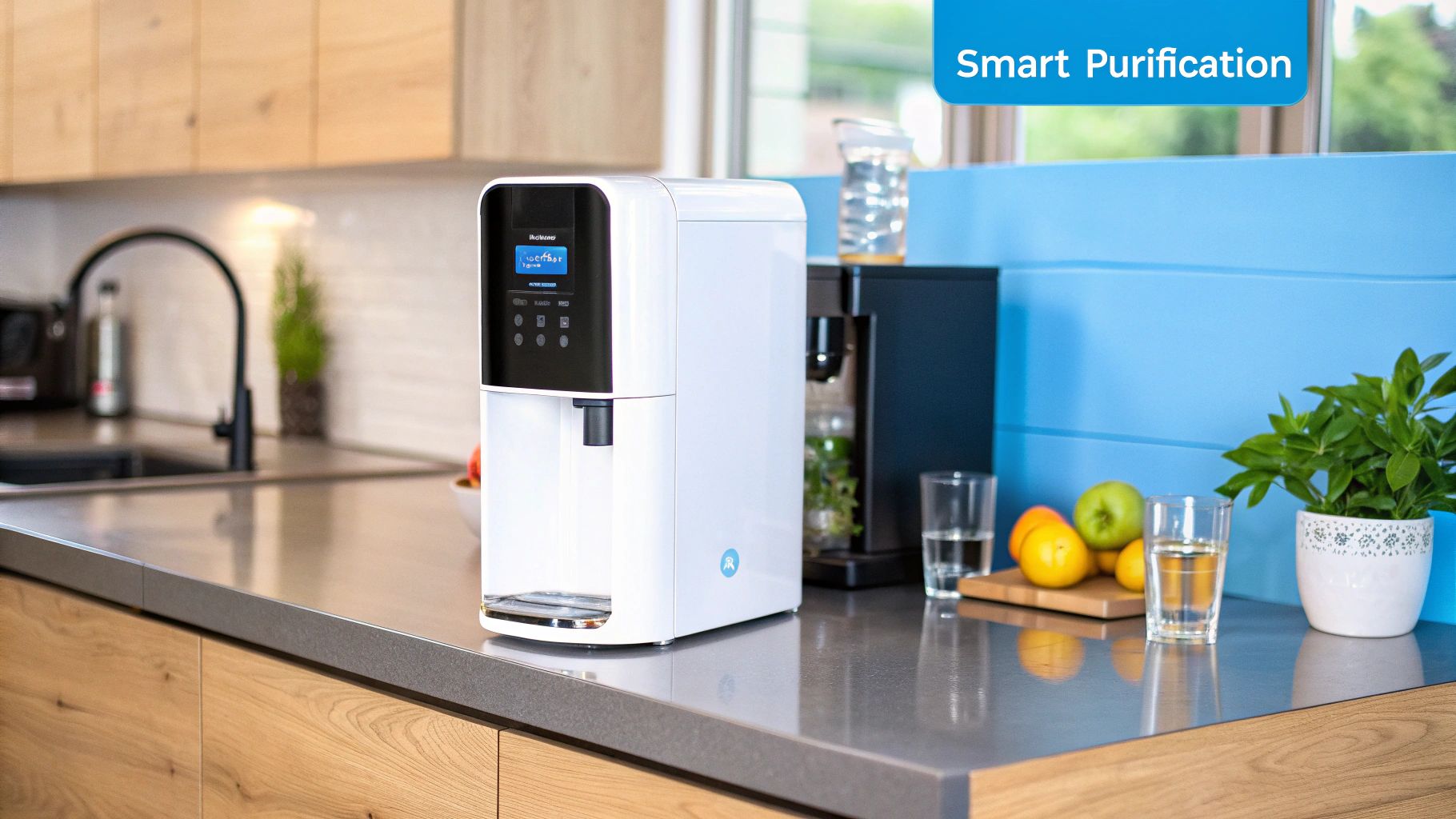
A sleek, modern smart water filter integrated into a kitchen counter, with a digital display showing water quality data.

The days of sticking a reminder note on your fridge to change your water filter are fading fast. Home water filtration is getting a massive tech upgrade, ushering in a new era of systems that are smarter, more connected, and far more intuitive. These aren't just filters anymore; they're intelligent guardians of your home's water supply.

This evolution is powered by the integration of AI and IoT (Internet of Things) technology directly into the filtration systems. The newest models can monitor your water quality in real-time, track your household's usage patterns, and send detailed updates straight to your smartphone. It’s a quantum leap from a simple calendar alert.

The Rise of Intelligent Water Management

Smart water filters are changing the game by arming us with proactive, data-driven knowledge. Instead of blindly following a generic replacement schedule, these systems analyze your actual water consumption to predict the precise moment a filter's effectiveness begins to drop. This predictive maintenance ensures your system is always operating at peak performance.

And the world is taking notice. The global residential water purifier market, valued at around USD 21.96 billion in 2024, is projected to surge to an astonishing USD 76.61 billion by 2034. This boom is driven by innovations like AI-powered contaminant detection and dynamic filtration that adjusts to your water's needs.

This intelligence delivers real, tangible benefits:

  • Real-time Quality Monitoring: Onboard sensors continuously test your water, giving you an instant snapshot of its purity.
  • Predictive Filter Alerts: The system notifies you before a filter expires, based on actual usage, not just a date on a calendar.
  • Leak Detection: Some advanced models can even detect leaks and automatically shut off the water, preventing a potential catastrophe.

A smart water filter does more than just clean your water—it gives you peace of mind. When you know the exact status of your system and your water quality at any given moment, all the guesswork just disappears.

Seamless Smart Home Integration

The real magic unfolds when these systems begin to communicate with the rest of your smart home ecosystem. Imagine your water filter syncing with other devices to create a truly automated and responsive living environment.

You could ask Amazon Alexa or Google Assistant for a quick water quality update or check your filter's remaining lifespan with a simple voice command. Some systems can even be programmed to automatically reorder new filters when they're running low, ensuring you never miss a swap. As filtration becomes more intelligent, it solidifies its place as a cornerstone of the connected home. To see how it all fits together, check out this ultimate guide to smart apartment technology.

Ultimately, a smart purifier offers a level of convenience and control that traditional models simply can't match, making it a natural and powerful addition to any modern home.

Common Questions About Home Water Filters

Even after diving deep into the world of filtration, it’s normal to have a few questions lingering. Choosing the right water filter is a big decision, and you want to be absolutely sure you’re making the best call for your home.

We’ve rounded up some of the most frequent questions we hear. Consider this your final cheat sheet to help you choose with total confidence.

Do I Really Need a Water Filter If My City Water Is Safe?

This is the million-dollar question. While your city's water may meet federal standards when it leaves the plant, that's just the start of its journey. The water then travels through miles of pipes—some potentially decades old—before reaching your tap.

Along the way, it can pick up unwelcome hitchhikers: lead from old plumbing, residual chlorine from the treatment process, and other sediment. A home filter acts as your personal, last line of defense. It's an extra layer of security that also happens to make your water taste and smell infinitely better, which is the main reason most people get one.

How Do I Know What Contaminants Are in My Water?

You can't solve a problem you can't see. Identifying what's actually in your water is the most crucial first step. The easiest starting point is your local utility's annual Consumer Confidence Report (CCR). This gives you a general overview of the municipal supply.

But for the truth about what’s coming from your own faucet, you need to test it.

  • At-Home Test Kits: These are perfect for quick checks on things like chlorine and water hardness.
  • Lab Testing: To get the complete, detailed story, send a water sample to a state-certified lab. This is the gold standard and an absolute must if you're on a private well.

Don't guess. A proper water test is an investment that pays for itself. It guarantees you buy a filter that targets your specific problems, saving you from wasting money and time on the wrong solution.

What Is the Difference Between Water Filtration and Purification?

People often use these terms interchangeably, but they mean different things in the water world. Filtration is a physical process, like a high-tech strainer that traps particles like sediment, chlorine, and some larger bacteria.

Purification is the next level. It removes or neutralizes even the tiniest microscopic threats, including viruses. This is typically achieved with technologies like UV light (which deactivates them) or the ultra-fine membranes found in Reverse Osmosis systems. An RO system is powerful enough to be classified as a purifier because it can remove up to 99% of all dissolved solids, including microbiological contaminants.

How Often Should I Change My Water Filters?

This one is non-negotiable. The simple answer is: follow the manufacturer's instructions to the letter. Filter replacement schedules vary wildly depending on the system type and your household's water usage.

For example:

  • A pitcher filter might need a new cartridge every two months.
  • An under-sink system's pre-filters could last 6-12 months.
  • The main RO membrane in a reverse osmosis system can go for two years or more.

Procrastinating on this is a huge mistake. A clogged filter doesn't just stop working; it can become a breeding ground for bacteria. Even worse, it can release all the contaminants it has captured back into your water, potentially making it dirtier than unfiltered tap water.


At Water Filter Advisor, we give you the resources to make a smart choice, from deep-dive reviews to easy-to-follow maintenance guides. Check out our expert advice and find the perfect water filter for your family.
Find your ideal water filter on WaterFilterAdvisor.com

TOP 5 Best Under Sink Water Filters 2025

TOP 5 Best Under Sink Water Filters 2025


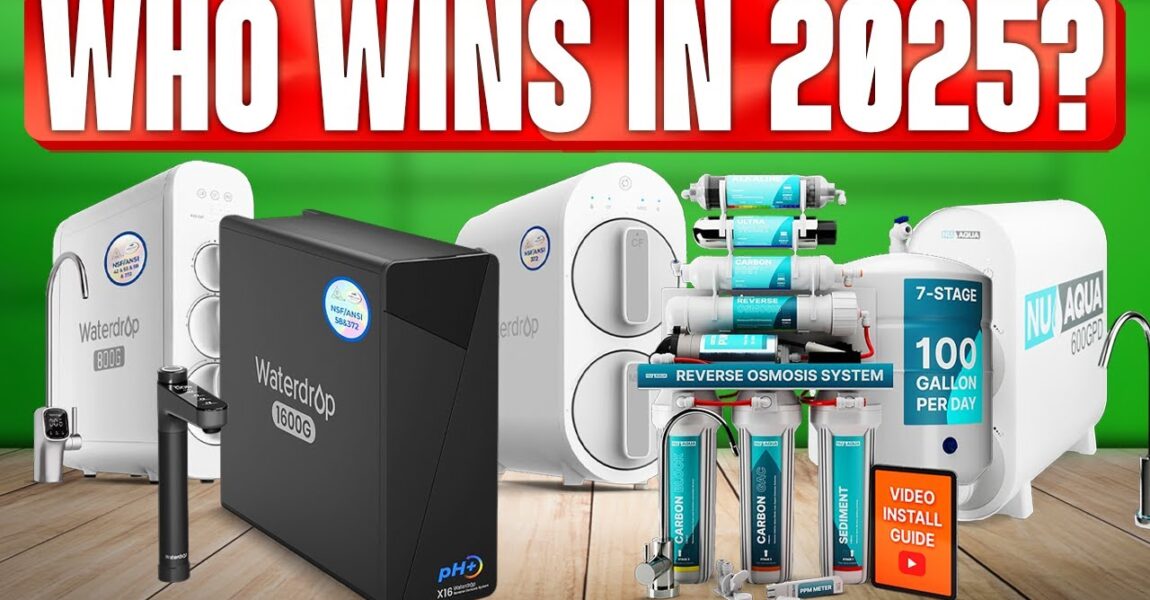
Best Under Sink Water Filter 2025 | Links To Products ⤵️
1. Waterdrop X16 Tankless Reverse Osmosis System ✅
✓ Check Prices –

2. NU Aqua Tankless RO System ✅
✓ Check Prices –

3. Waterdrop G3P800 ✅
✓ Check Prices –

4. NU Aqua 7-Stage RO System ✅
✓ Check Prices –

5. Waterdrop G2 RO System ✅
✓ Check Prices –

We are a participant in the Amazon Services LLC Associates Program, an affiliate advertising program designed to provide a means for us to earn fees by linking to Amazon.com and affiliated sites.

00:00 Intro
00:25 5️⃣ Waterdrop G2 RO System Review
01:21 4️⃣ NU Aqua 7-Stage RO System Review
02:13 3️⃣ Waterdrop G3P800 Review
03:06 2️⃣ NU Aqua Tankless RO System Review
04:03 1️⃣ Waterdrop X16 Tankless Reverse Osmosis System Review

In today’s world, ensuring access to clean and safe drinking water is a top priority for many households. An under sink water filter has become an increasingly popular solution for homeowners looking to improve their water quality. These compact and efficient systems offer a convenient way to purify tap water right at the point of use.

The best water filtration system for home use often depends on individual needs and preferences. However, under sink water filters consistently rank among the top choices due to their effectiveness and ease of installation. These systems are designed to remove a wide range of contaminants, including chlorine, lead, pesticides, and microorganisms, resulting in better-tasting and healthier water.

One of the most advanced types of under sink water filter is the reverse osmosis filter. This technology is widely regarded as the best water purifier available for residential use. A reverse osmosis system uses a semi-permeable membrane to remove up to 99% of dissolved solids, providing exceptionally pure water. For those seeking the best reverse osmosis system, it’s essential to consider factors such as filtration capacity, water pressure, and maintenance requirements.

Water filtration systems come in various configurations, but under sink models offer a balance of performance and convenience. They’re hidden from view, saving valuable counter space while providing on-demand filtered water. The best under sink water filter system will typically include multiple stages of filtration, often combining activated carbon filters with sediment filters and, in some cases, UV sterilization.

As we look ahead to 2025, the best under sink water filter options continue to evolve. Manufacturers are incorporating smart technology, improved filter materials, and more efficient designs. The best under the sink water filter in 2025 is likely to offer enhanced contaminant removal, longer filter life, and easier maintenance.

When choosing the best water filter under sink for your home, it’s crucial to consider your specific water quality issues and household needs. Some systems are designed to address particular contaminants, while others offer more comprehensive filtration. The best under sink water filter 2024 models are expected to provide a perfect balance of filtration effectiveness, ease of use, and cost-efficiency.

Water purification systems have come a long way, and under sink filters represent a significant advancement in home water treatment. Whether you’re concerned about taste, odor, or potential health risks, investing in a high-quality under sink water filter can provide peace of mind and improve your overall quality of life. By choosing the best water filtration system for your needs, you can enjoy clean, great-tasting water straight from your tap, making it easier than ever to stay hydrated and healthy.

#undersinkwaterfilter #waterfilter #waterfiltersystem

Original Video Source

What’s the BEST KEPT SECRET in WATER FILTRATION?

What’s the BEST KEPT SECRET in WATER FILTRATION?


Wondering what’s HUM Water Filtration and why it’s important to your family? There are all kinds of brands of water filters and products but how is HUM different from the rest?
When you’re investing in water treatment for your family there are so many products and brands out there, where do you start? Who do you believe? How can you be sure you get what you need? Surely there must be a short cut to get to what you need! There is and it’s the HUM Water Filtration Brand of products.
Think of HUM Water Filtration like the story of Goldilocks and the three bears. HUM Water Filtration products offer that “just right” mix of great quality, ease of installation & use, product support and service. Make no mistake about it, these are definitely not the most expensive water filtration products, they offer no bells, no whistles just great performance day after day, year after year. HUM water filtration products will give your family the biggest and best “bang for the buck”.
HUM water filtration is our own private label brand. Although we’ve access to over 20,000 water filtration products there are only a select group that are good enough to be chosen by me, Gary the Water Guy to join our HUM water filtration brand because these products give great performance, last a long time and are available at a very reasonable cost to purchase and operate.
Whenever our customers identify the need for water filtration, we look for the best solution and product to fill that need. Because we’ve had a retail water filtration store since 2003 we’re in consumers’ homes every day testing water, installing and servicing their water filtration needs so we soon know what works and what doesn’t, which brands provide the quality products and customer support our customers love and which ones don’t. We vet our suppliers and personally test all HUM water filtration products, installing them in our homes and monitoring their performance daily. The manufacturer must have a proven track record of not only building a high performance product but also providing amazing after sales support and service. HUM water filtration products are easy to install & service, in most cases use widely available non proprietary consumables and when possible, are Made in North America. We offer YouTube videos that support HUM water filtration products explaining how they work, how to install and service.
We do offer other high end and perceived higher quality water filtration brands that come with a high price tag, but are not good enough to become HUM water filtration products because often they are difficult to use, extremely expensive to purchase & operate. We find those flashy “bells and whistles” that come with the premium brands always break down first, often rendering the system useless. And the cheap stuff, well some families look for the lowest price point but then find those products are very difficult to use, often break down and after a year or two those proprietary replacement filters or UV lamps are nowhere to be found.
HUM water filtration products are “just right” and are what I’ve installed in my home for my family. We offer a 100% money back guarantee if you’re not satisfied with your investment in HUM water filtration products for your family.

20

Click here for your next video on HUM water filtration products and I’ll see you there!

Any questions or comments about this video or water softeners in general? Please enter them below, I read them all and would love to answer yours.
LOVE GARY THE WATER GUY AND WANT TO LEARN MORE ABOUT WATER FILTRATION FOR YOUR FAMILY? HERE ARE SOME NEXT STEPS!
SUBSCRIBE

2) LET’S CONNECT!

3) CONTACT!
info@WaterEstore.com or info@WaterStoreMidland.com

4) SHOP!
Midland
Canada
USA

Please share this video
Please comment or ask questions below.
#garythewaterguy#waterfiltration#uvdisinfection#humwaterfiltration

Original Video Source

Beginners GUIDE to House WATER FILTRATION

Beginners GUIDE to House WATER FILTRATION


This video will help you to identify what water filtration you have in your house, cottage or cabin for your family. You’ve recently moved to a new home and aren’t sure about what if any water filtration you need. Maybe your new home, cottage or cabin has a bunch of water filtration equipment in it already but not only do you not know if it’s working you don’t even know what you have. Maybe it’s your first cottage or cabin that has a well or is on lake water? What is all this water filtration stuff? Relax!! Check out this Beginners GUIDE to House WATER FILTRATION
This video is for the “new to you homeowner” who needs this Beginners GUIDE to House WATER FILTRATION. I’m going to explain how you can identify “all those tanks” what they do and how a well or lake water source is totally different than being on a municipal water source in a city or town. I’ll explain what to expect in terms of sounds and other aspects as well as what to look for in your home to identify if what you have is working and what symptoms you will get from your water.
We will be covering everything from a basic, single filter housing that is removing dirt or chlorine water right up to whole house water softeners, iron filters and Reverse Osmosis systems. I’ll also guide you through the process of fixing your water if your family has concerns about the safety, smell discoloration or staining caused by the water in your new home. If after watching the video you’re still confused about what you have you can always email me a picture with your questions to info@waterestore.com
Municipal water systems are used in cities, towns and village communities where they treat your water to make sure that it is delivered to your home within drinking water standards. So they make sure that it is potable water.
Well or lake water systems are where you have your own water well or draw from a lake or stream. If you don’t treat this water to make sure that it is safe for you family no one else will!!
Filter Housings
How to pick the right micron filter
Water Softener – Discount Pricing and FREE Shipping
This YouTube video of mine explains how they work
Automatic Backwashable filters – Discount Pricing and FREE Shipping
This video of mine explains how they work
Reverse Osmosis drinking water systems – Discount Pricing and FREE Shipping
This video explains how RO works
Typically that’s it for municipal systems, but well and lake water systems can also include:
Iron and sulphur filter – Discount Pricing and FREE Shipping
This video explains iron filters and how they work
UV Systems – Discount Pricing and FREE Shipping
This video explains how UV works
Pressure tank is filled by the well pump so that the pump doesn’t need to come on every time someone runs water in your home, cottage or cabin.
You could also have other equipment too, just email me a picture to help identify what you have. info@waterestore.com
FREE Shipping either from our warehouse or directly from our suppliers warehouses to you.
Click here for your next video and I’ll see you there!
Any questions or comments about this video or water softeners in general? Please enter them below, I read them all and would love to answer yours.
LOVE GARY THE WATER GUY AND WANT TO LEARN MORE ABOUT WATER FILTRATION FOR YOUR FAMILY? HERE ARE SOME NEXT STEPS!
SUBSCRIBE

6) LET’S CONNECT!

7) CONTACT!
info@WaterEstore.com or info@WaterStoreMidland.com

8) SHOP!
Midland
Canada
USA

Please share this video
Please comment or ask questions below.
#garythewaterguy#waterfiltration#uvdisinfection#watersoftener#ironfilter

Original Video Source

How to get a home water filtration system for as little as $15/mo

How to get a home water filtration system for as little as $15/mo


Enjoy cleaner, healthy water with a water filtration system with professional installation for only $15 a month. Visit our website to learn more: or give us a call at 1-833-433-0337 to get a free quote!

#waterfiltrationsystem #waterfilter #homewaterfilter #waterfiltration #cleanwater

Who doesn’t want clean water inside their home? With a water filtration system, you can rest easy knowing the H2O you use to cook, clean, and bathe with is fresh, healthy, and free from harmful toxins.

A water filtration system doesn’t have to be expensive either. When you have the professionals at ONIT install a system for you, the payments for the home filtration system are just $15 a month. Trusting our team of experts to install the equipment frees you from the hassle and assures your system is installed right the first time.

The appliances you keep inside your home will also appreciate the water filtration system, as common contaminants such as hard water often damage plumbing. Having clean water reduces wear and tear on pipes in your home. It also means you don’t have to see pesky hard water stains on glassware or across sinks.

Want to find out what’s in your tap water at home? Schedule a free water test with us! We’re happy to swing by and analyze your home’s H2O. After conducting the test, we’ll review the results with you and offer recommendations for how you can get cleaner water. This no-obligation review is an excellent way for you to stay safe and learn more about the water you’re using. Give us a call today at 1-833-433-0337 or visit us online to schedule your appointment.

Connect With Us on Social!
Facebook:
LinkedIn:
Instagram:
Twitter:

Video Transcript:
Water is an absolute necessity of life.

At ONIT, we’re in the business of providing families with clean, healthy water for every home at a price they can afford. That’s why we’re now offering home water filtration systems with professional installation starting at $15 a month.

We believe that everyone should have clean, fresh tasting water, no matter their budget. From RO drinking water systems to whole home water softening and filtering systems, we offer customized solutions unique to your family’s needs. Our whole home water filtration systems are built as permanent solutions to filtering contaminants like chlorine, bromine, and hard water.

This not only provides cleaner water, but also prevents build-up of minerals on the inside of pipes, lengthens the life of some appliances, prevents mineral spots on glassware and prevents soap films and detergent residue in sinks, bathtubs, and washing machines.

Installing a reverse osmosis drinking water system removes any remaining traces of chlorine and microscopic debris, tiny particles, pollutants, fluoride, and trihalomethanes that are trapped by pre-filters, organic and odorous chemicals like hydrogen sulfide, and any other foul tastes or odors while boosting your PH level to ensure bottle quality water.

This results in tastier food and drinks and reduces your plastic waste.

After your professional installation you can sit back and enjoy cleaner, fresh-tasting water and save on household expenses. The average family of four saves up to $870 a year by eliminating expenses such as bottled water, water filters and plumbing and appliance maintenance.

Schedule an appointment with an ONIT water specialist today. Call us at 1-833-433-0337 to get started today!

Original Video Source

3M™ Water Filtration Solutions for Service Companies

3M™ Water Filtration Solutions for Service Companies


Oliver Rudman, 3M Application Engineer, explains the need for service companies to understand and offer a range of water filtration solutions for pubs and high street restaurants. Find out how incorporating water cartridges and heads within your portfolio not only adds an additional revenue stream to your business and helps to improve customer satisfaction, but can also save your service engineers’ time and improve their efficiency.

Contact us for more information: www.3m.co.uk/waterquality

Original Video Source