Faucet Filter for Drinking Water: A 2026 Buyer’s Guide

You turn on the kitchen tap, fill a glass, take a sip, and pause. Maybe the water smells a little like a swimming pool. Maybe it tastes flat, metallic, or just off. Maybe your local water report or neighborhood chatter made you second-guess what's coming out of the faucet.

That hesitation is common. A lot of households want better drinking water without tearing into cabinets or calling a plumber. That's one reason the faucet filter for drinking water has become such a practical middle ground. It sits right where you already use water most, asks very little from the installer, and gives you filtered water on demand.

Why Your Kitchen Sink Needs an Upgrade

A kitchen sink does a lot of jobs. It fills pasta pots, rinses fruit, washes pans, tops off the dog bowl, and pours the glass of water you drink before bed. But not every one of those jobs needs filtered water.

That's where a faucet-mounted filter makes so much sense. It attaches directly to the tap and usually lets you switch between filtered and unfiltered water. In plain terms, you can use filtered water for drinking and cooking, then switch back to regular flow for dishwashing or quick cleanups. It's a simple setup, but it matches how people use a sink.

A broad shift toward home filtration helps explain why this category matters. A 2022 survey reported that 77% of Americans filter their drinking water at home, up from 73% in 2020 and 74% in 2021, according to Consumer Reports' water filter buying guide. That doesn't mean every home needs the same solution. It does show that concern about drinking water has moved from niche to normal.

Why faucet filters appeal to real households

For renters, a faucet filter can feel like the sweet spot. You don't need a whole-house system. You don't need to give up fridge space for a pitcher. You don't need a remodel.

For homeowners, it can be a fast first step. If you're still sorting out bigger plans for purified water for homes and businesses, a faucet-mounted unit can improve taste and odor right away at the point where your family drinks water.

Practical rule: If your main frustration is what comes out of one kitchen tap, start by looking at point-of-use options before jumping to a whole-home solution.

There's also a psychological benefit. People like seeing where treatment happens. A filter attached to the faucet is visible. You know which water is filtered. You can hear it running. That's reassuring in a way that hidden systems sometimes aren't.

How Faucet Filters Magically Clean Your Water

The word “filter” can sound more mysterious than it is. A faucet filter doesn't perform magic. It performs a compact, targeted cleanup job.

Most faucet-mounted units are built around activated carbon, often in carbon block form, and sometimes combined with other media. According to Tap Score's guidance on faucet filters, the practical effect is strong reduction of taste and odor compounds like chlorine. It also notes that these filters are usually not appropriate for nitrate, fluoride, or arsenic unless a specific model has third-party certification for that target contaminant.
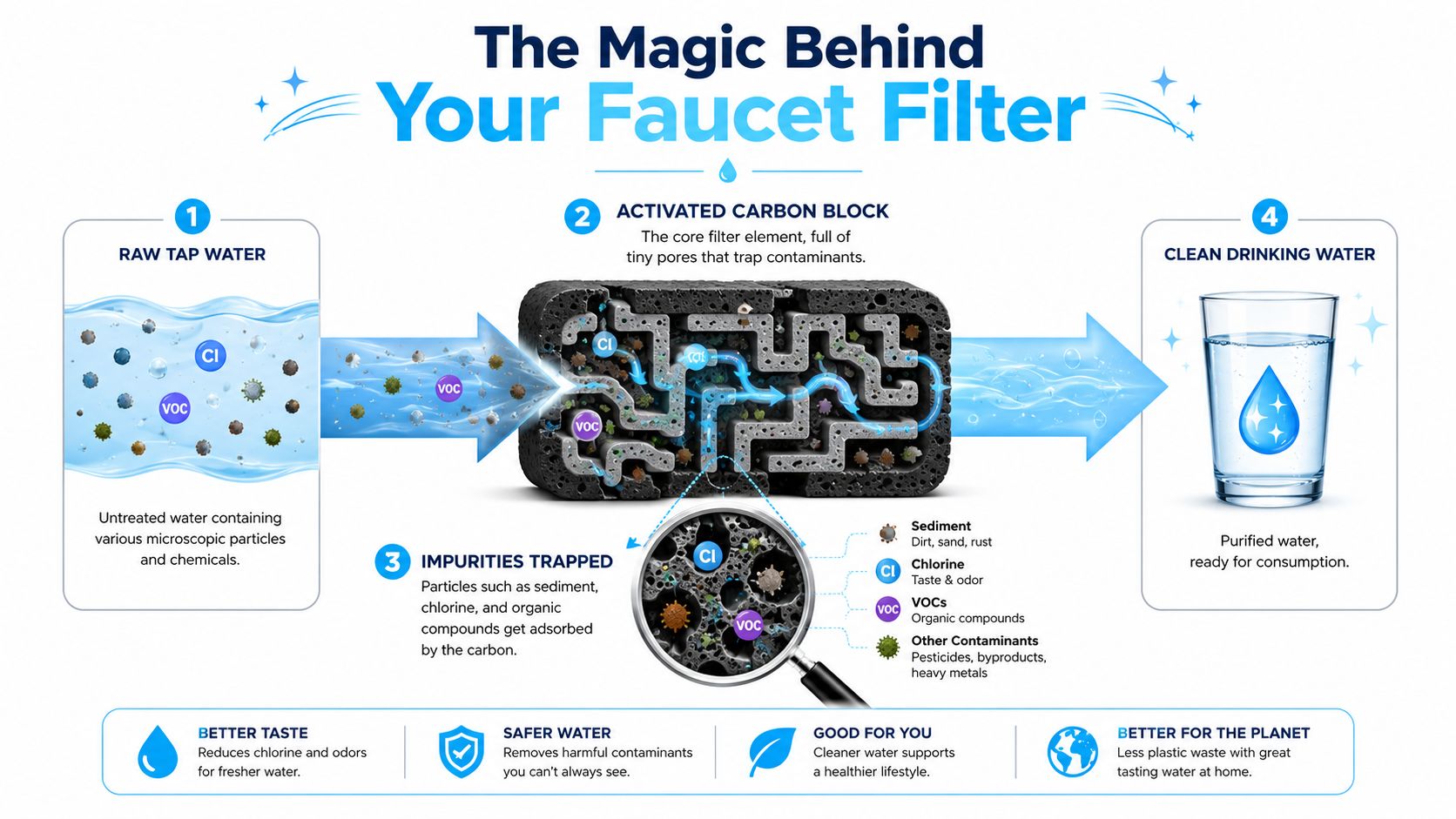
An infographic illustrating how a faucet filter uses an activated carbon block to purify tap water.

Think of activated carbon like a microscopic sponge

A pasta strainer catches noodles because the holes are smaller than the noodles. A coffee filter catches grounds while water passes through. Activated carbon works differently.

A better analogy is a microscopic sponge mixed with a maze. Water flows through a dense material full of tiny pores and pathways. Certain compounds cling to the carbon as water moves past. That “sticking” action is why activated carbon is so good at improving taste and odor.

If your tap water tastes like chlorine, carbon is often the reason filtered water tastes better almost immediately.

Carbon granules versus carbon block

Not all carbon filters are built the same way.

  • Granulated activated carbon uses loose carbon particles. Water can move through it more easily, which often helps flow.
  • Carbon block compresses carbon into a denser structure. That can create more contact between water and the filter media.

Neither format should be judged by marketing language alone. The important question is whether the finished product is certified for the contaminants you care about.

A faucet filter can be excellent for chlorine taste and still be the wrong tool for another water issue.

That's where many buyers get tripped up. They see “carbon filter” and assume broad protection. In reality, a faucet filter is more like a specialized kitchen knife than a full toolbox. It can do one set of jobs very well, but it isn't meant to solve every water problem.

What these filters do well

Faucet filters are usually strongest when your goals are practical and everyday:

  • Better taste
  • Less odor
  • Reduction of selected contaminants when the model is certified for them
  • Filtered water on demand without storing a pitcher

If your concern is very specific, such as a dissolved inorganic contaminant, don't assume the media type tells the whole story. The certification does.

Faucet Filters vs The Competition

A faucet filter makes more sense when you compare it to the other ways people clean drinking water at home. None of these systems is universally right. Each one fits a different kind of kitchen and a different level of patience.
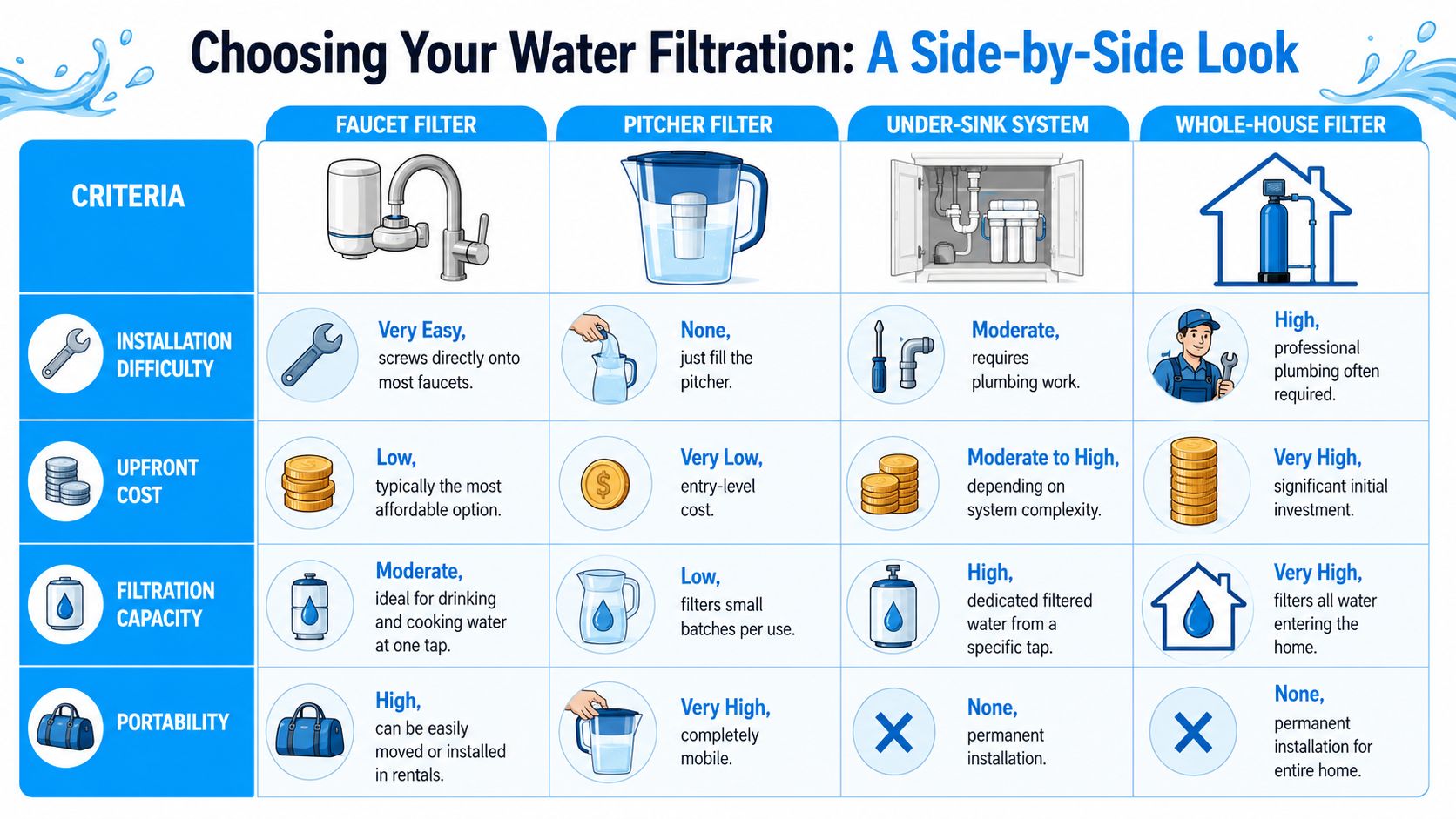
A comparison chart showing the differences between faucet, pitcher, under-sink, and whole-house water filtration systems.

The quick comparison

Filter type Best for What it gets right What gets annoying
Pitcher Small households, dorms, minimal setup No installation, easy to move You have to refill and wait
Faucet filter Renters, busy kitchens, on-demand drinking water Fast setup, switchable filtered flow at the sink Can slow water flow and may not fit every faucet
Under-sink system Homeowners who want hidden filtration No device hanging off the faucet, dedicated setup More installation effort
Whole-house filter Treating water throughout the home Addresses water at every tap Bigger project, bigger commitment

Pitchers are simple, but they interrupt the routine

Pitcher filters are popular for a reason. You buy one, rinse it, fill it, and you're done.

But a pitcher changes your habits. You have to remember to refill it. You have to wait for it to process water. You need fridge or counter space. If your family drinks a lot of water or cooks often, a pitcher can start to feel like filling a watering can one cup at a time.

A faucet filter is usually more convenient when you want filtered water right now, not after the reservoir catches up.

Faucet filters sit in the middle

This is the “good enough for many homes” option. You get filtered water at the sink without the permanence of an under-sink system. That's especially useful if you rent, move often, or just want a lower-commitment starting point.

The trade-off is right in front of you. The device is visible. It changes the look and feel of the faucet. It may also reduce flow compared with unfiltered tap water.

Under-sink systems hide the hardware

Under-sink filters appeal to people who don't want a gadget hanging off the faucet. The filtration hardware lives in the cabinet, and the sink area looks cleaner.

They also avoid one of the biggest faucet-filter annoyances, which is compatibility with unusual faucet shapes. But under-sink systems ask more from the installer. Even when the job is manageable, there's more plumbing, more planning, and less portability.

Whole-house systems solve a different problem

A whole-house filter isn't really a competitor if your main concern is drinking water at the kitchen sink. It treats incoming water for the home, which matters when you also care about showers, laundry, scale, or fixture protection.

That's a different mission. If your only complaint is bad-tasting water in one place, a whole-house system can be more solution than you need.

The smartest filter choice usually follows the problem. One tap problem, start small. House-wide water problem, think bigger.

The hidden factor most comparison charts miss

Many product roundups focus on what a filter removes. Real buyers often care just as much about how the system behaves on a Tuesday night when someone is filling a pot, another person wants a glass of water, and the sink is already crowded.

Ask these practical questions:

  • Will this slow down everyday tasks
  • Can I move it if I change apartments
  • Will anyone in the house replace the cartridge on time
  • Does it fit the faucet I already own

That's where faucet filters either shine or disappoint.

Decoding Filter Certifications Like a Pro

Filter packaging can look like alphabet soup. NSF. ANSI. Model numbers. Bold claims in tiny print. The easiest way to cut through the noise is to treat certification like a scorecard for specific promises.

The CDC explains that NSF International standards such as NSF/ANSI 42, 53, 58, and 62 are used to verify specific performance claims, and it advises consumers to match the filter to the contaminants present in their water. It also notes that many faucet-mounted units are commonly certified to reduce chlorine, lead, and sometimes PFAS. You can read that guidance directly in the CDC overview on choosing home water filters.

What certification really means

Certification does not mean “filters everything.”

It means a product has been evaluated for a specific claim. That distinction matters. A faucet filter might be certified for chlorine taste and odor, but not for another contaminant you're worried about.

Here's a simple way to think about the common standards the CDC lists:

  • NSF/ANSI 42 usually relates to aesthetic improvements, such as taste and odor concerns.
  • NSF/ANSI 53 is commonly associated with certain health-related contaminant reduction claims.
  • NSF/ANSI 58 is tied to reverse osmosis systems.
  • NSF/ANSI 62 applies to distillation systems.

A faucet filter shopper will most often run into claims connected to chlorine, lead, and sometimes PFAS. The key is to confirm the exact model, not just the brand or product family.

How to shop without getting fooled

Use a short checklist before you buy:

  1. Start with your concern. Bad taste is not the same problem as lead or PFAS.
  2. Read the certification claim. Look for the specific reduction, not broad language like “pure” or “clean.”
  3. Match the product to your water. If you don't know what's in your water, your shopping list will be fuzzy too.

Certification is the bridge between marketing and evidence. Cross that bridge before you buy.

One more thing confuses people. A faucet filter can have activated carbon inside and still vary a lot from another carbon-based model. The certification tells you what the full design has been validated to reduce. That's more useful than staring at the media description alone.

Installation and Long-Term Maintenance

Faucet filters transition from an abstract product to a part of your daily routine. Installation is often easy. Living with the filter is the crucial decision.

A typical unit attaches by removing the faucet aerator and screwing the filter onto the faucet, sometimes with an adapter. That sounds simple because it often is. But “simple” doesn't always mean “fits my sink.”
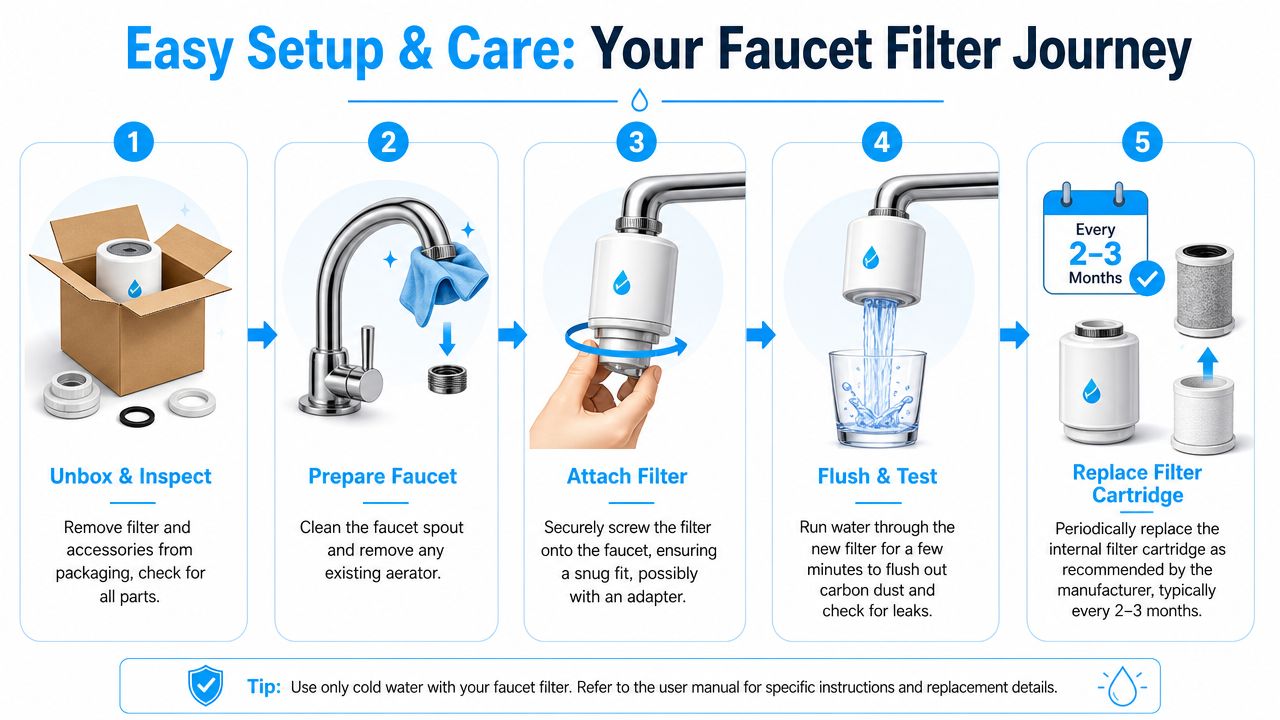
A step-by-step infographic illustrating the installation and maintenance process for a faucet-mounted water filtration system.

The basic install path

Most faucet-mounted filters follow a familiar pattern:

  1. Remove the aerator from the tip of the faucet.
  2. Check the threads and choose the right adapter if one is included.
  3. Attach the filter housing and tighten it by hand.
  4. Run water through it to flush out initial carbon dust.
  5. Test the switch between filtered and unfiltered flow.

If your faucet has a standard shape and accessible threading, this can be a quick project. If you have a pull-down sprayer or an unusual spout, the process may stop at step one.

A lot of homeowners find it useful to review broader sink and supply-line basics before adding anything to the faucet. This kind of Northpoint Construction plumbing solutions checklist can help you spot whether your kitchen setup has any obvious practical issues beyond the filter itself.

Flow rate is where convenience gets tested

Consumer testing summarized in this YouTube review of faucet-mounted filters notes that these units commonly operate around 0.5 to 0.6 gpm, and that capacity varies widely. The same source notes that one popular system is rated for up to 100 gallons or about 3 months, while another may claim a much higher capacity.

Those numbers explain a lot of real-life frustration.

A faucet filter is not meant to blast water into a stock pot at full speed. It's more like switching from a garden hose to a watering wand. The water still comes out, but the delivery is more controlled. As the cartridge loads up over time, that flow can feel slower.

If a faucet filter makes you impatient on day one, you probably won't love it on day sixty.

Replacement isn't optional

The cartridge is the working part of the system. Once it reaches its usable life, performance and convenience both suffer. Water may trickle. Taste may change. The filter may no longer do the job you bought it to do.

That's why the long-term cost is tied directly to maintenance discipline. Pick a system with replacement intervals you'll follow.

For households comparing models, practical maintenance guidance matters more than shiny packaging. A resource like Water Filter Advisor's maintenance and advice section can help you compare cartridge schedules, replacement steps, and common upkeep issues before you commit.

A short visual walkthrough also helps if you want to see how the process usually looks in practice:

What causes most complaints

Most faucet-filter problems fall into a few buckets:

  • Bad fit because the faucet thread or shape doesn't work with the adapter set
  • Low flow frustration when someone expects regular tap speed
  • Late cartridge changes that make water pressure drop further
  • Bulky placement when the filter bumps dishes, backsplash, or sink accessories

None of those problems means faucet filters are bad. They mean this category rewards realistic expectations.

The True Cost of a Faucet Water Filter

The sticker price on the box is only the opening chapter. The ongoing expense comes from replacement cartridges, and that's where buyers either make a smart choice or accidentally trap themselves in a maintenance routine they resent.

A faucet filter is a bit like buying a coffee maker that only works with one kind of pod. The machine may be easy to afford. The habit is what costs money over time.

Think in two buckets

When you compare options, separate the cost into:

  • The filter unit itself
  • The replacement cartridges you'll keep buying

That sounds obvious, but many people focus almost entirely on the first number they see. A lower-priced housing can still turn into a less attractive value if replacement filters are frequent, hard to find, or annoying to swap.

Cost of ownership is also about behavior

The “true” cost isn't just money. It includes friction.

If a cartridge is difficult to install, people delay it. If a filter slows the sink too much, family members switch back to unfiltered water. If the unit doesn't fit cleanly, some people remove it after a few weeks and never reinstall it. In all of those cases, even a modest purchase becomes wasted money.

That's why value matters more than bargain hunting. Kitchen buyers already understand this in other categories. When comparing ranges, dishwashers, or refrigerators, people often look past sticker price and think about long-term practicality. The same logic shows up in guides about selecting budget appliances for renovation. Water filtration deserves the same mindset.

A simple way to compare models

Use this framework:

  1. Check the replacement schedule
  2. Estimate how often your household uses filtered water
  3. Ask whether the convenience matches the recurring commitment

If one model needs frequent attention and another better matches your routine, the second may be the cheaper decision in practice, even if the box costs more on day one.

The best faucet filter for drinking water isn't always the one with the lowest upfront cost. It's the one your household will keep using, maintaining, and replacing without complaint.

Is a Faucet Filter Right for Your Kitchen

This decision comes down to fit in every sense of the word. Not just contaminant fit. Faucet fit, routine fit, and budget fit.

Consumer guidance has pointed out a question many shoppers ask too late: will the filter fit my faucet? Faucet-mounted units usually attach by unscrewing the aerator, but users need to check adapter fit and faucet geometry. They are often incompatible with pull-down, pull-out, or nonstandard faucets, according to Consumer Reports' faucet filter guidance.
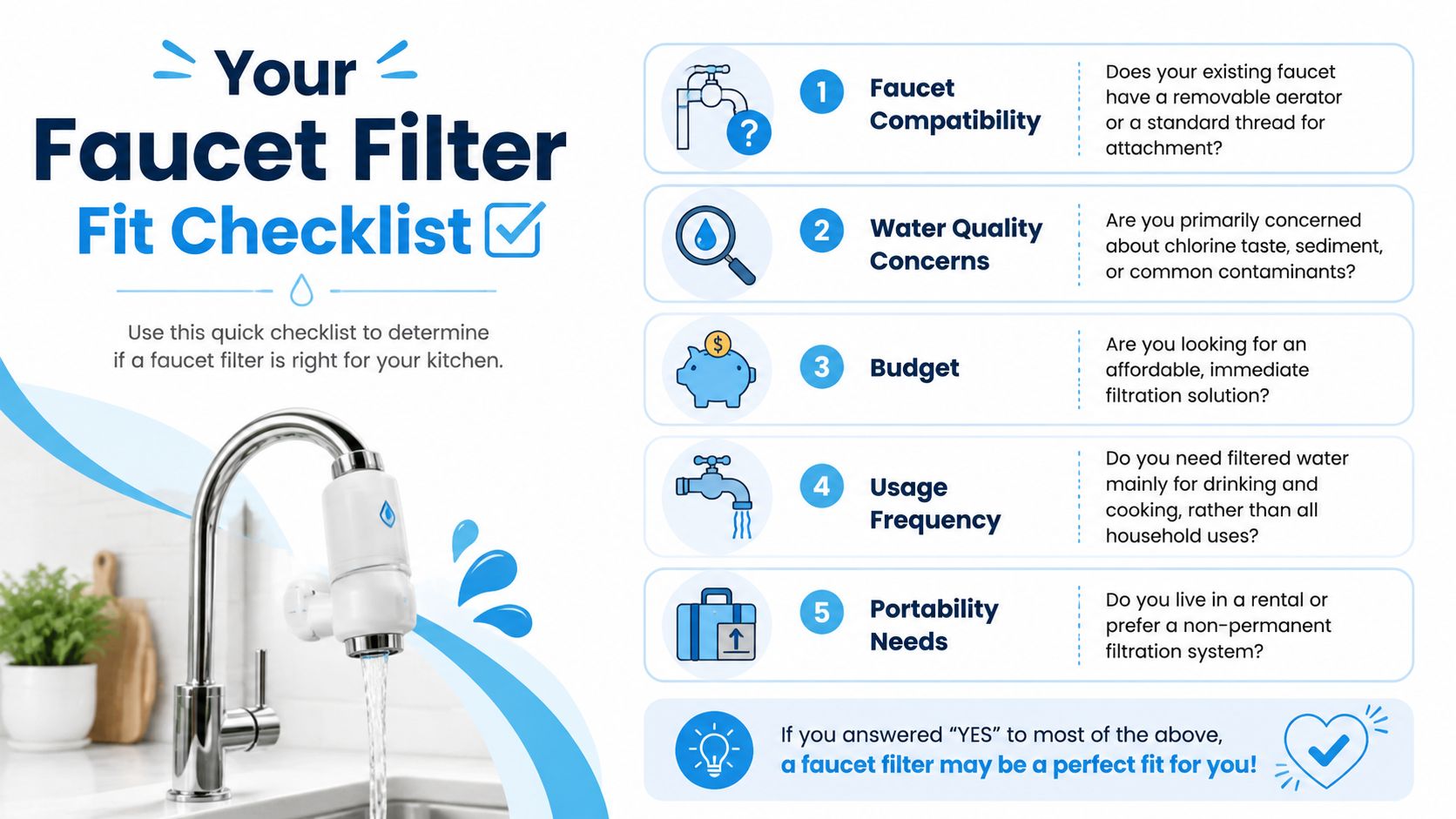
A helpful infographic guide titled Your Faucet Filter Fit Checklist to determine if a faucet filter is right.

A quick self-check

A faucet filter is often a good match if most of these sound like you:

  • You want better drinking water at one sink, not a whole-home treatment project
  • You rent or prefer simple DIY upgrades
  • Your faucet has a removable aerator and standard-looking attachment point
  • Your main concerns are taste, odor, and selected certified reductions
  • You can live with a visible device on the faucet

It may be the wrong fit if your faucet is a pull-down or pull-out style, if your sink area is already crowded, or if your main concern requires a type of treatment this category usually doesn't provide.

The kitchen test that matters most

Stand at your sink and answer three plain questions:

  1. Can something attach cleanly to this faucet
  2. Will slower filtered flow annoy me every day
  3. Am I willing to replace cartridges on schedule

If the answer to all three is yes, a faucet filter for drinking water can be a smart, low-commitment upgrade. If one answer is no, another category may fit your life better.

The right water filter should solve a problem without creating a new one at the sink.

That's the true standard. Not the box copy. Not the trend. Not the promise of “cleaner water” in giant letters. The system has to work with your faucet, your habits, and your patience.


If you're narrowing down options and want practical help comparing systems, certifications, and maintenance trade-offs, Water Filter Advisor offers consumer-focused guidance built around real household use, not just spec sheets.

Faucet Water Filtration Systems for Home: A 2026 Guide

You fill a glass from the kitchen tap, hold it to the light, and pause. Maybe it smells a little like a swimming pool. Maybe the taste is flat, metallic, or just off enough that you reach for coffee, juice, or bottled water instead. That hesitation is exactly why so many households start looking into faucet water filtration systems for home.

A good faucet filter sits in a practical middle ground. It's easier than a major plumbing project, more immediate than waiting on a city report, and often enough to solve the day-to-day problems people notice first: better taste, less odor, and more confidence when pouring water for kids, cooking pasta, or filling the kettle.

That First Sip Why Trust in Tap Water is Fading

For many people, the issue starts small. A strange smell one week. Cloudiness after plumbing work. A glass of water that tastes fine at one house and unpleasant at another. You don't need to be alarmist to admit that trust can fade quickly when something seems off.

That loss of confidence shows up in national research too. NSF found that 91% of Americans are now using water filters, and only 52% of filtration owners trust their home tap water overall. In rural areas, that drops to 44%, according to NSF's research on trust in certified water filters.

What people are reacting to

Most homeowners aren't starting with lab chemistry. They're reacting to real-life signs:

  • Taste changes: Water can taste like chlorine, metal, or stale minerals.
  • Odor surprises: A noticeable smell makes people question safety, even if the water is technically compliant.
  • Family routines: Parents often become more selective when they're mixing baby formula, packing school bottles, or making meals.
  • Old plumbing worries: If the home is older, the concern often shifts from the water source to what happens on the way to the faucet.

Trust doesn't disappear because someone read a technical report. It disappears when daily use no longer feels normal.

That's why faucet filters have become such a common first step. They let people improve the water they drink and cook with right at the sink, without committing to a major remodel or a whole-house system.

Why faucet filters feel approachable

A faucet-mounted system answers a simple question: “What can I do today?”

It gives you filtered water on demand, usually at the exact spot where you fill a glass, rinse produce, or top off the coffee maker. For many households, that's enough to move from vague concern to a concrete solution.

And that matters. Better-tasting water often means people drink more of it. Cleaner-smelling water can make tea, soup, and coffee more enjoyable. A modest kitchen upgrade can also reduce the temptation to keep buying bottled water out of habit.

Decoding the Different Types of Faucet Filters

When shoppers say they want a faucet filter, they usually mean one of a few different setups. Some attach directly to the faucet. Others hide under the sink but still serve the main kitchen tap. A few live nearby on the counter and connect when needed.

An infographic showing four common types of water filtration systems for homes with descriptions and illustrations.

The main categories at a glance

Type Best for What it feels like in daily use Main tradeoff
Faucet-mounted Renters, quick upgrades, low-commitment buyers Flip a lever or run water through the attached unit Visible on the faucet
Countertop People who want more filter room without going under the sink Sits beside the sink and connects to the faucet Takes up counter space
Pitcher Small households, dorms, backup use Fill, wait, pour Batch filtering, not on-demand
Under-sink direct-connect or point-of-use Homeowners or renters who want a cleaner look Filtered water through sink plumbing with less clutter up top Some install effort and under-sink space needed

Faucet-mounted filters

These are the classic screw-on units. They install directly onto the faucet spout and usually include a diverter, so you can switch between filtered and unfiltered water.

Their appeal is simple: low fuss. If your goal is better-tasting water for drinking and cooking, a faucet mount often gets you there fast. They're especially attractive for renters because they can usually come off just as easily when it's time to move.

Countertop filters and pitchers

These aren't faucet-mounted in the strict sense, but they often show up in the same shopping journey. Countertop filters connect to the faucet while keeping the filter body off the spout itself. That can be useful if you dislike the bulky look of a mounted unit.

Pitchers are the least permanent option. They're handy for refrigerators, guest rooms, or temporary setups, but they don't give you filtered water instantly from the tap.

Direct-connect under-sink systems

This category deserves more attention than it gets. Some newer models are designed to avoid the usual “major install” fear. Aquasana says renter-friendly direct-connect systems are responding to a 40% rise in renter queries for “no-drill” systems, and its Claryum Direct Connect offers a 15-minute DIY install while removing 78 contaminants, including chloramine, as described on Aquasana's under-sink filter page.

That matters if you want a cleaner countertop and don't love a device hanging off your faucet. It also matters if chloramine is on your radar, since some standard faucet-mounted options focus more narrowly on chlorine and lead.

Quick shortcut: If you want the easiest path, choose faucet-mounted. If you want the tidiest kitchen look, direct-connect under-sink models deserve a serious look.

If you want a side-by-side look at specific models, browsing these faucet water filter reviews can help you narrow down what fits your sink, habits, and budget.

The Science Inside How Your Filter Cleans Water

Most faucet filters look simple from the outside. Inside, they're doing layered work. Different materials target different problems, and knowing the basics helps you match the filter to what bothers you about your water.

A close-up view of a transparent faucet water filtration system with layered filter media purifying running water.

Activated carbon is the taste-and-odor workhorse

Think of activated carbon like an ultra-porous sponge with a huge amount of internal surface area. Water passes through it, and unwanted compounds stick to that surface instead of staying in your glass.

That's why carbon is so common in home filters. It's especially useful for reducing chlorine and certain compounds that affect taste and odor. If your coffee tastes harsh or your iced water smells like a pool, carbon is often the part doing the heavy lifting.

The technical side is impressive, but the practical side is what matters. Better taste usually means better everyday use. You notice it in plain drinking water first, then in tea, soups, rice, pasta, and coffee.

Ion exchange helps with heavy metals

Now picture a second layer that works more like a selective catcher. Ion exchange resin attracts and holds certain dissolved metals, including lead.

That's important because taste alone doesn't tell you whether a metal is present. Some of the contaminants people care most about aren't the ones they can smell. A filter that combines carbon with ion exchange can tackle both the obvious annoyances and the less visible concerns.

Why multi-stage design matters

A strong faucet filter usually doesn't rely on one material doing everything. It uses a sequence. One stage improves taste and odor. Another targets metals. Sometimes additional media are included for a wider contaminant range.

According to Tap Score's explanation of faucet filter media and standards, activated carbon has a surface area of about 1000 m²/g, adsorbs chlorine and VOCs, and ion exchange resins capture heavy metals. The same source notes that an NSF/ANSI 53 certified filter must demonstrate more than 99% lead reduction over its rated capacity, often 100 to 200 gallons.

That phrase “over its rated capacity” is the key detail many buyers miss. A filter shouldn't just work on day one. It needs to keep working until it reaches the cartridge's stated life.

Practical rule: If your main complaint is taste, carbon matters a lot. If your concern is lead, look for a filter that clearly includes the right media and certification for that job.

Why filters slow down over time

Every cartridge has limits. As media fill up, water can move more slowly and contaminant reduction can weaken. That doesn't mean the filter failed suddenly. It means it's doing what all filters do: collecting what you asked it to remove until replacement is due.

That's why a fresh cartridge often restores both flavor and flow. It's also why replacement timing isn't just a maintenance chore. It's part of the filter's actual performance.

Reading the Labels Understanding Certifications

Water filter packaging loves acronyms. The most useful ones tell you whether a product's claims were checked against a real standard. That's where NSF/ANSI certifications become valuable.

A simple way to think about certifications is this: marketing tells you what a brand says the filter does. Certification helps show what the filter has been tested to do.

The standards most shoppers should recognize

Here's the plain-English version of the labels you'll see most often on faucet water filtration systems for home:

  • NSF/ANSI 42: Focuses on aesthetic improvements such as reducing chlorine taste and odor.
  • NSF/ANSI 53: Covers health-related contaminant reduction, including concerns such as lead.
  • NSF/ANSI 372: Relates to lead content in the product materials themselves.
  • NSF/ANSI 401: Applies to certain emerging contaminants and is worth noticing if you want broader performance coverage.

If you only remember one distinction, make it this one: 42 is usually about making water more pleasant, while 53 is about reducing specific health-related contaminants.

How to read a box without getting lost

Don't stop at a logo on the front panel. Look for the exact claims tied to the standard. A filter might be certified for chlorine reduction but not for lead. Another might reduce lead but say nothing about chloramine.

That's where shoppers get tripped up. They assume “certified” means “certified for everything.” It doesn't. It means certified for the specific things listed.

A good label answers three questions clearly: what it reduces, which standard applies, and how long that claim lasts.

A simple shopping framework

When you compare filters, use this checklist:

  1. Start with your concern. Taste and odor? Lead? A broader list?
  2. Match the concern to the standard. Don't buy a taste-focused filter if lead is your main reason for shopping.
  3. Check the rated life. A strong certification matters most when the claim lasts through the cartridge's usable capacity.
  4. Prefer independent certification. It adds confidence that the performance claim wasn't self-declared.

This is one of the easiest ways to avoid buyer's remorse. Many disappointing filter purchases happen because the product worked exactly as designed, but the buyer chose the wrong design for the problem.

Simple Setup and Ongoing Filter Maintenance

Installation worries stop a lot of people before they start. In reality, many faucet-mounted systems are very manageable for a basic DIYer. You're usually removing the faucet aerator, matching an adapter if needed, and twisting the unit into place.

A person installing a water filtration system onto a kitchen faucet with easy setup instructions.

A typical faucet-mount install

Most setups follow a familiar pattern:

  1. Remove the aerator from the faucet tip.
  2. Check the threads and choose the correct adapter if the filter includes more than one.
  3. Hand-tighten the filter housing onto the faucet or adapter.
  4. Run water through the new cartridge to flush carbon fines and prep the media.

The biggest mistake is forcing the wrong adapter. If the fit feels off, stop and verify the threading before tightening further. Cross-threading turns a quick project into an annoying leak chase.

A few setup details matter

A faucet filter works best when it matches both your plumbing and your habits. If you have an unusual faucet shape, a pull-down sprayer, or limited clearance, compatibility is just as important as the contaminant list.

For homeowners who want a better grasp of plumbing basics before installing anything near the sink, Northpoint Construction's plumbing advice offers useful context on how water lines and fixtures come together behind the wall. You don't need to become a plumber, but a little background makes the install feel less mysterious.

If a filter leaks on first install, the issue is often simple: wrong adapter, crooked threading, or a washer that didn't seat properly.

Maintenance is where performance lives

A faucet filter is only as good as its replacement routine. You don't need to obsess over it, but you do need to pay attention.

Common signs it's time to replace the cartridge include:

  • Slower flow: Water takes longer to fill a glass or pot.
  • Taste returning: Chlorine or off-flavors start creeping back in.
  • Indicator alerts: Some models have built-in reminders.
  • Heavy recent use: Holidays, house guests, or lots of cooking can use up filter life faster.

A short visual can help if you want to see a faucet-style install in action:

Keep maintenance realistic

The easiest system to maintain is the one that fits your routine. If you know you won't remember a complicated schedule, choose a model with a clear cartridge indicator or an easy subscription option for replacements.

That small convenience matters more than people think. A well-maintained basic filter will usually serve a household better than an advanced system with cartridges that get ignored.

Calculating the True Cost of Clean Water

The box price gets attention. The replacement cartridge determines whether you'll still like the purchase a year later.

Buyers often make the wrong comparison. They line up upfront prices, pick the cheapest model, and only later realize the ongoing cost or replacement frequency changes the value equation.

Upfront price versus ownership cost

According to Consumer Reports' faucet filter cost comparison, faucet filters often cost $15 to $80 upfront, while annual replacement costs for popular models such as ZeroWater Extremelife and Brita Basic SAFF-100 range from $36 to $57. The same source notes that faucet models can end up costing more over time than some under-sink options because their cartridges may need more frequent replacement.

That doesn't mean faucet filters are a poor value. It means the cheapest-looking option isn't always the least expensive to live with.

A better way to compare

Use three questions instead of one:

  • What does the unit cost to start?
  • How often will I replace cartridges in my household?
  • Am I paying for performance I need?

A single person filling a bottle and making coffee may be perfectly happy with a compact faucet mount. A busy family using filtered water for drinking, cooking, and filling multiple bottles every day may burn through cartridges much faster.

Where hidden costs show up

The long-term cost usually rises because of one of these reasons:

Cost driver Why it matters
Replacement frequency More cartridge swaps mean more spending and more hassle
Low capacity Heavy use shortens the time between replacements
Flow frustration If a filter feels slow, people may bypass it and waste the investment
Mismatch with water quality Sediment or certain water conditions can make a cartridge less practical in daily use

The true price of a filter isn't what you pay on day one. It's what you pay to keep getting water you actually enjoy using.

Faucet filter or under-sink

For some households, a faucet filter is still the smartest financial choice because the initial commitment is low and installation is simple. For others, especially those using a lot of filtered water, a direct-connect under-sink model can make more sense over time.

The practical lesson is simple. Don't ask only, “What can I afford today?” Ask, “What will this feel like to own?” That one shift leads to better decisions than chasing the lowest sticker price.

How to Choose the Right Faucet Filter System

Choosing among faucet water filtration systems for home gets easier when you stop shopping by brand first and start shopping by situation. The right filter for a renter in a studio kitchen isn't the right filter for a family with older plumbing.

A good decision usually comes down to three things: your water concern, your kitchen setup, and your household's daily volume.

Match the filter to the person using it

Here's a practical way to think about it.

The renter who wants no drama

You want something easy to install, easy to remove, and unlikely to start a conversation with a landlord. A faucet-mounted unit is often the safest bet. A renter-friendly direct-connect under-sink option can also work if you want a cleaner look and your sink cabinet has room.

Look for straightforward installation and clear replacement access. If you move often, portability matters almost as much as performance.

The family with young kids

You're probably thinking beyond taste. You want stronger reassurance at the tap used for drinking, cooking, and filling cups all day.

Certification and flow rate become more important. A system that performs well but feels too slow during busy mornings can become frustrating fast.

The coffee and cooking household

If flavor is your main issue, focus on a filter known for improving taste and odor. Water used in coffee, tea, soups, oatmeal, and pasta has nowhere to hide. You'll notice improvements quickly when chlorine-heavy taste is reduced.

Use flow rate and capacity as real-life clues

According to Pfister's Xtract performance overview, high-performing faucet filter systems can reach 1.5 GPM and filter 300 to 500 gallons, while standard models may deliver 0.8 GPM for 200 gallons. The same source says households of 4 or more should prioritize more than 1 GPM to avoid bottlenecks.

That “bottleneck” point is practical, not technical. If multiple people fill bottles, cook, and make drinks from the same sink, a slower filter changes the way the kitchen functions.

A simple decision checklist

Before buying, ask yourself:

  • What bothers me most right now? Taste, smell, lead concern, convenience, clutter?
  • Do I need an easy install? If yes, lean faucet-mounted or renter-friendly direct-connect.
  • How many people use this sink daily? Larger households should pay close attention to flow and capacity.
  • Do I want the filter visible or hidden? This alone can narrow the list quickly.
  • Will I keep up with replacements? Choose a system whose maintenance style matches your habits.

Buy for your real routine, not your ideal one. The best filter is the one your household will use correctly every day.

If you're comparing options side by side, this roundup of the top faucet water filters can help you narrow your shortlist and focus on systems that fit your sink, budget, and water concerns.


If you want help comparing models, understanding certifications, and finding a system that fits your home without guesswork, Water Filter Advisor is a useful place to start. It's built for people who want clear, practical guidance on choosing and maintaining better water filtration at home.