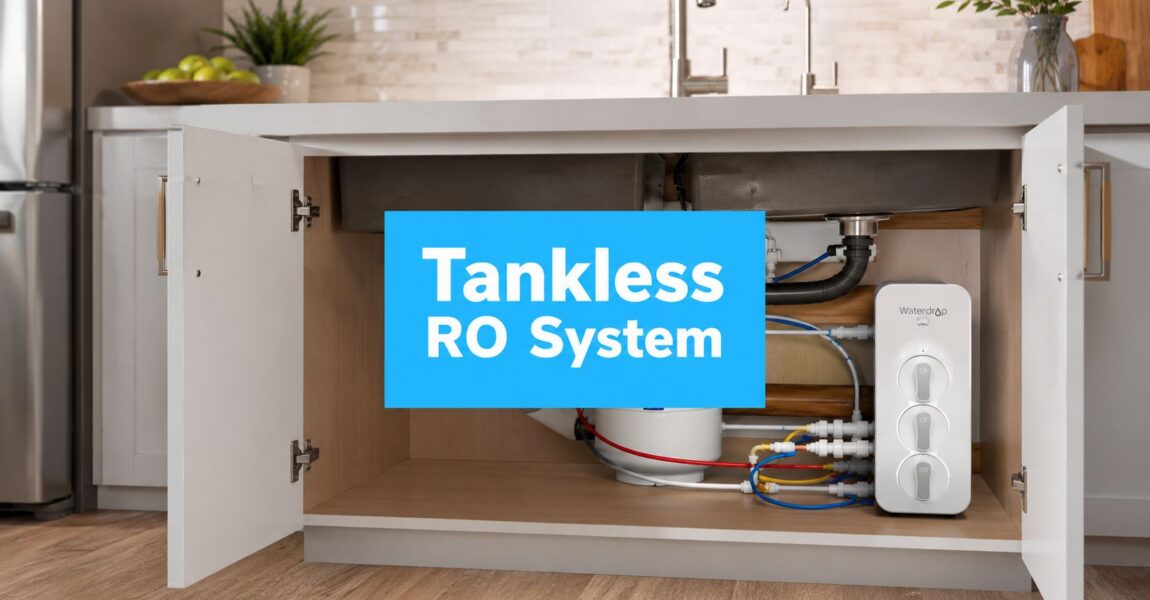
Tankless Under Sink RO System: A Homeowner’s Guide
You're standing at the kitchen sink with a pot in one hand and a pitcher in the other, and the old setup is making you wait. The cabinet under the sink is already crowded, the water filter you're considering sounds promising, and you're trying to figure out whether a tankless under sink RO system is smarter, or just newer.
The appeal is easy to understand. You want reverse osmosis drinking water without surrendering half your cabinet to a storage tank, without staring at a slow trickle at the faucet, and without feeling like you've bought a solution that creates a different problem. That's where tankless RO stands out, because the design changes how the system stores water, how it fills, and how much room it takes up in a real kitchen.

What a Tankless Under Sink RO System Does
A homeowner usually notices the problem before they know the name for it. The pot is too big for the faucet, the pitcher needs refilling again, and there's barely any room left under the sink because of the disposal, cleaners, and random plumbing elbows. A tankless under sink RO system is built for that exact scene, because it replaces the bulky storage tank with a compact unit that makes purified water on demand.
The basic idea is simple. Reverse osmosis still does the cleaning, which means water is pushed through a membrane that removes what basic sediment and carbon filters leave behind. The tankless format changes the way the system fits into a cabinet and the way it delivers water at the tap, because it does not wait to fill a separate reserve before you can use it.
Cabinet space is only one part of the story. Under a sink, the P-trap, disposal, shutoff valves, and nearby hoses can leave an awkward layout that makes a traditional tank hard to place without crowding everything else. A tankless unit is designed to work around that geometry, which is why it appeals to homeowners who want RO water without turning the cabinet into a storage puzzle.
Water use is the other part. The U.S. EPA notes that a typical point-of-use RO system can send 5 gallons or more of reject water for every gallon of treated water, while WaterSense-labeled models must stay at 2.3 gallons or less per gallon produced. The EPA also estimates that choosing a WaterSense-labeled RO can save more than 3,100 gallons of water per year versus a typical system, or about 47,000 gallons over the system's lifetime. EPA point-of-use reverse osmosis systems That long-term cost picture matters because the system is not only about taste and convenience, it also shapes how much water goes down the drain and how often filters need to be replaced.
How Reverse Osmosis Works Without a Storage Tank
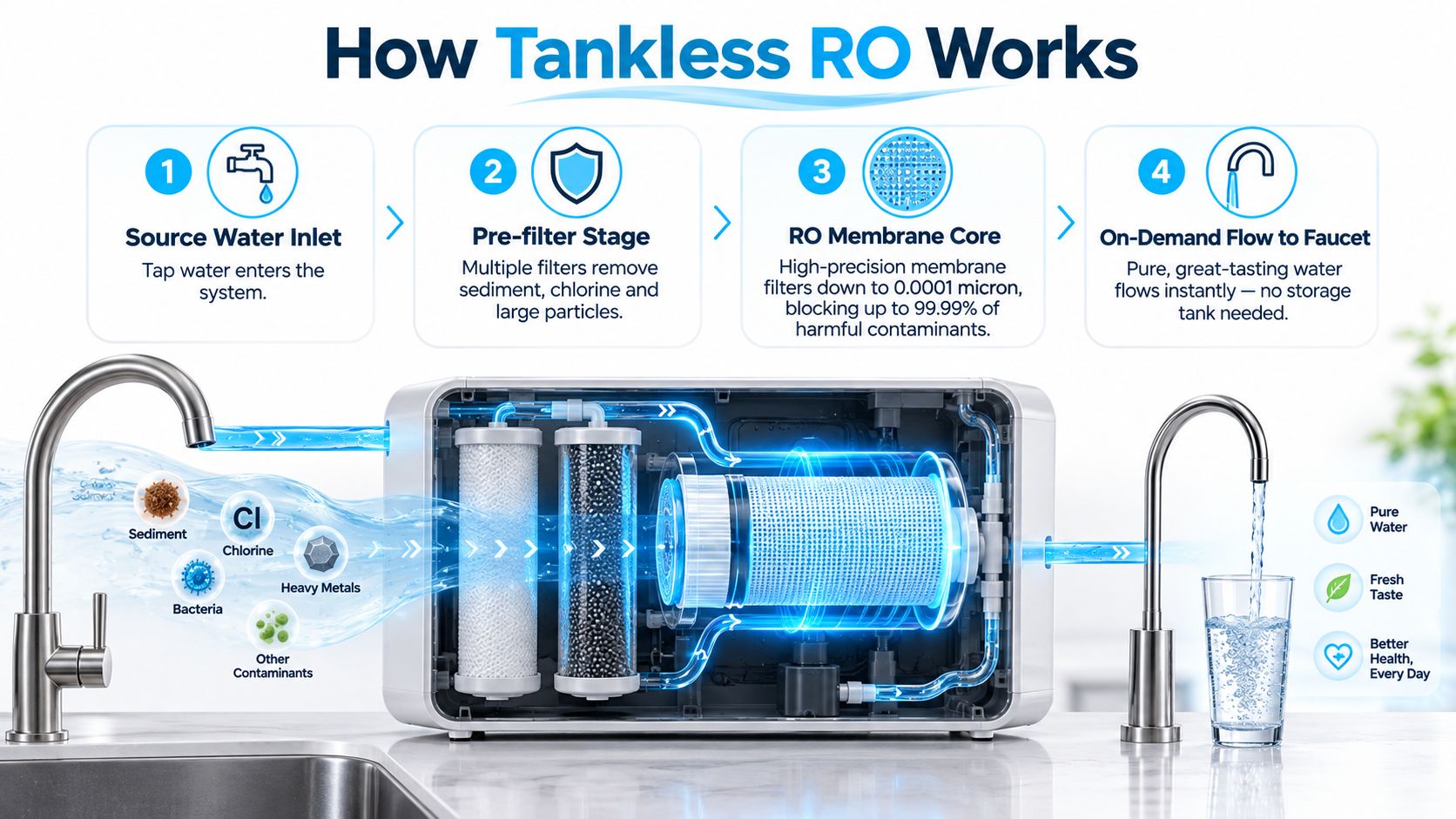
Reverse osmosis is easier to understand if you picture a screen so fine that only water can move through it. A coffee filter catches grounds because the holes are smaller than the particles, but an RO membrane is far more selective, and that's why it can remove dissolved contaminants that ordinary filters can't catch. In a home system, the water usually moves through a sediment pre-filter, a carbon pre-filter, the semi-permeable membrane, and then a polishing post-filter.
Why the pump changes everything
A tankless system keeps the same cleaning stages, but it changes how water is moved. Instead of filling a storage tank slowly and then pushing water out later, the unit uses an internal electric pump to pressurize the feed water and send it through the membrane as you open the faucet. That's the whole trick. No storage tank means no waiting for a reserve to rebuild, and no air-pressure bladder taking up cabinet space.
Practical rule: If the water only needs to exist when you're using it, a tank is optional, not essential.
The pump and the automatic shutoff logic work together so the system produces water only when the faucet is open. That's why tankless units feel more immediate at the tap, and why the water tastes fresher to many users, since it hasn't been sitting in a pressurized reservoir for hours. Modern tankless designs also tend to use direct-flow membranes and tighter waste control, which is part of why the category has moved from niche upgrade to mainstream kitchen equipment.
The result is simple to feel in daily use. You open the faucet, the system wakes up, and water starts moving without the tank refill cycle that older RO owners know well. That on-demand behavior is what makes tankless RO feel less like a reservoir and more like a mini purification station tucked under the sink. For a visual walkthrough of small-space planning, Aureli Construction's Greater Boston kitchen guide is a useful reference for thinking about tight cabinet layouts.
Tankless vs Tanked RO Systems Compared
A buyer usually wants the comparison in one glance, not buried in jargon. The short version is that tankless wins on space, on-demand delivery, and usually better efficiency, while tanked systems still have real advantages if you want simpler mechanics and no electrical dependence. The right choice isn't about which format sounds modern, it's about which one fits your cabinet, usage pattern, and tolerance for complexity.
Tankless vs Tanked Under-Sink RO at a Glance
| Criterion | Tanked RO | Tankless RO |
|---|---|---|
| Under-sink footprint | Larger, because the storage tank needs space | Compact, no storage tank |
| Gallons per day output | Adequate for many homes, but tied to refill cycle | Often higher and more continuous in use |
| Waste-to-pure ratio | Often less efficient in older designs | Commonly tighter, especially in modern units |
| Power requirement | Usually no electricity | Requires electricity for the pump |
| Typical filter-change complexity | Straightforward, plus tank sanitizing | Front-access cartridges are often easier to swap |
A tanked system still makes sense for people who want a simpler machine with fewer powered parts. It can keep working through a power outage, and it doesn't require an outlet under the sink. That appeals to homeowners who'd rather trade cabinet space for mechanical simplicity.
Tankless pulls ahead in kitchens where the cabinet is the bottleneck. Water World notes that tankless systems can save 50% to 75% of under-sink space compared with tank-based systems, which is a big deal if you're sharing that cabinet with a disposal or a tight drain layout. Water World on storage tanks vs tankless reverse osmosis systems
There's also the daily-use side. Tankless units don't run out in the same way a small reserve can, so they suit households that pour a lot of filtered water throughout the day. Tanked units can feel punchier at first, but the tankless format is the one that better matches a sink used for repeated cooking, bottle filling, and back-to-back glasses.
Sizing, Flow Rate, and Pressure Requirements
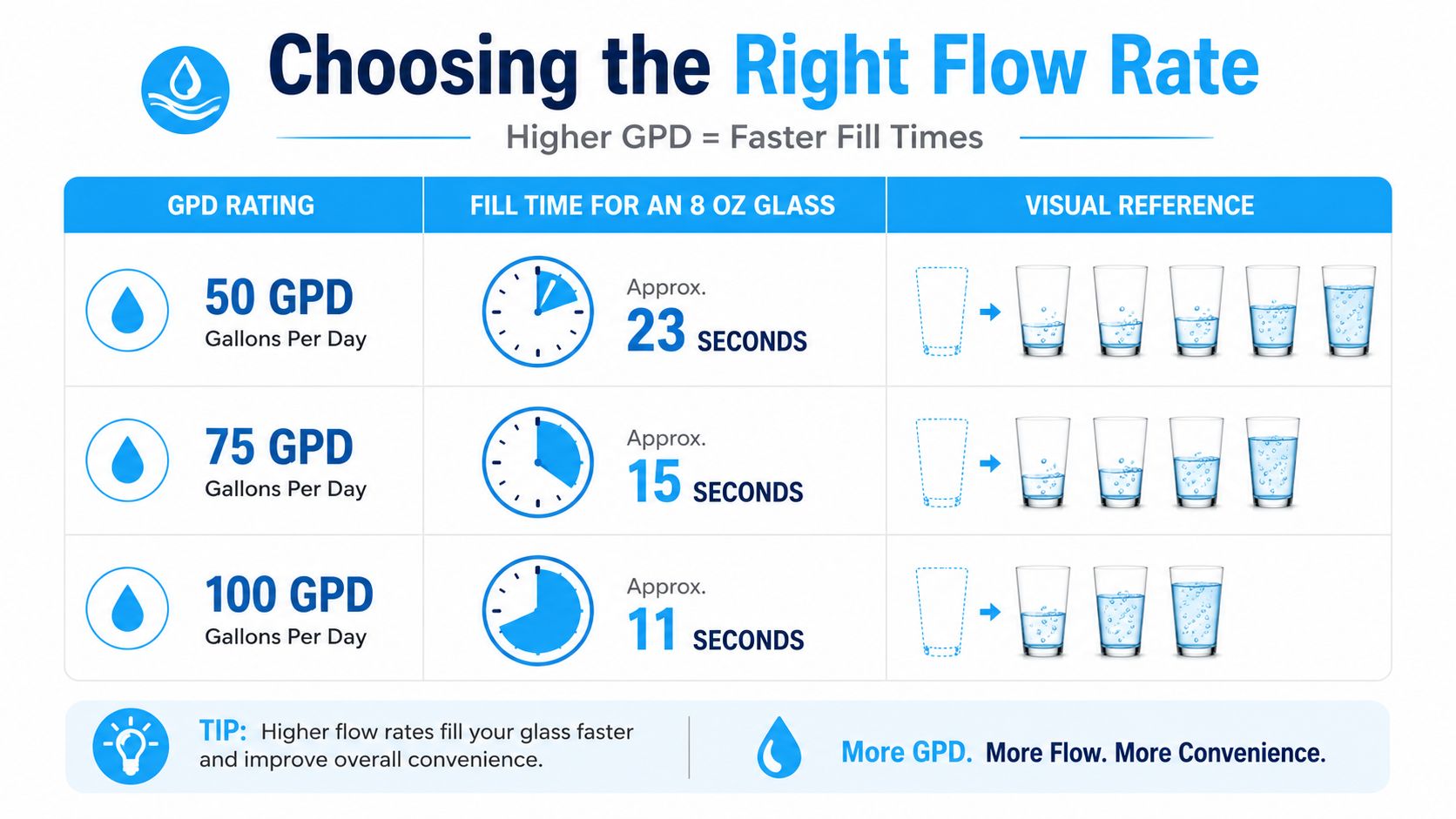
A tankless RO system can look impressive on a product page and still feel slow at the sink if the home's plumbing does not match its operating window. The numbers matter, but they only make sense when you connect them to the way water is used in a kitchen. Modern tankless systems commonly rate around 400 to 800 GPD, and some products advertise up to 1000 GPD. In faucet terms, that often works out to filtered-water flow rates around 0.28 to 0.56 GPM, with some 1000 GPD units advertising up to 0.69 GPM. Tankless RO market data and product summaries Waterdrop tankless RO product details
What those numbers mean in a kitchen
GPD is a daily production rating, while GPM is the pace you feel when a glass or pot is filling. A homeowner may never think about gallons per day, but they notice whether the faucet gives a steady stream or leaves them waiting. If the unit is sized well for the house, it should feel closer to ordinary tap water than to a refill station.
Pressure is where many buyers get caught off guard. One technical guide notes that RO membranes need at least 40 PSI, and that pressure below that point can reduce production and lower TDS rejection below 90%. The same guidance says pressures above 80 PSI may require a pressure-reducing valve. Another product specification lists an operating window of roughly 20 to 80 psi and 41 to 100°F for a 600 GPD unit. OneMiro technical installation guidance Waterdrop tankless RO product details
A tankless RO system can be undersized for the home even when the brochure looks strong.
That is why sizing is more than picking a large capacity. The question is whether the supply pressure, water temperature, and electrical setup all fit the unit's range. Cold inlet water, weak pressure, or a home that needs a booster pump can change performance more than the headline GPD rating suggests. A tankless system is fast when it is fed correctly, but it also shows the limits of the plumbing behind it.
If you are comparing systems for a real kitchen, the cabinet matters too. The filter housing has to share space with the P-trap, disposal, shutoff valve, tubing bends, and any nearby outlet, so a unit that looks compact on paper can still be awkward to service. A useful way to judge fit is to treat the cabinet like a small mechanical room, not just an empty box. For a buyer weighing a do-it-yourself setup against help from a pro, DIY vs professional installers is worth a careful look.
The long-term cost picture also depends on how hard the system has to work. A unit that is constantly pushed outside its comfortable pressure or temperature window can waste more water, strain filters sooner, and make replacement cycles feel less predictable. In that sense, sizing is not only about speed at the faucet. It is about whether the system can keep delivering that speed without turning your under-sink space into a compromise between cabinet geometry, pressure, and upkeep.
Installation Realities Most Buyers Don't Expect
The under-sink cabinet is where the marketing copy meets the actual house. A unit can be small on paper and still feel awkward in a real cabinet if the P-trap, disposal, shutoff valve, tubing bends, and electrical outlet all compete for the same few inches. One technical guide gives a typical clear-space target of about 40 cm × 20 cm × 45 cm, which is a much more useful starting point than the product's bare dimensions alone. Technical cabinet-fit guidance
What has to fit in the cabinet
The first thing to check is not the box, it's the plumbing around the box. The drain saddle has to go on the horizontal drain section before the P-trap, and you need room for future filter changes without removing half the cabinet contents. Disposal reset access, outlet reach, and tubing bend radius all matter more than they sound like they should.
A typical install follows a predictable path. The bracket gets mounted, a hole gets drilled for the dedicated faucet, the cold-water line gets tapped with a feed-water adapter, the drain saddle gets placed correctly on the drain line, and the pump gets plugged into a GFCI outlet. That sequence sounds basic until a homeowner discovers the outlet is blocked, the cabinet wall is too shallow, or the drain layout leaves no safe spot for the saddle.
If you're deciding whether to handle it yourself, DIY vs professional installers is a helpful place to compare the kind of cabinet work that feels manageable versus the kind that benefits from a pro. A tankless system still rewards careful measuring before purchase, because cabinet geometry can make a compact unit feel oversized.
Measure the cabinet for service access, not just for physical placement. If you can't get a hand, a filter, and a wrench in there later, the install isn't really finished.
That's the part product pages skip. They usually show the unit size, but the cabinet is what decides whether the system is pleasant to live with.
Honest Pros and Cons of Going Tankless
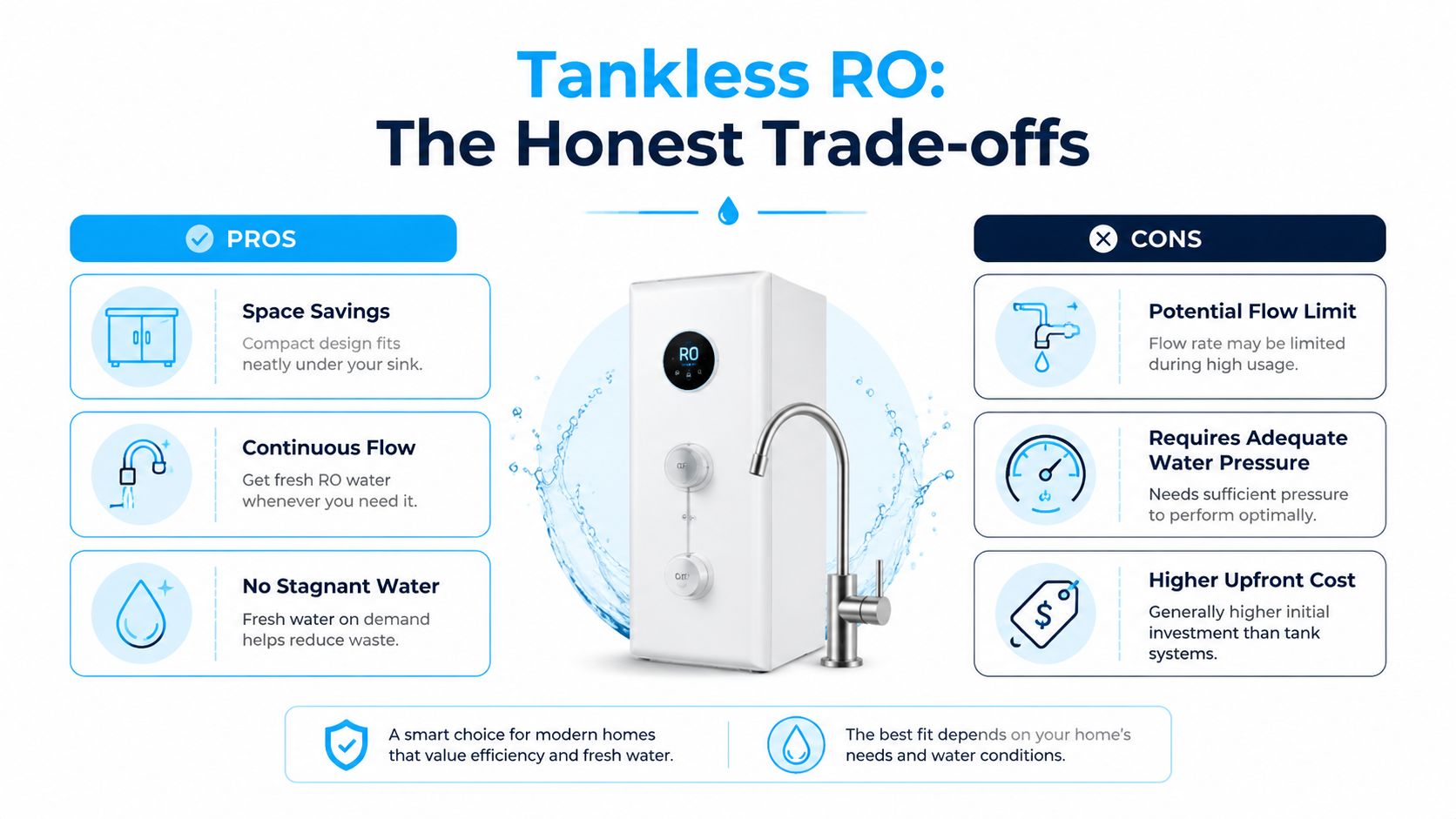
A tankless under sink RO system looks appealing for a simple reason. It gives you drinking water on demand, keeps the cabinet from feeling crowded, and removes the stored-water feel that some homeowners notice with a tanked setup. It can also reduce waste water compared with older reverse osmosis habits, and product data for the category points to more efficient ratios than the old, drain-heavy approach.
The advantage is not only space. It is the way the unit fits a busy kitchen cabinet while still doing the same job as a larger system, like a compact tool that replaces a bulky one without changing the task itself.
The trade-offs are real
Electricity is part of the package, so no outlet means no pump. The pump can add a soft hum while the system runs, and the plumbing is usually less forgiving than with a simple tank setup. That does not make the system complicated, but it does mean a cramped cabinet or awkward wiring can turn a straightforward purchase into a headache.
Pressure is the next constraint homeowners run into. If the membrane needs at least 40 PSI to work properly, a home with weak pressure may need a booster strategy so the system can keep up. If household pressure rises above 80 PSI, some installs may need a pressure-reducing valve. Those details shape performance and lifespan, because reverse osmosis is a little like squeezing water through a fine screen, too little force slows it down, too much stress can shorten the system's comfortable operating range.
The cost picture also needs to be honest. Filter and membrane changes still happen, and some product-level data ties high-efficiency models to average annual operating costs around $140/year. That is why a tankless unit can look lean on paper but still ask for ongoing upkeep over time.
Cabinet fit is the third reality, and it is easy to underestimate. A system can be physically compact and still clash with the drain, the disposal, or the outlet location, especially if the cabinet already feels crowded. If you open the door and find the receptacle is not ready for a pump-driven unit, an outlet not working electrician can save a lot of trial and error.
Certifications, Contaminants, and Water Quality Fit
The point of all this hardware is still the water at the glass. For an RO system, the core drinking-water standard is NSF/ANSI 58, which covers reverse osmosis performance. NSF/ANSI 42 relates to aesthetic effects like chlorine taste and odor, while NSF/ANSI 53 covers health-related contaminant claims. Those standards matter because they help you connect a system's label to what it's built to reduce.
That's especially useful when you're matching the system to the home. City water with chlorine or chloramine often leads people toward RO because taste and odor are part of the complaint. Older plumbing raises lead concerns. Well water or water with high total dissolved solids can make the case for RO even stronger, because the membrane is designed for broad dissolved-solids reduction rather than just surface-level polishing.
The contaminants homeowners usually care about most in this category include lead, arsenic, chromium, fluoride, nitrates, and total dissolved solids. A tankless unit doesn't change the chemistry of what RO can do, it changes how the water is delivered and how much space the system needs to do it. That's the useful way to think about fit.
Buy for the water you actually have, not for the label that sounds most advanced.
A tankless system is a strong match when the goal is point-of-use drinking water with compact hardware, especially in kitchens where the cabinet is already doing too much work. It's less compelling if the household doesn't need RO-level treatment and would be better served by a simpler filter stage.
Maintenance, Filter Schedules, and Who Should Buy One
Maintenance is where the long-term comfort of tankless lives or dies. A practical cadence is sediment and carbon pre-filters every 6 to 12 months, the RO membrane every 2 to 3 years depending on feed water, and a polishing post-filter annually. An annual sanitization also helps keep biofilm from forming inside the lines.
The daily habits are simple. Check for drips at the drain saddle after the first week, keep the space in front of the unit clear so you can swap cartridges easily, and watch the TDS reading on the faucet if the system includes one. If you want a broader maintenance reference, the Water Filter Advisor advice section covers practical filter-care topics in a homeowner-friendly format.
Tankless makes the most sense for small kitchens, apartments without basement utility rooms, households that fill pots and pitchers often, and homeowners who want filtration with lower waste and less cabinet clutter. It makes less sense for people with chronically low pressure who don't want a booster pump, off-grid homes without a reliable outlet, or anyone who's happy living with a slower tank-fed trickle.
If you're comparing a tankless under sink RO system to other home filtration options, Water Filter Advisor has guides that can help you sort through cabinet fit, contaminant concerns, and maintenance trade-offs before you buy. Visit Water Filter Advisor to compare systems, check filter-care guidance, and narrow down the right setup for your kitchen.
