
Your Ultimate Guide to the Parts of a Water Filter
Ever cracked open a water filter and wondered what magical wizardry happens inside? It’s not some single, mystical component doing all the heavy lifting. It's more like a super-efficient factory assembly line, where each part has a very specific, crucial job to do to get your water from funky to fantastic.
Think of it as a multi-stage security checkpoint for your H2O. The first guard is a big, burly bouncer who tosses out the obvious riff-raff—sand, dirt, and rust. Further down the line, you’ve got chemical specialists who sniff out and neutralize invisible villains like chlorine that make your water taste and smell like a swimming pool.
The different parts of a water filter all work in harmony, with each component designed to target specific contaminants. The big players include sediment pre-filters to catch the chunky stuff, activated carbon blocks to grab chemicals, and high-tech gear like reverse osmosis membranes for the ultimate purification showdown. Getting a handle on these parts is the secret to understanding your filter and keeping your home’s water sparkling clean.
Your Water Filter’s Inner Workings Uncovered
To really get what's happening inside that mysterious plastic canister, it helps to understand the big picture. We've got a great general overview of how a water filter works that explains how these individual parts fit into the overall process. Knowing this stuff is what empowers you to make smart choices about your home's water.
The Key Players in Filtration
At its heart, any decent home water filter uses a few core stages to clean your water. Each stage hands the water off to the next, making it progressively purer along its journey to your glass.
- The Initial Cleanup: First, you have to get rid of the physical gunk. This is the "get the mud off your boots" stage, and it's non-negotiable.
- The Taste and Odor Fix: Next up, the system targets the chemicals and compounds that cause bad tastes and smells. This is where the real flavor transformation happens.
- The Final Polish: Lastly, the water gets a final once-over to make sure it's as crisp and clean as possible before it hits your glass.
This quick infographic shows you exactly how those main stages work in most home filters.

As you can see, it's not a single step but a deliberate sequence. This layered approach is brilliant because it uses the tough, inexpensive sediment filter to protect the finer, more complex (and often more expensive) filters downstream. It's this teamwork that makes modern home water filters so effective.
Key Water Filter Components and Their Functions
To make it even clearer, here’s a quick-reference table breaking down the most common parts you'll find in a home water filter and what they do.
| Component | Primary Function | Common Contaminants Removed |
|---|---|---|
| Sediment Pre-Filter | Captures large physical particles. | Dirt, sand, silt, rust, scale. |
| Activated Carbon | Adsorbs chemicals and impurities. | Chlorine, chloramines, VOCs, pesticides. |
| Reverse Osmosis (RO) Membrane | Forces water through a semi-permeable membrane. | Dissolved solids, heavy metals, fluoride. |
| Ion-Exchange Media | Swaps mineral ions to soften water. | Calcium, magnesium (limescale). |
| UV Lamp | Sterilizes water with ultraviolet light. | Bacteria, viruses, protozoa. |
This table covers the heavy hitters, but remember that many systems combine these technologies in different orders and configurations to tackle specific water quality issues in your home.
The First Line of Defense: Sediment Pre-Filters
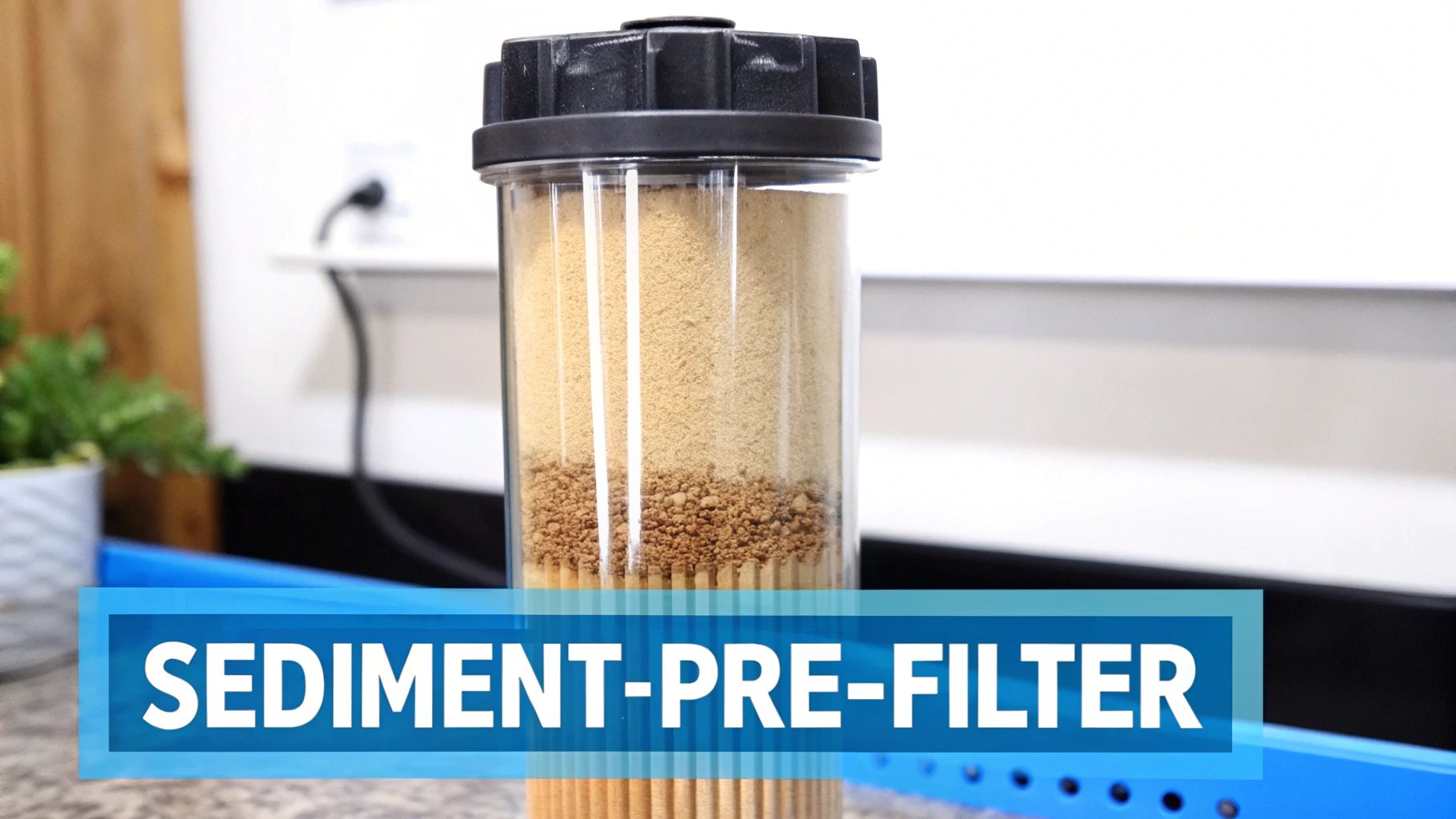
Before your water gets the deep clean for invisible contaminants, it needs a good old-fashioned scrubbing. That's the all-important job of the sediment pre-filter, the unsung hero that acts as the rugged first line of defense in pretty much any serious home water filtration system.
Think of it as the bouncer at a club. Its one and only job is to stop the obvious troublemakers—the grit, sand, rust flakes from old pipes, and other chunky stuff—right at the door.
This hardworking filter physically blocks and traps these larger particles. Its primary mission? To keep all that gunk from crashing the party further down the line, where it would absolutely wreck the more delicate and expensive parts, like your carbon filters or that pricey reverse osmosis membrane.
Why This First Step Is So Important
By taking on all the heavy lifting of this coarse filtration, the sediment pre-filter lets the rest of your system actually do its job. Without it, those finer filters would get gummed up and clogged almost instantly. You'd see a massive drop in water pressure, and you'd be replacing expensive filters way more often than you should.
This first stage is what keeps the water flowing and your maintenance costs from getting out of hand.
Sediment filters have been around since the 1980s, typically made from pleated polyester or polypropylene. They are designed to trap particulates larger than 5-50 microns—stuff you can often see. Adding one can extend the life of your entire system by 30-50%. They're especially critical if your home is on well water, which is notorious for having higher levels of sediment. You can get more background on how these systems have evolved over at Cognitive Market Research.
This crucial protective role is why you’ll find a sediment filter as stage one in just about every under-sink, whole-house, or reverse osmosis setup.
The Support Crew: Housings and O-Rings
Of course, the filter cartridge doesn't just float in your pipes. It lives inside a filter housing, which is the tough canister that holds the filter and connects everything to your water lines. These are usually made from heavy-duty, food-grade plastic built to handle constant water pressure.
A tiny but critical part you can't ignore is the O-ring. It’s just a simple rubber gasket that sits at the top of the housing to create a perfect, watertight seal. If that seal fails, you've got a leak on your hands. That's why checking the O-ring for any cracks or wear every single time you change a filter is a non-negotiable maintenance step for any homeowner.
Wondering if your sediment pre-filter is crying for help? Here are the common signs:
- A big drop in water pressure: This is the number one sign of a clogged filter.
- Visible floaties in your water: If you can see particles, the filter is either full or has failed completely.
- Discolored water: A sudden burst of rusty or cloudy water means the filter is overwhelmed and can't keep up.
Replacing this filter is usually the most frequent chore you'll have with any system. But the good news is, it's also one of the easiest and cheapest ways to protect your entire investment.
The Real Workhorses: Activated Carbon and Ion-Exchange Media
If the sediment pre-filter is the bouncer at the door, think of activated carbon as the charismatic host inside. It's the part of the system that deals with all the unseen troublemakers, completely transforming the taste and smell of your water. This is where cloudy, foul-smelling tap water becomes crisp, clean, and refreshing.
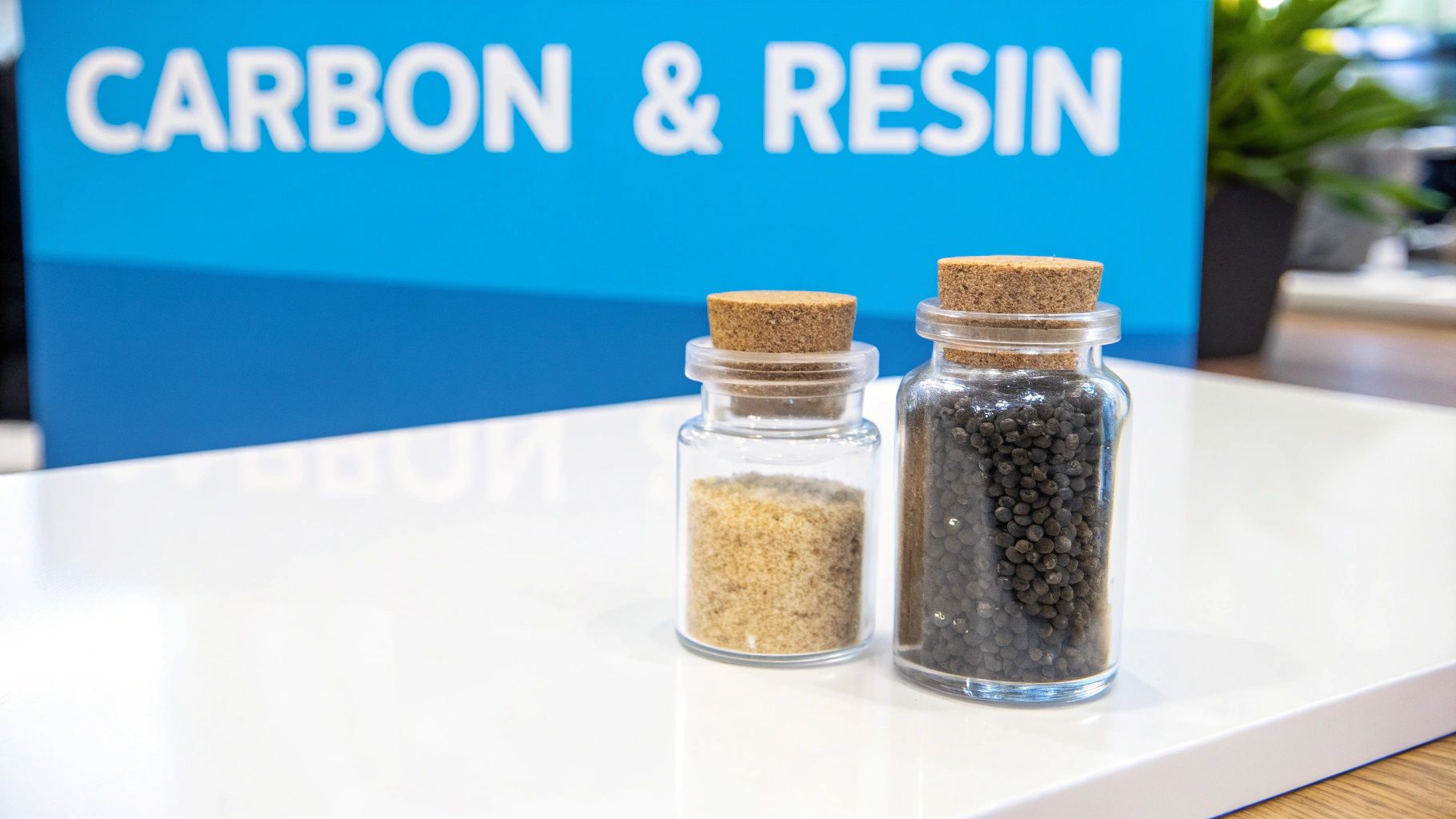
So, how does it work? Imagine activated carbon as a highly porous, magnetic sponge. Its surface is covered in millions of tiny nooks and crannies, creating a massive area for contaminants to get trapped. As water passes over it, a process called adsorption kicks in, grabbing onto things like chlorine, pesticides, and volatile organic compounds (VOCs). That's the magic that gets rid of that "public pool" smell from your tap.
Activated Carbon: The Flavor Saver
Using activated carbon to clean up water isn't some newfangled idea; people have been using it since the late 18th century. It's still the best tool we have for getting rid of the chlorine, chloramine, and weird odors that plague municipal water supplies. Its effectiveness is a big reason why the global water filter market hit USD 14.26 billion in 2023 and is expected to keep climbing. If you're curious, you can check out more data on the water filter market growth on SkyQuest.
You'll run into this stuff in a couple of different forms:
- Granular Activated Carbon (GAC): These are loose carbon granules. They do a good job, but sometimes water can find a path around them, a problem known as "channeling."
- Carbon Block: This is a solid, compressed block of carbon. It forces every drop of water to pass through it, ensuring maximum contact time and preventing any channeling.
No matter the form, carbon is the backbone of filtration. You'll find it in everything from a simple pitcher filter to a high-end under-sink system. It's a key player in just about every setup out there.
Ion-Exchange Media: The Hard Water Specialist
While carbon is busy tackling chemicals, ion-exchange media is the specialist you call in for hard water. Ever seen that chalky white scale building up on your faucets, showerheads, or inside your coffee maker? That's hard water, caused by high levels of calcium and magnesium.
Think of ion-exchange media as a microscopic trading post. It's made of tiny resin beads loaded up with harmless sodium ions. When hard water flows through, these beads snatch the troublesome calcium and magnesium ions and trade them for the sodium ions, effectively "softening" the water on the spot.
This process is a lifesaver for your plumbing and appliances. Hard water scale can clog pipes, make your water heater less efficient, and leave ugly spots all over your dishes. By swapping out those minerals, this media stops scale before it even starts, saving you a world of headaches and expensive repairs down the road. You’ll find this technology inside dedicated water softeners and some of the more advanced filtration systems.
The Ultimate Guardian: The Reverse Osmosis Membrane
When you absolutely, positively need the purest water possible, you call in the specialist. And in the world of home water filters, the undisputed specialist is the Reverse Osmosis (RO) membrane. This isn't just another filter layer; it’s a highly advanced gatekeeper that works at the molecular level.
The RO membrane uses your home’s existing water pressure to literally force water molecules through a tightly wrapped, semi-permeable sheet. You can think of it like a bouncer at an exclusive club with an incredibly strict guest list. Only pure water molecules get in, while up to 99% of dissolved solids are turned away and flushed down the drain. This process is exactly how an RO system can eliminate tiny contaminants that other filters simply can't touch.
What the RO Membrane Targets
While a good carbon filter is your go-to for chlorine and funky tastes, the RO membrane is in a different league, tackling a whole other class of impurities. Its pores are so ridiculously small that they can block a massive range of contaminants that are otherwise very difficult to get out of your water.
Here’s a look at what an RO membrane is designed to remove:
- Heavy Metals like lead, arsenic, mercury, and cadmium.
- Dissolved Salts, which is why RO technology is famous for desalination (turning salt water into fresh water).
- Fluoride, a common additive in municipal water that many people prefer to remove.
- Nitrates and Nitrites, contaminants often found in areas with agricultural runoff.
Reverse osmosis is the heart and soul of any advanced home water filtration system. It was originally patented way back in the 1950s for military use, turning seawater into drinkable water for sailors. By the 1970s, the technology made its way into homes, and today it powers about 40% of premium residential systems. You can dig deeper into the growth of home water filtration market share on Arizton.
Essential Supporting Parts of an RO System
An RO membrane is a powerhouse, but it can’t do the job all by itself. The process is slow and meticulous, so it relies on a couple of other critical parts to make it practical for your kitchen sink.
The most obvious companion piece is the storage tank. Since the RO membrane purifies water almost drop by drop, the tank is there to collect and hold a reserve of that super-clean water. This ensures you have a ready supply at the faucet whenever you need it. Without it, you’d be waiting several minutes just to fill a glass of water.
Another crucial—but often overlooked—component is the flow restrictor. This tiny but mighty part is vital for creating the back-pressure needed for reverse osmosis to even happen. It carefully controls how much wastewater goes to the drain, making sure the membrane operates at the perfect pressure to maximize pure water production and minimize waste.
Final Polishing and Sterilization: Post-Filters and UV Lamps
Your water has made it through the heavy-hitters—the sediment filter, the carbon block, and maybe even a reverse osmosis membrane. It’s almost ready. But before it hits your glass, a couple of specialists get the final say, acting as the ultimate quality control to make sure every drop is perfect. These last parts of a water filter are all about adding that final polish and ensuring total microbial safety.

First up is the post-filter, which is almost always another carbon filter. Think of it as the final taste polisher. This is especially important in a reverse osmosis system, where purified water often sits in a storage tank before you turn on the faucet. The post-filter’s one job is to catch any faint tastes or smells the water might have picked up while waiting in the tank, giving you that crisp, clean finish every time.
The Final Polish with a Post-Filter
This last-stage carbon filter is like the final inspector on a factory line. It’s there to catch any tiny imperfections that might have snuck past the other stages, guaranteeing the final product—your drinking water—is absolutely flawless. It’s what turns good water into great-tasting water.
Just like the other filters in the system, this component needs to be swapped out regularly, usually every 6 to 12 months. The tell-tale sign it’s time for a change is when that slight "off" taste or odor you got rid of starts to creep back in.
Ultimate Microbial Safety with UV Lamps
For absolute peace of mind, particularly if you're on well water or live in an area prone to boil water advisories, the final stop is often an Ultraviolet (UV) lamp. This component doesn't filter anything in the traditional sense; it sterilizes. It’s a completely different kind of guardian angel for your water.
A UV lamp blasts the water with powerful UV-C light, which is a potent germicidal agent. As water flows past the glowing lamp, this intense light instantly scrambles the DNA of any microorganisms present. It doesn't kill them outright, but it makes it impossible for them to reproduce and make you sick.
It's an incredibly effective, chemical-free way to neutralize a whole host of invisible threats:
- Bacteria like E. coli and Salmonella
- Viruses like Hepatitis A and Rotavirus
- Cysts such as Giardia and Cryptosporidium
The UV lamp bulb itself needs to be replaced once a year—that’s about 10,000 hours of use. Even if the light still turns on, its germ-killing power weakens over time. The lamp is protected by a quartz sleeve, a clear glass tube that also needs to be kept clean so the UV rays can fully penetrate the water. Together, this powerful duo provides a final, non-chemical line of defense, ensuring your water isn't just clean, but biologically safe.
Connecting It All: Valves, Fittings, and Faucets
The filter cartridges and high-tech membranes tend to get all the attention, but they’d be completely useless without the plumbing hardware that ties the whole system together. These connecting parts of a water filter are the unsung heroes. They’re the ones managing water flow, stopping leaks before they start, and delivering that purified water right to your glass.
Think of your home filtration system as a complete plumbing circuit. These components are its critical infrastructure.
Take the feed water valve, for example. This is ground zero. It’s a small valve that taps directly into your cold water line, essentially acting as the main on/off switch for the entire operation. From there, a network of flexible tubing and sturdy fittings takes over, guiding the water from one filter stage to the next and ensuring a secure, leak-free path.
The Essential Connectors
These parts might look small, but their role in your system's performance and safety is massive. A single bad fitting can lead to a catastrophic leak, which is exactly why using high-quality components is non-negotiable. In fact, unfiltered water is responsible for over 50% of espresso machine leak problems, usually because scale buildup has damaged the internal connections.
Here are a few of the key players:
- Dedicated Faucet: Most under-sink systems will come with their own stylish faucet. This is a great feature because it keeps your newly purified water separate from your regular hot and cold tap water.
- Check Valves: Think of these as one-way gates. They prevent wastewater from flowing backward into the clean water line—an absolutely crucial safety feature, especially in RO systems.
- Pressure Regulators: If your home has high or unpredictable water pressure, this part is a must-have. It acts as a shield, protecting the more delicate filter housings and membranes from sudden pressure spikes that could cause cracks or total failure.
Getting a handle on how these components work together is the real key to a successful, leak-free installation. They make sure purified water gets exactly where it needs to go, safely and reliably, turning a simple collection of filters into a high-performance system you can depend on.
Common Questions About Water Filter Parts
Figuring out replacement parts and system maintenance can sometimes feel like you’re a detective trying to solve a tricky case. Let's tackle some of the most common questions we hear from homeowners, so you can keep your system running perfectly without any of the guesswork.
How Do I Find the Right Replacement Part for My Filter?
Your first clue is always in the system's user manual. It’s the definitive guide, listing the exact model numbers for everything from the main filter cartridges and membranes to those tiny but critical O-rings.
If your manual has gone missing (it happens to the best of us!), check the filter housing itself for a label or sticker. The manufacturer's website is also a great resource. Just remember, using the correct model number is the key to getting a perfect fit and keeping your filter working at its best.
Can I Add New Parts to Upgrade My System?
Absolutely. Many home systems are designed to be modular, which makes upgrading surprisingly straightforward.
A really popular upgrade for reverse osmosis systems is adding a remineralization filter. This little add-on puts back the healthy minerals that the RO process strips out. Another great option is installing a UV lamp for an extra layer of protection against microbes, especially if your original setup didn't include one.
Before you start any upgrade, double-check that the new component is compatible with your system's pressure and flow rate. A mismatch can lead to lousy performance or even damage your filter. Following the installation instructions to the letter is your ticket to a successful upgrade. For more tips, check out our expert advice section.
Why Does My Water Look Cloudy After Changing a Filter?
Don't worry, this is totally normal and nearly always just tiny air bubbles trapped in the new filter. The cloudiness is harmless and should disappear on its own within a day or two as the air gets pushed out of the system.
Sometimes, a new carbon filter will also release some harmless carbon "fines" (which is basically just dust). This might give the water a slightly off taste at first. That's why the instructions always tell you to flush a new filter for a few minutes before you start drinking from it. This simple step clears out both the air and any loose carbon, making sure your first glass of water is crisp and clean.
At Water Filter Advisor, we're here to help you understand every single piece of your filtration system so you can enjoy safe, clean water every single day. Find the best solution for your home at https://www.waterfilteradvisor.com.
