Do Water Filters Remove Bacteria at Home?
Some certified ultrafiltration, reverse osmosis, UV, and chemical treatment systems remove or inactivate bacteria, while ordinary activated-carbon and many aesthetic household filters don't reliably do so. If clearer, better-tasting water feels cleaner, why doesn't that feeling tell you anything reliable about germs you can't see, taste, or smell?
That gap trips up many homeowners. A pitcher can make coffee taste better and still leave bacteria untouched, because taste improvement and microbiological treatment are different jobs. When people ask do water filters remove bacteria, the honest answer depends on three separate questions. What physically crosses the barrier? What does the certification cover? And does the system still perform after installation and months of use?
What Filtering for Bacteria Really Means
A homeowner stands in a kitchen aisle comparing two boxes. One promises great taste and chlorine reduction, the other mentions microbiological treatment in smaller print, and both show a sparkling glass of water. It's easy to assume the prettier water is the safer water.
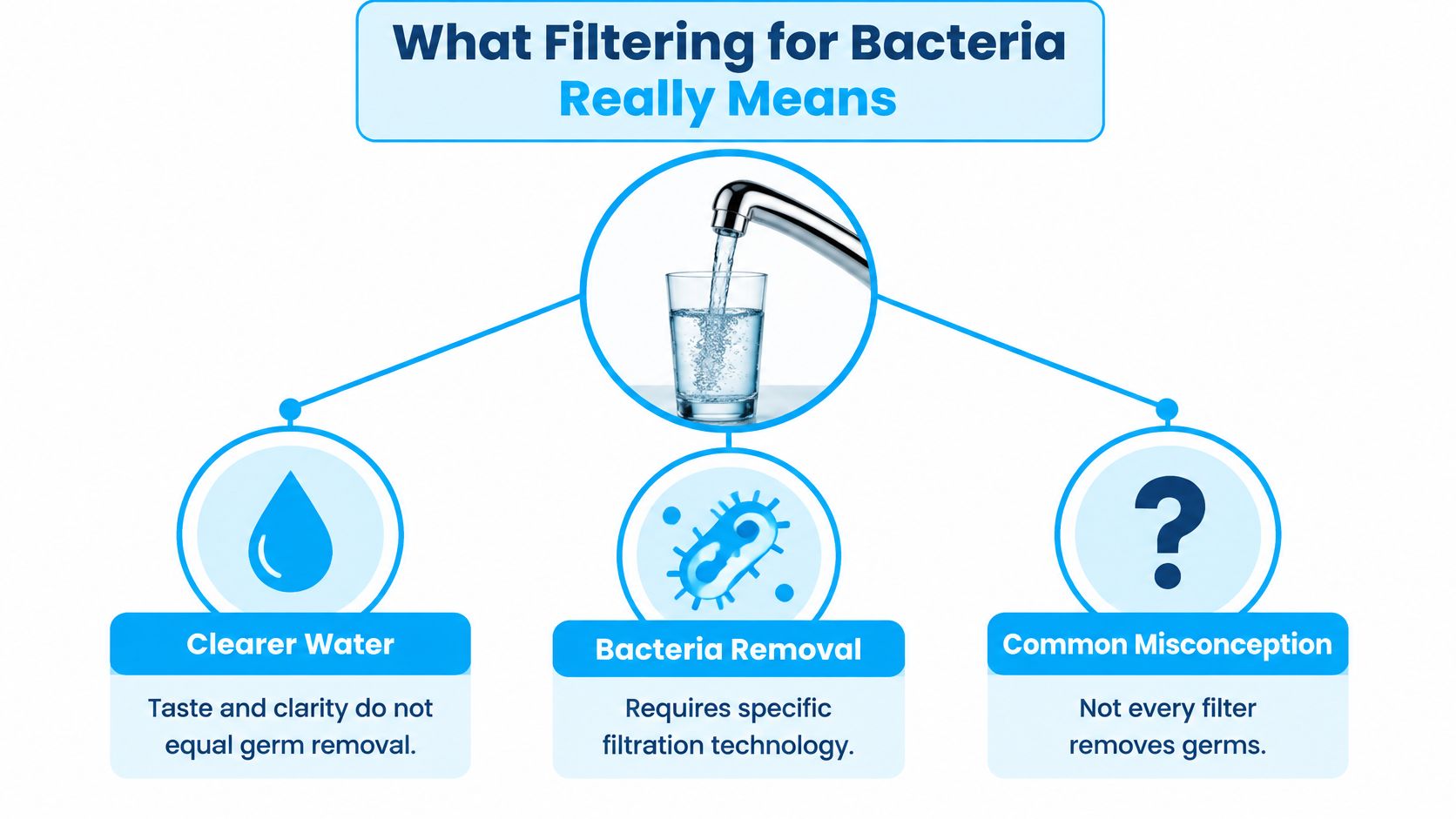
That assumption is where confusion starts. Most household water filters do not automatically remove bacteria, and conventional activated-carbon filters are generally designed to improve taste and odor and reduce selected contaminants rather than destroy bacteria, a distinction the EPA makes for conventional activated-carbon filters. Sediment, rust, and chlorine are not living organisms, so removing them says nothing by itself about E. coli or Salmonella.
Removal and Inactivation Are Different
Think of physical filtration as a sieve. Water passes through tiny openings, and particles too large to fit stay behind. If the openings are too large, or if the rating describes an average rather than a maximum, smaller organisms can slip through.
Inactivation works differently. UV light and chemical disinfectants don't strain bacteria out of the water. They damage the organisms so they can't reproduce or cause infection, even though the cells may remain in the glass.
Aesthetic treatment is a third job entirely. Carbon improves flavor and odor by adsorbing chlorine and selected organic chemicals. That's valuable for daily drinking water, but it isn't disinfection, and a carbon filter can't make microbiologically contaminated water safe.
Clear water, good-tasting water, and bacteria-treated water are three different outcomes. A filter can deliver the first two without delivering the third.
Why Source Water Changes the Question
A municipal supply that's already disinfected asks less of a home filter than a private well with unknown microbiological quality. Some products described as bacteriostatic use agents such as silver ions to inhibit bacterial growth inside the cartridge, but that isn't the same as reliably removing bacteria from incoming water.
So use a practical test for every claim you meet. Identify the mechanism, check the certification scope, confirm correct installation, and ask whether performance lasts. No filter should be presumed safe for unknown contamination just because it's called a filter.
How Each Water Filter Technology Handles Bacteria
Start with what each technology physically does, because the mechanism sets the limit. A barrier can only block what can't fit through it, and a light or chemical can only affect organisms it reaches under the right conditions. That's why a stated claim for chlorine or lead doesn't establish bacteria reduction.
The CDC identifies an absolute pore size of 0.3 microns or smaller as a threshold for removing bacteria such as Salmonella and E. coli, while noting that filtration at this level does not remove viruses, in its guidance on choosing home water filters. Bacteria such as E. coli and Salmonella span roughly 0.2 to 4 microns, so pore size has to be read carefully rather than guessed from marketing language.
Common Household Formats
Activated carbon in pitchers, refrigerator cartridges, and many faucet filters mainly addresses chlorine, taste, odor, and selected chemicals. It isn't a bacteria barrier. Simple mechanical cartridges catch sediment and rust, which protects downstream equipment but doesn't disinfect water.
Microfiltration uses finer pores and can capture some organisms, but capture isn't complete for every bacterium. Ultrafiltration tightens that physical barrier further and, when properly designed and maintained, can remove bacteria. The step from microfiltration to ultrafiltration is a step in pore size, not just in price.
Reverse osmosis pushes water through a semipermeable membrane under pressure. That dense membrane can remove bacteria when the system is properly designed and maintained, and it also reduces a broad range of dissolved contaminants. Nanofiltration sits in the same membrane family and can also support bacterial removal.
Inactivation Methods
UV treatment doesn't remove anything. Water flows through a chamber where ultraviolet light inactivates microbes, so clarity, flow rate, and lamp condition matter. If you're comparing that approach, understanding how UV purification systems work helps you see why prefiltration and maintenance are part of the design, not accessories.
Chemical treatment disinfects through an added antimicrobial. It can inactivate bacteria, but dose and contact conditions determine the result. You'll see it more often in well treatment and emergency use than in a simple countertop pitcher.
| Technology | How It Acts | Bacteria Capability | Important Limit |
|---|---|---|---|
| Activated carbon | Adsorbs chlorine and selected chemicals | Not reliably | Built for taste and odor |
| Microfiltration | Physical barrier, larger pores | Some organisms only | Doesn't remove viruses |
| Ultrafiltration | Tighter physical barrier | Capable when certified and maintained | Needs correct rating and upkeep |
| Reverse osmosis | Semipermeable membrane under pressure | Capable when properly designed | Membrane and seals must stay intact |
| UV | Light inactivates microbes | Inactivates, doesn't remove | Needs clear water and power |
| Chemical treatment | Antimicrobial disinfection | Inactivates with proper dosing | Dose and contact conditions matter |
Placement matters too. A point-of-use system treats one tap, while a whole-house system treats water entering the home. Whole-house carbon can remove chlorine early, which may allow more microbes to grow in downstream plumbing, so treatment order and sanitation deserve attention.
Read Bacteria Claims Without Guesswork
Two listings can both say sub-micron and mean very different things. One gives an absolute rating, meaning the largest pore is no bigger than stated. The other gives a nominal or average rating, which allows some larger openings. For bacteria, that single word changes the claim.
The visual below lays out a four-step routine you can apply to any product page or box before you buy.
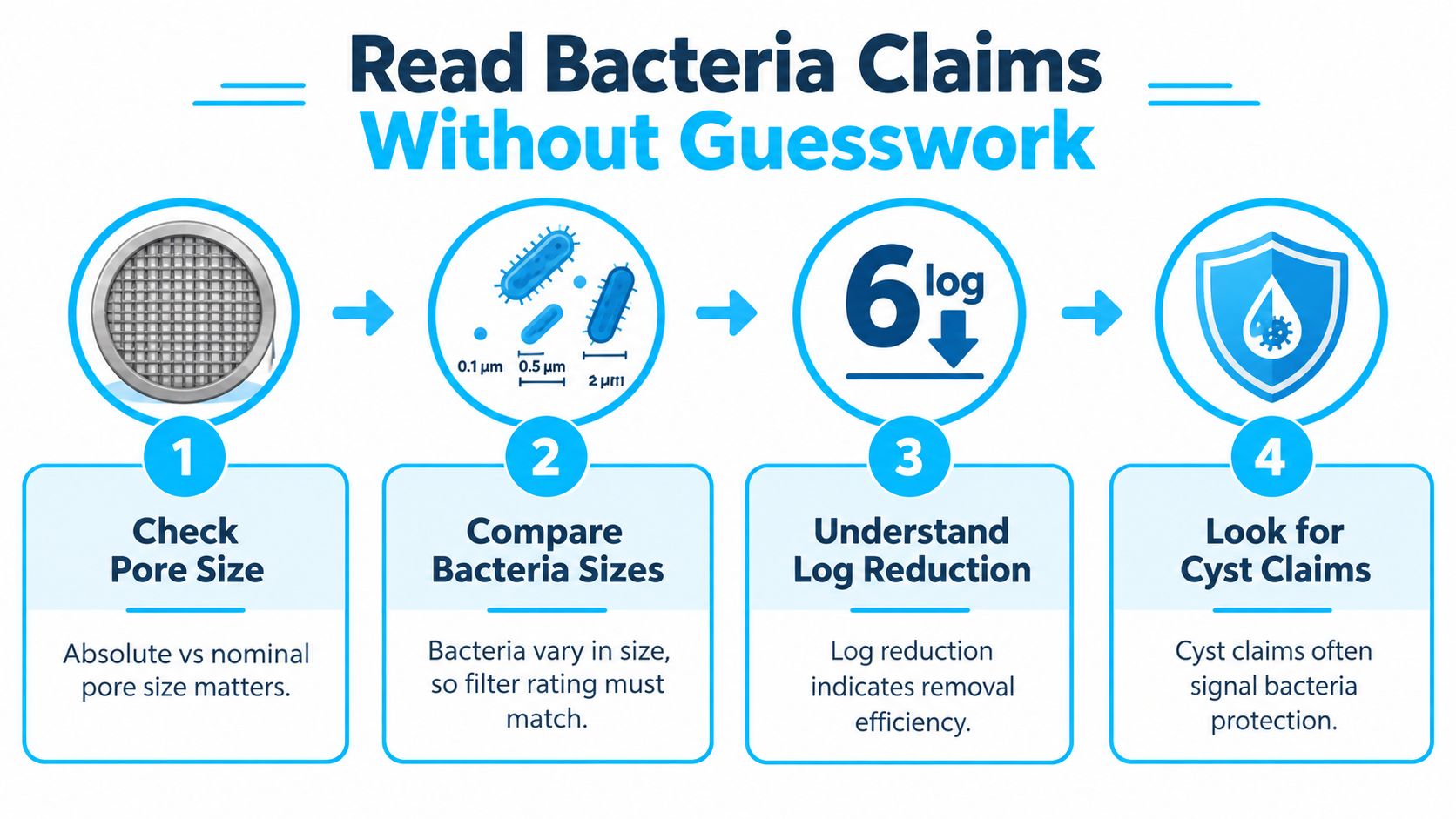
Four Checks Before You Believe a Claim
- Check the pore rating type: Look for the word absolute, not just a micron number, and check whether the claim names bacteria specifically.
- Match the organism: A cyst claim covers larger parasites such as Giardia and Cryptosporidium. Filters rated at 1 micron or smaller are intended mainly for parasites, and cyst reduction doesn't establish removal of all bacteria.
- Read the reduction value: A log reduction describes how many organisms are removed or inactivated relative to the starting level, with higher values meaning fewer survivors under test conditions.
- Separate unrelated claims: Chlorine, lead, taste, and odor results prove those reductions only. They don't transfer to bacteria.
Microfiltration illustrates why this care matters. The CDC describes it as only somewhat effective against bacteria, since it may remove some organisms while allowing others through, and it doesn't remove viruses such as norovirus or hepatitis A. Enteric viruses average about 0.03 microns, far smaller than most bacteria, so a bacteria-capable filter still isn't a virus solution.
The strongest benchmark is an explicit purifier claim. For an EPA purifier designation, products must demonstrate at least 99.9999% bacterial removal, 99.99% viral removal, and 99.9% removal of Cryptosporidium or Giardia, as summarized in the CDC overview of home water treatment systems. Compare that threshold with vague phrases like cleaner or purer, which carry no tested meaning.
The short video below walks through filter claim language in a visual way, which can help when several labels compete on one box.
Labels also need separating. Filter, purifier, bacteriostatic, and microfiltration aren't interchangeable. Bacteriostatic describes inhibiting growth in the cartridge, microfiltration describes a pore range, and purifier implies a tested microbiological claim.
Treatment sequence adds one more layer. A sediment or carbon prefilter can protect a downstream UV chamber by improving clarity, while disinfection may still follow filtration when viruses are part of the risk. Your routine stays simple. Name the organism, the standard, the reduction, and the use conditions, and skip any product that won't state them.
Certification and Lab Results That Matter
A familiar certification logo feels reassuring, but the logo alone proves less than most shoppers think. Certification applies only to the contaminants, performance claims, and conditions covered by the applicable standard. A system certified for chlorine and lead hasn't been certified for bacteria unless bacteria appear in that scope.
The photo below shows the kind of pairing worth looking for, a product next to documentation you can read rather than a badge you have to trust blindly.
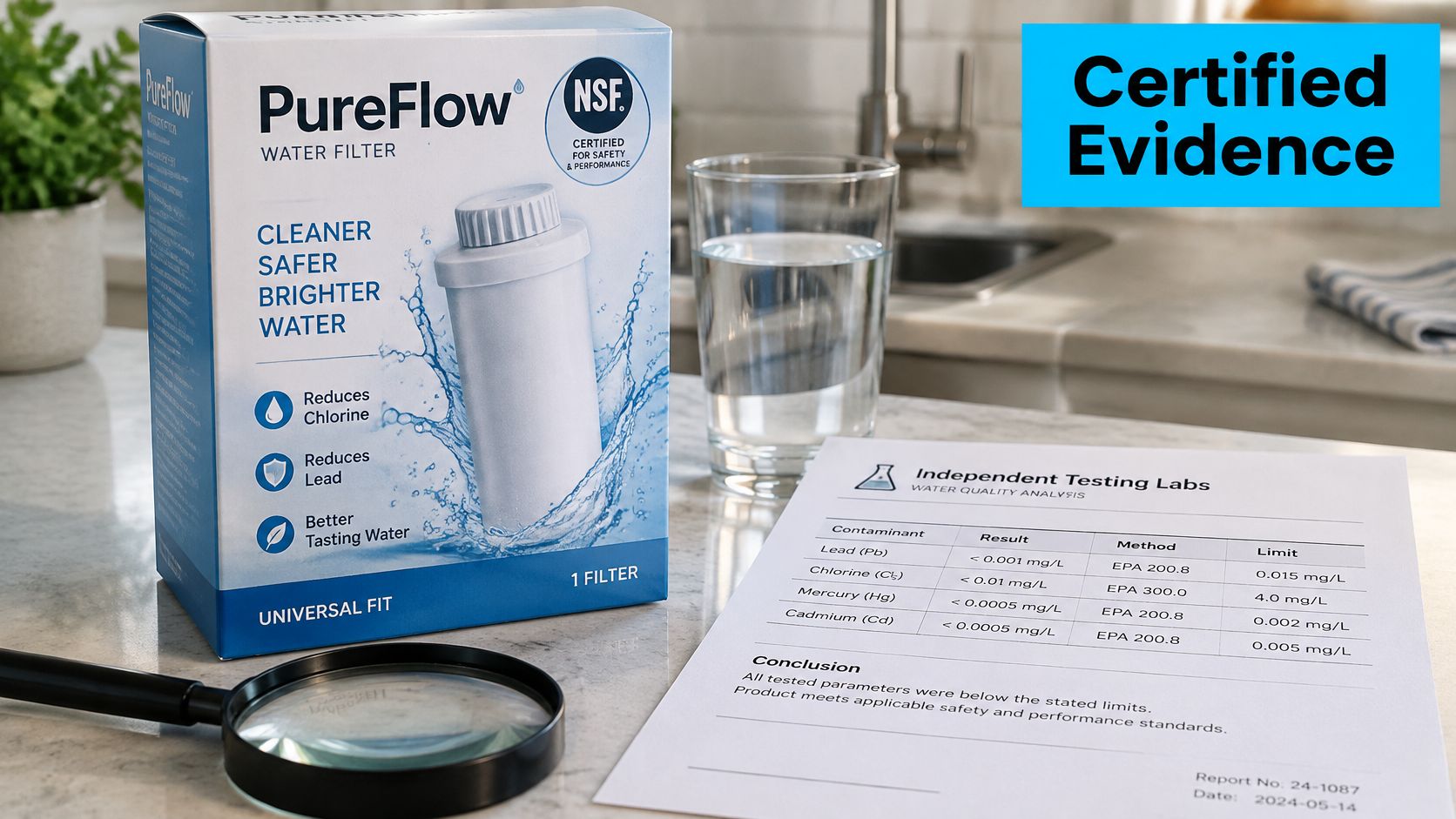
What Different Evidence Actually Shows
NSF notes that residential treatment standards are voluntary, so you need to check which standard a manufacturer chose and what it covers. If you're decoding a label, learning what NSF certification means helps you separate a tested claim from a general quality impression.
NSF/ANSI 53 is a common source of confusion. That standard covers reduction of specified contaminants and is intended for microbiologically safe water, not water of unknown or unsafe quality without disinfection. Seeing that number shouldn't lead you to assume bacterial removal.
NSF/ANSI 244 addresses a different problem. It covers intermittent microbiological contamination and requires structural-integrity testing, a 3-log reduction of bacteria and viruses, and an end-of-life indicator, according to the NSF summary of NSF/ANSI 244 technical requirements. That end-of-life requirement matters, because protection that fades without notice isn't protection you can manage.
Practical rule: Read the standard number, the tested organism, and the reduction value together. Any one of them alone can mislead you.
Reading a Lab Report
Look for the exact model tested, the organism or surrogate used, the flow and capacity conditions, and any manufacturer limitations. Controlled testing shows what a system can accomplish under specified conditions. It can't guarantee your installation, your water pressure, or your replacement habits.
That distinction isn't a reason to distrust testing. It's a reason to use testing correctly, as evidence of capability that still needs correct setup and upkeep at home. If a seller can't point you to the standard and scope behind a bacteria claim, treat the claim as marketing, not evidence.
Home Filter Examples in Real Situations
A family fills a carbon pitcher every morning because their tap water tastes like a swimming pool. The coffee improves, the kids drink more water, and the pitcher earns its place on the counter. For that job, on a disinfected municipal supply, it's doing exactly what it was built to do.
The mistake would be promoting that pitcher to a safety device during a boil-water notice. Its carbon was chosen for taste, not for bacteria. The evidence to seek in that moment isn't a better pitcher claim, it's official guidance for the notice and, afterward, a system with a bacteria-specific claim if concern remains.
A Well-Water Household
A rural household on a private well faces a different question, because no utility disinfects their supply before it reaches the tap. If a lab test suggests bacterial contamination, they need treatment matched to that result, not reassurance from a taste filter. Validated ultrafiltration, reverse osmosis, UV, or chemical disinfection may each play a role, often in combination.
Sequence matters in their setup. Sediment filtration can protect a UV chamber, UV can inactivate organisms the membrane doesn't address, and testing after installation confirms whether the arrangement works on their water. Chemical disinfection is another option, but it brings dosing decisions that a passive cartridge doesn't.
A Tenant and a Seasonal Home
A tenant who can't modify plumbing might choose a faucet filter for taste and chlorine. That's a reasonable, limited goal, as long as nobody expects bacteria protection the label never promised. If the building issues a contamination notice, the faucet filter doesn't change the response.
A seasonal home creates a quieter risk. Water sits in housings, tubing, storage tanks, and wet cartridges for weeks, and bacteria can grow on distillation-system cooling coils while a system isn't being used. In that house, the weak point isn't the original filter medium. It's stagnation, storage, and whether anyone flushes and sanitizes the system before the first glass.
- Pitcher on city water: Judge it on taste, odor, and its stated contaminant claims.
- Well with a positive test: Ask for bacteria-specific certification, correct sizing, and follow-up lab testing.
- Rental faucet filter: Confirm what it reduces, and don't stretch that list to germs.
- Seasonal property: Plan flushing, sanitation, and cartridge replacement after idle periods.
Each scenario ends at the same place. Match the evidence to the actual risk, rather than asking one familiar product to cover every situation.
Why Good Filters Can Underperform at Home
Buying a certified system feels like finishing the job. It isn't. Certification describes performance under test conditions, and your kitchen adds variables the lab didn't, including missed replacement dates, a housing that wasn't seated properly, and water that sat unused during a vacation.
Capacity is the first pressure point. A filter used beyond its rated capacity can't be assumed to deliver its tested reduction, even if flow still seems fine and taste hasn't changed. Bacteria performance can decline without a visible warning, which is why an end-of-life indicator and a replacement schedule matter more than guesswork.
When the System Becomes the Problem
Germs in pipe slime can live and multiply in water filters, particularly when filters are not properly maintained or replaced, a risk the CDC flags for home water filters. Wet cartridges, housings, tubing, and storage tanks give microbes surfaces and time. Handling a new cartridge with unwashed hands or storing it damp can add contamination before treatment even starts.
Whole-house treatment adds a trade-off. Removing chlorine at the entry point improves taste throughout the home, but it also removes the disinfectant that suppresses growth in household plumbing. That doesn't make whole-house carbon a bad choice. It makes sanitation and filter selection part of the decision.
A headline percentage from a lab test is not a maintenance plan. The cartridge you forgot for a year is not the cartridge that was tested.
A Maintenance Routine That Protects the Claim
- Track capacity, not just time: Follow the rated volume and the manufacturer's replacement interval, and note the install date on the housing.
- Flush after idle periods: Run water through seldom-used systems and taps before drinking, especially in seasonal homes.
- Sanitize on schedule: Clean housings and follow manufacturer sanitation steps during cartridge changes.
- Inspect the quiet parts: Check tubing, tanks, seals, and bypass settings, since a bypassed or poorly sealed housing lets untreated water through.
- Store spares dry: Keep replacement cartridges sealed and dry until installation.
Separate two kinds of failure in your mind. A test limit means the system was never proven for your organism or condition. A maintenance failure means a proven system stopped being given the conditions it was proven under. Both end the same way, but only one is fixed by buying differently.
Choose and Verify the Right Home System
Start with your source, because it sets the burden of proof. Municipal water arrives disinfected, so many households shop mainly for taste, chlorine, or specific contaminants. Well water puts testing and treatment decisions on you, so a bacteria concern there calls for lab results before equipment.
The decision path below connects source, known risk, and verification so you can place your own household on it.
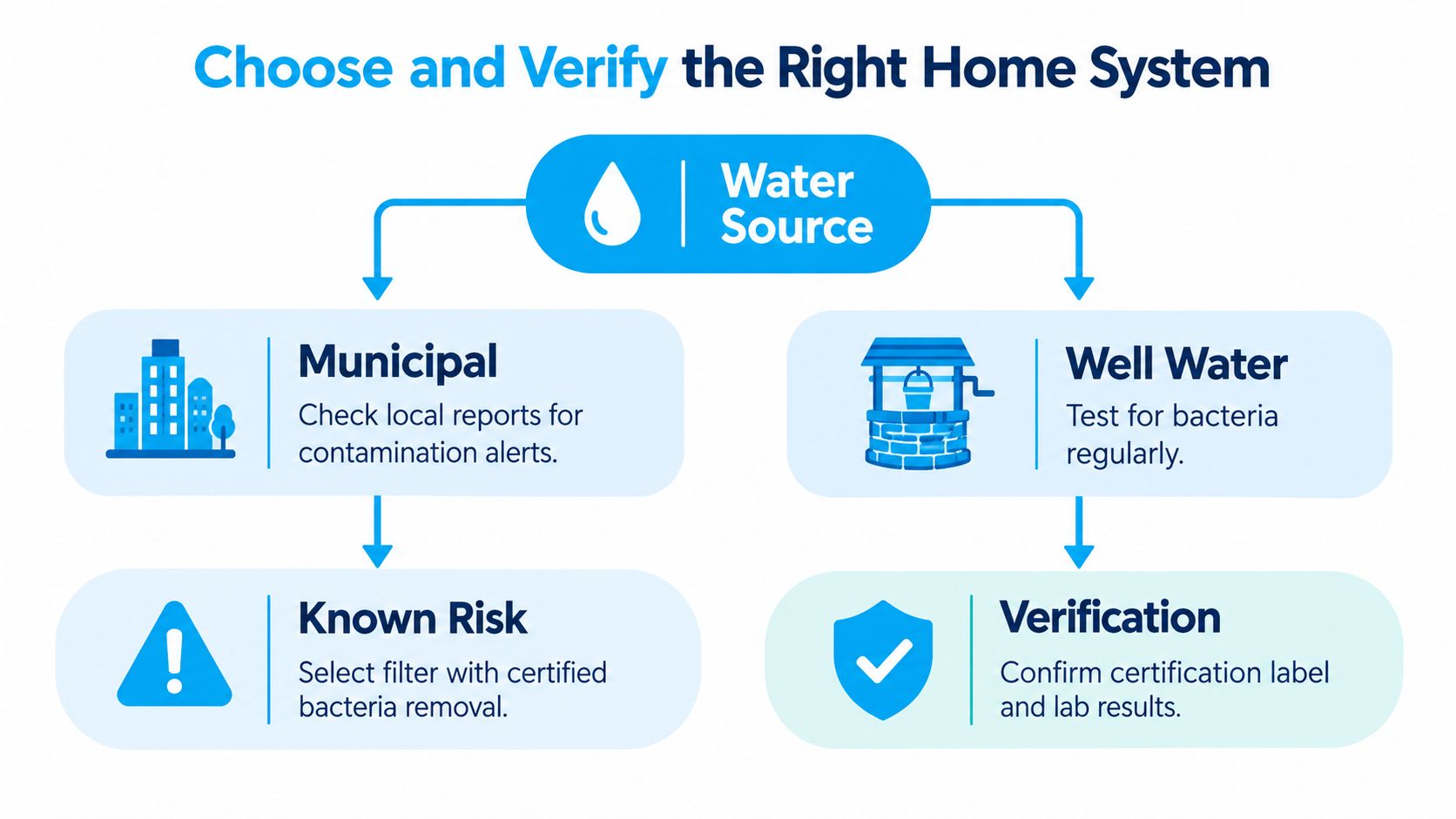
Next, name your situation. Is bacterial contamination confirmed by a test, suspected after flooding or plumbing work, or a worry raised by a product listing? Confirmed or suspected contamination calls for a validated microbiological process, and reverse osmosis is identified by the CDC as a household treatment method that can remove bacteria and viruses in its emergency water guidance.
Then verify before you commit. Check the bacteria-specific standard and reduction claim, confirm your plumbing and flow conditions suit the system, and write down replacement and sanitation tasks before purchase. After installation, follow the manufacturer's startup guidance, replace any expired components, and arrange laboratory testing when contamination is suspected rather than assuming a filter can diagnose your water.
Keep one concise rule. Use ordinary carbon for its stated aesthetic functions, and use a validated microbiological treatment process when the goal is making water safe from bacteria. That single distinction answers the original question more reliably than any badge on a box.
Before you buy your next cartridge or system, compare its bacteria claims, certification scope, and replacement requirements side by side using the guides at Water Filter Advisor. You'll find plain-language comparisons of whole-house, under-sink, faucet, and UV options, plus maintenance checklists that help you keep a good system performing. Visit today and choose based on evidence your household can verify.
