Nanofiltration Water Filters: The Ultimate Guide to Cleaner, Healthier Home Water

Ever wonder if you could have a water filter smart enough to kick out tiny threats like viruses and lead, but cool enough to leave in the healthy minerals your body actually needs? That’s the magic of nanofiltration water filters. They act like a microscopic bouncer for your water supply, catching all the unwanted party-crashers while waving the good stuff, like calcium and magnesium, right on through. It's a total game-changer for anyone wanting seriously pure, great-tasting water right from the tap.

How Nanofiltration Water Filters Actually Work

Clear display model of water filtration through soil layers, with 'How Nanofiltration Works' on a screen.

The heart of any nanofiltration (NF) system is a high-tech material called a semipermeable membrane. The best way to picture it is like a bouncer at a very exclusive nightclub. Only the most desirable guests—in this case, water molecules and beneficial minerals—get past the velvet rope.

How does it pull this off? The membrane is peppered with incredibly tiny pores, typically between 1 and 10 nanometers wide. To put that in perspective, a single human hair is about 80,000 nanometers thick. These minuscule openings are just big enough for water molecules to squeeze through but small enough to physically block a huge range of unwanted contaminants.

The Power of Pressure and Selectivity

For any of this to happen, the system uses your home’s existing water pressure to push water against the membrane. This force squeezes the clean water through the tiny pores, leaving all the larger gunk behind. That leftover stream of concentrated contaminants gets flushed down the drain, so only purified water ends up at your faucet.

But what really sets nanofiltration apart is its selective nature, which works in two clever ways:

  • Size Exclusion: This one’s pretty simple. If a contaminant particle—think a virus, a pesticide molecule, or a heavy metal ion—is physically bigger than the membrane’s pores, it gets blocked. End of story.
  • Electrostatic Repulsion: Here's where it gets really smart. Many NF membranes have a slight negative charge. Since a lot of dissolved contaminants (like sulfates and phosphates) are also negatively charged, the membrane actively repels them, like two magnets pushing each other away.

This one-two punch allows nanofiltration to do something pretty remarkable: it targets harmful dissolved contaminants that simpler filters can't touch, all while keeping the beneficial minerals like calcium and magnesium that more aggressive systems strip out.

This unique ability is why the technology has taken off. The global market for nanofiltration membranes shot up from $89.1 million in 2006 to over $738 million by 2022, and North America makes up over 32% of that. It’s a testament to how effective these systems are. If you want to dive deeper, you can explore more about the nanofiltration market trends and growth projections. It's this precise, intelligent approach that's making nanofiltration a go-to choice for so many families.

What Contaminants Does Nanofiltration Actually Remove?

When you buy a water filter, you're not just buying a piece of hardware. You're buying the peace of mind that your family is protected from the invisible junk in your tap water. This is where nanofiltration systems really shine, acting as a fine-tuned guardian against a surprisingly wide range of contaminants.

The magic is in the membrane's incredibly tiny pores, typically just 1 to 2 nanometers wide. This isn't just a filter; it's a nearly impenetrable physical barrier. That kind of precision is what makes nanofiltration such a workhorse for keeping your home's water safe.

Tackling Heavy Metals and Industrial Chemicals

A major worry for any homeowner is heavy metals, which can leach from old pipes or find their way into the water supply from industrial runoff. Nanofiltration is exceptionally good at kicking these out.

The membrane is designed to block divalent ions—a science-y term for ions with a double positive charge. This group just happens to include some of the worst offenders:

  • Lead: A powerful neurotoxin that's especially dangerous for kids.
  • Arsenic: A common headache for well water users, linked to serious health problems.
  • Mercury: Often finds its way into water from industrial pollution.
  • Cadmium: Another industrial byproduct you don't want accumulating in your body.

But it's not just about metals. These systems are also a formidable defense against a whole host of man-made chemicals. They do a great job removing pesticides, herbicides, and other volatile organic compounds (VOCs) that can show up in both city and well water. This makes them a critical safety net, especially if you live in an agricultural or industrial area.

Here's a quick rundown of what a typical home nanofiltration system can handle.

Nanofiltration Contaminant Removal Spectrum

This table gives you a general idea of the removal efficiency you can expect from a home nanofiltration system for common contaminants.

Contaminant Category Examples Typical Removal Rate
Heavy Metals Lead, Arsenic, Mercury, Cadmium, Copper 90% – 98%+
Hardness Minerals Calcium, Magnesium 50% – 90%+
Microbiological Bacteria, Viruses, Cysts (Giardia, Crypto) 99%+
"Forever Chemicals" PFOA, PFOS, and other PFAS compounds 90% – 99%
Pesticides/Herbicides Atrazine, Glyphosate 90% – 99%+
Disinfection Byproducts Trihalomethanes (THMs) 85% – 95%
Dissolved Solids (TDS) Sulfates, Nitrates, Chlorides 50% – 80%

Keep in mind that exact performance can vary based on your specific water chemistry and the system you choose, but this shows just how versatile these filters are.

The Modern Solution for Water Hardness

Sick of that chalky white scale building up on your faucets and inside your coffee maker? That’s hard water, caused by too much calcium and magnesium. For years, the only fix was a salt-based water softener that swaps those hardness minerals for sodium.

Nanofiltration offers a smarter, salt-free alternative. Because calcium and magnesium are also divalent ions, the NF membrane catches and removes a big chunk of them—usually 50% to 90%. This "membrane softening" gives you all the perks of softer water, like better soap lather and longer-lasting appliances, without dumping extra salt into your drinking water.

Think of it as a two-for-one deal: you get top-tier purification from harmful contaminants and a built-in, chemical-free water softener. It’s a cleaner way to protect both your health and your home.

Emerging Threats and Microbiological Dangers

Water quality issues are always changing, and one of the biggest headlines today is about PFAS, the infamous "forever chemicals." These things are notoriously tough to get rid of, but nanofiltration is up to the task. Studies have shown NF membranes can achieve 90-99% removal rates for many types of PFAS by physically blocking their large, complex molecules.

Nanofiltration also provides a strong defense against microbiological threats. The pores are small enough to stop:

  • Viruses
  • Bacteria
  • Cysts like Giardia and Cryptosporidium

This is a huge plus for anyone on well water, where biological contamination is a bigger risk. It’s this all-around effectiveness that has made the technology so dominant. In fact, nanofiltration water filters have become a major player, making up 76% of the global water and wastewater treatment market in 2023. They hit the sweet spot of removing micropollutants, ions, and pathogens while letting beneficial minerals pass through—a game-changer for families who want truly reliable, high-quality water. You can read the full research on nanofiltration's market impact and performance to dive deeper.

Nanofiltration Versus Reverse Osmosis and Ultrafiltration

Trying to pick a home water filtration system can feel like navigating a maze. You’ve probably seen terms like Reverse Osmosis, Ultrafiltration, and Nanofiltration floating around, and it’s tough to know which one is right for your kitchen. Let's break down these three powerhouse membrane technologies so you can see exactly how they stack up.

Think of it like sorting things in your kitchen. Ultrafiltration (UF) is your colander—perfect for catching big stuff like pasta, but smaller things like salt slip right through. Reverse Osmosis (RO) is more like a high-end espresso filter; it stops almost everything, letting only pure water pass.

Nanofiltration (NF) hits that perfect "just right" spot in the middle. It's like a fine-mesh tea strainer. It’s tight enough to catch all the unwanted, bitter tea leaves (dissolved contaminants) but loose enough to let the rich flavor of the brew (healthy minerals) flow into your cup. That simple picture is the key to understanding the difference.

A Closer Look at Ultrafiltration

Ultrafiltration systems use a membrane with fairly large pores, measuring around 0.01 to 0.1 microns. This size is great for physically blocking larger particles. We're talking suspended solids, sediment, and pesky microbiological threats like bacteria and protozoa.

The downside? UF can't touch dissolved contaminants. Because its pores are bigger, things like heavy metals, salts, pesticides, and hardness minerals sail right on through. That makes UF a solid choice if your main worry is biological safety from well water, but it won't do much for chemical contamination or hard water problems.

Reverse Osmosis: The Purification Powerhouse

On the complete opposite end, you have Reverse Osmosis. RO uses an incredibly tight membrane with pores as tiny as 0.0001 microns. This lets it remove an almost unbelievable range of contaminants—we're talking up to 99% of all total dissolved solids (TDS).

But that extreme purity comes with a couple of trade-offs. First, RO systems strip out just about everything, including beneficial minerals like calcium and magnesium. This can leave the water tasting flat or "empty." Second, the process can be inefficient. Older RO systems were notorious for wasting up to 4 gallons of water for every single gallon they purified.

Reverse Osmosis gives you the absolute highest level of purity, but you sacrifice mineral content and water efficiency to get it. It’s the ultimate purification tool, but it's often overkill unless you truly need sterile-grade water.

Nanofiltration: The Balanced Solution

This is exactly where nanofiltration water filters shine. With a pore size of about 0.001 microns, an NF membrane is perfectly wedged between UF and RO. It’s small enough to remove the vast majority of harmful dissolved contaminants that UF simply can't catch.

This diagram gives you a great visual of what nanofiltration is designed to remove, from heavy metals all the way down to microscopic organisms.

Diagram illustrating nanofiltration's effectiveness in removing heavy metals, chemicals, and organisms from water.

As you can see, NF acts as a powerful, multi-layered shield against a huge range of common household water pollutants.

But what really makes nanofiltration special is what it leaves in. The pores are engineered to let healthy monovalent ions, like calcium and magnesium, pass right through. You get the peace of mind that comes with near-RO level purification while keeping the beneficial minerals that make water taste great and support your health.

To make it even clearer, let's put these three technologies head-to-head.

Comparing Home Water Filtration Membranes

This table breaks down the key differences between Nanofiltration, Reverse Osmosis, and Ultrafiltration at a glance.

Feature Nanofiltration (NF) Reverse Osmosis (RO) Ultrafiltration (UF)
Pore Size ~0.001 micron ~0.0001 micron ~0.01 micron
Operating Pressure Moderate (100-300 PSI) High (150-600 PSI) Low (30-100 PSI)
Contaminant Removal Heavy metals, PFAS, viruses, hardness, pesticides Nearly all TDS, including minerals, salts, and chemicals Bacteria, sediment, viruses, protozoa
Mineral Retention Yes, retains beneficial minerals like calcium and magnesium. No, removes nearly all minerals, resulting in demineralized water. Yes, all dissolved minerals pass through freely.
Water Efficiency Good (80-95% recovery) Fair (50-75% recovery) Excellent (nearly 100% recovery)

The comparison really highlights why nanofiltration is often seen as the ideal compromise. It’s far more water-efficient than RO, with some systems boasting an impressive 80-95% water recovery rate. It also runs on lower pressure, which can mean lower energy bills over time.

For most homeowners, nanofiltration offers robust protection against today's biggest water threats—from lead and PFAS to viruses and hardness minerals—all without the downsides of demineralized water or excessive waste. It’s a smart, balanced approach to getting clean, healthy, and great-tasting water for your entire home.

How To Choose the Right Nanofiltration System for Your Home

Deciding to bring a nanofiltration system into your home is a fantastic step toward cleaner, safer water. But once you start shopping, it's easy to feel a little overwhelmed by the options. The secret is to match the system to your home’s unique needs, and that all starts with one simple question: where do you need the filtered water?

Generally, you’ll find nanofiltration water filters fall into two main camps: point-of-use and point-of-entry. They’re each built for a completely different job.

Point-of-Use vs. Point-of-Entry Systems

A Point-of-Use (POU) system is your specialist. Think of it as a precision tool. These are typically compact units that get installed right under your kitchen sink to feed a single, dedicated faucet. They’re perfect for delivering that ultra-pure water right where you need it for drinking, cooking, and filling up your water bottle.

On the other hand, a Point-of-Entry (POE) system is the guardian of your entire home. Often called a "whole-house" filter, this much larger unit is installed at the main water line where it first enters your house. This means every single tap—from the kitchen and bathrooms to your shower and washing machine—gets treated, nanofiltered water.

Here’s a quick way to figure out which is for you:

  • Choose Point-of-Use if: Your main concern is top-quality drinking and cooking water, and you’re okay with your existing water for things like showering and laundry.
  • Choose Point-of-Entry if: You want the benefits of softened, purified water everywhere. This is the way to go if you want to protect your plumbing and appliances from scale and reduce your family's exposure to contaminants in the shower.

Your Practical Buying Checklist

Once you’ve settled on POU vs. POE, it’s time to get into the nitty-gritty. This checklist will help you narrow the field and find a system that’s the right fit, so you don't end up overspending or, worse, buying a filter that doesn't solve your problem.

  1. Test Your Water First: This is non-negotiable. You can't fix a problem you haven't identified. A good lab test reveals exactly what’s lurking in your water—hardness minerals, specific heavy metals, bacteria, or chemicals like PFAS. These results are your roadmap to choosing a filter certified to remove your specific contaminants.

  2. Calculate Your Daily Water Use: How much water does your family go through? A small POU system might be fine for a couple, but a bigger family will likely need a whole-house unit with a higher flow rate. Flow rate is measured in gallons per minute (GPM) and is especially critical for POE systems. You need enough GPM to run a shower and a load of laundry at the same time without the water pressure dropping to a trickle.

  3. Scope Out Your Plumbing and Space: Before you click "buy," take a look under your sink or in your utility closet. Do you have enough space for a POU system under the kitchen sink? For a whole-house POE system, you'll need a decent amount of room near your main water line, usually in a basement, garage, or utility room. Also, be honest about your DIY skills—most POE systems require a professional plumber for installation.

  4. Budget for Maintenance and Filters: The upfront price is just the beginning. You need to investigate the cost and replacement schedule for the pre-filters and the main nanofiltration membrane. A system with affordable, long-lasting filters can save you a ton of money over its lifespan. For more general advice on picking the right system, our water filtration advice and guides can be a big help.

The Importance of Certifications

In the world of water filtration, anyone can make a claim. Proof is what really counts. That’s where independent certifications from organizations like the NSF (National Sanitation Foundation) and the ANSI (American National Standards Institute) become so important.

An NSF/ANSI certification isn't just a fancy sticker on the box; it's a guarantee. It means the system has been put through its paces by an independent third party to confirm it meets strict standards for material safety and its ability to actually remove the contaminants it claims to.

When you're shopping, look for specific standards that align with your water test results. For instance, NSF/ANSI 58 is a key certification for systems that remove dissolved solids and certain health-related contaminants. NSF/ANSI 42, on the other hand, deals with aesthetic issues like the taste and smell of chlorine. Choosing a certified system is your best assurance that you're getting a product that will do what it promises.

Installation, Maintenance, and Long-Term Costs

A person's hand adjusting an under-sink water filter, with a 'MAINTENANCE SCHEDULE' text overlay.

A great nanofiltration water filter isn't just a one-time purchase. It's an investment in your home and your health, and understanding what comes after you get it home is crucial for making sure it runs smoothly for years. We'll walk through everything from installation day to routine filter changes so you know exactly what to expect.

Getting your system up and running is the first step, and the process really depends on whether you've chosen a smaller under-sink unit or a whole-house system.

If you have a point-of-use (POU) system that goes under your kitchen sink, there's a good chance you can handle the installation yourself. Most kits come with clear instructions and all the fittings you need to hook into your cold water line and add a separate faucet. If you're comfortable with basic plumbing, you can probably get it done in a couple of hours.

Whole-house, or point-of-entry (POE), systems are a different beast entirely. These units connect right where your main water line enters your home, which usually means cutting and fitting pipes. Unless you've got serious plumbing experience, this is a job for a professional. They'll make sure it's installed correctly and up to local code.

A Smart Maintenance Schedule is Key

Once your filter is installed, regular maintenance is the single most important thing you can do to keep it working properly. It’s just like changing the oil in your car—if you skip it, you’re eventually going to have problems. A typical nanofiltration system has a few different stages, and each one needs attention at different times.

Here’s what a typical maintenance calendar looks like:

  • Pre-Filters (Sediment and Carbon): Think of these as the bodyguards for your system. They catch the big stuff like dirt, rust, and chlorine before it can damage the more delicate NF membrane. They take the most abuse, so you'll need to replace them every 6 to 12 months.
  • Nanofiltration Membrane: This is the heart of the whole operation. Because the pre-filters do such a good job protecting it, the membrane lasts a lot longer. Expect to replace it every 2 to 4 years, depending on your water quality and how much you use it.

Sticking to this schedule is non-negotiable. If your pre-filters get clogged, water pressure will drop and the membrane will have to work overtime, wearing it out faster. If the membrane itself gets fouled, it won’t remove contaminants effectively, defeating the whole purpose of the filter. It's a good idea to get familiar with filter changes in general—even learning how to change a Maytag refrigerator water filter gives you a better sense of the upkeep involved with water purification.

Here's a pro tip: Set reminders on your phone or calendar for your filter changes. It's a simple habit that takes the guesswork out of maintenance and ensures your system is always delivering the clean, safe water you paid for.

The True Cost of Owning an NF System

To really understand the cost, you have to look past the sticker price. The true cost of ownership includes the initial purchase and the ongoing cost of replacement filters. While prices vary, we can map out a pretty realistic budget.

Let's break down the typical five-year costs for a quality under-sink nanofiltration system:

Cost Component Year 1 Years 2-5 (Annual Average) Total 5-Year Cost
Initial System Purchase $300 – $600 $0 $300 – $600
Annual Pre-Filter Set $50 – $100 $50 – $100 $250 – $500
NF Membrane (Replaced Once) $0 $25 – $40 (prorated) $100 – $160
Total Estimated Cost $350 – $700 $75 – $140 $650 – $1,260

As you can see, after that first year, a good system can cost as little as $75 to $140 a year to keep running. Knowing these numbers upfront helps you plan and avoid any financial surprises. By investing in regular maintenance, you're not just taking care of your filter—you're guaranteeing your family has access to pure, healthy water for the long haul.

Frequently Asked Questions About Nanofiltration

Diving into the world of advanced water filtration can bring up a lot of questions. We get it. This last section tackles the most common things homeowners ask us about nanofiltration water filters. Let's get you some clear, straightforward answers so you can feel good about your decision.

Is Nanofiltration Better Than a Water Softener?

Think of nanofiltration as the modern, salt-free evolution of a traditional water softener. There's a reason it's often called "membrane softening." Instead of just swapping hardness minerals for sodium, it physically blocks and removes a huge chunk of the calcium and magnesium in your water.

This gives you all the perks of soft water—no more scale in your pipes, appliances that last longer, and soap that actually lathers up—without adding any salt. If you're dealing with both hard water and other headaches like heavy metals or pesticides, a nanofiltration system is a much more complete, all-in-one solution than a standard softener could ever be.

Do Nanofiltration Systems Waste Water?

Yes, like reverse osmosis, nanofiltration systems have to flush away the contaminants they catch, creating a stream of wastewater. The good news? They are designed to be way more efficient.

Older RO systems were notorious for wasting three or even four gallons for every single gallon of pure water they made. Modern nanofiltration systems have seriously improved recovery rates. Many top-tier home systems now run close to a 1-to-1 ratio. That means you're only sending about one gallon of water down the drain for every gallon of pure water you get. It's a much more water-conscious choice for anyone wanting serious purification without the guilt.

A huge plus for nanofiltration is its high water recovery. Systems can hit 80-95% water recovery, making them a more sustainable choice than typical RO units, which often top out around 50-75%.

Will Nanofiltration Lower My Water Pressure?

Anytime you add a filter to your plumbing, you can expect a slight drop in water pressure—the water just has to push through more stuff. But don't worry, modern whole-house nanofiltration systems are built specifically to keep this from being an issue.

To make sure you don't notice a difference, many of these point-of-entry systems come with a booster pump. This little workhorse keeps your pressure strong and steady for everything from a powerful shower to running the washing machine. As long as the system is sized correctly for your home and installed by a pro, any pressure change is usually so small you'll never even notice it. And for a simple under-sink system that just feeds one faucet? The impact on your home's overall pressure is practically zero.

Can I Use a Nanofiltration Filter with Well Water?

Absolutely. In fact, nanofiltration is a fantastic solution for well water. It's a powerhouse that tackles a whole range of common well water problems at once, giving you a solid defense against whatever might be lurking in your private well.

A single NF system can handle:

  • Hardness: It knocks down the high levels of calcium and magnesium that are so common in well water.
  • Microbiological Threats: The membrane's tiny pores are a physical barrier against bacteria, viruses, and cysts.
  • Agricultural Runoff: It’s great at pulling out nitrates, pesticides, and herbicides.
  • Heavy Metals: It removes iron and other dissolved metals that stain your fixtures and make water taste bad.

The secret to success with well water is proper pre-treatment. Wells often kick up a lot of sediment, iron, and other gunk that can clog up and ruin a delicate nanofiltration membrane in no time. Installing a good sediment filter—and sometimes an iron filter or water conditioner—before the NF unit is a must. It's the smart move to protect your investment and ensure your system pumps out pure, safe water for years to come.


At Water Filter Advisor, our mission is to give you the clear, practical guidance you need to find the perfect water filtration solution for your home. We turn complex data into simple advice so you can protect your family with confidence. To continue your journey toward cleaner, better-tasting water, explore our comprehensive guides and reviews at https://www.waterfilteradvisor.com.
The Ultimate Guide to Choosing a PFAS Water Filter

Yes, the right PFAS water filter can absolutely get the job done. Top-tier technologies like reverse osmosis and activated carbon have been shown to slash these contaminants by over 90%. A good filter is really your last line of defense, because PFAS—often called "forever chemicals"—don't break down in nature and can build up in your body over years.

What Are These "Forever Chemicals" Lurking in Your Water?

Clean tap water fills a clear drinking glass from a kitchen faucet, bubbles visible.

Ever tried to clean up glitter after a craft project or a party? Just when you think you've vacuumed up every last speck, you find it weeks later in the oddest places. That’s the perfect way to think about PFAS, a group of man-made chemicals that have earned the nickname "forever chemicals" for sticking around in the environment—and in us.

PFAS is short for per- and polyfluoroalkyl substances. It’s not just one chemical, but a huge family of thousands of synthetic compounds that are incredibly good at repelling heat, oil, grease, and water. That stubborn resilience is what made them a go-to ingredient in all sorts of consumer and industrial products for decades.

Where Do PFAS Come From?

The very same quality that makes PFAS so useful also makes them a massive environmental headache. Because they don't break down, they just accumulate. These chemicals have a few common ways of getting into our home water supplies:

  • Industrial Sites: Factories that made or used PFAS in their processes often discharged them into nearby rivers and lakes.
  • Firefighting Foam: For years, a special foam called AFFF was used at airports, military bases, and fire training centers. It's a huge source of PFAS contamination that seeps into the ground.
  • Consumer Products: Things you use every day, like non-stick pans, stain-proof carpets, and even some food packaging, can shed PFAS particles that eventually make their way into our water cycle.
  • Landfills: When all those products get thrown away, they sit in landfills. Over time, the PFAS can leach out and contaminate the groundwater below.

Once they're out there, PFAS are highly mobile in water. That means they can travel far from the original source, getting into municipal water systems and private wells, and eventually, right into the glass of water on your kitchen counter.

A recent study from the U.S. Geological Survey was a real eye-opener, estimating that nearly half of all tap water in the United States has at least one type of PFAS chemical in it. That widespread contamination is exactly why people are looking for effective filtration at home.

Why Are They a Health Concern?

The fact that "forever chemicals" stick around isn't just an environmental problem; it's a very real health issue. Since they don't break down easily, they can build up in our bodies from repeated exposure. Even tiny amounts over a long time have been linked to a whole host of potential health problems.

Scientific studies have connected long-term PFAS exposure to things like hormonal imbalances, liver damage, developmental issues in kids, and a higher risk for certain types of cancer. This is precisely why finding a reliable PFAS water filter has become such a priority for families everywhere. The idea is to create a solid barrier between these invisible contaminants and your household, making sure the water you drink every day is as clean and safe as it can possibly be.

How to Know If Your Home Has a PFAS Problem

So, how can you tell if you have a PFAS problem? This is the tricky part. These "forever chemicals" are completely invisible—they have no color, no odor, and no taste. You could be drinking them every day and have no idea.

Fortunately, you don't have to stay in the dark. There are a few solid ways to figure out if these chemicals are coming out of your tap.

Start With Your Local Water Report

Your first move is to do a little armchair detective work. Every public water supplier is legally required to send out an annual water quality report, sometimes called a Consumer Confidence Report (CCR).

This report lists all the contaminants they've tested for and what levels they found. Scan through it for any mention of PFAS, PFOA, or PFOS. It's not always the easiest document to read, but it's your first clue.

Use Online Tools to Check Your Area

If you can't find your CCR or it doesn't mention PFAS, don't sweat it. Several public health groups have done the heavy lifting for you by building online maps of known contamination zones.

The Environmental Working Group's (EWG) interactive PFAS map is an excellent place to start. Just type in your zip code, and you can see if contamination has been documented nearby. While this won't give you the exact level in your kitchen sink, it's a powerful indicator of your potential risk.

Pro Tip: A "non-detect" result on a water report doesn't always mean the level is zero. It just means the amount was below what the lab's equipment could measure. That detection limit might still be higher than what's considered safe, which is why testing your own water is the only way to be certain.

The Only Way to Know for Sure: Professional Lab Testing

While reports and maps give you a good idea of the risk, the only way to get a definitive answer for your home is to get your water professionally tested. This is, without a doubt, the most accurate method.

You can order specialized test kits online that are designed specifically for PFAS. The process is dead simple:

  1. Order the Kit: Find a certified lab that does PFAS analysis and buy a test kit.
  2. Take a Sample: The kit arrives with a sterile bottle and clear instructions. Follow them to the letter to avoid contaminating the sample—it really matters.
  3. Ship It Back: Pop the sample into the prepaid mailer and send it off to the lab.
  4. Get Your Report: In a couple of weeks, you'll get a detailed breakdown of which PFAS were found and their exact concentrations, usually measured in parts per trillion (ppt).

This lab report is your personal roadmap. It gives you the hard data you need to stop guessing and start acting. With these numbers in hand, you can choose the right pfas water filter that will actually solve the problem you have.

The Best Technologies for Removing PFAS

So, you've done your homework and suspect PFAS might be in your water. The next question is obvious: how do you get them out? The good news is, you don't need a Ph.D. in chemistry to tackle this. Several powerful filtration technologies are readily available for home use, and each one has a unique way of dealing with these stubborn "forever chemicals."

To make sense of it all, let's use a few analogies. Some filters act like microscopic bouncers at a nightclub, while others are more like super-sticky flypaper. Let's break down the three most effective methods for any homeowner on the hunt for the best PFAS water filter.

Granular Activated Carbon (GAC): The Super-Sticky Sponge

Picture a sponge with a ridiculously massive surface area—we're talking millions of tiny nooks, crannies, and pores. That's a pretty good way to think about Granular Activated Carbon (GAC). This isn't your average backyard grill charcoal; it's a specially treated material engineered to be incredibly porous.

When water passes through a GAC filter, PFAS chemicals get stuck in those tiny pores through a process called adsorption. It’s almost as if the carbon is a powerful magnet and the PFAS are tiny bits of metal—they just cling to the surface and don't let go. GAC is especially effective at nabbing the larger, "long-chain" PFAS molecules. Its reliable performance has caused a huge surge in demand for these filters.

The global market for PFAS filtration, currently valued at USD 2.75 billion, is expected to skyrocket to USD 8.38 billion by 2035. This boom is largely driven by new regulations, particularly in North America where the EPA has set incredibly strict limits as low as 4 parts per trillion (ppt). Activated carbon filters, with GAC leading the charge, hold a massive 32.40% of the market thanks to their proven effectiveness in both homes and city water systems. For a deeper dive, you can read the full research about these market trends.

Reverse Osmosis: The Ultra-Strict Bouncer

If GAC is the sticky sponge, then Reverse Osmosis (RO) is the bouncer at the most exclusive club in town, and he has an incredibly strict guest list. An RO system works by using your home's water pressure to force water molecules through a semipermeable membrane—basically, a filter with unimaginably small holes.

These pores are so tiny that only pure water molecules can get through. Everything else—larger molecules like PFAS, salts, heavy metals, and other nasty stuff—is physically blocked. They get turned away at the door and flushed down the drain with the wastewater.

Key Takeaway: Reverse osmosis is widely considered one of the most effective methods for PFAS removal, often achieving a reduction rate of over 90% for a wide range of "forever chemicals," including both long-chain and the trickier short-chain versions.

Because it works so well, RO is a cornerstone technology for under-sink drinking water systems. These setups usually combine the RO membrane with other filters, like sediment and carbon pre-filters, to create a multi-stage defense against a whole host of contaminants.

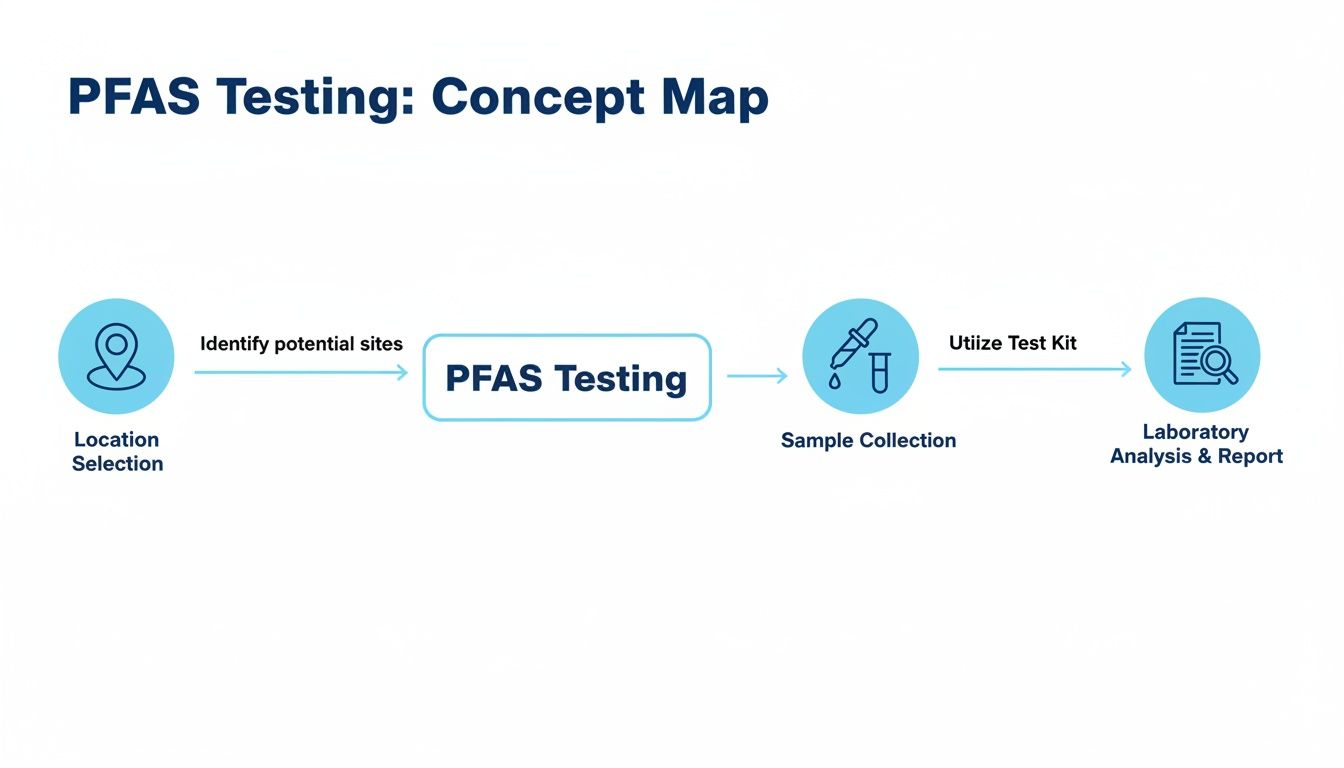
This chart lays out the different paths you can take to figure out your home's PFAS risk, from checking public data to ordering a private test kit.

Concept map outlining the PFAS testing process from location selection to laboratory analysis and reporting.

Knowing your starting point—whether it’s from a city report, a risk map, or your own water test—is the critical first step before you pick a filtration technology.

Ion Exchange Resins: The Chemical Magnet

The third major player in the PFAS filtration game is Ion Exchange. This technology works on a completely different principle. It’s less about physically blocking things and more about chemical attraction.

Think of it like a magnet. Ion exchange systems use tiny resin beads that are engineered with a specific electrical charge. Since PFAS molecules have an opposite charge, they are irresistibly drawn to the resin beads as water flows past. In the process, the resin releases a harmless ion (like chloride) in exchange for the PFAS contaminant, effectively swapping the bad for the good.

  • How It Works: Specially designed anion exchange resins carry a positive charge that attracts and latches onto negatively charged PFAS molecules.
  • Where It Shines: This method is highly effective for both long-chain and short-chain PFAS, making it an incredibly versatile solution.
  • Common Applications: You'll often find ion exchange resins in high-capacity whole-house filtration systems, sometimes paired with GAC to provide a powerful one-two punch against contaminants right at the source.

Each of these technologies offers a proven way to get safer drinking water. The best choice for your home really depends on things like the specific PFAS levels in your water, your budget, and whether you want to treat all the water in your house or just the water you drink from the kitchen sink.

PFAS Filtration Technology Comparison

To help you see how these options stack up, here’s a quick side-by-side comparison.

Technology Effectiveness Pros Cons Commonly Found In
Granular Activated Carbon (GAC) Good to Excellent. Very effective for long-chain PFAS; less so for short-chain. Affordable, widely available, removes chlorine and improves taste/odor. Media needs regular replacement, can become saturated, less effective on short-chain PFAS. Pitcher filters, faucet filters, refrigerator filters, under-sink systems, whole-house systems.
Reverse Osmosis (RO) Excellent. Removes over 90% of a wide range of PFAS (long and short-chain). Extremely high removal rate for many contaminants, produces very pure water. Wastes water (brine), removes beneficial minerals, slower flow rate, requires more maintenance. Under-sink drinking water systems, countertop RO units.
Ion Exchange (IX) Resin Excellent. Highly effective for both long-chain and short-chain PFAS. Very targeted and efficient, high capacity, can be regenerated in some systems. More expensive upfront, can be affected by other water contaminants (like sulfates). Whole-house systems, specialty filter cartridges (often combined with GAC).

This table should give you a solid starting point for figuring out which technology aligns best with your needs and priorities.

Choosing the Right PFAS Water Filter for Your Home

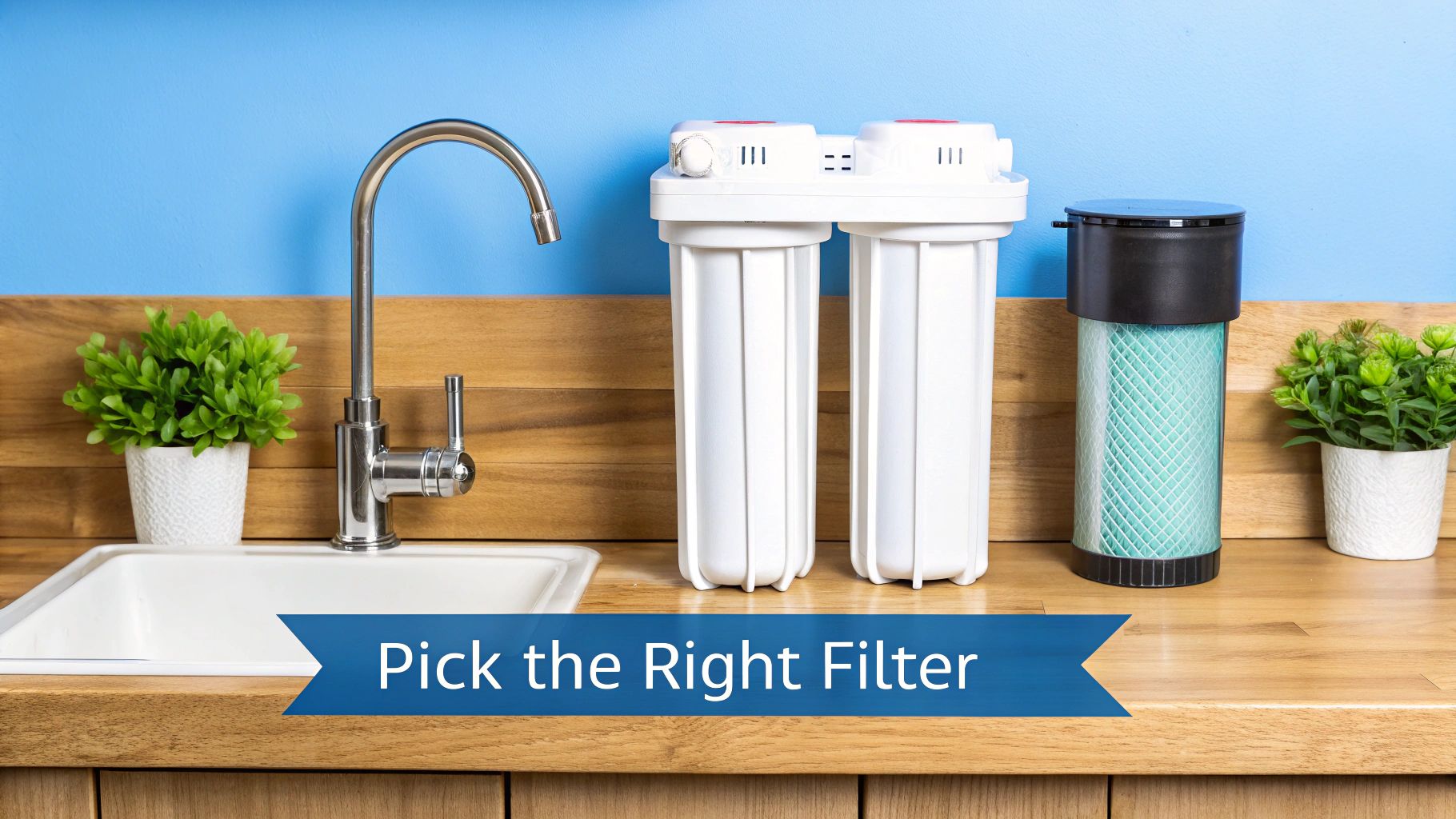
A kitchen counter displays a sink, faucet, and multiple water filtration systems, advising to 'Pick the Right Filter'.

Knowing the science behind filtration is one thing, but picking the right filter off the shelf? That's the real trick. With a dizzying number of options out there, the best PFAS water filter isn't a one-size-fits-all solution. It’s about finding the perfect match for your home, your family, and your wallet.

Think of it like buying a car. You wouldn't buy a two-seater sports car to haul a little league team. In the same way, the filter that works for a single person in an apartment is going to be completely different from what a big family in a three-story house needs.

Let’s walk through the main types of filters so you can figure out which one makes the most sense for you.

Whole-House Systems for Total Protection

If you're after complete, set-it-and-forget-it protection, a whole-house system is the undisputed champ. Often called a Point-of-Entry (POE) system, it gets installed right where the main water line enters your house. This means it treats every single drop of water before it ever reaches a faucet, showerhead, or appliance.

You’re getting purified water not just for drinking, but for bathing, laundry, and everything in between. Since we know PFAS can be absorbed through the skin or inhaled as steam in a hot shower, this comprehensive approach offers the ultimate peace of mind. These systems typically rely on massive GAC tanks, sometimes paired with ion exchange resins, to handle the high volume of water your home uses every day.

  • Ideal User: Homeowners, especially those with kids, who want to slash their PFAS exposure from every tap in the house.
  • Installation: This is a job for a pro. It requires a plumber to cut into your main water line to get it installed correctly.
  • Cost: Be prepared for a significant upfront investment. These systems can run from hundreds to several thousand dollars, not including the plumber's fee. You'll also have the ongoing cost of replacing the filter media every few years.

Under-Sink Systems: The Drinking Water Powerhouse

Maybe your main goal is just to make sure the water you drink and cook with is as pure as possible. If that's the case, an under-sink system is the gold standard. These are called Point-of-Use (POU) systems because they treat water right where you use it. They fit neatly in the cabinet under your kitchen sink and feed a separate, dedicated faucet.

Most of the top-performing under-sink units are Reverse Osmosis (RO) systems. As we covered earlier, RO is a beast when it comes to removing PFAS and a whole host of other contaminants. These systems almost always include GAC filters before and after the RO membrane, creating a powerful multi-stage defense that delivers incredibly pure water without the cost of treating your entire home.

This focus on drinking water is a major driver in the market. Drinking water treatment commands a massive 55.54% of the PFAS filtration market share and is growing rapidly as utilities and families work to meet strict safety standards. Households are increasingly turning to solutions like under-sink systems to combat contamination from sources like industrial runoff and firefighting foam. Discover more insights about PFAS filtration market trends on mordorintelligence.com.

Countertop and Pitcher Filters for Flexibility and Affordability

For anyone who can't make permanent plumbing changes (hello, renters!) or is just working with a tighter budget, countertop and pitcher filters are fantastic, accessible options. Don't write them off as too basic; the best new models are specifically engineered to go after PFAS.

  • Water Pitcher Filters: This is the easiest and most affordable way to get started. Just be sure to look for pitchers that use a combination of GAC and ion exchange media and, most importantly, are certified for PFAS reduction. They're perfect for individuals or small households.
  • Countertop Filters: These units sit on your counter and hook directly up to your existing faucet. They give you a much higher capacity and faster flow than a pitcher, making them a great middle-ground choice that doesn't require a plumber.

While your average, everyday water pitcher won't do much against "forever chemicals," a new wave of high-performance models has hit the market to meet this challenge. No matter what you choose, always, always check for third-party certifications to make sure the filter can actually do what it claims. At the end of the day, the best PFAS water filter is the one you’ll actually use, day in and day out.

How to Read Filter Certifications and Performance Data

When it comes to your water, you can't afford to take chances. Flashy marketing and vague promises on a box mean nothing without cold, hard proof that a pfas water filter actually does its job. Learning to decode the technical language on certifications and data sheets is the only real way to know if a filter is effective or just an empty promise.

Think of it like reading a nutrition label. The front of the package might scream "healthy," but the tiny print on the back tells the real story. For water filters, that story is told through third-party certifications.

Demystifying NSF/ANSI Certifications

The most important acronyms to look for are NSF/ANSI. NSF International is the independent, non-profit referee of the water filtration world. They test products against rigorous public health standards, and when you see their mark, it means a filter has been put through its paces and proven it can do what it claims.

For getting rid of PFAS, two standards are key:

  • NSF/ANSI 53: This is the standard for filters that reduce specific health-related contaminants. It covers things like lead, cysts, and—most importantly for us—certain PFAS chemicals like PFOA and PFOS. A filter with this certification has proven it can pull these specific compounds out of your water.
  • NSF/ANSI 58: This one is specifically for reverse osmosis (RO) systems. It confirms the system can reduce a whole host of contaminants, including everything covered under NSF/ANSI 53, plus others like arsenic and fluoride.

An NSF certification isn't a one-and-done deal. To keep it, manufacturers have to undergo regular facility inspections and get their products re-tested. It’s a mark of ongoing quality and proof that the company is committed to high standards.

How to Read a Performance Data Sheet

Beyond the official seal, you need to dig into the filter's Performance Data Sheet. This document is the filter’s report card, and you can usually find it on the manufacturer's website. Don't let the charts and numbers intimidate you—you only need to spot a few key things to know what you're looking at.

First, find the section on PFAS reduction. Here’s exactly what to look for to size up any pfas water filter:

  1. Specific PFAS Tested: The sheet should list the exact "forever chemicals" that were tested. Did they only check for PFOA and PFOS, or did they also test for others like GenX? The more compounds on that list, the more thorough the testing was.
  2. Reduction Percentage: Look for the removal rate. You want to see 90% or higher. The best filters out there will often hit over 99% reduction for specific PFAS compounds. Anything less than 90% probably isn't giving you the protection you're after.
  3. Filter Capacity and Service Life: This number tells you how many gallons the filter can clean before it's full and needs to be replaced. Pay close attention to this. An old, maxed-out filter doesn't just stop working—it can actually dump all the nasty stuff it has captured right back into your water.

By learning to spot these details, you can cut right through the marketing noise and make a decision based on real, verifiable performance. This is how you choose a filter that truly protects your family.

Installation, Maintenance, and Long-Term Costs

Picking out the right PFAS water filter is a fantastic first step, but your work isn’t over once you hit that "buy" button. A filter is only ever as good as its upkeep, and getting a handle on the real-world costs and effort is crucial for making sure your system actually protects you for years to come.

Think of it this way: the sticker price is just the down payment. The true cost of owning a water filter includes installation, all those replacement cartridges, and maybe even a plumber's visit down the road. It’s an ongoing investment in your family's health, not a one-and-done purchase.

Getting Your System Up and Running

How tough is the setup? Well, that depends entirely on what you bought. A simple water pitcher is a breeze—you just unbox it, give the cartridge a quick rinse, and you're good to go. Countertop units are almost as easy and usually just involve screwing a small adapter onto your kitchen faucet.

But when you get into under-sink and whole-house systems, it’s a whole different ballgame.

  • Under-Sink Systems: Many of these are sold as DIY-friendly, but you’ll need some basic plumbing comfort. Get ready to work in that cramped cabinet under the sink, connect new water lines, and drill a fresh hole in your countertop for the system's dedicated faucet.
  • Whole-House Systems: Don't even think about DIYing this one. This is a job for a licensed plumber, period. The process requires cutting into your home's main water line, which can lead to major problems if not done correctly. Be sure to factor a plumber's fee into your total budget for these systems.

Critical Maintenance Insight: An old, maxed-out filter doesn't just quietly stop working. It can actually become a source of contamination itself. A clogged filter can eventually release a concentrated slug of the very PFAS chemicals it captured, a nasty phenomenon known as "dumping."

The Ongoing Commitment to Clean Water

Long-term care is where the real work begins, and it's absolutely non-negotiable. The single most important job you have is changing your filter cartridges on time, every single time. Sticking to the manufacturer's schedule isn't just a suggestion; it’s vital for the system to remain effective.

The cost and timing of these changes will be your main recurring expense. A pitcher filter, for instance, might need a new cartridge every 2-3 months at about $15-$30 a pop. A more complex under-sink reverse osmosis system has several filters—some need changing every six months, others annually, with yearly costs falling between $50 to $150.

For a big whole-house system, you might only have to replace the giant media tank every 3-5 years, but that can be a hefty bill, sometimes running several hundred dollars. By understanding these future costs upfront, you can make a choice that keeps your water safe and your budget happy for the long haul.

Your PFAS Water Filter Questions Answered

Let's dive into some of the most common questions we hear from homeowners trying to choose a PFAS water filter. Getting straight answers is the first step toward feeling confident you're making the right call for your family.

Do Regular Brita or Fridge Filters Remove PFAS?

This is a big one, and the short answer is: probably not effectively. Most standard pitcher and refrigerator filters use a simple form of activated carbon. While carbon can grab onto some PFAS, these small filters just aren't designed to be powerful enough for the job.

You really need to see proof. Unless the filter has been specifically tested and certified by an independent group like NSF International for PFAS reduction (that would be under the NSF/ANSI 53 standard), you should assume it’s not giving you the protection you're looking for. Always hunt down the performance data sheet to be sure.

Does Boiling Water Get Rid of Forever Chemicals?

It's an old myth that boiling water fixes everything. When it comes to PFAS, boiling is not only useless—it actually makes the problem worse.

Think about it: when you boil water, the pure H₂O turns into steam and escapes, but the heavy PFAS chemicals get left behind. This process concentrates them in the water that's left, meaning what you end up with is even more contaminated than what you started with.

Crucial Takeaway: Never, ever rely on boiling to make your water safe from forever chemicals. The only proven ways to get them out are with dedicated filtration technologies like reverse osmosis, granular activated carbon, and ion exchange.

How Often Should I Change My PFAS Filter?

Sticking to the filter change schedule is absolutely critical. It’s not just that an old, maxed-out filter stops working. It can actually fail and dump all the contaminants it has captured back into your water in a concentrated burst. This is a real phenomenon known as "dumping," and you want to avoid it at all costs.

Here’s a general rule of thumb:

  • Pitcher filters: Every 2-3 months.
  • Under-sink systems: Cartridges usually last 6-12 months.
  • Whole-house systems: The large media bed can last 3-5 years or even longer.

Always, always follow the manufacturer's specific timeline for your exact model. If you're still weighing your options, check out some more detailed advice on selecting the best water filtration systems to compare different setups.


At Water Filter Advisor, our mission is to provide clear, research-backed guidance to help you find the perfect filtration solution. Explore our in-depth reviews and buying guides to protect your family from water contaminants. https://www.waterfilteradvisor.com