Best Water Hardness Test Kit for Home Filtration in 2026

You're standing at the sink, staring at the same white crust around the faucet again. The shower doesn't feel great, the dishwasher spots are getting worse, and now you're wondering whether you need a softener, a filter, or just a better test before you spend real money on the wrong setup.

The answer is simple. Test the hardness first, then choose the treatment that fits the number. That's the difference between a system that protects your plumbing and one that just looks good in the cart.

Test Kit Type Accuracy Speed Best Use
Basic strips About 25 to 50 mg/L Fast Quick screening
Drop titration kits About 1 gpg, 17.1 mg/L Fast to moderate Softener setup and before/after checks
Certified lab testing Standardized results Slower Private wells and documentation

If you want a quick way to browse hard water solutions for homes, browse hard water solutions for homes can help you see how testing ties into real-world treatment choices. For broader buying advice, the internal Water Filter Advisor advice page is useful once you already know what your water is doing.

Why Testing Water Hardness Matters Before Installing Filtration

A homeowner notices the same thing over and over. The shower doors haze up, the kettle gets crusty, and soap never seems to rinse clean. That is usually the moment people start shopping for filters, but guessing at hardness is how they buy the wrong system or set a softener incorrectly.

Hard water is a plumbing problem first and a comfort problem second. Calcium and magnesium do not just leave residue on fixtures, they also shorten the useful life of appliances and change how treatment systems behave. If the water is harder than you thought, a small programming error can leave the softener underperforming, and if you overreact to a bad guess, you can spend money on equipment you did not need.

The hidden cost of guessing

The mistake I see most often is simple. Someone assumes all scale means a full treatment overhaul. Sometimes that is true. Other times, a properly sized softener or a targeted scale-control approach solves the problem, but only if the hardness number is real.

That is why a water hardness test kit is the first purchase, not the last. Hardness is commonly reported in gpg or ppm as CaCO3, and the difference between soft, moderately hard, and hard water can hinge on a small measurement error. A homeowner who skips testing may set the system too low, buy the wrong cartridge, or miss the actual reason dishes keep spotting.

Practical rule: if you are choosing between softening, scale control, or routine maintenance, test before you buy anything bigger than a basic replacement part.

For a homeowner dealing with scale and soap issues, the smartest path is to test at the faucet that matters most, then match treatment to that exact reading. If you want a broader starting point before you buy, the Water Filter Advisor advice page is useful once you already know what your water is doing.

If you want to compare how hardness problems show up in different regions, you can browse hard water solutions for homes and see how testing connects to real treatment choices. Outdoor conditions and city reports do not tell you what is happening after water goes through your own plumbing.

Understanding the Three Main Types of Hardness Test Kits

Hardness testing has moved in a clear direction. Homeowners started with strip-based screening, moved toward drop titration, and now have access to certified lab testing when they need defensible numbers. The right choice depends on whether you want a fast snapshot, a softener-setting number, or a result that can stand up in a dispute.
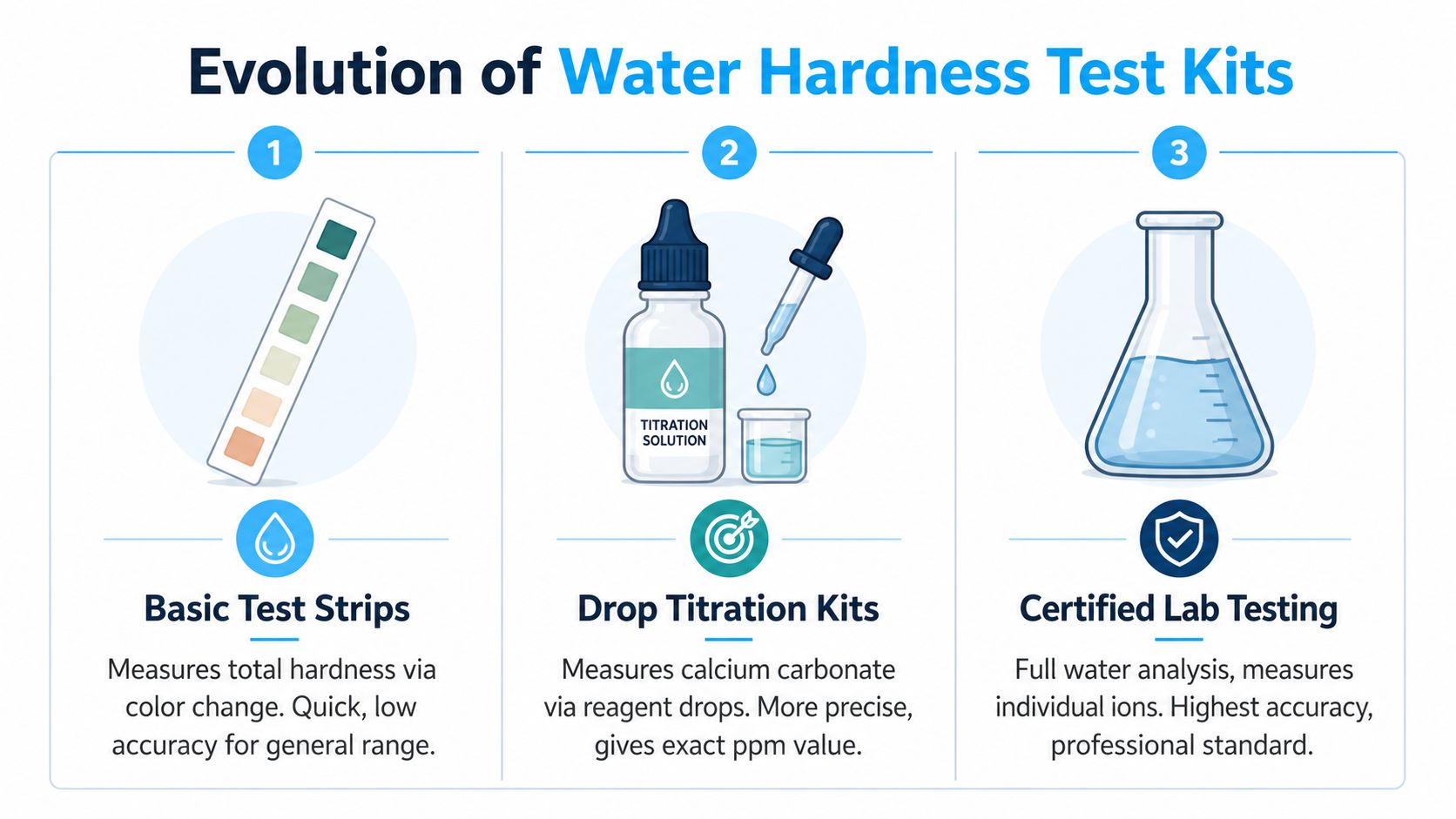
A graphic showing the evolution of water hardness testing methods from basic strips to lab analysis.

Strips, the cheap and fast option

Hardness strips are the quickest way to get a broad answer. Recent comparison guides put them at roughly $8 to $15 for 50 to 100 strips, and they typically read within about 25 to 50 mg/L. That's enough for a homeowner who wants to know whether water is roughly soft or clearly hard, but it's not the tool I'd trust for fine-tuning a softener.

Strips win on convenience and lose on precision. They're fine for a first pass, a rental property check, or a quick look at a faucet you don't use for drinking. They're not the tool for calibration.

Drop titration kits, the practical homeowner's pick

Drop kits are the sweet spot for most homes. Comparison guides place them at about $15 to $25, and they're accurate to within 1 gpg, 17.1 mg/L, which is exactly why they're useful for softener setup and before/after comparisons. If you need a number you can trust when adjusting equipment, I'd spend the money here.

This is the kit type I recommend most often. It's precise enough to matter, but it doesn't drag you into lab pricing when all you want is a solid household decision. If you're dealing with scale on fixtures or trying to confirm whether your softener is doing its job, drop titration is the right tool.

Certified lab testing, the documentation option

Lab testing costs more, about $25 to $50 for a hardness-specific analysis or $30 to $150 for a broader mineral panel. In exchange, you get standardized results that can hold up in private-well or dispute situations. That matters when you need documentation, not just a household estimate.

For pure hardness measurement, Hach's hardness-focused kits and analyzers are positioned as a higher-precision option, and third-party roundups list their span at about 0 to 1,000 ppm, or 0 to 30 gpg for titration-based versions. That wider range makes them attractive when you want a purpose-built hardness tool instead of a generic strip.

If you're deciding between all three, the rule is simple. Strips are for screening, drop kits are for action, and lab testing is for proof. That's the whole decision tree for most homes.

Top Water Hardness Test Kits Compared for Home Use

For routine home filtration, I'd separate the category into two jobs, precision and volume. Precision matters when you're setting a softener. Volume matters when you're checking the same system over and over and don't want to spend a fortune on each test.

One reliable benchmark is the Hach Total Hardness Test Kit / WaterWorks strip family. Hach's hardness-focused kits are built specifically for hardness determination, and comparison roundups place the measurement span around 0 to 1,000 ppm, or 0 to 30 gpg for titration-based versions. That makes it a strong pick when you care about a wider measurement window and don't want a strip kit that tops out too soon.

At the other end of the use case is JNW Direct, which multiple independent reviews list as a high-volume household choice. It comes with 150 strips, measures 0 to 425 ppm, 0 to 25 gpg, and returns results within 60 seconds. That's a routine-check kit, not a calibration tool, but for trend monitoring it's a sensible value benchmark.

If you need a broader context for choosing between products, check Melbourne water hardness alongside your own results so you can compare local conditions with what your home is seeing. Just don't use that as a substitute for testing your own tap.

Water Hardness Test Kit Comparison

Test Kit Type Accuracy Range Price Best For
Hach Total Hardness Test Kit / WaterWorks Strip and titration-focused hardness kit Higher precision for hardness-focused use About 0 to 1,000 ppm, or 0 to 30 gpg on titration versions Varies by kit Softener setup and hardness-specific testing
JNW Direct Strip kit Fast routine reads, not lab-grade 0 to 425 ppm, 0 to 25 gpg Value-oriented strip pack High-throughput household checks
Drop titration kit Liquid-drop kit Within 1 gpg, 17.1 mg/L Good for household hardness comparisons About $15 to $25 Softener programming and before/after checks
Certified lab hardness analysis Lab test Standardized documented result Broader mineral confirmation About $25 to $50 Wells, disputes, documentation

My blunt take is this. If you're a homeowner managing a softener, buy a drop titration kit first. If you're screening a rental, checking a faucet, or just confirming a hard-water suspicion, a good strip kit is enough. If the result may be challenged, or your well water situation needs paperwork, go straight to the lab.

How to Use Your Test Kit and Read the Results Correctly

A bad sample gives you a bad number, and a bad number leads to the wrong filter. That's why the setup matters as much as the kit itself. Clean sample handling keeps you from chasing false hardness readings that were caused by contamination, residue, or sloppy timing.

For strips, collect a fresh water sample in a clean glass and use it immediately. Dip the strip exactly as directed, then compare the color under white light instead of warm bathroom lighting. The big mistake is guessing from memory, because a slightly off shade can push you into the wrong hardness category.

For drop kits, count drops carefully and stop only when the endpoint changes the way the instructions describe. Don't rush the reaction, and don't assume more shaking means more accuracy. The whole point of the titration method is that the drop count tells you the number.

Don't test from a dirty cup, a showerhead, or a container with soap residue. Those shortcuts can distort the reading enough to make a softener look fine when it isn't.

Reading the units without confusion

Hardness often shows up in gpg or ppm as CaCO3. That means you need to know how your kit reports results before you compare them to a softener chart. If you're tracking before-and-after treatment, keep the same unit every time so the comparison stays clean.

Document the result, the faucet, and the time of day. If your home uses a softener, test before and after the system at least once so you can confirm the equipment is changing the water the way you expect. That kind of log is also useful if you later need to compare a DIY result with a lab report.

What Your Test Results Mean for Your Filtration System

A hardness number only matters if it changes what you do next. If your water is already soft, you don't need to chase a big treatment system just because the shower glass looks annoying. If it's hard, though, you need to treat it as a real plumbing threat, not a cosmetic nuisance.

Match the number to the fix

Soft water generally needs little more than standard filtration for taste or sediment. Moderate hardness is where homeowners start weighing a basic softener or a scale inhibitor filter, especially if appliances are already showing residue. Hard water calls for a water softener system and a correct hardness setting, because scale control becomes a maintenance issue instead of a comfort upgrade.
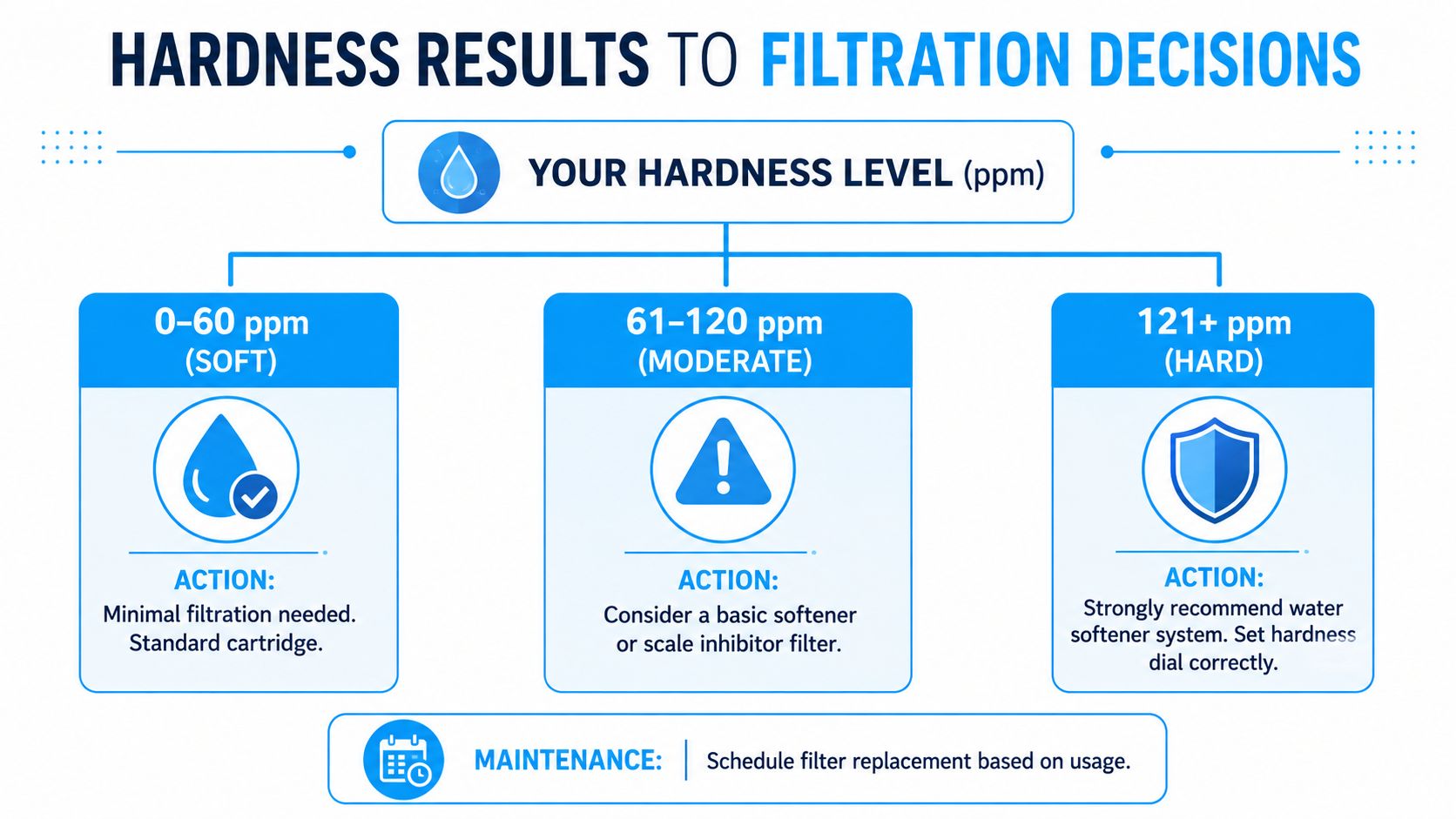
A flowchart guide explaining water filtration decisions based on hardness levels ranging from soft to hard.

The reason to read the number carefully is simple. Hardness classification can shift with a small error, and that can change whether you install nothing, a basic cartridge, or a full softener. That's especially important for homeowners who want to protect water heaters, dishwashers, and shower valves from scale buildup.

Use the result to set maintenance expectations

Once the hardness number is known, maintenance becomes easier to plan. A softener that's dialed correctly should produce a noticeably different before-and-after result, and a filter handling scale or mineral load should be checked with the same water source every time. If the number moves, your maintenance schedule needs to move with it.

For homeowners who want a cleaner decision rule, keep it this simple. Low hardness means keep filtration modest. Midrange hardness means watch scale and consider treatment. High hardness means stop improvising and size the system properly.

Best move: choose the treatment after the number, not before it.

Choosing the Right Kit for Your Specific Situation

This is the question most buying guides dodge. You don't need the same accuracy if you're a renter checking a kitchen faucet that you'll use once a week and if you're a well owner trying to document a water problem for a contractor. Buy to the job, not to the hype.

Renters and quick checks

If you just want a fast answer, strips are enough. They're cheap, easy, and perfectly fine for learning whether the water looks soft, moderate, or hard. A renter doesn't need to overthink this unless the result is being used to argue for treatment or repairs.

Softener installers and homeowners tuning a system

If you're programming a softener, use a drop titration kit. Precision matters more than convenience here, because the number directly affects system settings and your before/after comparison. The kit should make the system easier to trust, not leave you guessing.

Private wells and documentation-heavy situations

If you own a private well, or you're in a situation where the result might be questioned, use certified lab testing. Hardness-only lab work costs more, but it gives you standardized results that are much stronger for records and disputes. That's the right call when your water chemistry is part of a larger treatment or property issue.

Families monitoring an existing system

If you already have treatment in place and just want to track performance, pick a repeatable kit and stick with it. JNW Direct is a practical example for high-volume monitoring, while Hach is the better choice when you want a hardness-focused measurement span and a more specialized option.

I'd make the recommendation even simpler. Buy strips if you need a quick answer, buy drops if you need to make a decision, and buy lab testing if you need proof. That's the right ordering for most homes, and it keeps you from overspending on precision you won't use.

Common Testing Mistakes and When You Need Professional Help

The biggest testing mistake is assuming one faucet tells the whole story. It doesn't. Hardness can vary by location in the house, and if you only test one point, you may miss what's happening at the tap that feeds your drinking water or appliance line.

Another mistake is assuming hardness is the only thing that matters. It's a major factor for scale and soap performance, but it doesn't tell you anything about every other water concern a home might have. That's why hardness testing is useful, but not universal as a full water-quality solution.

Seasonal changes can also throw people off. If your water source changes over time, a single reading can give you a false sense of certainty. The smarter move is to keep records and compare like with like.

When to stop DIY and call for lab testing

Use professional lab testing when the result needs stronger documentation, especially for private wells or any water dispute. It's also the right move if you're trying to understand broader mineral issues, not just hardness. A home kit gives you a useful household answer, but it won't replace a documented lab report.

If you're still unsure, don't buy the most expensive kit just to feel safer. Buy the one that matches the decision in front of you. That's usually the cheapest path to the right filtration system.


Water Filter Advisor helps homeowners turn confusing water results into practical filtration decisions, and that's exactly what you need when you're choosing a hardness test kit. If you want more direct guidance on matching testing methods to softeners, filters, and home setups, visit Water Filter Advisor and use the advice there to pick the right next step for your house.

Water Testing Kit for Home: Types, Accuracy, and Best Picks

You're standing at the sink with a glass that looks clean, but something's off. Maybe the water smells faintly metallic, maybe the tea tastes flat, or maybe you're mixing formula and you'd rather not guess what's coming out of the tap. That's the exact moment a water testing kit for home stops being a gadget and starts being the first sensible move before you buy a filter.

A filter without a test is a blind purchase. You can spend money on the wrong media, the wrong installation, or a system built for a problem you don't have. The smarter move is simple, test first, then match the filter to the water, not the other way around.

An infographic illustrating why home water testing is essential for health, safety, taste, and plumbing maintenance concerns.

If you want a broader consumer guide to taste and quality issues before you commit to hardware, the PureHQ coffee water quality guide is a useful companion read. For a more filtration-focused overview, the advice hub at https://www.waterfilteradvisor.com/advice/ is worth keeping handy while you sort out what your water needs.

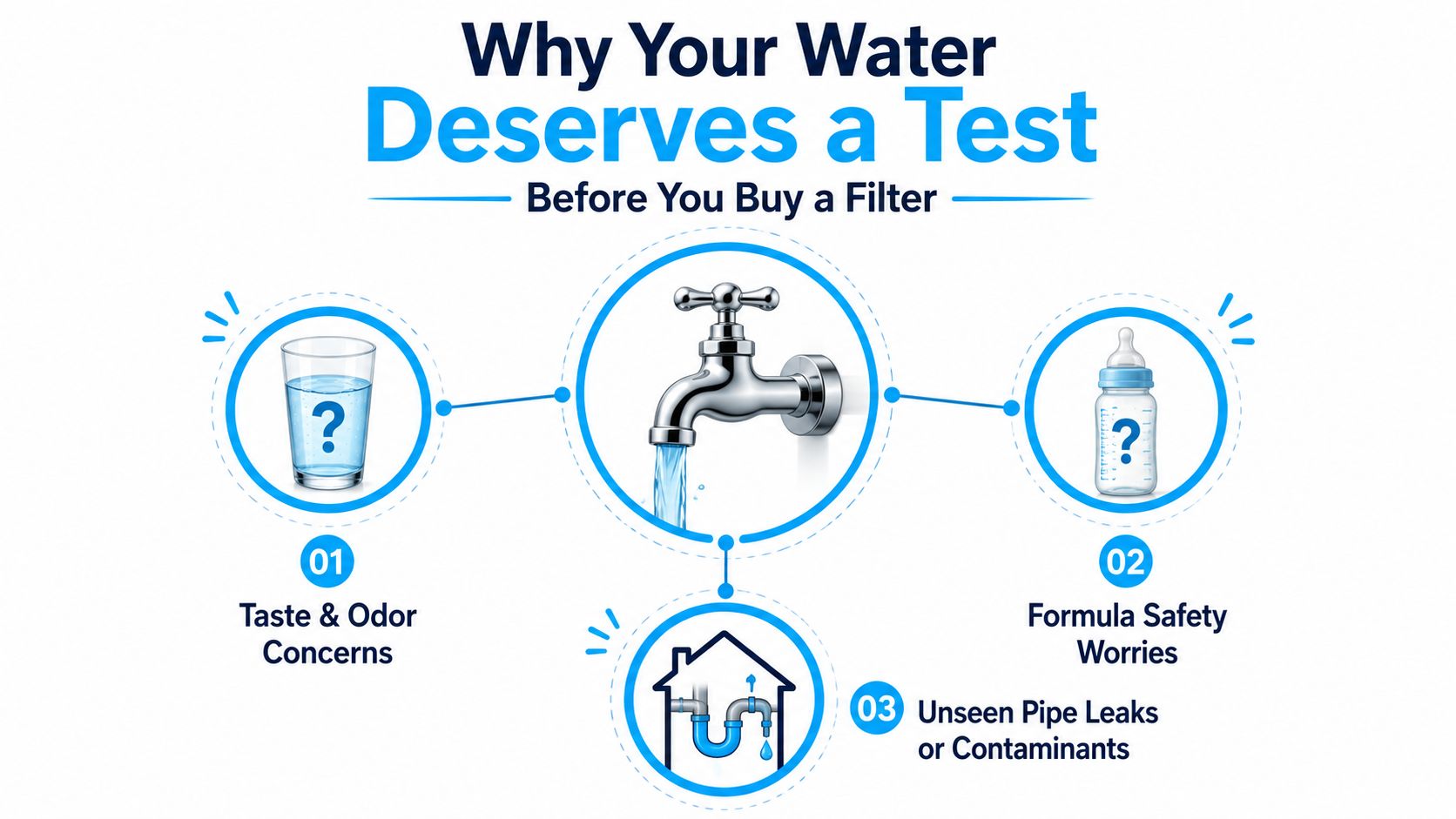
Why Your Water Deserves a Test Before You Buy a Filter

The quickest way to waste money on filtration is to shop by guesswork. A homeowner notices a smell, hears a neighbor complain, or sees a little scale on fixtures, then buys a random cartridge system that claims to fix everything. That usually ends in disappointment, because a filter that handles chlorine will not solve iron staining, and a softener will not address bacteria concerns.

The EPA has long treated home water testing as a routine task, not a panic move. For private wells, it recommends testing every year for total coliform bacteria, nitrates, total dissolved solids, and pH, and every 3 years for sulfate, chloride, iron, manganese, hardness, and corrosion EPA home water testing guidance. It also recommends extra testing after a new well, pipe repairs, or an objectionable taste or smell, which is exactly why a water testing kit for home is a screening tool you keep using, not a one-time novelty.

Practical rule: if the water source changed, the plumbing changed, or the taste changed, test before you treat.

The family-health side gets overlooked too often. The EPA specifically says nitrate should be tested in the early months of pregnancy and again during the first six months of a baby's life. That makes testing especially important for households with infants or pregnancy concerns, because a clean-looking glass tells you nothing about dissolved contaminants EPA home water testing guidance.

A quick test is the cheapest insurance policy in filtration. It tells you whether you need chlorine reduction, softening, iron control, or a higher-confidence lab result before you buy the wrong fix.

If you want a broader consumer guide to taste and quality issues before you commit to hardware, the PureHQ coffee water quality guide is a useful companion read. For a more filtration-focused overview, the advice hub at Water Filter Advisor advice is worth keeping handy while you sort out what your water needs.

The Four Main Types of Home Water Testing Kits

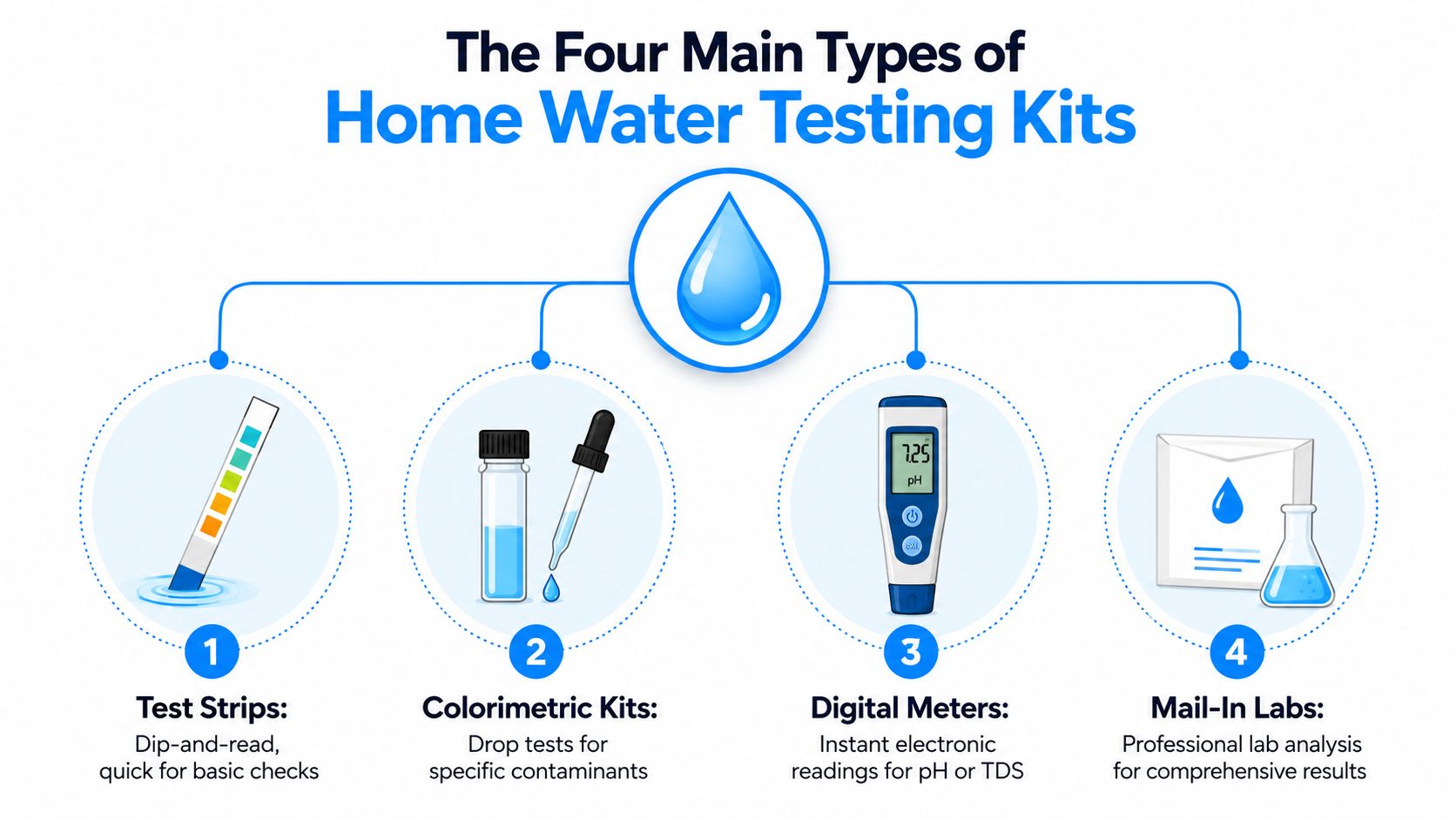
A water testing kit for home usually falls into one of four buckets, and the format matters more than the packaging. Test strips are a fast screen. Drop kits are a little more hands-on and usually more specific. Digital meters give you a number for a narrow measurement. Mail-in labs hand the sample to professionals and give you the broadest picture.

Test strips

Test strips are the quickest option. You dip them, wait, and compare the color to a chart. They're useful for everyday checks like pH, chlorine, hardness, and sometimes nitrates or iron, but they're not magic and they're definitely not the right tool for every concern.

Colorimetric drop kits

Drop kits work more like a small home chemistry set. You add reagents to a sample, watch for a color change, and read the result against a chart or vial scale. They usually give you better control than a strip when you're chasing one parameter, especially if you care about a specific nuisance like hardness or chlorine residual.

Digital meters

Digital meters are the blunt, no-drama tools. They're best for narrow readings such as pH or TDS, where you want a number instead of a color guess. They don't cover broad contamination, but for routine monitoring they're easy to live with and faster to read than a strip if you're the kind of person who hates squinting at pale yellow squares.

Mail-in laboratory kits

Mail-in kits are the heavyweight option. You collect the sample at home, ship it out, and get a lab report back. Independent review coverage notes that some of these kits can measure more than 100 contaminants, including metals like lead, mercury, and arsenic, VOCs like chloroform, bacteria, pesticides, and nitrates, while DIY strips stay much narrower Wirecutter review of home water test kits.

An infographic illustrating four main types of home water testing kits including strips, drops, meters, and labs.

Kit Format Typical Parameters Best For Limits
Test Strips pH, chlorine, hardness, sometimes nitrates or iron Quick baseline checks Narrow coverage, color reading can be fuzzy
Colorimetric Kits Specific contaminants with better visual resolution Targeted homeowner testing Still limited to what the kit is built to measure
Digital Meters pH, TDS, and similar narrow readings Fast numeric tracking Doesn't tell you much about actual contaminant type
Mail-In Labs Broad panels for metals, VOCs, bacteria indicators, pesticides, nitrates Serious screening and deeper confidence Slower turnaround, more hassle, more expensive than strips

What Each Kit Type Actually Detects

The marketing on the box often oversells convenience and undersells limits. That's a bad trade for homeowners, because the central question isn't how many boxes of color you get. The central question is whether the kit can detect the contaminant you're concerned about at a useful level.

Strips and simple screens

Strips are fine for basics like pH, hardness, chlorine, and sometimes a rough read on nitrates or iron. They're a decent first pass if you want a quick read on whether your softener is working or whether chlorine is present in city water. They are not the right answer when you need action-level confidence on trace metals or bacteria.

Drop kits and narrow chemistry

Colorimetric kits usually do one thing better than strips, they give you a more controlled read on a chosen parameter. That makes them better for a homeowner who already suspects a specific issue, like scale, low pH, or residual disinfectant. They don't turn into a broad contamination detector just because they look more technical on the counter.

Digital meters and lab panels

Digital meters are built for narrow measurements, not broad safety screening. They shine when you want repeatable pH or TDS readings and nothing else. Mail-in lab kits, by contrast, are built for wider screening and can include metals, VOCs, bacteria indicators, pesticides, and nitrates, which is why they're the right tool when you need a real map of the water, not a snapshot.

A kit that measures more parameters isn't automatically better. If it can't detect the contaminant you care about at a meaningful level, the extra boxes on the label are just decoration.

Format What It Commonly Detects Well What It Misses
Test strips pH, chlorine, hardness, sometimes nitrates or iron Lead at actionable levels, bacteria, deeper contamination
Colorimetric kits Specific single-issue chemistry with better visual resolution Broad pathogen screening, many trace contaminants
Digital meters pH, TDS, other narrow numeric readings Actual contaminant identity, health-risk context
Mail-in labs Wider contaminant panels, including metals, VOCs, bacteria indicators, pesticides, nitrates Depends on the chosen panel, not all labs test the same list

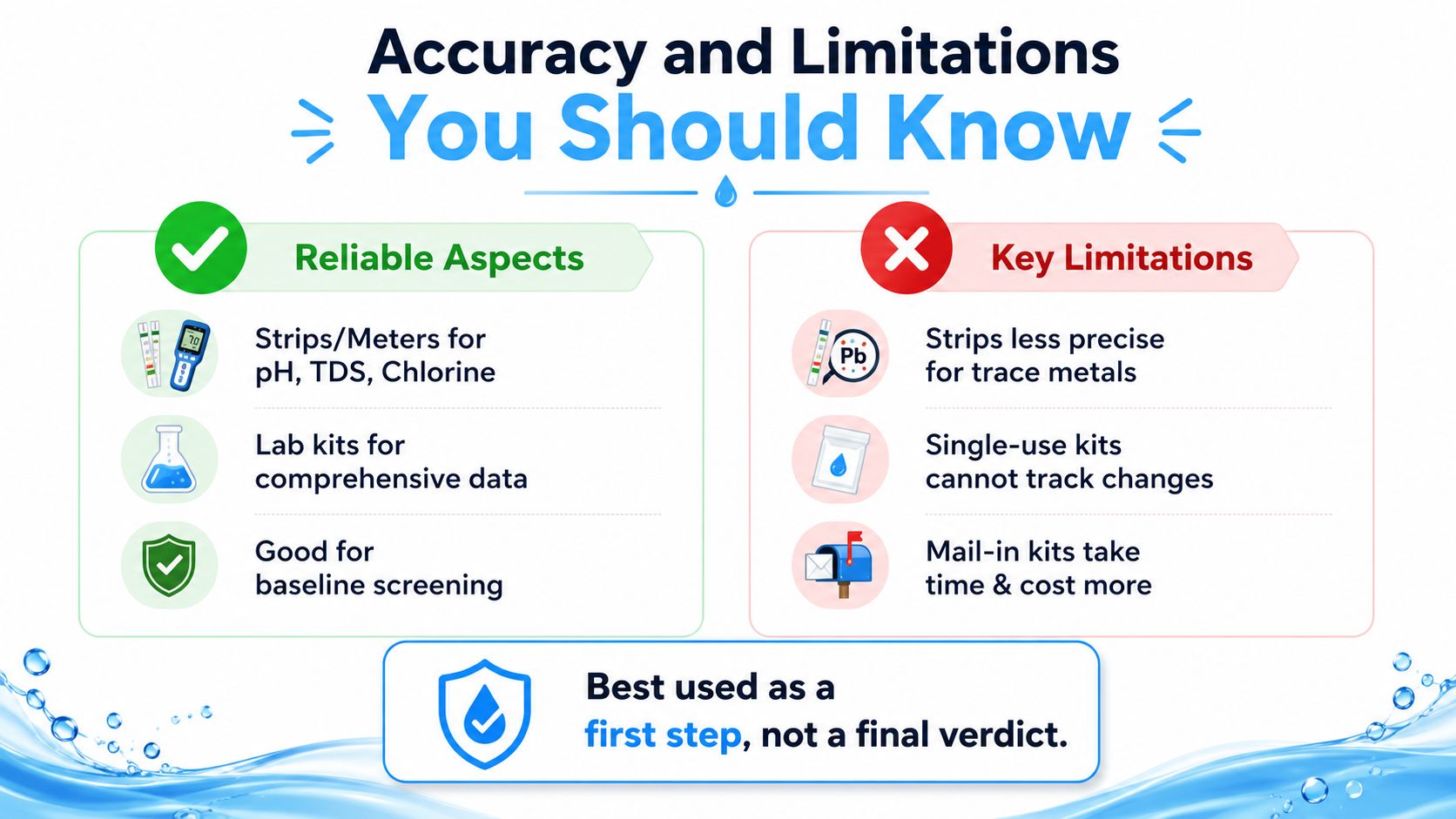
Accuracy and Limitations You Should Know Upfront

The hard truth is that a water testing kit for home can be useful and still be imperfect. A 2025 PubMed-indexed study found home-use drinking water test kits were highly repeatable, but performance varied depending on the contaminant, the water matrix, and the kit used PubMed study on home water test kit performance. That's the detail homeowners need to hear, because repeatable doesn't always mean equally accurate across every contaminant.

The big takeaway is simple. Single-parameter tests tend to be more dependable than multiparameter tests when you care about a specific reading. A 2025 University of Massachusetts Amherst study reported high variability among at-home water kits, and found that none of the multiparameter tests detected low levels of iron while 3 of 4 single-parameter tests did UMass Amherst study coverage. That matters because iron is a common nuisance contaminant that affects taste, staining, and filter choice.

False positives and false negatives are real. Color-matching errors happen when lighting is bad or the user reads the strip too early or too late. Multi-parameter strips also create a trap that shoppers fall into all the time, they assume more paddles on the card means broader truth. It doesn't. It often means more places for the reading to drift.

An infographic titled Accuracy and Limitations You Should Know, outlining pros and cons of various water testing methods.

Best use: treat home testing as a first step, not a final verdict, especially when the concern is lead, bacteria, or illness-related.

Accuracy matters, but so does the question you're asking. A kit can be perfectly decent for baseline screening and still be the wrong tool for a health-triggering problem. The goal is not to get an answer fast. The goal is to get the right answer.

How to Collect a Sample and Run the Test Correctly

Bad sampling ruins good kits. You can buy a solid tester and still get a nonsense result if you pull from the wrong faucet, grab the sample too soon, or touch the reactive end of a strip. Homeowners blame the water when the actual problem is the sample.

Start with the tap that reflects the water you drink. If you're testing household plumbing, use a kitchen cold tap unless the kit says otherwise. If you're testing a well or post-filter water, sample at the point you care about, not somewhere convenient that gives you a distorted reading.

A few habits keep you from contaminating the result:

  • Flush first: run the tap before collecting, because stagnant water can exaggerate metal readings.
  • Skip the aerator if instructed: debris trapped at the faucet tip can skew a sample.
  • Handle strips by the edge: skin oils and wet fingers can interfere with the pad.
  • Read on time: every strip and color chart has a window, and missing it changes the result.
  • Use good light: daylight or a bright neutral bulb beats a dark sink corner every time.

Do this every time: if you don't flush the line first, you're testing what sat in the pipe, not necessarily what your water source actually contains.

The flush time matters because standing water can pick up copper or lead from plumbing before you ever touch the glass. That's why a first-draw sample and a flushed sample answer different questions. One tells you what sat in the pipe, the other tells you what's coming through the line under normal use.

If you're using a lab kit, follow the kit's bottle order and preservation steps exactly. Those details matter more than people think. A rushed collection turns a useful test into expensive guesswork, and guesswork is how homeowners buy the wrong filter twice.

Reading the Results and Knowing What They Mean

Numbers mean nothing until you tie them to a decision. A result can be acceptable, worth monitoring, or a sign that you need a different filter or a lab follow-up. The point is not to stare at the chart. The point is to know what the chart is telling you about water quality, plumbing, and taste.

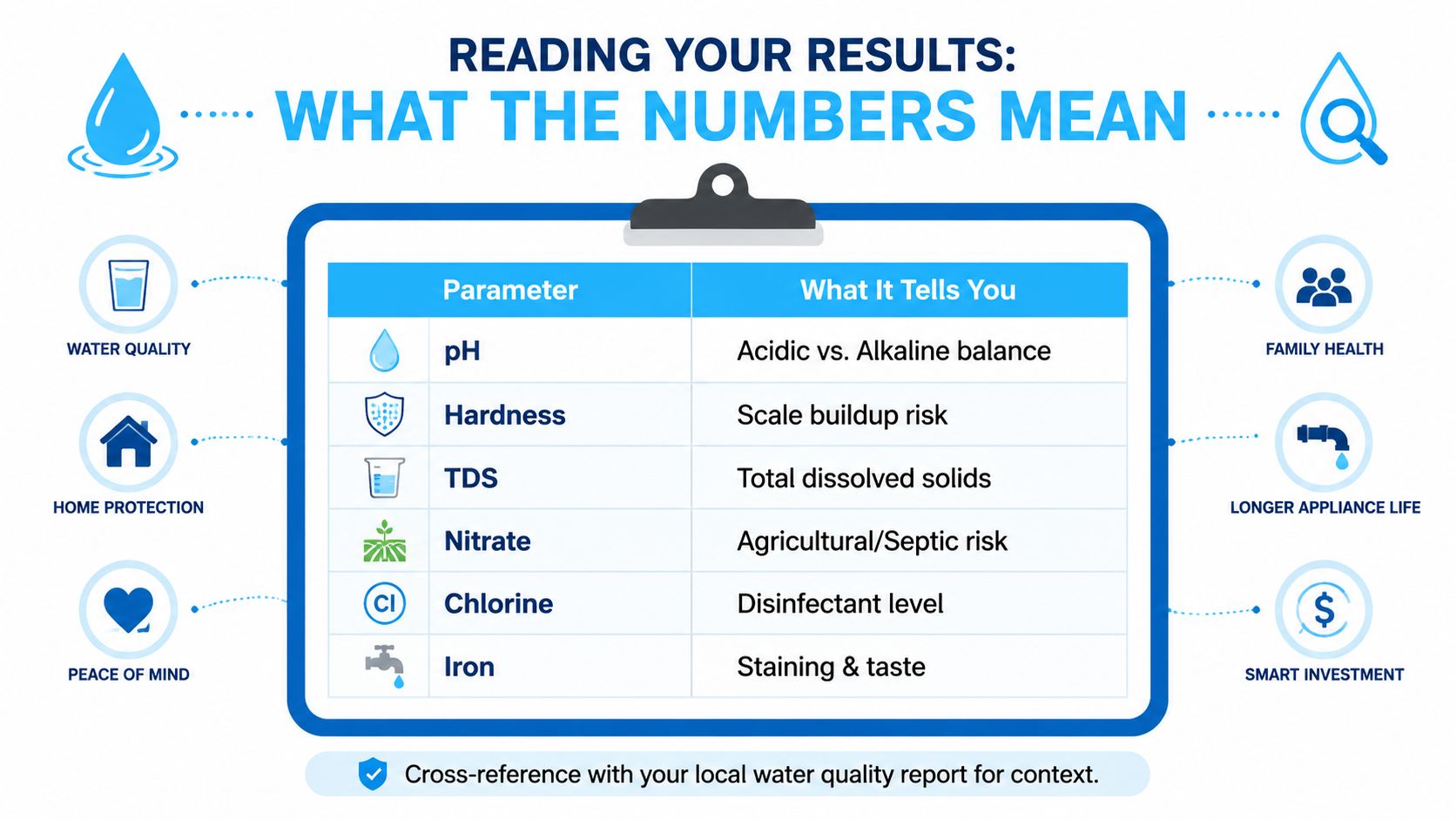
What the common parameters usually tell you

pH tells you whether water leans acidic or alkaline. Low pH can point toward corrosion risk, which matters for plumbing and for any household worried about metals leaching from pipes. Hardness points to scale buildup risk, which is why it changes shower feel, spot residue, and softener selection.

TDS means total dissolved solids, a broad measure that tells you how much dissolved material is in the water, not exactly what the material is. Nitrate is a red-flag screening item for households on well water, especially where agriculture or septic influence is possible. Chlorine tells you whether disinfectant is present in treated municipal water. Iron points to staining and taste issues, and it also changes what kind of filter media makes sense.

If a lab report arrives, don't let the jargon intimidate you. Look for the parameter name, the unit, the detection limit, and whether the result is flagged. A result below the detection limit is not the same as a clean bill of health, it just means the lab couldn't quantify it at that level.

A realistic example helps. If a well-water test shows low pH and iron, the immediate takeaway is not panic. It means you may be looking at corrosion control, stain control, or both, which points you toward the right treatment path instead of a random pitcher filter.

An infographic explaining water test parameters like pH, hardness, TDS, nitrate, chlorine, and iron levels.

Cross-reference your result with your local water quality report if you have one, but don't use that report as a substitute for the sample in your hand. The report gives context. Your kit tells you what your household sees at the tap.

When a Home Kit Is Not Enough and You Need a Lab

Homeowners often get themselves into trouble. A casual kit is fine for routine screening, but it's the wrong call when the issue moves from convenience to health concern. If the water smells off after flooding, if a well was just repaired, if plumbing changed, or if someone in the house is sick and water is a suspect, stop guessing and escalate.

The EPA's own guidance draws a line between screening and higher-confidence testing, and it recommends retesting after plumbing changes, flooding, well repairs, or suspected contamination EPA home drinking water testing page. That's the moment to use a state-certified lab or get guidance from your health department, not because home kits are useless, but because the situation is more than a strip can handle.

Here's where I'd push most homeowners toward a lab immediately:

  • Bacteria concerns: especially when illness, septic issues, or contamination after flooding are part of the story.
  • Lead worries: especially in homes with children or pregnancy.
  • Sudden taste or odor changes: because the cause may be broader than a basic screen can explain.
  • New well or plumbing work: because disturbed systems can change the water picture fast.
  • Repeated bad results: because one odd strip reading is a clue, but repeated concerns deserve better analysis.

If you need a lab, use a state-certified one and choose the panel based on the concern, not the marketing language. A broad lab panel is worth it when you need confidence, especially for metals, bacteria indicators, or compounds that basic home kits don't handle well. The cost and turnaround are the tradeoff, and they're worth paying when the alternative is buying the wrong treatment or missing a serious issue.

The rule is plain. Screen at home. Confirm at a lab when the problem is health-related, system-related, or oddly persistent.

Choosing the Right Kit Based on Your Water Source and Concerns

Start with three questions. Where does the water come from? What are you worried about? How much certainty do you need? Answer those and the right kit type usually picks itself.

If you're on municipal water and your complaint is taste, odor, or scale, a strip, drop kit, or digital meter may be enough for a first screen. If you're on a private well, routine screening matters more, and a mail-in lab or a targeted home kit is the smarter default when you need a broader contaminant view. If you're worried about lead, bacteria, or an illness-linked problem, skip the casual all-in-one strip and go straight to a lab-backed approach.

For routine maintenance, choose the simplest tool that answers the question. For filter selection, match the kit to the contaminant. For health concerns, use home testing as a checkpoint, not the finish line. That approach keeps you from overbuying on false alarms and underbuying when the water really does need serious treatment.

The cleanest strategy is a two-step path. Use a home kit to identify the likely issue, then pair it with a lab test when the reading is unclear, or the source is a well. That's how homeowners stop buying generic filters and start building a filtration setup that fits the water in the house.


If you want a straight answer on filters after you test, Water Filter Advisor breaks down which systems fit different water problems without the marketing fluff. Visit Water Filter Advisor when you're ready to match your test results to the right home filtration setup and avoid buying the wrong kit or the wrong system twice.