Water Descaler vs Water Softener: The Ultimate Showdown for Your Home’s Water

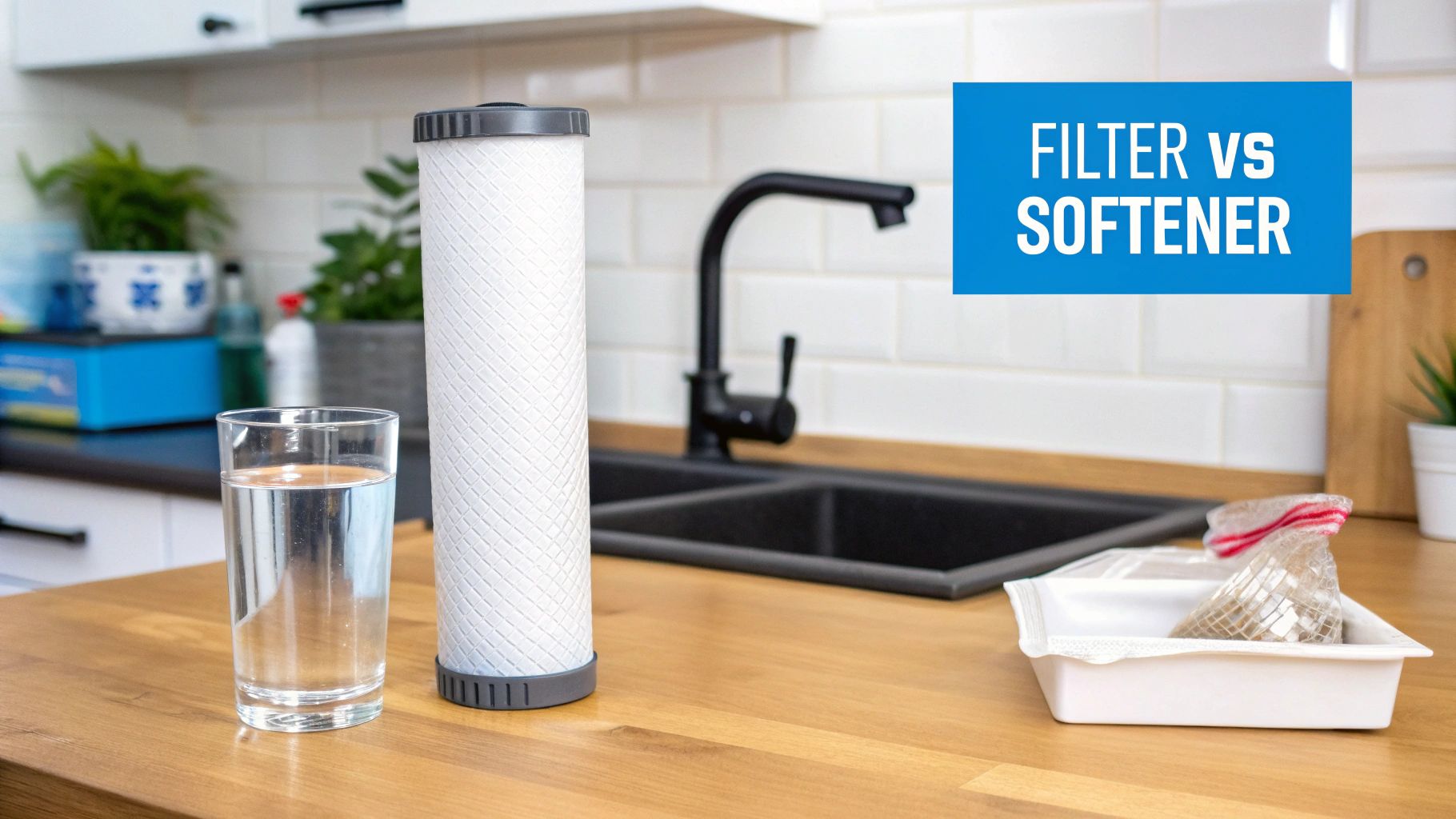
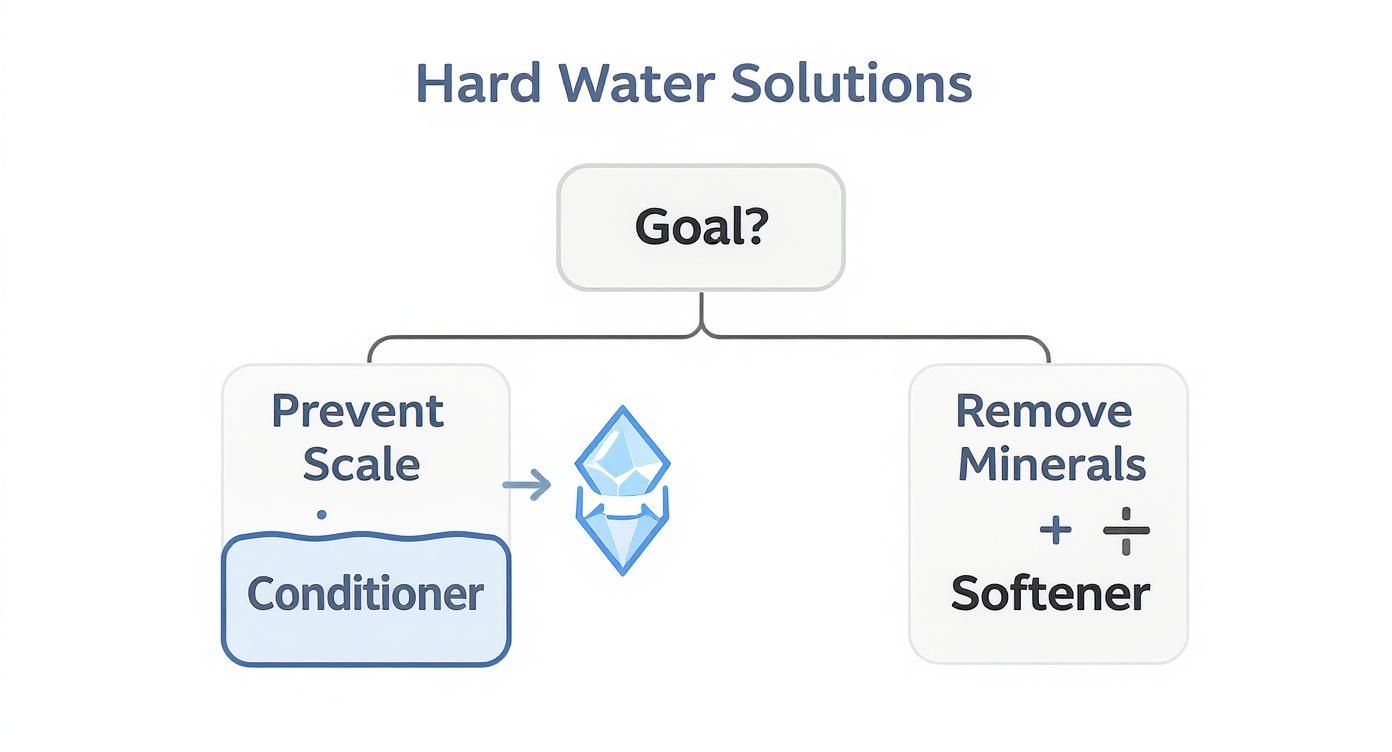
What's the real difference between a water descaler and a water softener? It all boils down to a battle with hard water minerals. Think of a water softener as a bouncer that physically removes troublemakers like calcium and magnesium using salt. On the flip side, a water descaler is more like a peacekeeper; it doesn't kick the minerals out, but it changes their behavior so they can't stick to your pipes and cause that destructive limescale.

The Hard Water Dilemma: Time to Pick a Side?

If you're waging war against chalky white buildup on faucets, stiff towels, and glasses that look perpetually cloudy, you're fighting hard water. It’s a super common problem, plaguing an estimated 85% of homes in the U.S.

Hard water is chock-full of dissolved minerals, mainly calcium and magnesium. While they’re perfectly safe to drink, these minerals are absolute villains for your home. They create limescale, that crusty deposit that clogs pipes, sabotages your water heater's efficiency, and dramatically shortens the lifespan of your appliances. The problem isn't about your health—it's about protecting your home's entire water filtration ecosystem. This is where you face the big decision: water descaler vs. water softener.

Understanding the Core Technologies

Picking the right system means getting what makes them tick. It’s not about one being "better," but which one is the right champion for your specific home filtration needs.

  • Water Softeners (Ion Exchange): These are the heavyweights, the classic solution. Their whole mission is to completely remove the minerals that cause hardness. They work by swapping out pesky calcium and magnesium ions for sodium ions, giving you truly "soft" water.
  • Water Descalers (Conditioners): These systems are the clever strategists. They neutralize the minerals' ability to cause damage without actually removing them. Technologies like Template Assisted Crystallization (TAC) convert the minerals into tiny, harmless micro-crystals that just flow right through your plumbing instead of clinging to surfaces.

Here's the bottom line: a softener removes minerals to solve all hard water symptoms, while a descaler conditions them to prevent the most destructive problem—limescale—making it a crucial player in your home filtration setup.

Your choice really hinges on how hard your water is, how much maintenance you’re willing to do, and your personal water philosophy. Here’s a quick tale of the tape.

Feature Water Softener (Ion Exchange) Water Descaler (Conditioner)
Primary Function Physically removes hardness minerals Alters mineral structure to prevent scale
Water Hardness Reduces hardness to near zero Mineral count remains the same
Core Technology Ion exchange using salt and resin Template Assisted Crystallization (TAC)
Feel of Water Silky, slippery feel No noticeable change in water feel
Maintenance Requires regular salt refills Virtually maintenance-free

How Water Softeners Create Truly Soft Water
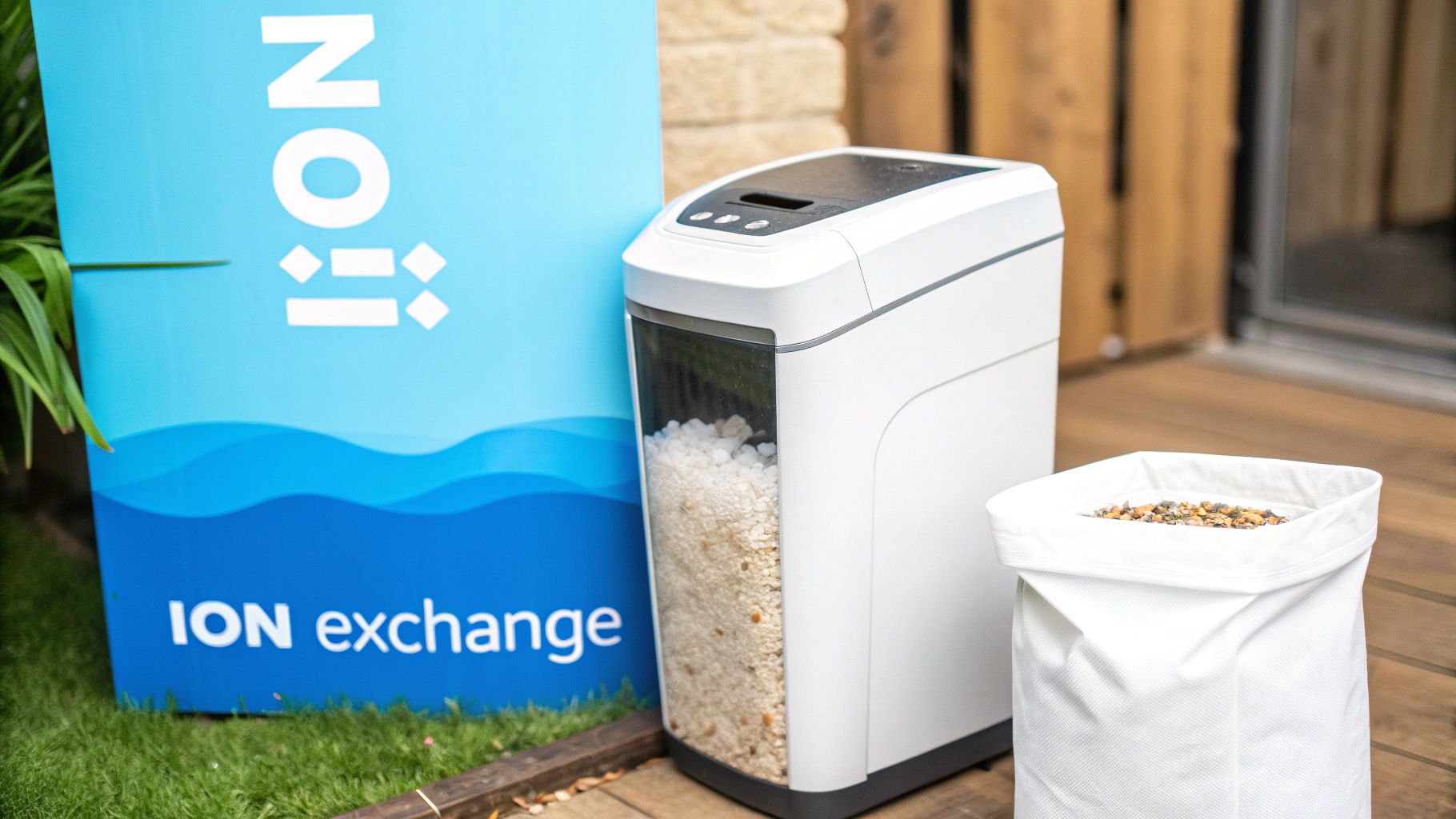
A white water softener machine filled with salt pellets next to an "ION exchange" sign and a bag of media.

When you want a surefire knockout punch for hard water, the classic salt-based water softener is the reigning champ. Unlike systems that just condition water, a true softener is engineered to physically yank the hardness minerals right out. This isn't a partial fix; it’s a complete solution for everything from crusty scale buildup to stubborn soap scum, making it a cornerstone of many home water filtration systems.

The magic behind it all is a process called ion exchange. It sounds complex, but it's basically a clever swap meet. Imagine your softener's main tank is packed with millions of tiny resin beads, all pre-loaded with sodium ions.

As your hard water flows over this resin bed, the calcium and magnesium minerals—the culprits behind your hard water woes—are drawn to the beads like tiny magnets. The resin has a stronger attraction to these minerals, so it grabs them and, in a simple trade, releases its sodium ions into the water. Voila! The water leaving the tank is now genuinely soft.

The Science of Ion Exchange in Action

This mineral-swapping process is incredibly effective, leaving your water almost entirely free of the gunk that causes limescale, stiff laundry, and spotty dishes. The result is water that feels totally different—many people describe it as silky or even a bit slippery to the touch.

But those little resin beads can't work forever without a refresh. They eventually become saturated with all the calcium and magnesium they've collected. When that happens, it's time for a cleaning process known as the regeneration cycle.

During regeneration, the system hits pause on softening. It pulls a concentrated salt solution, or brine, from a separate tank and uses it to flush the resin bed. The sheer amount of sodium in the brine forces the captured hardness minerals off the beads and sends them down the drain. Once the resin is clean and recharged with fresh sodium ions, the softener is ready to get back to work.

Inputs and Outputs: The Complete Cycle

To truly get how a softener works in your home, you have to look at what goes in and what comes out.

  • Input: The main ingredient is salt (either sodium chloride or potassium chloride). You’ll have to add it to the brine tank regularly to keep the system regenerating.
  • Input: The system also uses water to backwash and rinse the resin bed during the regeneration cycle.
  • Output: The star of the show is softened water, flowing to every faucet and appliance, protecting them from scale buildup.
  • Output: The byproduct is brine wastewater. This is a highly salty discharge containing all the flushed-out hardness minerals, which gets sent down your drain.

The undeniable benefit of this process is the complete elimination of scale. By removing the minerals at the source, water softeners protect your entire plumbing infrastructure, from the water heater to the showerhead, ensuring they operate at peak efficiency.

The numbers back up their effectiveness. Salt-based models command a massive 74.18% market share in 2024 precisely because ion exchange is a proven technology. While the global softener market is expected to hit USD 12.58 billion by 2030, the whole "water descaler vs water softener" conversation is heating up as salt-free alternatives find their place. You can dive deeper into these water softener market trends on Mordor Intelligence. Still, this dominance, especially in the U.S. where hard water plagues millions, shows just how many people trust this technology for a definitive end to their hard water headaches.

The Water Descaler: A Smarter, Salt-Free Approach to Scale
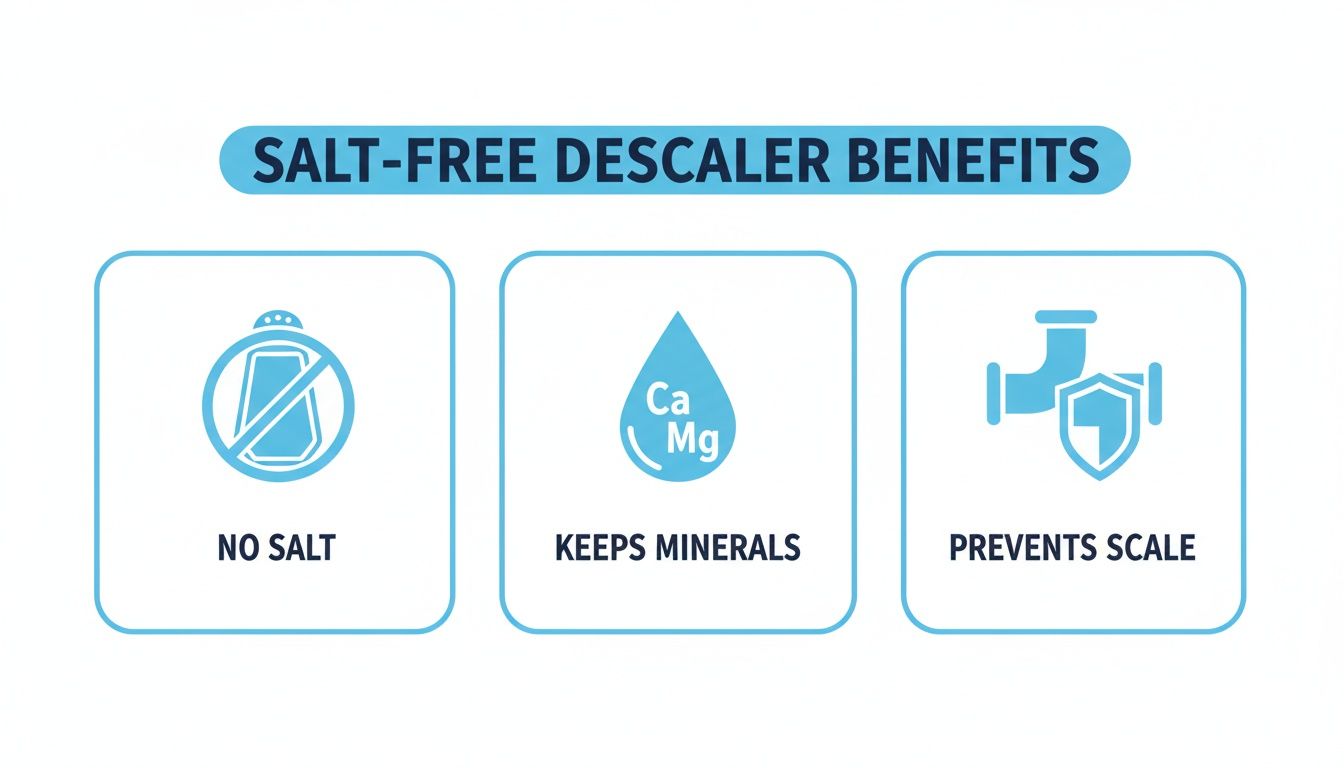
Infographic illustrating the three main benefits of a salt-free descaler: no salt, keeps minerals, and prevents scale.

For homeowners tired of lugging heavy salt bags and worried about salty wastewater, water descalers offer a compelling alternative. You’ll often see them marketed as "salt-free water softeners," but it’s crucial to know they’re technically water conditioners. Their job isn't to remove hard minerals, but to change how they behave.

Instead of yanking calcium and magnesium out of your water, a descaler simply stops them from forming destructive limescale. This means you get the biggest benefit—protecting your pipes and appliances—without actually changing the water's mineral makeup. A water test will show the same hardness level, but those minerals won't be able to stick to surfaces anymore. It's a targeted strike against the worst part of hard water.

The Science of Crystallization

The most trusted and effective technology in this field is Template Assisted Crystallization (TAC). Think of the hardness minerals in your water like tiny, super-sticky Lego bricks that want to clump together on any surface they find.

A TAC system uses a special media with "nucleation sites" that act like a template. As water passes through, these sites grab the calcium and magnesium ions and force them into stable, non-sticky micro-crystals. These harmless, microscopic crystals just flow right through your plumbing without building up. It's a brilliant piece of water filtration science.

Another approach uses magnetic or electronic descalers. These are devices that you wrap around your main water pipe, where they create an electromagnetic field. The idea is that this field changes the electrical charge of the mineral ions, making them repel each other and the pipe walls instead of sticking and forming scale.

Retaining Minerals Without the Mess

One of the coolest things about a descaler is that it leaves beneficial minerals like calcium and magnesium right where they belong—in your water. Since these are essential for a healthy diet, a lot of people prefer not to remove them. A descaler lets you keep the good stuff while neutralizing the bad behavior.

A water descaler neutralizes the threat of limescale while leaving beneficial minerals like calcium and magnesium in your water.

This gives you a great middle-ground option in the water descaler vs water softener debate. You get top-notch scale prevention without needing salt, electricity (for non-electronic models), or the wastewater that comes from a regeneration cycle. It’s pretty much a set-it-and-forget-it solution for your home's water filtration.

This shift toward conditioning water instead of stripping it is making waves in the industry. In the global market for 2024, descalers hold a massive 50% share, leaving traditional water softeners behind at just 30%. This trend shows a clear preference for systems that stop limescale without the environmental footprint of salt and brine. With North America leading the way, projections show descalers could hit a 52% market share by 2025, thanks to their efficiency and eco-friendly design. You can dig into more data on descaler market trends and future opportunities at Cognitive Market Research.

What a Descaler Does Not Do

It's just as important to understand what a descaler can't do. Because the minerals are still in the water, you won't get the other perks that come with truly soft water.

Here’s what you should know:

  • Soap Lather: You won’t notice a big difference in how well your soap lathers up in the shower or washing machine.
  • Water Feel: The water won't have that classic silky, slippery feel you get from soft water.
  • Soap Scum: While it stops scale, you might still see some minor soap scum on surfaces like shower doors.

At the end of the day, a descaler is a highly specialized tool in the water filtration world. It's built to do one thing and do it extremely well: stop limescale from ruining your home’s plumbing and appliances. For homeowners focused on protection and sustainability, it’s a powerful, salt-free alternative.

Comparing Hard Water Solutions Head-to-Head

Trying to choose between a water descaler and a water softener can feel like picking between a sledgehammer and a scalpel. Both are designed to tackle the headaches caused by hard water, but they go about it in fundamentally different ways, leading to very different results and long-term commitments for your home.

Let's break down what really matters for homeowners in this head-to-head comparison. As you weigh your options, it helps to understand the full scope of what's out there. Getting familiar with the various water conditioners on the market will give you a clearer picture of the different technologies available to fight scale.

Effectiveness Against Scale Buildup

The number one reason anyone invests in a home water treatment system is to stop limescale in its tracks. A water softener delivers a complete knockout punch here. It works by physically removing the hard minerals—calcium and magnesium—from your water. With those minerals gone, scale has a 0% chance of forming. This means total protection for your pipes, water heater, and appliances.

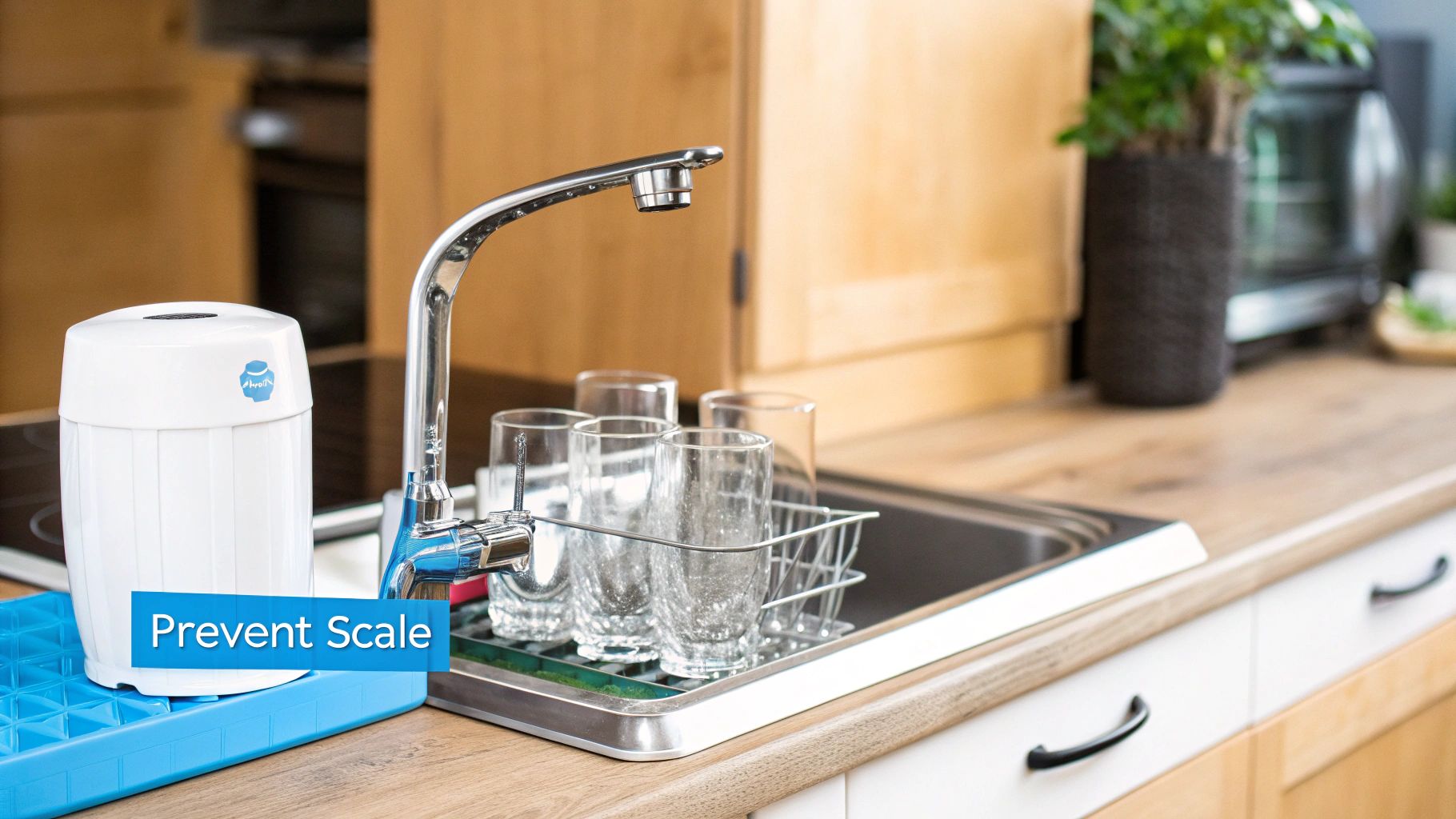
A water descaler takes a more tactical approach. It doesn't actually remove the minerals. Instead, it uses technologies like Template Assisted Crystallization (TAC) to change their structure, making them unable to stick to surfaces. It’s incredibly effective at preventing new scale, often reducing it by over 95%. As a bonus, it can even help slowly break down existing buildup over time.

For homes with extremely hard water (anything over 10 GPG), a water softener provides the most reliable and thorough scale prevention. If you're dealing with moderate hardness, a high-quality descaler is an excellent, fuss-free protective measure.

Costs Upfront And Over Time

Your budget will obviously play a big role in this decision. Water softeners typically have a higher upfront cost, usually running between $800 and $2,500 for a decent unit, not including professional installation. The long-term costs also pile up, with regular salt purchases costing around $200-$400 per year, plus the cost of extra water used during regeneration cycles.

Water descalers are generally much easier on the wallet upfront, with most models falling in the $300 to $1,500 range. The real win, though, is their near-zero long-term operational cost. They don't require salt, don't use extra water, and many—like TAC systems—don't even use electricity. They are truly a "set it and forget it" solution.

The infographic below really nails the core, maintenance-free benefits of going salt-free.

It’s a great visual that shows how a descaler prevents scale without salt while leaving healthy minerals right where they belong—in your water.

Environmental And Health Considerations

This is where the two systems couldn't be more different. A water softener’s regeneration cycle flushes a concentrated saltwater solution (brine) down the drain. This salty discharge can be a real problem for local water treatment facilities and has even been banned in some environmentally conscious counties. If you have a septic system, this brine can also disrupt the essential bacterial balance.

From a health standpoint, softeners add a small amount of sodium to the water. It’s usually not enough for most people to notice, but it can be a genuine concern for anyone on a strictly low-sodium diet.

Water descalers, on the other hand, have a minimal environmental footprint.

  • Zero Wastewater: No regeneration cycle means no brine discharge.
  • No Added Sodium: The water's mineral composition isn't altered, so no sodium is introduced.
  • Mineral Retention: They leave beneficial minerals like calcium and magnesium in the water, which are important for our daily diet.

The Feel Of The Water And Daily Use

The final point of comparison is how the water actually feels and affects your daily life. Softened water has a distinct "silky" or even "slippery" feel. This happens because the lack of minerals allows soaps and detergents to lather up like crazy, meaning you'll use less of them. You'll also notice softer skin, smoother hair, and brighter clothes.

A descaler doesn't change the feel of the water at all. Since the minerals are still there, you won't get that slippery sensation or see a huge increase in soap lather. Its benefits are invisible—all the hard work is happening inside your pipes, protecting your home's water system.

Water Descaler Vs Water Softener Feature Comparison

To make the choice a little easier, here is a detailed breakdown comparing the key attributes of water descalers and salt-based water softeners for homeowners.

Feature Water Softener (Ion Exchange) Water Descaler (Conditioner)
Scale Prevention 100% removal of scale-causing minerals. 95%+ prevention by crystallizing minerals.
Ongoing Costs Requires salt, water, and electricity. Virtually zero; no salt or wastewater.
Environmental Impact Produces brine wastewater. Eco-friendly; no waste.
Health Impact Adds sodium to water. Retains healthy, natural minerals.
Water Feel Creates a "silky," slippery feel. No change to water feel.
Maintenance Regular salt refills required. Minimal to no maintenance.

Ultimately, the best choice really comes down to your primary goal. If you want a solution that eliminates every single symptom of hard water—from scale buildup to dry skin and spotty dishes—a water softener is the way to go. But if your main concern is simply protecting your home’s plumbing and appliances with a low-maintenance, eco-friendly solution, then a descaler is the smarter investment for your home filtration strategy.

Which System Is Right for Your Home?

Alright, let's get down to the real question: which of these systems actually makes sense for your home? The water descaler vs. water softener debate isn't just about technical specs; it’s about how a system fits into your life. The right choice depends on your priorities, where you live, and what you’re trying to fix with your home's water.

To make it simple, we’ve broken it down into a few common homeowner situations. Find the one that sounds most like you, and you’ll have your answer.

For the Eco-Conscious Homeowner in a Brine-Restricted Area

If your main goal is sustainability and leaving the smallest environmental footprint, a water descaler is the obvious choice. This is for the person who’s worried about water waste and the impact of salt being flushed into local waterways or their septic system.

A classic water softener's regeneration cycle can dump up to 100 gallons of water down the drain, along with a heavy brine solution. This is such a big deal that some towns have actually banned them. A descaler, especially a Template Assisted Crystallization (TAC) model, is a zero-waste alternative.

  • No Wastewater: It doesn’t produce any brine discharge, so it’s perfectly safe for septic tanks and keeps you compliant with local regulations.
  • No Salt or Chemicals: It operates without adding a single thing to your water or the environment.
  • Energy Efficiency: Many descalers don’t even use electricity, which helps shrink your home's carbon footprint.

Recommendation: For anyone committed to green living, a water descaler is the perfect match. It stops scale buildup without the environmental baggage of a salt-based system.

For the Family Battling Extremely Hard Water

Now, picture a family living in an area where the water hardness is off the charts—we’re talking over 10 grains per gallon (GPG). Their problem is much bigger than just spotty glasses. Appliances are dying early, showerheads are constantly clogged, and everyone's skin and hair feel dry and scratchy.

In this case, the complete mineral removal of a water softener is non-negotiable. A descaler is fantastic for preventing scale, but it does nothing for the other symptoms of seriously hard water, like soap that won't lather and that gross soap scum ring in the tub.

When you're up against severe hard water, a softener's power to physically remove hardness minerals delivers a level of protection and comfort that a descaler simply can't match.

A salt-based softener gives you that slick, "silky" water feel, makes your soaps and detergents work way better, and puts a complete stop to scale. The ongoing cost of salt is a small price to pay for solving every single hard water headache.

Recommendation: A traditional water softener is the only real solution for homes that need full-spectrum relief from extremely hard water.

For the DIYer Who Wants a Zero-Maintenance Solution

If you’re the kind of person who loves a "set it and forget it" solution, the water descaler is your best friend. This is for the homeowner who wants scale protection without ever having to think about maintenance, lugging salt bags, or messing with programming.

Let's be honest, traditional softeners need regular attention. You have to keep an eye on the salt levels, haul those 40-pound bags from the store, and occasionally deal with a regeneration cycle that goes haywire. A TAC-based descaler, on the other hand, gets installed on your main water line and just… works.

While salt-based softeners hold a massive 58.6% of the market in 2025 and require all that upkeep, descalers simply condition the minerals. With over 85% of U.S. households dealing with hard water, descalers also prevent scale in water heaters, which can kill their efficiency by up to 29%. If you're curious how market trends are influencing these choices, you can check out the latest water softener industry analysis from Coherent Market Insights.

Recommendation: A water descaler provides serious scale protection with almost zero effort, making it the perfect choice for a busy, hands-off homeowner. For more general tips on water treatment systems, head over to our water filtration advice page.

Common Questions We Hear About Descalers and Softeners

Even after you've weighed the options, a few last-minute questions always seem to pop up. When you're trying to decide between a water descaler and a water softener, these practical details can make all the difference. We've compiled some of the most common questions we get from homeowners to give you clear, straight answers.

Think of this as your final check-in before you commit to improving your home's water filtration.

Can a Water Descaler Really Get Rid of Old Limescale?

Yes, it can, but think of it as a marathon, not a sprint. A descaler’s main job is to stop new scale from forming by changing the structure of the minerals in your water. But it has a nice side effect.

Over weeks and months, that conditioned water will slowly start to dissolve and break down the existing scale already stuck inside your pipes and on your fixtures. It’s a slow, gentle cleaning process, not a harsh chemical flush, so you'll need to be patient.

Will a Water Softener Make My Water Taste Salty?

This is probably the biggest myth out there, and the answer is almost always no. The ion-exchange process does add a tiny bit of sodium to the water, and how much depends on how hard your water is to begin with. For most people, you'll never even taste it.

That said, the small amount of added sodium can be a real concern for anyone on a strict low-sodium diet. In those cases, a great solution is to keep the water softener for the whole house but add a separate reverse osmosis system under the sink for pure drinking and cooking water.

Key Insight: While softened water is perfectly safe to drink, its sodium content might matter for specific health needs. A descaler adds nothing to the water, completely sidestepping this issue.

Do I Still Need a Filter if I Have a Softener or Descaler?

One hundred percent, yes. This is a critical point that people often misunderstand. Neither a softener nor a descaler is a water filter. Their jobs are very specific: they only deal with hard water minerals to stop scale. They are scale-fighters, not all-purpose purifiers.

They won't touch the common contaminants that ruin your water's taste and safety, like:

  • Chlorine and Chloramine: Chemicals your city uses for disinfection.
  • Lead and Heavy Metals: Nasty stuff that can leach from older pipes.
  • Pesticides and VOCs: Chemicals from runoff that can get into the water supply.
  • Bacteria and Viruses: A major concern, especially for homes on well water.

If you want truly clean, great-tasting water, you absolutely need a dedicated filtration system. This could be a whole-house carbon filter that works in tandem with your softener or descaler, or just an under-sink filter to purify water right at the tap.

Which System Is Better for Well Water with a Lot of Iron?

When you’re on a well, the conversation isn’t just about calcium and magnesium anymore—you’re often dealing with iron. Iron is what causes those ugly reddish-brown stains on your sinks, toilets, and laundry, and gives your water a metallic taste.

For well water with any noticeable amount of iron, a specialized water softener that comes with an iron filter is almost always the right call.

A standard softener can handle trace amounts of dissolved (ferrous) iron, but it gets overwhelmed by higher levels or by oxidized (ferric) iron. That stuff will clog up the resin bed and wreck the system. A dedicated iron filter or an all-in-one softener is built to handle it. Most descalers, especially TAC models, don't treat iron at all, making them a poor choice for this situation. The whole water descaler vs water softener debate gets a lot simpler when iron is in the picture.


At Water Filter Advisor, we believe that every home deserves safe, clean, and great-tasting water. Our in-depth guides and unbiased reviews are designed to help you navigate the world of water filtration with confidence. Explore our resources to find the perfect solution for your family’s needs at https://www.waterfilteradvisor.com.

How to Remove Calcium from Your Water: A Practical Home Guide

So, you're ready to declare war on the calcium in your water? Excellent. Your two superstar players in this fight are the classic salt-based water softener and the high-tech reverse osmosis system. Think of a water softener as a clever diplomat, swapping out hard calcium for soft sodium. Reverse osmosis, on the other hand, is pure brute force—it shoves water through a microscopic bouncer that physically blocks the minerals from getting in.

The Sneaky Cost of Hard Water in Your Home

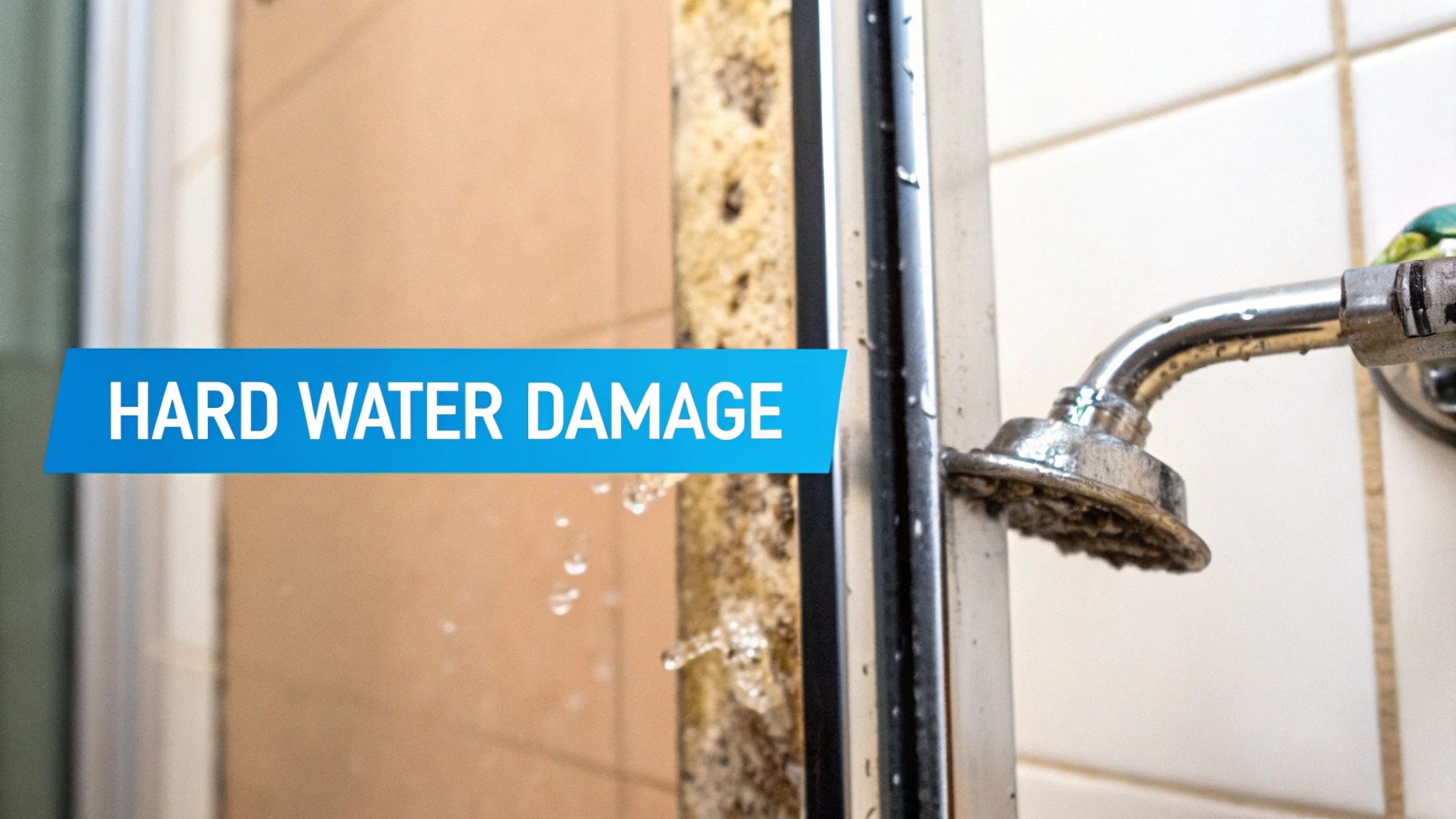
A close-up shows a shower head and door suffering from severe hard water damage and mineral buildup.

If you've ever waged a Saturday morning battle scrubbing that ghostly white film off your shower door, you've met hard water. If you've ever pulled your favorite t-shirt from the dryer only to find it feels like cardboard, you're a victim of hard water. This isn't just a minor inconvenience; it’s the daily grind for millions, all thanks to invisible calcium and magnesium particles crashing the party in your water supply.

These mineral freeloaders are the reason your soap throws a tantrum and refuses to lather, and why your wine glasses come out of the dishwasher looking like they’ve been frosted. You're trapped in an endless, and often losing, fight against soap scum on faucets, sinks, and tubs. But as annoying as these visible clues are, they’re just the opening act. The real damage is happening behind the scenes.

The Hidden Damage Calcium Causes

Beyond the daily cleaning headaches, hard water is silently waging a secret war on your home's plumbing and appliances. That same calcium that leaves spots on your glassware is building a rock-hard fortress inside your pipes called limescale. Over time, this mineral buildup chokes your plumbing, strangling water flow and putting a serious strain on your entire system.

Your water-using appliances are taking the biggest beating. Limescale loves to cozy up to the heating element in your water heater, wrapping it in a mineral blanket. This forces the unit to work overtime, burning more energy just to heat the same amount of water.

Hard water is a problem for a staggering 85% of American households. That relentless scale buildup can slash the lifespan of water heaters by up to 30% and crank up your energy bills by 20-30%.

Let that sink in. It means you could be forking over cash for a new water heater every 8-12 years instead of getting the full 20, all while paying more on your utility bills every single month. The same costly assault is happening to your dishwasher, washing machine, and even your beloved coffee maker. One of the most obvious signs is the never-ending task of removing hard water stains from windows and shower doors—it’s a crystal-clear sign of how much mineral gunk is being left behind.

The good news? You don't have to surrender. By understanding how to remove calcium from your water with the right filtration system, you can protect your home, save money, and finally win the war against limescale for good.

Diagnosing Your Hard Water Problem

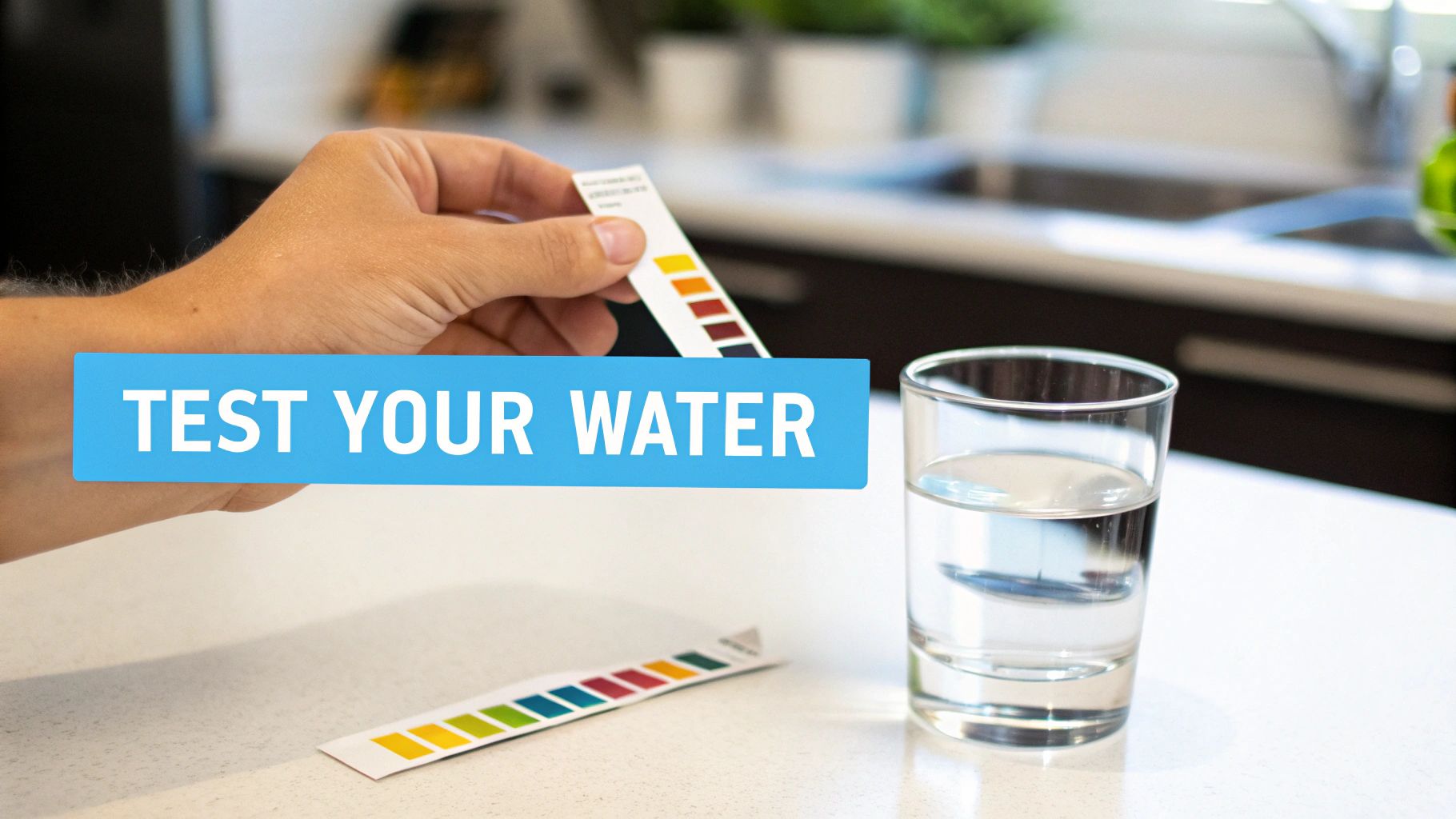
A person's hand holds a water test strip above a glass of water, with 'TEST YOUR WATER' text overlay.

Before you can vanquish the calcium in your water, you have to play detective. You need to know exactly how hard your water is. This isn't just a fun fact for a cocktail party; it's the crucial first step that determines which filtration weapon is actually going to work for your home.

You've probably already spotted the evidence. Those stubborn, milky-white spots on your windows and shower doors? Those are the classic calling cards of hard water, which are primarily calcium and magnesium deposits. While these clues tell you there's a problem, you need a real number to make a smart decision.

Luckily, you don't need a lab coat and a Ph.D. to figure this out. There are several ways to test your water, from simple DIY tricks to highly accurate lab tests.

Quick and Easy At-Home Tests

If you just want a quick confirmation that you're dealing with hard water, you can start with a couple of methods that cost next to nothing. They won't give you a precise number, but they'll tell you if you're on the right track.

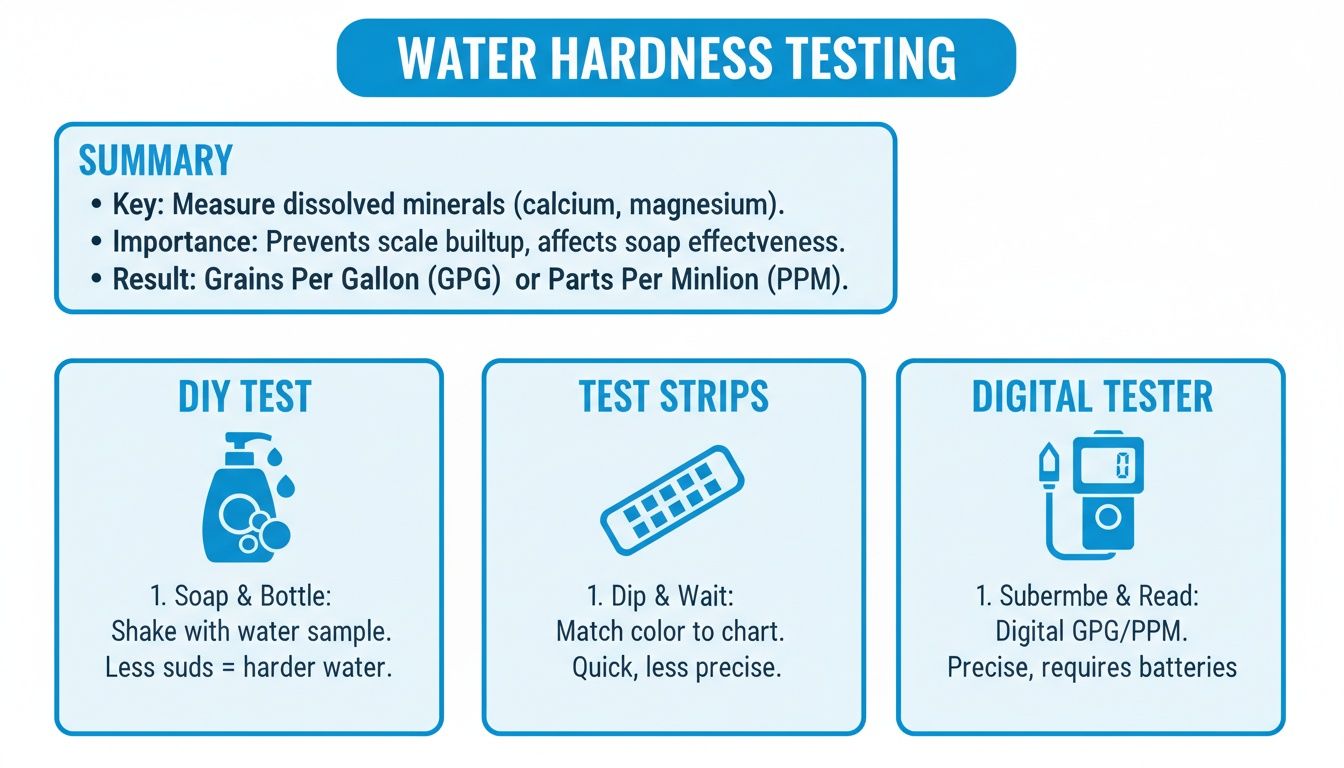
  • The Soap Suds Test: This is the old-school way. Grab a clean, clear bottle, fill it about a third of the way with tap water, and add a few drops of pure liquid soap (Castile soap is perfect). Now, shake it like a Polaroid picture. If you get a big, fluffy layer of bubbles, your water is probably soft. If you just get a sad, cloudy film and barely any suds, congratulations, you’ve got hard water.
  • Water Hardness Test Strips: These are cheap, easy, and you can find them at any home improvement store. Just dip a strip into a glass of your water, and watch the color change. Match that color to the chart in the kit, and voilà, you'll have a good estimate of your water's hardness level.

Getting a Precise Measurement

The DIY tests are a great start, but if you're planning to invest in a real water filtration system, you need a more accurate number. This is especially true if you're on a private well, where mineral levels can be all over the map and other sneaky contaminants might be lurking.

Knowing your exact water hardness number is essential. A water softener needs to be programmed with this value to work efficiently. Get it wrong, and you’ll either waste a mountain of salt and water, or worse, the system won't soften your water at all.

For a reliable result, you have a couple of better options. I’ve put together a quick comparison to help you choose the best method for your needs.

Water Hardness Testing Methods Compared

Different testing methods offer varying levels of detail and accuracy. Here’s a breakdown of the most common options to help you decide which is right for your situation.

Testing Method How It Works Accuracy Level Typical Cost Best For
Soap Suds Test Shaking soap in a water-filled bottle to observe suds formation. Low (Qualitative) Free Quick confirmation of a suspected hard water problem.
Test Strips A strip is dipped in water and changes color, which is then matched to a chart. Low to Moderate $10 – $20 A fast, inexpensive estimate of hardness in Grains per Gallon (GPG).
Digital Testers An electronic meter measures Total Dissolved Solids (TDS) in the water. Moderate to High $15 – $50 Getting an instant, precise TDS reading, which is a strong indicator of hardness.
Lab Testing A water sample is mailed to a certified lab for a detailed chemical analysis. Very High $50 – $200+ Homeowners on well water or anyone needing a comprehensive water quality report.

Ultimately, choosing a more precise method like a digital tester or a professional lab test is a smart move. Once you have that specific number, you’ll be armed with the exact data you need to pick the right system, size it correctly, and get it programmed to work perfectly for years to come.

Effective Calcium Removal Methods for Your Home

Alright, you've done your homework and confirmed that hard water is the villain. Now for the fun part: picking your hero. Getting rid of calcium isn't a one-size-fits-all game. It’s about choosing the right tool for the job, whether you need to protect every pipe in your house or just want a perfect, scale-free cup of coffee.

Let's dive into the most common and effective ways to tackle hard water at home. We'll break down how each method works, from classic water softeners that physically rip the calcium out to newer systems that just change its bad behavior. This will give you a clear picture of what's happening to your water and why it matters.

The Gold Standard: Ion Exchange Water Softeners

When you want to remove calcium from your entire home's water supply, the traditional salt-based water softener is still the king of the castle. These systems are the absolute workhorses of the water filtration world, designed specifically to hunt down and eliminate the minerals that make water hard.

Think of it as a microscopic nightclub bouncer. Inside the main tank is a bed of tiny resin beads covered in sodium ions. As your hard water flows through, the rowdy calcium and magnesium ions, which have a stronger electrical charge, get grabbed and pulled onto the resin beads. In the process, they kick the weaker sodium ions off and into the water.

That's the "ion exchange" in a nutshell. The hard minerals get trapped, and a tiny, usually unnoticeable amount of sodium takes their place. The result? Truly soft water flowing to every faucet, showerhead, and appliance you own.

Of course, those resin beads can only hold so many troublemakers before they're full. That's when the system needs to clean itself, a process called regeneration.

  • First, the system backwashes the resin tank to flush out any gunk.
  • Next, it sucks a concentrated saltwater solution (brine) from a separate tank to wash the resin beads.
  • The massive wave of sodium in the brine overpowers the trapped calcium and magnesium, kicking them off the resin and sending them down the drain.
  • Finally, the system gives the resin a good rinse to get rid of any leftover brine, leaving it recharged with sodium and ready to get back to work.

The best part is this all happens automatically, usually in the middle of the night, so you never run out of glorious soft water.

Surgical Precision with Reverse Osmosis

While a water softener is the perfect whole-house guardian, sometimes you need an even higher level of purity—especially for the water you drink and cook with. This is where a Reverse Osmosis (RO) system truly shines. An RO system doesn't just swap minerals; it acts like a microscopic fortress.

Think of it like a top-secret security checkpoint for water molecules. An RO system uses pressure to force water through a special semipermeable membrane—basically a filter with pores so tiny they make a human hair look like a tunnel.

These pores are so incredibly small that only pure water molecules can squeeze through. Calcium, magnesium, and a whole army of other contaminants (like lead, chlorine, and salts) are just too big to pass. They get rejected by the membrane and are unceremoniously washed away down a separate drain line. The purified water is then stored in a small tank under your sink, ready to be dispensed from its own dedicated faucet.

An RO system can strip out up to 99% of all total dissolved solids (TDS), including calcium. This makes it the go-to choice for getting perfectly pure, spot-free water for drinking, making crystal-clear ice, or brewing the best-tasting coffee you've ever had.

Because the process is slow and creates some wastewater, RO is almost always used as a "point-of-use" system at a single tap, not for the whole house. It's the perfect sidekick for a water softener: the softener protects the delicate RO membrane from getting clogged with scale, and the RO system gives you bottled-water quality right from the tap.

A Different Approach: Salt-Free Water Conditioners

For those who want to stop scale damage without adding salt or changing their water's chemistry, there's another popular option: a salt-free water conditioner. Now, it's critical to understand that these systems do not actually remove calcium from the water. Instead, they're like a behavioral therapist, altering calcium's structure so it can't stick to surfaces.

The leading technology here is called Template Assisted Crystallization (TAC). A TAC system uses a special media that acts as a seed for mineral crystals to form. As hard water flows past, the calcium and magnesium ions are grabbed and forced to clump together into tiny, stable micro-crystals.

These crystals are then released back into the water, but because they're now in a hardened, crystalline form, they can't cling to your pipes, faucets, or water heater elements. They just flow right through your plumbing and down the drain, minding their own business.

The big advantages of a TAC system are:

  • No Salt: You never have to buy or lug around those heavy bags of salt.
  • No Wastewater: They don't have a regeneration cycle that flushes water and brine down the drain.
  • Low Maintenance: The media inside can last for several years before it needs to be replaced.

The trade-off is that you don't get the other perks of truly soft water. Soap and shampoo won't lather up any better, you'll still see some water spots (though they should be easier to wipe away), and you won't get that classic silky-smooth feel of soft water on your skin. Think of it strictly as a scale-prevention device.

Calcium Removal Methods At-A-Glance

Trying to decide which system is your champion? It really comes down to your primary goals, budget, and how much maintenance you're willing to do.

This table gives you a quick side-by-side comparison of the top ways to deal with calcium in your home's water.

Filtration Method How It Works Calcium Removal Avg. Initial Cost Ongoing Maintenance
Ion Exchange Softener Swaps calcium ions for sodium ions. Yes, fully removes $800 – $2,500 Adding salt regularly; potential resin replacement every 10-15 years.
Reverse Osmosis (RO) Pushes water through a fine membrane. Yes, filters out $150 – $600 Replacing pre-filters (6-12 months) and RO membrane (2-4 years).
Salt-Free Conditioner (TAC) Crystallizes minerals to prevent scale. No, neutralizes $500 – $1,800 Replacing TAC media every 3-6 years; no salt or electricity needed.

Use this as a starting point. If you want the full benefits of soft water everywhere, a softener is your best bet. If you only care about pristine drinking water, an RO system is perfect. And if you just want to protect your pipes without the salt, a TAC conditioner is a great modern alternative.

Selecting the Right System for Your Household

Choosing a system to remove calcium from your water can feel a little overwhelming. With so many options, sizes, and technical terms floating around, it's easy to get lost. The key is to simplify. You just need to match the right technology to your home, your family, and your water.

Getting this right isn't just about picking a box off a shelf; it's about finding a real-world solution. What works for a couple in a small condo with moderately hard water is going to be totally different from what a family of five on a private well needs.

Sizing Your System Correctly

One of the biggest blunders homeowners make is buying a system that's too small or way too big. An undersized water softener, for example, will constantly be playing catch-up. It'll regenerate too often, which just burns through salt and water. Go too big, and you've just spent more money than you needed to upfront.

To get the sizing just right, you need two key pieces of info:

  • Your household water consumption: The average person uses around 80-100 gallons of water a day. Just multiply that by the number of people in your home to get a daily total. For a family of four, that's roughly 320-400 gallons per day.
  • Your water hardness level: This is the number you got from your water test, measured in grains per gallon (GPG). This tells you exactly how much of a workout the system has to do for every single gallon that flows through it.

With those two numbers, you can figure out the "grains of hardness" your system has to remove each day. Simply multiply your daily water usage by your GPG. For our family of four using 320 gallons with 15 GPG water, that’s 4,800 grains of hardness daily. This number becomes your guidepost for choosing a softener with the right capacity.

A correctly sized system means you'll have a steady supply of soft water without the system constantly regenerating. That saves you money on salt and water over the long haul. It's really the difference between a "set-it-and-forget-it" solution and a constant headache.

Understanding Water Flow Rate

Beyond just capacity, the other critical factor is the flow rate, which is measured in gallons per minute (GPM). This number tells you how much softened water the system can actually deliver at one time. If the flow rate is too low for your family's peak demand, you're going to notice a frustrating drop in water pressure.

Picture this: someone's in the shower, the dishwasher is running, and you flush a toilet. A system with a low GPM just can't keep up with that demand, and the person in the shower suddenly feels the water pressure drop to a trickle. For a typical family home, a system with a flow rate of at least 10-12 GPM is a safe bet to keep everyone happy and the pressure strong.

Whole-House vs. Point-of-Use Solutions

Next up, you have to decide where you want to treat your water. This really boils down to two main approaches: treating all the water that enters your home or just zeroing in on a specific faucet.

This quick decision tree can help you visualize which path makes the most sense for what you're trying to fix.

Flowchart for calcium removal from water, addressing problems like scale buildup or drinking water concerns.

As the chart lays out, if your main headache is scale buildup wrecking your entire home, a whole-house system is the clear winner.

Whole-House (Point-of-Entry) Systems
These are the heavy hitters, like ion exchange water softeners or salt-free conditioners. They get installed right where your main water line enters the house, treating every drop before it can reach your pipes, appliances, and faucets.

  • Best for: Protecting your entire plumbing system, your water heater, dishwasher, and washing machine from scale. You also get the benefit of soft water for showering, which can be great for your skin and hair.
  • Real-World Scenario: A large family in a rural area with extremely hard well water (25+ GPG). For them, a whole-house softener isn't a luxury—it's essential to prevent constant appliance repairs and keep their plumbing from clogging up.

Point-of-Use (POU) Systems
These systems are specialists. They're designed to deliver highly purified water to a single spot, which is usually the kitchen sink. The most common example is an under-sink reverse osmosis (RO) filter.

  • Best for: Getting the highest purity for your drinking and cooking water. An RO system is the gold standard for removing not just calcium but a whole host of other contaminants, giving you bottled-water quality right from a dedicated faucet. For more helpful insights, you can explore additional water filtration advice from Water Filter Advisor.
  • Real-World Scenario: A couple living in a city apartment with moderately hard water. They aren't too worried about their pipes but really want to get rid of calcium and chlorine for better-tasting coffee and crystal-clear ice. A simple under-sink RO system is the perfect, budget-friendly fit for their needs.

Installation and Long-Term System Care

A man in a blue shirt crouches, performing system maintenance on a white water filter in a cabinet.

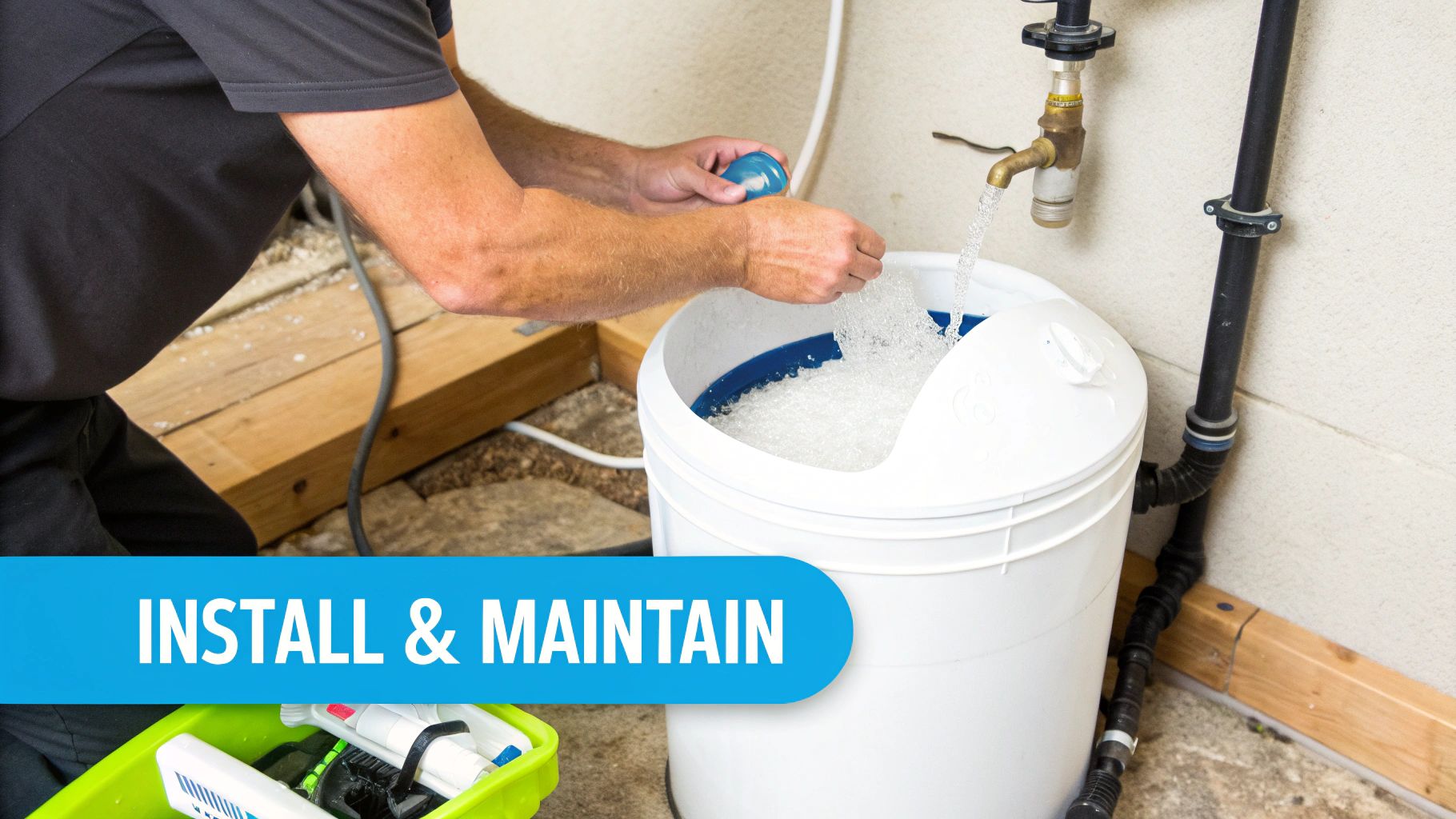
Choosing the right system is the hard part; getting it running and keeping it that way shouldn't feel like a chore. The final hurdle is installation, followed by a simple care routine that will keep your system performing flawlessly for years. Nailing this ensures you get every penny's worth out of your investment and enjoy consistently great water.

Some systems are perfect for a weekend DIY project, while others really need a pro's touch. It all comes down to the system type and how comfortable you are with plumbing.

Point-of-use units, like an under-sink RO filter, are usually pretty straightforward. The kits are designed for homeowners, with clear instructions and push-to-connect fittings that take the guesswork out of it. If you can read a manual and operate a drill, you can probably have it done in an afternoon.

Whole-house systems are a completely different animal. Installing a water softener or a salt-free conditioner means cutting into your main water line. This is not the time for trial and error. It demands precision, the right tools, and a real understanding of local plumbing codes. A small mistake here can quickly turn into a massive leak and some seriously expensive water damage.

Pro Tip: Unless you've got serious plumbing experience, just hire a licensed plumber for a whole-house system. It's a smart move that guarantees the job is done right, meets code, and keeps your manufacturer's warranty intact.

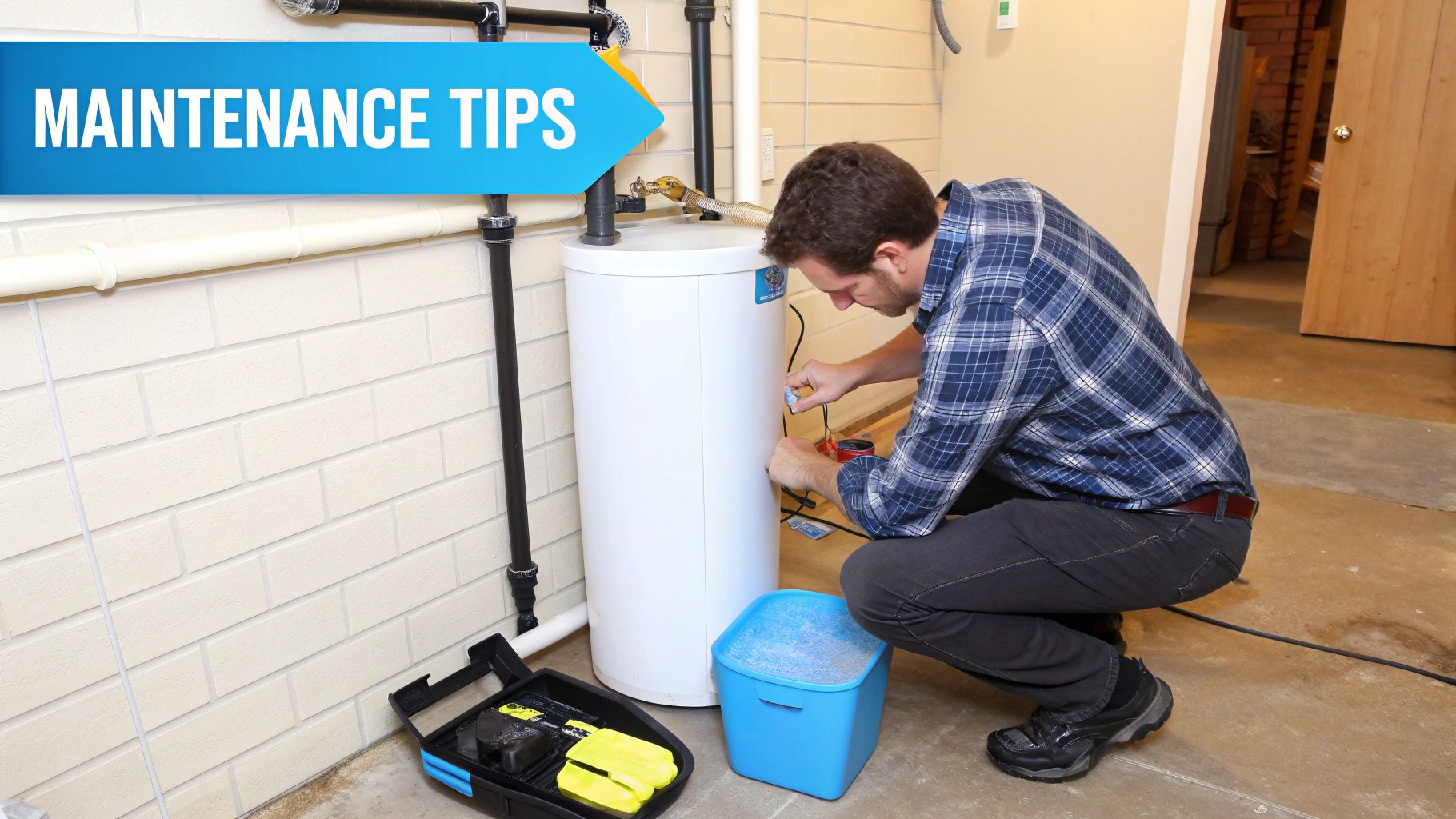
Creating a Simple Maintenance Routine

Once everything is up and running, a little TLC is all you need. The best part is that modern water filtration systems are built to be incredibly low-maintenance. Your to-do list will just depend on the tech you picked.

Here's what the typical upkeep looks like for the most popular systems:

  • Ion Exchange Water Softeners: This is about as easy as it gets. Your main job is just keeping the brine tank filled with salt. Glance at the salt level once a month and top it off. Most tanks hold enough to last a few months anyway. Stick with high-quality salt to avoid "salt bridging," a hard crust that can form and stop the system from working.
  • Reverse Osmosis (RO) Systems: These systems rely on filter changes to keep the water pure. The sediment and carbon pre-filters generally need to be swapped out every 6 to 12 months. The main RO membrane is much more durable, lasting anywhere from 2 to 4 years. Your system's manual will have a schedule—just pop a reminder in your phone's calendar.
  • Salt-Free Water Conditioners (TAC): If you want "set it and forget it," this is it. The special TAC media that neutralizes the calcium usually lasts 3 to 6 years before you need to think about replacing it. There's no salt to buy, no electricity, and no drain line to monitor.

Troubleshooting Common Hiccups

Even the most reliable system can have an off day. If you notice your water quality has changed, don't panic. Most problems are surprisingly simple to diagnose and fix.

A sudden drop in water pressure is a classic sign. The first thing to check is any pre-filter on your system. A clogged sediment filter is the usual suspect, and it's a cheap and easy fix. On an RO system, low pressure could also signal that it's time to change the filters or that the storage tank's air bladder needs a top-up.

What if your water starts feeling hard again? With a water softener, the fix is almost always simple. First, check if you're out of salt or if a salt bridge has formed. If the salt looks fine, make sure the system's settings—especially the water hardness level you programmed in—are correct and that the unit has power. These few checks will solve the issue over 90% of the time, getting you back to soft, scale-free water.

Frequently Asked Questions About Calcium Removal

Even after digging into the best ways to get rid of calcium, some questions always seem to pop up. Let's clear the air and tackle some of the most common worries homeowners have about taming their hard water for good.

Will a Water Softener Make My Water Taste Salty?

This is easily the biggest myth out there, and the short answer is no. A properly working water softener adds a tiny, almost always undetectable amount of sodium to your water. The exact amount is tied directly to how hard your water is to begin with.

For instance, if your water is moderately hard at 15 GPG, the process adds about 280 mg of sodium per gallon. For a little real-world context, a single slice of white bread has around 170 mg of sodium. Most people never notice the taste.

That said, if you're on a strict sodium-restricted diet or just don't want any added minerals in your drinking water, pairing a whole-house softener with a point-of-use reverse osmosis system at your kitchen sink is the perfect combo.

Can I Use a Water Filter Pitcher to Remove Calcium?

Those standard filter pitchers you keep in the fridge are really only good for one thing: making your water taste and smell better. They use activated carbon to trap things like chlorine, which definitely makes for a more pleasant glass of water.

But when it comes to dissolved minerals like calcium and magnesium, they don't do a thing. Getting rid of hardness requires a specific technology like ion exchange or reverse osmosis. You might see some niche pitchers claim a minor hardness reduction, but they just can’t handle the job in a way that will make a real difference for your appliances or even stop scale from forming in your kettle.

What Is the Difference Between a Water Softener and a Salt-Free Water Conditioner?

This is a really important distinction, and it all comes down to how they deal with calcium.

  • A water softener physically removes the calcium and magnesium minerals from the water using ion exchange. The result is genuinely soft water.
  • A salt-free water conditioner (which uses Template Assisted Crystallization, or TAC) doesn't remove the minerals at all. Instead, it changes their structure, crystallizing them so they can’t stick to pipes and form scale.

So, your choice really depends on what you're trying to achieve. If you're after that silky-smooth feeling in the shower and better lather from your soap, a traditional softener is the only way to go. If your main goal is simply to protect your home’s plumbing from scale buildup without the hassle of salt, a conditioner is a fantastic modern alternative.

How Often Do I Need to Replace the Resin in My Water Softener?

The resin bed is the heart of your softener, and it's surprisingly tough. With a little care and typical city water (that isn't loaded with iron or chlorine), a high-quality resin bed can last anywhere from 10 to 20 years.

The things that really shorten its lifespan are high levels of chlorine or iron, which can break down the tiny resin beads over time. You’ll know it might be time for a change if your system seems to be regenerating correctly but your water still feels hard. Another tell-tale sign is a big drop in water pressure, which can happen if old, broken-down resin particles start clogging up the system. Using a resin cleaner once a year can really help you get the most life out of it.


Ready to find the perfect solution for your home's hard water problems? At Water Filter Advisor, we provide in-depth reviews, buying guides, and practical advice to help you make a confident choice. Explore our resources and find the right filter for your family at https://www.waterfilteradvisor.com.
Your Ultimate Guide to the Water Softener Installation Diagram

Think of your water softener installation diagram as your project's command center—your treasure map to pure, soft water. It's the sacred scroll that transforms a potentially confusing plumbing saga into a straightforward, follow-the-arrows quest. This diagram is your secret weapon, laying out exactly how water will journey from your main line, through the magical resin tank, and then out to every faucet in your home. It clearly flags the inlet, outlet, bypass valve, and other key landmarks, making the entire home water filtration process completely manageable.

Decoding Your Water Softener Blueprint

A detailed installation diagram on a clipboard with plumbing tools and a large white bucket, on a blue grid background.

Before you even dream of cutting a pipe, take a few minutes to get intimate with your installation diagram. Don't see it as a complex schematic; view it as a storybook for your plumbing. This visual guide demystifies the whole setup, showing you precisely how every piece fits together to create a fortress against hard water.

When you trace the path of the water on paper first, you're building the confidence you'll need when you're actually holding the tools. The diagram illustrates the entire pilgrimage your water will take, starting right at your main supply line. This is where you'll tap into your home's water circulatory system to route it into the softener. From there, it’s just a matter of following the lines to victory.

Key Components on Your Installation Diagram

To truly master the diagram, you need to know the cast of characters. Each part plays a vital role in the water filtration drama. This table breaks down the essentials you'll find on almost any water softener diagram.

Component Name What It Does Installation Tip
Inlet Port Welcomes hard water from the main supply into the softener. This must connect to the pipe coming from your water meter or well. No exceptions!
Outlet Port Sends the newly purified, soft water to the rest of your house. This pipe will feed all your hot and cold water lines (but not your garden hose!).
Bypass Valve Lets you temporarily shut off water to the softener for maintenance. Always install this. It’s your “get out of jail free” card for maintenance without a household water shutdown.
Brine Line A small tube that sips saltwater from the brine tank. Ensure the connection is airtight to prevent hiccups during the regeneration cycle.
Drain Line Carries the captured hard minerals and waste water away to a drain. Make sure there's an air gap between the tube and the drain to prevent gross back-siphoning.
Overflow Tube A safety line on the brine tank that acts as a flood warden. This is your insurance policy. Route it to the same drain as the main drain line.

Getting familiar with these parts on paper first makes the hands-on work feel less like brain surgery and more like building with LEGOs.

Tracing the Flow of Water

The first thing to find on your diagram is the inlet port on the control head. This is the gateway where hard water enters the filtration system. Follow the lines, and you'll see the water travel down into the resin tank. That tank is where the real magic happens—it’s filled with tiny resin beads that act like magnets, grabbing onto hard water minerals like calcium and magnesium through a process called ion exchange.

Once the water is purified, it flows back up and out through the outlet port. This is the pipeline that delivers silky-smooth, soft water to your showers, sinks, and washing machine. Getting the inlet and outlet pipes hooked up correctly is the most critical part of the job. It’s a common DIY mistake to reverse them, and if you do, the softener simply won't work.

Key Takeaway: The arrows on your diagram and the labels on the control valve are your best friends. Double- and triple-check that the "IN" port is connected to your main water supply and the "OUT" port is feeding the rest of your house.

Identifying Critical Connections

Your diagram will also highlight a few other essential connections that are just as important as the main water lines. These allow the softener to clean itself and operate safely, ensuring your home filtration system runs smoothly.

You'll need to locate:

  • The Bypass Valve: A lifesaver for any future maintenance. The diagram shows how this valve fits onto the inlet and outlet, giving you a way to isolate the softener without turning off your home's water.
  • The Brine Line: Look for the smaller-diameter tube connecting the control head to the salt tank. This line is responsible for sucking the saltwater solution into the resin tank to "recharge" the beads during a regeneration cycle.
  • The Drain Line: This line runs from the control head to a nearby floor drain or utility sink. It’s where all the hard minerals and salty rinse water get flushed out.
  • The Overflow Tube: This is a crucial safety feature. It’s a secondary tube on the brine tank that prevents a salty flood if the tank ever overfills due to a malfunction.

More and more homeowners are taking control of their water quality, and it shows in the market. The global water softeners market was valued at USD 3.35 billion in 2024 and is on track to hit USD 5.57 billion by 2032. This growth comes from people in areas with hard water, especially in North America, who are seeing the value in DIY-friendly solutions. Learning to read a simple installation diagram is your first step to joining them. You can find more insights about the growing water softener market and its drivers here.

Gathering Your Tools and Finding the Perfect Spot

Any good DIY quest starts with assembling your gear, and a water softener install is no exception. Before you even glance at a water softener installation diagram, you need to have every tool and part laid out and ready. Nothing kills your momentum faster than a mid-project run to the hardware store for a fitting you forgot.

Think of yourself as a surgeon for your home's water filtration system. You wouldn't start an operation without your instruments neatly arranged, right? For this procedure, you’ll need a few key items on your "surgical tray."

Your Essential Installation Checklist

You're going to need more than just a single wrench for this job. The type of plumbing you have—copper, PEX, or CPVC—will determine some of the specifics, but this list is a solid starting point for almost any setup.

  • Pipe Cutters: Make sure you have the right kind for your pipes (copper, PEX, etc.).
  • Two Adjustable Wrenches: Your go-to tools for tightening down fittings and connecting hoses.
  • Measuring Tape: You get one shot when cutting your main water line. Measure twice, cut once.
  • Teflon Tape: A plumber’s best friend for a reason. Use it to create a leak-proof seal on any threaded connections.
  • Bucket and Towels: When you cut that pipe, water is coming out. Be ready for it.

Beyond these basics, you’ll need the right fittings. Modern push-to-connect fittings (like SharkBites) are a game-changer for DIYers because they don't require any soldering. If you're more old-school and comfortable with sweat soldering on copper pipes, that'll give you a permanent, rock-solid bond.

Choosing the Right Battleground for Your Softener

Where you install your water filtration system is just as critical as how you install it. The wrong spot can lead to poor performance, a major headache during maintenance, or even expensive water damage. You're looking for a spot that checks a few very important boxes.

The perfect location is as close as possible to where your main water line enters the house, and before it tees off to the water heater. This setup ensures that all the water in your home, both hot and cold, gets treated. Before you cut any pipes, it's also a good idea to confirm you have good flow; learning how to address low water pressure can be a crucial first step.

Pro Tip: Never, ever install a water softener after your water heater. The high temperatures will absolutely destroy the delicate resin beads inside the tank, rendering your entire filtration unit useless.

Your chosen spot also needs easy access to a power outlet and a drain. The control head needs electricity to run the regeneration cycles, and the system needs that drain to flush out all the hard minerals it captures.

Finally, keep your investment safe from the elements. A garage, basement, or utility closet is ideal. Steer clear of any spot where temperatures might drop below freezing—a frozen, cracked tank is a costly disaster you don't want to deal with. For more expert guidance on a variety of home water systems, be sure to visit Water Filter Advisor and check out these tips for various water filtration needs. Nailing the location from the start will save you a world of trouble and keep your system running at its best for years.

Bringing Your Installation Diagram to Life

Alright, you've got your tools laid out and the perfect spot picked. Now for the main event. This is where we turn that water softener installation diagram from a piece of paper into a hard-working piece of equipment for your home. We're going from blueprint to reality, and it all starts with one critical, non-negotiable step.

First things first: shut off the main water supply to your house. Find your main shutoff valve—it's usually where the water line first enters your home—and turn it completely off. To drain the pipes, open the lowest faucet you have (like in the basement or an outside spigot) and the highest one (maybe an upstairs bathroom sink). This simple step is the difference between a smooth installation and a frantic, soggy call to a plumber.

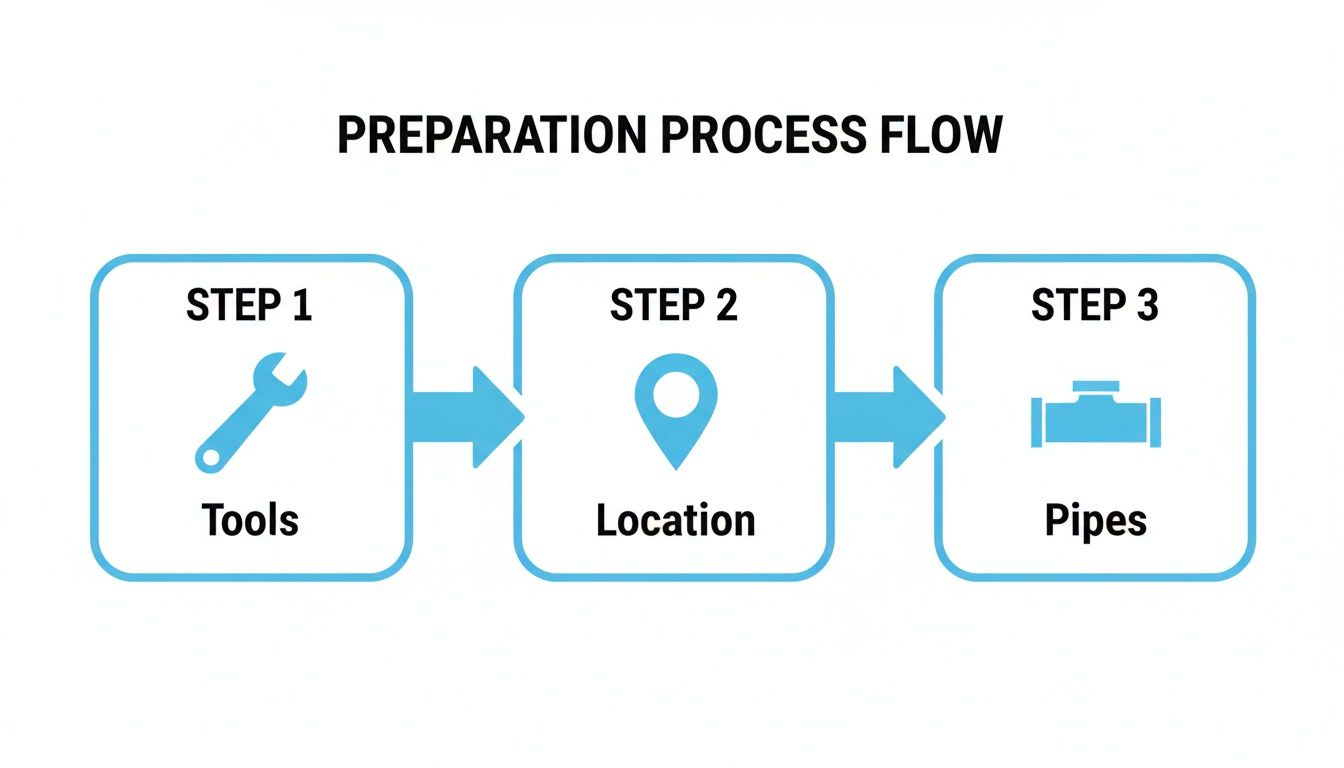
This quick visual guide sums up the prep work we've covered, from grabbing your tools to prepping the pipes.

A three-step preparation process flow diagram showing tools, location, and pipes.

Think of it this way: good prep work is the foundation for a successful install. It makes sure you have everything you need before you make a single cut.

Making the Cut and Installing the Bypass

Here we go—the point of no return. It’s time to cut into your main water line. Carefully measure the space you'll need for the bypass valve assembly that came with your softener. Remember the old rule: measure twice, cut once. It definitely applies here. Use a pipe cutter for a clean, straight cut and keep a bucket handy to catch any leftover water.

With that section of pipe removed, you can install the bypass valve. This little piece is a lifesaver, letting you shut off water to the softener for maintenance without turning off water to the whole house. Most modern systems are pretty DIY-friendly, using push-to-connect or threaded fittings. Just make sure the arrows on the valve are pointing in the direction of the water flow—away from the main and toward the rest of your home's plumbing.

Connecting to the Control Valve

Now that the bypass is in, it's time to connect it to the softener's control valve. This is the brain of the whole filtration operation. It tells the water where to go and manages the cleaning (regeneration) cycle. Your kit should have flexible connector hoses or fittings for this.

Hand-tighten the connections first, then give them a gentle quarter-turn with a wrench. A classic rookie mistake is cranking down on these fittings, especially the plastic ones. Overtightening can create tiny cracks that turn into slow, disastrous leaks over time. You’re looking for a snug, watertight seal, not a new world record in grip strength.

To really nail your install, it helps to understand the bigger picture of plumbing. For a deeper dive, check out this complete plumbing installation guide.

Securing the Brine and Drain Lines

Your diagram also shows two smaller lines coming from the control valve. Don't overlook them—the brine line and drain line are essential for the softener to actually do its job and recharge itself.

  • The Brine Line: This is the thin tube running from the control valve to the salt tank. It pulls the saltwater solution into the resin tank during the regeneration cycle. Make sure the compression fittings on both ends are tight enough to keep air from getting sucked in, which can mess up the whole process.
  • The Drain Line: This line gets rid of all the hard minerals and wastewater after the regeneration cycle. You'll run it from the control valve to a suitable drain—a floor drain or utility sink works great. Be sure to secure it so it doesn't pop out and start spraying funky water all over your basement.

Critical Safety Note: The drain line needs an air gap. This means the end of the drain tube must hang at least 1.5 inches above the top of the drain. This gap prevents nasty wastewater from being siphoned back into your clean water supply. It's not just a suggestion; it's a mandatory plumbing code in most places.

Getting these connections right is what empowers you to tap into a growing trend. The residential water softener market, guided by these same principles, was worth USD 1.12 billion back in 2018 and has seen a 25% yearly installation surge. With hard water affecting 80% of urban supplies, a good DIY install doesn't just save you a plumber's fee—it protects your appliances from about $300 in yearly damage.

Final Checks Before Powering On

Before you even think about turning that main valve back on, do one last sweep. Go over every single connection you made. Run your hand over the fittings on the bypass valve, the control head, and that tiny nut on the brine line. Double-check that everything feels solid and matches your water softener installation diagram.

This final check is your best defense against leaks. A couple of minutes of inspection right now can save you hours of cleanup and a massive headache later. Once you’re confident everything is buttoned up, you're ready for the final stage: turning on the water and programming your new system.

Powering Up and Programming Your System

The pipes are all connected, and your setup is finally starting to look like the installation diagram. But the wrench-turning is only half the battle. Now it’s time for the crucial final phase: the initial startup and programming. This is where you breathe life into your water filtration system and teach it how to protect your home.

The very first thing you’ll do is turn the water back on—but slowly and methodically. Make sure your water softener is still in the bypass position, then just crack open the main water shutoff valve. You want water to trickle back into your plumbing, not blast through like a fire hose.

This gentle repressurization gives you a chance to meticulously inspect every single connection you made for drips. I like to use a dry paper towel and touch it to each fitting; the slightest hint of moisture means you need to shut the water off and give that connection another quarter-turn. Once you're absolutely certain everything is bone-dry and watertight, you can fully open the main valve.

Opening the Gates to Soft Water

With your connections leak-free, it’s time for the moment of truth. Slowly open the bypass valve to let water flow into the softener for the first time. You’ll hear some gurgling and hissing as air gets purged from the resin tank and pushed out through your pipes. Don't worry, this is completely normal.

Just head to the faucet farthest from your softener (like a second-floor bathroom sink) and open the cold water tap. Let it run until the stream is clear and free of any air bubbles. This ensures the entire system is filled and ready for the next step: plugging it in and programming the control head.

Key Takeaway: That initial water test is your final quality control check. Taking your time here prevents a tiny drip from becoming a major flood. A little patience now will save you a massive headache later.

Demystifying the Control Head Settings

The control head is the brain of your softener, and programming it correctly is what makes the magic happen. While every model’s interface is a bit different, they all need the same core information to run efficiently. Getting these settings right from the jump is the key to an effective and efficient home water filtration system.

You will typically need to input three main things:

  • Current Time: This tells the softener when it’s okay to run its cleaning cycle.
  • Water Hardness: Measured in grains per gallon (GPG), this is the most critical setting. It dictates how often the system needs to regenerate.
  • Regeneration Time: You can schedule the cycle for a time when nobody is using water. 2 AM is the classic choice for a reason.

Entering the correct water hardness value is non-negotiable. If you set it too low, you'll get hard water creeping back into your home before the next cycle. Set it too high, and the system will regenerate way too often, wasting hundreds of gallons of water and bags of salt every year.

It's no wonder these systems are so popular. North America led the water softeners market in 2024, holding a global share of about 39.17%. That’s largely because an estimated 60 million U.S. households are dealing with moderate-to-hard water. For those homeowners, a properly programmed softener can extend appliance life by 30-50%, cutting down on repair costs that often average $500 annually in hard water areas. Following a precise water softener installation diagram and programming it correctly helps ensure your system performs as expected. You can explore more about the growth and benefits of the water softener market here.

This table breaks down the most common settings you'll encounter on your control head. Understanding these will help you dial in your system for peak performance and efficiency.

Common Control Head Settings Explained

Setting What It Controls Why It's Important
Water Hardness (GPG) Determines the capacity of the resin between regenerations. The most critical setting. Too low causes hard water breakthrough; too high wastes salt and water.
Regeneration Time Sets the time of day (e.g., 2:00 AM) for the automatic cleaning cycle. Prevents regeneration during peak water usage times, ensuring you always have soft water when you need it.
Salt Setting For some models, this sets the amount of salt used per regeneration. Balances salt efficiency with water softness. A higher salt dose provides more capacity but is less efficient.
Regeneration Type Switches between "metered" (demand-based) and "timed" (scheduled) cycles. Metered is far more efficient, as it only regenerates after a specific volume of water has been treated.

Once you have these core settings programmed, your system will be ready for its first official run.

Kicking Off the First Regeneration Cycle

With your settings locked in, the final step is to initiate a manual regeneration cycle. This isn't just for practice; it serves a vital purpose. It allows the system to flush out any leftover manufacturing residue from the resin tank and properly prepares the resin beads for their first water filtration job.

Just find the "Regen" or "Recharge" button on your control head and hold it down for a few seconds. The softener will immediately kick off its first cycle. This is your chance to watch the whole process unfold, making sure water is properly drawn from the brine tank and flushed out the drain line.

Once it completes this first cycle, your system is officially online and ready to deliver soft, luxurious water to your entire home.

Common Installation Mistakes to Avoid

A man with a beard displays plumbing parts and a banner reading 'COMMON MISTAKES' on a table.

Look, even the best water softener installation diagram can’t save you from a few classic blunders I see all the time. The secret to a smooth install isn’t being a master plumber—it’s knowing how to sidestep the handful of common, and often costly, mistakes that trip people up.

These simple errors can quickly turn a satisfying home filtration project into a nightmare of leaks, a softener that doesn't soften, and money down the drain. Let’s walk through the most common foul-ups so you can get it right the first time.

The Classic Inlet and Outlet Mix-Up

It sounds way too basic to be a real issue, but hooking the unit up backward is easily the number one mistake I see. Your control valve will have ports clearly marked "IN" and "OUT." If you connect your incoming hard water to the "OUT" port, you're forcing water through the filtration system the wrong way.

This doesn't just mean your water won't get soft; it can actually damage the internal parts like the resin bed and distribution tube, which are built for water to flow in a specific direction.

The Fix: Before you wrench anything down, stop and trace the pipes with your finger. Say it out loud: "This is the hard water coming from the main, and it's going into the 'IN' port." It feels silly, but this five-second check can save you hours of teardown and frustration.

Forgetting the Essential Drain Line Air Gap

This one isn't just a simple mistake; it's a serious health risk and a code violation in most places. The drain line is where your softener purges all the brine and hard minerals during its cleaning cycle. If you shove the end of that drain tube directly into a floor drain or sink, you risk siphoning that nasty wastewater right back into your clean water supply.

It’s called back-siphonage, and it can contaminate your entire home’s plumbing system.

  • The Rule: You absolutely must have an air gap of at least 1.5 inches between the end of your drain line and the point where water could overflow the drain.
  • The Method: Just secure the tube so it hangs above the drain. Don't create a sealed connection. It’s that simple.

Over-Tightening Plastic Fittings

I get it. When you're dealing with water, you want every connection to be rock solid. But most modern softeners use control valves and bypass valves made from high-strength plastic, not brass. If you crank down on them with the same force you'd use on a metal fitting, you can easily cause hairline cracks.

You might not even see a leak right away. But over time, water pressure will find that weak spot and start a slow drip that can lead to some serious water damage. The goal here is "snug," not strained.

Here’s the right way to do it:

  1. Hand-tighten the fitting as far as it will go.
  2. Then, use your wrench to give it just another quarter to a half turn.
  3. That's it. Stop right there. This is all you need for a perfect seal without risking damage.

Choosing a Poor Location

Where you put your filtration system is just as important as how you plumb it. Stick it in an unheated garage in a cold climate, and you're just asking for a frozen, cracked tank and a massive flood. At the same time, wedging it into a tiny closet will make hauling 40-pound bags of salt a miserable chore.

Before you cut a single pipe, make sure your spot is:

  • Protected: Away from freezing temperatures.
  • Accessible: With plenty of room to open the lid and pour in salt.
  • Level: The unit needs to sit on a flat, stable surface to work correctly.

Getting the location right from the get-go, just like your water softener installation diagram shows, will save you from a world of hurt down the road.

Your Water Softener Installation Questions Answered

Even with the best water softener installation diagram and a pile of new tools, a few questions always manage to pop up. Think of this as your final check-in, where we'll tackle those common head-scratchers that can trip you up. Getting these last few things straight will give you the confidence to finish the job and finally start enjoying the benefits of a complete home water filtration system.

From whether you should call a pro to figuring out just how hard your water actually is, let's get these last few questions answered so you can wrap this project up.

Do I Need a Plumber to Install a Water Softener

This is the big one, and the honest answer is… maybe. For many homeowners with some solid DIY experience, this is a totally doable project. If you’re comfortable with the idea of cutting into your main water line and have a good handle on basic plumbing, you can probably tackle this yourself.

But, if the thought of making that first cut sends a jolt of anxiety down your spine, or if your local codes demand it, hiring a plumber is the way to go. A pro guarantees the install is up to code, which is especially important for things like backflow prevention and the drain line air gap, ensuring your water filtration is both effective and safe.

Where Is the Best Place to Install a Water Softener

Location is everything. The perfect spot is right where the main water line enters your house, but before it splits off to the water heater. That’s the only way to ensure both your hot and cold water get treated, protecting all your pipes and appliances.

Look for a spot that checks these boxes:

  • It's on a level surface that can handle the weight of the tank when it's full of water and salt.
  • It has easy access to a standard electrical outlet.
  • It's close to a suitable drain, like a floor drain or a utility sink.
  • It's in a spot that will never freeze.

Basements, utility closets, or a heated garage are usually your best bets. Just make sure you leave enough elbow room around the unit to make refilling salt and doing maintenance a hassle-free job later on.

Pro Tip: Don't forget about your outside spigots and sprinklers. You almost never want to soften the water going to your lawn and garden—the sodium from the softening process is terrible for plants. Make sure you install the softener after any pipes that tee off to feed your outdoor faucets.

What Happens If I Install My Water Softener Backward

Hooking up your water softener backward by swapping the inlet and outlet pipes means it simply won't work. Water is supposed to flow down through the resin bed in a very specific way. Reversing that flow can actually damage the internal parts of your filtration system, like the delicate resin beads and the distributor tube.

The system also won't be able to regenerate properly, which means it can't clean itself, and you'll be stuck with hard water. Always, always double-check the "IN" and "OUT" arrows on the control valve before you tighten those final connections.

How Do I Determine My Water Hardness Level for Programming

This is the single most important piece of info you'll need to program your new system. The most reliable way to get it is with a simple water hardness test kit, which you can grab online or at any home improvement store. They’re cheap and give you an exact number in just a few minutes.

You can sometimes find this information in your city’s annual water quality report, which is usually posted on your local utility's website. If you're on a private well, testing is an absolute must. Punching in the right hardness level—measured in grains per gallon (GPG)—ensures your softener only regenerates when it needs to. That’s a huge long-term savings in both salt and water.


At Water Filter Advisor, our mission is to give you the clear, practical information you need to improve your home's water. From detailed diagrams to troubleshooting tips, we're here to help you make confident decisions about your home water filtration. Explore our in-depth guides and reviews at https://www.waterfilteradvisor.com.
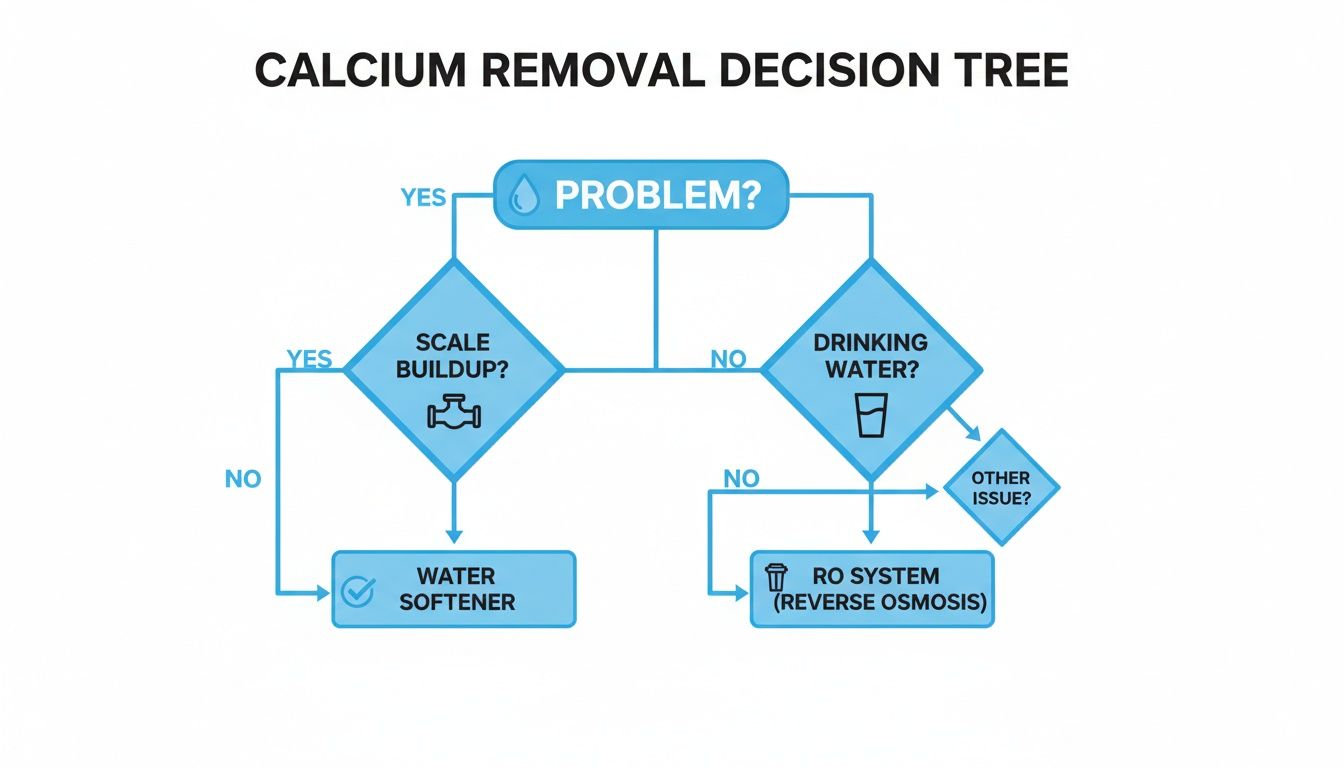
How to Treat Hard Water: A Homeowner’s Filtration Face-Off

Tired of chalky faucets, sad-looking soap suds, and dishes that come out of the dishwasher looking dirtier than they went in? You’re not just imagining it—you’re in a battle with hard water. The only way to win this war for good is to install a whole-house water filtration system that attacks the problem at the source, kicking those pesky hardness minerals like calcium and magnesium to the curb. This is your ticket to stopping limescale in its tracks, getting a luxurious lather, and saving your appliances from an early, crusty demise.

The Telltale Signs of Hard Water in Your Home

An old faucet with running water in a kitchen sink, showing mineral deposits from hard water.

Before you can pick your weapon, you need to be sure you're fighting the right enemy. Luckily, hard water isn't subtle. It leaves a trail of evidence all over your house, disguised as everyday annoyances you've probably just accepted as normal.

Hard water is simply water that’s loaded with dissolved minerals—mostly calcium and magnesium—that it picked up on its journey through the ground. While it’s perfectly safe to drink, it’s a menace to your home. So, if you think your shower doors have a permanent fog or your faucets look like they have a bad case of dandruff, you're not going crazy. That's just hard water making itself at home.

Visible Clues Around Your Sinks and Showers

The easiest place to spot the signs of this mineral invasion is wherever you use water the most. Your kitchen and bathroom are ground zero, and they're probably covered in a trail of gunk that defies all your cleaning efforts.

Look at the base of your faucets and around your showerhead. See that stubborn, white, crusty buildup? That's limescale, the calling card of hard water. It’s what’s left behind when water evaporates, and it’s basically rock. Another dead giveaway is the slimy soap scum that clings to your shower doors and tub. The minerals in your water are having a chemical party with your soap, creating that sticky, insoluble mess.

Chalky spots are another telltale sign, and they can be a real pain to remove. For some specific tips on that, check out Your Ultimate Guide to Removing Hard Water Spots on Windows.

You might also be dealing with:

  • Dull, spotty dishes and glassware: No matter how much rinse aid you use, your glasses look like they were dried with a dirty towel.
  • Weak water pressure: Limescale isn’t just an eyesore; it’s building up inside your pipes and faucet heads, slowly strangling your water flow.
  • That filmy feeling on your skin: The same reaction creating soap scum in your tub is happening on your body, leaving a residue that can clog pores and make your skin feel dry and itchy.

The Invisible Damage to Appliances and Fabrics

What you can't see is often doing the most damage. Hard water is waging a silent war on your appliances, and the collateral damage can get expensive.

Your water heater is public enemy number one for limescale. As it heats the water, scale forms directly on the heating elements, acting like a concrete blanket. This forces the unit to work way harder and burn more energy just to do its job, often leading it to fail years before its time. In fact, studies show that hard water can slash a gas water heater's efficiency by up to 24%.

Hard water doesn't just make cleaning harder; it actively works against the things you’re trying to clean. The minerals prevent detergents from lathering properly, meaning you have to use more product to get the same result, whether you're washing clothes, dishes, or yourself.

This problem carries over to the laundry room, too. Those same minerals get trapped in the fibers of your clothes, leaving them feeling stiff and scratchy. You’ll notice that your bright colors fade faster and your whites start looking dingy or gray, no matter how much bleach you throw at them. It’s a frustrating cycle of washing things that never seem to get truly clean.

To help you connect the dots, here’s a quick reference table.

Hard Water Problems and Their Filtration Solutions

This table breaks down the common issues you're seeing and points you toward the most effective water filtration system to solve them.

Common Problem Primary Cause Effective Filtration Solution
Limescale on fixtures & appliances High calcium and magnesium levels Ion-Exchange Water Softener, Salt-Free Conditioner
Soap scum & poor lather Minerals reacting with soap Ion-Exchange Water Softener
Dull, stiff, or faded laundry Mineral deposits in fabric fibers Ion-Exchange Water Softener
Dry skin and dull hair Soap residue left on skin/hair Ion-Exchange Water Softener, Showerhead Filter
Cloudy or spotty dishes Mineral deposits left after drying Ion-Exchange Water Softener, Reverse Osmosis
Reduced appliance efficiency Scale buildup on heating elements Ion-Exchange Water Softener

Ultimately, understanding these signs is the first step toward finding the right filtration treatment and reclaiming your home.

Alright, you've seen the signs. The soap scum that won’t quit, the chalky film on your faucets—something’s definitely up with your water. The next move is to find out just how hard it is.

Knowing your water's specific hardness level isn't just for bragging rights. It's the critical first step to choosing the right water treatment system. You don’t want to end up with a system that’s too weak to handle the job or, conversely, pay for more power than you actually need.

The Quick and Dirty Soap Suds Test

If you're impatient and want a rough idea right now, try the classic soap suds test. It's free, takes about five minutes, and all you need is a clean bottle with a cap and some basic liquid soap—think simple castile soap, not a fancy detergent.

Here's the drill:

  • Fill the clean bottle about a third of the way with your tap water.
  • Add around 10 drops of the liquid soap and screw the cap on tight.
  • Now, give it a good, hard shake for about 15 seconds.

Take a look. If your water is soft, you’ll see a nice, thick layer of suds, and the water below will be mostly clear. Hard water, on the other hand, will give you a sad-looking, suds-free surface and the water itself will look cloudy or milky. That cloudiness? That's your soap reacting with all the calcium and magnesium, creating the very soap scum you’re trying to get rid of.

For a More Accurate Number: DIY Test Strips

For a more scientific result, grab a pack of DIY water hardness test strips. They're cheap, easy to find at any home improvement store or online, and they give you a real number to work with.

You just dip a strip into a glass of tap water for a couple of seconds, pull it out, and wait. After a minute or so, the strip will change color. You then match that color to the chart that came in the kit.

The chart gives you a hardness reading, usually in Parts Per Million (PPM) or Grains Per Gallon (GPG). Professionals almost always talk in GPG, but the conversion is easy: 1 GPG equals 17.1 PPM.

This number is what really matters. For most homes, once you get over 7 GPG (or 120 PPM), you’re in the territory where a water softener starts to make a lot of sense. That’s the point where you’ll really see limescale build-up wreak havoc on your pipes and appliances.

For Pinpoint Accuracy: A Digital Tester

If you're a data geek or just want to be absolutely certain, a digital water tester is your best bet. These are handheld gadgets that measure the Total Dissolved Solids (TDS) in your water.

While a TDS meter measures everything dissolved in the water (not just the hardness minerals), a high TDS reading in city tap water is almost always a dead giveaway for high hardness. You get an instant, precise reading in PPM on a digital screen, which takes all the color-matching guesswork out of the equation. This kind of precision is perfect if you’re trying to dial in the settings on a high-efficiency water softener.

It's no surprise that more and more people are getting serious about this. The global water softener market was a US$2.9 billion industry back in 2022 and is projected to hit $6.8 billion by 2033. That’s a lot of homeowners deciding to protect their homes from hard water damage. You can check out more details on the water softener market trends on custommarketinsights.com.

Water Softeners vs. Water Conditioners: The Main Event

Okay, so you've confirmed hard water is the problem. Now, how do you fix it? When you're looking for a whole-house filtration solution, it really comes down to two main players: the classic salt-based water softener and the modern salt-free water conditioner.

This isn't just about plumbing hardware. It’s a choice between two completely different philosophies for dealing with those pesky minerals.

Think of it this way: a water softener is like a bouncer at a club, physically throwing the troublemakers (calcium and magnesium) out. A water conditioner, on the other hand, is like a skilled negotiator that convinces them to behave so they don't cause any problems. Both get the job done, but their methods are worlds apart.

The Classic Solution: Salt-Based Water Softeners

For most people, the image that pops into their head when they hear "hard water treatment" is a salt-based water softener. There's a good reason for that—they are the undisputed champions of hardness removal, and their method is both simple and incredibly effective.

The magic happens through a process called ion exchange. Your water flows through a tank filled with resin beads that are covered in sodium ions. Since the calcium and magnesium ions in your water have a stronger charge, they get pulled to the resin like a magnet, bumping the sodium ions off and into your water. It’s a direct swap: bad minerals out, harmless sodium in.

This total removal of hardness minerals is what gives you genuinely soft water. The difference is night and day:

  • Limescale vanishes: With the scale-forming minerals gone, they can't build up on faucets, shower doors, or inside your water heater.
  • Soap works like it should: You'll get that rich, sudsy lather you see in commercials. You'll also use way less soap, shampoo, and detergent.
  • That signature "slippery" feel: This is the tell-tale sign of truly soft water. Without minerals to react with soap, it rinses off completely, leaving your skin's natural moisture behind. It feels slick, but that’s actually the feeling of being 100% clean.

But this level of performance requires some upkeep. Eventually, those resin beads get clogged with all the minerals they've collected. To clean them, the system runs a regeneration cycle, flushing itself with a saltwater brine from a second tank. That brine tank is the part you have to keep topped up with heavy bags of salt.

The Modern Alternative: Salt-Free Water Conditioners

If you're looking for a way to stop scale damage without adding sodium to your water or lugging salt bags, a salt-free water conditioner is a fantastic option. The most important thing to know is that these systems do not remove the minerals, so they don't technically "soften" the water.

So what do they do? They change the minerals' behavior. The most proven technology here is Template Assisted Crystallization (TAC). As water flows through the TAC media, the calcium and magnesium minerals are converted into microscopic crystals.

These tiny, harmless crystals can't stick to pipes, fixtures, or heating elements. They just flow right on through your plumbing and down the drain. You get the number one benefit—scale prevention—without actually altering your water's mineral content. The healthy calcium and magnesium are still there, they've just been neutralized.

Here's the bottom line: Salt-free conditioners are all about preventing scale. You won't get that slippery feeling or mountains of soap bubbles, but you will protect your pipes, water heater, and dishwasher from destructive limescale.

This infographic lays out a few simple ways to figure out just how hard your water is. Knowing your numbers is the first critical step before picking any treatment system.

Infographic on water hardness testing, outlining a summary and three methods: DIY, test strips, and digital testers.

Whether you use a basic soap test or a precise digital meter, getting this data helps you choose and size your system correctly.

Making the Right Choice for Your Home

So, which one is for you? It really comes down to what you're trying to achieve. There’s no single “best” system, just the one that’s the best fit for your home and your priorities.

This head-to-head comparison should make the differences crystal clear.

Water Softener vs. Water Conditioner: Head-to-Head Comparison

Feature Salt-Based Water Softener Salt-Free Water Conditioner
Primary Function Physically removes calcium & magnesium Neutralizes minerals to prevent scale
How It Works Ion Exchange Template Assisted Crystallization (TAC)
Scale Prevention 100% elimination Excellent scale prevention (99%+ effective)
"Soft Water" Feel Yes, creates the distinct slippery feel No, water chemistry is unchanged
Soap Lather Significantly improves lather No change in lather
Maintenance Regularly add salt (40-50 lbs/month) Virtually maintenance-free
Environmental Impact Discharges salt brine into wastewater No salt, no waste, no electricity
Initial Cost Generally lower upfront cost Often a higher initial investment
Ongoing Costs Salt, water, and electricity for regeneration None
Best For Homeowners wanting to fix all hard water issues Homeowners focused on protecting plumbing & appliances

In the end, it’s a straightforward choice.

If you want the full soft-water experience—no scale, better skin and hair, and amazing soap lather—then a salt-based water softener is the clear winner. It's the only way to physically remove the minerals that cause all the problems.

If your main goal is to protect your home's expensive plumbing and appliances from scale buildup, and you want a zero-maintenance, eco-friendly solution, then a salt-free water conditioner is an excellent choice. It's the ultimate "set it and forget it" system for preventing the costly damage hard water can do.

Exploring Other Hard Water Filtration Methods

While whole-house softeners and conditioners are the heavy hitters, they aren't the only tools in your filtration arsenal. Sometimes, a more focused, targeted approach is exactly what’s needed.

Maybe you just want ultra-pure drinking water or a simple fix for your dry hair. For that, other filtration methods offer the perfect solution. These alternatives can work great on their own or even supplement a larger system, letting you fine-tune the water quality throughout your home.

Reverse Osmosis for Pure Drinking Water

You’ve probably heard of Reverse Osmosis (RO) systems. They are the gold standard for water purification, usually installed right under the kitchen sink with a small, dedicated faucet. An RO system is a multi-stage filtration beast that does a lot more than just soften water.

It works by pushing water through a special membrane filled with microscopic pores. This process strips out nearly everything that isn't H₂O, including:

  • Hardness minerals like calcium and magnesium
  • Contaminants like chlorine, lead, and pesticides
  • Dissolved solids, salts, and even fluoride

What you get is exceptionally clean, great-tasting water that's amazing for drinking and cooking. But that level of purification is exactly why RO is rarely a whole-house solution. These systems produce water slowly and create wastewater in the process, making them impractical and wasteful for things like showers and laundry.

Key Takeaway: An RO system is the ultimate point-of-use filtration fix for pristine drinking water. It will remove hardness minerals from the water you drink, but it isn't designed to protect your home's entire plumbing network from limescale.

The Power of Showerhead Filters

Is your main complaint about hard water what it does to your hair and skin? If so, a specialized showerhead filter is a fantastic and incredibly budget-friendly fix.

These devices are a breeze to install—they just screw on between your existing showerhead and the pipe coming out of the wall. They target the water exactly where it impacts your personal care routine the most.

They use filtration media, often a mix of KDF (Kinetic Degradation Fluxion) and carbon, to cut down on both hardness minerals and chlorine. While they don't technically "soften" water like an ion-exchange system, they do a great job reducing the scale and chlorine that are the real culprits behind dry, itchy skin and dull, brittle hair. This is an ideal solution for renters or anyone who wants to solve skin and hair issues without the cost of a whole-house system.

A Broader Look at Water Filtration

As you can see, treating hard water often involves more than just tackling minerals. The world of water filtration is huge, with systems designed for everything from sediment to specific chemical contaminants. For instance, you might have a softener to handle the minerals but still want a carbon filter to improve the taste and smell.

This is especially true in unique setups, like mobile living. In these cases, a broad approach to water quality is key. For more on keeping water clean on the go, you might want to read up on finding the best RV water filter system.

Reverse osmosis is only becoming more popular. In fact, within the water treatment world, reverse osmosis systems are expected to command about 35% of the market share by the end of 2035. It's easy to see why, since these membrane filters can remove up to 99% of water impurities. Whether it’s for your whole house, your RV, or just your drinking glass, understanding all these options is the key to finding the perfect fix for your water.

Installation and Maintenance for Your Filtration System

A man performing maintenance on a white water heater in a utility room with tools and a bucket.

Getting a hard water filtration system is a huge step, but the work doesn't stop once you've made the purchase. Proper installation and a little upkeep are what protect your investment and keep your home running scale-free for years to come.

Think of it this way: even a brand-new car needs its oil changed.

A whole-house system is a serious piece of plumbing. You're cutting into your home's main water line, which can feel pretty daunting. Your first big call is deciding whether to roll up your sleeves and do it yourself or bring in a pro.

DIY Installation vs. Professional Help

If you're already comfortable with plumbing projects, a DIY installation is definitely on the table. Most systems arrive with detailed instructions, and the basic process is straightforward: shut off the main water, cut a piece of pipe, and hook up the new unit. If you've handled pipe cutters, soldering, or PEX fittings before, you'll probably feel right at home.

For a lot of folks, though, this is a job best left to a professional plumber.

A licensed pro brings a lot to the table. They’ll ensure the system is installed to code, won’t leak (preventing a potential disaster), and can help you figure out the optimal spot for the unit. That's a big deal, especially since a salt-based softener needs to be near both a drain and a power outlet.

Expert Insight: Spending a few hundred dollars on a professional installer buys you total peace of mind. A bad install can cause leaks, a drop in water pressure, or even void your warranty, which makes hiring a pro a smart move for such a long-term home improvement.

Your Long-Term Maintenance Checklist

Once your system is up and running, a little routine care goes a long way. The maintenance you'll need to do really depends on the type of filtration system you picked.

For a traditional salt-based water softener, your main task is pretty simple: keep the brine tank topped up with salt. Here’s what that looks like:

  • Check the Salt Level: Take a peek inside the brine tank at least once a month.
  • Refill as Needed: A good rule of thumb is to keep the tank at least one-third full. For a typical family of four, you'll likely add one 40-pound bag of salt every month or two.
  • Choose the Right Salt: Stick to high-purity salt pellets made specifically for water softeners. Cheaper rock salt often has dirt and gunk that can clog up the system's more delicate parts.
  • Clean the Brine Tank: About once a year, it's a great idea to empty and clean out the brine tank. This gets rid of any sediment or "salt mush" that’s built up on the bottom.

Care for Salt-Free and Cartridge-Based Systems

If you went with a salt-free water conditioner that uses Template Assisted Crystallization (TAC), your to-do list is much shorter. There's a reason people call these "set it and forget it" solutions.

The TAC media inside the tank will eventually need to be replaced, but usually only every three to five years. It's a job many homeowners can handle themselves in under an hour—just unscrew the tank head, dump out the old media, and pour in the new.

For smaller, cartridge-based filters, like the ones you find on showerheads or under a sink, it’s even easier. All you have to do is swap out the filter cartridge based on the manufacturer's schedule, which is typically every six months to a year. Keeping up with this is key to making sure the filter keeps doing its job effectively.

Your Hard Water Questions Answered

After digging into all the different filtration methods for hard water, there are always a few questions that pop up. This is where we tackle those last few uncertainties head-on, giving you straight answers to the things we hear most often from homeowners just like you. Let's get everything cleared up so you can feel good about your next step.

Will a Water Softener Make My Drinking Water Salty?

This is probably the biggest myth we run into, and it's a totally fair question. While salt-based softeners do use sodium chloride (salt) to regenerate, the actual amount of sodium that makes its way into your tap water is tiny.

It's an ion exchange, not an addition. The system swaps a sodium ion for a calcium or magnesium ion. For most homes with moderately hard water, the sodium added is less than what's in a single slice of white bread. Honestly, you'd be hard-pressed to taste any difference at all.

That said, if you're on a strict, doctor-ordered low-sodium diet, it's something to discuss with them. A great workaround many people choose is to install a whole-house softener and then add a reverse osmosis system under the kitchen sink. You get the best of both worlds: your whole house is protected from scale, and you have ultra-pure, sodium-free water for drinking and cooking.

Can I Treat Hard Water if I Live in an Apartment?

You absolutely can. Installing a big whole-house system is usually off the table for renters, but you’ve still got some fantastic point-of-use filtration options that can make a world of difference. You don't have to just put up with hard water because you don't own the place.

Here are the most common filtration fixes for renters:

  • Showerhead Filters: This is the go-to for apartment dwellers. A simple screw-on shower filter designed for hard water can drastically cut down on scale and chlorine. The result? Skin that feels softer and hair that's healthier and easier to manage.
  • Faucet-Mounted Filters: For your kitchen sink, a filter that attaches right to the faucet is an easy way to improve the taste and quality of the water you drink and cook with.
  • Countertop Filtration Systems: From simple pitcher filters to more advanced countertop units, you can get great-tasting, filtered water without touching the plumbing at all.

These targeted solutions let you enjoy many of the perks of treated water without making a single permanent change.

How Do I Choose the Right Size Water Softener?

Getting the right size water softener is a huge deal for its efficiency and your long-term happiness with it. If it's too small, it will regenerate constantly, wasting salt and water. If it's too big, you've just spent more money than you needed to.

The right size all comes down to two numbers: your water hardness level (in Grains Per Gallon, or GPG) and how much water your household uses each day.

You can figure out your daily needs with a quick calculation:
(Number of People in Home) x (75 Gallons per Person) x (Your Water’s GPG) = Daily Grains to Remove

Let's walk through a real-world example. A family of four with water that has a hardness of 10 GPG would figure it out like this: 4 people x 75 gallons x 10 GPG = 3,000 grains per day. Since you want the system to go a few days between regeneration cycles, a standard 32,000-grain unit would be a solid choice for this family. Most manufacturers have easy-to-read sizing charts to help you lock in the perfect model. For more general filtration questions, you can always find more in-depth articles in our water filter advice section.


At Water Filter Advisor, our goal is to give you the clear, unbiased information you need to find the perfect solution for your home's water. Whether you need a whole-house system or a simple faucet filter, explore our guides and reviews to make a confident choice. Visit us at https://www.waterfilteradvisor.com to get started.

How to Get Rid of Calcium in Your Water: The Ultimate Homeowner’s Guide

Tired of chalky water spots and crusty faucets? The most effective way to eliminate calcium from your home's water is with a whole-house ion-exchange water softener. If you're only after pure water for drinking and cooking, a point-of-use reverse osmosis system under your kitchen sink is your best bet. This guide will break down the science, cut through the jargon, and help you choose the right filtration system to declare victory over hard water.

The Hard Truth About Your Home's Water

A kitchen sink with a faucet and dirty dishes, showing visible hard water stains and mineral deposits.

If you're locked in a never-ending battle with stubborn white spots on your glassware, constantly scrubbing crusty buildup off your showerheads, or wondering why your towels feel like sandpaper, you’re not alone. Welcome to the world of hard water, where the main villain is dissolved calcium.

This isn't some industrial pollutant; it’s a natural mineral that water absorbs as it travels through underground rock like limestone and gypsum. Whether you're on city water or a private well, this invisible mineral can infiltrate your pipes and become your home's arch-nemesis. It's the secret force behind some of your most frustrating household chores.

Why Calcium Is a Household Nuisance

While calcium is perfectly safe to drink, the high concentrations found in hard water create a host of expensive and infuriating mechanical problems. And the damage goes far beyond a few unsightly stains.

  • Appliance Sabotage: Calcium buildup, also known as limescale, forms an insulating layer on the heating elements in your water heater and dishwasher. This forces them to work harder and guzzle more energy just to reach the right temperature, leading to higher bills and premature failure.
  • Plumbing Clogs: Over time, limescale builds up inside your pipes, slowly choking off the flow of water. You might first notice a drop in water pressure, which can eventually lead to a full-blown, wallet-draining plumbing emergency.
  • Personal Care Problems: That same mineral residue doesn't just stick to pipes—it clings to your skin and hair, leaving them feeling dry, brittle, and lifeless. It also clogs pores and neutralizes soaps and shampoos, preventing them from lathering up properly.

Water hardness is one of the most common water quality headaches homeowners face. According to the U.S. Geological Survey, water with calcium levels over 120 mg/L is considered very hard. That level of hardness can slash an appliance's energy efficiency by 15-25%. The constant strain from limescale forces your machines to work overtime, shortening their lifespan and driving up your utility bills.

The frustrating cycle of cleaning, scrubbing, and replacing appliances often leads back to one root cause: hard water. By tackling the calcium at its source, you can protect your investments and simplify your daily routines.

The impact of hard water goes beyond your home's pipes and appliances. For hobbyists, managing water parameters is everything, highlighting the crucial need for specific water conditions in aquariums. It's a perfect example of how mineral content affects more than just our plumbing.

If you want to dive deeper into different filtration options, you can explore plenty of comprehensive guides and advice over at https://www.waterfilteradvisor.com.
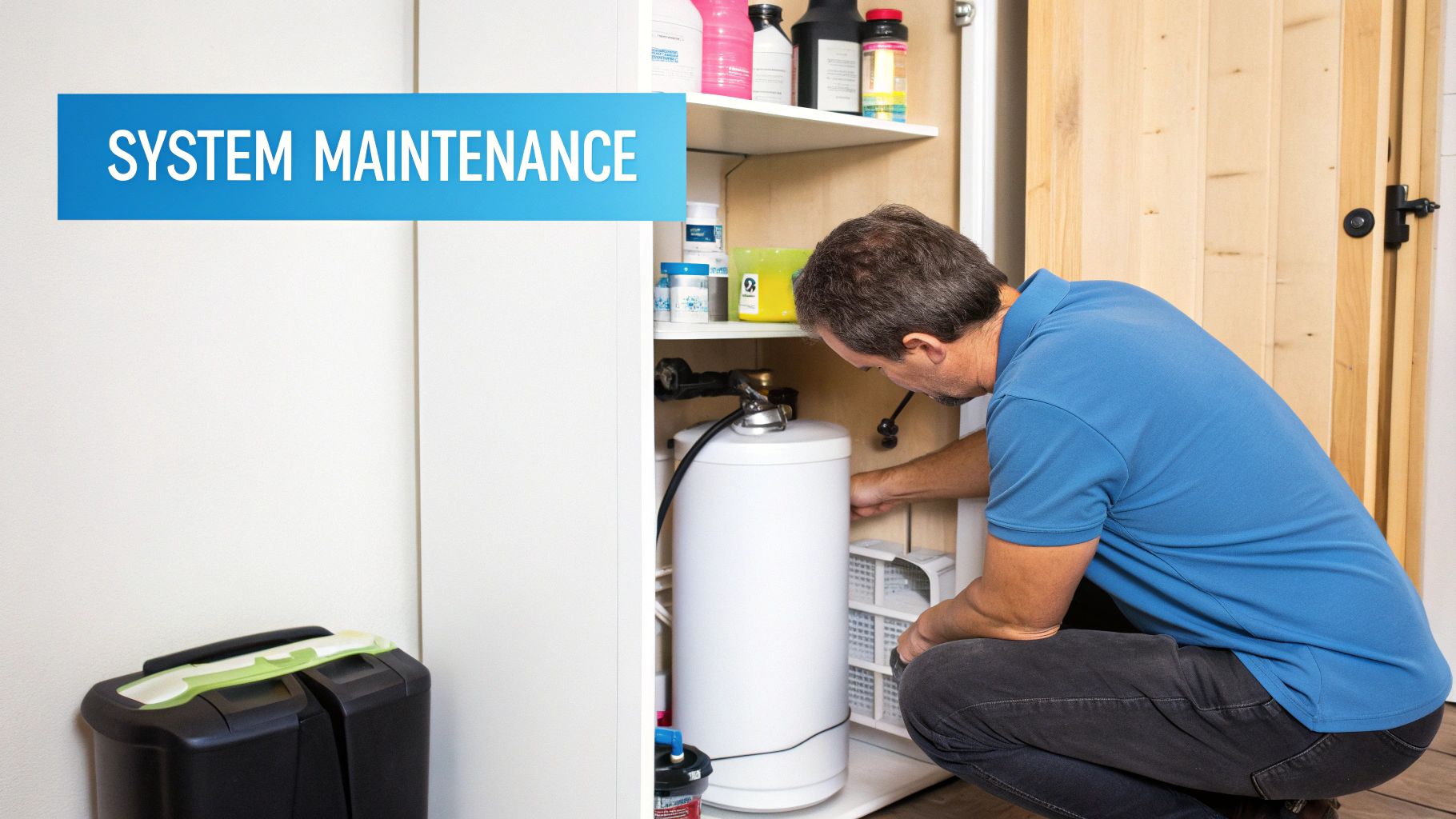
Pinpointing Your Calcium Problem: What the Tests Reveal

Before you can declare war on hard water, you need to know exactly what you’re fighting. It’s like a doctor diagnosing an illness before prescribing medicine—guessing is not an option. Measuring the calcium level in your water gives you a specific number, and that number is the single most important factor in choosing the right filtration system.

Trying to figure out how to get rid of calcium in water without knowing your hardness level is a recipe for failure. You could end up with a system that's too weak for the job or, just as bad, an overpowered one that wastes salt and water.

Starting with Simple Home Observations

You can get a quick gut check on your water with a simple, old-fashioned soap test. Grab a clear bottle with a tight-fitting cap, fill it halfway with tap water, and add about ten drops of pure liquid soap (like castile soap, not detergent).

Shake it vigorously for 30 seconds. If you get a thick, sudsy head of foam that sticks around, your water is likely on the softer side. If all you see are a few pathetic bubbles and a cloudy, milky film, you’re definitely dealing with hard water. This won't give you a precise number, but it confirms your suspicions and tells you it's time to dig deeper.

Getting a Specific Number with Test Strips

For a more accurate measurement, home water hardness test strips are an affordable and incredibly easy option. You can grab them at most home improvement stores or online. They work just like a litmus test: dip a strip into a glass of tap water, wait a few seconds, and then compare the color to a chart on the package.

That chart translates the color into a specific hardness level, usually measured in grains per gallon (GPG). This is the magic number you need. For instance, a result of 12 GPG tells you your water is "very hard" and gives you the exact data needed to properly size a water softener.

Knowing your GPG is non-negotiable. It dictates the grain capacity of the water softener you'll need and ensures it regenerates at the right intervals, saving you money on salt and water while guaranteeing soft water on demand.

The Most Accurate Testing Methods

For the highest degree of accuracy, you have two great options. If you're on city water, your local utility is required to publish a yearly Water Quality Report (sometimes called a Consumer Confidence Report). You can usually find this on their website, detailing everything about your water supply, including its average hardness level.

If you have a private well, sending a sample to a certified water testing laboratory is the best investment you can make. This will not only give you a precise hardness reading but will also screen for other potential contaminants. It gives you a complete picture of your water's chemistry so you can choose a system that addresses all your home's needs.

Imagine this: a family buys a new, high-efficiency washing machine but is constantly frustrated because their clothes come out stiff and dingy. They blame the machine, but a simple $10 test kit reveals their water is a staggering 18 GPG. Armed with this number, they install a properly sized water softener, and suddenly, the washer performs perfectly. That small diagnostic step saved them from needlessly replacing an expensive appliance.

Alright, you've got your water test results in hand and now it's time to pick your weapon. Walking into the world of water treatment can feel overwhelming, with a bunch of technical jargon like "ion exchange" and "reverse osmosis" getting thrown around.

Let's cut through the noise. I'm going to break down the most common ways to deal with calcium in your water so you can figure out what actually makes sense for your house.

This decision tree gives you a good visual of where to start. It's all about figuring out if you have a problem first, then deciding how deep you need to go with testing.

The bottom line is simple: you have to confirm you've got hard water before you start shopping. A quick DIY test can give you a clue, but a lab analysis gives you the hard numbers you need to make a smart choice.

Ion Exchange Water Softeners: The Gold Standard

If you want to protect your entire home—we're talking pipes, faucets, showerheads, and every appliance that uses water—then a traditional salt-based water softener is the undisputed champ. This is the only method that physically yanks the hard minerals right out of your water.

They work on a principle called ion exchange. Water flows into a tank filled with resin beads coated in sodium. The calcium and magnesium in your water are like magnets to these beads, sticking to them and "kicking off" the sodium into the water.

The result? Genuinely soft water. The kind that feels silky smooth, makes soap lather like crazy, and stops scale buildup dead in its tracks. It’s a true whole-house fix that tackles the problem at its source.

Salt-Free Water Conditioners: A Different Approach

You've probably seen "salt-free water softeners" advertised. Let's be crystal clear: these are water conditioners, not softeners. They don't actually remove any calcium.

Instead, they use a clever bit of science (often called Template Assisted Crystallization, or TAC) to change the physical form of the calcium minerals. Think of it like turning sticky Velcro into smooth little crystals that can't grab onto pipes or fixtures.

This is a great way to prevent scale buildup, but the calcium is still there. You won't get that classic "slick" feel of soft water and might still see some light water spots, but it's a fantastic, low-maintenance option if you just want to protect your plumbing without adding salt.

Reverse Osmosis: For Pure Drinking Water

Maybe you're not worried about your pipes, but you want absolutely pure, amazing-tasting water for drinking and cooking. In that case, a reverse osmosis (RO) system is what you're looking for.

These are typically installed right under the kitchen sink. An RO system pushes water through an incredibly fine membrane that acts like a bouncer, blocking up to 99% of all dissolved solids—calcium included.

You get incredibly clean water from a special, dedicated faucet. The catch? It's a "point-of-use" solution. It does nothing to protect your dishwasher, shower, or water heater from scale. For extreme purity, some specialized systems like lab water purifiers for distilled water use similar, highly advanced filtration principles.

Calcium Removal Methods at a Glance

To make it even simpler, here’s a side-by-side look at how these options stack up.

Treatment Method How It Works Effectiveness on Calcium Average Upfront Cost Ongoing Maintenance
Ion Exchange Water Softener Physically removes calcium and magnesium ions, replacing them with sodium ions. Excellent. Completely removes hardness minerals for whole-house protection. $800 – $3,000+ Regular salt refills (typically every 1-2 months).
Salt-Free Water Conditioner Alters mineral structure to prevent scale formation without removing calcium. Good at scale prevention. Does not soften water or remove calcium. $600 – $2,000 Minimal. Media replacement may be needed every 3-6 years.
Reverse Osmosis System Forces water through a fine membrane to remove dissolved solids. Excellent. Removes up to 99% of calcium at a single point of use. $200 – $600 Annual filter and membrane replacements.
Magnetic Descaler Uses a magnetic field to supposedly alter mineral ions. Poor / Unproven. Lacks consistent scientific backing for effectiveness. $100 – $400 None. "Set it and forget it" installation.

As you can see, the right choice really boils down to whether you want to completely remove calcium for your whole house or just manage its effects at specific taps.

What About Magnetic Descalers?

You’ll also stumble across magnetic or electronic "descalers." These are little gadgets that you clamp onto the outside of your main water pipe. The claim is that a magnetic field changes the calcium ions so they won’t form scale.

Frankly, the science behind these is shaky at best. While some people swear they see a small difference, most independent tests and plumbing pros agree they just don't provide the reliable, long-term results you get from a real softener or conditioner. I generally tell people to save their money and invest in a proven technology.

Sizing and Selecting Your Water Filtration System

Alright, you've got your water test results in hand. Now comes the fun part: picking the right hardware to finally get rid of that pesky calcium.

This is where a little bit of planning can save you a mountain of headaches later. One of the most common—and costly—mistakes homeowners make is choosing the wrong size system. You either end up with a unit that can't keep up with demand or, just as bad, one that’s constantly wasting salt and water.

Let’s walk through exactly how to match a filtration system to your home's unique needs. Getting this right means you’ll nail that perfect balance of performance and efficiency.

Calculating Your Water Softener Grain Capacity

When you're shopping for water softeners, "one size fits all" is a recipe for disaster. The most important number you need to get familiar with is grain capacity. This tells you how many "grains" of hardness the softener can pull out of your water before it has to run a cleaning cycle, which is called regeneration.

To figure out the right capacity, you only need two things:

  • Your water hardness in grains per gallon (GPG). This is the key number from your water test.
  • Your family's daily water usage. A solid rule of thumb is 75 gallons per person, per day.

The math is actually pretty simple:
Number of People x 75 Gallons/Person x Hardness (GPG) = Total Grains Per Day

That final number is the daily workload your softener will be up against. With that, you can pick a system sized to regenerate about once a week—the sweet spot for peak efficiency.

Pro Tip: Try to find a softener that regenerates roughly every seven days. If it regenerates too often, you're just throwing money away on salt and water. If it waits too long, you risk hard water "bleeding" back into your pipes before the cycle runs.

A Real-World Sizing Example

Let's make this real. Imagine a family of four—two adults, two teenagers, and a dishwasher that seems to be running 24/7.

  • Family Size: 4 people
  • Water Hardness Test Result: 15 GPG (which is considered very hard)

Here’s how they'd calculate their daily grain requirement:
4 people x 75 gallons/person x 15 GPG = 4,500 grains per day

Since the goal is a weekly regeneration cycle, we just multiply that by seven days:
4,500 grains x 7 days = 31,500 grains

Based on this, the family should be looking for a water softener with a capacity of at least 32,000 grains. A standard 32k-grain unit would be a perfect match, easily handling their high water usage without constantly having to regenerate.

Whole-House vs. Point-of-Use: The Strategic Choice

Your next big decision is about scope. Are you trying to protect your entire home from calcium buildup, or is your main goal just to get crystal-clear drinking water at the kitchen sink?

A whole-house water softener is your go-to solution if you want to eliminate calcium everywhere. It gets installed right where the main water line enters your home, which means every faucet, showerhead, and appliance—from the water heater to the washing machine—gets treated, soft water. This is the best way to protect your plumbing and extend the life of your appliances.

On the flip side, a point-of-use (POU) system, like an under-sink reverse osmosis (RO) filter, is a more targeted approach. It delivers incredibly pure water to a single tap, which is perfect for drinking and cooking. Just remember, it won't do a thing to stop scale from building up in your pipes or dishwasher. The right choice really just depends on what problem you're trying to solve.

Look for Credible Certifications

In the world of water treatment, it’s easy for a company to make big claims. Real proof is what separates the good from the junk. To make sure you’re buying a product that actually does what it promises, always look for third-party certifications from reputable organizations.

  • For water softeners, the gold standard is NSF/ANSI 44. This certification guarantees the system effectively reduces hardness as advertised.
  • For reverse osmosis systems, look for NSF/ANSI 58. This confirms the system's ability to reduce a whole host of contaminants, including dissolved solids like calcium.

Think of these certifications as your quality-control check.

This is especially critical when you look at the global picture. The World Resources Institute has documented that 25 countries, home to a quarter of the world's population, face extreme water stress. In these areas, shrinking water supplies often lead to higher concentrations of minerals. This makes effective calcium removal a must-have for both homes and industries. You can explore the findings on high water-stress regions to learn more about these growing challenges.

Installation and Maintenance for Lasting Results

A person maintains a water softener system, pouring water into its brine tank for optimal function.

You've done the research and picked out the perfect water treatment system. That’s a huge win, but it's really only half the battle.

The truth is, a top-of-the-line softener with a sloppy installation is just a fancy, oversized paperweight. Proper setup and a little routine upkeep are what really lock in years of soft, scale-free water.

Whether you're a confident DIYer ready to roll up your sleeves or you'd rather leave it to the pros, let's walk through what it takes to get it done right.

The DIY Installation Path

If you're comfortable with basic plumbing, installing a water softener can be a totally manageable weekend project. It just requires attention to detail. The whole idea is to install the unit near your main water line—usually in the garage, basement, or a utility closet—before the line splits off to your water heater.

Before you even think about cutting pipes, make sure you've got the right gear. A smooth installation is all about having the proper tools from the start.

  • Essential Tools for the Job:
    • Pipe cutters and a deburring tool (for clean, professional cuts)
    • Two adjustable wrenches to get fittings nice and snug
    • Teflon tape for creating those crucial leak-proof seals
    • A tape measure and a level to keep everything straight
    • The right pipes and fittings for your specific plumbing (PEX, copper, or PVC)

One of the most important parts of any softener is the bypass valve. This is a godsend. It lets you route water around the softener for maintenance or repairs without shutting off water to the entire house. Trust me, you’ll be glad it's there.

On a difficulty scale of 1 to 10, I’d put a DIY softener installation around a 6 or 7. It’s definitely more involved than changing a faucet, but it's not as intense as replumbing a whole bathroom. If cutting into your home's main water line makes you nervous, it's always smarter to call a pro.

Vetting a Professional Plumber

Not into the idea of a DIY plumbing project? No problem. Hiring a qualified plumber is the most surefire way to get the job done right. But don't just hire the first person who pops up in a search.

A great installation starts with asking the right questions. When you're getting quotes, make sure you ask:

  • "How many water softener installations have you done?" (You want experience here.)
  • "Are you fully licensed and insured for this type of plumbing work?"
  • "Does your quote include all parts and labor, or will there be hidden fees?"
  • "Do you offer a warranty on your installation work?"

A plumber who gives you confident, straightforward answers to these questions is likely a pro you can trust.

A Simple Maintenance Schedule for Peak Performance

Once your system is up and running, a little routine care is all it takes to keep it working perfectly for years. Think of it like changing the oil in your car—a small task that prevents huge, expensive problems.

1. Keep the Salt Topped Off: This is your main job. Check the brine tank about once a month and add salt as needed. The golden rule is to always keep the salt level above the water line. This ensures the system can make the brine solution it needs for the regeneration cycle.

2. Clean the Brine Tank Annually: At least once a year, it’s a good idea to empty and clean out the brine tank. Over time, salt impurities can form a "salt bridge" or a layer of sludge at the bottom, which can clog up the works.

3. Check the Settings Periodically: If you suddenly notice your water feels hard again or your salt usage goes through the roof, your settings might have been knocked out of whack. Just take a look and verify the hardness level programmed into the control valve still matches your original water test results.

Got Questions About Removing Calcium from Water?

Even after you've done your homework on getting rid of calcium in your water, a few questions always seem to come up. Let's tackle those last-minute uncertainties and bust a few common myths so you can move forward with total confidence.

It's perfectly normal to have some lingering thoughts. You're making a pretty big decision for your home, after all, and you want to know you've covered all your bases. Here are the most common questions we hear from homeowners just like you.

Will a Refrigerator or Pitcher Filter Get Rid of Calcium?

This is a big one, and the answer is a hard no. Your standard refrigerator filter, countertop pitcher, or the little filter you screw onto your faucet are almost always just activated carbon. Their job is to make your water taste and smell better by grabbing things like chlorine.

They simply aren't designed to capture dissolved minerals like calcium and magnesium—those minerals sail right on through. To actually pull calcium out, you need a system built for that specific job, like a water softener that uses ion exchange or a reverse osmosis system that filters water down to the molecular level.

Is It Actually Unhealthy to Drink Hard Water?

For most people, drinking hard water is totally fine. In fact, it can be a small source of essential minerals like calcium and magnesium. The fight against hard water is really about protecting your house, not your health.

The real problems are mechanical and financial. Hard water is brutal on your appliances, clogs up your pipes, and leaves that scaly film on your skin and hair. The only time a health concern might come into play is for someone with specific medical issues, like a history of kidney stones. In that case, they should definitely talk to their doctor.

I Installed a Softener, So Why Do My Dishes Still Have Spots?

This is super frustrating, but it's usually an easy fix. If you're seeing spots on "clean" dishes after putting in a new softener, a few things could be going on.

First off, a rinse aid is your dishwasher's best friend, even with soft water. It helps water slide right off the dishes so spots can't form as they dry. Second, go check the settings on your softener's control head. If the hardness level is programmed too low, the system won't regenerate often enough and some hard water can slip through.

And finally, take a look in the brine tank. The number one reason a softener stops working is because it's out of salt. No salt means the resin beads can't get recharged to do their job.

What’s the Annual Cost to Run a Water Softener?

A lot of homeowners worry about the ongoing costs, but you'll be surprised at how low they are. You're really only looking at two things: salt and a tiny bit of electricity.

A typical family of four can expect to spend somewhere between $50 and $100 a year on salt, depending on how hard their water is and how much they use. The electricity is minimal—often less than what your digital alarm clock uses.

Most people find these costs are easily covered by the savings. You’ll use less soap, detergent, and cleaning supplies, and you’ll significantly extend the life of your water heater and dishwasher, which helps you avoid having to replace them way too early.


At Water Filter Advisor, we believe everyone deserves access to clean, high-quality water. Our in-depth guides and unbiased reviews are designed to help you navigate your options and make the best choice for your family. Explore our resources to find the perfect solution for your home at https://www.waterfilteradvisor.com.

Whole House Water Filtration: Your Ultimate Guide to Cleaner, Safer Water at Home

Ever wonder what's really in your tap water? When you start exploring ways to improve it, you'll quickly run into the great debate: whole house water filtration vs water softener. But here’s the secret: they're not really in competition. One is about creating the healthiest, best-tasting water imaginable, and the other is a specialized tool for a very specific plumbing problem.

Let's focus on the star of the show: the whole house water filter. Think of it as a personal bodyguard for every drop of water that enters your home. Its mission? To purify your water by removing a whole host of unwanted contaminants, giving you healthier, tastier water from every single tap. On the other hand, a water softener is more like a plumber's assistant, designed solely to remove hard minerals that clog up your pipes.

Depending on your water, you might need one, the other, or even both. But understanding the power of filtration is the first step to truly transforming your home's water.

What Problem Are You Really Trying to Solve?

Let's cut through the jargon. What's the real difference between a filter and a softener?

Imagine a water filter is a high-tech security system for your body, while a water softener is an insurance policy for your pipes.

A white water filter cartridge, a glass of water, and a kitchen sink with a 'FILTER VS SOFTENER' sign.

A whole-house water filter is all about your health, safety, and senses. Its job is to be an uncompromising gatekeeper, trapping and removing a wide range of impurities. We're talking about things that can make your water unsafe, smell like a swimming pool, or taste like dirt. It’s the hero your water deserves.

A water softener, by contrast, is a one-trick pony—a very useful one, but still a specialist. Its single, focused mission is to combat "hard water," which is water loaded with minerals like calcium and magnesium. These minerals are harmless to drink but are absolutely brutal on your pipes, faucets, and appliances.

The Core Mission of Filtration

To put it plainly, you get a filter to protect your family's health. You get a softener to protect your financial investment in your home. A filter targets the quality of the water you drink, cook with, and bathe in; a softener deals with the destructive consequences of your water's mineral content.

This is the critical takeaway. A filter won't soften your water, and a softener won't remove chlorine, lead, or pesticides. Each is a specialized tool for a specific task, but filtration is the one that directly impacts your well-being.

Here's the simplest way to remember it: Filtration is for consumption and health, while softening is for plumbing and appliance preservation. Once you get that, you're on your way to diagnosing your water woes and finding the perfect solution.

Let's break it down side-by-side to make it even clearer.

Feature Whole House Water Filtration Water Softener
Primary Goal Purification: To remove contaminants from water. Protection: To remove hardness minerals from water.
What It Removes Chlorine, sediment, pesticides, lead, VOCs, and other chemicals. Calcium, magnesium, and sometimes small amounts of iron.
Key Benefit Improves water taste, odor, and safety for drinking and bathing. Prevents scale buildup, extending appliance life and improving efficiency.

Ultimately, it’s not always an either/or choice. Many homes—especially those on well water—are stuck with both hard water and other contaminants. For them, the ultimate setup involves both systems working in tandem to deliver genuinely clean, problem-free water from every faucet.

How a Whole House Filter Cleans Your Water

Think of a whole house water filtration system as a dedicated security checkpoint for your home's entire water supply. Installed right where the main water line enters your house, its sole job is to stop an army of contaminants before they ever reach your taps. This isn't just a simple strainer; it's a multi-stage purification process designed to give your water a serious upgrade from the ground up.

Your water embarks on a journey through different layers of specialized filter media, with each layer targeting specific impurities. It’s a comprehensive strategy that ensures every single drop—whether for drinking, cooking, or showering—is cleaner, safer, and tastes amazing.

Water pouring from a modern kitchen faucet into a clear glass on a wooden countertop.

This is the heart of the whole house water filtration vs water softener discussion. While softeners tackle minerals, filtration systems are engineered to purify water by removing the things that impact its taste, smell, and safety.

The Unsung Heroes: Filter Media

The real magic happens inside the filter tanks, where different types of filter media team up to form a powerful line of defense against common water contaminants.

  • Sediment Pre-Filters: This is stage one, the bouncer at the door. These filters catch the big stuff—sand, silt, rust, and dirt. Removing this gunk not only makes your water look clearer but also protects the more advanced filter stages from getting clogged and worn out prematurely.

  • Activated Carbon Filters: This is the brains of the operation. Activated carbon is an incredibly porous material with a massive surface area, making it a rockstar at trapping chemical contaminants through a process called adsorption. It effectively grabs onto chlorine, pesticides, herbicides, and volatile organic compounds (VOCs), which is why your water suddenly starts tasting and smelling fantastic.

Think of activated carbon as a powerful magnet for chemicals. As water flows through, unwanted contaminants stick to the carbon's surface, letting wonderfully pure water flow into your home. This is exactly how that "public pool" smell from chlorinated city water vanishes.

Whole house filters are designed to capture a wide array of contaminants that municipal treatment plants might not completely remove. They can handle everything from chlorine and its byproducts to heavy metals like lead. In fact, real-world tests show just how effective they are, with some systems reducing lead levels to 0.0007 ppm and eliminating disinfection byproducts entirely. For a closer look at what these filters remove, this whole-home water filtration system guide is a great resource.

The Real-World Health Perks

By removing this cocktail of contaminants, a whole house filter does far more than improve your water's taste. It’s a direct investment in your family's health and well-being.

Filtering water at the point of entry means you’re protected from contaminants in the water you drink and the water you shower in. Your skin is your body's largest organ, and it can absorb chemicals like chlorine directly from shower water. By eliminating these substances, a great filtration system can lead to softer skin, healthier hair, and even better indoor air quality by reducing chemical vapors released during a hot shower.

At the end of the day, a whole house filtration system delivers unparalleled peace of mind. You can trust that the water from every tap is consistently clean and safe, tackling potential health concerns at the source.

How Water Softeners Protect Your Home

If a whole-house filter is the guardian of your family's health, a water softener is the bodyguard for your home's plumbing and appliances. It’s designed to fight a single, destructive enemy: hard water.

Hard water is just water that’s loaded with dissolved minerals, mostly calcium and magnesium. While these minerals won't hurt you to drink, they can absolutely wreck your home from the inside out.

A water softener has one job and one job only: stop those minerals before they can cause any damage. This is the fundamental difference to keep in mind when comparing whole-house water filtration vs. water softener systems. One is for broad-spectrum contaminant removal, and the other is a specialist, surgically targeting the minerals that lead to expensive problems.

A white water filter system on a blue mat next to a kitchen sink with clean glasses.

This distinction matters because hard water is everywhere. More than 85% of homes in the U.S. deal with it. The fallout is significant—scale buildup from hard water can drive up a home's energy costs by as much as 29% and slash the lifespan of your appliances by 30%.

The Science of Ion Exchange Explained Simply

The magic behind a salt-based water softener is a process called ion exchange. Think of it as a simple trade. The main tank of the softener is filled with tiny resin beads that are covered in sodium ions.

When hard water flows over these beads, the calcium and magnesium ions—which have a stronger electrical charge—are drawn to the resin. They literally bump the weaker sodium ions off and take their place. The sodium flows out with the water, leaving you with "soft" water that's free of those damaging minerals.

It’s a simple swap, but it completely changes how your water behaves. The system works automatically until the resin beads are full of hardness minerals. Then, it runs a "regeneration" cycle to wash the minerals away and recoat the beads with fresh sodium.

Solving Everyday Hard Water Annoyances

You’ll see the benefits of this mineral swap almost right away. Soft water makes a huge difference in daily chores and eliminates all those frustrating hard water symptoms.

Here’s what you can expect:

  • Soap That Actually Lathers: Hardness minerals kill suds. With soft water, you’ll find yourself using way less soap, shampoo, and detergent to get a rich, cleansing lather.
  • Spotless Dishes and Glassware: That annoying cloudy film on your glasses? It’s mineral residue. Soft water rinses completely clean, leaving dishes and glassware sparkling.
  • Brighter, Softer Laundry: The same minerals that spot your dishes also get trapped in your clothing fibers, making them feel stiff and look dull. Soft water helps detergent work better, keeping colors vibrant and fabrics feeling soft.

A water softener’s primary job is to stop scale buildup before it starts. By removing calcium and magnesium, it protects the expensive, hard-working parts of your home's plumbing from the inside out.

Protecting Your Home's Most Valuable Assets

Beyond the daily perks, a water softener offers critical long-term protection for your home. The biggest threat from hard water is limescale—that hard, chalky gunk that clogs up pipes, faucets, and appliances.

Scale acts like cholesterol in your home’s arteries. It restricts water flow and makes your appliances work much harder than they should, eventually causing them to fail. Hard water can also cause other malfunctions, like the ones covered in this list of common reasons your dishwasher might not be getting water.

By preventing scale from ever forming, a water softener extends the life and efficiency of your most expensive appliances—like your water heater, dishwasher, and washing machine. It saves you a fortune in premature replacement costs and frustrating repair bills.

Comparing Filtration and Softening Head-to-Head

So, when it comes down to the whole house water filtration vs water softener choice, you need to look past the sales pitch and get into the practical, day-to-day realities. How do they actually work? What’s the upkeep really like? What will they cost you over the long haul?

Let's put these two systems side-by-side and break down how they perform in the areas that actually matter to a homeowner. This isn’t just about what’s getting pulled out of your water; it’s about what it’s like to live with each of these systems.

Primary Function: Health vs. Protection

The biggest difference between these two is their fundamental mission. A whole-house water filter is all about your health. Its job is to purify your water by taking out a wide range of nasty contaminants to improve the safety, taste, and smell of the water you drink and use every day.

A water softener, on the other hand, is basically a protection plan for your home. It does one thing and one thing only: it removes the hard minerals—calcium and magnesium—that wreck your pipes and appliances. Its purpose is to stop that destructive scale buildup before it starts, saving you a fortune in repairs and replacements.

Here’s the simplest way to think about it: A filter cleans water for your body. A softener conditions water for your house. They aren't interchangeable.

Installation and Space Requirements

Both of these systems get installed right where your main water line enters your house, but the space they take up can be surprisingly different.

  • Whole House Filters: These are often the more compact option, especially the newer cartridge or single-tank carbon setups. You’re usually looking at one or two tanks or housings you can mount right on the wall or sit on the floor, so they don’t demand a huge amount of real estate.

  • Water Softeners: Your typical salt-based softener is a bit more of a space hog. You've got the main mineral tank (where the magic happens) plus a separate, pretty bulky brine tank for the salt. This two-tank setup almost always needs more floor space than a filtration system.

Maintenance Routines: Salt vs. Filters

This is where your life as a homeowner really changes depending on which system you choose. The ongoing maintenance couldn't be more different.

With a whole house filtration system, your main job is changing out filters. Depending on your water quality and usage, you might swap a pre-filter every few months, but the main carbon media can last anywhere from 5 to 10 years. It’s a pretty clean and predictable task.

A salt-based water softener requires a lot more muscle. You’ll be buying and lugging 40-50 pound bags of salt to dump into the brine tank, probably once a month. You also have to keep an eye on it to make sure it’s regenerating properly and that you don't get a "salt bridge" clogging things up.

Long-Term Operational Costs

Don't just look at the price tag on the box. The real cost of any water treatment system is what you pay to keep it running year after year.

For a whole house filter, your ongoing costs are almost entirely for replacement filters. It’s a straightforward expense you can easily budget for. They also use very little electricity and don’t waste water, unless you have a model that backwashes occasionally.

For a water softener, you’re looking at a few different running costs:

  1. Salt: This is the big one. You’ll be buying salt for the life of the system.
  2. Water: Every time the softener regenerates to clean itself, it flushes a good amount of water down the drain.
  3. Electricity: The control valve needs power to run the regeneration cycles.

These costs add up over time, which is why a softener is generally more expensive to operate than a filter.

Water Filtration vs. Water Softener At A Glance

To make it even clearer, here’s a quick-glance table breaking down the core differences. This should help you see exactly where each system shines.

Feature Whole House Water Filtration Water Softener
Main Purpose Removes contaminants for health, taste, and odor. Removes hardness minerals to protect plumbing and appliances.
Targets Chlorine, pesticides, lead, sediment, VOCs. Calcium and magnesium.
Primary Benefit Safer, better-tasting water from every tap. Prevents limescale buildup and extends appliance life.
Typical Footprint More compact; often one or two tanks. Larger; requires both a mineral tank and a brine tank.
Maintenance Change filters periodically (months to years). Regularly add heavy bags of salt (monthly).
Operating Costs Replacement filters. Ongoing purchases of salt, plus water and electricity for regeneration.

This side-by-side look makes it obvious: these are two very different tools for two very different jobs. One isn't better than the other—it's all about what problem you're trying to solve with your water.

Choosing the Right System for Your Home

Deciding between whole house water filtration vs water softener really comes down to diagnosing your specific water issues. Instead of taking a guess, let the water itself tell you what it needs. Think of it like being a detective—the clues are right there in your home.

Start with your senses. Does your tap water smell like a swimming pool? That’s a clear sign of chlorine, which is a job for a filter. If you notice a metallic taste or that "rotten egg" smell, those are also classic signs that a whole house filter is what you need to remove those contaminants.

The evidence for hard water is more visual and tactile. Are you tired of scrubbing that stubborn white scale off your faucets and showerheads? Is your glassware always cloudy, even right after a wash? These are the telltale signs of excess minerals, pointing you straight toward a water softener.

When a Filter Is Your Priority

If your main concern is the safety and quality of the water you drink and bathe in, a filtration system should be your first consideration. It’s the go-to solution for improving the overall health of your water.

You should make a whole house filter your top priority if you're dealing with:

  • Noticeable Odors: A strong chlorine or chemical smell is a dead giveaway that your water needs to be purified.
  • Unpleasant Taste: If your water tastes metallic, earthy, or just "off," a filter will target the contaminants causing it.
  • Concerns About Contaminants: For anyone worried about invisible threats like lead, pesticides, or VOCs, a high-quality filtration system provides critical peace of mind.

This infographic breaks down the core functions: filters are for health, while softeners are for protection.

Two icons separated by a line: a blue water drop for Health and a gray shield for Protection.

The image makes the distinction clear: filtration improves the water you consume, while softening protects your home’s plumbing and appliances.

When a Softener Is the Answer

If your biggest headaches are home maintenance and extending the life of your appliances, a water softener is the specialized tool for the job. It directly solves the expensive and annoying problems caused by mineral buildup.

A water softener is the right call if your home has:

  • Visible Limescale: That chalky white residue on fixtures, shower doors, and in your coffee maker is the most obvious sign of hard water.
  • Poor Soap Performance: If soap and shampoo just don't lather well and you find yourself using more and more detergent, hardness minerals are the culprit.
  • Appliance Issues: Frequent breakdowns or the early death of your water heater, dishwasher, or washing machine often traces back to scale.

The Common Scenario When You Need Both

For many people, especially those on well water, the problems aren't so clear-cut. You might have hard water that also smells like sulfur and is full of sediment. In these common cases, picking just one system means you’re leaving a big problem unsolved.

The best solution for total water treatment is often a combined system. This setup delivers the best of both worlds: pure, great-tasting water for your family and mineral-free water to protect your home.

When you install both, the order is crucial. The whole house water filter is always installed first, right after the main water line enters your home. This lets it strip out chlorine, sediment, and chemicals that can ruin the sensitive resin beads inside a water softener, making it last longer and work better. The softener comes second, treating the already-filtered water to remove the hardness minerals.

This two-stage setup ensures every tap in your house delivers clean, safe, and soft water. For more detailed guides on specific water problems, you can find tons of practical water filter advice to help you figure out exactly what you need. When looking at your home's water system, also consider if you need water storage solutions like Vertical Water Storage Tanks as part of a complete setup.

Common Questions About Water Treatment Systems

Diving into the world of home water treatment can feel like a lot, especially when you're just trying to solve a specific problem like hard water spots or weird-tasting tap water. As you weigh the pros and cons in the whole house water filtration vs water softener debate, the same handful of questions pop up again and again. Getting clear answers is the key to making a smart investment.

Let’s tackle the most common questions we hear from homeowners. We'll clear up the confusion and give you the straightforward details you need to choose the right system for your family.

Can A Whole House Filter Also Soften Water?

This is probably the number one question we get, and the short answer is a firm no. A standard whole house water filter is a purifier, not a softener. Its job is to grab contaminants like chlorine, sediment, pesticides, and other chemicals that make your water taste and smell bad.

These systems use media like activated carbon, which is fantastic at adsorbing chemicals but simply doesn't interact with the dissolved minerals—calcium and magnesium—that cause hard water. Some devices might claim to reduce scale, but they aren't true softeners and won’t give you the same results as a dedicated ion exchange system.

Think of it this way: a filter is like a sieve catching silt and debris, but the salt dissolved in the water flows right through. You need a completely different tool to deal with dissolved minerals.

If I Get Both Systems, Which One Is Installed First?

When you need both to get the job done, the installation order is absolutely critical. The rule of thumb is simple: the whole house water filtration system always goes first, right after the main water line enters your home. The water softener comes second.

The logic here is all about protecting your equipment. City water is treated with chlorine or chloramines, which are great for killing bacteria but are absolute murder on the resin beads inside a water softener. By putting the filter first, you strip out those harsh chemicals before they can destroy the softener’s resin, which dramatically extends its lifespan.

On top of that, the filter also catches any sediment or grit that could clog the small, precise parts in the softener’s control valve, saving you from a costly repair call down the road.

Are There Health Concerns With Softened Water?

The main thing people wonder about is the sodium that salt-based softeners add to the water. In the ion-exchange process, the hard minerals (calcium and magnesium) get swapped for sodium ions. For the vast majority of people, the amount of sodium added is tiny and poses no health risk—often less than what's in a single slice of bread.

However, if you or someone in your family is on a strict low-sodium diet for a medical reason like hypertension, it’s a valid consideration. The good news is, you have options:

  • Use Potassium Chloride: You can use potassium chloride pellets instead of sodium chloride salt. It works the same way but swaps hardness for potassium.
  • Install a Reverse Osmosis System: An RO filter at your kitchen sink is a perfect companion to a softener. It removes the added sodium (along with virtually everything else) to give you purified water for drinking and cooking.
  • Choose a Salt-Free Conditioner: Also called descalers, these systems don't remove hard minerals or add sodium. Instead, they crystallize the minerals so they can't stick to your pipes and fixtures.

How Do I Test My Water To Know What I Need?

You can't fix a problem if you don't know what it is. Testing your water is the only way to move forward with confidence. Guessing is a great way to waste money on the wrong equipment and still be stuck with the same water issues.

You have two main paths for testing:

  1. DIY Test Kits: You can grab an inexpensive test kit from a hardware store for a quick read on the basics. These strips will give you a ballpark figure for hardness (measured in Grains Per Gallon, or GPG), chlorine, and pH.
  2. Certified Laboratory Testing: If you’re worried about things like lead, bacteria, arsenic, or industrial chemicals (VOCs), a professional lab test is non-negotiable. It's the only way to get accurate results you can trust. Check with your local health department for a list of state-certified labs.

A full lab report gives you the hard data you need to make an informed decision. It eliminates all the guesswork and ensures you invest in a system that’s perfectly matched to your water’s unique chemistry.


At Water Filter Advisor, we believe every family deserves access to clean, safe water. Our in-depth guides and unbiased reviews are designed to help you understand your water and choose the best solution with confidence. Explore our resources to find the perfect system for your home at https://www.waterfilteradvisor.com.
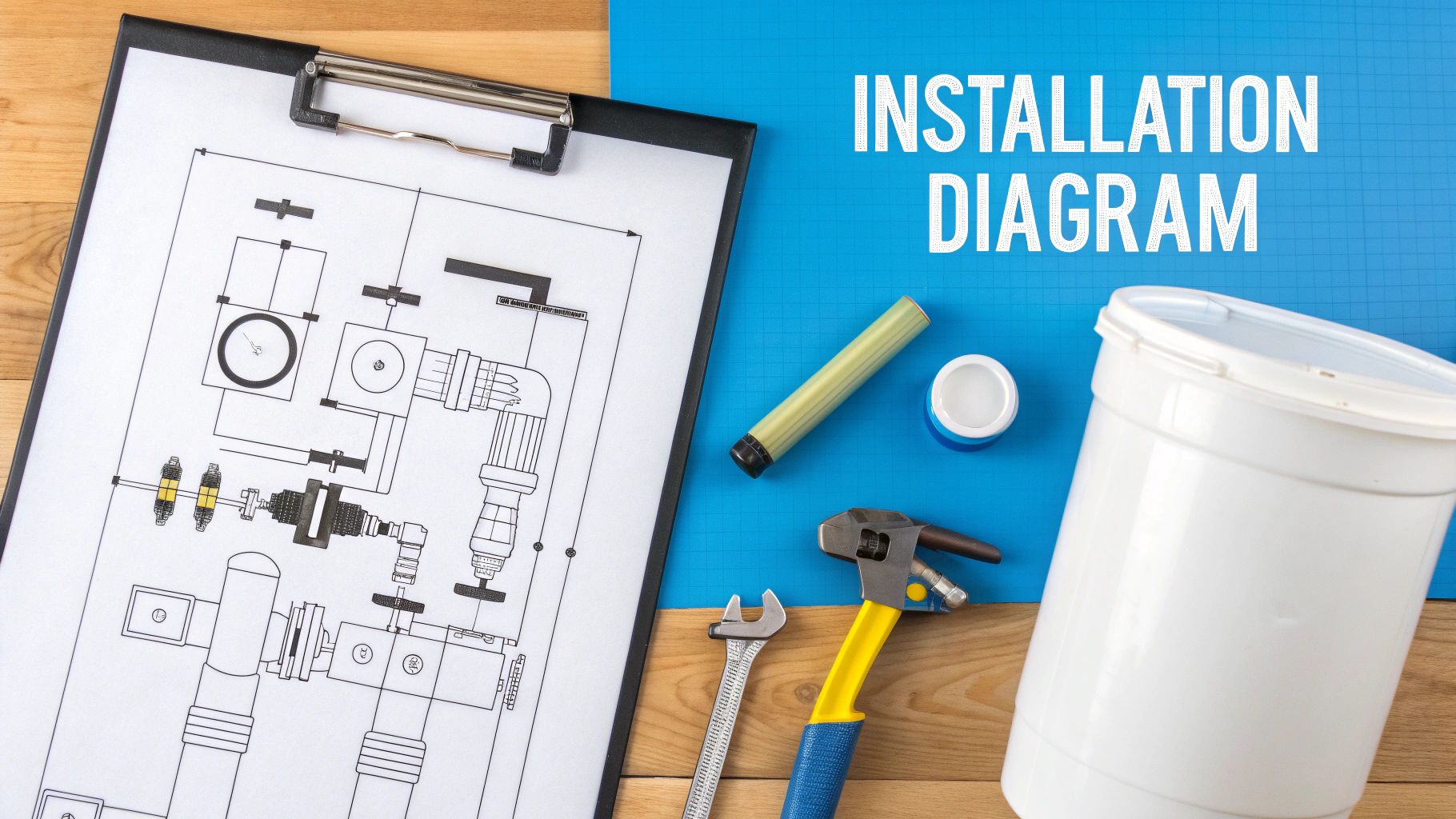
Does a Water Filter Soften Water in Your Home

Let's dive right in: a standard water filter does not soften water. It's an easy mix-up, but filtration and softening are two completely different ball games, designed to solve entirely different problems in your home's water supply.

Imagine your water filter is the head of security for your drinking glass. Its mission is to spot and block troublemakers like chlorine, funky-tasting sediment, and pesky pesticides. It ensures the water you drink is clean, safe, and doesn't taste like a swimming pool. A water softener, however, is more like a diplomatic negotiator—it specifically targets "hard" mineral ions and swaps them for something less problematic.

Filtration vs. Softening: The Core Difference

Clear water pouring from a kitchen faucet into a glass, symbolizing clean filtered water.

Most of us reach for a water filter to make our tap water safer and more enjoyable. The goal is purification. You want to kick out anything that might be harmful or just plain weird-tasting.

A filter's job is to remove a whole squad of contaminants, from chlorine and heavy metals to VOCs and bacteria. It's all about purity. But the minerals that cause hardness—our old friends calcium and magnesium—usually get a free pass to slide right on through.

Water softening, on the other hand, is on a completely different mission.

Its one and only purpose is to eliminate the minerals responsible for that crusty, white scale buildup in your pipes, on your showerheads, and inside your appliances. That buildup is a silent killer of efficiency and can lead to eye-watering repair bills. Softening is all about protecting the plumbing and appliances you've invested in.

To help you see the difference clearly, here's a quick side-by-side comparison.

Filtration vs. Softening at a Glance

Feature Water Filter Water Softener
Primary Goal Removes contaminants Removes hardness minerals
Improves Water taste, odor, and safety Prevents scale buildup
Targets Chlorine, lead, bacteria, pesticides, etc. Calcium and magnesium
Main Benefit Healthier, better-tasting water Protects pipes & appliances

This table shows that you're not choosing between one or the other; you're choosing which problem you want to solve.

Why You Might Need Both

Because filters and softeners are specialists in different fields, they aren't mutually exclusive. In fact, many homes with hard, contaminated water benefit from having both systems working in tandem.

The filter first removes the nasty stuff, then the softener takes care of the minerals. This dream team ensures your water is not only pure and great-tasting but also won't wage war on your coffee maker.

For anyone looking for a complete fix, a water softener and filter system combo is the way to go. This integrated approach gives you the best of both worlds, and understanding this key difference is the first step toward finding the perfect setup for your home.

Understanding the Problem of Hard Water

So, what is this stuff we call “hard water”? It’s really just water that’s picked up a high concentration of dissolved minerals—mostly calcium and magnesium—on its journey through the ground.

Think of these minerals as microscopic bits of rock hitching a ride in your water. When the water evaporates from a surface, like your shower door or kitchen faucet, it leaves those tiny hitchhikers behind. That’s where all the frustration begins.

A shower head clogged with white mineral scale buildup.

This leftover residue is the culprit behind that chalky film on your glass shower doors, the stubborn white spots on your dishes, and that crusty buildup around your sink fixtures. It’s also the reason your soap and shampoo just won't lather up properly, forcing you to use way more product than you should need to.

More Than Just Annoying Spots

While the visible signs are a nuisance, the real damage is happening where you can't see it. That mineral residue quietly builds up inside your pipes and appliances, forming a hard, rocky coating called limescale.

Limescale acts like plaque in your home's plumbing arteries. It slowly constricts water flow, forcing your entire system to work harder and less efficiently.

This buildup has serious consequences for some of your most expensive household appliances. It can choke the life right out of your water heater, dishwasher, washing machine, and even your coffee maker. In fact, some espresso machine experts claim that unfiltered hard water is directly responsible for over 50% of leak-related problems they see.

The effect on your energy bills is just as bad. Limescale is a terrible heat conductor, so when it coats the heating element in your water heater, the unit has to burn more energy just to get the water to the right temperature. This leads straight to higher utility bills and a much shorter lifespan for the appliance itself.

The Real-World Impact of Scale Buildup

The effects of this silent destroyer pop up all over the house. Over time, you’ll probably start to notice:

  • Reduced water pressure: As scale narrows the inside of your pipes, water flow drops. This means weak showers and sinks that take forever to fill.
  • Dull, stiff laundry: Hardness minerals get trapped in the fibers of your clothes, leaving them feeling rough and making colors fade much faster.
  • Dry skin and hair: Those same minerals that leave a film on your dishes also leave a residue on your body, which can clog pores and leave your skin and hair feeling dry and itchy.
  • Appliance failure: The constant strain and internal damage from scale buildup eventually lead to costly repairs and, all too often, premature appliance replacement.

Ultimately, dealing with hard water isn't just about getting shinier dishes or a better lather from your soap. It’s about protecting your home’s critical infrastructure—your plumbing and major appliances—from slow, expensive, and completely preventable damage. Since a standard water filter doesn't remove these minerals, homeowners often need to look at specific solutions designed to tackle hardness.

How Home Water Filters Actually Work

To get why most filters don't soften water, we have to pop the hood and see how they’re built. Think of water filtration like a series of specialized nets, where each one is designed to catch a different kind of unwanted particle. The size and type of that net dictate what it catches and what it lets slip right on through.

Most of the filters you find in homes are all about purification—getting rid of things that make your water taste, smell, or feel funky. They are fantastic at their jobs, but that job isn't softening.

https://www.youtube.com/embed/-_sr7mzhVsE

The Most Common Filter Types

Let's break down the workhorses of home water filtration. Each has a very specific role, and you'll quickly notice a common theme: they aren't designed to go after hardness minerals.

  • Sediment Filters: These are the simplest of the bunch. They work like a screen door for your water supply, blocking bigger stuff like dirt, sand, rust, and silt before it gets into your plumbing. While they're essential for protecting other filters and appliances, those dissolved hardness minerals just sail right through.

  • Activated Carbon Filters: This is the hero you'll find in pitcher filters, refrigerator filters, and a lot of faucet-mounted systems. Activated carbon has this incredibly porous surface that acts like a magnet for contaminants like chlorine, pesticides, and chemicals that cause bad tastes and smells. But calcium and magnesium ions? They just don't stick to the carbon and keep on flowing.

  • UV Purifiers: Ultraviolet (UV) systems are more like assassins than catchers. They use a powerful UV light to scramble the DNA of bacteria, viruses, and other nasty microorganisms, making them totally harmless. It's a super effective way to handle microbiological threats, but it does absolutely nothing to the mineral content in the water.

An EPA overview of treatment technologies confirms this. While methods like activated carbon are great for organics and chlorine, they don't touch the minerals that cause hardness. For that, the EPA points to cation exchange as a proven method with over 99% removal efficiency for both calcium and magnesium ions.

What About Reverse Osmosis?

Now, there is one major exception in the world of filtration: Reverse Osmosis (RO). An RO system uses an incredibly fine semipermeable membrane to strip out a massive range of dissolved solids from water. We're talking lead, arsenic, and—you guessed it—the calcium and magnesium that make water hard.

So, does a water filter soften water if it’s an RO system? Technically, yes, but only at the specific tap where it’s installed.

Using an RO system for whole-home softening is like using a sniper rifle for a job that needs a bulldozer. RO is perfect for producing highly purified drinking water at your kitchen sink, but it’s not built for the volume and flow rate your entire house demands.

It produces wastewater as part of its process and just can't keep up with showers, laundry, and the dishwasher all running at once.

This distinction is crucial. While a couple of filter types can reduce hardness, their main job is purification. For true, whole-home softening, you need a system that was engineered specifically for that task.

The Science of Making Hard Water Soft

So, if most filters aren’t designed to tackle hard water, what’s the real fix? This is where a dedicated water softener comes into play. These systems are the undisputed heavyweights of hard water treatment, and the science behind them is actually pretty straightforward.

At the core of a traditional water softener is a process called ion exchange. Picture the softener’s main tank filled with millions of tiny, porous resin beads. Right out of the box, these beads are loaded up with sodium ions.

As your home's hard water flows through this tank, the magic happens. The calcium and magnesium minerals—the very things causing all that scale and soap scum—have a stronger positive charge than the sodium ions. Because of this, the resin beads act like powerful little magnets, grabbing the calcium and magnesium right out of the water and releasing the sodium ions to take their place. It's a simple and incredibly effective trade that physically removes the minerals that make water hard.

The Trade-Off: How Ion Exchange Works

This mineral swap is what gives you genuinely soft water, unlocking all the benefits you’ve heard about: no more scale buildup, richer soap lather, and softer skin and hair. Of course, this process can't go on forever.

Eventually, the resin beads become completely saturated with all the calcium and magnesium they’ve pulled from the water. At that point, they can’t grab any more. This is when the softener needs to "regenerate"—it flushes the mineral-packed beads with a concentrated saltwater (brine) solution, washing the hard minerals down the drain and reloading the beads with a fresh supply of sodium ions, ready to start the cycle all over again.

There’s no question about the demand for this technology. The U.S. water softening systems market is a clear indicator of how widespread hard water problems are, with projections showing growth from $763.6 million in 2025 to a staggering $1.19 billion by 2032. This boom is driven by a growing awareness of hard water’s damaging effects, and proven salt-based ion exchange softeners continue to dominate the market. You can discover more about the water softening market's growth and see the trends for yourself.

The Salt-Free Alternative: Water Conditioners

For homeowners who want a lower-maintenance option, there's another player in the game: the salt-free water conditioner, often called a descaler. Now, it's critical to understand that these systems do not actually soften the water. They don’t remove the hard minerals at all.

Instead, they use a clever technology called Template Assisted Crystallization (TAC). This process changes the physical form of the calcium and magnesium minerals, turning them into microscopic crystals that simply won't stick to your pipes, fixtures, or appliances.

Think of it this way: if scale buildup is like LEGOs clicking together to form a solid mass, a water conditioner coats each LEGO piece so it can't connect with the others. The minerals are still present in your water, but they just flow harmlessly through your plumbing without causing that destructive scale. This makes conditioners a fantastic choice for scale prevention, but you won't get those other classic benefits of soft water, like silky-smooth skin or better soap performance.

Choosing the Right Water System for Your Home

So, how do you take all this information and turn it into the right decision for your family? It really just comes down to one simple question: What problem are you trying to solve? The best choice for you is all about your specific goals.

Are you mainly concerned with making your drinking water taste better and getting rid of nasty contaminants? Or are you just plain sick of replacing appliances caked in scale and scrubbing that chalky film off your shower doors? Your answer is the key to figuring out the perfect water treatment plan for your home.

Assess Your Home’s Unique Needs

Before you buy anything, you need to know what you’re working with. A great first step is to grab a simple water hardness test kit. It will tell you exactly how many grains per gallon (GPG) of minerals are in your water. If you see a number over 3 GPG, you've got hard water that’s likely causing problems.

Next, think about your family's priorities and your budget. Are you looking for a whole-house system that protects every pipe and appliance, or is a simple under-sink filter for pure drinking water all you really need? Nailing down what you actually need helps you avoid spending money on a system that's overkill. For some great pointers, check out the expert advice on water filters to explore options that fit your situation.

This handy decision tree makes the choice even simpler, focusing on whether you want to stop scale or completely remove the minerals causing it.

Infographic about does a water filter soften water

As you can see, if your main goal is just to stop scale from building up without messing with the water chemistry, a conditioner is the way to go. But if you want those minerals gone for good, a softener is what you need.

Creating a Hybrid Water Treatment System

For a lot of homeowners, one device just doesn't cut it. The best setups often combine different systems to create a powerful, multi-stage defense against both contaminants and hardness minerals.

Here are a couple of popular combinations that work incredibly well:

  • Ultimate Protection: Combine a whole-house sediment filter with a traditional water softener. Think of the filter as a bodyguard for your softener—it catches all the dirt, sand, and rust that could clog up and damage the softener’s resin, helping it run smoothly for years.
  • Targeted Purity and Scale Prevention: Pair a salt-free water conditioner with an under-sink Reverse Osmosis (RO) system. The conditioner protects your home's entire plumbing system from scale, while the RO unit sits right under your kitchen sink, giving you ultra-pure water for drinking and cooking.

This kind of layered approach means you're no longer just asking, "Does a water filter soften water?" Instead, you’re building a complete system that delivers pure, non-damaging water to every tap in your house.

It's also worth thinking about how your water system fits into your other home improvement goals, like creating energy-efficient smart home solutions. By preventing scale from building up inside your water heater, a softener or conditioner allows it to work more efficiently. That means less energy wasted and lower utility bills, making your water treatment system a smart investment for a more cost-effective home.

Common Questions About Water Filters and Softeners

Diving into the world of water treatment can feel a little overwhelming. Once you realize filters and softeners aren't the same thing, a whole new set of questions usually pops up. We get it.

Here are some straightforward answers to the most common queries we hear from homeowners trying to map out the perfect water strategy for their house.

Will a Reverse Osmosis System Soften My Water?

Yes, a reverse osmosis (RO) system definitely softens water, and it does a fantastic job of it. Its super-fine membrane is a beast, designed to strip out pretty much all dissolved solids, and that includes the calcium and magnesium minerals that make water hard.

But here’s the catch: RO systems are designed for a single faucet, like your kitchen sink. They work slowly, produce a stream of wastewater, and just can't keep up with the demands of an entire house. For whole-house softening, a dedicated water softener is a much more practical and efficient choice.

Is Softened Water Safe to Drink?

For almost everyone, drinking softened water is perfectly safe. The ion exchange process does add a tiny bit of sodium to the water, which is something to be aware of if you're on a strict, doctor-ordered low-sodium diet.

The amount of sodium added depends on how hard your water is to start with—the harder it is, the more sodium gets swapped in. If that’s a concern for you, you've got a couple of easy workarounds:

  • Use potassium chloride pellets in your softener instead of the standard sodium chloride ones.
  • Have your plumber bypass the cold water line to your kitchen sink, so you get unsoftened water for drinking and cooking.

Can I Use a Water Softener and a Water Filter Together?

Absolutely! In fact, combining them is often the best way to get top-tier water quality throughout your home. Think of it as creating a multi-stage defense that tackles a whole range of problems.

A popular and highly effective setup is to install a whole-house sediment pre-filter before the water softener. This filter acts like a bodyguard, grabbing all the dirt, sand, and rust that could clog up and damage the softener's sensitive resin bed. Then, you can add an activated carbon filter after the softener to strip out chlorine, giving you great-tasting, clean-smelling water from every single tap.

This layered approach is the real answer to whether a filter can soften water. It accepts that they are different tools for different jobs, and using them together gives you a complete solution for pure, non-damaging water.

What’s the Difference Between a Water Softener and a Water Conditioner?

This is a really important distinction. A traditional water softener relies on ion exchange to physically pull the hardness minerals out of your water, trading them for sodium ions. The result is truly soft water, with all the benefits you’d expect—great soap lather, no spots on dishes, and softer skin.

A water conditioner, which you might also hear called a descaler, is a salt-free alternative that works completely differently. It doesn't remove the minerals. Instead, it uses a technology like Template Assisted Crystallization (TAC) to change the physical shape of the mineral crystals. This keeps them from sticking to surfaces and forming that destructive limescale in your pipes and appliances.

Here’s a simple way to think about it: a softener removes the troublemakers entirely, while a conditioner just puts them in handcuffs so they can't cause any harm as they pass through. Conditioners are great for preventing scale buildup but won't give you the other perks of genuinely soft water.


At Water Filter Advisor, our mission is to provide clear, research-driven guidance to help you make confident decisions about your home's water quality. Explore our in-depth guides and reviews to find the perfect solution for your family at https://www.waterfilteradvisor.com.