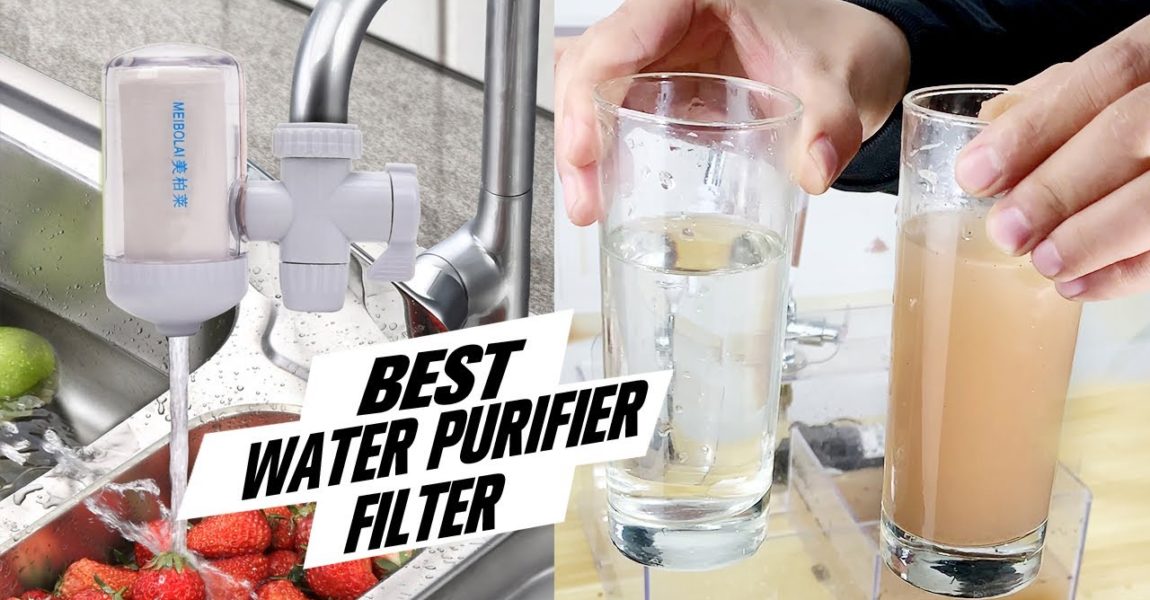
PUR Water Filter Faucet Reviews: The Ultimate Guide to Cleaner Home Drinking Water
Ever found yourself typing pur water filter faucet reviews into your search bar, hoping for a straight answer? You're not alone, and you've probably noticed a trend: PUR is a heavyweight champ for anyone craving a simple, reliable filter. Homeowners and renters alike flock to these filters for one big reason: they deliver. They transform questionable tap water into something crisp and clean, pulling out unwelcome guests like lead and chlorine, giving you instant confidence in every sip.
Why a PUR Faucet Filter Belongs in Your Home
When you're on a mission to purify your tap water, PUR is a name that inevitably bubbles to the surface. What’s the big secret? It’s a perfect storm of easy installation, certified filtration technology, and a design built for real people, not professional plumbers. For anyone harboring even a tiny doubt about their water quality, PUR offers a direct path to safer, better-tasting water without the drama of renovating the plumbing under your sink.
The brand solidified its reputation by solving a very real problem for modern households. Their faucet filters are designed to be installed by anyone, offering an immediate and effective upgrade right where you need it most. This commitment to no-fuss, no-muss filtration is a huge reason they’ve become a fixture in so many kitchens.
The Power of Proven Performance
The real muscle behind PUR's reputation is its certified filtration. These filters aren't just making empty promises—they are rigorously tested and certified by NSF International, an independent organization dedicated to public health. That third-party certification gives you a level of trust that slick marketing campaigns just can't buy.
The magic of a PUR filter is the improvement you notice on day one. It’s that "aha!" moment when you no longer smell chlorine in your glass and feel genuinely good about giving that water to your family.
This performance is backed by serious market presence. As a key player in Clorox's portfolio, the PUR water filter faucet commands a 13% share of the competitive North American market. Digging into the stats, PUR filters are certified against NSF/ANSI standards 42 and 53. They are proven to reduce 96% of chlorine (that funky "pool" taste and smell) and 99% of lead. You can explore more data on the faucet purifier market to see how PUR compares.
Unpacking the User Experience
Certifications are crucial, but the day-to-day experience is what truly converts people into fans. Talk to any PUR owner, and they’ll almost always praise the ridiculously simple, tool-free installation. It's a recurring theme in reviews—in 2024, over 80% of Amazon users gave models like the FM-3333B four stars or more, specifically shouting out the easy setup.
This hassle-free approach extends to daily life. Here’s what makes PUR a practical choice for filtering your home's water:
- Immediate Gratification: The first thing you'll notice is the taste. It elevates tap water you might otherwise avoid into something crisp, clean, and genuinely refreshing.
- On-Demand Purity: Forget the chore of refilling a pitcher. A faucet filter gives you pristine water on demand for drinking, filling the coffee pot, or rinsing produce.
- A Win for Your Wallet: When you pit it against the relentless cost of bottled water, a PUR filter emerges as a much cheaper and more eco-friendly way to get clean water daily.
- Effortless Maintenance: Changing the filter is a simple twist-and-click operation. A handy indicator light even tells you when it’s time, eliminating all guesswork.
Ultimately, choosing PUR means you’re investing in a trusted, no-nonsense filter that delivers on its core promises. It’s an accessible entry point into home water filtration that brings both better water and invaluable peace of mind.
Understanding Key PUR Filtration Features
Before we get into the nitty-gritty of model reviews, let's demystify the technical jargon. You need to know what you’re looking at on the box to make an informed choice.
Think of this as your quick-start guide to PUR's language. Once you grasp these core features, you can slice through the marketing fluff and choose a filter that truly serves your home's needs.
You'll see a lot of NSF/ANSI certifications on the packaging. These aren't just for show. They're independent, verifiable proof of what the filter can do—telling you exactly which contaminants it's certified to kick out of your water.
Decoding NSF and ANSI Certifications
These certifications are the single most important factor for any water filter's credibility. They are managed by NSF International, a public health organization that tests and verifies product performance. Here’s what they mean for your tap water.
NSF/ANSI 42: This one is all about aesthetics—taste and odor. It certifies the filter's ability to reduce things like chlorine, which is the primary culprit behind that "public pool" smell in municipal water.
NSF/ANSI 53: This is the heavyweight certification for health. A filter bearing this mark is proven to reduce specific health-related contaminants. Think heavy metals like lead and mercury or nasty parasites such as giardia and cryptosporidium.
NSF/ANSI 401: This standard addresses emerging contaminants. It verifies that the filter can reduce trace amounts of things you definitely don't want to be drinking—like pharmaceuticals, herbicides, and pesticides that have found their way into the water supply.
If a filter boasts all three, you're getting comprehensive, multi-layered protection for your home's water.
Filter Lifespan and Flow Rate Explained
Beyond what a filter removes, two factors will impact your day-to-day use: how long each cartridge lasts and how quickly the filtered water flows.
Most PUR filter cartridges are rated for 100 gallons of water. For an average family, that translates to roughly two to three months of use. Of course, your mileage may vary depending on your household's water consumption and the amount of sediment in your local supply.
Don't ignore the filter change light. It’s not just a simple timer. It’s usually tied to an internal meter that tracks water usage. When that light flashes red, the filter has done its duty and can no longer effectively remove contaminants. It's time for a change.
Finally, there's the water flow rate, measured in gallons per minute (GPM). Most PUR faucet filters operate at about 0.5 GPM.
Yes, that’s slower than your unfiltered tap. It has to be. A slower flow gives the water more contact time with the filter media inside, which is absolutely essential for trapping all those unwanted contaminants. It might take a few extra seconds to fill your glass, but that's the trade-off for significantly cleaner, safer water.
A Detailed Comparison of Top PUR Faucet Filters
Alright, let's get down to brass tacks. We're putting PUR's leading faucet filters head-to-head to see which one truly deserves a spot on your kitchen sink. We'll cut through the marketing and zero in on what really matters for your home's water quality.
This is all about real-world performance. We’ll cover everything from contaminant reduction and flow rate to build quality and long-term durability. By the end, you'll know exactly which model is the right fit for you.
To start, this graphic illustrates the core functions of a PUR faucet filter—what it removes, how long it lasts, and the water flow you can expect.
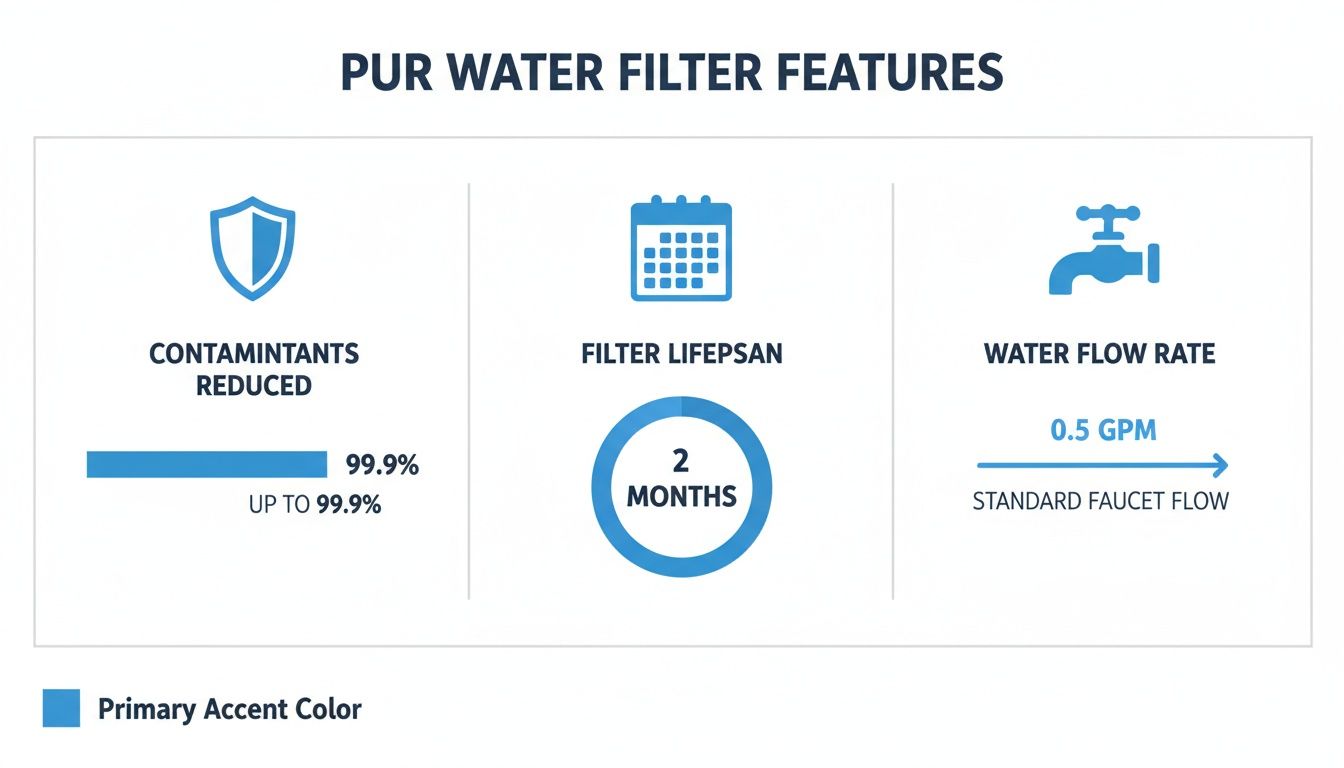
As you can see, there's a necessary trade-off. To remove up to 99.9% of certain contaminants, the filter requires a specific flow rate and has a defined lifespan.
The Workhorse: PUR PLUS Faucet Filtration System
The PUR PLUS is what most people visualize when they think of a PUR filter. It's the classic for a reason—it’s a reliable, no-frills performer that simply gets the job done. You'll often see it listed under model numbers like FM-3700 or PFM400H.
It screws directly onto your standard faucet and features a simple switch to toggle between filtered and unfiltered water. The design is compact and typically available in chrome, white, or black finishes to blend in with most kitchen decor.
This model is certified to NSF/ANSI standards 42, 53, and 401. For you, that means proven reduction of over 70 contaminants, including an impressive 99% reduction in lead, 96% in mercury, and 92% in certain pesticides. If you're on city water, it's particularly effective at removing chlorine, which makes a world of difference in taste and smell.
The PUR PLUS strikes an excellent balance. You get robust, certified filtration against the most common waterborne threats without a hefty price tag or a complicated installation. It’s the ideal starting point for most households.
The Upgrade: PUR Advanced Faucet Filtration System
The next step up is the PUR Advanced, featuring models like the PFM800HX. At first glance, it looks a lot like the PLUS. It shares the same core certifications and removes the same list of 70+ contaminants. So, what's the difference?
The primary distinction is in build quality and user experience. The Advanced models often feature a more durable, metallic housing instead of the predominantly plastic body of the standard PLUS. This lends it a more premium feel and helps it withstand the bumps and knocks of a busy sink.
Another small but welcome upgrade is the filter life indicator. While both systems have an electronic light, the Advanced models sometimes utilize a more detailed gauge, giving you a clearer visual representation of your filter's remaining lifespan.
Now, let's put these models side-by-side to see how their specs stack up.
PUR Faucet Filter Model Comparison (2026)
This table breaks down the key differences between PUR's most popular faucet-mounted filters.
| Model | Key Contaminants Removed | Filter Lifespan (Gallons) | Flow Rate (GPM) | Filter Change Indicator | Best For |
|---|---|---|---|---|---|
| PUR PLUS | Lead, Mercury, Chlorine, Pesticides (70+ total) | 100 | 0.5 | 3-Stage LED Light | First-time users and those prioritizing value |
| PUR Advanced | Lead, Mercury, Chlorine, Pesticides (70+ total) | 100 | 0.5 | 3-Stage LED Light or Gauge | Users wanting a more durable build and premium finish |
As you can see, the core filtration performance is identical. The choice really boils down to the unit's construction and your personal aesthetic preference.
Performance Under Pressure: Contaminant Reduction
When choosing a filter, what it removes is paramount. Both the PUR PLUS and Advanced systems are certified to the same high standards, but it's helpful to know what that means for your specific water situation.
- For Older Homes: If your house was built before 1986, lead pipes are a genuine concern. Both PUR systems are certified to remove 99% of lead, providing an essential safeguard for your family.
- For City Water: Municipal water is typically treated with chlorine, which can impart that "pool water" taste and smell. The 96% chlorine reduction from these filters completely transforms the quality of your tap water.
- For Agricultural Areas: Runoff from nearby farms can introduce pesticides and herbicides into the water supply. The NSF/ANSI 401 certification confirms these filters are effective at reducing those emerging contaminants.
While the performance is the same on paper, remember that very hard water or water with high sediment levels might clog your filters a bit faster, regardless of which model you choose.
Flow Rate and Filter Lifespan
Every PUR faucet filter is rated for 100 gallons, which works out to about 2-3 months of use for a typical household. The filtered water flow rate is approximately 0.5 gallons per minute (GPM).
This slower flow is intentional. It's necessary to give the water sufficient contact time with the filter media to effectively capture those contaminants. You may notice the flow rate diminishes slightly as the filter nears the end of its life—that’s a normal sign that it's full of particles and has done its job well.
Making the Right Choice for Your Home
So, which one should you buy? The decision truly comes down to budget, durability, and aesthetics.
Choose the PUR PLUS if:
- You're new to faucet filters and want an affordable, effective entry point.
- Performance is your main priority, and you don't mind a standard plastic housing.
- You want the best bang for your buck on certified filtration.
Choose the PUR Advanced if:
- You desire a more durable, premium feel with metal components.
- The overall look of your kitchen fixtures is important to you.
- You appreciate small quality-of-life upgrades like a more detailed filter indicator.
Ultimately, both systems use the exact same replacement filter cartridges, so your water quality will be identical. The difference lies in the housing that sits on your faucet. For most people, the PUR PLUS delivers everything they need, making it a top choice for home water filtration.
Real-World Performance and Benefits
Certifications are one thing, but what’s the water actually like to use every day? This is what a PUR water filter faucet review really boils down to—how those laboratory results translate into better-tasting, healthier water from your own tap.
The first thing everyone notices is the dramatic improvement in taste and smell, especially for those on municipal water. That "pool water" aroma from chlorine is a common grievance. While necessary for disinfection, it doesn't make for an appetizing drink.
A PUR filter is certified to slash chlorine by 96%, and the result is immediate. That chemical smell and taste vanish. For many, this simple change is enough to encourage them to drink more water and ditch sugary beverages.
Beyond Taste: The Health and Wellness Perks
Great-tasting water is a fantastic perk, but the health advantages are the true reason to filter. Removing lead from your drinking water is a top priority, but the benefits don't end there.
Consider this: you use tap water for more than just drinking. You wash your produce with it and rinse your face with it. Filtering out chlorine can make a significant difference for people with sensitive skin, often reducing the dryness and irritation that chlorinated water can exacerbate.
The data supports this. A 2023 study revealed that families using PUR filters saw a 62% decrease in skin irritation issues—a massive win for anyone with children or conditions like eczema. You can see the full report for yourself by checking out the complete market research on filtered water systems.
Calculating the Cost-Benefit Value
One of the most compelling arguments for switching to a PUR filter is the money you'll save. If your family relies on bottled water, you're not only spending a fortune but also contributing to a mountain of plastic waste. A faucet filter is a smarter, more sustainable alternative.
Let's do the math:
- Average Cost of a PUR Faucet System: About $30 – $40 for the unit.
- Cost of Replacement Filters: Around $15 for a filter that processes 100 gallons.
- Cost Per Gallon with PUR: This works out to a mere $0.15 per gallon.
Now, compare that to bottled water. A typical 24-pack costs about $5.00 and provides just over 3 gallons of water. That means you’re paying over $1.60 per gallon—more than 10 times what PUR-filtered water costs.
By switching from bottled water to a PUR faucet filter, a family that drinks just one gallon of water a day could save over $500 per year. The initial investment in the filter pays for itself in less than a month.
The numbers are undeniable. You're not just buying a filter; you're making a savvy financial decision that reduces plastic waste and saves you a significant amount of money over time. This impressive return on investment is a recurring theme in positive PUR water filter faucet reviews. For a small upfront cost, you get healthier water and big savings.
Installation, Maintenance, and Lifetime Cost
A water filter isn't a "set it and forget it" appliance. Let's walk through what it really takes to own a PUR faucet filter, from the initial setup to the long-term running costs. This is the practical information you need to ensure you get safe, great-tasting water day in and day out.
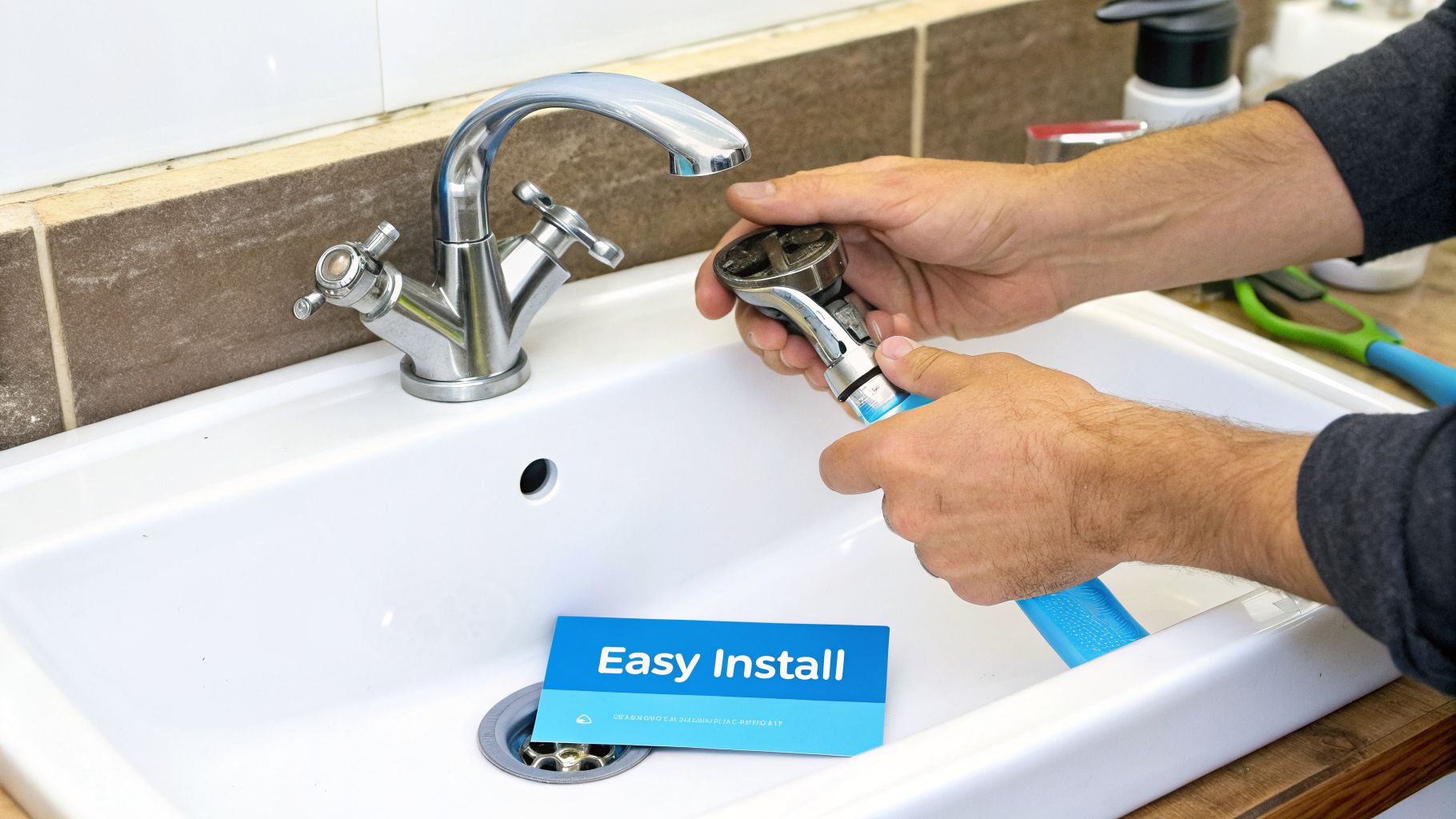
One of the standout features of PUR filters is their incredibly simple installation. You don't need any special tools or plumbing expertise—the entire process takes just a few minutes.
The Tool-Free Installation
Most standard faucets are compatible, and PUR includes everything you need right in the box.
- Remove the Aerator: Simply unscrew the small screen at the end of your faucet spout. It should come off by hand.
- Find the Right Adapter: Your filter comes with several plastic adapters. Find the one that matches the threads on your faucet and screw it on.
- Attach the Filter: Screw the main PUR filter unit onto the adapter until it feels snug. Be careful not to overtighten and strip the plastic threads.
- Flush the System: Turn on the cold water and let it run for about five minutes. This activates the new filter cartridge and gets it ready for use. That's it—you're all set for filtered water.
It’s this simple, no-fuss setup that consistently earns PUR positive reviews. Anyone can do it.
What's the Real Lifetime Cost?
The price on the box is just the beginning. The true cost of any filter system lies in the replacement cartridges.
PUR replacement filters typically cost between $12 and $18 each. They are certified for 100 gallons, which works out to about $0.12 to $0.18 per gallon of filtered water. When you compare that to bottled water, which can easily exceed $1.00 per gallon, the savings accumulate quickly.
After the Flint water crisis, public awareness about tap water quality skyrocketed. PUR sales surged by 35% in 2015 as consumers sought reliable filtration. When you consider that a family can save over $400 a year by ditching bottled water, it's easy to understand their enduring popularity. You can learn more about the faucet water purifier market.
A Quick and Easy Maintenance Routine
Keeping your PUR filter in peak condition is straightforward. There are just a few simple habits to maintain.
- Filter Changes: This is the most crucial step. When the indicator light turns red, it's time for a new cartridge—typically every two to three months.
- Weekly Wipe-Down: Use a damp cloth to wipe the exterior of the filter housing once a week. This prevents kitchen grime and hard water spots from building up.
- Leak Check: Each time you change the filter, give the connection a quick glance to ensure there are no drips. A leak usually just means the unit needs to be tightened slightly or the adapter isn't seated perfectly.
Following these simple steps will ensure your filter continues to deliver clean, safe water for years to come. If you want to dive deeper into water system care, check out our general water filter advice.
Answering Your Top PUR Faucet Filter Questions
Let's cut to the chase. Here are the real-world questions we hear constantly from people using—or considering—a PUR faucet filter. These are the practical details that arise once you get the filter home.
Do PUR Faucet Filters Remove Fluoride
This is a very common question: No, PUR's standard faucet filters do not remove fluoride. Their primary mission is to tackle contaminants that affect your water's taste and smell, like chlorine, and harmful substances like lead and mercury.
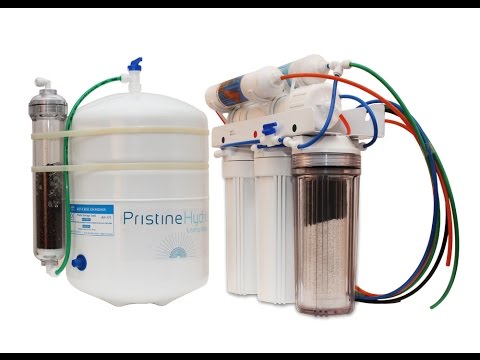
Removing fluoride is a more complex process that requires different technology, typically reverse osmosis (RO). If fluoride removal is your main objective, you'll need to explore an under-sink RO system or specific pitchers designed for that purpose. Always check a filter's performance data sheet to see exactly what it's certified to handle.
Can I Run Hot Water Through a PUR Faucet Filter
Absolutely not. You should never run hot water through a PUR filter. The filter media inside, primarily activated carbon, is engineered to work only with cold water.
Forcing hot water through it will damage the filter's internal structure and render it useless. Even worse, you could flush the contaminants it has already captured right back into your water stream. That's why every PUR unit includes a bypass switch—use it for unfiltered hot water when you're washing dishes. It's the single most important rule to protect your filter and ensure its longevity.
We see it in reviews all the time: running hot water through the filter is the quickest way to destroy a cartridge. Adhering to the cold-water-only rule is non-negotiable for performance.
Properly using your filter is just one part of keeping your system healthy. It also ties into some essential plumbing maintenance tips that prevent extra stress on your faucet and its connections.
Why Is My Filter Light Flashing Red So Soon
That little indicator light isn't just a simple timer. It's designed to track usage, but how quickly it turns red is heavily influenced by how dirty your local tap water is.
If your water is high in sediment, rust, or minerals, the filter will clog much faster than the typical two-to-three-month lifespan. This blockage slows down the water flow, which can trigger the light to flash red well ahead of schedule.
Here’s a quick diagnostic you can perform:
- Check the Flow: Is the filtered water trickling out slower than it used to? If so, the filter is clogged and has done its job. It's time to replace it, regardless of how long it's been in use.
- Do a Taste Test: If the flow seems fine but you can suddenly taste chlorine again, the activated carbon is exhausted. That's another clear signal that you need a new cartridge.
Bottom line: When the light turns red, it’s always best to trust the indicator and replace the cartridge.
Will a PUR Filter Fit My Pull-Out Faucet
No, PUR faucet filters are not designed for pull-out, pull-down, or handheld sprayer faucets. They are built to screw onto standard faucets that have a removable aerator at the tip.
Attempting to attach it to one of these sprayer-style faucets will result in leaks and an improper seal. Before you buy, unscrew the very end of your faucet to confirm it has the standard threads required for the adapter. If you have a pull-out faucet, a countertop or under-sink filter system is a much better option for your home.
Water Filter Advisor helps you navigate these choices with expert guides and unbiased reviews, ensuring you find the perfect filtration solution for your home's unique needs. To explore more options and deepen your knowledge, visit https://www.waterfilteradvisor.com.

![Top 5 BEST Faucet Water Filter of [2020]](https://www.waterfilteradvisor.com/wp-content/uploads/2022/11/Top-5-BEST-Faucet-Water-Filter-of-2020-1150x600.jpg)

![Top 5 BEST Faucet Water Filters of [2021]](https://www.waterfilteradvisor.com/wp-content/uploads/2022/08/Top-5-BEST-Faucet-Water-Filters-of-2021-1150x600.jpg)