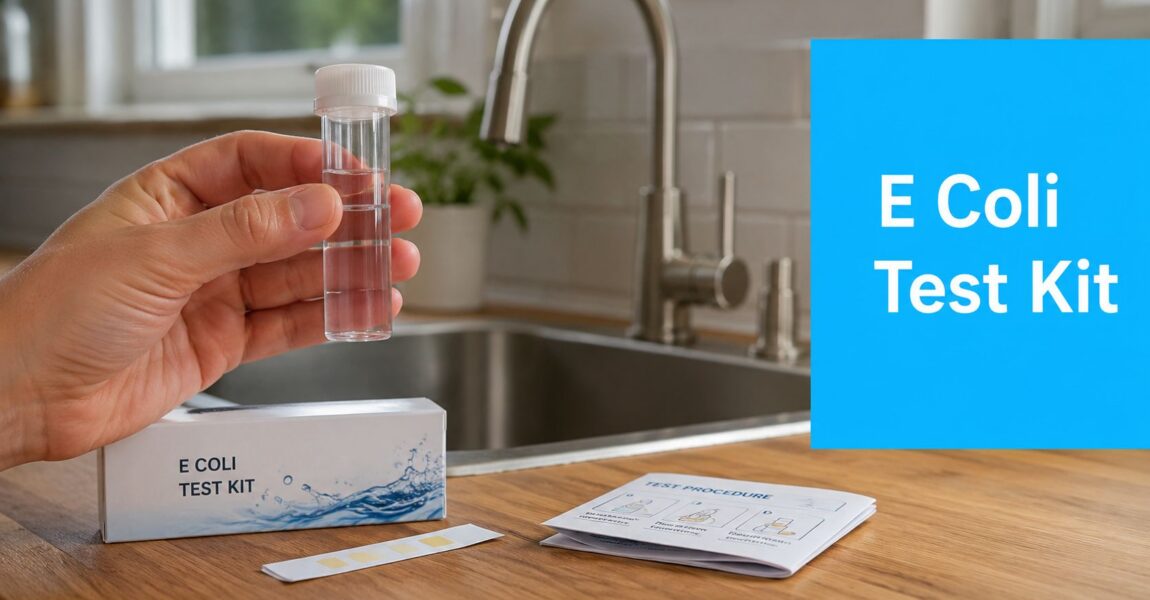
E Coli Test Kit Guide for Home Water Safety
A storm rolls through, and the water from your kitchen faucet looks faintly cloudy. It doesn't smell unusual, but you're suddenly asking practical questions: Can I drink it? Is it safe for cooking? Should I bathe my baby in it? Will my under-sink filter remove whatever caused the change? An E. coli test kit can help answer part of that problem, but only if you understand what it measures, how the sample is collected, and what a negative result leaves unknown.
For homeowners, the kit is best viewed as one tool in a broader water-safety plan. Filtration, well maintenance, source protection, and laboratory confirmation all have different jobs. The right test depends less on finding the fastest product and more on the household decision you need to make.
Why Homeowners Are Reaching for E Coli Test Kits
Private well owners often notice changes first after heavy rain. Runoff can reach vulnerable wells through damaged casing, poor drainage, shallow groundwater, septic problems, or flooding. Cloudiness doesn't prove that E. coli is present, and clear water doesn't prove that it's absent. Taste, odor, and appearance can't reliably identify bacterial contamination.
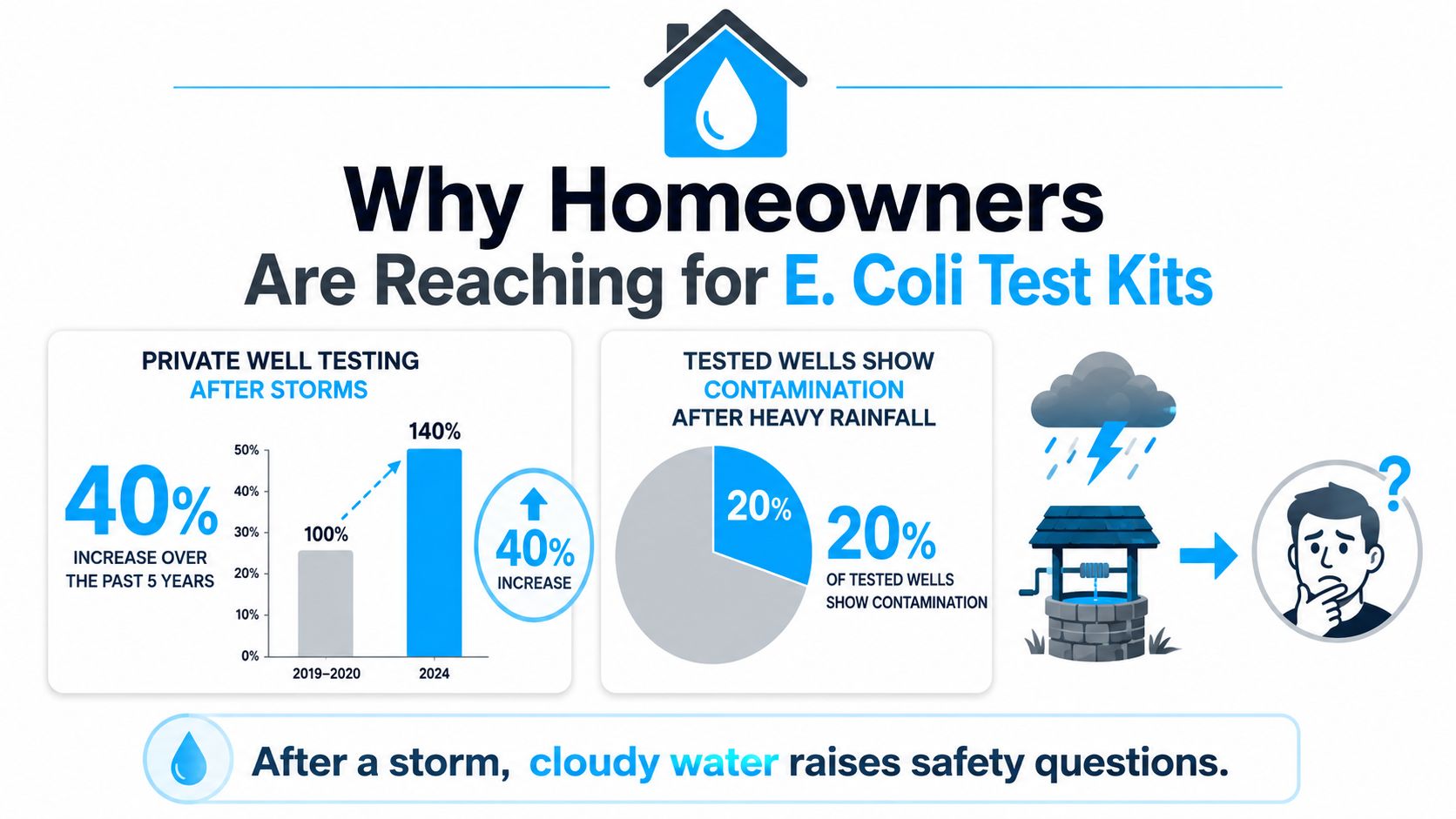
A homeowner with a private well carries more responsibility than someone connected to a regulated municipal system. A city utility usually provides public water-quality information and manages treatment at the source, while a well owner must arrange testing and decide whether the well, plumbing, or treatment equipment needs attention. Families with infants, older adults, or immunocompromised members may also want a more cautious testing and filtration routine because the consequences of contaminated drinking water can be more serious.
What the kit can and can't answer
An at-home kit can provide a screening result from a particular sample. That result may help you decide whether to stop drinking the water, collect a confirmation sample, call a health department, inspect the well, or review your filtration system. It doesn't replace a certified laboratory when you need confirmation, quantification, or a documented result.
A kit also fills a gap between waiting for laboratory work and relying on guesswork. Municipal reports describe the public supply, not necessarily the water coming from your private plumbing. A filter may improve taste and reduce selected contaminants, but a standard carbon filter shouldn't automatically be treated as a bacteria-control system.
Practical rule: Treat a cloudy-water event after flooding as a reason to investigate the source and test the water, not as proof of a specific contaminant.
If a storm has caused flooding or water damage around the home, professional remediation may matter before you focus on drinking-water testing. For urgent cleanup concerns, homeowners can trust Eagle Restoration for urgent water damage, while a water-quality test addresses a separate question about what may be in the tap or well water.
What an E Coli Test Kit Actually Does
Think of an E. coli test kit as a screening signal, similar to an aquarium strip that changes color when a water condition crosses a detection point. It usually doesn't give a complete chemical or microbiological profile. Instead, it looks for evidence associated with E. coli, total coliforms, or both.
Another useful comparison is an at-home pregnancy test. A visible line can answer a narrow presence-or-absence question, but it doesn't explain every detail about the underlying condition. In the same way, a positive water result says that the target signal was detected under the test's conditions. It doesn't automatically identify the contamination source or tell you whether every tap in the home has the same result.
Presence versus quantity
Most home kits use one of two reporting styles:
- Presence or absence: The kit reports whether the target was detected. This is easy to understand, but it won't tell you the concentration.
- Quantitative estimate: The kit reports an estimated bacterial level, often using CFU or MPN.
A colony-forming unit, or CFU, represents a viable unit capable of producing a colony under the test conditions. MPN, or most probable number, is a statistical estimate based on growth patterns in multiple portions of a sample. Neither term means that a homeowner can see individual bacteria in the vial. They're ways of translating biological growth into a result that can guide action.
For drinking water, a common operational benchmark is 1 CFU per 100 mL. The EPA Method 1604 performance framework reports a detection limit of one E. coli cell per sample volume or dilution tested and documents 95.7% specificity, with false-positive and false-negative rates both reported at 4.3%. That historical benchmark helps explain why a kit's sample volume, detection limit, incubation conditions, and reporting method matter.
Screening isn't diagnosis
Many consumer products are designed to indicate risk, not provide a definitive diagnosis. Some formats may detect total coliforms without isolating E. coli, while others use fluorescence or a second reading step to provide additional evidence. If you're curious about how molecular tests differ from growth-based methods, this overview of NAAT basics from VirusFAQ.com offers useful background on nucleic-acid amplification.
The label should tell you exactly what the kit detects, the sample volume it requires, the temperature and incubation time, and whether it distinguishes E. coli from other coliforms. If those details are vague, the result deserves less confidence.
The Four Main Types of E Coli Test Kits
The four broad families look different on a store shelf, but the household decision is the key point of comparison. A renter may want a quick indication before buying a faucet filter. A well owner after flooding may need a more controlled method and laboratory confirmation. A public-water customer dealing with a suspected distribution problem may need to contact the utility rather than rely on a consumer strip.
| Kit Type | Time to Result | Typical Cost Per Test | Best For |
|---|---|---|---|
| Culture-based method | Often requires incubation before reading | Varies by laboratory or kit | Well owners who need a conventional, defensible screening approach |
| Presence/absence vial | Same day to about 24 hours, depending on the method | Varies by product and test provider | Household screening when a simple yes/no result is useful |
| Rapid immunoassay strip | Minutes to same day, depending on the product | Varies by product | A quick preliminary check, not compliance documentation |
| DNA or PCR-based device | Minutes to about an hour for some portable formats | Varies by device and consumables | Fast point-of-use screening when the user understands the method's limits |
Culture-based and enzyme-substrate formats
Culture-based methods allow organisms to grow under controlled conditions, then use visible color, gas, fluorescence, or another signal to indicate the target. Enzyme-substrate kits belong in this practical family because bacterial activity changes the test medium. They're often a sensible choice for a private well owner who can wait for a more informative result rather than depending on a rapid strip.
The EPA's standardized methods created a comparison framework for later portable and kit-based testing. That matters because speed alone doesn't tell you whether a result is useful.
Strips and molecular devices
Rapid strips can provide a fast gut check, but a quick result may use a different detection threshold or target than a regulated method. DNA and PCR-based devices detect genetic material rather than waiting for the same growth process, which can shorten the time to answer. They may be valuable after a flood or during an urgent investigation, but a homeowner should still check whether the device detects viable organisms, genetic material, E. coli specifically, or a broader bacterial group.
Speed is a feature, not a substitute for method validation.
How an Enzyme-Substrate Kit Works Step by Step
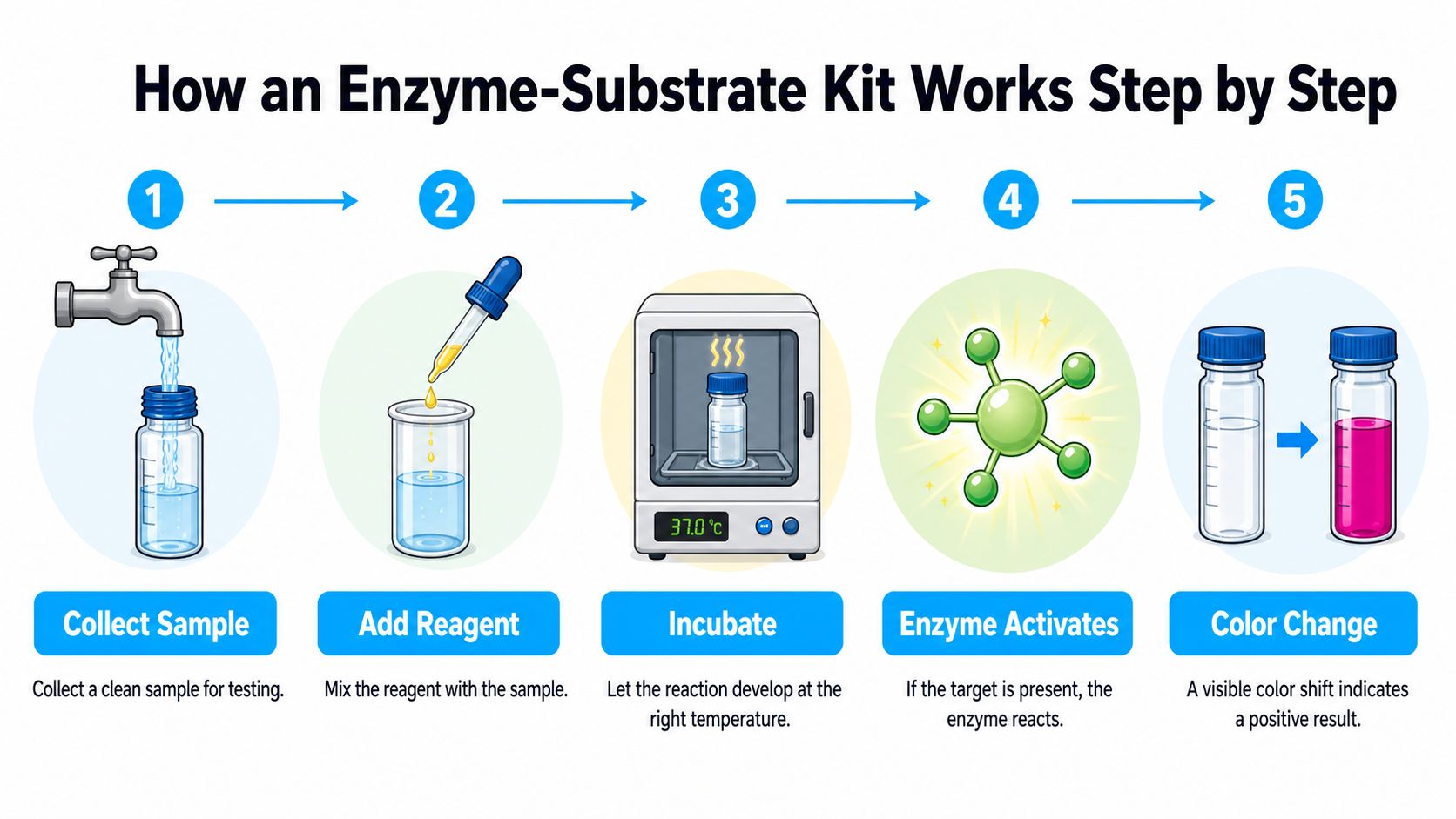
Most homeowners don't need to memorize microbiology to use an enzyme-substrate kit. The basic idea is straightforward: the sample is placed in a prepared medium, the reagent provides chemical ingredients, and bacterial enzymes act on those ingredients during incubation. The reaction produces a visible color change, fluorescence, or both.
The five practical stages
- Collect the sample. Use the sterile bottle or bag supplied with the kit. The container is part of the test system, not a convenience that can be replaced by a kitchen glass.
- Add the reagent. The prepared medium supplies substrates that react with bacterial activity.
- Incubate. Keep the sample within the temperature and time range specified by the manufacturer. Too little warmth or too little time can prevent a low-level signal from developing.
- Allow the enzyme reaction to develop. If target bacteria are present, their metabolic activity can produce a detectable change.
- Read the result. Depending on the kit, you may inspect the vial in normal light for a color change and use a UV light to check fluorescence.
Colitag provides a useful worked example. It's an EPA-approved test for compliance monitoring of public water systems, and it tests a 100 mL sample for total coliforms and E. coli with a detection limit as low as 1 MPN. Its stated workflow is to add reagent, incubate for 16 to 48 hours, check visually for coliforms, and confirm E. coli with fluorescence under the specified reading conditions. The Colitag product workflow illustrates why incubation and the reading environment are central to the result.
A rapid test can feel like a pregnancy test because the output is simple, but the chemistry is still conditional. The reaction only means what the instructions define, at the sample volume and incubation conditions they specify.
This short demonstration can help visual learners see how the equipment and reading process fit together:
Collecting a Water Sample the Right Way
A contaminated glass can create a contaminated result. A poorly collected sample can also miss bacteria that are present in the water source. The most common mistake is pouring tap water into a regular drinking glass instead of using the sterile bottle or bag included with the kit.
Use a clean, controlled collection routine
Follow the kit's own instructions first, then use this general sequence:
- Choose the correct sampling point. A kitchen faucet can show what reaches the sink, while a well-head sample may tell you more about the source. An outdoor spigot may contain residue or connections that don't represent indoor drinking water.
- Remove attachments. Take off aerators, filters, spray heads, or hose fittings if the instructions call for it. These components can hold material that changes the sample.
- Flush the line. Let cold water run for the period specified by the kit or laboratory. Flushing helps produce a sample that represents the source rather than stagnant water sitting in the fixture.
- Open the sterile container only when ready. Don't touch the inside of the cap, bottle, bag, or sampling area.
- Fill to the required volume. A test designed for 100 mL shouldn't be improvised with a smaller amount unless the manufacturer explicitly allows it.
- Start the test promptly. If transport is required, follow the stated temperature and holding instructions. Don't leave a sample on a sunny counter and assume the result remains valid.
Why handling changes the answer
A dirty glass can introduce bacteria and create a false positive. Disinfecting a faucet too aggressively or using a container that isn't sterile can also distort the sample and produce a false negative. If the result conflicts with what happened at the property, collect a new sample carefully and consider sending one to a certified laboratory.
For practical guidance on water testing, sampling, and filtration decisions, use the Water Filter Advisor water-testing advice alongside the kit instructions. Testing before and after a filtration system can also help separate a source problem from a treatment or plumbing problem.
Accuracy Limits Every Homeowner Should Know
A home kit gives a result under specific conditions, not a permanent verdict on the whole water system. Specificity describes how well a method avoids signaling its target when that target is absent. A false positive reports contamination that the comparison method does not confirm. A false negative misses contamination present under the reference conditions.
For homeowners, the EPA Method 1604 benchmark is best used as a comparison point, not a promise about a consumer kit. Its 95.7% specificity and reported 4.3% false-positive and false-negative rates show why one result should be interpreted with the method, sample, and follow-up plan in mind.
Portable testing is useful, not perfect
An independent laboratory evaluation of the Aquagenx CBT EC+TC MPN kit found correct identification of E. coli presence or absence in 93% of cases at a 1 CFU/100 mL threshold. At 10 and 100 CFU/100 mL, it matched expected results 93% and 97% of the time, respectively, according to the UNICEF laboratory assessment of the Aquagenx kit.
For a well owner checking conditions after flooding, that makes a portable kit useful for screening. It still cannot turn one carefully timed sample into proof that every fixture is safe. Incubation temperature, timing, storage, sample quality, and result interpretation can all change performance. A sensitivity claim on the package may depend on controlled conditions that are difficult to reproduce in a kitchen.
Detection limits can change with speed
One enzyme-substrate assay reported qualitative detection down to 1 CFU per sampling after 10 hours, while its immediate-read mode supported much higher loads, about 250,000 CFU per sampling, according to the Sigma-Aldrich assay performance documentation for enzyme-substrate detection. For a household with intermittent well contamination, a quick negative may therefore provide less reassurance than a completed incubation period.
Many consumer kits also cannot separate E. coli from other coliforms without laboratory confirmation. A positive broad-coliform result deserves attention, but it may not identify the organism or the contamination pathway. A city-tap user, a household with a baby, and a flood-affected well owner may need different follow-up, even when the same kit produced the result.
Reading Your Results and Taking the Right Next Steps
A clear vial feels reassuring, especially when you're standing in the kitchen waiting for an answer. But a negative result means only that the kit didn't detect its target under its test conditions in that sample. It doesn't prove that the well is permanently safe, that every faucet is free of bacteria, or that viruses and protozoa are absent.
Bacteria tests don't detect viruses or protozoa such as Giardia or Cryptosporidium. That limitation matters most for shallow wells, surface water, flood-affected properties, and any home with a questionable source. A filter designed for sediment or taste improvement also shouldn't be assumed to remove every biological hazard.
Use the result as a decision signal
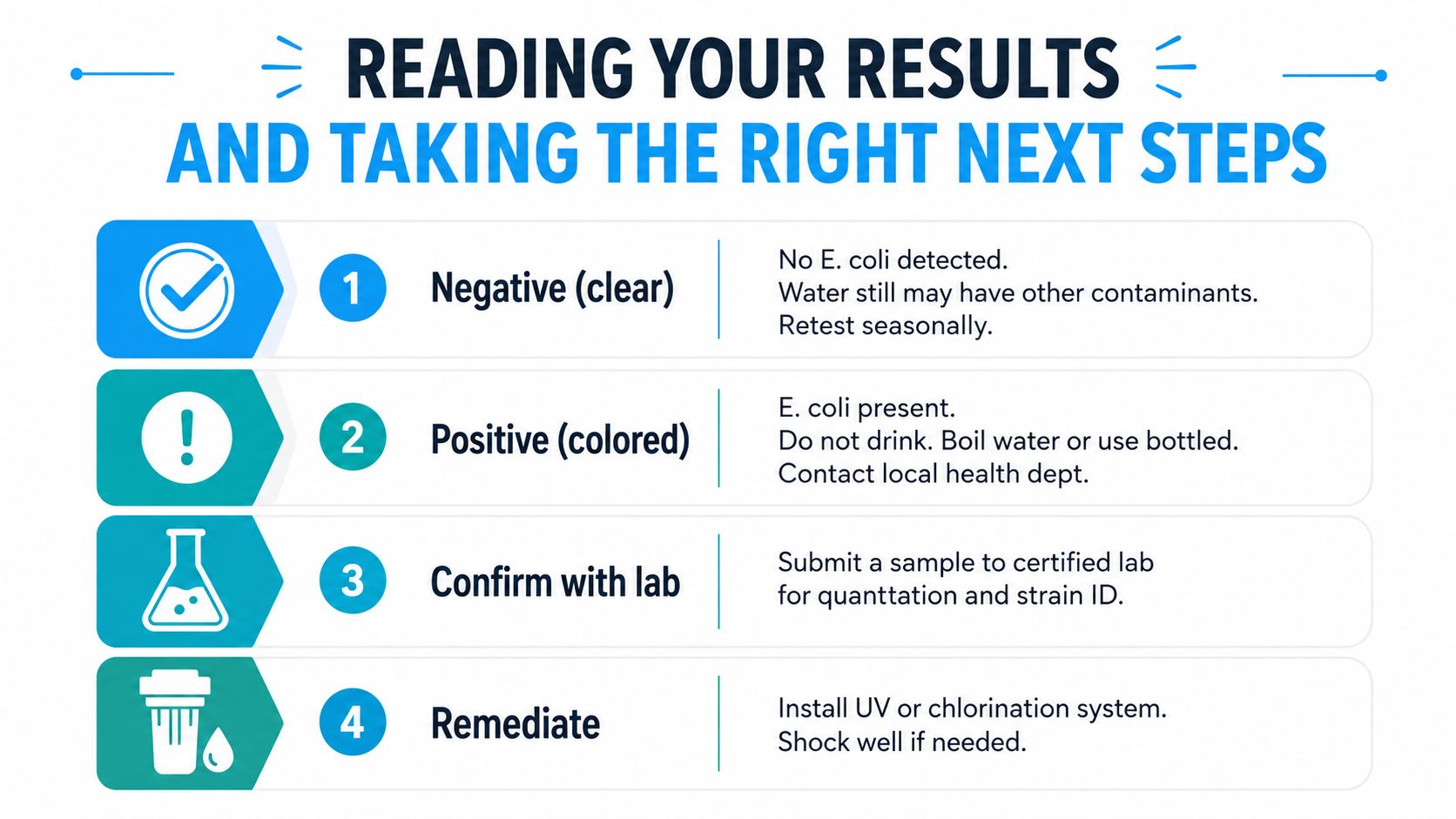
- Negative result: No E. coli was detected by that test. Continue source protection and planned testing, especially if the well is shallow, the property has a history of contamination, or weather conditions have changed.
- Positive result: Stop using the water for drinking, cooking, brushing teeth, and other ingestion-related purposes until you receive appropriate public-health or laboratory guidance. Use bottled water or follow local boil-water advice.
- Unclear result: Don't guess based on a weak color shift. Compare the sample with the kit's control or reference chart, then contact the manufacturer or repeat the test with a fresh, properly collected sample.
- Confirmed contamination: Contact the local health department, water authority, or a qualified well professional. A laboratory can help quantify the result and investigate whether disinfection, source repair, or treatment is needed.
Retesting and filtration
A positive private-well result may lead to well inspection, shock disinfection, plumbing checks, or installation of a treatment system such as UV or chlorination. Filtration can support a long-term plan, but the treatment must match the hazard and be maintained according to its design.
A negative kit result lowers uncertainty. It doesn't turn an unknown water source into a guaranteed-safe one.
After remediation, retest rather than assuming the problem has disappeared. If contamination returns, look for the pathway, including runoff, septic influence, damaged well components, or treatment failure.
Choosing the Right Kit for Your Household
The best E. coli test kit depends on the decision waiting behind the test.
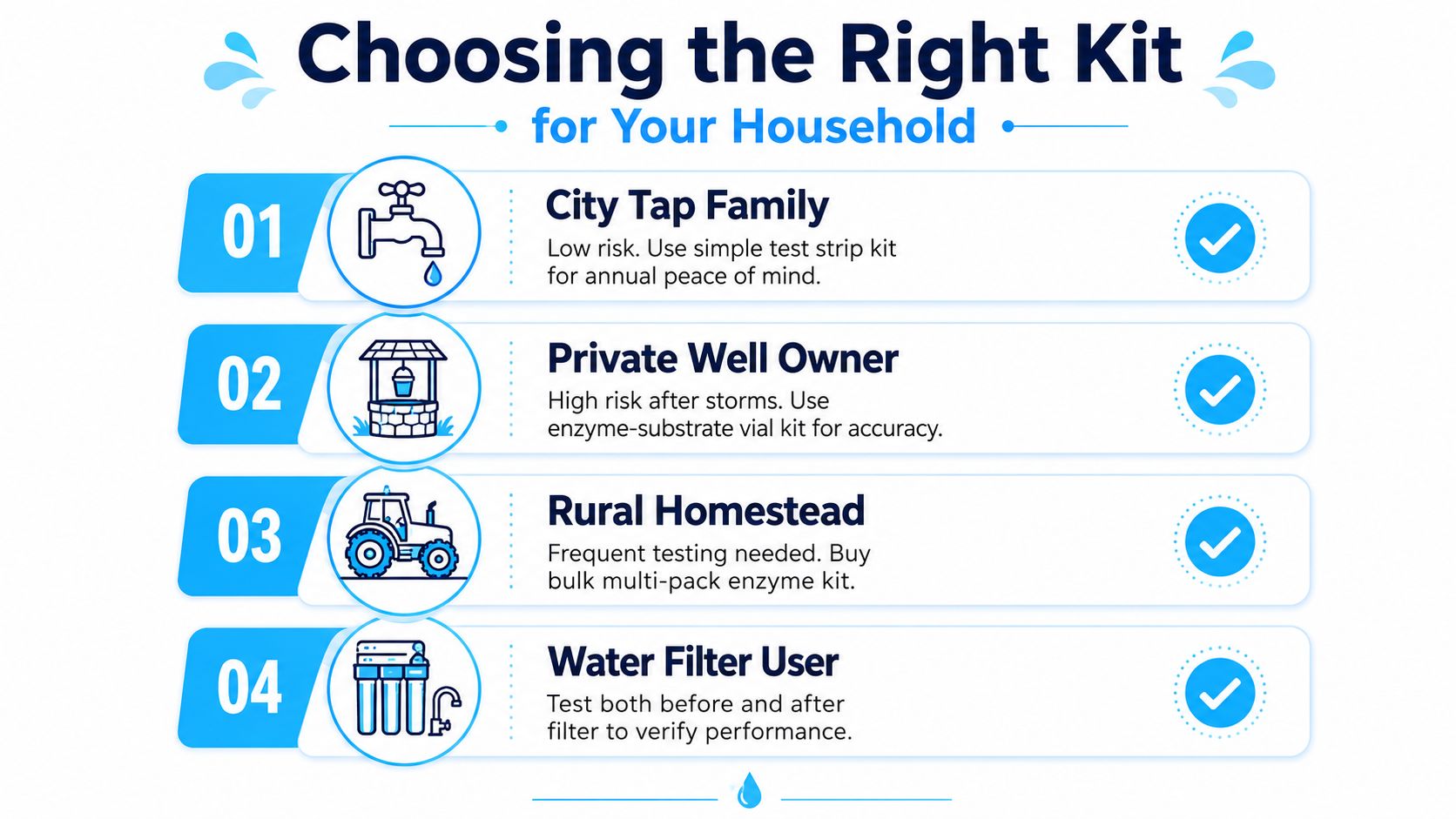
A city-tap household doing a routine check may prefer a simple presence/absence format, provided the goal is personal screening rather than compliance documentation. If the municipal supply has issued an advisory, follow the utility's instructions instead of relying on a consumer kit to clear the water.
A private well owner after heavy rainfall needs a method that uses an appropriate sample volume, clear incubation conditions, and a follow-up path to laboratory confirmation. The Aquagenx well-water testing information emphasizes the responsibility private well owners carry and the importance of testing when environmental conditions or well conditions change.
A family with a newborn may reasonably choose a slower, better-documented test and use laboratory confirmation for a positive or questionable result. A single adult renter who wants a quick gut check before installing an under-sink filter may use a rapid screen, but shouldn't treat a negative strip as a complete water-safety certificate.
Before buying, check these features:
- Target: Does it identify E. coli, total coliforms, or broad bacterial contamination?
- Sample volume: Is the method built around the drinking-water benchmark of 100 mL?
- Timing: Does the claimed speed require a higher detection threshold?
- Validation: Does the manufacturer provide performance information or identify an approved method?
- Filtration plan: Can you test before and after treatment to check whether your selected system addresses the relevant risk?
Water Filter Advisor offers consumer guidance on water testing kits, filtration types, maintenance, and replacement planning. Use that information to connect a test result with the right treatment approach, rather than buying a filter based only on taste or a single color change.
Visit Water Filter Advisor to compare home filtration options, understand which systems address bacteria and other contaminants, and build a testing routine that fits your water source. Use the site's practical buying and maintenance guidance before choosing an E. coli kit or installing treatment for a private well.
