Your Guide to Sink Water Filtration Systems for Cleaner, Safer H2O
If you've ever side-eyed your tap water and wondered what's really in there, you're not alone. Even if your water is officially "safe" to drink, that doesn't always mean it tastes or smells great. Think of the best sink water filtration systems as your personal bodyguard, standing guard at your kitchen tap to stop common intruders like chlorine and lead that sneak past your city's treatment plant.
This guide will show you how to transform your kitchen faucet from a source of questionable liquid into a pristine spring of truly clean, great-tasting water.
Turning Your Tap Water Into Liquid Gold
The water reaching your faucet has been on an epic journey. It starts at a treatment plant and then travels through miles and miles of pipes, some of which could be older than your grandparents. While municipal treatment does a solid job of meeting legal standards, that long trip can add some unwanted hitchhikers.
It's like washing your car and then driving it home through a dust storm. It won’t be showroom-shiny when you arrive. Your water picks up contaminants from old pipes or absorbs byproducts from the disinfection process itself. That's exactly why your "safe" water might smell like a public swimming pool or have a funky metallic tang.
Why a Sink Filter Is Your Kitchen's Best Friend
A sink water filter offers a targeted solution right where you need it most: for drinking, cooking, and making that perfect cup of coffee. It’s a final checkpoint to ensure the water filling your glass is as pure and delicious as possible.
Here’s what these home heroes can tackle:
- Bad Tastes and Odors: The most common complaint is that chemical zing from chlorine. A basic carbon filter can banish it, leaving your water tasting crisp, clean, and refreshing.
- The Unseen Villains: Old plumbing can leach lead into your water, which is a major health no-no. More advanced filters can remove heavy metals, pesticides, and even emerging concerns like microplastics.
- Peace of Mind: There's a priceless comfort in knowing your family is drinking water that's been through an extra layer of purification right at the tap.
People have strong opinions on water filters, but most agree on one thing: a good system makes a noticeable difference. It takes an everyday necessity—water—and elevates it, so you can stop worrying about what's lurking in your pipes.
Making Water Filtration Fun (Yes, Really!)
The world of water filtration can feel like a stuffy science lecture, full of confusing acronyms and technical jargon. But we're here to cut through the noise. We’ll break down the magic behind different sink filters, from the simple gadgets you screw onto your faucet to the powerhouse systems that live under your sink.
This guide will walk you through everything you need to know. We'll explore how different filters work and demystify the process of picking the right one for your home's unique water needs. By the end, you'll be ready to choose the perfect system for your kitchen and start enjoying cleaner, better-tasting water right away.
Comparing Under Sink and Faucet Mount Filters
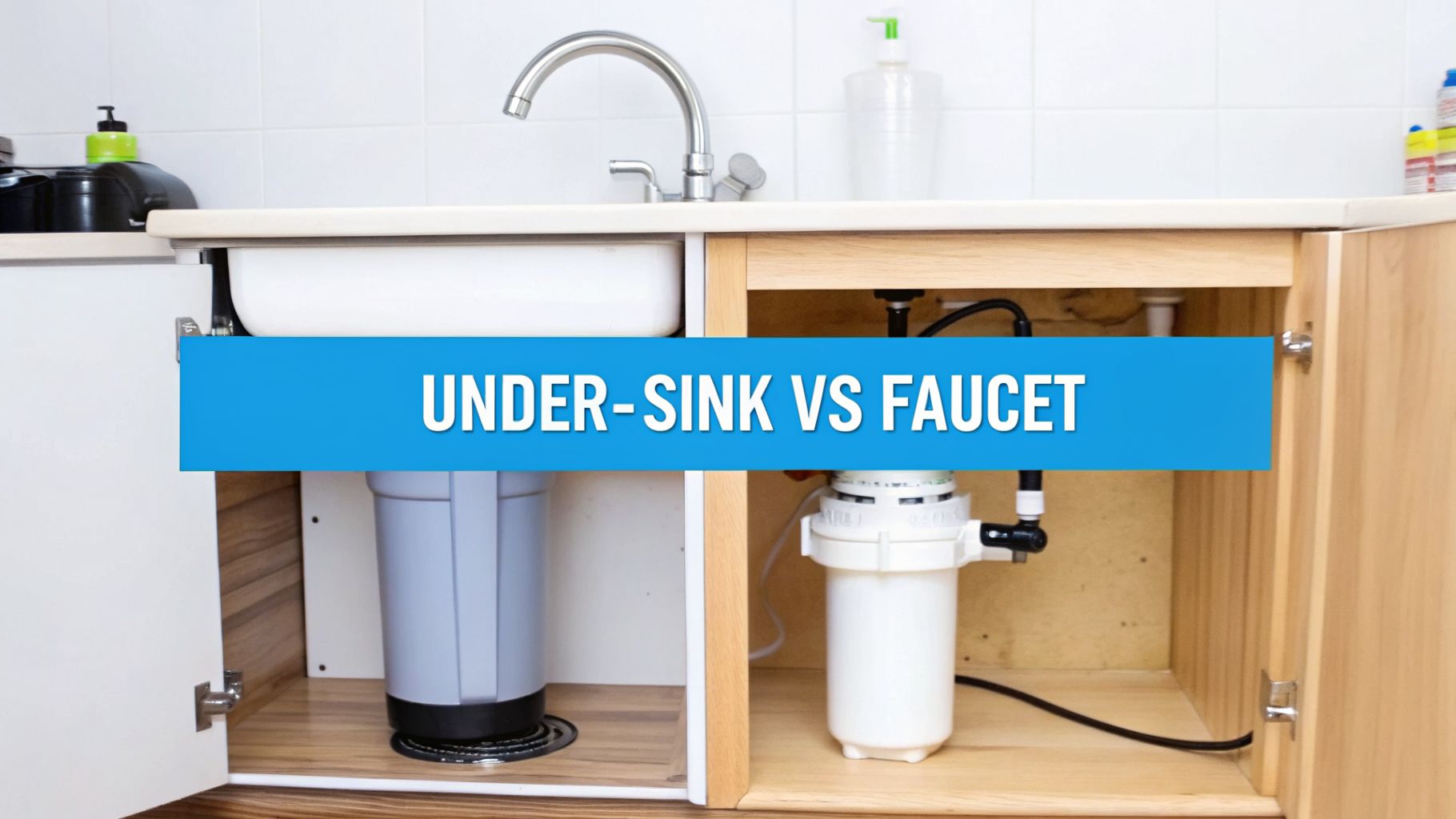
When you start exploring sink water filtration systems, you’ll quickly discover two main contenders: under-sink filters and faucet-mount filters. The choice boils down to a classic showdown: out-of-sight power versus grab-and-go convenience.
Think of it like choosing your home audio. An under-sink filter is like a custom-installed surround sound system—powerful, completely integrated, and invisible. A faucet-mount filter is more like a top-notch Bluetooth speaker; it's a breeze to set up, affordable, and delivers great results without any renovation.
Both will give you better water, but they’re designed for different homes, different priorities, and different people. Let’s dive into what makes them tick so you can figure out which one is your perfect match.
Under-Sink Filters: The Out-of-Sight Powerhouse
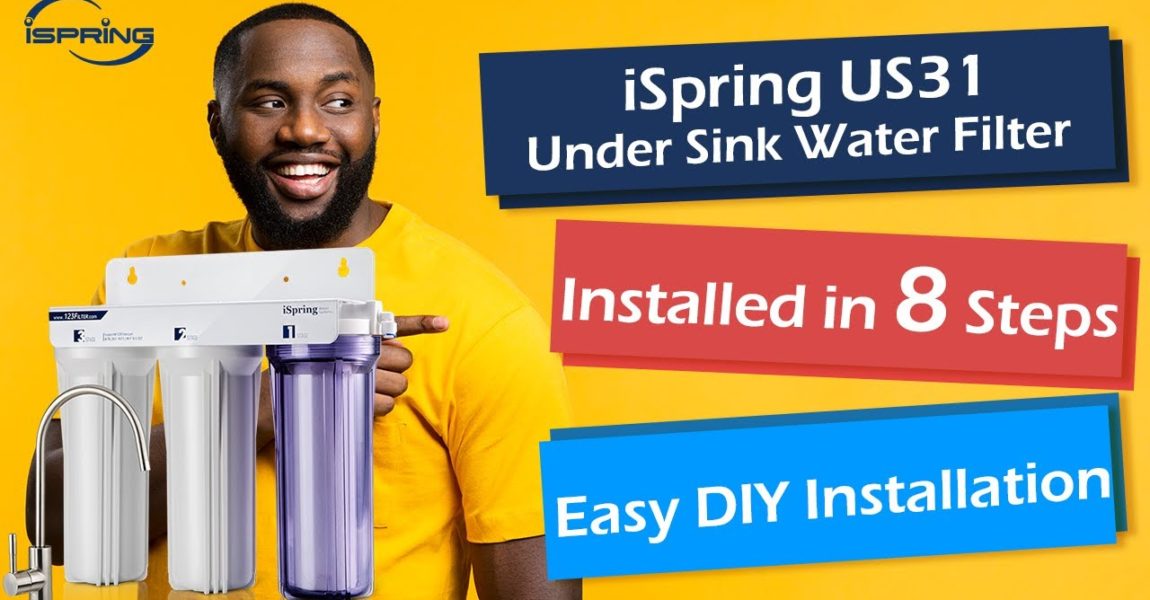
Just as the name suggests, these systems are installed right in the cabinet beneath your kitchen sink. They tap directly into your cold water line, sending purified water to either your main kitchen faucet or, more commonly, a sleek, dedicated tap right on your countertop.
These systems are the heavy lifters of home water filtration. Because they have more space to work with, they use larger, more robust filter cartridges. This means they can target a much wider range of contaminants, and you won't have to change the filters nearly as often.
Here's why people fall in love with under-sink systems:
- Superior Filtration: They can handle multi-stage filtration, including powerful methods like Reverse Osmosis (RO) that can remove up to 99% of nasty stuff like dissolved solids, heavy metals, and chemicals.
- Longer Filter Life: Bigger filters mean less hassle. You might only have to swap them out every 6 to 12 months—sometimes even longer.
- Uncluttered Countertops: Everything is tucked away. The only thing you see is a slim, elegant dispenser faucet next to your main one.
The trade-offs? The installation is more involved and might require a bit of plumbing know-how (or a call to a professional). They also carry a higher upfront cost. But if your goal is maximum purification and long-term convenience, an under-sink system is tough to beat.
Faucet-Mount Filters: The Convenient Clip-On
Faucet-mount filters are all about simplicity. These clever little devices screw directly onto the end of your faucet, usually without any tools, in just a couple of minutes. A small lever on the side lets you instantly switch between filtered water for drinking and regular tap water for washing dishes.
Their biggest advantage is their accessibility. They are very budget-friendly and the dead-simple installation makes them a perfect fit for renters or anyone who'd rather not mess with their plumbing.
While they are incredibly convenient, their compact size limits their filtration capacity compared to their under-sink counterparts. They are fantastic for improving taste and odor but may not be the best solution for more serious contamination concerns.
When looking at what attaches to your faucet, it’s also worth considering other add-ons like high-efficiency aerators for kitchen faucets, which can help you save on your water bill.
Under-Sink vs. Faucet-Mount Filters At a Glance
So, how do they really stack up head-to-head? This table breaks down the key differences to make your decision a little easier.
| Feature | Under-Sink Systems | Faucet-Mount Systems |
|---|---|---|
| Filtration Power | High (can remove a wide range of contaminants, including lead, VOCs, and TDS) | Moderate (primarily removes chlorine, improves taste and odor) |
| Installation | Moderate to difficult (often requires plumbing work) | Very Easy (clips on in minutes, no tools needed) |
| Kitchen Space | Uses cabinet space, keeps counters clear | Attaches to faucet, visible on the sink |
| Filter Lifespan | Long (6-12+ months) | Short (2-3 months) |
| Upfront Cost | Higher | Lower |
| Best For | Homeowners wanting comprehensive filtration | Renters, budget-conscious users, and simple taste/odor issues |
Ultimately, choosing your filter is about finding the right balance. You have to weigh your water quality needs against your budget and how much time you're willing to put into installation and maintenance.
How Sink Water Filters Actually Clean Your Water
Ever wondered what’s happening inside that filter under your sink? It’s not magic, but a series of smart, scientific steps that grab the gunk and let the good stuff—clean water—flow through to your glass.
Think of it like a bouncer at an exclusive club. Each filtration stage has a specific job, checking for and kicking out different types of unwanted contaminants. Once you understand who does what, you can pick the right system to protect your family's water.
Activated Carbon: The Contaminant Sponge
The workhorse of almost every sink filter is activated carbon. It’s the single best tool for making your water taste and smell better, fast. Imagine a sponge with a massive surface area, but instead of soaking up water, it’s designed to trap chemical impurities.
To make it, carbon granules are treated with oxygen, which creates millions of microscopic pores. When water passes over it, a process called adsorption kicks in. Nasty stuff like chlorine, pesticides, and volatile organic compounds (VOCs) that give water off-tastes and odors get stuck to the carbon’s surface, while the clean water passes by.
This is why even a simple faucet-mounted filter can make such a huge difference. It’s a master at getting rid of that “public pool” chlorine smell.
Bottom line: Activated carbon is like a magnet for the most common things that make water taste and smell bad. It’s your first line of defense for better-tasting water right from the tap.
Reverse Osmosis: The Ultimate Gatekeeper
Carbon is fantastic for improving taste, but what about the contaminants you can't see, taste, or smell? That’s where Reverse Osmosis (RO) takes over. This is one of the most powerful purification methods you can get for your home. If carbon is a sponge, RO is a high-security checkpoint.
An RO system uses your home’s water pressure to force water through a special semipermeable membrane. This membrane is incredibly fine—its pores are only about 0.0001 microns wide. That’s so small that pretty much only pure water molecules can squeeze through.
So what gets left behind? Just about everything else.
- Dissolved Solids: Salts, nitrates, and even fluoride.
- Heavy Metals: Lead, arsenic, chromium, and mercury are stopped in their tracks.
- Other Contaminants: It's also highly effective against tiny things like bacteria and viruses.
Because it’s so thorough, RO is the go-to choice for anyone dealing with serious water quality issues. It's a technology that dominates the market, with its share expected to hit 38.7% by 2026, mainly because people trust its power to remove heavy metals and other tough contaminants. As more families invest in these systems, you can check out more data on water purifier market trends to see how the technology is evolving.
One thing to know is that the RO process is so fine it can also strip out beneficial minerals. To fix this, many modern RO systems add a remineralization stage at the end. This step puts back a small amount of healthy minerals like calcium and magnesium, which actually improves the water’s taste and brings it to a more natural pH.
Other Key Filtration Methods
Beyond carbon and RO, some systems use extra stages to tackle specific problems. One you'll often see is Kinetic Degradation Fluxion (KDF).
KDF is a filter media made from high-purity copper-zinc granules. When water flows through it, an electrochemical reaction happens that reduces heavy metals like lead, mercury, and iron. It also has another key job: it helps control the growth of bacteria and algae inside the filter itself. This protects the carbon filter that often comes after it, helping it last longer and work more effectively. You’ll frequently find KDF paired with carbon in multi-stage systems for a really solid, broad defense against contaminants.
How to Choose the Right Filter for Your Home
Figuring out the "best" sink water filter is a personal decision. There’s no one-size-fits-all answer.
If all you're trying to do is get rid of a slight chlorine taste, a powerful, multi-stage system is total overkill. On the flip side, a simple faucet filter isn't going to cut it if you're worried about lead from old pipes. The right choice always starts with one thing: knowing what’s actually in your water.
Think of yourself as a water detective. Your first job is to gather some evidence. This is the single most important step in the whole process because it ensures you buy a filter that actually solves your problem.
Start with a Water Quality Report
If your water comes from a city or town, your first clue is free. It’s called a Consumer Confidence Report (CCR). The EPA requires every community water supplier to give their customers this report every year.
It’s basically a scorecard for your water, showing what contaminants have been detected over the past year. You can usually find it right on your local water utility’s website. This report gives you a baseline for things like chlorine, lead, nitrates, and other regulated stuff your filter might need to tackle.
Got a private well? Then you're the one in charge of testing. You can grab an at-home test kit or, for a much more detailed picture, send a sample to a state-certified lab. This is a must-do, as well water can have surprises like bacteria or high iron levels that you won't find in treated city water. For more in-depth guidance, you can explore our collection of expert advice on water filtration to help you along.
Match the Filter to the Foe
Once you have your "evidence" from a water report or lab test, you can pick your weapon. It's all about matching the right filtration technology to the specific contaminants you're trying to get rid of.
Here’s how it usually breaks down:
Problem: Your water tastes and smells like a swimming pool.
Solution: An activated carbon filter is your best friend here. It’s fantastic at grabbing the chlorine and other chemicals that cause those bad tastes and odors. A simple faucet filter or a basic under-sink unit will do the job perfectly.
Problem: Your water report shows lead, arsenic, or nitrates are a problem, or you live near industrial areas.
Solution: This is a job for the heavy-hitter: a Reverse Osmosis (RO) system. Its special membrane is like a bouncer at an exclusive club, blocking an incredibly wide range of contaminants that carbon filters just can't handle.
Problem: You've got bad taste and you're worried about things like heavy metals.
Solution: A multi-stage under-sink system is a great middle ground. These combine different filter types, like activated carbon and sediment filters, to give you broad protection without going to a full RO setup.
This handy chart can help you visualize the decision process. You start with your main concern and follow it to the right technology.
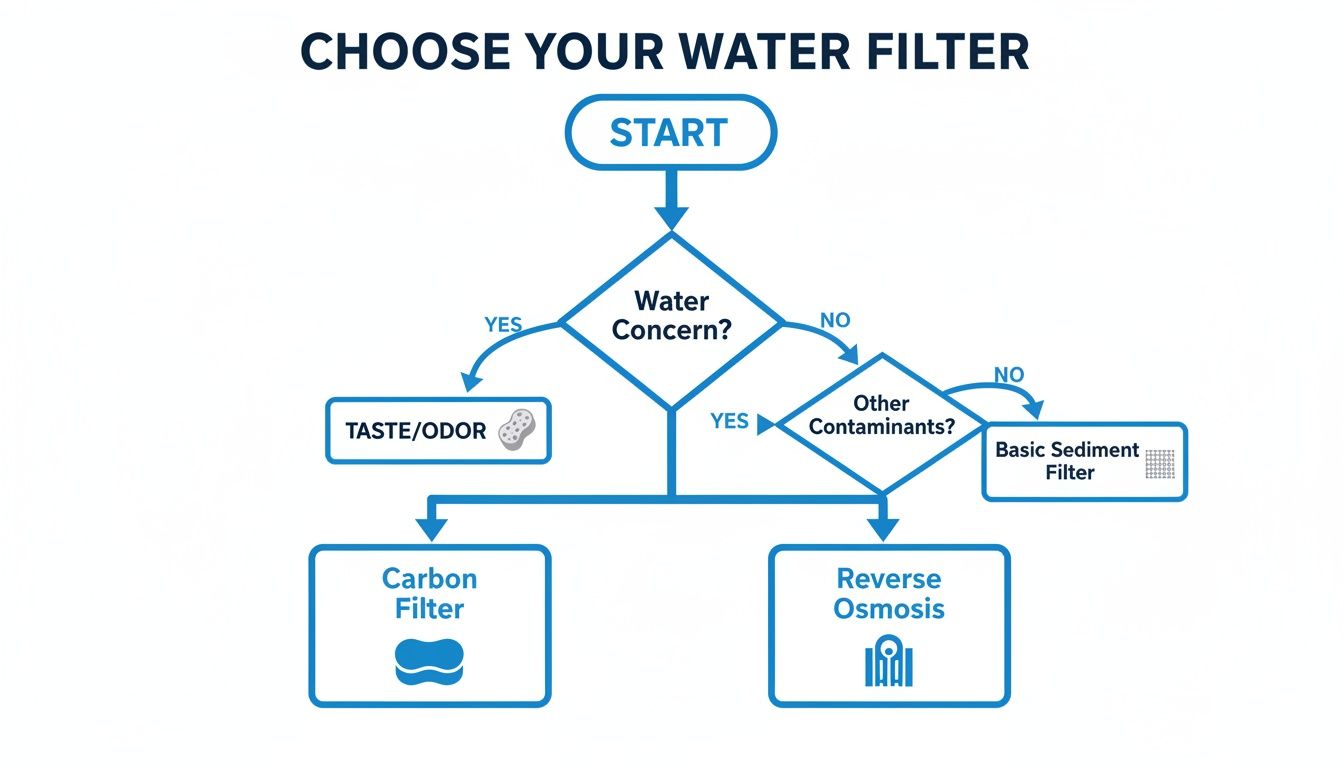
The key is to identify your main problem first. That will lead you straight to the most effective and budget-friendly filter for your home.
Decode the Certifications
So how do you know if a filter really does what the box says it does? You look for proof from a third party. In the water filter world, the gold standard is a certification from the NSF (National Sanitation Foundation).
An NSF/ANSI certification is your guarantee that a filter has been rigorously tested by an independent lab. It proves the product meets strict standards for safety and performance, so you know it’s not just marketing fluff.
When you're shopping, keep an eye out for these key certifications:
NSF/ANSI 42: This one’s for aesthetic effects. A filter with this seal is proven to reduce things that affect taste and smell, like chlorine. It makes your water more pleasant to drink.
NSF/ANSI 53: This is the big one for health effects. If a filter has this, it's been tested and verified to reduce specific health-related contaminants like lead, mercury, or VOCs.
NSF/ANSI 58: This certification applies only to Reverse Osmosis systems. It confirms the system’s ability to reduce a long list of tough contaminants, including arsenic, nitrates, and total dissolved solids (TDS).
Don't just take a company's word for it. Look for that official NSF seal on the box or in the product manual. Taking an evidence-based approach is the best way to choose a system that delivers real protection and true peace of mind.
Understanding Installation and Long-Term Costs
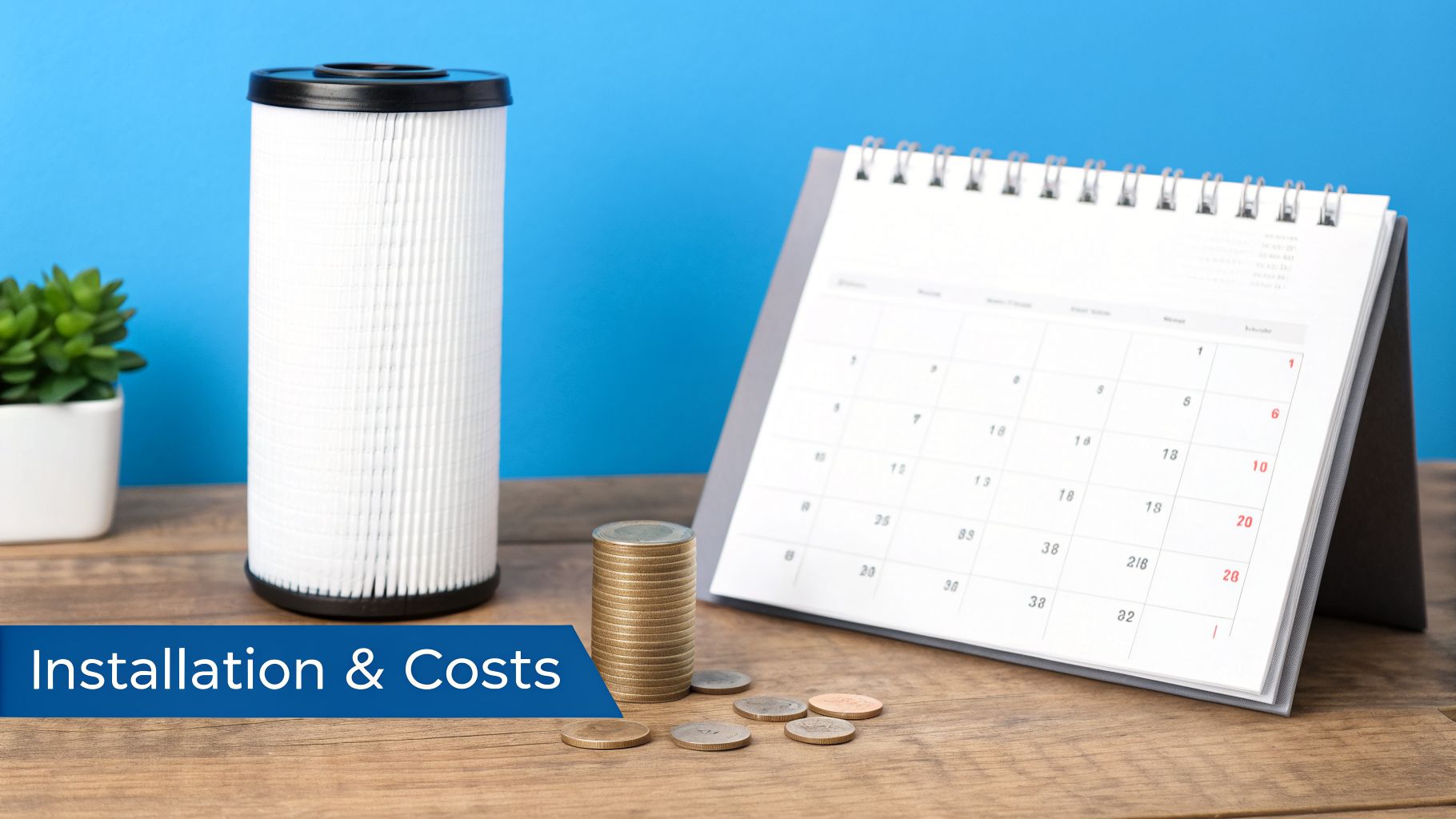
Choosing the perfect sink water filtration system is a great first step. But the real journey begins when you get it home, and that involves both the initial setup and the ongoing upkeep. It's crucial to look beyond the sticker price and understand the total cost of ownership if you want to make a smart investment in your home's water quality.
This means factoring in everything—from getting the system installed to buying replacement filters down the road. Getting a clear picture of these expenses from the start ensures you can budget properly and pick a system that delivers both clean water and genuine value for years to come.
Navigating the Installation Process
The time, effort, and money it takes to install a sink water filter can vary wildly from one system to the next. On one end, you have what might be the easiest DIY project ever.
Faucet-Mount Filters: These are literally designed to be installed without any tools. You just unscrew the little aerator on your faucet, screw the filter on, and you're done. The whole thing usually takes less than five minutes.
Basic Under-Sink Systems: Many of the simpler single or dual-cartridge systems are also made with the homeowner in mind. They often come with color-coded hoses and quick-connect fittings, so all you might need is a basic wrench and a little bit of patience.
Complex RO Systems: This is where things get more involved. Reverse Osmosis systems are the heavy-lifters of water filtration, and their installation reflects that. You'll likely need to drill a hole in your countertop for a separate, dedicated faucet and also tap into your sink's drain line for the wastewater. While a handy person can definitely tackle this, it’s often a job best left to a professional.
If you're not comfortable with plumbing, calling in a pro ensures a clean, leak-free setup and gives you total peace of mind. The principles of quality plumbing work in Dubai are universal—a proper installation is key to a system working correctly from day one.
Calculating the True Cost of Ownership
The initial purchase price is a one-time thing, but the filters are a recurring cost. This is the single most important detail when you're trying to figure out the true, long-term price of your system. A cheap unit that needs new filters every other month can easily end up costing you more than a pricier system with long-lasting cartridges.
The real value of a sink water filtration system is found by looking at its annual cost. Calculate how much you'll spend on replacement filters per year to see the complete financial picture.
For instance, a $50 faucet-mount filter might look like a steal. But if its $20 replacement cartridge only lasts three months, you're actually spending $80 every single year. Compare that to a $200 under-sink system whose $60 filter lasts a full year. The more expensive system actually saves you money over time.
It's clear that homeowners are prioritizing clean water. The global water purification filters market was valued at a staggering USD 44.22 billion in 2024 and is expected to climb to USD 62.53 billion by 2034. This intense competition is great for us, as it pushes manufacturers to create filters that last longer and perform better. You can read more about these water purification market projections to get a sense of where the industry is heading.
Staying on Top of Filter Replacements
The number one way a water filter fails is simple: people forget to change the cartridge. An old, clogged filter doesn't just stop removing contaminants; it can also slow your water flow down to a frustrating trickle and even become a breeding ground for bacteria.
Most manufacturers suggest replacing standard filters every 6 to 12 months, but this can change based on how much water you use and how contaminated it is to begin with. RO membranes are the exception, typically lasting much longer—often 2 to 3 years.
Here’s how to make sure you never miss a change:
- Look for an Indicator: Many systems now come with a small LED light that changes color or an audible timer that beeps when it's time for a new filter.
- Use Your Calendar: If your system is low-tech, just use your phone. The day you install a new filter, set a recurring calendar reminder for its replacement date.
- Watch the Water Flow: A noticeable drop in water pressure from the filtered tap is a dead giveaway. If the flow slows down, the filter is clogged and ready to be replaced.
Common Questions About Home Water Filtration
Deciding to add a water filter under your sink is a great move, but it's totally normal to have a few questions before you start. Let's clear up some of the most common things people wonder about. We'll give you straight, simple answers to help you feel good about your choice.
Will an Under Sink Water Filter Reduce My Water Pressure?
This is probably the most common worry we hear, and the short answer is: it depends on the system. For a standard under-sink cartridge filter, the impact on your water pressure is usually so small you won't even notice a change at your main faucet.
Reverse Osmosis (RO) systems are a different beast. They work by forcing water through an incredibly fine membrane to get the highest level of purity, and that process does slow things down quite a bit.
But don't worry, they've already solved for that. Almost every RO system includes a small storage tank. This tank holds a reserve of purified water, ready to go. When you turn on the special RO faucet, you get a strong, steady stream. The system then quietly gets to work refilling the tank so you're never left waiting.
How Do I Know When to Change My Filter Cartridges?
Forgetting to change your filters is the number one reason a system stops working well. A clogged filter doesn't just fail to remove contaminants; it can slow your water flow to a trickle and even become a place for bacteria to grow.
Thankfully, you don't have to rely on memory alone. Many modern sink water filtration systems have built-in reminders, from a simple sticker for the date to an LED light that switches from green to red when it's time for a change.
If your system is more basic, just watch for these tell-tale signs:
- Check the Manual: Start with the manufacturer's suggestion. It’s usually every 6 to 12 months for carbon or sediment filters. RO membranes are tougher and can last 2 to 3 years.
- Slow Water Flow: If your filtered water starts sputtering out, that's a classic sign the filter is packed with gunk and needs to be replaced.
- The Bad Taste Comes Back: Notice that old chlorine or musty taste again? Your filter is officially tapped out. Time for a new one.
A pro tip? Just set a recurring reminder on your phone’s calendar. It’s a foolproof way to stay on top of it.
Can I Install an Under Sink Filtration System Myself?
Absolutely. Most sink filters today are designed so that a handy homeowner can install them. The difficulty really just depends on the type of system you choose. Faucet-mount filters are the easiest—they just snap onto your tap in a few seconds, no tools required.
A lot of the single-cartridge under-sink systems are also very DIY-friendly. They often come with color-coded tubes and quick-connect fittings that make the job much simpler. If you can handle a basic wrench and follow a set of instructions, you can probably get it done in less than an hour.
Reverse Osmosis systems are a bit more involved. The installation usually means drilling a hole in your countertop for the new faucet and connecting a line to your sink's drain pipe. Plenty of people with some basic plumbing confidence do it themselves, but there's no shame in calling a plumber to ensure it's done right and without any leaks.
Do Water Filters Remove Healthy Minerals?
That's a fantastic question, and it gets right to the heart of how different filters work.
Your standard activated carbon, sediment, and KDF filters are what you might call "smart" filters. They are designed to target specific troublemakers like chlorine, lead, and pesticides while letting beneficial minerals like calcium and magnesium pass right on through.
Reverse Osmosis, on the other hand, is a powerhouse. It's so thorough that it strips out nearly everything—including those healthy minerals. This can sometimes leave the water tasting a little flat or even slightly acidic.
To fix this, many top-tier RO systems now come with a remineralization stage. After all the intense purification, the water flows through one last cartridge that adds a balanced blend of healthy minerals back in. This does two great things: it makes the water taste crisp and refreshing, and it raises the pH to a more natural, alkaline level.
It’s the perfect finishing touch, giving you the best of both worlds: incredibly pure water that also tastes fantastic.
At Water Filter Advisor, our mission is to give you the knowledge you need to make the best choice for your home's water. We have everything from deep-dive guides to honest reviews to help you find the right filter for your family. Start your journey to better water by exploring our resources at https://www.waterfilteradvisor.com.