How Often to Replace Water Filter: A 2026 Home Guide
You're probably here because something finally tipped you off. The refrigerator light started blinking. Your pitcher got painfully slow. Your coffee tastes flat, metallic, or vaguely like pool water again. Many find themselves waiting for one of those moments, then realize they have no idea how often to replace a water filter without guessing.
Here's the blunt answer: guessing is how people end up drinking poorly filtered water for months. An expired filter doesn't just “work a little less well.” In some setups, it becomes a clogged, exhausted cartridge that still looks normal from the outside while doing a lousy job inside. That's why homeowners get confused. The filter is still physically there, water is still coming out, and the system hasn't exploded, so they assume they're fine.
They might not be.
Your Filter Is Expired Now What
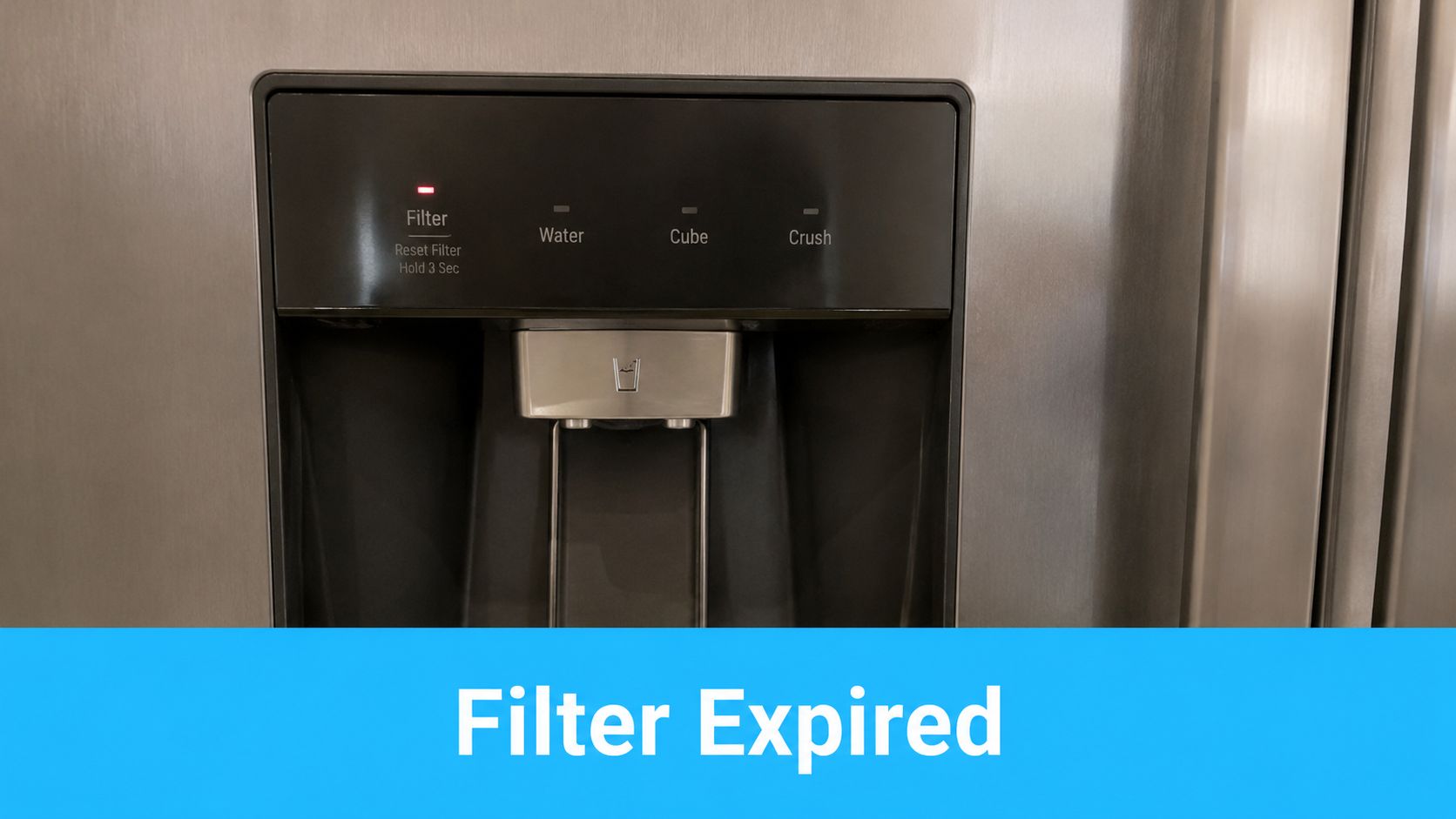
A homeowner ignores the red light on the fridge for a few weeks. Then a few months. Water still comes out, so it gets pushed down the list behind groceries, school pickups, and fixing the gutter leak. Then one morning the ice tastes stale and the dispenser slows to a crawl. That's usually when people start paying attention.
That moment matters more than is commonly believed.
Old filters don't fail in a dramatic way. They fail subtly. Water may still look clear while taste, odor, and contaminant reduction slip in the background. That's why filter replacement isn't a cosmetic chore. It's routine home maintenance, right up there with changing smoke detector batteries and servicing HVAC equipment.
The problem isn't just age
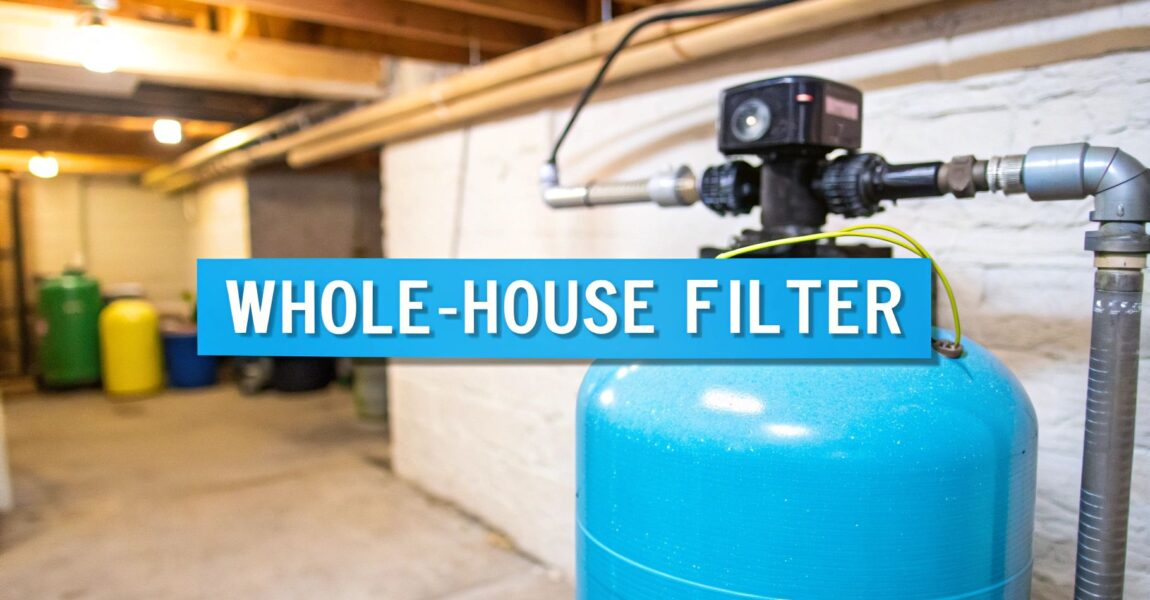
Different filters age in different ways. A pitcher cartridge reaches the end of its capacity fast. A refrigerator cartridge follows a fixed calendar. A whole-house setup usually has one schedule for sediment and another for carbon. Reverse osmosis systems add another layer because the membrane lasts much longer than pre-filters.
According to DuPure's water filter replacement overview, whole-house sediment and carbon filters typically require replacement every 6–12 months, while reverse osmosis membranes last 2–3 years, but pitcher filters may need replacement every 1–2 months due to shorter capacity.
That spread is exactly why so many homeowners get tripped up. They assume every filter follows the same logic. It doesn't.
Practical rule: If you can't remember the last time you changed a filter, treat it as overdue until proven otherwise.
What to do first
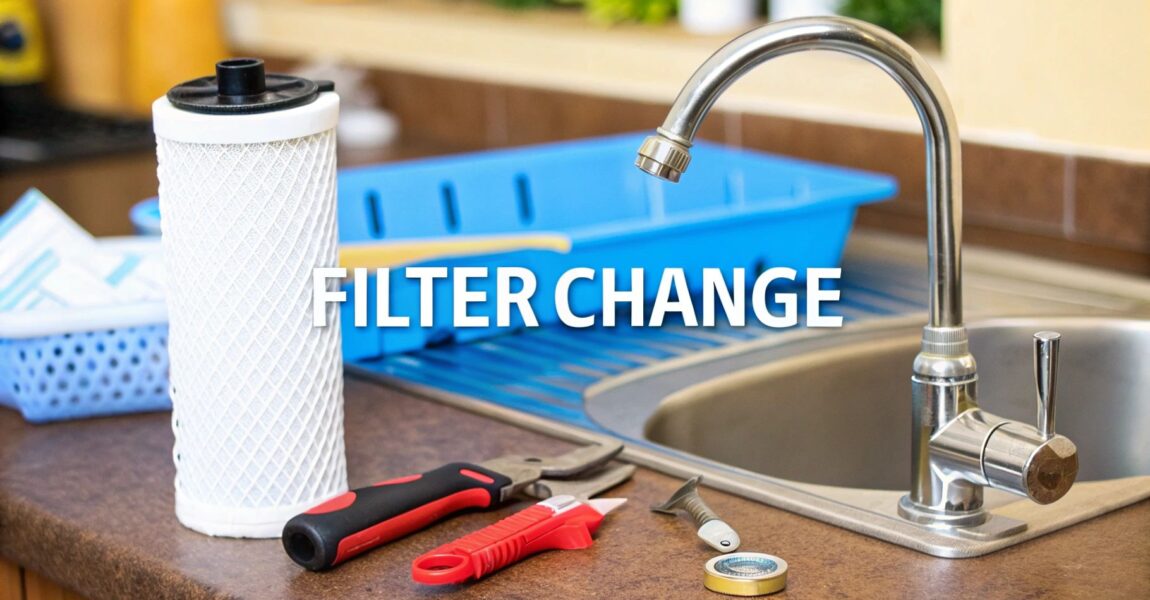
If your filter is already expired, don't overthink it. Start with the basics:
- Replace the overdue cartridge first. Don't waste time trying to squeeze “just a little more life” out of a filter you already know is past schedule.
- Check your filter type. Refrigerator, pitcher, whole-house, under-sink, and RO systems all play by different rules.
- Write the install date down. Marker on the housing, note on your phone, calendar alert, whatever you'll use.
- Pay attention after the change. Fresh filters usually improve taste, odor, and flow quickly. If they don't, the issue may be your water source or the wrong filter media.
A more complicated system isn't generally required. What's often needed is a better habit.
The Standard Water Filter Replacement Calendar
Start with a calendar, not a guess.
Manufacturer timelines are the baseline. They are not marketing fluff, but they are also not the whole answer. Use them as your default replacement schedule, then adjust later based on your water source, household use, and the warning signs your filter gives you.
Refrigerator filters have a hard deadline
Refrigerator filters get ignored because the water still looks clear and the dispenser still works. That mistake is common, and it leads to stale media sitting in a damp, enclosed system for too long.
Whirlpool states that refrigerator water filters must be replaced every 6 months regardless of usage indicators, and if an indicator light is absent, the 6-month rule remains mandatory. Follow that rule. If your fridge does not track filter life, put the replacement date on your calendar and move on.
Standard Water Filter Replacement Intervals
| Filter Type | Typical Lifespan (Time) | Typical Lifespan (Gallons) |
|---|---|---|
| Pitcher filter | 1–2 months | 40 gallons |
| Refrigerator filter | 6 months | Not specified |
| Whole-house sediment filter | 6–12 months | Not specified |
| Whole-house carbon filter | 6–12 months | Not specified |
| Reverse osmosis membrane | 2–3 years | Not specified |
| Aquasana OptimH2O filter | 12 months | 100,000 gallons |
| Aquasana Rhino main filter | 10 years | 1,000,000 gallons |
What these timelines actually mean
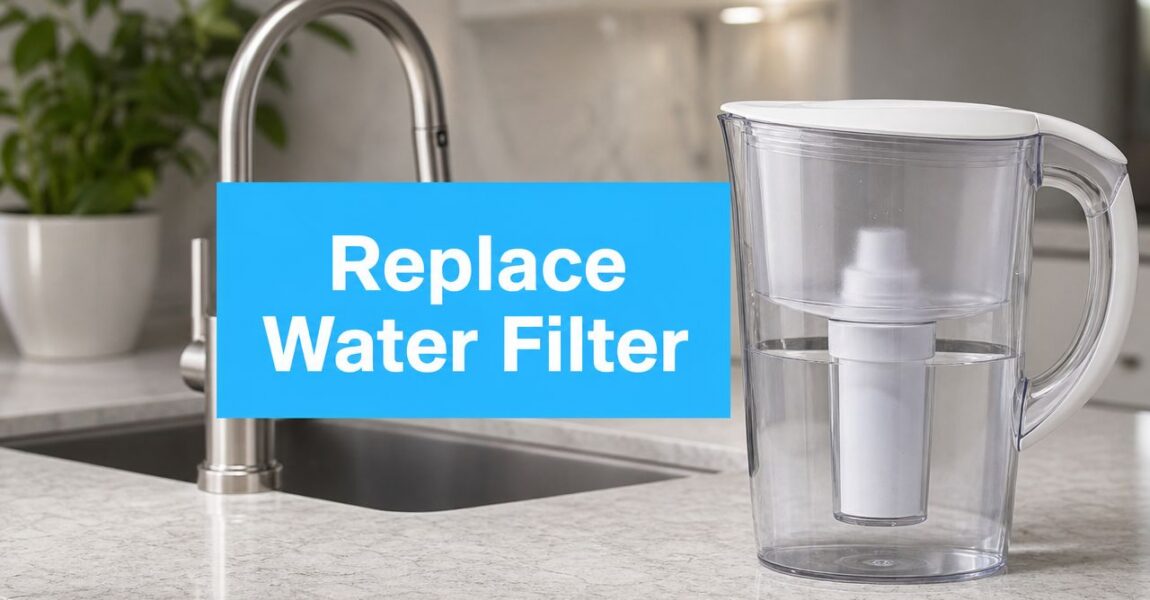
Pitcher filters are the shortest-life filters in the house. Treat them that way. A good rule is every 2 months or 40 gallons for standard pitcher cartridges. Small filters clog and exhaust fast, especially if they handle all your drinking water.
Whole-house sediment and carbon filters usually land in the 6 to 12 month range. Reverse osmosis membranes usually last 2 to 3 years. The mistake is assuming the membrane schedule covers the whole system. It does not. The pre-filters and post-filters around it usually need replacement much sooner.
Large-capacity systems can run much longer, but only when the product is built for it and the water conditions allow it.
Brand examples show why one schedule never fits every filter
Aquasana is a good example because one brand can have very different replacement intervals across its lineup. According to Aquasana's filter lifespan guide, the Rhino® and Rhino® Max Flow whole-house tanks are designed for a 10-year or 1,000,000-gallon main filter lifespan, while the OptimH2O® filter must be replaced every 12 months or at 100,000 gallons, whichever comes first.
That gap matters. A large whole-house tank and a point-of-use cartridge do completely different jobs with completely different media volumes. Copying one schedule onto another filter is lazy and expensive.
Follow the schedule for your exact filter type first. Then refine it based on real-world performance.
The calendar I recommend homeowners use
Use this as your default schedule:
- Pitcher filter: every 2 months or at 40 gallons
- Refrigerator filter: every 6 months
- Whole-house sediment or carbon: inspect on a routine basis and expect replacement in 6 to 12 months
- RO membrane: plan on 2 to 3 years
- Large-capacity whole-house tanks: follow the product spec exactly
Faucet, under-sink, and shower filters need the same discipline
These filters vary too much for a single universal timeline. Some are calendar-based. Some are gallon-based. Some do both.
The right move is simple. Start with the manufacturer schedule. Then pay attention to what your water and your system are telling you. Flow rate alone is not a reliable judge of filter life, and a filter that still passes water can still be overdue.
Why Your Filter Might Die Sooner Or Later
Your neighbor swaps a filter every two months and swears that schedule works perfectly. You copy it, but your water starts tasting off weeks earlier. Same filter. Different house. Different result.
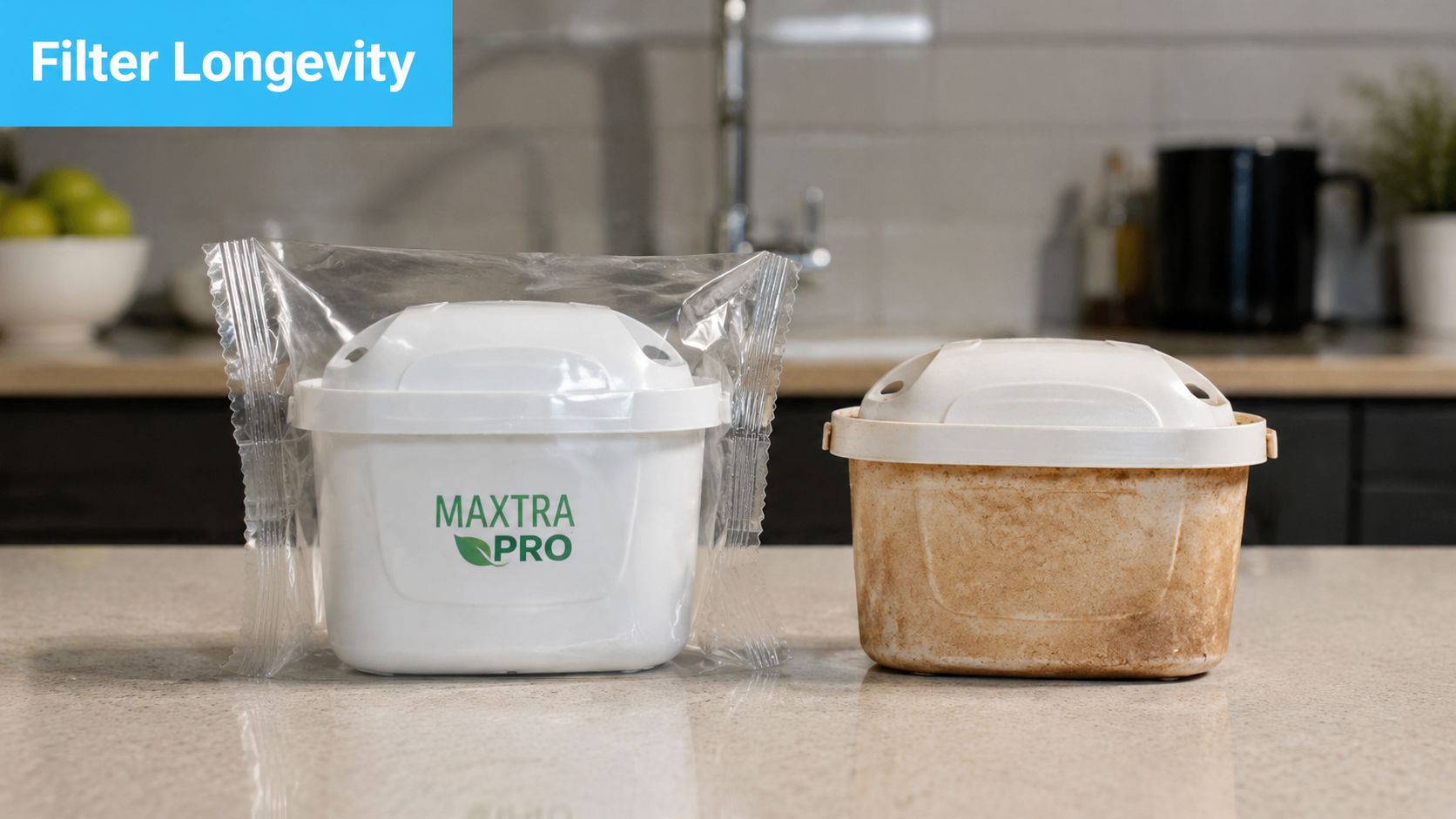
Usage changes everything
Filter life starts with gallons used. A single adult who fills one glass at night puts far less strain on a pitcher cartridge than a family using it for water bottles, coffee, cooking, and pet bowls all day.
That is why manufacturer timelines are only a starting point. The common pitcher schedule of every 2 months or 40 gallons is a decent default, but it is not a law of nature. Light use may stretch performance. Heavy daily use can burn through capacity much faster.
Do not confuse lower usage with automatic safety. A lightly used filter can still age out, and a heavily used one can be spent long before the calendar says it should be.
Source water decides how hard the filter works
A filter in relatively clean municipal water has an easier job than one dealing with heavy chlorine, chloramine, sediment, or hard water. Well water adds even more variation. One home gets mild nuisance minerals. Another gets sediment, iron, sulfur, and constant filter stress.
Homeowners often get misled by generic packaging claims. A cartridge rated for a certain time or gallon count was tested under specific conditions. Your water may be harsher. If it is, the filter will not care what the box promised.
The biggest lifespan variables
- Household size: More people means more gallons through the media.
- Water quality: Sediment, disinfectants, metals, and hardness wear filters down in different ways.
- Filter job: A basic taste-and-odor filter will age differently than one built to reduce tougher contaminants.
- System design: A compact pitcher or fridge cartridge has far less media than a larger under-sink or whole-house system.
Filters fail from workload, not from a date printed on the calendar.
The myth that trips up homeowners
Plenty of homeowners judge filter life by flow alone. That is a mistake.
A clogged filter often slows down. A worn-out carbon filter may still pass water at a normal rate while removing far less chlorine, taste, odor, or other contaminants. Good flow only tells you water is getting through. It does not prove the media is still doing its job.
Use a better framework. Start with the official schedule for your exact filter. Then shorten it if you have high usage, hard water, heavy chlorine, visible sediment, or well water with known issues. If your usage is low and your water is relatively easy to treat, you may have some room, but do not stretch replacements blindly. Build your schedule around your water, your household, and the way the filter is performing.
Decoding the Signs of a Dying Water Filter
Most homeowners wait for one dramatic sign. That's a mistake. Filters usually wave several smaller red flags first.
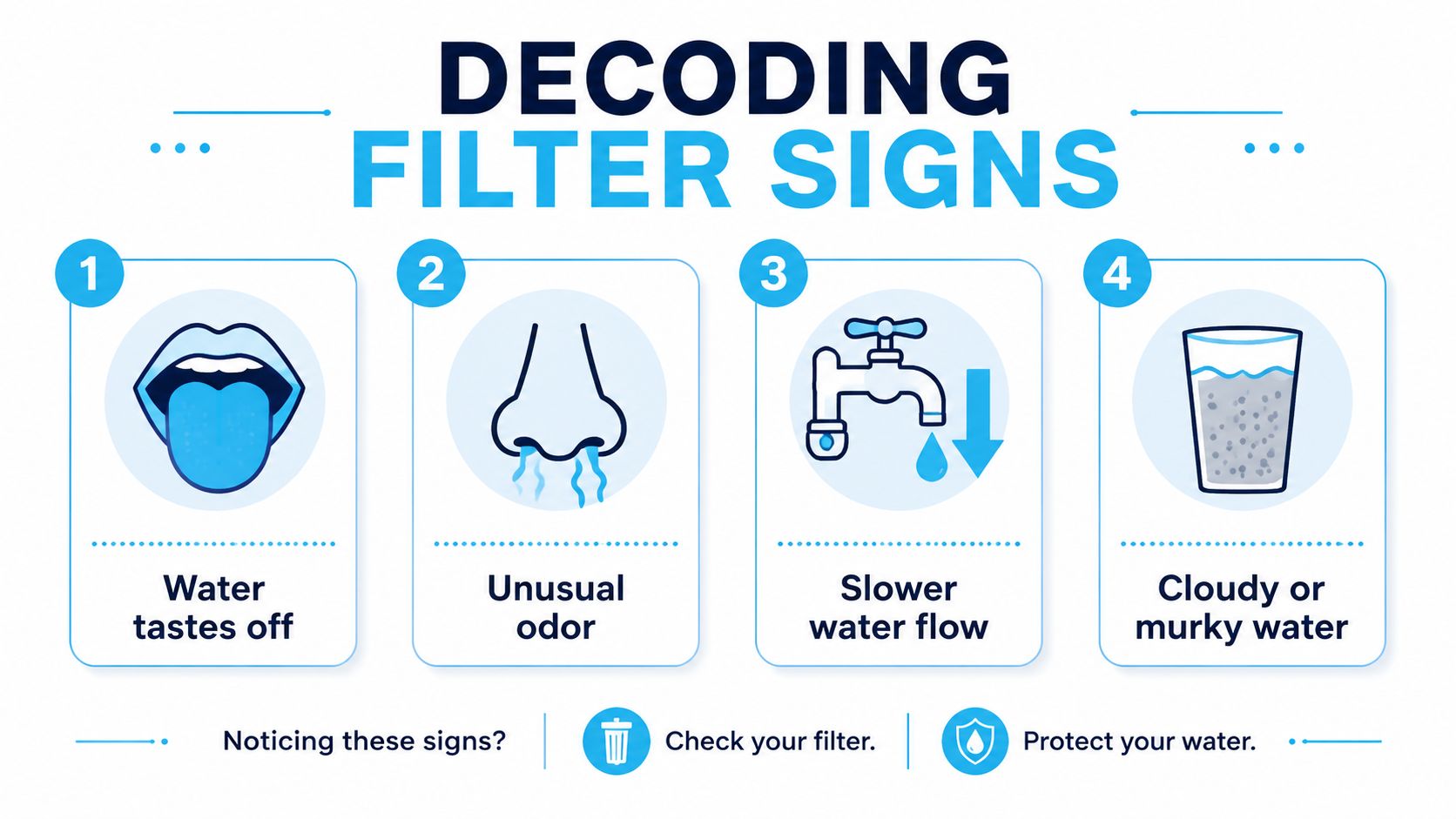
The obvious signs people notice first
You don't need lab equipment to catch the basics. Your senses are useful if you pay attention.
- Taste changes: Filtered water starts tasting flat, chlorinated, metallic, or stale.
- Odor returns: That clean neutral smell disappears and something chemical or musty creeps back in.
- Flow gets slower: Dispensing takes longer, pitchers drip more slowly, and faucets lose pressure.
- Water looks wrong: Cloudiness, floating particles, or a murky appearance means stop ignoring the system.
Those signs matter. They just don't tell the whole story.
Slow flow is not the full story
The biggest myth in home filtration is that slow flow equals failure, normal flow equals safety. That sounds tidy, but it's wrong. According to Frizzlife's discussion of filter change timing, carbon filters can lose 50% of their contaminant adsorption capacity for chloramine and lead while flow rate remains near normal.
That means a filter can still pour water at a decent rate while doing a much worse job removing certain contaminants.
Reality check: Flow rate tells you about clogging. It does not reliably tell you whether carbon media is still capturing chemical contaminants.
Here's a useful visual refresher if you want to compare the common warning signs at a glance.
What each warning sign usually points to
| Sign | What it often means |
|---|---|
| Slower flow | Sediment or particulate clogging |
| Bad taste | Carbon media is losing effectiveness |
| Odd odor | Chemical reduction is weakening or stale water is present |
| Cloudy water | Particle breakthrough, trapped debris, or another system issue |
The dangerous part is assuming one sign explains everything. A clogged filter may still reduce some chemicals. A normal-flow filter may already be chemically spent. That's why relying on only one symptom is lazy maintenance.
Use signs as triggers, not the whole decision
If taste, odor, appearance, or pressure changes, don't wait around hoping it fixes itself. Replace the filter if it's near schedule. If it's not near schedule and the problem appears suddenly, investigate the water source, the cartridge fit, and the filter type. The symptom is your cue to act, not your excuse to keep delaying.
A Proactive Approach to Filter Maintenance
Reactive maintenance is what people do after the water tastes bad. Proactive maintenance is what people do when they'd rather not find out the hard way. The second group drinks better water and wastes less time.
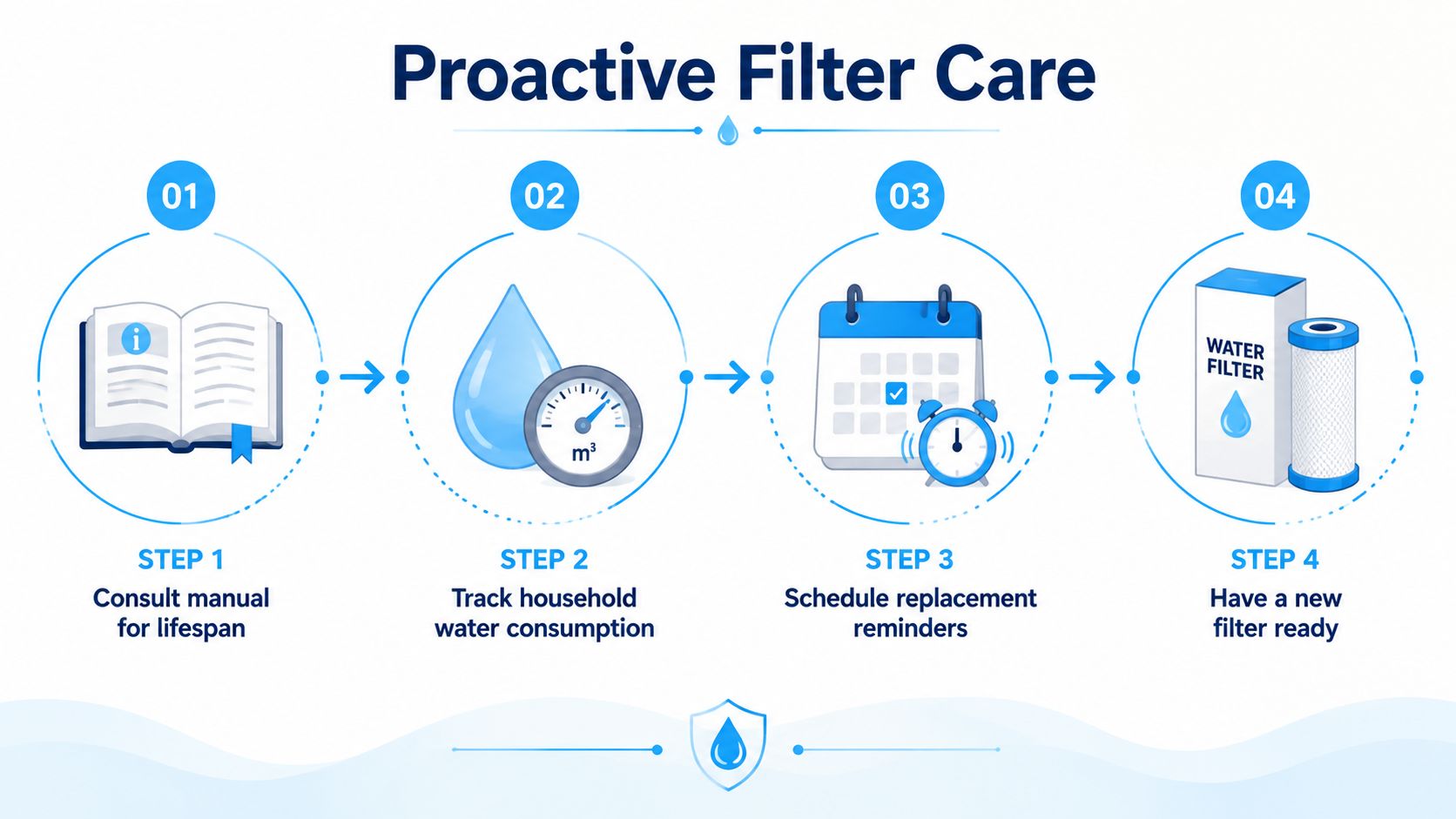
Stop treating well water like a generic category
A lot of homeowners with wells get handed the same lazy advice: change filters every 3 months and call it good. That shortcut can fail in both directions. According to Enpress on home water filter replacement schedules, a 2024 meta-analysis found that 38% of filters replaced every 3 months were still 70% effective, while 15% replaced at 6 months had already failed on key contaminants like arsenic.
That's why a blanket well-water schedule is bad advice. One well may load a sediment filter quickly. Another may need media chosen around a very different contaminant profile.
What proactive homeowners actually do
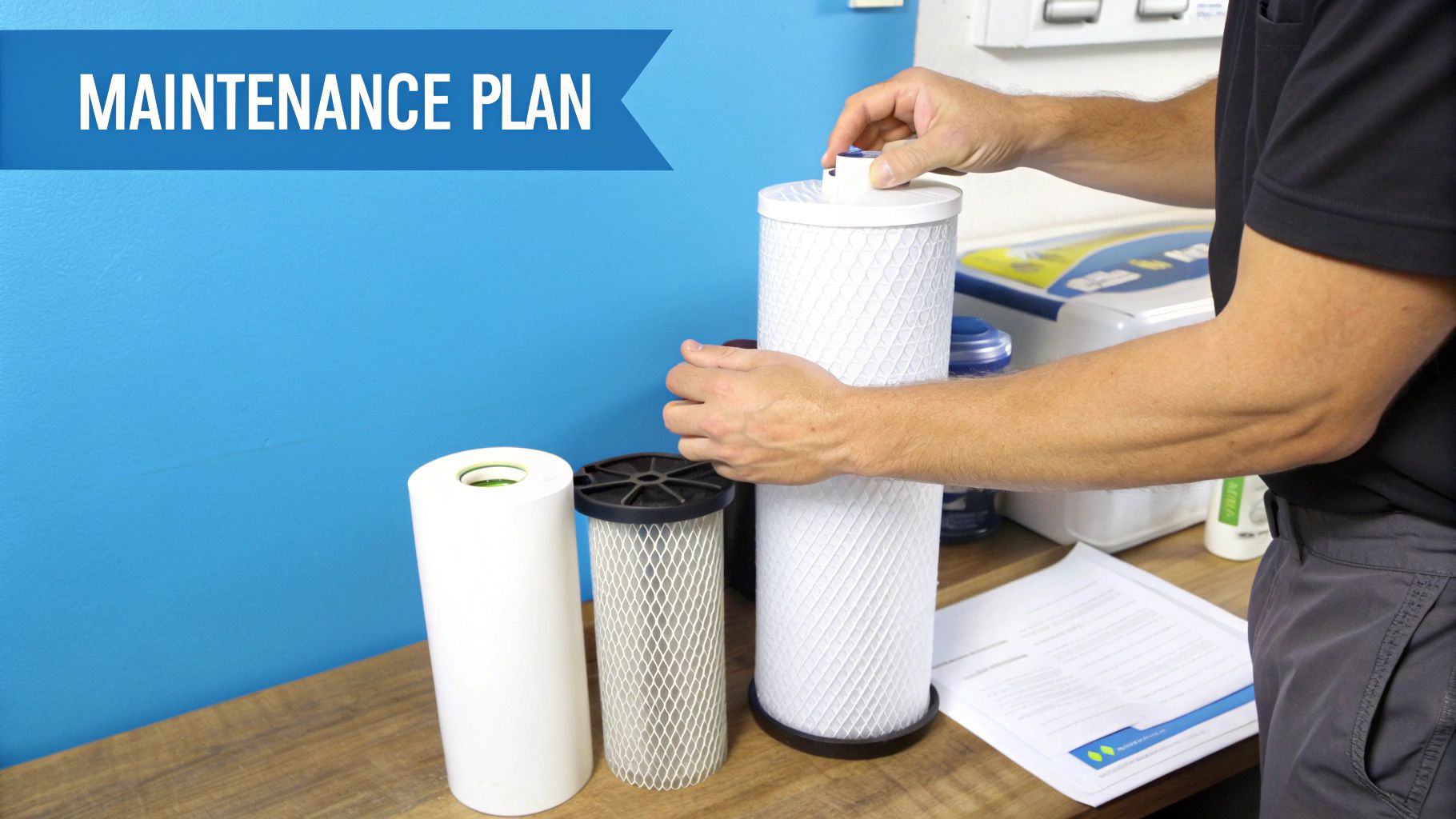
A useful maintenance plan doesn't need to be fancy. It needs to be consistent.
- Track the install date: Write it on the housing or the cartridge itself.
- Track usage where possible: This matters a lot for pitchers and any filter sold with a gallon capacity.
- Keep one replacement on hand: Waiting until a filter is dead before ordering the next one creates delays.
- Use simple testing when it fits: Chlorine test strips can help confirm whether a carbon filter is still doing meaningful work.
- Review your setup periodically: If your water source changes, your schedule may need to change with it.
For homeowners who know they'll forget, these free maintenance log templates are a practical way to keep replacement dates, cartridge types, and notes in one place without building your own spreadsheet.
Build a schedule that matches your house
If you want a framework that works, use this order:
- Start with the manufacturer interval.
- Shorten it if your water is difficult or your household uses a lot of water.
- Use testing and real-world performance to refine it.
- Update your notes every time you swap a cartridge.
If you want more general homeowner maintenance guidance, this water filtration advice resource is a good place to compare maintenance habits across common system types.
Test when you can. Track what you do. Replace before problems become obvious.
That's how you stop playing filter roulette.
Balancing Cost Safety and Eco-Impact
Homeowners usually lean too far in one direction. Some try to stretch every cartridge to save money. Others replace filters early out of anxiety. Neither approach is smart if your goal is clean water, predictable costs, and less waste.
Cheap filtration gets expensive when you push it too far
Trying to squeeze extra life out of a used filter feels frugal right up until the water tastes awful, the flow drops, or a downstream component gets worked harder than it should. A replacement cartridge costs money. So does neglect.
The better move is to buy intelligently and replace on schedule. If your system uses common cartridges, buying a multi-pack often makes planning easier. Auto-ship can help too, but only if the timing matches your actual household use. Otherwise you'll either overstock or replace too early out of guilt because the new filter is sitting there staring at you.
Safety has to outrank convenience
People love visible proof. If water looks clear, they assume the system is fine. That's comforting and wrong. Safety depends on whether the filter media is still capable of doing the job it was installed to do.
Use a simple hierarchy:
- First priority: keep the filter within its proper service window.
- Second: pay attention to taste, odor, and flow changes.
- Third: use testing when the contaminant profile justifies it.
- Last: worry about squeezing a few extra days from a cartridge.
That order saves more headaches than any hack.
Eco-impact improves when maintenance gets smarter
Disposable cartridges create waste. That's true. But reckless overextension isn't an environmental strategy. It's just poor maintenance with a green excuse attached. A better approach is to choose systems with sensible cartridge life, keep records so you don't replace too early, and check whether your brand offers a recycling option for used filters.
The greener homeowner isn't the one who ignores replacement dates. It's the one who buys the right system, uses it correctly, and doesn't burn through cartridges because of disorganization.
Think in terms of household protection
Water filtration is part of a bigger home-protection mindset. The homeowners who manage water systems well usually manage the rest of the house the same way. They don't wait for obvious failure. They use routines, logs, and preventive maintenance. That broader mindset shows up well in HomeProBadge's approach to home protection, especially if you're trying to build a more disciplined maintenance routine across the whole property.
The cheapest filter is the one you replace on time, not the one you run past its useful life.
The right long-term strategy is simple. Follow the baseline schedule. Adjust for your water and usage. Watch for warning signs. Test when needed. Keep records. That's how you balance cost, safety, and waste without fooling yourself on any of the three.
If you want straightforward help choosing replacement schedules, comparing filter types, or figuring out what your water needs, visit Water Filter Advisor. It's a solid starting point for homeowners who want cleaner water without the marketing fluff.