Is Your Tap Water *Really* Clean? The Filtered Truth

We’ve all been there—holding a glass under the tap, pausing for a split second, and wondering, is this stuff actually safe to drink? That moment of hesitation is more common than you think. While our cities do a pretty good job treating our water, what they consider "safe" might not line up with what you consider ideal for your family. Think of municipal treatment as the first draft. A home water filter? That's your final, polished edit.

This guide is all about taking back control. We’re going to dive into why home filtration isn't just a luxury—it's the crucial last step to ensuring the water in your glass is as pure as it can possibly be.

The Unfiltered Truth About Your Tap Water
A clean glass of water being filled from a modern kitchen tap.

Imagine your water is a VIP guest traveling to a gala (your faucet). It leaves the treatment plant looking sharp and clean. But then it has to navigate miles of old, sometimes ancient, underground pipes. Along the way, it can pick up some rather unsavory party crashers.

This is the "last mile" problem. The water was clean when it started its journey, but the trip itself can introduce a whole host of contaminants. That's where a home filtration system steps in, acting like a personal bouncer at your kitchen sink, ensuring only the invited guest—pure water—gets through.

Why Municipal Treatment Is Only Half the Story

Your local water utility is fighting the big battles, neutralizing major threats before they send water into the system. But they can't control the unique conditions of every pipe between their plant and your home. Things like local plumbing integrity and even things like backflow prevention device inspections play a role. A home filter closes that gap.

Think of a home filtration system as your personal quality control manager. It's the final checkpoint that guarantees the water making it into your coffee, your soup, and your drinking glass is nothing but the best.

A Global Thirst for Purity

This isn't just about what's happening in your town. Globally, the quest for clean water is a massive challenge. In 2022, a report from WHO and UNICEF revealed that 1.7 billion people were using drinking water sources contaminated with feces. Even in developed countries, the journey through aging infrastructure means risks remain. It's a powerful reminder that the final say on water quality should happen right at your tap.

What Party Crashers Are Hiding in Your Water?
A magnifying glass held over a glass of water, showing illustrative particles.

Even crystal-clear water can be a crowded party of invisible gatecrashers. Let's meet the usual suspects that your personal filter-bouncer might need to show the door.

Without a filter, you’re essentially trusting that none of these troublemakers hitched a ride into your home. A good filter lets you stop trusting and start knowing.

The Chemical Crew

The most famous member of this group is chlorine. It’s the chemical bouncer hired by the city to kill off dangerous bacteria. It does its job, but it has a bad habit of lingering, leaving behind that "public pool" taste and smell. A simple carbon filter can politely ask it to leave.

But some uninvited chemical guests are far more sinister. Lead is a major villain, often leaching from old pipes and solder. The scary part? There is no safe level of lead exposure. This makes a filter that specifically targets lead an absolute must-have for many homes.

Then there are the stealthier chemicals: pesticides from farm runoff, herbicides, and industrial chemicals known as volatile organic compounds (VOCs). They're the shadowy figures in the corner you definitely don't want sticking around.

Even after a major disaster like a wildfire, toxic chemicals from burnt infrastructure can contaminate the underground pipe network. This can introduce dangerous compounds like benzene into the water supply, posing serious health risks long after the event.

The Gritty Gang

Next up are the physical particles that make your water less than perfect. They might not be a direct health threat, but they're certainly not welcome.

  • Sediment, Silt, and Rust: These are the clumsy party guests who knock things over. They come from old pipes and can make your water cloudy, taste metallic, and even stain your sinks and clothes.
  • Microplastics: This is a growing problem. Tiny plastic fragments from countless sources are now found in tap water around the world. We're still learning about the long-term health effects, but who wants to be a guinea pig? A quality filter is your best bet for keeping them out.

The Biological Bugs

Even with city-level disinfection, there's always a tiny chance of biological contaminants showing up, especially if a pipe breaks. These are the microscopic menaces a filter can stop dead in their tracks.

  • Bacteria and Viruses: Pathogens that can cause nasty, immediate stomach issues.
  • Cysts: Think of these as microbial tanks. Hardy parasites like Giardia and Cryptosporidium are resistant to chlorine and can make you seriously ill.

This rogue's gallery shows why a multi-talented filtration system is so important.

Common Tap Water Contaminants and Their Sources

Contaminant Common Source Potential Impact
Lead Leaching from old pipes, solder, and fixtures Developmental issues, neurological damage
Chlorine Municipal water treatment disinfectant Unpleasant taste and odor
Pesticides/Herbicides Agricultural and urban runoff Potential long-term health risks
VOCs (e.g., Benzene) Industrial pollution, fuel spills, solvents Can increase cancer risk; liver/kidney damage
Sediment/Rust Corrosion of old water mains and plumbing Cloudy water, poor taste, stains fixtures
Microplastics Breakdown of plastic waste, synthetic fibers Health effects are still being studied
Bacteria/Viruses Contamination from sewage or animal waste Gastrointestinal illness (e.g., E. coli)
Cysts (Giardia) Contamination from human/animal feces Severe diarrheal disease ("Beaver Fever")

A home water filter isn't just an appliance; it's a personalized security detail for your drinking water, ensuring it's pure the moment it hits your glass.

How to Decode Your Local Water Quality Report

Every year, your water utility releases a document called a Consumer Confidence Report (CCR). Let's be real: it often looks like a rejected script from a science show, filled with charts and jargon.

But don't throw it away! This report is your secret weapon. It's a report card that tells you exactly what contaminants were found in your water over the past year. You can find it on your utility's website or by searching for "[Your City Name] water quality report."

Translating the Geek-Speak

Once you have the report, you need to know two key terms:

  • Maximum Contaminant Level (MCL): This is the legal limit. It's the highest amount of a substance allowed in drinking water.
  • Maximum Contaminant Level Goal (MCLG): This is the health goal. It's the level where there's no known health risk. This is the perfect-world number.

The most eye-opening part is the gap between the MCL (legal) and the MCLG (ideal). For nasty stuff like lead, the health goal (MCLG) is zero. But the legal limit (MCL) is higher. This creates a "legally acceptable" risk that you might not find acceptable at all.

From Report to Filter: Connecting the Dots

This is where you become the hero of your home's water story. Scan your report for any contaminant with a level above the MCLG, even if it’s below the legal MCL. Those are the specific party crashers that made it past the city's security.

Your report might show trace amounts of lead, pesticides, or disinfection byproducts. Now, the question isn't a vague "is my water safe?" It's a laser-focused "how do I get rid of these specific things?" This insight lets you choose a filter that’s a sharpshooter, targeting your water’s unique problems.

Choosing Your Filtration Champion

Alright, you've unmasked the villains in your water report. Now it's time to choose your champion—the right home water filter for the job. It sounds daunting, but it’s really about matching the filter's superpower to the specific contaminant you want to defeat.

You wouldn't hire a bodyguard who's great at spotting pickpockets if your main threat is a cyber-attack. The same logic applies here. Match the tool to the task.

From Bouncer to Fortress: Know Your Tech

Let's meet the main players. First up, activated carbon filters. These are the friendly bouncers at the door. You’ll find them in pitchers and faucet-mounted filters. They excel at grabbing chlorine, which instantly makes your water taste and smell fantastic. They're an affordable and effective first line of defense.

On the other end of the spectrum is Reverse Osmosis (RO). This is your impenetrable fortress. An RO system, usually installed under the sink, uses a semi-permeable membrane to muscle out nearly everything that isn't pure water. It's a beast, wiping out tough contaminants like lead, arsenic, fluoride, and countless other dissolved solids.

This chart is your treasure map, guiding you from your water report to the right filtration system.
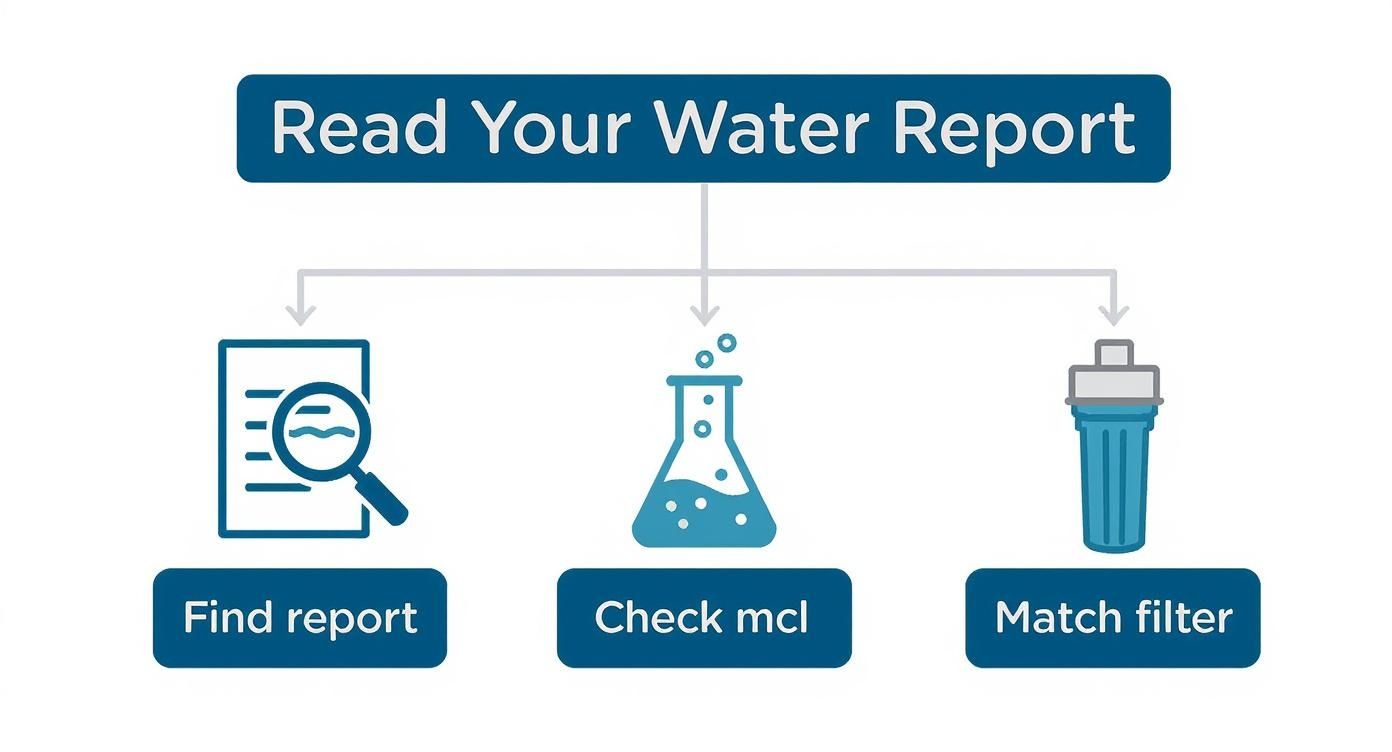
Infographic decision tree for choosing a water filter based on a water quality report.

The key takeaway? Your water report empowers you to make an informed choice, not a wild guess.

The Full Spectrum of Water Warriors

There’s a whole world of options between a simple pitcher and a full-blown RO system. Getting to know them helps you pick the perfect ally for your home.

This table breaks down the most popular filtration technologies, showing what they're best at, what they cost, and how much upkeep they need.

Comparing Home Water Filter Technologies

Filtration Type Best For Removing Average Cost Maintenance Level
Pitcher/Dispenser Filters Chlorine, taste, odor $20 – $70 High (frequent filter changes)
Faucet-Mounted Filters Chlorine, some lead, VOCs $30 – $100 Moderate (replace every 2-3 months)
Countertop Filters Wider range of contaminants than pitchers $50 – $300 Moderate (replace every 6-12 months)
Under-Sink Filters Lead, cysts, chlorine, VOCs, sediment $100 – $500+ Low (replace annually)
Reverse Osmosis (RO) Lead, arsenic, fluoride, TDS, nitrates $200 – $1,000+ Moderate (multiple filters/membrane)
Whole-House Systems Sediment, chlorine, hard water minerals $500 – $3,000+ Low to Moderate (depends on system)

The perfect filter for you is one that balances powerful performance with a price and maintenance schedule you can live with.

Matching Your Filter to Your Foe

So how do you make the final decision? Just line up the problem from your water report with a filter's known strengths. Here are a few scenarios:

  1. Foe: Your water tastes like it came from a swimming pool.

    • Champion: An activated carbon filter (pitcher, faucet, or under-sink) is the perfect, budget-friendly hero.
  2. Foe: Your report shows lead levels are above the zero-tolerance health goal.

    • Champion: A Reverse Osmosis (RO) system is your super-soldier. It offers the highest level of protection against lead.
  3. Foe: You have hard water leaving crusty deposits everywhere, and your water is full of sediment.

    • Champion: A whole-house filtration system, often paired with a water softener, is your all-in-one solution. It protects every tap and appliance in your home.

Choosing a filter is a big deal, but it becomes simple when you focus on solving a specific problem. For a deep dive into models and brands, check out this extensive collection of water filter advice. It’s a fantastic resource for finding the perfect filtration partner for your home.

The Everyday Perks of Filtered Water

Switching to a home water filter does more than just banish invisible contaminants—it delivers an immediate, noticeable upgrade to your daily life. The first thing you'll experience is the taste. It's like switching from standard definition to 4K for your taste buds.

This simple upgrade creates a ripple effect. Your morning coffee is suddenly richer. Your tea is cleaner and brighter. Even simple foods like pasta and steamed vegetables taste purer, free from that subtle chemical background noise you didn't even know was there.

Beyond a Better-Tasting Brew

The benefits go far beyond flavor. By consistently filtering out contaminants like lead, VOCs, and disinfection byproducts, you reduce your family's daily exposure to substances linked to long-term health issues.

It's a proactive health investment. Every glass of filtered water you drink is a small, positive step toward long-term wellness, giving you priceless peace of mind.

It's easy to take clean water for granted. But a staggering 2.1 billion people worldwide still lack access to safely managed drinking water. You can learn more about this global challenge in a report from WHO and UNICEF.

A Win for Your Wallet and the Planet

Let's talk dollars and sense. Yes, there's an upfront cost for a filtration system. But it pays for itself surprisingly quickly once you break free from the endless cycle of buying bottled water.

And the environmental win is huge. Every time you refill a glass from your tap, you're preventing another plastic bottle from ending up in a landfill or the ocean. Filtering at home is a triple win:

  • For Your Health: You're in complete control of your water quality.
  • For Your Wallet: You stop renting your water from beverage companies.
  • For The Planet: You dramatically reduce your plastic waste.

Common Questions About Water Filtration

Even when you're convinced, a few nagging questions can pop up before you pull the trigger on a filtration system. Let's clear the air and tackle the most common concerns.

Getting straight answers is the final step to feeling confident that your tap water isn't just okay—it's awesome.

If My Water Tastes Fine, Do I Really Need a Filter?

This is the biggest myth in the world of water. Great taste is not a guarantee of safety. Many of the most dangerous contaminants—lead, arsenic, pesticides, and VOCs—are completely tasteless, odorless, and invisible.

A filter acts as a safety net, catching the threats you can't detect with your senses. Your taste buds are great, but they're not a science lab.

The only way to know for sure what's in your water is by looking up your local water quality report or having it tested yourself. A filter ensures that even if contaminants are lurking at low levels, they won't end up in your glass.

Are Pitcher Filters Just as Good as Under-Sink Filters?

They're different tools for different jobs. A pitcher filter is a fantastic starting point. It's affordable, portable, and does an excellent job removing chlorine to improve taste and smell.

An under-sink system, however, is a major upgrade. These systems, especially Reverse Osmosis (RO) units, are certified to remove a much longer list of serious contaminants like lead, fluoride, nitrates, and dissolved solids. If your water report shows any of those red flags, an under-sink system is the more powerful and reliable choice.

How Often Do I Actually Have to Change My Filter?

This is non-negotiable. Following the manufacturer's replacement schedule is crucial. An old, clogged filter doesn't just stop working; it can become a breeding ground for bacteria. A neglected filter can actually make your water quality worse than unfiltered tap water.

Here's a quick cheat sheet:

  • Pitcher Filters: Every 2 months or after 40 gallons.
  • Faucet Filters: About every 3 months.
  • Under-Sink & Whole-House Filters: Anywhere from 6 months to a year or more.

Always read the manual for your specific model. It’s the only way to ensure your filter continues to be your champion, protecting you with every drop.


At Water Filter Advisor, our goal is to help you find the right filtration system for your home. Our detailed guides and honest reviews are here to help you protect your family and enjoy cleaner, safer water. Find out more at https://www.waterfilteradvisor.com.
Finding the Best Inline Water Filter for Your Refrigerator

Ever wonder why the water from your fridge dispenser tastes a little… off? Or why your ice cubes look cloudy and melt into a drink with a faint swimming-pool funk? You’re not imagining it. While your refrigerator’s built-in filter is a nice thought, it’s often just a glorified tea bag for your water line. It might catch a little chlorine, but that’s about it. If you want truly clean, safe, and delicious water and ice, it’s time to call in the specialist: the inline water filter.

Think of it as a bouncer for your fridge's water line. It installs before the water even reaches the appliance, creating a powerful checkpoint that strips out a whole host of nasty contaminants that internal filters can't touch. The best ones are certified for NSF 53, a seal of approval that means they’re proven to reduce health-related contaminants like lead, cysts, and nasty chemicals. They are the secret to unlocking water that's not just better-tasting, but fundamentally cleaner.

Why an Inline Filter is the Ultimate Upgrade for Your Water and Ice

Let's be honest, those little pop-in cartridges inside your fridge are designed for convenience, not performance. They’re tiny, so they can only hold a small amount of filtration media, which is why they’re mostly good for one thing: reducing the taste and smell of chlorine. An inline filter, however, is a whole different beast. It’s an external powerhouse that gets plumbed directly into your water line.

This "outside the box" design is its superpower. Since it isn’t crammed into a tiny refrigerator compartment, an inline filter can be much larger. More size means more filtration media, and that translates into two huge wins for your home: a filter that lasts way longer and, more importantly, one that can wage war on a much broader spectrum of impurities.

A person installing an inline water filter on a refrigerator's water line.

Beyond Just Getting Rid of the Chlorine Taste

An inline filter isn't just about masking bad tastes; it's about actively purifying your water to make it safer for your family.

  • Serious Contaminant Takedown: High-quality inline filters are certified to reduce genuinely harmful stuff like lead, cysts (like Giardia), asbestos, and volatile organic compounds (VOCs). These are invisible villains most standard fridge filters simply ignore.
  • Crystal Clear Ice Cubes: The same junk that messes up your drinking water gets frozen into your ice, making it look cloudy and taste funky. The quality of your filter has a direct impact on your ice, and you can see how different filters for refrigerator ice makers can produce clean, fresh-tasting cubes that don't ruin your drink.
  • Marathon-Like Lifespan: A good inline filter can go for six months, a year, or even longer, often purifying thousands of gallons of water. That's a massive leap from the paltry 200-300 gallon capacity you get with most internal fridge filters.

The real game-changer is the level of protection. An internal filter might be certified for NSF 42 (Aesthetic Effects), but a great inline model will often carry the NSF 53 (Health Effects) certification. That's your proof it removes contaminants that can actually impact your health.

This isn't just a niche product anymore. The demand for cleaner water at home has exploded, pushing the global refrigerator water filter market toward $2.5 billion by 2025, with a steady annual growth between 5.4% and 7.7%. This just shows how vital reliable home water filtration has become. By choosing an inline filter, you’re not just buying a piece of hardware; you’re investing in a more powerful and long-lasting system for truly pure water and ice.

Decoding Filter Specs to Make a Smarter Choice

Choosing the right inline water filter can feel like trying to crack a secret code. You've got terms like "micron rating" and "NSF 42" flying around, and it's easy to get lost in the jargon. But once you understand what these specs actually mean for the water in your home, you can see right past the marketing fluff and find a filter that genuinely delivers.

Think of the filter media as the engine of the whole operation. It’s the stuff inside the cartridge that does all the heavy lifting to pull contaminants out of your water. You'll mainly encounter two types: Granular Activated Carbon (GAC) and Carbon Blocks.

Filter Media: The Heart of the System

GAC filters are filled with loose bits of carbon. As water weaves its way through these granules, the carbon acts like a magnet for chlorine, which is a huge help for improving the taste and smell of your water. They work well and usually don't choke your flow rate, so you won't be waiting an eternity to fill a glass.

Carbon Block filters are a different animal. They're made from super-fine carbon powder that's been compressed into a solid block. This creates a much denser and more intricate maze for water to navigate, allowing it to trap a wider variety of smaller contaminants, including some VOCs and cysts. The trade-off can be a slightly slower flow, but you often get a much higher level of filtration.

Here's the bottom line: if your main goal is to banish that swimming-pool taste from your water and ice, a good GAC filter is your champion. But if you’re concerned about a wider range of chemical contaminants in your home's water supply, a carbon block filter is your best bet for a more robust defense.

Micron Ratings: Size Really Does Matter

A filter's micron rating tells you the size of the particle it can reliably trap. A micron is impossibly small—one-millionth of a meter. So a filter with a 5-micron rating will stop anything 5 microns or larger, but a 0.5-micron filter will snatch much smaller, sneakier particles from your water.

To give you some perspective:

  • Human Hair: Around 50-70 microns
  • Silt and Sediment: Typically 5-30 microns
  • Cysts (like Giardia and Cryptosporidium): Between 2-10 microns

A smaller micron number means more powerful filtration. For instance, to get certified for reducing cysts, a filter needs a rating of 1 micron or less. This is a huge deal if you're concerned about microbiological contaminants in your water.

NSF Certifications: The Gold Standard of Trust

This is arguably the most important thing to look for on the box. An NSF/ANSI certification is a seal of approval from an independent lab, verifying that the filter actually does what the manufacturer claims. It's not just marketing hype; it's a performance guarantee.

These are the three big ones you'll see for home water filters:

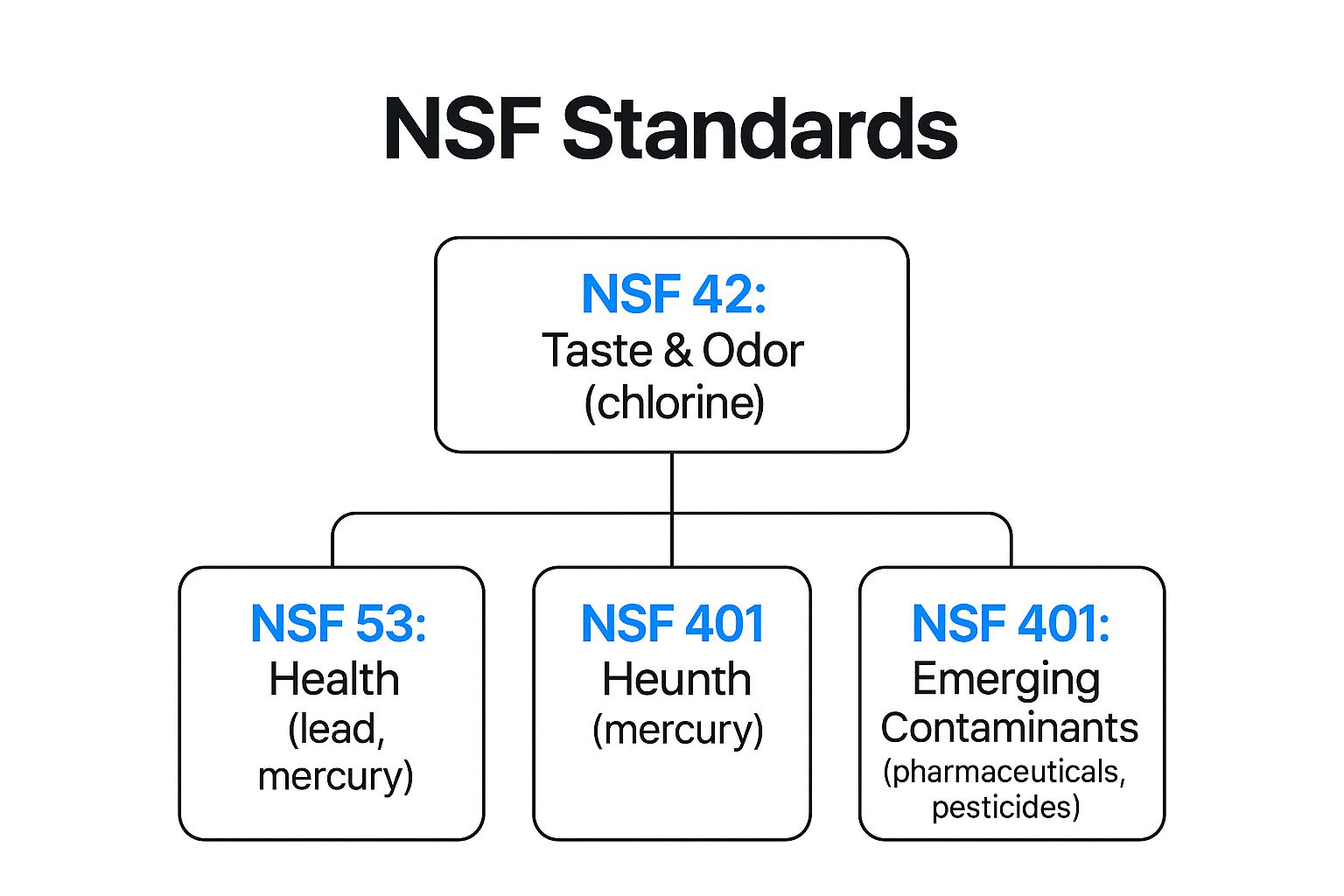
  • NSF/ANSI 42 (Aesthetic Effects): This is the baseline certification. It confirms the filter reduces things that affect taste and odor, like chlorine.
  • NSF/ANSI 53 (Health Effects): This is a much tougher standard. A filter with this certification is proven to reduce specific health-related contaminants like lead, mercury, asbestos, and cysts.
  • NSF/ANSI 401 (Emerging Contaminants): This certification deals with newer concerns, showing that a filter can reduce trace amounts of things like pharmaceuticals, herbicides, and pesticides that are increasingly found in water supplies.

Flow Rate and Filter Life

Finally, you have to think about the day-to-day experience. The flow rate, measured in gallons per minute (GPM), dictates how fast your dispenser fills a glass. Most inline filters run at about 0.5 GPM, which is plenty for filling a water bottle without feeling like you're watching paint dry.

The filter lifespan tells you how many gallons it can purify before it needs to be replaced. A standard inline filter is usually good for about 1,500 gallons or six months of use. Knowing this helps you calculate the true long-term cost and how often you'll be performing a quick filter swap.

Comparing The Top Inline Refrigerator Water Filters

Alright, now that we’ve decoded the technical jargon, let’s see how the best inline filters actually perform in the real world. A simple list of features on a box is one thing, but finding the best inline water filter refrigerator solution for your home comes down to your unique water quality, your daily needs, and what you value most.

We're going to move past the marketing fluff and put the top contenders side-by-side, focusing on what really counts: raw filtration power, official certifications, water flow, lifespan, and overall value. This is about connecting the dots from specs on a page to the practical benefits you'll enjoy every day.

This quick guide highlights the big three specs—certifications, micron rating, and flow rate—that separate a decent filter from a great one.

Infographic about best inline water filter refrigerator

As you can see, these three elements have to work in harmony. They're what determine if a filter just makes water taste a little better or if it's a serious purification workhorse for your home.

Performance Showdown of Leading Inline Filters

To give you a clearer picture, let's lay out the key metrics for a few top-performing models in a side-by-side comparison. This table breaks down what you get with each filter, helping you match their strengths to your specific household needs.

Model Key Certifications Filter Lifespan (Gallons) Flow Rate (GPM) Primary Contaminants Reduced Best For
Heavy Metal Specialist NSF/ANSI 42 & 53 750 0.5 Chlorine, Lead, Cysts, VOCs Homes with older plumbing and lead concerns.
The Marathon Runner NSF/ANSI 42 3,000 0.75 Chlorine, Taste, Odor Busy families seeking long-term value and convenience.
Multi-Stage Defender NSF/ANSI 42 1,500 0.6 Sediment, Chlorine, Bacteria Households using well water or with high sediment.
The Budget Champion NSF/ANSI 42 1,500 0.75 Chlorine, Taste, Odor Renters or those prioritizing low upfront cost.

This showdown illustrates that there’s no single "best" filter—just the best one for a particular home. Now, let's put these into real-world contexts.

Scenario One: The Urban Home With Aging Infrastructure

Picture this: you live in an older city apartment or a house built before the 1980s. Your biggest water worry isn't just that chlorine taste. It's the nagging thought of lead leaching from old pipes and solder. In this case, your buying decision should hinge on one critical credential.

You absolutely need a filter with a solid NSF/ANSI 53 certification specifically for lead reduction.

  • The Heavy Metal Specialist: This filter is built for this exact job. It uses a super-dense carbon block with a tiny pore size, often just 0.5 microns. Its claim to fame is its proven ability to slash lead by over 99%, giving you real peace of mind.
  • The Generalist: Another filter might have a great NSF 42 rating for taste, but without that NSF 53 for lead, it's a non-starter here. It's a fine product, but it fails to address the biggest health risk in this scenario.

For anyone with older home plumbing, the choice is clear. The superior contaminant removal of the Specialist is the only responsible option, even if it’s a bit more expensive or has a slightly slower flow.

Key Differentiator: This isn't about better-tasting water; it's about health protection. An NSF 53 certification for lead is a non-negotiable feature for homes with old pipes, elevating the filter from a simple convenience to an essential home safety device.

Scenario Two: The Busy Family Seeking Convenience and Value

Now, imagine a suburban family with decent municipal water. Their main goals? Get rid of the chemical taste in their water and ice, find a filter that lasts as long as possible so they don't have to change it constantly, and keep the budget in check.

Here, the focus shifts from hardcore contaminant removal to longevity and cost-effectiveness.

  • The Marathon Runner: This filter is a beast, rated for an impressive 3,000 gallons or a full 12 months of use. It relies on Granular Activated Carbon (GAC) to keep the water flowing fast (0.75 GPM), so filling up a bunch of water bottles before soccer practice is a breeze. It’s got the NSF 42 certification to prove it handles chlorine.
  • The Budget Champion: This one is cheaper upfront and also has an NSF 42 certification. The catch? Its lifespan is much shorter, usually just 1,500 gallons or six months.

While the Budget Champion saves you a few dollars at the register, the Marathon Runner is the smarter long-term buy. You'd have to purchase and install two of the budget filters to get the same life out of one long-lasting model, which wipes out the savings and doubles the hassle. For any busy household, that "set it and forget it" factor is a huge win.

Scenario Three: The Water Connoisseur With Well Water

Finally, let's consider a homeowner on a private well. Their water problems are completely different. Instead of chlorine, they're battling sediment, maybe some rust particles, and that "earthy" taste. Plus, their water pressure can be unpredictable.

The right filter for this job needs to be a multi-stage powerhouse.

  • The Multi-Stage Defender: This kind of filter is engineered for tough water sources. It typically uses a multi-step process:
    1. First, a sediment pre-filter (around 5 microns) catches the big stuff like sand and silt. This protects the main filter from getting clogged.
    2. Next, a dense carbon block (maybe 1 micron) goes to work on organic compounds, tastes, and odors.
    3. It might also include KDF media, which helps inhibit bacteria from growing inside the filter housing—a fantastic feature for non-chlorinated well water.
  • The Basic Carbon Filter: A simple GAC filter would be overwhelmed here. It would clog with sediment in no time, your water flow would drop to a trickle, and you’d be swapping it out constantly. It just doesn't have the muscle for untreated water.

For anyone on a well, the multi-stage filter is really the only way to go. Its layered design ensures you get clean water and a decent filter life because it doesn't let sediment overwhelm the carbon core.

A filter's effectiveness is completely situational. The "best" filter is simply the one whose strengths are a perfect match for your home water's specific weaknesses.

Making Your Final Decision

When you're ready to buy, look past the brand name and get right to the performance data. Certifications are your proof of performance, filter life determines your long-term cost and how often you'll be under the sink, and the filter media dictates what’s actually being removed from your water.

As you compare models, you can explore a wide selection of Awesome Water Fridge Filters to see how these different specs line up with different price points. By matching the filter's capabilities to your home's unique water profile, you can confidently pick an inline filter that will deliver pure, fantastic-tasting water and ice for years to come.

A Straightforward Guide to Installing Your Inline Filter

https://www.youtube.com/embed/kho7FMA4t1Q

Installing an inline water filter probably sounds a lot more intimidating than it really is. The truth is, most modern filters are designed for a quick DIY job that just about anyone can knock out in less than 30 minutes. You can put away the plumber's number and that giant toolbox. All you really need is a little confidence and a couple of basic items.

This guide will walk you through it, step by step. We’ll demystify the process and make sure you get a solid, leak-free connection. Your reward? Crisp, clean water and ice straight from your fridge for years to come.

Gathering Your Tools and Supplies

Before you even touch that water line, get all your supplies laid out and ready. It beats scrambling to find something mid-installation. Luckily, the list is short and sweet.

You will need:

  • Your new inline water filter (of course!)
  • A utility knife or a tube cutter to get a nice, clean cut.
  • A small bucket or a few old towels to catch the few drips when you disconnect the line.
  • A marker to jot down the installation date right on the filter cartridge.

That's it. Seriously. Most of the best inline water filter refrigerator kits these days use push-to-connect fittings, so you won’t need any special glues, clamps, or wrenches to get a tight seal.

Step-by-Step Installation Process

With your gear ready, you're set to begin. Just follow these simple steps for a perfect install.

  1. Locate and Shut Off the Water Supply: This is the most critical first step. Find the small shut-off valve on the 1/4" plastic or copper tube running to the back of your refrigerator. It’s usually a small handle or a saddle valve. Turn it clockwise until it stops. To double-check, try the water dispenser on your fridge—if nothing comes out, you're good to go.

  2. Cut the Water Line: Now, decide where you want the filter to live. You'll thank yourself later if you pick a spot with easy access for future changes, like right behind the fridge or under the kitchen sink. Once you've found the perfect spot, use your tube cutter or utility knife to make one clean, straight cut. A crooked cut is the number one cause of a leaky connection.

  3. Connect the Filter: Take a look at your new filter. You should see an arrow printed on it that shows the direction of water flow. This arrow must point towards your refrigerator for the filter to work correctly. Now, just push the end of the waterline coming from the wall firmly into the "in" port. Then, push the other end of the line that goes to your fridge into the "out" port.

The real trick to these modern push-to-connect fittings is making sure the tube is seated all the way in. You should feel a little "click" or see it bottom out about half an inch into the fitting. Give the tube a gentle tug to be sure it’s locked in.

Final Checks and Flushing

You're on the home stretch! These last few steps are just to make sure your work is solid and the filter is ready to provide great-tasting water.

  • Slowly Turn the Water Back On: Head back to the shut-off valve and turn it counter-clockwise, but do it slowly. This lets the pressure build up gradually and avoids any sudden shocks to the system.
  • Check for Leaks: Look closely at the connections on both ends of the filter. If you spot any drips, turn the water off again. Check that your cut is straight and try pushing the tubing more firmly into the fitting.
  • Flush the New Filter: Every new carbon filter has some harmless carbon "fines" (which look like black powder) left over from manufacturing. You need to flush them out. Run about 2-3 gallons of water through your dispenser into a bucket. The water might look a little gray or cloudy at first, but it will clear up quickly.

Once the water runs clear, you're officially done. Don't forget to write the date on the filter so you'll know when it's time for a replacement—usually every six months. You've just successfully installed the best inline water filter refrigerator solution for your home.

Keeping Your Filter at Peak Performance

A person marking the installation date on a new inline water filter.

Alright, you’ve got your new inline filter installed. Fantastic! But before you grab a glass, there’s one small but critical step to get everything running perfectly. Properly commissioning the filter is the key to getting that clean, crisp taste you’re after from day one.

Any new carbon-based filter needs a good flush. This does two things: it clears out any harmless carbon "fines"—tiny, loose particles of carbon left over from the manufacturing process—and it saturates the filtration media. This ensures water flows evenly through the entire cartridge for the best possible performance.

Just run about 2-3 gallons of water through your fridge’s dispenser into a bucket or the sink. Don't be alarmed if the water looks a bit cloudy or discolored at first; that's totally normal. Once it runs crystal clear, your filter is officially ready for duty.

Why Sticking to a Schedule Matters

It's tempting to take a "set it and forget it" approach with an inline filter, but changing it on time is the single most important part of keeping it working. Over time, the filter's media gets clogged with all the contaminants it has trapped from your water. Once it hits capacity, its ability to capture new impurities plummets.

Worse yet, a clogged filter can become a breeding ground for bacteria. It also forces your refrigerator’s water system to work harder, which can strain the appliance and lead to leaks or a frustratingly slow water flow. If neglected, your powerful filter can quickly turn into part of the problem.

Sticking to the manufacturer's replacement schedule isn't just a recommendation—it's the only way to guarantee you're getting the water quality and safety you paid for. An old filter is often worse than no filter at all.

Staying on Top of Filter Swaps

Most inline filters are built to last about six months or for a certain number of gallons, whichever comes first. The easiest trick is to just write the installation date on the filter cartridge with a permanent marker. Pair that with a recurring reminder on your phone’s calendar for six months down the road.

You also need to consider your local water conditions.

  • Hard Water Areas: If your home's water has a high mineral content, you might notice the flow rate slowing down sooner. That's your cue that an earlier replacement is needed.
  • High Sediment: Homes on well water or in older neighborhoods with aging municipal pipes often deal with more sediment. This can clog filters much faster, cutting their effective lifespan short.

There’s a reason the replacement filter market is so huge. The global refrigerator water filter market is projected to grow from $1.23 billion to nearly $1.90 billion by 2031, and replacement cartridges are a massive slice of that pie. It just goes to show how critical regular changes are for home water filter performance.

By following these simple maintenance steps, you can ensure your investment continues to deliver the best-tasting and safest water for your family.

Your Questions About Inline Refrigerator Filters Answered

Even after getting the basics down, you probably still have a few questions about how these filters work for your home. Let’s tackle the most common things people ask, so you can feel totally confident in your choice.

Getting these details sorted out is what separates a decent purchase from a great one.

Can I Use an Inline Filter If My Refrigerator Doesn't Have One?

Absolutely! In fact, that's one of the best reasons to get one. Inline filters are the perfect solution for refrigerators that didn't come with a built-in filter system.

They connect directly to the standard 1/4-inch water line that feeds your ice maker and water dispenser. The filter purifies the water before it even enters your fridge, giving you a serious filtration upgrade no matter how old or basic your appliance is.

Will an Inline Filter Kill My Water Pressure?

It shouldn’t. While adding anything to a water line will technically slow it down a tiny bit, a good inline filter is designed to maintain a smooth flow. Most run around 0.5 GPM (gallons per minute), which is plenty for a fast fill-up at the dispenser.

If you ever notice a major drop in pressure, it's almost never the filter's fault. It’s actually the clearest sign that the filter has done its job, has captured a ton of gunk, and is ready to be swapped out for a fresh one.

An inline filter is often a much better choice than the standard one inside your fridge. They're bigger, so they hold more filter media. This means they last longer and can pull out a much wider range of contaminants—not just the chlorine that affects taste and smell.

How Do I Know When It’s Time for a Replacement?

Most manufacturers suggest a new filter every six months, or after a specific number of gallons (like 1,500) has passed through it. The easiest trick is to grab a permanent marker and write the installation date right on the filter cartridge itself.

I also like to set a recurring reminder on my phone calendar. Beyond that, just trust your senses. If you notice the water starts tasting a little off or the flow from the dispenser slows down, it's definitely time for a change. For more tips on this, you can find a lot of practical advice on water filter maintenance.

Are Inline Filters Actually Better Than the Internal Ones?

When it comes to pure filtration performance, yes, in most cases they are a significant upgrade. The built-in filter that comes with your fridge is convenient, but it's also small and typically only certified to improve taste and smell (NSF 42).

An inline filter, on the other hand, gives you a much higher level of protection. Many are certified under NSF 53, which means they are proven to reduce serious health-related contaminants like lead, cysts, and harmful chemicals. You're getting far more comprehensive purification for your home's water.


At Water Filter Advisor, we provide the insights you need to make confident decisions about your home's water quality. Explore our guides and reviews to find the perfect filtration solution for your family.
https://www.waterfilteradvisor.com

How to Reduce Chlorine in Your Home Water: A Filtration Guide

Tired of your tap water tasting like it just came from the local swimming pool? The undisputed champion for banishing chlorine from your home’s water is a quality filtration system, especially one powered by activated carbon. While letting a pitcher sit on the counter might help a little, it’s a slow-motion solution. For a real, lasting fix, filtration is the only way to go.

Why Your Tap Water Smells Like a Swimming Pool

Ever turn on the kitchen sink and get hit with that unmistakable "public pool" smell? You're not just imagining it. That distinct odor is chlorine, a powerful disinfectant your local water utility adds for a critical reason.

Think of it as a bodyguard for your water. Chlorine's job is to kill off nasty bacteria, viruses, and other pathogens during the long trip from the treatment plant all the way to your tap. This process, called chlorination, has been a massive public health success, saving countless people from waterborne diseases. Without it, drinking tap water would be a serious gamble.

But the very chemical that keeps our water safe can also make it taste and smell… less than ideal. This leaves a lot of people wondering how to get rid of the chlorine once it’s done its job and reached their home. The answer lies in targeted home filtration.

Chlorine vs. Chloramine

Just to make things interesting, many water suppliers now use chloramine instead of just chlorine. This is a more stable compound they make by adding ammonia to the chlorine.

Why the switch? While chlorine evaporates pretty quickly, chloramine sticks around much longer. It's designed to keep the water disinfected right to the end of the line, but that stability also makes it tougher to remove. This is a crucial detail because your standard chlorine filter might not be up to the task. Figuring out if you have chlorine or chloramine is the first step to picking the right filter.

It's About More Than Just Taste and Smell

Getting rid of that chemical taste is a big motivator, but it's not the only reason people install filters. When chlorine mixes with the natural organic stuff in water, it can create what are known as disinfection byproducts (DBPs), like trihalomethanes (THMs).

Your city's water is treated to keep these DBP levels within legally safe limits. Still, many folks would rather just minimize their exposure altogether right at home.

Filtering your water right where you use it gives you the best of both worlds. You get all the protection of a professionally disinfected public water supply, but you get to strip out the chlorine and its byproducts just before you drink, cook, or shower.

This approach lines up with where the industry is heading. Agencies like the U.S. Environmental Protection Agency are constantly tightening the rules, and as reported on GlobeNewswire, there's a lot of research into new ways to handle chlorine with less environmental impact. By installing a home filter, you're just taking that final, personal step to make sure your water is exactly how you want it.

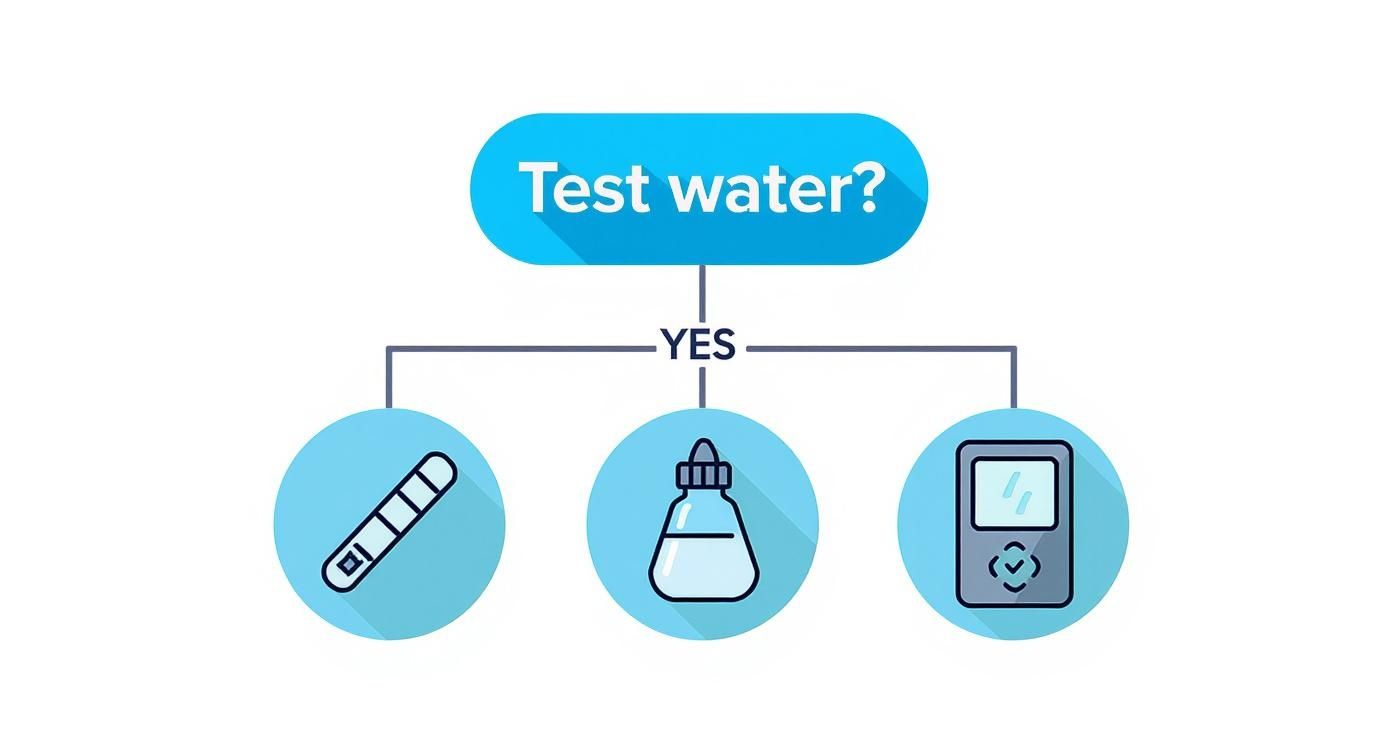
How to Test Chlorine Levels in Your Water

Before you can fix that chlorine taste in your water, you have to know what you’re up against. Think of it like a detective—you need to gather evidence before you can pinpoint the right solution. Just guessing could mean you end up with a filtration system that's either total overkill or not nearly strong enough for the job.

The good news? You don't need a lab coat or a chemistry degree to get solid answers.

Testing your water at home is quick, easy, and gives you the hard data you need to make a smart decision. This first step will tell you exactly what concentration of chlorine you're dealing with.

Simple and Affordable Test Strips

The fastest way to get a reading is with test strips. These are just little disposable paper strips with chemical pads on them. Dip one into a glass of your tap water, give it a swirl for a few seconds, and pull it out.

After about a minute, the pads will change color. All you do is match those colors to the chart that comes with the kit. It's a dead-simple method that gives you a ballpark figure, usually in parts per million (PPM).

While they're super easy to use and cheap, they aren't the most precise tool. For most homes getting city water, a reading between 0.5 and 2.0 PPM is pretty standard. The EPA says levels up to 4.0 PPM are safe, but most of us can taste and smell it long before that—sometimes at levels as low as 0.5 PPM. Test strips are great for a quick "yes" or "no" on whether chlorine is present.

More Accurate Liquid Reagent Kits

If you're after a more precise number, your best bet is a liquid reagent kit, sometimes called a drop test kit. These are the same types of kits people use for swimming pools, but you can easily find versions made specifically for drinking water.

It's a pretty straightforward process:

  • Fill a small vial with a specific amount of your tap water.
  • Add a few drops of a chemical reagent into the vial.
  • Cap it, give it a little shake, and watch the water change color.

Just like with the strips, you compare the final color of the water to a printed chart to find the chlorine concentration. Because you're using a controlled amount of water and a precise number of drops, the results are a lot more reliable than what you'll get from a simple test strip.

Getting an accurate measurement is the first real step in your journey to better water. Knowing your specific chlorine level—whether it's 1.0 PPM or 3.5 PPM—directly influences which type of water filter will be most effective and economical for your household.

The Precision of Digital Meters

For anyone who loves gadgets and wants the most exact reading possible, a digital colorimeter is the way to go. These handheld electronic devices give you pinpoint accuracy and take all the guesswork out of matching colors.

You still add a reagent to your water sample, but instead of eyeballing it, you pop the vial inside the meter. The device shines a light through the sample and measures exactly how much of it is absorbed, then gives you a precise digital reading right on the screen.

Digital meters are definitely the most expensive option, but they're also the most accurate. They're perfect if you're really sensitive to chlorine or just want to track your levels over time to see how they change. Knowing your baseline is key to picking the right filter and, just as importantly, confirming it's actually working once you've got it installed.

Choosing Your Chlorine-Busting Filtration Weapon

A clear glass pitcher of water sitting on a wooden countertop in a sunlit kitchen.

Alright, you’ve tested your water and you know how much chlorine you’re dealing with. Now for the fun part: picking the right gear to get rid of it.

Diving into the world of water filtration can feel like a lot at first, with all the different technologies and acronyms out there. But when your main goal is knocking out chlorine, the best options quickly rise to the top.

The three heavy hitters you’ll see most often for home chlorine removal are Activated Carbon, KDF (Kinetic Degradation Fluxion), and Reverse Osmosis. They all work a bit differently, come with their own price points, and have unique maintenance needs. Let's break them down so you can find the perfect fit for your home and budget.

The Magic of Activated Carbon Filters

Think of activated carbon as a super-powered sponge with an almost magnetic attraction to chlorine. This isn't your backyard BBQ charcoal; it's a special carbon that’s been “activated” to create millions of microscopic pores. The surface area is staggering—a single pound of activated carbon can have a surface area of over 100 acres!

When water passes through the filter, chlorine molecules get pulled into these pores and stick to the surface. This process is called adsorption. The water flows right on through, but the chlorine gets left behind. The result? Water that tastes and smells noticeably cleaner and fresher.

There's a reason activated carbon is the go-to method. It's incredibly effective, pretty affordable, and you'll find it in everything from a simple pitcher filter to a large whole-house system. The core of these filters is often just replacement activated carbon for dechlorinator purifiers, which does the bulk of the work.

KDF Media: The Chemical Neutralizer

Next on the list is KDF, which stands for Kinetic Degradation Fluxion. If activated carbon is a sponge, think of KDF as a tiny chemical factory. This filter media is made of high-purity copper and zinc granules. As water flows over them, they create a small electrochemical reaction.

This reaction, known as redox (oxidation-reduction), literally changes free chlorine into a harmless chloride salt. It doesn’t just trap the chlorine; it neutralizes it on a chemical level. This makes KDF media exceptionally durable and long-lasting.

One of the coolest things about KDF is that it also stops bacteria, algae, and fungi from growing inside the filter. This bacteriostatic property means it not only tackles chlorine but also keeps the filter media itself clean, which can really extend the life of any activated carbon filters it’s paired with.

In fact, a lot of the best filters on the market use both KDF and activated carbon together. The KDF does the heavy lifting on chlorine, protecting the carbon and letting it focus on other organic stuff that affects taste and odor.

This infographic can help you map out your testing and filtering journey.

Infographic about how to reduce chlorine

It’s a simple visual that shows how getting some hard data—whether from simple test strips or a digital meter—is the essential first move.

Reverse Osmosis: The Ultimate Barrier

For the most complete filtration you can get at home, you’ve got Reverse Osmosis (RO). While carbon and KDF are chlorine-zapping specialists, an RO system is designed to remove a massive list of other things, like lead, fluoride, salts, and arsenic. And yes, it’s also fantastic at getting rid of chlorine.

An RO system works by pushing water through a very fine, semi-permeable membrane. The pores in this membrane are so tiny that only pure water molecules can squeeze through. Everything else, including chlorine, gets blocked and flushed down the drain.

The process is so thorough it can eliminate over 99% of chlorine. But there’s a small catch: chlorine is actually pretty tough on that delicate RO membrane. That’s why virtually every home RO system comes with pre-filters, usually activated carbon, to remove the chlorine before it even gets to the membrane. This is key to protecting the most important part of the system and making it last.

People who choose RO usually want more than just chlorine removal; they're aiming for the highest level of water purity possible. If you want to explore different setups, our water filtration advice guides have a ton of great information.

Comparing Chlorine Filtration Methods for Your Home

Trying to decide between these options can feel tough, but it really comes down to weighing how well they work against their cost and how much upkeep they need. This table puts the key details side-by-side to make the choice a little clearer.

Filtration Method Effectiveness Best For Typical Cost Maintenance Needs
Activated Carbon High for chlorine, taste, odor. Does not remove minerals or TDS. Budget-conscious users, improving taste and smell, renters. $ – $$ Regular filter changes (every 3-12 months).
KDF Media Very high for chlorine. Also reduces heavy metals and inhibits bacteria. Long-lasting performance, whole-house systems, pairing with carbon. $$ – $$$ Very low; media can last for several years.
Reverse Osmosis Extremely high (99%+). Removes chlorine and a wide range of other contaminants. Maximum purity, homes with multiple water quality concerns. $$$ – $$$$ Annual pre/post-filter changes; membrane replacement every 2-4 years.

Ultimately, the right system is the one that solves your water issues without becoming a major hassle or a drain on your wallet. Whether it's a simple carbon filter for better-tasting coffee or a full-blown RO system for total peace of mind, there's a solution that fits.

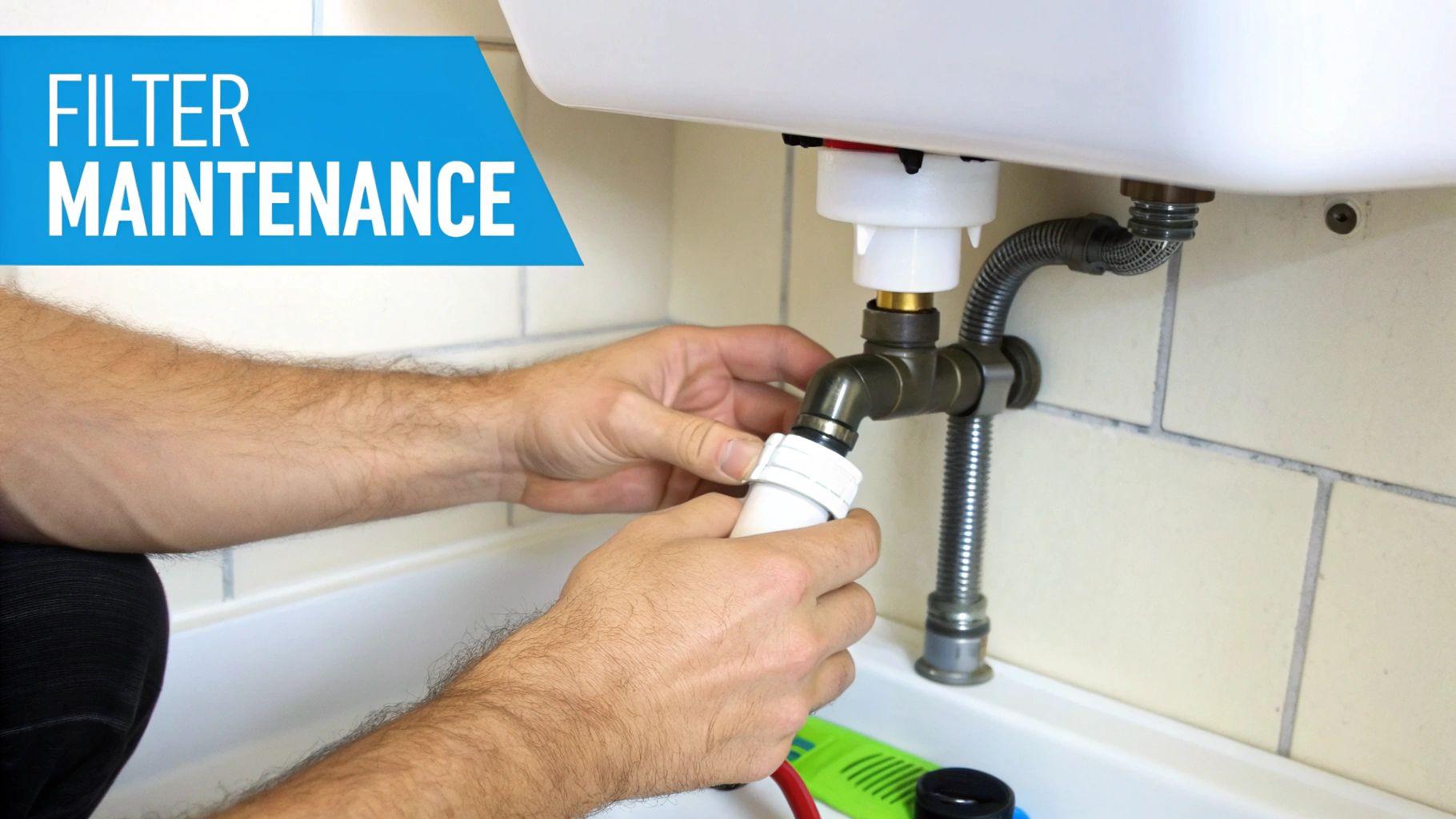
Keeping Your Water Filter Working Like New

A water filter is only as good as its last cartridge change. Getting the system installed is really just the beginning—it’s the consistent maintenance that keeps that fresh, chlorine-free water flowing. If you neglect your filter, it's like buying a brand-new car and never bothering with an oil change. Sooner or later, performance is going to suffer.

I like to think of a filter cartridge as a microscopic parking lot for contaminants. When it's fresh out of the box, there are plenty of open spaces. But over time, every one of those spots gets filled up with chlorine, sediment, and other gunk. Once it’s full, any new contaminants just drive right on by and end up in your glass.

A simple maintenance routine doesn't just guarantee performance; it also prevents nasty bacteria from building up inside the filter housing. This protects your investment and, more importantly, your family's health.

Your Filter Maintenance Timetable

Every filter has a different lifespan, and your best bet is to stick to the manufacturer's recommended schedule. A little planning goes a long way here, ensuring you always have clean, great-tasting water on tap.

Here’s a general guide for the most common filter types:

  • Pitcher Filters: These are the sprinters of the filter world. Plan on swapping the cartridge every one to two months, or after filtering about 40 gallons.
  • Faucet-Mounted Filters: A bit more durable, these usually last for two to three months, which works out to around 100 gallons.
  • Under-Sink & Countertop Filters: These have a lot more capacity and can often go for six months to a year before you need to think about a new cartridge.
  • Whole-House Filters: The true marathon runners. Depending on your water usage and how much sediment is in your water, these can last anywhere from three months to over a year.

Telltale Signs a Filter Change Is Due

Even if you forget to mark your calendar, your filter will give you some clear clues when it's time for a change. You just have to pay attention to what your water is telling you.

The most obvious sign is the return of that distinct chlorine taste or smell. If your morning glass of water suddenly tastes like you're at the community pool, it's a dead giveaway that the filter is saturated and can't absorb any more.

Another huge indicator is a drop in water pressure. If the flow from your filtered tap slows to a trickle, the cartridge is probably clogged with all the sediment and particles it has successfully pulled from your water.

Pro Tip: Grab a permanent marker and write the date you changed the filter directly on the new cartridge or the housing. It's a simple little trick that takes all the guesswork out of remembering when it's due for a replacement.

The Bigger Picture of Chlorine Use

While we're focused on getting chlorine out of our homes, it’s fascinating to look at its use on a global scale. The Asia-Pacific region is a massive player in the chlorine industry, driven by rapid industrialization and an enormous demand for safe water.

For perspective, India's chlorine consumption is projected to hit 3.3 million tons by 2024. At the same time, China's production capacity is expected to reach 4.5 million tons. This growth really highlights the ongoing need for large-scale disinfection. Yet, even as global demand grows, the push to reduce chlorine dependence is gaining momentum, with new technologies offering better, more localized solutions. You can discover more insights about the chlorine market on straitsresearch.com.

This global context really drives home why point-of-use filtration at home is so effective. It lets municipal systems do their job of ensuring broad public health safety, while you get the final say over the quality of the water you and your family actually drink. Keeping that filter in top shape is simply your part of the deal.

Common Questions About Chlorine in Water

Even when you've done your homework, a few questions always seem to pop up when you're trying to improve your home's water quality. It's totally normal. Making the right call means understanding the little details, so let's clear up some of the most common things people ask about reducing chlorine.

Think of this as a quick-reference guide—no deep technical jargon, just straight answers to help you feel confident about your next steps.

Does a Water Softener Remove Chlorine

This is probably one of the biggest points of confusion I hear. The short answer is no, a standard water softener isn't built to remove chlorine. Its one and only job is to combat hard water by swapping out minerals like calcium and magnesium for sodium.

While that's fantastic for stopping scale buildup in your pipes and appliances, it does absolutely nothing to the chlorine or chloramine swimming around in your water. Some of the newer "hybrid" systems do combine a softener with a carbon filter stage, but if you have a typical salt-based softener, you'll need a separate, dedicated filter to tackle chlorine.

Is Chloramine Harder to Remove Than Chlorine

Yes, it absolutely is. Chloramine is a much more stubborn chemical than free chlorine. Water municipalities actually designed it that way—to be more stable and stick around longer in the water supply. Great for disinfection, but a real headache for home filtration.

Simple tricks like letting water sit out or giving it a quick boil are completely useless against chloramine.

To get rid of chloramine effectively, you need a special filter medium called catalytic carbon. Your average activated carbon filter is a champ against chlorine, but it will barely make a dent in chloramine. This is exactly why testing your water or checking your utility’s water report is a non-negotiable first step.

Will My Refrigerator Filter Remove Chlorine

For the most part, yes! The built-in water and ice dispensers on modern fridges almost always use a small activated carbon filter. They do a pretty decent job of reducing the taste and smell of chlorine, giving you clean-tasting drinking water right from the door.

The key thing to remember is their tiny capacity. These filters need to be replaced on a strict schedule—usually every six months—to keep working correctly. They're a great solution for the glass of water you're about to drink, but they won't touch the water coming out of your kitchen tap or showerhead.

Can I Just Boil the Chlorine Out of My Water?

While boiling water for about 15 minutes can force free chlorine to evaporate, it's not a practical home filtration strategy. Here’s why it falls short:

  • It’s an energy hog, making it totally impractical for anything more than a small pot of water.
  • It concentrates other contaminants like heavy metals or nitrates that don't evaporate.
  • It does not work for chloramine, which will stay right where it is.

The impact of chlorine goes beyond just what you drink. It can affect your hair and skin, which is why you see articles explaining the purpose of specialized 'De chlorinate My Hair' products. It just goes to show how far-reaching the effects of chlorinated water can be. Getting these common questions answered is the final step toward picking the right whole-home solution.


At Water Filter Advisor, our mission is to give you clear, research-backed advice so you can have safer, better-tasting water. From deep-dive buying guides to practical tips, we're here to help you make confident choices for your home. Check out all our resources to find the perfect filtration system for your family at https://www.waterfilteradvisor.com.
Your Ultimate Guide to NSF Certified Water Filters for Your Home

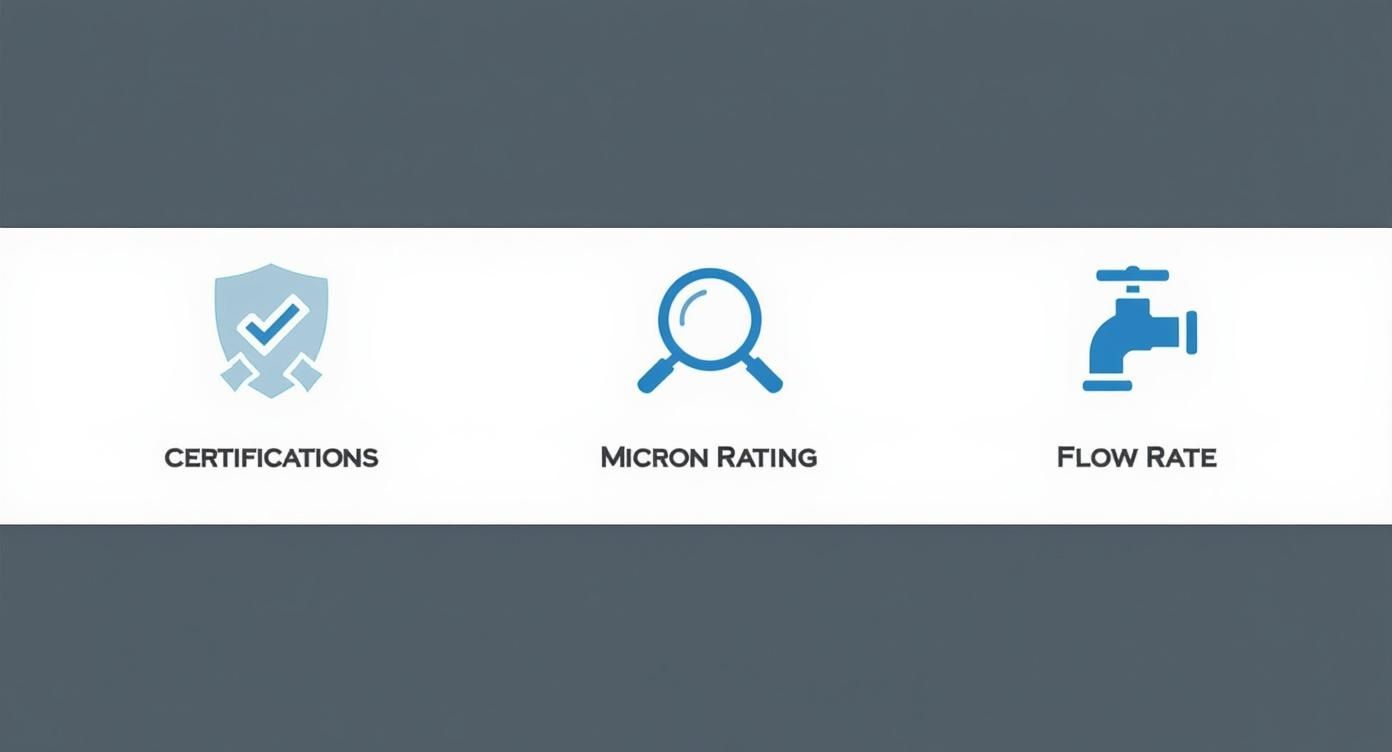
Ever stood in the water filter aisle, stared at a wall of boxes, and felt completely lost? You're not alone. When you're trying to find the best way to get clean, safe water for your family, seeing the letters "NSF" is like finding a lighthouse in a storm. Using an nsf certified water filters list is your secret weapon to ensure the water from your tap is as pure as it gets.

Think of NSF certification as a brutally honest, tell-all review from a world-class expert. It means the filter has been rigorously tested by an independent third party and proven to do exactly what the manufacturer promises. No marketing fluff, just verified results.

What NSF Certification Really Means for Your Drinking Water

Let's be real: when you buy a product to protect your family's health, you're putting a massive amount of trust in the company that made it. But without an unbiased referee checking their work, it's just their word against whatever gunk might be lurking in your pipes.

That's where the National Sanitation Foundation (NSF) steps in. They are the impartial judge, the trusted umpire for home water filtration. That little blue NSF seal isn't just a sticker; it's a rock-solid guarantee that the filter delivers on its promises of performance and safety.

To earn that seal, a filter has to survive a gauntlet of intense tests:

  • Contaminant Takedown: The filter is challenged to prove it can actually remove the specific contaminants it claims to, whether that's lead, chlorine, pesticides, or microscopic cysts.
  • Material Safety Check: Every single part that touches your water is meticulously analyzed to ensure it won't add any new, harmful chemicals back into the mix. No leaching allowed.
  • Built to Last: The entire unit is pressure-tested to make sure it can handle the daily grind of your home's plumbing without springing a leak or falling apart.

This level of independent proof builds massive consumer confidence. It's no wonder that 92% of water filter owners say they have more trust in products certified by an organization like NSF. That confidence directly impacts how people shop—in fact, 81% of buyers feel much better about their purchase when they choose a certified filter. You can dig deeper into consumer trust in water filter certifications to see just how critical it is.

Beware the Marketing Mumbo-Jumbo

Keep an eye out for vague language. A company might claim its product "meets NSF standards" or is "NSF compliant." These phrases sound impressive, but they are not the same as being officially certified. It’s a marketing sleight of hand that often means the product has dodged the independent verification process entirely.

The NSF certification is a commitment to public health. It ensures the product in your home performs exactly as advertised, providing a reliable barrier against unwanted contaminants and giving you peace of mind with every glass.

Ultimately, choosing an NSF-certified filter removes the guesswork. It transforms a complex decision into a simple one based on verified science and trust. You're not just buying a filter; you're investing in a scientifically-proven tool to give your family safer, cleaner, and better-tasting water.

How to Decode the Secret Language of NSF Standards

https://www.youtube.com/embed/IP1qjUI24yM

Walking down the water filter aisle can feel like trying to decipher ancient hieroglyphics. You'll see numbers like NSF 42, 53, and 401 stamped on the boxes. What in the world do they mean for the water you drink every day?

Think of these numbers less like a random code and more like a specific job description for your filter. Each standard tells you exactly what that filter is certified to fight. Just because a filter is certified doesn't mean it removes everything, and learning to read these codes is the key to matching a filter to your home’s unique water quality challenges.

NSF 42: The Taste and Odor Specialist

First up is NSF/ANSI 42, which is all about the "aesthetic" qualities of your water. This is the standard that verifies a filter's ability to make your water taste and smell fantastic. Its primary job is to tackle non-health-related impurities that just make your water unpleasant to drink.

The most common villain it defeats is chlorine. While cities use it to disinfect water, it often leaves that distinct "public pool" smell and taste behind. An NSF 42 certified filter is your first line of defense, ensuring every glass is crisp, clean, and refreshing.

NSF 53: The Health Guardian

When your concerns go beyond just funky taste and odor, you need to look for NSF/ANSI 53. This is a much more serious standard focused on contaminants with known adverse health effects. Think of it as the bodyguard for your drinking water, trained to remove specific, harmful intruders.

This is the certification you need if you're worried about things like lead from old pipes, mercury, cysts like Giardia, or volatile organic compounds (VOCs). It's crucial to know that a product must be certified for each specific contaminant. Always read the fine print on the packaging to see exactly what an NSF 53 filter is certified to reduce.

A filter can be certified to NSF 53 for lead reduction but not for mercury. It's crucial to check the details to confirm it targets the specific contaminants in your local water supply.

To help you get a quick handle on these standards, here's a simple breakdown.

Common NSF Standards at a Glance

This table is your quick-reference cheat sheet for understanding what the key NSF certifications mean for your home water filter.

NSF/ANSI Standard What It Certifies Common Contaminants Reduced
NSF/ANSI 42 Aesthetic Effects Chlorine, Taste, Odor, Particulates
NSF/ANSI 53 Health Effects Lead, Mercury, Cysts (Giardia), VOCs
NSF/ANSI 401 Emerging Contaminants Pharmaceuticals, Herbicides, Pesticides

Bookmark this in your mind for your next trip to the store.

This infographic also helps visualize the primary roles of the most common NSF standards.

Infographic about nsf certified water filters list

This guide shows how each standard addresses a different level of concern, from simple taste issues to serious health contaminants.

NSF 401: The Modern Contaminant Watcher

Finally, there's NSF/ANSI 401, one of the newer standards on the block. This one tackles what are called "incidental contaminants" or "emerging compounds." These are substances whose long-term health effects we're just beginning to understand.

We're talking about trace amounts of pharmaceuticals, over-the-counter medications, herbicides, and pesticides that find their way into our water supplies. While these are usually found in very small concentrations, many people prefer to remove them as a precaution. A filter with an NSF 401 certification offers an extra layer of defense against this modern category of contaminants.

By understanding these three key standards, you can confidently browse any NSF certified water filters list and choose a product that provides the exact type of protection your family needs.

Choosing the Right Type of NSF Filter for Your Home

A kitchen sink area showing a water filter pitcher, a faucet-mounted filter, and a dedicated tap for an under-sink system, representing different filter choices.

Alright, you've cracked the code of NSF standards. Now for the fun part: picking the right tool for the job. The "best" water filter isn't just about what it removes—it’s about how it fits seamlessly into your life, your budget, and your home.

Think of it like buying a car. You wouldn't use a two-seater sports car to haul lumber, right? In the same way, a simple pitcher filter is perfect for a single person in an apartment, but it just won't cut it for a big family worried about what's coming out of every tap.

The global demand for clean water is exploding. The water filter market was valued at around USD 15.88 billion in 2024 and is expected to rocket to USD 26.42 billion by 2032. This isn't just a fad; it's a direct response to growing awareness about water quality and the amazing new filter technologies hitting the market.

Pitchers and Dispensers: Simple, Smart, and Effective

Water filter pitchers are the gateway to better water for most people, and for good reason. They’re affordable, require zero installation, and are perfect for renters or anyone who wants to keep things simple.

Just fill it up, pop it in the fridge, and you’ve got cold, filtered water ready to go. Most basic pitchers are certified to NSF 42, making them champions at improving taste and smell by eliminating chlorine. The best models also earn an NSF 53 certification for tackling nasty stuff like lead. Once your home water is sorted, finding the best water bottles for hiking is a great next step to stay hydrated on the go.

Faucet-Mounted Filters: Clean Water on Demand

Tired of the fill-and-wait game with a pitcher? A faucet filter is a fantastic upgrade. It attaches directly to your kitchen tap and delivers filtered water with the simple flip of a switch—no more waiting.

Installation is usually a snap and tool-free, making it another great choice for renters. These filters often carry both NSF 42 and NSF 53 certifications, offering a more powerful defense against common contaminants right where you fill your glass.

Your choice of filter should directly address your primary concern. If it's just about better-tasting coffee, a simple NSF 42 pitcher works. If your local water report shows lead, an NSF 53 certified system is non-negotiable.

Under-Sink Systems: The Hidden Powerhouse

If you're a homeowner looking for a more permanent and robust solution, an under-sink system is the champion. These systems are tucked away neatly under your cabinet, connect directly to the cold water line, and deliver purified water through their own dedicated faucet.

They boast a much higher filter capacity and a longer lifespan than pitchers or faucet mounts. Many are certified for NSF 42, NSF 53, and even NSF 401 to tackle emerging contaminants like pesticides and pharmaceuticals. Top-tier reverse osmosis (RO) models, certified under NSF 58, can remove an even broader spectrum of dissolved solids.

Whole-House Filters: The Ultimate Fortress of Filtration

For the most comprehensive solution, nothing beats a whole-house filter. Also known as a point-of-entry (POE) system, this unit is installed where the main water line enters your home. The result? It treats every single drop of water you use.

This is the ultimate choice for tackling widespread problems like hard water, sediment, or high chlorine levels that affect your showers, laundry, and appliances—not just your drinking glass. It's a bigger investment, for sure, but a whole-house unit provides total peace of mind by purifying all the water flowing into your home.

Our Top Picks for NSF Certified Water Filters

Trying to pick a water filter can feel like a guessing game. Every brand makes big promises, but how do you know which ones actually deliver? That's where we come in. We’ve cut through the noise and put together a straightforward list of our vetted NSF certified water filters to highlight options that are independently proven to do their job.

We've broken down our recommendations by type, making it easy to find the right match for your home, budget, and specific water concerns. You can rest easy knowing every filter here is backed by official NSF certifications, which means a trusted third party has put it through its paces.

Best Pitcher Filter for Simplicity and Performance

Brita Elite Pitcher Filter (Longlast+)

If you're renting, in a dorm, or just want an easy-to-use solution, the Brita Elite (you might know it as the Longlast+) is a fantastic choice. It’s the simplest way to get into water filtration—no tools, no installation, no fuss.

What makes this pitcher stand out is its certification lineup. It’s got the NSF/ANSI 42 certification, which means it dramatically improves the taste and smell of your water by tackling chlorine. But it also has the critical NSF/ANSI 53 certification for reducing nasty stuff like lead, mercury, and asbestos. That one-two punch makes it a surprisingly powerful filter for something so simple.

  • Key Certifications: NSF/ANSI 42, 53
  • Best For: Renters and anyone who needs a simple, affordable way to get lead and chlorine out of their drinking water without a complicated setup.

Best Faucet-Mounted Filter for On-Demand Convenience

PUR PLUS Faucet Filtration System

Tired of waiting for a pitcher to fill? A faucet-mounted filter gives you clean water right on tap, and the PUR PLUS system is a real winner in this category. It clicks right onto your kitchen sink for a seamless blend of convenience and serious filtration.

This thing is a workhorse, certified against NSF/ANSI 42, 53, and 401. So, it doesn't just make your water taste better (NSF 42) and pull out lead (NSF 53), it also handles emerging contaminants like certain pesticides and pharmaceuticals (NSF 401). A quick flip of a switch lets you go between filtered and unfiltered water, which is a great feature for making the filter last longer.

That triple certification is a big deal. It gives you a solid defense against a whole host of common water problems, making it one of the most capable faucet filters you can buy.

Best Under-Sink System for Hidden Power

Aquasana Claryum 3-Stage Under Sink Filter

For homeowners looking for a more permanent, high-capacity solution that doesn't clutter the countertop, an under-sink system is the way to go. The Aquasana Claryum 3-Stage system is an absolute beast that works its magic completely out of sight, feeding a dedicated, elegant faucet.

This filter is certified against NSF/ANSI 42, 53, and 401, and its multi-stage process is incredibly thorough. It’s proven to reduce over 77 different contaminants, including 99% of lead and asbestos, along with herbicides, pesticides, and pharmaceuticals. What’s really smart is that, unlike reverse osmosis systems, it leaves healthy minerals like calcium and magnesium in the water. You get all the good, none of the bad.

  • Key Certifications: NSF/ANSI 42, 53, 401
  • Best For: Homeowners who want a serious, long-term filtration system that tackles a massive range of contaminants while keeping healthy minerals in their water.

To make things even easier, here’s a quick side-by-side look at our top picks.

Top NSF Certified Water Filter Picks

Filter Model Type Key NSF Certifications Best For
Brita Elite (Longlast+) Pitcher NSF 42, 53 Renters and simple lead/chlorine removal.
PUR PLUS Faucet System Faucet-Mounted NSF 42, 53, 401 On-demand filtration for a wide range of contaminants.
Aquasana Claryum 3-Stage Under-Sink NSF 42, 53, 401 Homeowners wanting comprehensive, hidden filtration.

This should give you a solid starting point for finding the perfect NSF certified filter for your home and peace of mind.

How to Verify a Filter's NSF Certification Like a Pro

When it comes to your family's water, trust but verify. Anyone can slap a claim on a box, but how do you know it’s true? Learning to check for an official NSF certification yourself is the ultimate power move, giving you total confidence that a filter actually does what it says it will.

It’s a simple skill that cuts through marketing fluff and protects you from misleading claims. The best part? It only takes a minute.

Screenshot from https://info.nsf.org/Certified/DWTU/

The screenshot above shows the official NSF Certified Products Database—your one-stop shop for the truth about any filter's certification.

A Step-by-Step Guide to Verification

The only way to be 100% sure a filter is legitimate is to check the official NSF database. Be wary of vague phrases like “tested to NSF standards.” That’s not the same thing. Only an official listing in the database confirms the product survived the rigorous testing process.

Here’s how you can become a verification expert in four easy steps:

  1. Get the Product Info: Find the brand name and the specific model number. This is usually printed right on the box or in the online product description.
  2. Go to the Source: Head over to the official NSF Certified Drinking Water Treatment Units, Water Filters database. This is the only resource that matters.
  3. Search the Database: Type the brand or model number into the search bar.
  4. Check the Listing: If the filter is legit, it will appear in the search results. The listing will show you exactly which NSF standards it meets (like NSF 42, 53, or 401) and the complete list of specific contaminants it’s proven to reduce.

If a filter isn’t listed in this database, it is not NSF certified—no matter what the package says. This simple check is your best defense against clever marketing.

This process lets you see the full performance data sheet, so you can confirm every single claim the manufacturer makes. For more hands-on help choosing the right filter, you can find a ton of practical advice right here on our site. Learning more about water filter maintenance and selection will help you make a smart, informed choice. By verifying the certification yourself, you can be sure the filter you bring home is truly up to the job of protecting your family.

Common Questions About NSF Certified Filters

Even after you've waded through all the standards and product specs, a few questions always seem to pop up. Let's tackle those nagging doubts head-on so you can purchase your new filter with complete confidence.

The demand for certified filters is skyrocketing, and for good reason. In Europe, the water filter market hit USD 5.28 billion in 2024 and is expected to nearly double to USD 10.30 billion by 2033. This isn't just a trend; it's a direct response to growing concerns over water quality, with industrial and agricultural runoff linked to a staggering 3.5 million deaths worldwide each year from contaminated water. You can discover more insights on the European water filter market and see the data for yourself.

Is "NSF Compliant" the Same as "NSF Certified"?

Absolutely not. This is probably the single most important distinction to understand.

When a product is "NSF Certified," it means it has been sent to NSF International, put through a battery of independent tests, and proven to meet every single claim on its label. It’s a rock-solid guarantee that it does what it says it does.

On the other hand, phrases like "NSF compliant" or "tested to NSF standards" are just marketing speak. It usually means the company tested the filter themselves, in their own lab, without any third-party oversight. Always look for the official NSF seal on the product and double-check the model number on the NSF database.

Think of it like this: "NSF Certified" is like graduating with an official degree from an accredited university. "NSF Compliant" is like saying you "followed the curriculum" without ever taking the final exams or getting a diploma.

Do I Need a Filter if My Tap Water Is "Safe"?

Just because your city’s water meets the legal requirements doesn't mean it's as clean or tasty as it could be. For starters, municipal water is treated with chlorine. While it’s great for disinfection, it leaves behind a chemical taste and odor that most people find unpleasant. An NSF 42 certified filter is designed specifically to eliminate that.

More importantly, your water’s journey doesn’t end at the treatment plant. Contaminants like lead can easily leach into your water from old city service lines or even the plumbing inside your own home. An NSF 53 certified filter acts as the final line of defense, capturing these contaminants right at your tap before they ever make it into your glass.


At Water Filter Advisor, our mission is simple: to give you clear, honest information so you can find the perfect water filtration system for your home. Dive into our detailed guides and reviews to choose the right solution for your family.

Learn more and find your ideal filter at Water Filter Advisor

New water filter technology aims for clean water worldwide

New water filter technology aims for clean water worldwide


The world’s population is projected to increase by 2-3 billion over the next 40 years. Already, more than three quarters of a billion people lack access to clean drinking water and 85 percent live in the driest areas of the planet. Those statistics are inspiring chemist Ben Hsiao and his team at Stony Brook University. With support from the National Science Foundation (NSF), the team is hard at work designing nanometer-scale water filters that could soon make clean drinking water available and affordable for even the poorest of the poor.

Check out the full video here:

Original Video Source