How to Clean Your Water Softener Brine Tank Like a Pro

To get your brine tank sparkling clean, you'll need to start by putting your water softener into bypass mode. After that, unplug it, and get ready to manually empty out all the old salt and water. Once it's empty, a good scrub with mild soap and warm water is in order, followed by a sanitizing rinse with a diluted bleach or vinegar solution. Rinse it out thoroughly, put it all back together, and you're good to go. This whole process is your secret weapon for getting rid of that nasty sludge and stopping salt bridges before they start.

Why a Clean Brine Tank Is Your Secret Weapon for Soft Water
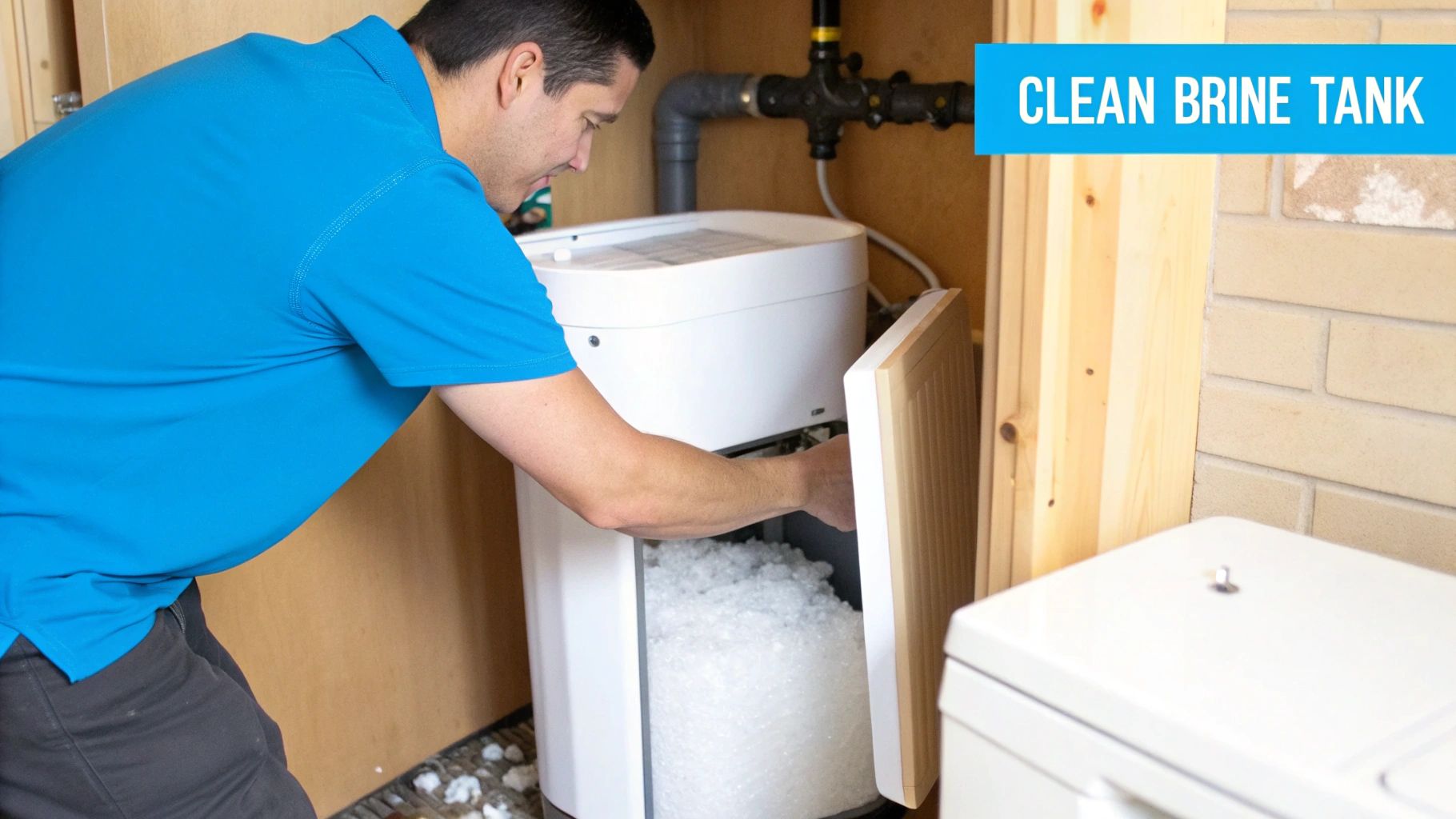
A man in a blue shirt inspects the inside of a water softener brine tank filled with salt.

Ever notice your glassware coming out of the dishwasher with those chalky spots again? Or maybe your skin and hair just feel dry and dull, even though you have a water softener. The problem might not be the system itself, but its often-forgotten sidekick: the brine tank.

This simple tank is the heart of your softener’s regeneration process. Keeping it clean isn’t just a random chore on your to-do list—it's one of the most important maintenance tasks for making sure your home has consistently soft, luxurious water.

Think of the brine tank as the recharger for your entire home water filtration system. It’s where salt dissolves in water to create a powerful brine solution. During a regeneration cycle, this salty water gets pulled into the main resin tank to wash away the hard minerals—calcium and magnesium—that have been collected from your water. If that brine isn't clean and potent, the whole process just falls apart.

The Enemies of Soft Water: Salt Bridges and Mushing

When a brine tank gets neglected, a couple of common villains can pop up and stop your system dead in its tracks. Knowing what they are is the first step to defeating them.

  • Salt Bridges: This is when a hard crust of salt forms over the top of the water level in the tank. You're left with a hollow space underneath, which means the rest of the salt can't actually dissolve. Your softener will still try to regenerate, but it ends up pulling in plain water instead of salty brine, leaving the resin beads full of hard minerals.
  • Salt Mushing: Down in the murky depths of the tank, undissolved salt can turn into a thick, sludge-like mess. This "mush" can clog up the brine well and block water flow, making the regeneration cycle completely useless.

A properly functioning brine tank is the unsung hero of home water filtration. Regular cleaning isn't just a chore; it’s an investment in protecting your appliances, plumbing, and the soft water your family depends on.

Ignoring these problems means your softener isn't actually softening your water. This brings back all the classic hard water headaches: limescale buildup on faucets and inside pipes, appliances that work harder and die sooner, and needing to use way more soap and detergent. This guide will walk you through the entire cleaning process, turning what seems like a big job into a simple, confidence-building project.

Gearing Up for a Brine Tank Clean-Out

A little prep work goes a long way. Before you even think about touching the brine tank, taking a few minutes to get your gear together can be the difference between a quick, painless job and a messy, frustrating afternoon. Trust us, you don’t want to be halfway through, with salty water on the floor, realizing you need to run to the hardware store.

Let’s walk through exactly what you’ll need to have on hand. The good news? You probably already have most of this stuff tucked away in your garage or laundry room.

Your Brine Tank Cleaning Toolkit

We've put together a quick checklist of everything you'll need for a successful cleaning. Having these items ready and within arm's reach will make the entire process a breeze.

Item Recommended Type Pro Tip
Buckets 2-3 gallon buckets (at least two) Use one for scooping out old salt and the other for dirty water to avoid a sloshy mess.
Scoop Sturdy plastic cup or small scoop Never use metal! It can easily scratch the inside of the tank, creating little hiding spots for gunk.
Shop-Vac Wet/dry vacuum This is a game-changer for getting that last bit of water and sludge out of the bottom. Totally optional, but highly recommended.
Garden Hose Standard hose with a spray nozzle Makes rinsing the tank after scrubbing incredibly fast and effective.
Brush Long-handled with stiff (not metal) bristles Find one that lets you comfortably reach the bottom of the tank. A toilet brush dedicated to this task works surprisingly well.
Towels/Rags Old, absorbent towels Spills happen. Be ready for them to protect your floors and make cleanup easy.

Once your hardware is squared away, you just need a few more things to handle the actual cleaning and, more importantly, to keep yourself safe.

Cleaning Supplies and Safety Gear

Before you start scrubbing, let’s talk safety. You're dealing with grime, possibly some mold, and cleaning agents. It's smart to gear up properly. For a deep dive into why this matters, check out this guide on Personal Protective Equipment for Chemicals.

Here’s what you’ll need to grab:

  • Waterproof Gloves: A good pair of rubber or nitrile gloves is a must. Brine is corrosive, and you don’t want that stuff on your hands.
  • Safety Glasses: A simple pair of safety glasses will protect your eyes from any accidental splashes, especially if you’re using a bleach solution.
  • Mild Dish Soap: Your everyday, non-abrasive dish soap is perfect for breaking down the initial layer of grime inside the tank.
  • Sanitizer: You've got options here. A solution of 2-3 tablespoons of unscented household bleach per gallon of water is a powerful disinfectant. If you prefer a non-chemical route, plain old white vinegar works great too.

Pro Tip: The absolute best time to tackle this job is when your salt level is low, right before you’d normally add a new bag. It means a lot less heavy, wet salt you have to scoop out. Work smarter, not harder!

Finally, and this is the most critical part, you need to prep the softener itself. First, find the bypass valve on your unit and push or turn it to the bypass position. This keeps water flowing to your house but stops it from entering the softener.

Once it's in bypass, unplug the water softener from the electrical outlet. This is a non-negotiable safety step. It guarantees the system won’t kick into a regeneration cycle while your hands are inside the tank.

The Complete Guide to Cleaning Your Brine Tank

Okay, you've got your gear ready and the softener is safely in bypass mode. Now for the main event. Don't worry, this isn't some complex plumbing nightmare. We're going to walk through this step-by-step, and you'll see it's more like deep-cleaning a kitchen appliance than anything else.

With a little bit of elbow grease, we'll get that brine tank looking brand new, and your softener will run so much better for it.

Phase One: Draining and Salt Removal

First things first, we need to get everything out of that tank—the water, the old salt, and whatever gunk has settled at the bottom. The less salt you have to deal with, the quicker this goes. That's why timing this for when your salt is already low is a pro move.

This diagram gives you a quick visual of the prep work before you start digging in.
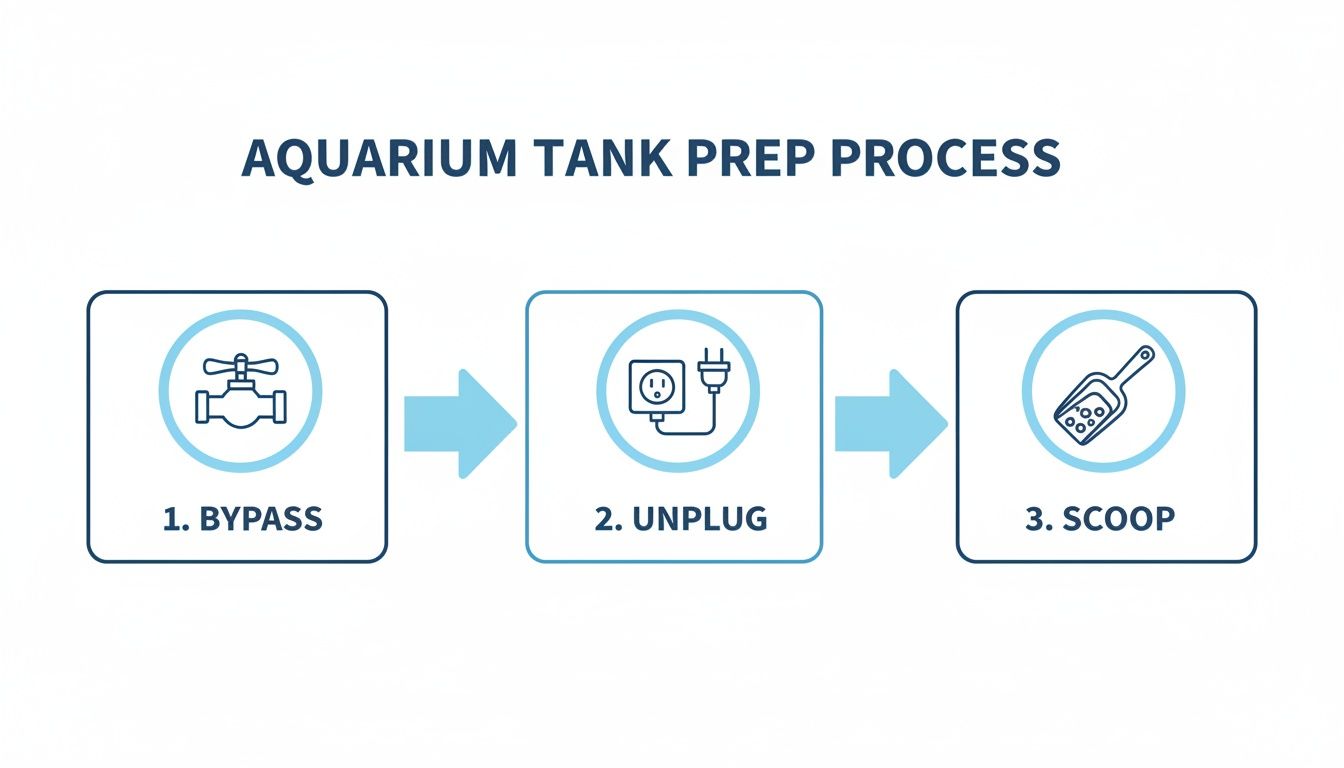
A diagram illustrates three steps for aquarium tank preparation: bypass, unplug, and scoop.

Hitting these three points—bypassing, unplugging, and getting your scoop ready—is the key to a smooth and safe cleaning job.

Go ahead and disconnect the brine line and the overflow tube from the tank. They’re usually held on by simple clips or threaded fittings. Just be gentle here; old plastic can get brittle. Pop them off and move them out of your way.

Now, let's tackle that salt.

  1. Scoop it out: Grab your plastic scoop and start moving the leftover salt into your buckets. If the salt is damp, it gets heavy fast, so don't try to be a hero and overfill the buckets.
  2. Keep it or toss it? If the salt looks clean and isn't a mushy mess, feel free to set it aside to reuse later. But if it's discolored or feels sludgy, it’s better to just get rid of it and start fresh.
  3. Deal with the water: After the salt is out, you'll have a few gallons of salty water left. You can bail it out with your scoop, but a wet/dry shop vac is your best friend here. It makes quick work of that last bit of gritty water.

Once the tank is empty, you'll likely see the enemy: a layer of dirt, sediment, and general sludge. This is the stuff that can clog your system and cause all sorts of problems.

It's really common to find a gritty, sand-like layer in tanks that haven't been cleaned for a few years. This is usually just insoluble material from lower-grade salts that builds up over time and can mess with the brine draw.

With the tank empty, we're ready for the satisfying part—the scrub-down.

Phase Two: Scrubbing and Sanitizing

This is where the magic happens. A clean tank surface is essential for stopping bacteria growth and making sure your new salt dissolves correctly. We want a deep clean, but without using harsh chemicals that could damage the tank.

Grab your mild dish soap. Squirt a good amount into the tank and add a gallon or two of warm water. Now, take your long-handled brush and give the whole interior a really good scrub.

Focus on the bottom and the corners where all the grime likes to collect. Work your way up the sides, breaking loose any salt residue. Don't forget to scrub the lid, too.

After you've scrubbed every surface, it's time to rinse. The easiest way is to take the tank outside and blast it with a garden hose. If you're stuck indoors, you'll have to use your buckets and rags to rinse it completely. Keep rinsing until the water runs clear and all the soap is gone.

Now for the sanitizing step—this is critical for killing any lingering bacteria or mold. You've got a couple of great options:

  • Bleach Solution: Mix 2 to 3 tablespoons of unscented household bleach with about 3 gallons of water. Pour it in and use your brush to splash it all over the interior surfaces. Let it sit for about 15 minutes.
  • Vinegar Solution: For a non-bleach option, mix one cup of white vinegar with 2 to 3 gallons of water. Do the same thing—pour it in, coat the sides, and let this one sit for 20 minutes. Vinegar is a great natural disinfectant.

After the sanitizing solution has done its job, you have to rinse the tank out thoroughly. Any leftover bleach or soap can cause problems for the resin. Rinse it two or three times until you can't smell any bleach or vinegar.

Phase Three: Cleaning the Brine Well and Float

Look inside your brine tank and you'll see a tall tube—that's the brine well. It holds the safety float, which is the mechanism that keeps your tank from overflowing. It's a key part of the system that needs a gentle cleaning.

The brine well is usually held in by a couple of clips at the bottom. Carefully detach it so you can clean it out properly.

Here’s how to handle it:

  • Disassemble with care: The float assembly typically lifts right out of the tube. Pay attention to how it comes apart so you can put it back together the same way.
  • Clean the tube: Use your brush and soapy water to clean the inside and outside of the brine well. Slime can build up in there, so get it nice and clear.
  • Inspect the float: Wipe down the float mechanism with a rag and soapy water. Make sure it moves up and down its guide rod smoothly. If it sticks, it can't shut off the water properly.
  • Rinse and reassemble: Rinse everything well, put the float back inside the brine well, and then snap the whole unit back into place in the tank.

Paying attention to these smaller parts makes sure your whole system is ready to work perfectly.

Phase Four: Reassembly and Refill

We're in the home stretch! The tank is sparkling clean, and it's time to put it all back together.

First, reconnect the brine line and the overflow tube. The connections should be snug, but don't go crazy overtightening them. Hand-tight is almost always enough to prevent leaks.

Next, add the salt. If you saved your old salt, you can put it back in. If not, open up a new bag. Pour the salt into the tank, trying to aim for the sides rather than dumping it right on top of the brine well.

Now for the water. A good rule of thumb is to add just enough water to be about one inch above the salt level. For most home softeners, this will be around 3 to 5 gallons. Use your buckets to pour it in gently.

Don't fill the tank all the way up with water. The softener will automatically add the right amount after it regenerates. This initial water is just to get the first batch of brine made.

Finally, plug the softener back in. Slowly turn the bypass valve back to the "service" position. You should hear water start to flow back into the unit. Do a quick check around your connections for any drips.

With everything hooked up, the very last step is to kick off a manual regeneration cycle. This will pull the new brine into the resin tank and get the whole system back online. Check your manual, but it's usually as simple as holding down a "regenerate" button for a few seconds.

The cycle will probably take an hour or two. Once it's finished, you're all done! Your water softener is now running with a perfectly clean brine tank, ready to give you great soft water again.

How to Bust Salt Bridges and Other Common Problems
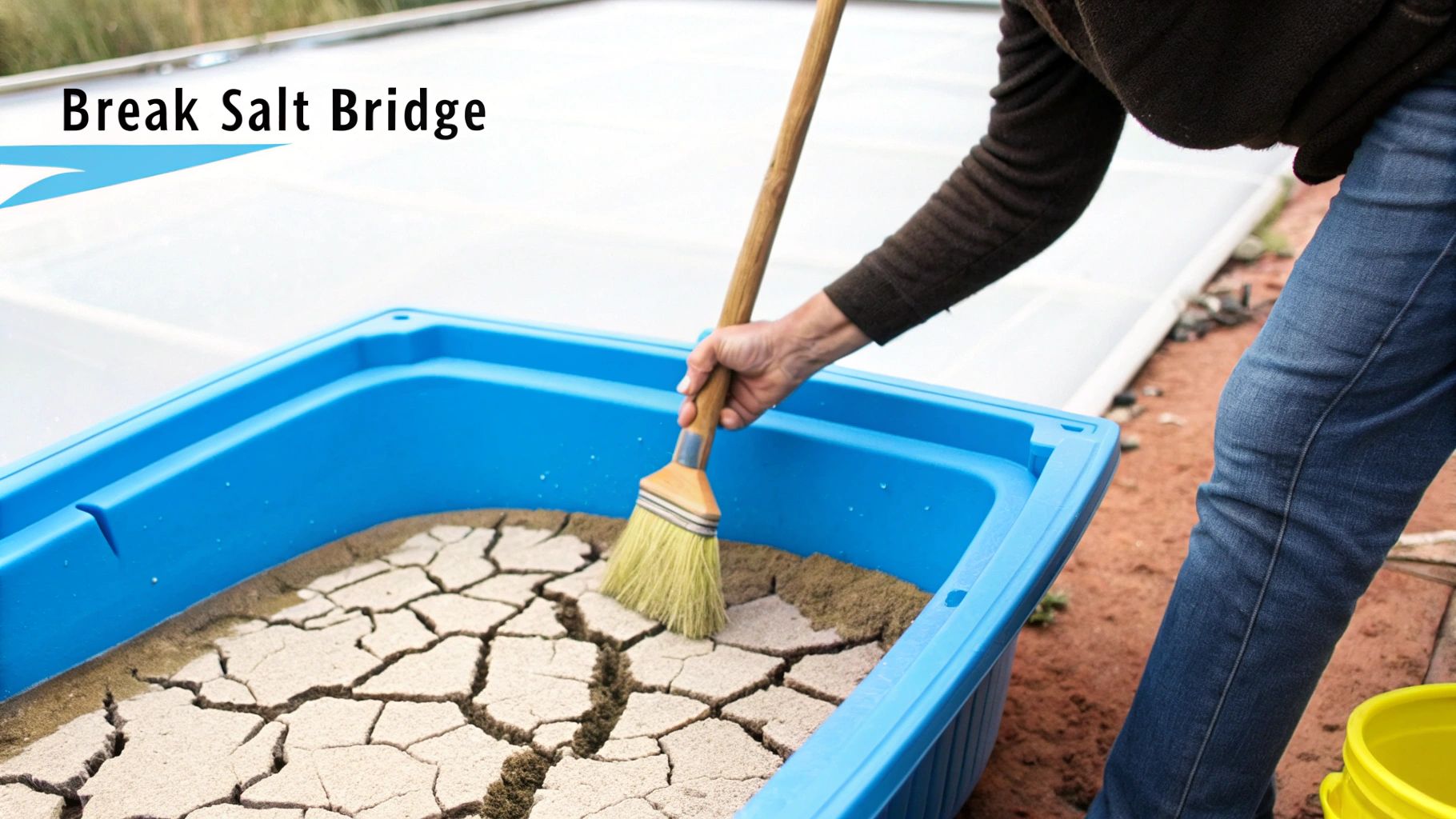
A person uses a brush to break up a cracked salt bridge in a blue water softener brine tank.

Even with a perfectly clean brine tank, you can still run into a couple of really common, frustrating issues. We're talking about the two biggest culprits that can stop your water softener in its tracks: salt bridges and salt mushing.

Think of this as your field guide to fixing these headaches yourself. You'll save a surprise bill from the plumber.

These problems can pop up for a few reasons—high humidity in the basement, using the wrong kind of salt, or just filling the tank a little too high. The good news? Both are usually pretty simple to fix once you know what you're looking for.

Spotting and Fixing a Salt Bridge

A salt bridge is exactly what it sounds like. It's a hard, solid crust of salt that forms a "bridge" over the water in your tank. This creates a big air pocket underneath, so the loose salt on top never actually dissolves into the brine. Your softener goes through its cycle, but it's just pulling in plain water instead of the saltwater it needs. That's when your hard water problems come roaring back.

So, how do you know you've got one?

  • The Tap Test: Your water suddenly feels hard again. Soap isn't lathering like it should, and you're seeing spots on your clean dishes.
  • The Visual Check: You look in the tank, and the salt level never seems to go down, even after a few regeneration cycles.
  • The Poke Test: This is the surefire way. Grab a broom handle or a long wooden dowel and gently push it down into the center of the salt. If it hits a hard layer and then suddenly breaks through into empty space, you’ve found your salt bridge.

Once you’ve confirmed the bridge, breaking it up is easy. Take your broom handle and gently tap and push down on the crust in a few different places. The goal is just to break it into smaller pieces that can fall down into the water.

Be careful here. Don't use anything sharp or metal, and don't get too aggressive. There's a delicate plastic float mechanism inside that brine well, and one forceful jab can damage it, leading to a much more expensive repair.

After breaking it up, give the salt a good stir to help it dissolve. From there, just kick off a manual regeneration cycle on your softener to get the system back on track.

Dealing with Salt Mushing

Salt mushing is the sneaky cousin of the salt bridge. This is where undissolved salt and all its impurities turn into a thick, gooey sludge right at the bottom of the brine tank. This mush can clog the brine well and completely block the flow of water, making regeneration impossible.

You'll usually discover this problem during a routine cleaning when you empty the tank out. It tends to be more common in homes with high humidity or if you're using lower-purity salts, like rock salt, which often contains more dirt and sediment.

If you find a layer of that sludge at the bottom of your tank, the only real solution is to get it out.

  1. Scoop the Sludge: Use a plastic scoop to get all of that mushy, recrystallized salt out of the tank and dump it into a bucket.
  2. Scrub and Rinse: This is where that full clean we already covered becomes essential. You've got to scrub the tank thoroughly to remove every bit of that residue.
  3. Rinse Again: Make absolutely sure you rinse the tank completely to get rid of any fine sediment that could cause clogs later on.

The best way to prevent both salt bridges and mushing is just to be proactive. In fact, neglecting a brine tank can lead to salt bridges in up to 70% of residential systems within the first year alone. For a deeper dive into your system's health, it's worth reviewing a complete water softener maintenance checklist. Sticking to a simple routine is really the key.

Keeping Your Water Softener in Peak Condition

Now that your brine tank is sparkling clean, let’s talk about how to keep it that way. Moving from a one-off cleaning to a smart, proactive maintenance routine is the real secret to a long-lasting softener and consistently soft water. Trust us, it’s always easier to prevent problems than it is to fix them.

A proactive approach really just starts with a simple schedule. For most homes, giving the tank a thorough cleaning once a year is perfect. However, if you're on well water or dealing with high iron—the usual suspect behind those nasty rust stains—you’ll want to bump that up to every six to eight months. This keeps you ahead of any serious sediment or sludge buildup.

Choosing the Right Salt Makes a Huge Difference

The type of salt you use directly impacts how often you’ll find yourself cleaning that tank. It might seem like salt is just salt, but the purity level makes a world of difference and is the single biggest factor in preventing future gunk.

Here’s a quick rundown of what you’ll find on the shelf:

  • Evaporated Salt: This is the good stuff. It’s your best choice for any water softener, hands down. Typically 99.9% pure, it dissolves cleanly and leaves almost nothing behind. Using evaporated salt pellets dramatically cuts down on salt “mushing” and bridging.
  • Solar Salt: Made by evaporating seawater, solar salt is a solid, budget-friendly option with a purity of about 99.5%. It’s a huge step up from rock salt but can sometimes contain tiny bits of insoluble material that will eventually build up.
  • Rock Salt: This is your cheapest option, but it's also the least pure. It looks like little pebbles for a reason—it’s often full of dirt and other minerals that don't dissolve. This stuff will quickly create a sludgy mess at the bottom of your tank.

By simply switching from rock salt to a high-purity evaporated salt, many homeowners find they can push their cleaning schedule from every six months to once a year, or even longer. The few extra cents per bag absolutely pays for itself in less work for you.

Don't Forget the Resin Cleaner

While keeping the brine tank clean is crucial, it’s only half the battle. Inside the main mineral tank, you have thousands of tiny resin beads doing the heavy lifting of grabbing those hard minerals. Over time, things like iron and manganese can foul these beads, and regular salt regeneration just can't get them clean.

Using a dedicated water softener resin cleaner every few months is a fantastic maintenance habit. You just pour the right amount into the brine well or directly into the tank right before a regeneration cycle. The cleaner gets sucked into the resin tank with the salt water, where it chemically strips away that stubborn buildup and gets the beads back to working like new.

Maintaining your whole system is one of the smartest investments you can make. To keep all your home equipment running smoothly for years, it’s a good idea to adopt some general top preventive maintenance best practices. This proactive mindset doesn’t just save you from surprise repair bills; it ensures your family gets the full benefits of soft water every single day. For more tips on home water systems, check out our guides for more expert advice on water filtration.

Brine Tank Maintenance: Your Top Questions Answered

Let's tackle some of the most common questions that pop up when it's time to clean a brine tank. Getting these details right makes the whole process smoother and keeps your system running like a top.

What’s the Best Salt to Use to Avoid Future Headaches?

Your salt choice is genuinely the biggest factor in how often you'll need to roll up your sleeves and clean this thing. If you want to make life easier, evaporated salt pellets are the way to go, hands down.

These pellets are incredibly pure, often testing at 99.6% to 99.9% sodium chloride. That high purity means they dissolve almost completely, leaving behind minimal gunk that would otherwise turn into sludge at the bottom of your tank. They might be a little more expensive, but they pay for themselves in reduced labor.

A simple switch to a high-purity salt can easily push your cleaning schedule from every six months out to once a year. The few extra bucks per bag are well worth it to avoid the hassle.

Can I Clean My Brine Tank with Vinegar Instead of Bleach?

You absolutely can. White vinegar is an excellent natural sanitizer if you'd rather not use bleach. It's great for handling any lingering mold or bacteria without the harsh chemicals.

Here’s how to do it:

  • Once the tank is scrubbed with soap and fully rinsed, pour in 2-3 gallons of fresh water.
  • Add about one cup of white vinegar and give it a good swish to mix.
  • Let the solution sit for around 20 minutes, making sure it gets on all the inside surfaces.
  • Finally, give it one last scrub with your brush and rinse everything out completely.

How Can I Tell if the Softener is Working Right After I Clean It?

This is the satisfying part—confirming your hard work paid off. The fastest and most reliable method is to use a water hardness test strip.

After you've put the tank back together, added the new salt, and poured in a few gallons of water, you'll need to trigger a manual regeneration cycle. This usually takes an hour or two. Once it's finished, grab a water sample from a faucet inside your home. If everything's working correctly, the test strip should show a hardness level near zero.

You'll also feel the difference pretty quickly. Soap will lather up nicely again, and you'll see those tell-tale, spot-free glasses coming out of the dishwasher. That's the real proof.


At Water Filter Advisor, we're here to help you get the best water quality for your home. For more in-depth guides and honest product reviews, check us out at https://www.waterfilteradvisor.com.
How to Maintain a Water Softener for Peak Performance

So you've welcomed a water softener into your home. Fantastic choice! Now, let's make sure this champion of home water filtration stays in fighting shape. Taking care of your water softener really boils down to a few simple tasks. You’ll need to keep an eye on the salt levels, give the brine tank a good cleaning about once a year, and occasionally use a resin cleaner. If you can stick to this simple routine, you'll head off most common problems and keep your system running smoothly for years to come.

Why Bother with Water Softener Maintenance

You invested in a water softener to protect your pipes, fixtures, and appliances from the scaly tyranny of hard water. That’s a smart move. But it’s not an appliance you can just "set and forget." Think of it more like a high-performance engine for your home's water—it needs a little TLC to perform its best and avoid expensive repairs down the line. A bit of regular upkeep is all it takes to guarantee a steady supply of silky-smooth soft water and get the most life out of your unit.

Letting your softener go without maintenance is like watching money swirl down the drain. An ignored system becomes less efficient, burning through more salt and water with every regeneration cycle. That means higher utility bills and more trips to the store for salt. More importantly, a little effort now prevents a massive plumbing headache later.

The Real Payoff of a Simple Routine

A small amount of care pays off in big ways, saving you money and keeping your home's entire water system running smoothly. With regular maintenance, a good water softener can last up to 20 years—far longer than the typical 10-15 year lifespan of a neglected one. This is huge, especially considering that over 85% of households in North America are in a constant battle with hard water.

Something as simple as checking the salt every few weeks can prevent 70% of common failures. It makes sense when you realize that salt-based systems, which make up a whopping 74.18% of the market, are completely reliant on it to do their job.

Before you start any hands-on maintenance, make sure you know how to turn off your water main. It’s a crucial first step that can save you from turning a small fix into a major flood.

The core tasks aren't complicated. We're talking about managing salt levels, cleaning out the brine tank, and making sure the settings are optimized for your household's needs. Getting these right is the key to peak filtration performance.

If you’re looking to get a better handle on your home's water quality, our complete collection of advice on water filtration systems is packed with helpful information. To get you started, here’s a quick-glance guide to your softener’s maintenance schedule.

Water Softener Maintenance at a Glance

This table breaks down the essential maintenance tasks, how often you should do them, and what you’ll need to get the job done.

Maintenance Task Recommended Frequency Required Tools & Supplies
Check Salt Levels Every 2-4 weeks Water softener salt
Clean Brine Tank Annually Mild soap, water, soft brush
Add Resin Cleaner Every 6-12 months Resin cleaner solution
Check Settings Quarterly Your system's manual

Sticking to this simple schedule will keep your water softener in peak condition, ensuring it works efficiently for its entire lifespan.

Mastering the Brine Tank and Salt Levels

Your water softener's brine tank is its command center. This is where the salt lives, creating the brine solution that strips all those hard minerals out of the resin bed. Keeping an eye on this tank is probably the most important thing you'll do for your softener. If you let it run dry, the system just stops filtering. Simple as that. You'll be right back to dealing with hard water scale.

A good habit is to keep the tank at least half-full of salt. This guarantees you'll always have enough on hand for a strong brine solution when it's time to regenerate. For most families, a quick peek every two to four weeks is plenty. Just top it off as needed, but try not to fill it all the way to the brim—that can sometimes lead to clumping and other headaches.

Choosing the Right Salt for Your System

When you're at the store, you'll see a few different kinds of salt. They all work, but they're not all the same. The one you pick can really affect how often you have to clean the tank and how well your home's water filtration system performs.

  • Evaporated Salt Pellets: This is the good stuff. It’s typically 99.9% pure sodium chloride, which means it leaves almost no gunk behind in your tank. You'll clean it less often, and it's the least likely to cause salt bridges. For most modern softeners, this is the top recommendation.
  • Solar Salt Crystals: Made from evaporated seawater, this type is also very pure (around 99.6%). It's a solid, budget-friendly choice. The only downside is it might leave a bit more sediment at the bottom of the tank over time compared to the pellets.
  • Rock Salt: It’s the cheapest option, but you get what you pay for. Rock salt has more impurities and minerals that don't dissolve. All that dirt and sediment builds up fast, potentially clogging up your filtration system and forcing you to do a lot more cleaning.

Honestly, spending a little extra on evaporated salt pellets usually pays for itself. You'll save time on maintenance and keep the system running better for longer.

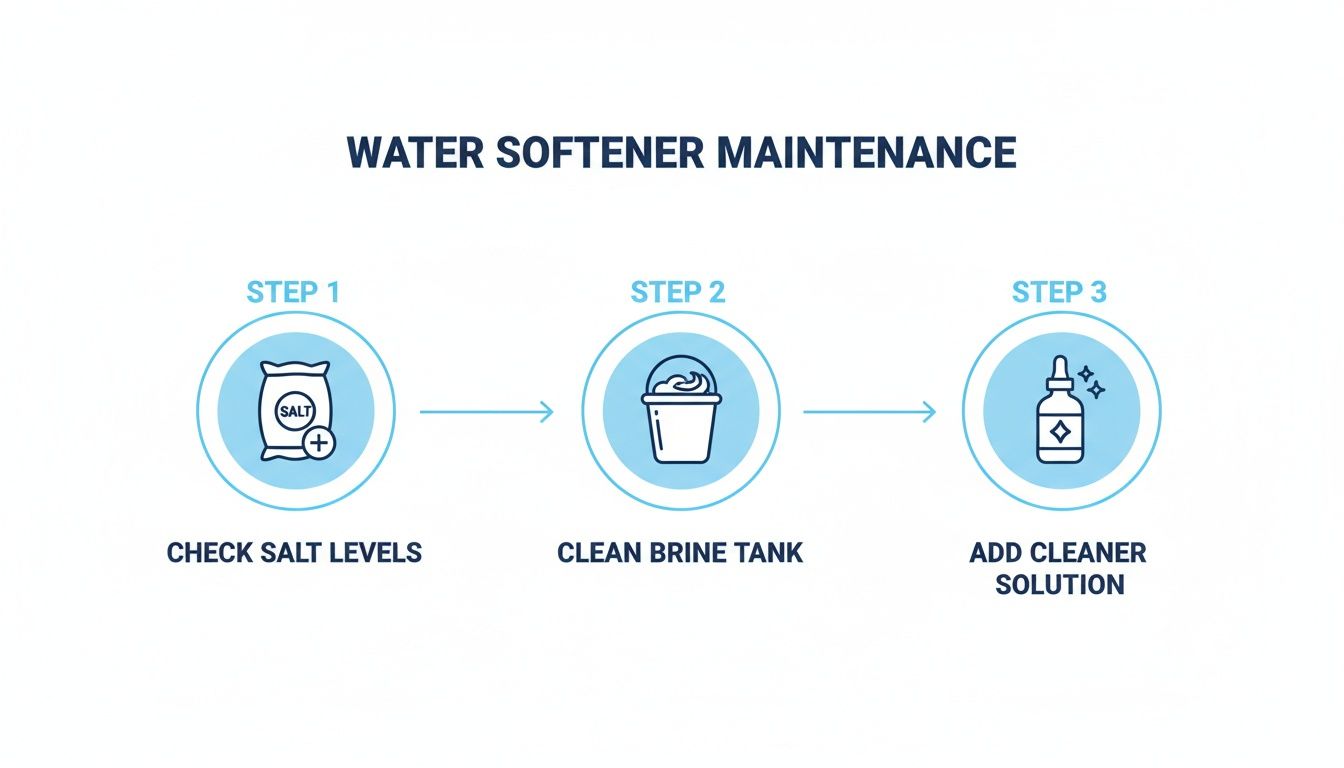
This simple workflow gives you a great visual of the core tasks for keeping your softener in top shape.

A diagram showing three essential steps for water softener maintenance: check salt levels, clean brine tank, and add cleaner solution.

As you can see, it's all about a simple, proactive cycle: regular salt checks, an annual tank cleaning, and throwing in a resin cleaner every now and then.

The Annual Brine Tank Deep Clean

About once a year, you’ll want to give the brine tank a good scrub. This gets rid of all the sludge, dirt, and "salt mush" that can build up, preventing clogs and keeping your filtration process sanitary. It's an easy job that shouldn't take you more than an hour.

The easiest way to start is to let the salt level get low so there’s less to scoop out. Next, switch the softener to bypass mode—this stops water from flowing to the unit. Now you can disconnect the brine tank, dump out any leftover salt and water, and tip it on its side to drain completely.

Once it's empty, grab a soft brush or cloth and some mild soapy water to scrub the inside clean. Really focus on the bottom, since that's where most of the gunk settles. Rinse it out well with fresh water, hook it back up, and you're ready to fill it with a fresh bag of salt.

Defeating the Dreaded Salt Bridge

A salt bridge is one of the most common—and annoying—filtration problems you'll run into. It’s a hard crust of salt that forms in the tank, creating a dome over the water. The salt above can't drop down and dissolve, so your system stops making brine, even though the tank looks full. You'll know it's happened when your water suddenly feels hard again.

A salt bridge effectively starves your softener of the one thing it needs to regenerate. Identifying and breaking it is a simple fix that solves a major filtration failure.

To check for one, just take a broom handle and gently poke the salt. If you feel a hard crust with an empty space underneath, you've got a salt bridge.

Breaking it up is easy. Just use the handle to gently tap the crust near the edges of the tank until it all falls apart. Just be sure not to use anything sharp, you don't want to puncture the plastic tank. After it's broken up, give the salt a good stir with the handle to make sure it settles back into the water. Then, just run a manual regeneration cycle to get things back to normal.

Keeping Your Resin Bed Healthy and Effective

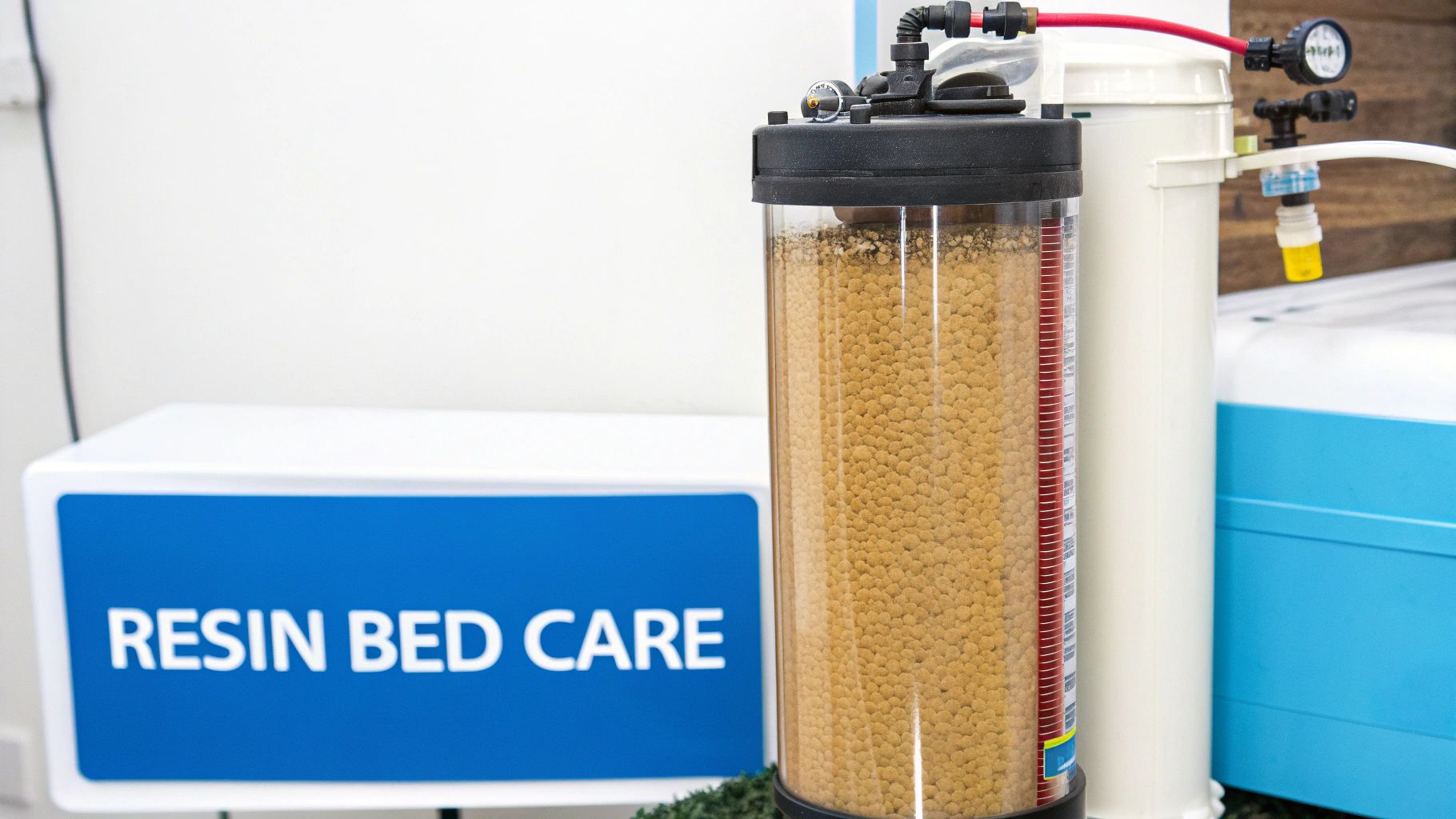
A transparent resin bed water filter container with a 'RESIN BED CARE' sign on a blue panel.

While everyone talks about the brine tank, the real heavy lifting happens inside the resin tank. This tank is jam-packed with thousands of tiny, porous resin beads. Think of them like microscopic magnets that grab onto hard water minerals—calcium and magnesium—as water passes through. This is the heart of your home's water filtration process.

These little beads are the soul of your softener. When the system regenerates, that salty brine solution you’ve been maintaining washes over them, breaking the minerals' grip and flushing them away. This recharges the beads, getting them ready to filter more water.

But here's the catch: hard water minerals aren't the only thing that can get stuck to them.

Recognizing the Signs of Resin Fouling

Over time, other gunk like iron, manganese, sediment, and even chlorine can build up on the resin beads. This is what we call resin fouling. It essentially puts a stranglehold on the beads, stopping them from grabbing those hardness minerals. When that happens, your softener’s performance just tanks.

You’ll know you have a problem when those all-too-familiar hard water issues start creeping back. Keep an eye out for these tell-tale signs:

  • Your water just doesn't feel soft anymore. The soap won't lather up, and your skin and hair feel dry and sticky after a shower—just like before you got the softener.
  • Stains reappear on fixtures. See those ugly reddish-brown rust stains showing up in your sinks and toilets again? That's a dead giveaway for iron fouling.
  • Water pressure takes a hit. If the resin bed gets badly clogged with sediment, it can choke off the water flow, giving you weak pressure at your faucets and showerheads.

If you spot any of these, and you know your salt level is fine and the brine tank is clean, it's a pretty safe bet your resin bed is crying out for help. Ignoring it won't make it go away.

Think of resin cleaner as a powerful detox for your water softener. It strips away the iron and sediment that a normal salt regeneration cycle can't touch, restoring the beads to their original mineral-grabbing glory.

A good maintenance schedule that includes resin care is crucial for the long haul. A healthy resin bed can last a solid 10 to 15 years, but a fouled one might give up in just a few, sticking you with a hefty replacement bill.

Using a Resin Cleaner for a Deep Clean

Using a resin cleaner is a simple but incredibly effective task you should tackle every six to twelve months. Your timing really depends on your water quality. If you're on well water with high iron, you’ll want to do this more often, maybe even every four months.

Most resin cleaners are pretty straightforward. They’re specifically designed to dissolve iron and other crud without harming the delicate resin beads themselves. The process is a breeze:

  1. Read the Instructions: First things first, always read the label on the cleaner you buy. Most will have you pour a certain amount directly into the brine well—that's the narrow tube inside your brine tank.
  2. Add the Cleaner: Carefully measure and pour the recommended amount of cleaner right into that brine well. If your system doesn't have a well, the instructions might tell you to add it to the tank itself when the salt level is low.
  3. Run a Manual Regeneration: The final step is to immediately kick off a manual regeneration cycle. This will pull the cleaner-infused brine into the resin tank, letting it get to work scrubbing those beads clean.

This simple job restores your system’s filtration efficiency, keeps your water feeling great, and can seriously extend the life of your resin bed. It's one of the easiest ways to protect your investment and keep your softener working like a champ.

Optimizing Regeneration for Peak Efficiency

Your water softener's regeneration cycle is its reset button—it's how the system flushes out all the hard minerals it has trapped and recharges itself with salt. But get the settings wrong, and that "reset" becomes a huge waste of salt and water. This is where a little bit of know-how goes a long way toward keeping your filtration system running efficiently and your bills down.

The whole show is run by the control valve, which is basically the brain of your softener. Most of the time, when a softener is wasting resources, it's because the settings on this valve aren't matched to your home's water filtration needs.

Timer-Based vs. Demand-Initiated Regeneration

First things first, you need to know what kind of system you're working with. Softeners decide when to regenerate in one of two ways, and understanding which one you have is key.

  • Timer-Based Systems: These are the old-school, set-it-and-forget-it models. You program a schedule—say, every four days at 2 AM—and it regenerates like clockwork, no matter what. The downside is its inflexibility. It doesn't know you had a house full of guests or that you were away on vacation. This often leads to regenerating too early (wasting resources) or too late (hello, hard water).

  • Demand-Initiated (Metered) Systems: These are the smart ones. They actually track how much water your household uses and only kick off a regeneration cycle once a preset volume of water has been treated. It's a much more efficient approach because it adapts to your actual usage. A metered system can cut your salt and water consumption by up to 75% compared to a basic timer model.

If you have the option, a demand-initiated system is the hands-down winner for saving money and optimizing your home's filtration.

True water softener maintenance is about tailoring the machine to your life. The whole point is to sync up its regeneration schedule with your family’s water habits and the specific hardness of your local water.

Dialing in the Settings for Your Home

Fine-tuning your softener isn't guesswork; it's about plugging in the right numbers. You just need two key pieces of information to get started: your water hardness level and how much water your family uses.

You can usually find your water hardness on your local utility's website or by using a simple test kit. It’s measured in grains per gallon (GPG). For water usage, a solid rule of thumb is 75 gallons per person, per day. A family of four, for example, will go through about 300 gallons daily.

Let’s run through a quick example. Say you're that family of four, and your water is a very hard 20 GPG.

  1. Figure out the daily hardness load: Just multiply your daily water use by the hardness. So, 300 gallons/day × 20 GPG = 6,000 grains of hardness that your softener has to tackle every day.
  2. Know your system's capacity: Check the manual for your softener's grain capacity. A 32,000-grain unit is a pretty common size.
  3. Calculate the regeneration frequency: Divide the softener's capacity by the daily hardness load. 32,000 grains ÷ 6,000 grains/day = 5.3 days. This tells you the system needs to regenerate roughly every five days to keep up.

That's it. This simple math takes all the mystery out of it.

Fine-Tuning at the Control Valve

Once you've got your numbers, it's time to head to the control valve. Every model's a bit different, so grab your owner's manual. Generally, you’ll be punching in the hardness (GPG) and the number of people in your household.

On a metered system, entering these values lets the softener's computer figure out the regeneration schedule automatically. If you have a timer-based unit, you'll use your own calculation (like our "every five days" result) to set the schedule manually.

And don't be afraid to tweak things. If you start to feel that hard water film on your skin again, you might need to shorten the time between cycles. On the flip side, if you're burning through salt like crazy, try extending the cycle by a day. A few small adjustments can make a huge impact on both filtration performance and your wallet.

Troubleshooting Common Water Softener Problems

Even with perfect maintenance, filtration systems can act up. One day your water is silky smooth, and the next you’re right back to dealing with spotty dishes and soap scum. It’s frustrating, but don’t pick up the phone just yet.

Most of the time, the fix is something you can easily handle yourself in just a few minutes. We’ll walk through the most common hiccups—from a system that mysteriously stops using salt to weird noises and leaks—so you can play detective and get your filtration running again.

Hard Water Is Suddenly Back

This is the number one complaint I hear, and it almost always has a simple solution. Before you assume the whole filtration unit is shot, let's run through a quick checklist.

First thing to check: is the bypass valve on? This handle routes water around the softener, which is great for maintenance but not for daily use. If it's in the "bypass" position, just flip it back. Problem solved.

If that's not it, take a look inside the brine tank. A salt bridge is a frequent offender. This is a hard crust of salt that forms above the water level, creating an empty space underneath. The system thinks it has salt, but none is dissolving. Just take a broom handle and gently poke at the salt. If it collapses, you've found your culprit.

Why Isn’t My System Using Any Salt?

You keep checking the brine tank, but the salt level never goes down. This is a clear sign your softener isn’t regenerating, which means your water isn't actually getting softened.

Again, check for a salt bridge first. If the salt is solid all the way down, you might be dealing with "salt mushing." This is a thick, pasty sludge at the bottom of the tank that’s clogging everything up. If you see that, you'll need to scoop it all out and give the tank a good cleaning.

Also, trace the brine line—that little tube running from the tank to the control valve. Make sure it isn’t kinked, disconnected, or blocked. No brine can get to the resin tank if that line is compromised.

Neglecting basic water softener maintenance isn’t just an inconvenience; it can drive up operational costs by 25-40% annually. In regions like Europe and North America, unchecked systems often suffer from resin fouling, which can slash efficiency by 50% in just two years and spike energy bills as the system works harder to compensate.

Decoding Leaks and Strange Noises

A puddle of water or a new clanking sound is enough to make any homeowner nervous, but it's not always a five-alarm fire.

Most leaks come from loose fittings. Get a flashlight and carefully check where the water lines connect to the control valve and where the brine line attaches. Often, a simple hand-tighten is all it takes to stop the drip.

As for noises, a bit of gurgling during the regeneration cycle is normal. But if you hear a constant hiss or a loud, mechanical grinding sound you haven't heard before, that could point to an issue with the valve motor or internal seals. Beyond troubleshooting, addressing common issues often requires delving into general maintenance and repairs to restore your system's functionality.

For a quick reference, here are some of the most common issues at a glance.

Quick Fixes for Common Softener Issues

Symptom Potential Cause DIY Solution to Try First
Water feels hard again Bypass valve is engaged Locate the bypass valve and ensure it's in the "Service" position.
Salt level isn't dropping Salt bridge has formed Gently break up the hard crust of salt with a broom handle.
Water in brine tank is too high Clogged brine line or injector Disconnect and clear the brine line; clean the venturi/injector assembly.
System is making unusual noises Loose parts or air in the line Check for loose fittings. Manually run a regeneration to purge any air.
A small puddle is on the floor Loose hose connections Check and hand-tighten the connections on the bypass valve and brine line.

This table should get you through the most frequent headaches, but remember, some problems are bigger than a quick DIY fix.

When Is It Time to Call a Professional?

Knowing your limits is key. Trying to be a hero on a complex repair can turn a small issue into a very expensive one. It's time to call in an expert if you run into these situations:

  • Electrical Issues: The display is dead or flashing an error code you can’t clear (and yes, you’ve already checked the outlet). This usually points to a bad circuit board.
  • Persistent Leaks: You've tightened every fitting you can find, but the drip continues. This could be a cracked tank or a bad internal seal, which isn't a simple fix.
  • Motor or Valve Failure: The softener is stuck in a regeneration cycle for hours, or you hear a constant grinding from the control head. The internal mechanics have likely failed.
  • You've Tried Everything: If you've gone through this guide and are still stumped, a pro has the diagnostic tools and experience to find the root cause quickly.

Knowing how to troubleshoot the basics empowers you to handle the small stuff and make a smarter call when you need backup.

Your Top Water Softener Questions Answered

We’ve covered the nuts and bolts of routine maintenance, but a few questions always seem to pop up. It's totally normal to have a few lingering "what-ifs" as you get to know your system. Let's tackle some of the most common ones we hear from homeowners.

Think of this as your quick-reference FAQ. No fluff, just straight answers to help you manage your home water filtration system like a pro and protect your investment.

How Often Should I Really Clean My Brine Tank?

The standard answer is "once a year," but honestly, it really depends on what you’re feeding your softener.

If you stick to high-purity evaporated salt pellets and your city water is relatively clean, you can easily push that to every 18 months. But if you're using cheaper rock salt or have well water that’s heavy on iron and sediment, you need to be more watchful.

In that case, I’d pop the lid and take a look every six months. See a thick layer of gunk, sludge, or just general nastiness at the bottom? It's cleaning time, regardless of what the calendar says.

A little proactive cleaning goes a long way. It's much easier to prevent a sludge problem than it is to fix a clogged-up injector assembly later.

Can I Use Any Type of Salt in My Water Softener?

While most softeners can technically use pellets, crystals, or block salt, that doesn't mean you should. One type is almost always the right choice for your specific unit. High-purity pellets are the gold standard for a good reason—they burn clean, dissolve evenly, and are the least likely to cause frustrating salt bridges.

Solar salt crystals are another great, often more affordable, option. Block salt is the cleanest but is also the most expensive and is really designed for specific models that can handle it. The most important thing you can do? Check your manufacturer's manual. Using the wrong salt can tank your filtration performance and might even void your warranty.

What Are the Signs I Need a New Water Softener?

A well-cared-for softener is a workhorse, often lasting 15 years or more. But nothing lasts forever. There are a few dead giveaways that it's time to start shopping for a replacement.

  • Hard Water Returns: If your water feels hard again and you've already deep-cleaned the resin bed and checked the settings, that's the biggest red flag.
  • Constant Repairs: Are you on a first-name basis with your plumber? If repair bills are piling up, they can quickly eclipse the cost of a new, more efficient unit.
  • Visible Damage: Cracks, rust, or serious leaks on the tanks aren't just cosmetic issues; they are major warning signs.
  • Major Drop in Water Pressure: If you've ruled out other plumbing issues, a sudden drop in pressure throughout the house could mean the resin bed is so clogged it's strangling your water flow.

If your system is over a decade old and showing any of these signs, investing in a new model is usually the smarter financial move.

Should I Install a Pre-Filter Before My Softener?

For most people, yes. A pre-filter is one of the best upgrades you can make to protect your softener.

If you're on a private well, a simple sediment pre-filter is practically a necessity. It’s your front-line defense, catching sand, silt, and rust before they can gum up your softener's control valve or foul the resin.

Even on city water, a carbon pre-filter is a brilliant move. It removes chlorine, which slowly degrades the resin beads over time and can drastically shorten their lifespan. Think of a pre-filter as a cheap insurance policy for your much more expensive water softener.


At Water Filter Advisor, our mission is to empower you with the knowledge to achieve safer, better-tasting water at home. From in-depth buying guides to practical maintenance checklists, we provide clear, research-driven advice to help you make confident decisions for your family. Explore our resources today at https://www.waterfilteradvisor.com.
How to Maintain Your Water Softener: A Guide to Silky-Smooth Water

Keeping your water softener humming along is surprisingly simple. Forget picturing some complex, intimidating chore. Think of it as a small time investment that protects a major home filtration system, guaranteeing you that glorious silky-smooth water while saving your pipes and appliances from the villainous clutches of scale buildup.

This isn't just a niche concern anymore. The crusade for better home water is booming. The global water softener market is on track to become a multi-billion dollar industry, a testament to how many people are tired of hard water hassles and are taking control of their home's water quality.

Making Maintenance a Simple Habit

The secret to a long and happy life for your water softener isn't becoming a certified water treatment expert. It's all about a few core tasks that deliver the most bang for your buck. Simple, consistent checks are what separate a well-oiled machine from a future headache.

Here are the absolute must-dos for any solid water softener maintenance routine:

  • Keep an Eye on the Salt: This is your most frequent mission. A quick peek once a month is usually all it takes to make sure you don't run out. If the salt's gone, the softening party stops dead.
  • Watch for Salt Bridges: This is a classic softener snafu where a hard crust of salt forms in the tank. It’s a sneaky trick because it looks like the tank is full, but the salt underneath can't dissolve. We'll show you how to spot and bust these up in a snap.
  • Give the Brine Tank a Good Scrub: Once a year, or maybe twice if your water source is particularly gunky, a full clean-out evicts sediment and keeps your whole filtration setup hygienic and efficient.
  • Double-Check Your Settings: Make sure your softener’s regeneration schedule is still a good fit for your family's water usage. Getting this right saves a ton on salt and water.

Once you get these few tasks down, you're no longer just reacting to problems. You're proactively managing your home's water filtration. That simple shift is the secret to getting years of reliable service from your water softener.

Water Softener Maintenance At-a-Glance

To make it even easier, here’s a quick-reference table that lays out the essential tasks and when you should be doing them.

Maintenance Task Recommended Frequency Purpose
Check Salt Level Monthly Ensures the system has enough salt to regenerate and soften water.
Break Up Salt Bridges As needed (check monthly) Prevents blockages that stop salt from dissolving into the brine.
Clean the Brine Tank Every 6-12 months Removes sediment, dirt, and salt residue for optimal filtration performance.
Check System Settings Annually Confirms the regeneration cycle matches your water usage for efficiency.

Following this simple schedule will keep your home water filtration system in top shape and prevent most common issues before they start.

It also helps to understand how your softener fits into your home’s bigger plumbing picture. For a great overview, checking out an ultimate guide to plumbing can be a real eye-opener. And for more targeted info on all things filtration, we’ve got a whole library of https://www.waterfilteradvisor.com/advice/ waiting for you.

Mastering Salt Management for Peak Filtration

Think of the salt in your softener as its fuel. Without it, the whole ion exchange process—that scientific magic trick where hard minerals get swapped out for sodium ions—grinds to a halt. Nailing salt management is the single most important part of your maintenance routine, and there's more to it than just dumping in a bag.

The kind of salt you use really does matter. You'll typically find three main options: evaporated, solar, and rock salt.

  • Evaporated Salt: This is the purest (and priciest) stuff. It dissolves without leaving much gunk behind, making it a fantastic choice for keeping your filtration system clean and running at peak efficiency.
  • Solar Salt: This is a solid middle-of-the-road option. It's made from evaporated seawater, so it's cleaner than rock salt but can still leave a bit of sediment over time.
  • Rock Salt: It's the cheapest but also the dirtiest. If you go this route, plan on cleaning your brine tank more often to get rid of the sludge that will inevitably build up.

For most modern home softeners, your best bet is usually evaporated salt pellets. They keep maintenance low and filtration performance high.

Spotting and Solving Common Salt Problems

Even with the best salt, a couple of common issues can shut your system down: salt bridges and salt mushing. Knowing what these are and how to fix them is a must for any softener owner.

A salt bridge is exactly what it sounds like—a hard crust of salt that forms over the water in your brine tank. This usually happens when it's humid or if the tank gets overfilled. It’s tricky because when you peek inside, it looks like you've got a full tank of salt, but underneath that crust is just empty air. The salt can't dissolve, no brine gets made, and your system essentially starves.

It's a classic scenario: a homeowner notices their dishes are spotty and their soap isn't lathering. They check the tank, see what looks like plenty of salt, and figure there's a serious mechanical failure. More often than not, it's just a sneaky salt bridge.

Pro Tip: Not sure if you have a bridge? Give the side of the tank a gentle tap, or use a broom handle to poke the top of the salt. If it feels solid and sounds hollow underneath, you've found your culprit.

Fixing it is easy. Just take your broom handle and carefully tap and poke the crust until it breaks apart. Scoop out any big chunks that are left.

Preventing Salt Mushing and Blockages

Down at the bottom of the tank, you can run into salt mushing. This is when salt recrystallizes into a thick, mucky sludge that can completely block the system's intake. Cheaper, less pure salts are notorious for causing this filtration nightmare.

Taking care of your salt isn't just a chore; it’s about protecting your investment. The global water softener market hit USD 1.14 billion in 2024 and is expected to climb to USD 1.53 billion by 2032, which shows just how vital these water filtration systems have become. Simple maintenance, like cleaning the brine tank every six months to clear out any potential bridges or mush, is key to performance. You can dig deeper into water softener market trends to see how proper care protects value. A clean tank means your softener can do its job, giving you the soft water you rely on.

A Practical Guide to Cleaning Your Brine Tank

While you’re probably used to topping off the salt every month or so, your brine tank needs a much more thorough cleaning about once every six to twelve months. Don't think of it as just another chore; it's more like a vital tune-up for your home’s water filtration system. This isn't just about appearances—it's about keeping your softener running at its best.

Over time, all sorts of gunk like sediment, dirt, and impurities from lower-quality salt can build up a nasty sludge at the bottom of the tank. If you let it go, this sludge can clog the brine well, which is the heart of the regeneration process. When that happens, your softener can't make the brine solution it needs to flush out hardness minerals, and you're suddenly back to square one with spotty dishes and scratchy laundry.

Getting Started with Your Tank Cleanout

First things first, you need to prep the tank. The easiest way to do this is to let the system use up most of the salt. A nearly empty tank is a lot easier to handle.

Once the salt is low, switch your system to bypass mode. You'll usually find a valve or a handle that reroutes water around the softener. This is a brilliant feature because it means you can work on the unit without having to shut off the water to your whole house.

Now you can disconnect the brine tank from the control valve. This usually just means detaching a couple of tubes and maybe the brine well cover. Just be gentle here—those plastic parts can get brittle over the years. With the tank free, your next job is to get rid of any leftover salt and water. A wet/dry vac makes short work of this, but a good old-fashioned scoop and bucket work just fine too.

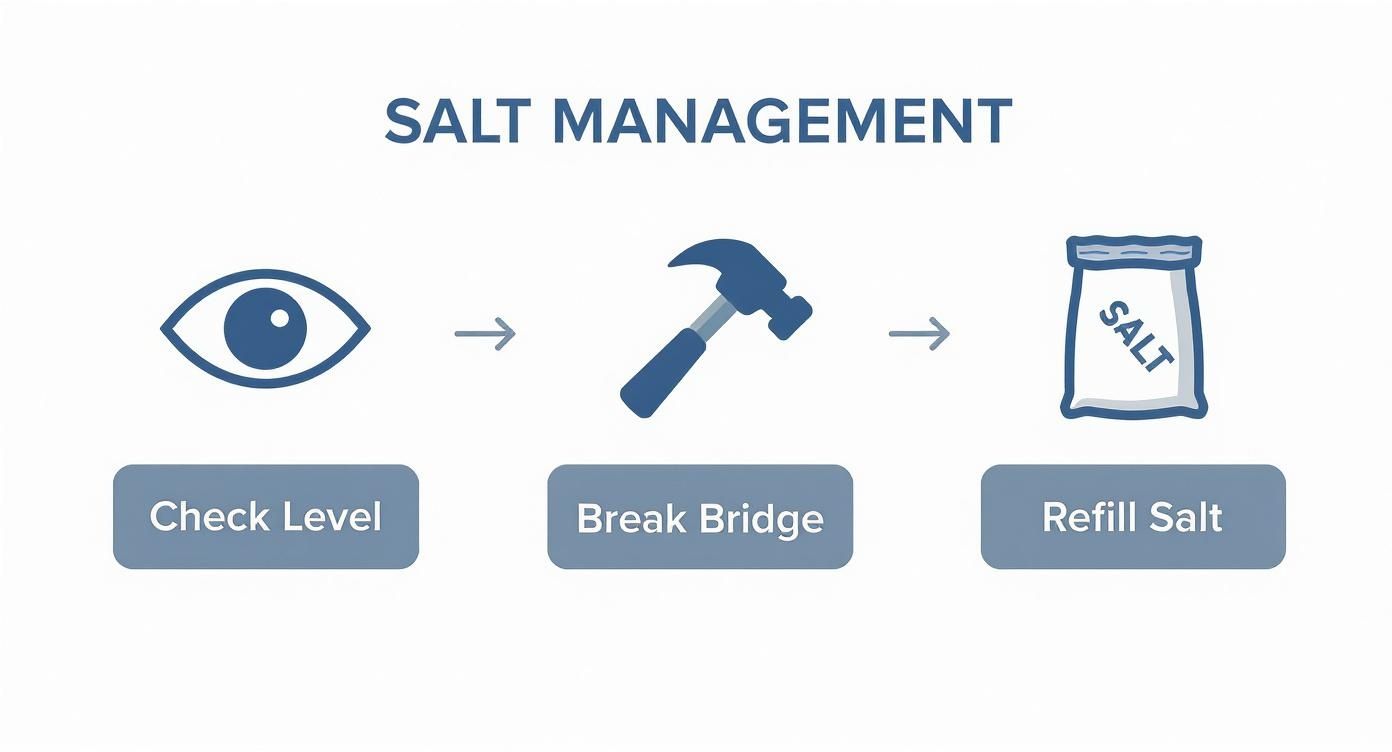
This simple infographic gives you a visual on the day-to-day salt care that leads up to this big cleanout.

Infographic about how to maintain water softener

As you can see, staying on top of salt levels and breaking up any salt bridges are key. Good habits here mean you'll have a lot less gunk to deal with when cleaning day comes around.

The Cleaning and Sanitizing Process

Okay, now for the main event. With the tank empty, you can finally see what’s been lurking at the bottom. If you're on well water, don't be shocked to find a sludgy, rust-colored layer of iron sediment. It looks nasty, but this is exactly why you're doing this.

You don't need any harsh chemicals to get it clean. A simple mix of mild dish soap and warm water is usually all it takes.

  • Grab a long-handled brush and scrub the inside of the tank. Really get into the bottom and the corners where all that gunk likes to hide.
  • After a good scrubbing, rinse the tank out completely with clean water. You want to get every last bit of soap residue out.
  • Sanitizing is an optional step, but I highly recommend it. Just mix a small amount of unscented household bleach with a few gallons of water, swish it around the tank, and let it sit for about 15 minutes. This will kill off any bacteria that might be hanging around. Dump it and give the tank one final, thorough rinse.

Make absolutely sure the tank is completely rinsed and dry before you hook anything back up. Leftover soap or bleach can mess with your system's filtration performance and, more importantly, the quality of your home's water.

Once it's clean and dry, reattach the tubes to the control valve. Pour a few gallons of fresh water into the tank, then fill it up with new, high-quality salt. The last step is to take the system out of bypass mode. I always recommend running a manual regeneration cycle right away. This gets a fresh batch of brine into the system and ensures your softener is ready to get back to its water-purifying work.

How to Revitalize Your System's Resin Bed

The resin bed is the heart and soul of your water softener. It's the engine room of your home filtration, where the magic happens—where those pesky hard water minerals get snatched up and swapped out. But like any hard-working component, it can get tired. Over time, it gets gunked up with iron, manganese, and other sediment, which slowly kills its ability to do its job.

Think of the resin beads as tiny, powerful magnets. When they're clean, they grab onto calcium and magnesium with no problem. But once they're coated in grime, that magnetic pull gets weaker, and hard water starts sneaking past.

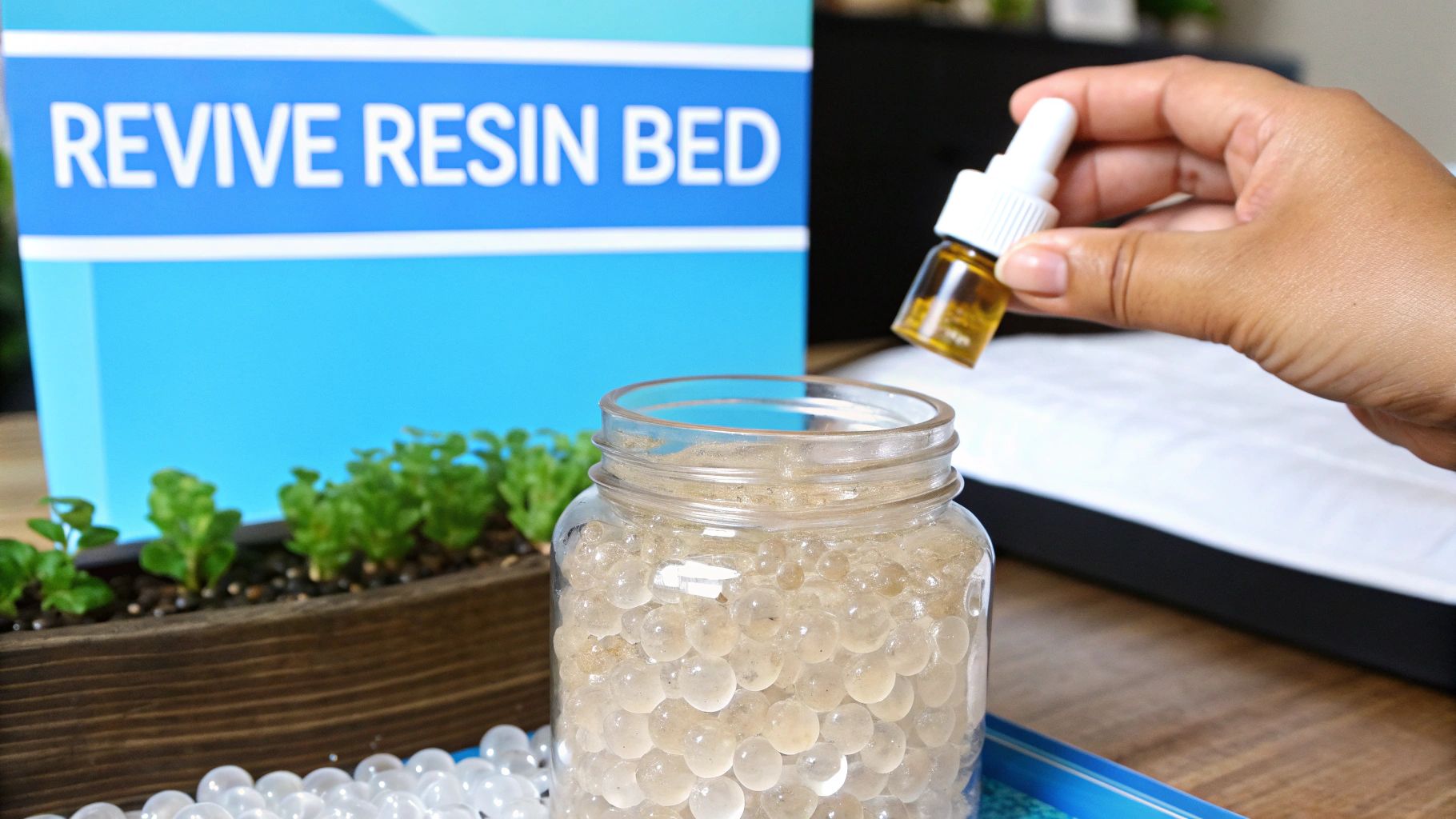
A close-up view of water softener resin beads

This is a really common issue for homes on well water, since it’s often packed with higher levels of iron that are brutal on resin. If you're noticing your laundry looks dingy, soap scum is making a comeback, or the water just doesn't feel as soft, a fouled-up resin bed is probably the culprit.

Why a Resin Tune-Up Is a Smart Move

Letting a clogged resin bed go is just asking for trouble. It's not just that your water quality drops; the entire system has to work harder to regenerate, which means you're wasting both salt and water. A quick cleaning can bring it right back to life and add years to your softener's lifespan.

Think of it like this: you wouldn't drive your car for years without an oil change and expect the engine to hold up. A resin cleaning is a cheap, easy bit of preventative maintenance that can save you from a massive replacement bill later on.

This simple step in how to maintain water softener performance really pays off. Research shows that well-maintained systems can help appliances last up to 50% longer than those running on hard water, saving you a fortune in repair costs. This is especially true in places with extremely hard water, like the U.S. Southwest, where softener ownership can be over 70% and routine care is absolutely essential. You can find more data about water softening systems on futuremarketinsights.com.

Using a Resin Cleaner Effectively

Thankfully, getting your resin bed back in shape is pretty straightforward. All you need is a good water softener resin cleaner, which is made specifically to break down iron and mineral deposits without damaging the delicate resin beads themselves.

Here’s how you do it:

  • Wait for the Right Moment: The best time to add the cleaner is when the salt in your brine tank is running low, right before you toss in a new bag. This helps the cleaner get pulled into the system properly during the next cycle.
  • Add the Cleaner: Pour the amount recommended on the bottle right into the brine well. That’s the narrow tube you see inside the main tank. If you can't get to it easily, just pouring it over the remaining salt will also work.
  • Kick Off a Manual Regeneration: As soon as you add the cleaner, start a manual regeneration cycle on your softener. This will send the cleaner-and-brine mix through the resin bed, giving it a deep clean and stripping away all that built-up gunk.

Do this just once or twice a year, and you'll keep the core of your water softening system running like new, giving you consistently soft, filtered water for a long time to come.

Fine-Tuning Your Softener's Settings for Ultimate Efficiency

Your water softener's control valve is its brain, but it's not a mind reader. So many people think the settings punched in during installation are set in stone, but that's almost never the case. A "set it and forget it" attitude is a fast track to wasting salt, water, and money.

Life changes, and your water consumption changes right along with it.

Think about a family whose kids just went off to college. All of a sudden, their daily water use can drop by 50% or more. If the softener is still regenerating based on the old, higher-demand schedule, it's literally just flushing salt and water down the drain for no good reason.

This is why getting familiar with your system's settings is a huge part of knowing how to maintain water softener efficiency.

Demand-Initiated vs Timer-Based Regeneration

Most modern softeners run on demand-initiated regeneration. This is a smart system that actually tracks how much water you use and only triggers a cleaning cycle when the resin bed is getting close to full. It’s hands-down the most efficient method because it adjusts to your life—whether you've got a house full of holiday guests or you're gone for a week on vacation.

Older models might use a simple timer, kicking off a regeneration cycle on a fixed schedule, like every Sunday night. It's dependable, sure, but it can be incredibly wasteful if your usage isn't perfectly consistent. If your system has a "metered" or demand-initiated option, switching to it is the single best tweak you can make for your filtration system.

Programming Your Water Hardness Level

Your softener can't do its job right if it doesn't know what it's up against. That means you need to program in your local water hardness level, which is measured in grains per gallon (GPG). You can usually get this number from your city water provider's website, or you can find it yourself with a simple water test kit.

Let's imagine your water hardness is 15 GPG, but your softener is still set to a default of 25 GPG. What happens? Your system will regenerate way too often because it thinks the water is much harder than it really is.

Getting the GPG setting right is fundamental. It tells the softener exactly how much filtration work the resin beads have to do before they need a rinse, making sure every regeneration cycle is truly necessary. This one small adjustment has a direct impact on your salt and water bills.

Adjusting Regeneration Frequency

Even with a smart, demand-initiated system, you often have some control over the regeneration frequency or reserve capacity. This setting basically tells the softener how low to let the "tank" get before scheduling a cleaning.

For example, setting it to regenerate when it hits 20% capacity is a good way to ensure you never get caught with hard water, even after an unusually heavy day of laundry and showers.

Pull out your user manual and see how to adjust these settings. Spending just 15 minutes to dial in your softener to your family's current habits will ensure your home's water filtration runs as efficiently as possible, protecting your plumbing and appliances without wasting a drop.

Common Questions About Water Softener Care

Even with the best routine, questions always come up. Think of this as the troubleshooting guide that turns you from a water softener owner into a water softener pro. These are the most common hiccups I see, and the answers are usually simpler than you think.

How Often Do I Really Need to Add Salt?

There's no single, perfect answer here, but a great rule of thumb is to check the salt level once a month. You're aiming to keep the brine tank at least one-third full. Letting it run completely empty is a big no-no, but you also don't want to overfill it and create those rock-hard salt bridges.

For a typical family of four, you'll probably find yourself adding a new bag of salt every month or two. But if your water is extra hard or your family uses a ton of water, you might be topping it off more frequently. Just keep an eye on it—that’s the real secret.

My Water Suddenly Feels Hard Again. What Do I Check First?

It's always a bummer when you feel that dry, scratchy skin and see spots on your glassware making a comeback. Don't call for service just yet. Before you do anything else, run through this quick checklist.

  1. Check the Brine Tank: First, is there enough salt? Just as important, is there a solid crust on top? That’s a salt bridge, and it’s stopping the salt from dissolving into the water.
  2. Find the Bypass Valve: It's easy for this valve to get bumped into the "bypass" position, especially if it's in a high-traffic area. If it is, your water is just skipping the softener completely.
  3. Look for Power: Is the unit actually on? Check if it's plugged in and if the screen is lit up. You'd be surprised how often this is the culprit.

Honestly, these three simple steps solve the problem more than 90% of the time and will save you the cost of a service call.

A sudden change in water feel is almost always a sign of a simple issue with salt, power, or the bypass valve. Checking these three things first will save you time, money, and a lot of headaches.

Does the Type of Salt I Use Really Matter?

Oh, absolutely. It matters a lot. While you can use any type of water softener salt in a pinch, they are definitely not all the same. Using the right kind is a huge part of keeping your filtration system running well for years.

  • Rock Salt: It’s the cheapest, but it’s also the dirtiest. It's full of impurities that will turn into a nasty sludge at the bottom of your tank, meaning more frequent, messy cleanouts for you.
  • Solar Salt: This is a good middle-of-the-road option. It's much cleaner than rock salt but can still leave some sediment behind over time.
  • Evaporated Salt: This is the good stuff. It's the purest salt you can get, dissolving cleanly with almost no residue. It's the best choice, hands down, for keeping modern, high-efficiency softeners happy.

If you're interested in a wider view of home system care, you can often find helpful parallels. For further insights and tips on home maintenance, check out resources that cover the whole home.

Is Cleaning the Resin Bed Necessary if My Water Is Clear?

Yes, and think of it as cheap insurance for your softener. Even if you don't have iron issues, the chlorine and other tiny sediments in city water slowly build up on the resin beads over time. This makes them less effective. You probably won't even notice the performance drop until it's pretty bad. A quick cleaning with a dedicated resin cleaner once a year keeps those beads working at full capacity and helps you squeeze every last bit of life out of your home filtration system.


At Water Filter Advisor, our goal is to empower you with the knowledge to manage your home's water quality effectively. From choosing the right system to keeping it in peak condition, we provide the expert guidance you need for safer, better-tasting water. Discover more at https://www.waterfilteradvisor.com.