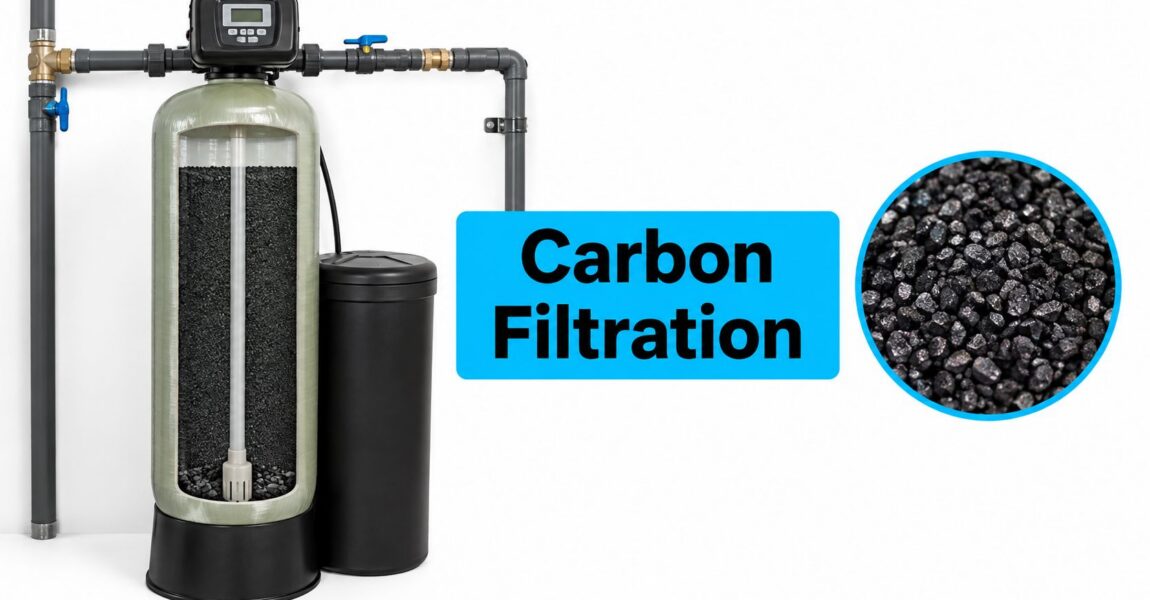
Whole House Water Filter Carbon: How It Works
You step into the shower, turn on the hot water, and catch the familiar swimming-pool smell before the room fills with steam. The same disinfectant note may linger on freshly washed laundry, while winter skin feels drier than expected. At the kitchen tap, a pitcher filter might improve drinking water, but it can't change what reaches the shower, washing machine, or bath.
That's where whole-house water filter carbon enters the conversation. A point-of-use filter treats water at one faucet. A point-of-entry carbon system connects to the main supply and treats water before it branches throughout the home. The right choice depends less on the word “carbon” than on the chemistry of your water, the tank's contact time, the household flow rate, and your maintenance routine.
Why Every Faucet Tastes Like the Pool
A homeowner named Maya noticed the problem first in the morning. Her shower smelled faintly of chlorine, her towels carried the same clean-but-sharp scent after washing, and the kitchen pitcher helped only when someone remembered to fill it. The water wasn't necessarily unsafe, but the treatment plant's disinfectant was making itself known throughout the house.
A whole-house carbon system addresses that kind of household-wide experience at the main entry point. Instead of polishing only drinking water, a point-of-entry tank sends the home's incoming supply through carbon before it reaches every fixture. That can improve taste and odor across showers, sinks, laundry, and appliances, provided the media, tank size, and flow rate match the water.
The distinction matters:
- Point-of-use filtration treats water at a single location, such as an under-sink faucet.
- Point-of-entry filtration treats the incoming supply for the entire building.
- A carbon tank is primarily an adsorption system, not a universal purifier.
The U.S. Environmental Protection Agency's guidance on granular activated carbon explains that activated carbon is particularly effective against less water-soluble organic compounds, including many volatile organic chemicals, pesticides, and herbicides. It's also commonly used to reduce the taste and odor associated with chlorine at every fixture.
The trade-off is just as important. Carbon alone isn't an effective barrier for most dissolved inorganic contaminants, including salts and many metals such as lead, and it doesn't reliably remove microorganisms. A whole-house carbon filter can be an excellent tool for chlorine, odors, and selected organic compounds, but it shouldn't be treated as complete purification for microbiologically unsafe water or as a universal well-water treatment.
How Activated Carbon Actually Cleans Water
Activated carbon doesn't work like a sieve that catches every unwanted particle. Its main mechanism is adsorption, a surface process in which molecules attach to the carbon's internal pore surfaces.
A useful analogy is a sponge covered with microscopic magnets. The sponge doesn't block water. As water passes through, some compounds are attracted to and held by the carbon's porous structure. A sediment filter behaves differently, physically straining particles that are larger than its openings.
Core principle: Organic compounds attach to carbon pores. They aren't mechanically strained out.
The EPA's explanation of activated carbon treatment identifies granular activated carbon as useful for reducing volatile organic compounds, synthetic organic compounds, natural organic matter, and disinfection-byproduct precursors. The same source explains that taste, odor, and color compounds attach to granular or powdered carbon rather than being screened out like sand.
A typical whole-house carbon tank has a straightforward water path:
- Inlet: The home's main supply enters the treatment assembly.
- Media tank: Water travels through a bed of activated carbon.
- Control valve: A backwash or service valve directs flow and handles maintenance functions where the system includes them.
- Drain line: Backwash water leaves through a connected drain.
- Outlet: Treated water returns to the home's plumbing branches.
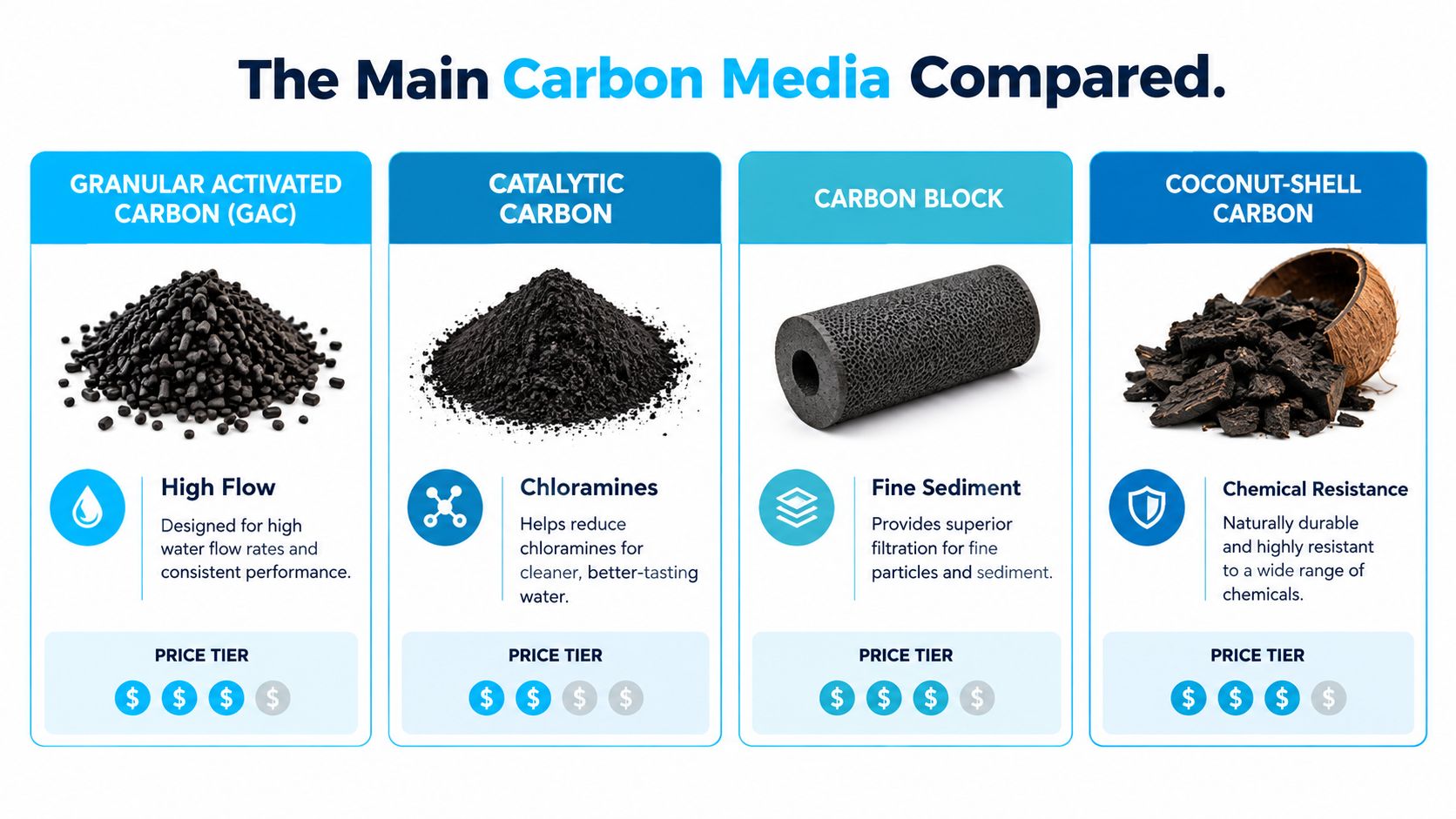
The media inside that tank changes the result. Granular activated carbon, often called GAC, leaves space between particles and can support useful flow. Catalytic carbon is designed for reactions that ordinary GAC may not handle as effectively, particularly with chloramine. Carbon blocks compress carbon into a solid cartridge and can provide finer particulate control, but they may create more resistance when the household demands high flow. Coconut-shell carbon describes a carbon source and structure, not a guarantee that every contaminant claim applies.
The tank only performs as well as its operating conditions allow. Water must remain in contact with the media long enough for target compounds to attach, and an exhausted bed has fewer available sites for adsorption. That's why the label on a tank is only the starting point. Media type, bed depth, flow, and replacement planning determine the actual treatment.
The Main Carbon Media Compared
Four labels appear often in whole-house discussions, but they describe different design choices rather than interchangeable products.
| Media | Strongest fit | Flow behavior | Important limitation |
|---|---|---|---|
| GAC | Chlorine, taste, odor, and many organic compounds | Generally flow-friendly in a properly sized tank | May not handle chloramine like catalytic carbon |
| Catalytic carbon | Chloramine, chlorine, and selected organic compounds | Needs adequate contact time | A generic carbon cartridge shouldn't be assumed equivalent |
| Carbon block | Cartridge-based polishing and fine particulate control | Can restrict flow if undersized or loaded with debris | Requires cartridge replacement and careful flow matching |
| Coconut-shell carbon | A carbon source commonly used for organic adsorption | Depends on the product and bed design | The shell source alone doesn't prove a contaminant claim |
The University of Georgia guidance on activated carbon explains that activated carbon can destroy both chlorine and chloramine through catalytic reduction, producing chloride. Chloramine often needs specialized catalytic carbon and adequate contact time, so a standard carbon cartridge shouldn't be treated as automatically equivalent.
Some systems combine carbon with other media, such as KDF-type redox media. That can broaden a system's intended role, but it doesn't turn carbon into a universal solution for salts, every metal, or microorganisms. Match each media claim to a tested contaminant claim rather than assuming that a longer ingredient list guarantees complete treatment.
For a broader comparison of treatment mechanisms, homeowners can also review comparing ceramic and carbon filters from Water Filtration Systems. The useful question isn't which material wins in the abstract. It's which mechanism suits the water problem and the home's demand pattern.
Contact Time, Flow Rate, and Bed Depth
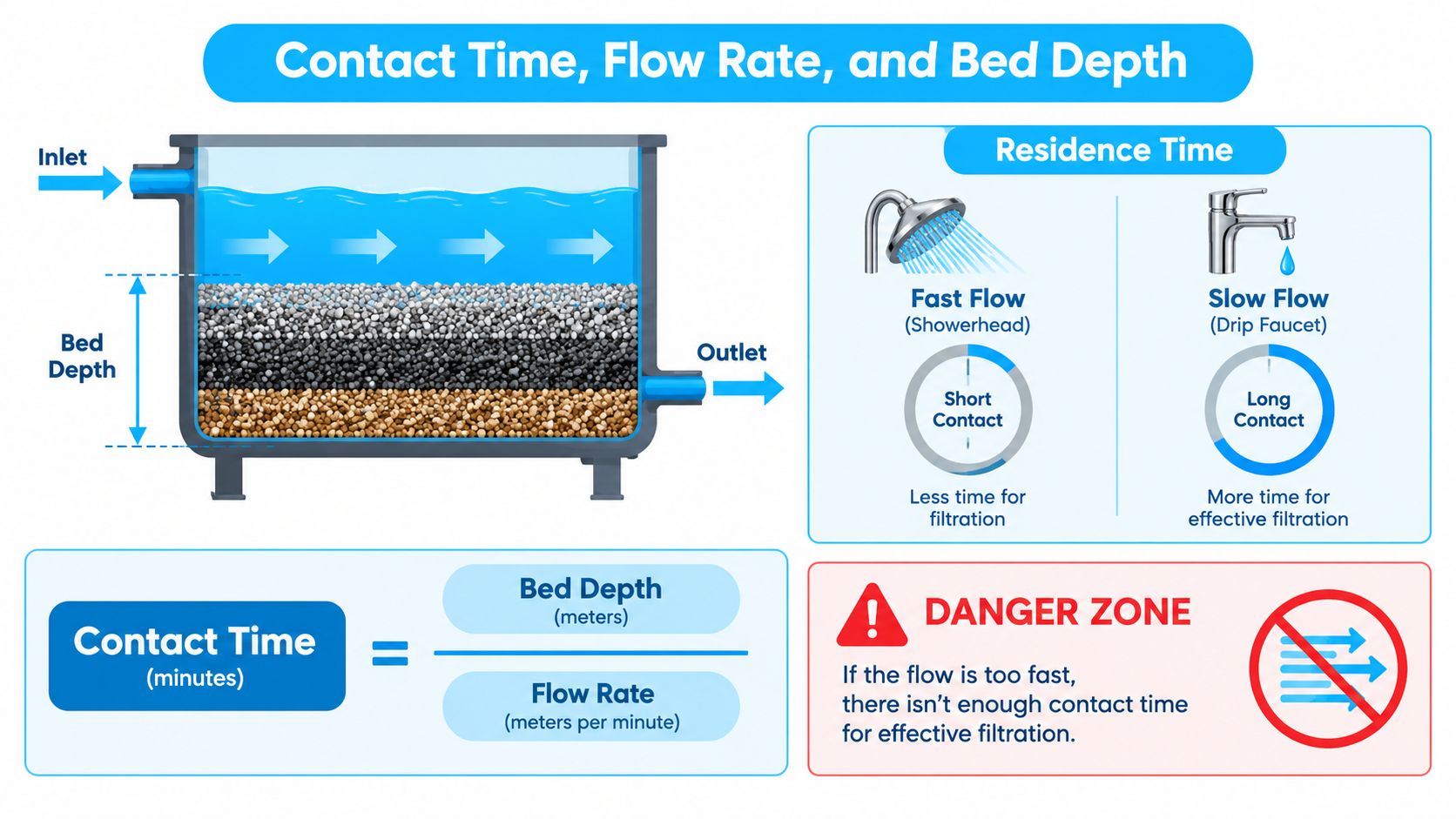
Think about steeping coffee in a press. If water rushes through the grounds and leaves immediately, extraction changes. If it remains in contact with the grounds, more opportunity exists for compounds to move into the water. Carbon filtration follows a similar principle, although the chemistry involves adsorption rather than coffee extraction.
Four variables control the result:
- Contact time: Water needs enough residence time inside the carbon bed.
- Flow rate: Faster flow gives contaminants less opportunity to attach.
- Bed depth: A deeper bed creates a longer treatment path and more media capacity.
- Influent concentration: Heavier contaminant loading uses adsorption capacity faster.
The EPA's PFAS treatment fact sheet identifies PFAS type, carbon-bed depth, flow rate, temperature, and competing organic matter as factors that affect removal. The same principle applies broadly: a tank can't deliver the intended result if the household sends water through it faster than the design allows.
A small tank can look impressive on a product page and still underperform when several fixtures run together.
A common mistake is sizing only for average use. A quiet afternoon at one bathroom faucet doesn't represent a morning when a shower, washing machine, and kitchen tap draw water at the same time. During those peaks, a smaller bed may experience a shorter effective contact time, while high velocity can also increase pressure loss.
A larger bed isn't automatically better if the system's design causes excessive pressure loss or if the media isn't suited to the target contaminant. The useful comparison is rated service flow against real peak demand, not tank size in isolation. Ask for the flow condition associated with the contaminant claim, especially when PFAS, chloramine, or another health-related concern drives the purchase.
Sizing the System for Your Home
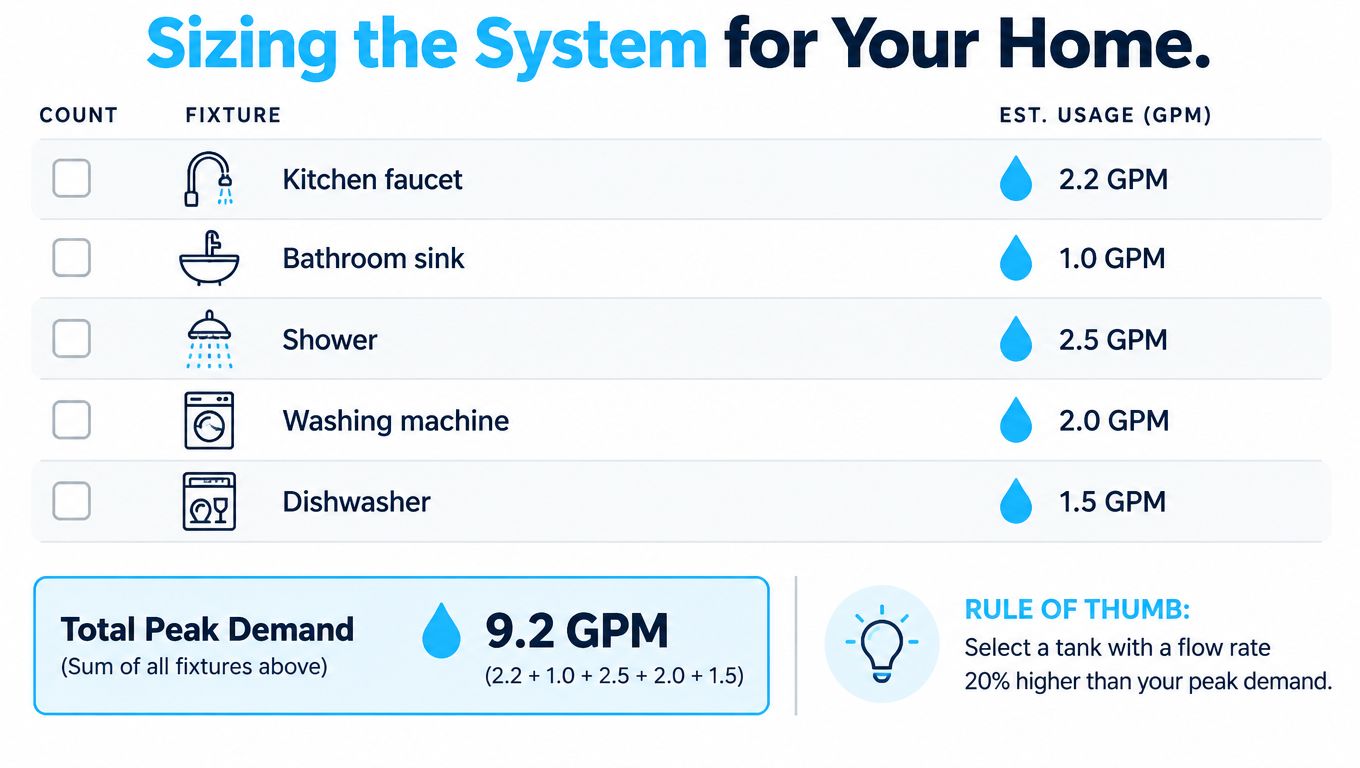
Start with the home's busiest realistic water-use period. Count the fixtures that may operate together, then compare that demand with the carbon tank's rated service flow. Don't select a system from bedroom count alone. Two homes with the same number of occupants can have very different fixture layouts and usage habits.
A practical checklist includes:
- Count fixtures: Include showers, kitchen faucets, bathroom sinks, dishwashers, and washing machines.
- Check the main line: Confirm whether the home's plumbing uses 3/4-inch or 1-inch connections.
- Compare service ratings: Look for a rated flow that can support peak use without forcing water through the bed too quickly.
- Plan for pressure: A system that causes a noticeable pressure drop during a shower is poorly matched, clogged, or undersized.
- Leave room for maintenance: Tank access, valve operation, drain plumbing, and media service all need usable space.
Port size affects how easily water moves through the assembly. A 1-inch connection can be a better match for a higher-demand home than a 3/4-inch connection, but a larger port doesn't compensate for a shallow carbon bed or unsuitable media.
Sizing rule: Protect treatment performance first, then confirm that the system can deliver comfortable flow at the fixtures.
If you're comparing tank specifications, ask the seller to identify both the maximum flow and the service flow tied to the relevant contaminant claim. Those values may differ. A system can pass water at a high rate while providing less contact time than the treatment claim requires.

Reading Certifications Without Getting Misled
Certification gives a marketing claim a defined target. Without it, “carbon filtration” may describe anything from a small taste-and-odor cartridge to a tank tested for a specific health contaminant under specified conditions.
| Standard | What it covers | Useful for | Limits |
|---|---|---|---|
| NSF/ANSI 42 | Aesthetic effects such as free-chlorine taste and odor reduction | Evaluating chlorine-related taste and odor claims | It doesn't automatically certify lead, PFAS, microorganisms, or other health contaminants |
| NSF/ANSI 53 | Health-related contaminant reduction claims when the product is certified for the specific claim | Reviewing targeted claims such as lead or PFAS reduction | Certification applies to the listed contaminant and tested conditions, not to carbon in general |
The described NSF/ANSI 42 chlorine-reduction test collects water samples after each 10-unit volume has passed through the filter. Free-chlorine analysis must occur within one minute, and the system must reduce free available chlorine by at least 50% throughout the test. That's a defined test, not a vague promise that water “tastes better.”
PFAS certification has also evolved. The EPA issued a health advisory of 70 parts per trillion for the combined concentration of PFOA and PFOS in 2016, as described in the EPA's PFAS treatment and drinking-water materials. NSF developed Protocol P473, and a task group began incorporating its test methods into NSF/ANSI Standard 53 in 2017. Updates released in 2022 addressed additional PFAS compounds and reduced the combined PFAS benchmark for the relevant certification claim from 70 ppt to 20 ppt, while EPA issued its first national legally enforceable U.S. drinking-water standard for PFAS in April 2024.
That history matters when you read older labels. A certification may reflect an earlier benchmark, and a product carrying a general carbon claim may not carry a specific PFAS claim at all. Check the exact contaminant, standard, test conditions, and current certification listing.
Maintenance Schedules That Keep Carbon Working
Carbon treatment doesn't end when the tank is installed. The media gradually uses its adsorption capacity, sediment can restrict flow, and neglected equipment can become a place where germs grow. Maintenance is part of the treatment design, not a chore added after the purchase.
The CDC's guidance on choosing and maintaining home water filters advises changing filters according to the manufacturer's schedule and maintaining the equipment to prevent germs from growing in or around the filter. It also recommends wearing gloves during filter changes and washing hands afterward.
Match the routine to the equipment
A tank system with a control valve may require scheduled backwashing. Backwashing reverses or redirects water through the media to remove accumulated particles and restore the bed's hydraulic condition. Follow the valve and media manufacturer's schedule, because the correct interval depends on the media, source water, and system design.
A cartridge system needs a different routine. Replace the sediment cartridge when it loads up, replace carbon cartridges according to the manufacturer's capacity guidance, and flush the new cartridge until fines no longer appear. A pressure gauge can help reveal restriction, but pressure alone doesn't prove that the carbon still removes a target contaminant.
Full media replacement also needs advance planning. A carbon bed may continue passing water after its adsorption capacity has declined, so a returning chlorine taste or odor can be a warning rather than a precise measurement of remaining capacity. For a health-related contaminant, use treated-water testing and the certified capacity assumptions instead of relying on taste.
Recognize the warning signs
- Chlorine odor returns: The bed may be exhausted, the flow may exceed the design condition, or water may be bypassing the media.
- Flow weakens: Sediment loading, fouling, a clogged cartridge, or a valve problem may be restricting the system.
- Performance varies by fixture: Bypass, channeling, or uneven flow through the bed can produce inconsistent treatment.
- The tank was left idle: Stagnant, neglected equipment deserves careful sanitation and maintenance before normal use resumes.
A useful replacement guide is Good Boy Plumbing's filter guide, which can help homeowners understand the practical steps involved in changing whole-house cartridges. Keep the manufacturer's instructions beside the system, and record installation and replacement dates where everyone responsible for the home can find them.
Build treatment in stages
Carbon often works best as one part of a planned treatment train:
- Sediment pre-filter: Captures sand, rust, and other particles before they load the carbon bed.
- Carbon tank: Targets chlorine, taste, odor, and selected organic compounds.
- Water softener or conditioner: Addresses hardness, which carbon doesn't reliably remove.
- UV or reverse osmosis stage: Handles treatment goals that carbon alone can't meet, depending on the water test and system certification.
A household with municipal water might use sediment protection before a carbon tank, then a point-of-use reverse-osmosis system at the kitchen tap for a targeted drinking-water concern. A well-water home may need a different sequence, because bacteria, metals, salts, or hardness can require specialized treatment.
Carbon isn't a reliable barrier for salts, many dissolved metals, or microorganisms. It rarely stands alone as a complete whole-house answer for microbiologically unsafe water or complex well chemistry.
Before choosing stages, test the source water and identify whether the concern is aesthetic, chemical, physical, or microbiological. The Water Filter Advisor advice library offers additional guidance on water testing, filtration media, replacement planning, and system comparisons.
The Carbon Trap Most Guides Miss
Removing chlorine can make water smell and taste better, but maximum disinfectant removal isn't automatically the safest whole-house objective. A carbon system can reduce chlorine or chloramine throughout the home's plumbing, including the residual that helps limit microbial growth as treated water travels through building pipes.
The University of Georgia source cited earlier explains that activated carbon can destroy chlorine and chloramine through catalytic reduction, producing chloride. That chemistry creates a household trade-off: the same treatment that improves shower water may substantially reduce disinfectant residual throughout the building, while an under-maintained filter can become a biological niche.
This concern deserves extra attention in chloraminated systems. Chloramine often needs catalytic carbon and adequate contact time, so installing a generic cartridge and assuming complete dechlorination or complete contaminant protection can lead to false confidence. The household's source, plumbing condition, temperature, residence time, and maintenance discipline all belong in the decision.
A safer decision sequence
Use this order before buying:
- Test the source water first. Identify chlorine, chloramine, metals, PFAS, hardness, sediment, and microorganisms where relevant.
- Confirm the disinfectant. Ask the utility whether it uses chlorine or chloramine, and don't treat the two as interchangeable.
- Choose media for the chemistry. Ordinary GAC, catalytic carbon, carbon block, and combination media have different roles.
- Size for peak flow. Preserve contact time when showers, appliances, and faucets operate together.
- Check the certification. Look for NSF/ANSI 42 for aesthetic chlorine claims and targeted NSF/ANSI 53 claims for certified health contaminants.
- Plan maintenance before installation. Decide who will backwash, replace, flush, sanitize, and document the system.
- Stage treatment when needed. Use sediment filtration, softening, UV, reverse osmosis, or point-of-use treatment for problems carbon doesn't reliably solve.
- Retest treated water. Testing confirms whether the selected system works under the home's actual conditions.
For some households, a point-of-use carbon filter at the kitchen tap may be the better compromise. It can improve drinking-water taste while leaving disinfectant residual in the rest of the plumbing. For others, whole-house treatment makes practical sense because chlorine odor affects showers, laundry, and every fixture. Neither choice is universally correct.
A whole-house carbon filter is a powerful tool for taste, odor, chlorine, and many organic contaminants, but its performance depends on adsorption capacity, contact time, flow, bed depth, contaminant concentration, and maintenance. Treat it as a designed water-treatment system, not as a magic word printed on a tank.
Water Filter Advisor helps households compare whole-house carbon systems, filtration media, certifications, replacement planning, and water-testing options. Visit Water Filter Advisor to evaluate your water concerns and build a maintenance plan before choosing a carbon filter.
