
Best Whole House Filter for Iron That Stops Stains
You turn on the shower and see orange streaks sliding toward the drain. The bathroom sink has a rusty ring, white laundry comes out with tan marks, and the water smells faintly metallic. A cartridge filter under the kitchen sink may make one glass look better, but it won't protect the shower, washing machine, water heater, or every fixture in the house.
The best whole house filter for iron isn't chosen by a flashy removal number or a popular brand. It starts with the form of iron in your well water, then accounts for pH, manganese, hydrogen sulfide, iron bacteria, household flow, and the filter's ability to backwash. Iron is usually an aesthetic and plumbing problem rather than a toxic contaminant, but it can still make the entire home harder to use and maintain.
| Water profile | Best-fit system type | Main trade-off |
|---|---|---|
| Low ferrous iron, suitable pH | Catalytic or oxidizing media | Lower maintenance, but chemistry must cooperate |
| Ferric iron with visible sediment | Sediment prefilter plus oxidizing media | Strong removal, with more attention to backwashing |
| Higher iron with sulfur odor | Air-injection oxidation or chemical oxidation | Better contaminant coverage, more equipment and flow demand |
| Organic or colloidal iron | Specialized treatment after complete testing | Standard media may struggle |
| Iron with low pH | pH correction before iron treatment | Adds equipment, but protects downstream media |
| High-flow home or large household | Larger oxidation and filtration system | Higher purchase cost, better pressure management |
Why Iron Ruins Whole House Water and What Actually Fixes It
The problem usually announces itself in the fixtures first. A clear glass of fresh well water may look harmless, then develop a rusty tint after exposure to air. A toilet bowl collects an orange shadow, the showerhead loses clean spray patterns, and laundry picks up stains that no detergent seems able to remove.
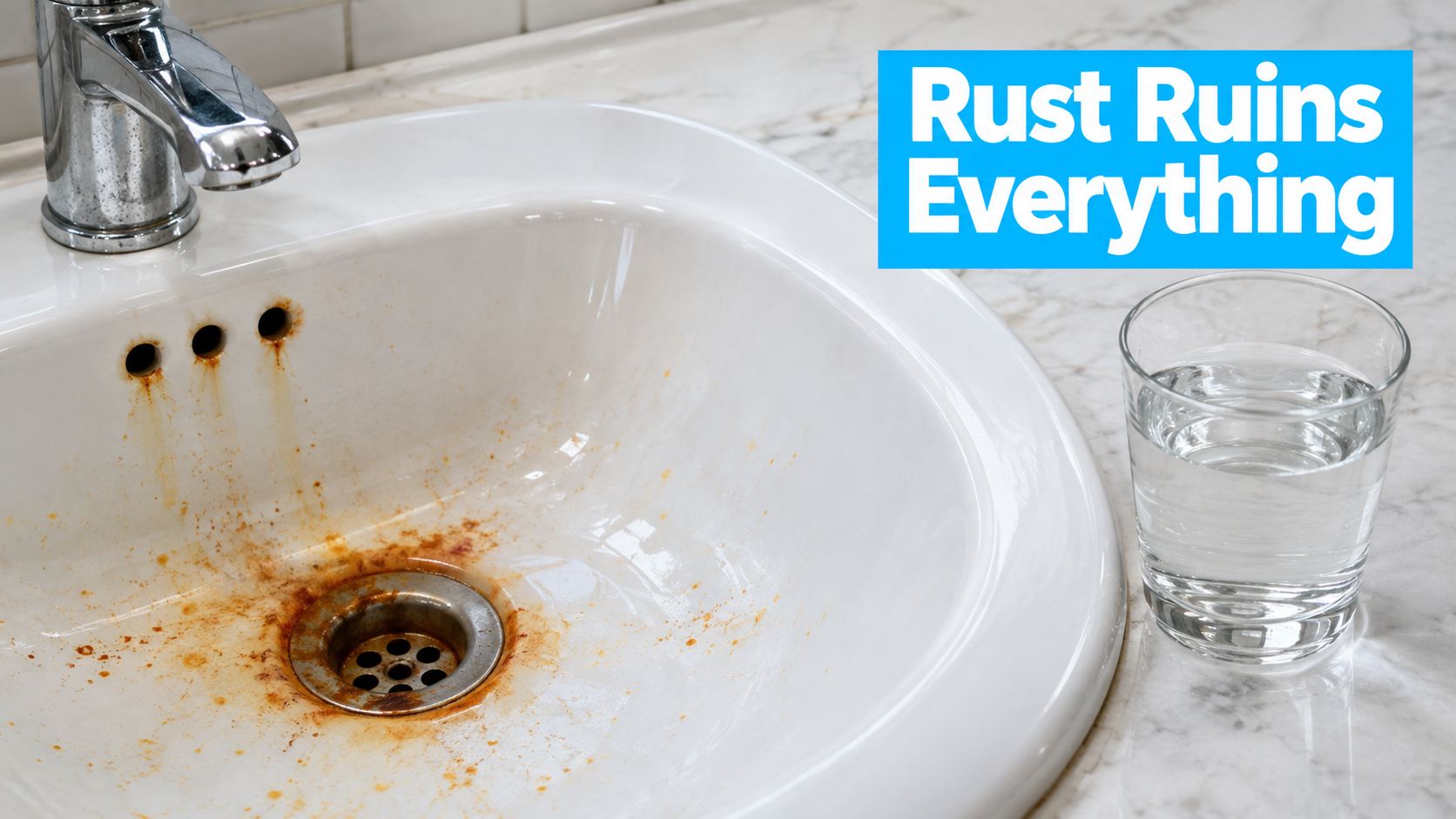
Iron is common in water. The World Health Organization reports that natural fresh waters typically contain 0.5 to 50 mg/L of iron, while Canadian reporting finds median concentrations in most sources below 1 mg/L. Health Canada uses an aesthetic objective of 0.1 mg/L, and the U.S. EPA secondary standard is 0.3 mg/L, the level at which water commonly turns reddish-brown. These are appearance, taste, odor, and plumbing thresholds, not a claim that iron at those levels is a dangerous poison. Illinois public-health guidance on iron in drinking water
Practical rule: If iron is staining fixtures, treat the water before it enters the house. Don't ask a kitchen cartridge to solve a whole-house problem.
A point-of-use filter can improve drinking water at one faucet, but it can't stop iron from reaching the shower, laundry, dishwasher, or water heater. Whole-house treatment works at the point of entry, where the system can oxidize dissolved iron and capture the resulting particles before they travel through the plumbing.
For stubborn deposits already on fixtures, cleaning still matters. A practical resource on DIY hard water stain removal can help restore affected surfaces, but cleaning is only the cosmetic step. If untreated water keeps arriving, the stains return.
The core fix is usually oxidation followed by filtration. Air, catalytic media, chlorine, or another oxidant changes dissolved ferrous iron into particles that a filter can trap. The correct choice depends on whether the iron is ferrous, ferric, organic, or colloidal, and whether other contaminants alter the treatment order.
Know Your Iron Type Before You Choose a Filter
Buying by parts per million alone is how homeowners end up with the wrong tank. Two wells can show similar iron concentrations and need completely different equipment because the iron behaves differently in the water.
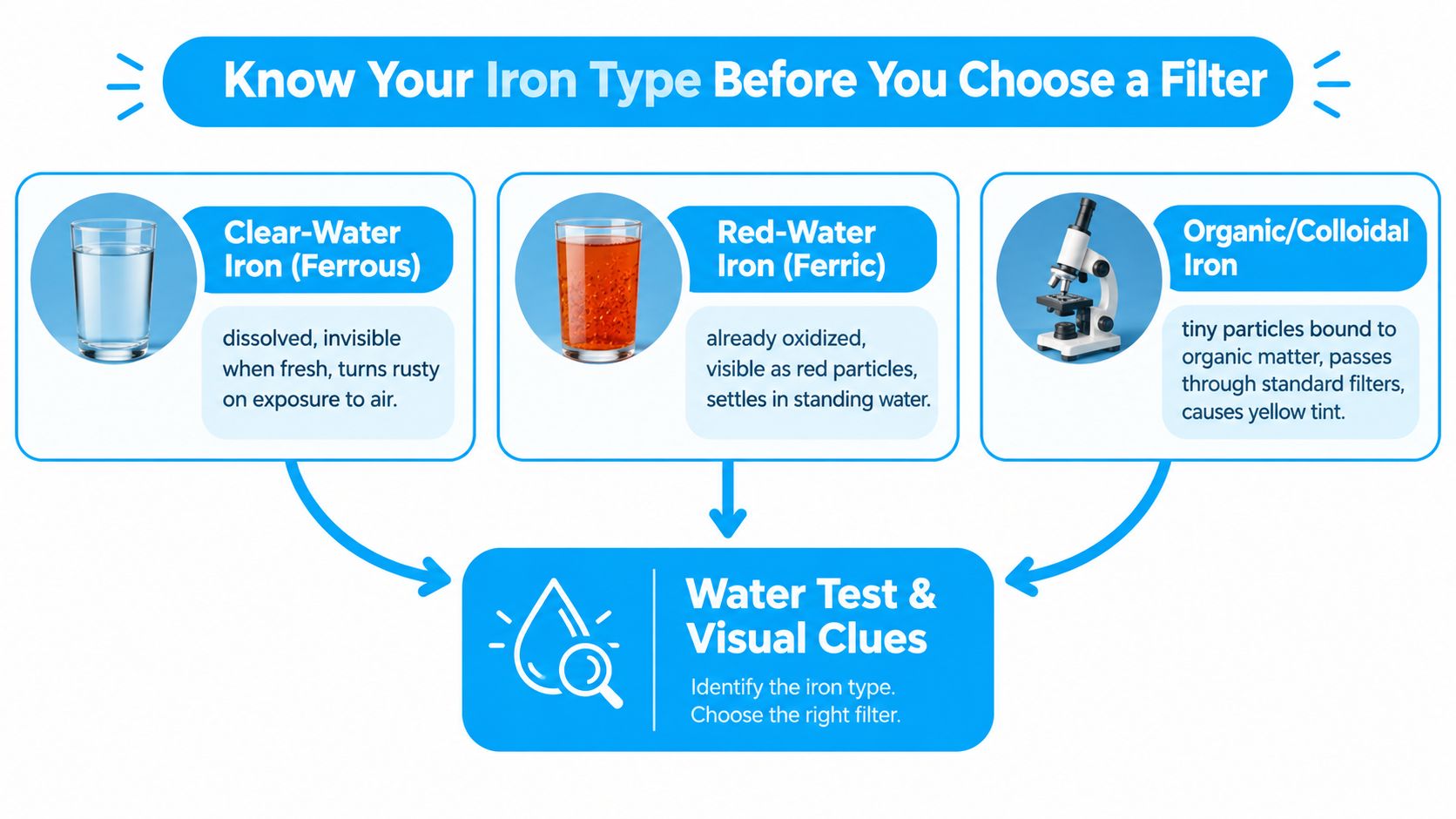
Ferrous iron stays invisible until it meets air
Ferrous, or clear-water, iron is dissolved. The sample may look clear when collected, then develop rust-colored particles after sitting or contacting air. This form often calls for oxidation inside the treatment system, followed by media that captures the newly formed iron oxide.
A clear sample doesn't mean the water is clean of iron. It means the iron hasn't oxidized yet. A laboratory test should measure total iron, and your sampling method should preserve the distinction between dissolved and particulate material where possible.
Ferric iron arrives as visible particles
Ferric, or red-water, iron has already oxidized. It may appear as reddish particles, settle in a container, or arrive with sediment from the well. A sediment stage can protect the main iron filter, but a basic cartridge alone is rarely a complete answer when the source keeps producing oxidized iron.
Ferric iron also creates a hydraulic problem. As particles collect, pressure falls and the filter can channel water through easier paths. That makes backwashing and tank sizing central to performance.
Organic and colloidal iron needs a different strategy
Organic or colloidal iron can bind to organic matter or remain suspended as extremely small particles. It may create a yellow tint and pass through standard iron media. If your water contains tannins or persistent color that doesn't behave like ordinary rust, don't buy a conventional iron filter and hope for the best.
Test the companions before selecting media:
- pH: Low pH can reduce oxidation performance, foul media, and change the order of treatment.
- Manganese: It often requires treatment conditions that overlap with iron but may demand different media capacity.
- Hydrogen sulfide: Rotten-egg odor points toward an oxidation requirement beyond iron alone.
- Iron bacteria: Slime, recurring odor, and rapid fouling may require a broader remediation plan rather than a filter-only purchase.
- Sediment and hardness: These affect pretreatment, valve protection, and whether a softener belongs elsewhere in the system.
Retest when the well has changed, the odor or staining pattern shifts, or the installed system stops meeting expectations. A current test is cheaper than replacing media that never matched the water chemistry.
How Whole House Iron Filter Media Really Compare
The media family determines how the system creates and captures iron particles. The control valve, tank diameter, drain line, and backwash capacity determine whether that media keeps working after installation.
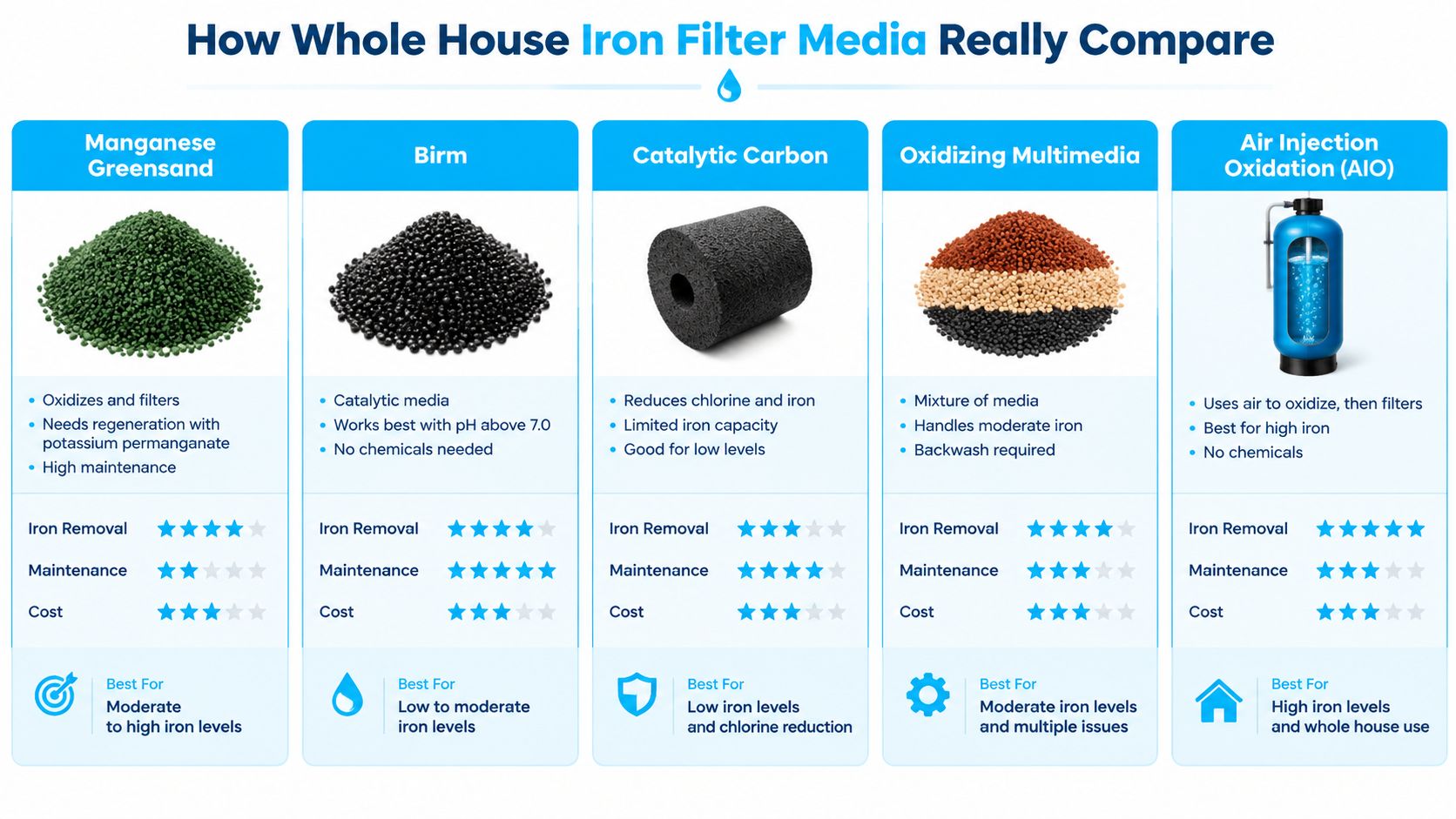
Manganese greensand
Manganese greensand oxidizes and filters iron, but traditional designs depend on regeneration with potassium permanganate. That chemical requirement adds handling, dosing, storage, and monitoring. Greensand can be effective for the right water, but I wouldn't call it the easiest choice for a homeowner who wants a low-touch system.
It makes sense when the installer understands the regeneration cycle and the household accepts the maintenance. It becomes a poor fit when chemical replenishment is likely to be forgotten.
Manganese greensand is a proven workhorse, not a maintenance-free shortcut.
Birm
Birm is catalytic media. It uses dissolved oxygen and works best when the water chemistry supports the reaction, including pH above 7.0 according to the supplied comparison guidance. It doesn't require the same chemical regeneration approach as traditional greensand, which simplifies ownership.
Birm is sensitive to conditions that interfere with its catalytic action. Low pH, insufficient oxygen, and certain water constituents can turn an attractive chemical-free design into an underperforming filter.
Catalytic carbon
Catalytic carbon is strongest when iron is light and chlorine, odor, or taste also matter. It can reduce chlorine and help with iron, but its iron capacity is limited compared with dedicated oxidation systems. I consider it a polishing or low-load option, not the default answer for a heavily staining well.
It can work well as part of a broader design, especially where the main goal includes taste and odor improvement. It shouldn't carry an iron load beyond its practical capacity.
Oxidizing multimedia
Oxidizing multimedia blends media types to handle moderate iron and related sediment. The design can offer broader performance than a single media, but it still needs correct flow and regular backwashing. A layered bed only works when water distributes evenly and the cleaning cycle lifts the bed effectively.
Air-injection oxidation
Air-injection oxidation, often called AIO, introduces air to oxidize dissolved iron before filtration. It avoids routine chemical addition and is often the most practical category for higher iron or combined iron and sulfur problems, provided the well pump and drain can support the required cycle.
The trade-off is equipment and hydraulics. Air-injection systems need enough service flow, adequate backwash flow, and a tank sized for the household rather than the marketing label.
Chemical-free doesn't mean maintenance-free. You still need backwashing, valve checks, and media inspection.
A water softener or ion-exchange system belongs in a separate category. It can address hardness and may handle limited iron under suitable conditions, but iron can foul the resin, and a softener doesn't solve hydrogen sulfide, iron bacteria, or every form of iron. Use it for the problem it was designed to solve, not as a universal iron filter.
No single media type handles every water profile. The supplied technical review notes that different filtration deposits produced iron-removal efficiencies ranging from roughly 82.59% to 97.61%, yet none purified the water enough to meet all regulatory limits. The technical buyer guidance on iron filtration reinforces the point: the highest headline removal figure isn't automatically the best whole-house design.
Sizing and Flow Rate Selection That Protects Performance
A filter can have the right media and still fail because the tank is too small or the backwash is too weak. Water must pass through the bed at a controlled service rate, then expand the bed enough during backwash to release trapped iron oxides.
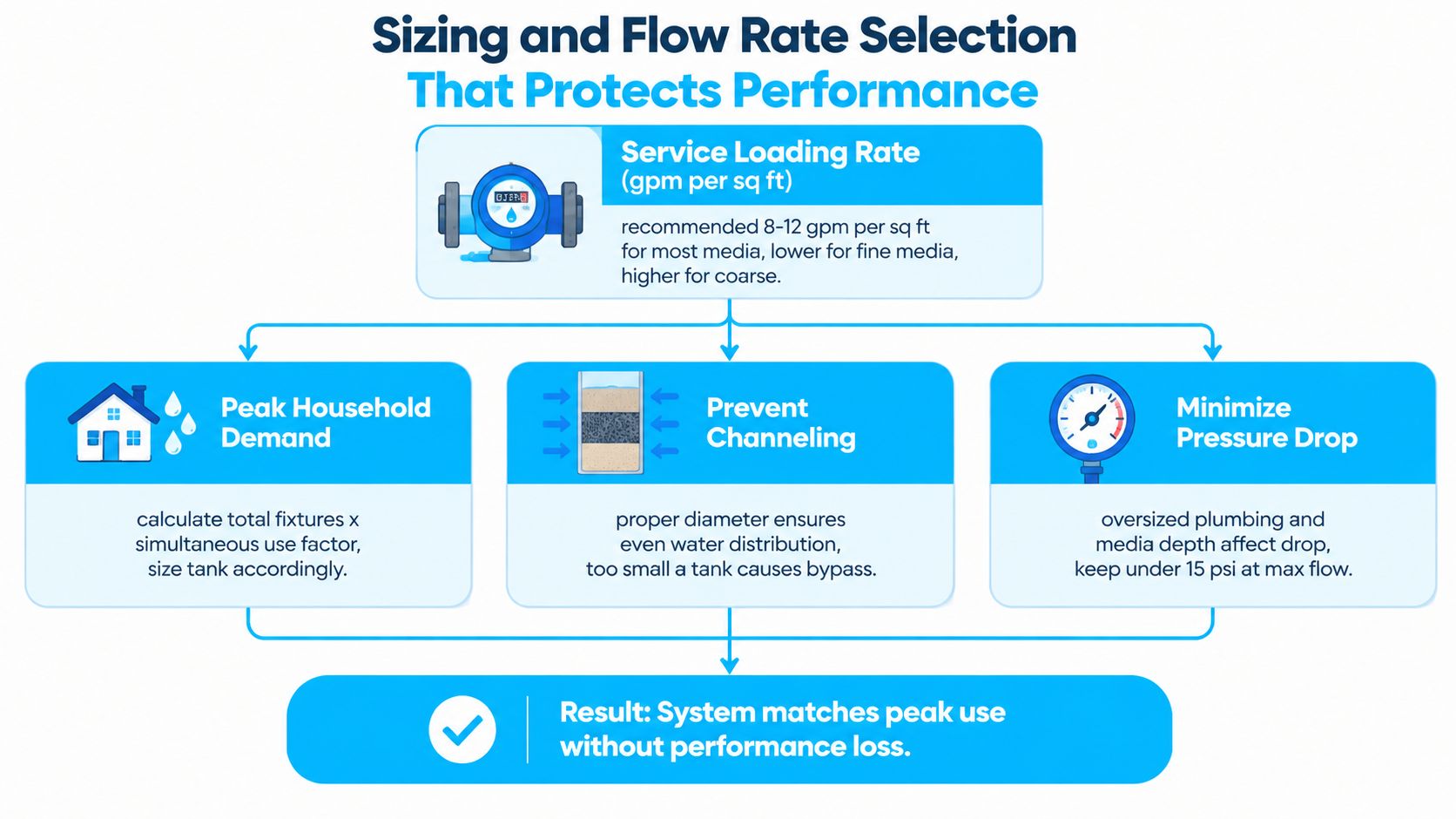
Greensand Plus documentation commonly specifies effective service loading at 2 to 5 gpm per square foot, with a minimum backwash rate of 12 gpm per square foot in the media sheet and backwashing designed to achieve about 40% bed expansion. Greensand Plus and whole-house iron filter guidance shows why those figures matter. Service flow controls contact time and pressure drop, while backwash flow determines whether the bed cleans itself.
Start with peak demand
List the fixtures that may run together. A shower, toilet refill, washing machine, and kitchen faucet can create a different demand pattern from a single-tap test. The system should deliver that peak household flow without excessive pressure loss or untreated water slipping through channels.
Then compare the demand with the well pump's production and the pressure tank's recovery behavior. A filter that requires more backwash water than the well can supply is incorrectly sized, even if its service rating looks attractive.
Backwash is not a minor setting
Iron oxides accumulate inside the bed. If the backwash rate is too low, the media won't expand enough to separate trapped material, and the bed gradually hardens or channels. Water then finds low-resistance paths, reducing contact with the media and weakening removal.
The drain also needs capacity. A system that technically backwashes but sends dirty water slowly down an inadequate drain may never complete a proper cleaning cycle.
Match tank diameter to hydraulics
Tank diameter controls bed area. Larger diameter gives water more cross-sectional area and can support higher household flow at an acceptable loading rate. A narrow tank may restrict pressure or force an aggressive loading rate, while an oversized tank can demand backwash flow the pump can't deliver.
Use a real sizing calculation, not a label such as “whole house” or “high flow.” The water filtration system sizing tips from WaterJobsIntel provide useful design context for matching equipment to demand and installation conditions.
Before approving the installation, verify:
- Service flow: The rated flow covers simultaneous household use.
- Backwash flow: The well and pump can meet the media's cleaning requirement.
- Drain capacity: The drain can handle the backwash discharge without flooding.
- Pressure drop: The filter won't turn a healthy pressure system into weak showers.
- Bypass access: A bypass valve allows service without shutting down the entire home.
- Pre-filtration: Sediment protection is installed when ferric iron or grit threatens the control valve.
A correctly sized system protects removal efficiency and household comfort. An undersized system creates the familiar cycle of clean water after installation, rusty fixtures later, and a homeowner blaming the media for a hydraulic mistake.
Best Whole House Filter for Iron by Real World Use Case
Different homes need different winners. The right system for a modest well with clear-water iron may be the wrong system for a large home with manganese, sulfur odor, and a demanding backwash cycle.
| Water Profile | Best Fit System Type | Why It Works Here |
|---|---|---|
| Low ferrous iron with suitable pH | Catalytic media or light-duty oxidizing filter | Oxidizes dissolved iron without adding unnecessary treatment stages |
| Moderate ferric iron with visible sediment | Sediment prefilter plus oxidizing multimedia | Captures particles before they overload the main bed |
| Higher iron with manganese and sulfur odor | Air-injection oxidation or chemical oxidation followed by filtration | Addresses multiple oxidizable contaminants in one coordinated design |
| Organic iron with tannins or yellow color | Specialized organic and iron treatment selected after testing | Standard media may not capture colloidal or organically bound iron |
| High-flow home with several bathrooms | Larger oxidation and filtration tanks | Protects service flow and reduces pressure loss during simultaneous use |
Low ferrous iron on city-like pH
If the sample is clear, the staining is light, and pH supports oxidation, a catalytic or oxidizing media system is the sensible starting point. Don't pay for chemical injection or a large multi-stage installation unless the test shows a reason.
Moderate ferric iron with sediment
Visible particles need physical protection. Add sediment handling before the main media, then choose a backwashing iron filter sized for the household. A cartridge may be useful as a protective prefilter, but it shouldn't become the primary treatment for a continuous iron source.
High iron with manganese and sulfur
Simple softeners and small cartridge systems disappoint. Extension guidance identifies oxidizing filters as a common point-of-entry option for treating the home's entire supply for iron, manganese, and hydrogen sulfide, especially when dissolved iron exceeds about 0.30 mg/L (0.30 ppm). University of Georgia extension guidance on oxidizing filters
Air injection is my first chemical-free category to investigate. Chemical oxidation and carbon filtration may make more sense when odor, bacteria concerns, or difficult sulfur conditions require broader control.
Organic iron and tannins
Yellow water, persistent color, and a poor response to ordinary oxidation point toward organic or colloidal iron. Get a more complete analysis before buying. This is not the place for a generic “up to” claim on a product page.
The best system solves the whole water profile, not just the iron line on the lab report.
High-flow homes
Large households need a larger hydraulic design, not a bigger media claim. Check peak demand, pump output, tank diameter, backwash supply, and valve capacity together. A system that removes iron beautifully at a low flow may become a pressure problem when several fixtures operate at once.
Maintenance Media Life and True Cost of Ownership
The purchase price is only one line in the ownership ledger. A system also consumes backwash water, may require salt or oxidant, can need cartridge replacement, and can create pressure-related strain when the tank or plumbing is too restrictive.
Manganese greensand carries the clearest recurring chemical burden because it needs potassium permanganate regeneration. A softener adds salt handling and regeneration. Catalytic and air-injection systems avoid those routine chemical inputs, but they still require reliable backwash cycles, valve checks, and eventual media service.
Read the influent limits carefully
Pentair's WaterTrust Pro Series lists a maximum influent iron concentration of 5.0 ppm. Other whole-house systems advertise design ranges up to 7 ppm iron, 1 ppm manganese, and 8 ppm hydrogen sulfide. Pentair's WaterTrust Pro Series manual shows how manufacturers define capacity in practical terms.
Those limits aren't interchangeable. A system rated for 5 ppm shouldn't be treated as a safe choice for a well testing above that level, and a broader advertised range still depends on pH, flow, temperature, oxidant conditions, and backwash performance.
Build a maintenance routine
- Check the control valve: Confirm scheduled backwash occurs and the valve completes its cycle.
- Inspect the drain discharge: Dirty water should leave freely, without backup or overflow.
- Watch pressure: A rising pressure difference can indicate fouling or inadequate cleaning.
- Replace protective cartridges: Sediment cartridges can clog before the main media does.
- Review the water test: Test before and after treatment when performance changes.
- Plan media service: Media life depends on iron load, companion contaminants, flow, and cleaning, so don't accept a universal replacement promise.
A chemical-free system may cost more initially but reduce day-to-day handling. A lower-priced greensand or softener design may look attractive until chemicals, salt, and missed regeneration cycles become part of the household routine.
For long-term planning, compare the total maintenance burden over the period you expect to own the home. Include media, cartridges, chemicals, salt, water used for backwash, service calls, and any pressure-system changes. The cheapest tank at purchase isn't necessarily the cheapest filter to live with.
Final Recommendation and How to Buy With Confidence
My buying path is straightforward.
First, test for total and dissolved iron, pH, manganese, hydrogen sulfide, sediment, hardness, and signs of iron bacteria or organic color. Next, identify the iron form. Then size the tank and valve around peak household flow and the well's backwash capability.
For a modest low-iron problem with supportive chemistry, choose catalytic or light-duty oxidizing media. For moderate ferric iron, add sediment protection and use a properly backwashed oxidizing filter. For higher iron combined with manganese or sulfur, look first at air-injection oxidation, then consider chemical oxidation when the water profile demands it.
The product class matters more than the brand name. One manufacturer benchmark reports up to 3.0 ppm iron reduced to 0.01 ppm with service flow up to 15 GPM in a 20-inch by 4.5-inch format, while another unit in the same product class claims up to 7 ppm iron at 12 to 20 GPM. The iSpring whole-house iron system specifications illustrate the trade-off. Capacity, tank size, media depth, and flow must be read together.
Before installation, verify the influent limits, media type, backwash requirement, drain connection, warranty terms, and any independent certification relevant to the claim. After startup, complete the initial backwash, flush the plumbing, and test water at more than one tap.
For additional consumer-focused guidance on treatment decisions and maintenance, review Water Filter Advisor's water filtration advice.
Water Filter Advisor helps homeowners compare whole-house filters, iron-treatment methods, replacement media, certifications, and maintenance requirements without reducing every well to the same product recommendation. Visit Water Filter Advisor with your water test results and use its practical buying guides to choose a system that matches your iron chemistry, flow needs, and maintenance tolerance.
