Is Well Water Safe to Drink? A Homeowner’s Guide to Flawless Filtration

So, is your well water safe to drink? Here’s the fun-sized answer: it’s entirely up to you. Unlike city water, which is babysat by public authorities, your private well is the wild west of water. You're the sheriff, the mayor, and the town doctor all rolled into one.

This means you could be sipping on a cocktail of hidden contaminants and have no idea. But don't panic! This is where the magic of home water filtration comes in.

The Unfiltered Truth About Your Well Water

Relying on an untested well is like getting a mystery box delivered every day—it might be full of treasure, or it might be full of… well, things you don’t want in your water. This unregulated reality makes you the official water manager for your home.

Being proactive about testing and choosing the right filtration system isn't just a smart move—it’s the secret to unlocking pure, delicious water and total peace of mind.

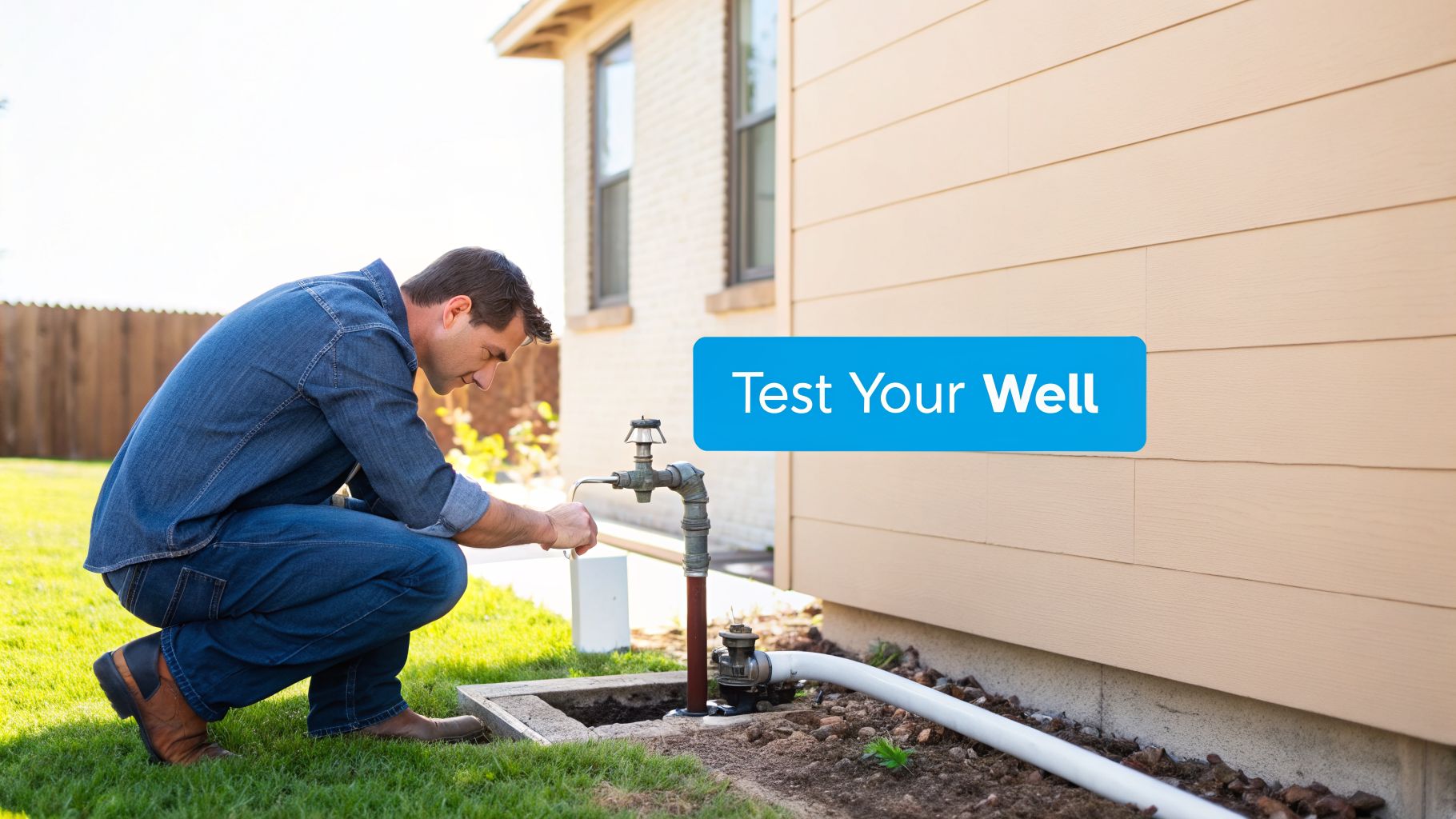
A man in denim clothes crouches to test a water well faucet near a house.

You Are Your Own Water Company

When a city-dweller opens their tap, that water has already passed more tests than a medical student. But when you turn on your well-fed faucet, you’re getting water straight from the ground—along with any freeloaders it picked up on its journey.

The responsibility that comes with this is massive. In the United States, nearly 17% of the population—that's about 43 million people—rely on private wells that aren't regulated by the government. In fact, research from the CDC shows that 1 in 5 private wells tested had unhealthy levels of contaminants like arsenic, nitrates, or bacteria. You can learn more by checking out the CDC’s resources on the importance of well water safety.

The biggest myth about well water is thinking "natural" automatically means "safe." It can be wonderfully pure, but it can also hide invisible party crashers that only a proper filtration system can kick out.

Municipal Water vs. Private Well Water A Quick Comparison

Looking at the differences between public water and your own private well really drives home why filtration is the superhero well owners need. Your role instantly changes from being a passive water user to the active guardian of your home's water quality.

Here’s a quick breakdown:

Aspect Municipal Water System Private Well Water
Regulation Governed by the EPA's Safe Drinking Water Act. Unregulated by federal law; regulation is up to the homeowner.
Testing Mandatory, frequent testing by the public water utility. Responsibility of the well owner; recommended annually.
Treatment Treated at a central facility to remove contaminants. Untreated unless a home filtration system is installed.
Responsibility The utility is responsible for water quality up to your home. The homeowner is 100% responsible for safety and quality.

As you can see, the buck stops with you. While municipal water users pay a utility to handle testing and treatment, well owners get to take control with the ultimate home upgrade: a tailored filtration system.

What Is Hiding in Your Well Water

The romance of drawing fresh, clean water right from your own land is undeniable. But here’s the plot twist: just because your well water looks clear doesn't mean it's pure. To really know if your well water is safe to drink, you have to know which uninvited guests might be hitching a ride from the ground to your glass.

These aren't just bits of dirt. We're talking about invisible, tasteless, and odorless threats that a good home filtration system is built to trap and eliminate.

A glass of water outdoors with multiple virus icons and a 'Hidden Contaminants' banner.

Microbial Invaders: The Fast and Furious Threat

Let's start with the fast-acting troublemakers. Microbial contaminants are living organisms that can make you sick in a hurry—sometimes just hours after you drink contaminated water. This is a huge reason why annual testing and filtration are non-negotiable for well owners.

These biological baddies usually sneak in from failing septic systems, farm runoff, or surface water seeping into a poorly sealed well.

Common microbial invaders include:

  • Bacteria: Nasty organisms like E. coli and Coliform are major red flags. Their presence often means your water has been contaminated by sewage or animal waste, bringing a risk of severe stomach cramps and other gastrointestinal nightmares.
  • Viruses: Tiny pathogens like Rotavirus and Norovirus can also get into your water supply. They're infamous for causing the stomach flu and are especially risky for kids and the elderly.
  • Protozoa: Parasites such as Giardia and Cryptosporidium are tough little organisms that can resist chlorine and cause serious digestive issues. They often wash into wells from surface water.

A UV purification system is your secret weapon against these bugs. It acts like a bouncer at the door, using powerful light to neutralize 99.99% of them without adding any chemicals to your water.

Inorganic Contaminants: The Silent Saboteurs

While microbes are a sprint, inorganic contaminants are a marathon. They build up in your body over months and years, posing serious long-term health risks without you ever tasting or smelling them. This makes a reliable filtration system your only real defense.

These chemicals and heavy metals typically leach into groundwater from natural mineral deposits or from agricultural and industrial pollution.

The most dangerous threats in well water are often the ones you can't see, taste, or smell. Heavy metals and chemicals accumulate slowly, causing chronic health issues that only appear after years of exposure.

For instance, lead in well water doesn't taste bad—it just silently accumulates, contributing to high blood pressure and increased cancer risks over decades. In the US, between 15-17% of people—that's over 43 million—get their water from private wells, which aren't covered by the EPA regulations that protect city water. As a startling example, arsenic in private US wells is linked to 500 deaths from ischemic heart disease and nearly 500 fatal cancers every single year, hitting rural communities the hardest. You can dig into the full list of these common well water intruders on the EPA's informational page about private wells.

Some of the key inorganic culprits are:

  • Arsenic: A toxic heavy metal that can seep into groundwater from natural rock formations.
  • Lead: Usually comes from old plumbing parts like pipes or the solder used to connect them.
  • Nitrates: A common problem in farming areas due to fertilizer runoff seeping into the ground.
  • Pesticides & Herbicides: Runoff from farms and even golf courses can carry these chemicals into the water table, and some studies have shown links to higher health risks for people living nearby.

A reverse osmosis system is one of the most effective ways to remove this wide range of silent saboteurs from the water you drink every day, giving you water that’s as pure as it gets.

Aesthetic Nuisances: The Annoying Intruders

Finally, you have the contaminants that are more annoying than dangerous. While they don't usually pose a direct health threat, these "aesthetic nuisances" can ruin your water's vibe and cause real damage to your plumbing and appliances.

  • Iron: The culprit behind those ugly reddish-brown stains in your sinks, tubs, and laundry. It also gives water a metallic taste, like you're drinking from a rusty tin can.
  • Manganese: Leaves behind blackish stains and can also make your water taste off.
  • Hydrogen Sulfide: This is what causes that unmistakable "rotten egg" smell that can make your water completely undrinkable.
  • Hardness Minerals: Calcium and magnesium are the minerals that cause limescale buildup, slowly strangling your pipes and water heater, killing their efficiency and shortening their lifespan.

These are exactly the kinds of problems that water softeners and specialized iron filters are designed to fix, transforming your water from a problematic pest to a pristine resource.

How to Test Your Well Water and Read the Results

Alright, you know the potential villains that can sneak into your well water. But the big question is, are they in your water? The only way to know for sure is to test it.

Testing isn't just a good idea; it's your first mission. Without a water test, buying a filter is a complete shot in the dark. With a test, you get a treasure map that leads you directly to the perfect filtration system for your home.

Finding a Lab and Choosing Your Tests

Your first move is to find a state-certified laboratory. Just search online for "[Your State] certified water testing lab" to get a list of options. Using a certified lab is key because they use proper methods to get you results you can trust.

The lab will mail you a special collection kit with very specific instructions. Follow them to the letter! This is especially critical for bacteria tests, where even a tiny mistake can contaminate the sample and give you a false positive. It usually means sterilizing your tap, letting the water run for a bit, and getting the sample back to the lab quickly.

So, what should you even test for?

  • Annual Essentials: At a bare minimum, test your well once a year for coliform bacteria, nitrates, and pH levels. These give you a quick snapshot of the most common health risks and whether your water is corrosive.
  • Local Concerns: Play detective and test for problems common in your area. If you're near farms, it's smart to test for pesticides. In regions with specific rock formations, checking for arsenic and radon is a must. Your local health department can usually tell you what to look out for.

To get a solid handle on what you're testing, it helps to understand the essential water quality testing methods that labs use for different chemical and microbial threats. Knowing the basics helps you pick the right tests for your well.

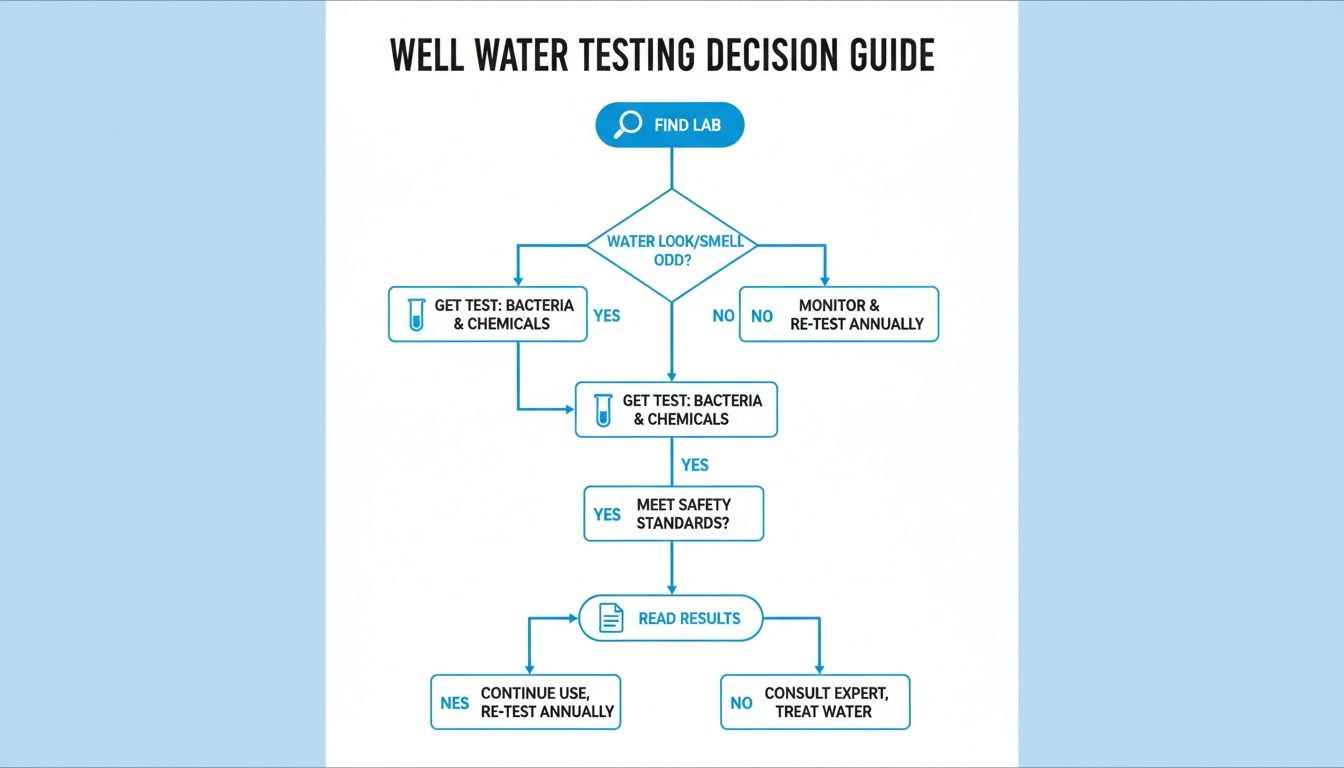
This simple decision guide lays out the whole process, from finding a lab to treating your water.

A well water testing decision guide flowchart showing steps from finding a lab to treating water.

As you can see, figuring out what's in your water is a straightforward process that puts you in control.

Decoding Your Water Test Report

When you get your results back, the report might look a little intimidating. Don't worry, it's simpler than it looks. The report lists each contaminant, how much was found, and the unit of measurement.

Here’s a quick rundown of what you’ll see:

  • mg/L (milligrams per liter): This is just another way of saying parts per million (ppm). It’s used for things like minerals, nitrates, and most metals.
  • µg/L (micrograms per liter): This is parts per billion (ppb). It’s for contaminants like lead or arsenic that are dangerous even in tiny amounts.
  • ND (Not Detected): This is what you want to see! It means the contaminant wasn't found in your sample.
  • Coliform Bacteria: This is usually a simple "present" or "absent." If it's "present," that’s a red flag telling you that surface water might be getting into your well.

The most critical step is to compare your numbers to the Maximum Contaminant Level (MCL) set by the EPA. The MCL is the safety standard for public water, and it's the best yardstick you have for your own well.

Your water test report is your battle plan. Every contaminant over the EPA’s limit is a problem pointing directly to a specific type of filter. High bacteria? You need a UV purifier. High arsenic? An RO system is your hero. Too much iron? An iron filter or water softener will save the day. This is how you stop guessing and start getting clean water.

Choosing the Right Home Filtration System for Your Well

Alright, this is where the action begins. You’ve got your water test results, which means you can finally stop worrying and start solving. Think of those results as a specific blueprint for building your home's ultimate water defense system.

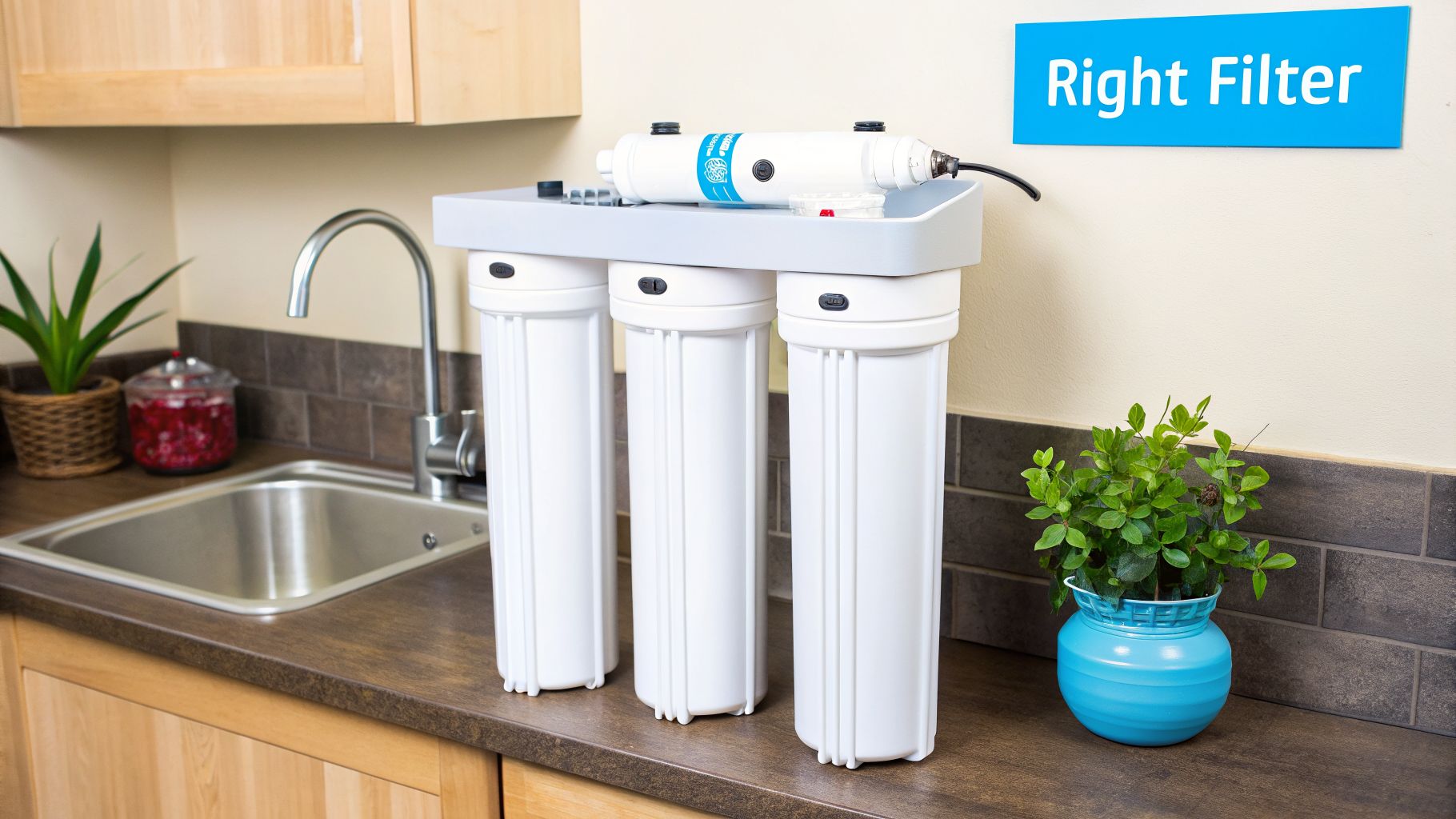
A multi-stage water filtration system on a kitchen counter next to a stainless steel sink.

Let's turn that lab report into a simple shopping list. We'll walk through exactly how to match the right filter to the right problem, so you can gear up with the perfect filtration tech for your family’s health.

Matching the Filter to the Foe

Every water issue has a specific fix. The biggest mistake people make is grabbing a generic, one-size-fits-all filter and hoping for the best. Instead, you need to target the unique contaminants your test uncovered with laser precision.

Here’s a quick guide on how your test results point to the right hardware:

  • Bacteria and Viruses: If your report flagged Coliform bacteria or other microbes, disinfection is your top priority. A UV purification system is the modern gold standard. It uses powerful ultraviolet light to zap bacteria and viruses, sterilizing them instantly without adding a single chemical to your water.
  • Arsenic, Nitrates, and Heavy Metals: For these invisible health threats, you need the heavy artillery. A Reverse Osmosis (RO) system is the ultimate weapon, forcing water through a special membrane that strips out an incredible range of contaminants like arsenic, lead, and nitrates.
  • Iron, Manganese, and Hardness: Seeing those tell-tale reddish-brown stains or battling crusty scale on your faucets? That’s iron, manganese, and hardness minerals at work. A dedicated iron filter or a good water softener is built specifically to knock these out, protecting your pipes and appliances from a slow, crusty death.
  • "Rotten Egg" Smell: That unmistakable sulfur smell comes from hydrogen sulfide gas. You can banish it with an oxidation filter or a quality carbon filter, which will dramatically improve your water’s taste and smell, making it enjoyable again.

The best filtration setups are often multi-stage. You might need a whole-house water softener to handle hardness, followed by a UV light for microbial safety. It's all about layering your defenses based on what your water test tells you.

Point of Entry vs. Point of Use Systems

Once you know what to filter, you have to decide where to filter it. This comes down to a fundamental choice: treat all the water entering your house, or just the water you plan to drink and cook with? This is the Point-of-Entry (POE) versus Point-of-Use (POU) decision.

Point-of-Entry (POE) systems, or whole-house filters, are installed right where your main water line enters your home. They treat every single drop of water going to your taps, showers, and appliances. This is the way to go for issues that affect your entire home, like:

  • Hardness minerals causing scale buildup in your pipes and water heater.
  • Iron that’s staining your sinks, tubs, and laundry.
  • Sediment that clogs faucets and wears down your appliances.

Point-of-Use (POU) systems are smaller and treat water at a single spot, usually the kitchen sink. These are perfect for zeroing in on health-related contaminants in the water you'll be consuming. Under-sink RO systems and simple countertop filters are common POU options. They're cheaper and easier to install, but they don't protect the rest of your home from aesthetic issues.

If you're trying to figure out what's best for your situation, our team at Water Filter Advisor has put together a ton of great resources. You can read more advice and tips on selecting the right type of filter for your needs here.

Well Water Filtration Methods Compared

Picking the right technology can feel overwhelming, but it gets much clearer when you see what each system is designed to do. This table breaks down the most common filtration methods to help you match them to your needs.

Filtration Method Primary Contaminants Targeted Best For Maintenance Level
Reverse Osmosis (RO) Arsenic, Lead, Nitrates, Fluoride, Dissolved Solids Highest-purity drinking water at a single tap (POU). High (Membrane/filter changes)
UV Purification Bacteria, Viruses, Protozoa (E. coli, Giardia) Whole-house disinfection (POE) without chemicals. Low (Annual bulb change)
Water Softener Calcium, Magnesium (Hardness Minerals) Protecting pipes and appliances from scale (POE). Medium (Adding salt regularly)
Iron/Manganese Filter Iron, Manganese Preventing rust stains and metallic taste (POE). Medium (Backwashing cycles)
Activated Carbon Filter Chlorine, Pesticides, Odors, Bad Taste Improving taste and smell at a specific tap (POU) or for the whole house (POE). Low (Cartridge changes)

At the end of the day, making sure your well water is safe is an ongoing mission, not a one-time fix. By using your water test as your guide and knowing your filtration options, you can build a reliable system that delivers clean, safe water for years to come.

Maintaining Your Well and Filtration System

Getting a powerful water filtration system installed is a fantastic first step. But it’s not a "set it and forget it" appliance. Think of it like a high-performance car—you wouldn't skip an oil change and expect it to win a race. Your water system needs the same kind of TLC to keep it running flawlessly.

Regular, consistent maintenance is the secret sauce. It's what ensures your system keeps delivering pure, safe water day after day, protecting both your family and your investment.

Your Well Maintenance Checklist

Before we even touch the filters, let's talk about the well itself. A well-maintained wellhead is your first line of defense, making it much harder for contaminants to sneak into your water in the first place.

A few times a year, just take a walk out and do a quick visual inspection. Check for cracks in the well casing and make sure the cap is on tight. Is the ground around the well sloped so that rainwater runs away from it, not toward it? This simple five-minute check can stop a contamination problem before it starts.

Proper maintenance isn't just about protecting your equipment; it's about safeguarding your health. A clogged filter or a failing UV bulb means your water is no longer protected, reintroducing the very risks you sought to eliminate.

Part of your overall system's health is the plumbing that carries the water into your home. This includes basic home maintenance like preventing burst water pipes, which can cause massive damage and let contaminants flood your supply.

A Practical Filtration Upkeep Schedule

Every filtration system has parts that are designed to wear out. They absorb and block gunk, so eventually, they get full. Sticking to a replacement schedule isn't just a suggestion; it’s what keeps your water safe. Put these on your calendar right now.

  • Sediment Pre-Filters: These are the bouncers, catching all the sand, dirt, and rust. They need to be checked monthly and replaced every 3-6 months. If your water is particularly gritty, you’ll be on the 3-month schedule.

  • Carbon Filters: These are the taste and smell specialists, grabbing chlorine, pesticides, and other yucky stuff. Plan on changing them every 6-12 months. Once the carbon is saturated, it stops working, and those contaminants sneak right through.

  • UV Purifier Bulbs: This is your germ warfare unit. The crucial thing to know is that UV bulbs lose their killing power long before they burn out. You must replace the bulb annually to ensure it's actually disinfecting your water. While you're at it, clean the quartz sleeve that houses the bulb.

  • Reverse Osmosis (RO) Membranes: This is the heart of your RO system. The pre- and post-filters will need changing every 6-12 months, but the high-tech membrane itself is tougher. It generally lasts 2-3 years.

  • Water Softener Salt: If you have a softener, your only real job is to keep the brine tank topped up with salt. Just check the level once a month. Without salt, your softener is just a big, useless tank taking up space.

Staying on top of this schedule means your answer to "is my well water safe?" will always be a confident "yes." If you let it slide, your expensive system becomes little more than a good luck charm, giving you a false sense of security while letting problems flow right to your faucet.

Your Top Questions on Well Water Safety

Once you dive into the world of water filtration, you're bound to have more questions. Let's tackle some of the most common ones we hear from homeowners ready to take control of their well water.

My Well Water Tastes and Smells Fine. Do I Still Need to Test It?

Yes, absolutely! This is one of the most dangerous assumptions. The most harmful contaminants—like arsenic, lead, nitrates, and many bacteria—are completely tasteless, odorless, and invisible.

Relying on your senses is a huge gamble. The only way to know for sure what's in your water is to get it tested by a state-certified lab at least once a year. Think of it as an annual check-up for your water.

What's the Difference Between a Water Softener and a Water Filter?

Great question, as they solve two totally different problems.

A water softener is a specialist. It only targets "hardness" minerals—calcium and magnesium. These are the culprits behind scaly buildup in your pipes and appliances but aren't considered a health risk. It's all about protecting your home's plumbing and fixtures.

A water filter is a guardian. It's built to remove dangerous contaminants. A reverse osmosis system will go after lead and arsenic, while a UV purifier is designed to kill bacteria and viruses. Many well owners need both: a softener to protect the plumbing and a filtration system to protect their health.

Can I Install a Whole-House Filtration System Myself?

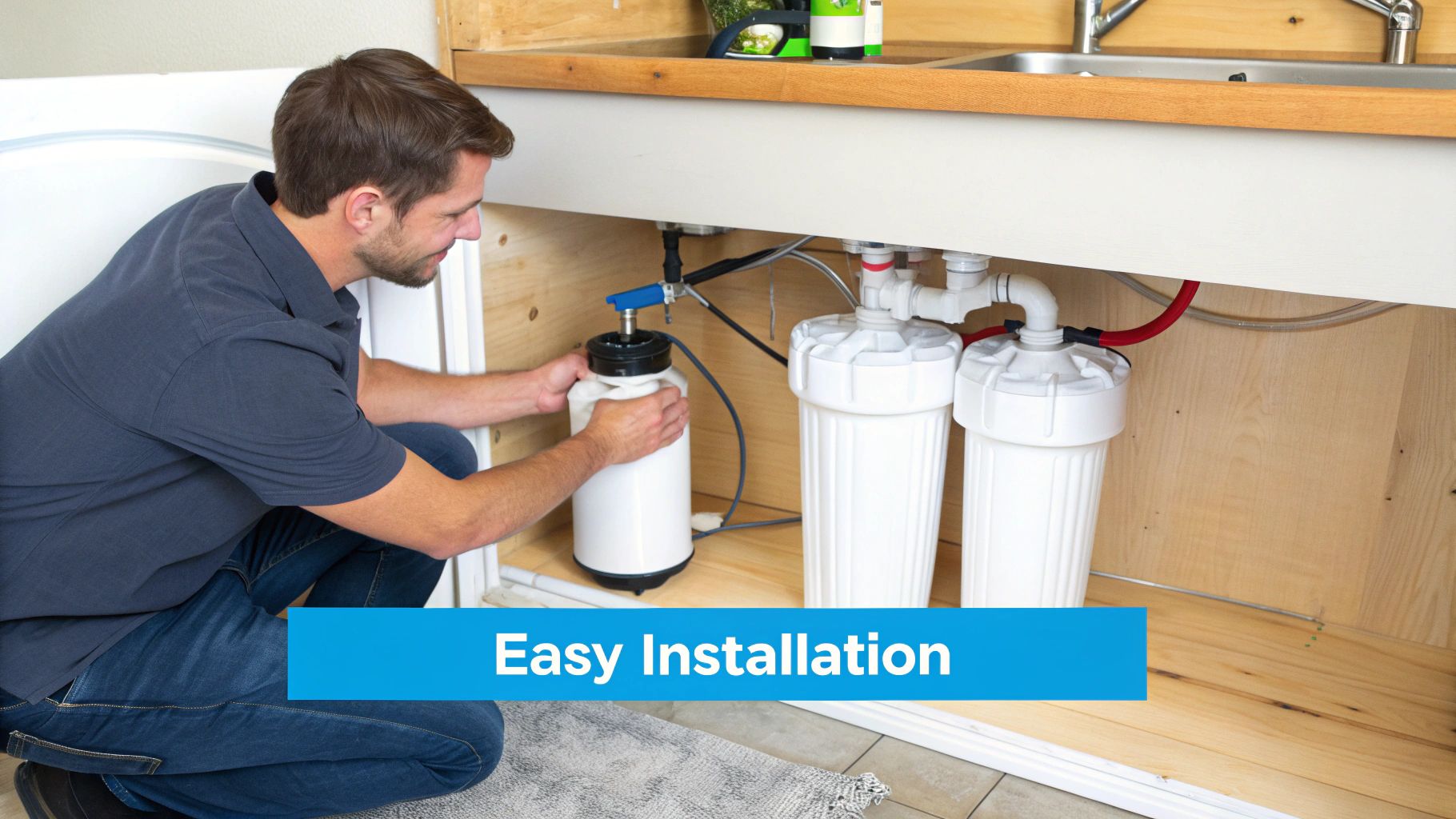
An under-sink filter? Sure, many handy homeowners can tackle that. But a whole-house (or Point-of-Entry) system is a much bigger project. It involves cutting into your main water line, which demands real plumbing skills. Some systems, like UV purifiers, also need electrical work.

We always recommend hiring a licensed plumber or certified water professional for a whole-house system. A bad installation can cause massive leaks, void your warranty, and—worst of all—it might not even work correctly, leaving your water unprotected. It's worth the investment to have it done right.

How Often Should I Shock My Well?

Shock chlorination is like calling in a SWAT team for your well. It's an emergency fix you use after a bad bacteria test, after well maintenance, or if floodwater gets in. It's a heavy dose of chlorine meant to disinfect the entire system.

Some folks do it annually as a "just in case" measure. But if you're constantly shocking the well because of recurring bacteria, you have a bigger problem. Shocking is a band-aid. You need a permanent fix like a UV purification system to provide constant, 24/7 protection against contamination.


At Water Filter Advisor, we cut through the noise to give you clear, straightforward advice for your home's water. Check out our guides and product reviews at https://www.waterfilteradvisor.com.

Your Guide to a Sediment Filter for Well Water

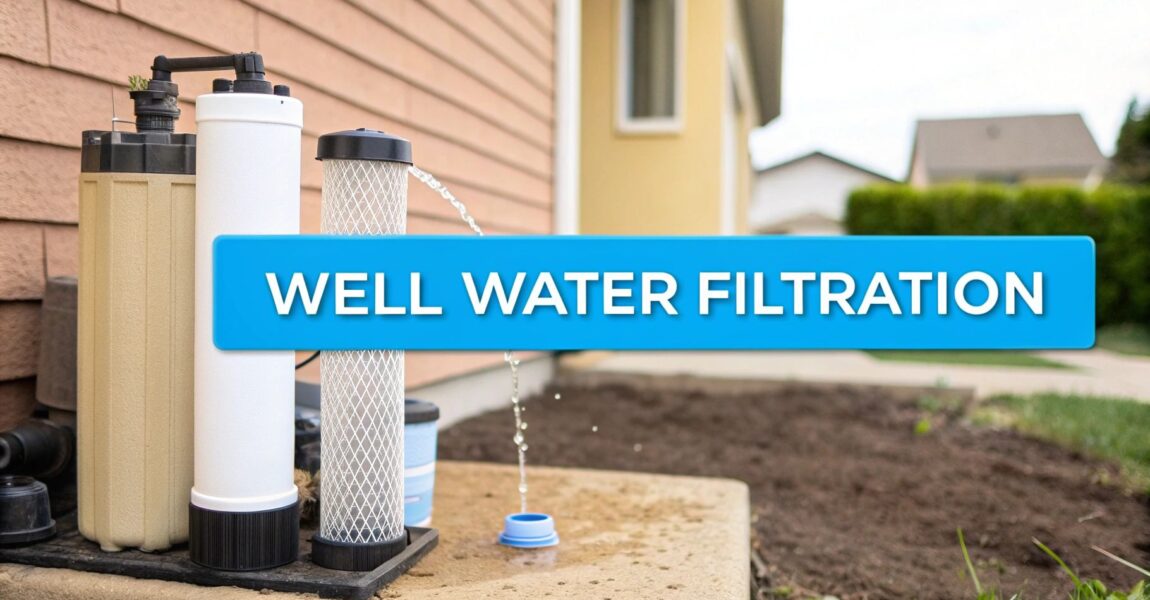
A sediment filter for well water is your home's bouncer. It stands at the door and stops all the riff-raff—grit, sand, silt, rust—from crashing your plumbing party. Its one and only job is to physically block these unwelcome guests, protecting your pipes, faucets, and expensive appliances from getting clogged and destroyed. If you're on a private well, it's the most critical first step you can take to get clean, clear water from every tap.

Why Your Well Water Looks Like Swamp Tea

Ever fill a glass from your tap and notice it's cloudy, gritty, or has that sad, brownish tint? That’s sediment, the number one headache for well owners. Your well pulls water directly from underground aquifers, and on its journey up, that water naturally grabs tiny bits of sand, clay, and rust from the surrounding rock and soil.

Think of your well as a giant milkshake straw stuck in the ground. It’s meant to suck up water, but it's going to pull in some of the surrounding dirt, too. Without a filter in place, all that grit flows straight into your house, ready to cause chaos.

The Hidden Costs of Gritty Water

A little cloudiness might not seem like a big deal, but those tiny, abrasive particles are like liquid sandpaper tearing through your home's plumbing. Over time, the wear and tear really adds up, leading to some truly eye-watering repair bills.

This isn't a rare problem. Roughly 23 million households in the US depend on private wells, and sediment is one of the most common complaints. This grit is famous for clogging pipes and wrecking appliances, costing homeowners an average of $1,500 a year in repairs. You can read more about the future trends in the water filter market that underscore this very issue.

So, what's actually at risk?

  • Appliances: The small, delicate valves and pumps in your dishwasher, washing machine, and ice maker get clogged easily. That means expensive service calls or having to replace them years before you should.
  • Faucets and Showerheads: Sediment builds up in the aerators and nozzles, slowing your water flow down to a pathetic trickle. Say goodbye to satisfying showers.
  • Hot Water Heaters: Grit settles at the bottom of the tank, forming a thick, energy-sucking blanket. This forces the heater to work harder just to heat the water, wasting energy and eventually burning out the heating element.
  • Other Water Filters: If you have a water softener or a UV purifier, sediment will absolutely destroy them. It clogs the sensitive resin beads in a softener and coats the quartz sleeve of a UV lamp, making it completely ineffective.

A sediment filter for well water is like the bouncer for your home's plumbing. Its sole job is to stop troublemakers like sand and silt at the door, preventing them from crashing the party and wrecking your expensive appliances. This simple, first line of defense is non-negotiable for protecting your investment.

Choosing Your Well's First Line of Defense

Picking the right sediment filter for your well isn't a one-size-fits-all deal. Every well has its own personality—some cough up sand and grit, while others are full of fine, cloudy silt. Getting this choice right is the key to clear water without the headache of constant filter changes.

It's like picking the right tool for the job. You wouldn't use a sledgehammer to hang a picture, right? The same logic applies here. Your filter needs to match the kind of sediment your well is kicking out.

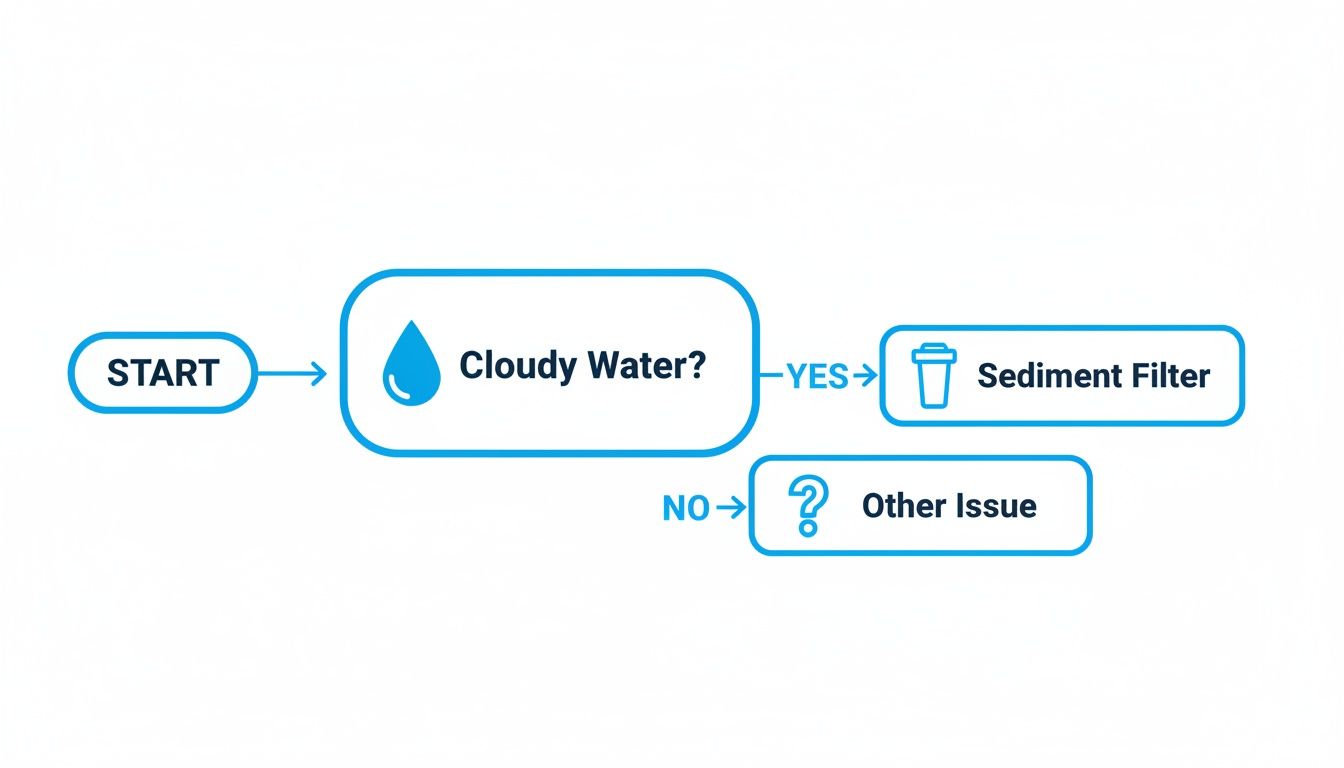
This simple chart shows the first step in figuring out what's going on with your water.

Flowchart troubleshooting cloudy water, recommending a sediment filter or identifying other issues.

If your water is cloudy, a sediment filter is the first logical place to start. Let's dive into the main types you'll be looking at.

The Heavy-Hitting Spin-Down Filters

If you can actually see sand or grit in your water, you need a spin-down filter. These are the workhorses for heavy-duty sediment. They use centrifugal force to literally spin the grit right out of your water, collecting it at the bottom of a clear bowl.

The best part? Maintenance is incredibly simple. No swapping cartridges. Just open a little valve at the bottom to flush all the gunk out. It takes seconds and you don't need any tools.

  • Best For: Wells with a lot of sand, grit, or other big, visible particles.
  • Pros: They're reusable, a breeze to clean, and the clear housing lets you see exactly what you've caught.
  • Cons: They won't catch the super-fine stuff. Think of them as a pre-filter, not a fine polisher, as they struggle with anything below 40-50 microns.

The Detail-Oriented Pleated Cartridges

For that hazy, cloudy look caused by much finer particles, a pleated cartridge filter is what you want. Picture an accordion-style design. All those pleats create a massive surface area to trap a ton of fine sediment without killing your water pressure.

These are the finishers, catching the tiny particles that a spin-down might miss. Most are made from polyester, so you can often rinse and reuse them a few times before they need to be replaced, which is a great value.

When you're trying to improve your well water, a good sediment water filter is the foundation, and pleated cartridges are a popular and solid choice. They work great on their own for cleaner wells or as a second-stage filter after a spin-down for total sediment removal.

The Depth-Specialist Filters

Last up are the string-wound and spun-polypropylene filters, often just called depth filters. These are specialists designed to trap particles of all different sizes through the entire thickness of the filter, not just on the outside surface.

Think of a depth filter like a dense thicket of bushes. The big stuff gets caught on the outer branches, while smaller particles work their way deeper before getting snagged. This design keeps the filter from clogging up on the surface and gives it a much longer life.

  • String-Wound Filters: Use tightly wound cords (like cotton or polypropylene) to create a web that gets denser toward the core.
  • Spun Filters: Are made by melting and blowing polypropylene fibers into a cylinder, creating a similar graded density.

Because these filters trap gunk all the way through, you can't clean them. Once they're full, you just toss them and put a new one in. Their incredible dirt-holding capacity makes them a go-to for wells where the sediment is all over the place in terms of size.

For a deeper dive into all your filtration options, you can check out our general water filter advice to help make the right choice for your home.

Matching Your Filter to Your Water Flow

Picking the right sediment filter isn't just about grabbing one off the shelf. You need to match it perfectly to your well's unique conditions. Getting this wrong means you'll either get cloudy water or a frustrating trickle from your taps.

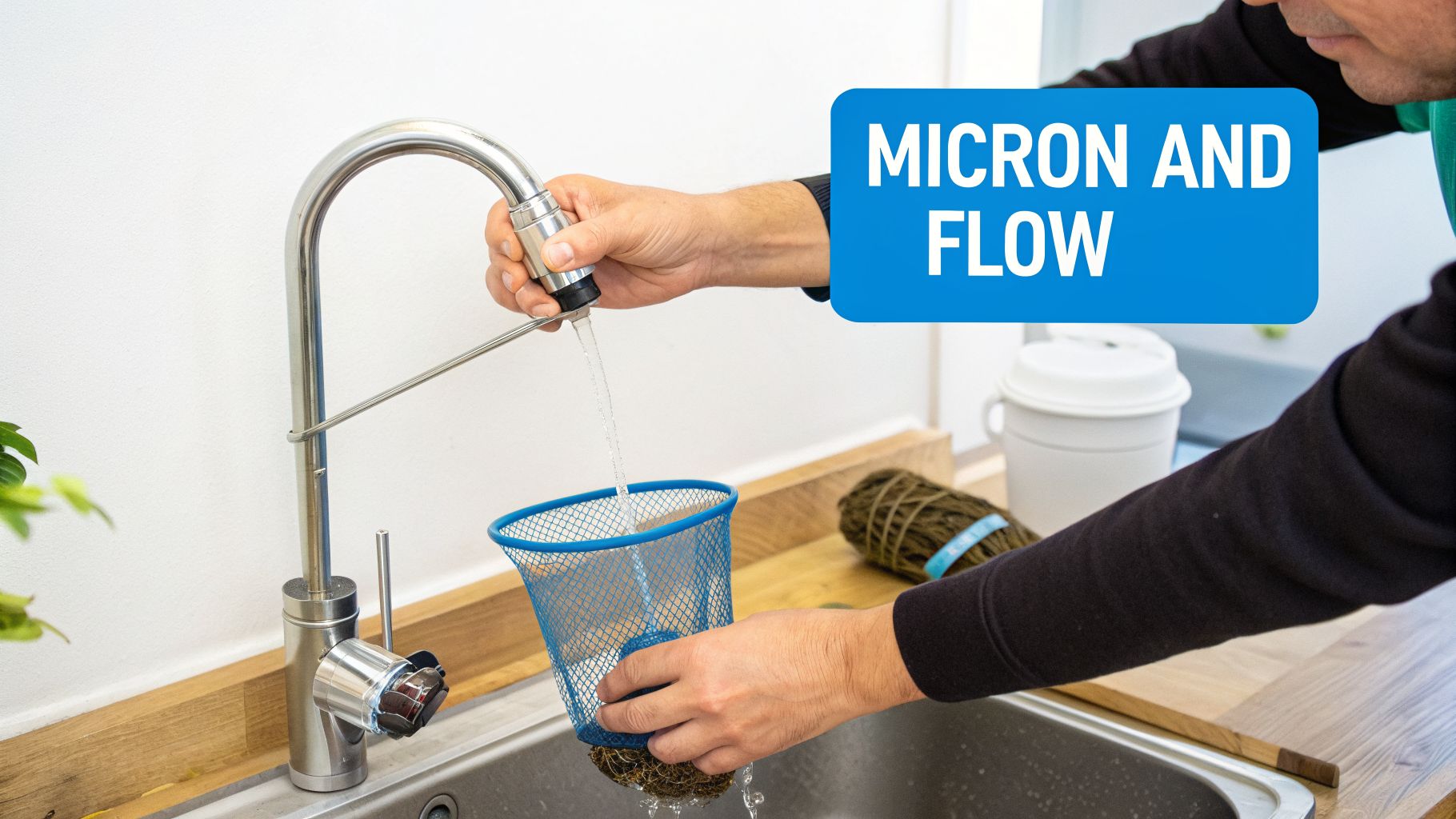
Two numbers are key: the micron rating and the flow rate (GPM). Nailing these two is the secret to a system that just works.

Hands rinse a dirty mesh basket under a kitchen faucet, illustrating water filtration.

What's a Micron Rating?

The micron rating simply tells you how small of a particle the filter can stop. A micron (µm) is tiny—one-millionth of a meter. For perspective, a single human hair is about 50-70 microns thick, and the smallest speck you can see is around 40 microns.

Think of it like fishing. A wide net catches the big fish but lets the little ones slip through. A fine-mesh net catches everything. Sediment filters are the same way.

  • Higher micron ratings (like 50 microns) are your wide net. They're great for catching big stuff you can see, like sand and bits of rust.
  • Lower micron ratings (like 5 microns) are the fine-mesh net. They grab the tiny, invisible particles like silt and clay that make your water look murky.

A common mistake is going too fine, too fast. If your well water is full of sand, a 1-micron filter will clog in no time. It's almost always better to start with a larger rating, like 20-50 microns, and see if that clears things up.

The right micron rating depends entirely on what kind of gunk is in your water. This is especially true for wells, where sediment can change from day to day.

Here's a quick guide to help you match your filter to the problem.

Matching Micron Rating to Sediment Type

Sediment Type Common Appearance Recommended Micron Rating
Sand & Grit Visible particles that settle quickly 25-100 microns
Silt Fine, silky particles causing cloudiness 5-20 microns
Clay Extremely fine particles; water looks murky 1-5 microns

This table should get you in the right ballpark. If your water looks like it has a mix, you might need a multi-stage approach, but starting with the right primary filter is the most important step.

Sizing Your Filter for Your Home's Flow Rate

The other critical number is flow rate, measured in gallons per minute (GPM). This is all about how much water can move through the filter without losing pressure.

If the filter's GPM is too low for your home, you'll feel it immediately. It’s like trying to push a river through a skinny garden hose—the pressure plummets. Your shower will turn into a sad dribble the moment someone flushes a toilet.

This is a massive issue for well owners. USGS data shows that a staggering 43% of private wells in the US have high turbidity. After a heavy rain, sediment can spike by 300%. All that grit chews up well pumps, causing them to fail 25% faster and leading to $500 million in replacement costs every year in the US. You can discover more insights about the commercial water filtration market to see just how common this problem is.

To keep your water pressure strong, your filter's GPM must be higher than your home's peak demand. Here’s a quick way to figure that out:

  1. Count your fixtures: Tally up every sink, shower, toilet, dishwasher, and washing machine.
  2. Use standard GPM values:
    • Shower/Bathtub: 2.5 GPM
    • Toilet: 1.6 GPM
    • Kitchen/Bathroom Faucet: 1.5 GPM
    • Dishwasher: 1.5 GPM
    • Washing Machine: 2.0 GPM
  3. Add it up: Think about a busy morning. A shower (2.5), a toilet flush (1.6), and the dishwasher running (1.5) all at once is a peak demand of 5.6 GPM.

For that family, a filter rated for at least 6 GPM is the bare minimum. To be safe, I always recommend a filter rated for 10-15 GPM. This gives you a nice buffer so you never have to think about losing water pressure again.

Installing Your Filter for Maximum Protection

Picking the right sediment filter for well water is half the battle. Where you put it is the other half, and it's just as important. Think of your water system as an assembly line—you have to get the first step right for everything else to work.

Here’s the single most important rule for well water filtration: the sediment filter always goes first. It needs to be the very first thing your water hits after leaving the pressure tank. No exceptions.

This isn't just a friendly suggestion. Placing your sediment filter at the front of the line is the foundation for a system that actually works and doesn't break down on you.

The Gatekeeper for Your Entire System

Imagine throwing a handful of sand into the gears of a complex machine. That’s what you're doing if you install other filters before the sediment filter. That abrasive grit will clog up sensitive valves, ruin expensive filter media, and cause all sorts of headaches.

The sediment filter’s main job is to be the bodyguard for your more expensive, specialized equipment. It’s designed to take the hits so the rest of your system doesn't have to.

Here’s a look at what your sediment filter is protecting:

  • Water Softeners: The resin beads inside a softener are tiny and delicate. Sand and silt will foul them up in no time, making your softener completely useless. Protecting that resin is the key to keeping your water soft and your unit alive.
  • Carbon Filters: Carbon blocks are amazing for removing chemicals, but they clog easily with sediment. This creates "channeling," where water just finds a path around the carbon, leaving contaminants in your water.
  • UV Purifiers: A UV system needs clear water to work. If the quartz sleeve protecting the UV lamp gets coated with a film of sediment, that light can't zap the bacteria. The whole system becomes ineffective.

Strategic placement is non-negotiable. Installing your sediment filter first prevents the premature failure of other filters and appliances, saving you hundreds, if not thousands, of dollars in replacement costs and service calls down the road.

Maximizing Efficiency and Saving Money

Getting the placement right isn't just about protection; it's about making sure the whole system runs like a well-oiled machine. When your other filters aren't constantly fighting a battle against grit and sand, they can do the jobs they were designed for.

Better efficiency means you save real money. A good multi-layer sediment filter can achieve 99.9% removal of particles down to 5 microns at flow rates up to 30 GPM. For well owners, this simple step can extend the media life of a water softener by up to 40%. You can learn more about global water purifier trends to see how technology is advancing.

Putting your sediment filter first isn't just about catching dirt. It's a smart investment in the health of your entire water system. It’s the one move that ensures every other part works better, lasts longer, and delivers the clean, safe water your family deserves.

A DIY Guide to Filter Installation and Care

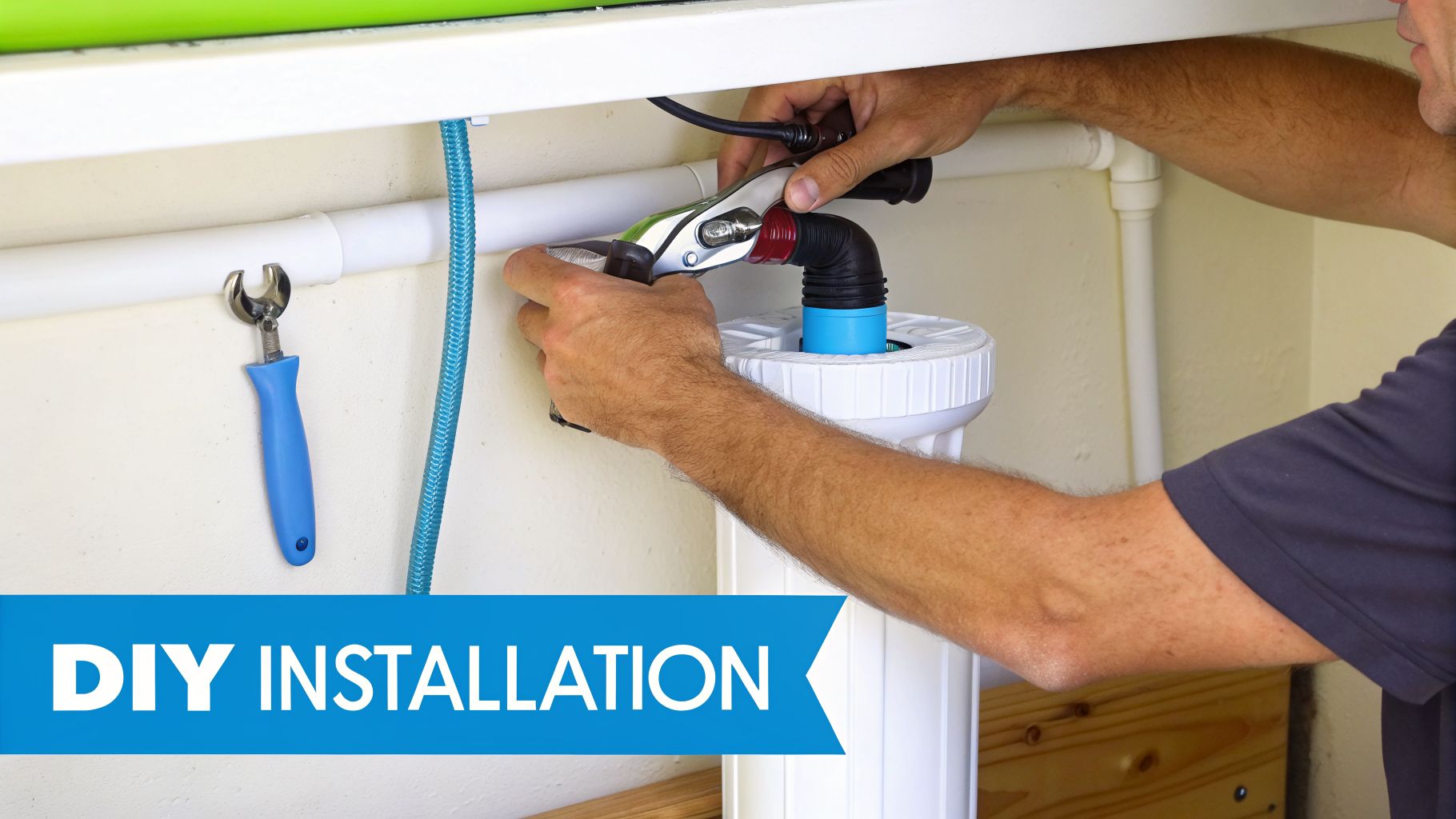
Installing and maintaining your own sediment filter is a manageable DIY job. With the right tools and some planning, you can get your system running perfectly, save a few hundred dollars on a plumber, and get to know your home's water system inside and out.

A man's hands are busy installing a water sediment filter with a wrench.

This guide will walk you through the installation and then cover the simple, regular tasks needed to keep your water clean. Let's get to it.

Step-by-Step Installation Checklist

Before you start, get your tools and parts together. You'll need the filter housing, mounting bracket, a filter cartridge, pipe cutters, two shut-off valves, and the right fittings for your plumbing (PEX, copper, etc.). Always double-check the manufacturer's guide, but these are the universal steps.

  1. Shut Off the Water: This is the most important step. Find your main shut-off valve—it's usually near the pressure tank—and close it. Open a faucet somewhere else in the house to drain the lines.

  2. Choose the Location: The sediment filter for well water is always installed right after the pressure tank. Pick a spot on the pipe where you'll have enough room to mount the unit and, more importantly, to swap out the filter later.

  3. Cut the Pipe: Measure the total width of your filter assembly with the shut-off valves attached. Mark this length on the pipe and use a pipe cutter to make two clean, straight cuts.

  4. Install Shut-Off Valves: Add a shut-off valve to each end of the pipe you just cut. You'll thank yourself later—these let you isolate the filter for maintenance without turning off water to the entire house.

  5. Mount the Filter: Screw the mounting bracket securely to a wall stud. Attach the filter housing to the bracket. Pay close attention to the "IN" and "OUT" arrows to make sure it's aligned with the water flow from the well.

  6. Connect the Plumbing: Use your fittings to connect the shut-off valves to the filter's "IN" and "OUT" ports. Use Teflon tape on the threads to get a good seal, but be careful not to overtighten plastic fittings, which can crack.

  7. Turn Water On & Check for Leaks: Slowly open the main water valve. Next, open the inlet valve to the filter and let the housing fill up. Press the red pressure-relief button on top of the housing to bleed out the air. Once water starts to spurt out, open the outlet valve. Now, carefully check every single connection for drips.

Smart Maintenance for Lasting Performance

Installation is a one-time thing. The real key to clean water is knowing when to do maintenance.

The pro trick for filter maintenance is to use pressure gauges. Install one gauge before the filter and another right after it. A new filter should only cause a pressure drop of 1-2 PSI. When you see that drop increase to 8-10 PSI, the filter is clogged. It's time for a change—no more guesswork.

This method is way better than just following a calendar. A big rainstorm can stir up sediment in your well, clogging a filter in a few weeks that might have lasted for months otherwise.

A Simple Maintenance Schedule

Your routine depends on the type of filter you have. A basic schedule will keep things running smoothly.

  • For Cartridge Filters:

    • Monthly: Give the housing a quick visual check for any leaks.
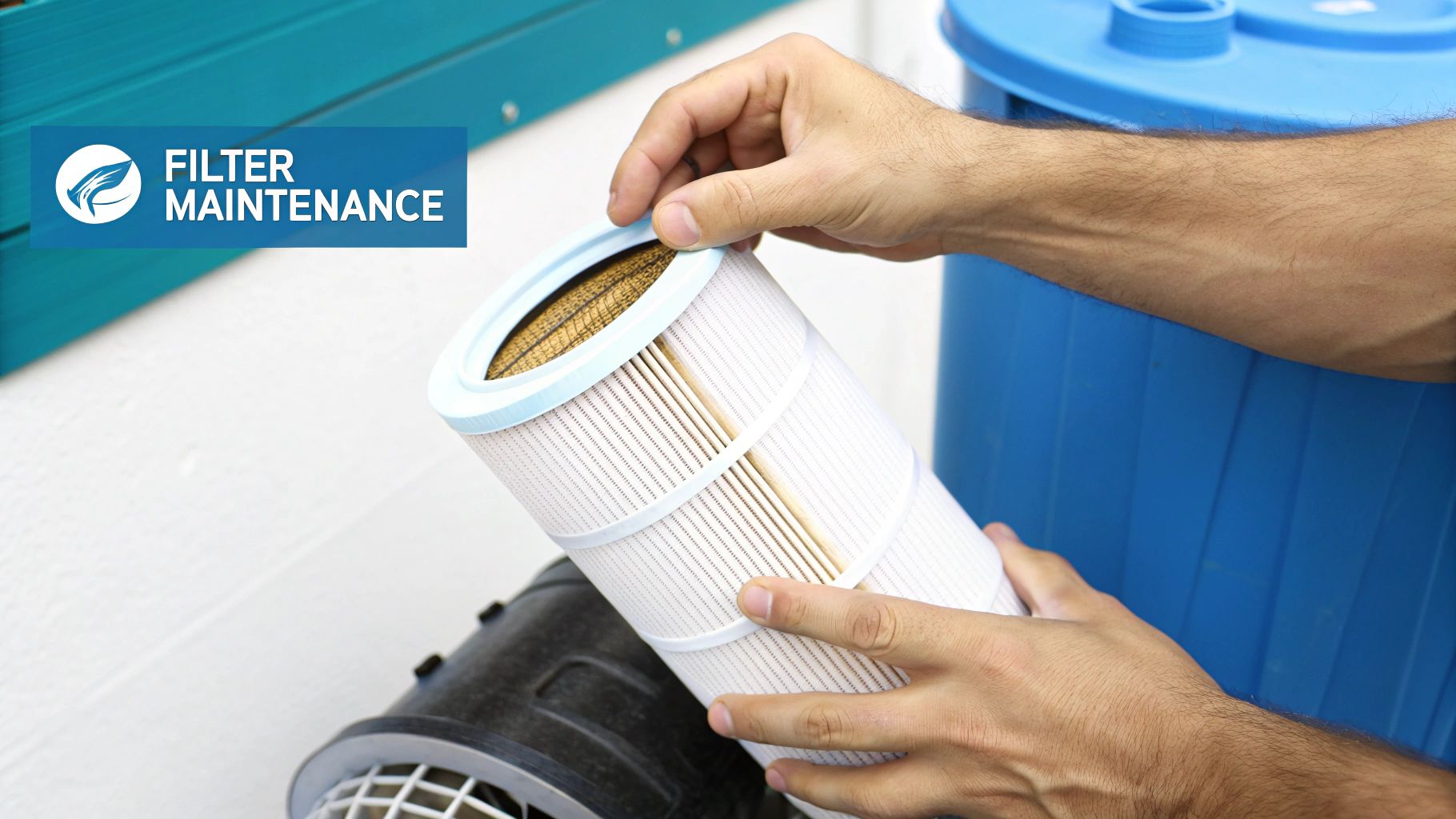
    • As Needed: When your pressure gauge tells you it's time, replace the cartridge. Turn off the in/out valves, hit the relief button, and unscrew the housing. Swap the old filter for a new one, check that the O-ring is in good shape, and screw it all back together.
  • For Spin-Down Filters:

    • Weekly: Look at the clear bowl. If you can see sediment building up, it's time for a flush.
    • To Flush: Just open the purge valve at the bottom for about 30 seconds. The water pressure will shoot all the gunk out. That’s it. No tools needed.

Common Questions About Well Sediment Filters

Once your filter is in, you can finally enjoy clean, clear water. But it's normal for a few questions to pop up as you get used to the new system. We’ll cover the most common ones that people ask after the installation is done.

Getting these details right will help you keep your system running perfectly for years.

How Often Should I Really Replace My Sediment Filter Cartridge?

This is the big one. The honest answer? It depends. That "3-6 months" on the box is just a wild guess. The real timeline is set by your specific well's water quality and how much water your family uses.

A well with lots of sediment might need a new filter every month. A cleaner well might go for a year. Instead of guessing, here’s how to know for sure:

  • Install Pressure Gauges: This is the best way. Put one gauge on the pipe right before the filter housing and one right after. A new filter will have a tiny pressure drop, maybe 1-2 PSI.
  • Watch the Drop: As the filter clogs with dirt, that pressure drop gets bigger. Once the difference between the two gauges hits 8-10 PSI, the filter is full. Time to change it.

Using pressure gauges takes all the guesswork out of maintenance. You change filters based on real data, not a random date on the calendar. You won't waste money changing them too soon or strain your pump by waiting too long.

Can a Sediment Filter Remove Iron or Sulfur Smells?

Nope. A sediment filter for well water has one job: removing physical bits of sand, dirt, and rust. It can't touch dissolved contaminants that cause stains and bad smells.

Think of it like a screen door. It stops bugs (sediment) from getting in, but it can't stop smells (dissolved gases) from drifting through.

  • Iron Staining: Those orange stains in your sinks are from dissolved ferrous iron. A sediment filter only catches solid rust particles, not the dissolved iron that causes the stains. You’ll need a dedicated iron filter installed after the sediment filter to handle that.
  • "Rotten Egg" Smell: That nasty sulfur smell comes from hydrogen sulfide gas dissolved in the water. It sails right through a sediment filter. An aeration system or a carbon filter is what you need to fix that problem.

Will a Sediment Filter Tank My Water Pressure?

A correctly sized filter won't cause a noticeable drop in pressure. If your water pressure plummets right after you install one, something is wrong.

The most common problem is that the filter is too small for your home's flow rate (GPM). It’s like trying to fight a fire with a garden hose—the equipment just can't keep up. This is why the "Big Blue" 4.5-inch diameter filters are so popular for whole-house systems; they have a larger surface area that can handle higher flow rates without choking your pressure.

The other possibility is the filter clogged up fast. A big storm can churn up sediment in your well, sending a huge slug of dirt into your pipes that can clog a new filter in a matter of hours.

What Is the Difference Between Pleated and Spun Filters?

Pleated and spun filters look similar, but they work very differently. The right one for you depends on what kind of sediment is in your well water.

Pleated Filters:
Think of an accordion. The folds give a pleated filter a huge amount of surface area to catch particles. They are best at grabbing sediment where all the particles are about the same size.

  • Best For: Water with uniform-sized sediment.
  • Key Feature: Some can be rinsed and reused a few times, which can save money.

Spun (or Depth) Filters:
These are built more like a dense bundle of fibers, looser on the outside and tighter toward the middle. This design lets them trap big particles on the outer layers and finer silt deeper inside.

  • Best For: Well water that has a mix of different-sized particles.
  • Key Feature: They can hold a lot more dirt than pleated filters before they clog, but they are single-use and can't be cleaned.

For most wells, where the sediment can change from one day to the next, a spun depth filter is usually the most reliable choice. It's built to handle whatever the well throws at it.


At Water Filter Advisor, we're dedicated to helping you achieve the best possible water quality for your home. We provide the resources and expert guidance you need to choose, install, and maintain the perfect filtration system for your well. Explore our comprehensive buying guides and reviews to make a confident decision for your family's health and comfort at https://www.waterfilteradvisor.com.

Your Guide to Vanquishing Sediment in Well Water

You pour a glass of water from your kitchen tap, hold it up to the light, and… there it is. Tiny particles doing a slow-motion dance—the tell-tale sign of sediment in your well water. It's an incredibly common issue for homeowners with wells, basically meaning bits of sand, silt, or clay have snuck into your plumbing. The good news? It's a completely winnable battle with the right filtration setup.

What Is This Gritty Stuff in My Well Water?

Ever noticed a gritty film at the bottom of a drinking glass after it sits for a while? Or found mysterious specks staining your freshly washed laundry? Congratulations, you've met sediment. At its heart, sediment is just a mix of natural, solid particles that get stirred up and hitch a ride in your water.

Think of your well as a giant straw sipping water from an underground aquifer. That aquifer is surrounded by layers of earth—sand, clay, rock, and silt. Heavy rain, a shifting water table, or even an aging well pump can shake these fine particles loose, pulling them right into your home's water supply.

Why You Should Actually Care About This Gritty Intruder

A little bit of grit might not seem like a big deal, but it’s a lot more than a visual annoyance. These tiny particles are the uninvited bullies of your plumbing system, acting like liquid sandpaper. They slowly wear down pipes, clog faucet aerators, and can absolutely wreck expensive appliances like your water heater, dishwasher, and washing machine. It’s a silent war that can cause serious financial damage over time.

And this isn't some rare occurrence. Sediment in well water is a widespread problem affecting millions, especially in areas not hooked up to a municipal water system. The United Nations World Water Development Report noted that in 2022, over 3.5 billion people relied on water sources outside of safely managed systems, and a huge number of them depend on wells. You can learn more about this global water challenge on UNESCO's site.

The most important thing to know is that you don't have to live with it. A good whole-house water filtration system acts like a bouncer at the club, stopping these unwelcome particles before they ever enter your home and wreak havoc.

Filtration: Your Ultimate Weapon Against Grit

Instead of constantly cleaning out clogged faucets or watching your appliances die a slow, painful death, a whole-house filtration system provides a real, permanent answer. By installing a filter right where your main water line enters your home, you guarantee that every single tap—from the kitchen sink to the shower—delivers clean, clear water.

Here’s what a dedicated filtration system brings to the party:

  • Crystal-Clear Water, Instantly: It gets rid of that cloudy, murky look and all the visible specks, giving you pristine water for drinking, cooking, and bathing.
  • Protection for Your Fortress: By catching all that abrasive sediment, it prevents clogs and helps your valuable appliances live long, prosperous lives.
  • Total Peace of Mind: There's a special kind of confidence in knowing your water is clean and free of suspended gunk every time you turn on the faucet.

At the end of the day, tackling sediment in well water is all about taking back control of your home’s most vital resource. With the right filter, you can make that cloudy, gritty water a distant memory.

Decoding the Sediment in Your Water

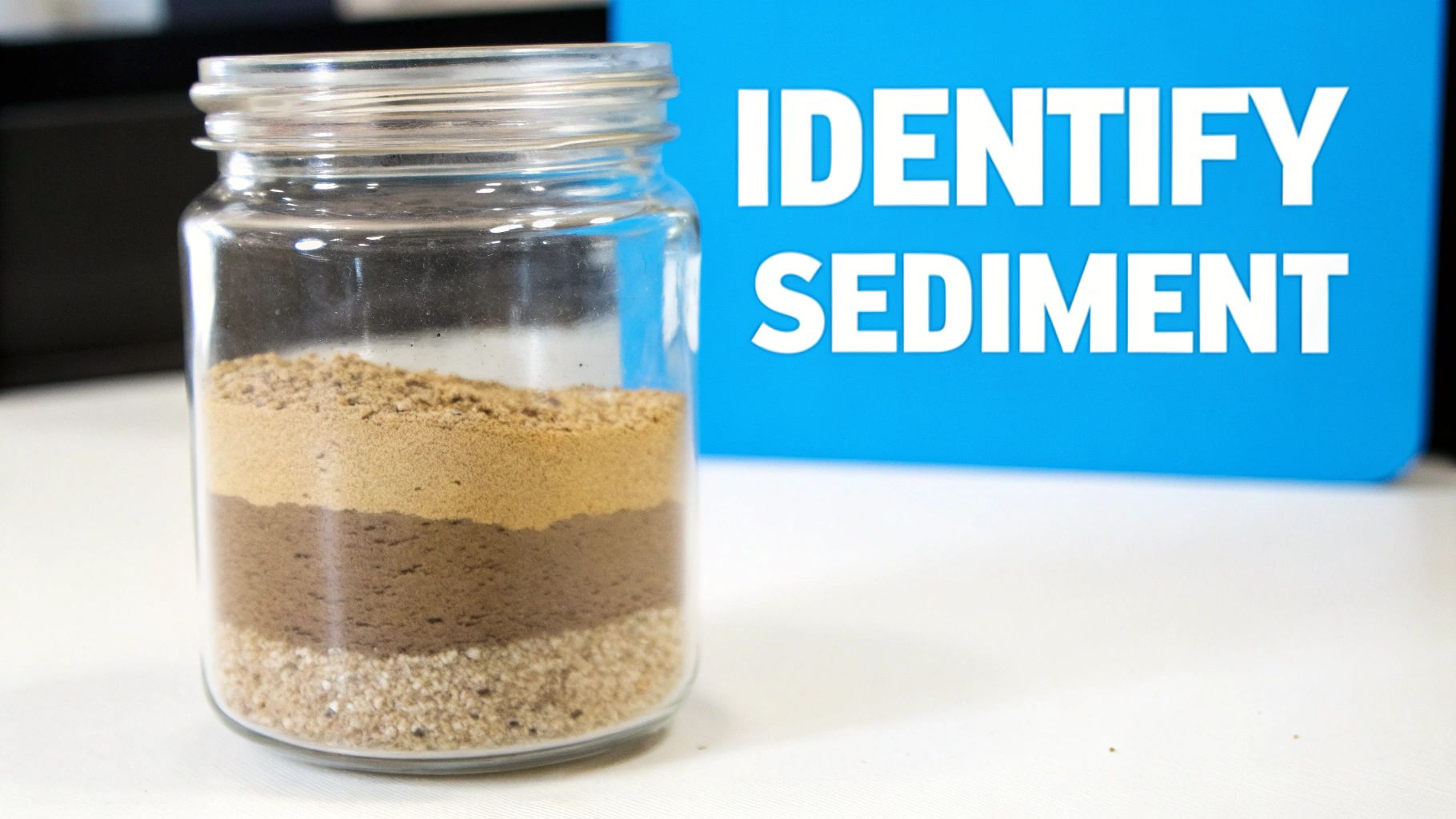
Clear glass jar containing layered sediment samples from well water for identification and testing purposes

Not all sediment is created equal, and the first step to clear water is figuring out exactly what you're dealing with. Think of yourself as a water detective. The clues are floating right there in your glass, and knowing what they mean is critical for choosing the right filter.

It’s like using the right tool for the job. You wouldn't use a spaghetti colander to strain coffee grounds, right? The same logic applies here—a filter designed for coarse sand won't do a thing against ultra-fine clay. This is where a little hands-on diagnosis pays off big time.

The Simple Jar Test: Your Secret Weapon

You don’t need a fancy lab to get started. Your best diagnostic tool is probably already in your kitchen cabinet: a plain, clear glass jar. This ridiculously easy test will tell you a surprising amount about the sediment in your well water.

Here’s your mission, should you choose to accept it:

  1. Collect Your Evidence: Grab a large, clear jar and fill it with cold water. Use a faucet that doesn’t have an aerator, like an outdoor spigot or your bathtub tap, to make sure you get a raw, unfiltered sample.
  2. Let It Chill: Put the jar on a counter or shelf where it won’t be disturbed. Now, just leave it alone for at least 24 hours. Patience, detective.
  3. Observe the Results: Take a look at what happened. How fast did the particles fall? What do the layers look like after they’ve settled at the bottom?

The way the particles separate tells a story. Heavy, coarse sand will drop to the bottom in just a few minutes, while fine silt might take a few hours. The absolute finest clay particles can stay suspended, keeping your water cloudy for a full day or even longer.

This simple observation is your cheat code for picking the right filtration system. Heavier gunk is easy to trap, but those tiny suspended particles require a much finer filter to get the job done.

Identifying the Common Culprits

Once your jar test is done, you can compare the layers at the bottom to figure out what’s floating around in your pipes. Here's a quick field guide to help you identify the usual suspects.

Common Well Water Sediment Types and Indicators

Sediment Type Appearance in Water Feel Potential Cause
Sand or Grit Heavy particles that settle instantly Coarse, gritty texture Failing well screen, pump set too low
Silt Muddy, cloudy, or murky water Soft, flour-like powder when dry Runoff, well construction issues
Clay Water stays cloudy for 24+ hours Very fine, almost sticky powder Surface water infiltration, very fine earth
Rust / Iron Red, orange, or brown flakes Flaky or gritty Aging iron pipes, high iron in groundwater

Knowing what you’re up against is half the battle.

Is it coarse sand? Or is it fine, suspended silt that just won't settle? The answer directly points to the type of filter you’ll need. Without this step, you’re just guessing, and that can lead to buying the wrong equipment and wasting a pile of money.

How Sediment Damages Your Home (And Maybe You)

You might not think much of those tiny particles swirling in your well water, but they're waging a slow, costly war on your home's plumbing and appliances. It's helpful to think of sediment as liquid sandpaper, constantly grinding away inside every pipe. This nonstop abrasive action is the start of a whole cascade of expensive problems.

This gritty flow gradually wears down everything from pipe fittings and faucet seals to valve seats. The result? Drips and leaks that can lead to serious water damage over time. Your water-using appliances, however, are on the front lines, taking the worst of the assault.

The Slow, Silent Appliance Killer

Sediment is the secret enemy of your home's hardest-working machines. It sneaks into tiny passages, builds up in tanks, and grinds away at delicate components, dramatically shortening their lifespan. You’ll find yourself facing more frequent repairs or, even worse, having to replace an expensive appliance far too soon.

The most common appliance casualties include:

  • Water Heaters: Sediment loves to settle at the bottom of the tank, forming a thick, insulating layer. This forces the heating element to work overtime just to heat your water, which spikes your energy bills and eventually burns out the element. In tankless heaters, it’s even worse—it can clog the heat exchanger and cause a total system failure.
  • Washing Machines and Dishwashers: Those little inlet valve screens get clogged with tiny particles, restricting water flow and triggering error codes. Over time, that same grit can destroy the water pump and leave a nasty, gritty film all over your clothes and dishes.
  • Faucets and Showerheads: The fine mesh screens (aerators) in your faucets and showerheads are magnets for sand and silt. This blockage is exactly why you end up with sputtering fixtures and a frustrating loss of water pressure.

When the staining and clogging from well water sediment gets bad enough, some homeowners find they need to look at major improvements like these sink and faucet upgrades just to get things working properly again.

Health Concerns Hiding in the Haze

Beyond the mechanical damage, sediment in well water can hide some real health concerns. While particles like sand, silt, and clay usually aren't toxic on their own, they create the perfect hiding spot for harmful microorganisms.

Think of a sediment particle as a tiny shield. It can protect dangerous bacteria, viruses, and protozoa from disinfectants like chlorine or UV light. This "shielding" effect means that even if you treat your water, nasty contaminants can survive by hiding behind the sediment.

This makes it incredibly difficult to know if your water is truly safe to drink. High turbidity—the technical term for cloudiness caused by suspended sediment—is often linked to a higher risk of gastrointestinal illnesses. The particles can also act like little sponges, soaking up and carrying contaminants like heavy metals or pesticides.

Ultimately, filtering out the sediment is a critical first step toward guaranteeing the safety and quality of your well water.

Choosing the Right Filtration System for Your Home

Alright, you've played detective with your water, seen what kind of gunk is floating around, and you know the damage it can cause. Now for the fun part: picking the right solution. It can feel like a lot to take in, but it really just boils down to matching the right filter to the type of sediment you have. You wouldn't use a tiny screwdriver on a massive bolt, right? Same idea here.

The goal is to get a whole-house sediment filter in place. This is a single unit that treats every drop of water coming into your home, protecting everything from your showerhead to your washing machine. Let's walk through the main options and break down how they work so you can feel confident you're making the right call.

Comparing Home Sediment Filtration Options

To make sense of the different technologies out there, it helps to see them side-by-side. Each type of filter has its own strengths and is designed to tackle a specific kind of sediment problem. This table lays out the most common choices to help you figure out what's best for your home, your water, and your budget.

Filter Type Best For Micron Range Maintenance Upfront Cost
Spin-Down Heavy, coarse sediment like sand and grit 75 to 1,000 microns Flush periodically (low) Moderate to High
Cartridge Fine particles like silt, clay, and rust 1 to 100 microns Replace cartridge regularly Low to Moderate
Backwashing Both fine and coarse sediment 5 to 100 microns Automatic (very low) High

Ultimately, the "best" filter is the one that directly addresses the type of sediment you discovered in your jar test. A spin-down is fantastic for "heavy" problems, while a cartridge filter is your go-to for clearing up that persistent cloudiness from fine particles.

Spin-Down Filters: The Centrifuge for Your Plumbing

If your jar test showed a layer of sand or heavier grit at the bottom, a spin-down filter is probably your best first move. These things are pretty clever—they work like a mini centrifuge right in your plumbing line. Water zips into the filter and is forced into a rapid spin.

This spinning motion throws the heavier sediment particles to the outside wall of the filter housing, where gravity takes over and they settle at the bottom. The clean, sediment-free water then continues on its way into your house. The best part? Maintenance is incredibly simple. When you see gunk building up in the clear housing, you just open a valve at the bottom and flush it all out. No cartridges, no fuss.

A spin-down filter is a great choice if you have:

  • Coarse sand or grit that settles out fast.
  • A lot of large sediment that would absolutely destroy a normal cartridge filter in a week.
  • The desire for a low-maintenance, reusable filter.

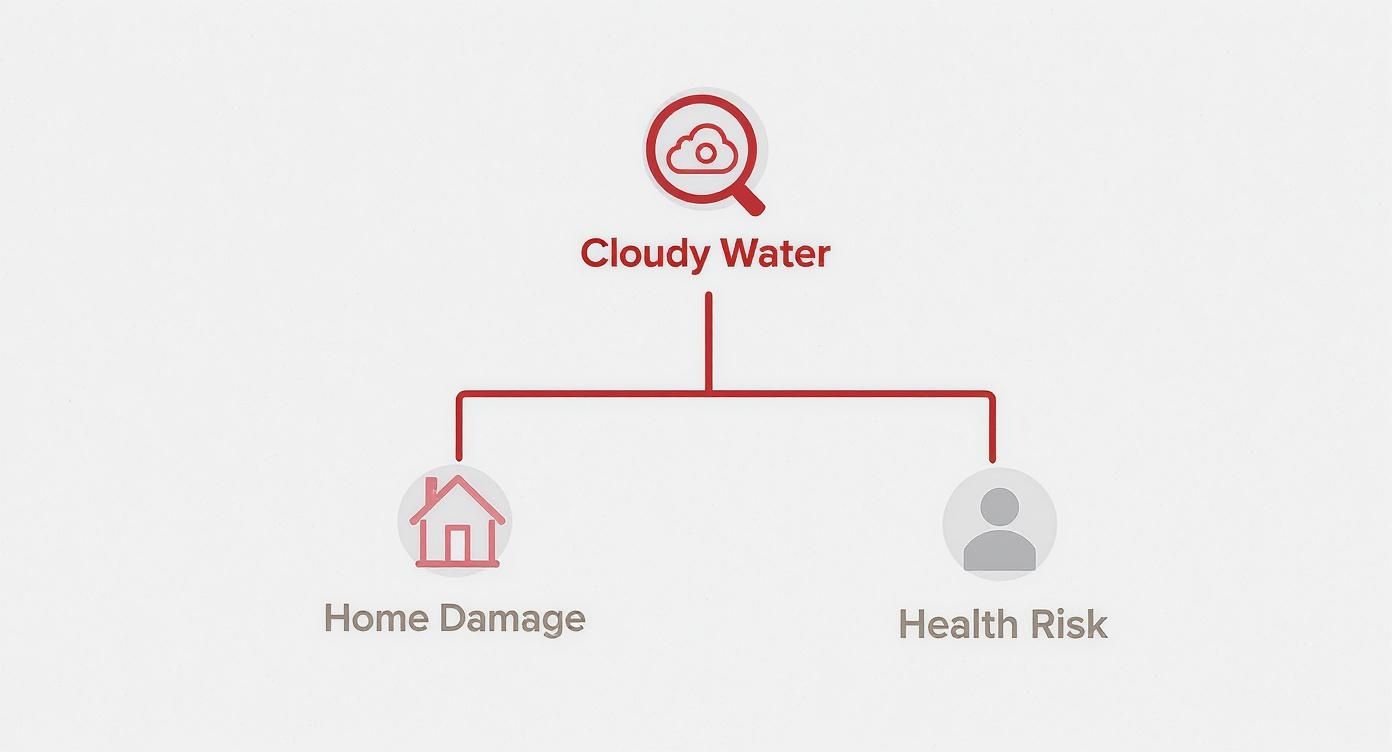
This diagram really drives home what happens when you let sediment problems go unchecked.

Diagram showing cloudy water causing home damage and health risks with magnifying glass icon

As you can see, what starts as cloudy water can quickly spiral into bigger issues for both your home and your health.

Cartridge Filters: The Microscopic Net

Now, if your water is murky with fine silt or clay that just seems to hang there forever, a cartridge filter is what you need. Think of these as a super-fine net. Water is pushed through a pleated or spun material that physically traps tiny particles, letting only the clean water get through.

The key to these filters is the micron rating. A micron is just a microscopic unit of measurement, and the rating on a filter tells you exactly how small of a particle it can catch.

A 100-micron filter is like a pasta strainer—great for catching big, obvious debris. But a 5-micron or 1-micron filter is more like an espresso filter, designed to grab the super-fine particles that make your water look hazy.

Getting the micron rating right is everything. For that fine silt you saw in your test, starting with a 20-micron or 5-micron filter is usually a sweet spot. It's fine enough to clear up the water but not so fine that it clogs up immediately and kills your water pressure.

Creating a Multi-Stage Filtration System

For a lot of well owners, the water has a mix of both heavy sand and fine silt. If that's you, a single filter might not cut it. The real pro move here is to combine filters into a multi-stage system. The most common and effective setup is putting a spin-down filter before a cartridge filter.

This one-two punch is incredibly effective:

  1. The Spin-Down (Pre-Filter): This first filter does all the heavy lifting, grabbing the sand and large grit.
  2. The Cartridge (Polishing Filter): Now that the big stuff is gone, this second filter can easily "polish" the water by trapping the fine silt and clay without getting overwhelmed.

Going this route will make your replacement cartridges last way, way longer, which saves you a ton of hassle and money over time. If you want to dive deeper into different filter setups, feel free to check out our other articles for more in-depth guidance at https://www.waterfilteradvisor.com/advice/.

And remember, your whole-house system is just one piece of the puzzle. Things like maintaining refrigerator water filters are also part of keeping clean water flowing everywhere. By matching the right filtration technology to the specific sediment in your well water, you can build a system that delivers perfectly clear water for years to come.

Installation, Maintenance, and Long-Term Costs

Picking the right filter is a huge step, but what you do next is just as crucial for keeping that water clear and clean for years. It's easy to focus on the upfront price, but thinking about the installation, ongoing upkeep, and the total cost of ownership is what really makes it a smart investment, not just a quick fix for the sediment in your well water.

Let's break down what you can really expect. This will help you budget your time and your money without any surprises down the road.

DIY vs. Professional Installation

First things first: are you going to install this yourself or call in a pro? There’s no single right answer, and it really depends on the filter’s complexity and how comfortable you are with plumbing.

For a lot of handy homeowners, putting in a simple cartridge or spin-down filter is a totally manageable weekend project. You'll likely need to cut into your main water line, fit some new connections, and mount the filter housing. If that sounds like something you can tackle, you could save a few hundred bucks on labor.

But when you get into more advanced systems like backwashing filters, things get tricky. These often involve wiring for the control valve and more complex plumbing. One wrong move could lead to leaks, a drop in water pressure, or a system that just doesn't work right. Hiring a licensed plumber, which usually runs between $300 and $800, buys you peace of mind. They'll get it done right and make sure everything is up to code.

Creating a Maintenance Playbook

Here's the secret to making your filter last: proper maintenance. If you ignore it, it’s like never changing the oil in your car—sooner or later, things are going to grind to a halt. A well-maintained filter doesn't just give you clear water; it protects your home's water pressure, too.

Your maintenance routine will look completely different depending on your filter type:

  • Spin-Down Filters: These are the simplest. Just open the flush valve at the bottom to purge all the gunk it’s collected. If you have a really sandy well, you might do this weekly. For water with less debris, once a month might be fine.
  • Cartridge Filters: The name of the game here is replacing the filter cartridge. The classic tell-tale sign is a noticeable drop in your water pressure. For most homes, you'll be swapping these out every 1-3 months.
  • Backwashing Filters: For the most part, these systems run on autopilot. The control valve will trigger a backwash cycle on its own to flush the media clean. Your only real job is making sure it has power and the drain line isn't blocked. The filter media inside can last a surprisingly long time—often 5 to 10 years—before it needs to be replaced.

Don't just guess when it's time for a filter change. Set a recurring reminder on your phone's calendar. It's a simple habit that protects your investment and keeps your system working like it should.

Understanding Long-Term Costs

When you’re budgeting, it’s critical to look past the sticker price. The true long-term cost is a mix of the initial purchase, the installation, and all the replacement parts you'll need over the years.

A basic cartridge filter system might only set you back $50-$150 to start, but those replacement filters ($20-$60 each) will add up over time. A spin-down filter costs a bit more upfront ($100-$300), but with a reusable screen, it has almost zero ongoing costs.

Backwashing systems carry the biggest initial price tag, often from $600 to over $1,500. But because they're automated and the media lasts for years, their long-term running costs are actually very low. For wells with stubborn, persistent sediment problems, they often end up being the most cost-effective choice. By weighing these factors, you can find the perfect solution for both your water and your wallet.

Your Questions About Well Water Sediment Answered

Figuring out the right filtration strategy can leave you with a few lingering questions. It's totally normal. Dealing with sediment in well water feels like a big job, so it’s smart to get all the facts straight first. Let's tackle some of the most common concerns homeowners run into.

We'll clear up the confusion so you can get the job done with confidence, knowing you’ve covered all the bases for crystal-clear water.

Will a Sediment Filter Reduce My Water Pressure?

This is the number one worry we hear, and for good reason—nobody wants to trade gritty water for a trickle of a shower. Here’s the short answer: a correctly sized and maintained sediment filter will not noticeably tank your water pressure.

Where people run into trouble is when a filter is too small for the home's flow rate, or the micron rating is way too fine for the kind of gunk in their water. Think about it like trying to drain a swimming pool through a coffee filter. It’s just not going to work, and you’ll get a major backup. The same principle applies when a filter gets clogged because it's the wrong type or it hasn't been changed on schedule.

Here’s how to keep your pressure up:

  • Size it right: Make sure the filter's flow rate (gallons per minute, or GPM) matches what your household actually uses at peak times.
  • Use a multi-stage approach: If you're dealing with a lot of sediment, a spin-down pre-filter is your best friend. It catches the big stuff before it ever gets to your finer cartridge filter.
  • Stay on top of maintenance: The minute you notice the pressure dropping, it's time to change that cartridge or flush your system.

What Is the Difference Between a Sediment Filter and a Water Softener?

This is a classic mix-up, but they do completely different jobs. A good way to think about it is that a sediment filter is like a bouncer at a club, while a water softener is more like a chemist.

A sediment filter is a physical barrier. Its only job is to block and trap solid particles—sand, dirt, rust, and other debris. It grabs all the "floaties" to make your water clear.

A water softener, on the other hand, doesn't remove particles at all. It uses a chemical process called ion exchange to target dissolved minerals like calcium and magnesium that make water "hard." Sediment can actually wreck a water softener, which is why you always install a sediment filter before the softener in your water line.

One can't do the other's job. You need a sediment filter for cloudy, gritty water and a water softener if you're fighting hard water stains and scaly buildup.

How Do I Choose the Right Micron Rating?

Picking a micron rating sounds technical, but it doesn't have to be. Just follow this simple rule of thumb: start with a higher micron rating (which is less fine) and only go lower if you need to.

If you can see coarse sand in your water, a 100-micron spin-down filter might be all it takes to solve the problem. For that general cloudy look caused by silt or clay, a 20- to 30-micron cartridge is a fantastic starting point. Only move down to a 5-micron filter if the water still isn't clear enough.

Jumping straight to a super-fine 1-micron filter without any pre-filter is just asking for constant clogs and pressure problems.


Here at Water Filter Advisor, we're all about helping you find a practical solution that actually works for your home. Our detailed guides and honest reviews are designed to cut through the marketing noise, making it easier to choose a system that will deliver clean, safe water for your family. To build the right plan for your well, check out our resources at https://www.waterfilteradvisor.com.

Choosing Well Water Filtration Systems for Your Home

If you're one of the millions of homeowners who gets their water from a private well, you know the freedom that comes with it. No monthly water bill! But you also know the responsibility for that water's quality is 100% on you.

Unlike city water, which is treated before it ever reaches your home, well water is a direct line from the ground to your tap. That means it's up to you to handle whatever comes along for the ride—sediment, iron, nasty bacteria, and even chemicals. A good well water filtration system isn't just a nice-to-have; it's the essential gatekeeper that makes sure your water is safe, clean, and delicious.

Why Your Well Water Needs a Guardian

Image

There's something special about having your own private well. But that independence means you're the one in charge of your water's quality and safety. While the earth does a decent job of filtering water naturally, it’s far from a perfect bouncer.

Whatever is in the ground around your property has a good chance of ending up in your glass. This could be anything from naturally occurring minerals that cause hard water to agricultural runoff or invisible bacteria. This guide is here to give you the know-how to tackle these challenges head-on.

From Murky to Crystal Clear

Think of yourself as becoming your own personal water treatment expert. You’re about to learn the story of your water, from the moment it enters the ground to the second it hits your faucet. We’ll dig into the common culprits behind those frustrating household water problems, like:

  • Aesthetic Issues: Things like that "rotten egg" smell, rust-colored stains ruining your sinks and toilets, or water that just looks cloudy and unappealing.
  • Hidden Dangers: These are the invisible threats you can't see, smell, or taste. We're talking about bacteria, nitrates, arsenic, and other chemicals that can pose serious health risks.
  • Appliance Assassins: Hard water minerals are notorious for building up inside your pipes, water heater, and dishwasher. This limescale buildup chokes their efficiency and shortens their lifespan.

Managing your well water isn't about just buying a random filter. It's about building a custom defense system designed specifically for your water's unique chemistry. This guide is your blueprint.

Once you understand what's really in your well water, you can confidently choose the right well water filtration systems to protect your home and family. We'll walk you through everything—from testing your water to picking, installing, and maintaining the perfect setup—so every drop is pure, safe, and tastes fantastic.

What Is Hiding in Your Well Water?

Before you can even think about choosing a well water filtration system, you first have to know what you’re up against. Think of your well water as its own little ecosystem. While it's mostly pure, it almost always has a few uninvited guests from the surrounding earth, and these intruders fall into a few distinct categories.

Figuring out what's in your water is the most important first step. You wouldn’t buy a home security system without knowing if you’re trying to stop a raccoon or a burglar, right? The same logic applies here. A professional water test is your reconnaissance mission, giving you the intel you need to build the right defense.

The Physical Intruders You Can See

First up are the things you can actually see—the particles and debris that make your water look cloudy or just plain dirty. These are usually the easiest problems to spot and are often the first thing a good filtration setup tackles.

Think of your well as a giant underground reservoir. As rainwater trickles down through soil and rock to fill it, it picks up tiny hitchhikers along the way. These often include:

  • Sediment, Silt, and Sand: These are the fine bits of dirt and rock that cause cloudiness, a quality known as turbidity. They don't just look bad; they can clog up your pipes, wear out appliance parts, and settle at the bottom of your water heater, making it work harder and less efficiently.
  • Rust and Iron Particles: Seeing orange or reddish-brown stains in your sinks, toilets, or laundry? That’s a dead giveaway for iron. It’s a super common mineral in groundwater that can also give your water a metallic taste.

These physical bits are more than just an eyesore. They provide perfect hiding spots for bacteria and can gum up the works for more advanced filters, like UV purifiers. This is exactly why a simple sediment filter is almost always the first component in any well water system.

To help you get a better handle on what might be lurking, here’s a quick guide to connect the dots between what you see, smell, or taste and the likely culprit.

Common Well Water Contaminants and Their Signs

Contaminant Type Common Examples Potential Signs in Your Home
Physical Sediment, Silt, Sand, Rust Cloudy or murky water, orange/brown stains on fixtures and laundry, gritty texture.
Chemical Calcium & Magnesium (Hardness) Soap scum, mineral buildup (limescale) on faucets, poor soap lather, stiff laundry.
Chemical Hydrogen Sulfide A distinct "rotten egg" smell, especially from hot water.
Chemical Heavy Metals (Arsenic, Lead) Often tasteless, colorless, and odorless. Requires a lab test to detect.
Biological Bacteria (E. coli, Coliform) Also tasteless, colorless, and odorless. Can cause stomach issues or illness.

This table is just a starting point. While some issues are obvious, many of the most serious contaminants are completely invisible, which is why a professional lab test is non-negotiable for well owners.

The Invisible Chemical Threats

Next, we have the chemical contaminants. These are dissolved substances you often can't see, taste, or smell, which is what makes them so tricky. They can seep into groundwater from all sorts of places, like farm runoff, industrial pollution, or even just the natural rocks in your area.

For well owners, this is a huge deal. The whole reason filtration became popular was because of concerns over contamination in private water sources. Globally, around 2 billion people drink from sources contaminated with feces, a stark reminder of the health risks of untreated water. Here in the United States, about 15% of the population gets their water from private wells, which aren't regulated by the EPA like city water. This leaves the responsibility for safety squarely on the homeowner. You can discover more insights about the global water filter market and its growth drivers over on openpr.com.

Some of the most common chemical culprits are:

  • Nitrates and Nitrites: These usually come from fertilizers or leaky septic systems. High nitrate levels are a serious health risk, particularly for infants.
  • Heavy Metals: Arsenic, lead, and mercury can leach into groundwater from natural mineral deposits or industrial activity. Long-term exposure can cause severe health problems.
  • Hardness Minerals: Calcium and magnesium are the duo responsible for hard water. While not a health hazard, they cause limescale buildup that wreaks havoc on your pipes, appliances, and even your skin and hair.
  • Hydrogen Sulfide: This is the gas that produces that awful "rotten egg" smell. It's created by harmless bacteria in the ground, but it can make your water completely undrinkable.

A comprehensive water test is the only way to uncover these hidden chemical threats. Without one, you’re just guessing at what your water needs, which can be an expensive and ineffective gamble.

The Biological Contaminants

Finally, we get to the biological contaminants—the living microorganisms that can make you sick. Because well water isn't treated with chlorine like city water, it’s a potential breeding ground for bacteria and viruses that get in from animal waste or failing septic tanks.

These microscopic invaders include:

  • Bacteria: E. coli and coliform bacteria are the big ones. Their presence is a strong indicator that your well has been contaminated with fecal matter, which means other nasty, disease-causing pathogens could be in there too.
  • Viruses and Protozoa: Organisms like Giardia and Cryptosporidium are notorious for causing severe gastrointestinal illness.

You can't see, smell, or taste these organisms, so a specific test for bacteria is absolutely critical. This is the one area you can’t afford to mess around with, making a UV purifier or another disinfection system a must-have for many well owners.

Alright, you've got the results from your water test. Think of that report as a scouting report on the enemy. Now, it's time to build your dream team of filters to defend your home's water supply.

Choosing the right well water filtration systems isn't a one-size-fits-all deal. It's more like putting together a special ops team—each filter has a specific job, a unique skill set designed to take out a particular contaminant. It's rare that a single, magic-bullet filter will solve all your well water woes. That's why the most effective setups are multi-stage, layering different technologies to create an impenetrable defense.

You wouldn't ask the bouncer checking IDs at the door (your sediment filter) to deal with an invisible threat like bacteria, right? You need layers. Each part of the system has its role, working in concert to deliver clean, safe water from the moment it enters your house. This approach guarantees total protection, from chunky sand and silt down to microscopic germs you can't even see.

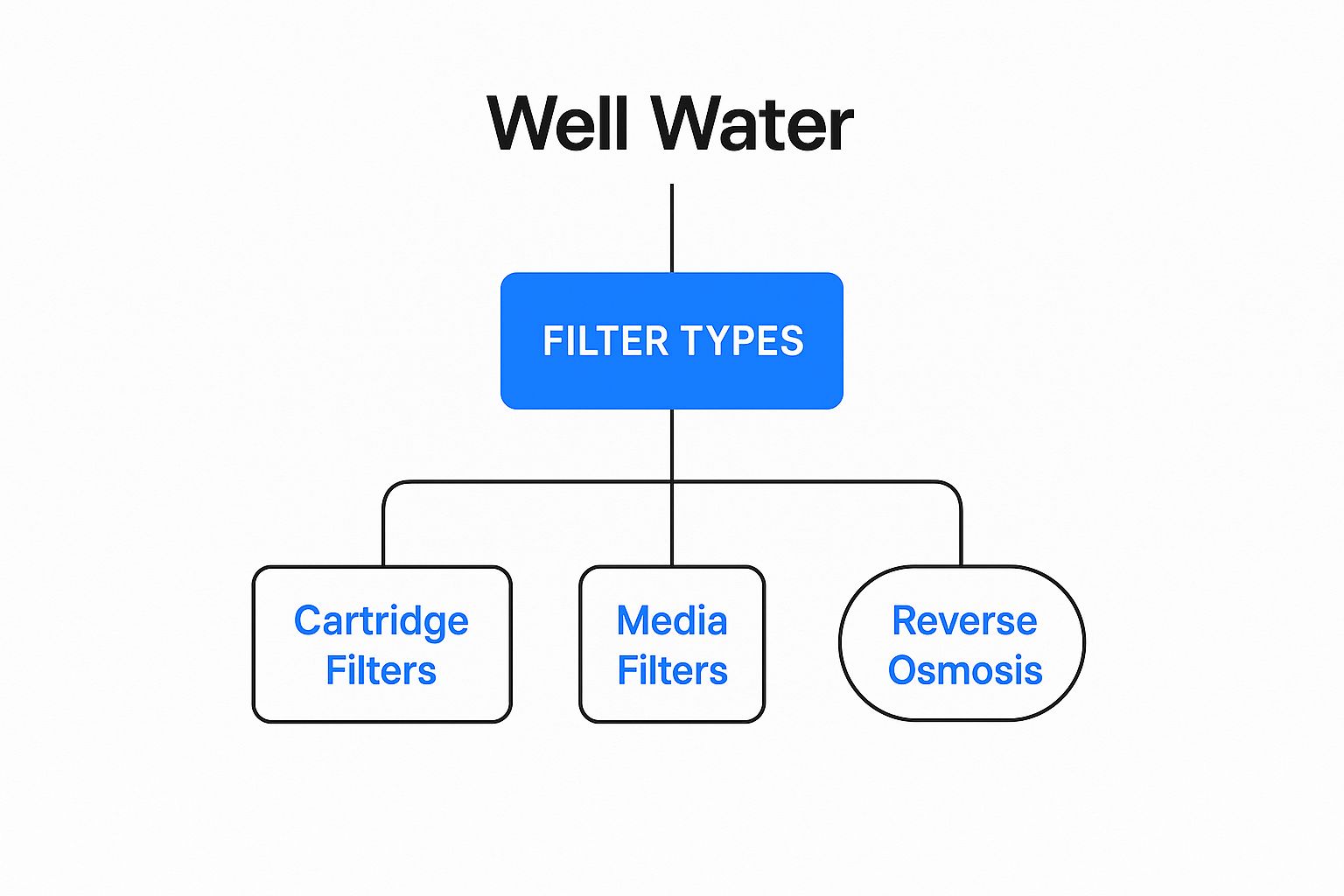
This diagram gives you a bird's-eye view of the main categories of well water filters, showing how they all fit together.

Image

As you can see, a solid strategy will likely mix and match a few of these types to get the job done right.

The Frontline Defender: Sediment Filters

Every great well water system kicks off with a sediment filter. This is your first line of defense, the bouncer at the door whose job is to stop the big, clumsy invaders before they gum up the works. Its mission is simple but absolutely critical: catch all the physical junk like sand, dirt, silt, and rust flakes.

Think of it like a screen on your window—it lets the fresh air (water) in but keeps the bugs (sediment) out. By trapping all that debris right at the start, a sediment filter not only clears up cloudy water but also acts as a bodyguard for the more delicate and expensive filters down the line. This one simple step can dramatically boost the lifespan and performance of your entire system.

The Taste and Odor Specialist: Carbon Filters

Next in the lineup is the activated carbon filter. This is your specialist, the one you call in to handle chemical contaminants and get rid of funky tastes and smells. If your water has that swimming pool chlorine odor or a weird, earthy taste, this is your hero.

The secret is its ridiculously huge internal surface area, made up of millions of microscopic pores. These pores work like a magnet for chemicals, snagging things like chlorine, pesticides, and volatile organic compounds (VOCs) through a process called adsorption. It’s the MVP for turning murky, smelly water into something that tastes crisp, clean, and refreshing.

The Mineral Manager: Water Softeners

Did your water report come back with high levels of calcium and magnesium? If so, you've got hard water. That's where a water softener steps in. Now, it's not technically a "filter" in the traditional sense; it's more of a water conditioner. Its job is to stop mineral buildup—that crusty limescale that wreaks havoc on your appliances and leaves soap scum all over your shower.

A water softener uses a clever process called ion exchange. It literally swaps out the "hard" mineral ions (calcium and magnesium) for "soft" sodium ions. This simple trade prevents scale from ever forming in your pipes, water heater, and dishwasher.

This system is your best defense against the costly damage hard water can cause, especially to appliances like water heaters, which can fail years ahead of schedule without one.

The Heavy-Duty Brawler: Iron and Sulfur Filters

For those wells cursed with rusty orange stains and that distinct "rotten egg" smell, you need to bring in the heavy hitters. Iron filters and air-injection oxidizing (AIO) systems are the specialized brawlers built to knock out high concentrations of iron, manganese, and hydrogen sulfide gas.

These systems work by oxidizing the dissolved troublemakers, which basically forces them to turn into solid particles. Once they're solid, the filter media can easily grab and flush them away, getting rid of those ugly stains and nasty smells for good. This targeted attack is way more effective than hoping a standard carbon filter or softener can handle a serious iron or sulfur problem.

The Microbial Assassin: UV Purifiers

If your water test flagged bacteria, coliform, E. coli, or other living critters, you need a surefire way to neutralize them. A UV purifier is the silent assassin for these biological threats. The best part? It doesn't add a single chemical to your water or alter its taste.

It uses a powerful ultraviolet lamp that zaps any water flowing past it. This UV light scrambles the DNA of bacteria, viruses, and other microorganisms, making it impossible for them to reproduce and cause harm. It’s a clean, highly effective final barrier that ensures your water is biologically safe to drink.

The Ultimate Purifier: Reverse Osmosis Systems

Finally, when you want the absolute highest level of purity for your drinking and cooking water, you bring in the special forces: reverse osmosis (RO). An RO system uses a super-fine, semi-permeable membrane to strip out up to 99% of all dissolved solids.

It forces water through this membrane, which is so tight it blocks nearly everything that isn't a pure water molecule. We're talking heavy metals like lead and arsenic, plus nitrates, fluoride, and salts. Because this purification process is slow and meticulous, RO systems are usually installed at a single tap—like under the kitchen sink—to provide a dedicated source of incredibly pure water right where you use it most.

How to Choose the Right Filtration System

Image

Alright, you’ve got your water test results back. Now the real fun begins. This is where you put on your detective hat and figure out exactly what your water needs to be clean, safe, and great-tasting.

Choosing the right well water filtration system isn’t about buying the most expensive gear you can find. It’s about a smart, targeted approach based on what’s actually in your water, how much of it you use, and where you need it most. Your water test is your road map—let’s use it to build the perfect solution for your home.

Decode Your Water Test and Match the Filter

Think of your water test as a diagnostic report for your well. It tells you exactly what you’re up against. Are sediment levels high? Is iron turning your fixtures orange? Your job is to match each problem with the right tool.

Here’s a simple way to break it down:

  • High Sediment or Turbidity: If your water looks cloudy, a sediment pre-filter is non-negotiable. This is always your first line of defense, catching all the dirt, sand, and rust before it can clog up the rest of your system.
  • Elevated Iron or Manganese: Seeing those classic orange or black stains? You’ll probably need a dedicated iron filter or an air-injection oxidizing (AIO) system. A water softener alone just can't keep up with heavy iron.
  • Positive for Bacteria (E. coli, Coliform): This is a serious health concern that needs an immediate fix. A UV purification system is your best bet here. It zaps bacteria and viruses with ultraviolet light, making your water biologically safe without adding any chemicals.
  • Hard Water Minerals (Calcium & Magnesium): If you're tired of limescale buildup on your faucets and appliances, a water softener is the clear winner. It's the only way to truly tackle hardness.

Make a checklist from your water report. For every contaminant you find, you'll want a specific filter stage designed to remove it.

Calculate Your Household's Flow Rate

Here's a detail that's easy to miss but can make or break your system: flow rate. Measured in gallons per minute (GPM), this tells you how much water your system can process at once. Get this wrong, and you'll be dealing with a frustrating trickle every time someone flushes a toilet while the shower is running.

You don't want your filter system to become a bottleneck. A system that's too small for your home will choke your water pressure.

To get a rough idea, just add up the GPM of the fixtures you might use at the same time. A shower is about 2.5 GPM, a toilet can be 2.2 GPM, and a sink faucet is around 1.5 GPM. For a typical family of four, a system that can handle 10-15 GPM is a pretty safe bet to keep the pressure strong everywhere.

Picking a system with a flow rate that meets or slightly beats your home's peak demand is the single best way to guarantee you never have to worry about weak water pressure again.

Point of Entry vs. Point of Use Systems

The last big decision is where you need the filtered water. Do you want to treat every drop coming into your house, or just the water at a specific tap? This leads you to two main categories: Point-of-Entry (POE) and Point-of-Use (POU).

Deciding between a whole-house system and a single-tap filter really comes down to the scope of your water problems and your end goals. Are you trying to protect your entire plumbing system or just purify your drinking water? Here's a quick comparison to help you think it through.

Point-of-Entry (POE) vs. Point-of-Use (POU) Systems

Feature Point-of-Entry (Whole House) Point-of-Use (Single Tap)
Location Installed at the main water line. Installed at a single fixture (e.g., under the kitchen sink).
Treatment Scope Treats all water entering the home. Treats water for one specific tap or appliance.
Best For Widespread issues: hardness, sediment, iron, general chemicals. Targeted issues: lead, chlorine, cysts, specific taste/odor problems.
Primary Benefit Protects plumbing, appliances, skin, and hair. Provides highly purified water for drinking and cooking.
Typical Cost Higher initial investment. Lower initial cost.
Maintenance Less frequent, but larger filter changes. More frequent, but smaller and easier filter changes.

Ultimately, a whole-house POE system offers a comprehensive solution, safeguarding your entire home. The global market for these systems was valued at $10.17 billion and is expected to keep growing as more people become aware of well water contaminants.

On the other hand, POU systems like an under-sink reverse osmosis unit are fantastic for getting ultra-pure water right where you need it most—your kitchen. They are an excellent, budget-friendly way to target drinking water quality without overhauling your entire plumbing setup.

Getting It Installed and Keeping It Running

Image

You’ve picked out the perfect filtration system for your well. Awesome. But now comes the part that makes it all work: getting it installed right and setting up a simple plan to keep it that way.

Think of your new system like a car you just drove off the lot. The installation is like making sure the engine is seated correctly, but the routine maintenance—the oil changes and filter swaps—is what keeps it from breaking down on the side of the road. Neglect this part, and you’re just asking for trouble.

DIY vs. Calling in a Pro

First up, you need to decide if you’re going to tackle the installation yourself or hire a professional. It's a big decision. While a lot of us love a good weekend project, a botched plumbing job can quickly turn into leaks, water damage, or a system that doesn't filter anything at all.

Installing a simple under-sink filter is usually something you can handle on your own. But a whole-house system with multiple tanks? That's a whole different ballgame. It means cutting into your main water line, and that requires some serious skill and confidence.

Ask yourself these questions:

  • How complex is this thing? Is it a single filter cartridge, or a multi-stage setup with a UV light that needs wiring?
  • What are my plumbing skills, really? Are you comfortable cutting pipe, sweating copper fittings, and knowing for sure it won't leak?
  • Do I have the right tools? We're talking pipe cutters, multiple wrenches, maybe even PEX crimpers.
  • What does the warranty say? Some manufacturers will void the warranty unless a licensed professional installs the system.

If you’re hesitating on any of those, just call a plumber. The cost of a professional install—often a few hundred to over a thousand dollars—is a small price to pay for the peace of mind that it’s done right.

Your Maintenance Playbook

Once your system is up and running, a little bit of proactive care is your best friend. Filters are designed to catch gunk, which means eventually, they get full. A clogged filter is not only useless, but it can also tank your home’s water pressure.

Think of your maintenance schedule as the playbook for your system's health. It turns these little tasks into simple habits, stopping small issues before they become big, expensive headaches.

The idea is to get into a routine. A good way to stay on top of everything is to use a preventive maintenance schedule template to track what needs to be done and when. No more guessing.

Here’s a general guide for what your schedule might look like:

  1. Sediment Pre-Filter: This is your first line of defense and gets dirty the fastest. Plan on swapping this out every 3-6 months, depending on how much sediment is in your water.
  2. Carbon Filters: These filters typically need to be replaced every 6-12 months. Always double-check the manufacturer's recommendation.
  3. Reverse Osmosis (RO) Membranes: The main RO membrane is a long-hauler and can last 2-5 years. But don't forget its pre-filters and post-filters—those still need to be changed every 6-12 months.
  4. UV Purifier Lamp: A UV bulb needs to be replaced every single year. It might still light up after 12 months, but its germ-killing intensity fades, leaving your water vulnerable.
  5. Water Softener Salt: This isn’t a replacement, just a refill. Peek inside the brine tank once a month and top it off with salt pellets as needed.

Jot these dates down in a calendar or set reminders on your phone. Sticking to a schedule is the single most important thing you can do to protect your investment and keep your water clean and safe for years to come.

Your Top Well Water Filtration Questions Answered

Stepping into the world of well water filtration can feel like learning a new language. You've got questions, and we've got straightforward answers from our years of experience. Let's tackle some of the most common ones homeowners ask.

How Often Should I Test My Well Water?

Think of it like an annual check-up for your water. At a minimum, you should test your well water once a year for the usual suspects like bacteria and nitrates.

But you also have to be your own first line of defense. If you ever notice a sudden change in the taste, smell, or even the color of your water, get it tested right away. It's also a smart move to do a more comprehensive test for things like heavy metals and pesticides every 3-5 years. You never know when something deep in the ground has shifted, and it's always better to be safe.

Can a Single Filter Solve All My Well Water Problems?

That’s a common hope, but unfortunately, it’s not realistic. Well water is rarely a one-problem situation; you're usually dealing with a cocktail of sediment, hard minerals, and maybe even some unseen biological contaminants.

Since most filters are built to do one job really well, a single filter just can't handle that kind of complexity. This is exactly why multi-stage systems are the gold standard. A setup that combines a sediment filter, a carbon filter, and a UV purifier creates a powerful, layered defense that addresses everything in turn.

A layered filtration strategy is the key. Each stage acts as a specialist, working with the others to remove a wide range of contaminants, ensuring the water is thoroughly treated before it reaches your tap.

A properly installed system shouldn't crush your water pressure. If you notice a serious drop, it's almost always one of two things: either your filters are clogged and screaming for a replacement, or the system itself is too small for your home's needs. Always check the flow rate (measured in gallons per minute) and make sure it can keep up with your family’s peak water usage.

Looking for more info? You might find answers in these additional Well Water FAQs.


Ready to ensure every drop from your well is clean and safe? The experts at Water Filter Advisor provide in-depth guides and unbiased reviews to help you confidently choose the perfect system for your home. Explore our resources and make the right decision for your family's water at https://www.waterfilteradvisor.com.

Article created using Outrank