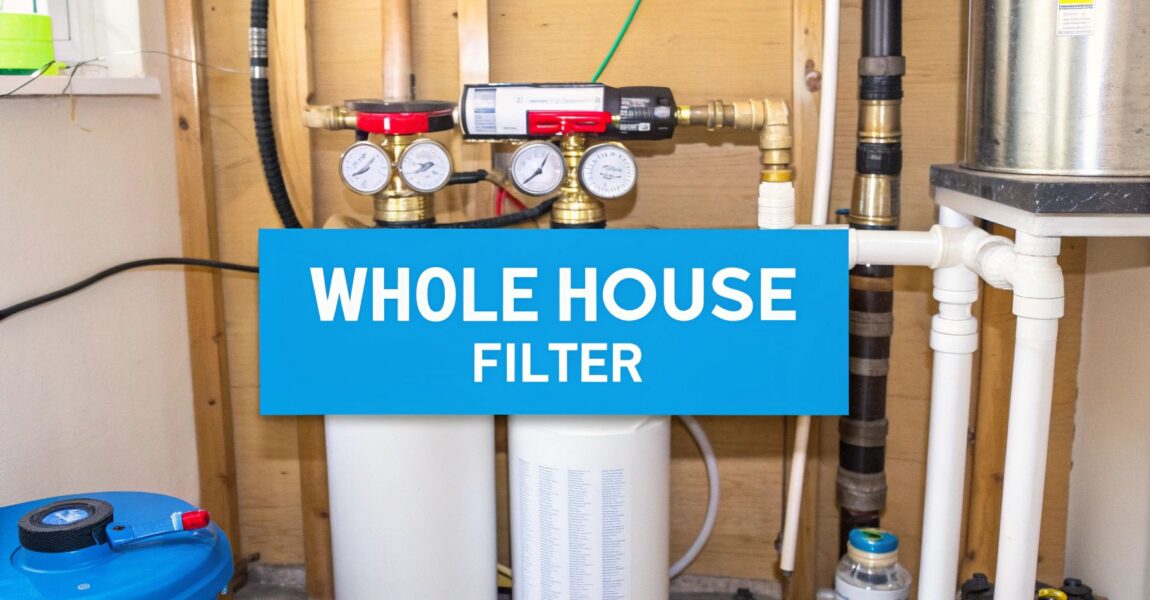
DIY Whole House Water Filter System: Your Complete Install Guide

Taking on a DIY whole house water filter system is a seriously satisfying project, and it's far more achievable than you might think. This guide is your complete game plan, walking you through everything from figuring out what's lurking in your water to getting your system installed and flowing. No confusing jargon here—just the practical, hands-on steps you need to build the perfect water purification fortress for your home.

Your Blueprint for Pure Water in Every Faucet
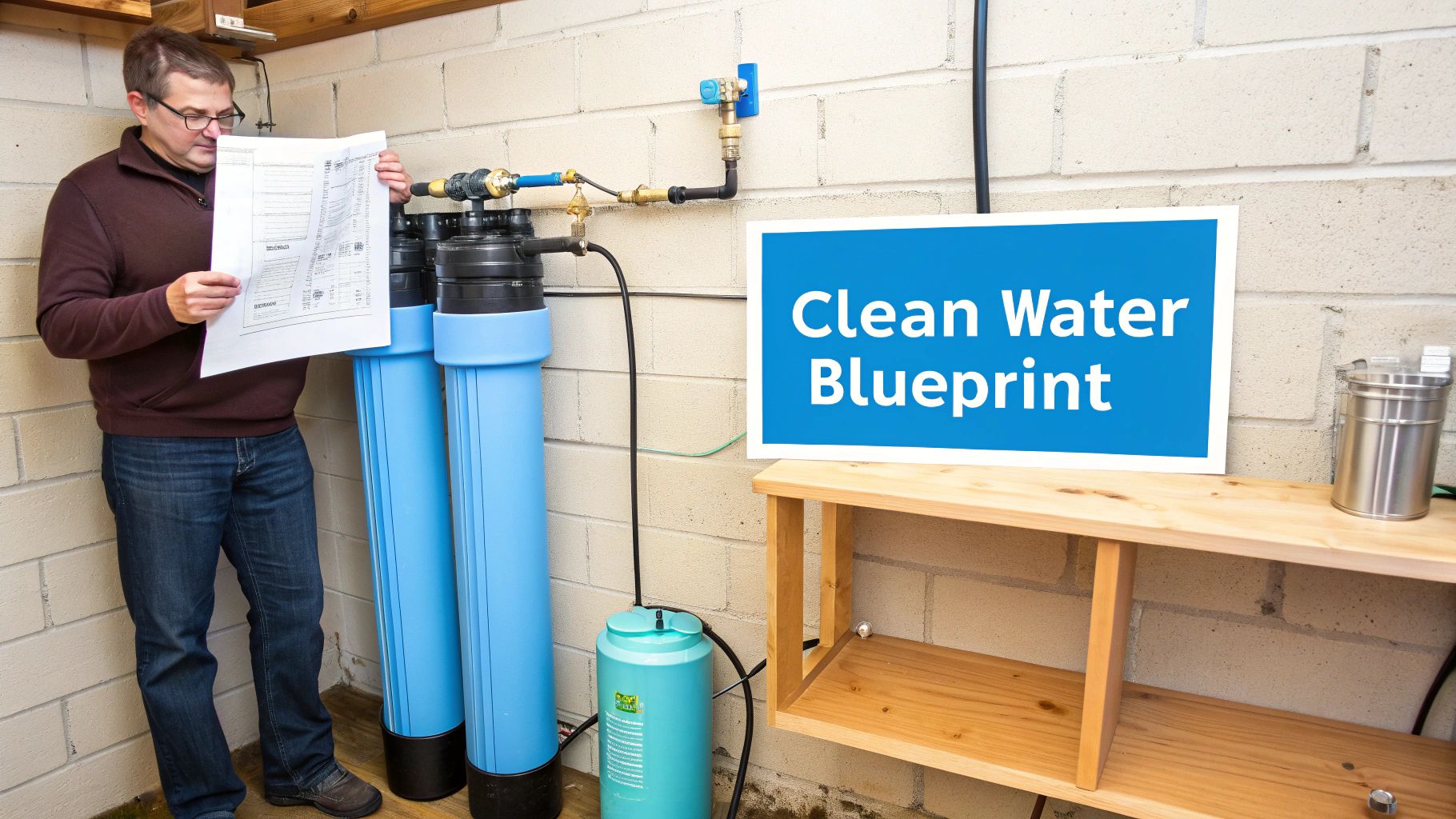
A man reviews a blueprint next to a DIY whole house water filter system with blue tanks.

When you decide to go the DIY route for your water filtration, you're the master of your water's destiny. You get to build a setup that's perfectly dialed in for your home's unique water challenges. Whether you're on city water or a private well, a whole house system—often called a point-of-entry (POE) system—purifies every single drop of water coming into your house.

That means pristine water from every tap, from the kitchen sink where you fill your glass to the shower that starts your day. And the benefits go way beyond just better-tasting water.

Why Go with a Whole House System?

Installing a system that treats all your water offers some major advantages that those little pitcher filters just can't touch. By catching contaminants right at the source, you're protecting your entire home's plumbing from the inside out.

  • Protect Your Appliances: Sediment, chlorine, and hard water minerals can be assassins for your water heater, dishwasher, and washing machine, causing them to fail prematurely. A whole house filter is like a personal bodyguard for these expensive appliances.
  • Healthier Showers: Your skin and hair can absorb chemicals like chlorine during a hot shower. Filtering that water can lead to softer skin, shinier hair, and less irritation.
  • Improved Taste and Odor: Say goodbye to common culprits behind funky tastes and smells, like chlorine or sulfur. You’ll have crisp, clean water for drinking, cooking, and making that perfect cup of coffee.
  • Peace of Mind: There's nothing like knowing your family is protected from a whole range of potential contaminants—think lead, pesticides, and industrial chemicals that can slip through municipal treatment.

This proactive approach to water quality is catching on. The global home water filtration market, valued at USD 20.8 billion in 2025, is expected to surge to USD 35.7 billion by 2035. This huge jump is fueled by growing concerns over contaminants like PFAS and lead. The DIY option is particularly popular because it eliminates the high installation costs that deter nearly half of homeowners. You can discover more insights about the home water filtration market and its growth.

A DIY whole house water filter system isn't just another weekend project; it's a powerful investment in your family’s health and the longevity of your home's plumbing. By handling the install yourself, you gain complete control over your water quality and save a significant amount of money.

What's Really Lurking In Your Water?
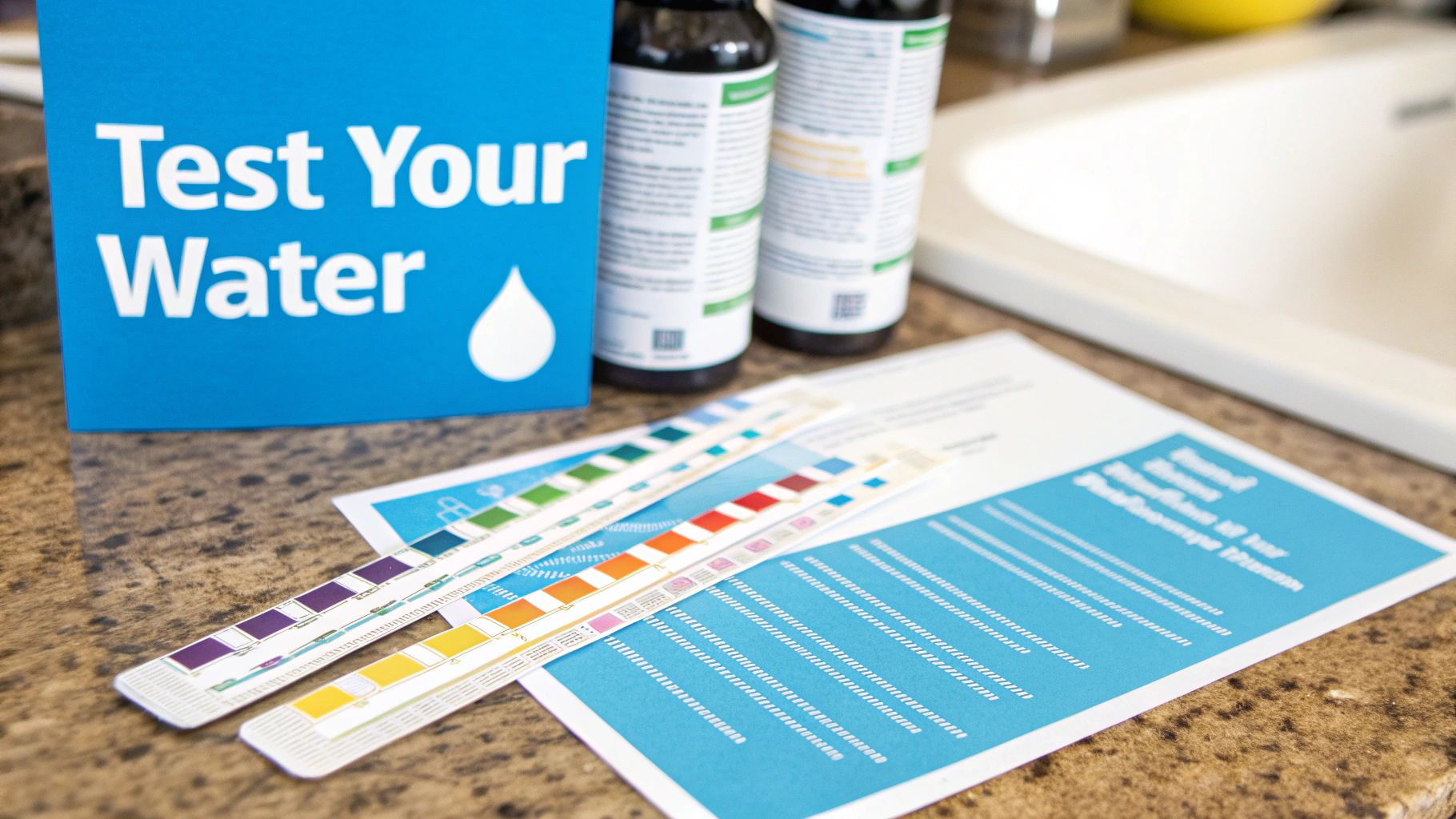
A blue 'Test Your Water' sign stands beside water testing strips and reagent bottles on a kitchen counter near a sink.

Before you buy a single fitting or cut a single pipe, you have to play water detective. The single biggest mistake people make with a DIY whole house water filter system is guessing what they need to filter out.

Building a system without knowing what’s in your water is like trying to cook a gourmet meal blindfolded. You'll likely use the wrong ingredients and end up with an expensive mess.

Your water gives you clues every day. That faint swimming pool smell in the shower? That’s chlorine. Those frustrating reddish-brown stains in the toilet bowl? Almost certainly iron. These signs are a good start, but you need hard data to build a filtration strategy that truly works.

First Stop: Your City's Water Report

If you’re on city water, you have a powerful and free tool at your disposal: the Consumer Confidence Report (CCR). Your local water utility is legally required to publish this annually. It details what contaminants they found, at what levels, and how those numbers compare to EPA safety standards.

You can usually find your CCR on your utility’s website by searching for "[Your City Name] water quality report." It can look a bit technical, but focus on common players like chlorine, lead, haloacetic acids (HAA5), and total trihalomethanes (TTHMs)—these are typical byproducts of disinfection. This report is your starting blueprint.

Remember, the city’s report shows water quality as it leaves their plant. It doesn't account for contaminants the water might pick up on its journey through miles of pipes to your home—like lead from old service lines.

Digging Deeper with Home and Lab Testing

For well water users—and anyone on city water who wants the complete picture—testing is non-negotiable. You have a couple of options.

  • At-Home Test Strips: These are the quick-and-easy option. They’re inexpensive and give you an instant reading for basics like chlorine, pH, and water hardness. They're great for a quick snapshot but lack the precision for serious contaminants.
  • Lab Analysis Kits: This is the gold standard. You buy a kit, collect a water sample, and mail it to a certified lab. In return, you get a detailed report showing the exact levels of heavy metals, VOCs, bacteria, and much more. If you're on a private well, this is an absolute must.

Identifying the Usual Suspects

With your test results in hand, you can connect the dots and choose the right filtration solutions. Here are the common culprits and what they mean for your home.

The Common Contaminants Table

Contaminant Common Signs & Symptoms Primary Concern
Chlorine Swimming pool smell, dry skin/hair after showering. Taste, odor, and potential formation of harmful byproducts.
Hardness Minerals White, crusty scale on fixtures; soap scum; dull clothes. Damage to plumbing and appliances; inefficient soap usage.
Iron Reddish-brown stains on sinks and laundry; metallic taste. Staining, potential for pipe buildup, and unpleasant taste.
Sediment Cloudy or murky water; grit in your tap aerators. Clogs pipes and appliances; can carry other contaminants.
Lead Odorless, tasteless, and colorless. Only detectable via testing. Serious health risks, especially for children.
VOCs Can have a chemical or gasoline-like odor in high concentrations. Wide range of health effects depending on the specific chemical.

Armed with this data, you’re no longer guessing. You're making an informed decision, ready to pick the specific filters that will solve your unique water problems. This evidence-based approach is the foundation of a successful DIY whole house water filter system.

Choosing Your Filtration Arsenal

Alright, you've got your water test results. The mystery is solved. Now for the fun part: choosing the hardware to battle whatever is lurking in your pipes. This is where you architect a diy whole house water filter system that’s custom-built for your water.

It’s easy to get lost in the sea of filter types and technical jargon. But don't worry. Think of it like assembling a team of superheroes—each filter has a specific power, and you just need to pick the right heroes for your situation.

The Core Components of Your System

Most whole house setups aren't a single magic bullet; they're a series of filters working in sequence, with each stage tackling a different class of contaminants. Let's break down the key players.

  • Sediment Filters: This is your non-negotiable first line of defense. A sediment filter is a mechanical screen that snags physical gunk like dirt, sand, rust, and silt. Placing this filter first is crucial; it protects the more delicate and expensive filters downstream from getting clogged with debris.
  • Carbon Filters: These are the undisputed champions of water filtration. Granular Activated Carbon (GAC) is incredible at adsorbing chemical contaminants. Its main job is to remove chlorine, which dramatically improves the taste and smell of city water. Carbon also excels at tackling volatile organic compounds (VOCs) and other chemicals. If your water utility uses chloramine, look for catalytic carbon, which is specially designed to break it down.
  • Specialized Media Filters: For specific problems, you need a specialist. If your tests show heavy metals like lead or mercury, you'll need a filter with media like KDF (Kinetic Degradation Fluxion). This alloy media uses a chemical process to remove those heavy metals and also inhibits bacteria growth within the filter.
  • Water Softeners or Conditioners: If you're battling hard water—those stubborn white, crusty deposits on your faucets and shower doors—a water softener is the definitive solution. These systems use ion exchange to physically remove hardness minerals (calcium and magnesium), protecting your plumbing and appliances from destructive scale buildup.

Matching Filtration Media to Your Water Problems

Here’s a quick-reference table to help you match the most common water issues with the right filtration media.

Filtration Media and Contaminant Targets

Contaminant Type Common Examples Primary Filtration Media Best For
Physical Particulates Dirt, Sand, Rust, Silt Sediment Filter (Spun or Pleated) The first stage of any system; protects other filters from clogging.
Chemical Disinfectants Chlorine, Chloramines Activated Carbon (GAC, Catalytic) Improving taste and odor; removing synthetic chemicals and VOCs.
Heavy Metals Lead, Mercury, Iron KDF, Activated Alumina, Manganese Greensand Targeted removal of specific metals; often used for well water.
Hardness Minerals Calcium, Magnesium Ion Exchange Resin (Water Softener) Preventing scale buildup and protecting pipes and appliances.
Microbiological Bacteria, Viruses, Cysts UV (Ultraviolet) Purifier Disinfecting water without chemicals; essential for untreated well water.

Choosing the right system isn't about buying the most expensive setup. It’s about a targeted, intelligent approach. You use your water test results to assemble the exact team of filters needed to solve your specific problems—nothing more, nothing less.

Sizing Your System to Avoid a Pressure Catastrophe

This is one of the most critical steps, and it’s where many DIY projects go wrong. Sizing isn't just about fitting the system in your basement; it's about ensuring it can keep up with your family's water demand. Get this wrong, and you'll suffer the ultimate frustration: a weak, dribbling shower.

The key metric is Gallons Per Minute (GPM), which measures the system's flow rate.

An undersized system creates a bottleneck, unable to treat water fast enough. Ever tried to shower while the washing machine is running, only to have the pressure drop to a pathetic trickle? That’s the classic sign of an undersized system.

To figure out your needs, add up the flow rates of all the fixtures you might use simultaneously:

  • Standard shower: ~2.5 GPM
  • Dishwasher: ~2 GPM
  • Washing machine: ~2 GPM

With all three running, you’d need a system that can handle at least 6.5 GPM. For most families, a system rated for 10-15 GPM provides a safe buffer.

Equally important is the port size on the filter housings. Always choose 1-inch ports. The slightly cheaper ¾-inch options are a trap. That extra quarter-inch makes a massive difference in flow capacity and is your best insurance against pressure loss. The technology is similar to how different air purification systems target specific pollutants; different water filtration media are designed for specific water contaminants.

The Hands-On Installation Process

Alright, you’ve done the research, tested your water, and selected your filtration arsenal. Now comes the exciting part: getting your hands dirty and installing your DIY whole house water filter system. This is where your planning pays off, and it’s a completely manageable project for anyone with some basic confidence and the right tools.

This isn't just about connecting a few pipes. It's about building a reliable system that will serve you for years. Let's walk through the process, from prepping your workspace to the final victory of turning the water back on.

Your Pre-Installation Checklist

A smooth installation begins before you ever touch a pipe. Getting organized now will save you from frustration and those dreaded mid-project trips to the hardware store.

First, let's gather your tools and materials:

  • Pipe Cutters: Ensure you have the right type for your pipes—a tubing cutter for copper or a specialized shear cutter for PEX.
  • Wrenches: A couple of adjustable pipe wrenches are essential for tightening fittings.
  • Deburring Tool: Don't skip this. This gadget cleans the inside and outside of a cut pipe, which is critical for a perfect, leak-free seal.
  • Tape Measure & Marker: The classic rule: measure twice, cut once.
  • Bucket & Towels: Water will come out of the lines when you cut them. Be prepared.
  • Fittings: Whether using push-to-connect, compression, or threaded fittings, always buy a few extras.

With your gear ready, the next step is the most important: safety.

Safety First, Always: Before you do anything, find your home's main water shutoff valve and turn it off completely. Inform everyone in the house not to use any faucets. Also, kill the power to your electric water heater at the breaker box to prevent the heating elements from burning out.

Planning Your Layout and Bypass Loop

Now, let's determine the system's location. It must be installed on the main water line, immediately after the shutoff valve and water meter, but before the line splits off to the water heater or other fixtures. This ensures every drop of water entering your house is filtered.

Here’s a pro tip that will make future maintenance a breeze: build a bypass loop. A bypass is a simple three-valve arrangement that lets you route water around the filter system.

Why is this so critical? When it’s time to change filters, you simply close the valves to the filter and open the bypass valve. Water is instantly restored to your house. This means you can perform maintenance without being rushed. It’s a small amount of extra work upfront that pays off immensely.

Even if you’re new to plumbing, reviewing a step-by-step plumbing installation guide for a simpler project can give you confidence in working with home water lines.

Making the Cut and Installing the System

The main water is off. Open the lowest faucet in your house (like a basement sink) and one on the top floor to drain most of the water from the pipes. Now you're ready.
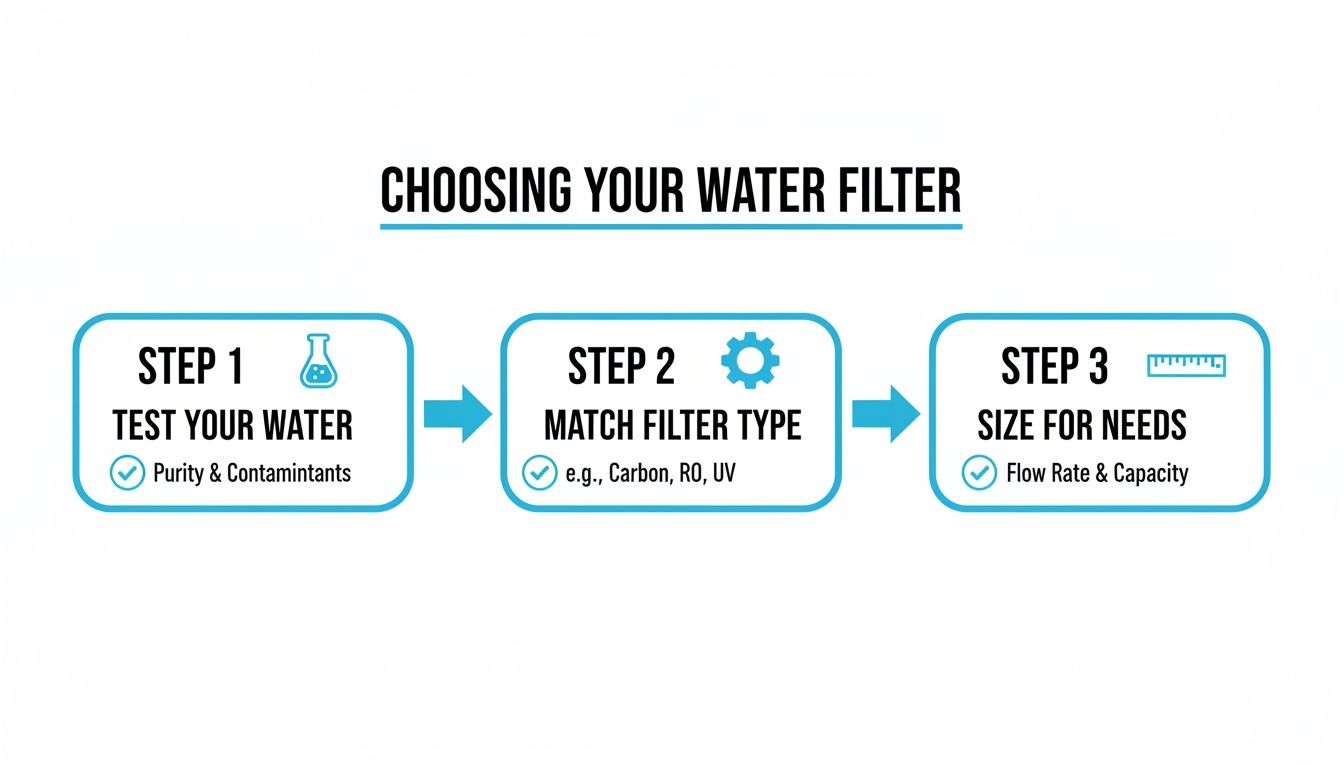
A step-by-step guide on choosing a water filter, covering testing, type matching, and sizing.

A successful project follows a clear path: test the water, match the filter to the problem, and size it correctly for your home.

Here’s how to bring it all together:

  1. Measure and Cut: Carefully measure the section of pipe you need to remove for the filter assembly, including your bypass valves. Double-check your measurement, take a deep breath, and make a clean, straight cut.
  2. Clean and Prepare: Use your deburring tool to smooth the cut edges. For copper pipe, use emery cloth to polish the ends until they shine. This prep work is essential for a watertight connection.
  3. Assemble and Connect: Install your shutoff valves and fittings onto the pipe ends. Whether you're using push-to-connect fittings or soldering copper, ensure every connection is solid. Pay close attention to the "in" and "out" arrows on the filter unit—installing it backward is a common mistake!
  4. Add Pressure Gauges: Here’s another pro tip. Install a pressure gauge before the filter and another one right after. This is your system’s dashboard. When the filter is new, both gauges will read about the same. As the filter clogs, the "after" gauge will show a pressure drop, visually telling you it's time for a filter change.

Once connected, turn the main water supply back on—just a crack at first. Listen for hissing and check every joint for drips. If it’s dry, open the valve fully. Turn on a faucet to bleed the air out of the lines. That’s it! You've just upgraded your entire home's water quality.

Keeping Your System Running Smoothly

Getting your new DIY whole house water filter system installed is a major achievement, but the job isn't quite finished. Think of it like a car—it needs regular tune-ups to perform at its best. Consistent, simple maintenance is the secret to ensuring your investment continues to pay dividends in clean, pure water for years to come.

If you just set it and forget it, filters will inevitably clog, performance will degrade, and you’ll eventually be right back where you started. A little proactive scheduling keeps everything running perfectly.

Creating a Realistic Maintenance Schedule

There’s no universal maintenance schedule; it depends on your specific water quality and the system you installed. For example, if your water is heavy with sediment, that pre-filter will clog much faster than it would with relatively clear city water.

As a starting point, here’s a general timeline you can adapt:

  • Sediment Pre-Filters (Every 3-6 Months): This will be your most frequent task. These filters are on the front lines, catching all the physical debris.
  • Carbon Block Filters (Every 6-12 Months): These workhorses remove chlorine and chemicals. They eventually become saturated and stop absorbing contaminants.
  • Large Carbon Media Tanks (Every 3-5+ Years): For large, backwashing carbon systems, you'll replace the media inside the tank itself. It's a less frequent but more involved job.

Keeping up with maintenance is getting easier. The water filter market, expected to grow from USD 16.78 billion in 2026 to USD 22.8 billion by 2030, is embracing smart technology. Many new systems feature app alerts that notify you when a filter change is due.

The benefits are clear—a good system can extend a water heater’s life by 30% by preventing scale buildup, a problem affecting 85% of US homes. For most homeowners, spending $100-$200 a year on filters is a small price compared to the $1,000+ they might spend on bottled water. You can read the full research about the water filters market for more details.

Listening to Your System: Signs of Trouble

Your system will give you clear signals when it needs attention. You just have to know what to look—and taste—for. Catching these clues early prevents small issues from becoming major problems.

A sudden, noticeable drop in water pressure is the #1 sign of a clogged filter. Those pressure gauges you installed are your best friend. If the "post-filter" gauge reads significantly lower than the "pre-filter" one, it's time to change that sediment filter.

Another dead giveaway is a decline in water quality. If that chlorine taste or musty smell returns, your carbon filter is exhausted and can no longer absorb contaminants. It's time for a replacement.

Troubleshooting Common Hiccups

Even with a perfect installation, you might encounter minor issues. Don't worry; most are simple fixes.

The Noisy Pipes Problem
A "water hammer" or vibrating noise when a faucet is shut off quickly is usually caused by air trapped in the lines post-installation. You can typically bleed it out by opening a few faucets on your top floor and in the basement simultaneously for a couple of minutes.

The Tiny Drip at a Fitting
Small, persistent drips at threaded fittings are more annoying than anything. To fix it:

  1. Shut off the water using your bypass loop.
  2. Open a nearby faucet to relieve pressure.
  3. Use two wrenches—one to hold the fitting steady and the other to give the nut a slight quarter-turn.
  4. Turn the water back on and check your work. Avoid over-tightening.

Filters That Clog Too Quickly
If you're replacing sediment filters in weeks instead of months, it could be due to city water main flushing or high sediment levels in a well. The solution might be switching to a pleated, washable sediment filter or adding a "spin-down" filter before your main cartridge to catch larger debris.

Common Questions About DIY Water Filtration

It's one thing to have a plan, but another to get ready to cut into your home's main water line. A DIY whole house water filter system is a significant project, and it’s normal to have questions. Let's tackle the most common ones so you can start with confidence.

How Much Does This Project Really Cost?

This is where the DIY approach truly shines. The total cost can vary, but you are almost guaranteed to save a substantial amount over hiring a professional.

The system itself is the biggest expense, ranging from $300 for a simple sediment and carbon filter combo to over $1,500 for multi-stage systems with a water softener or UV lamp.

Budget another $50 to $200 for plumbing supplies like pipes, fittings, and valves for your bypass loop. Ongoing costs for replacement filters might be $75-$150 per year. Compare that to the $500 to $1,000 in labor alone that a plumber might charge, and the savings are crystal clear.

Will a Whole House Filter Kill My Water Pressure?

This is the number one fear, but a correctly sized system will have a virtually unnoticeable effect on your water pressure. The key is matching the system's Gallons Per Minute (GPM) rating to your home's peak water demand.

A classic rookie mistake is choosing a filter with ¾-inch ports instead of 1-inch ports to save a few dollars. That smaller diameter is a guaranteed bottleneck that will choke your flow. Always invest in 1-inch ports to keep your showers powerful.

If you notice a pressure drop over time, it’s almost always a clogged sediment filter—proof the system is doing its job and a friendly reminder that it's time for a filter change.

Do I Need a Plumber or Can I Really Do This Myself?

If you have basic plumbing skills, this is a very achievable DIY project. If you've ever installed a faucet or repaired a leaky pipe, you likely have the necessary skills. Modern push-to-connect fittings have made this job even more accessible by eliminating the need for soldering copper pipes.

However, it's always wise to check with your local municipality. Some building codes require a licensed plumber for any work on a home's main water supply. A quick call can prevent a major headache later.

What Is the Difference Between a Filter and a Softener?

This is a crucial distinction. The easiest way to think about it is that filters remove things, while softeners exchange things.

  • A water filter is designed to trap or absorb contaminants. Media like activated carbon or sediment cartridges grab things like chlorine, pesticides, rust, and lead.
  • A water softener has one specific job: to target "hardness minerals" like calcium and magnesium. It uses ion exchange to swap those mineral ions for sodium ions, preventing scale buildup in your pipes and appliances.

For many homes, especially those with hard water, the best solution is to have both. They work perfectly as a team—the filter cleans the water, and the softener protects your plumbing.


At Water Filter Advisor, we're dedicated to helping you make sense of your home's water quality. From in-depth buying guides to practical maintenance tips, we provide the clear, research-backed information you need. Start your journey to better water today by exploring our resources at https://www.waterfilteradvisor.com.
How to Install a Whole House Water Filter: Your Ultimate DIY Guide

Ready to declare independence from funky-tasting water? Installing a whole-house water filter is one of the most satisfying DIY projects you can tackle. It's your ticket to pure, clean water from every single tap in your home. Before you touch a single pipe, though, a little prep work is the secret sauce. The key to a smooth installation lies in three crucial upfront steps: testing your water to figure out what microscopic villains you're fighting, finding the main water shut-off valve and a good spot for the unit, and measuring your pipes to get the right parts.

Getting these details sorted out first is the difference between a triumphant weekend project and an unscheduled, frantic trip to the hardware store—or worse, a call to a very expensive plumber.

Your Blueprint for Water Filtration Glory

Seriously, don't even think about cutting a pipe until you've got a solid plan. Think of this as your mission briefing—it's where you figure out exactly what you're dealing with. I’ve seen too many DIY projects go sideways because someone rushed this part. A bit of reconnaissance now saves you from a world of plumbing pain later.

This is all about understanding your home's unique plumbing personality. Every house is a little different, and your water quality isn't the same as your neighbor's. The goal here is simple: match the right filtration superhero to your water's specific problems and make sure you've got a clear, accessible path for the installation.

Know Your Water Before You Start

You wouldn't take medicine without knowing what you're treating, right? The same logic applies to water filtration. A simple water test is your non-negotiable first step. It's like a spy report that tells you exactly what’s hiding in your water, whether that's an over-chlorinated taste from the city, sediment from old pipes, or too much iron from your well.

Without that data, you’re just flying blind. A test kit can tell you if your Total Dissolved Solids (TDS) are over the recommended 500 parts per million (ppm), which is a big clue you'll need a more robust, multi-stage filter. You have to know your enemy to win the battle. If you need some help choosing a filter based on your water quality, we've got some great https://www.waterfilteradvisor.com/advice/ to get you started.

Scout the Perfect Installation Location

Next up, it’s time to play detective in your own basement or garage. Your mission: find the perfect spot for your new filtration command center. The ideal location is almost always on the main water line, immediately after your main shut-off valve but before your water heater. Placing it here guarantees that every drop of water in your house—hot, cold, and in-between—gets the full purification treatment.

Look for a spot with enough room not only to hang the unit but also to make changing filters a breeze later on. Most models will need at least a foot of clearance below them for easy cartridge swaps.

Pro Tip: While you’re scouting, snap a few photos of your plumbing with your phone. They’ll be a lifesaver when you’re at the hardware store trying to remember if you need a 90-degree elbow or a straight union.

Measure Twice, Cut Once

Last but not least, let's get specific. You absolutely must know your pipe size. In the U.S., most homes run on either 3/4-inch or 1-inch main water lines. Grab a tape measure or a pair of calipers to get an exact measurement. This ensures you buy a filter and fittings that are a perfect match. Getting this wrong means another trip to the store with your project sitting half-finished and your plumbing in pieces.

Before you start the install, it's worth reminding yourself why you're doing this. Understanding the benefits of installing a home water filtration system can really reinforce your decision and keep you motivated through the process.

Making the Cut: The Core Installation Process

Alright, this is where the action begins. All that planning and prep work is about to pay off. You’ve scoped out the perfect spot, your tools are laid out, and it’s time to get your hands dirty. We're about to dive into the heart of the project: cutting into your home's main water line to tie in the new filtration system. It sounds a little nerve-wracking, I know, but if you take it step-by-step, it's a completely manageable job.

The whole game here is about being methodical and precise. We'll walk through shutting off the water, making clean cuts, and creating solid, leak-proof connections that will guard your home's water supply for years to come. This is the moment you transform that box of parts into a powerful protector for every faucet in your house.

Before we grab any tools, let's visualize the first few moves that set you up for success.

A clear process flow diagram outlining three steps for filter preparation: Test Water, Locate Valve, and Measure Pipe.

Nailing these three fundamentals—testing the water, finding the valve, and measuring your pipe—is the foundation for a smooth installation. It's how you avoid those "oops" moments and costly mistakes down the line.

Shutting Down the Flow

First thing's first: you have to shut off the main water supply to your house. Don't even think about skipping this. Find your main shut-off valve, which is usually tucked away in the basement, garage, or near the water meter. A lever-style valve is off when the handle is perpendicular to the pipe. If you have an older gate-style valve, turn it clockwise until it gently stops.

With the main off, you need to drain the water still sitting in your pipes. The best way to do this is to open the highest faucet in your house (like an upstairs bathroom) and the lowest one (maybe a basement utility sink). This breaks the vacuum and lets gravity work its magic. You might be surprised how much water comes out—often 5-10 gallons—so just let it run until it slows to a drip.

Making a Clean and Precise Cut

Now that the lines are drained, it's time to make your mark. Grab the measurements you took earlier and mark the section of pipe where the filter assembly will live. Don't forget to account for the width of the filter housing plus the fittings and unions you'll need on each side.

Your goal is a perfectly square, clean cut. A smooth, burr-free edge is absolutely critical for getting a watertight seal, especially if you're using modern push-to-connect fittings.

  • For Copper Pipe: A tube cutter is your best friend. It clamps on, and you just rotate it, tightening the knob a little with each turn until it pops right through.
  • For PEX or PVC Pipe: A ratcheting pipe cutter is the tool of choice. It works like a heavy-duty pair of scissors and gives you a quick, straight cut without much fuss.

Once the cut is made, take a minute to clean up the edges. Use a deburring tool or even a small file to smooth out the inside and outside of the pipe. This little step is a pro move; it prevents you from tearing the delicate O-rings inside your fittings.

Mounting the Filter Housing Securely

With a section of pipe removed, you can now mount the filter housing. Position the mounting bracket against the wall or joist and use a level to get it perfectly straight. A crooked filter doesn't just look sloppy; it can put unnecessary stress on your plumbing connections over time, begging for a leak.

Drill your pilot holes and sink the screws to get the bracket good and firm. Then, attach the filter housing to the bracket. One of the most common rookie mistakes is not leaving enough room underneath the filter. You need space to unscrew the sump to change the cartridge, so make sure you have at least a foot of clearance.

Insider Tip: Before you drill a single hole, do a "dry fit." Hold the entire filter assembly up to the pipes to see how everything lines up. This simple check confirms your measurements are spot-on and can save you from the headache of patching and drilling a new set of holes.

Creating Leak-Proof Connections

This is the moment of truth. Every connection has to be perfect. For most DIYers, push-to-connect fittings (like the popular SharkBite brand) are a game-changer because they don't require any soldering. You just push the clean, deburred pipe into the fitting until you feel it click. It creates a strong, reliable seal in seconds.

If you have the skills and tools, soldering copper is a fantastic, permanent solution. It just requires a torch, flux, and a bit of practice to get a clean joint. If you're tackling a bigger plumbing project, checking out some DIY bathroom installation tips can give you some transferable skills and a confidence boost.

No matter which method you choose, always use Teflon tape on any threaded fittings. Wrap the tape clockwise—the same direction you'll be tightening—about 3-4 times. This fills any microscopic gaps in the threads and helps you get a tight, leak-free seal.

A skilled DIYer can save a lot on professional fees here. With the main shut-off located, which is the case in about 85% of U.S. homes, the process is pretty straightforward. Installing the filter and bypass, taping the threads, and torquing the fittings to the recommended 50-60 ft-lbs can usually be knocked out in under two hours.

Bringing Your System Online: Flushing and Leak Testing

You’ve tightened the last fitting and the filter is mounted. Looks good, right? While the heavy lifting is done, you can’t just turn the water back on and call it a day. This final phase—commissioning the system—is where a good installation becomes a great one. It’s the difference between a reliable, leak-free setup and a future plumbing disaster.

We're about to bring your new filter to life. This means carefully reintroducing water to avoid any nasty shocks to your plumbing, flushing the new filter media to get it ready for action, and doing a meticulous leak check on every single connection you made. Let's get it done right.

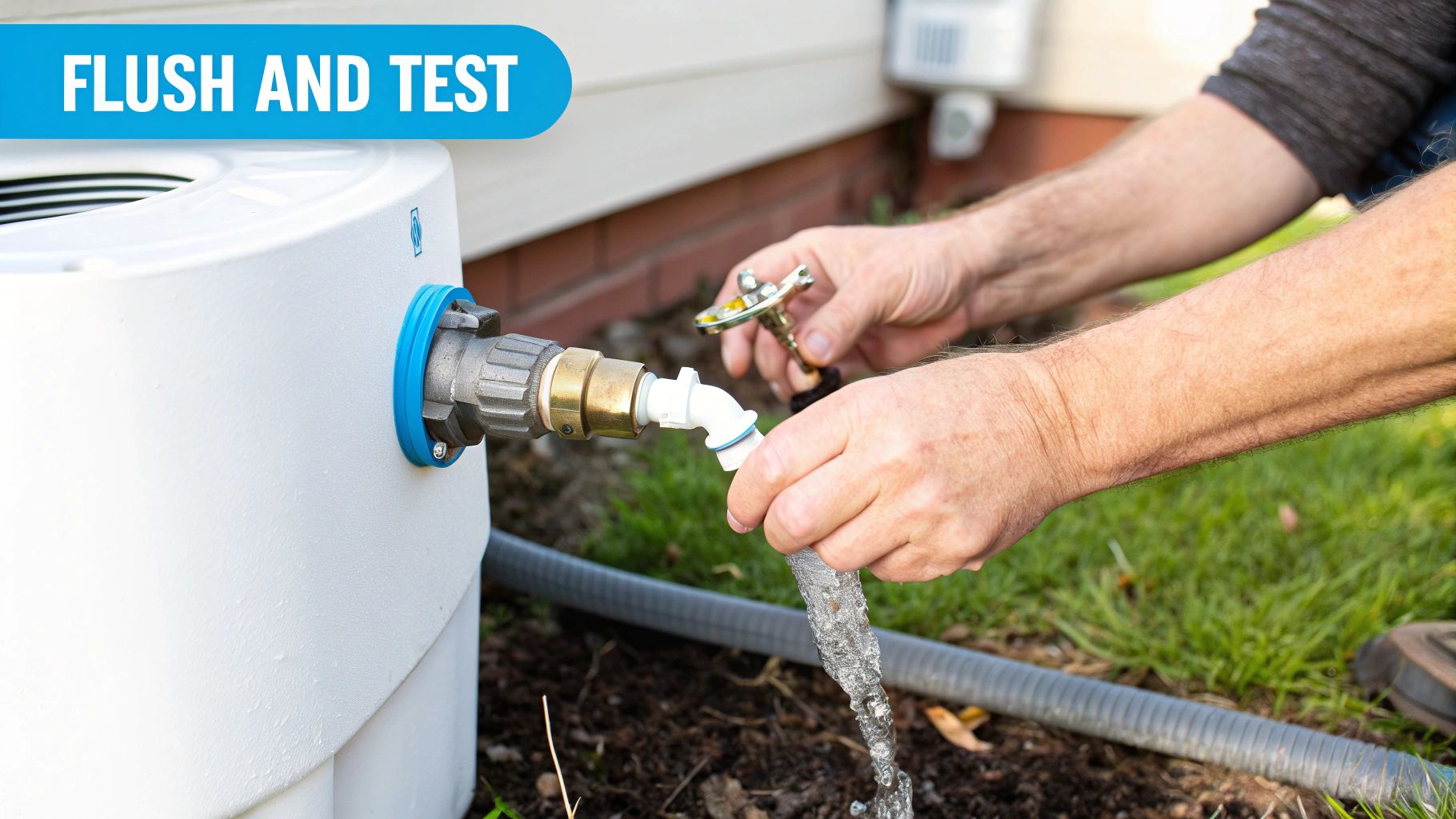
A person flushes water from an outdoor whole-house water filter unit into the grass.

Gently Reintroducing Water to Your System

Right now, your home's plumbing is full of air. If you just crank open the main valve, you’ll unleash a violent surge of water called a water hammer. It's that loud, banging noise that can shake pipes loose, damage joints, and even wreck your appliances. It’s a classic rookie mistake, and it’s completely avoidable.

The trick is to re-pressurize the system slowly and gently.

  1. Start in Bypass Mode: First thing's first, make sure your new filter is in the "bypass" position. This lets water flow through the original plumbing, temporarily skipping the new filter.
  2. Crack the Main Valve: Head back to your main shut-off valve. Don't open it all the way. Just give it a quarter turn—that's it. You'll hear the water start to hiss and trickle in.
  3. Listen and Wait: You’ll hear a lot of sputtering and gurgling as air gets pushed out of the open faucets you left on earlier. Just let it happen. Once the sounds die down, you can slowly open the main valve the rest of the way.

This simple, gradual process lets the air escape gently, protecting your entire plumbing system from a damaging shockwave.

The All-Important Flushing Process

Okay, water is back in the main lines. Now it’s time to activate the filter itself. The goal here is to wash out any leftover dust from manufacturing, especially the carbon "fines" you find in new filters. They're harmless, but you definitely don't want that gritty black stuff in your first glass of water.

Close the bypass valve and slowly open the inlet valve to the filter. You’ll hear the housing fill up. Once it’s full, open the outlet valve. Now, go to an outdoor spigot or a big utility sink and turn on the cold water full blast.

Let it run for a good 10-15 minutes. Don't be alarmed if the water comes out cloudy or even black at first—that's the carbon dust washing out, and it's totally normal. You're just cleaning the pipes, so to speak. Keep it running until the water is crystal clear.

A proper installation sequence is crucial. Generally, this involves shutting off the main, draining the system for a few minutes, making square cuts to avoid leak risks, and using 3-4 wraps of PTFE tape on threads. When reconnecting, opening the valve slowly is key. After that, flushing about 10-20 gallons clears the media dust and ensures your pressure drop stays under a manageable 10 PSI.

The Final Leak Inspection

This is the moment of truth. With the system under full pressure and the filter running, you have to inspect every single joint for leaks. Be patient and meticulous here. Even a tiny, slow drip can cause thousands in water damage down the road.

Your two best friends for this job are a bright flashlight and a dry paper towel.

  • Visual Check: Get your flashlight and look closely at every connection you made—unions, threaded fittings, push-to-connects, all of it. Shine the light from different angles to catch the glint of any moisture.
  • The Paper Towel Trick: This is a classic plumber's move for a reason. Take a bone-dry paper towel and wipe it firmly around the bottom of every single joint. Even a pinhole leak that your eyes might miss will show up instantly on the paper.

Check everything right after you turn the water on, and then circle back an hour later to check again. Some sneaky leaks take a little while to show themselves. If you find a drip, don't sweat it. Just shut the water off, drain the pressure, and re-tighten or re-tape the fitting. A completely dry system is the signature of a job well done.

Keeping Your Water Pure with Long-Term Filter Maintenance

You did it. The whole-house water filter is installed, and clean, fresh water is flowing through every pipe in your home. It’s a great feeling, but the job isn't completely done. Think of it like owning a new car—a little routine maintenance is all it takes to keep it running perfectly. This is all about getting into a simple rhythm of care to protect your investment and keep that water quality sky-high.

The best part? Keeping your system in top shape is a whole lot easier than the installation was. It really just boils down to changing filters on time, a quick clean now and then, and keeping half an eye on your water pressure.

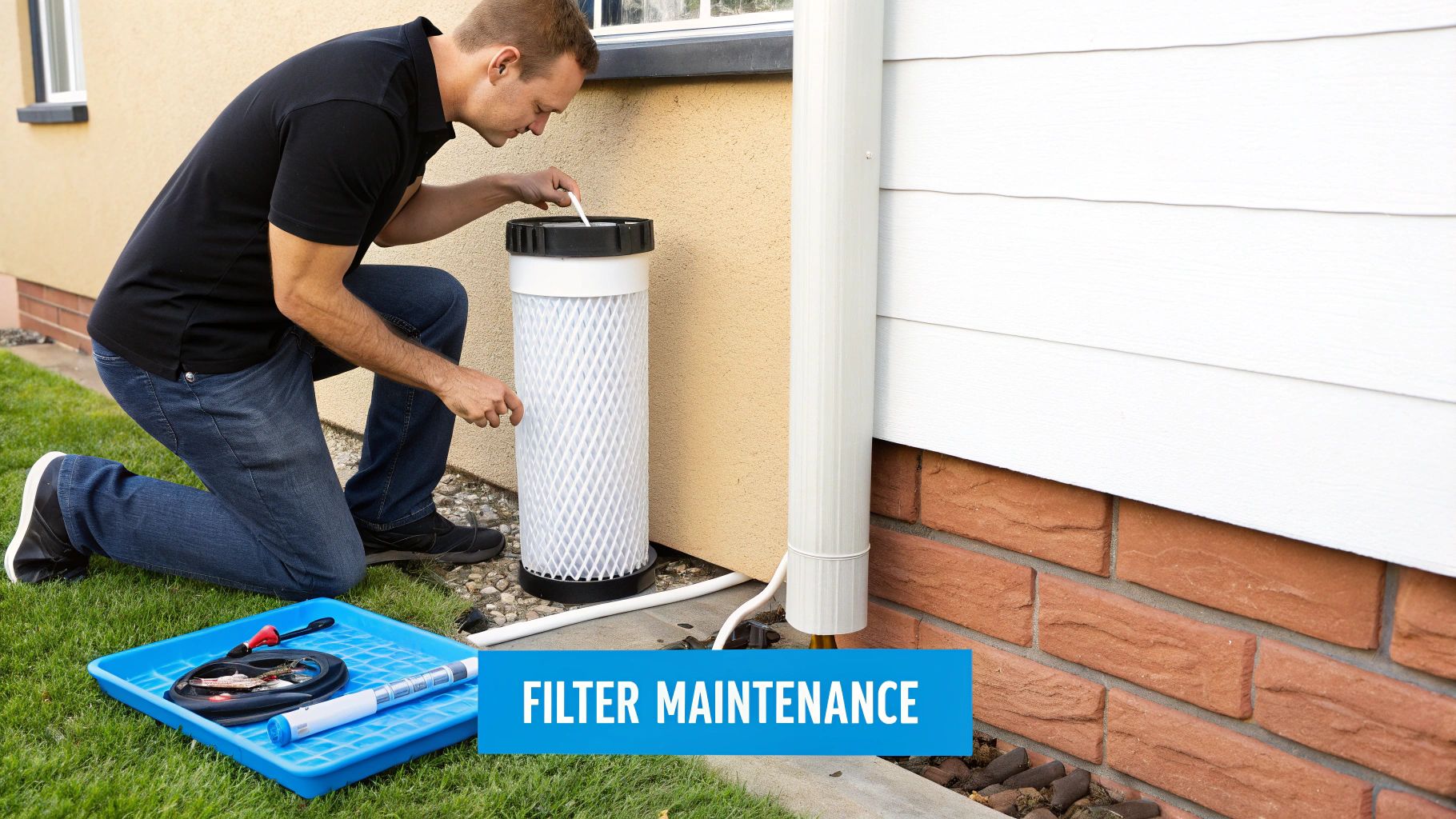
A man kneels on the grass, performing maintenance on an outdoor whole house water filter, with tools in a blue tray.

Establishing Your Filter Replacement Schedule

Not all filters are created equal, and they definitely don’t last the same amount of time. The manufacturer’s guide is your starting point, but your real-world replacement schedule will be dictated by your local water quality and how much you use. For instance, a house on well water with a lot of sediment is going to clog pre-filters way faster than a home on a clean city supply.

Here’s a general idea of what to expect for the most common filter types in a multi-stage system:

  • Sediment Pre-Filters: These are the unsung heroes catching all the big stuff like dirt, sand, and rust flakes. They’re the bodyguards for your more expensive filters. Plan to check and swap these out every 3 to 6 months.
  • Carbon Block Filters: This is your heavy hitter for stripping out chlorine, weird tastes, bad smells, and other chemicals. They typically last 6 to 12 months, though high chlorine levels can wear them out sooner.
  • Specialty Media (e.g., KDF, Calcite): Filters made for specific problems like heavy metals or acidic water often have much longer lifespans, sometimes lasting for years. You’ll definitely want to consult the manual for these.

I recommend keeping a simple log. Just grab a marker and write the date you changed the filter right on the housing, along with the date it’s next due. It takes two seconds and completely removes the guesswork.

The Filter Change Process: A Quick Guide

Changing a filter cartridge is a straightforward job that you’ll master after the first go. It's a quick and clean mission if you follow the right steps.

  1. Hit the Bypass: The first thing you'll do is switch the system into bypass mode. This isolates the filter unit so you can work on it without cutting the water off to your entire house.
  2. Let Off the Pressure: Find the red pressure-relief button, usually right on top of the housing, and give it a press. You’ll hear a quick hiss of air. Make sure you have a bucket underneath to catch the inevitable drips.
  3. Unscrew and Swap: Grab the filter wrench that came with your kit and use it to unscrew the main canister (the sump). Pull out the old, gunked-up filter, give the inside of the housing a quick rinse with some soap and water, and slide the new one in.
  4. Put It Back Together: Screw the sump back on, tightening it by hand until it’s good and snug. Give it a final quarter-turn with the wrench—but don't go crazy and overtighten. Slowly take the system out of bypass and hit that pressure-relief button one more time to bleed out any trapped air.

Crucial Maintenance Step: While you have the housing open, take a second to inspect and clean the O-ring. A little dab of food-grade silicone grease keeps it from drying out and ensures you get a perfect, leak-free seal every single time.

Monitoring Your Water Pressure

Forget the calendar for a second. Your home’s water pressure is the best real-time indicator of your filter's health. You should have pressure gauges on both the inlet and outlet sides of the filter. When a filter is fresh and clean, those two readings should be almost identical.

As the filter does its job and gets clogged with contaminants, the outlet pressure will start to dip. Once you see a pressure difference of 10-15 PSI between the inlet and outlet gauges, that’s your system screaming for a new filter, even if it's not "due" yet. It’s a clear sign the filter has done its duty and is ready for retirement. Paying attention to this one metric is the secret to proactive, smart maintenance.

Solving Common Installation Problems

Even the most carefully planned DIY project can throw you a curveball. You've followed every step, tightened every fitting, and suddenly your water pressure has vanished or you spot a stubborn little drip that just won't quit.

Don't panic. Most issues that pop up during a whole-house water filter installation are pretty common and, thankfully, have simple fixes. Think of this as your troubleshooting guide for those head-scratching moments. We’ll walk through the most frequent snags so you can get back on track without making a panicked call to a plumber.

Diagnosing a Sudden Drop in Water Pressure

You’ve turned the water back on, but the flow from your faucets is just a trickle. A big drop in pressure is one of the most common post-installation complaints, but it's rarely a sign of a serious problem. Before you start questioning your handiwork, let's run through the usual suspects.

Often, the issue is just an airlock trapped somewhere in your plumbing. This happens when air gets compressed in the pipes and blocks the flow of water. Another possibility is that the filter cartridge was installed incorrectly, or maybe a valve somewhere isn't fully open.

Here’s how to systematically hunt down the cause:

  • Check All Your Valves: Go back and physically double-check that your main shut-off valve, plus the inlet and outlet valves on your filter, are 100% open. It sounds almost too simple, but you'd be surprised how often a partially closed valve is the culprit.
  • Purge the Airlock: Go to the highest faucet in your house (usually a shower on the top floor) and open the hot and cold taps all the way. Next, open the lowest faucet (like a basement sink or outdoor spigot). Let them run for a few minutes; this will push all that trapped air out of the system.
  • Inspect the Filter Cartridge: If the pressure is still low, switch the system into bypass mode and carefully remove the filter cartridge. If your water pressure immediately returns to normal, the issue is with the filter itself. Make sure it's the correct model for your housing and that it's seated properly.

Fixing That Annoying Slow Drip

There is nothing more frustrating than seeing a tiny, perfect droplet of water forming on a brand-new connection. A leak, no matter how small, is a clear sign that a seal isn't quite right. The good news is the fix is usually quick. The most common reasons for a slow drip are an improperly sealed threaded fitting or a compromised O-ring.

Pro Tip: Never, ever overtighten a fitting to stop a leak. This is a classic rookie mistake that can crack the plastic housing or strip the threads, turning a tiny problem into a big, expensive one. The real solution is almost always to take it apart, re-seal it, and tighten it correctly.

If you spot a leak, shut off the water and open a faucet to relieve the pressure. Disconnect the leaking fitting and take a close look at the threads. Did you use enough Teflon tape? A good rule of thumb is 3-4 wraps in a clockwise direction (the same direction you tighten the fitting). If it's a connection with an O-ring, check that the ring isn't twisted, pinched, or dirty. A tiny piece of grit is all it takes to break the seal.

Silencing Noisy or Vibrating Pipes

After the installation, you might hear a new humming, rattling, or thumping sound when water is running. This is often caused by something called water hammer—a pressure surge that happens when flowing water suddenly stops or changes direction. Your new filter system can sometimes make this more noticeable, but it's easily managed.

First, make sure the filter housing is mounted securely to a solid surface like a wall stud or floor joist. A loose bracket will vibrate and amplify any noise in the pipes. If the sound continues, you might need to install a water hammer arrestor. These are small, inexpensive devices that absorb the shockwave and quiet your pipes right down. They’re easy to install and simply screw into a nearby faucet line, like the one for your washing machine.

Quick Troubleshooting Guide

When a problem pops up, it’s easy to get flustered. This little cheat sheet covers the most common issues at a glance to help you quickly identify the cause and get things flowing smoothly again.

Symptom Likely Cause Solution
Low Water Pressure Airlock in pipes; partially closed valve; clogged or incorrect filter. Purge air from the system; double-check all valves are fully open; verify and reseat the filter cartridge.
Slow Drip or Leak Improperly sealed threads; damaged or dirty O-ring. Shut off water, re-apply Teflon tape (3-4 wraps), clean and reseat O-ring. Do not overtighten.
Vibrating/Noisy Pipes Loose filter mounting bracket; "water hammer" effect. Securely tighten all mounting hardware; install a water hammer arrestor on a nearby appliance line.
Cloudy or Discolored Water Air bubbles in the water; sediment flushed from pipes. This is normal at first. Run faucets for 5-10 minutes until the water runs clear.
No Water Flow at All Main shut-off valve is still closed; system is in bypass mode. Fully open the main water supply valve; ensure the bypass valve is in the "service" or "filter" position.

Remember, most installation hiccups are minor and can be fixed with a bit of patience and a methodical approach. Don't be afraid to retrace your steps

Your Top DIY Installation Questions Answered

Even with the best guide in hand, it’s completely normal to have a few questions before you start cutting into your plumbing. This is a big project, after all. Let’s tackle some of the most common things people ask before they jump in.

How Much Does a DIY Installation Typically Cost?

This is usually the first question on everyone's mind. The honest answer? It depends on your specific system and plumbing setup. While getting a pro to do the job can set you back anywhere from $500 to over $2,000 just for labor, going the DIY route saves you a massive chunk of that.

Your main expenses will be the filter unit itself and the plumbing parts to connect it. A typical shopping list might look like this:

  • Fittings: Easy-to-use push-to-connect fittings will run you $10-$20 a piece. If you're comfortable with traditional copper or PEX, the fittings are cheaper, but the tool requirements go up.
  • Pipe: You might need a few extra feet of pipe, but this is usually a minor expense, often under $30.
  • Tools: If you’re starting from scratch, you'll need to grab a good pipe cutter and a deburring tool, which could cost $20-$50.

When all is said and done, a DIY install can easily save you 70% or more compared to hiring a plumber. That's a huge win for your wallet.

How Long Does a Typical Installation Take?

Time is money, right? For someone doing this for the first time—but who has read the instructions and has everything laid out—plan for about four to six hours. That gives you enough time to drain the system properly, make careful cuts, get the unit mounted securely, and double-check for leaks without rushing.

If you’ve done this kind of plumbing work before, you could probably get it done in two to three hours. The biggest things that affect the timeline are how easy it is to get to your main water line and what kind of pipes you have. Soldering copper always takes more time than using modern push-fit connectors.

My Advice: Whatever you estimate, add a couple of hours. Nothing good comes from rushing a plumbing project. Block out a Saturday morning so you're not trying to wrap things up when you're tired and it's getting dark.

When Should I Call a Professional Plumber?

Knowing when to tag in a pro is the sign of a smart DIYer, not a failure. This project is totally doable for most, but there are definitely times when it’s best to pick up the phone.

Think about hiring a plumber if you run into any of these situations:

  • You’re dealing with old, corroded, or galvanized pipes that look like they might crumble if you breathe on them too hard.
  • Your main shut-off valve is frozen solid or just won't close all the way.
  • The job requires a complicated rerouting of your pipes, or you have to solder in a super tight and awkward spot.
  • You’re just plain not comfortable with the idea of cutting into your home's main water supply—and that's perfectly okay!

There is absolutely no shame in calling for backup. That peace of mind from a professionally installed, guaranteed-not-to-leak system is often worth every penny.


At Water Filter Advisor, our goal is to help you get cleaner, safer water in your home. From picking out the perfect system to giving you the confidence to install it yourself, we've got your back. Check out all our guides and reviews at https://www.waterfilteradvisor.com.
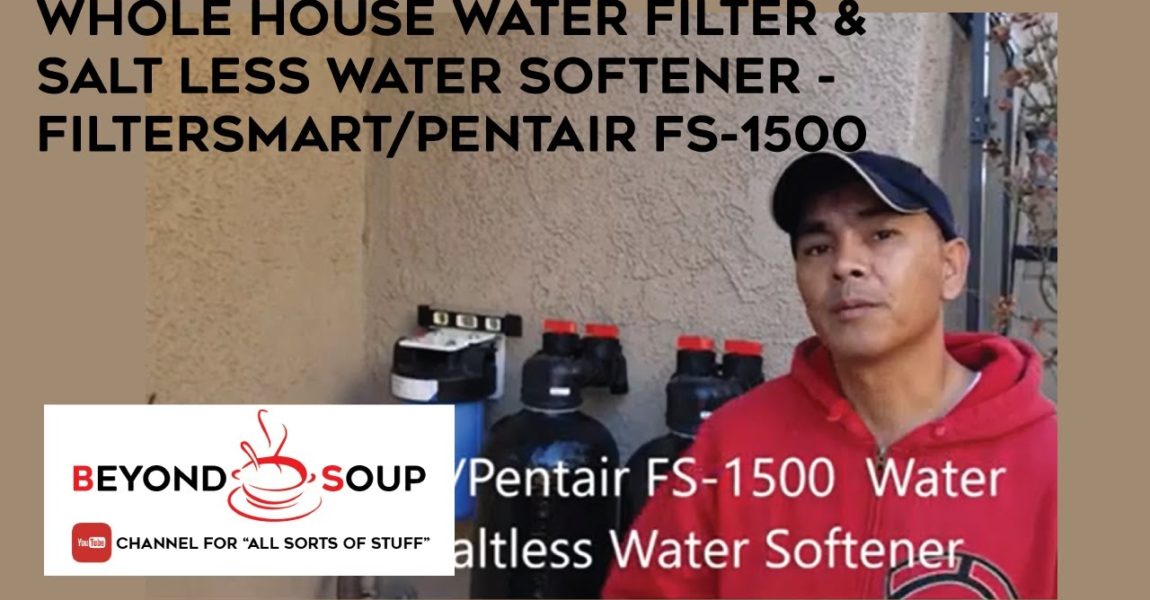
FilterSmart/Pentair Whole House Water Filter & Salt-less Water Softener DIY Installation

FilterSmart/Pentair Whole House Water Filter & Salt-less Water Softener DIY Installation


FilterSmart/Pentair Whole House Water Filter & Salt-less Water Softener

Rated for 1-3 Bathrooms
1,000,000 gallons or 5 Years
Prefilter cartridge change every 8-10 months

DISCLAIMER: The information on my videos and channel is for general information and viewing purposes ONLY. All information is provided in good faith. I make no representation or warranty of any kind, express or implied, regarding the accuracy, adequacy, validity, reliability, availability or completeness of any information on the video. Any errors shown or mentioned are not intentional in any way.
Under no circumstance shall I have any liability to the viewer for any loss or damage of any kind incurred as a result of the use of the video/channel or reliance on any information provided. Use and your reliance on any information is solely at your own risk.

Original Video Source